







 Chat with AI


Business Ethics Now 3rd Edition by Andrew Ghillyer
Edition 3ISBN: 978-0073524696Business Ethics Now 3rd Edition by Andrew Ghillyer
Edition 3ISBN: 978-0073524696 Exercise 38
Thirty years after its production, the Ford Pinto is still remembered as a dangerous firetrap.
In the late 1960s, the baby boom generation was starting to attend college. With increasing affluence in America, demand for affordable transportation increased, and foreign carmakers captured the market with models like the Volkswagen Beetle and Toyota Corolla. Ford needed a competitive vehicle, and Lee Iacocca authorized production of the Pinto. It was to be small and inexpensive- under 2,000 pounds and under $2,000. The production schedule had it in dealers' lots in the 1971 model year, which meant that it went from planning to production in under two years. At the time, it was typical to make a prototype vehicle first and then gear up production. In this case, Ford built the machines that created the shell of the vehicle at the same time as it was designing the first model. This concurrent development shortened production time but made modifications harder.
The compact design called for a so-called saddlebag gas tank, which straddled the rear axle. In tests, rear impacts over 30 mph sometimes caused the tank to rupture in such a way that it sprayed gas particles into the passenger compartment, somewhat like an aerosol. Canadian regulations demanded a greater safety factor, and models for export were modified with an extra buffer layer. However, the Pinto met all U.S. federal standards at the time it was made.
Ford actively campaigned against stricter safety standards throughout the production of the Pinto. The government actively embraced cost-benefit analysis, and Ford's argument against further regulations hinged on the purported benefits. Under pressure, the National Highway Traffic Safety Administration came up with a figure that put a value of just over $200,000 on a human life. Using this figure, and projecting some 180 burn deaths a year, Ford argued that retrofitting the Pinto would be overly problematic.
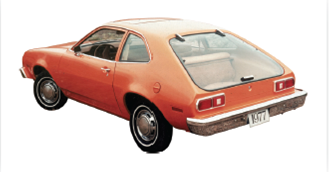
At one point, over 2 million Pintos were on the road, so it is not surprising that they were involved in a number of crashes. However, data began to indicate that some kinds of crashes, particularly rear-end and rollover crashes, were more likely to produce fires in the Pinto than in comparable vehicles. A dramatic article in Mother Jones drew on internal Ford memos to show that the company was aware of the safety issue and indicted the company for selling cars "in which it knew hundreds of people would needlessly burn to death." It also claimed that installing a barrier between the tank and the passenger compartment was an inexpensive fix (less than $20). In 1978, in an almost unprecedented case in Goshen, Indiana, the state charged the company itself with the criminal reckless homicide of three young women. The company was acquitted, largely because the judge confined the evidence to the particular facts-the car was stalled and rammed at high speed by a pickup truck-but Ford was faced with hundreds of lawsuits and a severely tarnished reputation.
Under government pressure, and just before new standards were enacted, Ford recalled 1.5 million Pintos in 1978. The model was discontinued in 1980.
Lee Iacocca said that his company did not deliberately make an unsafe vehicle, that the proportion of deadly accidents was not unusually high for the model, and that the controversy was essentially a legal and public relations issue.
Once Pintos had a poor reputation, they were often sold at a discount. Do private sellers have the same obligations as Ford if they sell a car they know may have design defects Does the discount price absolve sellers from any responsibility for the product
Source: K. Gibson, Business Ethics: People, Profits, and the Planet (New York: McGraw-Hill, 2006), pp. 630-32.
In the late 1960s, the baby boom generation was starting to attend college. With increasing affluence in America, demand for affordable transportation increased, and foreign carmakers captured the market with models like the Volkswagen Beetle and Toyota Corolla. Ford needed a competitive vehicle, and Lee Iacocca authorized production of the Pinto. It was to be small and inexpensive- under 2,000 pounds and under $2,000. The production schedule had it in dealers' lots in the 1971 model year, which meant that it went from planning to production in under two years. At the time, it was typical to make a prototype vehicle first and then gear up production. In this case, Ford built the machines that created the shell of the vehicle at the same time as it was designing the first model. This concurrent development shortened production time but made modifications harder.
The compact design called for a so-called saddlebag gas tank, which straddled the rear axle. In tests, rear impacts over 30 mph sometimes caused the tank to rupture in such a way that it sprayed gas particles into the passenger compartment, somewhat like an aerosol. Canadian regulations demanded a greater safety factor, and models for export were modified with an extra buffer layer. However, the Pinto met all U.S. federal standards at the time it was made.
Ford actively campaigned against stricter safety standards throughout the production of the Pinto. The government actively embraced cost-benefit analysis, and Ford's argument against further regulations hinged on the purported benefits. Under pressure, the National Highway Traffic Safety Administration came up with a figure that put a value of just over $200,000 on a human life. Using this figure, and projecting some 180 burn deaths a year, Ford argued that retrofitting the Pinto would be overly problematic.
At one point, over 2 million Pintos were on the road, so it is not surprising that they were involved in a number of crashes. However, data began to indicate that some kinds of crashes, particularly rear-end and rollover crashes, were more likely to produce fires in the Pinto than in comparable vehicles. A dramatic article in Mother Jones drew on internal Ford memos to show that the company was aware of the safety issue and indicted the company for selling cars "in which it knew hundreds of people would needlessly burn to death." It also claimed that installing a barrier between the tank and the passenger compartment was an inexpensive fix (less than $20). In 1978, in an almost unprecedented case in Goshen, Indiana, the state charged the company itself with the criminal reckless homicide of three young women. The company was acquitted, largely because the judge confined the evidence to the particular facts-the car was stalled and rammed at high speed by a pickup truck-but Ford was faced with hundreds of lawsuits and a severely tarnished reputation.
Under government pressure, and just before new standards were enacted, Ford recalled 1.5 million Pintos in 1978. The model was discontinued in 1980.
Lee Iacocca said that his company did not deliberately make an unsafe vehicle, that the proportion of deadly accidents was not unusually high for the model, and that the controversy was essentially a legal and public relations issue.
Once Pintos had a poor reputation, they were often sold at a discount. Do private sellers have the same obligations as Ford if they sell a car they know may have design defects Does the discount price absolve sellers from any responsibility for the product
Source: K. Gibson, Business Ethics: People, Profits, and the Planet (New York: McGraw-Hill, 2006), pp. 630-32.
Explanation Verified
Verified
Case summary:
Car FP of Company FR is re...

Business Ethics Now 3rd Edition by Andrew Ghillyer

Why don’t you like this exercise?
Other Minimum 8 character and maximum 255 character
Character 255






