







 Chat with AI


Consumer Behavior: Building Marketing Strategy 13th Edition by Delbert Hawkins, David Mothersbaugh
Edition 13ISBN: 978-1259232541Consumer Behavior: Building Marketing Strategy 13th Edition by Delbert Hawkins, David Mothersbaugh
Edition 13ISBN: 978-1259232541 Exercise 12
Situational Influences on Consumer Choice
Rational choice theory suggests that consumer choices and preferences should be independent of the context. As a simple example, it is assumed that consumers will evaluate a $5 discount the same way regardless of context. However, this is not the case. Consumers tend to perceive the value of the $5 discount as higher when it is on a product originally priced at $10 and lower on a product originally priced at $100. The reason goes back to Chapter 8 and relative preferences. Consumers appear to evaluate the $5 savings in the context of or relative to the original price of the product.
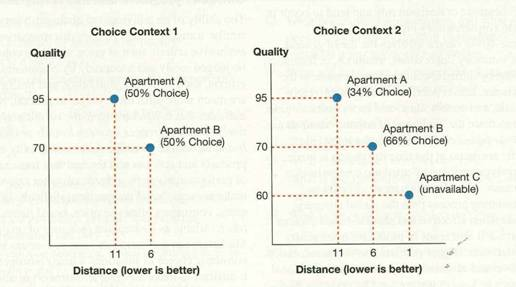
In a similar way, consumers are affected by the competitive context in which they make choices, or what we referred to in Chapter 13 as the purchase situation. There are numerous context effects on consumer choice. Here we discuss the compromise effect. 36 We begin with Choice Set 1 (left graph), in which there are two apartments (A and B) evaluated on two attributes (distance from campus in miles and quality on a 1-100 scale where 100 is the best). As the graph on the left shows, option A is farther from campus (a negative) but of higher quality (a positive), whereas option B is nearer to campus (a positive) but of lower quality (a negative). Choosing between these apartments involves a compensatory choice process in which distance and quality must be traded off against each other. As configured here, the apartments split the market equally. That is, 50 percent of the students chose option A (presumably weighting quality more heavily) and 50 percent chose option B (presumably weighting distance more heavily).
Now consider Choice Set 2 (right graph). In this context, there is a third apartment that consumers are aware of but that is not currently available. It is closer than A or B in terms of distance (a positive) but poorer than A or B in terms of quality (a negative). Rational choice theory assumes that if an option such as C is included, consumers should still prefer the brands the same way as they did previously. Particularly because option C is not even available, rational choice theory would suggest that options A and B would hold steady at 50 percent of the market each. However, this is not what happens. Instead, adding option C, even though not available for rent, increases B's share up to 66 percent!
This is called the compromise effect because adding option C made option B the compromise solution. It is a compromise between the two extremes of A (farthest away, best quality) and C (nearest, worst quality). Consumers prefer compromise options and find them easy to justify (a metagoal). The compromise effect seems strongest when the compromise brand is the more familiar brand in the set.
The compromise effect has important implications for marketers. Real estate agents who want to sell a particular property might first show their clients an unavailable property that makes their available property seem like the compromise option to increase the chances their client will purchase it. For retailers, because consumers often search and evaluate alternatives online and then go to a physical store to purchase the selected brand, an "online only" option (option C) could be created to make their in-store options seem like compromise options to increase their choice share.
Beyond being easy to justify, can you think of other reasons why consumers prefer compromise options
Rational choice theory suggests that consumer choices and preferences should be independent of the context. As a simple example, it is assumed that consumers will evaluate a $5 discount the same way regardless of context. However, this is not the case. Consumers tend to perceive the value of the $5 discount as higher when it is on a product originally priced at $10 and lower on a product originally priced at $100. The reason goes back to Chapter 8 and relative preferences. Consumers appear to evaluate the $5 savings in the context of or relative to the original price of the product.
In a similar way, consumers are affected by the competitive context in which they make choices, or what we referred to in Chapter 13 as the purchase situation. There are numerous context effects on consumer choice. Here we discuss the compromise effect. 36 We begin with Choice Set 1 (left graph), in which there are two apartments (A and B) evaluated on two attributes (distance from campus in miles and quality on a 1-100 scale where 100 is the best). As the graph on the left shows, option A is farther from campus (a negative) but of higher quality (a positive), whereas option B is nearer to campus (a positive) but of lower quality (a negative). Choosing between these apartments involves a compensatory choice process in which distance and quality must be traded off against each other. As configured here, the apartments split the market equally. That is, 50 percent of the students chose option A (presumably weighting quality more heavily) and 50 percent chose option B (presumably weighting distance more heavily).
Now consider Choice Set 2 (right graph). In this context, there is a third apartment that consumers are aware of but that is not currently available. It is closer than A or B in terms of distance (a positive) but poorer than A or B in terms of quality (a negative). Rational choice theory assumes that if an option such as C is included, consumers should still prefer the brands the same way as they did previously. Particularly because option C is not even available, rational choice theory would suggest that options A and B would hold steady at 50 percent of the market each. However, this is not what happens. Instead, adding option C, even though not available for rent, increases B's share up to 66 percent!
This is called the compromise effect because adding option C made option B the compromise solution. It is a compromise between the two extremes of A (farthest away, best quality) and C (nearest, worst quality). Consumers prefer compromise options and find them easy to justify (a metagoal). The compromise effect seems strongest when the compromise brand is the more familiar brand in the set.
The compromise effect has important implications for marketers. Real estate agents who want to sell a particular property might first show their clients an unavailable property that makes their available property seem like the compromise option to increase the chances their client will purchase it. For retailers, because consumers often search and evaluate alternatives online and then go to a physical store to purchase the selected brand, an "online only" option (option C) could be created to make their in-store options seem like compromise options to increase their choice share.
Beyond being easy to justify, can you think of other reasons why consumers prefer compromise options
Explanation Verified
Verified
Consumer choice refers to the taste and ...

Consumer Behavior: Building Marketing Strategy 13th Edition by Delbert Hawkins, David Mothersbaugh

Why don’t you like this exercise?
Other Minimum 8 character and maximum 255 character
Character 255






