







 Chat with AI


Essentials of Business Communication 10th Edition by Dana Loewy,Mary Ellen Guffey
Edition 10ISBN: 978-1305630567Essentials of Business Communication 10th Edition by Dana Loewy,Mary Ellen Guffey
Edition 10ISBN: 978-1305630567 Exercise 11
To minimize disappointment, Americans generally prefer to present negative messages indirectly. Other cultures may treat bad news differently, as illustrated in the following:
• In Germany business communicators occasionally use buffers but tend to present bad news directly.
• British writers tend to be straightforward with bad news, seeing no reason to soften its announcement.
• In Latin countries the question is not how to organize negative messages but whether to present them at all. It is considered disrespectful and impolite to report bad news to superiors. Therefore, reluctant employees may fail to report accurately any negative situations to their bosses.
• In Thailand the negativism represented by a refusal is completely alien; the word no does not exist. In many cultures negative news is offered with such subtlety or in such a positive light that it may be overlooked or misunderstood by literal-minded Americans.
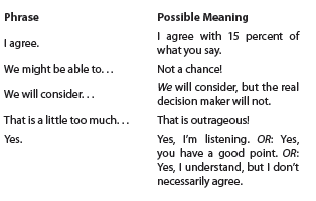
• In many Asian and some Latin cultures, one must look beyond an individual's actual words to understand what is really being communicated. One must consider the communication style, the culture, and especially the context. Consider the following phrases and their possible meanings:
Career Application. Interview fellow students or work colleagues who are from other cultures. Collect information by asking the following questions:
• How is negative news handled in your culture?
• How would typical business communicators refuse a request for a business favor (such as a contribution to a charity)?
• How would typical business communicators refuse a customer's claim?
• How would an individual be turned down for a job?
Your Task. Report the findings of your interviews in class discussion or in a memo report. In addition, collect samples of foreign business letters. You might ask foreign students, your campus admissions office, or local export/import companies whether they would be willing to share business letters from other countries. Compare letter styles, formats, tone, and writing strategies. How do these elements differ from those in typical North American business letters?
• In Germany business communicators occasionally use buffers but tend to present bad news directly.
• British writers tend to be straightforward with bad news, seeing no reason to soften its announcement.
• In Latin countries the question is not how to organize negative messages but whether to present them at all. It is considered disrespectful and impolite to report bad news to superiors. Therefore, reluctant employees may fail to report accurately any negative situations to their bosses.
• In Thailand the negativism represented by a refusal is completely alien; the word no does not exist. In many cultures negative news is offered with such subtlety or in such a positive light that it may be overlooked or misunderstood by literal-minded Americans.
• In many Asian and some Latin cultures, one must look beyond an individual's actual words to understand what is really being communicated. One must consider the communication style, the culture, and especially the context. Consider the following phrases and their possible meanings:
Career Application. Interview fellow students or work colleagues who are from other cultures. Collect information by asking the following questions:
• How is negative news handled in your culture?
• How would typical business communicators refuse a request for a business favor (such as a contribution to a charity)?
• How would typical business communicators refuse a customer's claim?
• How would an individual be turned down for a job?
Your Task. Report the findings of your interviews in class discussion or in a memo report. In addition, collect samples of foreign business letters. You might ask foreign students, your campus admissions office, or local export/import companies whether they would be willing to share business letters from other countries. Compare letter styles, formats, tone, and writing strategies. How do these elements differ from those in typical North American business letters?
Explanation


This question doesn’t have an expert verified answer yet, let Quizplus AI Copilot help.

Essentials of Business Communication 10th Edition by Dana Loewy,Mary Ellen Guffey

Why don’t you like this exercise?
Other Minimum 8 character and maximum 255 character
Character 255






