







 Chat with AI

Deck 11: Heat Engines and the Second Law of Thermodynamics
Full screen (f)

Question

Question
Question
Question
Question
Question
Question
Question
Question
Question
Question
Question
Question
Shown below are 4 figures that represent the heat flow in a heat engine. The thickness of the arrows represents the amount of heat flow. TH is the high-temperature reservoir, TC is the low-temperature reservoir, QH is heat to/from TH, QC is heat to/from TC, and W is work. Which figure best represents a real heat engine? 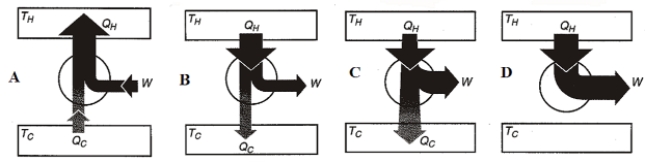
A) A
B) B
C) C
D) D
A) A
B) B
C) C
D) D
Question
Question
Question
Question
Question
Question
Question
Question
Question
Question
Question
Question
Question
Question
Question
Question
Question
Question
Question
Question
Question
Question
Question
Question
Question
Question
Question
Question
Question
Question
Question
Question
Question
Question
Question
Question
Question
Question
Question
Question
Question
Question
Question
Question

Unlock Deck
Sign up to unlock the cards in this deck!
Unlock Deck
Unlock Deck
1/57

Play

Full screen (f)
Deck 11: Heat Engines and the Second Law of Thermodynamics
1
A Carnot engine operating between reservoirs at 500 C and 300 C would have an efficiency of approximately
A) 0.11.
B) 0.30.
C) 0.50.
D) 0.67.
E) 0.74.
A) 0.11.
B) 0.30.
C) 0.50.
D) 0.67.
E) 0.74.
0.30.
2
The work performed by a heat engine
A) equals the heat energy exhausted from the engine.
B) equals the heat energy entering the engine.
C) equals the change in the internal energy of the engine.
D) equals the net heat flow into the engine.
A) equals the heat energy exhausted from the engine.
B) equals the heat energy entering the engine.
C) equals the change in the internal energy of the engine.
D) equals the net heat flow into the engine.
equals the net heat flow into the engine.
3
In one cycle of any heat engine
A) the net heat flow is zero.
B) the internal energy of the engine does not change.
C) more heat flows from the engine than enters the engine.
D) the net work done is larger than the heat exhausted.
A) the net heat flow is zero.
B) the internal energy of the engine does not change.
C) more heat flows from the engine than enters the engine.
D) the net work done is larger than the heat exhausted.
the internal energy of the engine does not change.
4
If a Carnot heat engine is run in reverse, it becomes
A) a heat engine with the smallest possible efficiency.
B) an engine that has a negative efficiency.
C) a refrigerator.
D) nothing. It can't be run in reverse because to do so would violate the second law of thermodynamics.
A) a heat engine with the smallest possible efficiency.
B) an engine that has a negative efficiency.
C) a refrigerator.
D) nothing. It can't be run in reverse because to do so would violate the second law of thermodynamics.
Unlock Deck
Unlock for access to all 57 flashcards in this deck.
Unlock Deck
k this deck
5
The amount of disorder in a system is called
A) density.
B) entropy.
C) temperature on the Kelvin scale.
D) pressure.
A) density.
B) entropy.
C) temperature on the Kelvin scale.
D) pressure.
Unlock Deck
Unlock for access to all 57 flashcards in this deck.
Unlock Deck
k this deck
6
Some power plants extract energy from the warm ocean currents. A major disadvantage to these power plants is that
A) the efficiency is quite low.
B) there is no low temperature reservoir.
C) the amount of heat released to the environment is unacceptable.
D) the cost of warm ocean water is quite high.
A) the efficiency is quite low.
B) there is no low temperature reservoir.
C) the amount of heat released to the environment is unacceptable.
D) the cost of warm ocean water is quite high.
Unlock Deck
Unlock for access to all 57 flashcards in this deck.
Unlock Deck
k this deck
7
Why couldn't you use an electric motor to turn an electrical generator that in turn provides the electrical energy for the motor?
A) No energy converter is 100% efficient.
B) Yes, you can do this!
C) Motors require AC and generators produce DC.
A) No energy converter is 100% efficient.
B) Yes, you can do this!
C) Motors require AC and generators produce DC.
Unlock Deck
Unlock for access to all 57 flashcards in this deck.
Unlock Deck
k this deck
8
Energy added to a cyclical heat engine
A) is completely converted to external work.
B) is converted to work and to waste heat.
C) is used to generate work that is greater than the added energy.
D) is converted to increased internal energy in the engine plus external work.
A) is completely converted to external work.
B) is converted to work and to waste heat.
C) is used to generate work that is greater than the added energy.
D) is converted to increased internal energy in the engine plus external work.
Unlock Deck
Unlock for access to all 57 flashcards in this deck.
Unlock Deck
k this deck
9
An ideal heat engine is operating between high and low temperature reservoirs. Suppose that now the low temperature reservoir has its temperature lowered, but no other changes are made. This temperature change affects the engine efficiency in the following way:
A) the efficiency decreases.
B) the efficiency is unchanged.
C) the efficiency increases.
D) there is now no way to calculate the efficiency.
A) the efficiency decreases.
B) the efficiency is unchanged.
C) the efficiency increases.
D) there is now no way to calculate the efficiency.
Unlock Deck
Unlock for access to all 57 flashcards in this deck.
Unlock Deck
k this deck
10
The overall direction of change in the universe is toward
A) a state of increased mass in the universe.
B) increased energy content of the universe.
C) a state of increased organization.
D) a state of greater disorder.
A) a state of increased mass in the universe.
B) increased energy content of the universe.
C) a state of increased organization.
D) a state of greater disorder.
Unlock Deck
Unlock for access to all 57 flashcards in this deck.
Unlock Deck
k this deck
11
One important feature of the Carnot cycle is that it
A) maximizes the entropy of a heat engine operating between two temperatures.
B) specifies the operating temperatures of any heat engine.
C) converts all of the heat flowing into an engine to work.
D) predicts the maximum efficiency of a heat engine operating between two temperatures.
A) maximizes the entropy of a heat engine operating between two temperatures.
B) specifies the operating temperatures of any heat engine.
C) converts all of the heat flowing into an engine to work.
D) predicts the maximum efficiency of a heat engine operating between two temperatures.
Unlock Deck
Unlock for access to all 57 flashcards in this deck.
Unlock Deck
k this deck
12
A Carnot engine is
A) equivalent to the gasoline internal combustion engine.
B) currently in production for the new generation of imported cars.
C) a theoretical engine having the highest possible efficiency for the temperatures involved.
D) one that would violate the second law of thermodynamics.
A) equivalent to the gasoline internal combustion engine.
B) currently in production for the new generation of imported cars.
C) a theoretical engine having the highest possible efficiency for the temperatures involved.
D) one that would violate the second law of thermodynamics.
Unlock Deck
Unlock for access to all 57 flashcards in this deck.
Unlock Deck
k this deck
13
Shown below are 4 figures that represent the heat flow in a heat engine. The thickness of the arrows represents the amount of heat flow. TH is the high-temperature reservoir, TC is the low-temperature reservoir, QH is heat to/from TH, QC is heat to/from TC, and W is work. Which figure best represents a real heat engine?
A) A
B) B
C) C
D) D
A) A
B) B
C) C
D) D
Unlock Deck
Unlock for access to all 57 flashcards in this deck.
Unlock Deck
k this deck
14
A correct statement of the Second Law of Thermodynamics is
A) the random motion of gas molecules will be decreased if energy is added to a gas.
B) there is no process that can make heat flow from a cold object to a hot object.
C) no heat engine can have an efficiency greater than 30%.
D) heat will not flow spontaneously from a cold object to a hot object.
A) the random motion of gas molecules will be decreased if energy is added to a gas.
B) there is no process that can make heat flow from a cold object to a hot object.
C) no heat engine can have an efficiency greater than 30%.
D) heat will not flow spontaneously from a cold object to a hot object.
Unlock Deck
Unlock for access to all 57 flashcards in this deck.
Unlock Deck
k this deck
15
A Carnot engine
A) consists of only isothermal processes.
B) consists of only processes which do not involve heat flow.
C) consists of constant temperature and constant volume processes.
D) absorbs heat at a single high temperature and rejects heat at a single low temperature.
E) consists of zero heat flow and constant pressure processes.
A) consists of only isothermal processes.
B) consists of only processes which do not involve heat flow.
C) consists of constant temperature and constant volume processes.
D) absorbs heat at a single high temperature and rejects heat at a single low temperature.
E) consists of zero heat flow and constant pressure processes.
Unlock Deck
Unlock for access to all 57 flashcards in this deck.
Unlock Deck
k this deck
16
The change in internal energy during one complete cycle of a heat engine
A) equals zero.
B) equals the net heat flow into the engine.
C) equals the heat energy exhausted from the engine.
D) equals the heat energy entering the engine.
A) equals zero.
B) equals the net heat flow into the engine.
C) equals the heat energy exhausted from the engine.
D) equals the heat energy entering the engine.
Unlock Deck
Unlock for access to all 57 flashcards in this deck.
Unlock Deck
k this deck
17
The efficiency of an engine can be defined as the
A) ratio of work done to energy input.
B) total amount of work performed.
C) ratio of work done to energy exhausted.
D) ratio of heat exhausted to heat intake.
A) ratio of work done to energy input.
B) total amount of work performed.
C) ratio of work done to energy exhausted.
D) ratio of heat exhausted to heat intake.
Unlock Deck
Unlock for access to all 57 flashcards in this deck.
Unlock Deck
k this deck
18
The primary function of any heat engine is to
A) create a large amount of energy from a small amount of heat.
B) create heat.
C) convert heat into work.
D) destroy energy and replace it with work.
A) create a large amount of energy from a small amount of heat.
B) create heat.
C) convert heat into work.
D) destroy energy and replace it with work.
Unlock Deck
Unlock for access to all 57 flashcards in this deck.
Unlock Deck
k this deck
19
The second law of thermodynamics says that the total amount of entropy, or randomness, in the universe cannot decrease. However, we see all around us objects that become more ordered-for example, the development of a biological organism or water that freezes. The decrease in entropy, or randomness, in such cases does not violate the second law because
A) energy must be removed.
B) energy must be added.
C) there is always a greater increase in entropy somewhere else.
D) water and living things do not have entropy.
A) energy must be removed.
B) energy must be added.
C) there is always a greater increase in entropy somewhere else.
D) water and living things do not have entropy.
Unlock Deck
Unlock for access to all 57 flashcards in this deck.
Unlock Deck
k this deck
20
A heat engine having an efficiency of 0.20 takes in 2000 J of energy from the hot reservoir in one cycle. In the same time, how much work will it perform?
A) 0 J
B) 400 J
C) 1000 J
D) 120 J
E) 33,333 J
A) 0 J
B) 400 J
C) 1000 J
D) 120 J
E) 33,333 J
Unlock Deck
Unlock for access to all 57 flashcards in this deck.
Unlock Deck
k this deck
21
Entropy is
A) another term for heat.
B) a quantity that is conserved in any thermal process.
C) a quantity that increases as the disorder of a system increases.
D) something that never locally decreases in any process.
A) another term for heat.
B) a quantity that is conserved in any thermal process.
C) a quantity that increases as the disorder of a system increases.
D) something that never locally decreases in any process.
Unlock Deck
Unlock for access to all 57 flashcards in this deck.
Unlock Deck
k this deck
22
Which of these is characteristic of an ideal (Carnot) heat engine?
A) It does not create waste heat.
B) It cannot be used to cool a house.
C) It creates more energy than it consumes.
D) It causes no increase in entropy.
A) It does not create waste heat.
B) It cannot be used to cool a house.
C) It creates more energy than it consumes.
D) It causes no increase in entropy.
Unlock Deck
Unlock for access to all 57 flashcards in this deck.
Unlock Deck
k this deck
23
A heat engine that would take in 1000 J of heat from a reservoir at 500 K and exhaust 500 J to a reservoir at 300 K, converting the other 500 J of heat to work, is
A) thermodynamically possible.
B) possible only for a Carnot cycle.
C) not thermodynamically possible.
A) thermodynamically possible.
B) possible only for a Carnot cycle.
C) not thermodynamically possible.
Unlock Deck
Unlock for access to all 57 flashcards in this deck.
Unlock Deck
k this deck
24
Suppose 150 Joules of work is done on a system and that 300 Joules of heat are delivered to the system. Which of these is predicted by the first law of thermodynamics?
A) The internal energy U of the system increases by 450 J, since Q = +300 and W = -150.
B) The internal energy U of the system decreases by 150 J, since Q = -300 and W = +150.
C) The internal energy U of the system increases by 150 J, since Q = +300 and W = +150.
D) The internal energy U of the system does not change.
A) The internal energy U of the system increases by 450 J, since Q = +300 and W = -150.
B) The internal energy U of the system decreases by 150 J, since Q = -300 and W = +150.
C) The internal energy U of the system increases by 150 J, since Q = +300 and W = +150.
D) The internal energy U of the system does not change.
Unlock Deck
Unlock for access to all 57 flashcards in this deck.
Unlock Deck
k this deck
25
A reversible engine is one that
A) does no net work.
B) causes no increase in net entropy.
C) generates no net heat.
D) acts as a refrigerator.
A) does no net work.
B) causes no increase in net entropy.
C) generates no net heat.
D) acts as a refrigerator.
Unlock Deck
Unlock for access to all 57 flashcards in this deck.
Unlock Deck
k this deck
26
Which of these is impossible, by the second law of thermodynamics?
A) Using heat exhausted by a refrigerator to cook a meal.
B) An engine that generates electricity by extracting heat from cold water and dumping waste heat to warmer air
C) Water evaporating from a lake and then condensing to form clouds.
D) A single match carelessly discarded causes 1500 acres of woodland to burn.
A) Using heat exhausted by a refrigerator to cook a meal.
B) An engine that generates electricity by extracting heat from cold water and dumping waste heat to warmer air
C) Water evaporating from a lake and then condensing to form clouds.
D) A single match carelessly discarded causes 1500 acres of woodland to burn.
Unlock Deck
Unlock for access to all 57 flashcards in this deck.
Unlock Deck
k this deck
27
What method does not directly use heat for generating electricity?
A) Nuclear power plants
B) Hydroelectric dams
C) Natural gas
D) Geothermal power
E) All of these methods use heat to generate electricity.
A) Nuclear power plants
B) Hydroelectric dams
C) Natural gas
D) Geothermal power
E) All of these methods use heat to generate electricity.
Unlock Deck
Unlock for access to all 57 flashcards in this deck.
Unlock Deck
k this deck
28
An inventor has created a heat engine that extracts energy from geothermal hotspots and geysers like Old Faithful at Yellowstone National Park. She claims to turn all of the geothermal energy into work. Such a device is
A) a violation of the first law of thermodynamics.
B) consistent with Clausius's statement of the second law of thermodynamics.
C) only possible for a Carnot cycle.
D) a violation of Kelvin's statement of the second law of thermodynamics.
A) a violation of the first law of thermodynamics.
B) consistent with Clausius's statement of the second law of thermodynamics.
C) only possible for a Carnot cycle.
D) a violation of Kelvin's statement of the second law of thermodynamics.
Unlock Deck
Unlock for access to all 57 flashcards in this deck.
Unlock Deck
k this deck
29
Entropy and temperature measure different properties of a sample of a substance, because temperature gauges average kinetic energy of molecules or atoms, but
A) entropy is the inverse of temperature, due to conservation of momentum.
B) low entropy substances cannot have a temperature.
C) entropy of an isolated system cannot decrease.
D) entropy measures disorderliness or unruliness.
A) entropy is the inverse of temperature, due to conservation of momentum.
B) low entropy substances cannot have a temperature.
C) entropy of an isolated system cannot decrease.
D) entropy measures disorderliness or unruliness.
Unlock Deck
Unlock for access to all 57 flashcards in this deck.
Unlock Deck
k this deck
30
An amount of water forms a single hexagonally symmetric snowflake. Elsewhere the same amount of water is a droplet of liquid water. Which state has higher entropy?
A) Their entropy levels are the same, since they are actually the same amount of H2O, just different phases.
B) The droplet of liquid water, since it is more unruly and can adopt almost any shape.
C) The solid water, since it has a tight restriction to hexagonal symmetry.
A) Their entropy levels are the same, since they are actually the same amount of H2O, just different phases.
B) The droplet of liquid water, since it is more unruly and can adopt almost any shape.
C) The solid water, since it has a tight restriction to hexagonal symmetry.
Unlock Deck
Unlock for access to all 57 flashcards in this deck.
Unlock Deck
k this deck
31
A heat engine takes in 500 J of energy from the hot reservoir in one cycle while performing 100 J of work. The amount of heat transferred to the cold reservoir in the same time is
A) 500 J.
B) 400 J.
C) 300 J.
D) 200 J.
E) zero.
A) 500 J.
B) 400 J.
C) 300 J.
D) 200 J.
E) zero.
Unlock Deck
Unlock for access to all 57 flashcards in this deck.
Unlock Deck
k this deck
32
A heat pump is capable of delivering more energy to the home than goes into the operation of the pump itself, when conditions are favorable. Which of the following statements is correct?
A) A heat pump transfers some energy from the outdoors.
B) A heat pump violates the second law of thermodynamics.
C) A heat pump violates the first law of thermodynamics.
D) A heat pump, like the Carnot engine, is a theoretical device that is not useful in practice.
E) A heat pump is more efficient when the outside temperature is colder.
A) A heat pump transfers some energy from the outdoors.
B) A heat pump violates the second law of thermodynamics.
C) A heat pump violates the first law of thermodynamics.
D) A heat pump, like the Carnot engine, is a theoretical device that is not useful in practice.
E) A heat pump is more efficient when the outside temperature is colder.
Unlock Deck
Unlock for access to all 57 flashcards in this deck.
Unlock Deck
k this deck
33
Electric heaters can operate at efficiencies very close to 100%. This does not contradict the fact that Carnot engines are the most efficient heat engines because
A) electric heaters have very low temperature exhaust.
B) electric heaters reduce the total entropy of a room.
C) Carnot engines cannot be used to heat things.
D) electric heaters are not heat engines.
A) electric heaters have very low temperature exhaust.
B) electric heaters reduce the total entropy of a room.
C) Carnot engines cannot be used to heat things.
D) electric heaters are not heat engines.
Unlock Deck
Unlock for access to all 57 flashcards in this deck.
Unlock Deck
k this deck
34
A refrigerator transfers heat from a colder body to a hotter body while energy is used to operate the device. This is
A) allowed only if the internal energy of the refrigerator increases.
B) consistent with Clausius's statement of the second law.
C) possible if entropy of the contents of the refrigerator increases.
D) impossible unless the refrigerator uses a Carnot cycle.
A) allowed only if the internal energy of the refrigerator increases.
B) consistent with Clausius's statement of the second law.
C) possible if entropy of the contents of the refrigerator increases.
D) impossible unless the refrigerator uses a Carnot cycle.
Unlock Deck
Unlock for access to all 57 flashcards in this deck.
Unlock Deck
k this deck
35
It is impossible to construct an engine that is more than 100% efficient. The physical law covering this case is
A) the zeroth law of thermodynamics.
B) the first law of thermodynamics.
C) Clausius's statement of the second law of thermodynamics.
D) Kelvin's statement of the second law of thermodynamics.
E) the third law of thermodynamics.
A) the zeroth law of thermodynamics.
B) the first law of thermodynamics.
C) Clausius's statement of the second law of thermodynamics.
D) Kelvin's statement of the second law of thermodynamics.
E) the third law of thermodynamics.
Unlock Deck
Unlock for access to all 57 flashcards in this deck.
Unlock Deck
k this deck
36
The efficiency of a Carnot engine would be increased if
A) the high temperature were lowered by 100 C.
B) the low temperature were raised by 100 C.
C) the high and low temperatures were both raised by 100 C.
D) the high and low temperatures were both lowered by 100 C.
A) the high temperature were lowered by 100 C.
B) the low temperature were raised by 100 C.
C) the high and low temperatures were both raised by 100 C.
D) the high and low temperatures were both lowered by 100 C.
Unlock Deck
Unlock for access to all 57 flashcards in this deck.
Unlock Deck
k this deck
37
Some people claim that the theory of evolution violates the second law of thermodynamics, since that theory holds that order develops out of disorder, corresponding to a decrease in entropy. This claim
A) is incorrect; the second law says only that the total entropy in a closed system increases.
B) is correct, thereby disproving the theory evolution.
C) if incorrect, would mean that the theory of evolution must be true.
D) none of these.
A) is incorrect; the second law says only that the total entropy in a closed system increases.
B) is correct, thereby disproving the theory evolution.
C) if incorrect, would mean that the theory of evolution must be true.
D) none of these.
Unlock Deck
Unlock for access to all 57 flashcards in this deck.
Unlock Deck
k this deck
38
If, for an ideal heat engine, QH , QC, and W are, respectively, the heat absorbed, the heat exhausted, and the work done per cycle, which of these is true?
A) QH cannot be more than W.
B) QC cannot be more than QH.
C) W cannot be more than QC.
D) QH cannot be more than QC.
A) QH cannot be more than W.
B) QC cannot be more than QH.
C) W cannot be more than QC.
D) QH cannot be more than QC.
Unlock Deck
Unlock for access to all 57 flashcards in this deck.
Unlock Deck
k this deck
39
An engine that decreases the total entropy in the universe is
A) a refrigerator.
B) a Carnot engine.
C) a heat pump.
D) impossible.
A) a refrigerator.
B) a Carnot engine.
C) a heat pump.
D) impossible.
Unlock Deck
Unlock for access to all 57 flashcards in this deck.
Unlock Deck
k this deck
40
It is an advantage for an automobile engine to run at a high temperature because
A) its efficiency is higher, since the temperature difference is what dictates efficiency.
B) gasoline only ignites under high temperature conditions.
C) a high operating temperature cools off the fuel before ignition.
D) it allows the use of lighter engine components made from aluminum.
A) its efficiency is higher, since the temperature difference is what dictates efficiency.
B) gasoline only ignites under high temperature conditions.
C) a high operating temperature cools off the fuel before ignition.
D) it allows the use of lighter engine components made from aluminum.
Unlock Deck
Unlock for access to all 57 flashcards in this deck.
Unlock Deck
k this deck
41
If a refrigerator door is left open while the refrigerator is on, the temperature of a house will ____________ (increase, decrease, not change).
Unlock Deck
Unlock for access to all 57 flashcards in this deck.
Unlock Deck
k this deck
42
A refrigerator that would transfer heat from a cold body to a hotter body without work being done would violate __________________ statement of the second law of thermodynamics.
Unlock Deck
Unlock for access to all 57 flashcards in this deck.
Unlock Deck
k this deck
43
In an ideal reversible process such as a Carnot cycle the entropy of the universe ___________________ (increases, decreases, is unchanged).
Unlock Deck
Unlock for access to all 57 flashcards in this deck.
Unlock Deck
k this deck
44
Oceanic thermal generation operates from a relatively inexhaustible source of energy in the oceans that have heat energy from
A) the energy in sunlight.
B) subatomic heat.
C) the decay of carbon in the rock formations underlying Earth's oceans.
D) carbon dioxide in the ozone layer.
A) the energy in sunlight.
B) subatomic heat.
C) the decay of carbon in the rock formations underlying Earth's oceans.
D) carbon dioxide in the ozone layer.
Unlock Deck
Unlock for access to all 57 flashcards in this deck.
Unlock Deck
k this deck
45
An automobile engine operates between a high temperature set by the burning of gasoline and the low temperature of the outside environment. If the engine has been running for some time, the engine is most efficient on ______________ (hot or cold) days.
Unlock Deck
Unlock for access to all 57 flashcards in this deck.
Unlock Deck
k this deck
46
An example of a reversible process would be
A) firing a bullet from a gun
B) quickly pouring hot water into colder water
C) striking a match
D) slowly pouring hot water into cold while allowing the beakers to achieve ambient temperature levels
E) None of these
A) firing a bullet from a gun
B) quickly pouring hot water into colder water
C) striking a match
D) slowly pouring hot water into cold while allowing the beakers to achieve ambient temperature levels
E) None of these
Unlock Deck
Unlock for access to all 57 flashcards in this deck.
Unlock Deck
k this deck
47
According to the kinetic theory of gases, the molecules in the air in a particular room must have some kinetic energy which depends on the temperature in the room. In order to extract this energy to do mechanical work I would need for the object receiving this energy to be at a much colder temperature. This is best explained by
A) Conservation of energy
B) The law of gravity
C) the Second Law of Thermodynamics
D) Newton's laws of motion
A) Conservation of energy
B) The law of gravity
C) the Second Law of Thermodynamics
D) Newton's laws of motion
Unlock Deck
Unlock for access to all 57 flashcards in this deck.
Unlock Deck
k this deck
48
A heat engine that converts all the heat taken in from a single temperature source to work would be in violation of what natural law? ______________________ (more than one word)
Unlock Deck
Unlock for access to all 57 flashcards in this deck.
Unlock Deck
k this deck
49
The actual source of wind energy is
A) solar energy
B) the daily rotation of the Earth on its axis
C) the tides
D) the lunar cycle
Fill in the Blank Questions
A) solar energy
B) the daily rotation of the Earth on its axis
C) the tides
D) the lunar cycle
Fill in the Blank Questions
Unlock Deck
Unlock for access to all 57 flashcards in this deck.
Unlock Deck
k this deck
50
A Carnot heat engine could have an efficiency of 100% only if the temperature of the exhaust were at ______________.
Unlock Deck
Unlock for access to all 57 flashcards in this deck.
Unlock Deck
k this deck
51
A good conductor of electricity is generally a good conductor of heat. True or False? ______________
Unlock Deck
Unlock for access to all 57 flashcards in this deck.
Unlock Deck
k this deck
52
In any process, the total ________________ in all parts of the universe increases or remains constant.
Unlock Deck
Unlock for access to all 57 flashcards in this deck.
Unlock Deck
k this deck
53
Nuclear power stations have thermal electric generation that
A) converts uranium into natural gas, and then ignites the natural gas.
B) converts the nucleus of uranium atoms into electrons.
C) generates heat first, then steam which drives a spinning turbine connected to a generator.
D) are reversible heat engines.
A) converts uranium into natural gas, and then ignites the natural gas.
B) converts the nucleus of uranium atoms into electrons.
C) generates heat first, then steam which drives a spinning turbine connected to a generator.
D) are reversible heat engines.
Unlock Deck
Unlock for access to all 57 flashcards in this deck.
Unlock Deck
k this deck
54
Heat is extracted from a hot reservoir during a(n) ________________ expansion in a Carnot cycle.
Unlock Deck
Unlock for access to all 57 flashcards in this deck.
Unlock Deck
k this deck
55
A refrigerator is actually a ________ (two words) running in reverse.
Unlock Deck
Unlock for access to all 57 flashcards in this deck.
Unlock Deck
k this deck
56
A process carried out at constant temperature is known as a(n) _________________ process.
Unlock Deck
Unlock for access to all 57 flashcards in this deck.
Unlock Deck
k this deck
57
When one kilogram of ice at 0 C is converted to the same amount of water at 0 C by adding heat, the change in entropy is _______________ (positive, negative, zero).
Unlock Deck
Unlock for access to all 57 flashcards in this deck.
Unlock Deck
k this deck
Unlock Deck
Unlock for access to all 57 flashcards in this deck.






