







 Chat with AI

Deck 30: The Labor Market
Full screen (f)

Question

Question
Question
Question
Question
Question
Question
Question
Question
Question
Question
Question
Question
Question
Question
Question
Question
Question
Question
Question
Question
Question
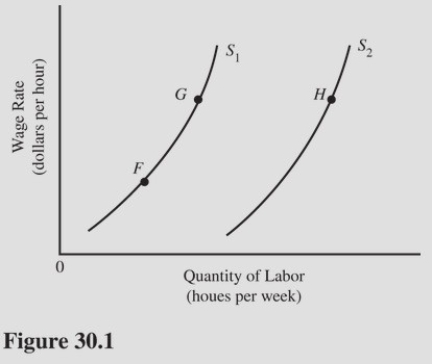 In Figure 30.1,the movement from point G to point F along the labor supply curve S1 is a result of
A)The income effect of higher wages.
B)The substitution effect of a higher wage rate.
C)Increased job satisfaction.
D)A lower wage rate.
Question
Question
Question
Question
Question
Question
Question
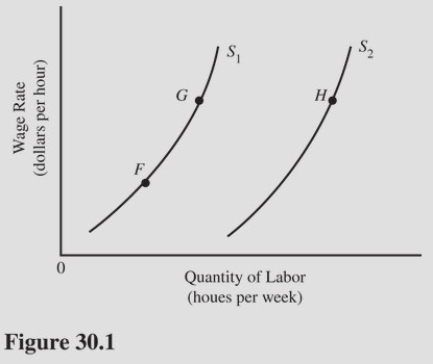 In Figure 30.1,the labor supply could shift from S1 to S2 due to all of the following except
A)Fewer workers preferring to work in this labor market.
B)An increase in the number of workers willing to work in this labor market.
C)A decrease in the payroll tax on workers.
D)A decrease in the attraction of leisure activities.
Question
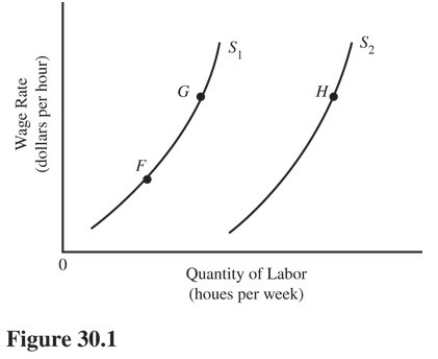 In Figure 30.1,the shift in the labor supply curve from S1 to S2 means that
A)The marginal utility of labor has decreased.
B)Workers are being paid higher wage rates,given their taste for work.
C)The marginal utility of labor relative to leisure has increased.
D)The demand for labor has increased,and this encourages more labor force participation.
Question
Question
Question
Question
Question
Question
Question
Question
Question
Question
Question
Question
Question
Question
Question
Question
Question
Question
Question
Question
Question
Question
Question
Question
Question
Question
Question
Question
Question
Question
Question
Question
Question
Question
Question
Question
Question
Question
Question
Question
Question
Question
Question
Question
Question
Question
Question
Question
Question
Question

Unlock Deck
Sign up to unlock the cards in this deck!
Unlock Deck
Unlock Deck
1/137

Play

Full screen (f)
Deck 30: The Labor Market
1
The opportunity cost of working is the
A)Wage rate.
B)Earnings that could be made in an alternative job.
C)Amount of leisure time that must be given up in the process.
D)Amount of consumption that is made possible.
A)Wage rate.
B)Earnings that could be made in an alternative job.
C)Amount of leisure time that must be given up in the process.
D)Amount of consumption that is made possible.
C
2
The number of hours that a worker is willing to work is determined by the trade-off between the increasing
A)Total utility of income and the decreasing marginal utility of leisure.
B)Value of leisure time and the decreasing marginal utility of income.
C)Total utility of leisure and the decreasing total utility of income.
D)Marginal utility of both income and leisure.
A)Total utility of income and the decreasing marginal utility of leisure.
B)Value of leisure time and the decreasing marginal utility of income.
C)Total utility of leisure and the decreasing total utility of income.
D)Marginal utility of both income and leisure.
B
3
The value of an hour of leisure can best be estimated as
A)Zero since no income is earned.
B)The hourly wage that could have been earned.
C)Total recreational expenditures divided by hours of leisure.
D)The value of any productive work,although such a value is lower than what could have been earned.
A)Zero since no income is earned.
B)The hourly wage that could have been earned.
C)Total recreational expenditures divided by hours of leisure.
D)The value of any productive work,although such a value is lower than what could have been earned.
B
4
The willingness and ability to work specific amounts of time at alternative wage rates is known as
A)Labor supply.
B)Labor demand.
C)Derived supply.
D)Derived demand.
A)Labor supply.
B)Labor demand.
C)Derived supply.
D)Derived demand.
Unlock Deck
Unlock for access to all 137 flashcards in this deck.
Unlock Deck
k this deck
5
As we work fewer hours and our leisure time increases,the opportunity cost of labor
A)Falls and the marginal utility of income falls.
B)Rises and the marginal utility of income falls.
C)Falls and the marginal utility of income rises.
D)Rises and the marginal utility of income rises.
A)Falls and the marginal utility of income falls.
B)Rises and the marginal utility of income falls.
C)Falls and the marginal utility of income rises.
D)Rises and the marginal utility of income rises.
Unlock Deck
Unlock for access to all 137 flashcards in this deck.
Unlock Deck
k this deck
6
The wage rate is
A)Not related to the value of leisure because people need to relax.
B)Not related to labor supply because people must work to survive.
C)The opportunity cost of labor.
D)The payment for labor.
A)Not related to the value of leisure because people need to relax.
B)Not related to labor supply because people must work to survive.
C)The opportunity cost of labor.
D)The payment for labor.
Unlock Deck
Unlock for access to all 137 flashcards in this deck.
Unlock Deck
k this deck
7
The labor supply curve will be negatively sloped if the substitution effect of wages is
A)Weaker than the income effect of wages.
B)Stronger than the income effect of wages.
C)Equal to the income effect of wages.
D)Negative.
A)Weaker than the income effect of wages.
B)Stronger than the income effect of wages.
C)Equal to the income effect of wages.
D)Negative.
Unlock Deck
Unlock for access to all 137 flashcards in this deck.
Unlock Deck
k this deck
8
The labor supply curve starts to bend backward once the
A)Income effect exceeds the substitution effect.
B)Substitution effect exceeds the income effect.
C)Marginal revenue product of labor equals the marginal utility of leisure.
D)Total utility of leisure outweighs the total utility of labor.
A)Income effect exceeds the substitution effect.
B)Substitution effect exceeds the income effect.
C)Marginal revenue product of labor equals the marginal utility of leisure.
D)Total utility of leisure outweighs the total utility of labor.
Unlock Deck
Unlock for access to all 137 flashcards in this deck.
Unlock Deck
k this deck
9
The substitution effect of wages states that a decreased wage rate
A)Encourages people to consume less leisure.
B)Will shift the labor supply curve rightward.
C)Will lead to a movement up along the existing supply curve.
D)Encourages people to work less hours.
A)Encourages people to consume less leisure.
B)Will shift the labor supply curve rightward.
C)Will lead to a movement up along the existing supply curve.
D)Encourages people to work less hours.
Unlock Deck
Unlock for access to all 137 flashcards in this deck.
Unlock Deck
k this deck
10
Higher wage rates allow a person to reduce the hours worked without losing income.This is known as the
A)Substitution effect.
B)Income effect.
C)Law of diminishing marginal utility.
D)Law of diminishing marginal leisure.
A)Substitution effect.
B)Income effect.
C)Law of diminishing marginal utility.
D)Law of diminishing marginal leisure.
Unlock Deck
Unlock for access to all 137 flashcards in this deck.
Unlock Deck
k this deck
11
The labor supply curve will be positively sloped if the substitution effect of wages is
A)Equal to the income effect of wages.
B)Stronger than the income effect of wages.
C)Weaker than the income effect of wages.
D)Negative.
A)Equal to the income effect of wages.
B)Stronger than the income effect of wages.
C)Weaker than the income effect of wages.
D)Negative.
Unlock Deck
Unlock for access to all 137 flashcards in this deck.
Unlock Deck
k this deck
12
If we move to the right along the upward-sloping labor supply curve,we observe that the cost of labor
A)Increases due to the increasing opportunity cost.
B)Increases due to the decreasing opportunity cost.
C)Decreases due to the increasing opportunity cost.
D)Decreases due to the decreasing opportunity cost.
A)Increases due to the increasing opportunity cost.
B)Increases due to the decreasing opportunity cost.
C)Decreases due to the increasing opportunity cost.
D)Decreases due to the decreasing opportunity cost.
Unlock Deck
Unlock for access to all 137 flashcards in this deck.
Unlock Deck
k this deck
13
Campbell loves to work.He does not receive any enjoyment from leisure time.The last dollar that he earns each year means just as much to him as the first dollar.Which of the following best describes the shape of Campbell's labor supply curve?
A)Upward-sloping to the right.
B)Vertical.
C)Downward-sloping to the right.
D)Horizontal.
A)Upward-sloping to the right.
B)Vertical.
C)Downward-sloping to the right.
D)Horizontal.
Unlock Deck
Unlock for access to all 137 flashcards in this deck.
Unlock Deck
k this deck
14
Kip will work fewer hours if his salary increases.For Kip,the ________ effect must outweigh the ________ effect.
A)substitution;income
B)income;substitution
C)income;utility
D)utility;substitution
A)substitution;income
B)income;substitution
C)income;utility
D)utility;substitution
Unlock Deck
Unlock for access to all 137 flashcards in this deck.
Unlock Deck
k this deck
15
Workers typically require higher wages in order to work additional hours because of the
A)Increasing opportunity cost of labor.
B)Increasing marginal utility of income.
C)Decreasing value of leisure time forgone.
D)Constant marginal utility of income.
A)Increasing opportunity cost of labor.
B)Increasing marginal utility of income.
C)Decreasing value of leisure time forgone.
D)Constant marginal utility of income.
Unlock Deck
Unlock for access to all 137 flashcards in this deck.
Unlock Deck
k this deck
16
If Lauren's substitution effects outweigh her income effects,her labor supply curve will
A)Appear horizontal.
B)Slope upward.
C)Bend backward.
D)Appear vertical.
A)Appear horizontal.
B)Slope upward.
C)Bend backward.
D)Appear vertical.
Unlock Deck
Unlock for access to all 137 flashcards in this deck.
Unlock Deck
k this deck
17
If wages are relatively high,the individual labor supply curve may
A)Become horizontal.
B)Bend backward.
C)Bend outward.
D)Become vertical.
A)Become horizontal.
B)Bend backward.
C)Bend outward.
D)Become vertical.
Unlock Deck
Unlock for access to all 137 flashcards in this deck.
Unlock Deck
k this deck
18
As more hours are worked,the marginal utility of leisure time tends to
A)Increase.
B)Decrease.
C)Stay the same.
D)Decrease initially,but then increase.
A)Increase.
B)Decrease.
C)Stay the same.
D)Decrease initially,but then increase.
Unlock Deck
Unlock for access to all 137 flashcards in this deck.
Unlock Deck
k this deck
19
For an upward-sloping labor supply curve,the quantity of labor supplied varies directly,ceteris paribus,with
A)The wage rate.
B)The value of leisure time.
C)Payroll taxes.
D)The derived demand for labor.
A)The wage rate.
B)The value of leisure time.
C)Payroll taxes.
D)The derived demand for labor.
Unlock Deck
Unlock for access to all 137 flashcards in this deck.
Unlock Deck
k this deck
20
As an individual earns additional income,the marginal utility of income tends to
A)Increase.
B)Decrease.
C)Remain constant.
D)Shift toward the origin.
A)Increase.
B)Decrease.
C)Remain constant.
D)Shift toward the origin.
Unlock Deck
Unlock for access to all 137 flashcards in this deck.
Unlock Deck
k this deck
21
The elasticity of labor supply does not depend on
A)The demand for labor.
B)The prices of consumer goods.
C)Income and wealth.
D)Expectations for income or consumption.
A)The demand for labor.
B)The prices of consumer goods.
C)Income and wealth.
D)Expectations for income or consumption.
Unlock Deck
Unlock for access to all 137 flashcards in this deck.
Unlock Deck
k this deck
22
In Figure 30.1,the movement from point G to point F along the labor supply curve S1 is a result ofA)The income effect of higher wages.
B)The substitution effect of a higher wage rate.
C)Increased job satisfaction.
D)A lower wage rate.
Unlock Deck
Unlock for access to all 137 flashcards in this deck.
Unlock Deck
k this deck
23
The determinants of the market supply of labor include all of the following except
A)Taxes.
B)The market wage rate.
C)Income and wealth.
D)Prices of consumer goods.
A)Taxes.
B)The market wage rate.
C)Income and wealth.
D)Prices of consumer goods.
Unlock Deck
Unlock for access to all 137 flashcards in this deck.
Unlock Deck
k this deck
24
If there is an increase in the number of workers who want to work as accountants,there will be a
A)Leftward shift of the labor supply curve.
B)Rightward shift of the labor supply curve.
C)Movement up the labor supply curve to the right.
D)Movement down the labor supply curve to the left.
A)Leftward shift of the labor supply curve.
B)Rightward shift of the labor supply curve.
C)Movement up the labor supply curve to the right.
D)Movement down the labor supply curve to the left.
Unlock Deck
Unlock for access to all 137 flashcards in this deck.
Unlock Deck
k this deck
25
An individual's labor supply curve
A)Slopes upward initially,and then may bend backward.
B)Slopes downward initially,and then may bend upward.
C)Always slopes downward.
D)Always slopes upward.
A)Slopes upward initially,and then may bend backward.
B)Slopes downward initially,and then may bend upward.
C)Always slopes downward.
D)Always slopes upward.
Unlock Deck
Unlock for access to all 137 flashcards in this deck.
Unlock Deck
k this deck
26
Jackson hates to work.He receives a great deal of enjoyment from leisure time.Jackson's elasticity of labor supply is
A)High.
B)Low,perhaps even negative.
C)1.
D)Highly negative.
A)High.
B)Low,perhaps even negative.
C)1.
D)Highly negative.
Unlock Deck
Unlock for access to all 137 flashcards in this deck.
Unlock Deck
k this deck
27
If the elasticity of labor is 0.60,a 15 percent increase in the wage rate will induce a
A)9.0 percent decrease in the quantity of labor supplied.
B)9.0 percent increase in the quantity of labor supplied.
C)4.0 percent decrease in the quantity of labor supplied.
D)4.0 percent increase in the quantity of labor supplied.
A)9.0 percent decrease in the quantity of labor supplied.
B)9.0 percent increase in the quantity of labor supplied.
C)4.0 percent decrease in the quantity of labor supplied.
D)4.0 percent increase in the quantity of labor supplied.
Unlock Deck
Unlock for access to all 137 flashcards in this deck.
Unlock Deck
k this deck
28
The market supply curve for labor curve is upward-sloping because
A)As the wage rises,most workers want to work fewer hours.
B)As the wage falls,most workers want to work more hours.
C)As the wage rises,most workers are willing to work more hours.
D)For most workers,as the wage rises,the preference for leisure time increases.
A)As the wage rises,most workers want to work fewer hours.
B)As the wage falls,most workers want to work more hours.
C)As the wage rises,most workers are willing to work more hours.
D)For most workers,as the wage rises,the preference for leisure time increases.
Unlock Deck
Unlock for access to all 137 flashcards in this deck.
Unlock Deck
k this deck
29
In Figure 30.1,the labor supply could shift from S1 to S2 due to all of the following exceptA)Fewer workers preferring to work in this labor market.
B)An increase in the number of workers willing to work in this labor market.
C)A decrease in the payroll tax on workers.
D)A decrease in the attraction of leisure activities.
Unlock Deck
Unlock for access to all 137 flashcards in this deck.
Unlock Deck
k this deck
30
In Figure 30.1,the shift in the labor supply curve from S1 to S2 means thatA)The marginal utility of labor has decreased.
B)Workers are being paid higher wage rates,given their taste for work.
C)The marginal utility of labor relative to leisure has increased.
D)The demand for labor has increased,and this encourages more labor force participation.
Unlock Deck
Unlock for access to all 137 flashcards in this deck.
Unlock Deck
k this deck
31
The demand for labor and other factors of production typically decline in a recession because those factors
A)Have become relatively scarcer than before the recession.
B)Are no longer offered for sale in factor markets.
C)Are derived from the demand for final output,which also declines in a recession.
D)Have become more expensive than before the recession.
A)Have become relatively scarcer than before the recession.
B)Are no longer offered for sale in factor markets.
C)Are derived from the demand for final output,which also declines in a recession.
D)Have become more expensive than before the recession.
Unlock Deck
Unlock for access to all 137 flashcards in this deck.
Unlock Deck
k this deck
32
The market supply of labor is
A)The sum of all jobs created in the economy each year.
B)Different for each individual based on training and education levels.
C)The total of all goods produced in the economy each year.
D)The total quantity of labor that workers are willing and able to supply at alternative wage rates in a given period.
A)The sum of all jobs created in the economy each year.
B)Different for each individual based on training and education levels.
C)The total of all goods produced in the economy each year.
D)The total quantity of labor that workers are willing and able to supply at alternative wage rates in a given period.
Unlock Deck
Unlock for access to all 137 flashcards in this deck.
Unlock Deck
k this deck
33
The elasticity of labor supply measures the
A)Opportunity cost of labor.
B)Magnitude of the substitution effect of labor.
C)Responsiveness of the wage rate to changes in the labor supplied.
D)Responsiveness of labor supplied to changes in the wage rate.
A)Opportunity cost of labor.
B)Magnitude of the substitution effect of labor.
C)Responsiveness of the wage rate to changes in the labor supplied.
D)Responsiveness of labor supplied to changes in the wage rate.
Unlock Deck
Unlock for access to all 137 flashcards in this deck.
Unlock Deck
k this deck
34
When a labor supply curve is backward-bending,the elasticity of labor supply in the backward-bending portion is
A)Negative.
B)Positive but less than 1.
C)Greater than 1.
D)Zero.
A)Negative.
B)Positive but less than 1.
C)Greater than 1.
D)Zero.
Unlock Deck
Unlock for access to all 137 flashcards in this deck.
Unlock Deck
k this deck
35
If Janella increases her supply of labor by 6 percent in response to a 5 percent increase in the wage rate,her elasticity of labor supply must be
A)5.0.
B)6.0.
C)1.2.
D)0.83.
A)5.0.
B)6.0.
C)1.2.
D)0.83.
Unlock Deck
Unlock for access to all 137 flashcards in this deck.
Unlock Deck
k this deck
36
If the wage rate increases,there will be a
A)Leftward shift of the labor supply curve.
B)Rightward shift of the labor supply curve.
C)Movement up the labor supply curve to the right.
D)Movement down the labor supply curve to the left.
A)Leftward shift of the labor supply curve.
B)Rightward shift of the labor supply curve.
C)Movement up the labor supply curve to the right.
D)Movement down the labor supply curve to the left.
Unlock Deck
Unlock for access to all 137 flashcards in this deck.
Unlock Deck
k this deck
37
If payroll taxes are increased,there will be a
A)Leftward shift of the labor supply curve.
B)Rightward shift of the labor supply curve.
C)Movement up the labor supply curve to the right.
D)Movement down the labor supply curve to the left.
A)Leftward shift of the labor supply curve.
B)Rightward shift of the labor supply curve.
C)Movement up the labor supply curve to the right.
D)Movement down the labor supply curve to the left.
Unlock Deck
Unlock for access to all 137 flashcards in this deck.
Unlock Deck
k this deck
38
Which of the following is not true about the demand for factors of production?
A)It is derived from the demand for the goods and services the firm produces.
B)It is a function of diminishing marginal physical product.
C)It depends on the firm's expected sales and output.
D)It is a function of the elasticity of supply.
A)It is derived from the demand for the goods and services the firm produces.
B)It is a function of diminishing marginal physical product.
C)It depends on the firm's expected sales and output.
D)It is a function of the elasticity of supply.
Unlock Deck
Unlock for access to all 137 flashcards in this deck.
Unlock Deck
k this deck
39
If leisure activities become more attractive,there will be a
A)Rightward shift of the labor supply curve.
B)Leftward shift of the labor supply curve.
C)Movement up the labor supply curve to the right.
D)Movement down the labor supply curve to the left.
A)Rightward shift of the labor supply curve.
B)Leftward shift of the labor supply curve.
C)Movement up the labor supply curve to the right.
D)Movement down the labor supply curve to the left.
Unlock Deck
Unlock for access to all 137 flashcards in this deck.
Unlock Deck
k this deck
40
If Anh's elasticity of labor supply is 1.5 and she increases her supply of labor by 5 percent,then the wage rate must have
A)Increased by 3.3 percent.
B)Increased by 3.0 percent.
C)Increased by 7.5 percent.
D)Decreased by 7.5 percent.
A)Increased by 3.3 percent.
B)Increased by 3.0 percent.
C)Increased by 7.5 percent.
D)Decreased by 7.5 percent.
Unlock Deck
Unlock for access to all 137 flashcards in this deck.
Unlock Deck
k this deck
41
As marginal physical product diminishes,marginal revenue product
A)Also diminishes.
B)Is not affected.
C)Rises at a diminishing rate and eventually falls.
D)Rises.
A)Also diminishes.
B)Is not affected.
C)Rises at a diminishing rate and eventually falls.
D)Rises.
Unlock Deck
Unlock for access to all 137 flashcards in this deck.
Unlock Deck
k this deck
42
The marginal revenue product of labor is equal to
A)The marginal physical product multiplied by the price.
B)The change in the quantity of labor divided by the change in total revenue.
C)The change in total output divided by the change in the quantity of labor.
D)The percentage change in total revenue divided by the percentage change in the quantity of labor.
A)The marginal physical product multiplied by the price.
B)The change in the quantity of labor divided by the change in total revenue.
C)The change in total output divided by the change in the quantity of labor.
D)The percentage change in total revenue divided by the percentage change in the quantity of labor.
Unlock Deck
Unlock for access to all 137 flashcards in this deck.
Unlock Deck
k this deck
43
The change in total revenue associated with one additional unit of input is referred to as
A)Elasticity of labor supply.
B)Cost efficiency.
C)MPP.
D)MRP.
A)Elasticity of labor supply.
B)Cost efficiency.
C)MPP.
D)MRP.
Unlock Deck
Unlock for access to all 137 flashcards in this deck.
Unlock Deck
k this deck
44
The marginal revenue product establishes
A)An upper limit to the wage rate an employer is willing and able to pay.
B)A lower limit to profit on the sale of a unit of output.
C)A lower limit to the productivity of a worker.
D)A lower limit to the wage rate demands of laborers.
A)An upper limit to the wage rate an employer is willing and able to pay.
B)A lower limit to profit on the sale of a unit of output.
C)A lower limit to the productivity of a worker.
D)A lower limit to the wage rate demands of laborers.
Unlock Deck
Unlock for access to all 137 flashcards in this deck.
Unlock Deck
k this deck
45
Marginal physical product diminishes as additional workers are hired because
A)Each worker has an increasingly smaller amount of other factors with which to work.
B)Each worker has an increasingly larger amount of other factors with which to work.
C)Later hires are not as skilled as earlier hires.
D)Later hires do not work as hard as earlier hires.
A)Each worker has an increasingly smaller amount of other factors with which to work.
B)Each worker has an increasingly larger amount of other factors with which to work.
C)Later hires are not as skilled as earlier hires.
D)Later hires do not work as hard as earlier hires.
Unlock Deck
Unlock for access to all 137 flashcards in this deck.
Unlock Deck
k this deck
46
Students who major in computer science are paid a lot more when they graduate than those who major in philosophy because
A)The derived demand for computer science majors is less than the derived demand for philosophy majors.
B)The marginal revenue product for computer science majors is less than the marginal revenue product for philosophy majors.
C)The search for the meaning of life is a growth industry.
D)Information technology is a growth industry.
A)The derived demand for computer science majors is less than the derived demand for philosophy majors.
B)The marginal revenue product for computer science majors is less than the marginal revenue product for philosophy majors.
C)The search for the meaning of life is a growth industry.
D)Information technology is a growth industry.
Unlock Deck
Unlock for access to all 137 flashcards in this deck.
Unlock Deck
k this deck
47
The demand for labor is downward-sloping because of
A)Rising MPP.
B)Falling MC.
C)Diminishing returns to labor.
D)Rising P.
A)Rising MPP.
B)Falling MC.
C)Diminishing returns to labor.
D)Rising P.
Unlock Deck
Unlock for access to all 137 flashcards in this deck.
Unlock Deck
k this deck
48
The law of diminishing returns states that,ceteris paribus,the
A)MPP of labor declines as additional land,raw materials,and other factors of production are employed.
B)MPP of labor declines as the wage rate falls.
C)MPP of labor declines as product price declines.
D)MPP of labor declines as more of it is employed with a given quantity of other (fixed)inputs.
A)MPP of labor declines as additional land,raw materials,and other factors of production are employed.
B)MPP of labor declines as the wage rate falls.
C)MPP of labor declines as product price declines.
D)MPP of labor declines as more of it is employed with a given quantity of other (fixed)inputs.
Unlock Deck
Unlock for access to all 137 flashcards in this deck.
Unlock Deck
k this deck
49
In competitive markets,the marginal revenue product curve and marginal physical product curve have similar shapes because
A)The demand curve for the product slopes downward in accordance with the law of diminishing returns.
B)MRP = P × MPP.
C)The law of diminishing marginal utility and the law of diminishing returns imply a downward-sloping demand curve in the product market.
D)The demand curve for labor is the same for both the individual firm and the market as a whole.
A)The demand curve for the product slopes downward in accordance with the law of diminishing returns.
B)MRP = P × MPP.
C)The law of diminishing marginal utility and the law of diminishing returns imply a downward-sloping demand curve in the product market.
D)The demand curve for labor is the same for both the individual firm and the market as a whole.
Unlock Deck
Unlock for access to all 137 flashcards in this deck.
Unlock Deck
k this deck
50
A competitive firm should continue to hire workers until the MRP is equal to
A)Demand.
B)The number of workers hired.
C)The market wage rate.
D)Zero.
A)Demand.
B)The number of workers hired.
C)The market wage rate.
D)Zero.
Unlock Deck
Unlock for access to all 137 flashcards in this deck.
Unlock Deck
k this deck
51
A firm should hire an additional worker as long as the wage rate is
A)Greater than the MRP.
B)Greater than the MPP.
C)Less than or equal to the MRP.
D)Less than the MPP.
A)Greater than the MRP.
B)Greater than the MPP.
C)Less than or equal to the MRP.
D)Less than the MPP.
Unlock Deck
Unlock for access to all 137 flashcards in this deck.
Unlock Deck
k this deck
52
Because of the law of diminishing returns,as additional workers are hired,total output
A)Rises at a constant rate at all output levels.
B)Rises at a diminishing rate initially and eventually falls.
C)Falls at a diminishing rate at all output levels.
D)Falls at an increasing rate at all output levels.
A)Rises at a constant rate at all output levels.
B)Rises at a diminishing rate initially and eventually falls.
C)Falls at a diminishing rate at all output levels.
D)Falls at an increasing rate at all output levels.
Unlock Deck
Unlock for access to all 137 flashcards in this deck.
Unlock Deck
k this deck
53
A firm's demand for labor is referred to as a derived demand because
A)It is derived from the MPP of labor.
B)It is derived from the demand for the product that the labor is producing.
C)The quantity of goods and services labor can purchase is derived from the wages labor receives from the firm.
D)It is derived from the supply of labor.
A)It is derived from the MPP of labor.
B)It is derived from the demand for the product that the labor is producing.
C)The quantity of goods and services labor can purchase is derived from the wages labor receives from the firm.
D)It is derived from the supply of labor.
Unlock Deck
Unlock for access to all 137 flashcards in this deck.
Unlock Deck
k this deck
54
If consumers decide to buy fewer strawberries,then the
A)Demand for strawberry pickers will fall.
B)Demand for strawberry pickers will rise.
C)Quantity demanded of strawberry pickers will fall.
D)Quantity demanded of strawberry pickers will rise.
A)Demand for strawberry pickers will fall.
B)Demand for strawberry pickers will rise.
C)Quantity demanded of strawberry pickers will fall.
D)Quantity demanded of strawberry pickers will rise.
Unlock Deck
Unlock for access to all 137 flashcards in this deck.
Unlock Deck
k this deck
55
If a chair can be sold for $20 and it takes a worker two hours to make a chair,the marginal revenue product of this worker is
A)$5 per hour.
B)$10 per hour.
C)$20 per hour.
D)$2 per hour.
A)$5 per hour.
B)$10 per hour.
C)$20 per hour.
D)$2 per hour.
Unlock Deck
Unlock for access to all 137 flashcards in this deck.
Unlock Deck
k this deck
56
Assume the apple market is competitive.If citizens want wages and the number of available jobs for apple pickers to increase,the best strategy would be to
A)Insist that the government establish a minimum wage for apple pickers.
B)Boycott apples until wages increased.
C)Buy more apples.
D)Insist that the sellers raise the price of apples.
A)Insist that the government establish a minimum wage for apple pickers.
B)Boycott apples until wages increased.
C)Buy more apples.
D)Insist that the sellers raise the price of apples.
Unlock Deck
Unlock for access to all 137 flashcards in this deck.
Unlock Deck
k this deck
57
The marginal physical product of labor is equal to
A)Total output divided by the quantity of labor.
B)The percentage change in total output divided by the percentage change in quantity of labor.
C)The change in total output associated with one additional unit of labor.
D)The change in total revenue associated with one additional unit of input.
A)Total output divided by the quantity of labor.
B)The percentage change in total output divided by the percentage change in quantity of labor.
C)The change in total output associated with one additional unit of labor.
D)The change in total revenue associated with one additional unit of input.
Unlock Deck
Unlock for access to all 137 flashcards in this deck.
Unlock Deck
k this deck
58
When the MPP of labor is zero,ceteris paribus,
A)Employment can be increased only by offering a higher wage rate.
B)No further increases in output can be achieved by using additional units of labor.
C)MRP is at a maximum.
D)Additional units of labor must be employed because other factors of production are being wasted.
A)Employment can be increased only by offering a higher wage rate.
B)No further increases in output can be achieved by using additional units of labor.
C)MRP is at a maximum.
D)Additional units of labor must be employed because other factors of production are being wasted.
Unlock Deck
Unlock for access to all 137 flashcards in this deck.
Unlock Deck
k this deck
59
The marginal revenue product of labor curve is the firm's
A)MPP of labor curve divided by the wage rate.
B)Marginal revenue curve.
C)Demand curve for labor.
D)Marginal physical product multiplied by the wage rate.
A)MPP of labor curve divided by the wage rate.
B)Marginal revenue curve.
C)Demand curve for labor.
D)Marginal physical product multiplied by the wage rate.
Unlock Deck
Unlock for access to all 137 flashcards in this deck.
Unlock Deck
k this deck
60
Which of the following would not shift the market demand for labor,ceteris paribus?
A)The wage paid to labor.
B)The demand for final products.
C)The productivity of labor.
D)The number of employers.
A)The wage paid to labor.
B)The demand for final products.
C)The productivity of labor.
D)The number of employers.
Unlock Deck
Unlock for access to all 137 flashcards in this deck.
Unlock Deck
k this deck
61
Table 30.2 Table 30.2 shows how many hairstyling appointments a hair salon can schedule per week based on the number of stylists.In the spaces provided,compute the marginal physical product (MPP)of the hair stylists,total revenue,and marginal revenue product of the stylists,assuming that a hair stylist charges $60 per appointment.What is the marginal revenue product of the second hairstylist?
A)$80 per week.
B)$1,200 per week.
C)$20 per week.
D)$4,800 per week.
A)$80 per week.
B)$1,200 per week.
C)$20 per week.
D)$4,800 per week.
Unlock Deck
Unlock for access to all 137 flashcards in this deck.
Unlock Deck
k this deck
62
If the demand for hair gel increases,the effect on the hair gel manufacturing job market will be to
A)Increase the demand for labor and increase equilibrium wages.
B)Reduce the supply of labor and increase equilibrium wages.
C)Decrease the demand for labor and reduce equilibrium wages.
D)Have no impact on equilibrium wages.
A)Increase the demand for labor and increase equilibrium wages.
B)Reduce the supply of labor and increase equilibrium wages.
C)Decrease the demand for labor and reduce equilibrium wages.
D)Have no impact on equilibrium wages.
Unlock Deck
Unlock for access to all 137 flashcards in this deck.
Unlock Deck
k this deck
63
Table 30.1 Assume that the product price is $4 per unit and that the hourly wage for workers is $12.Neither price nor wage changes with output.In Table 30.1,the marginal physical product of the third worker hired is
A)15 units per hour.
B)4 units per hour.
C)3 units per hour.
D)5 units per hour.
A)15 units per hour.
B)4 units per hour.
C)3 units per hour.
D)5 units per hour.
Unlock Deck
Unlock for access to all 137 flashcards in this deck.
Unlock Deck
k this deck
64
If the number of employers for a particular type of labor increases,which of the following shifts should occur in the labor market for the particular type of labor?
A)Demand for labor should shift to the left.
B)Supply of labor should shift to the left.
C)Demand for labor should shift to the right.
D)Supply of labor should shift to the right.
A)Demand for labor should shift to the left.
B)Supply of labor should shift to the left.
C)Demand for labor should shift to the right.
D)Supply of labor should shift to the right.
Unlock Deck
Unlock for access to all 137 flashcards in this deck.
Unlock Deck
k this deck
65
Table 30.2 Table 30.2 shows how many hairstyling appointments a hair salon can schedule per week based on the number of stylists.In the spaces provided,compute the marginal physical product (MPP)of the hair stylists,total revenue,and marginal revenue product of the stylists,assuming that a hair stylist charges $60 per appointment.In Table 30.2,suppose a hairstylist is paid $600 per week.How many hairstylists should a profit-maximizing salon hire?
A)1.
B)2.
C)3.
D)4.
A)1.
B)2.
C)3.
D)4.
Unlock Deck
Unlock for access to all 137 flashcards in this deck.
Unlock Deck
k this deck
66
If the MPP of an additional unit of labor is 3 units per hour,product price is constant at $8 per unit,and the wage rate is $26 per hour,then
A)The additional unit of labor should be employed.
B)The additional unit of labor should not be employed because it costs more than it is worth.
C)The employer should lower wages and accept less employment of labor.
D)Product price must be reduced if profits are to be made.
A)The additional unit of labor should be employed.
B)The additional unit of labor should not be employed because it costs more than it is worth.
C)The employer should lower wages and accept less employment of labor.
D)Product price must be reduced if profits are to be made.
Unlock Deck
Unlock for access to all 137 flashcards in this deck.
Unlock Deck
k this deck
67
If the price of the output produced by a particular type of labor decreases,which of the following shifts should occur in the labor market for the particular type of labor?
A)Demand for labor should shift to the left.
B)Supply of labor should shift to the left.
C)Demand for labor should shift to the right.
D)Supply of labor should shift to the right.
A)Demand for labor should shift to the left.
B)Supply of labor should shift to the left.
C)Demand for labor should shift to the right.
D)Supply of labor should shift to the right.
Unlock Deck
Unlock for access to all 137 flashcards in this deck.
Unlock Deck
k this deck
68
If the MPP of an additional unit of labor is 4 units per hour,product price is constant at $5 per unit,and the wage rate is $19 per hour,then
A)The additional unit of labor should be employed.
B)The additional unit of labor should not be employed because it costs more than it is worth.
C)The employer should lower wages and accept less employment of labor.
D)Product price must be reduced if profits are to be made.
A)The additional unit of labor should be employed.
B)The additional unit of labor should not be employed because it costs more than it is worth.
C)The employer should lower wages and accept less employment of labor.
D)Product price must be reduced if profits are to be made.
Unlock Deck
Unlock for access to all 137 flashcards in this deck.
Unlock Deck
k this deck
69
Other things being equal,which of the following would increase the market demand for labor?
A)A fall in the wage rate.
B)An increase in the marginal productivity of labor.
C)A decrease in the cost-effectiveness of labor relative to other inputs.
D)A decrease in the market demand for the firm's output.
A)A fall in the wage rate.
B)An increase in the marginal productivity of labor.
C)A decrease in the cost-effectiveness of labor relative to other inputs.
D)A decrease in the market demand for the firm's output.
Unlock Deck
Unlock for access to all 137 flashcards in this deck.
Unlock Deck
k this deck
70
Table 30.1 Assume that the product price is $4 per unit and that the hourly wage for workers is $12.Neither price nor wage changes with output.In Table 30.1,the marginal revenue product of the second worker hired is
A)$4 per hour.
B)$6 per hour.
C)$24 per hour.
D)$40 per hour.
A)$4 per hour.
B)$6 per hour.
C)$24 per hour.
D)$40 per hour.
Unlock Deck
Unlock for access to all 137 flashcards in this deck.
Unlock Deck
k this deck
71
Table 30.2 Table 30.2 shows how many hairstyling appointments a hair salon can schedule per week based on the number of stylists.In the spaces provided,compute the marginal physical product (MPP)of the hair stylists,total revenue,and marginal revenue product of the stylists,assuming that a hair stylist charges $60 per appointment.In Table 30.2 suppose a hairstylist is paid $700 per week.How many hairstylists should a profit-maximizing salon hire?
A)1.
B)2.
C)3.
D)4.
A)1.
B)2.
C)3.
D)4.
Unlock Deck
Unlock for access to all 137 flashcards in this deck.
Unlock Deck
k this deck
72
Which of the following is true about the equilibrium market wage? A.All workers are satisfied with the wage.
A)All employers are satisfied with the wage.
B)There is no unemployment in the market at the equilibrium wage.
C)Competitive employers have market power with respect to the equilibrium wage.
D)All workers are satisfied with the wage.
A)All employers are satisfied with the wage.
B)There is no unemployment in the market at the equilibrium wage.
C)Competitive employers have market power with respect to the equilibrium wage.
D)All workers are satisfied with the wage.
Unlock Deck
Unlock for access to all 137 flashcards in this deck.
Unlock Deck
k this deck
73
If the marginal revenue product of labor improves,which of the following shifts in the labor market should occur?
A)Supply of labor should shift to the left.
B)Demand for labor should shift to the left.
C)Supply of labor should shift to the right.
D)Demand for labor should shift to the right.
A)Supply of labor should shift to the left.
B)Demand for labor should shift to the left.
C)Supply of labor should shift to the right.
D)Demand for labor should shift to the right.
Unlock Deck
Unlock for access to all 137 flashcards in this deck.
Unlock Deck
k this deck
74
If the demand for alarm clocks decreases,the effect on the alarm clock job market will be to
A)Increase the demand for labor and increase equilibrium wages.
B)Reduce the supply of labor and increase equilibrium wages.
C)Decrease the demand for labor and reduce equilibrium wages.
D)Have no impact on equilibrium wages.
A)Increase the demand for labor and increase equilibrium wages.
B)Reduce the supply of labor and increase equilibrium wages.
C)Decrease the demand for labor and reduce equilibrium wages.
D)Have no impact on equilibrium wages.
Unlock Deck
Unlock for access to all 137 flashcards in this deck.
Unlock Deck
k this deck
75
If the number of available workers of a particular type increases,which of the following shifts should occur in the labor market for the particular type of labor?
A)Demand for labor should shift to the left.
B)Supply of labor should shift to the left.
C)Demand for labor should shift to the right.
D)Supply of labor should shift to the right.
A)Demand for labor should shift to the left.
B)Supply of labor should shift to the left.
C)Demand for labor should shift to the right.
D)Supply of labor should shift to the right.
Unlock Deck
Unlock for access to all 137 flashcards in this deck.
Unlock Deck
k this deck
76
As labor productivity increases,which of the following shifts in the labor market should occur?
A)Supply of labor should shift to the left.
B)Demand for labor should shift to the left.
C)Supply of labor should shift to the right.
D)Demand for labor should shift to the right.
A)Supply of labor should shift to the left.
B)Demand for labor should shift to the left.
C)Supply of labor should shift to the right.
D)Demand for labor should shift to the right.
Unlock Deck
Unlock for access to all 137 flashcards in this deck.
Unlock Deck
k this deck
77
Table 30.1 Assume that the product price is $4 per unit and that the hourly wage for workers is $12.Neither price nor wage changes with output.In Table 30.1,the contribution to total revenue of the fourth worker hired is
A)$76 per hour.
B)$16 per hour.
C)$4 per hour.
D)$12 per hour.
A)$76 per hour.
B)$16 per hour.
C)$4 per hour.
D)$12 per hour.
Unlock Deck
Unlock for access to all 137 flashcards in this deck.
Unlock Deck
k this deck
78
Table 30.2 Table 30.2 shows how many hairstyling appointments a hair salon can schedule per week based on the number of stylists.In the spaces provided,compute the marginal physical product (MPP)of the hair stylists,total revenue,and marginal revenue product of the stylists,assuming that a hair stylist charges $60 per appointment.In Table 30.2,as more stylists are hired,
A)There are diminishing returns.
B)There are economies of scale.
C)There are diseconomies of scale.
D)MRP increases.
A)There are diminishing returns.
B)There are economies of scale.
C)There are diseconomies of scale.
D)MRP increases.
Unlock Deck
Unlock for access to all 137 flashcards in this deck.
Unlock Deck
k this deck
79
Table 30.1 Assume that the product price is $4 per unit and that the hourly wage for workers is $12.Neither price nor wage changes with output.In Table 30.1,how many workers should be hired?
A)2.
B)3.
C)4.
D)5.
A)2.
B)3.
C)4.
D)5.
Unlock Deck
Unlock for access to all 137 flashcards in this deck.
Unlock Deck
k this deck
80
Table 30.2 Table 30.2 shows how many hairstyling appointments a hair salon can schedule per week based on the number of stylists.In the spaces provided,compute the marginal physical product (MPP)of the hair stylists,total revenue,and marginal revenue product of the stylists,assuming that a hair stylist charges $60 per appointment.What is the marginal physical product of the fourth hairstylist?
A)5,400.
B)90.
C)22.5.
D)0.
A)5,400.
B)90.
C)22.5.
D)0.
Unlock Deck
Unlock for access to all 137 flashcards in this deck.
Unlock Deck
k this deck
Unlock Deck
Unlock for access to all 137 flashcards in this deck.






