







 Chat with AI

Deck 34: Transfer Payments: Welfare and Social Security
Full screen (f)

Question

Question
Question
Question
Question
Question
Question
Question
Question
Question
Question
Question
Question
Question
Question
Question
Question
Question
Question
Question
Question
Question
Question
Question
Question
Question
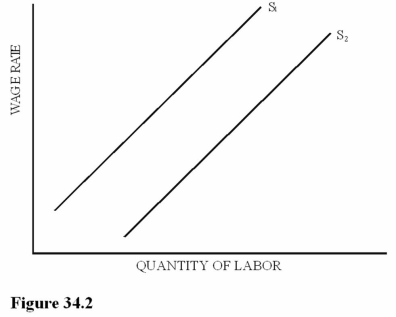 Figure 34.2 illustrates two labor supply curves.If in-kind payments become less available in this economy and marginal tax rates decrease significantly,we would expect a shift from
A)S1 to S2 only.
B)S1 to S2 and a movement up S2.
C)S2 to S1 only.
Question
Question
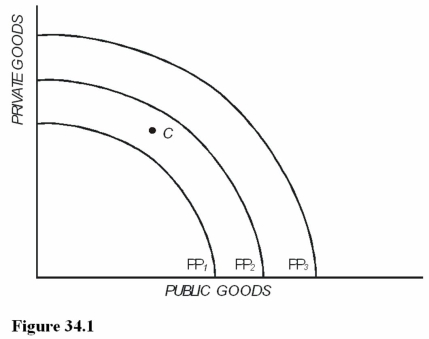 Refer to Figure 34.1.Suppose the production possibilities curve PP2 represents the goods and services produced in the U.S.economy.If welfare discourages people from seeking work,and laws change so that more people receive welfare benefits,the most likely result would be
A)A movement from point C to point PP2.
B)A shift from PP2 to PP1.
C)A shift from PP2 to PP3.
Question
Question
Question
Question
Question
Question
Question
Question
Question
Question
Question
Question
Question
Question
Question
Question
Question
Question
Question
Question
Question
Question
Question
Question
Question
Question
Question
Question
Question
Question
Question
Question
Question
Question
Question
Question
Question
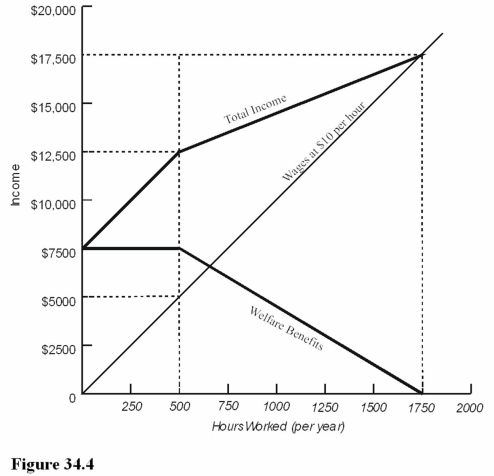
Refer to Figure 34.4.If an individual does not work,she or he will receive welfare benefits of
A)$0.
B)$5,000.
C)$7,500.
Question
Question
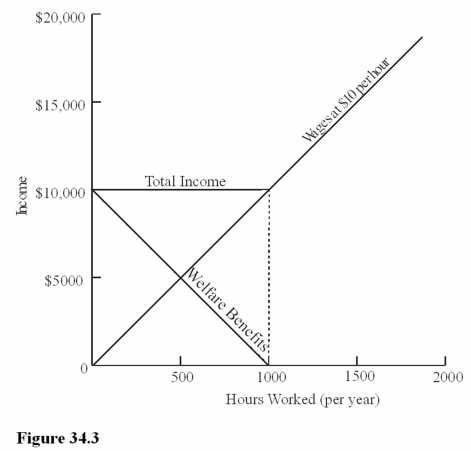
Refer to Figure 34.3.If a welfare recipient did not work,he or she would receive welfare benefits of
A)$0.
B)$1,000.
C)$5,000.
D)$10,000.
Question
Question
Question
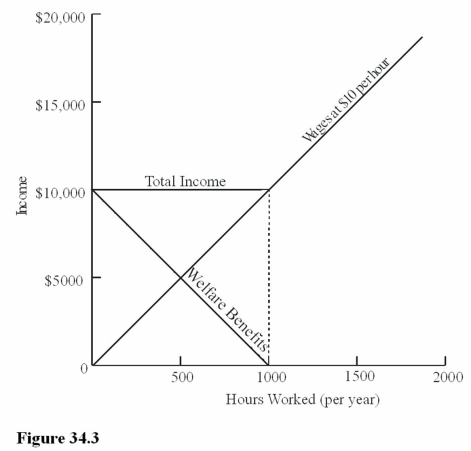
Refer to Figure 34.3.The disincentive to work caused by this welfare program
A)Ends as soon as any income is earned.
B)Ends at $5,000 where benefits equal wages.
C)Ends at $10,000.
Question
Question
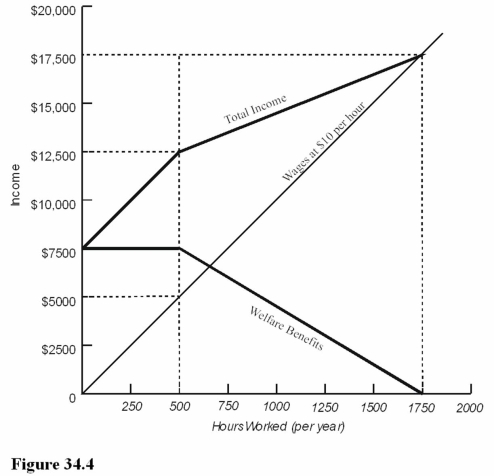
Refer to Figure 34.4.There is a welfare-induced disincentive to work starting at
A)$5,000.
B)$7,500.
C)$12,500.
Question
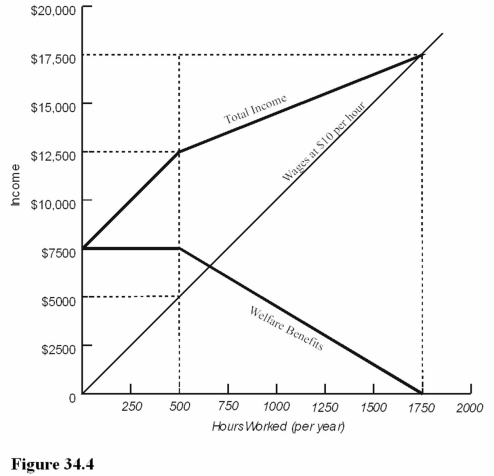
Refer to Figure 34.4.The implied marginal tax rate in this example is
A)0 percent.
B)Between 0 and 100 percent.
C)100 percent.
Question
Question
Question
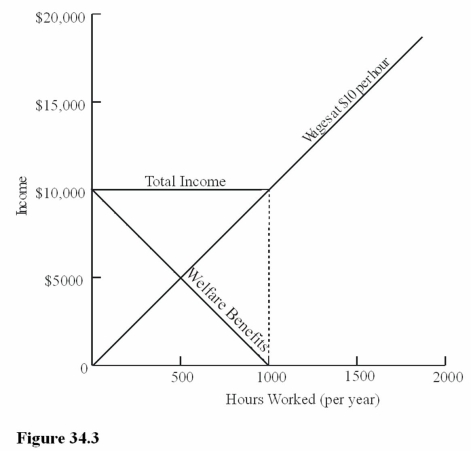
Refer to Figure 34.3.The implied marginal tax rate is
A)0 percent.
B)50 percent.
C)100 percent.
Question
Question
Question
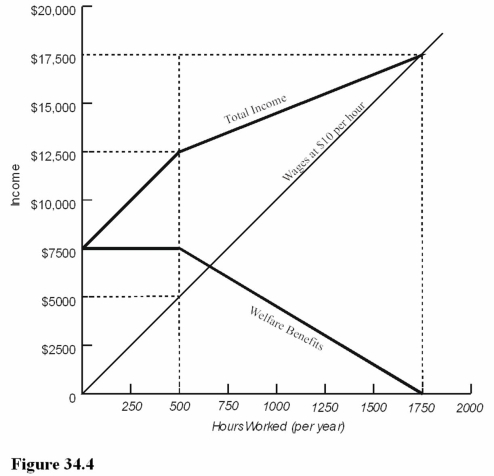
Refer to Figure 34.4.The breakeven level of income in this example is
A)$5,000.
B)$7,500.
C)$12,500.
D)$17,500.
Question

Unlock Deck
Sign up to unlock the cards in this deck!
Unlock Deck
Unlock Deck
1/138

Play

Full screen (f)
Deck 34: Transfer Payments: Welfare and Social Security
1
The percentage of income transfers that go to the intended recipients and purposes refers to the
A)Target welfare population.
B)Target efficiency.
C)Efficiency coefficient.
A)Target welfare population.
B)Target efficiency.
C)Efficiency coefficient.
Target efficiency.
2
Which of the following is an example of an in-kind transfer?
A)Income transfers.
B)TANF.
C)Medicaid.
A)Income transfers.
B)TANF.
C)Medicaid.
Medicaid.
3
Which of the following programs is the largest federal income transfer program?
A)Welfare.
B)Social Security.
C)Unemployment compensation.
A)Welfare.
B)Social Security.
C)Unemployment compensation.
Social Security.
4
Means-tested income transfer programs are referred to as
A)In-kind transfer programs.
B)Welfare programs.
C)Cash transfer programs.
A)In-kind transfer programs.
B)Welfare programs.
C)Cash transfer programs.
Unlock Deck
Unlock for access to all 138 flashcards in this deck.
Unlock Deck
k this deck
5
Transfer payments include all of the following except
A)Government-subsidized loans for students.
B)Federal crop assistance for farmers.
C)A church-run thrift store for the poor.
A)Government-subsidized loans for students.
B)Federal crop assistance for farmers.
C)A church-run thrift store for the poor.
Unlock Deck
Unlock for access to all 138 flashcards in this deck.
Unlock Deck
k this deck
6
Transfer payments are
A)Payments to individuals for which no current goods or services are exchanged.
B)Government tax receipts.
C)Government expenditures on goods and services.
A)Payments to individuals for which no current goods or services are exchanged.
B)Government tax receipts.
C)Government expenditures on goods and services.
Unlock Deck
Unlock for access to all 138 flashcards in this deck.
Unlock Deck
k this deck
7
Income transfers that entail direct payments to recipients,such as unemployment benefits,are known as
A)In-kind transfers.
B)Money transfers.
C)Cash transfers.
A)In-kind transfers.
B)Money transfers.
C)Cash transfers.
Unlock Deck
Unlock for access to all 138 flashcards in this deck.
Unlock Deck
k this deck
8
Social Security is an example of
A)An in-kind transfer program.
B)A cash transfer program.
C)A welfare program.
A)An in-kind transfer program.
B)A cash transfer program.
C)A welfare program.
Unlock Deck
Unlock for access to all 138 flashcards in this deck.
Unlock Deck
k this deck
9
Which of the following is most likely to occur if Medicare is converted from an in-kind transfer program to a cash transfer program?
A)A more equitable distribution of health care.
B)Increased target efficiency.
C)Increased poverty.
D)A reduction in health care for the elderly.
A)A more equitable distribution of health care.
B)Increased target efficiency.
C)Increased poverty.
D)A reduction in health care for the elderly.
Unlock Deck
Unlock for access to all 138 flashcards in this deck.
Unlock Deck
k this deck
10
In-kind transfers
A)Are a payment for work.
B)Increase the poverty index.
C)Are one way to reduce the moral hazards of the welfare system.
D)Provide the direct transfer of goods and services.
A)Are a payment for work.
B)Increase the poverty index.
C)Are one way to reduce the moral hazards of the welfare system.
D)Provide the direct transfer of goods and services.
Unlock Deck
Unlock for access to all 138 flashcards in this deck.
Unlock Deck
k this deck
11
Which of the following is a goal of an in-kind transfer program but not a cash transfer program?
A)To change the market's answer to the FOR WHOM question.
B)To address the issue of inequity.
C)To ensure that recipients get the type of aid intended.
A)To change the market's answer to the FOR WHOM question.
B)To address the issue of inequity.
C)To ensure that recipients get the type of aid intended.
Unlock Deck
Unlock for access to all 138 flashcards in this deck.
Unlock Deck
k this deck
12
Which of the following is not an example of in-kind income?
A)Food stamps.
B)Unemployment benefits.
C)Housing assistance.
A)Food stamps.
B)Unemployment benefits.
C)Housing assistance.
Unlock Deck
Unlock for access to all 138 flashcards in this deck.
Unlock Deck
k this deck
13
To be eligible for a welfare program,the recipient must
A)Be elderly.
B)Be poor.
C)Be in need of medical care.
A)Be elderly.
B)Be poor.
C)Be in need of medical care.
Unlock Deck
Unlock for access to all 138 flashcards in this deck.
Unlock Deck
k this deck
14
Social Security benefits paid by the federal government
A)Are income transfers financed by taxes on workers and employers.
B)Are classified as in-kind benefits.
C)Have no effect on the decision of for whom output is to be produced.
A)Are income transfers financed by taxes on workers and employers.
B)Are classified as in-kind benefits.
C)Have no effect on the decision of for whom output is to be produced.
Unlock Deck
Unlock for access to all 138 flashcards in this deck.
Unlock Deck
k this deck
15
When a program is means-tested,it means that
A)To be eligible,the recipient must be poor.
B)It is a social insurance program.
C)It is an in-kind program.
A)To be eligible,the recipient must be poor.
B)It is a social insurance program.
C)It is an in-kind program.
Unlock Deck
Unlock for access to all 138 flashcards in this deck.
Unlock Deck
k this deck
16
In-kind transfers are
A)The transfer of goods and services,instead of income,to those in need.
B)Paid to individuals in a form that gives them the maximum flexibility to buy what they need.
C)A means to allow the poor to make financial transactions between private providers of their own choosing.
A)The transfer of goods and services,instead of income,to those in need.
B)Paid to individuals in a form that gives them the maximum flexibility to buy what they need.
C)A means to allow the poor to make financial transactions between private providers of their own choosing.
Unlock Deck
Unlock for access to all 138 flashcards in this deck.
Unlock Deck
k this deck
17
Which of the following programs is likely to have low target efficiency?
A)An insurance card that allows the elderly to obtain health care.
B)A cash payment directly to the landlord to offset the cost of housing for certain individuals.
C)Food stamps that can only be used for food.
D)A cash payment that the recipient is encouraged to use for housing.
A)An insurance card that allows the elderly to obtain health care.
B)A cash payment directly to the landlord to offset the cost of housing for certain individuals.
C)Food stamps that can only be used for food.
D)A cash payment that the recipient is encouraged to use for housing.
Unlock Deck
Unlock for access to all 138 flashcards in this deck.
Unlock Deck
k this deck
18
In-kind transfers
A)Are received as cash.
B)Are more target-efficient than cash.
C)Encourage the poor to earn more income.
A)Are received as cash.
B)Are more target-efficient than cash.
C)Encourage the poor to earn more income.
Unlock Deck
Unlock for access to all 138 flashcards in this deck.
Unlock Deck
k this deck
19
Which of the following programs is the second-largest federal income transfer program?
A)Medicare.
B)Social Security.
C)Unemployment compensation.
A)Medicare.
B)Social Security.
C)Unemployment compensation.
Unlock Deck
Unlock for access to all 138 flashcards in this deck.
Unlock Deck
k this deck
20
Which of the following student aid programs is likely to have the highest target efficiency?
A)Direct payment of tuition to the university.
B)Direct cash payments to the student.
C)Low-interest loans.
A)Direct payment of tuition to the university.
B)Direct cash payments to the student.
C)Low-interest loans.
Unlock Deck
Unlock for access to all 138 flashcards in this deck.
Unlock Deck
k this deck
21
The existence of income transfer programs is likely to
A)Result in recipients having fewer children.
B)Change the distribution of income but not the mix of output.
C)Decrease the supply of labor.
A)Result in recipients having fewer children.
B)Change the distribution of income but not the mix of output.
C)Decrease the supply of labor.
Unlock Deck
Unlock for access to all 138 flashcards in this deck.
Unlock Deck
k this deck
22
Welfare benefits reduce the need to work and result in a shift in the
A)Labor supply curve to the left.
B)Labor supply curve to the right.
C)Labor demand curve to the left.
A)Labor supply curve to the left.
B)Labor supply curve to the right.
C)Labor demand curve to the left.
Unlock Deck
Unlock for access to all 138 flashcards in this deck.
Unlock Deck
k this deck
23
The existence of income transfer programs can
A)Decrease the birth rate.
B)Increase the wage rate as the labor supply decreases.
C)Decrease the wage rate as labor supply increases.
A)Decrease the birth rate.
B)Increase the wage rate as the labor supply decreases.
C)Decrease the wage rate as labor supply increases.
Unlock Deck
Unlock for access to all 138 flashcards in this deck.
Unlock Deck
k this deck
24
Which of the following is a welfare program?
A)Food stamps.
B)Social Security.
C)Medicare.
A)Food stamps.
B)Social Security.
C)Medicare.
Unlock Deck
Unlock for access to all 138 flashcards in this deck.
Unlock Deck
k this deck
25
The existence of transfer programs implies that
A)Government failure has occurred.
B)Market failure has occurred.
C)Technical efficiency exists.
A)Government failure has occurred.
B)Market failure has occurred.
C)Technical efficiency exists.
Unlock Deck
Unlock for access to all 138 flashcards in this deck.
Unlock Deck
k this deck
26
Figure 34.2 illustrates two labor supply curves.If in-kind payments become less available in this economy and marginal tax rates decrease significantly,we would expect a shift fromA)S1 to S2 only.
B)S1 to S2 and a movement up S2.
C)S2 to S1 only.
Unlock Deck
Unlock for access to all 138 flashcards in this deck.
Unlock Deck
k this deck
27
The shortfall between actual income and the poverty threshold is the
A)Welfare gap.
B)Poverty gap.
C)Target efficiency.
A)Welfare gap.
B)Poverty gap.
C)Target efficiency.
Unlock Deck
Unlock for access to all 138 flashcards in this deck.
Unlock Deck
k this deck
28
Refer to Figure 34.1.Suppose the production possibilities curve PP2 represents the goods and services produced in the U.S.economy.If welfare discourages people from seeking work,and laws change so that more people receive welfare benefits,the most likely result would beA)A movement from point C to point PP2.
B)A shift from PP2 to PP1.
C)A shift from PP2 to PP3.
Unlock Deck
Unlock for access to all 138 flashcards in this deck.
Unlock Deck
k this deck
29
The official poverty index is based on
A)Family size and income.
B)In-kind income.
C)An event condition.
A)Family size and income.
B)In-kind income.
C)An event condition.
Unlock Deck
Unlock for access to all 138 flashcards in this deck.
Unlock Deck
k this deck
30
Social insurance programs
A)Are event-conditional.
B)Involve an income eligibility test.
C)Are a type of welfare program.
A)Are event-conditional.
B)Involve an income eligibility test.
C)Are a type of welfare program.
Unlock Deck
Unlock for access to all 138 flashcards in this deck.
Unlock Deck
k this deck
31
Social insurance programs are
A)Event-conditional.
B)Means-tested.
C)Available only to those at least 65 years old.
A)Event-conditional.
B)Means-tested.
C)Available only to those at least 65 years old.
Unlock Deck
Unlock for access to all 138 flashcards in this deck.
Unlock Deck
k this deck
32
Welfare programs differ from social insurance programs in that welfare programs
A)Are event-based.
B)Are available only to people who do not work.
C)Offer benefits only to the needy.
A)Are event-based.
B)Are available only to people who do not work.
C)Offer benefits only to the needy.
Unlock Deck
Unlock for access to all 138 flashcards in this deck.
Unlock Deck
k this deck
33
Medicaid and food stamps are received by
A)Anyone that applies.
B)Only the elderly.
C)Only the poor.
A)Anyone that applies.
B)Only the elderly.
C)Only the poor.
Unlock Deck
Unlock for access to all 138 flashcards in this deck.
Unlock Deck
k this deck
34
In 2011,the largest U.S.in-kind transfer program was
A)Medicare.
B)Food stamps.
C)Unemployment insurance.
A)Medicare.
B)Food stamps.
C)Unemployment insurance.
Unlock Deck
Unlock for access to all 138 flashcards in this deck.
Unlock Deck
k this deck
35
A goal of income transfer programs is to do all of the following except
A)Alter the distribution of income.
B)Reduce income inequalities.
C)Change the mix of output.
D)Change how output is produced.
A)Alter the distribution of income.
B)Reduce income inequalities.
C)Change the mix of output.
D)Change how output is produced.
Unlock Deck
Unlock for access to all 138 flashcards in this deck.
Unlock Deck
k this deck
36
If welfare benefits equaled the poverty gap for each household in poverty,then
A)Work effort would increase.
B)Production possibilities would expand.
C)Poverty would be eliminated.
A)Work effort would increase.
B)Production possibilities would expand.
C)Poverty would be eliminated.
Unlock Deck
Unlock for access to all 138 flashcards in this deck.
Unlock Deck
k this deck
37
The existence of income transfer programs can
A)Increase the work incentive and increase GDP.
B)Increase the work incentive and increase total income.
C)Decrease the incentive to work,but still increase GDP.
D)Decrease the incentive to work and reduce income and output.
A)Increase the work incentive and increase GDP.
B)Increase the work incentive and increase total income.
C)Decrease the incentive to work,but still increase GDP.
D)Decrease the incentive to work and reduce income and output.
Unlock Deck
Unlock for access to all 138 flashcards in this deck.
Unlock Deck
k this deck
38
The poverty gap is the
A)Shortfall between a household's actual income and the poverty threshold.
B)Percentage of families under the poverty level.
C)Difference between the income of a household in poverty and the average income.
A)Shortfall between a household's actual income and the poverty threshold.
B)Percentage of families under the poverty level.
C)Difference between the income of a household in poverty and the average income.
Unlock Deck
Unlock for access to all 138 flashcards in this deck.
Unlock Deck
k this deck
39
A market failure exists when an imperfection in
A)Federal government policies prevents an optimal outcome.
B)Welfare programs prevents an optimal outcome.
C)The market mechanism prevents an optimal outcome.
A)Federal government policies prevents an optimal outcome.
B)Welfare programs prevents an optimal outcome.
C)The market mechanism prevents an optimal outcome.
Unlock Deck
Unlock for access to all 138 flashcards in this deck.
Unlock Deck
k this deck
40
Which of the following is least likely to be the case?
A)Food stamps encourage the production of more food.
B)Housing subsidies encourage the production of additional housing.
C)Medicare changes the mix of output away from medical services.
A)Food stamps encourage the production of more food.
B)Housing subsidies encourage the production of additional housing.
C)Medicare changes the mix of output away from medical services.
Unlock Deck
Unlock for access to all 138 flashcards in this deck.
Unlock Deck
k this deck
41
Use the following formula to answer the indicated question: Welfare benefit = Maximum benefit - 0.7 [Wages - (Work expenses + Child care costs)]
Suppose Miller works 2,000 hours per year at a wage of $8 per hour,has child care expenses of $3,000 per year,and has work expenses of $2,000.If the state maximum welfare benefit is $10,000 per year,based on the welfare formula given,Miller's welfare benefit will be
A)Zero because his income has exceeded the limit.
B)$2,300.
C)$10,000.
Suppose Miller works 2,000 hours per year at a wage of $8 per hour,has child care expenses of $3,000 per year,and has work expenses of $2,000.If the state maximum welfare benefit is $10,000 per year,based on the welfare formula given,Miller's welfare benefit will be
A)Zero because his income has exceeded the limit.
B)$2,300.
C)$10,000.
Unlock Deck
Unlock for access to all 138 flashcards in this deck.
Unlock Deck
k this deck
42
Use the following formula to answer the indicated question: Welfare benefit = Maximum benefit - Wages
Suppose Parker works 2,000 hours per year at a wage of $12 per hour.If the state maximum welfare benefit is $14,000 per year,based on the welfare formula given,Parker's welfare benefit will be
A)Zero.
B)$7,000.
C)$14,000.
Suppose Parker works 2,000 hours per year at a wage of $12 per hour.If the state maximum welfare benefit is $14,000 per year,based on the welfare formula given,Parker's welfare benefit will be
A)Zero.
B)$7,000.
C)$14,000.
Unlock Deck
Unlock for access to all 138 flashcards in this deck.
Unlock Deck
k this deck
43
Which of the following statements concerning lower marginal tax rates is correct?
A)They encourage work effort and make more people eligible for welfare benefits.
B)They discourage work effort and make more people eligible for welfare benefits.
C)They encourage work effort and make fewer people eligible for welfare benefits.
A)They encourage work effort and make more people eligible for welfare benefits.
B)They discourage work effort and make more people eligible for welfare benefits.
C)They encourage work effort and make fewer people eligible for welfare benefits.
Unlock Deck
Unlock for access to all 138 flashcards in this deck.
Unlock Deck
k this deck
44
Which of the following statements concerning higher marginal tax rates is correct?
A)They encourage work effort and make more people eligible for welfare benefits.
B)They discourage work effort and make fewer people eligible for welfare benefits.
C)They encourage work effort and make fewer people eligible for welfare benefits.
A)They encourage work effort and make more people eligible for welfare benefits.
B)They discourage work effort and make fewer people eligible for welfare benefits.
C)They encourage work effort and make fewer people eligible for welfare benefits.
Unlock Deck
Unlock for access to all 138 flashcards in this deck.
Unlock Deck
k this deck
45
If welfare benefits equal the poverty gap for each household in poverty,then the
A)Effective marginal tax rate for welfare recipients is 100 percent.
B)Poor have a strong incentive to begin working.
C)The poverty gap will become greater.
A)Effective marginal tax rate for welfare recipients is 100 percent.
B)Poor have a strong incentive to begin working.
C)The poverty gap will become greater.
Unlock Deck
Unlock for access to all 138 flashcards in this deck.
Unlock Deck
k this deck
46
Use the following formula to answer the indicated question: Welfare benefit = Maximum benefit - 0.4 [Wages - (Work expenses + Child care costs)]
Suppose Emily works 1,800 hours per year at a wage of $8 per hour,has child care expenses of $4,000 per year,and has work expenses of $1,000.If the state maximum welfare benefit is $12,000 per year,based on the welfare formula given,Emily's welfare benefit will be
A)$8,240.
B)$2,600.
C)$3,760.
Suppose Emily works 1,800 hours per year at a wage of $8 per hour,has child care expenses of $4,000 per year,and has work expenses of $1,000.If the state maximum welfare benefit is $12,000 per year,based on the welfare formula given,Emily's welfare benefit will be
A)$8,240.
B)$2,600.
C)$3,760.
Unlock Deck
Unlock for access to all 138 flashcards in this deck.
Unlock Deck
k this deck
47
A marginal tax rate of zero for welfare programs will
A)Increase work effort.
B)Reduce welfare costs.
C)Increase the number of people eligible for welfare.
A)Increase work effort.
B)Reduce welfare costs.
C)Increase the number of people eligible for welfare.
Unlock Deck
Unlock for access to all 138 flashcards in this deck.
Unlock Deck
k this deck
48
Moral hazard is
A)The risk involved in accepting welfare.
B)An incentive to engage in undesirable behavior.
C)The involvement in illegal activity.
A)The risk involved in accepting welfare.
B)An incentive to engage in undesirable behavior.
C)The involvement in illegal activity.
Unlock Deck
Unlock for access to all 138 flashcards in this deck.
Unlock Deck
k this deck
49
Use the following formula to answer the indicated question: Welfare benefit = Maximum benefit - 0.7 [Wages - (Work expenses + Child care costs)]
Based on the information given,the marginal tax rate is
A)Zero percent.
B)30 percent.
C)70 percent.
Based on the information given,the marginal tax rate is
A)Zero percent.
B)30 percent.
C)70 percent.
Unlock Deck
Unlock for access to all 138 flashcards in this deck.
Unlock Deck
k this deck
50
Higher marginal tax rates for welfare programs will
A)Increase total welfare costs.
B)Decrease the incentive to work.
C)Increase the number of people eligible for welfare.
A)Increase total welfare costs.
B)Decrease the incentive to work.
C)Increase the number of people eligible for welfare.
Unlock Deck
Unlock for access to all 138 flashcards in this deck.
Unlock Deck
k this deck
51
Use the following formula to answer the indicated question: Welfare benefit = Maximum benefit - 0.4 [Wages - (Work expenses + Child care costs)]
Based on the information given,the marginal tax rate is
A)Zero percent.
B)40 percent.
C)60 percent.
Based on the information given,the marginal tax rate is
A)Zero percent.
B)40 percent.
C)60 percent.
Unlock Deck
Unlock for access to all 138 flashcards in this deck.
Unlock Deck
k this deck
52
A lower marginal tax rate for welfare recipients will
A)Decrease work incentives.
B)Reduce the possibility of moral hazard.
C)Increase the poverty gap.
A)Decrease work incentives.
B)Reduce the possibility of moral hazard.
C)Increase the poverty gap.
Unlock Deck
Unlock for access to all 138 flashcards in this deck.
Unlock Deck
k this deck
53
Lower marginal tax rates for welfare programs will
A)Decrease the incentive to work.
B)Decrease total welfare costs.
C)Make more people eligible for welfare.
A)Decrease the incentive to work.
B)Decrease total welfare costs.
C)Make more people eligible for welfare.
Unlock Deck
Unlock for access to all 138 flashcards in this deck.
Unlock Deck
k this deck
54
If welfare benefits equal the poverty gap for each household in poverty,then
A)The effective marginal tax rate for welfare recipients is 50 percent.
B)Every dollar of wages results in a lost dollar of welfare benefits.
C)Total output for the economy will increase.
A)The effective marginal tax rate for welfare recipients is 50 percent.
B)Every dollar of wages results in a lost dollar of welfare benefits.
C)Total output for the economy will increase.
Unlock Deck
Unlock for access to all 138 flashcards in this deck.
Unlock Deck
k this deck
55
Use the following formula to answer the indicated question: Welfare benefit = Maximum benefit - Wages
A welfare system based on the welfare formula given
A)Will increase the risk of moral hazard.
B)Will increase work incentives.
C)Will increase the number of people eligible for welfare.
A welfare system based on the welfare formula given
A)Will increase the risk of moral hazard.
B)Will increase work incentives.
C)Will increase the number of people eligible for welfare.
Unlock Deck
Unlock for access to all 138 flashcards in this deck.
Unlock Deck
k this deck
56
Which of the following is used to determine if a family is in poverty?
A)The level of education attained.
B)The level of current income.
C)The medical needs of the family.
A)The level of education attained.
B)The level of current income.
C)The medical needs of the family.
Unlock Deck
Unlock for access to all 138 flashcards in this deck.
Unlock Deck
k this deck
57
Use the following formula to answer the indicated question: Welfare benefit = Maximum benefit - 0.7 [Wages - (Work expenses + Child care costs)]
Suppose Carter works 1,200 hours per year at a wage of $6 per hour,has child care expenses of $2,200 per year,and has work expenses of $800.If the state maximum welfare benefit is $12,000 per year,based on the welfare formula given,Carter's welfare benefit will be
A)$3,000.
B)$10,200.
C)$9,060.
Suppose Carter works 1,200 hours per year at a wage of $6 per hour,has child care expenses of $2,200 per year,and has work expenses of $800.If the state maximum welfare benefit is $12,000 per year,based on the welfare formula given,Carter's welfare benefit will be
A)$3,000.
B)$10,200.
C)$9,060.
Unlock Deck
Unlock for access to all 138 flashcards in this deck.
Unlock Deck
k this deck
58
Welfare support creates a moral hazard by
A)Reducing the need to work.
B)Encouraging workfare.
C)Encouraging individuals to help themselves.
A)Reducing the need to work.
B)Encouraging workfare.
C)Encouraging individuals to help themselves.
Unlock Deck
Unlock for access to all 138 flashcards in this deck.
Unlock Deck
k this deck
59
Use the following formula to answer the indicated question: Welfare benefit = Maximum benefit - 0.4 [Wages - (Work expenses + Child care costs)]
Suppose Shanika works 2,000 hours per year at a wage of $6 per hour,has child care expenses of $3,000 per year,and has work expenses of $900.If the state maximum welfare benefit is $11,000 per year,based on the welfare formula given,Shanika's welfare benefit will be
A)$2,900.
B)$8,100.
C)$7,760.
Suppose Shanika works 2,000 hours per year at a wage of $6 per hour,has child care expenses of $3,000 per year,and has work expenses of $900.If the state maximum welfare benefit is $11,000 per year,based on the welfare formula given,Shanika's welfare benefit will be
A)$2,900.
B)$8,100.
C)$7,760.
Unlock Deck
Unlock for access to all 138 flashcards in this deck.
Unlock Deck
k this deck
60
An assistance program that guarantees a minimum income,regardless of the family's earned income,has a
A)Marginal tax rate of zero percent.
B)Breakeven income level equal to the need standard.
C)Zero disregard.
A)Marginal tax rate of zero percent.
B)Breakeven income level equal to the need standard.
C)Zero disregard.
Unlock Deck
Unlock for access to all 138 flashcards in this deck.
Unlock Deck
k this deck
61
The breakeven level of income is the
A)Lowest level of income at which in-kind benefits are no longer necessary.
B)Level of income at which an individual household begins to have some discretionary income.
C)Level of income above which a person loses all welfare benefits.
A)Lowest level of income at which in-kind benefits are no longer necessary.
B)Level of income at which an individual household begins to have some discretionary income.
C)Level of income above which a person loses all welfare benefits.
Unlock Deck
Unlock for access to all 138 flashcards in this deck.
Unlock Deck
k this deck
62
Suppose a poverty program has a basic benefit of $14,000,zero deductions,and a marginal tax rate of 0.70.The breakeven level of income is
A)$14,000.
B)$9,800.
C)$4,200.
D)$20,000.
A)$14,000.
B)$9,800.
C)$4,200.
D)$20,000.
Unlock Deck
Unlock for access to all 138 flashcards in this deck.
Unlock Deck
k this deck
63
Suppose a poverty program has a basic benefit of $5,000,zero deductions,and a marginal tax rate of 0.50.The breakeven level of income is
A)$2,500.
B)$25,000.
C)$15,000.
D)$10,000.
A)$2,500.
B)$25,000.
C)$15,000.
D)$10,000.
Unlock Deck
Unlock for access to all 138 flashcards in this deck.
Unlock Deck
k this deck
64
Higher breakeven levels of income can be achieved by decreasing
A)In-kind benefits.
B)Earnings disregards.
C)Basic benefits.
D)The marginal tax rate.
A)In-kind benefits.
B)Earnings disregards.
C)Basic benefits.
D)The marginal tax rate.
Unlock Deck
Unlock for access to all 138 flashcards in this deck.
Unlock Deck
k this deck
65
Refer to Figure 34.4.If an individual does not work,she or he will receive welfare benefits of
A)$0.
B)$5,000.
C)$7,500.
Unlock Deck
Unlock for access to all 138 flashcards in this deck.
Unlock Deck
k this deck
66
A transfer program that is event-triggered for those who are eligible for benefits is known as
A)An in-kind transfer.
B)A cash transfer.
C)Welfare.
D)Social insurance.
A)An in-kind transfer.
B)A cash transfer.
C)Welfare.
D)Social insurance.
Unlock Deck
Unlock for access to all 138 flashcards in this deck.
Unlock Deck
k this deck
67
Refer to Figure 34.3.If a welfare recipient did not work,he or she would receive welfare benefits of
A)$0.
B)$1,000.
C)$5,000.
D)$10,000.
Unlock Deck
Unlock for access to all 138 flashcards in this deck.
Unlock Deck
k this deck
68
The breakeven level of income is
A)The amount of welfare benefits that can be received without taxation.
B)The amount of income that can be earned without a loss of welfare benefits.
C)A welfare recipient who is ignored or who does not receive benefits.
A)The amount of welfare benefits that can be received without taxation.
B)The amount of income that can be earned without a loss of welfare benefits.
C)A welfare recipient who is ignored or who does not receive benefits.
Unlock Deck
Unlock for access to all 138 flashcards in this deck.
Unlock Deck
k this deck
69
Welfare costs can be reduced by
A)Decreasing the breakeven level of income.
B)Reducing the marginal tax rate.
C)Increasing earnings disregards.
A)Decreasing the breakeven level of income.
B)Reducing the marginal tax rate.
C)Increasing earnings disregards.
Unlock Deck
Unlock for access to all 138 flashcards in this deck.
Unlock Deck
k this deck
70
Refer to Figure 34.3.The disincentive to work caused by this welfare program
A)Ends as soon as any income is earned.
B)Ends at $5,000 where benefits equal wages.
C)Ends at $10,000.
Unlock Deck
Unlock for access to all 138 flashcards in this deck.
Unlock Deck
k this deck
71
A transfer program that uses means testing to identify who is eligible for benefits is known as
A)An in-kind transfer.
B)A cash transfer.
C)Welfare.
A)An in-kind transfer.
B)A cash transfer.
C)Welfare.
Unlock Deck
Unlock for access to all 138 flashcards in this deck.
Unlock Deck
k this deck
72
Refer to Figure 34.4.There is a welfare-induced disincentive to work starting at
A)$5,000.
B)$7,500.
C)$12,500.
Unlock Deck
Unlock for access to all 138 flashcards in this deck.
Unlock Deck
k this deck
73
Refer to Figure 34.4.The implied marginal tax rate in this example is
A)0 percent.
B)Between 0 and 100 percent.
C)100 percent.
Unlock Deck
Unlock for access to all 138 flashcards in this deck.
Unlock Deck
k this deck
74
The breakeven level of income equals the
A)Minimum amount of income society considers desirable for households to have.
B)Amount of income a family may earn without losing any welfare benefits.
C)Need standard with a marginal tax rate of zero percent.
D)The highest level of income at which a household ceases to receive welfare benefits.
A)Minimum amount of income society considers desirable for households to have.
B)Amount of income a family may earn without losing any welfare benefits.
C)Need standard with a marginal tax rate of zero percent.
D)The highest level of income at which a household ceases to receive welfare benefits.
Unlock Deck
Unlock for access to all 138 flashcards in this deck.
Unlock Deck
k this deck
75
In 2010 the largest U.S.cash transfer program was
A)Food stamps.
B)Social Security.
C)Medicaid.
A)Food stamps.
B)Social Security.
C)Medicaid.
Unlock Deck
Unlock for access to all 138 flashcards in this deck.
Unlock Deck
k this deck
76
Refer to Figure 34.3.The implied marginal tax rate is
A)0 percent.
B)50 percent.
C)100 percent.
Unlock Deck
Unlock for access to all 138 flashcards in this deck.
Unlock Deck
k this deck
77
Suppose a poverty program has a basic benefit of $12,000,zero deductions,and a marginal tax rate of 0.80.The breakeven level of income is
A)$12,000.
B)$9,600.
C)$15,000.
A)$12,000.
B)$9,600.
C)$15,000.
Unlock Deck
Unlock for access to all 138 flashcards in this deck.
Unlock Deck
k this deck
78
Suppose a poverty program provides a basic benefit of $6,000,zero deductions,and a marginal tax rate of 0.6.The breakeven level of income is
A)$10,000.
B)$3,600.
C)$6,000.
A)$10,000.
B)$3,600.
C)$6,000.
Unlock Deck
Unlock for access to all 138 flashcards in this deck.
Unlock Deck
k this deck
79
Refer to Figure 34.4.The breakeven level of income in this example is
A)$5,000.
B)$7,500.
C)$12,500.
D)$17,500.
Unlock Deck
Unlock for access to all 138 flashcards in this deck.
Unlock Deck
k this deck
80
The largest amounts of dollars spent on income transfers are for
A)Social insurance programs.
B)Welfare programs.
C)TANF.
A)Social insurance programs.
B)Welfare programs.
C)TANF.
Unlock Deck
Unlock for access to all 138 flashcards in this deck.
Unlock Deck
k this deck
Unlock Deck
Unlock for access to all 138 flashcards in this deck.






