







 Chat with AI

Deck 9: The Clinical Significance of Bacterial Anatomy
Full screen (f)

Question

Question
Question
Question
Question
Question
Question
Question
Question
Question
Question
Question
Question
Question
Question
Question
Question
Question
Question
Question
Question
Question
Use the figure below to answer the following questions.
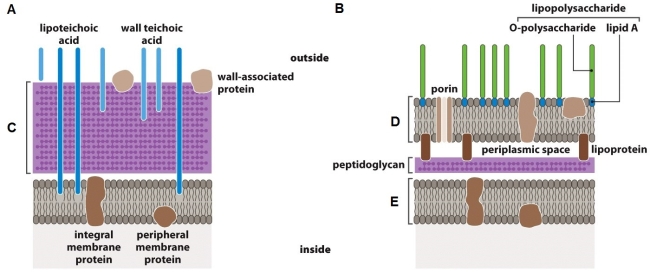
In the figure which letter (A to E)indicates a Gram-negative cell portion?
In the figure which letter (A to E)indicates a Gram-negative cell portion?
Question
Question
Question
Question
Use the figure below to answer the following questions.
In the figure which letter (A to E)indicates the structure that contains the electron transport system?
In the figure which letter (A to E)indicates the structure that contains the electron transport system?
Question
Question
Question
Question
Question
Question
Use the figure below to answer the following questions.
In the figure which letter (A to E)indicates the structure that permanently stains with crystal violet?
In the figure which letter (A to E)indicates the structure that permanently stains with crystal violet?
Question
Question
Use the figure below to answer the following questions.
In the figure which letter (A to E)indicates the structure which is impermeable to many antibiotics?
In the figure which letter (A to E)indicates the structure which is impermeable to many antibiotics?
Question
Question
Question
Question
Question
Question
Question
Question
Question
Question
Question
Question
Question
Question
Question
Question
Question

Unlock Deck
Sign up to unlock the cards in this deck!
Unlock Deck
Unlock Deck
1/51

Play

Full screen (f)
Deck 9: The Clinical Significance of Bacterial Anatomy
1
A feature that distinguishes slime layers from capsules is that
A)Only capsules are secreted exterior to the cell wall
B)Only slime layers are composed of polysaccharides
C)Slime layers adhere loosely to the cell wall
D)Only slime layers inhibit phagocytosis
E)Only capsules are used for cellular motility
A)Only capsules are secreted exterior to the cell wall
B)Only slime layers are composed of polysaccharides
C)Slime layers adhere loosely to the cell wall
D)Only slime layers inhibit phagocytosis
E)Only capsules are used for cellular motility
Slime layers adhere loosely to the cell wall
2
Comparing eukaryotic to prokaryotic electron transport,only eukaryotic electron transport
A)Yields energy to generate ATP
B)Produces more energy than glycolysis
C)Occurs in the plasma membrane
D)Occurs in the mitochondria
E)Uses FAD and NAD
A)Yields energy to generate ATP
B)Produces more energy than glycolysis
C)Occurs in the plasma membrane
D)Occurs in the mitochondria
E)Uses FAD and NAD
Occurs in the mitochondria
3
The outer membrane is found in _____ bacteria and is composed of _____.
A)Gram-positive; lipopolysaccharide, lipoprotein, and phospholipid
B)Gram-negative; lipopolysaccharide, lipoprotein, and phospholipid
C)Gram-positive; teichoic acid and lipoteichoic acid
D)Gram-negative; teichoic acid and lipoteichoic acid
A)Gram-positive; lipopolysaccharide, lipoprotein, and phospholipid
B)Gram-negative; lipopolysaccharide, lipoprotein, and phospholipid
C)Gram-positive; teichoic acid and lipoteichoic acid
D)Gram-negative; teichoic acid and lipoteichoic acid
Gram-negative; lipopolysaccharide, lipoprotein, and phospholipid
4
Which of the following is correctly matched?
A)Gram-positive cell wall: diaminopimelic acid
B)Gram-positive cell wall: many layers of peptidoglycan
C)Gram-negative cell wall: glycine-glycine bridges
D)Gram-negative cell wall: teichoic acid
E)Gram-positive cell wall: endotoxin
A)Gram-positive cell wall: diaminopimelic acid
B)Gram-positive cell wall: many layers of peptidoglycan
C)Gram-negative cell wall: glycine-glycine bridges
D)Gram-negative cell wall: teichoic acid
E)Gram-positive cell wall: endotoxin
Unlock Deck
Unlock for access to all 51 flashcards in this deck.
Unlock Deck
k this deck
5
Which of the following does not describe O polysaccharides?
A)They are a component of lipopolysaccharide (LPS) in the outer membrane of Gram-negative bacteria
B)They provoke poor immune responses
C)They are used by epidemiologists to identify outbreaks caused by the same strain of bacteria
D)They are carbohydrate chains that face outwards and are therefore accessible to host defenses
E)They are found in Gram-negative bacteria
A)They are a component of lipopolysaccharide (LPS) in the outer membrane of Gram-negative bacteria
B)They provoke poor immune responses
C)They are used by epidemiologists to identify outbreaks caused by the same strain of bacteria
D)They are carbohydrate chains that face outwards and are therefore accessible to host defenses
E)They are found in Gram-negative bacteria
Unlock Deck
Unlock for access to all 51 flashcards in this deck.
Unlock Deck
k this deck
6
Which of the following is true of both fimbriae and pili?
A)They are involved with adherence
B)They are the same length
C)Both are needed for bacterial conjugation
D)They are made only by Gram-positive bacteria
E)Their retraction aids in motility
A)They are involved with adherence
B)They are the same length
C)Both are needed for bacterial conjugation
D)They are made only by Gram-positive bacteria
E)Their retraction aids in motility
Unlock Deck
Unlock for access to all 51 flashcards in this deck.
Unlock Deck
k this deck
7
Gram-positive bacteria possess how many pair(s)of rings anchoring the flagellum to the plasma membrane?
A)One
B)Two
C)Three
D)Four
A)One
B)Two
C)Three
D)Four
Unlock Deck
Unlock for access to all 51 flashcards in this deck.
Unlock Deck
k this deck
8
Which host cell components provide bacteria with intracellular and intercellular movement within and between host cells?
A)Axial filaments
B)Integral proteins
C)Permease
D)ABC transport systems
E)Cytoskeletal structures
A)Axial filaments
B)Integral proteins
C)Permease
D)ABC transport systems
E)Cytoskeletal structures
Unlock Deck
Unlock for access to all 51 flashcards in this deck.
Unlock Deck
k this deck
9
Which is not an example of the way Neisseria use basal body pili modification during an infection?
A)Secretion of S pili
B)Post-translational modification
C)Phase variation
D)Secretion of pili-specific proteases
E)Antigenic variation
A)Secretion of S pili
B)Post-translational modification
C)Phase variation
D)Secretion of pili-specific proteases
E)Antigenic variation
Unlock Deck
Unlock for access to all 51 flashcards in this deck.
Unlock Deck
k this deck
10
Which of the following is a mismatched pair?
A)Fosfomycin: inhibition of cytoplasmic phase of cell wall formation
B)Lipid A: endotoxin
C)M protein: Streptococcus pyogenes
D)Gram-positive cell wall: teichoic acid
E)Bacitracin: inhibition of extra-cytoplasmic phase of cell wall formation
A)Fosfomycin: inhibition of cytoplasmic phase of cell wall formation
B)Lipid A: endotoxin
C)M protein: Streptococcus pyogenes
D)Gram-positive cell wall: teichoic acid
E)Bacitracin: inhibition of extra-cytoplasmic phase of cell wall formation
Unlock Deck
Unlock for access to all 51 flashcards in this deck.
Unlock Deck
k this deck
11
Starting from the inside of the cell,what is the order of prokaryotic cell structures?
A)Hook, filament, basal body, and outer ring
B)Basal body, outer ring, hook, filament
C)Outer ring, filament, basal body, hook
D)Filament, hook, outer ring basal body
A)Hook, filament, basal body, and outer ring
B)Basal body, outer ring, hook, filament
C)Outer ring, filament, basal body, hook
D)Filament, hook, outer ring basal body
Unlock Deck
Unlock for access to all 51 flashcards in this deck.
Unlock Deck
k this deck
12
All of the following participate in adherence except
A)Slime layers
B)Axial filaments
C)Fimbriae
D)Pili
E)Capsules
A)Slime layers
B)Axial filaments
C)Fimbriae
D)Pili
E)Capsules
Unlock Deck
Unlock for access to all 51 flashcards in this deck.
Unlock Deck
k this deck
13
A waxy substance called _____ is part of the cell wall of Mycobacterium spp.
A)Mycolic acid
B)M protein
C)Lipid A
D)Lipoteichoic acid
E)The slime layer
A)Mycolic acid
B)M protein
C)Lipid A
D)Lipoteichoic acid
E)The slime layer
Unlock Deck
Unlock for access to all 51 flashcards in this deck.
Unlock Deck
k this deck
14
Gram-positive bacteria have a net negative charge on their surface as a result of the presence of
A)Lipopolysaccharide in the cell wall
B)Porins in the plasma membrane
C)An outer membrane
D)Teichoic acid molecules in the cell wall
E)M proteins in the cell wall
A)Lipopolysaccharide in the cell wall
B)Porins in the plasma membrane
C)An outer membrane
D)Teichoic acid molecules in the cell wall
E)M proteins in the cell wall
Unlock Deck
Unlock for access to all 51 flashcards in this deck.
Unlock Deck
k this deck
15
Bacterial conjugation is a process in which
A)Genetic material is transferred from a donor to a recipient by means of a pilus
B)The host binds to the surface of the bacterium and then ingests it by phagocytosis
C)Biofilms form through glycocalyx formation
D)End flagella rotate and move the bacterium in a corkscrew motion
E)Nutrients are transported to the cytoplasm down a concentration gradient
A)Genetic material is transferred from a donor to a recipient by means of a pilus
B)The host binds to the surface of the bacterium and then ingests it by phagocytosis
C)Biofilms form through glycocalyx formation
D)End flagella rotate and move the bacterium in a corkscrew motion
E)Nutrients are transported to the cytoplasm down a concentration gradient
Unlock Deck
Unlock for access to all 51 flashcards in this deck.
Unlock Deck
k this deck
16
A bacterium with a tuft of flagella at one end of the cell has _____ flagella.
A)Peritrichous
B)Amphitrichous
C)Lophotrichous
D)Monotrichous
A)Peritrichous
B)Amphitrichous
C)Lophotrichous
D)Monotrichous
Unlock Deck
Unlock for access to all 51 flashcards in this deck.
Unlock Deck
k this deck
17
Which of the following is not a characteristic of the bacterial cell wall?
A)It protects from differences in osmolarity between intracellular and extracellular environments
B)It uses non-covalent bonds, permitting rapid synthesis during active growth periods
C)It is made, in part, of a peptidoglycan backbone
D)It is synthesized using enzymes such as transglycosylase, transpeptidase, polymerase, and hydrolase
E)Its synthesis is inhibited by the antibiotic fosfomycin
A)It protects from differences in osmolarity between intracellular and extracellular environments
B)It uses non-covalent bonds, permitting rapid synthesis during active growth periods
C)It is made, in part, of a peptidoglycan backbone
D)It is synthesized using enzymes such as transglycosylase, transpeptidase, polymerase, and hydrolase
E)Its synthesis is inhibited by the antibiotic fosfomycin
Unlock Deck
Unlock for access to all 51 flashcards in this deck.
Unlock Deck
k this deck
18
Treponema pallidum,the causative agent of syphilis,is able to bore through tissues by using
A)S pili
B)Flagella
C)Hooks
D)Axial filaments
E)Integral proteins
A)S pili
B)Flagella
C)Hooks
D)Axial filaments
E)Integral proteins
Unlock Deck
Unlock for access to all 51 flashcards in this deck.
Unlock Deck
k this deck
19
Which of the following is not a function of the plasma membrane?
A)Secretion
B)Protection from osmotic pressure
C)Energy production
D)DNA replication
E)Transport
A)Secretion
B)Protection from osmotic pressure
C)Energy production
D)DNA replication
E)Transport
Unlock Deck
Unlock for access to all 51 flashcards in this deck.
Unlock Deck
k this deck
20
A barrier to water is achieved in the interior of the plasma membrane by orienting the _____ of the phospholipid layers toward each other.
A)Hydrophobic tails
B)Hydrophobic heads
C)Hydrophilic tails
D)Hydrophilic heads
E)Integral proteins
A)Hydrophobic tails
B)Hydrophobic heads
C)Hydrophilic tails
D)Hydrophilic heads
E)Integral proteins
Unlock Deck
Unlock for access to all 51 flashcards in this deck.
Unlock Deck
k this deck
21
Predict what would happen if the bacterial efflux pumps fail.
A)Uptake of glucose would be inhibited
B)The cell will become less antibiotic resistant
C)The high-energy phosphate, PEP, will build up in the cell
D)Osmosis will slow
E)Osmosis will accelerate
A)Uptake of glucose would be inhibited
B)The cell will become less antibiotic resistant
C)The high-energy phosphate, PEP, will build up in the cell
D)Osmosis will slow
E)Osmosis will accelerate
Unlock Deck
Unlock for access to all 51 flashcards in this deck.
Unlock Deck
k this deck
22
Use the figure below to answer the following questions.
In the figure which letter (A to E)indicates a Gram-negative cell portion?
In the figure which letter (A to E)indicates a Gram-negative cell portion?
Unlock Deck
Unlock for access to all 51 flashcards in this deck.
Unlock Deck
k this deck
23
Answer true or false to the following statement: Teichoic acid is a glycoprotein that can be found in two forms: wall teichoic acid and lipoteichoic acid.
Unlock Deck
Unlock for access to all 51 flashcards in this deck.
Unlock Deck
k this deck
24
Answer true or false to the following statement: The cell wall is thicker in Gram-positive bacteria than in Gram-negative ones.
Unlock Deck
Unlock for access to all 51 flashcards in this deck.
Unlock Deck
k this deck
25
Which of the following transport mechanisms uses phosphoenolpyruvate (PEP)as an energy source to facilitate solute transport across the plasma membrane?
A)Efflux pumping
B)Facilitated diffusion
C)Passive transport
D)Group translocation
E)ABC transport system
A)Efflux pumping
B)Facilitated diffusion
C)Passive transport
D)Group translocation
E)ABC transport system
Unlock Deck
Unlock for access to all 51 flashcards in this deck.
Unlock Deck
k this deck
26
Use the figure below to answer the following questions.
In the figure which letter (A to E)indicates the structure that contains the electron transport system?
In the figure which letter (A to E)indicates the structure that contains the electron transport system?
Unlock Deck
Unlock for access to all 51 flashcards in this deck.
Unlock Deck
k this deck
27
The _____ store(s)materials required by bacteria.
A)Inclusion bodies
B)Glycocalyx
C)Plasmids
D)Peptidoglycan
E)Endospore
A)Inclusion bodies
B)Glycocalyx
C)Plasmids
D)Peptidoglycan
E)Endospore
Unlock Deck
Unlock for access to all 51 flashcards in this deck.
Unlock Deck
k this deck
28
What is the process by which bacteria in a dormant spore state return to the vegetative state?
A)Translation
B)Group translocation
C)Germination
D)Conjugation
E)Sporulation
A)Translation
B)Group translocation
C)Germination
D)Conjugation
E)Sporulation
Unlock Deck
Unlock for access to all 51 flashcards in this deck.
Unlock Deck
k this deck
29
Answer true or false to the following statement: Mycobacterium species incorporate mycolic acid (a waxy substance)in their cell walls,which makes them resistant to antibiotics.
Unlock Deck
Unlock for access to all 51 flashcards in this deck.
Unlock Deck
k this deck
30
Osmosis is a function of plasma membranes that allows which of the following to cross the membrane.
A)Proteins
B)Water
C)DNA
D)RNA
E)Polysaccharide
A)Proteins
B)Water
C)DNA
D)RNA
E)Polysaccharide
Unlock Deck
Unlock for access to all 51 flashcards in this deck.
Unlock Deck
k this deck
31
Answer true or false to the following statement: Gram-negative organisms contain teichoic acid
Unlock Deck
Unlock for access to all 51 flashcards in this deck.
Unlock Deck
k this deck
32
Use the figure below to answer the following questions.
In the figure which letter (A to E)indicates the structure that permanently stains with crystal violet?
In the figure which letter (A to E)indicates the structure that permanently stains with crystal violet?
Unlock Deck
Unlock for access to all 51 flashcards in this deck.
Unlock Deck
k this deck
33
Protein synthesis requires particles called _____,which perform the process of_____.
A)Ribosomes; translation
B)Endospore; germination
C)Inclusion bodies; group translocation
D)Capsule; conjugation
E)Plasmids; DNA replication
A)Ribosomes; translation
B)Endospore; germination
C)Inclusion bodies; group translocation
D)Capsule; conjugation
E)Plasmids; DNA replication
Unlock Deck
Unlock for access to all 51 flashcards in this deck.
Unlock Deck
k this deck
34
Use the figure below to answer the following questions.
In the figure which letter (A to E)indicates the structure which is impermeable to many antibiotics?
In the figure which letter (A to E)indicates the structure which is impermeable to many antibiotics?
Unlock Deck
Unlock for access to all 51 flashcards in this deck.
Unlock Deck
k this deck
35
Which of the following is not an example of active transport?
A)Group translocation
B)Efflux pumping
C)Simple diffusion
D)ABC transport systems
E)ATP dependent diffusion
A)Group translocation
B)Efflux pumping
C)Simple diffusion
D)ABC transport systems
E)ATP dependent diffusion
Unlock Deck
Unlock for access to all 51 flashcards in this deck.
Unlock Deck
k this deck
36
What is clipped from proteins as they are secreted from the cell?
A)Inclusion body
B)Signal sequence
C)Endospore
D)Porin
E)Glycocalyx
A)Inclusion body
B)Signal sequence
C)Endospore
D)Porin
E)Glycocalyx
Unlock Deck
Unlock for access to all 51 flashcards in this deck.
Unlock Deck
k this deck
37
Answer true or false to the following statement: Some Gram-negative bacteria incorporate virulence factors known as M proteins in their cell walls.
Unlock Deck
Unlock for access to all 51 flashcards in this deck.
Unlock Deck
k this deck
38
Answer true or false to the following statement: Lipoteichoic acid is involved with the production of inflammation.
Unlock Deck
Unlock for access to all 51 flashcards in this deck.
Unlock Deck
k this deck
39
Which of the following does not use a membrane-bound molecule to facilitate the transfer of molecules across the plasma membrane?
A)ABC transport system
B)Active transport
C)Efflux pumping
D)Group translocation
E)Simple diffusion
A)ABC transport system
B)Active transport
C)Efflux pumping
D)Group translocation
E)Simple diffusion
Unlock Deck
Unlock for access to all 51 flashcards in this deck.
Unlock Deck
k this deck
40
Facilitated diffusion requires
A)A permease
B)A hypotonic solution
C)The expenditure of energy
D)An ATP-binding cassette
E)A high-energy molecule such as phosphoenolpyruvate (PEP)
A)A permease
B)A hypotonic solution
C)The expenditure of energy
D)An ATP-binding cassette
E)A high-energy molecule such as phosphoenolpyruvate (PEP)
Unlock Deck
Unlock for access to all 51 flashcards in this deck.
Unlock Deck
k this deck
41
Describe the strategy used by Neisseria species for immune escape involving pili.
Unlock Deck
Unlock for access to all 51 flashcards in this deck.
Unlock Deck
k this deck
42
Explain what happens to a solute when it is transported across a membrane by using the group translocation method.
Unlock Deck
Unlock for access to all 51 flashcards in this deck.
Unlock Deck
k this deck
43
Answer true or false to the following statement: The outer layer of Gram-negative organisms functions as an exotoxin.
Unlock Deck
Unlock for access to all 51 flashcards in this deck.
Unlock Deck
k this deck
44
Some bacteria incorporate chemical entities into their cell walls that contribute to virulence.Provide three examples and explain why these molecules increase the virulence of these bacteria.
Unlock Deck
Unlock for access to all 51 flashcards in this deck.
Unlock Deck
k this deck
45
Name the three phases of peptidoglycan synthesis and briefly describe the events that take place during each phase.
Unlock Deck
Unlock for access to all 51 flashcards in this deck.
Unlock Deck
k this deck
46
Explain why endospores are attractive agents for bioterrorism.Provide an example.
Unlock Deck
Unlock for access to all 51 flashcards in this deck.
Unlock Deck
k this deck
47
Answer true or false to the following statement: The bacterial outer membrane is permeable to most antibiotics.
Unlock Deck
Unlock for access to all 51 flashcards in this deck.
Unlock Deck
k this deck
48
Which disease is caused by Treponema pallidum? Explain which characteristics enable this bacterium to enter the body through epithelia of the genitourinary tract but end up in the central nervous system.
Unlock Deck
Unlock for access to all 51 flashcards in this deck.
Unlock Deck
k this deck
49
What is the function of the bacterial flagellum? Describe the three components of a flagellum and the four distinct patterns of flagella arrangement.Provide a brief explanation of each pattern.
Unlock Deck
Unlock for access to all 51 flashcards in this deck.
Unlock Deck
k this deck
50
Describe two types of passive transport.Explain how they are similar and different from each other.
Unlock Deck
Unlock for access to all 51 flashcards in this deck.
Unlock Deck
k this deck
51
You are examining a blood agar plate that contains colonies exhibiting a wet,sticky appearance.Explain what characteristic of bacteria gives rise to this feature and why it can be problematic in the host during an infection.
Unlock Deck
Unlock for access to all 51 flashcards in this deck.
Unlock Deck
k this deck
Unlock Deck
Unlock for access to all 51 flashcards in this deck.






