







 Chat with AI

Deck 54: Biodiversity and Conservation Biology
Full screen (f)

Question
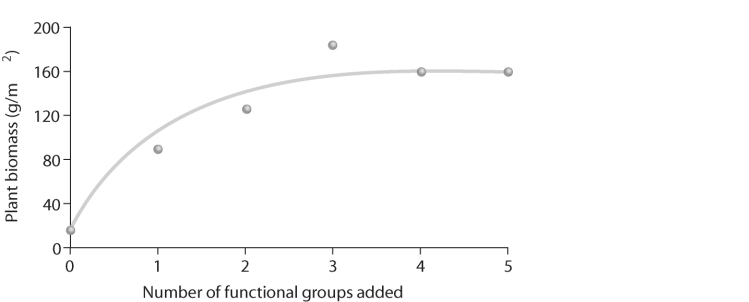 Figure 54.4
Hypothesis: Productivity increases with species richness because certain species or functional groups facilitate the growth of other species by providing them with nutrients, partial shade, or other benefits. In looking at the data in Figure 54.4, how would you relate it to this hypothesis?
A) The data do not relate to the hypothesis given.
B) The hypothesis is partially supported.
C) The hypothesis is rejected.
D) The hypothesis is proven.
E) The hypothesis is supported.

Question
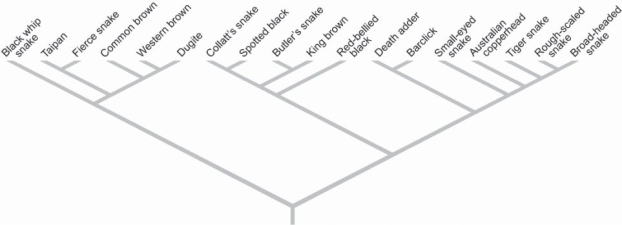 Figure 54.2
Based on how you would go about measuring biodiversity, which of the following is true?
A) The most intensively studied lineages are vertebrates.
B) The easiest animals to study are the insects.
C) Bacteria are among the easiest to count regarding numbers of different species.
D) Species in the tropics are much easier to study than species in other biomes.
Question
Question
Question
Question
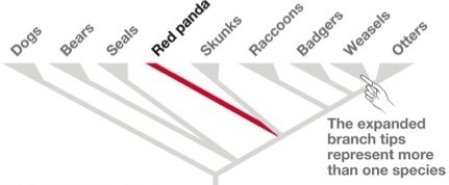 Figure 54.1
Dogs ~43 Bears ~19 Seals ~36
Red Panda ~1 Skunks ~13 Raccoons ~15 Badgers ~10 Weasels ~38 Otters ~8
According to the figure above, which of the following groups is particularly important to preserve?
A) Weasels
B) Dogs
C) Red Panda
D) Raccoons
Question
Figure 54.1Dogs ~43 Bears ~19 Seals ~36
Red Panda ~1 Skunks ~13 Raccoons ~15 Badgers ~10 Weasels ~38 Otters ~8
Why is it important to preserve the tuataras see Figure 54.1)?
A) The group has very few representatives of its lineage.
B) The group is economically important.
C) The group is particularly sensitive to environmental disturbances.
D) The group has low genetic diversity.
Question
Figure 54.2By knowing the interrelatedness of various snake species, the type of antivenom can be chosen depending on the species involved in the bite. Based on Figure 54.2, which snake antivenom would you administer to a person bitten by an Australian copperhead?
A) taipan
B) red- bellied black snake
C) tiger snake
D) death adder
E) common brown snake
Question
Question
Question
Question
Question
Question
Question
Question
Question
Question
Figure 54.2Based on Figure 54.2, what snake antivenom would you administer to a person bitten by a king brown snake?
A) death adder
B) common brown snake
C) tiger snake
D) red- bellied black snake
E) taipan
Question
Question
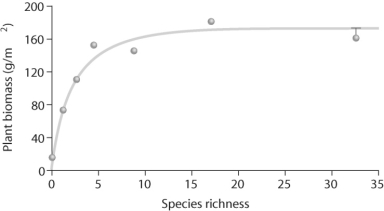 Figure 54.3
Upon looking at Figure 54.3 regarding Tilman's experiments, what can you conclude about the data?
A) As species richness increases, plant biomass increases.
B) As species richness changes, plant biomass remains consistent.
C) As species richness decreases, plant biomass increases.
D) As species richness increases, plant biomass increases and then levels off.
Question
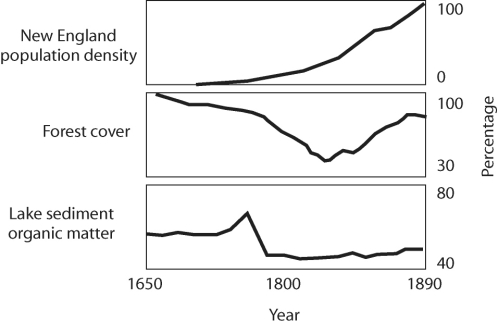 Figure 54.9
-Based on Figure 54.9, what can you conclude about land- use legacy in New England?
A) Sediment spikes correlate with massive population growth.
B) A spike in lake sediments caused massive deforestation due to loss of soil nutrients.
C) Lake sediments reflect deforestation and despite reforestation, do not recover.
D) Population growth has increasingly devastated the forests.
E) All of the above answers apply.
Question
Question
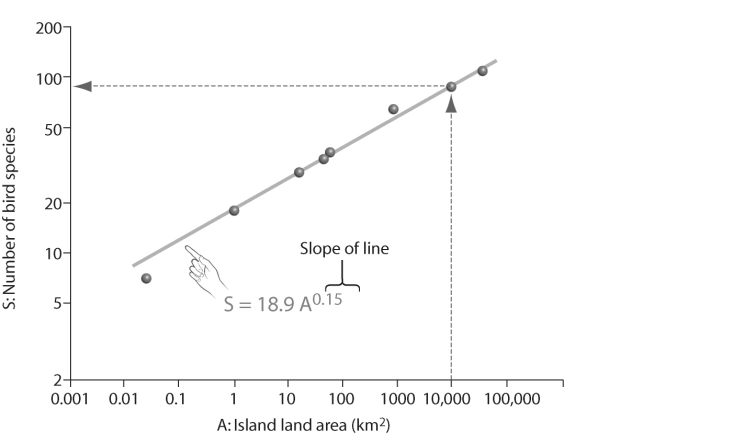 Figure 54.7
-Based on the species- area plot in the figure above, if habitable area on an island were reduced from 10,000 km2 to 1,000 km2, roughly what percentage of the species would disappear?
A) 0.3%
B) 3%
C) 30%
D) 60%
Question
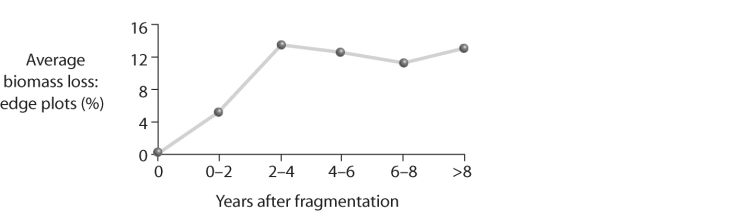 Figure 54.6
In looking at the figure above, what can be said about edge effects?
A) Biomass increases along the edges of forest fragments.
B) Fragmentation does not affect biomass.
C) Biomass declines sharply along edges of forest fragments.
D) Species diversity decreases along the edges of forest fragments.
Question
Question
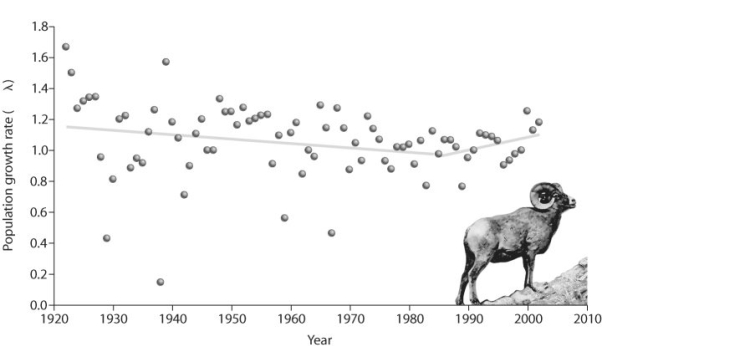 Figure 54.5
According to the figure above, what is occurring after 1985?
A) The sheep are climbing a hill.
B) The population is increasing.
C) The population growth rate is increasing.
D) The population is increasing exponentially.
Question
Figure 54.7In looking at the species- area plot in the figure above, what can be concluded?
A) Number of bird species increases exponentially with island area.
B) Diversity is independent from island area.
C) Number of bird species is different on various islands.
D) Number of bird species increases linearly with island area.
Question
Question
Question
Question
Question
Question
Question
Use the following information when answering the corresponding questions).
Abstract:
Recognition of the importance of land- use legacies in most ecological systems has been a major factor driving the recent focus on human activity as a legitimate and essential subject of environmental science. Ecologists, conservationists, and natural resource policy makers now recognize that the legacies of land- use activities continue to influence ecosystem structure and function for decades or centuries-or even longer-after those activities have ceased. Copyright © 2003 American Institute of Biological Sciences. Foster, D.R., F. Swanson, J. Aber, D. Tilman, N. Brockaw, I. Burke and A Knapp. 2003. The importance of land- use and its legacies to ecology and environmental management. BioScience 53:77- 88.)
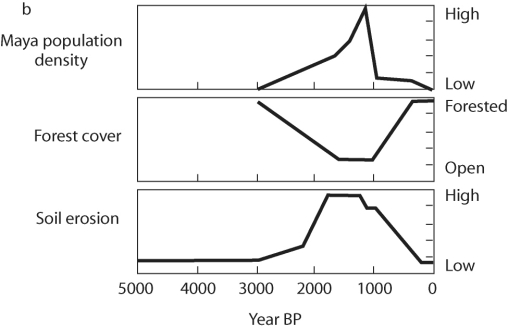 Figure 54.8
-Based on the figure above, what can you conclude about land- use legacy in the southern Yucatán?
A) Massive soil erosion caused the Mayan population to crash.
B) As Mayan population increased, deforestation increased, leading to increased soil erosion.
C) Reduction in forest cover caused the Mayan population to crash.
D) All of the above answers are correct.
Abstract:
Recognition of the importance of land- use legacies in most ecological systems has been a major factor driving the recent focus on human activity as a legitimate and essential subject of environmental science. Ecologists, conservationists, and natural resource policy makers now recognize that the legacies of land- use activities continue to influence ecosystem structure and function for decades or centuries-or even longer-after those activities have ceased. Copyright © 2003 American Institute of Biological Sciences. Foster, D.R., F. Swanson, J. Aber, D. Tilman, N. Brockaw, I. Burke and A Knapp. 2003. The importance of land- use and its legacies to ecology and environmental management. BioScience 53:77- 88.)
Figure 54.8-Based on the figure above, what can you conclude about land- use legacy in the southern Yucatán?
A) Massive soil erosion caused the Mayan population to crash.
B) As Mayan population increased, deforestation increased, leading to increased soil erosion.
C) Reduction in forest cover caused the Mayan population to crash.
D) All of the above answers are correct.
Question
Question
Question
Question

Unlock Deck
Sign up to unlock the cards in this deck!
Unlock Deck
Unlock Deck
1/38

Play

Full screen (f)
Deck 54: Biodiversity and Conservation Biology
1
Figure 54.4Hypothesis: Productivity increases with species richness because certain species or functional groups facilitate the growth of other species by providing them with nutrients, partial shade, or other benefits. In looking at the data in Figure 54.4, how would you relate it to this hypothesis?
A) The data do not relate to the hypothesis given.
B) The hypothesis is partially supported.
C) The hypothesis is rejected.
D) The hypothesis is proven.
E) The hypothesis is supported.
B
2
Figure 54.2Based on how you would go about measuring biodiversity, which of the following is true?
A) The most intensively studied lineages are vertebrates.
B) The easiest animals to study are the insects.
C) Bacteria are among the easiest to count regarding numbers of different species.
D) Species in the tropics are much easier to study than species in other biomes.
A
3
During the inventory of bacterial genes present in the Sargasso Sea, a research team concluded that at least 1800 bacterial species were discovered. Based on what you know about this area, what would expect to see in coral reef waters?
A) markedly greater genetic diversity
B) slightly greater genetic diversity
C) slightly smaller genetic diversity
D) markedly smaller genetic diversity
E) equal genetic diversity
A) markedly greater genetic diversity
B) slightly greater genetic diversity
C) slightly smaller genetic diversity
D) markedly smaller genetic diversity
E) equal genetic diversity
A
4
In a debate about the destruction of tropical wet forests, the arguments keep focussing on biodiversity and how this affects the animals themselves, as well as the ecosystem. What is one direct benefit of biodiversity to humans that you can argue to help people understand why these forests need to be preserved?
A) This diversity could contain undocumented insect species.
B) The diversity could contain a new crop plant for agriculture.
C) The areas could be visited by tourists for profit.
D) The diversity could contain novel drugs for consumers.
A) This diversity could contain undocumented insect species.
B) The diversity could contain a new crop plant for agriculture.
C) The areas could be visited by tourists for profit.
D) The diversity could contain novel drugs for consumers.
Unlock Deck
Unlock for access to all 38 flashcards in this deck.
Unlock Deck
k this deck
5
How can biodiversity affect the way we decontaminate industrial sites?
A) Trees produce sawdust, which can be used to soak up chemicals.
B) Bacteria have been found to be able to detoxify certain chemicals; perhaps there are more.
C) Species evolving in contaminated areas could adapt and detoxify the area.
D) None of the answers given is correct.
A) Trees produce sawdust, which can be used to soak up chemicals.
B) Bacteria have been found to be able to detoxify certain chemicals; perhaps there are more.
C) Species evolving in contaminated areas could adapt and detoxify the area.
D) None of the answers given is correct.
Unlock Deck
Unlock for access to all 38 flashcards in this deck.
Unlock Deck
k this deck
6
Figure 54.1Dogs ~43 Bears ~19 Seals ~36
Red Panda ~1 Skunks ~13 Raccoons ~15 Badgers ~10 Weasels ~38 Otters ~8
According to the figure above, which of the following groups is particularly important to preserve?
A) Weasels
B) Dogs
C) Red Panda
D) Raccoons
Unlock Deck
Unlock for access to all 38 flashcards in this deck.
Unlock Deck
k this deck
7
Figure 54.1Dogs ~43 Bears ~19 Seals ~36
Red Panda ~1 Skunks ~13 Raccoons ~15 Badgers ~10 Weasels ~38 Otters ~8
Why is it important to preserve the tuataras see Figure 54.1)?
A) The group has very few representatives of its lineage.
B) The group is economically important.
C) The group is particularly sensitive to environmental disturbances.
D) The group has low genetic diversity.
Unlock Deck
Unlock for access to all 38 flashcards in this deck.
Unlock Deck
k this deck
8
Figure 54.2By knowing the interrelatedness of various snake species, the type of antivenom can be chosen depending on the species involved in the bite. Based on Figure 54.2, which snake antivenom would you administer to a person bitten by an Australian copperhead?
A) taipan
B) red- bellied black snake
C) tiger snake
D) death adder
E) common brown snake
Unlock Deck
Unlock for access to all 38 flashcards in this deck.
Unlock Deck
k this deck
9
Philippe Bouchet and colleagues conducted a massive survey of marine molluscs on the west coast of New Caledonia. Twenty percent of the species found were represented by a single specimen. What does that suggest about the diversity of molluscs in this area?
A) They did not look very hard for those 20 percent.
B) Many of the species from this 20 percent are probably rare.
C) There are only a few species of molluscs in the area.
D) Most of the species from this 20 percent are quite common.
A) They did not look very hard for those 20 percent.
B) Many of the species from this 20 percent are probably rare.
C) There are only a few species of molluscs in the area.
D) Most of the species from this 20 percent are quite common.
Unlock Deck
Unlock for access to all 38 flashcards in this deck.
Unlock Deck
k this deck
10
Ecosystems services include processes that increase the quality of the abiotic environment. Which of the following processes would not fall under this category?
A) The presence of land plants builds soil.
B) The presence of diverse wetlands helps in flood control.
C) Green plants produce the oxygen we breathe.
D) Keystone predators have a marked effect on species diversity.
A) The presence of land plants builds soil.
B) The presence of diverse wetlands helps in flood control.
C) Green plants produce the oxygen we breathe.
D) Keystone predators have a marked effect on species diversity.
Unlock Deck
Unlock for access to all 38 flashcards in this deck.
Unlock Deck
k this deck
11
Approximately how many species have we described out of the species alive today?
A) We have described about half of the species on Earth.
B) Apart from the tropics, we have described almost all the species on Earth.
C) We have described only a small fraction of the species on Earth.
D) We have described almost all of the species on Earth.
A) We have described about half of the species on Earth.
B) Apart from the tropics, we have described almost all the species on Earth.
C) We have described only a small fraction of the species on Earth.
D) We have described almost all of the species on Earth.
Unlock Deck
Unlock for access to all 38 flashcards in this deck.
Unlock Deck
k this deck
12
If the last remaining population of a particular bird species were all highly related, which type of diversity would be of greatest concern when planning to keep the species from going extinct?
A) genetic diversity
B) species diversity
C) ecosystem diversity
D) Both A and B
E) Both B and C
A) genetic diversity
B) species diversity
C) ecosystem diversity
D) Both A and B
E) Both B and C
Unlock Deck
Unlock for access to all 38 flashcards in this deck.
Unlock Deck
k this deck
13
Erwin and Scott used an insecticidal fog to knock down insects from the top of a L. seemannii tree. The researchers identified over 900 species of beetles among the individuals that fell. Erwin also projected that this entire tree is host to about 600 specialist arthropods. There are approximately 50,000 species of tropical trees. Although it could not be entirely accurate, what would be the best way to estimate the total number of arthropod species?
A) Divide 900 by 600 and then multiply by 50,000.
B) Multiply 900 by 50,000.
C) Multiply 600 by 50,000.
D) Estimate the species density and then multiply by 50,000.
A) Divide 900 by 600 and then multiply by 50,000.
B) Multiply 900 by 50,000.
C) Multiply 600 by 50,000.
D) Estimate the species density and then multiply by 50,000.
Unlock Deck
Unlock for access to all 38 flashcards in this deck.
Unlock Deck
k this deck
14
While travelling in the Alps, you come across a butterfly that you cannot identify. You quickly find out that it is a new species. Which of the following is NOT a step in understanding the biodiversity of this new species?
A) looking at what other species are related to the new species
B) understanding the species' ecology
C) assessing the species' geographic range
D) measuring general physiology of the species
E) naming and describing the species
A) looking at what other species are related to the new species
B) understanding the species' ecology
C) assessing the species' geographic range
D) measuring general physiology of the species
E) naming and describing the species
Unlock Deck
Unlock for access to all 38 flashcards in this deck.
Unlock Deck
k this deck
15
Which of the following is the true statement regarding species diversity and taxonomic diversity?
A) The variety of species in a given area represents taxonomic diversity.
B) In taxonomic diversity, the evolutionary relationships of species in a lineage are important.
C) Species diversity measures the relative frequency of all alleles present in a species.
D) In species diversity, the numbers of animals in a particular lineage is important.
A) The variety of species in a given area represents taxonomic diversity.
B) In taxonomic diversity, the evolutionary relationships of species in a lineage are important.
C) Species diversity measures the relative frequency of all alleles present in a species.
D) In species diversity, the numbers of animals in a particular lineage is important.
Unlock Deck
Unlock for access to all 38 flashcards in this deck.
Unlock Deck
k this deck
16
Which one of the following is likely not a hotspot for birds?
A) Amazon River basin
B) Southwest United States
C) Southwest China
D) East Africa
A) Amazon River basin
B) Southwest United States
C) Southwest China
D) East Africa
Unlock Deck
Unlock for access to all 38 flashcards in this deck.
Unlock Deck
k this deck
17
With regard to the destruction of tropical forests, the focus is often on biodiversity and the impact on these ecosystems. What is a direct compelling benefit to humans that helps explain why these forests need to be preserved?
A) Natural and undisturbed areas are important wildlife habitats.
B) The plant diversity provides shade, which reduces the impact of global warming.
C) The diversity could contain novel drugs for consumers.
D) These forests produce goods for consumers such as avocado and macadamia nuts.
E) This diversity could contain undocumented insect species.
A) Natural and undisturbed areas are important wildlife habitats.
B) The plant diversity provides shade, which reduces the impact of global warming.
C) The diversity could contain novel drugs for consumers.
D) These forests produce goods for consumers such as avocado and macadamia nuts.
E) This diversity could contain undocumented insect species.
Unlock Deck
Unlock for access to all 38 flashcards in this deck.
Unlock Deck
k this deck
18
Figure 54.2Based on Figure 54.2, what snake antivenom would you administer to a person bitten by a king brown snake?
A) death adder
B) common brown snake
C) tiger snake
D) red- bellied black snake
E) taipan
Unlock Deck
Unlock for access to all 38 flashcards in this deck.
Unlock Deck
k this deck
19
Environmental sequencing has brought to light what crucial finding?
A) Individual diversity is as important as ecosystem diversity.
B) Genetic diversity is highest in the most complex ecosystems.
C) Even the world's simplest ecosystems contain an enormous amount of genetic diversity.
D) Genetic diversity is very difficult to detect in small ecosystems.
A) Individual diversity is as important as ecosystem diversity.
B) Genetic diversity is highest in the most complex ecosystems.
C) Even the world's simplest ecosystems contain an enormous amount of genetic diversity.
D) Genetic diversity is very difficult to detect in small ecosystems.
Unlock Deck
Unlock for access to all 38 flashcards in this deck.
Unlock Deck
k this deck
20
Figure 54.3Upon looking at Figure 54.3 regarding Tilman's experiments, what can you conclude about the data?
A) As species richness increases, plant biomass increases.
B) As species richness changes, plant biomass remains consistent.
C) As species richness decreases, plant biomass increases.
D) As species richness increases, plant biomass increases and then levels off.
Unlock Deck
Unlock for access to all 38 flashcards in this deck.
Unlock Deck
k this deck
21
Figure 54.9-Based on Figure 54.9, what can you conclude about land- use legacy in New England?
A) Sediment spikes correlate with massive population growth.
B) A spike in lake sediments caused massive deforestation due to loss of soil nutrients.
C) Lake sediments reflect deforestation and despite reforestation, do not recover.
D) Population growth has increasingly devastated the forests.
E) All of the above answers apply.
Unlock Deck
Unlock for access to all 38 flashcards in this deck.
Unlock Deck
k this deck
22
The main focus in combating loss of biodiversity is
A) transportation.
B) habitat fragmentation.
C) industrialization.
D) habitat destruction.
A) transportation.
B) habitat fragmentation.
C) industrialization.
D) habitat destruction.
Unlock Deck
Unlock for access to all 38 flashcards in this deck.
Unlock Deck
k this deck
23
Figure 54.7-Based on the species- area plot in the figure above, if habitable area on an island were reduced from 10,000 km2 to 1,000 km2, roughly what percentage of the species would disappear?
A) 0.3%
B) 3%
C) 30%
D) 60%
Unlock Deck
Unlock for access to all 38 flashcards in this deck.
Unlock Deck
k this deck
24
Figure 54.6In looking at the figure above, what can be said about edge effects?
A) Biomass increases along the edges of forest fragments.
B) Fragmentation does not affect biomass.
C) Biomass declines sharply along edges of forest fragments.
D) Species diversity decreases along the edges of forest fragments.
Unlock Deck
Unlock for access to all 38 flashcards in this deck.
Unlock Deck
k this deck
25
During the inventory of bacterial genes present in the Sargasso Sea in the middle of the Atlantic Ocean, a research team concluded that at least 1800 bacterial species were discovered. Based on what you know about this area, what would you expect to see in coral reef waters?
A) equal genetic diversity
B) markedly smaller genetic diversity
C) markedly greater genetic diversity
D) slightly greater genetic diversity
E) slightly smaller genetic diversity
A) equal genetic diversity
B) markedly smaller genetic diversity
C) markedly greater genetic diversity
D) slightly greater genetic diversity
E) slightly smaller genetic diversity
Unlock Deck
Unlock for access to all 38 flashcards in this deck.
Unlock Deck
k this deck
26
Figure 54.5According to the figure above, what is occurring after 1985?
A) The sheep are climbing a hill.
B) The population is increasing.
C) The population growth rate is increasing.
D) The population is increasing exponentially.
Unlock Deck
Unlock for access to all 38 flashcards in this deck.
Unlock Deck
k this deck
27
Figure 54.7In looking at the species- area plot in the figure above, what can be concluded?
A) Number of bird species increases exponentially with island area.
B) Diversity is independent from island area.
C) Number of bird species is different on various islands.
D) Number of bird species increases linearly with island area.
Unlock Deck
Unlock for access to all 38 flashcards in this deck.
Unlock Deck
k this deck
28
Researchers have been studying a rare population of 87 voles in an isolated area. Ten voles from a larger population were added to this isolated population. Besides having 10 additional animals, what benefits are there to importing individuals?
A) Additional animals will bring additional competition and could hurt the population.
B) Additional animals from a distant population will likely bring genetic diversity and reduce inbreeding depression.
C) Additional animals would increase beneficial genetic drift.
D) There is no benefit other than increasing the overall population size.
A) Additional animals will bring additional competition and could hurt the population.
B) Additional animals from a distant population will likely bring genetic diversity and reduce inbreeding depression.
C) Additional animals would increase beneficial genetic drift.
D) There is no benefit other than increasing the overall population size.
Unlock Deck
Unlock for access to all 38 flashcards in this deck.
Unlock Deck
k this deck
29
A land developer is arguing with a group of ecologists. Of course the land developer wants the most land possible for building houses, but has to compromise by saving some land for animal habitat. The land developer offers 20 hectares in evenly distributed but isolated 1- hectare portions. The ecologists keep arguing for one 20 hectare area to remain intact. Why are the ecologists making this proposal?
A) The isolated hectare plots are better because they spread out the habitat.
B) The isolated plots are more vulnerable to edge effects.
C) There really is no difference; they should both work equally well.
D) The large plot will create more inbreeding in many species.
A) The isolated hectare plots are better because they spread out the habitat.
B) The isolated plots are more vulnerable to edge effects.
C) There really is no difference; they should both work equally well.
D) The large plot will create more inbreeding in many species.
Unlock Deck
Unlock for access to all 38 flashcards in this deck.
Unlock Deck
k this deck
30
According to the figure above, what is the least likely explanation for the data after 1985?
A) immigration
B) introduction of new individuals to the population
C) increased resources in the area
D) emigration
A) immigration
B) introduction of new individuals to the population
C) increased resources in the area
D) emigration
Unlock Deck
Unlock for access to all 38 flashcards in this deck.
Unlock Deck
k this deck
31
Which of the following statements regarding extinction is FALSE?
A) Extinctions can even be caused indirectly by humans.
B) Extinction occurs whether humans interfere or not.
C) Only certain species are immune from extinction.
D) Species are vanishing today faster than at any other time in Earth's history.
A) Extinctions can even be caused indirectly by humans.
B) Extinction occurs whether humans interfere or not.
C) Only certain species are immune from extinction.
D) Species are vanishing today faster than at any other time in Earth's history.
Unlock Deck
Unlock for access to all 38 flashcards in this deck.
Unlock Deck
k this deck
32
You discover, in your massive 2000- hectare forest, a species of bat that is not found anywhere else. The habitat of your bat population is designated as a protected area. What, if any, would be an advantage of removing a small number of bats and placing them in a zoo?
A) Removing bats would do too much harm to the original population.
B) Zoos offer no advantage at all to the population.
C) It is better to isolate bats into breeding groups in the wild than to put them in a zoo.
D) Some animals in the zoo could breed more readily and maybe repopulate another area.
A) Removing bats would do too much harm to the original population.
B) Zoos offer no advantage at all to the population.
C) It is better to isolate bats into breeding groups in the wild than to put them in a zoo.
D) Some animals in the zoo could breed more readily and maybe repopulate another area.
Unlock Deck
Unlock for access to all 38 flashcards in this deck.
Unlock Deck
k this deck
33
What is true concerning the high consumption of fossil fuels?
A) It affects biodiversity both directly and indirectly via climate change.
B) It affects biodiversity by directly harming species.
C) It affects biodiversity indirectly via climate change.
D) It affects biodiversity indirectly via decreases in CO2 emissions.
E) It has no effect on biodiversity.
A) It affects biodiversity both directly and indirectly via climate change.
B) It affects biodiversity by directly harming species.
C) It affects biodiversity indirectly via climate change.
D) It affects biodiversity indirectly via decreases in CO2 emissions.
E) It has no effect on biodiversity.
Unlock Deck
Unlock for access to all 38 flashcards in this deck.
Unlock Deck
k this deck
34
Use the following information when answering the corresponding questions).
Abstract:
Recognition of the importance of land- use legacies in most ecological systems has been a major factor driving the recent focus on human activity as a legitimate and essential subject of environmental science. Ecologists, conservationists, and natural resource policy makers now recognize that the legacies of land- use activities continue to influence ecosystem structure and function for decades or centuries-or even longer-after those activities have ceased. Copyright © 2003 American Institute of Biological Sciences. Foster, D.R., F. Swanson, J. Aber, D. Tilman, N. Brockaw, I. Burke and A Knapp. 2003. The importance of land- use and its legacies to ecology and environmental management. BioScience 53:77- 88.)
Figure 54.8
-Based on the figure above, what can you conclude about land- use legacy in the southern Yucatán?
A) Massive soil erosion caused the Mayan population to crash.
B) As Mayan population increased, deforestation increased, leading to increased soil erosion.
C) Reduction in forest cover caused the Mayan population to crash.
D) All of the above answers are correct.
Abstract:
Recognition of the importance of land- use legacies in most ecological systems has been a major factor driving the recent focus on human activity as a legitimate and essential subject of environmental science. Ecologists, conservationists, and natural resource policy makers now recognize that the legacies of land- use activities continue to influence ecosystem structure and function for decades or centuries-or even longer-after those activities have ceased. Copyright © 2003 American Institute of Biological Sciences. Foster, D.R., F. Swanson, J. Aber, D. Tilman, N. Brockaw, I. Burke and A Knapp. 2003. The importance of land- use and its legacies to ecology and environmental management. BioScience 53:77- 88.)
Figure 54.8-Based on the figure above, what can you conclude about land- use legacy in the southern Yucatán?
A) Massive soil erosion caused the Mayan population to crash.
B) As Mayan population increased, deforestation increased, leading to increased soil erosion.
C) Reduction in forest cover caused the Mayan population to crash.
D) All of the above answers are correct.
Unlock Deck
Unlock for access to all 38 flashcards in this deck.
Unlock Deck
k this deck
35
Which of the following statements regarding species diversity is FALSE?
A) More than 99% of the species known to science are now extinct.
B) As much as 20% of the world's biodiversity will be lost during the next 50 years.
C) About 85 mammal species and 113 species of birds have become extinct in the last 400 years.
D) Through agriculture, humans have actually increased the number of plant species.
A) More than 99% of the species known to science are now extinct.
B) As much as 20% of the world's biodiversity will be lost during the next 50 years.
C) About 85 mammal species and 113 species of birds have become extinct in the last 400 years.
D) Through agriculture, humans have actually increased the number of plant species.
Unlock Deck
Unlock for access to all 38 flashcards in this deck.
Unlock Deck
k this deck
36
Which of the following have an impact on decisions about humans mitigating the extinctions and damages to ec services?
I. moral issues
II. economic problems
III. biological problems
A) I and II only
B) III only
C) I, II, and III
D) II and III only
I. moral issues
II. economic problems
III. biological problems
A) I and II only
B) III only
C) I, II, and III
D) II and III only
Unlock Deck
Unlock for access to all 38 flashcards in this deck.
Unlock Deck
k this deck
37
What is the main purpose of the wildlife corridor?
A) to facilitate the transfer of individuals back and forth between populations
B) to connect two otherwise isolated populations
C) to slowly introduce a species to a new preserve
D) to slow down the introduction of new individuals of a species
A) to facilitate the transfer of individuals back and forth between populations
B) to connect two otherwise isolated populations
C) to slowly introduce a species to a new preserve
D) to slow down the introduction of new individuals of a species
Unlock Deck
Unlock for access to all 38 flashcards in this deck.
Unlock Deck
k this deck
38
Which of the following is a cultural service of ecosystems?
A) providing genetic resources
B) education
C) soil formation
D) climate moderation
E) nutrient cycling
A) providing genetic resources
B) education
C) soil formation
D) climate moderation
E) nutrient cycling
Unlock Deck
Unlock for access to all 38 flashcards in this deck.
Unlock Deck
k this deck
Unlock Deck
Unlock for access to all 38 flashcards in this deck.






