







 Chat with AI

Deck 52: Community Ecology
Full screen (f)

Question

Question
Question
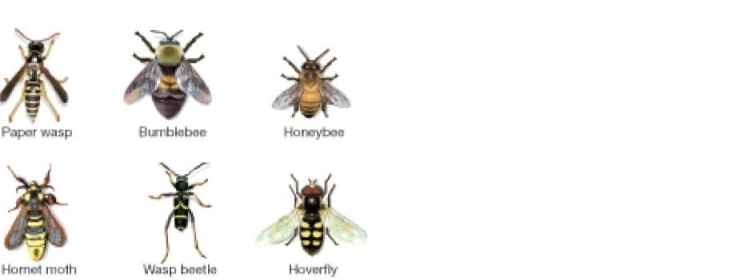 Figure 52.5
In the figure above, the labelled groups, which group is displaying Batesian mimicry?
A) group A
B) group B
C) both groups A and B
D) none of the above groups
Question
Question
Question
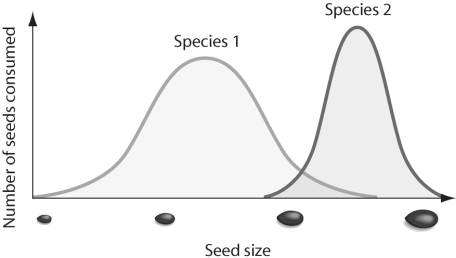 Figure 52.1
In looking at the figure above, what conclusions can be drawn?
A) Both species compete for all sizes of seeds other than those of intermediate size.
B) Both species compete for seeds of intermediate size.
C) Both species compete for all sizes of seeds.
D) Both species eat all sizes of seeds.
Question
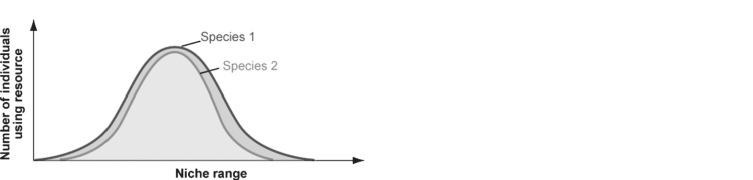 Figure 52.3
In the figure above, which species is the stronger competitor?
A) species 1
B) species 2
C) Both species compete equally.
D) It is not possible to tell from this figure.
Question
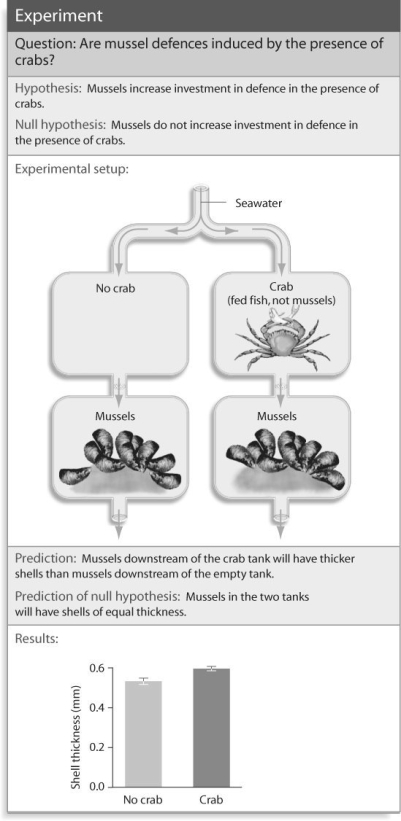 Figure 52.4
Based on the figure above, what result would you expect if you replaced the crabs with broken mussel shells?
A) a higher degree of difference than the crab experiment
B) the same result as the experiment with crabs
C) impossible to hypothesize
D) no difference in shell thickness
Question
Question
Question
Question
Question
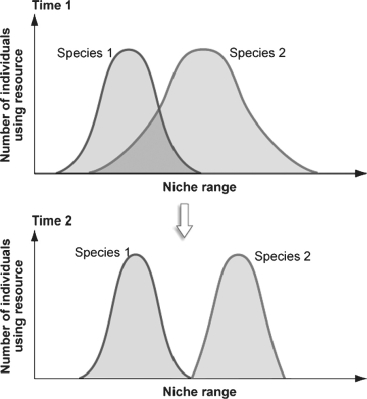 Figure 52.2
What is the term used to describe the process shown in the panels in the figure above?
A) competition
B) species interaction
C) niche realization
D) niche differentiation
Question
Refer to the grids below to answer the following question.
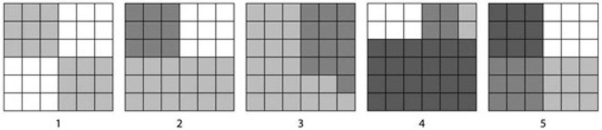
According to the Shannon Diversity Index, which of the five grids provided, with each one containing 36 square show the greatest diversity?
A) 1
B) 2
C) 3
D) 4
E) 5
According to the Shannon Diversity Index, which of the five grids provided, with each one containing 36 square show the greatest diversity?
A) 1
B) 2
C) 3
D) 4
E) 5
Question
Figure 52.1According to the figure above, which species is more successful in competing for seeds?
A) species 1
B) species 2
C) These species do not compete for seeds.
D) This figure does not illustrate which species is more successful.
Question
Question
Question
Figure 52.4What conclusion can you draw from the figure above?
A) Mussels can sense the presence of crabs only visually.
B) Without direct contact, mussels can sense the presence of crabs.
C) Shell thickness is a non- inducible defense.
D) Mussels are increasing their shell thickness in response to water current.
Question
Figure 52.5In the figure above, which of the following statements is true?
A) All of the species of insects shown are in the order Hymenoptera.
B) There are no true mimics in the insects shown.
C) Half of the insects shown are harmless.
D) All of the insects are displaying Batesian mimicry.
Question
Question
Question
Question
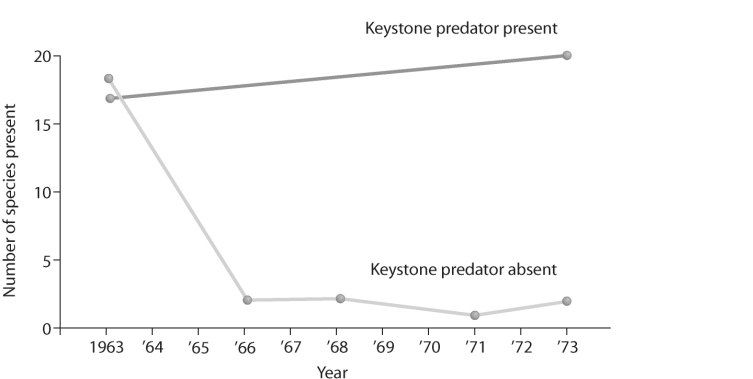 Figure 52.7
Clements's view of biological communities is that of a highly predictable and interrelated structure, while Gleason's view of biological communities is that individual species operate independently. If we set up many identical sterilized ponds in the same area and allowed them to be colonized, what should we predict if Gleason's hypothesis is the one we believe is correct?
A) Different plankton communities will develop in all ponds.
B) Identical plankton communities will develop in all ponds.
C) Limited plankton communities will develop in all ponds.
D) Similar plankton communities will develop in all ponds.
Question
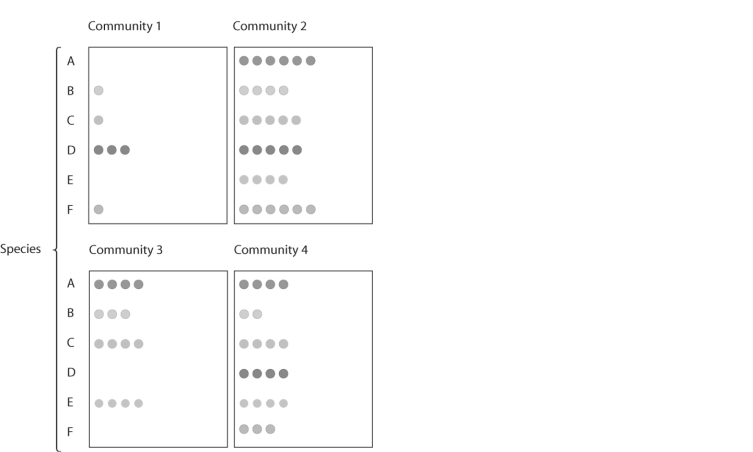 Figure 52.9
In the figure above, which community has the highest species richness?
A) community 1
B) community 2
C) community 3
D) community 4
Question
Figure 52.9In the figure above, which community has the highest species diversity?
A) community 1
B) community 2
C) community 3
D) community 4
Question
Question
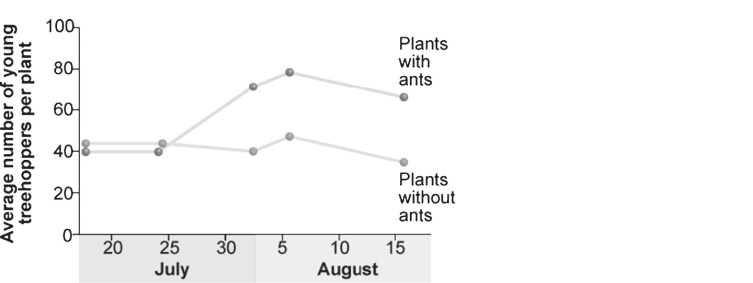 Figure 52.6
Treehoppers a type of insect) produce honeydew, which ants use for food. Treehoppers have a major predator, the jumping spider. Researchers hypothesized that the ants would protect the treehoppers from the spiders. In an experiment, researchers followed study plots with ants removed from the system and compared them to a control plot. In the figure above, what can you conclude?
A) Ants do somehow protect the treehoppers from spiders.
B) Ants reduce the numbers of treehoppers.
C) No specific conclusions can be drawn from this figure.
D) Ants do not protect the treehoppers from spiders.
Question
Question
Figure 52.7What does the graph in the figure above tell you about the definition of a keystone species?
A) A keystone species added to a community can make it more robust.
B) A keystone species has little interaction with other species in an environment.
C) A keystone species removed from a community could have drastic effects.
D) A keystone species can be any species.
Question
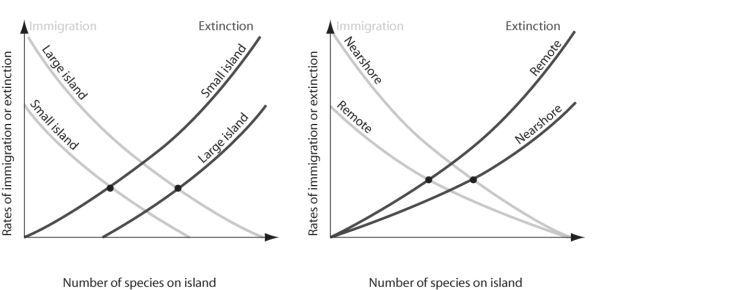 Figure 52.11
Which of the following statements regarding the figure above is true?
A) Extinction rates are highest on large islands close to the mainland.
B) Species diversity should be highest on larger islands away from mainland.
C) Immigration rates are higher on smaller islands.
D) Species richness should be higher on larger islands close to mainland.
Question
Question
Question
Question
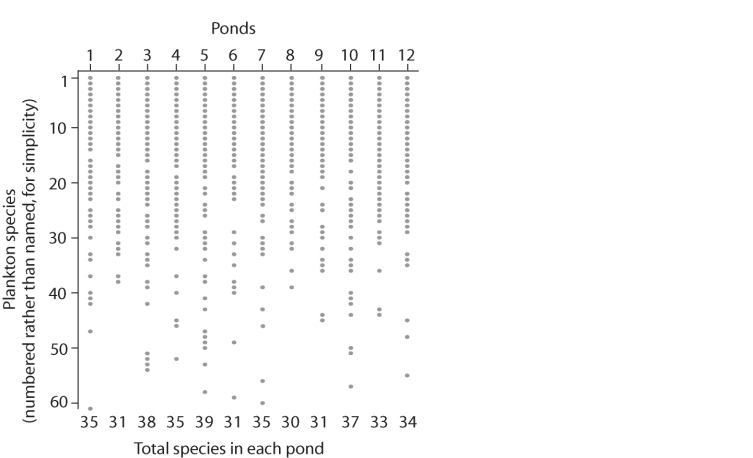 Figure 52.8
Clements's view of biological communities is that of a highly predictable and interrelated structure, while Gleason's view of biological communities is that individual species operate independently. Looking at the results in the figure above, which hypothesis by Clements or Gleason) is supported by the data?
A) Gleason
B) Clements
C) both
D) neither
Question
Question
Figure 52.11According to Figure 52.11, a species has the highest chance of extinction when
A) the island is large and close to the mainland.
B) the island is large and remote.
C) the island is small and close to the mainland.
D) the island is small and remote.
Question
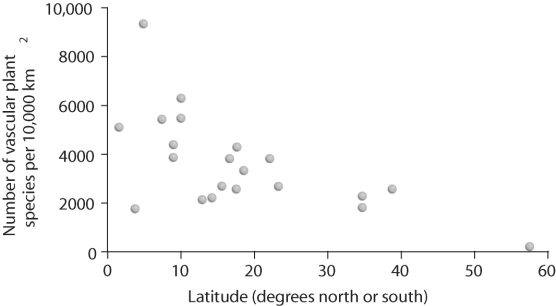 Figure 52.10
In figure above, what can be stated about species diversity and latitude?
A) Species diversity is independent of latitude.
B) As latitude increases, diversity decreases.
C) As latitude decreases, diversity decreases.
D) Species diversity and latitude cannot be compared using this figure.
Question

Unlock Deck
Sign up to unlock the cards in this deck!
Unlock Deck
Unlock Deck
1/38

Play

Full screen (f)
Deck 52: Community Ecology
1
The competitive exclusion principle states that
A) it is not possible for two species with different niches to coexist.
B) it is not possible for two species with the same niche to coexist.
C) it is possible for two species with different niches to coexist.
D) it is possible for two species with the same niche to coexist.
A) it is not possible for two species with different niches to coexist.
B) it is not possible for two species with the same niche to coexist.
C) it is possible for two species with different niches to coexist.
D) it is possible for two species with the same niche to coexist.
B
2
What is the main difference between asymmetric competition and symmetric competition?
A) Competition is barely measurable in symmetric competition.
B) One species is outcompeted completely in asymmetric competition.
C) The fitness reduction is roughly equal between each species in symmetric competition.
D) None of the above answers applies.
A) Competition is barely measurable in symmetric competition.
B) One species is outcompeted completely in asymmetric competition.
C) The fitness reduction is roughly equal between each species in symmetric competition.
D) None of the above answers applies.
The fitness reduction is roughly equal between each species in symmetric competition.
3
Figure 52.5In the figure above, the labelled groups, which group is displaying Batesian mimicry?
A) group A
B) group B
C) both groups A and B
D) none of the above groups
B
4
While traveling in Texas, you stumble across a snake with red, yellow, and black bands. You somehow remember that this could be a poisonous coral snake or a harmless milk snake, but you forget how to differentiate them because they both have similar colours and banding patterns. You wisely decide not to pick up the snake. What defence was successful in preventing you from grabbing the snake?
A) Batesian mimicry
B) inducible defences
C) Müllerian mimicry
D) constitutive defence
E) none of the above
A) Batesian mimicry
B) inducible defences
C) Müllerian mimicry
D) constitutive defence
E) none of the above
Unlock Deck
Unlock for access to all 38 flashcards in this deck.
Unlock Deck
k this deck
5
Some birds follow moving swarms of army ants in the tropics. As the ants march along the forest floor hunting insects and small vertebrates, birds follow and pick off any insects or small vertebrates that fly or jump out of the way of the ants. This is an example of what kind of species interaction?
A) consumption
B) commensalism
C) mutualism
D) parasitism
E) competition
A) consumption
B) commensalism
C) mutualism
D) parasitism
E) competition
Unlock Deck
Unlock for access to all 38 flashcards in this deck.
Unlock Deck
k this deck
6
Figure 52.1In looking at the figure above, what conclusions can be drawn?
A) Both species compete for all sizes of seeds other than those of intermediate size.
B) Both species compete for seeds of intermediate size.
C) Both species compete for all sizes of seeds.
D) Both species eat all sizes of seeds.
Unlock Deck
Unlock for access to all 38 flashcards in this deck.
Unlock Deck
k this deck
7
Figure 52.3In the figure above, which species is the stronger competitor?
A) species 1
B) species 2
C) Both species compete equally.
D) It is not possible to tell from this figure.
Unlock Deck
Unlock for access to all 38 flashcards in this deck.
Unlock Deck
k this deck
8
Figure 52.4Based on the figure above, what result would you expect if you replaced the crabs with broken mussel shells?
A) a higher degree of difference than the crab experiment
B) the same result as the experiment with crabs
C) impossible to hypothesize
D) no difference in shell thickness
Unlock Deck
Unlock for access to all 38 flashcards in this deck.
Unlock Deck
k this deck
9
Some birds follow moving swarms of army ants in the tropics. As the ants march along the forest floor hunting insects and small vertebrates, birds follow and pick off any insects or small vertebrates that fly or jump out of the way of the ants. What is the specific benefit relationship?
A) Birds benefit from the association and harm the ants.
B) Birds and ants benefit from the association.
C) Birds do not benefit from the association, but the ants do.
D) Birds benefit from the association, but have no impact on the ants.
E) Neither birds nor ants benefit from the association.
A) Birds benefit from the association and harm the ants.
B) Birds and ants benefit from the association.
C) Birds do not benefit from the association, but the ants do.
D) Birds benefit from the association, but have no impact on the ants.
E) Neither birds nor ants benefit from the association.
Unlock Deck
Unlock for access to all 38 flashcards in this deck.
Unlock Deck
k this deck
10
In the hypothesis that C. stellatus a species of barnacle) is competitively excluded from the lower intertidal zone by B. balanoides another species of barnacle), what could be concluded about the two species?
A) The fundamental and realized niches of B. balanoides are identical, but the fundamental and realized niches of C. stellatus are different.
B) The fundamental and realized niches of B. balanoides and C. stellatus are both identical.
C) The fundamental and realized niches of B. balanoides and C. stellatus are both different.
D) The fundamental and realized niches of B. balanoides are different, but the fundamental and realized niches of C. stellatus are identical.
A) The fundamental and realized niches of B. balanoides are identical, but the fundamental and realized niches of C. stellatus are different.
B) The fundamental and realized niches of B. balanoides and C. stellatus are both identical.
C) The fundamental and realized niches of B. balanoides and C. stellatus are both different.
D) The fundamental and realized niches of B. balanoides are different, but the fundamental and realized niches of C. stellatus are identical.
Unlock Deck
Unlock for access to all 38 flashcards in this deck.
Unlock Deck
k this deck
11
Which hypothesis supports the observation that herbivores do not generally eat all of the available plants?
A) plant- defence hypothesis
B) poor nutrition hypothesis
C) top- down control hypothesis
D) a combination of all of the above
E) none of the above
A) plant- defence hypothesis
B) poor nutrition hypothesis
C) top- down control hypothesis
D) a combination of all of the above
E) none of the above
Unlock Deck
Unlock for access to all 38 flashcards in this deck.
Unlock Deck
k this deck
12
Which of the following is not a type of consumption?
A) herbivory
B) parasitism
C) mutualism
D) predation
A) herbivory
B) parasitism
C) mutualism
D) predation
Unlock Deck
Unlock for access to all 38 flashcards in this deck.
Unlock Deck
k this deck
13
Figure 52.2What is the term used to describe the process shown in the panels in the figure above?
A) competition
B) species interaction
C) niche realization
D) niche differentiation
Unlock Deck
Unlock for access to all 38 flashcards in this deck.
Unlock Deck
k this deck
14
Refer to the grids below to answer the following question.
According to the Shannon Diversity Index, which of the five grids provided, with each one containing 36 square show the greatest diversity?
A) 1
B) 2
C) 3
D) 4
E) 5
According to the Shannon Diversity Index, which of the five grids provided, with each one containing 36 square show the greatest diversity?
A) 1
B) 2
C) 3
D) 4
E) 5
Unlock Deck
Unlock for access to all 38 flashcards in this deck.
Unlock Deck
k this deck
15
Figure 52.1According to the figure above, which species is more successful in competing for seeds?
A) species 1
B) species 2
C) These species do not compete for seeds.
D) This figure does not illustrate which species is more successful.
Unlock Deck
Unlock for access to all 38 flashcards in this deck.
Unlock Deck
k this deck
16
What is a likely reason for the observation that there are more species in tropical areas than in places more distant from the equator?
A) more frequent ecological disturbances
B) fewer predators
C) more intense annual solar radiation
D) fewer agents of disease
A) more frequent ecological disturbances
B) fewer predators
C) more intense annual solar radiation
D) fewer agents of disease
Unlock Deck
Unlock for access to all 38 flashcards in this deck.
Unlock Deck
k this deck
17
Snails typically avoid sunlit areas, but some snails infected with certain parasites become attracted to light and prefer sunlit areas. Which of the following is the most likely hypothesis given the life cycles of many parasites?
A) The parasite must exit the snail in a sunlit area in order to move and find its next host.
B) The snail is dying from the parasite and is therefore looking for the light.
C) The parasite itself must be exposed to light in order to survive in the snail.
D) The parasite manipulates the behaviour of the snail so that it gets eaten more readily, which allows the parasite to complete its life cycle.
E) The snail is behaving differently in order to rid itself of the parasite.
A) The parasite must exit the snail in a sunlit area in order to move and find its next host.
B) The snail is dying from the parasite and is therefore looking for the light.
C) The parasite itself must be exposed to light in order to survive in the snail.
D) The parasite manipulates the behaviour of the snail so that it gets eaten more readily, which allows the parasite to complete its life cycle.
E) The snail is behaving differently in order to rid itself of the parasite.
Unlock Deck
Unlock for access to all 38 flashcards in this deck.
Unlock Deck
k this deck
18
Figure 52.4What conclusion can you draw from the figure above?
A) Mussels can sense the presence of crabs only visually.
B) Without direct contact, mussels can sense the presence of crabs.
C) Shell thickness is a non- inducible defense.
D) Mussels are increasing their shell thickness in response to water current.
Unlock Deck
Unlock for access to all 38 flashcards in this deck.
Unlock Deck
k this deck
19
Figure 52.5In the figure above, which of the following statements is true?
A) All of the species of insects shown are in the order Hymenoptera.
B) There are no true mimics in the insects shown.
C) Half of the insects shown are harmless.
D) All of the insects are displaying Batesian mimicry.
Unlock Deck
Unlock for access to all 38 flashcards in this deck.
Unlock Deck
k this deck
20
Which would be the best way to directly test the hypothesis that C. stellatus a species of barnacle) is competitively excluded from the lower intertidal zone by B. balanoides another species of barnacle)?
A) Place individuals of each species in a jar and see which species survives.
B) Clear rocks in an entire area and document recolonization events.
C) Transplant B. balanoides to the upper intertidal zone.
D) Remove all C. stellatus from the upper tidal zone.
E) Remove all B. balanoides from the lower intertidal zone.
A) Place individuals of each species in a jar and see which species survives.
B) Clear rocks in an entire area and document recolonization events.
C) Transplant B. balanoides to the upper intertidal zone.
D) Remove all C. stellatus from the upper tidal zone.
E) Remove all B. balanoides from the lower intertidal zone.
Unlock Deck
Unlock for access to all 38 flashcards in this deck.
Unlock Deck
k this deck
21
Which one of the following animals would most likely be defined as a keystone species?
A) housefly
B) nauplii a species of zooplankton)
C) fathead minnow
D) sea otter
A) housefly
B) nauplii a species of zooplankton)
C) fathead minnow
D) sea otter
Unlock Deck
Unlock for access to all 38 flashcards in this deck.
Unlock Deck
k this deck
22
During succession, tall canopies of maple trees form allowing chipmunks to be better hidden against hawks. This is an example of
A) inhibition.
B) interaction.
C) facilitation.
D) tolerance.
A) inhibition.
B) interaction.
C) facilitation.
D) tolerance.
Unlock Deck
Unlock for access to all 38 flashcards in this deck.
Unlock Deck
k this deck
23
Figure 52.7Clements's view of biological communities is that of a highly predictable and interrelated structure, while Gleason's view of biological communities is that individual species operate independently. If we set up many identical sterilized ponds in the same area and allowed them to be colonized, what should we predict if Gleason's hypothesis is the one we believe is correct?
A) Different plankton communities will develop in all ponds.
B) Identical plankton communities will develop in all ponds.
C) Limited plankton communities will develop in all ponds.
D) Similar plankton communities will develop in all ponds.
Unlock Deck
Unlock for access to all 38 flashcards in this deck.
Unlock Deck
k this deck
24
Figure 52.9In the figure above, which community has the highest species richness?
A) community 1
B) community 2
C) community 3
D) community 4
Unlock Deck
Unlock for access to all 38 flashcards in this deck.
Unlock Deck
k this deck
25
Figure 52.9In the figure above, which community has the highest species diversity?
A) community 1
B) community 2
C) community 3
D) community 4
Unlock Deck
Unlock for access to all 38 flashcards in this deck.
Unlock Deck
k this deck
26
What is the main difference between a disturbance and a disturbance regime?
A) A disturbance regime includes defining the length of the disturbance.
B) They are essentially the same thing.
C) A disturbance regime is a more specific type of disturbance.
D) A disturbance regime includes defining the predictable frequency and severity of the disturbance.
A) A disturbance regime includes defining the length of the disturbance.
B) They are essentially the same thing.
C) A disturbance regime is a more specific type of disturbance.
D) A disturbance regime includes defining the predictable frequency and severity of the disturbance.
Unlock Deck
Unlock for access to all 38 flashcards in this deck.
Unlock Deck
k this deck
27
Figure 52.6Treehoppers a type of insect) produce honeydew, which ants use for food. Treehoppers have a major predator, the jumping spider. Researchers hypothesized that the ants would protect the treehoppers from the spiders. In an experiment, researchers followed study plots with ants removed from the system and compared them to a control plot. In the figure above, what can you conclude?
A) Ants do somehow protect the treehoppers from spiders.
B) Ants reduce the numbers of treehoppers.
C) No specific conclusions can be drawn from this figure.
D) Ants do not protect the treehoppers from spiders.
Unlock Deck
Unlock for access to all 38 flashcards in this deck.
Unlock Deck
k this deck
28
Which of the following is not an example of a mutualism?
A) fungi residing in plant roots, such as endomycorrhizae
B) rancher ants that protect aphids in exchange for sugar- rich honeydew
C) birds eating insects jumping out of the path of army ants
D) bacteria fixing nitrogen in plants
A) fungi residing in plant roots, such as endomycorrhizae
B) rancher ants that protect aphids in exchange for sugar- rich honeydew
C) birds eating insects jumping out of the path of army ants
D) bacteria fixing nitrogen in plants
Unlock Deck
Unlock for access to all 38 flashcards in this deck.
Unlock Deck
k this deck
29
Figure 52.7What does the graph in the figure above tell you about the definition of a keystone species?
A) A keystone species added to a community can make it more robust.
B) A keystone species has little interaction with other species in an environment.
C) A keystone species removed from a community could have drastic effects.
D) A keystone species can be any species.
Unlock Deck
Unlock for access to all 38 flashcards in this deck.
Unlock Deck
k this deck
30
Figure 52.11Which of the following statements regarding the figure above is true?
A) Extinction rates are highest on large islands close to the mainland.
B) Species diversity should be highest on larger islands away from mainland.
C) Immigration rates are higher on smaller islands.
D) Species richness should be higher on larger islands close to mainland.
Unlock Deck
Unlock for access to all 38 flashcards in this deck.
Unlock Deck
k this deck
31
Elephants are not the most dominant species in African grasslands, yet they influence community structure. The grasslands contain scattered woody plants, but they are kept in check by the uprooting activities of the elephants. Take away the elephants, and the grasslands convert to forests or to shrublands. The newly growing forests support fewer species than the previous grasslands. Which of the following describes why elephants are the keystone species in this scenario?
A) Elephants exhibit a disproportionate influence on the structure of the community relative to their abundance.
B) Elephants help other populations survive by keeping out many of the large African predators.
C) Grazing animals depend upon the elephants to convert forests to grasslands.
D) Elephants are the biggest herbivore in this community.
E) Elephants prevent drought in African grasslands.
A) Elephants exhibit a disproportionate influence on the structure of the community relative to their abundance.
B) Elephants help other populations survive by keeping out many of the large African predators.
C) Grazing animals depend upon the elephants to convert forests to grasslands.
D) Elephants are the biggest herbivore in this community.
E) Elephants prevent drought in African grasslands.
Unlock Deck
Unlock for access to all 38 flashcards in this deck.
Unlock Deck
k this deck
32
During a one year study, researchers found no difference in treehopper populations in any of their control and experimental groups. What could they measure during the second year to gain information about why this might have occurred?
A) Measure the number of ant females.
B) Measure the relative abundance of jumping spiders.
C) Measure the success of treehoppers with a different ant species.
D) Measure the relative sizes of the treehoppers.
A) Measure the number of ant females.
B) Measure the relative abundance of jumping spiders.
C) Measure the success of treehoppers with a different ant species.
D) Measure the relative sizes of the treehoppers.
Unlock Deck
Unlock for access to all 38 flashcards in this deck.
Unlock Deck
k this deck
33
Which are the only two interaction types to depend on density and effective defence to determine the short- term impact?
A) mutualism and commensalism
B) consumption and parasitism
C) competition and consumption
D) parasitism and mutualism
A) mutualism and commensalism
B) consumption and parasitism
C) competition and consumption
D) parasitism and mutualism
Unlock Deck
Unlock for access to all 38 flashcards in this deck.
Unlock Deck
k this deck
34
Figure 52.8Clements's view of biological communities is that of a highly predictable and interrelated structure, while Gleason's view of biological communities is that individual species operate independently. Looking at the results in the figure above, which hypothesis by Clements or Gleason) is supported by the data?
A) Gleason
B) Clements
C) both
D) neither
Unlock Deck
Unlock for access to all 38 flashcards in this deck.
Unlock Deck
k this deck
35
A measure of how much a community is affected by a disturbance is termed
A) primary productivity.
B) stability.
C) resilience.
D) resistance.
A) primary productivity.
B) stability.
C) resilience.
D) resistance.
Unlock Deck
Unlock for access to all 38 flashcards in this deck.
Unlock Deck
k this deck
36
Figure 52.11According to Figure 52.11, a species has the highest chance of extinction when
A) the island is large and close to the mainland.
B) the island is large and remote.
C) the island is small and close to the mainland.
D) the island is small and remote.
Unlock Deck
Unlock for access to all 38 flashcards in this deck.
Unlock Deck
k this deck
37
Figure 52.10In figure above, what can be stated about species diversity and latitude?
A) Species diversity is independent of latitude.
B) As latitude increases, diversity decreases.
C) As latitude decreases, diversity decreases.
D) Species diversity and latitude cannot be compared using this figure.
Unlock Deck
Unlock for access to all 38 flashcards in this deck.
Unlock Deck
k this deck
38
In a particular case of secondary succession, three species of wild grass all invaded a field. By the second season, a single species dominated the field. What is a possible factor in this secondary succession?
A) inhibition
B) parasitism
C) facilitation
D) immigration
E) equilibrium
A) inhibition
B) parasitism
C) facilitation
D) immigration
E) equilibrium
Unlock Deck
Unlock for access to all 38 flashcards in this deck.
Unlock Deck
k this deck
Unlock Deck
Unlock for access to all 38 flashcards in this deck.






