







 Chat with AI

Deck 33: The Gains From International Trade
Full screen (f)

Question
The diagram below shows the (hypothetical)demand and supply curves for regional jets in Canada.Assume that the market is competitive,all jets are identical,and that Canada engages in international trade.
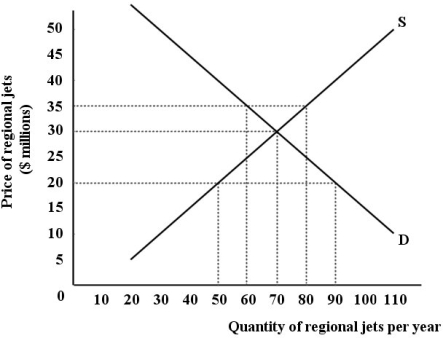 FIGURE 33- 6
Refer to Figure 33- 6.If the world price of a regional jet is $30 million,Canada will
A)import 70 jets per year.
B)export 70 jets per year.
C)export 50 jets per year.
D)neither import nor export any jets.
E)import 90 jets per year.
FIGURE 33- 6Refer to Figure 33- 6.If the world price of a regional jet is $30 million,Canada will
A)import 70 jets per year.
B)export 70 jets per year.
C)export 50 jets per year.
D)neither import nor export any jets.
E)import 90 jets per year.

Question
Question
The diagram below shows the (hypothetical)demand and supply curves for regional jets in Canada.Assume that the market is competitive,all jets are identical,and that Canada engages in international trade.
FIGURE 33- 6
The "terms of trade" reflect the
A)conditions under which trade takes place,as established by the World Trade Organization.
B)quantity of imports that must be purchased to sell a unit of exported goods.
C)quantity of domestic goods that must be exported to get a unit of imported goods.
D)amount of absolute advantage held by one country over another.
E)difference in opportunity costs between two countries.
FIGURE 33- 6The "terms of trade" reflect the
A)conditions under which trade takes place,as established by the World Trade Organization.
B)quantity of imports that must be purchased to sell a unit of exported goods.
C)quantity of domestic goods that must be exported to get a unit of imported goods.
D)amount of absolute advantage held by one country over another.
E)difference in opportunity costs between two countries.
Question
Question
The diagram below shows the domestic demand and supply curves in the market for newsprint in Paperland.
 FIGURE 33- 5
Refer to Figure 33- 5.If Paperland engages in international trade and the world price is PC,the amount of newsprint will be .
A)imported; Q4 - Q2
B)exported; Q4 - Q2
C)exported; Q2
D)imported; Q3
E)imported; Q4
FIGURE 33- 5Refer to Figure 33- 5.If Paperland engages in international trade and the world price is PC,the amount of newsprint will be .
A)imported; Q4 - Q2
B)exported; Q4 - Q2
C)exported; Q2
D)imported; Q3
E)imported; Q4
Question
Question
Question
Question
The figure below shows Arcticland's annual production possibilities boundary for the production of fish and ice.
 FIGURE 33- 4
The increases in a nation's output and consumption that result from specialization and trade are called
A)comparative advantage.
B)the terms of trade.
C)the gains from trade.
D)absolute advantage.
E)autarky.
FIGURE 33- 4The increases in a nation's output and consumption that result from specialization and trade are called
A)comparative advantage.
B)the terms of trade.
C)the gains from trade.
D)absolute advantage.
E)autarky.
Question
Question
Question
Question
The figure below shows Arcticland's annual production possibilities boundary for the production of fish and ice.
FIGURE 33- 4
Refer to Figure 33- 4.Starting from point A and moving to point B,the opportunity cost of producing each additional tonne of ice is
A)constant.
B)decreasing followed by increasing.
C)increasing followed by decreasing.
D)increasing.
E)decreasing.
FIGURE 33- 4Refer to Figure 33- 4.Starting from point A and moving to point B,the opportunity cost of producing each additional tonne of ice is
A)constant.
B)decreasing followed by increasing.
C)increasing followed by decreasing.
D)increasing.
E)decreasing.
Question
Question
Question
Question
Question
Question
Question
Question
The diagram below shows the domestic demand and supply curves in the market for newsprint in Paperland.
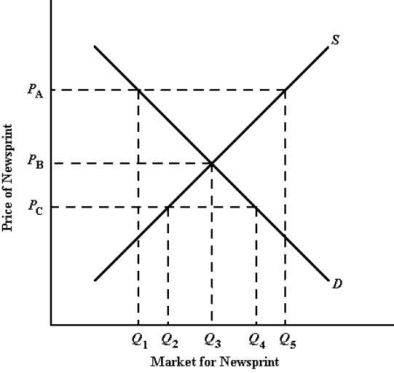 FIGURE 33- 5
Suppose Canada could produce all goods and services more cheaply than all other countries.In that case,
A)no trade would occur because Canada would not have a comparative advantage in producing anything.
B)trade would probably take place because Canada would still have a comparative disadvantage in producing some goods.
C)trade would occur but only if other countries subsidize the import of Canadian goods and services.
D)trade would occur but only if other countries also have an absolute advantage.
E)no trade would occur because Canada would have an absolute advantage in producing everything.
FIGURE 33- 5Suppose Canada could produce all goods and services more cheaply than all other countries.In that case,
A)no trade would occur because Canada would not have a comparative advantage in producing anything.
B)trade would probably take place because Canada would still have a comparative disadvantage in producing some goods.
C)trade would occur but only if other countries subsidize the import of Canadian goods and services.
D)trade would occur but only if other countries also have an absolute advantage.
E)no trade would occur because Canada would have an absolute advantage in producing everything.
Question
The diagram below shows the domestic demand and supply curves in the market for newsprint in Paperland.
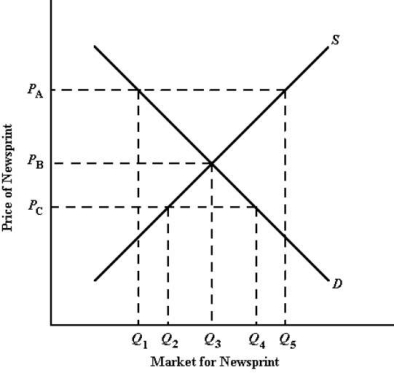 FIGURE 33- 5
Refer to Figure 33- 5.If Paperland engages in international trade and the world price is PC,the amount of newsprint produced by Paperland will be
A)Q1.
B)Q2.
C)Q3.
D)Q4.
E)Q5.
FIGURE 33- 5Refer to Figure 33- 5.If Paperland engages in international trade and the world price is PC,the amount of newsprint produced by Paperland will be
A)Q1.
B)Q2.
C)Q3.
D)Q4.
E)Q5.
Question
The diagram below shows the (hypothetical)demand and supply curves for regional jets in Canada.Assume that the market is competitive,all jets are identical,and that Canada engages in international trade.
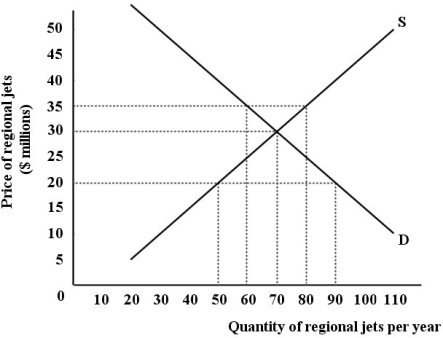 FIGURE 33- 6
Refer to Figure 33- 6.Assume the world price of a regional jet is $20 million.How many jets are not produced in Canada that would have been if Canada did not engage in international trade?
A)20
B)40
C)90
D)70
E)50
FIGURE 33- 6Refer to Figure 33- 6.Assume the world price of a regional jet is $20 million.How many jets are not produced in Canada that would have been if Canada did not engage in international trade?
A)20
B)40
C)90
D)70
E)50
Question
Question
Question
The diagram below shows the domestic demand and supply curves in the market for newsprint in Paperland.
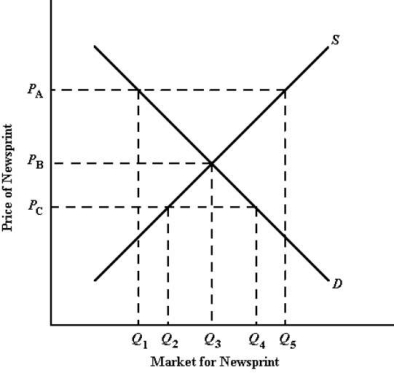 FIGURE 33- 5
Refer to Figure 33- 5.If Paperland engages in international trade and the world price is PA,the amount of newsprint produced by Paperland will be
A)Q1.
B)Q2.
C)Q3.
D)Q4.
E)Q5.
FIGURE 33- 5Refer to Figure 33- 5.If Paperland engages in international trade and the world price is PA,the amount of newsprint produced by Paperland will be
A)Q1.
B)Q2.
C)Q3.
D)Q4.
E)Q5.
Question
The diagram below shows the domestic demand and supply curves in the market for newsprint in Paperland.
FIGURE 33- 5
Refer to Figure 33- 5.If Paperland engages in trade and the world price is PA,the residents of Paperland will consume units of newsprint.
A)Q1
B)Q2
C)Q3
D)Q4
E)Q5
FIGURE 33- 5Refer to Figure 33- 5.If Paperland engages in trade and the world price is PA,the residents of Paperland will consume units of newsprint.
A)Q1
B)Q2
C)Q3
D)Q4
E)Q5
Question
The figure below shows Arcticland's annual production possibilities boundary for the production of fish and ice.
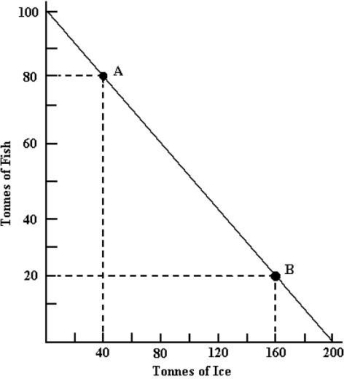 FIGURE 33- 4
Refer to Figure 33- 4.Suppose that a trading partner offers to give Arcticland ice in exchange for its fish.If Arcticland is to improve its consumption possibilities,the terms of trade must be 1 tonne of ice for:
A)2 tonnes of fish.
B)3 tonnes of fish.
C)1 tonne of fish.
D)0.33 tonne of fish.
E)0.5 tonne of fish.
FIGURE 33- 4Refer to Figure 33- 4.Suppose that a trading partner offers to give Arcticland ice in exchange for its fish.If Arcticland is to improve its consumption possibilities,the terms of trade must be 1 tonne of ice for:
A)2 tonnes of fish.
B)3 tonnes of fish.
C)1 tonne of fish.
D)0.33 tonne of fish.
E)0.5 tonne of fish.
Question
Question
The diagram below shows the domestic demand and supply curves in the market for newsprint in Paperland.
FIGURE 33- 5
According to David Ricardo's principle of comparative advantage,there will be gains from international trade
A)only by developed countries.
B)by only one country if opportunity costs are identical across countries.
C)by any trading country with opportunity costs similar to other countries.
D)by any country with opportunity costs different from other countries.
E)only by a country with an absolute advantage in the production of some commodity.
FIGURE 33- 5According to David Ricardo's principle of comparative advantage,there will be gains from international trade
A)only by developed countries.
B)by only one country if opportunity costs are identical across countries.
C)by any trading country with opportunity costs similar to other countries.
D)by any country with opportunity costs different from other countries.
E)only by a country with an absolute advantage in the production of some commodity.
Question
Question
Question
The figure below shows Arcticland's annual production possibilities boundary for the production of fish and ice.
FIGURE 33- 4
If Country A has a comparative advantage in the production of good X relative to Country B,
A)then the opportunity cost of producing X in Country A is higher than in Country B.
B)then Country A also has an absolute advantage in the production of this good.
C)then the opportunity cost of producing X in Country A is lower than in Country B.
D)we do not have enough information to say anything about relative opportunity costs.
E)then Country A also has an absolute advantage in the production of some good other than X.
FIGURE 33- 4If Country A has a comparative advantage in the production of good X relative to Country B,
A)then the opportunity cost of producing X in Country A is higher than in Country B.
B)then Country A also has an absolute advantage in the production of this good.
C)then the opportunity cost of producing X in Country A is lower than in Country B.
D)we do not have enough information to say anything about relative opportunity costs.
E)then Country A also has an absolute advantage in the production of some good other than X.
Question
The figure below shows Arcticland's annual production possibilities boundary for the production of fish and ice.
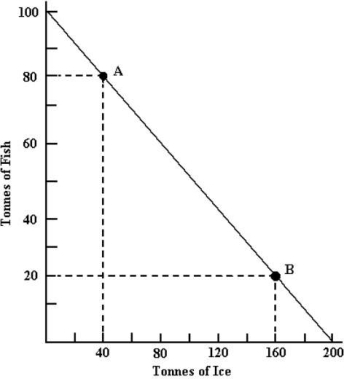 FIGURE 33- 4
Refer to Figure 33- 4.Beginning at point A on Arcticland's production possibilities boundary,the opportunity cost of producing 10 more tonnes of fish is and the opportunity cost of producing 10 more tonnes of ice is _ .
A)20 tonnes of ice; 5 tonnes of fish
B)0; 0
C)10 tonnes of ice; 10 tonnes of fish
D)5 tonnes of ice; 20 tonnes of fish
E)5 tonnes of fish; 20 tonnes of ice
FIGURE 33- 4Refer to Figure 33- 4.Beginning at point A on Arcticland's production possibilities boundary,the opportunity cost of producing 10 more tonnes of fish is and the opportunity cost of producing 10 more tonnes of ice is _ .
A)20 tonnes of ice; 5 tonnes of fish
B)0; 0
C)10 tonnes of ice; 10 tonnes of fish
D)5 tonnes of ice; 20 tonnes of fish
E)5 tonnes of fish; 20 tonnes of ice
Question
Question
Question
The diagram below shows the (hypothetical)demand and supply curves for regional jets in Canada.Assume that the market is competitive,all jets are identical,and that Canada engages in international trade.
FIGURE 33- 6
Since 1950,the world's real GDP has increased by seven times and the volume of world trade has increased by roughly
A)the same amount.
B)thirty times.
C)two times.
D)fifteen times.
E)ten times.
FIGURE 33- 6Since 1950,the world's real GDP has increased by seven times and the volume of world trade has increased by roughly
A)the same amount.
B)thirty times.
C)two times.
D)fifteen times.
E)ten times.

Unlock Deck
Sign up to unlock the cards in this deck!
Unlock Deck
Unlock Deck
1/37

Play

Full screen (f)
Deck 33: The Gains From International Trade
1
The diagram below shows the (hypothetical)demand and supply curves for regional jets in Canada.Assume that the market is competitive,all jets are identical,and that Canada engages in international trade.
FIGURE 33- 6
Refer to Figure 33- 6.If the world price of a regional jet is $30 million,Canada will
A)import 70 jets per year.
B)export 70 jets per year.
C)export 50 jets per year.
D)neither import nor export any jets.
E)import 90 jets per year.
FIGURE 33- 6Refer to Figure 33- 6.If the world price of a regional jet is $30 million,Canada will
A)import 70 jets per year.
B)export 70 jets per year.
C)export 50 jets per year.
D)neither import nor export any jets.
E)import 90 jets per year.
D
2
The concept of "comparative advantage" refers to the
A)terms of trade index.
B)gains from international trade.
C)ability of one region to produce a commodity with fewer total inputs than another region.
D)ability of one region to produce a commodity at a lower opportunity cost than another region.
E)ability of one region to produce a commodity with less labour input than another region.
A)terms of trade index.
B)gains from international trade.
C)ability of one region to produce a commodity with fewer total inputs than another region.
D)ability of one region to produce a commodity at a lower opportunity cost than another region.
E)ability of one region to produce a commodity with less labour input than another region.
D
3
The diagram below shows the (hypothetical)demand and supply curves for regional jets in Canada.Assume that the market is competitive,all jets are identical,and that Canada engages in international trade.
FIGURE 33- 6
The "terms of trade" reflect the
A)conditions under which trade takes place,as established by the World Trade Organization.
B)quantity of imports that must be purchased to sell a unit of exported goods.
C)quantity of domestic goods that must be exported to get a unit of imported goods.
D)amount of absolute advantage held by one country over another.
E)difference in opportunity costs between two countries.
FIGURE 33- 6The "terms of trade" reflect the
A)conditions under which trade takes place,as established by the World Trade Organization.
B)quantity of imports that must be purchased to sell a unit of exported goods.
C)quantity of domestic goods that must be exported to get a unit of imported goods.
D)amount of absolute advantage held by one country over another.
E)difference in opportunity costs between two countries.
C
4
The concept of comparative advantage in international trade is based on _ as opposed to absolute costs.
A)opportunity costs
B)absolute prices
C)average cost
D)total cost
E)relative prices
A)opportunity costs
B)absolute prices
C)average cost
D)total cost
E)relative prices
Unlock Deck
Unlock for access to all 37 flashcards in this deck.
Unlock Deck
k this deck
5
The diagram below shows the domestic demand and supply curves in the market for newsprint in Paperland.
FIGURE 33- 5
Refer to Figure 33- 5.If Paperland engages in international trade and the world price is PC,the amount of newsprint will be .
A)imported; Q4 - Q2
B)exported; Q4 - Q2
C)exported; Q2
D)imported; Q3
E)imported; Q4
FIGURE 33- 5Refer to Figure 33- 5.If Paperland engages in international trade and the world price is PC,the amount of newsprint will be .
A)imported; Q4 - Q2
B)exported; Q4 - Q2
C)exported; Q2
D)imported; Q3
E)imported; Q4
Unlock Deck
Unlock for access to all 37 flashcards in this deck.
Unlock Deck
k this deck
6
Economies of scale and product differentiation can provide an explanation for
A)countries trading in similar products.
B)firms seeking government intervention to protect their industries.
C)firms seeking government approval of mergers.
D)countries trading in completely different products.
E)countries remaining at their autarkic positions.
A)countries trading in similar products.
B)firms seeking government intervention to protect their industries.
C)firms seeking government approval of mergers.
D)countries trading in completely different products.
E)countries remaining at their autarkic positions.
Unlock Deck
Unlock for access to all 37 flashcards in this deck.
Unlock Deck
k this deck
7
The division of the gains of trade between two trading countries depends on the
A)size of the absolute advantages possessed by each country.
B)quantity of resources held by each country.
C)difference between the terms of trade and the countries' autarkic relative prices.
D)level of unemployment in both countries.
E)long- run costs.
A)size of the absolute advantages possessed by each country.
B)quantity of resources held by each country.
C)difference between the terms of trade and the countries' autarkic relative prices.
D)level of unemployment in both countries.
E)long- run costs.
Unlock Deck
Unlock for access to all 37 flashcards in this deck.
Unlock Deck
k this deck
8
Suppose that Spain is currently producing 90 units of wine and 10 units of cheese,but to produce 10 more units of cheese it must sacrifice 30 units of wine.Further,suppose that Portugal produces 45 units of wine and 45 units of cheese,but to produce 10 more units of cheese it must sacrifice only 10 units of wine.It can be concluded that
A)neither country has an absolute advantage in the production of either wine or cheese.
B)Portugal has an absolute advantage in both wine and cheese production.
C)Portugal has an absolute advantage in wine production and Spain has an absolute advantage in cheese production.
D)Spain has an absolute advantage in both wine and cheese production.
E)more information is needed to conclude anything about absolute advantage in either country.
A)neither country has an absolute advantage in the production of either wine or cheese.
B)Portugal has an absolute advantage in both wine and cheese production.
C)Portugal has an absolute advantage in wine production and Spain has an absolute advantage in cheese production.
D)Spain has an absolute advantage in both wine and cheese production.
E)more information is needed to conclude anything about absolute advantage in either country.
Unlock Deck
Unlock for access to all 37 flashcards in this deck.
Unlock Deck
k this deck
9
The figure below shows Arcticland's annual production possibilities boundary for the production of fish and ice.
FIGURE 33- 4
The increases in a nation's output and consumption that result from specialization and trade are called
A)comparative advantage.
B)the terms of trade.
C)the gains from trade.
D)absolute advantage.
E)autarky.
FIGURE 33- 4The increases in a nation's output and consumption that result from specialization and trade are called
A)comparative advantage.
B)the terms of trade.
C)the gains from trade.
D)absolute advantage.
E)autarky.
Unlock Deck
Unlock for access to all 37 flashcards in this deck.
Unlock Deck
k this deck
10
If Country A has a comparative advantage in the production of oil relative to Country B,then
A)the opportunity cost of producing oil is higher in Country A than in Country B.
B)Country A also has an absolute advantage in producing some good other than oil.
C)Country A also has an absolute advantage in producing oil.
D)Country A when compared to Country B must have an absolute advantage in producing some good other than oil.
E)the opportunity cost of producing oil is lower in Country A than in Country B.
A)the opportunity cost of producing oil is higher in Country A than in Country B.
B)Country A also has an absolute advantage in producing some good other than oil.
C)Country A also has an absolute advantage in producing oil.
D)Country A when compared to Country B must have an absolute advantage in producing some good other than oil.
E)the opportunity cost of producing oil is lower in Country A than in Country B.
Unlock Deck
Unlock for access to all 37 flashcards in this deck.
Unlock Deck
k this deck
11
If,over a period of a year,a country's import price index rises from 100 to 120 and its export price index rises from 100 to 110,its index for the terms of trade has
A)risen from 100 to 110.
B)risen to 109.09.
C)risen from 100 to 120.
D)fallen to 91.67.
E)fallen from 110 to 100.
A)risen from 100 to 110.
B)risen to 109.09.
C)risen from 100 to 120.
D)fallen to 91.67.
E)fallen from 110 to 100.
Unlock Deck
Unlock for access to all 37 flashcards in this deck.
Unlock Deck
k this deck
12
There will be a favourable change in a nation's terms of trade if the
A)export and import prices fall by the same amount.
B)export price index rises by more than the import price index.
C)export and import prices rise by the same amount.
D)export and import prices stay the same.
E)import price index rises by more than the export price index.
A)export and import prices fall by the same amount.
B)export price index rises by more than the import price index.
C)export and import prices rise by the same amount.
D)export and import prices stay the same.
E)import price index rises by more than the export price index.
Unlock Deck
Unlock for access to all 37 flashcards in this deck.
Unlock Deck
k this deck
13
The figure below shows Arcticland's annual production possibilities boundary for the production of fish and ice.
FIGURE 33- 4
Refer to Figure 33- 4.Starting from point A and moving to point B,the opportunity cost of producing each additional tonne of ice is
A)constant.
B)decreasing followed by increasing.
C)increasing followed by decreasing.
D)increasing.
E)decreasing.
FIGURE 33- 4Refer to Figure 33- 4.Starting from point A and moving to point B,the opportunity cost of producing each additional tonne of ice is
A)constant.
B)decreasing followed by increasing.
C)increasing followed by decreasing.
D)increasing.
E)decreasing.
Unlock Deck
Unlock for access to all 37 flashcards in this deck.
Unlock Deck
k this deck
14
Suppose that Spain is currently producing 90 units of wine and 10 units of cheese,but to produce 10 more units of cheese it must sacrifice 30 units of wine.Further,suppose that Portugal produces 45 units of wine and 45 units of cheese,but to produce 10 more units of cheese it must sacrifice only 10 units of wine.It can be concluded that
A)Portugal has an absolute advantage in wine production and Spain has an absolute advantage in cheese production.
B)Spain has an absolute advantage in both wine and cheese production.
C)more information is needed to conclude anything about comparative advantage in either country.
D)Portugal has an absolute advantage in both wine and cheese production.
E)Spain has a comparative advantage in the production of wine and Portugal has a comparative advantage in the production of cheese.
A)Portugal has an absolute advantage in wine production and Spain has an absolute advantage in cheese production.
B)Spain has an absolute advantage in both wine and cheese production.
C)more information is needed to conclude anything about comparative advantage in either country.
D)Portugal has an absolute advantage in both wine and cheese production.
E)Spain has a comparative advantage in the production of wine and Portugal has a comparative advantage in the production of cheese.
Unlock Deck
Unlock for access to all 37 flashcards in this deck.
Unlock Deck
k this deck
15
The theory that patterns of international trade are determined by natural endowments of factors successfully explains the prominence of
A)Japan in car manufacturing.
B)Canada in communications technology.
C)the United States in pharmaceutical research.
D)Britain in the pop music industry.
E)tourism in the Turks and Caicos.
A)Japan in car manufacturing.
B)Canada in communications technology.
C)the United States in pharmaceutical research.
D)Britain in the pop music industry.
E)tourism in the Turks and Caicos.
Unlock Deck
Unlock for access to all 37 flashcards in this deck.
Unlock Deck
k this deck
16
Which of the following statements about comparative advantage is true?
A)A country with a rising price level will lose any existing comparative advantage.
B)Comparative advantage is based solely on differences in climate.
C)To have a comparative advantage a country must also have an absolute advantage.
D)Comparative advantage for certain products may be acquired by deliberate domestic government policy.
E)Comparative advantage is based solely on differences in factor endowments.
A)A country with a rising price level will lose any existing comparative advantage.
B)Comparative advantage is based solely on differences in climate.
C)To have a comparative advantage a country must also have an absolute advantage.
D)Comparative advantage for certain products may be acquired by deliberate domestic government policy.
E)Comparative advantage is based solely on differences in factor endowments.
Unlock Deck
Unlock for access to all 37 flashcards in this deck.
Unlock Deck
k this deck
17
Consider the trade of a product between two regions.If it is very inexpensive to move the product from one regional market to another,then the
A)price it sells for in every country will depend on the cost of labour in the single low- cost country in which the product was produced.
B)absolute cost of producing the product must be the same in all markets.
C)difference in the price from one market to another will depend on the relative elasticities of supply in the separate markets.
D)"law of one price" argues that it will sell for the same price in all markets.
E)production of the world supply will be from the single country with the lowest absolute cost of producing it.
A)price it sells for in every country will depend on the cost of labour in the single low- cost country in which the product was produced.
B)absolute cost of producing the product must be the same in all markets.
C)difference in the price from one market to another will depend on the relative elasticities of supply in the separate markets.
D)"law of one price" argues that it will sell for the same price in all markets.
E)production of the world supply will be from the single country with the lowest absolute cost of producing it.
Unlock Deck
Unlock for access to all 37 flashcards in this deck.
Unlock Deck
k this deck
18
If two countries each produce wool and cotton,we know that the country with the comparative advantage in cotton will also have a lower
A)opportunity cost to produce cotton.
B)resource input per unit produced of cotton.
C)resource input per unit produced of wool.
D)resource input per unit produced of both cotton or wool.
E)opportunity cost to produce wool.
A)opportunity cost to produce cotton.
B)resource input per unit produced of cotton.
C)resource input per unit produced of wool.
D)resource input per unit produced of both cotton or wool.
E)opportunity cost to produce wool.
Unlock Deck
Unlock for access to all 37 flashcards in this deck.
Unlock Deck
k this deck
19
Consider a country that is initially autarkic and then engages freely in international trade.If a country has a comparative advantage in the production of soybeans,it will most probably
A)increase the production of soybeans for domestic consumption.
B)derive no advantage from any trade in soybeans.
C)increase the production of soybeans to allow for the export of soybeans.
D)import soybeans
E)decrease the production of soybeans for domestic consumption.
A)increase the production of soybeans for domestic consumption.
B)derive no advantage from any trade in soybeans.
C)increase the production of soybeans to allow for the export of soybeans.
D)import soybeans
E)decrease the production of soybeans for domestic consumption.
Unlock Deck
Unlock for access to all 37 flashcards in this deck.
Unlock Deck
k this deck
20
Australia exports wine to Canada,and Canada also exports wine to Australia.This is a(n)
A)example of the inefficiency of trade patterns.
B)general conclusion of the Heckscher- Ohlin theory.
C)likely result of economies of scale and product differentiation.
D)obvious failure to take advantage of specialization.
E)violation of the law of comparative advantage.
A)example of the inefficiency of trade patterns.
B)general conclusion of the Heckscher- Ohlin theory.
C)likely result of economies of scale and product differentiation.
D)obvious failure to take advantage of specialization.
E)violation of the law of comparative advantage.
Unlock Deck
Unlock for access to all 37 flashcards in this deck.
Unlock Deck
k this deck
21
The diagram below shows the domestic demand and supply curves in the market for newsprint in Paperland.
FIGURE 33- 5
Suppose Canada could produce all goods and services more cheaply than all other countries.In that case,
A)no trade would occur because Canada would not have a comparative advantage in producing anything.
B)trade would probably take place because Canada would still have a comparative disadvantage in producing some goods.
C)trade would occur but only if other countries subsidize the import of Canadian goods and services.
D)trade would occur but only if other countries also have an absolute advantage.
E)no trade would occur because Canada would have an absolute advantage in producing everything.
FIGURE 33- 5Suppose Canada could produce all goods and services more cheaply than all other countries.In that case,
A)no trade would occur because Canada would not have a comparative advantage in producing anything.
B)trade would probably take place because Canada would still have a comparative disadvantage in producing some goods.
C)trade would occur but only if other countries subsidize the import of Canadian goods and services.
D)trade would occur but only if other countries also have an absolute advantage.
E)no trade would occur because Canada would have an absolute advantage in producing everything.
Unlock Deck
Unlock for access to all 37 flashcards in this deck.
Unlock Deck
k this deck
22
The diagram below shows the domestic demand and supply curves in the market for newsprint in Paperland.
FIGURE 33- 5
Refer to Figure 33- 5.If Paperland engages in international trade and the world price is PC,the amount of newsprint produced by Paperland will be
A)Q1.
B)Q2.
C)Q3.
D)Q4.
E)Q5.
FIGURE 33- 5Refer to Figure 33- 5.If Paperland engages in international trade and the world price is PC,the amount of newsprint produced by Paperland will be
A)Q1.
B)Q2.
C)Q3.
D)Q4.
E)Q5.
Unlock Deck
Unlock for access to all 37 flashcards in this deck.
Unlock Deck
k this deck
23
The diagram below shows the (hypothetical)demand and supply curves for regional jets in Canada.Assume that the market is competitive,all jets are identical,and that Canada engages in international trade.
FIGURE 33- 6
Refer to Figure 33- 6.Assume the world price of a regional jet is $20 million.How many jets are not produced in Canada that would have been if Canada did not engage in international trade?
A)20
B)40
C)90
D)70
E)50
FIGURE 33- 6Refer to Figure 33- 6.Assume the world price of a regional jet is $20 million.How many jets are not produced in Canada that would have been if Canada did not engage in international trade?
A)20
B)40
C)90
D)70
E)50
Unlock Deck
Unlock for access to all 37 flashcards in this deck.
Unlock Deck
k this deck
24
Since joining NAFTA in the early 1990s,Canada has experienced increases in productivity and output in many export- oriented industries because of economies of scale and learning by doing.In these industries,these gains from trade will lead to
A)downward shifts in the long- run average cost (LRAC)curve.
B)downward shifts in the LRAC curves and downward movement (to the right)along the LRAC curve.
C)downward shifts in the LRAC and short- run AC curves.
D)downward movement (to the right)along the LRAC curve only.
E)downward shifts in the LRAC and movement to the left along the LRAC curve.
A)downward shifts in the long- run average cost (LRAC)curve.
B)downward shifts in the LRAC curves and downward movement (to the right)along the LRAC curve.
C)downward shifts in the LRAC and short- run AC curves.
D)downward movement (to the right)along the LRAC curve only.
E)downward shifts in the LRAC and movement to the left along the LRAC curve.
Unlock Deck
Unlock for access to all 37 flashcards in this deck.
Unlock Deck
k this deck
25
The hypothesis that the price of some given internationally traded product in one country will be equal to the price of the same product in some other country is known as
A)comparative advantage.
B)gains from trade.
C)the Big Mac index.
D)the law of one price.
E)absolute advantage.
A)comparative advantage.
B)gains from trade.
C)the Big Mac index.
D)the law of one price.
E)absolute advantage.
Unlock Deck
Unlock for access to all 37 flashcards in this deck.
Unlock Deck
k this deck
26
The diagram below shows the domestic demand and supply curves in the market for newsprint in Paperland.
FIGURE 33- 5
Refer to Figure 33- 5.If Paperland engages in international trade and the world price is PA,the amount of newsprint produced by Paperland will be
A)Q1.
B)Q2.
C)Q3.
D)Q4.
E)Q5.
FIGURE 33- 5Refer to Figure 33- 5.If Paperland engages in international trade and the world price is PA,the amount of newsprint produced by Paperland will be
A)Q1.
B)Q2.
C)Q3.
D)Q4.
E)Q5.
Unlock Deck
Unlock for access to all 37 flashcards in this deck.
Unlock Deck
k this deck
27
The diagram below shows the domestic demand and supply curves in the market for newsprint in Paperland.
FIGURE 33- 5
Refer to Figure 33- 5.If Paperland engages in trade and the world price is PA,the residents of Paperland will consume units of newsprint.
A)Q1
B)Q2
C)Q3
D)Q4
E)Q5
FIGURE 33- 5Refer to Figure 33- 5.If Paperland engages in trade and the world price is PA,the residents of Paperland will consume units of newsprint.
A)Q1
B)Q2
C)Q3
D)Q4
E)Q5
Unlock Deck
Unlock for access to all 37 flashcards in this deck.
Unlock Deck
k this deck
28
The figure below shows Arcticland's annual production possibilities boundary for the production of fish and ice.
FIGURE 33- 4
Refer to Figure 33- 4.Suppose that a trading partner offers to give Arcticland ice in exchange for its fish.If Arcticland is to improve its consumption possibilities,the terms of trade must be 1 tonne of ice for:
A)2 tonnes of fish.
B)3 tonnes of fish.
C)1 tonne of fish.
D)0.33 tonne of fish.
E)0.5 tonne of fish.
FIGURE 33- 4Refer to Figure 33- 4.Suppose that a trading partner offers to give Arcticland ice in exchange for its fish.If Arcticland is to improve its consumption possibilities,the terms of trade must be 1 tonne of ice for:
A)2 tonnes of fish.
B)3 tonnes of fish.
C)1 tonne of fish.
D)0.33 tonne of fish.
E)0.5 tonne of fish.
Unlock Deck
Unlock for access to all 37 flashcards in this deck.
Unlock Deck
k this deck
29
If the index of export prices increases from 120 to 150 and the index of import prices increases from 100 to 125,it may be said that
A)the terms of trade have deteriorated.
B)there has been no change in the terms of trade.
C)there is insufficient information to calculate the terms of trade.
D)the terms of trade have improved by 10%.
E)the terms of trade have improved.
A)the terms of trade have deteriorated.
B)there has been no change in the terms of trade.
C)there is insufficient information to calculate the terms of trade.
D)the terms of trade have improved by 10%.
E)the terms of trade have improved.
Unlock Deck
Unlock for access to all 37 flashcards in this deck.
Unlock Deck
k this deck
30
The diagram below shows the domestic demand and supply curves in the market for newsprint in Paperland.
FIGURE 33- 5
According to David Ricardo's principle of comparative advantage,there will be gains from international trade
A)only by developed countries.
B)by only one country if opportunity costs are identical across countries.
C)by any trading country with opportunity costs similar to other countries.
D)by any country with opportunity costs different from other countries.
E)only by a country with an absolute advantage in the production of some commodity.
FIGURE 33- 5According to David Ricardo's principle of comparative advantage,there will be gains from international trade
A)only by developed countries.
B)by only one country if opportunity costs are identical across countries.
C)by any trading country with opportunity costs similar to other countries.
D)by any country with opportunity costs different from other countries.
E)only by a country with an absolute advantage in the production of some commodity.
Unlock Deck
Unlock for access to all 37 flashcards in this deck.
Unlock Deck
k this deck
31
When opportunity costs differ between countries,
A)only the larger countries will benefit from trade.
B)each country should produce only those goods for which it has an absolute advantage.
C)comparative advantages may not exist.
D)specialization and trade can lead to increases in the production of all commodities.
E)only the smaller countries will benefit from trade.
A)only the larger countries will benefit from trade.
B)each country should produce only those goods for which it has an absolute advantage.
C)comparative advantages may not exist.
D)specialization and trade can lead to increases in the production of all commodities.
E)only the smaller countries will benefit from trade.
Unlock Deck
Unlock for access to all 37 flashcards in this deck.
Unlock Deck
k this deck
32
When opportunity costs are identical between two countries for all goods,
A)there will be gains from trade for both countries if one country has an absolute advantage in the production of some commodity.
B)absolute advantages will determine the gains from trade.
C)there will be absolute advantages from trade but no comparative advantages from trade.
D)international trade will be advantageous only to the country that has an absolute advantage in the production of some commodity.
E)there can be no gains from trade unless there are economies of scale in some of the products.
A)there will be gains from trade for both countries if one country has an absolute advantage in the production of some commodity.
B)absolute advantages will determine the gains from trade.
C)there will be absolute advantages from trade but no comparative advantages from trade.
D)international trade will be advantageous only to the country that has an absolute advantage in the production of some commodity.
E)there can be no gains from trade unless there are economies of scale in some of the products.
Unlock Deck
Unlock for access to all 37 flashcards in this deck.
Unlock Deck
k this deck
33
The figure below shows Arcticland's annual production possibilities boundary for the production of fish and ice.
FIGURE 33- 4
If Country A has a comparative advantage in the production of good X relative to Country B,
A)then the opportunity cost of producing X in Country A is higher than in Country B.
B)then Country A also has an absolute advantage in the production of this good.
C)then the opportunity cost of producing X in Country A is lower than in Country B.
D)we do not have enough information to say anything about relative opportunity costs.
E)then Country A also has an absolute advantage in the production of some good other than X.
FIGURE 33- 4If Country A has a comparative advantage in the production of good X relative to Country B,
A)then the opportunity cost of producing X in Country A is higher than in Country B.
B)then Country A also has an absolute advantage in the production of this good.
C)then the opportunity cost of producing X in Country A is lower than in Country B.
D)we do not have enough information to say anything about relative opportunity costs.
E)then Country A also has an absolute advantage in the production of some good other than X.
Unlock Deck
Unlock for access to all 37 flashcards in this deck.
Unlock Deck
k this deck
34
The figure below shows Arcticland's annual production possibilities boundary for the production of fish and ice.
FIGURE 33- 4
Refer to Figure 33- 4.Beginning at point A on Arcticland's production possibilities boundary,the opportunity cost of producing 10 more tonnes of fish is and the opportunity cost of producing 10 more tonnes of ice is _ .
A)20 tonnes of ice; 5 tonnes of fish
B)0; 0
C)10 tonnes of ice; 10 tonnes of fish
D)5 tonnes of ice; 20 tonnes of fish
E)5 tonnes of fish; 20 tonnes of ice
FIGURE 33- 4Refer to Figure 33- 4.Beginning at point A on Arcticland's production possibilities boundary,the opportunity cost of producing 10 more tonnes of fish is and the opportunity cost of producing 10 more tonnes of ice is _ .
A)20 tonnes of ice; 5 tonnes of fish
B)0; 0
C)10 tonnes of ice; 10 tonnes of fish
D)5 tonnes of ice; 20 tonnes of fish
E)5 tonnes of fish; 20 tonnes of ice
Unlock Deck
Unlock for access to all 37 flashcards in this deck.
Unlock Deck
k this deck
35
When specialization according to comparative advantage also makes economies of scale possible,
A)costs will rise in all trading countries.
B)trade is not beneficial to the country that has the absolute advantage in both goods.
C)the production possibilities boundaries of all trading countries will shift inward.
D)there will be additional gains from trade.
E)it will be beneficial for all trading countries to impose tariffs.
A)costs will rise in all trading countries.
B)trade is not beneficial to the country that has the absolute advantage in both goods.
C)the production possibilities boundaries of all trading countries will shift inward.
D)there will be additional gains from trade.
E)it will be beneficial for all trading countries to impose tariffs.
Unlock Deck
Unlock for access to all 37 flashcards in this deck.
Unlock Deck
k this deck
36
Consider Canada's terms of trade.Canadians consume millions of cups of Tim Horton's coffee each year.If Tim Horton's reduced the price per cup of coffee (because of a decrease in administration and transportation costs),ceteris paribus,Canada's terms of trade will
A)improve.
B)deteriorate.
C)deteriorate as long as consumption of coffee increases.
D)improve as long as consumption of coffee decreases.
E)not change.
A)improve.
B)deteriorate.
C)deteriorate as long as consumption of coffee increases.
D)improve as long as consumption of coffee decreases.
E)not change.
Unlock Deck
Unlock for access to all 37 flashcards in this deck.
Unlock Deck
k this deck
37
The diagram below shows the (hypothetical)demand and supply curves for regional jets in Canada.Assume that the market is competitive,all jets are identical,and that Canada engages in international trade.
FIGURE 33- 6
Since 1950,the world's real GDP has increased by seven times and the volume of world trade has increased by roughly
A)the same amount.
B)thirty times.
C)two times.
D)fifteen times.
E)ten times.
FIGURE 33- 6Since 1950,the world's real GDP has increased by seven times and the volume of world trade has increased by roughly
A)the same amount.
B)thirty times.
C)two times.
D)fifteen times.
E)ten times.
Unlock Deck
Unlock for access to all 37 flashcards in this deck.
Unlock Deck
k this deck
Unlock Deck
Unlock for access to all 37 flashcards in this deck.






