







 Chat with AI

Deck 17: The Economics of Environmental Protection
Full screen (f)

Question

Question
Question
The diagram below shows the private and social marginal costs (MCP and MCS)and the social marginal benefits (MBS)of producing disposable diapers.
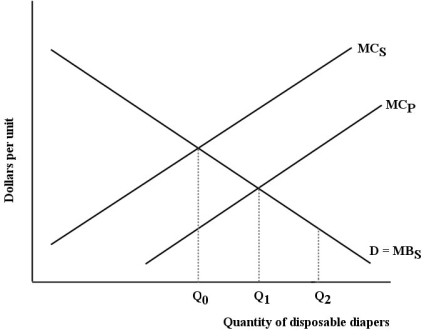 FIGURE 17- 2
Refer to Figure 17- 2.The net social benefit derived from the production and use of disposable diapers is
A)zero at Q0,because that is where MCS equals MBS.
B)at a minimum at Q0,because MCS exceeds MCP.
C)zero at Q2,because that is where the externality is internalized.
D)at a maximum at Q1,because that is where MCS equals MBS.
E)at a maximum at Q0,because that is where MCS equals MBS.
FIGURE 17- 2Refer to Figure 17- 2.The net social benefit derived from the production and use of disposable diapers is
A)zero at Q0,because that is where MCS equals MBS.
B)at a minimum at Q0,because MCS exceeds MCP.
C)zero at Q2,because that is where the externality is internalized.
D)at a maximum at Q1,because that is where MCS equals MBS.
E)at a maximum at Q0,because that is where MCS equals MBS.
Question
Question
Question
The diagram below shows a market for tradable pollution permits.
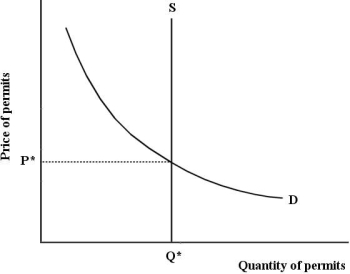 Figure 17- 7
Refer to Figure 17- 7,which depicts the market for tradable pollution permits.If the environmental organization called "Friends of the Earth" buys a large quantity of pollution permits and permanently decides not to use them,then
A)the supply curve shifts to the left,and the equilibrium price rises.
B)allocative efficiency is lost.
C)there is no impact on the equilibrium.
D)the demand curve shifts to the left,and the equilibrium price falls.
E)the supply curve shifts to the right,and the equilibrium price falls.
Figure 17- 7Refer to Figure 17- 7,which depicts the market for tradable pollution permits.If the environmental organization called "Friends of the Earth" buys a large quantity of pollution permits and permanently decides not to use them,then
A)the supply curve shifts to the left,and the equilibrium price rises.
B)allocative efficiency is lost.
C)there is no impact on the equilibrium.
D)the demand curve shifts to the left,and the equilibrium price falls.
E)the supply curve shifts to the right,and the equilibrium price falls.
Question
The diagram below shows the marginal cost of abatement for each of two firms,A and B.Each firm is initially abating Q0 units of pollution.
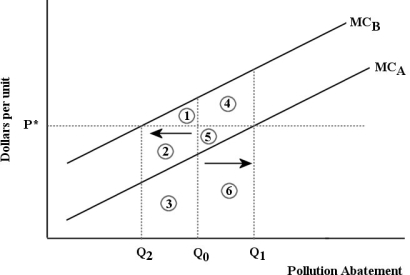 FIGURE 17- 6
Refer to Figure 17- 6.Suppose that a system of tradable pollution permits is introduced into this market and the equilibrium permit price is p×.Firm A will sell permits to Firm B because
A)Firm B has lower costs of pollution abatement than Firm A.
B)Firm A's total cost of abating more pollution (areas 5 + 6)is less than the revenue it earns from selling the permits (areas 4 + 5 + 6).
C)the revenue Firm A earns from selling permits (areas 5 + 6)is greater than the cost it incurs from abating more pollution (area 6).
D)Firm A's total cost of abating more pollution (area 6)is less than the revenue it earns from selling the permits (area 4 + 5).
E)Firm A can buy the permits at a lower price than Firm B.
FIGURE 17- 6Refer to Figure 17- 6.Suppose that a system of tradable pollution permits is introduced into this market and the equilibrium permit price is p×.Firm A will sell permits to Firm B because
A)Firm B has lower costs of pollution abatement than Firm A.
B)Firm A's total cost of abating more pollution (areas 5 + 6)is less than the revenue it earns from selling the permits (areas 4 + 5 + 6).
C)the revenue Firm A earns from selling permits (areas 5 + 6)is greater than the cost it incurs from abating more pollution (area 6).
D)Firm A's total cost of abating more pollution (area 6)is less than the revenue it earns from selling the permits (area 4 + 5).
E)Firm A can buy the permits at a lower price than Firm B.
Question
Question
Question
The figure below shows the marginal benefit to consumers,MB,the marginal cost to private firms,MCP,and the marginal cost to society,MCS,at each level of output of some good.
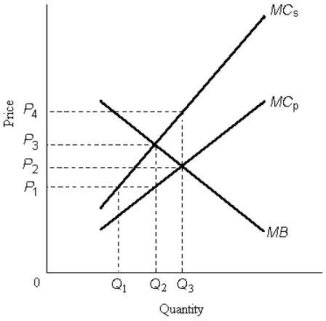 FIGURE 17- 1
Refer to Figure 17- 1.The price that leads consumers to demand the socially optimal quantity of output is
A)P3.
B)P1.
C)P2.
D)zero.
E)not possible to know from the information given.
FIGURE 17- 1Refer to Figure 17- 1.The price that leads consumers to demand the socially optimal quantity of output is
A)P3.
B)P1.
C)P2.
D)zero.
E)not possible to know from the information given.
Question
The figure below shows the marginal benefit to consumers,MB,the marginal cost to private firms,MCP,and the marginal cost to society,MCS,at each level of output of some good. 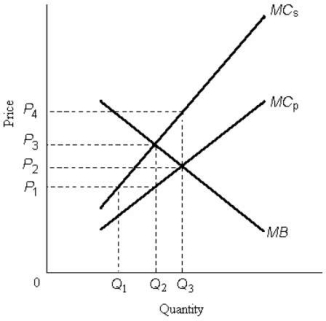 FIGURE 17- 1
Refer to Figure 17- 1.A negative externality is depicted because the
A)marginal social cost is greater than the marginal social benefit.
B)marginal social cost is greater than the marginal private cost.
C)optimal level of output occurs where marginal private benefit is positive.
D)optimal level of output occurs where marginal private cost is positive.
E)marginal social benefit to consumers is diminishing with greater output.
FIGURE 17- 1Refer to Figure 17- 1.A negative externality is depicted because the
A)marginal social cost is greater than the marginal social benefit.
B)marginal social cost is greater than the marginal private cost.
C)optimal level of output occurs where marginal private benefit is positive.
D)optimal level of output occurs where marginal private cost is positive.
E)marginal social benefit to consumers is diminishing with greater output.
Question
Question
Question
The figure below shows the demand and supply curves for pollution abatement.
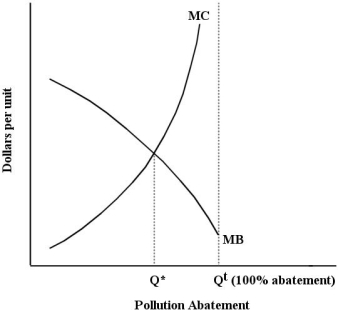 FIGURE 17- 3
Refer to Figure 17- 3.On the horizontal axis,the label "Qt(100% abatement)" refers to
A)the maximum pollution abatement that is cost effective.
B)zero pollution abatement.
C)the maximum pollution abatement attainable at the lowest cost.
D)zero remaining pollution.
E)the maximum pollution abatement attainable with given technology.
FIGURE 17- 3Refer to Figure 17- 3.On the horizontal axis,the label "Qt(100% abatement)" refers to
A)the maximum pollution abatement that is cost effective.
B)zero pollution abatement.
C)the maximum pollution abatement attainable at the lowest cost.
D)zero remaining pollution.
E)the maximum pollution abatement attainable with given technology.
Question
Question
The diagram below shows the marginal cost of abatement for each of two firms,A and B.Each firm is initially abating Q0 units of pollution.
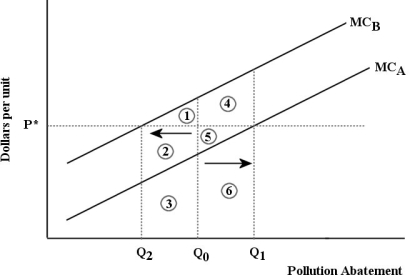 FIGURE 17- 6
Private and competitive markets could produce efficient levels of pollution if
A)the worst polluting firms were closed down.
B)regulated by government through direct controls.
C)the producers were made aware of the pollution externality.
D)left alone by government regulators.
E)the appropriate tax per unit of pollution were administered and enforced.
FIGURE 17- 6Private and competitive markets could produce efficient levels of pollution if
A)the worst polluting firms were closed down.
B)regulated by government through direct controls.
C)the producers were made aware of the pollution externality.
D)left alone by government regulators.
E)the appropriate tax per unit of pollution were administered and enforced.
Question
Question
The figure below shows the marginal benefit to consumers,MB,the marginal cost to private firms,MCP,and the marginal cost to society,MCS,at each level of output of some good.
FIGURE 17- 1
Consider the following equation: GHG = GHG × Energy × GDP,
Energy GDP
Where GHG = world annual emissions of greenhouse gases Energy = world annual amount of energy consumed GDP = world's annual gross domestic product
The ratio Energy/GDP describes
A)the number of units of carbon- based energy produced as a fraction of GDP.
B)the amount of energy used per unit of output in the energy- intensive sector of the economy.
C)the number of units of energy used per dollar of GDP produced.
D)the energy efficiency of greenhouse gas emissions.
E)the amount of energy per unit of GDP required to stabilize greenhouse gas emissions.
FIGURE 17- 1Consider the following equation: GHG = GHG × Energy × GDP,
Energy GDP
Where GHG = world annual emissions of greenhouse gases Energy = world annual amount of energy consumed GDP = world's annual gross domestic product
The ratio Energy/GDP describes
A)the number of units of carbon- based energy produced as a fraction of GDP.
B)the amount of energy used per unit of output in the energy- intensive sector of the economy.
C)the number of units of energy used per dollar of GDP produced.
D)the energy efficiency of greenhouse gas emissions.
E)the amount of energy per unit of GDP required to stabilize greenhouse gas emissions.
Question
Question
The diagram below shows the marginal cost of abatement for each of two firms,A and B.Each firm is initially abating Q0 units of pollution.
FIGURE 17- 6
Refer to Figure 17- 6.Suppose that a system of tradable pollution permits is introduced into this market and the equilibrium permit price is p*.The effect will be that
A)Firm B will buy permits from Firm A,pollute less,and increase its costs by the areas 2+3; Firm A will sell permits to Firm B,pollute more,and reduce its earnings by areas 4+5.
B)Firm B will sell permits to Firm A,pollute less,and reduce its costs by the area 1; Firm A will buy permits from Firm B,pollute more,and increase its costs by the area 4.
C)Firm B will sell permits to Firm A,pollute more,and reduce its costs by the area 1; Firm A will buy permits from Firm B,pollute less,and increase its earnings by area 4.
D)Firm B will buy permits from Firm A,pollute more,and reduce its costs by the area 1; Firm A will sell permits to Firm B,pollute less,and increase its earnings by area 5.
FIGURE 17- 6Refer to Figure 17- 6.Suppose that a system of tradable pollution permits is introduced into this market and the equilibrium permit price is p*.The effect will be that
A)Firm B will buy permits from Firm A,pollute less,and increase its costs by the areas 2+3; Firm A will sell permits to Firm B,pollute more,and reduce its earnings by areas 4+5.
B)Firm B will sell permits to Firm A,pollute less,and reduce its costs by the area 1; Firm A will buy permits from Firm B,pollute more,and increase its costs by the area 4.
C)Firm B will sell permits to Firm A,pollute more,and reduce its costs by the area 1; Firm A will buy permits from Firm B,pollute less,and increase its earnings by area 4.
D)Firm B will buy permits from Firm A,pollute more,and reduce its costs by the area 1; Firm A will sell permits to Firm B,pollute less,and increase its earnings by area 5.
Question
Question
The figure below shows the demand and supply curves for pollution abatement.
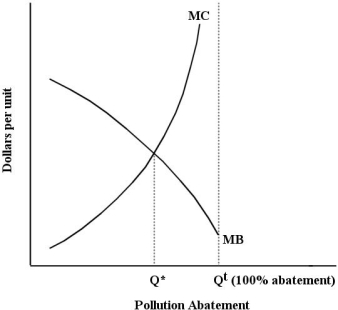 FIGURE 17- 3
Refer to Figure 17- 3.The socially optimal amount of pollution is
A)Q* + Qt.
B)Qt.
C)Qt - Q*.
D)0.
E)Q*.
FIGURE 17- 3Refer to Figure 17- 3.The socially optimal amount of pollution is
A)Q* + Qt.
B)Qt.
C)Qt - Q*.
D)0.
E)Q*.
Question
Question
Question
Question
The diagram below shows the marginal costs of pollution abatement for two firms,Firm 1 and Firm 2.
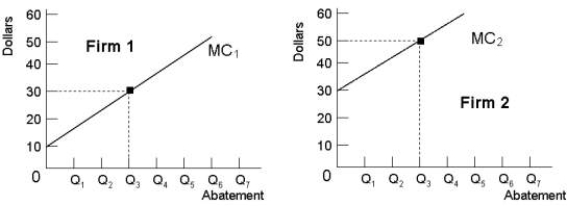 FIGURE 17- 5
Refer to Figure 17- 5.If the government requires each firm to abate Q3 units of pollution,the social costs of this abatement
A)would be minimized.
B)could be reduced further if Firm 2 increased abatement and Firm 1 reduced its abatement by the same amount.
C)could be reduced further if Firm 1 increased its abatement and Firm 2 reduced its abatement by the same amount.
D)could be reduced further if each firm was required to abate more.
E)could be reduced further if each firm was allowed to pollute more.
FIGURE 17- 5Refer to Figure 17- 5.If the government requires each firm to abate Q3 units of pollution,the social costs of this abatement
A)would be minimized.
B)could be reduced further if Firm 2 increased abatement and Firm 1 reduced its abatement by the same amount.
C)could be reduced further if Firm 1 increased its abatement and Firm 2 reduced its abatement by the same amount.
D)could be reduced further if each firm was required to abate more.
E)could be reduced further if each firm was allowed to pollute more.
Question
The diagram below shows the marginal cost of pollution abatement for two firms,Firm X and Firm Y.
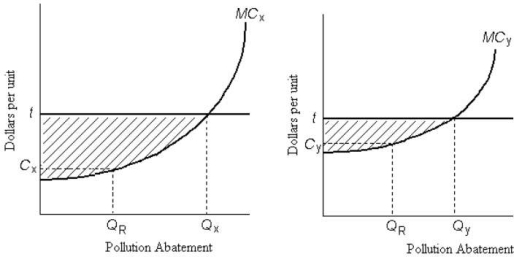 FIGURE 17- 4
Refer to Figure 17- 4.Ignore the horizontal line at t.The optimal amount of pollution abatement for these two firms together is
A)QR for X + Qy for Y.
B)Qx + Qy.
C)QR for X + QR for Y.
D)Qx for X + QR for Y.
E)impossible to tell without the marginal benefit of abatement curve.
FIGURE 17- 4Refer to Figure 17- 4.Ignore the horizontal line at t.The optimal amount of pollution abatement for these two firms together is
A)QR for X + Qy for Y.
B)Qx + Qy.
C)QR for X + QR for Y.
D)Qx for X + QR for Y.
E)impossible to tell without the marginal benefit of abatement curve.
Question
Question
The diagram below shows the marginal costs of pollution abatement for two firms,Firm 1 and Firm 2.
FIGURE 17- 5
Refer to Figure 17- 5.Suppose Firm 1 and Firm 2 are each abating Q3 units of pollution.If the government imposed an emissions tax of $40 per unit of emissions,
A)Firm 2 would increase abatement beyond Q3 and Firm 1 would abate less than Q3.
B)each firm would abate to the same level.
C)Firm 1 would increase abatement beyond Q3 and Firm 2 would abate less than Q3.
D)each firm would abate to Q3.
E)the level of pollution would be optimal.
FIGURE 17- 5Refer to Figure 17- 5.Suppose Firm 1 and Firm 2 are each abating Q3 units of pollution.If the government imposed an emissions tax of $40 per unit of emissions,
A)Firm 2 would increase abatement beyond Q3 and Firm 1 would abate less than Q3.
B)each firm would abate to the same level.
C)Firm 1 would increase abatement beyond Q3 and Firm 2 would abate less than Q3.
D)each firm would abate to Q3.
E)the level of pollution would be optimal.
Question
Question
The figure below shows the demand and supply curves for pollution abatement.
FIGURE 17- 3
The socially optimal level of output of any good is the quantity where all marginal costs of production,private plus external,equal the
A)average benefit to society.
B)marginal benefit to society.
C)total benefit to society.
D)marginal cost of production.
E)marginal benefit to the firm.
FIGURE 17- 3The socially optimal level of output of any good is the quantity where all marginal costs of production,private plus external,equal the
A)average benefit to society.
B)marginal benefit to society.
C)total benefit to society.
D)marginal cost of production.
E)marginal benefit to the firm.
Question
The diagram below shows the private and social marginal costs (MCP and MCS)and the social marginal benefits (MBS)of producing disposable diapers.
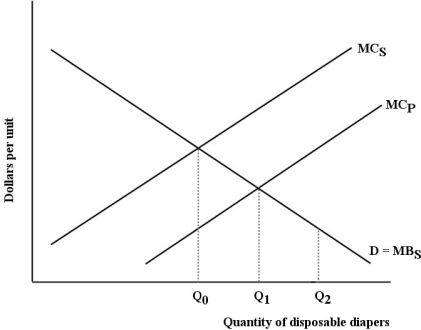 FIGURE 17- 2
Refer to Figure 17- 2.The net social benefit derived from the production and use of the last unit of disposable diapers is
A)at a maximum at Q0,because that is where MCS equals MBS.
B)zero at Q2,because that is where the externality is fully maximized.
C)at a minimum at Q0,because MCS exceeds MCP.
D)at a maximum at Q1,because that is where MCS equals MBS.
E)zero at Q0,because that is where MCS equals MBS.
FIGURE 17- 2Refer to Figure 17- 2.The net social benefit derived from the production and use of the last unit of disposable diapers is
A)at a maximum at Q0,because that is where MCS equals MBS.
B)zero at Q2,because that is where the externality is fully maximized.
C)at a minimum at Q0,because MCS exceeds MCP.
D)at a maximum at Q1,because that is where MCS equals MBS.
E)zero at Q0,because that is where MCS equals MBS.
Question
Question
The figure below shows the marginal benefit to consumers,MB,the marginal cost to private firms,MCP,and the marginal cost to society,MCS,at each level of output of some good.
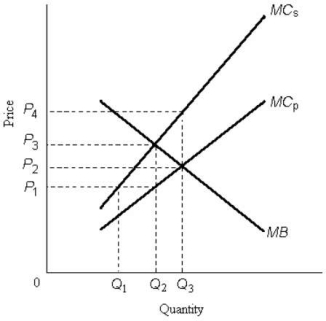 FIGURE 17- 1
Refer to Figure 17- 1.The socially optimal level of output is
A)zero.
B)Q1.
C)Q2.
D)Q3.
E)none of the above; there is no optimal output level.
FIGURE 17- 1Refer to Figure 17- 1.The socially optimal level of output is
A)zero.
B)Q1.
C)Q2.
D)Q3.
E)none of the above; there is no optimal output level.
Question
Question
Question
Question
Question
Question
Question
Question
Question
Question
The diagram below shows the marginal cost of pollution abatement for two firms,Firm X and Firm Y.
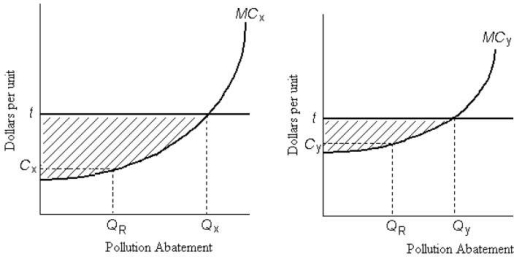 FIGURE 17- 4
Refer to Figure 17- 4.Ignore the horizontal line at t.If the government wanted to impose an emissions tax,efficiency requires that it
A)choose a different tax rate for each firm so that each firm abates QR units of pollution.
B)levy a tax at the same rate to both firms.
C)tax only the low- cost firm (Firm X)and fix the amount of pollution abatement for the high- cost firm (Firm Y).
D)tax only the high- cost firm (Firm Y)and fix the amount of pollution abatement for the low- cost firm (Firm X).
E)impose the same tax on both firms and also fix the amount of pollution abatement at QR for each firm.
FIGURE 17- 4Refer to Figure 17- 4.Ignore the horizontal line at t.If the government wanted to impose an emissions tax,efficiency requires that it
A)choose a different tax rate for each firm so that each firm abates QR units of pollution.
B)levy a tax at the same rate to both firms.
C)tax only the low- cost firm (Firm X)and fix the amount of pollution abatement for the high- cost firm (Firm Y).
D)tax only the high- cost firm (Firm Y)and fix the amount of pollution abatement for the low- cost firm (Firm X).
E)impose the same tax on both firms and also fix the amount of pollution abatement at QR for each firm.
Question
The diagram below shows the marginal cost of abatement for each of two firms,A and B.Each firm is initially abating Q0 units of pollution.
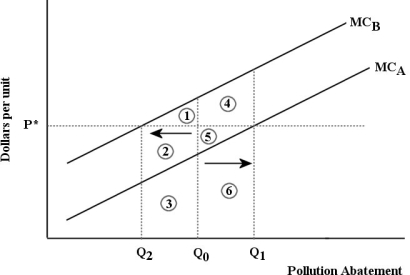 FIGURE 17- 6
Refer to Figure 17- 6.Suppose that a system of tradable pollution permits is introduced into this market and the equilibrium permit price is p*.Firm B will buy permits from Firm A because
A)Firm B has lower costs of pollution abatement than Firm A.
B)its total savings from abating less (areas 1+2+3)exceed the cost of buying the permits (areas 2+3).
C)Firm B can buy the permits at a lower price than Firm A.
D)its total cost of abating less (areas 1+2+3)exceeds the cost of buying the permits (areas 2+3).
E)its total savings from abating less (areas 1+2+3)exceed the total costs of Firm A abating more (area 6).
FIGURE 17- 6Refer to Figure 17- 6.Suppose that a system of tradable pollution permits is introduced into this market and the equilibrium permit price is p*.Firm B will buy permits from Firm A because
A)Firm B has lower costs of pollution abatement than Firm A.
B)its total savings from abating less (areas 1+2+3)exceed the cost of buying the permits (areas 2+3).
C)Firm B can buy the permits at a lower price than Firm A.
D)its total cost of abating less (areas 1+2+3)exceeds the cost of buying the permits (areas 2+3).
E)its total savings from abating less (areas 1+2+3)exceed the total costs of Firm A abating more (area 6).
Question
Question
The figure below shows the marginal benefit to consumers,MB,the marginal cost to private firms,MCP,and the marginal cost to society,MCS,at each level of output of some good.
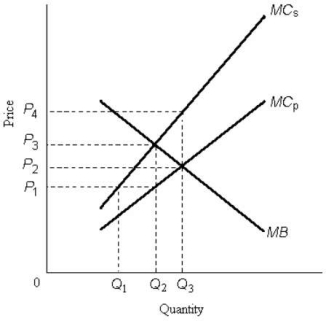 FIGURE 17- 1
Refer to Figure 17- 1.The price that would occur in a competitive market in the absence of government intervention is
A)P2.
B)P4.
C)P1.
D)P3.
E)not possible to know from the information given.
FIGURE 17- 1Refer to Figure 17- 1.The price that would occur in a competitive market in the absence of government intervention is
A)P2.
B)P4.
C)P1.
D)P3.
E)not possible to know from the information given.
Question
Question
Question
The diagram below shows the marginal costs of pollution abatement for two firms,Firm 1 and Firm 2.
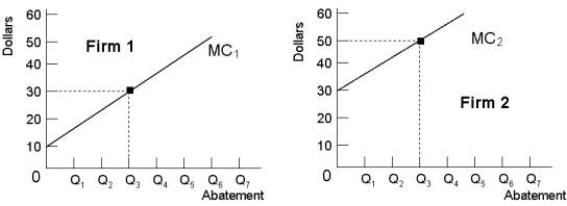 FIGURE 17- 5
Refer to Figure 17- 5.Suppose Firm 1 and Firm 2 are each abating Q3 units of pollution.If the government imposed an emissions tax of $40 per unit of emissions,and this tax rate was known to equal the social marginal cost of pollution,then we can predict with confidence that
A)each firm would abate to the same level.
B)each firm would abate to Q3.
C)the resulting level of pollution would be optimal.
D)Firm 2 would increase its emissions and this would not be socially optimal.
E)Firm 2 would increase abatement beyond Q3 and Firm 1 would abate less than Q3.
FIGURE 17- 5Refer to Figure 17- 5.Suppose Firm 1 and Firm 2 are each abating Q3 units of pollution.If the government imposed an emissions tax of $40 per unit of emissions,and this tax rate was known to equal the social marginal cost of pollution,then we can predict with confidence that
A)each firm would abate to the same level.
B)each firm would abate to Q3.
C)the resulting level of pollution would be optimal.
D)Firm 2 would increase its emissions and this would not be socially optimal.
E)Firm 2 would increase abatement beyond Q3 and Firm 1 would abate less than Q3.
Question
Question
Question
Question
Question
Question
Question
Question
Question
The diagram below shows the marginal cost of pollution abatement for two firms,Firm X and Firm Y.
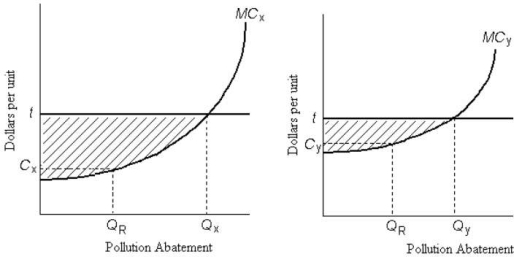 FIGURE 17- 4
Refer to Figure 17- 4.There is an emissions tax of $t per unit of pollution.The resulting amount of pollution abatement is socially optimal if
A)the emissions tax is equal to the marginal social cost of pollution.
B)the emissions tax causes no change in firms' polluting activity.
C)each firm abates at QR.
D)Firm X abates QX and Firm Y abates QY.
E)each firm pays the maximum amount of tax.
FIGURE 17- 4Refer to Figure 17- 4.There is an emissions tax of $t per unit of pollution.The resulting amount of pollution abatement is socially optimal if
A)the emissions tax is equal to the marginal social cost of pollution.
B)the emissions tax causes no change in firms' polluting activity.
C)each firm abates at QR.
D)Firm X abates QX and Firm Y abates QY.
E)each firm pays the maximum amount of tax.
Question
Question
The diagram below shows the marginal costs of pollution abatement for two firms,Firm 1 and Firm 2.
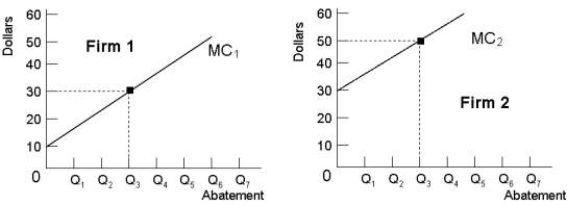 FIGURE 17- 5
A paper mill discharges chemicals into a river which washes the shores of a downstream resort area.The private marginal cost,social marginal cost,and marginal benefit associated with the production of paper are given by the following equations: MCP = 5 + Q,MCS = 10 + 2Q,and MB = 35 - 0.5Q.The allocatively efficient level of output is _ units.
A)15
B)30
C)10
D)25
E)0
FIGURE 17- 5A paper mill discharges chemicals into a river which washes the shores of a downstream resort area.The private marginal cost,social marginal cost,and marginal benefit associated with the production of paper are given by the following equations: MCP = 5 + Q,MCS = 10 + 2Q,and MB = 35 - 0.5Q.The allocatively efficient level of output is _ units.
A)15
B)30
C)10
D)25
E)0
Question
Question
Question
Question
The diagram below shows the marginal cost of pollution abatement for two firms,Firm X and Firm Y.
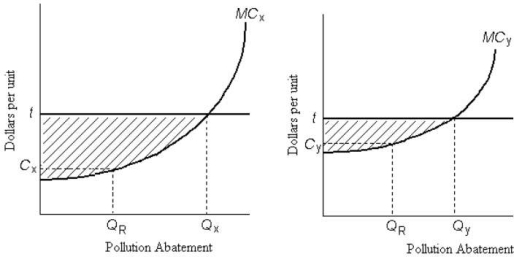 FIGURE 17- 4
If emissions permits are traded freely between profit- maximizing firms in the private market,
A)the amount of pollution abatement will be identical to that which the firms would have willingly undertaken on their own.
B)marginal abatement costs will be equalized across firms.
C)each firm will face identical costs of pollution abatement.
D)there will be more than the optimal amount of pollution.
E)all firms will use identical pollution abatement technologies.
FIGURE 17- 4If emissions permits are traded freely between profit- maximizing firms in the private market,
A)the amount of pollution abatement will be identical to that which the firms would have willingly undertaken on their own.
B)marginal abatement costs will be equalized across firms.
C)each firm will face identical costs of pollution abatement.
D)there will be more than the optimal amount of pollution.
E)all firms will use identical pollution abatement technologies.
Question
Question
The diagram below shows the marginal costs of pollution abatement for two firms,Firm 1 and Firm 2.
FIGURE 17- 5
Refer to Figure 17- 5.Suppose the government requires that each firm abate pollution to the level Q3.The outcome would be efficient because
A)the marginal costs of abatement are equated for the two firms.
B)the marginal cost and marginal benefit of pollution abatement are equated.
C)the maximum amount of pollution is being abated at the lowest cost.
D)all of the above.
E)none of the above; the outcome would be inefficient.
FIGURE 17- 5Refer to Figure 17- 5.Suppose the government requires that each firm abate pollution to the level Q3.The outcome would be efficient because
A)the marginal costs of abatement are equated for the two firms.
B)the marginal cost and marginal benefit of pollution abatement are equated.
C)the maximum amount of pollution is being abated at the lowest cost.
D)all of the above.
E)none of the above; the outcome would be inefficient.
Question
Question
Question
Question
Question
The figure below shows the marginal benefit to consumers,MB,the marginal cost to private firms,MCP,and the marginal cost to society,MCS,at each level of output of some good.
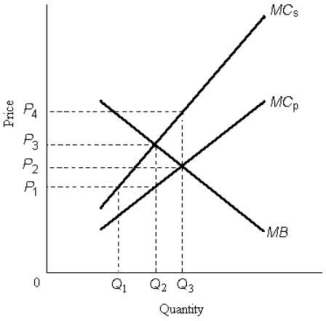 FIGURE 17- 1
Refer to Figure 17- 1.The equilibrium output that would occur in a competitive market in the absence of government intervention is
A)zero.
B)Q1.
C)Q2.
D)Q3.
E)none of the above; there is no equilibrium output level.
FIGURE 17- 1Refer to Figure 17- 1.The equilibrium output that would occur in a competitive market in the absence of government intervention is
A)zero.
B)Q1.
C)Q2.
D)Q3.
E)none of the above; there is no equilibrium output level.
Question
The diagram below shows the marginal cost of abatement for each of two firms,A and B.Each firm is initially abating Q0 units of pollution.
 FIGURE 17- 6
Refer to Figure 17- 6.Suppose that a system of tradable pollution permits is introduced into this market and the equilibrium permit price is p*.The effect will be that
A)there will be no change in the quantity of abatement by each firm.
B)Firms A and B will each abate Q2 units of pollution.
C)Firm A will abate less pollution-the amount Q2,and Firm B will abate more pollution-the amount Q1.
D)Firms A and B will each abate Q0 units of pollution.
E)Firm B will abate less pollution-the amount Q2,and Firm A will abate more pollution-the amount Q1.
FIGURE 17- 6Refer to Figure 17- 6.Suppose that a system of tradable pollution permits is introduced into this market and the equilibrium permit price is p*.The effect will be that
A)there will be no change in the quantity of abatement by each firm.
B)Firms A and B will each abate Q2 units of pollution.
C)Firm A will abate less pollution-the amount Q2,and Firm B will abate more pollution-the amount Q1.
D)Firms A and B will each abate Q0 units of pollution.
E)Firm B will abate less pollution-the amount Q2,and Firm A will abate more pollution-the amount Q1.
Question
The diagram below shows the marginal cost of pollution abatement for two firms,Firm X and Firm Y.
FIGURE 17- 4
Refer to Figure 17- 4.Firms X and Y have an emissions tax of $t imposed on each unit of pollution they produce.If Firm X chooses to abate QX units of pollution,the total cost of its abatement is
A)area beneath the marginal cost of pollution abatement curve.
B)tax amount t multiplied by the level of pollution abatement,QX.
C)tax amount t multiplied by the maximum possible level of pollution abatement.
D)area beneath the marginal cost of pollution abatement curve up to QX.
E)area below the horizontal line at t and above the MC of pollution abatement curve.
FIGURE 17- 4Refer to Figure 17- 4.Firms X and Y have an emissions tax of $t imposed on each unit of pollution they produce.If Firm X chooses to abate QX units of pollution,the total cost of its abatement is
A)area beneath the marginal cost of pollution abatement curve.
B)tax amount t multiplied by the level of pollution abatement,QX.
C)tax amount t multiplied by the maximum possible level of pollution abatement.
D)area beneath the marginal cost of pollution abatement curve up to QX.
E)area below the horizontal line at t and above the MC of pollution abatement curve.
Question
Question
Question
Question
Question
The diagram below shows a market for tradable pollution permits.
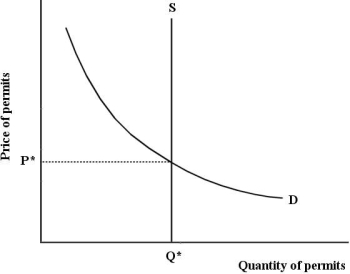 Figure 17- 7
Refer to Figure 17- 7,which depicts the market for tradable pollution permits.The amount of permits Q* is determined by
A)market forces.
B)the level of abatement technology.
C)large corporations.
D)the relevant government.
E)the World Environmental Organization.
Figure 17- 7Refer to Figure 17- 7,which depicts the market for tradable pollution permits.The amount of permits Q* is determined by
A)market forces.
B)the level of abatement technology.
C)large corporations.
D)the relevant government.
E)the World Environmental Organization.
Question

Unlock Deck
Sign up to unlock the cards in this deck!
Unlock Deck
Unlock Deck
1/109

Play

Full screen (f)
Deck 17: The Economics of Environmental Protection
1
In general,the economist's view on allocating resources to reduce pollution is that
A)it is not allocatively efficient to reduce pollution.
B)the reduction of pollution should proceed up to the point where the marginal cost of pollution reduction equals the marginal benefit to society.
C)the extent of pollution reduction should be based only on a comparison of total costs and total benefits to the environment.
D)all forms of water and air pollution should be eliminated.
E)government policies to reduce pollution have zero opportunity cost.
A)it is not allocatively efficient to reduce pollution.
B)the reduction of pollution should proceed up to the point where the marginal cost of pollution reduction equals the marginal benefit to society.
C)the extent of pollution reduction should be based only on a comparison of total costs and total benefits to the environment.
D)all forms of water and air pollution should be eliminated.
E)government policies to reduce pollution have zero opportunity cost.
B
2
A paper mill discharges chemicals into a river which washes the shores of a downstream resort area.The private marginal cost,social marginal cost,and marginal benefit associated with the production of paper are given by the following equations: MCP = 5 + Q,MCS = 10 + 2Q,and MB = 35 - 0.5Q.A competitive free market will produce output of units,and this amount is than the allocatively efficient level of output.
A)15; more
B)25; more
C)5; less
D)20; more
E)10; less
A)15; more
B)25; more
C)5; less
D)20; more
E)10; less
D
3
The diagram below shows the private and social marginal costs (MCP and MCS)and the social marginal benefits (MBS)of producing disposable diapers.
FIGURE 17- 2
Refer to Figure 17- 2.The net social benefit derived from the production and use of disposable diapers is
A)zero at Q0,because that is where MCS equals MBS.
B)at a minimum at Q0,because MCS exceeds MCP.
C)zero at Q2,because that is where the externality is internalized.
D)at a maximum at Q1,because that is where MCS equals MBS.
E)at a maximum at Q0,because that is where MCS equals MBS.
FIGURE 17- 2Refer to Figure 17- 2.The net social benefit derived from the production and use of disposable diapers is
A)zero at Q0,because that is where MCS equals MBS.
B)at a minimum at Q0,because MCS exceeds MCP.
C)zero at Q2,because that is where the externality is internalized.
D)at a maximum at Q1,because that is where MCS equals MBS.
E)at a maximum at Q0,because that is where MCS equals MBS.
E
4
Economists often argue that a system of tradable pollution permits is cost- effective because
A)firms facing a low marginal cost of abatement will not abate at all.
B)firms will choose their abatement so that their marginal cost of abatement equals the price of a permit,which is the same for all firms.
C)firms facing a high marginal cost of abatement will not abate at all.
D)firms with a marginal cost of abatement lower than the permit price will buy permits and abate less.
E)firms facing a marginal cost of abatement lower than the permit price will not abate at all.
A)firms facing a low marginal cost of abatement will not abate at all.
B)firms will choose their abatement so that their marginal cost of abatement equals the price of a permit,which is the same for all firms.
C)firms facing a high marginal cost of abatement will not abate at all.
D)firms with a marginal cost of abatement lower than the permit price will buy permits and abate less.
E)firms facing a marginal cost of abatement lower than the permit price will not abate at all.
Unlock Deck
Unlock for access to all 109 flashcards in this deck.
Unlock Deck
k this deck
5
Two firms,A and B,are legally required to reduce their toxic emissions.If Firm A's marginal cost of abatement is $5 and Firm B's marginal cost of abatement is $5,
A)their joint total cost of abatement is at a maximum.
B)their joint total cost of abatement is at a minimum.
C)Firm A should abate more and Firm B should abate less.
D)Firm B should abate more and Firm A should abate less.
E)the socially optimal joint level of abatement is not being achieved.
A)their joint total cost of abatement is at a maximum.
B)their joint total cost of abatement is at a minimum.
C)Firm A should abate more and Firm B should abate less.
D)Firm B should abate more and Firm A should abate less.
E)the socially optimal joint level of abatement is not being achieved.
Unlock Deck
Unlock for access to all 109 flashcards in this deck.
Unlock Deck
k this deck
6
The diagram below shows a market for tradable pollution permits.
Figure 17- 7
Refer to Figure 17- 7,which depicts the market for tradable pollution permits.If the environmental organization called "Friends of the Earth" buys a large quantity of pollution permits and permanently decides not to use them,then
A)the supply curve shifts to the left,and the equilibrium price rises.
B)allocative efficiency is lost.
C)there is no impact on the equilibrium.
D)the demand curve shifts to the left,and the equilibrium price falls.
E)the supply curve shifts to the right,and the equilibrium price falls.
Figure 17- 7Refer to Figure 17- 7,which depicts the market for tradable pollution permits.If the environmental organization called "Friends of the Earth" buys a large quantity of pollution permits and permanently decides not to use them,then
A)the supply curve shifts to the left,and the equilibrium price rises.
B)allocative efficiency is lost.
C)there is no impact on the equilibrium.
D)the demand curve shifts to the left,and the equilibrium price falls.
E)the supply curve shifts to the right,and the equilibrium price falls.
Unlock Deck
Unlock for access to all 109 flashcards in this deck.
Unlock Deck
k this deck
7
The diagram below shows the marginal cost of abatement for each of two firms,A and B.Each firm is initially abating Q0 units of pollution.
FIGURE 17- 6
Refer to Figure 17- 6.Suppose that a system of tradable pollution permits is introduced into this market and the equilibrium permit price is p×.Firm A will sell permits to Firm B because
A)Firm B has lower costs of pollution abatement than Firm A.
B)Firm A's total cost of abating more pollution (areas 5 + 6)is less than the revenue it earns from selling the permits (areas 4 + 5 + 6).
C)the revenue Firm A earns from selling permits (areas 5 + 6)is greater than the cost it incurs from abating more pollution (area 6).
D)Firm A's total cost of abating more pollution (area 6)is less than the revenue it earns from selling the permits (area 4 + 5).
E)Firm A can buy the permits at a lower price than Firm B.
FIGURE 17- 6Refer to Figure 17- 6.Suppose that a system of tradable pollution permits is introduced into this market and the equilibrium permit price is p×.Firm A will sell permits to Firm B because
A)Firm B has lower costs of pollution abatement than Firm A.
B)Firm A's total cost of abating more pollution (areas 5 + 6)is less than the revenue it earns from selling the permits (areas 4 + 5 + 6).
C)the revenue Firm A earns from selling permits (areas 5 + 6)is greater than the cost it incurs from abating more pollution (area 6).
D)Firm A's total cost of abating more pollution (area 6)is less than the revenue it earns from selling the permits (area 4 + 5).
E)Firm A can buy the permits at a lower price than Firm B.
Unlock Deck
Unlock for access to all 109 flashcards in this deck.
Unlock Deck
k this deck
8
Suppose the government imposes an emissions tax of $t on each unit of pollution produced by a firm.Under which of the following circumstances would the tax rate be set too high to achieve allocative efficiency?
A)the tax rate is less than the marginal external cost of the pollution
B)the firm could not afford to pay the tax
C)the tax rate is greater than the firm's private marginal cost of production
D)the tax rate is greater than the marginal external cost of the pollution
E)the tax rate causes the firm's ATC curve to shift up
A)the tax rate is less than the marginal external cost of the pollution
B)the firm could not afford to pay the tax
C)the tax rate is greater than the firm's private marginal cost of production
D)the tax rate is greater than the marginal external cost of the pollution
E)the tax rate causes the firm's ATC curve to shift up
Unlock Deck
Unlock for access to all 109 flashcards in this deck.
Unlock Deck
k this deck
9
Consider a coal- fired electric- power plant that is operating under a cap- and trade- system.If its marginal cost of pollution abatement is $5 per unit and the price of the permit is $3 per unit,this firm will
A)not buy any permits,since that would push up its costs.
B)buy permits and abate less pollution.
C)not abate at all.
D)buy permits and abate more pollution.
E)sell permits and abate more pollution.
A)not buy any permits,since that would push up its costs.
B)buy permits and abate less pollution.
C)not abate at all.
D)buy permits and abate more pollution.
E)sell permits and abate more pollution.
Unlock Deck
Unlock for access to all 109 flashcards in this deck.
Unlock Deck
k this deck
10
The figure below shows the marginal benefit to consumers,MB,the marginal cost to private firms,MCP,and the marginal cost to society,MCS,at each level of output of some good.
FIGURE 17- 1
Refer to Figure 17- 1.The price that leads consumers to demand the socially optimal quantity of output is
A)P3.
B)P1.
C)P2.
D)zero.
E)not possible to know from the information given.
FIGURE 17- 1Refer to Figure 17- 1.The price that leads consumers to demand the socially optimal quantity of output is
A)P3.
B)P1.
C)P2.
D)zero.
E)not possible to know from the information given.
Unlock Deck
Unlock for access to all 109 flashcards in this deck.
Unlock Deck
k this deck
11
The figure below shows the marginal benefit to consumers,MB,the marginal cost to private firms,MCP,and the marginal cost to society,MCS,at each level of output of some good. FIGURE 17- 1
Refer to Figure 17- 1.A negative externality is depicted because the
A)marginal social cost is greater than the marginal social benefit.
B)marginal social cost is greater than the marginal private cost.
C)optimal level of output occurs where marginal private benefit is positive.
D)optimal level of output occurs where marginal private cost is positive.
E)marginal social benefit to consumers is diminishing with greater output.
FIGURE 17- 1Refer to Figure 17- 1.A negative externality is depicted because the
A)marginal social cost is greater than the marginal social benefit.
B)marginal social cost is greater than the marginal private cost.
C)optimal level of output occurs where marginal private benefit is positive.
D)optimal level of output occurs where marginal private cost is positive.
E)marginal social benefit to consumers is diminishing with greater output.
Unlock Deck
Unlock for access to all 109 flashcards in this deck.
Unlock Deck
k this deck
12
In a competitive market for tradable pollution permits,the quantity of permits (for a given amount of pollution)is set by and the equilibrium price is determined by _.
A)market forces; government policy
B)government policy; government policy
C)market forces; market forces
D)government policy; market forces
E)government policy; the average cost of pollution abatement
A)market forces; government policy
B)government policy; government policy
C)market forces; market forces
D)government policy; market forces
E)government policy; the average cost of pollution abatement
Unlock Deck
Unlock for access to all 109 flashcards in this deck.
Unlock Deck
k this deck
13
Suppose a firm producing roof shingles imposes a negative externality on the surrounding area due to the noxious fumes emitted from the plant.The private marginal cost,social marginal cost and marginal benefit associated with the production of the shingles are given by the following equations: MCp = 5 + 2Q MCs = 10 + 3Q MB = 50 - Q
What level of emissions tax (dollars per unit of output produced)would provide this firm with the incentive to produce at the allocatively efficient level of output?
A)$25
B)$30
C)$15
D)$40
E)$10
What level of emissions tax (dollars per unit of output produced)would provide this firm with the incentive to produce at the allocatively efficient level of output?
A)$25
B)$30
C)$15
D)$40
E)$10
Unlock Deck
Unlock for access to all 109 flashcards in this deck.
Unlock Deck
k this deck
14
The figure below shows the demand and supply curves for pollution abatement.
FIGURE 17- 3
Refer to Figure 17- 3.On the horizontal axis,the label "Qt(100% abatement)" refers to
A)the maximum pollution abatement that is cost effective.
B)zero pollution abatement.
C)the maximum pollution abatement attainable at the lowest cost.
D)zero remaining pollution.
E)the maximum pollution abatement attainable with given technology.
FIGURE 17- 3Refer to Figure 17- 3.On the horizontal axis,the label "Qt(100% abatement)" refers to
A)the maximum pollution abatement that is cost effective.
B)zero pollution abatement.
C)the maximum pollution abatement attainable at the lowest cost.
D)zero remaining pollution.
E)the maximum pollution abatement attainable with given technology.
Unlock Deck
Unlock for access to all 109 flashcards in this deck.
Unlock Deck
k this deck
15
When firms in an industry have fully internalized a production externality,
A)they produce at less than the optimal level of output.
B)the marginal social cost is zero.
C)they produce at more than the optimal level of output.
D)they bear the entire social marginal cost of production.
E)it is not possible to achieve allocative efficiency.
A)they produce at less than the optimal level of output.
B)the marginal social cost is zero.
C)they produce at more than the optimal level of output.
D)they bear the entire social marginal cost of production.
E)it is not possible to achieve allocative efficiency.
Unlock Deck
Unlock for access to all 109 flashcards in this deck.
Unlock Deck
k this deck
16
The diagram below shows the marginal cost of abatement for each of two firms,A and B.Each firm is initially abating Q0 units of pollution.
FIGURE 17- 6
Private and competitive markets could produce efficient levels of pollution if
A)the worst polluting firms were closed down.
B)regulated by government through direct controls.
C)the producers were made aware of the pollution externality.
D)left alone by government regulators.
E)the appropriate tax per unit of pollution were administered and enforced.
FIGURE 17- 6Private and competitive markets could produce efficient levels of pollution if
A)the worst polluting firms were closed down.
B)regulated by government through direct controls.
C)the producers were made aware of the pollution externality.
D)left alone by government regulators.
E)the appropriate tax per unit of pollution were administered and enforced.
Unlock Deck
Unlock for access to all 109 flashcards in this deck.
Unlock Deck
k this deck
17
Consider global greenhouse- gas emissions.Suppose that in 2012,greenhouse gases emitted per unit of energy consumed decreased by 2%,energy use per unit of GDP decreased by 2%,and world GDP increased by 4%.What will be the approximate change in global greenhouse gas emissions in 2012?
A)decrease by 4%
B)increase by 4%
C)no change
D)increase by 16%
E)decrease by 16%
A)decrease by 4%
B)increase by 4%
C)no change
D)increase by 16%
E)decrease by 16%
Unlock Deck
Unlock for access to all 109 flashcards in this deck.
Unlock Deck
k this deck
18
The figure below shows the marginal benefit to consumers,MB,the marginal cost to private firms,MCP,and the marginal cost to society,MCS,at each level of output of some good.
FIGURE 17- 1
Consider the following equation: GHG = GHG × Energy × GDP,
Energy GDP
Where GHG = world annual emissions of greenhouse gases Energy = world annual amount of energy consumed GDP = world's annual gross domestic product
The ratio Energy/GDP describes
A)the number of units of carbon- based energy produced as a fraction of GDP.
B)the amount of energy used per unit of output in the energy- intensive sector of the economy.
C)the number of units of energy used per dollar of GDP produced.
D)the energy efficiency of greenhouse gas emissions.
E)the amount of energy per unit of GDP required to stabilize greenhouse gas emissions.
FIGURE 17- 1Consider the following equation: GHG = GHG × Energy × GDP,
Energy GDP
Where GHG = world annual emissions of greenhouse gases Energy = world annual amount of energy consumed GDP = world's annual gross domestic product
The ratio Energy/GDP describes
A)the number of units of carbon- based energy produced as a fraction of GDP.
B)the amount of energy used per unit of output in the energy- intensive sector of the economy.
C)the number of units of energy used per dollar of GDP produced.
D)the energy efficiency of greenhouse gas emissions.
E)the amount of energy per unit of GDP required to stabilize greenhouse gas emissions.
Unlock Deck
Unlock for access to all 109 flashcards in this deck.
Unlock Deck
k this deck
19
Global greenhouse- gas (GHG)emission reductions are unlikely to be achieved through GDP reductions because
A)the rise in GDP in rich countries will be greater than the reductions in GDP in poor countries.
B)GDP cannot be reduced.
C)the growth rate of world GDP is negative.
D)the rise in GDP in poor countries will be greater than the reductions in GDP in rich countries.
E)ongoing population growth and per capita income growth are likely to drive GDP upward.
A)the rise in GDP in rich countries will be greater than the reductions in GDP in poor countries.
B)GDP cannot be reduced.
C)the growth rate of world GDP is negative.
D)the rise in GDP in poor countries will be greater than the reductions in GDP in rich countries.
E)ongoing population growth and per capita income growth are likely to drive GDP upward.
Unlock Deck
Unlock for access to all 109 flashcards in this deck.
Unlock Deck
k this deck
20
The diagram below shows the marginal cost of abatement for each of two firms,A and B.Each firm is initially abating Q0 units of pollution.
FIGURE 17- 6
Refer to Figure 17- 6.Suppose that a system of tradable pollution permits is introduced into this market and the equilibrium permit price is p*.The effect will be that
A)Firm B will buy permits from Firm A,pollute less,and increase its costs by the areas 2+3; Firm A will sell permits to Firm B,pollute more,and reduce its earnings by areas 4+5.
B)Firm B will sell permits to Firm A,pollute less,and reduce its costs by the area 1; Firm A will buy permits from Firm B,pollute more,and increase its costs by the area 4.
C)Firm B will sell permits to Firm A,pollute more,and reduce its costs by the area 1; Firm A will buy permits from Firm B,pollute less,and increase its earnings by area 4.
D)Firm B will buy permits from Firm A,pollute more,and reduce its costs by the area 1; Firm A will sell permits to Firm B,pollute less,and increase its earnings by area 5.
FIGURE 17- 6Refer to Figure 17- 6.Suppose that a system of tradable pollution permits is introduced into this market and the equilibrium permit price is p*.The effect will be that
A)Firm B will buy permits from Firm A,pollute less,and increase its costs by the areas 2+3; Firm A will sell permits to Firm B,pollute more,and reduce its earnings by areas 4+5.
B)Firm B will sell permits to Firm A,pollute less,and reduce its costs by the area 1; Firm A will buy permits from Firm B,pollute more,and increase its costs by the area 4.
C)Firm B will sell permits to Firm A,pollute more,and reduce its costs by the area 1; Firm A will buy permits from Firm B,pollute less,and increase its earnings by area 4.
D)Firm B will buy permits from Firm A,pollute more,and reduce its costs by the area 1; Firm A will sell permits to Firm B,pollute less,and increase its earnings by area 5.
Unlock Deck
Unlock for access to all 109 flashcards in this deck.
Unlock Deck
k this deck
21
Direct pollution controls can be inefficient because,for any given amount of pollution reduction,they
A)do not minimize the total cost of pollution abatement.
B)are not complied with by firms.
C)create new pollution as they eliminate existing pollution.
D)take into account differing marginal costs among firms.
E)cost too much to enforce.
A)do not minimize the total cost of pollution abatement.
B)are not complied with by firms.
C)create new pollution as they eliminate existing pollution.
D)take into account differing marginal costs among firms.
E)cost too much to enforce.
Unlock Deck
Unlock for access to all 109 flashcards in this deck.
Unlock Deck
k this deck
22
The figure below shows the demand and supply curves for pollution abatement.
FIGURE 17- 3
Refer to Figure 17- 3.The socially optimal amount of pollution is
A)Q* + Qt.
B)Qt.
C)Qt - Q*.
D)0.
E)Q*.
FIGURE 17- 3Refer to Figure 17- 3.The socially optimal amount of pollution is
A)Q* + Qt.
B)Qt.
C)Qt - Q*.
D)0.
E)Q*.
Unlock Deck
Unlock for access to all 109 flashcards in this deck.
Unlock Deck
k this deck
23
Suppose a farm that is polluting an underground water supply faces the following marginal costs for abating units of pollution: 1st unit abated,MC = $250 2nd unit abated,MC = $400 3rd unit abated,MC = $650 4th unit abated,MC = $950
The marginal benefit to society from this farm abating units of pollution are as follows: 1st unit abated,MB = $1000
2nd unit abated,MB = $800 3rd unit abated,MB = $650 4th unit abated,MB = $300
If this farm abates 4 units of pollution,what is the net benefit to society of the final unit of pollution abated?
A)$1150
B)- $1150
C)- $650
D)$0
E)$650
The marginal benefit to society from this farm abating units of pollution are as follows: 1st unit abated,MB = $1000
2nd unit abated,MB = $800 3rd unit abated,MB = $650 4th unit abated,MB = $300
If this farm abates 4 units of pollution,what is the net benefit to society of the final unit of pollution abated?
A)$1150
B)- $1150
C)- $650
D)$0
E)$650
Unlock Deck
Unlock for access to all 109 flashcards in this deck.
Unlock Deck
k this deck
24
If residential garbage collection were financed by charging households a fee per unit of garbage collected,rather than through general property taxation or a flat fee,you would expect
A)inadequate revenue to pay for the garbage collection.
B)less concern about recycling and more concern about the high cost of garbage collection.
C)the administration cost to outweigh any other savings,thus rendering this idea inefficient.
D)more recycling as households seek to minimize their garbage- collection bill.
E)higher costs for the municipality providing the garbage- collection service.
A)inadequate revenue to pay for the garbage collection.
B)less concern about recycling and more concern about the high cost of garbage collection.
C)the administration cost to outweigh any other savings,thus rendering this idea inefficient.
D)more recycling as households seek to minimize their garbage- collection bill.
E)higher costs for the municipality providing the garbage- collection service.
Unlock Deck
Unlock for access to all 109 flashcards in this deck.
Unlock Deck
k this deck
25
Suppose a firm producing roof shingles imposes a negative externality on the surrounding area due to the noxious fumes emitted from the plant.The private marginal cost,social marginal cost and marginal benefit associated with the production of the shingles are given by the following equations: MCP = 5 + 2Q MCS = 10 + 3Q MB = 50 - Q
The allocatively efficient level of output is _ units.
A)15
B)5
C)10
D)0
E)20
The allocatively efficient level of output is _ units.
A)15
B)5
C)10
D)0
E)20
Unlock Deck
Unlock for access to all 109 flashcards in this deck.
Unlock Deck
k this deck
26
The diagram below shows the marginal costs of pollution abatement for two firms,Firm 1 and Firm 2.
FIGURE 17- 5
Refer to Figure 17- 5.If the government requires each firm to abate Q3 units of pollution,the social costs of this abatement
A)would be minimized.
B)could be reduced further if Firm 2 increased abatement and Firm 1 reduced its abatement by the same amount.
C)could be reduced further if Firm 1 increased its abatement and Firm 2 reduced its abatement by the same amount.
D)could be reduced further if each firm was required to abate more.
E)could be reduced further if each firm was allowed to pollute more.
FIGURE 17- 5Refer to Figure 17- 5.If the government requires each firm to abate Q3 units of pollution,the social costs of this abatement
A)would be minimized.
B)could be reduced further if Firm 2 increased abatement and Firm 1 reduced its abatement by the same amount.
C)could be reduced further if Firm 1 increased its abatement and Firm 2 reduced its abatement by the same amount.
D)could be reduced further if each firm was required to abate more.
E)could be reduced further if each firm was allowed to pollute more.
Unlock Deck
Unlock for access to all 109 flashcards in this deck.
Unlock Deck
k this deck
27
The diagram below shows the marginal cost of pollution abatement for two firms,Firm X and Firm Y.
FIGURE 17- 4
Refer to Figure 17- 4.Ignore the horizontal line at t.The optimal amount of pollution abatement for these two firms together is
A)QR for X + Qy for Y.
B)Qx + Qy.
C)QR for X + QR for Y.
D)Qx for X + QR for Y.
E)impossible to tell without the marginal benefit of abatement curve.
FIGURE 17- 4Refer to Figure 17- 4.Ignore the horizontal line at t.The optimal amount of pollution abatement for these two firms together is
A)QR for X + Qy for Y.
B)Qx + Qy.
C)QR for X + QR for Y.
D)Qx for X + QR for Y.
E)impossible to tell without the marginal benefit of abatement curve.
Unlock Deck
Unlock for access to all 109 flashcards in this deck.
Unlock Deck
k this deck
28
The optimal amount of pollution abatement is generally less than 100%.Complete (100% )abatement would be optimal if
A)the marginal benefit of abatement is zero.
B)the marginal cost of abatement is positive but less than the marginal benefit of abatement.
C)the marginal cost of abatement exceeds the marginal benefit of abatement at all levels of abatement.
D)the marginal cost of abatement is always zero.
E)none of the above - we cannot even imagine a situation in which complete abatement would be optimal.
A)the marginal benefit of abatement is zero.
B)the marginal cost of abatement is positive but less than the marginal benefit of abatement.
C)the marginal cost of abatement exceeds the marginal benefit of abatement at all levels of abatement.
D)the marginal cost of abatement is always zero.
E)none of the above - we cannot even imagine a situation in which complete abatement would be optimal.
Unlock Deck
Unlock for access to all 109 flashcards in this deck.
Unlock Deck
k this deck
29
The diagram below shows the marginal costs of pollution abatement for two firms,Firm 1 and Firm 2.
FIGURE 17- 5
Refer to Figure 17- 5.Suppose Firm 1 and Firm 2 are each abating Q3 units of pollution.If the government imposed an emissions tax of $40 per unit of emissions,
A)Firm 2 would increase abatement beyond Q3 and Firm 1 would abate less than Q3.
B)each firm would abate to the same level.
C)Firm 1 would increase abatement beyond Q3 and Firm 2 would abate less than Q3.
D)each firm would abate to Q3.
E)the level of pollution would be optimal.
FIGURE 17- 5Refer to Figure 17- 5.Suppose Firm 1 and Firm 2 are each abating Q3 units of pollution.If the government imposed an emissions tax of $40 per unit of emissions,
A)Firm 2 would increase abatement beyond Q3 and Firm 1 would abate less than Q3.
B)each firm would abate to the same level.
C)Firm 1 would increase abatement beyond Q3 and Firm 2 would abate less than Q3.
D)each firm would abate to Q3.
E)the level of pollution would be optimal.
Unlock Deck
Unlock for access to all 109 flashcards in this deck.
Unlock Deck
k this deck
30
Between 1990 and 2009,Canada's greenhouse gas emissions by %.
A)increased; almost 30
B)decreased; 6
C)decreased; 1
D)increased; close to 20
E)increased; 6
A)increased; almost 30
B)decreased; 6
C)decreased; 1
D)increased; close to 20
E)increased; 6
Unlock Deck
Unlock for access to all 109 flashcards in this deck.
Unlock Deck
k this deck
31
The figure below shows the demand and supply curves for pollution abatement.
FIGURE 17- 3
The socially optimal level of output of any good is the quantity where all marginal costs of production,private plus external,equal the
A)average benefit to society.
B)marginal benefit to society.
C)total benefit to society.
D)marginal cost of production.
E)marginal benefit to the firm.
FIGURE 17- 3The socially optimal level of output of any good is the quantity where all marginal costs of production,private plus external,equal the
A)average benefit to society.
B)marginal benefit to society.
C)total benefit to society.
D)marginal cost of production.
E)marginal benefit to the firm.
Unlock Deck
Unlock for access to all 109 flashcards in this deck.
Unlock Deck
k this deck
32
The diagram below shows the private and social marginal costs (MCP and MCS)and the social marginal benefits (MBS)of producing disposable diapers.
FIGURE 17- 2
Refer to Figure 17- 2.The net social benefit derived from the production and use of the last unit of disposable diapers is
A)at a maximum at Q0,because that is where MCS equals MBS.
B)zero at Q2,because that is where the externality is fully maximized.
C)at a minimum at Q0,because MCS exceeds MCP.
D)at a maximum at Q1,because that is where MCS equals MBS.
E)zero at Q0,because that is where MCS equals MBS.
FIGURE 17- 2Refer to Figure 17- 2.The net social benefit derived from the production and use of the last unit of disposable diapers is
A)at a maximum at Q0,because that is where MCS equals MBS.
B)zero at Q2,because that is where the externality is fully maximized.
C)at a minimum at Q0,because MCS exceeds MCP.
D)at a maximum at Q1,because that is where MCS equals MBS.
E)zero at Q0,because that is where MCS equals MBS.
Unlock Deck
Unlock for access to all 109 flashcards in this deck.
Unlock Deck
k this deck
33
Economists generally view pollution as
A)a negative economy.
B)a positive externality.
C)a non- excludable good.
D)a negative externality.
E)an economic "bad" that must be eliminated entirely.
A)a negative economy.
B)a positive externality.
C)a non- excludable good.
D)a negative externality.
E)an economic "bad" that must be eliminated entirely.
Unlock Deck
Unlock for access to all 109 flashcards in this deck.
Unlock Deck
k this deck
34
The figure below shows the marginal benefit to consumers,MB,the marginal cost to private firms,MCP,and the marginal cost to society,MCS,at each level of output of some good.
FIGURE 17- 1
Refer to Figure 17- 1.The socially optimal level of output is
A)zero.
B)Q1.
C)Q2.
D)Q3.
E)none of the above; there is no optimal output level.
FIGURE 17- 1Refer to Figure 17- 1.The socially optimal level of output is
A)zero.
B)Q1.
C)Q2.
D)Q3.
E)none of the above; there is no optimal output level.
Unlock Deck
Unlock for access to all 109 flashcards in this deck.
Unlock Deck
k this deck
35
Suppose a per- unit tax is imposed on a firm's output which makes the marginal private cost of production equal to the marginal social cost.In this case,we can then say that
A)the externality has been fully internalized for that firm.
B)the firm will make losses as its costs have increased.
C)the firm will be forced by the extra cost burden to leave the industry.
D)the internality has been externalized for that firm.
E)the firm will not make any changes to its output decision.
A)the externality has been fully internalized for that firm.
B)the firm will make losses as its costs have increased.
C)the firm will be forced by the extra cost burden to leave the industry.
D)the internality has been externalized for that firm.
E)the firm will not make any changes to its output decision.
Unlock Deck
Unlock for access to all 109 flashcards in this deck.
Unlock Deck
k this deck
36
Which of the following groupings of major countries did not sign the Kyoto Protocol of 1997?
A)United States,Australia,China
B)Canada,China,India
C)Canada,United States,France
D)Germany,Canada,Indonesia
E)Russia,United Kingdom,Australia
A)United States,Australia,China
B)Canada,China,India
C)Canada,United States,France
D)Germany,Canada,Indonesia
E)Russia,United Kingdom,Australia
Unlock Deck
Unlock for access to all 109 flashcards in this deck.
Unlock Deck
k this deck
37
When a farmer in Manitoba produces fertilizer run- off that pollutes the local water system,
A)the amount of farm output will not be profitable.
B)the amount of farm output produced will be less than the efficient level.
C)the farm should stop producing agricultural products altogether.
D)the amount of farm output produced will exceed the efficient level.
E)the amount of farm output produced will not be cost- effective.
A)the amount of farm output will not be profitable.
B)the amount of farm output produced will be less than the efficient level.
C)the farm should stop producing agricultural products altogether.
D)the amount of farm output produced will exceed the efficient level.
E)the amount of farm output produced will not be cost- effective.
Unlock Deck
Unlock for access to all 109 flashcards in this deck.
Unlock Deck
k this deck
38
As a method of pollution control,tradable emissions permits,or "cap and trade,"
A)are more effective than emissions taxes when pollution is hard to measure.
B)allow pollution to continue unabated,but only at a huge price to polluting firms.
C)are not a morally acceptable method of pollution control.
D)are an example of paternalistic social regulation.
E)have the advantage of decentralized decision making (like emissions taxes)while also setting the maximum permissible level of pollution (like direct controls).
A)are more effective than emissions taxes when pollution is hard to measure.
B)allow pollution to continue unabated,but only at a huge price to polluting firms.
C)are not a morally acceptable method of pollution control.
D)are an example of paternalistic social regulation.
E)have the advantage of decentralized decision making (like emissions taxes)while also setting the maximum permissible level of pollution (like direct controls).
Unlock Deck
Unlock for access to all 109 flashcards in this deck.
Unlock Deck
k this deck
39
Suppose a competitive market for tradable pollution permits is in equilibrium at p*,with the quantity of permits being set by government policy at Q*.If technological advances reduce the marginal cost of pollution abatement,then
A)the equilibrium price of permits will rise above p*.
B)the equilibrium price of permits will fall below p*.
C)the equilibrium quantity of permits will fall below Q*.
D)the equilibrium quantity of permits will fall above Q*.
E)there will be no change in p* or Q*.
A)the equilibrium price of permits will rise above p*.
B)the equilibrium price of permits will fall below p*.
C)the equilibrium quantity of permits will fall below Q*.
D)the equilibrium quantity of permits will fall above Q*.
E)there will be no change in p* or Q*.
Unlock Deck
Unlock for access to all 109 flashcards in this deck.
Unlock Deck
k this deck
40
A potential disadvantage of emissions taxes versus direct pollution controls is that
A)pollution becomes a part of each firm's profit- maximizing calculations,encouraging firms to find more efficient ways to pollute.
B)emissions taxes do not specify how the pollution is to be controlled,which leads to economic inefficiency in the implementation of the pollution restraint.
C)emissions taxes are more expensive to administer.
D)the authorities might have a better idea of the socially optimal level of pollution than of the optimal tax rate that would achieve it.
E)emissions taxes introduce distortions to the price system,whereas direct controls do not.
A)pollution becomes a part of each firm's profit- maximizing calculations,encouraging firms to find more efficient ways to pollute.
B)emissions taxes do not specify how the pollution is to be controlled,which leads to economic inefficiency in the implementation of the pollution restraint.
C)emissions taxes are more expensive to administer.
D)the authorities might have a better idea of the socially optimal level of pollution than of the optimal tax rate that would achieve it.
E)emissions taxes introduce distortions to the price system,whereas direct controls do not.
Unlock Deck
Unlock for access to all 109 flashcards in this deck.
Unlock Deck
k this deck
41
The table below shows the marginal benefit and marginal cost of pollution abatement for an economy. TABLE 17- 1
-Refer to Table 17- 1.Suppose a public authority has the mandate to maximize social welfare by choosing the appropriate amount of pollution abatement.The marginal cost of reducing pollution by one unit is _ at a(n)rate.
A)decreasing; decreasing
B)increasing; decreasing
C)decreasing; reduced
D)increasing; increasing
E)increasing; constant
-Refer to Table 17- 1.Suppose a public authority has the mandate to maximize social welfare by choosing the appropriate amount of pollution abatement.The marginal cost of reducing pollution by one unit is _ at a(n)rate.
A)decreasing; decreasing
B)increasing; decreasing
C)decreasing; reduced
D)increasing; increasing
E)increasing; constant
Unlock Deck
Unlock for access to all 109 flashcards in this deck.
Unlock Deck
k this deck
42
Direct controls for reducing pollution are likely to be inefficient because
A)firms' output will rise above the socially optimal amount.
B)firms are not likely to comply with this method of government intervention.
C)firms with different pollution abatement costs are facing identical regulations.
D)the cost of reducing pollution is greater than the benefit.
E)direct controls are impossible to monitor.
A)firms' output will rise above the socially optimal amount.
B)firms are not likely to comply with this method of government intervention.
C)firms with different pollution abatement costs are facing identical regulations.
D)the cost of reducing pollution is greater than the benefit.
E)direct controls are impossible to monitor.
Unlock Deck
Unlock for access to all 109 flashcards in this deck.
Unlock Deck
k this deck
43
The social marginal cost of the production of snowmobiles
A)does not include the increased risk of accidents caused by the operation of snowmobiles.
B)does not include the carbon emissions from snowmobiles.
C)includes the noise pollution imposed on those living near snowmobile trails.
D)is less than the marginal external cost of production.
E)is greater than the sum of the private marginal cost and external cost.
A)does not include the increased risk of accidents caused by the operation of snowmobiles.
B)does not include the carbon emissions from snowmobiles.
C)includes the noise pollution imposed on those living near snowmobile trails.
D)is less than the marginal external cost of production.
E)is greater than the sum of the private marginal cost and external cost.
Unlock Deck
Unlock for access to all 109 flashcards in this deck.
Unlock Deck
k this deck
44
The diagram below shows the marginal cost of pollution abatement for two firms,Firm X and Firm Y.
FIGURE 17- 4
Refer to Figure 17- 4.Ignore the horizontal line at t.If the government wanted to impose an emissions tax,efficiency requires that it
A)choose a different tax rate for each firm so that each firm abates QR units of pollution.
B)levy a tax at the same rate to both firms.
C)tax only the low- cost firm (Firm X)and fix the amount of pollution abatement for the high- cost firm (Firm Y).
D)tax only the high- cost firm (Firm Y)and fix the amount of pollution abatement for the low- cost firm (Firm X).
E)impose the same tax on both firms and also fix the amount of pollution abatement at QR for each firm.
FIGURE 17- 4Refer to Figure 17- 4.Ignore the horizontal line at t.If the government wanted to impose an emissions tax,efficiency requires that it
A)choose a different tax rate for each firm so that each firm abates QR units of pollution.
B)levy a tax at the same rate to both firms.
C)tax only the low- cost firm (Firm X)and fix the amount of pollution abatement for the high- cost firm (Firm Y).
D)tax only the high- cost firm (Firm Y)and fix the amount of pollution abatement for the low- cost firm (Firm X).
E)impose the same tax on both firms and also fix the amount of pollution abatement at QR for each firm.
Unlock Deck
Unlock for access to all 109 flashcards in this deck.
Unlock Deck
k this deck
45
The diagram below shows the marginal cost of abatement for each of two firms,A and B.Each firm is initially abating Q0 units of pollution.
FIGURE 17- 6
Refer to Figure 17- 6.Suppose that a system of tradable pollution permits is introduced into this market and the equilibrium permit price is p*.Firm B will buy permits from Firm A because
A)Firm B has lower costs of pollution abatement than Firm A.
B)its total savings from abating less (areas 1+2+3)exceed the cost of buying the permits (areas 2+3).
C)Firm B can buy the permits at a lower price than Firm A.
D)its total cost of abating less (areas 1+2+3)exceeds the cost of buying the permits (areas 2+3).
E)its total savings from abating less (areas 1+2+3)exceed the total costs of Firm A abating more (area 6).
FIGURE 17- 6Refer to Figure 17- 6.Suppose that a system of tradable pollution permits is introduced into this market and the equilibrium permit price is p*.Firm B will buy permits from Firm A because
A)Firm B has lower costs of pollution abatement than Firm A.
B)its total savings from abating less (areas 1+2+3)exceed the cost of buying the permits (areas 2+3).
C)Firm B can buy the permits at a lower price than Firm A.
D)its total cost of abating less (areas 1+2+3)exceeds the cost of buying the permits (areas 2+3).
E)its total savings from abating less (areas 1+2+3)exceed the total costs of Firm A abating more (area 6).
Unlock Deck
Unlock for access to all 109 flashcards in this deck.
Unlock Deck
k this deck
46
Consider the following equation: GHG = GHG × Energy × GDP,
Energy GDP
Where GHG = world annual emissions of greenhouse gases Energy = world annual amount of energy consumed GDP = world's annual gross domestic product
The ratio GHG/Energy describes
A)the units of energy consumed per unit of greenhouse gases emitted.
B)the total units of greenhouse gases emitted annually.
C)the units of greenhouse gases emitted per unit of energy consumed.
D)the energy efficiency of greenhouse gas emissions.
E)greenhouse gas emissions expressed as a percentage of carbon- based energy consumed.
Energy GDP
Where GHG = world annual emissions of greenhouse gases Energy = world annual amount of energy consumed GDP = world's annual gross domestic product
The ratio GHG/Energy describes
A)the units of energy consumed per unit of greenhouse gases emitted.
B)the total units of greenhouse gases emitted annually.
C)the units of greenhouse gases emitted per unit of energy consumed.
D)the energy efficiency of greenhouse gas emissions.
E)greenhouse gas emissions expressed as a percentage of carbon- based energy consumed.
Unlock Deck
Unlock for access to all 109 flashcards in this deck.
Unlock Deck
k this deck
47
The figure below shows the marginal benefit to consumers,MB,the marginal cost to private firms,MCP,and the marginal cost to society,MCS,at each level of output of some good.
FIGURE 17- 1
Refer to Figure 17- 1.The price that would occur in a competitive market in the absence of government intervention is
A)P2.
B)P4.
C)P1.
D)P3.
E)not possible to know from the information given.
FIGURE 17- 1Refer to Figure 17- 1.The price that would occur in a competitive market in the absence of government intervention is
A)P2.
B)P4.
C)P1.
D)P3.
E)not possible to know from the information given.
Unlock Deck
Unlock for access to all 109 flashcards in this deck.
Unlock Deck
k this deck
48
If pollution is associated with the production of some good,then
A)too little of the good is being produced by the firm.
B)the price of the good is equal to firms' marginal private cost.
C)the marginal social cost is less than the marginal social benefit.
D)marginal social cost minus marginal private cost is negative.
E)marginal social cost minus marginal private cost is positive.
A)too little of the good is being produced by the firm.
B)the price of the good is equal to firms' marginal private cost.
C)the marginal social cost is less than the marginal social benefit.
D)marginal social cost minus marginal private cost is negative.
E)marginal social cost minus marginal private cost is positive.
Unlock Deck
Unlock for access to all 109 flashcards in this deck.
Unlock Deck
k this deck
49
In 2006,Professor Nicolas Stern of the United Kingdom stated "Climate change is the greatest market failure the world has ever seen." Which of the following statements describes the biggest challenge to efforts to begin correcting this market failure?
A)Climate change is too large a problem to be compared to a market failure.
B)Each government around the world must choose its own level of emissions.
C)We do not have precise estimates of the costs of increased levels of CO2e in the atmosphere.
D)We do not have precise estimates of the costs of reducing greenhouse gas emissions.
E)Policy design must be coordinated among all major governments of the world,as the problem is truly a global one.
A)Climate change is too large a problem to be compared to a market failure.
B)Each government around the world must choose its own level of emissions.
C)We do not have precise estimates of the costs of increased levels of CO2e in the atmosphere.
D)We do not have precise estimates of the costs of reducing greenhouse gas emissions.
E)Policy design must be coordinated among all major governments of the world,as the problem is truly a global one.
Unlock Deck
Unlock for access to all 109 flashcards in this deck.
Unlock Deck
k this deck
50
The diagram below shows the marginal costs of pollution abatement for two firms,Firm 1 and Firm 2.
FIGURE 17- 5
Refer to Figure 17- 5.Suppose Firm 1 and Firm 2 are each abating Q3 units of pollution.If the government imposed an emissions tax of $40 per unit of emissions,and this tax rate was known to equal the social marginal cost of pollution,then we can predict with confidence that
A)each firm would abate to the same level.
B)each firm would abate to Q3.
C)the resulting level of pollution would be optimal.
D)Firm 2 would increase its emissions and this would not be socially optimal.
E)Firm 2 would increase abatement beyond Q3 and Firm 1 would abate less than Q3.
FIGURE 17- 5Refer to Figure 17- 5.Suppose Firm 1 and Firm 2 are each abating Q3 units of pollution.If the government imposed an emissions tax of $40 per unit of emissions,and this tax rate was known to equal the social marginal cost of pollution,then we can predict with confidence that
A)each firm would abate to the same level.
B)each firm would abate to Q3.
C)the resulting level of pollution would be optimal.
D)Firm 2 would increase its emissions and this would not be socially optimal.
E)Firm 2 would increase abatement beyond Q3 and Firm 1 would abate less than Q3.
Unlock Deck
Unlock for access to all 109 flashcards in this deck.
Unlock Deck
k this deck
51
Zero pollution is almost surely NOT a desirable social goal because
A)the total benefits of complete pollution elimination will be far greater than the total costs.
B)society benefits by employing people in the "pollution fighting" industry.
C)the marginal benefit is equal to zero.
D)the totals costs of complete pollution elimination will be far greater than the total benefits.
E)the marginal cost is equal to zero.
A)the total benefits of complete pollution elimination will be far greater than the total costs.
B)society benefits by employing people in the "pollution fighting" industry.
C)the marginal benefit is equal to zero.
D)the totals costs of complete pollution elimination will be far greater than the total benefits.
E)the marginal cost is equal to zero.
Unlock Deck
Unlock for access to all 109 flashcards in this deck.
Unlock Deck
k this deck
52
The marginal benefit of reducing pollution and the marginal cost of reducing pollution are given by the following equations: MB = - 2U2 + 18,and MC = 2U2 + 2,where U is the number of units of pollution abatement.What is the optimal level of pollution abatement?
A)0
B)1
C)2
D)3
E)4
A)0
B)1
C)2
D)3
E)4
Unlock Deck
Unlock for access to all 109 flashcards in this deck.
Unlock Deck
k this deck
53
The marginal benefit of reducing pollution and the marginal cost of reducing pollution are given by the following equations: MB = - 2U2 + 18,and MC = 2U2 + 2,where U is the number of units of pollution abatement.What is the net marginal benefit (MB - MC)of abating the first unit of pollution (U = 1)?
A)14
B)18
C)12
D)10
E)16
A)14
B)18
C)12
D)10
E)16
Unlock Deck
Unlock for access to all 109 flashcards in this deck.
Unlock Deck
k this deck
54
Suppose a farm that is polluting an underground water supply faces the following marginal costs for abating units of pollution: 1st unit abated,MC = $250 2nd unit abated,MC = $400 3rd unit abated,MC = $650 4th unit abated,MC = $950
The marginal benefit to society from this farm abating units of pollution are as follows: 1st unit abated,MB = $1000
2nd unit abated,MB = $800 3rd unit abated,MB = $650 4th unit abated,MB = $300
What is the total net benefit to society if this farm engages in the socially optimal amount of pollution abatement?
A)$1150
B)$0
C)$2250
D)$650
E)$1300
The marginal benefit to society from this farm abating units of pollution are as follows: 1st unit abated,MB = $1000
2nd unit abated,MB = $800 3rd unit abated,MB = $650 4th unit abated,MB = $300
What is the total net benefit to society if this farm engages in the socially optimal amount of pollution abatement?
A)$1150
B)$0
C)$2250
D)$650
E)$1300
Unlock Deck
Unlock for access to all 109 flashcards in this deck.
Unlock Deck
k this deck
55
Consider the following equation: GHG = GHG × Energy × GDP,
Energy GDP
Where GHG = world annual emissions of greenhouse gases Energy = world annual amount of energy consumed GDP = world's annual gross domestic product
Suppose GHG emissions decreased by 6% between 2012 and 2014,a period when GDP increased by 4% and Energy/GDP decreased by 2%.We can conclude that GHG over the same period
Energy
A)remains unchanged.
B)decreased by 8%.
C)decreased by 6%.
D)decreased by 4%.
E)increased by 4%.
Energy GDP
Where GHG = world annual emissions of greenhouse gases Energy = world annual amount of energy consumed GDP = world's annual gross domestic product
Suppose GHG emissions decreased by 6% between 2012 and 2014,a period when GDP increased by 4% and Energy/GDP decreased by 2%.We can conclude that GHG over the same period
Energy
A)remains unchanged.
B)decreased by 8%.
C)decreased by 6%.
D)decreased by 4%.
E)increased by 4%.
Unlock Deck
Unlock for access to all 109 flashcards in this deck.
Unlock Deck
k this deck
56
Two firms,A and B,are legally required to reduce their toxic emissions.If Firm A's marginal cost of abatement is $5 and Firm B's marginal cost of abatement is $3,
A)their joint total cost of abatement is at a minimum.
B)the socially optimal joint level of abatement is not being achieved.
C)their joint total cost of abatement is at a maximum.
D)Firm A should abate more and Firm B should abate less in order to reduce total abatement costs.
E)Firm B should abate more and Firm A should abate less in order to reduce total abatement costs.
A)their joint total cost of abatement is at a minimum.
B)the socially optimal joint level of abatement is not being achieved.
C)their joint total cost of abatement is at a maximum.
D)Firm A should abate more and Firm B should abate less in order to reduce total abatement costs.
E)Firm B should abate more and Firm A should abate less in order to reduce total abatement costs.
Unlock Deck
Unlock for access to all 109 flashcards in this deck.
Unlock Deck
k this deck
57
The main advantage of using market- based schemes for reducing pollution is that they
A)improve the moral fibre of producers and consumers.
B)lead to a more efficient use of scarce resources.
C)lead to greater fairness in the distribution of resources.
D)maximize the difference between marginal cost and marginal benefit.
E)minimize the difference between total cost and total benefit.
A)improve the moral fibre of producers and consumers.
B)lead to a more efficient use of scarce resources.
C)lead to greater fairness in the distribution of resources.
D)maximize the difference between marginal cost and marginal benefit.
E)minimize the difference between total cost and total benefit.
Unlock Deck
Unlock for access to all 109 flashcards in this deck.
Unlock Deck
k this deck
58
All of the following are examples of direct pollution controls EXCEPT
A)legislation requiring scrubbers on coal- fired power stations.
B)legislation imposing per- unit taxes on harmful emissions from a pulp and paper plant.
C)a monetary fine in some communities for littering.
D)auto emissions standards.
E)a ban on wood stoves in some communities.
A)legislation requiring scrubbers on coal- fired power stations.
B)legislation imposing per- unit taxes on harmful emissions from a pulp and paper plant.
C)a monetary fine in some communities for littering.
D)auto emissions standards.
E)a ban on wood stoves in some communities.
Unlock Deck
Unlock for access to all 109 flashcards in this deck.
Unlock Deck
k this deck
59
The diagram below shows the marginal cost of pollution abatement for two firms,Firm X and Firm Y.
FIGURE 17- 4
Refer to Figure 17- 4.There is an emissions tax of $t per unit of pollution.The resulting amount of pollution abatement is socially optimal if
A)the emissions tax is equal to the marginal social cost of pollution.
B)the emissions tax causes no change in firms' polluting activity.
C)each firm abates at QR.
D)Firm X abates QX and Firm Y abates QY.
E)each firm pays the maximum amount of tax.
FIGURE 17- 4Refer to Figure 17- 4.There is an emissions tax of $t per unit of pollution.The resulting amount of pollution abatement is socially optimal if
A)the emissions tax is equal to the marginal social cost of pollution.
B)the emissions tax causes no change in firms' polluting activity.
C)each firm abates at QR.
D)Firm X abates QX and Firm Y abates QY.
E)each firm pays the maximum amount of tax.
Unlock Deck
Unlock for access to all 109 flashcards in this deck.
Unlock Deck
k this deck
60
A paper mill discharges chemicals into a river which washes the shores of a downstream resort area.The private marginal cost,social marginal cost,and marginal benefit associated with the production of paper are given by the following equations: MCP = 5 + Q,MCS = 10 + 2Q,and MB = 35 - 0.5Q.The marginal external cost at the competitive free- market equilibrium is
A)10.
B)5.
C)15.
D)20
E)25.
A)10.
B)5.
C)15.
D)20
E)25.
Unlock Deck
Unlock for access to all 109 flashcards in this deck.
Unlock Deck
k this deck
61
The diagram below shows the marginal costs of pollution abatement for two firms,Firm 1 and Firm 2.
FIGURE 17- 5
A paper mill discharges chemicals into a river which washes the shores of a downstream resort area.The private marginal cost,social marginal cost,and marginal benefit associated with the production of paper are given by the following equations: MCP = 5 + Q,MCS = 10 + 2Q,and MB = 35 - 0.5Q.The allocatively efficient level of output is _ units.
A)15
B)30
C)10
D)25
E)0
FIGURE 17- 5A paper mill discharges chemicals into a river which washes the shores of a downstream resort area.The private marginal cost,social marginal cost,and marginal benefit associated with the production of paper are given by the following equations: MCP = 5 + Q,MCS = 10 + 2Q,and MB = 35 - 0.5Q.The allocatively efficient level of output is _ units.
A)15
B)30
C)10
D)25
E)0
Unlock Deck
Unlock for access to all 109 flashcards in this deck.
Unlock Deck
k this deck
62
When comparing a system of emission taxes to a system of tradable pollution permits,the same amount of pollution could be abated in each as long as
A)the marginal benefit of abatement curve was horizontal.
B)the emission tax rate,t,was applied equally to all firms.
C)the cap on emissions was chosen such that the equilibrium price of the permits,p×,was equal to the emissions tax rate,t.
D)the marginal cost of abatement was equal across all firms.
E)the cap on emissions was chosen such that the equilibrium price of the permits,p×,could rise over time.
A)the marginal benefit of abatement curve was horizontal.
B)the emission tax rate,t,was applied equally to all firms.
C)the cap on emissions was chosen such that the equilibrium price of the permits,p×,was equal to the emissions tax rate,t.
D)the marginal cost of abatement was equal across all firms.
E)the cap on emissions was chosen such that the equilibrium price of the permits,p×,could rise over time.
Unlock Deck
Unlock for access to all 109 flashcards in this deck.
Unlock Deck
k this deck
63
A paper mill discharges chemicals into a river which washes the shores of a downstream resort area.The private marginal cost,social marginal cost,and marginal benefit associated with the production of paper are given by the following equations: MCP = 5 + Q,MCS = 10 + 2Q,and MB = 35 - 0.5Q.The marginal external cost is throughout the output range.
A)decreasing
B)zero
C)negative
D)constant
E)increasing
A)decreasing
B)zero
C)negative
D)constant
E)increasing
Unlock Deck
Unlock for access to all 109 flashcards in this deck.
Unlock Deck
k this deck
64
The marginal benefit of reducing pollution and the marginal cost of reducing pollution are given by the following equations: MB = - 2U2 + 18,and MC = 2U2 + 2,where U is the number of units of pollution abatement.What is the level of pollution abatement after which there is no benefit whatsoever in reducing pollution?
A)0
B)1
C)2
D)3
E)4
A)0
B)1
C)2
D)3
E)4
Unlock Deck
Unlock for access to all 109 flashcards in this deck.
Unlock Deck
k this deck
65
The diagram below shows the marginal cost of pollution abatement for two firms,Firm X and Firm Y.
FIGURE 17- 4
If emissions permits are traded freely between profit- maximizing firms in the private market,
A)the amount of pollution abatement will be identical to that which the firms would have willingly undertaken on their own.
B)marginal abatement costs will be equalized across firms.
C)each firm will face identical costs of pollution abatement.
D)there will be more than the optimal amount of pollution.
E)all firms will use identical pollution abatement technologies.
FIGURE 17- 4If emissions permits are traded freely between profit- maximizing firms in the private market,
A)the amount of pollution abatement will be identical to that which the firms would have willingly undertaken on their own.
B)marginal abatement costs will be equalized across firms.
C)each firm will face identical costs of pollution abatement.
D)there will be more than the optimal amount of pollution.
E)all firms will use identical pollution abatement technologies.
Unlock Deck
Unlock for access to all 109 flashcards in this deck.
Unlock Deck
k this deck
66
When designing a policy to reduce polluting emissions,policymakers are unlikely to know with certainty what the marginal cost of abatement is for each firm.If policymakers set an emissions cap of X units,and issue tradable permits for this amount,then they
A)know with certainty what the reduction in emissions will be and at what cost.
B)know the per- unit cost imposed on firms but do not know what the reduction in emissions will be.
C)are uncertain about both the amount of emission reduction and the cost.
D)know with certainty what the equilibrium permit price will be.
E)know what the reduction in emissions will be but do not know at what cost.
A)know with certainty what the reduction in emissions will be and at what cost.
B)know the per- unit cost imposed on firms but do not know what the reduction in emissions will be.
C)are uncertain about both the amount of emission reduction and the cost.
D)know with certainty what the equilibrium permit price will be.
E)know what the reduction in emissions will be but do not know at what cost.
Unlock Deck
Unlock for access to all 109 flashcards in this deck.
Unlock Deck
k this deck
67
The diagram below shows the marginal costs of pollution abatement for two firms,Firm 1 and Firm 2.
FIGURE 17- 5
Refer to Figure 17- 5.Suppose the government requires that each firm abate pollution to the level Q3.The outcome would be efficient because
A)the marginal costs of abatement are equated for the two firms.
B)the marginal cost and marginal benefit of pollution abatement are equated.
C)the maximum amount of pollution is being abated at the lowest cost.
D)all of the above.
E)none of the above; the outcome would be inefficient.
FIGURE 17- 5Refer to Figure 17- 5.Suppose the government requires that each firm abate pollution to the level Q3.The outcome would be efficient because
A)the marginal costs of abatement are equated for the two firms.
B)the marginal cost and marginal benefit of pollution abatement are equated.
C)the maximum amount of pollution is being abated at the lowest cost.
D)all of the above.
E)none of the above; the outcome would be inefficient.
Unlock Deck
Unlock for access to all 109 flashcards in this deck.
Unlock Deck
k this deck
68
Suppose a farm that is polluting an underground water supply faces the following marginal costs for abating units of pollution: 1st unit abated,MC = $250 2nd unit abated,MC = $400 3rd unit abated,MC = $650 4th unit abated,MC = $950
The marginal benefit to society from this farm abating units of pollution are as follows: 1st unit abated,MB = $1000
2nd unit abated,MB = $800 3rd unit abated,MB = $650 4th unit abated,MB = $300
Why would it not be optimal for this farmer to abate four units of pollution?
A)because it is not productively efficient
B)because the total net benefit of abating the 4th unit is greater than the total cost
C)because the farmer has no way to charge a price for the units of pollution abated
D)because the total cost of abating 4 units is greater than the total benefits
E)because abating the 4th unit adds more to social costs than to social benefits
The marginal benefit to society from this farm abating units of pollution are as follows: 1st unit abated,MB = $1000
2nd unit abated,MB = $800 3rd unit abated,MB = $650 4th unit abated,MB = $300
Why would it not be optimal for this farmer to abate four units of pollution?
A)because it is not productively efficient
B)because the total net benefit of abating the 4th unit is greater than the total cost
C)because the farmer has no way to charge a price for the units of pollution abated
D)because the total cost of abating 4 units is greater than the total benefits
E)because abating the 4th unit adds more to social costs than to social benefits
Unlock Deck
Unlock for access to all 109 flashcards in this deck.
Unlock Deck
k this deck
69
An emissions tax (imposed on each unit of pollution produced)that is set too high to achieve allocative efficiency will cause
A)too many resources to be devoted to pollution abatement and too little of the product to be produced.
B)new firms to enter the industry.
C)too few resources to be devoted to pollution abatement and too little of the product to be produced.
D)no change in the polluting firm's behaviour.
E)too few resources to be devoted to pollution abatement and too much of the product to be produced.
A)too many resources to be devoted to pollution abatement and too little of the product to be produced.
B)new firms to enter the industry.
C)too few resources to be devoted to pollution abatement and too little of the product to be produced.
D)no change in the polluting firm's behaviour.
E)too few resources to be devoted to pollution abatement and too much of the product to be produced.
Unlock Deck
Unlock for access to all 109 flashcards in this deck.
Unlock Deck
k this deck
70
Consider an oil company extracting oil from the Tar Sands in Northern Alberta.The production process generates greenhouse- gas emissions.At the socially efficient level of oil extraction,
A)the level of emissions will be zero.
B)the social marginal cost of the oil extraction will exceed its social marginal benefit.
C)the marginal cost of the emissions will be equal to the social marginal benefit derived from the extracted oil.
D)the marginal cost of the emissions will be more than the social marginal benefit derived from the extracted oil.
E)the social marginal cost of the oil extraction will be equal to its social marginal benefit.
A)the level of emissions will be zero.
B)the social marginal cost of the oil extraction will exceed its social marginal benefit.
C)the marginal cost of the emissions will be equal to the social marginal benefit derived from the extracted oil.
D)the marginal cost of the emissions will be more than the social marginal benefit derived from the extracted oil.
E)the social marginal cost of the oil extraction will be equal to its social marginal benefit.
Unlock Deck
Unlock for access to all 109 flashcards in this deck.
Unlock Deck
k this deck
71
The table below shows the marginal benefit and marginal cost of pollution abatement for an economy. TABLE 17- 1
-Refer to Table 17- 1.Suppose a public authority has the mandate to maximize social welfare by choosing the appropriate amount of pollution abatement.Compared to the optimal level of abatement,pollution abatement of 7 units would _ total social welfare by _.
A)increase; 15
B)decrease; 160
C)increase; 110
D)decrease; 110
E)decrease; 125
-Refer to Table 17- 1.Suppose a public authority has the mandate to maximize social welfare by choosing the appropriate amount of pollution abatement.Compared to the optimal level of abatement,pollution abatement of 7 units would _ total social welfare by _.
A)increase; 15
B)decrease; 160
C)increase; 110
D)decrease; 110
E)decrease; 125
Unlock Deck
Unlock for access to all 109 flashcards in this deck.
Unlock Deck
k this deck
72
The figure below shows the marginal benefit to consumers,MB,the marginal cost to private firms,MCP,and the marginal cost to society,MCS,at each level of output of some good.
FIGURE 17- 1
Refer to Figure 17- 1.The equilibrium output that would occur in a competitive market in the absence of government intervention is
A)zero.
B)Q1.
C)Q2.
D)Q3.
E)none of the above; there is no equilibrium output level.
FIGURE 17- 1Refer to Figure 17- 1.The equilibrium output that would occur in a competitive market in the absence of government intervention is
A)zero.
B)Q1.
C)Q2.
D)Q3.
E)none of the above; there is no equilibrium output level.
Unlock Deck
Unlock for access to all 109 flashcards in this deck.
Unlock Deck
k this deck
73
The diagram below shows the marginal cost of abatement for each of two firms,A and B.Each firm is initially abating Q0 units of pollution.
FIGURE 17- 6
Refer to Figure 17- 6.Suppose that a system of tradable pollution permits is introduced into this market and the equilibrium permit price is p*.The effect will be that
A)there will be no change in the quantity of abatement by each firm.
B)Firms A and B will each abate Q2 units of pollution.
C)Firm A will abate less pollution-the amount Q2,and Firm B will abate more pollution-the amount Q1.
D)Firms A and B will each abate Q0 units of pollution.
E)Firm B will abate less pollution-the amount Q2,and Firm A will abate more pollution-the amount Q1.
FIGURE 17- 6Refer to Figure 17- 6.Suppose that a system of tradable pollution permits is introduced into this market and the equilibrium permit price is p*.The effect will be that
A)there will be no change in the quantity of abatement by each firm.
B)Firms A and B will each abate Q2 units of pollution.
C)Firm A will abate less pollution-the amount Q2,and Firm B will abate more pollution-the amount Q1.
D)Firms A and B will each abate Q0 units of pollution.
E)Firm B will abate less pollution-the amount Q2,and Firm A will abate more pollution-the amount Q1.
Unlock Deck
Unlock for access to all 109 flashcards in this deck.
Unlock Deck
k this deck
74
The diagram below shows the marginal cost of pollution abatement for two firms,Firm X and Firm Y.
FIGURE 17- 4
Refer to Figure 17- 4.Firms X and Y have an emissions tax of $t imposed on each unit of pollution they produce.If Firm X chooses to abate QX units of pollution,the total cost of its abatement is
A)area beneath the marginal cost of pollution abatement curve.
B)tax amount t multiplied by the level of pollution abatement,QX.
C)tax amount t multiplied by the maximum possible level of pollution abatement.
D)area beneath the marginal cost of pollution abatement curve up to QX.
E)area below the horizontal line at t and above the MC of pollution abatement curve.
FIGURE 17- 4Refer to Figure 17- 4.Firms X and Y have an emissions tax of $t imposed on each unit of pollution they produce.If Firm X chooses to abate QX units of pollution,the total cost of its abatement is
A)area beneath the marginal cost of pollution abatement curve.
B)tax amount t multiplied by the level of pollution abatement,QX.
C)tax amount t multiplied by the maximum possible level of pollution abatement.
D)area beneath the marginal cost of pollution abatement curve up to QX.
E)area below the horizontal line at t and above the MC of pollution abatement curve.
Unlock Deck
Unlock for access to all 109 flashcards in this deck.
Unlock Deck
k this deck
75
When considering an entire industry,the marginal benefit of reducing pollution is expected
A)to fall as the amount of pollution abatement rises.
B)to exceed the marginal cost of pollution abatement for all positive levels of pollution.
C)to rise as the level of pollution gets closer to zero.
D)to be always greater than the marginal cost of pollution reduction.
E)to remain constant for all levels of pollution control.
A)to fall as the amount of pollution abatement rises.
B)to exceed the marginal cost of pollution abatement for all positive levels of pollution.
C)to rise as the level of pollution gets closer to zero.
D)to be always greater than the marginal cost of pollution reduction.
E)to remain constant for all levels of pollution control.
Unlock Deck
Unlock for access to all 109 flashcards in this deck.
Unlock Deck
k this deck
76
Consider the following equation: GHG = GHG × Energy × GDP,
Energy GDP
Where GHG = world annual emissions of greenhouse gases Energy = world annual amount of energy consumed GDP = world's annual gross domestic product
Suppose GHG emissions increased by 10% between 2009 and 2013,a period when GDP increased by 5% and Energy/GDP was constant.We can conclude that GHG/Energy over the same period
A)decreased by 5%.
B)increased by 10%.
C)increased by 5%.
D)decreased by 10%.
E)was unchanged.
Energy GDP
Where GHG = world annual emissions of greenhouse gases Energy = world annual amount of energy consumed GDP = world's annual gross domestic product
Suppose GHG emissions increased by 10% between 2009 and 2013,a period when GDP increased by 5% and Energy/GDP was constant.We can conclude that GHG/Energy over the same period
A)decreased by 5%.
B)increased by 10%.
C)increased by 5%.
D)decreased by 10%.
E)was unchanged.
Unlock Deck
Unlock for access to all 109 flashcards in this deck.
Unlock Deck
k this deck
77
When the marginal costs of pollution abatement equal the marginal benefits of pollution abatement,
A)any further reductions in pollution will continue to increase net social benefits.
B)any further reductions in pollution will lower net social benefits.
C)then firms are likely to decrease output.
D)pollution has been entirely eliminated.
E)then firms are likely to increase output.
A)any further reductions in pollution will continue to increase net social benefits.
B)any further reductions in pollution will lower net social benefits.
C)then firms are likely to decrease output.
D)pollution has been entirely eliminated.
E)then firms are likely to increase output.
Unlock Deck
Unlock for access to all 109 flashcards in this deck.
Unlock Deck
k this deck
78
A pollution- control policy that,in principle,can perfectly internalize pollution externalities is
A)emission limits.
B)moral suasion.
C)an emissions tax.
D)fines for firms that pollute over a certain amount.
E)None of the above can internalize the externality.
A)emission limits.
B)moral suasion.
C)an emissions tax.
D)fines for firms that pollute over a certain amount.
E)None of the above can internalize the externality.
Unlock Deck
Unlock for access to all 109 flashcards in this deck.
Unlock Deck
k this deck
79
The diagram below shows a market for tradable pollution permits.
Figure 17- 7
Refer to Figure 17- 7,which depicts the market for tradable pollution permits.The amount of permits Q* is determined by
A)market forces.
B)the level of abatement technology.
C)large corporations.
D)the relevant government.
E)the World Environmental Organization.
Figure 17- 7Refer to Figure 17- 7,which depicts the market for tradable pollution permits.The amount of permits Q* is determined by
A)market forces.
B)the level of abatement technology.
C)large corporations.
D)the relevant government.
E)the World Environmental Organization.
Unlock Deck
Unlock for access to all 109 flashcards in this deck.
Unlock Deck
k this deck
80
Zero environmental damage is probably
A)technologically possible but not economically efficient.
B)economically efficient but not technologically possible.
C)technologically possible and economically efficient.
D)neither technologically possible nor economically efficient.
E)necessary if the human race is to survive.
A)technologically possible but not economically efficient.
B)economically efficient but not technologically possible.
C)technologically possible and economically efficient.
D)neither technologically possible nor economically efficient.
E)necessary if the human race is to survive.
Unlock Deck
Unlock for access to all 109 flashcards in this deck.
Unlock Deck
k this deck
Unlock Deck
Unlock for access to all 109 flashcards in this deck.






