







 Chat with AI

Deck 14: Labour Markets
Full screen (f)

Question
FIGURE 14- 5 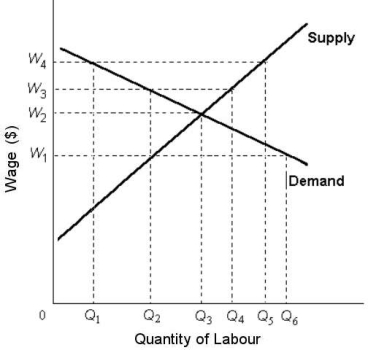
If we compare the wage rate and the level of employment achieved in a competitive labour market with those in a monopsonistic labour market,the latter will generate
A)a higher level of employment and a higher wage rate.
B)a higher level of employment and a lower wage.
C)a lower level of employment and a lower wage.
D)a lower level of employment and a higher wage rate.
E)the same outcomes as in a competitive labour market.
If we compare the wage rate and the level of employment achieved in a competitive labour market with those in a monopsonistic labour market,the latter will generate
A)a higher level of employment and a higher wage rate.
B)a higher level of employment and a lower wage.
C)a lower level of employment and a lower wage.
D)a lower level of employment and a higher wage rate.
E)the same outcomes as in a competitive labour market.

Question
FIGURE 14- 5 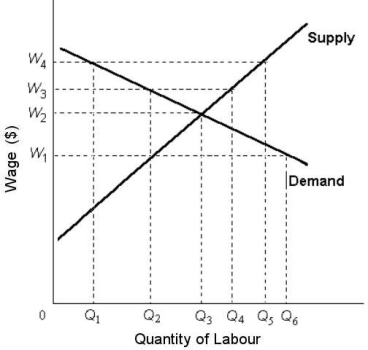
Refer to Figure 14- 5.Suppose the labour market is competitive.If a minimum wage of W3 is then imposed,the number of unemployed workers would be
A)0Q4.
B)Q3 - Q2.
C)Q4 - Q2.
D)0Q2.
E)Q3 - Q1.
Refer to Figure 14- 5.Suppose the labour market is competitive.If a minimum wage of W3 is then imposed,the number of unemployed workers would be
A)0Q4.
B)Q3 - Q2.
C)Q4 - Q2.
D)0Q2.
E)Q3 - Q1.
Question
Question
Question
Question
Question
Question
Question
The diagram below shows the supply and demand for labour in a hypothetical town in northern British Columbia,with only one employer,a logging company.
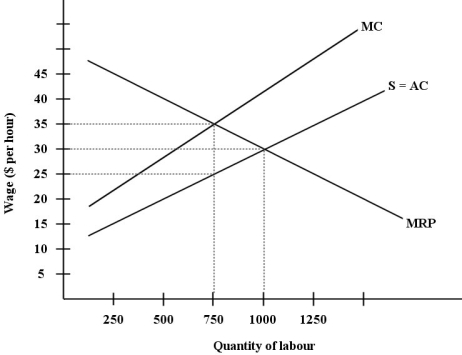 FIGURE 14- 4
One attempt to provide some minimum level of human capital for all citizens is a system of
A)comparable worth.
B)income taxation.
C)minimum wages.
D)unionism.
E)compulsory and publicly financed education.
FIGURE 14- 4One attempt to provide some minimum level of human capital for all citizens is a system of
A)comparable worth.
B)income taxation.
C)minimum wages.
D)unionism.
E)compulsory and publicly financed education.
Question
The diagram below shows the supply and demand for labour in a hypothetical town in northern British Columbia,with only one employer,a logging company.
FIGURE 14- 4
Suppose that a professional association strengthened the limits to entry into their profession and at the same time lengthened its required apprenticeship program.The likely effect would be that
A)both the demand and supply curves for labour would shift to the left.
B)there would be an increase in the quantity of labour supplied.
C)the supply curve for labour would shift to the right.
D)the supply curve for labour would shift to the left.
E)the demand curve for labour would shift to the right.
FIGURE 14- 4Suppose that a professional association strengthened the limits to entry into their profession and at the same time lengthened its required apprenticeship program.The likely effect would be that
A)both the demand and supply curves for labour would shift to the left.
B)there would be an increase in the quantity of labour supplied.
C)the supply curve for labour would shift to the right.
D)the supply curve for labour would shift to the left.
E)the demand curve for labour would shift to the right.
Question
Question
The diagram below shows the supply and demand for labour in a hypothetical town in northern British Columbia,with only one employer,a logging company.
FIGURE 14- 4
Refer to Figure 14- 4.The wage paid by this monopsonistic firm will be and employment will be _ .
A)below $25 per hour; below 750 units of labour
B)$25 per hour; 750 units of labour
C)$35 per hour; 750 units of labour
D)between $25 and $35 per hour; between 750 and 1000 units of labour
E)$30 per hour; 1000 units of labour
FIGURE 14- 4Refer to Figure 14- 4.The wage paid by this monopsonistic firm will be and employment will be _ .
A)below $25 per hour; below 750 units of labour
B)$25 per hour; 750 units of labour
C)$35 per hour; 750 units of labour
D)between $25 and $35 per hour; between 750 and 1000 units of labour
E)$30 per hour; 1000 units of labour
Question
Question
FIGURE 14- 5 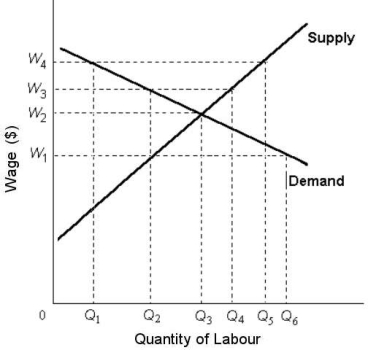
Refer to Figure 14- 5.Suppose this labour market is competitive.If a minimum wage of W3 is then imposed,the quantity of labour hired would be
A)Q1.
B)Q2.
C)Q3.
D)Q4.
E)Q5.
Refer to Figure 14- 5.Suppose this labour market is competitive.If a minimum wage of W3 is then imposed,the quantity of labour hired would be
A)Q1.
B)Q2.
C)Q3.
D)Q4.
E)Q5.
Question
Question
The diagram below shows the supply and demand for labour in a hypothetical town in northern British Columbia,with only one employer,a logging company.
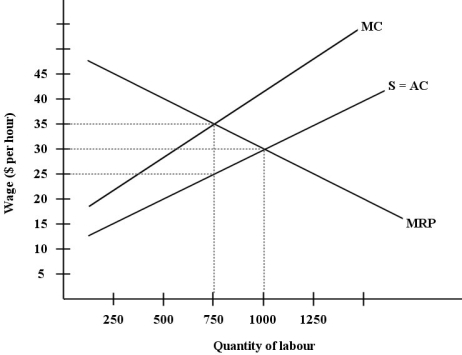 FIGURE 14- 4
Refer to Figure 14- 4.Compared to the outcome in a competitive labour market,the wage and employment outcome in this town's monopsonistic labour market are as follows:
A)wages are lower by $5 per hour and employment is lower by 250 units of labour.
B)wages are lower by $10 per hour and employment is the same as the competitive outcome.
C)wages and employment are both the same as the competitive outcome.
D)wages are the same as the competitive outcome and employment is higher by 250 units of labour.
E)wages are higher by $10 per hour and employment is lower by 250 units of labour.
FIGURE 14- 4Refer to Figure 14- 4.Compared to the outcome in a competitive labour market,the wage and employment outcome in this town's monopsonistic labour market are as follows:
A)wages are lower by $5 per hour and employment is lower by 250 units of labour.
B)wages are lower by $10 per hour and employment is the same as the competitive outcome.
C)wages and employment are both the same as the competitive outcome.
D)wages are the same as the competitive outcome and employment is higher by 250 units of labour.
E)wages are higher by $10 per hour and employment is lower by 250 units of labour.
Question
Question
Question
Question
FIGURE 14- 5
Refer to Figure 14- 5.Suppose this labour market is competitive.If a minimum wage of W4 is then imposed,the quantity of labour supplied would be
A)Q1.
B)Q2.
C)Q3.
D)Q4.
E)Q5.
Refer to Figure 14- 5.Suppose this labour market is competitive.If a minimum wage of W4 is then imposed,the quantity of labour supplied would be
A)Q1.
B)Q2.
C)Q3.
D)Q4.
E)Q5.
Question
FIGURE 14- 2 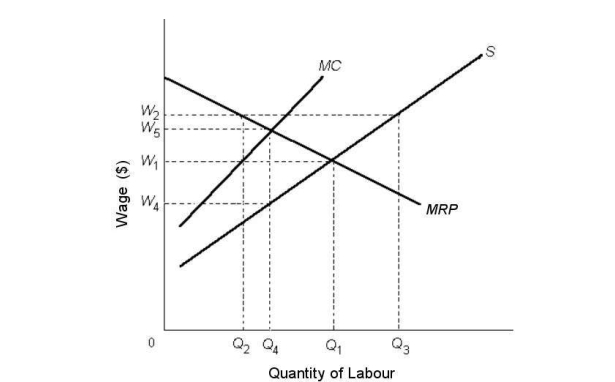
Refer to Figure 14- 2.Suppose the labour market is perfectly competitive.If a minimum wage of W4 is then established,the predicted change in the wage is
A)a decrease in the wage paid.
B)an increase in the wage paid.
C)no change in the wage paid.
D)an increase equal to W1 - W4.
E)a decrease equal to W1 - W4.
Refer to Figure 14- 2.Suppose the labour market is perfectly competitive.If a minimum wage of W4 is then established,the predicted change in the wage is
A)a decrease in the wage paid.
B)an increase in the wage paid.
C)no change in the wage paid.
D)an increase equal to W1 - W4.
E)a decrease equal to W1 - W4.
Question
Question
Question
The diagram below shows the supply and demand for labour in a hypothetical town in northern British Columbia,with only one employer,a logging company.
FIGURE 14- 4
A profit- maximizing monopsonist in a labour market will continue to hire labour until the
A)marginal cost of labour equals its average revenue.
B)marginal revenue product of labour equals its marginal cost.
C)hourly wage of the labour is equated with its marginal cost.
D)marginal product of labour is maximized.
E)hourly wage of the labour is equated with its average cost.
FIGURE 14- 4A profit- maximizing monopsonist in a labour market will continue to hire labour until the
A)marginal cost of labour equals its average revenue.
B)marginal revenue product of labour equals its marginal cost.
C)hourly wage of the labour is equated with its marginal cost.
D)marginal product of labour is maximized.
E)hourly wage of the labour is equated with its average cost.
Question
FIGURE 14- 2
Refer to Figure 14- 2.If the labour market were in a monopsonistic equilibrium,the predicted wage and number of workers employed would be
A)W5 and Q4.
B)W2 and Q1.
C)W4 and Q4.
D)W1 and Q2.
E)W1 and Q3.
Refer to Figure 14- 2.If the labour market were in a monopsonistic equilibrium,the predicted wage and number of workers employed would be
A)W5 and Q4.
B)W2 and Q1.
C)W4 and Q4.
D)W1 and Q2.
E)W1 and Q3.
Question
Question
Question
Question
Question
Question
Question
Question
FIGURE 14- 6 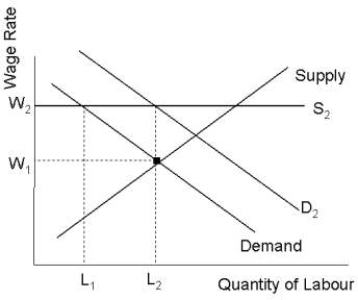
Refer to Figure 14- 6.The market begins in equilibrium with the curves labelled Demand and Supply.If a labour union negotiates the wage to W2 in an otherwise competitive labour market,
A)employers will hire L2 quantity of labour.
B)employers will hire L1 quantity of labour.
C)equilibrium will occur at W1 and L2.
D)the supply of labour will stay the same.
E)the demand for labour will shift to D2.
Refer to Figure 14- 6.The market begins in equilibrium with the curves labelled Demand and Supply.If a labour union negotiates the wage to W2 in an otherwise competitive labour market,
A)employers will hire L2 quantity of labour.
B)employers will hire L1 quantity of labour.
C)equilibrium will occur at W1 and L2.
D)the supply of labour will stay the same.
E)the demand for labour will shift to D2.
Question
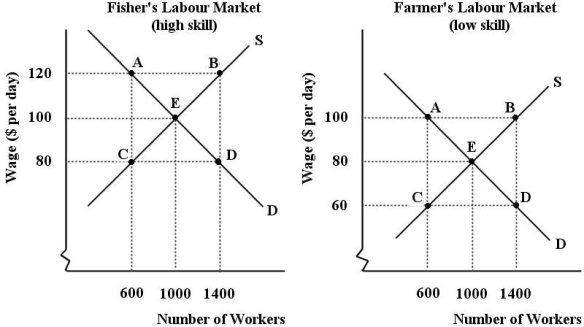
FIGURE 14- 1 Suppose an island economy has only two labour markets - fishing (high skill)and farming (low skill).There are 1000 males and 1000 females in the labour force.There is an equal distribution of skilled and non- skilled workers among each sex.
If you choose to stay in school beyond the compulsory minimum period,you are
A)realizing the benefits of your investment in human capital.
B)wasting your time from an economic standpoint.
C)delaying your investment in human capital.
D)refusing to invest in your human capital.
E)investing further in your human capital.
If you choose to stay in school beyond the compulsory minimum period,you are
A)realizing the benefits of your investment in human capital.
B)wasting your time from an economic standpoint.
C)delaying your investment in human capital.
D)refusing to invest in your human capital.
E)investing further in your human capital.
Question
FIGURE 14- 3 The three diagrams below show the supply and demand for teenage babysitters in one local area.The initial supply curve is S0 in all cases.
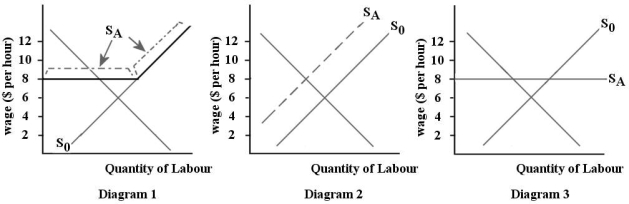
Refer to Figure 14- 3.Suppose the teenage babysitters in one local area are earning an equilibrium wage of $6 per hour.Now suppose the local government reduces the minimum age for working as a babysitter from 14 to 12 years of age.Which diagram illustrates the new supply curve (SA)for babysitters?
A)diagram 1
B)diagram 2
C)diagram 3
D)none of the diagrams
E)any of the diagrams
Refer to Figure 14- 3.Suppose the teenage babysitters in one local area are earning an equilibrium wage of $6 per hour.Now suppose the local government reduces the minimum age for working as a babysitter from 14 to 12 years of age.Which diagram illustrates the new supply curve (SA)for babysitters?
A)diagram 1
B)diagram 2
C)diagram 3
D)none of the diagrams
E)any of the diagrams
Question
FIGURE 14- 1 Suppose an island economy has only two labour markets - fishing (high skill)and farming (low skill).There are 1000 males and 1000 females in the labour force.There is an equal distribution of skilled and non- skilled workers among each sex.
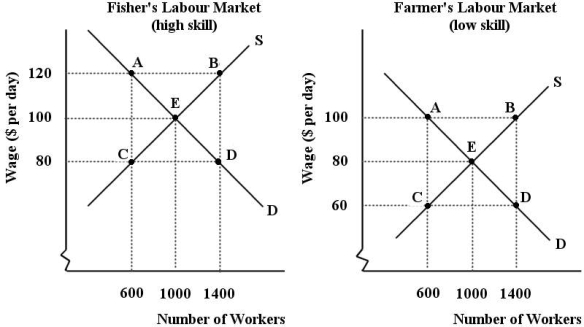
Refer to Figure 14- 1.Suppose the employers in the fishers labour market begin to discriminate against male workers.Which of the following can we expect to occur in the farmers labour market?
A)The demand for labour curve shifts to the right until a new equilibrium is reached at point B and the wage rises to $100 per day.
B)There will be an equal flow of workers between the two markets,equilibrium will remain at point E and the wage at $80 per day.
C)The labour supply curve shifts to the left until a new equilibrium is reached at point A and the wage rises to $100 per day.
D)The demand for labour curve shifts to the left until a new equilibrium is reached at point C and the wage falls to $60 per day.
E)The labour supply curve shifts to the right until a new equilibrium is reached at point D and the wage falls to $60 per day.
Refer to Figure 14- 1.Suppose the employers in the fishers labour market begin to discriminate against male workers.Which of the following can we expect to occur in the farmers labour market?
A)The demand for labour curve shifts to the right until a new equilibrium is reached at point B and the wage rises to $100 per day.
B)There will be an equal flow of workers between the two markets,equilibrium will remain at point E and the wage at $80 per day.
C)The labour supply curve shifts to the left until a new equilibrium is reached at point A and the wage rises to $100 per day.
D)The demand for labour curve shifts to the left until a new equilibrium is reached at point C and the wage falls to $60 per day.
E)The labour supply curve shifts to the right until a new equilibrium is reached at point D and the wage falls to $60 per day.
Question
FIGURE 14- 1 Suppose an island economy has only two labour markets - fishing (high skill)and farming (low skill).There are 1000 males and 1000 females in the labour force.There is an equal distribution of skilled and non- skilled workers among each sex.
One of the most unionized industries in Canada is
A)agriculture.
B)education.
C)finance and insurance.
D)non- governmental administrative services.
E)real estate.
One of the most unionized industries in Canada is
A)agriculture.
B)education.
C)finance and insurance.
D)non- governmental administrative services.
E)real estate.
Question
Question
Question
FIGURE 14- 1 Suppose an island economy has only two labour markets - fishing (high skill)and farming (low skill).There are 1000 males and 1000 females in the labour force.There is an equal distribution of skilled and non- skilled workers among each sex.
Refer to Figure 14- 1.The two labour markets are each in a equilibrium at point E.The wage differential between the industries is a(n)wage differential.
A)non- competitive; temporary
B)competitive; equilibrium
C)non- competitive; discriminatory
D)competitive; discriminatory
E)competitive; temporary
Refer to Figure 14- 1.The two labour markets are each in a equilibrium at point E.The wage differential between the industries is a(n)wage differential.
A)non- competitive; temporary
B)competitive; equilibrium
C)non- competitive; discriminatory
D)competitive; discriminatory
E)competitive; temporary
Question
FIGURE 14- 3 The three diagrams below show the supply and demand for teenage babysitters in one local area.The initial supply curve is S0 in all cases.
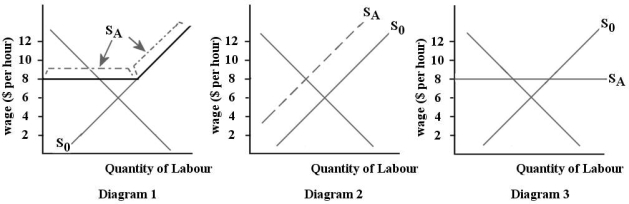
Refer to Figure 14- 3.Suppose all of the teenage babysitters in one local area form an association and set a minimum acceptable wage of $8 per hour.Which diagram illustrates the new supply curve (SA)for babysitters?
A)diagram 1
B)diagram 2
C)diagram 3
D)none of the diagrams
E)any of the diagrams
Refer to Figure 14- 3.Suppose all of the teenage babysitters in one local area form an association and set a minimum acceptable wage of $8 per hour.Which diagram illustrates the new supply curve (SA)for babysitters?
A)diagram 1
B)diagram 2
C)diagram 3
D)none of the diagrams
E)any of the diagrams
Question
The diagram below shows the supply and demand for labour in a hypothetical town in northern British Columbia,with only one employer,a logging company.
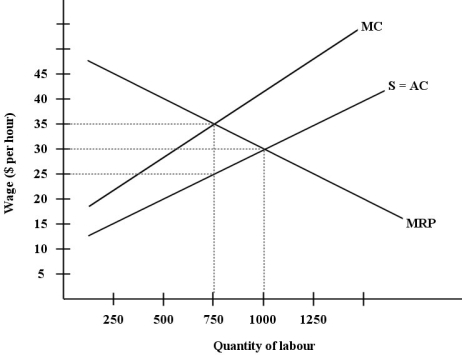 FIGURE 14- 4
A typical firm hiring in a perfectly competitive labour market faces a labour supply curve that
A)coincides with the firm's marginal cost of labour curve.
B)is upward sloping.
C)coincides with the firm's demand for labour curve.
D)is downward sloping.
E)coincides with the firm's marginal cost curve.
FIGURE 14- 4A typical firm hiring in a perfectly competitive labour market faces a labour supply curve that
A)coincides with the firm's marginal cost of labour curve.
B)is upward sloping.
C)coincides with the firm's demand for labour curve.
D)is downward sloping.
E)coincides with the firm's marginal cost curve.
Question
Question
FIGURE 14- 2 
Refer to Figure 14- 2.In a perfectly competitive labour market,the equilibrium wage rate and the quantity of labour employed would be
A)W5 and Q5.
B)W5 and Q4.
C)W2 and Q2.
D)W1 and Q1.
E)W4 and Q4.
Refer to Figure 14- 2.In a perfectly competitive labour market,the equilibrium wage rate and the quantity of labour employed would be
A)W5 and Q5.
B)W5 and Q4.
C)W2 and Q2.
D)W1 and Q1.
E)W4 and Q4.
Question
FIGURE 14- 6 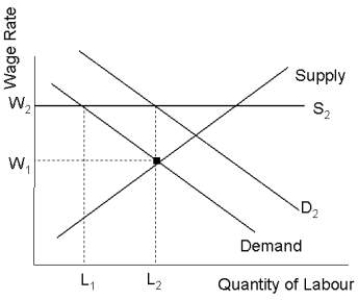
Refer to Figure 14- 6.Suppose a labour union is operating in this labour market.The practice of "feather- bedding" would be illustrated by
A)employers hiring L1 units of labour because a union organizes workers.
B)the supply of labour shifting to S2.
C)employers hiring L2 units of labour when a union has been able to increase the wage to W2.
D)the union wage premium equal to the difference between W1 and W2.
E)advertising causing the demand for labour to shift to D2.
Refer to Figure 14- 6.Suppose a labour union is operating in this labour market.The practice of "feather- bedding" would be illustrated by
A)employers hiring L1 units of labour because a union organizes workers.
B)the supply of labour shifting to S2.
C)employers hiring L2 units of labour when a union has been able to increase the wage to W2.
D)the union wage premium equal to the difference between W1 and W2.
E)advertising causing the demand for labour to shift to D2.
Question
FIGURE 14- 5 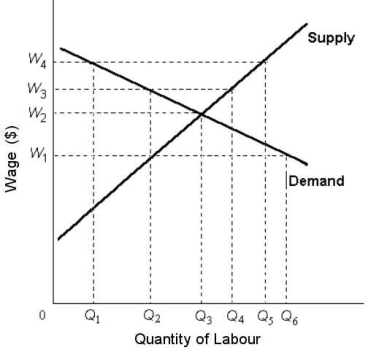
Refer to Figure 14- 5.Suppose this labour market is competitive.If a minimum wage of W4 is then imposed,the number of unemployed workers would be
A)Q5 - Q1.
B)Q3 - Q1.
C)0Q5.
D)0Q1.
E)0Q3.
Refer to Figure 14- 5.Suppose this labour market is competitive.If a minimum wage of W4 is then imposed,the number of unemployed workers would be
A)Q5 - Q1.
B)Q3 - Q1.
C)0Q5.
D)0Q1.
E)0Q3.
Question
Question
Question
Question
Question
Question
Question
The diagram below shows the supply and demand for labour in a hypothetical town in northern British Columbia,with only one employer,a logging company.
FIGURE 14- 4
Refer to Figure 14- 4.Suppose the workers in this town form a union to negotiate the wage rate with the firm.Economists refer to this situation as
A)a unionized monopoly.
B)a monopoly.
C)a competitive labour market.
D)a bilateral monopoly.
E)a monopolistic labour market.
FIGURE 14- 4Refer to Figure 14- 4.Suppose the workers in this town form a union to negotiate the wage rate with the firm.Economists refer to this situation as
A)a unionized monopoly.
B)a monopoly.
C)a competitive labour market.
D)a bilateral monopoly.
E)a monopolistic labour market.
Question
FIGURE 14- 3 The three diagrams below show the supply and demand for teenage babysitters in one local area.The initial supply curve is S0 in all cases.
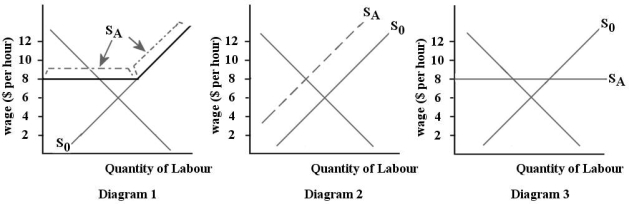
Refer to Figure 14- 3.Suppose the teenage babysitters in one local area are earning an equilibrium wage of $6 per hour.Now suppose that the local government imposes a minimum wage of $8 per hour for babysitters.Which diagram illustrates the new supply curve (SA)for babysitters?
A)diagram 1
B)diagram 2
C)diagram 3
D)none of the diagrams
E)any of the diagrams
Refer to Figure 14- 3.Suppose the teenage babysitters in one local area are earning an equilibrium wage of $6 per hour.Now suppose that the local government imposes a minimum wage of $8 per hour for babysitters.Which diagram illustrates the new supply curve (SA)for babysitters?
A)diagram 1
B)diagram 2
C)diagram 3
D)none of the diagrams
E)any of the diagrams
Question
Question
Question
Question
Question
Question
Question
Question
FIGURE 14- 5 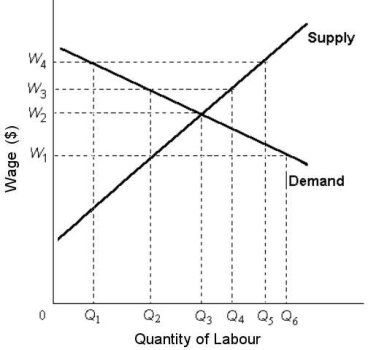
Given the continuing decline in manufacturing's share of total employment in Canada and other developed economies,which of the following provides a possible explanation that this phenomenon is a genuine problem?
A)Productivity increases in the service sector are likely underestimated.
B)Consumers have an increased demand for services as real income increases.
C)Real disposable income has continued to rise.
D)The decline is partly due to increasing productivity in that sector.
E)Many service jobs are low- wage,part- time,jobs,and many are without benefits.
Given the continuing decline in manufacturing's share of total employment in Canada and other developed economies,which of the following provides a possible explanation that this phenomenon is a genuine problem?
A)Productivity increases in the service sector are likely underestimated.
B)Consumers have an increased demand for services as real income increases.
C)Real disposable income has continued to rise.
D)The decline is partly due to increasing productivity in that sector.
E)Many service jobs are low- wage,part- time,jobs,and many are without benefits.
Question
The diagram below shows the supply and demand for labour in a hypothetical town in northern British Columbia,with only one employer,a logging company.
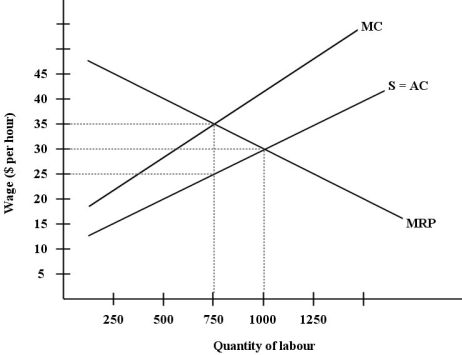 FIGURE 14- 4
Refer to Figure 14- 4.Suppose this labour market is in a monopsonistic equilibrium.Then,suppose the workers form a union and negotiate a higher wage with the firm.In this case the wage will be and the employment will be .
A)above $35 per hour; less than 750 units of labour
B)$35 per hour; 750 units of labour
C)between $25 and $35 per hour; between 750 and 1000 units of labour
D)above $25 per hour; above or below 750 units of labour,depending on the negotiated wage
E)$30 per hour; 1000 units of labour
FIGURE 14- 4Refer to Figure 14- 4.Suppose this labour market is in a monopsonistic equilibrium.Then,suppose the workers form a union and negotiate a higher wage with the firm.In this case the wage will be and the employment will be .
A)above $35 per hour; less than 750 units of labour
B)$35 per hour; 750 units of labour
C)between $25 and $35 per hour; between 750 and 1000 units of labour
D)above $25 per hour; above or below 750 units of labour,depending on the negotiated wage
E)$30 per hour; 1000 units of labour
Question
Question
The diagram below shows the supply and demand for labour in a hypothetical town in northern British Columbia,with only one employer,a logging company.
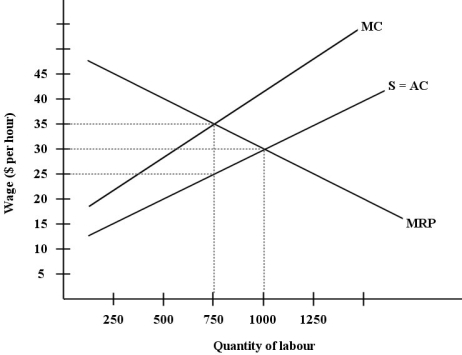 FIGURE 14- 4
Refer to Figure 14- 4.Suppose this labour market is in a monopsonistic equilibrium.Then,suppose the provincial government of British Columbia imposes a minimum wage for employees in this industry of $30 per hour.What will be the effects on wages and employment?
A)wages will fall by $5 per hour and employment will increase by 250 units of labour
B)wages will not change and employment will increase by 250 units of labour
C)wages will not change and employment will not change
D)wages will not change and employment will change by between 0 and 250 units of labour
E)wages will rise by $5 per hour and employment will increase by 250 units of labour
FIGURE 14- 4Refer to Figure 14- 4.Suppose this labour market is in a monopsonistic equilibrium.Then,suppose the provincial government of British Columbia imposes a minimum wage for employees in this industry of $30 per hour.What will be the effects on wages and employment?
A)wages will fall by $5 per hour and employment will increase by 250 units of labour
B)wages will not change and employment will increase by 250 units of labour
C)wages will not change and employment will not change
D)wages will not change and employment will change by between 0 and 250 units of labour
E)wages will rise by $5 per hour and employment will increase by 250 units of labour
Question
Question
FIGURE 14- 5 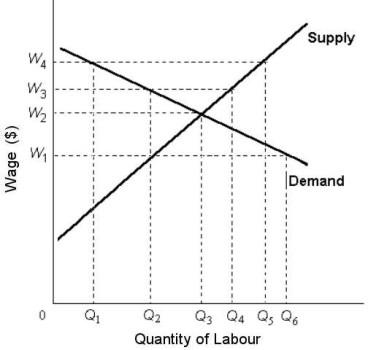
Refer to Figure 14- 5.Suppose this labour market is perfectly competitive.If a minimum wage of W1 is then imposed,the quantity of labour hired would be
A)Q1.
B)Q2.
C)Q3.
D)Q4.
E)Q5.
Refer to Figure 14- 5.Suppose this labour market is perfectly competitive.If a minimum wage of W1 is then imposed,the quantity of labour hired would be
A)Q1.
B)Q2.
C)Q3.
D)Q4.
E)Q5.
Question
Question
The diagram below shows the supply and demand for labour in a hypothetical town in northern British Columbia,with only one employer,a logging company.
FIGURE 14- 4
Suppose that the professional association of dentists reduces entry into their profession by lengthening the required training program.The likely effect is that
A)the supply curve of dentists will shift to the right.
B)the supply curve of dentists will shift to the left.
C)there will be an increase in the quantity of dentists supplied.
D)the demand curve for dentists will shift to the right.
E)both the demand and supply curves for dentists will shift to the left.
FIGURE 14- 4Suppose that the professional association of dentists reduces entry into their profession by lengthening the required training program.The likely effect is that
A)the supply curve of dentists will shift to the right.
B)the supply curve of dentists will shift to the left.
C)there will be an increase in the quantity of dentists supplied.
D)the demand curve for dentists will shift to the right.
E)both the demand and supply curves for dentists will shift to the left.
Question
Question
FIGURE 14- 3 The three diagrams below show the supply and demand for teenage babysitters in one local area.The initial supply curve is S0 in all cases.
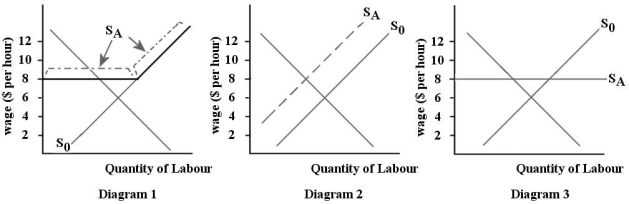
Refer to Figure 14- 3.Suppose all of the teenage babysitters in one local area form an association and set a minimum age of 16 for working as a babysitter.Which diagram illustrates the new supply curve (SA)for babysitters?
A)diagram 1
B)diagram 2
C)diagram 3
D)none of the diagrams
E)any of the diagrams
Refer to Figure 14- 3.Suppose all of the teenage babysitters in one local area form an association and set a minimum age of 16 for working as a babysitter.Which diagram illustrates the new supply curve (SA)for babysitters?
A)diagram 1
B)diagram 2
C)diagram 3
D)none of the diagrams
E)any of the diagrams
Question
Question
Question
FIGURE 14- 5 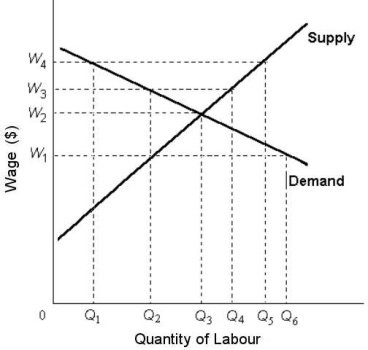
Refer to Figure 14- 5.If this labour market is monopsonistic,an increase in the minimum wage from W2 to W3 would
A)create unemployment in other minimum wage sectors.
B)create unemployment where there previously was none.
C)increase employment in this industry but decrease it in other industries.
D)have no effect on employment.
E)increase employment from what would have initially occurred.
Refer to Figure 14- 5.If this labour market is monopsonistic,an increase in the minimum wage from W2 to W3 would
A)create unemployment in other minimum wage sectors.
B)create unemployment where there previously was none.
C)increase employment in this industry but decrease it in other industries.
D)have no effect on employment.
E)increase employment from what would have initially occurred.
Question
FIGURE 14- 5
Consider a wage- setting union in an otherwise competitive labour market.If the union sets a wage above the competitive level,the effect will be
A)to increase the amount of employment in the industry.
B)to create a group of workers who would like to obtain jobs in the industry but cannot do so.
C)to cause the labour supply curve to shift to the right.
D)a level of employment which is the same as that at the competitive equilibrium wage.
E)to raise wages for all workers who wish to work in the industry.
Consider a wage- setting union in an otherwise competitive labour market.If the union sets a wage above the competitive level,the effect will be
A)to increase the amount of employment in the industry.
B)to create a group of workers who would like to obtain jobs in the industry but cannot do so.
C)to cause the labour supply curve to shift to the right.
D)a level of employment which is the same as that at the competitive equilibrium wage.
E)to raise wages for all workers who wish to work in the industry.
Question
Question
FIGURE 14- 5
Other things being equal,individuals working in relatively risky working conditions generally
A)work in perfectly competitive labour markets.
B)earn lower wages because of the scarcity of these jobs.
C)earn higher wages due to the reduced supply of risk- taking individuals.
D)earn higher wages due to the greater relative demand for these individuals.
E)do not concern economists as these situations are uncommon.
Other things being equal,individuals working in relatively risky working conditions generally
A)work in perfectly competitive labour markets.
B)earn lower wages because of the scarcity of these jobs.
C)earn higher wages due to the reduced supply of risk- taking individuals.
D)earn higher wages due to the greater relative demand for these individuals.
E)do not concern economists as these situations are uncommon.
Question
Question
FIGURE 14- 5
Refer to Figure 14- 5.If this labour market were perfectly competitive,the predicted wage and employment level would be
A)W3 and Q4.
B)W3 and Q2.
C)W2 and Q3.
D)W1 and Q2.
E)W4 and Q5.
Refer to Figure 14- 5.If this labour market were perfectly competitive,the predicted wage and employment level would be
A)W3 and Q4.
B)W3 and Q2.
C)W2 and Q3.
D)W1 and Q2.
E)W4 and Q5.
Question

Unlock Deck
Sign up to unlock the cards in this deck!
Unlock Deck
Unlock Deck
1/106

Play

Full screen (f)
Deck 14: Labour Markets
1
FIGURE 14- 5
If we compare the wage rate and the level of employment achieved in a competitive labour market with those in a monopsonistic labour market,the latter will generate
A)a higher level of employment and a higher wage rate.
B)a higher level of employment and a lower wage.
C)a lower level of employment and a lower wage.
D)a lower level of employment and a higher wage rate.
E)the same outcomes as in a competitive labour market.
If we compare the wage rate and the level of employment achieved in a competitive labour market with those in a monopsonistic labour market,the latter will generate
A)a higher level of employment and a higher wage rate.
B)a higher level of employment and a lower wage.
C)a lower level of employment and a lower wage.
D)a lower level of employment and a higher wage rate.
E)the same outcomes as in a competitive labour market.
C
2
FIGURE 14- 5
Refer to Figure 14- 5.Suppose the labour market is competitive.If a minimum wage of W3 is then imposed,the number of unemployed workers would be
A)0Q4.
B)Q3 - Q2.
C)Q4 - Q2.
D)0Q2.
E)Q3 - Q1.
Refer to Figure 14- 5.Suppose the labour market is competitive.If a minimum wage of W3 is then imposed,the number of unemployed workers would be
A)0Q4.
B)Q3 - Q2.
C)Q4 - Q2.
D)0Q2.
E)Q3 - Q1.
C
3
The table below shows the labour demand and labour supply schedules in a competitive labour market. TABLE 14- 1
-Refer to Table 14- 1.In a competitive labour market that clears,the equilibrium employment level would be
A)800 units.
B)1300 units.
C)400 units.
D)500 units.
E)1000 units.
-Refer to Table 14- 1.In a competitive labour market that clears,the equilibrium employment level would be
A)800 units.
B)1300 units.
C)400 units.
D)500 units.
E)1000 units.
1000 units.
4
In Canada in 2011,the share of total employment in agriculture was about
A)20%.
B)50%.
C)0.2%.
D)10%
E)2%.
A)20%.
B)50%.
C)0.2%.
D)10%
E)2%.
Unlock Deck
Unlock for access to all 106 flashcards in this deck.
Unlock Deck
k this deck
5
The fundamental dilemma facing labour unions is
A)members' roles as workers versus their roles as consumers.
B)wage increases versus employment growth.
C)wage increases versus publicly provided pensions.
D)job security versus worker safety.
E)"featherbedding" versus the union- wage premium.
A)members' roles as workers versus their roles as consumers.
B)wage increases versus employment growth.
C)wage increases versus publicly provided pensions.
D)job security versus worker safety.
E)"featherbedding" versus the union- wage premium.
Unlock Deck
Unlock for access to all 106 flashcards in this deck.
Unlock Deck
k this deck
6
Certain professions limit the number of students who are eligible to enroll in their programs in university - engineering,architecture,dentistry,and law,for example.Other things being equal,what is one predicted effect of such restrictions?
A)decreased wages in the labour market outside of these professions
B)increased wages in the labour market outside of these professions
C)increased wages across all segments of the labour market
D)decreased wages across all segments of the labour market
E)there will be no effect on any wages
A)decreased wages in the labour market outside of these professions
B)increased wages in the labour market outside of these professions
C)increased wages across all segments of the labour market
D)decreased wages across all segments of the labour market
E)there will be no effect on any wages
Unlock Deck
Unlock for access to all 106 flashcards in this deck.
Unlock Deck
k this deck
7
Suppose there is a competitive market for retail workers at a large shopping mall that is large enough to constitute its own labour market.The labour demand curve is QD = 1000 - 20(w).The labour supply curve is QS = 400 + 40(w).Suppose that a union now successfully organizes the workers at this mall and obtains a wage rate of $11 (but does not affect the demand curve).The number of workers who wish to work at the new wage is
A)780.
B)1000.
C)440.
D)840.
E)400.
A)780.
B)1000.
C)440.
D)840.
E)400.
Unlock Deck
Unlock for access to all 106 flashcards in this deck.
Unlock Deck
k this deck
8
Labour- market discrimination,which keeps one group of workers out of elite (E)occupations and limits them to ordinary (O)occupations,will have which of the following effects?
A)more unemployment in the E occupations.
B)a decrease in supply and higher wages in the O occupation.
C)more employment in the E occupations.
D)a decrease in supply and lower wages in the O occupations.
E)a decrease in supply and higher wages in the E occupations.
A)more unemployment in the E occupations.
B)a decrease in supply and higher wages in the O occupation.
C)more employment in the E occupations.
D)a decrease in supply and lower wages in the O occupations.
E)a decrease in supply and higher wages in the E occupations.
Unlock Deck
Unlock for access to all 106 flashcards in this deck.
Unlock Deck
k this deck
9
The diagram below shows the supply and demand for labour in a hypothetical town in northern British Columbia,with only one employer,a logging company.
FIGURE 14- 4
One attempt to provide some minimum level of human capital for all citizens is a system of
A)comparable worth.
B)income taxation.
C)minimum wages.
D)unionism.
E)compulsory and publicly financed education.
FIGURE 14- 4One attempt to provide some minimum level of human capital for all citizens is a system of
A)comparable worth.
B)income taxation.
C)minimum wages.
D)unionism.
E)compulsory and publicly financed education.
Unlock Deck
Unlock for access to all 106 flashcards in this deck.
Unlock Deck
k this deck
10
The diagram below shows the supply and demand for labour in a hypothetical town in northern British Columbia,with only one employer,a logging company.
FIGURE 14- 4
Suppose that a professional association strengthened the limits to entry into their profession and at the same time lengthened its required apprenticeship program.The likely effect would be that
A)both the demand and supply curves for labour would shift to the left.
B)there would be an increase in the quantity of labour supplied.
C)the supply curve for labour would shift to the right.
D)the supply curve for labour would shift to the left.
E)the demand curve for labour would shift to the right.
FIGURE 14- 4Suppose that a professional association strengthened the limits to entry into their profession and at the same time lengthened its required apprenticeship program.The likely effect would be that
A)both the demand and supply curves for labour would shift to the left.
B)there would be an increase in the quantity of labour supplied.
C)the supply curve for labour would shift to the right.
D)the supply curve for labour would shift to the left.
E)the demand curve for labour would shift to the right.
Unlock Deck
Unlock for access to all 106 flashcards in this deck.
Unlock Deck
k this deck
11
Suppose there is a competitive market for retail workers at a large shopping mall that is large enough to constitute its own labour market.The labour demand curve is QD = 1000 - 20(w).The labour supply curve is QS = 400 + 40(w).Suppose that a union now successfully organizes the workers at this mall and obtains a wage rate of $13 (but does not affect the position of the demand curve).One result is
A)an increase in employment of 20 workers.
B)a decrease in employment of 140 workers.
C)a decrease in employment of 100 workers.
D)an increase in employment of 60 workers.
E)a decrease in employment of 60 workers.
A)an increase in employment of 20 workers.
B)a decrease in employment of 140 workers.
C)a decrease in employment of 100 workers.
D)an increase in employment of 60 workers.
E)a decrease in employment of 60 workers.
Unlock Deck
Unlock for access to all 106 flashcards in this deck.
Unlock Deck
k this deck
12
The diagram below shows the supply and demand for labour in a hypothetical town in northern British Columbia,with only one employer,a logging company.
FIGURE 14- 4
Refer to Figure 14- 4.The wage paid by this monopsonistic firm will be and employment will be _ .
A)below $25 per hour; below 750 units of labour
B)$25 per hour; 750 units of labour
C)$35 per hour; 750 units of labour
D)between $25 and $35 per hour; between 750 and 1000 units of labour
E)$30 per hour; 1000 units of labour
FIGURE 14- 4Refer to Figure 14- 4.The wage paid by this monopsonistic firm will be and employment will be _ .
A)below $25 per hour; below 750 units of labour
B)$25 per hour; 750 units of labour
C)$35 per hour; 750 units of labour
D)between $25 and $35 per hour; between 750 and 1000 units of labour
E)$30 per hour; 1000 units of labour
Unlock Deck
Unlock for access to all 106 flashcards in this deck.
Unlock Deck
k this deck
13
Wage differentials due to cross- worker differences in human capital
A)exist because of distortions in labour markets.
B)will persist in competitive equilibrium.
C)are not justifiable on efficiency grounds.
D)are not an important source of observed wage differentials.
E)are an example of economic distortions due to monopoly power.
A)exist because of distortions in labour markets.
B)will persist in competitive equilibrium.
C)are not justifiable on efficiency grounds.
D)are not an important source of observed wage differentials.
E)are an example of economic distortions due to monopoly power.
Unlock Deck
Unlock for access to all 106 flashcards in this deck.
Unlock Deck
k this deck
14
FIGURE 14- 5
Refer to Figure 14- 5.Suppose this labour market is competitive.If a minimum wage of W3 is then imposed,the quantity of labour hired would be
A)Q1.
B)Q2.
C)Q3.
D)Q4.
E)Q5.
Refer to Figure 14- 5.Suppose this labour market is competitive.If a minimum wage of W3 is then imposed,the quantity of labour hired would be
A)Q1.
B)Q2.
C)Q3.
D)Q4.
E)Q5.
Unlock Deck
Unlock for access to all 106 flashcards in this deck.
Unlock Deck
k this deck
15
Some people are concerned that "good" manufacturing jobs are being replaced by "bad" service- sector jobs.Why is this not necessarily a problem?
A)Average real per capita income has continued to rise,despite the rise of the service sector.
B)The decline in manufacturing employment is partly due to increasing productivity in that sector.
C)Consumers have an increased demand for services as real income increases.
D)Productivity increases in the service sector are likely underestimated.
E)all of the above
A)Average real per capita income has continued to rise,despite the rise of the service sector.
B)The decline in manufacturing employment is partly due to increasing productivity in that sector.
C)Consumers have an increased demand for services as real income increases.
D)Productivity increases in the service sector are likely underestimated.
E)all of the above
Unlock Deck
Unlock for access to all 106 flashcards in this deck.
Unlock Deck
k this deck
16
The diagram below shows the supply and demand for labour in a hypothetical town in northern British Columbia,with only one employer,a logging company.
FIGURE 14- 4
Refer to Figure 14- 4.Compared to the outcome in a competitive labour market,the wage and employment outcome in this town's monopsonistic labour market are as follows:
A)wages are lower by $5 per hour and employment is lower by 250 units of labour.
B)wages are lower by $10 per hour and employment is the same as the competitive outcome.
C)wages and employment are both the same as the competitive outcome.
D)wages are the same as the competitive outcome and employment is higher by 250 units of labour.
E)wages are higher by $10 per hour and employment is lower by 250 units of labour.
FIGURE 14- 4Refer to Figure 14- 4.Compared to the outcome in a competitive labour market,the wage and employment outcome in this town's monopsonistic labour market are as follows:
A)wages are lower by $5 per hour and employment is lower by 250 units of labour.
B)wages are lower by $10 per hour and employment is the same as the competitive outcome.
C)wages and employment are both the same as the competitive outcome.
D)wages are the same as the competitive outcome and employment is higher by 250 units of labour.
E)wages are higher by $10 per hour and employment is lower by 250 units of labour.
Unlock Deck
Unlock for access to all 106 flashcards in this deck.
Unlock Deck
k this deck
17
In general,in collective bargaining between a labour union and a firm,the
A)employer sets the wages and the union decides how many workers will be hired.
B)wage and the number of workers to be hired is negotiated.
C)only the level of employment is negotiated.
D)wage is negotiated,whereas the firm is generally free to choose the level of employment.
E)union sets the wage and the employer decides how much labour will be hired.
A)employer sets the wages and the union decides how many workers will be hired.
B)wage and the number of workers to be hired is negotiated.
C)only the level of employment is negotiated.
D)wage is negotiated,whereas the firm is generally free to choose the level of employment.
E)union sets the wage and the employer decides how much labour will be hired.
Unlock Deck
Unlock for access to all 106 flashcards in this deck.
Unlock Deck
k this deck
18
The table below shows the labour demand and labour supply schedules in a competitive labour market. TABLE 14- 1
-Investment in human capital can be very costly to the individual,but it can also generate large returns.Canadian census data from 2007 show that average employment income for a university graduate is approximately of the average employment income of a worker with no more than a high school diploma.
A)400%
B)50%
C)300%
D)125%
E)200%
-Investment in human capital can be very costly to the individual,but it can also generate large returns.Canadian census data from 2007 show that average employment income for a university graduate is approximately of the average employment income of a worker with no more than a high school diploma.
A)400%
B)50%
C)300%
D)125%
E)200%
Unlock Deck
Unlock for access to all 106 flashcards in this deck.
Unlock Deck
k this deck
19
Consider a monopsonistic labour market.One hundred units of labour will be supplied if the wage rate is $12,and 101 units of labour will be supplied if the wage rate is $14.The marginal cost of the 101st worker is
A)$214.
B)$14.
C)$1414.
D)$140.
E)Not enough information to know.
A)$214.
B)$14.
C)$1414.
D)$140.
E)Not enough information to know.
Unlock Deck
Unlock for access to all 106 flashcards in this deck.
Unlock Deck
k this deck
20
FIGURE 14- 5
Refer to Figure 14- 5.Suppose this labour market is competitive.If a minimum wage of W4 is then imposed,the quantity of labour supplied would be
A)Q1.
B)Q2.
C)Q3.
D)Q4.
E)Q5.
Refer to Figure 14- 5.Suppose this labour market is competitive.If a minimum wage of W4 is then imposed,the quantity of labour supplied would be
A)Q1.
B)Q2.
C)Q3.
D)Q4.
E)Q5.
Unlock Deck
Unlock for access to all 106 flashcards in this deck.
Unlock Deck
k this deck
21
FIGURE 14- 2
Refer to Figure 14- 2.Suppose the labour market is perfectly competitive.If a minimum wage of W4 is then established,the predicted change in the wage is
A)a decrease in the wage paid.
B)an increase in the wage paid.
C)no change in the wage paid.
D)an increase equal to W1 - W4.
E)a decrease equal to W1 - W4.
Refer to Figure 14- 2.Suppose the labour market is perfectly competitive.If a minimum wage of W4 is then established,the predicted change in the wage is
A)a decrease in the wage paid.
B)an increase in the wage paid.
C)no change in the wage paid.
D)an increase equal to W1 - W4.
E)a decrease equal to W1 - W4.
Unlock Deck
Unlock for access to all 106 flashcards in this deck.
Unlock Deck
k this deck
22
The average union wage premium in Canada is
A)between 30 and 50%.
B)between 15 and 30%.
C)between 10 and 15%.
D)less than 10%.
E)more than 50%.
A)between 30 and 50%.
B)between 15 and 30%.
C)between 10 and 15%.
D)less than 10%.
E)more than 50%.
Unlock Deck
Unlock for access to all 106 flashcards in this deck.
Unlock Deck
k this deck
23
Canadian studies on the effects of minimum- wage laws
A)support the theoretical predictions that minimum- wage laws increase employment.
B)suggest that they have no effect whatsoever on employment.
C)find that they decrease the level of employment,particularly for low- skilled workers.
D)support the evidence from the United States that these laws increase wages and employment.
E)find that employment increases with increases in minimum wages,thus supporting the argument that labour markets are monopsonistic.
A)support the theoretical predictions that minimum- wage laws increase employment.
B)suggest that they have no effect whatsoever on employment.
C)find that they decrease the level of employment,particularly for low- skilled workers.
D)support the evidence from the United States that these laws increase wages and employment.
E)find that employment increases with increases in minimum wages,thus supporting the argument that labour markets are monopsonistic.
Unlock Deck
Unlock for access to all 106 flashcards in this deck.
Unlock Deck
k this deck
24
The diagram below shows the supply and demand for labour in a hypothetical town in northern British Columbia,with only one employer,a logging company.
FIGURE 14- 4
A profit- maximizing monopsonist in a labour market will continue to hire labour until the
A)marginal cost of labour equals its average revenue.
B)marginal revenue product of labour equals its marginal cost.
C)hourly wage of the labour is equated with its marginal cost.
D)marginal product of labour is maximized.
E)hourly wage of the labour is equated with its average cost.
FIGURE 14- 4A profit- maximizing monopsonist in a labour market will continue to hire labour until the
A)marginal cost of labour equals its average revenue.
B)marginal revenue product of labour equals its marginal cost.
C)hourly wage of the labour is equated with its marginal cost.
D)marginal product of labour is maximized.
E)hourly wage of the labour is equated with its average cost.
Unlock Deck
Unlock for access to all 106 flashcards in this deck.
Unlock Deck
k this deck
25
FIGURE 14- 2
Refer to Figure 14- 2.If the labour market were in a monopsonistic equilibrium,the predicted wage and number of workers employed would be
A)W5 and Q4.
B)W2 and Q1.
C)W4 and Q4.
D)W1 and Q2.
E)W1 and Q3.
Refer to Figure 14- 2.If the labour market were in a monopsonistic equilibrium,the predicted wage and number of workers employed would be
A)W5 and Q4.
B)W2 and Q1.
C)W4 and Q4.
D)W1 and Q2.
E)W1 and Q3.
Unlock Deck
Unlock for access to all 106 flashcards in this deck.
Unlock Deck
k this deck
26
All of the following are classified as human capital EXCEPT
A)education.
B)gender.
C)training.
D)health.
E)experience.
A)education.
B)gender.
C)training.
D)health.
E)experience.
Unlock Deck
Unlock for access to all 106 flashcards in this deck.
Unlock Deck
k this deck
27
The general theme of the "good jobs- bad jobs" debate is the
A)migration of "good jobs" to foreign competitors.
B)increase in non- unionized jobs at the expense of union jobs.
C)increase in the share of total employment in the manufacturing sector and a decline in the share of total employment in the service sector.
D)increasing concentration of jobs in the high- technology sector at the expense of jobs in the manufacturing sector.
E)increase in the share of total employment in the service sector and the decline in the share of total employment in the manufacturing sector.
A)migration of "good jobs" to foreign competitors.
B)increase in non- unionized jobs at the expense of union jobs.
C)increase in the share of total employment in the manufacturing sector and a decline in the share of total employment in the service sector.
D)increasing concentration of jobs in the high- technology sector at the expense of jobs in the manufacturing sector.
E)increase in the share of total employment in the service sector and the decline in the share of total employment in the manufacturing sector.
Unlock Deck
Unlock for access to all 106 flashcards in this deck.
Unlock Deck
k this deck
28
If a wage- setting union enters a monopsonistic labour market,the union can cause
A)wages to rise above the level set by the monopsonist,but only if it allows employment to fall below the level set by the monopsonist.
B)both wages and employment to rise over the monopsonistic level.
C)the level of non- wage benefits to rise but cannot affect either wages or employment.
D)wages to rise to what would have been the competitive level but no higher.
E)wages or employment to rise above the level set by the monopsonist,but not both.
A)wages to rise above the level set by the monopsonist,but only if it allows employment to fall below the level set by the monopsonist.
B)both wages and employment to rise over the monopsonistic level.
C)the level of non- wage benefits to rise but cannot affect either wages or employment.
D)wages to rise to what would have been the competitive level but no higher.
E)wages or employment to rise above the level set by the monopsonist,but not both.
Unlock Deck
Unlock for access to all 106 flashcards in this deck.
Unlock Deck
k this deck
29
Which of the following statements about a legislated minimum wage is true?
A)It will have no effect if the market is monopsonistic.
B)In a monopsonistic labour market,(if effective)it may increase wage rates but it must decrease employment.
C)In a competitive labour market,(if effective)it may increase wages and will increase employment.
D)In a monopsonistic labour market,if set equal to the competitive wage,will increase wages and employment.
E)It will have the same wage and employment effects in competitive and monopsonistic labour markets.
A)It will have no effect if the market is monopsonistic.
B)In a monopsonistic labour market,(if effective)it may increase wage rates but it must decrease employment.
C)In a competitive labour market,(if effective)it may increase wages and will increase employment.
D)In a monopsonistic labour market,if set equal to the competitive wage,will increase wages and employment.
E)It will have the same wage and employment effects in competitive and monopsonistic labour markets.
Unlock Deck
Unlock for access to all 106 flashcards in this deck.
Unlock Deck
k this deck
30
Unions currently represent government employees in Canada.
A)approximately half of the
B)all of the
C)less than 10% of
D)less than 30% of
E)over 70% of
A)approximately half of the
B)all of the
C)less than 10% of
D)less than 30% of
E)over 70% of
Unlock Deck
Unlock for access to all 106 flashcards in this deck.
Unlock Deck
k this deck
31
With regard to the "good jobs- bad jobs" debate,why is the categorization of manufacturing jobs as "good jobs" and service- sector jobs as "bad jobs" not necessarily accurate?
A)Because all manufacturing jobs have experienced declines in productivity over the past two decades and an associated increase in wages.
B)Because all service- sector jobs are preferable to manufacturing jobs.
C)Because all service- sector jobs have experienced large gains in productivity over the past two decades and an associated rise in wages.
D)Because many service- sector jobs require highly skilled workers and are highly paid.
E)Because all manufacturing jobs have experienced a decline in real wages over the past two decades.
A)Because all manufacturing jobs have experienced declines in productivity over the past two decades and an associated increase in wages.
B)Because all service- sector jobs are preferable to manufacturing jobs.
C)Because all service- sector jobs have experienced large gains in productivity over the past two decades and an associated rise in wages.
D)Because many service- sector jobs require highly skilled workers and are highly paid.
E)Because all manufacturing jobs have experienced a decline in real wages over the past two decades.
Unlock Deck
Unlock for access to all 106 flashcards in this deck.
Unlock Deck
k this deck
32
Suppose a labour union enters a competitive labour market and is successful in raising wages above the competitive equilibrium level.In this situation,
A)the number of firms in the industry will increase and the demand for labour curve will shift to the right,causing a subsequent increase in the wage.
B)the market supply curve for labour will be upward sloping over its entire range.
C)those workers already employed will earn a lower wage than before.
D)each firm in the industry will face a horizontal supply curve for labour at the union wage,up to the maximum quantity of labour that is prepared to work at that wage.
E)employment in the industry will surely increase.
A)the number of firms in the industry will increase and the demand for labour curve will shift to the right,causing a subsequent increase in the wage.
B)the market supply curve for labour will be upward sloping over its entire range.
C)those workers already employed will earn a lower wage than before.
D)each firm in the industry will face a horizontal supply curve for labour at the union wage,up to the maximum quantity of labour that is prepared to work at that wage.
E)employment in the industry will surely increase.
Unlock Deck
Unlock for access to all 106 flashcards in this deck.
Unlock Deck
k this deck
33
FIGURE 14- 6
Refer to Figure 14- 6.The market begins in equilibrium with the curves labelled Demand and Supply.If a labour union negotiates the wage to W2 in an otherwise competitive labour market,
A)employers will hire L2 quantity of labour.
B)employers will hire L1 quantity of labour.
C)equilibrium will occur at W1 and L2.
D)the supply of labour will stay the same.
E)the demand for labour will shift to D2.
Refer to Figure 14- 6.The market begins in equilibrium with the curves labelled Demand and Supply.If a labour union negotiates the wage to W2 in an otherwise competitive labour market,
A)employers will hire L2 quantity of labour.
B)employers will hire L1 quantity of labour.
C)equilibrium will occur at W1 and L2.
D)the supply of labour will stay the same.
E)the demand for labour will shift to D2.
Unlock Deck
Unlock for access to all 106 flashcards in this deck.
Unlock Deck
k this deck
34
FIGURE 14- 1 Suppose an island economy has only two labour markets - fishing (high skill)and farming (low skill).There are 1000 males and 1000 females in the labour force.There is an equal distribution of skilled and non- skilled workers among each sex.
If you choose to stay in school beyond the compulsory minimum period,you are
A)realizing the benefits of your investment in human capital.
B)wasting your time from an economic standpoint.
C)delaying your investment in human capital.
D)refusing to invest in your human capital.
E)investing further in your human capital.
If you choose to stay in school beyond the compulsory minimum period,you are
A)realizing the benefits of your investment in human capital.
B)wasting your time from an economic standpoint.
C)delaying your investment in human capital.
D)refusing to invest in your human capital.
E)investing further in your human capital.
Unlock Deck
Unlock for access to all 106 flashcards in this deck.
Unlock Deck
k this deck
35
FIGURE 14- 3 The three diagrams below show the supply and demand for teenage babysitters in one local area.The initial supply curve is S0 in all cases.
Refer to Figure 14- 3.Suppose the teenage babysitters in one local area are earning an equilibrium wage of $6 per hour.Now suppose the local government reduces the minimum age for working as a babysitter from 14 to 12 years of age.Which diagram illustrates the new supply curve (SA)for babysitters?
A)diagram 1
B)diagram 2
C)diagram 3
D)none of the diagrams
E)any of the diagrams
Refer to Figure 14- 3.Suppose the teenage babysitters in one local area are earning an equilibrium wage of $6 per hour.Now suppose the local government reduces the minimum age for working as a babysitter from 14 to 12 years of age.Which diagram illustrates the new supply curve (SA)for babysitters?
A)diagram 1
B)diagram 2
C)diagram 3
D)none of the diagrams
E)any of the diagrams
Unlock Deck
Unlock for access to all 106 flashcards in this deck.
Unlock Deck
k this deck
36
FIGURE 14- 1 Suppose an island economy has only two labour markets - fishing (high skill)and farming (low skill).There are 1000 males and 1000 females in the labour force.There is an equal distribution of skilled and non- skilled workers among each sex.
Refer to Figure 14- 1.Suppose the employers in the fishers labour market begin to discriminate against male workers.Which of the following can we expect to occur in the farmers labour market?
A)The demand for labour curve shifts to the right until a new equilibrium is reached at point B and the wage rises to $100 per day.
B)There will be an equal flow of workers between the two markets,equilibrium will remain at point E and the wage at $80 per day.
C)The labour supply curve shifts to the left until a new equilibrium is reached at point A and the wage rises to $100 per day.
D)The demand for labour curve shifts to the left until a new equilibrium is reached at point C and the wage falls to $60 per day.
E)The labour supply curve shifts to the right until a new equilibrium is reached at point D and the wage falls to $60 per day.
Refer to Figure 14- 1.Suppose the employers in the fishers labour market begin to discriminate against male workers.Which of the following can we expect to occur in the farmers labour market?
A)The demand for labour curve shifts to the right until a new equilibrium is reached at point B and the wage rises to $100 per day.
B)There will be an equal flow of workers between the two markets,equilibrium will remain at point E and the wage at $80 per day.
C)The labour supply curve shifts to the left until a new equilibrium is reached at point A and the wage rises to $100 per day.
D)The demand for labour curve shifts to the left until a new equilibrium is reached at point C and the wage falls to $60 per day.
E)The labour supply curve shifts to the right until a new equilibrium is reached at point D and the wage falls to $60 per day.
Unlock Deck
Unlock for access to all 106 flashcards in this deck.
Unlock Deck
k this deck
37
FIGURE 14- 1 Suppose an island economy has only two labour markets - fishing (high skill)and farming (low skill).There are 1000 males and 1000 females in the labour force.There is an equal distribution of skilled and non- skilled workers among each sex.
One of the most unionized industries in Canada is
A)agriculture.
B)education.
C)finance and insurance.
D)non- governmental administrative services.
E)real estate.
One of the most unionized industries in Canada is
A)agriculture.
B)education.
C)finance and insurance.
D)non- governmental administrative services.
E)real estate.
Unlock Deck
Unlock for access to all 106 flashcards in this deck.
Unlock Deck
k this deck
38
Unions currently represent employed workers in Canada.
A)less than 10% of
B)approximately 30% of
C)more than 50% of
D)all of the
E)half of the
A)less than 10% of
B)approximately 30% of
C)more than 50% of
D)all of the
E)half of the
Unlock Deck
Unlock for access to all 106 flashcards in this deck.
Unlock Deck
k this deck
39
If competitive labour market E discriminates against one group of workers and market O does not,we can predict an increase in
A)wages in market O.
B)employment in market E.
C)economy- wide wage rates.
D)wages in market E.
E)the welfare of the average worker.
A)wages in market O.
B)employment in market E.
C)economy- wide wage rates.
D)wages in market E.
E)the welfare of the average worker.
Unlock Deck
Unlock for access to all 106 flashcards in this deck.
Unlock Deck
k this deck
40
FIGURE 14- 1 Suppose an island economy has only two labour markets - fishing (high skill)and farming (low skill).There are 1000 males and 1000 females in the labour force.There is an equal distribution of skilled and non- skilled workers among each sex.
Refer to Figure 14- 1.The two labour markets are each in a equilibrium at point E.The wage differential between the industries is a(n)wage differential.
A)non- competitive; temporary
B)competitive; equilibrium
C)non- competitive; discriminatory
D)competitive; discriminatory
E)competitive; temporary
Refer to Figure 14- 1.The two labour markets are each in a equilibrium at point E.The wage differential between the industries is a(n)wage differential.
A)non- competitive; temporary
B)competitive; equilibrium
C)non- competitive; discriminatory
D)competitive; discriminatory
E)competitive; temporary
Unlock Deck
Unlock for access to all 106 flashcards in this deck.
Unlock Deck
k this deck
41
FIGURE 14- 3 The three diagrams below show the supply and demand for teenage babysitters in one local area.The initial supply curve is S0 in all cases.
Refer to Figure 14- 3.Suppose all of the teenage babysitters in one local area form an association and set a minimum acceptable wage of $8 per hour.Which diagram illustrates the new supply curve (SA)for babysitters?
A)diagram 1
B)diagram 2
C)diagram 3
D)none of the diagrams
E)any of the diagrams
Refer to Figure 14- 3.Suppose all of the teenage babysitters in one local area form an association and set a minimum acceptable wage of $8 per hour.Which diagram illustrates the new supply curve (SA)for babysitters?
A)diagram 1
B)diagram 2
C)diagram 3
D)none of the diagrams
E)any of the diagrams
Unlock Deck
Unlock for access to all 106 flashcards in this deck.
Unlock Deck
k this deck
42
The diagram below shows the supply and demand for labour in a hypothetical town in northern British Columbia,with only one employer,a logging company.
FIGURE 14- 4
A typical firm hiring in a perfectly competitive labour market faces a labour supply curve that
A)coincides with the firm's marginal cost of labour curve.
B)is upward sloping.
C)coincides with the firm's demand for labour curve.
D)is downward sloping.
E)coincides with the firm's marginal cost curve.
FIGURE 14- 4A typical firm hiring in a perfectly competitive labour market faces a labour supply curve that
A)coincides with the firm's marginal cost of labour curve.
B)is upward sloping.
C)coincides with the firm's demand for labour curve.
D)is downward sloping.
E)coincides with the firm's marginal cost curve.
Unlock Deck
Unlock for access to all 106 flashcards in this deck.
Unlock Deck
k this deck
43
For a monopsonist that faces an upward- sloping labour supply curve,the marginal cost of labour curve will be the supply curve because .
A)below; the increased wage necessary to attract an extra worker is paid to that worker alone
B)below; the extra labour supplied is less capable than previous units of labour supplied
C)above; the increased wage necessary to attract an extra worker must be paid to everyone already employed
D)above; the average wage exceeds the marginal wage when the average wage is rising
E)the same as; the marginal cost of labour equals the average cost of labour
A)below; the increased wage necessary to attract an extra worker is paid to that worker alone
B)below; the extra labour supplied is less capable than previous units of labour supplied
C)above; the increased wage necessary to attract an extra worker must be paid to everyone already employed
D)above; the average wage exceeds the marginal wage when the average wage is rising
E)the same as; the marginal cost of labour equals the average cost of labour
Unlock Deck
Unlock for access to all 106 flashcards in this deck.
Unlock Deck
k this deck
44
FIGURE 14- 2
Refer to Figure 14- 2.In a perfectly competitive labour market,the equilibrium wage rate and the quantity of labour employed would be
A)W5 and Q5.
B)W5 and Q4.
C)W2 and Q2.
D)W1 and Q1.
E)W4 and Q4.
Refer to Figure 14- 2.In a perfectly competitive labour market,the equilibrium wage rate and the quantity of labour employed would be
A)W5 and Q5.
B)W5 and Q4.
C)W2 and Q2.
D)W1 and Q1.
E)W4 and Q4.
Unlock Deck
Unlock for access to all 106 flashcards in this deck.
Unlock Deck
k this deck
45
FIGURE 14- 6
Refer to Figure 14- 6.Suppose a labour union is operating in this labour market.The practice of "feather- bedding" would be illustrated by
A)employers hiring L1 units of labour because a union organizes workers.
B)the supply of labour shifting to S2.
C)employers hiring L2 units of labour when a union has been able to increase the wage to W2.
D)the union wage premium equal to the difference between W1 and W2.
E)advertising causing the demand for labour to shift to D2.
Refer to Figure 14- 6.Suppose a labour union is operating in this labour market.The practice of "feather- bedding" would be illustrated by
A)employers hiring L1 units of labour because a union organizes workers.
B)the supply of labour shifting to S2.
C)employers hiring L2 units of labour when a union has been able to increase the wage to W2.
D)the union wage premium equal to the difference between W1 and W2.
E)advertising causing the demand for labour to shift to D2.
Unlock Deck
Unlock for access to all 106 flashcards in this deck.
Unlock Deck
k this deck
46
FIGURE 14- 5
Refer to Figure 14- 5.Suppose this labour market is competitive.If a minimum wage of W4 is then imposed,the number of unemployed workers would be
A)Q5 - Q1.
B)Q3 - Q1.
C)0Q5.
D)0Q1.
E)0Q3.
Refer to Figure 14- 5.Suppose this labour market is competitive.If a minimum wage of W4 is then imposed,the number of unemployed workers would be
A)Q5 - Q1.
B)Q3 - Q1.
C)0Q5.
D)0Q1.
E)0Q3.
Unlock Deck
Unlock for access to all 106 flashcards in this deck.
Unlock Deck
k this deck
47
In the 1950s and 1960s,Arvida,Quebec,was basically a one- company town where Alcan was the sole buyer of labour services.This is a good example of
A)monopsony.
B)union power.
C)pure monopoly.
D)oligopoly.
E)monopolistic competition.
A)monopsony.
B)union power.
C)pure monopoly.
D)oligopoly.
E)monopolistic competition.
Unlock Deck
Unlock for access to all 106 flashcards in this deck.
Unlock Deck
k this deck
48
A typical firm hiring in a perfectly competitive labour market faces a marginal cost curve for labour that is
A)vertical.
B)downward sloping.
C)equal to the supply curve of the firm.
D)horizontal.
E)parallel to the firm's marginal cost curve for its product.
A)vertical.
B)downward sloping.
C)equal to the supply curve of the firm.
D)horizontal.
E)parallel to the firm's marginal cost curve for its product.
Unlock Deck
Unlock for access to all 106 flashcards in this deck.
Unlock Deck
k this deck
49
Suppose your firm is a monopsonist hiring only one variable input.If you want to maximize profits,you will purchase that variable input up to the point where the
A)cost of the input equals the profit generated by the employment of that input.
B)demand curve intersects the supply curve of the input.
C)marginal product of that input equals the price of one unit of the input.
D)wage rate is the highest.
E)MRP curve for the input intersects the marginal cost curve for the input.
A)cost of the input equals the profit generated by the employment of that input.
B)demand curve intersects the supply curve of the input.
C)marginal product of that input equals the price of one unit of the input.
D)wage rate is the highest.
E)MRP curve for the input intersects the marginal cost curve for the input.
Unlock Deck
Unlock for access to all 106 flashcards in this deck.
Unlock Deck
k this deck
50
Consider a monopsonistic labour market.Ten units of labour will be supplied if the wage rate is $12,and 11 units of labour will be supplied if the wage rate is $14.The marginal cost of the eleventh worker is
A)$12.
B)$14.
C)$2.
D)more than $14.
E)between $12 and $14.
A)$12.
B)$14.
C)$2.
D)more than $14.
E)between $12 and $14.
Unlock Deck
Unlock for access to all 106 flashcards in this deck.
Unlock Deck
k this deck
51
One possible reason for wage differentials is that
A)there are competitive forces operating in labour markets.
B)there is only a single national labour market.
C)working conditions are the same for most jobs.
D)workers have more- or- less equal skills.
E)discrimination affects labour- market outcomes.
A)there are competitive forces operating in labour markets.
B)there is only a single national labour market.
C)working conditions are the same for most jobs.
D)workers have more- or- less equal skills.
E)discrimination affects labour- market outcomes.
Unlock Deck
Unlock for access to all 106 flashcards in this deck.
Unlock Deck
k this deck
52
The table below shows the labour demand and labour supply schedules in a competitive labour market. TABLE 14- 1
-Refer to Table 14- 1.In a competitive labour market,a legislated minimum wage imposed at $10 per hour would
A)lead to an employment level lower than the competitive level.
B)have no effect on the competitive equilibrium level of employment.
C)lead to an equilibrium wage higher than the competitive wage.
D)lead to unemployment of 500 hours/month.
E)lead to over- employment of 500 hours/month.
-Refer to Table 14- 1.In a competitive labour market,a legislated minimum wage imposed at $10 per hour would
A)lead to an employment level lower than the competitive level.
B)have no effect on the competitive equilibrium level of employment.
C)lead to an equilibrium wage higher than the competitive wage.
D)lead to unemployment of 500 hours/month.
E)lead to over- employment of 500 hours/month.
Unlock Deck
Unlock for access to all 106 flashcards in this deck.
Unlock Deck
k this deck
53
The diagram below shows the supply and demand for labour in a hypothetical town in northern British Columbia,with only one employer,a logging company.
FIGURE 14- 4
Refer to Figure 14- 4.Suppose the workers in this town form a union to negotiate the wage rate with the firm.Economists refer to this situation as
A)a unionized monopoly.
B)a monopoly.
C)a competitive labour market.
D)a bilateral monopoly.
E)a monopolistic labour market.
FIGURE 14- 4Refer to Figure 14- 4.Suppose the workers in this town form a union to negotiate the wage rate with the firm.Economists refer to this situation as
A)a unionized monopoly.
B)a monopoly.
C)a competitive labour market.
D)a bilateral monopoly.
E)a monopolistic labour market.
Unlock Deck
Unlock for access to all 106 flashcards in this deck.
Unlock Deck
k this deck
54
FIGURE 14- 3 The three diagrams below show the supply and demand for teenage babysitters in one local area.The initial supply curve is S0 in all cases.
Refer to Figure 14- 3.Suppose the teenage babysitters in one local area are earning an equilibrium wage of $6 per hour.Now suppose that the local government imposes a minimum wage of $8 per hour for babysitters.Which diagram illustrates the new supply curve (SA)for babysitters?
A)diagram 1
B)diagram 2
C)diagram 3
D)none of the diagrams
E)any of the diagrams
Refer to Figure 14- 3.Suppose the teenage babysitters in one local area are earning an equilibrium wage of $6 per hour.Now suppose that the local government imposes a minimum wage of $8 per hour for babysitters.Which diagram illustrates the new supply curve (SA)for babysitters?
A)diagram 1
B)diagram 2
C)diagram 3
D)none of the diagrams
E)any of the diagrams
Unlock Deck
Unlock for access to all 106 flashcards in this deck.
Unlock Deck
k this deck
55
The union wage premium refers to the
A)wage that a union is able to set unilaterally.
B)trade- off the union faces between the level of the wage and the size of the union.
C)wage that an employer is able to set unilaterally.
D)higher wage attributable only to the union status of the job.
E)portion of a union wage attributable to fees payable to the union.
A)wage that a union is able to set unilaterally.
B)trade- off the union faces between the level of the wage and the size of the union.
C)wage that an employer is able to set unilaterally.
D)higher wage attributable only to the union status of the job.
E)portion of a union wage attributable to fees payable to the union.
Unlock Deck
Unlock for access to all 106 flashcards in this deck.
Unlock Deck
k this deck
56
Consider a small,remote town with only one employer - a gold mining company.Suppose the current work force is 875 workers,each of whom is paid $6000 per month.In order to attract one additional worker,the employer must increase the wage to $6025 per month.The marginal cost of this additional worker is
A)$5.25 million per month.
B)$21 875 per month.
C)$21 900 per month.
D)$5.28 million per month.
E)$27 900 per month.
A)$5.25 million per month.
B)$21 875 per month.
C)$21 900 per month.
D)$5.28 million per month.
E)$27 900 per month.
Unlock Deck
Unlock for access to all 106 flashcards in this deck.
Unlock Deck
k this deck
57
In recent years,some business schools in Canada have begun charging tuition of close to $35 000 per year for a graduate degree,whereas Arts faculties charge much lower tuition for their graduate degrees.Students are prepared to pay the high tuition in a business school because
A)the cost of providing the business education is far higher than the cost of the Arts education.
B)the marginal revenue product of a business degree is lower than the marginal revenue product of an Arts degree.
C)the marginal cost of a business degree is less than the marginal benefit of a business degree.
D)they recognize that the investment in human capital is not worthwhile.
E)the expected payoff in terms of higher future wages is large.
A)the cost of providing the business education is far higher than the cost of the Arts education.
B)the marginal revenue product of a business degree is lower than the marginal revenue product of an Arts degree.
C)the marginal cost of a business degree is less than the marginal benefit of a business degree.
D)they recognize that the investment in human capital is not worthwhile.
E)the expected payoff in terms of higher future wages is large.
Unlock Deck
Unlock for access to all 106 flashcards in this deck.
Unlock Deck
k this deck
58
As a seller of labour services,a labour union is a form of
A)monopsony.
B)monopolistic competitor.
C)monopoly.
D)illegal cartel.
E)oligopoly.
A)monopsony.
B)monopolistic competitor.
C)monopoly.
D)illegal cartel.
E)oligopoly.
Unlock Deck
Unlock for access to all 106 flashcards in this deck.
Unlock Deck
k this deck
59
The table below shows the labour demand and labour supply schedules in a competitive labour market. TABLE 14- 1
-Refer to Table 14- 1.If the wage rate is $15 per hour,how many hours per month are supplied to this market but are not actually employed?
A)400
B)1000
C)0
D)1100
E)1500
-Refer to Table 14- 1.If the wage rate is $15 per hour,how many hours per month are supplied to this market but are not actually employed?
A)400
B)1000
C)0
D)1100
E)1500
Unlock Deck
Unlock for access to all 106 flashcards in this deck.
Unlock Deck
k this deck
60
Suppose there is a competitive market for retail workers at a large shopping mall that is large enough to constitute its own labour market.The labour demand curve is QD = 1000 - 20(w).The labour supply curve is QS = 400 + 40(w).Suppose that a union now successfully organizes the workers at this mall and obtains a wage rate of $11 (but does not affect the demand curve).One result is
A)an increase in employment of 20 workers.
B)a decrease in employment of 20 workers.
C)a decrease in employment of 40 workers.
D)an increase in employment of 40 workers.
E)a decrease in employment of 60 workers.
A)an increase in employment of 20 workers.
B)a decrease in employment of 20 workers.
C)a decrease in employment of 40 workers.
D)an increase in employment of 40 workers.
E)a decrease in employment of 60 workers.
Unlock Deck
Unlock for access to all 106 flashcards in this deck.
Unlock Deck
k this deck
61
One or two generations ago,fewer Canadians completed post- secondary training and education.One explanation for this is
A)a decrease in demand for more education in recent years.
B)that the opportunity cost of post- secondary education has increased.
C)wage differentials due to formal education have diminished over time.
D)a negative relationship between the acquisition of human capital and overall earnings.
E)the relative wage of more highly educated people has increased in recent years.
A)a decrease in demand for more education in recent years.
B)that the opportunity cost of post- secondary education has increased.
C)wage differentials due to formal education have diminished over time.
D)a negative relationship between the acquisition of human capital and overall earnings.
E)the relative wage of more highly educated people has increased in recent years.
Unlock Deck
Unlock for access to all 106 flashcards in this deck.
Unlock Deck
k this deck
62
FIGURE 14- 5
Given the continuing decline in manufacturing's share of total employment in Canada and other developed economies,which of the following provides a possible explanation that this phenomenon is a genuine problem?
A)Productivity increases in the service sector are likely underestimated.
B)Consumers have an increased demand for services as real income increases.
C)Real disposable income has continued to rise.
D)The decline is partly due to increasing productivity in that sector.
E)Many service jobs are low- wage,part- time,jobs,and many are without benefits.
Given the continuing decline in manufacturing's share of total employment in Canada and other developed economies,which of the following provides a possible explanation that this phenomenon is a genuine problem?
A)Productivity increases in the service sector are likely underestimated.
B)Consumers have an increased demand for services as real income increases.
C)Real disposable income has continued to rise.
D)The decline is partly due to increasing productivity in that sector.
E)Many service jobs are low- wage,part- time,jobs,and many are without benefits.
Unlock Deck
Unlock for access to all 106 flashcards in this deck.
Unlock Deck
k this deck
63
The diagram below shows the supply and demand for labour in a hypothetical town in northern British Columbia,with only one employer,a logging company.
FIGURE 14- 4
Refer to Figure 14- 4.Suppose this labour market is in a monopsonistic equilibrium.Then,suppose the workers form a union and negotiate a higher wage with the firm.In this case the wage will be and the employment will be .
A)above $35 per hour; less than 750 units of labour
B)$35 per hour; 750 units of labour
C)between $25 and $35 per hour; between 750 and 1000 units of labour
D)above $25 per hour; above or below 750 units of labour,depending on the negotiated wage
E)$30 per hour; 1000 units of labour
FIGURE 14- 4Refer to Figure 14- 4.Suppose this labour market is in a monopsonistic equilibrium.Then,suppose the workers form a union and negotiate a higher wage with the firm.In this case the wage will be and the employment will be .
A)above $35 per hour; less than 750 units of labour
B)$35 per hour; 750 units of labour
C)between $25 and $35 per hour; between 750 and 1000 units of labour
D)above $25 per hour; above or below 750 units of labour,depending on the negotiated wage
E)$30 per hour; 1000 units of labour
Unlock Deck
Unlock for access to all 106 flashcards in this deck.
Unlock Deck
k this deck
64
During recessions,individual investment in higher education typically _ _ due to the relatively opportunity cost of time spent in university.
A)falls; high
B)rises; high
C)stays constant; constant
D)falls; low
E)rises; low
A)falls; high
B)rises; high
C)stays constant; constant
D)falls; low
E)rises; low
Unlock Deck
Unlock for access to all 106 flashcards in this deck.
Unlock Deck
k this deck
65
The diagram below shows the supply and demand for labour in a hypothetical town in northern British Columbia,with only one employer,a logging company.
FIGURE 14- 4
Refer to Figure 14- 4.Suppose this labour market is in a monopsonistic equilibrium.Then,suppose the provincial government of British Columbia imposes a minimum wage for employees in this industry of $30 per hour.What will be the effects on wages and employment?
A)wages will fall by $5 per hour and employment will increase by 250 units of labour
B)wages will not change and employment will increase by 250 units of labour
C)wages will not change and employment will not change
D)wages will not change and employment will change by between 0 and 250 units of labour
E)wages will rise by $5 per hour and employment will increase by 250 units of labour
FIGURE 14- 4Refer to Figure 14- 4.Suppose this labour market is in a monopsonistic equilibrium.Then,suppose the provincial government of British Columbia imposes a minimum wage for employees in this industry of $30 per hour.What will be the effects on wages and employment?
A)wages will fall by $5 per hour and employment will increase by 250 units of labour
B)wages will not change and employment will increase by 250 units of labour
C)wages will not change and employment will not change
D)wages will not change and employment will change by between 0 and 250 units of labour
E)wages will rise by $5 per hour and employment will increase by 250 units of labour
Unlock Deck
Unlock for access to all 106 flashcards in this deck.
Unlock Deck
k this deck
66
Suppose that a regional health authority is the only employer of nurses,and further,suppose that nurses are not unionized.The 625 currently employed nurses are paid $27 per hour.To attract an additional nurse,the employer must increase the wage to $28 per hour.The marginal cost of this additional worker is
A)$27
B)$17 500
C)$28
D)$653
E)$17 528
A)$27
B)$17 500
C)$28
D)$653
E)$17 528
Unlock Deck
Unlock for access to all 106 flashcards in this deck.
Unlock Deck
k this deck
67
FIGURE 14- 5
Refer to Figure 14- 5.Suppose this labour market is perfectly competitive.If a minimum wage of W1 is then imposed,the quantity of labour hired would be
A)Q1.
B)Q2.
C)Q3.
D)Q4.
E)Q5.
Refer to Figure 14- 5.Suppose this labour market is perfectly competitive.If a minimum wage of W1 is then imposed,the quantity of labour hired would be
A)Q1.
B)Q2.
C)Q3.
D)Q4.
E)Q5.
Unlock Deck
Unlock for access to all 106 flashcards in this deck.
Unlock Deck
k this deck
68
Economists observe clear evidence of a union wage premium but do not observe the clear union effect on employment levels predicted from theory.One explanation for this is
A)that the labour supply curve shifts to the right in the collective bargaining process,thereby eliminating any employment effect.
B)that the labour supply curve,in the presence of a union,is very inelastic,which implies only a very small effect on employment.
C)that union- based advertising for the product increases demand for the product,shifts the demand curve to the right and eliminates any employment effect.
D)the union's ability,through the collective bargaining process,to pressure firms to hire more workers than they otherwise would at the union wage.
E)both C and D are correct.
A)that the labour supply curve shifts to the right in the collective bargaining process,thereby eliminating any employment effect.
B)that the labour supply curve,in the presence of a union,is very inelastic,which implies only a very small effect on employment.
C)that union- based advertising for the product increases demand for the product,shifts the demand curve to the right and eliminates any employment effect.
D)the union's ability,through the collective bargaining process,to pressure firms to hire more workers than they otherwise would at the union wage.
E)both C and D are correct.
Unlock Deck
Unlock for access to all 106 flashcards in this deck.
Unlock Deck
k this deck
69
The diagram below shows the supply and demand for labour in a hypothetical town in northern British Columbia,with only one employer,a logging company.
FIGURE 14- 4
Suppose that the professional association of dentists reduces entry into their profession by lengthening the required training program.The likely effect is that
A)the supply curve of dentists will shift to the right.
B)the supply curve of dentists will shift to the left.
C)there will be an increase in the quantity of dentists supplied.
D)the demand curve for dentists will shift to the right.
E)both the demand and supply curves for dentists will shift to the left.
FIGURE 14- 4Suppose that the professional association of dentists reduces entry into their profession by lengthening the required training program.The likely effect is that
A)the supply curve of dentists will shift to the right.
B)the supply curve of dentists will shift to the left.
C)there will be an increase in the quantity of dentists supplied.
D)the demand curve for dentists will shift to the right.
E)both the demand and supply curves for dentists will shift to the left.
Unlock Deck
Unlock for access to all 106 flashcards in this deck.
Unlock Deck
k this deck
70
Which of the following statements about minimum- wage laws is most accurate?
A)There is some evidence that minimum- wage laws create a lot of jobs,particularly among youths.
B)All Canadian provinces have the same minimum wage.
C)Minimum- wage laws only affect the income of the higher- skilled,lowest- wage workers.
D)Minimum- wage laws are unfair.
E)There is some evidence that minimum- wage laws cause additional unemployment,particularly among youths.
A)There is some evidence that minimum- wage laws create a lot of jobs,particularly among youths.
B)All Canadian provinces have the same minimum wage.
C)Minimum- wage laws only affect the income of the higher- skilled,lowest- wage workers.
D)Minimum- wage laws are unfair.
E)There is some evidence that minimum- wage laws cause additional unemployment,particularly among youths.
Unlock Deck
Unlock for access to all 106 flashcards in this deck.
Unlock Deck
k this deck
71
FIGURE 14- 3 The three diagrams below show the supply and demand for teenage babysitters in one local area.The initial supply curve is S0 in all cases.
Refer to Figure 14- 3.Suppose all of the teenage babysitters in one local area form an association and set a minimum age of 16 for working as a babysitter.Which diagram illustrates the new supply curve (SA)for babysitters?
A)diagram 1
B)diagram 2
C)diagram 3
D)none of the diagrams
E)any of the diagrams
Refer to Figure 14- 3.Suppose all of the teenage babysitters in one local area form an association and set a minimum age of 16 for working as a babysitter.Which diagram illustrates the new supply curve (SA)for babysitters?
A)diagram 1
B)diagram 2
C)diagram 3
D)none of the diagrams
E)any of the diagrams
Unlock Deck
Unlock for access to all 106 flashcards in this deck.
Unlock Deck
k this deck
72
The table below shows the labour demand and labour supply schedules in a competitive labour market. TABLE 14- 1
-To a monopsonist in a labour market,the average cost curve of labour
A)lies below the supply curve of labour.
B)coincides with the marginal cost curve of labour only below the profit- maximizing wage rate.
C)lies above the supply curve of labour.
D)is the supply curve of labour,which lies below the marginal cost curve for labour.
E)is the marginal cost curve of labour when the supply curve is upward sloping.
-To a monopsonist in a labour market,the average cost curve of labour
A)lies below the supply curve of labour.
B)coincides with the marginal cost curve of labour only below the profit- maximizing wage rate.
C)lies above the supply curve of labour.
D)is the supply curve of labour,which lies below the marginal cost curve for labour.
E)is the marginal cost curve of labour when the supply curve is upward sloping.
Unlock Deck
Unlock for access to all 106 flashcards in this deck.
Unlock Deck
k this deck
73
If a minimum wage is set above the free- market equilibrium wage in a competitive labour market,the labour market will experience an increase in wages and
A)there will be no unemployment.
B)employment will decrease.
C)there is an unpredictable effect on employment.
D)employment will increase.
E)employment will remain the same.
A)there will be no unemployment.
B)employment will decrease.
C)there is an unpredictable effect on employment.
D)employment will increase.
E)employment will remain the same.
Unlock Deck
Unlock for access to all 106 flashcards in this deck.
Unlock Deck
k this deck
74
FIGURE 14- 5
Refer to Figure 14- 5.If this labour market is monopsonistic,an increase in the minimum wage from W2 to W3 would
A)create unemployment in other minimum wage sectors.
B)create unemployment where there previously was none.
C)increase employment in this industry but decrease it in other industries.
D)have no effect on employment.
E)increase employment from what would have initially occurred.
Refer to Figure 14- 5.If this labour market is monopsonistic,an increase in the minimum wage from W2 to W3 would
A)create unemployment in other minimum wage sectors.
B)create unemployment where there previously was none.
C)increase employment in this industry but decrease it in other industries.
D)have no effect on employment.
E)increase employment from what would have initially occurred.
Unlock Deck
Unlock for access to all 106 flashcards in this deck.
Unlock Deck
k this deck
75
FIGURE 14- 5
Consider a wage- setting union in an otherwise competitive labour market.If the union sets a wage above the competitive level,the effect will be
A)to increase the amount of employment in the industry.
B)to create a group of workers who would like to obtain jobs in the industry but cannot do so.
C)to cause the labour supply curve to shift to the right.
D)a level of employment which is the same as that at the competitive equilibrium wage.
E)to raise wages for all workers who wish to work in the industry.
Consider a wage- setting union in an otherwise competitive labour market.If the union sets a wage above the competitive level,the effect will be
A)to increase the amount of employment in the industry.
B)to create a group of workers who would like to obtain jobs in the industry but cannot do so.
C)to cause the labour supply curve to shift to the right.
D)a level of employment which is the same as that at the competitive equilibrium wage.
E)to raise wages for all workers who wish to work in the industry.
Unlock Deck
Unlock for access to all 106 flashcards in this deck.
Unlock Deck
k this deck
76
Suppose there is a competitive market for retail workers at a large shopping mall that is large enough to constitute its own labour market.The labour demand curve is QD = 1000 - 20(w).The labour supply curve is QS = 400 + 40(w).Suppose that a union now successfully organizes the workers at this mall and obtains a wage rate of $11 (but does not affect the demand curve).The number of unemployed workers in this mall labour market becomes
A)60.
B)20.
C)100.
D)40.
E)80.
A)60.
B)20.
C)100.
D)40.
E)80.
Unlock Deck
Unlock for access to all 106 flashcards in this deck.
Unlock Deck
k this deck
77
FIGURE 14- 5
Other things being equal,individuals working in relatively risky working conditions generally
A)work in perfectly competitive labour markets.
B)earn lower wages because of the scarcity of these jobs.
C)earn higher wages due to the reduced supply of risk- taking individuals.
D)earn higher wages due to the greater relative demand for these individuals.
E)do not concern economists as these situations are uncommon.
Other things being equal,individuals working in relatively risky working conditions generally
A)work in perfectly competitive labour markets.
B)earn lower wages because of the scarcity of these jobs.
C)earn higher wages due to the reduced supply of risk- taking individuals.
D)earn higher wages due to the greater relative demand for these individuals.
E)do not concern economists as these situations are uncommon.
Unlock Deck
Unlock for access to all 106 flashcards in this deck.
Unlock Deck
k this deck
78
Labour- market discrimination,which keeps one group of workers out of elite (E)occupations and limits them to ordinary (O)occupations,will have which of the following effects?
A)an increase in supply and lower wages in the O occupations
B)a decrease in supply and lower wages in the O occupations
C)a decrease in supply and lower wages in the E occupations
D)an increase in supply and higher wages in the E occupations
E)an increase in supply and lower wages in the E occupations
A)an increase in supply and lower wages in the O occupations
B)a decrease in supply and lower wages in the O occupations
C)a decrease in supply and lower wages in the E occupations
D)an increase in supply and higher wages in the E occupations
E)an increase in supply and lower wages in the E occupations
Unlock Deck
Unlock for access to all 106 flashcards in this deck.
Unlock Deck
k this deck
79
FIGURE 14- 5
Refer to Figure 14- 5.If this labour market were perfectly competitive,the predicted wage and employment level would be
A)W3 and Q4.
B)W3 and Q2.
C)W2 and Q3.
D)W1 and Q2.
E)W4 and Q5.
Refer to Figure 14- 5.If this labour market were perfectly competitive,the predicted wage and employment level would be
A)W3 and Q4.
B)W3 and Q2.
C)W2 and Q3.
D)W1 and Q2.
E)W4 and Q5.
Unlock Deck
Unlock for access to all 106 flashcards in this deck.
Unlock Deck
k this deck
80
The table below shows the labour demand and labour supply schedules in a competitive labour market. TABLE 14- 1
-Refer to Table 14- 1.In this labour market,if the wage rate is $10 per hour,how many hours of labour per month are actually employed?
A)1000
B)1850
C)0
D)1300
E)500
-Refer to Table 14- 1.In this labour market,if the wage rate is $10 per hour,how many hours of labour per month are actually employed?
A)1000
B)1850
C)0
D)1300
E)500
Unlock Deck
Unlock for access to all 106 flashcards in this deck.
Unlock Deck
k this deck
Unlock Deck
Unlock for access to all 106 flashcards in this deck.






