







 Chat with AI

Deck 32: Government Debt and Deficits
Full screen (f)

Question

Question
Question
Question
The diagram below shows two budget deficit functions for a hypothetical economy.
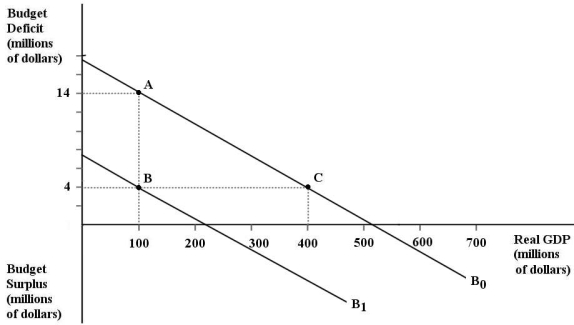 FIGURE 32- 2
Refer to Figure 32- 2. Initially, suppose that real GDP is $100 million and the budget deficit is $14 million, as shown by point A. Which of the following events could result in a move from point A to point C?
A)a fiscal contraction and an increase in GDP
B)a fiscal expansion and a decrease in GDP
C)a fiscal contraction and a decrease in GDP
D)an increase in GDP with no change in fiscal policy
E)a fiscal expansion and an increase in GDP
FIGURE 32- 2Refer to Figure 32- 2. Initially, suppose that real GDP is $100 million and the budget deficit is $14 million, as shown by point A. Which of the following events could result in a move from point A to point C?
A)a fiscal contraction and an increase in GDP
B)a fiscal expansion and a decrease in GDP
C)a fiscal contraction and a decrease in GDP
D)an increase in GDP with no change in fiscal policy
E)a fiscal expansion and an increase in GDP
Question
Question
Question
Question
The diagram below shows two budget deficit functions for a hypothetical economy.
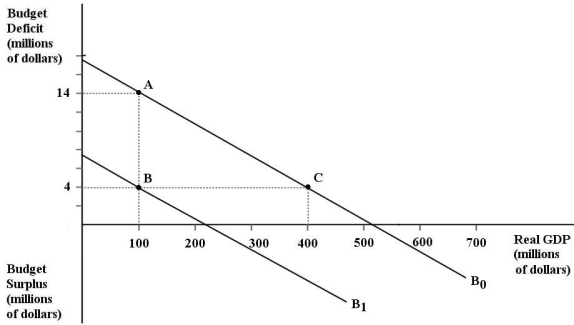 FIGURE 32- 2
Refer to Figure 32- 2. Initially, suppose the economy is at point A. If the government were to implement a fiscal expansion, the cyclically adjusted budget deficit would be
A)$6 million.
B)$4 million.
C)$7 million.
D)$10 million.
E)-- insufficient information to know.
FIGURE 32- 2Refer to Figure 32- 2. Initially, suppose the economy is at point A. If the government were to implement a fiscal expansion, the cyclically adjusted budget deficit would be
A)$6 million.
B)$4 million.
C)$7 million.
D)$10 million.
E)-- insufficient information to know.
Question
Question
Question
Question
Question
Question
Question
Question
Question
Question
Question
Question
Question
The diagram below shows two budget deficit functions for a hypothetical economy.
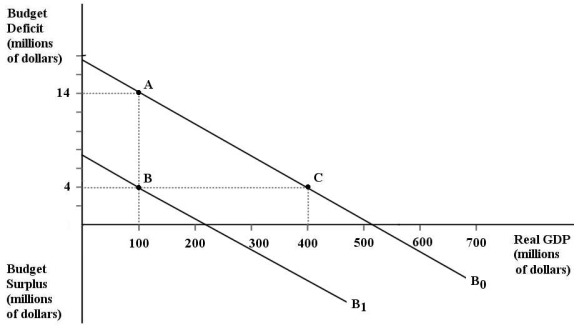 FIGURE 32- 2
Refer to Figure 32- 2. Initially, suppose the economy is at point A. If the level of potential output were 300, the cyclically adjusted budget deficit would be
A)$14 million.
B)$2 million.
C)negative.
D)positive.
E)-- insufficient information to know.
FIGURE 32- 2Refer to Figure 32- 2. Initially, suppose the economy is at point A. If the level of potential output were 300, the cyclically adjusted budget deficit would be
A)$14 million.
B)$2 million.
C)negative.
D)positive.
E)-- insufficient information to know.
Question
Question
Question
Question
The diagram below is for a closed economy which begins in long- run equilibrium at Y*.
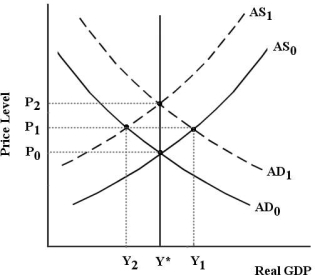 FIGURE 32- 3
Refer to Figure 32- 3. Suppose the government implements an expansionary fiscal policy which increases the budget deficit. The initial effect of this policy is the opening of a(n) gap, and a new short- run equilibrium with a price level of and real GDP of .
A)inflationary; P2; Y*
B)inflationary; P1; Y*
C)recessionary; P0; Y*
D)recessionary; P1; Y2
E)inflationary; P1; Y1
FIGURE 32- 3Refer to Figure 32- 3. Suppose the government implements an expansionary fiscal policy which increases the budget deficit. The initial effect of this policy is the opening of a(n) gap, and a new short- run equilibrium with a price level of and real GDP of .
A)inflationary; P2; Y*
B)inflationary; P1; Y*
C)recessionary; P0; Y*
D)recessionary; P1; Y2
E)inflationary; P1; Y1
Question
Question
The diagram below shows the budget deficit function for a hypothetical economy.
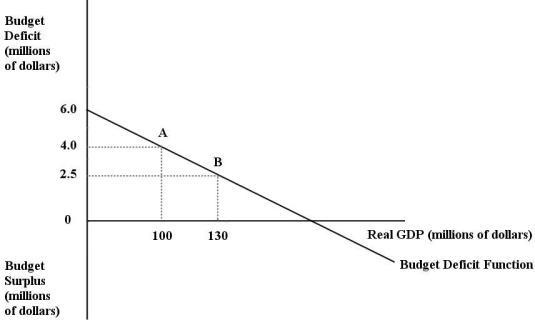 FIGURE 32- 1
Refer to Figure 32- 1. Initially, suppose that real GDP is $100 million and the budget deficit is $4 million, as shown by point A. If the government implements an expansionary fiscal policy by decreasing lump- sum taxes, then
A)the budget deficit function would become steeper.
B)the budget deficit function would become flatter.
C)the budget deficit function would shift up.
D)the budget deficit function would shift down.
E)the size of the budget deficit would decrease as we move from point A to point B.
FIGURE 32- 1Refer to Figure 32- 1. Initially, suppose that real GDP is $100 million and the budget deficit is $4 million, as shown by point A. If the government implements an expansionary fiscal policy by decreasing lump- sum taxes, then
A)the budget deficit function would become steeper.
B)the budget deficit function would become flatter.
C)the budget deficit function would shift up.
D)the budget deficit function would shift down.
E)the size of the budget deficit would decrease as we move from point A to point B.
Question
Question
Question
Question
Question
The diagram below shows the budget deficit function for a hypothetical economy.
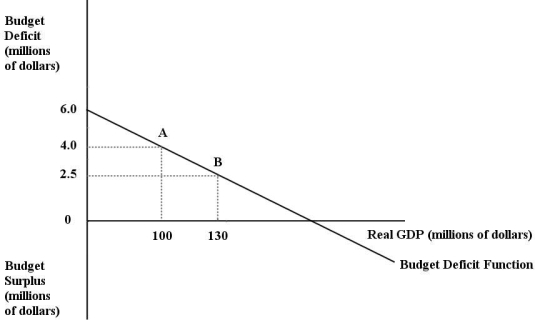 FIGURE 32- 1
It can be argued that a government budget deficit, rather than being a burden for future generations, may provide net benefits to future generations. This view is correct if the current budget deficit is used to
A)pay subsidies to Canadian firms to offset rising energy costs.
B)finance projects that deliver long- term benefits to society.
C)invest in the purchasing of goods not available in the local economy.
D)pay transfers such as welfare and old age pensions in the present period.
E)ensure that all interest paid goes to residents rather than foreigners.
FIGURE 32- 1It can be argued that a government budget deficit, rather than being a burden for future generations, may provide net benefits to future generations. This view is correct if the current budget deficit is used to
A)pay subsidies to Canadian firms to offset rising energy costs.
B)finance projects that deliver long- term benefits to society.
C)invest in the purchasing of goods not available in the local economy.
D)pay transfers such as welfare and old age pensions in the present period.
E)ensure that all interest paid goes to residents rather than foreigners.
Question
Question
Question
Question
Question
The diagram below shows the budget deficit function for a hypothetical economy.
FIGURE 32- 1
Refer to Figure 32- 1. Initially, suppose that real GDP is $100 million and the budget deficit is $4 million, as shown by point A. If the government implements a contractionary fiscal policy by decreasing its purchases of goods and services, then
A)the size of the budget deficit would decrease as we move from point A to point B.
B)the budget deficit function would become flatter.
C)the budget deficit function would shift up.
D)the budget deficit function would become steeper.
E)the budget deficit function would shift down.
FIGURE 32- 1Refer to Figure 32- 1. Initially, suppose that real GDP is $100 million and the budget deficit is $4 million, as shown by point A. If the government implements a contractionary fiscal policy by decreasing its purchases of goods and services, then
A)the size of the budget deficit would decrease as we move from point A to point B.
B)the budget deficit function would become flatter.
C)the budget deficit function would shift up.
D)the budget deficit function would become steeper.
E)the budget deficit function would shift down.
Question
Question
Question
Question
Question
Question
Question
Question
Question
Question
Question
Question
Question
Question
Question
Question
Question
Question
Question
Question
Question
The diagram below shows the budget deficit function for a hypothetical economy.
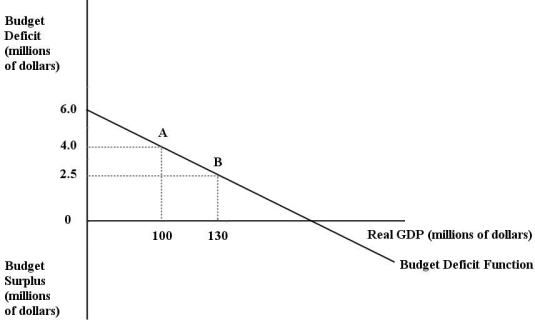 FIGURE 32- 1
Refer to Figure 32- 1. Initially, suppose that real GDP is $100 million and the budget deficit is $4 million, as shown by point A on the graph. Which of the following is consistent with a move from point A to point B?
A)the economy entering into a boom
B)implementation of an expansionary fiscal policy
C)implementation of a contractionary fiscal policy
D)the economy entering into a recession
E)implementation of a contractionary monetary policy
FIGURE 32- 1Refer to Figure 32- 1. Initially, suppose that real GDP is $100 million and the budget deficit is $4 million, as shown by point A on the graph. Which of the following is consistent with a move from point A to point B?
A)the economy entering into a boom
B)implementation of an expansionary fiscal policy
C)implementation of a contractionary fiscal policy
D)the economy entering into a recession
E)implementation of a contractionary monetary policy
Question
Question
Question
Question
Question
Question
Question
Question
Question
Question
The diagram below shows two budget deficit functions for a hypothetical economy.
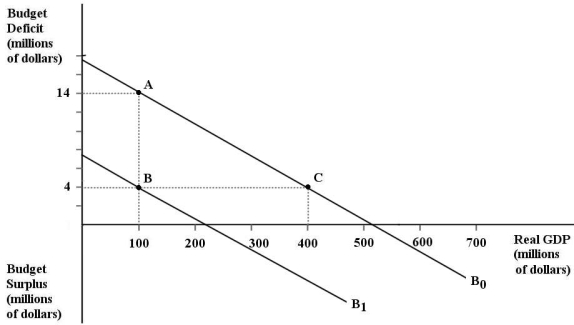 FIGURE 32- 2
Refer to Figure 32- 2. Initially, suppose the economy is at point A. If the level of potential output were 400, the cyclically adjusted budget deficit would be
A)- $10 million.
B)$0.
C)$4 million.
D)negative.
E)$14 million.
FIGURE 32- 2Refer to Figure 32- 2. Initially, suppose the economy is at point A. If the level of potential output were 400, the cyclically adjusted budget deficit would be
A)- $10 million.
B)$0.
C)$4 million.
D)negative.
E)$14 million.
Question
Question
Question
Question
Question
Question
Question
Question
Question
The diagram below shows two budget deficit functions for a hypothetical economy.
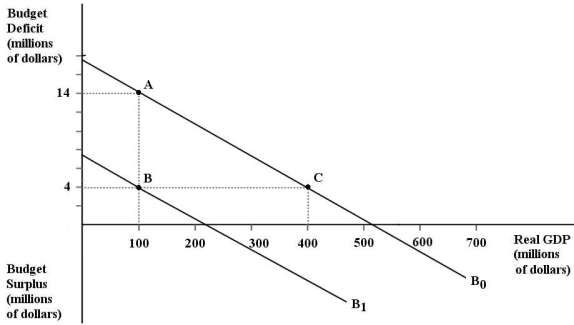 FIGURE 32- 2
Refer to Figure 32- 2. Initially, suppose that real GDP is $100 million and the budget deficit is $14 million, as shown by point A. Which of the following events could result in a move from point A to point B?
A)the implementation of an expansionary fiscal policy
B)the implementation of an expansionary monetary policy
C)the implementation of a contractionary monetary policy
D)the implementation of a contractionary fiscal policy
E)the economy entering into a boom
FIGURE 32- 2Refer to Figure 32- 2. Initially, suppose that real GDP is $100 million and the budget deficit is $14 million, as shown by point A. Which of the following events could result in a move from point A to point B?
A)the implementation of an expansionary fiscal policy
B)the implementation of an expansionary monetary policy
C)the implementation of a contractionary monetary policy
D)the implementation of a contractionary fiscal policy
E)the economy entering into a boom
Question
Question
The diagram below shows the budget deficit function for a hypothetical economy.
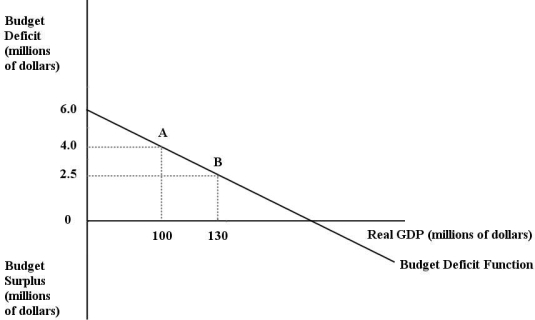 FIGURE 32- 1
Refer to Figure 32- 1. Initially, suppose that real GDP is $100 million and the budget deficit is $4 million, as shown by point A. If the government implements an expansionary fiscal policy by increasing its purchases of goods and services, then
A)the budget deficit function would shift down.
B)the size of the budget deficit would decrease as we move from point A to point B.
C)the budget deficit function would become steeper.
D)the budget deficit function would shift up.
E)the budget deficit function would become flatter.
FIGURE 32- 1Refer to Figure 32- 1. Initially, suppose that real GDP is $100 million and the budget deficit is $4 million, as shown by point A. If the government implements an expansionary fiscal policy by increasing its purchases of goods and services, then
A)the budget deficit function would shift down.
B)the size of the budget deficit would decrease as we move from point A to point B.
C)the budget deficit function would become steeper.
D)the budget deficit function would shift up.
E)the budget deficit function would become flatter.
Question

Unlock Deck
Sign up to unlock the cards in this deck!
Unlock Deck
Unlock Deck
1/106

Play

Full screen (f)
Deck 32: Government Debt and Deficits
1
Economists who claim that a stable or falling debt- to- GDP ratio is the best indicator of fiscal prudence support the view that
A)for many economies, the public debt can safely be allowed to grow at a rate up to the growth rate of real GDP.
B)budget deficits can grow at every phase of the business cycle.
C)the Bank of Canada must maintain the interest rate above the rate of growth on real GDP.
D)the public debt must be paid off at a rate equal to the interest rate times the growth rate on real GDP.
E)surpluses must be run only at the recessionary phase of the business cycle.
A)for many economies, the public debt can safely be allowed to grow at a rate up to the growth rate of real GDP.
B)budget deficits can grow at every phase of the business cycle.
C)the Bank of Canada must maintain the interest rate above the rate of growth on real GDP.
D)the public debt must be paid off at a rate equal to the interest rate times the growth rate on real GDP.
E)surpluses must be run only at the recessionary phase of the business cycle.
A
2
The Canadian tax and transfer system acts as an automatic stabilizer because
A)tax rates will automatically increase to stimulate the economy during economic recessions.
B)tax rates will automatically increase if the government is running deficits.
C)tax rates will automatically decrease to stimulate the economy during economic booms.
D)net tax revenues increase during economic booms and decrease during economic recessions.
E)net tax revenues decrease during economic booms and decrease during economic recessions.
A)tax rates will automatically increase to stimulate the economy during economic recessions.
B)tax rates will automatically increase if the government is running deficits.
C)tax rates will automatically decrease to stimulate the economy during economic booms.
D)net tax revenues increase during economic booms and decrease during economic recessions.
E)net tax revenues decrease during economic booms and decrease during economic recessions.
D
3
Consider the government's budget deficit function, graphed with dollars on the vertical axis and real GDP on the horizontal axis. This function is downward sloping because as real GDP
A)rises, tax revenues fall, decreasing the deficit or increasing the surplus.
B)falls, the budget deficit function shifts down.
C)rises, tax revenues rise, decreasing the deficit or increasing the surplus.
D)falls, tax revenues rise, decreasing the deficit or increasing the surplus.
E)rises, it leads to increasing debt- service payments.
A)rises, tax revenues fall, decreasing the deficit or increasing the surplus.
B)falls, the budget deficit function shifts down.
C)rises, tax revenues rise, decreasing the deficit or increasing the surplus.
D)falls, tax revenues rise, decreasing the deficit or increasing the surplus.
E)rises, it leads to increasing debt- service payments.
C
4
The diagram below shows two budget deficit functions for a hypothetical economy.
FIGURE 32- 2
Refer to Figure 32- 2. Initially, suppose that real GDP is $100 million and the budget deficit is $14 million, as shown by point A. Which of the following events could result in a move from point A to point C?
A)a fiscal contraction and an increase in GDP
B)a fiscal expansion and a decrease in GDP
C)a fiscal contraction and a decrease in GDP
D)an increase in GDP with no change in fiscal policy
E)a fiscal expansion and an increase in GDP
FIGURE 32- 2Refer to Figure 32- 2. Initially, suppose that real GDP is $100 million and the budget deficit is $14 million, as shown by point A. Which of the following events could result in a move from point A to point C?
A)a fiscal contraction and an increase in GDP
B)a fiscal expansion and a decrease in GDP
C)a fiscal contraction and a decrease in GDP
D)an increase in GDP with no change in fiscal policy
E)a fiscal expansion and an increase in GDP
Unlock Deck
Unlock for access to all 106 flashcards in this deck.
Unlock Deck
k this deck
5
Consider the following data about government debt and deficit in a given year: - real interest rate on government bonds = 2%
- growth rate of real GDP = 3%
- current debt- to- GDP ratio = 50%
- primary budget deficit = 0
Over this one- year period the debt- to- GDP ratio will have
A)fallen by 50 percent.
B)risen by 0.5 percentage points.
C)fallen by 0.5 percentage points.
D)risen by 50 percent.
E)remained unchanged.
- growth rate of real GDP = 3%
- current debt- to- GDP ratio = 50%
- primary budget deficit = 0
Over this one- year period the debt- to- GDP ratio will have
A)fallen by 50 percent.
B)risen by 0.5 percentage points.
C)fallen by 0.5 percentage points.
D)risen by 50 percent.
E)remained unchanged.
Unlock Deck
Unlock for access to all 106 flashcards in this deck.
Unlock Deck
k this deck
6
The best measure of the change in the stance of a government's fiscal policy is
A)the change in the cyclically adjusted deficit.
B)the change in the primary budget deficit.
C)the actual budget deficit.
D)the cyclically adjusted deficit.
E)the change in the actual budget deficit.
A)the change in the cyclically adjusted deficit.
B)the change in the primary budget deficit.
C)the actual budget deficit.
D)the cyclically adjusted deficit.
E)the change in the actual budget deficit.
Unlock Deck
Unlock for access to all 106 flashcards in this deck.
Unlock Deck
k this deck
7
In any given year, the government's debt- service payments are equal to
A)(fiscal borrowing)x (the interest rate)
B)(government spending + tax revenue)x (the interest rate)
C)(government spending)x (the interest rate)
D)(government spending - tax revenue)x (the interest rate)
E)(total outstanding government debt)x (the interest rate)
A)(fiscal borrowing)x (the interest rate)
B)(government spending + tax revenue)x (the interest rate)
C)(government spending)x (the interest rate)
D)(government spending - tax revenue)x (the interest rate)
E)(total outstanding government debt)x (the interest rate)
Unlock Deck
Unlock for access to all 106 flashcards in this deck.
Unlock Deck
k this deck
8
The diagram below shows two budget deficit functions for a hypothetical economy.
FIGURE 32- 2
Refer to Figure 32- 2. Initially, suppose the economy is at point A. If the government were to implement a fiscal expansion, the cyclically adjusted budget deficit would be
A)$6 million.
B)$4 million.
C)$7 million.
D)$10 million.
E)-- insufficient information to know.
FIGURE 32- 2Refer to Figure 32- 2. Initially, suppose the economy is at point A. If the government were to implement a fiscal expansion, the cyclically adjusted budget deficit would be
A)$6 million.
B)$4 million.
C)$7 million.
D)$10 million.
E)-- insufficient information to know.
Unlock Deck
Unlock for access to all 106 flashcards in this deck.
Unlock Deck
k this deck
9
If the Canadian federal government adopted a formal balanced budget rule, during times that GDP was falling it would have to
A)decrease tax rates and/or increase spending which would destabilize the economy.
B)decrease spending and transfer payments while holding tax rates constant.
C)increase tax rates and/or increase spending which would destabilize the economy.
D)increase tax rates and/or decrease spending which would destabilize the economy.
E)decrease interest payments on the debt.
A)decrease tax rates and/or increase spending which would destabilize the economy.
B)decrease spending and transfer payments while holding tax rates constant.
C)increase tax rates and/or increase spending which would destabilize the economy.
D)increase tax rates and/or decrease spending which would destabilize the economy.
E)decrease interest payments on the debt.
Unlock Deck
Unlock for access to all 106 flashcards in this deck.
Unlock Deck
k this deck
10
A simple equation describing the government's budget constraint is
A)government expenditure = tax revenue - borrowing.
B)tax revenue = borrowing - government expenditure.
C)tax revenue = government expenditure + borrowing.
D)government expenditure = tax revenue + borrowing.
E)government expenditure = tax revenue + debt- service payments.
A)government expenditure = tax revenue - borrowing.
B)tax revenue = borrowing - government expenditure.
C)tax revenue = government expenditure + borrowing.
D)government expenditure = tax revenue + borrowing.
E)government expenditure = tax revenue + debt- service payments.
Unlock Deck
Unlock for access to all 106 flashcards in this deck.
Unlock Deck
k this deck
11
Suppose the stock of government debt in Canada at the end of one fiscal year is $475 billion. If the stock of debt falls to $461 billion by the end of the next fiscal year, and debt- service payments during that year were $38 billion, then we know that the government had
A)a primary budget surplus of $52 billion.
B)a primary budget surplus of $14 billion.
C)an annual budget surplus of $14 billion.
D)an annual budget surplus of $38 billion.
E)a primary budget surplus of $24 billion.
A)a primary budget surplus of $52 billion.
B)a primary budget surplus of $14 billion.
C)an annual budget surplus of $14 billion.
D)an annual budget surplus of $38 billion.
E)a primary budget surplus of $24 billion.
Unlock Deck
Unlock for access to all 106 flashcards in this deck.
Unlock Deck
k this deck
12
Suppose the stock of government debt in Canada at the end of one fiscal year is $475 billion. If the stock of debt rises to $482 billion by the end of the next fiscal year, then we know that in that year
A)debt- service payments rose by $7 billion.
B)the government had a primary budget deficit of $7 billion.
C)the government had a primary budget surplus of $7 billion.
D)tax revenues decreased by $7 billion.
E)the government had an annual budget deficit of $7 billion.
A)debt- service payments rose by $7 billion.
B)the government had a primary budget deficit of $7 billion.
C)the government had a primary budget surplus of $7 billion.
D)tax revenues decreased by $7 billion.
E)the government had an annual budget deficit of $7 billion.
Unlock Deck
Unlock for access to all 106 flashcards in this deck.
Unlock Deck
k this deck
13
The Canadian federal government's debt- to- GDP ratio climbed steadily from
A)1975 to the mid 1990s.
B)1960 to the late 1990s.
C)2000 to 2009.
D)1995 to 2009.
E)1939 to the late 1980s.
A)1975 to the mid 1990s.
B)1960 to the late 1990s.
C)2000 to 2009.
D)1995 to 2009.
E)1939 to the late 1980s.
Unlock Deck
Unlock for access to all 106 flashcards in this deck.
Unlock Deck
k this deck
14
The accumulated stock of government debt will begin to fall
A)when the government's annual budget is in deficit.
B)if the government does not borrow money.
C)if the government's debt- service payments are zero.
D)if the growth rate of real GDP is higher than the real interest rate.
E)when the government's annual budget is in surplus.
A)when the government's annual budget is in deficit.
B)if the government does not borrow money.
C)if the government's debt- service payments are zero.
D)if the growth rate of real GDP is higher than the real interest rate.
E)when the government's annual budget is in surplus.
Unlock Deck
Unlock for access to all 106 flashcards in this deck.
Unlock Deck
k this deck
15
Consider a closed- economy AD/AS macro model. A policy- induced increase in the government's budget deficit is most likely to crowd- out private investment if
A)interest rates rise sharply as a result of the deficit.
B)consumers reduce consumption as a result of the deficit.
C)interest rates decrease sharply as a result of the deficit.
D)there is a very large output gap.
E)rising income increases the volume of saving and interest rates rise very little.
A)interest rates rise sharply as a result of the deficit.
B)consumers reduce consumption as a result of the deficit.
C)interest rates decrease sharply as a result of the deficit.
D)there is a very large output gap.
E)rising income increases the volume of saving and interest rates rise very little.
Unlock Deck
Unlock for access to all 106 flashcards in this deck.
Unlock Deck
k this deck
16
If we want to know whether tax revenues are sufficient to finance the discretionary part of government expenditure, which of the following measures should we analyze?
A)the government's budget constraint
B)the debt- to- GDP ratio
C)the interest rate on government bonds compared to the growth rate of real GDP
D)the cyclically adjusted deficit/surplus
E)the government's primary deficit/surplus
A)the government's budget constraint
B)the debt- to- GDP ratio
C)the interest rate on government bonds compared to the growth rate of real GDP
D)the cyclically adjusted deficit/surplus
E)the government's primary deficit/surplus
Unlock Deck
Unlock for access to all 106 flashcards in this deck.
Unlock Deck
k this deck
17
Do we get a useful and meaningful statistic by dividing the national debt by the GDP?
A)Yes -- we can then see how much of the national debt is owed by each individual citizen.
B)No -- the GDP is not a meaningful measure of the well- being of the economy.
C)No -- dividing a stock by a flow can never be sensible.
D)No -- we are essentially "dividing apples by oranges", which is unhelpful.
E)Yes -- we can see the burden of the debt more clearly than using the national debt figure alone.
A)Yes -- we can then see how much of the national debt is owed by each individual citizen.
B)No -- the GDP is not a meaningful measure of the well- being of the economy.
C)No -- dividing a stock by a flow can never be sensible.
D)No -- we are essentially "dividing apples by oranges", which is unhelpful.
E)Yes -- we can see the burden of the debt more clearly than using the national debt figure alone.
Unlock Deck
Unlock for access to all 106 flashcards in this deck.
Unlock Deck
k this deck
18
Consider the following data about government debt and deficit in a given year: - real interest rate on government bonds = 3%
- growth rate of real GDP = 1%
- current debt- to- GDP ratio = 40%
- primary budget deficit as a percentage of GDP = 2%
Over this one- year period the debt- to- GDP ratio will have risen by
A)8.2 percentage points.
B)82 percentage points.
C)0.82 percentage points.
D)0.28 percentage points.
E)2.8 percentage points.
- growth rate of real GDP = 1%
- current debt- to- GDP ratio = 40%
- primary budget deficit as a percentage of GDP = 2%
Over this one- year period the debt- to- GDP ratio will have risen by
A)8.2 percentage points.
B)82 percentage points.
C)0.82 percentage points.
D)0.28 percentage points.
E)2.8 percentage points.
Unlock Deck
Unlock for access to all 106 flashcards in this deck.
Unlock Deck
k this deck
19
Suppose during one fiscal year, government purchases are $195 billion, debt- service payments are $22 billion and net tax revenues are $208 billion. What is the annual budget deficit/surplus?
A)budget surplus of $13 billion
B)budget surplus of $22 billion
C)budget deficit of $9 billion
D)budget deficit of $13 billion
E)budget surplus of $9 billion
A)budget surplus of $13 billion
B)budget surplus of $22 billion
C)budget deficit of $9 billion
D)budget deficit of $13 billion
E)budget surplus of $9 billion
Unlock Deck
Unlock for access to all 106 flashcards in this deck.
Unlock Deck
k this deck
20
The concept of capital budgeting refers to the idea that
A)the government would direct a fixed percentage of its budget toward investment expenditure that would benefit future generations.
B)if the debt- to- GDP ratio rises to unacceptable levels, the central bank can monetize portions of the government debt.
C)government budgets should be designed to be balanced, while fully recognizing that changing economic circumstances may prevent such balance.
D)the government would classify all expenditures as either consumption (benefiting current generations)or investment (benefiting future generations).
E)counter- cyclical fiscal policy is included in the government budget.
A)the government would direct a fixed percentage of its budget toward investment expenditure that would benefit future generations.
B)if the debt- to- GDP ratio rises to unacceptable levels, the central bank can monetize portions of the government debt.
C)government budgets should be designed to be balanced, while fully recognizing that changing economic circumstances may prevent such balance.
D)the government would classify all expenditures as either consumption (benefiting current generations)or investment (benefiting future generations).
E)counter- cyclical fiscal policy is included in the government budget.
Unlock Deck
Unlock for access to all 106 flashcards in this deck.
Unlock Deck
k this deck
21
The diagram below shows two budget deficit functions for a hypothetical economy.
FIGURE 32- 2
Refer to Figure 32- 2. Initially, suppose the economy is at point A. If the level of potential output were 300, the cyclically adjusted budget deficit would be
A)$14 million.
B)$2 million.
C)negative.
D)positive.
E)-- insufficient information to know.
FIGURE 32- 2Refer to Figure 32- 2. Initially, suppose the economy is at point A. If the level of potential output were 300, the cyclically adjusted budget deficit would be
A)$14 million.
B)$2 million.
C)negative.
D)positive.
E)-- insufficient information to know.
Unlock Deck
Unlock for access to all 106 flashcards in this deck.
Unlock Deck
k this deck
22
Consider a government with a positive stock of debt, and suppose the real interest rate on government bonds equals the rate of growth of real GDP. In this case, the government's debt- to- GDP ratio will rise only if
A)the debt- to- GDP ratio is already high.
B)the real interest rate is high.
C)the primary budget surplus exceeds the overall budget surplus.
D)there is an overall budget deficit.
E)there is a primary budget deficit.
A)the debt- to- GDP ratio is already high.
B)the real interest rate is high.
C)the primary budget surplus exceeds the overall budget surplus.
D)there is an overall budget deficit.
E)there is a primary budget deficit.
Unlock Deck
Unlock for access to all 106 flashcards in this deck.
Unlock Deck
k this deck
23
If voters want to know how their tax dollars are being spent and how the federal government is managing its current spending, they should look at
A)the primary budget balance.
B)changes in the money supply.
C)federal/provincial tax transfers.
D)the overall budget balance.
E)the inflation adjusted deficit.
A)the primary budget balance.
B)changes in the money supply.
C)federal/provincial tax transfers.
D)the overall budget balance.
E)the inflation adjusted deficit.
Unlock Deck
Unlock for access to all 106 flashcards in this deck.
Unlock Deck
k this deck
24
The policy objective of an annually balanced government budget
A)is feasible and would be stabilizing.
B)would be stabilizing, but is difficult to achieve.
C)is difficult to achieve and would be destabilizing.
D)is feasible but would be destabilizing.
E)would eliminate the swings in real GDP.
A)is feasible and would be stabilizing.
B)would be stabilizing, but is difficult to achieve.
C)is difficult to achieve and would be destabilizing.
D)is feasible but would be destabilizing.
E)would eliminate the swings in real GDP.
Unlock Deck
Unlock for access to all 106 flashcards in this deck.
Unlock Deck
k this deck
25
The diagram below is for a closed economy which begins in long- run equilibrium at Y*.
FIGURE 32- 3
Refer to Figure 32- 3. Suppose the government implements an expansionary fiscal policy which increases the budget deficit. The initial effect of this policy is the opening of a(n) gap, and a new short- run equilibrium with a price level of and real GDP of .
A)inflationary; P2; Y*
B)inflationary; P1; Y*
C)recessionary; P0; Y*
D)recessionary; P1; Y2
E)inflationary; P1; Y1
FIGURE 32- 3Refer to Figure 32- 3. Suppose the government implements an expansionary fiscal policy which increases the budget deficit. The initial effect of this policy is the opening of a(n) gap, and a new short- run equilibrium with a price level of and real GDP of .
A)inflationary; P2; Y*
B)inflationary; P1; Y*
C)recessionary; P0; Y*
D)recessionary; P1; Y2
E)inflationary; P1; Y1
Unlock Deck
Unlock for access to all 106 flashcards in this deck.
Unlock Deck
k this deck
26
If the government's total budget surplus is $10 billion and its debt- service payments are $8 billion, then its primary budget surplus is
A)$18 billion.
B)$2 billion.
C)$8 billion.
D)$10 billion.
E)- $2 billion.
A)$18 billion.
B)$2 billion.
C)$8 billion.
D)$10 billion.
E)- $2 billion.
Unlock Deck
Unlock for access to all 106 flashcards in this deck.
Unlock Deck
k this deck
27
The diagram below shows the budget deficit function for a hypothetical economy.
FIGURE 32- 1
Refer to Figure 32- 1. Initially, suppose that real GDP is $100 million and the budget deficit is $4 million, as shown by point A. If the government implements an expansionary fiscal policy by decreasing lump- sum taxes, then
A)the budget deficit function would become steeper.
B)the budget deficit function would become flatter.
C)the budget deficit function would shift up.
D)the budget deficit function would shift down.
E)the size of the budget deficit would decrease as we move from point A to point B.
FIGURE 32- 1Refer to Figure 32- 1. Initially, suppose that real GDP is $100 million and the budget deficit is $4 million, as shown by point A. If the government implements an expansionary fiscal policy by decreasing lump- sum taxes, then
A)the budget deficit function would become steeper.
B)the budget deficit function would become flatter.
C)the budget deficit function would shift up.
D)the budget deficit function would shift down.
E)the size of the budget deficit would decrease as we move from point A to point B.
Unlock Deck
Unlock for access to all 106 flashcards in this deck.
Unlock Deck
k this deck
28
Suppose the budget deficit falls from one year to the next, but there has been no change in the government's fiscal policy. The change in the budget deficit can be explained by
A)a rising real interest rate.
B)a rise in the cyclically adjusted deficit.
C)a change in the stance of fiscal policy.
D)a rising real GDP.
E)a rise in the primary budget deficit.
A)a rising real interest rate.
B)a rise in the cyclically adjusted deficit.
C)a change in the stance of fiscal policy.
D)a rising real GDP.
E)a rise in the primary budget deficit.
Unlock Deck
Unlock for access to all 106 flashcards in this deck.
Unlock Deck
k this deck
29
In general, the government will have flexibility in implementing counter- cyclical fiscal policy when the outstanding stock of government debt is relative to the size of GDP.
A)less; insignificant
B)total; large
C)less; small
D)more; small
E)more; large
A)less; insignificant
B)total; large
C)less; small
D)more; small
E)more; large
Unlock Deck
Unlock for access to all 106 flashcards in this deck.
Unlock Deck
k this deck
30
Decreasing government expenditures in order to reduce the government's budget deficit can involve certain costs. An example of such a cost could be
A)improving the flexibility to practice counter- cyclical fiscal policy.
B)encouraging future generations to be more self- sufficient and less reliant on government to provide for them.
C)a lower portion of taxes being used to pay interest.
D)longer queues for essential government services such as health- care services.
E)adequate school facilities to accommodate a growing population.
A)improving the flexibility to practice counter- cyclical fiscal policy.
B)encouraging future generations to be more self- sufficient and less reliant on government to provide for them.
C)a lower portion of taxes being used to pay interest.
D)longer queues for essential government services such as health- care services.
E)adequate school facilities to accommodate a growing population.
Unlock Deck
Unlock for access to all 106 flashcards in this deck.
Unlock Deck
k this deck
31
The Canadian federal debt- to- GDP ratio reached a high of about percent in 1996. By 2009, the debt- to GDP ratio had percent.
A)70; fallen to less than 30
B)40; fallen to less than 10
C)50; fallen to 0
D)80; risen to 110
E)110; fallen to 50
A)70; fallen to less than 30
B)40; fallen to less than 10
C)50; fallen to 0
D)80; risen to 110
E)110; fallen to 50
Unlock Deck
Unlock for access to all 106 flashcards in this deck.
Unlock Deck
k this deck
32
The diagram below shows the budget deficit function for a hypothetical economy.
FIGURE 32- 1
It can be argued that a government budget deficit, rather than being a burden for future generations, may provide net benefits to future generations. This view is correct if the current budget deficit is used to
A)pay subsidies to Canadian firms to offset rising energy costs.
B)finance projects that deliver long- term benefits to society.
C)invest in the purchasing of goods not available in the local economy.
D)pay transfers such as welfare and old age pensions in the present period.
E)ensure that all interest paid goes to residents rather than foreigners.
FIGURE 32- 1It can be argued that a government budget deficit, rather than being a burden for future generations, may provide net benefits to future generations. This view is correct if the current budget deficit is used to
A)pay subsidies to Canadian firms to offset rising energy costs.
B)finance projects that deliver long- term benefits to society.
C)invest in the purchasing of goods not available in the local economy.
D)pay transfers such as welfare and old age pensions in the present period.
E)ensure that all interest paid goes to residents rather than foreigners.
Unlock Deck
Unlock for access to all 106 flashcards in this deck.
Unlock Deck
k this deck
33
Suppose during one fiscal year, government purchases are $195 billion, debt- service payments are $22 billion and net tax revenues are $208 billion. What is the government's primary budget deficit/surplus?
A)primary budget surplus of $9 billion
B)primary budget deficit of $9 billion
C)primary budget surplus of $13 billion
D)primary budget surplus of $22 billion
E)primary budget deficit of $13 billion
A)primary budget surplus of $9 billion
B)primary budget deficit of $9 billion
C)primary budget surplus of $13 billion
D)primary budget surplus of $22 billion
E)primary budget deficit of $13 billion
Unlock Deck
Unlock for access to all 106 flashcards in this deck.
Unlock Deck
k this deck
34
The government's cyclically adjusted budget deficit (CAD)adjusts for
A)interest rate changes that affect the absolute amount of debt- service payments.
B)changes in spending or tax revenues caused by fluctuations in national income.
C)any primary budget surplus or deficit incurred by the federal government.
D)changes in investment to smooth fluctuations in national income.
E)increases in the money supply in excess of the real growth in the economy.
A)interest rate changes that affect the absolute amount of debt- service payments.
B)changes in spending or tax revenues caused by fluctuations in national income.
C)any primary budget surplus or deficit incurred by the federal government.
D)changes in investment to smooth fluctuations in national income.
E)increases in the money supply in excess of the real growth in the economy.
Unlock Deck
Unlock for access to all 106 flashcards in this deck.
Unlock Deck
k this deck
35
Suppose the government decided to ensure that its cyclically adjusted budget deficit was always zero. This policy would be problematic because
A)it would act as a built- in destabilizer.
B)it would require continual fiscal expansion.
C)it would tend to mean that net exports would be crowded out.
D)it would entail a rising debt- to- GDP ratio.
E)it would require continual fiscal contraction.
A)it would act as a built- in destabilizer.
B)it would require continual fiscal expansion.
C)it would tend to mean that net exports would be crowded out.
D)it would entail a rising debt- to- GDP ratio.
E)it would require continual fiscal contraction.
Unlock Deck
Unlock for access to all 106 flashcards in this deck.
Unlock Deck
k this deck
36
a burden on future generations who will have to pay interest to the owners of government bonds.
A)1, 2, and 3
B)2 only
C)3 only
D)2 and 3
E)1 and 2
A)1, 2, and 3
B)2 only
C)3 only
D)2 and 3
E)1 and 2
Unlock Deck
Unlock for access to all 106 flashcards in this deck.
Unlock Deck
k this deck
37
The diagram below shows the budget deficit function for a hypothetical economy.
FIGURE 32- 1
Refer to Figure 32- 1. Initially, suppose that real GDP is $100 million and the budget deficit is $4 million, as shown by point A. If the government implements a contractionary fiscal policy by decreasing its purchases of goods and services, then
A)the size of the budget deficit would decrease as we move from point A to point B.
B)the budget deficit function would become flatter.
C)the budget deficit function would shift up.
D)the budget deficit function would become steeper.
E)the budget deficit function would shift down.
FIGURE 32- 1Refer to Figure 32- 1. Initially, suppose that real GDP is $100 million and the budget deficit is $4 million, as shown by point A. If the government implements a contractionary fiscal policy by decreasing its purchases of goods and services, then
A)the size of the budget deficit would decrease as we move from point A to point B.
B)the budget deficit function would become flatter.
C)the budget deficit function would shift up.
D)the budget deficit function would become steeper.
E)the budget deficit function would shift down.
Unlock Deck
Unlock for access to all 106 flashcards in this deck.
Unlock Deck
k this deck
38
If the Canadian federal government adopted a formal balanced budget rule, during times that GDP was rising it would have to
A)decrease tax rates and/or increase spending which would destabilize the economy.
B)decrease interest payments on the debt.
C)decrease tax rates and/or decrease spending which would destabilize the economy.
D)decrease spending and transfer payments while holding tax rates constant.
E)increase tax rates and/or increase spending which would destabilize the economy.
A)decrease tax rates and/or increase spending which would destabilize the economy.
B)decrease interest payments on the debt.
C)decrease tax rates and/or decrease spending which would destabilize the economy.
D)decrease spending and transfer payments while holding tax rates constant.
E)increase tax rates and/or increase spending which would destabilize the economy.
Unlock Deck
Unlock for access to all 106 flashcards in this deck.
Unlock Deck
k this deck
39
In an open economy like Canada's, a fiscal expansion by the government tends to
A)appreciate the currency.
B)attract foreign capital and encourage increased investment.
C)attract foreign capital, appreciate the currency, and crowd out net exports.
D)crowd out net exports and encourage private investment.
E)attract foreign capital, depreciate the currency, and crowd out net exports.
A)appreciate the currency.
B)attract foreign capital and encourage increased investment.
C)attract foreign capital, appreciate the currency, and crowd out net exports.
D)crowd out net exports and encourage private investment.
E)attract foreign capital, depreciate the currency, and crowd out net exports.
Unlock Deck
Unlock for access to all 106 flashcards in this deck.
Unlock Deck
k this deck
40
In any given year, the government's debt- service payments are
A)not related to the government deficit.
B)not required unless the debt is held by foreigners.
C)equal to the annual budget deficit.
D)equal to the annual primary budget deficit.
E)the interest payments on the outstanding stock of government debt.
A)not related to the government deficit.
B)not required unless the debt is held by foreigners.
C)equal to the annual budget deficit.
D)equal to the annual primary budget deficit.
E)the interest payments on the outstanding stock of government debt.
Unlock Deck
Unlock for access to all 106 flashcards in this deck.
Unlock Deck
k this deck
41
In every year between 1998 and 2008, the Canadian federal government had a
A)budget surplus, indicating that tax revenues were more than sufficient to cover total government expenditures.
B)primary surplus but overall deficit, indicating that tax revenues were more than sufficient to cover discretionary government expenditures.
C)budget deficit, indicating that even deep cuts in government spending were not sufficient to alleviate the problem.
D)primary deficit, indicating that tax revenues were insufficient to cover discretionary government expenditures.
E)budget deficit, which contributed to a growing stock of government debt.
A)budget surplus, indicating that tax revenues were more than sufficient to cover total government expenditures.
B)primary surplus but overall deficit, indicating that tax revenues were more than sufficient to cover discretionary government expenditures.
C)budget deficit, indicating that even deep cuts in government spending were not sufficient to alleviate the problem.
D)primary deficit, indicating that tax revenues were insufficient to cover discretionary government expenditures.
E)budget deficit, which contributed to a growing stock of government debt.
Unlock Deck
Unlock for access to all 106 flashcards in this deck.
Unlock Deck
k this deck
42
Consider a closed- economy AD/AS macro model. An expansionary fiscal policy will generally increase the government's budget and also tends to and thus investment.
A)surplus; reduce interest rates; increase
B)surplus; reduce interest rates; decrease
C)deficit; raise interest rates; decrease
D)deficit; reduce interest rates; increase
E)deficit; raise interest rates; increase
A)surplus; reduce interest rates; increase
B)surplus; reduce interest rates; decrease
C)deficit; raise interest rates; decrease
D)deficit; reduce interest rates; increase
E)deficit; raise interest rates; increase
Unlock Deck
Unlock for access to all 106 flashcards in this deck.
Unlock Deck
k this deck
43
Financing a budget deficit by increasing the money supply will
A)reduce the burden of government debt.
B)create greater inflationary pressure.
C)have no short- run monetary effects on the economy.
D)allow more flexibility in the design of monetary policy.
E)increase investment over time.
A)reduce the burden of government debt.
B)create greater inflationary pressure.
C)have no short- run monetary effects on the economy.
D)allow more flexibility in the design of monetary policy.
E)increase investment over time.
Unlock Deck
Unlock for access to all 106 flashcards in this deck.
Unlock Deck
k this deck
44
Suppose legislation in Canada required annually balanced government budgets. This legislation would
A)force increased levels of government spending automatically increasing the size of the government debt.
B)require the Bank of Canada to lower interest rates during periods of inflation.
C)allow deficits but prevent the government from running surpluses.
D)require the Bank of Canada to expand and contract the money supply according to an annual timetable.
E)force a balanced budget that could turn a minor downturn in the economy into a serious and prolonged recession.
A)force increased levels of government spending automatically increasing the size of the government debt.
B)require the Bank of Canada to lower interest rates during periods of inflation.
C)allow deficits but prevent the government from running surpluses.
D)require the Bank of Canada to expand and contract the money supply according to an annual timetable.
E)force a balanced budget that could turn a minor downturn in the economy into a serious and prolonged recession.
Unlock Deck
Unlock for access to all 106 flashcards in this deck.
Unlock Deck
k this deck
45
Suppose the government's actual budget deficit is equal to the cyclically adjusted budget deficit. Then it must be the case that
A)the debt- to- GDP ratio is stable.
B)the economy is at full employment.
C)the overall government budget is balanced.
D)the government is not reporting all of its expenses.
E)the primary budget deficit is zero.
A)the debt- to- GDP ratio is stable.
B)the economy is at full employment.
C)the overall government budget is balanced.
D)the government is not reporting all of its expenses.
E)the primary budget deficit is zero.
Unlock Deck
Unlock for access to all 106 flashcards in this deck.
Unlock Deck
k this deck
46
Annually balanced government budgets
A)would require the federal government to control both fiscal and monetary policy.
B)would reduce the size of output gaps.
C)would undermine the success of stabilization policies implemented by the government.
D)are easy to implement due to the total control of government over its budget components in the short run.
E)would allow the level of government expenditures to be independent of the changes in real GDP.
A)would require the federal government to control both fiscal and monetary policy.
B)would reduce the size of output gaps.
C)would undermine the success of stabilization policies implemented by the government.
D)are easy to implement due to the total control of government over its budget components in the short run.
E)would allow the level of government expenditures to be independent of the changes in real GDP.
Unlock Deck
Unlock for access to all 106 flashcards in this deck.
Unlock Deck
k this deck
47
Consider a closed- economy AD/AS model. If an increase in the government's budget deficit drives up market interest rates,
A)credit will become less expensive.
B)private expenditure will likely increase.
C)some private investment expenditure will probably be crowded out.
D)nothing -- government borrowing cannot push up interest rates.
E)the money supply will increase.
A)credit will become less expensive.
B)private expenditure will likely increase.
C)some private investment expenditure will probably be crowded out.
D)nothing -- government borrowing cannot push up interest rates.
E)the money supply will increase.
Unlock Deck
Unlock for access to all 106 flashcards in this deck.
Unlock Deck
k this deck
48
The government's cyclically adjusted budget deficit (CAD)is the budget deficit that would exist
A)if there were no discretionary fiscal interventions in the economy.
B)if real GDP were equal to potential GDP.
C)if policy were changed to eliminate the business cycle.
D)if tax rates were set to maximize tax revenues.
E)with taxes and expenditures measured at the equilibrium level of GDP.
A)if there were no discretionary fiscal interventions in the economy.
B)if real GDP were equal to potential GDP.
C)if policy were changed to eliminate the business cycle.
D)if tax rates were set to maximize tax revenues.
E)with taxes and expenditures measured at the equilibrium level of GDP.
Unlock Deck
Unlock for access to all 106 flashcards in this deck.
Unlock Deck
k this deck
49
Suppose the real interest rate on government bonds is 5 percent while the growth rate of real GDP is 4 percent, and that the government's current debt- to- GDP ratio is 30 percent. If the government has a primary budget balance of zero in the current year, the debt- to- GDP ratio will
A)rise by 3.0 percentage points.
B)rise by 0.3 percentage points.
C)remain unchanged.
D)fall by 3.0 percentage points.
E)fall by 0.3 percentage points.
A)rise by 3.0 percentage points.
B)rise by 0.3 percentage points.
C)remain unchanged.
D)fall by 3.0 percentage points.
E)fall by 0.3 percentage points.
Unlock Deck
Unlock for access to all 106 flashcards in this deck.
Unlock Deck
k this deck
50
In an open economy like Canada's, a policy- induced increase in the government's budget deficit tends to
A)crowd out public consumption.
B)depreciate the domestic currency.
C)attract foreign capital and crowd out net exports.
D)attract foreign capital and reduce interest rates.
E)crowd out net exports and reduce interest rates.
A)crowd out public consumption.
B)depreciate the domestic currency.
C)attract foreign capital and crowd out net exports.
D)attract foreign capital and reduce interest rates.
E)crowd out net exports and reduce interest rates.
Unlock Deck
Unlock for access to all 106 flashcards in this deck.
Unlock Deck
k this deck
51
If the government's total budget deficit is $24 billion and its debt- service payments are $20 billion, then its _ is $4 billion.
A)total tax revenue
B)cyclically adjusted deficit
C)primary budget deficit
D)government expenditure
E)primary budget surplus
A)total tax revenue
B)cyclically adjusted deficit
C)primary budget deficit
D)government expenditure
E)primary budget surplus
Unlock Deck
Unlock for access to all 106 flashcards in this deck.
Unlock Deck
k this deck
52
The Canadian government's debt- to- GDP ratio was falling from until 2008.
A)1987
B)1997
C)1977
D)1967
E)none of the above -- it hasn't been falling at all.
A)1987
B)1997
C)1977
D)1967
E)none of the above -- it hasn't been falling at all.
Unlock Deck
Unlock for access to all 106 flashcards in this deck.
Unlock Deck
k this deck
53
If the government were able to operate a "cyclically balanced budget", then the actual budget would
A)have deficits during inflationary gaps.
B)be balanced every year.
C)be balanced every four years.
D)have surpluses during inflationary gaps.
E)have surpluses during recessionary gaps.
A)have deficits during inflationary gaps.
B)be balanced every year.
C)be balanced every four years.
D)have surpluses during inflationary gaps.
E)have surpluses during recessionary gaps.
Unlock Deck
Unlock for access to all 106 flashcards in this deck.
Unlock Deck
k this deck
54
Suppose that the real rate of interest is 3 percent and the growth rate of real GDP is 1 percent. If the government has a positive stock of outstanding debt and its goal is to hold the debt- to- GDP ratio constant at its current level, then it
A)must run an annually balanced budget.
B)must run a cyclically balanced budget.
C)must run a primary budget deficit.
D)must run a primary budget surplus.
E)must eliminate the overall deficit.
A)must run an annually balanced budget.
B)must run a cyclically balanced budget.
C)must run a primary budget deficit.
D)must run a primary budget surplus.
E)must eliminate the overall deficit.
Unlock Deck
Unlock for access to all 106 flashcards in this deck.
Unlock Deck
k this deck
55
Consider the budget deficit function, graphed with the budget deficit on the vertical axis and real GDP on the horizontal axis. The vertical position (or height)of the budget deficit function is determined by
A)the purchase and sale of government securities on the open market.
B)the interest rate times taxes.
C)nominal GDP.
D)the government's fiscal policies.
E)the stock of government debt minus government spending.
A)the purchase and sale of government securities on the open market.
B)the interest rate times taxes.
C)nominal GDP.
D)the government's fiscal policies.
E)the stock of government debt minus government spending.
Unlock Deck
Unlock for access to all 106 flashcards in this deck.
Unlock Deck
k this deck
56
In an open economy with internationally mobile financial capital, we would expect a policy- induced increase in the government's budget deficit to crowd out
A)consumption more than net exports.
B)investment more than net exports.
C)net exports more than investment.
D)government purchases more than net exports.
E)consumption more than investment.
A)consumption more than net exports.
B)investment more than net exports.
C)net exports more than investment.
D)government purchases more than net exports.
E)consumption more than investment.
Unlock Deck
Unlock for access to all 106 flashcards in this deck.
Unlock Deck
k this deck
57
With an unchanged fiscal policy by government, an increase in national income causes the budget deficit function.
A)a downward movement along
B)a downward shift of
C)an upward shift of
D)an upward movement along
E)a downward rotation in
A)a downward movement along
B)a downward shift of
C)an upward shift of
D)an upward movement along
E)a downward rotation in
Unlock Deck
Unlock for access to all 106 flashcards in this deck.
Unlock Deck
k this deck
58
The diagram below shows the budget deficit function for a hypothetical economy.
FIGURE 32- 1
Refer to Figure 32- 1. Initially, suppose that real GDP is $100 million and the budget deficit is $4 million, as shown by point A on the graph. Which of the following is consistent with a move from point A to point B?
A)the economy entering into a boom
B)implementation of an expansionary fiscal policy
C)implementation of a contractionary fiscal policy
D)the economy entering into a recession
E)implementation of a contractionary monetary policy
FIGURE 32- 1Refer to Figure 32- 1. Initially, suppose that real GDP is $100 million and the budget deficit is $4 million, as shown by point A on the graph. Which of the following is consistent with a move from point A to point B?
A)the economy entering into a boom
B)implementation of an expansionary fiscal policy
C)implementation of a contractionary fiscal policy
D)the economy entering into a recession
E)implementation of a contractionary monetary policy
Unlock Deck
Unlock for access to all 106 flashcards in this deck.
Unlock Deck
k this deck
59
Suppose the stock of government debt in Canada at the end of one fiscal year is $475 billion. If the stock of debt falls to $461 billion by the end of the next fiscal year, then we know that in that year
A)debt- service payments fell by $14 billion.
B)the government had a primary budget surplus of $14 billion.
C)the government had a primary budget deficit of $14 billion.
D)tax revenues increased by $14 billion.
E)the government had an annual budget surplus of $14 billion.
A)debt- service payments fell by $14 billion.
B)the government had a primary budget surplus of $14 billion.
C)the government had a primary budget deficit of $14 billion.
D)tax revenues increased by $14 billion.
E)the government had an annual budget surplus of $14 billion.
Unlock Deck
Unlock for access to all 106 flashcards in this deck.
Unlock Deck
k this deck
60
Consider a government with an outstanding stock of public debt. If, in any given year, the government has a primary budget surplus and the real interest rate on government bonds is more than the growth rate of real GDP, then
A)the effect on the debt- to- GDP ratio is uncertain.
B)the debt- to- GDP ratio is certainly negative.
C)the debt- to- GDP ratio will certainly fall.
D)debt- service payments will be eliminated.
E)the debt- to- GDP ratio will certainly rise.
A)the effect on the debt- to- GDP ratio is uncertain.
B)the debt- to- GDP ratio is certainly negative.
C)the debt- to- GDP ratio will certainly fall.
D)debt- service payments will be eliminated.
E)the debt- to- GDP ratio will certainly rise.
Unlock Deck
Unlock for access to all 106 flashcards in this deck.
Unlock Deck
k this deck
61
If the economy goes into a recession, a government budget deficit is most likely to
A)decrease, because government expenditures will decrease and tax revenues will rise.
B)remain unchanged, because changes in government expenditures and tax revenues will balance each other out.
C)increase, because government expenditures will rise and tax revenues will decline.
D)increase, because government expenditures and tax revenues will both rise.
E)remain unchanged, although there will be a primary budget surplus.
A)decrease, because government expenditures will decrease and tax revenues will rise.
B)remain unchanged, because changes in government expenditures and tax revenues will balance each other out.
C)increase, because government expenditures will rise and tax revenues will decline.
D)increase, because government expenditures and tax revenues will both rise.
E)remain unchanged, although there will be a primary budget surplus.
Unlock Deck
Unlock for access to all 106 flashcards in this deck.
Unlock Deck
k this deck
62
Consider the following data about government debt and deficit in a given year: - real interest rate on government bonds = 3%
- growth rate of real GDP = 3%
- current debt- to- GDP ratio = 25%
- primary budget surplus as a percentage of GDP = 2% Over this one- year period the debt- to- GDP ratio will have
A)remained unchanged.
B)fallen by 2 percentage points.
C)risen by 0.2 percentage points.
D)risen by 2 percentage points.
E)fallen by 0.2 percentage points.
- growth rate of real GDP = 3%
- current debt- to- GDP ratio = 25%
- primary budget surplus as a percentage of GDP = 2% Over this one- year period the debt- to- GDP ratio will have
A)remained unchanged.
B)fallen by 2 percentage points.
C)risen by 0.2 percentage points.
D)risen by 2 percentage points.
E)fallen by 0.2 percentage points.
Unlock Deck
Unlock for access to all 106 flashcards in this deck.
Unlock Deck
k this deck
63
In the long run, the government budget will add to sustained inflation if
A)deficits are always accompanied by decreases in the money supply.
B)they require decreases in the money supply.
C)continual deficits are financed by the continual creation of new money.
D)government borrowing lowers interest rates.
E)the government finances the deficit by borrowing from the private sector.
A)deficits are always accompanied by decreases in the money supply.
B)they require decreases in the money supply.
C)continual deficits are financed by the continual creation of new money.
D)government borrowing lowers interest rates.
E)the government finances the deficit by borrowing from the private sector.
Unlock Deck
Unlock for access to all 106 flashcards in this deck.
Unlock Deck
k this deck
64
The stock of government debt will continue to rise unless the government
A)runs a budget surplus.
B)decreases its expenditures.
C)decreases the size of its transfers.
D)increases its taxes.
E)runs a budget deficit.
A)runs a budget surplus.
B)decreases its expenditures.
C)decreases the size of its transfers.
D)increases its taxes.
E)runs a budget deficit.
Unlock Deck
Unlock for access to all 106 flashcards in this deck.
Unlock Deck
k this deck
65
There is a long- term burden of government debt in a closed economy when
A)foreign owners of Canadian debt demand repayment.
B)the stock of physical productive capital is reduced because of crowding out.
C)it is no longer possible to find individuals in the private sector willing to finance the debt.
D)the burden of the debt is being borne by the current generation rather than future generations.
E)present consumption and government expenditure are not reduced because of future crowding- out.
A)foreign owners of Canadian debt demand repayment.
B)the stock of physical productive capital is reduced because of crowding out.
C)it is no longer possible to find individuals in the private sector willing to finance the debt.
D)the burden of the debt is being borne by the current generation rather than future generations.
E)present consumption and government expenditure are not reduced because of future crowding- out.
Unlock Deck
Unlock for access to all 106 flashcards in this deck.
Unlock Deck
k this deck
66
Most economists believe that balancing the government budget over the business cycle, rather than for each fiscal year,
A)is absolutely necessary for prudent management of the economy.
B)is a worthy idea but requires accurate forecasting and definition of the business cycle.
C)is the same as an annually balanced budget.
D)would be pro- cyclical.
E)would stabilize the economy and produce an annual budget balance of zero.
A)is absolutely necessary for prudent management of the economy.
B)is a worthy idea but requires accurate forecasting and definition of the business cycle.
C)is the same as an annually balanced budget.
D)would be pro- cyclical.
E)would stabilize the economy and produce an annual budget balance of zero.
Unlock Deck
Unlock for access to all 106 flashcards in this deck.
Unlock Deck
k this deck
67
The difference between the government's debt and its deficit is that the debt is the
A)accumulation of past deficits whereas the deficit is the annual shortfall between revenues and disbursements.
B)annual shortfall of revenues minus disbursements whereas the deficit is the accumulation of past debts .
C)difference between tax revenues and government expenditures whereas the deficit is the difference between tax revenues and borrowing.
D)amount the government pays in interest payments whereas the deficit has not yet incurred interest charges.
E)amount payable to the Bank of Canada whereas the deficit is the annual shortfall of revenue minus disbursements.
A)accumulation of past deficits whereas the deficit is the annual shortfall between revenues and disbursements.
B)annual shortfall of revenues minus disbursements whereas the deficit is the accumulation of past debts .
C)difference between tax revenues and government expenditures whereas the deficit is the difference between tax revenues and borrowing.
D)amount the government pays in interest payments whereas the deficit has not yet incurred interest charges.
E)amount payable to the Bank of Canada whereas the deficit is the annual shortfall of revenue minus disbursements.
Unlock Deck
Unlock for access to all 106 flashcards in this deck.
Unlock Deck
k this deck
68
The diagram below shows two budget deficit functions for a hypothetical economy.
FIGURE 32- 2
Refer to Figure 32- 2. Initially, suppose the economy is at point A. If the level of potential output were 400, the cyclically adjusted budget deficit would be
A)- $10 million.
B)$0.
C)$4 million.
D)negative.
E)$14 million.
FIGURE 32- 2Refer to Figure 32- 2. Initially, suppose the economy is at point A. If the level of potential output were 400, the cyclically adjusted budget deficit would be
A)- $10 million.
B)$0.
C)$4 million.
D)negative.
E)$14 million.
Unlock Deck
Unlock for access to all 106 flashcards in this deck.
Unlock Deck
k this deck
69
the stock of government debt is increasing.
A)1 and 2
B)1 only
C)3 only
D)2 only
E)1 and 3
A)1 and 2
B)1 only
C)3 only
D)2 only
E)1 and 3
Unlock Deck
Unlock for access to all 106 flashcards in this deck.
Unlock Deck
k this deck
70
Consider a government with an outstanding stock of public debt. If, in any given year, the government has a primary budget surplus and the real interest rate on government bonds is less than the growth rate of real GDP, then
A)the debt- to- GDP ratio will certainly rise.
B)the debt- to- GDP ratio is certainly negative.
C)debt- service payments will be eliminated.
D)real GDP will certainly rise.
E)the debt- to- GDP ratio will certainly fall.
A)the debt- to- GDP ratio will certainly rise.
B)the debt- to- GDP ratio is certainly negative.
C)debt- service payments will be eliminated.
D)real GDP will certainly rise.
E)the debt- to- GDP ratio will certainly fall.
Unlock Deck
Unlock for access to all 106 flashcards in this deck.
Unlock Deck
k this deck
71
Transfer payments (such as welfare payments and employment- insurance benefits)act as automatic stabilizers because they
A)increase the government surplus during the expansionary phase of the business cycle.
B)increase the debt- to- GDP ratio during the expansionary phase of the business cycle.
C)increase the swings of the business cycle and make an annually balanced budget much harder to achieve.
D)increase the swings of the business cycle but make an annually balanced budget much easier to achieve.
E)decrease the swings of the business cycle but make an annually balanced budget much harder to achieve.
A)increase the government surplus during the expansionary phase of the business cycle.
B)increase the debt- to- GDP ratio during the expansionary phase of the business cycle.
C)increase the swings of the business cycle and make an annually balanced budget much harder to achieve.
D)increase the swings of the business cycle but make an annually balanced budget much easier to achieve.
E)decrease the swings of the business cycle but make an annually balanced budget much harder to achieve.
Unlock Deck
Unlock for access to all 106 flashcards in this deck.
Unlock Deck
k this deck
72
With an unchanged fiscal policy by government, an increase in GDP tends to net tax revenues and thus the budget deficit.
A)lower; raise
B)lower; lower
C)raise; raise
D)lower; leave unchanged
E)raise; lower
A)lower; raise
B)lower; lower
C)raise; raise
D)lower; leave unchanged
E)raise; lower
Unlock Deck
Unlock for access to all 106 flashcards in this deck.
Unlock Deck
k this deck
73
Suppose the stock of government debt in Canada at the end of one fiscal year (Year 1)is $475 billion. During the following year (Year 2), government purchases were $180 billion, debt- service payments were $25 billion, and net tax revenues were $208 billion. What is the stock of debt at the end of Year 2?
A)$422 billion
B)$478 billion
C)$475 billion
D)$472 billion
E)$457 billion
A)$422 billion
B)$478 billion
C)$475 billion
D)$472 billion
E)$457 billion
Unlock Deck
Unlock for access to all 106 flashcards in this deck.
Unlock Deck
k this deck
74
An illustration of "crowding out" in macroeconomics is best provided by:
A)an increase in the money supply crowds out the issuance of privately held debt.
B)a decrease in the money supply decreases nominal GDP.
C)a decrease in government subsidies for low- cost housing causes an increase in private spending on housing.
D)a fiscal expansion raises interest rates and thereby lowers private investment.
E)an increase in tariffs causes a decrease in imports.
A)an increase in the money supply crowds out the issuance of privately held debt.
B)a decrease in the money supply decreases nominal GDP.
C)a decrease in government subsidies for low- cost housing causes an increase in private spending on housing.
D)a fiscal expansion raises interest rates and thereby lowers private investment.
E)an increase in tariffs causes a decrease in imports.
Unlock Deck
Unlock for access to all 106 flashcards in this deck.
Unlock Deck
k this deck
75
An annually balanced government budget is a difficult policy goal to achieve because
A)government has little control over interest- rate charges on its debt during a fiscal year.
B)a significant portion of the government's budget is beyond the short- term discretion of the federal government.
C)transfer payments rise during recessions and fall during economic booms.
D)tax revenues automatically rise during economic booms and fall during recessions.
E)All of the above are reasons why a balanced budget is difficult to achieve.
A)government has little control over interest- rate charges on its debt during a fiscal year.
B)a significant portion of the government's budget is beyond the short- term discretion of the federal government.
C)transfer payments rise during recessions and fall during economic booms.
D)tax revenues automatically rise during economic booms and fall during recessions.
E)All of the above are reasons why a balanced budget is difficult to achieve.
Unlock Deck
Unlock for access to all 106 flashcards in this deck.
Unlock Deck
k this deck
76
Consider the government's debt- to- GDP ratio. A significant reason for a government to maintain a low debt- to- GDP ratio is so that
A)the government has the flexibility to use expansionary fiscal policy if the economy enters a recession.
B)there is no "crowding in" of investment or net exports.
C)the Bank of Canada has the flexibility to use contractionary policy.
D)the real interest rate remains high, which leads to increased investment.
E)the Canadian dollar will appreciate and net exports will increase.
A)the government has the flexibility to use expansionary fiscal policy if the economy enters a recession.
B)there is no "crowding in" of investment or net exports.
C)the Bank of Canada has the flexibility to use contractionary policy.
D)the real interest rate remains high, which leads to increased investment.
E)the Canadian dollar will appreciate and net exports will increase.
Unlock Deck
Unlock for access to all 106 flashcards in this deck.
Unlock Deck
k this deck
77
The diagram below shows two budget deficit functions for a hypothetical economy.
FIGURE 32- 2
Refer to Figure 32- 2. Initially, suppose that real GDP is $100 million and the budget deficit is $14 million, as shown by point A. Which of the following events could result in a move from point A to point B?
A)the implementation of an expansionary fiscal policy
B)the implementation of an expansionary monetary policy
C)the implementation of a contractionary monetary policy
D)the implementation of a contractionary fiscal policy
E)the economy entering into a boom
FIGURE 32- 2Refer to Figure 32- 2. Initially, suppose that real GDP is $100 million and the budget deficit is $14 million, as shown by point A. Which of the following events could result in a move from point A to point B?
A)the implementation of an expansionary fiscal policy
B)the implementation of an expansionary monetary policy
C)the implementation of a contractionary monetary policy
D)the implementation of a contractionary fiscal policy
E)the economy entering into a boom
Unlock Deck
Unlock for access to all 106 flashcards in this deck.
Unlock Deck
k this deck
78
When a government changes its fiscal policy, it is
A)increasing the money supply to increase national income.
B)using government spending and taxes together with changing the money supply in order to achieve full employment.
C)buying and selling private bonds to increase or decrease the overnight lending rate.
D)changing tax rates to change national income.
E)changing government spending and/or tax rates to change national income.
A)increasing the money supply to increase national income.
B)using government spending and taxes together with changing the money supply in order to achieve full employment.
C)buying and selling private bonds to increase or decrease the overnight lending rate.
D)changing tax rates to change national income.
E)changing government spending and/or tax rates to change national income.
Unlock Deck
Unlock for access to all 106 flashcards in this deck.
Unlock Deck
k this deck
79
The diagram below shows the budget deficit function for a hypothetical economy.
FIGURE 32- 1
Refer to Figure 32- 1. Initially, suppose that real GDP is $100 million and the budget deficit is $4 million, as shown by point A. If the government implements an expansionary fiscal policy by increasing its purchases of goods and services, then
A)the budget deficit function would shift down.
B)the size of the budget deficit would decrease as we move from point A to point B.
C)the budget deficit function would become steeper.
D)the budget deficit function would shift up.
E)the budget deficit function would become flatter.
FIGURE 32- 1Refer to Figure 32- 1. Initially, suppose that real GDP is $100 million and the budget deficit is $4 million, as shown by point A. If the government implements an expansionary fiscal policy by increasing its purchases of goods and services, then
A)the budget deficit function would shift down.
B)the size of the budget deficit would decrease as we move from point A to point B.
C)the budget deficit function would become steeper.
D)the budget deficit function would shift up.
E)the budget deficit function would become flatter.
Unlock Deck
Unlock for access to all 106 flashcards in this deck.
Unlock Deck
k this deck
80
The government's primary budget deficit (or surplus)is the
A)sum of interest payments and revenues.
B)non- interest expenditures and interest payments.
C)total budget deficit (or surplus)excluding debt- service payments.
D)sum of total government expenditures and revenues.
E)total budget deficit between two fiscal years.
A)sum of interest payments and revenues.
B)non- interest expenditures and interest payments.
C)total budget deficit (or surplus)excluding debt- service payments.
D)sum of total government expenditures and revenues.
E)total budget deficit between two fiscal years.
Unlock Deck
Unlock for access to all 106 flashcards in this deck.
Unlock Deck
k this deck
Unlock Deck
Unlock for access to all 106 flashcards in this deck.






