







 Chat with AI

Deck 16: Market Failures and Government Intervention
Full screen (f)

Question

Question
Question
Question
The diagram below shows demand and supply curves for some perfectly competitive market. 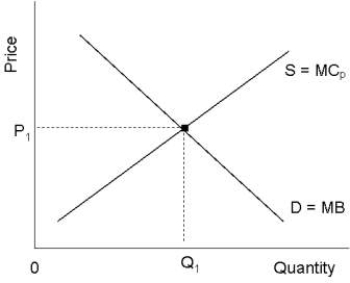 FIGURE 16- 2
Refer to Figure 16- 2. Suppose that the marginal benefit curve (MB) includes all social benefits and that there are no externalities in production. In this case, for allocative efficiency.
A) P1 and Q1 are appropriate
B) the price P1 is too low but the quantity Q1 is appropriate
C) the price P1 is appropriate but the quantity Q1 is too low
D) the price P1 is too high but the quantity Q1 is appropriate
E) the price P1 is appropriate but the quantity Q1 is too high
FIGURE 16- 2Refer to Figure 16- 2. Suppose that the marginal benefit curve (MB) includes all social benefits and that there are no externalities in production. In this case, for allocative efficiency.
A) P1 and Q1 are appropriate
B) the price P1 is too low but the quantity Q1 is appropriate
C) the price P1 is appropriate but the quantity Q1 is too low
D) the price P1 is too high but the quantity Q1 is appropriate
E) the price P1 is appropriate but the quantity Q1 is too high
Question
Question
The diagram below shows demand and supply curves for some perfectly competitive market. 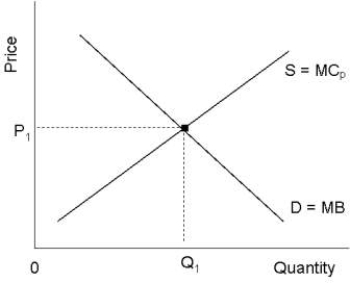 FIGURE 16- 2
Refer to Figure 16- 2. Suppose that the marginal benefit curve (MB) includes all social benefits and that there is a negative externality in production. In this case, for allocative efficiency.
A) the price P1 is appropriate but the quantity Q1 is too low
B) the price P1 is too high and the quantity Q1 is too low
C) the price P1 is too low and the quantity Q1 is too high
D) P1 and Q1 are appropriate
E) the price P1 is appropriate but the quantity Q1 is too high
FIGURE 16- 2Refer to Figure 16- 2. Suppose that the marginal benefit curve (MB) includes all social benefits and that there is a negative externality in production. In this case, for allocative efficiency.
A) the price P1 is appropriate but the quantity Q1 is too low
B) the price P1 is too high and the quantity Q1 is too low
C) the price P1 is too low and the quantity Q1 is too high
D) P1 and Q1 are appropriate
E) the price P1 is appropriate but the quantity Q1 is too high
Question
Question
Question
The diagram below shows the marginal benefit and marginal cost of a public good. This economy has 3 individuals, A, B and C. The diagram shows the MB for each individual and a summation of their marginal benefits.  FIGURE 16- 4
Refer to Figure 16- 4. Once some quantity of this public good is provided, the efficient price to charge for its use is
A) approximately zero.
B) P1.
C) P2.
D) P3.
E) P4.
FIGURE 16- 4Refer to Figure 16- 4. Once some quantity of this public good is provided, the efficient price to charge for its use is
A) approximately zero.
B) P1.
C) P2.
D) P3.
E) P4.
Question
The diagram below shows the marginal benefit and marginal cost of a public good. This economy has 3 individuals, A, B and C. The diagram shows the MB for each individual and a summation of their marginal benefits. 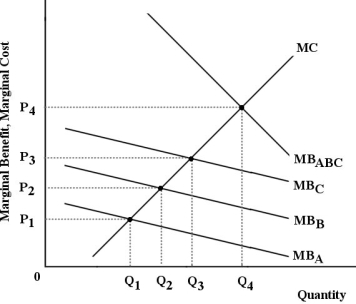 FIGURE 16- 4
Refer to Figure 16- 4. Suppose the optimal amount of this good is provided, but that Individual B was only consuming Q2 units of the good. What would be the marginal cost of Individual B consuming an extra unit of this good?
A) MB.
B) P2.
C) approximately zero.
D) P4- P2.
E) P4.
FIGURE 16- 4Refer to Figure 16- 4. Suppose the optimal amount of this good is provided, but that Individual B was only consuming Q2 units of the good. What would be the marginal cost of Individual B consuming an extra unit of this good?
A) MB.
B) P2.
C) approximately zero.
D) P4- P2.
E) P4.
Question
Question
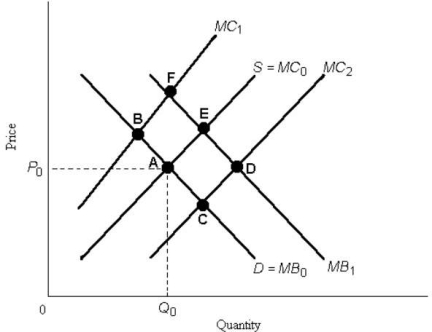 FIGURE 16- 1
Refer to Figure 16- 1. Suppose that the perfectly competitive market with no government intervention achieves equilibrium at point A. If the social marginal costs and social marginal benefits are represented by MC2 and MB0, respectively, then the competitive equilibrium quantity is
A) consistent with allocative efficiency.
B) not enough information to determine allocative efficiency.
C) too low for allocative efficiency.
D) too high for allocative efficiency.
Question
The diagram below shows the supply and demand diagrams for the competitive market for honey in one region. MC0 represents private marginal cost and MB0 represents private marginal benefit. 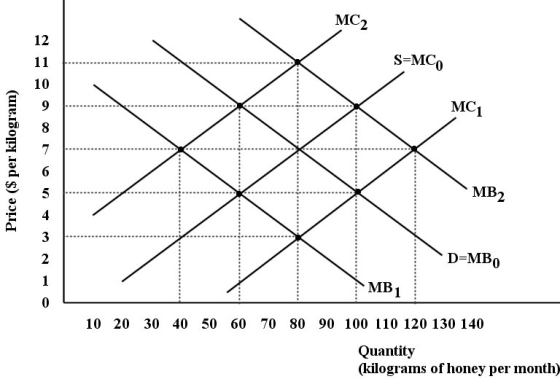 FIGURE 16- 3
Refer to Figure 16- 3. Assume there are two types of firms in this region - beekeepers that produce honey and orchard keepers that produce peaches . The bees provide a benefit to the orchard keepers by pollinating their peach trees. If the government subsidizes the beekeepers so as to fully internalize the externality, the equilibrium price of honey would be _ and the allocatively efficient output would be .
A) 3 ; 80
B) 5 ; 100
C) 11 ; 80
D) 9 ; 60
E) 7 ; 100
FIGURE 16- 3Refer to Figure 16- 3. Assume there are two types of firms in this region - beekeepers that produce honey and orchard keepers that produce peaches . The bees provide a benefit to the orchard keepers by pollinating their peach trees. If the government subsidizes the beekeepers so as to fully internalize the externality, the equilibrium price of honey would be _ and the allocatively efficient output would be .
A) 3 ; 80
B) 5 ; 100
C) 11 ; 80
D) 9 ; 60
E) 7 ; 100
Question
Question
The diagram below shows the marginal benefit and marginal cost of a public good. This economy has 3 individuals, A, B and C. The diagram shows the MB for each individual and a summation of their marginal benefits. 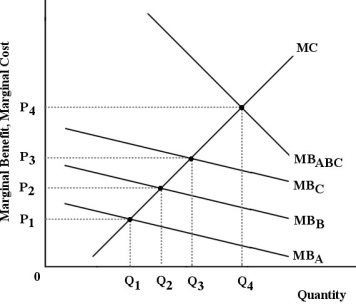 FIGURE 16- 4
Refer to Figure 16- 4. Suppose the government provides Q4 units of the public good. If consumers were then required to pay a price of zero for the good,
A) the inefficient quantity would be being produced.
B) consumers would use too little of the public good, and the outcome would be inefficient for society.
C) the appropriate price would be achieved, although not enough would be consumed.
D) the market would clear, although not enough would be produced.
E) consumers would use the public good until their marginal benefit was zero, and this would be socially optimal.
FIGURE 16- 4Refer to Figure 16- 4. Suppose the government provides Q4 units of the public good. If consumers were then required to pay a price of zero for the good,
A) the inefficient quantity would be being produced.
B) consumers would use too little of the public good, and the outcome would be inefficient for society.
C) the appropriate price would be achieved, although not enough would be consumed.
D) the market would clear, although not enough would be produced.
E) consumers would use the public good until their marginal benefit was zero, and this would be socially optimal.
Question
The diagram below shows the supply and demand diagrams for the competitive market for honey in one region. MC0 represents private marginal cost and MB0 represents private marginal benefit. 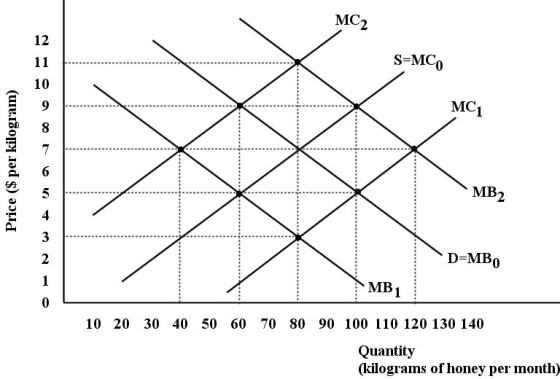 FIGURE 16- 3
Refer to Figure 16- 3. Assume there are two types of firms in this region - beekeepers that produce honey and orchard keepers that produce peaches . The bees provide a benefit to the orchard keepers by pollinating their peach trees. In the absence of any government intervention, the equilibrium price and quantity in the honey market are
A) $5 and 100 kg.
B) $5 and 60 kg.
C) $9 and 60 kg.
D) $11 and 80 kg.
E) $7 and 80 kg.
FIGURE 16- 3Refer to Figure 16- 3. Assume there are two types of firms in this region - beekeepers that produce honey and orchard keepers that produce peaches . The bees provide a benefit to the orchard keepers by pollinating their peach trees. In the absence of any government intervention, the equilibrium price and quantity in the honey market are
A) $5 and 100 kg.
B) $5 and 60 kg.
C) $9 and 60 kg.
D) $11 and 80 kg.
E) $7 and 80 kg.
Question
Question
The diagram below shows the marginal benefit and marginal cost of a public good. This economy has 3 individuals, A, B and C. The diagram shows the MB for each individual and a summation of their marginal benefits.  FIGURE 16- 4
Refer to Figure 16- 4. What is the optimal provision of this public good?
A) Q3
B) Q4
C) Q
D) Q1
E) Q2
FIGURE 16- 4Refer to Figure 16- 4. What is the optimal provision of this public good?
A) Q3
B) Q4
C) Q
D) Q1
E) Q2
Question
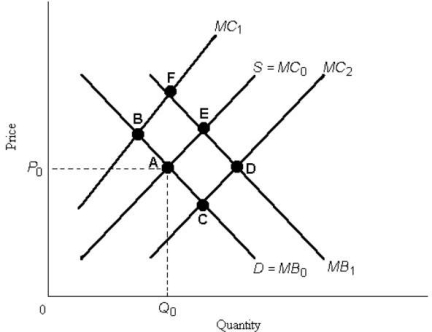 FIGURE 16- 1
Refer to Figure 16- 1. Suppose the perfectly competitive market with no government intervention achieves equilibrium at point A. If the social marginal costs and social marginal benefits are represented by MC0 and MB0, respectively, then there exists
A) a positive external benefit.
B) a negative external benefit.
C) a negative external cost.
D) a positive external cost.
E) no externality whatsoever.
Question
Question
Question
Question
Question
Question
Question
Question
Question
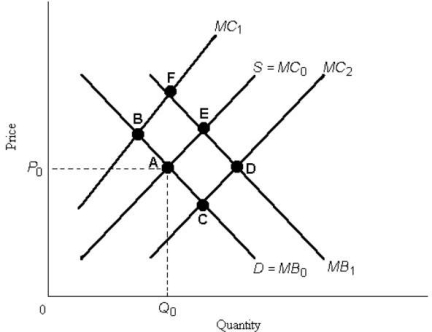 FIGURE 16- 1
Refer to Figure 16- 1. Suppose that the perfectly competitive market with no government intervention achieves equilibrium at point A. If the social marginal costs and social marginal benefits are represented by MC0 and MB1, respectively, then there exists
A) an external benefit.
B) an external cost.
C) a social cost that exceeds the private cost.
D) no external benefits or costs.
E) an external benefit and an external cost.
Question
Question
Question
Question
Question
Question
Question
The diagram below shows the supply and demand diagrams for the competitive market for honey in one region. MC0 represents private marginal cost and MB0 represents private marginal benefit. 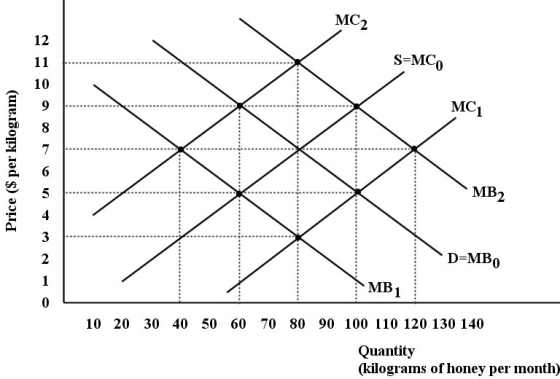 FIGURE 16- 3
Refer to Figure 16- 3. Assume there are two types of firms in this region-beekeepers that produce honey and orchard keepers that produce peaches . The bees provide a benefit to the orchard keepers by pollinating their peach trees. If the external marginal benefit is $4 per unit of honey, then what is the allocatively efficient output?
A) 120 kg
B) 40 kg
C) 100 kg
D) 80 kg
E) 60 kg
FIGURE 16- 3Refer to Figure 16- 3. Assume there are two types of firms in this region-beekeepers that produce honey and orchard keepers that produce peaches . The bees provide a benefit to the orchard keepers by pollinating their peach trees. If the external marginal benefit is $4 per unit of honey, then what is the allocatively efficient output?
A) 120 kg
B) 40 kg
C) 100 kg
D) 80 kg
E) 60 kg
Question
Question
Question
Question
Question
Question
Question
Question
Question
Question
Question
Question
Question
Question
The diagram below shows the marginal benefit and marginal cost of a public good. This economy has 3 individuals, A, B and C. The diagram shows the MB for each individual and a summation of their marginal benefits. 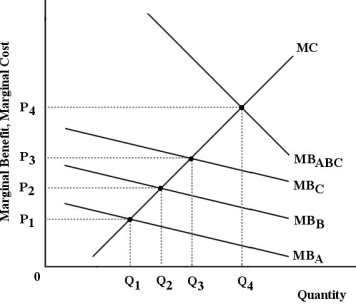 FIGURE 16- 4
Refer to Figure 16- 4. Suppose the government provides Q4 units of the public good. If consumers were then required to pay a price of P1 ,
A) the inefficient quantity would be being produced.
B) consumers would not use the public good at all, and this would be socially optimal.
C) the appropriate price would be achieved, although not enough would be consumed.
D) the market would clear, although not enough would be produced.
E) consumers would use too little of the public good, and the outcome would be inefficient for society.
FIGURE 16- 4Refer to Figure 16- 4. Suppose the government provides Q4 units of the public good. If consumers were then required to pay a price of P1 ,
A) the inefficient quantity would be being produced.
B) consumers would not use the public good at all, and this would be socially optimal.
C) the appropriate price would be achieved, although not enough would be consumed.
D) the market would clear, although not enough would be produced.
E) consumers would use too little of the public good, and the outcome would be inefficient for society.
Question
Question
Question
Question
Question
Question
Question
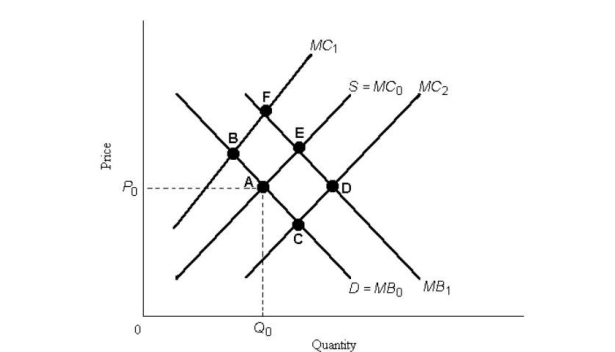 FIGURE 16- 1
Refer to Figure 16- 1. Suppose that the perfectly competitive market with no government intervention achieves equilibrium at point A. If the social marginal costs and social marginal benefits are represented by MC1 and MB0, respectively, then there exists
A) a positive external cost.
B) a negative external cost.
C) a positive external benefit.
D) a negative external benefit.
E) no externalities at all.
Question
Question
Question
Question
Question
Question
Question
Question
Question
Question
Question
Question
The diagram below shows the supply and demand diagrams for the competitive market for honey in one region. MC0 represents private marginal cost and MB0 represents private marginal benefit. 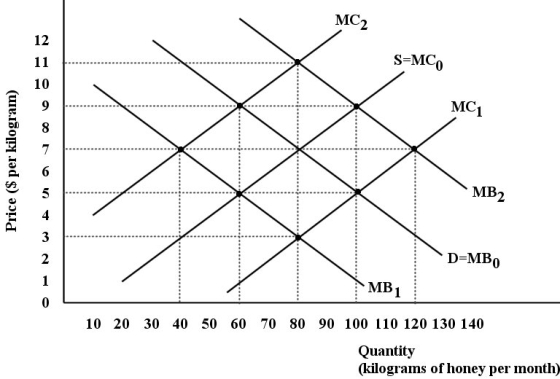 FIGURE 16- 3
Refer to Figure 16- 3. Assume there are two types of firms in this region - beekeepers that produce honey and orchard keepers that produce peaches . The bees provide a benefit to the orchard keepers by pollinating their peach trees. If MB2 represents the social marginal benefit of honey, the external benefit associated with producing one unit of honey is
A) $1.
B) $5.
C) $2.
D) $3.
E) $4.
FIGURE 16- 3Refer to Figure 16- 3. Assume there are two types of firms in this region - beekeepers that produce honey and orchard keepers that produce peaches . The bees provide a benefit to the orchard keepers by pollinating their peach trees. If MB2 represents the social marginal benefit of honey, the external benefit associated with producing one unit of honey is
A) $1.
B) $5.
C) $2.
D) $3.
E) $4.
Question
Question
The diagram below shows the marginal benefit and marginal cost of a public good. This economy has 3 individuals, A, B and C. The diagram shows the MB for each individual and a summation of their marginal benefits. 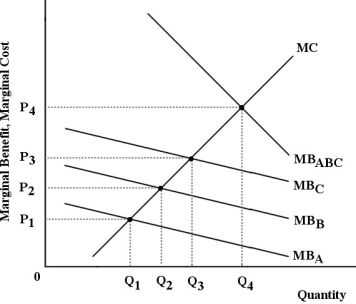 FIGURE 16- 4
Refer to Figure 16- 4. Suppose the government provides Q4 units of the public good. If consumers were then required to pay a price of P4 ,
A) the appropriate price would be achieved, although not enough would be consumed.
B) the market would clear, although not enough would be produced.
C) consumers would not use the public good at all, and this would not be an efficient outcome for society.
D) the inefficient quantity would be being produced.
E) consumers would not use the public good at all, and this would be socially optimal.
FIGURE 16- 4Refer to Figure 16- 4. Suppose the government provides Q4 units of the public good. If consumers were then required to pay a price of P4 ,
A) the appropriate price would be achieved, although not enough would be consumed.
B) the market would clear, although not enough would be produced.
C) consumers would not use the public good at all, and this would not be an efficient outcome for society.
D) the inefficient quantity would be being produced.
E) consumers would not use the public good at all, and this would be socially optimal.
Question
Question
Question
Question
Question
Question
Question
Question
Question
Question

Unlock Deck
Sign up to unlock the cards in this deck!
Unlock Deck
Unlock Deck
1/110

Play

Full screen (f)
Deck 16: Market Failures and Government Intervention
1
Which of the following statements about market economies is true?
A) Pure market economies provide the best social outcome.
B) An important characteristic of the market system is its ability to set in motion forces that tend to correct disequilibrium.
C) Market failure means that the market is incapable of satisfying human wants.
D) Most present- day economists advocate extensive government intervention in most parts of market economies.
E) Externalities make free- market outcomes socially efficient.
A) Pure market economies provide the best social outcome.
B) An important characteristic of the market system is its ability to set in motion forces that tend to correct disequilibrium.
C) Market failure means that the market is incapable of satisfying human wants.
D) Most present- day economists advocate extensive government intervention in most parts of market economies.
E) Externalities make free- market outcomes socially efficient.
B
2
The concept of moral hazard was publicly discussed in the context of the 2007- 2008 financial crisis because
A) it was feared that government bailouts of financial institutions would reduce competition in financial markets.
B) it was argued that the U.S. government should invoke moral hazard to sustain the financial sector.
C) it was feared that government bailouts of financial institutions would encourage the institutions to continue their risky behaviour.
D) it was claimed that moral hazard was necessary to prevent large U.S. financial institutions from going bankrupt.
E) it was feared that the U.S. government was taking advantage of its special knowledge in the financial markets.
A) it was feared that government bailouts of financial institutions would reduce competition in financial markets.
B) it was argued that the U.S. government should invoke moral hazard to sustain the financial sector.
C) it was feared that government bailouts of financial institutions would encourage the institutions to continue their risky behaviour.
D) it was claimed that moral hazard was necessary to prevent large U.S. financial institutions from going bankrupt.
E) it was feared that the U.S. government was taking advantage of its special knowledge in the financial markets.
C
3
Economic losses in an industry are a signal that
A) too few resources are allocated to the industry.
B) will lead resources to leave the industry (until the losses disappear).
C) the economy is in a recession.
D) a government subsidy is necessary.
E) all of the firms should leave the industry.
A) too few resources are allocated to the industry.
B) will lead resources to leave the industry (until the losses disappear).
C) the economy is in a recession.
D) a government subsidy is necessary.
E) all of the firms should leave the industry.
B
4
The diagram below shows demand and supply curves for some perfectly competitive market. FIGURE 16- 2
Refer to Figure 16- 2. Suppose that the marginal benefit curve (MB) includes all social benefits and that there are no externalities in production. In this case, for allocative efficiency.
A) P1 and Q1 are appropriate
B) the price P1 is too low but the quantity Q1 is appropriate
C) the price P1 is appropriate but the quantity Q1 is too low
D) the price P1 is too high but the quantity Q1 is appropriate
E) the price P1 is appropriate but the quantity Q1 is too high
FIGURE 16- 2Refer to Figure 16- 2. Suppose that the marginal benefit curve (MB) includes all social benefits and that there are no externalities in production. In this case, for allocative efficiency.
A) P1 and Q1 are appropriate
B) the price P1 is too low but the quantity Q1 is appropriate
C) the price P1 is appropriate but the quantity Q1 is too low
D) the price P1 is too high but the quantity Q1 is appropriate
E) the price P1 is appropriate but the quantity Q1 is too high
Unlock Deck
Unlock for access to all 110 flashcards in this deck.
Unlock Deck
k this deck
5
Moral hazard is said to exist when one party to a transaction
A) is subject to a hostile corporate takeover.
B) is not able to take advantage of the other party.
C) purchases insurance because they know they are involved in risky activities.
D) has no morals.
E) has the incentive to, and is able to, shift costs to another party in the transaction.
A) is subject to a hostile corporate takeover.
B) is not able to take advantage of the other party.
C) purchases insurance because they know they are involved in risky activities.
D) has no morals.
E) has the incentive to, and is able to, shift costs to another party in the transaction.
Unlock Deck
Unlock for access to all 110 flashcards in this deck.
Unlock Deck
k this deck
6
The diagram below shows demand and supply curves for some perfectly competitive market. FIGURE 16- 2
Refer to Figure 16- 2. Suppose that the marginal benefit curve (MB) includes all social benefits and that there is a negative externality in production. In this case, for allocative efficiency.
A) the price P1 is appropriate but the quantity Q1 is too low
B) the price P1 is too high and the quantity Q1 is too low
C) the price P1 is too low and the quantity Q1 is too high
D) P1 and Q1 are appropriate
E) the price P1 is appropriate but the quantity Q1 is too high
FIGURE 16- 2Refer to Figure 16- 2. Suppose that the marginal benefit curve (MB) includes all social benefits and that there is a negative externality in production. In this case, for allocative efficiency.
A) the price P1 is appropriate but the quantity Q1 is too low
B) the price P1 is too high and the quantity Q1 is too low
C) the price P1 is too low and the quantity Q1 is too high
D) P1 and Q1 are appropriate
E) the price P1 is appropriate but the quantity Q1 is too high
Unlock Deck
Unlock for access to all 110 flashcards in this deck.
Unlock Deck
k this deck
7
An efficient amount of a public good is unlikely to be produced in a free market because
A) of the high cost of producing the public good.
B) of the existence of adverse selection.
C) there is no way to prevent a person who is not willing to pay for the good from receiving benefits from the good.
D) of the existence of moral hazard.
E) social benefits exceed social costs.
A) of the high cost of producing the public good.
B) of the existence of adverse selection.
C) there is no way to prevent a person who is not willing to pay for the good from receiving benefits from the good.
D) of the existence of moral hazard.
E) social benefits exceed social costs.
Unlock Deck
Unlock for access to all 110 flashcards in this deck.
Unlock Deck
k this deck
8
When prices are determined in a free- market system
A) firms respond to changes in the economy mainly by altering the wage rate.
B) changes in the economy can be foreseen by officials.
C) supply shifts, caused by price changes, coordinate all necessary changes in the economy.
D) resources are allocated without conscious central coordination.
E) demand shifts, caused by price changes, coordinate all necessary changes in the economy.
A) firms respond to changes in the economy mainly by altering the wage rate.
B) changes in the economy can be foreseen by officials.
C) supply shifts, caused by price changes, coordinate all necessary changes in the economy.
D) resources are allocated without conscious central coordination.
E) demand shifts, caused by price changes, coordinate all necessary changes in the economy.
Unlock Deck
Unlock for access to all 110 flashcards in this deck.
Unlock Deck
k this deck
9
The diagram below shows the marginal benefit and marginal cost of a public good. This economy has 3 individuals, A, B and C. The diagram shows the MB for each individual and a summation of their marginal benefits. FIGURE 16- 4
Refer to Figure 16- 4. Once some quantity of this public good is provided, the efficient price to charge for its use is
A) approximately zero.
B) P1.
C) P2.
D) P3.
E) P4.
FIGURE 16- 4Refer to Figure 16- 4. Once some quantity of this public good is provided, the efficient price to charge for its use is
A) approximately zero.
B) P1.
C) P2.
D) P3.
E) P4.
Unlock Deck
Unlock for access to all 110 flashcards in this deck.
Unlock Deck
k this deck
10
The diagram below shows the marginal benefit and marginal cost of a public good. This economy has 3 individuals, A, B and C. The diagram shows the MB for each individual and a summation of their marginal benefits. FIGURE 16- 4
Refer to Figure 16- 4. Suppose the optimal amount of this good is provided, but that Individual B was only consuming Q2 units of the good. What would be the marginal cost of Individual B consuming an extra unit of this good?
A) MB.
B) P2.
C) approximately zero.
D) P4- P2.
E) P4.
FIGURE 16- 4Refer to Figure 16- 4. Suppose the optimal amount of this good is provided, but that Individual B was only consuming Q2 units of the good. What would be the marginal cost of Individual B consuming an extra unit of this good?
A) MB.
B) P2.
C) approximately zero.
D) P4- P2.
E) P4.
Unlock Deck
Unlock for access to all 110 flashcards in this deck.
Unlock Deck
k this deck
11
The government has seatbelt and airbag requirements in cars, and laws requiring individual drivers to use them. What broader social goal is being met in this case?
A) social responsibility
B) income distribution
C) protecting individuals from others or themselves
D) policies for economic growth
E) preference for public provision
A) social responsibility
B) income distribution
C) protecting individuals from others or themselves
D) policies for economic growth
E) preference for public provision
Unlock Deck
Unlock for access to all 110 flashcards in this deck.
Unlock Deck
k this deck
12
FIGURE 16- 1Refer to Figure 16- 1. Suppose that the perfectly competitive market with no government intervention achieves equilibrium at point A. If the social marginal costs and social marginal benefits are represented by MC2 and MB0, respectively, then the competitive equilibrium quantity is
A) consistent with allocative efficiency.
B) not enough information to determine allocative efficiency.
C) too low for allocative efficiency.
D) too high for allocative efficiency.
Unlock Deck
Unlock for access to all 110 flashcards in this deck.
Unlock Deck
k this deck
13
The diagram below shows the supply and demand diagrams for the competitive market for honey in one region. MC0 represents private marginal cost and MB0 represents private marginal benefit. FIGURE 16- 3
Refer to Figure 16- 3. Assume there are two types of firms in this region - beekeepers that produce honey and orchard keepers that produce peaches . The bees provide a benefit to the orchard keepers by pollinating their peach trees. If the government subsidizes the beekeepers so as to fully internalize the externality, the equilibrium price of honey would be _ and the allocatively efficient output would be .
A) 3 ; 80
B) 5 ; 100
C) 11 ; 80
D) 9 ; 60
E) 7 ; 100
FIGURE 16- 3Refer to Figure 16- 3. Assume there are two types of firms in this region - beekeepers that produce honey and orchard keepers that produce peaches . The bees provide a benefit to the orchard keepers by pollinating their peach trees. If the government subsidizes the beekeepers so as to fully internalize the externality, the equilibrium price of honey would be _ and the allocatively efficient output would be .
A) 3 ; 80
B) 5 ; 100
C) 11 ; 80
D) 9 ; 60
E) 7 ; 100
Unlock Deck
Unlock for access to all 110 flashcards in this deck.
Unlock Deck
k this deck
14
A flu vaccine has an associated externality. In the absence of government intervention, the quantity of flu vaccines purchased will be the socially optimal quantity.
A) negative; the same as
B) positive; more than
C) positive; the same as
D) positive; less than
E) negative; less than
A) negative; the same as
B) positive; more than
C) positive; the same as
D) positive; less than
E) negative; less than
Unlock Deck
Unlock for access to all 110 flashcards in this deck.
Unlock Deck
k this deck
15
The diagram below shows the marginal benefit and marginal cost of a public good. This economy has 3 individuals, A, B and C. The diagram shows the MB for each individual and a summation of their marginal benefits. FIGURE 16- 4
Refer to Figure 16- 4. Suppose the government provides Q4 units of the public good. If consumers were then required to pay a price of zero for the good,
A) the inefficient quantity would be being produced.
B) consumers would use too little of the public good, and the outcome would be inefficient for society.
C) the appropriate price would be achieved, although not enough would be consumed.
D) the market would clear, although not enough would be produced.
E) consumers would use the public good until their marginal benefit was zero, and this would be socially optimal.
FIGURE 16- 4Refer to Figure 16- 4. Suppose the government provides Q4 units of the public good. If consumers were then required to pay a price of zero for the good,
A) the inefficient quantity would be being produced.
B) consumers would use too little of the public good, and the outcome would be inefficient for society.
C) the appropriate price would be achieved, although not enough would be consumed.
D) the market would clear, although not enough would be produced.
E) consumers would use the public good until their marginal benefit was zero, and this would be socially optimal.
Unlock Deck
Unlock for access to all 110 flashcards in this deck.
Unlock Deck
k this deck
16
The diagram below shows the supply and demand diagrams for the competitive market for honey in one region. MC0 represents private marginal cost and MB0 represents private marginal benefit. FIGURE 16- 3
Refer to Figure 16- 3. Assume there are two types of firms in this region - beekeepers that produce honey and orchard keepers that produce peaches . The bees provide a benefit to the orchard keepers by pollinating their peach trees. In the absence of any government intervention, the equilibrium price and quantity in the honey market are
A) $5 and 100 kg.
B) $5 and 60 kg.
C) $9 and 60 kg.
D) $11 and 80 kg.
E) $7 and 80 kg.
FIGURE 16- 3Refer to Figure 16- 3. Assume there are two types of firms in this region - beekeepers that produce honey and orchard keepers that produce peaches . The bees provide a benefit to the orchard keepers by pollinating their peach trees. In the absence of any government intervention, the equilibrium price and quantity in the honey market are
A) $5 and 100 kg.
B) $5 and 60 kg.
C) $9 and 60 kg.
D) $11 and 80 kg.
E) $7 and 80 kg.
Unlock Deck
Unlock for access to all 110 flashcards in this deck.
Unlock Deck
k this deck
17
One part of the "informal defence" of the market system is the argument, made forcefully by the late Milton Friedman, that free markets provide for the
A) greatest equality in income distribution.
B) greatest scope for international trade.
C) decentralization of economic power.
D) government with the highest tax revenues.
E) greatest security for members of society.
A) greatest equality in income distribution.
B) greatest scope for international trade.
C) decentralization of economic power.
D) government with the highest tax revenues.
E) greatest security for members of society.
Unlock Deck
Unlock for access to all 110 flashcards in this deck.
Unlock Deck
k this deck
18
The diagram below shows the marginal benefit and marginal cost of a public good. This economy has 3 individuals, A, B and C. The diagram shows the MB for each individual and a summation of their marginal benefits. FIGURE 16- 4
Refer to Figure 16- 4. What is the optimal provision of this public good?
A) Q3
B) Q4
C) Q
D) Q1
E) Q2
FIGURE 16- 4Refer to Figure 16- 4. What is the optimal provision of this public good?
A) Q3
B) Q4
C) Q
D) Q1
E) Q2
Unlock Deck
Unlock for access to all 110 flashcards in this deck.
Unlock Deck
k this deck
19
FIGURE 16- 1Refer to Figure 16- 1. Suppose the perfectly competitive market with no government intervention achieves equilibrium at point A. If the social marginal costs and social marginal benefits are represented by MC0 and MB0, respectively, then there exists
A) a positive external benefit.
B) a negative external benefit.
C) a negative external cost.
D) a positive external cost.
E) no externality whatsoever.
Unlock Deck
Unlock for access to all 110 flashcards in this deck.
Unlock Deck
k this deck
20
If typical firms in a competitive industry are earning profits, the industry
A) can be expected to experience the entry of new firms.
B) is allocatively efficient.
C) is in a long- run equilibrium.
D) must have experienced a decrease in demand or an increase in the costs.
E) has too many resources allocated to it.
A) can be expected to experience the entry of new firms.
B) is allocatively efficient.
C) is in a long- run equilibrium.
D) must have experienced a decrease in demand or an increase in the costs.
E) has too many resources allocated to it.
Unlock Deck
Unlock for access to all 110 flashcards in this deck.
Unlock Deck
k this deck
21
The efficient price to charge consumers for their use of a public good is
A) equal to the highest individual marginal benefit from consuming a unit of the good.
B) equal to the price that the free market would achieve.
C) equal to the cost of providing the good to one additional consumer.
D) that price that prevents free riding by some consumers.
E) equal to the average per- person cost of providing this good.
A) equal to the highest individual marginal benefit from consuming a unit of the good.
B) equal to the price that the free market would achieve.
C) equal to the cost of providing the good to one additional consumer.
D) that price that prevents free riding by some consumers.
E) equal to the average per- person cost of providing this good.
Unlock Deck
Unlock for access to all 110 flashcards in this deck.
Unlock Deck
k this deck
22
A plausible example of market failure due to an externality is
A) the line- ups at the theatre when a good movie is playing.
B) a farmer with an apple orchard who also keeps bees.
C) the cost of building new highways outside of major cities.
D) the high salaries enjoyed by professional athletes.
E) the despoiling of rivers and lakes by nitrogen run- off from agricultural fertilizers.
A) the line- ups at the theatre when a good movie is playing.
B) a farmer with an apple orchard who also keeps bees.
C) the cost of building new highways outside of major cities.
D) the high salaries enjoyed by professional athletes.
E) the despoiling of rivers and lakes by nitrogen run- off from agricultural fertilizers.
Unlock Deck
Unlock for access to all 110 flashcards in this deck.
Unlock Deck
k this deck
23
Governments usually provide a system of unemployment insurance. What broader social goal is being met in this case?
A) social responsibility
B) protecting individuals from others or themselves
C) policies for economic growth
D) income distribution
E) preference for public provision
A) social responsibility
B) protecting individuals from others or themselves
C) policies for economic growth
D) income distribution
E) preference for public provision
Unlock Deck
Unlock for access to all 110 flashcards in this deck.
Unlock Deck
k this deck
24
Which of the following best describes the reason for over fishing in Canadian offshore fisheries?
A) The private marginal cost incurred by current fishermen is less than the social marginal cost.
B) Fishing has depleted fish stocks leading to smaller catches.
C) The Canadian government encourages foreign fishing within the Canadian offshore boundary.
D) The private marginal cost incurred by future generations of fishermen is greater than the private marginal cost incurred by current fishermen.
E) None of the above can explain overfishing.
A) The private marginal cost incurred by current fishermen is less than the social marginal cost.
B) Fishing has depleted fish stocks leading to smaller catches.
C) The Canadian government encourages foreign fishing within the Canadian offshore boundary.
D) The private marginal cost incurred by future generations of fishermen is greater than the private marginal cost incurred by current fishermen.
E) None of the above can explain overfishing.
Unlock Deck
Unlock for access to all 110 flashcards in this deck.
Unlock Deck
k this deck
25
Why would it be inefficient for the government to charge a price for consuming a public good such as national defence?
A) No one will be willing to pay to consume any national defence.
B) Too little national defence will be provided.
C) The price cannot be set to cover all defence costs.
D) Too much defence will be provided.
E) The marginal cost of providing national defence is zero.
A) No one will be willing to pay to consume any national defence.
B) Too little national defence will be provided.
C) The price cannot be set to cover all defence costs.
D) Too much defence will be provided.
E) The marginal cost of providing national defence is zero.
Unlock Deck
Unlock for access to all 110 flashcards in this deck.
Unlock Deck
k this deck
26
All Canadian provincial governments have legislated minimum wages. What broader social goal is being met in this case?
A) income distribution
B) policies for economic growth
C) social responsibility
D) protecting individuals from others or themselves
E) preference for public provision
A) income distribution
B) policies for economic growth
C) social responsibility
D) protecting individuals from others or themselves
E) preference for public provision
Unlock Deck
Unlock for access to all 110 flashcards in this deck.
Unlock Deck
k this deck
27
A public good is a product that is
A) produced by the government.
B) excludable but non- rivalrous
C) excludable and rivalrous.
D) non- excludable and non- rivalrous.
E) rivalrous but non- excludable.
A) produced by the government.
B) excludable but non- rivalrous
C) excludable and rivalrous.
D) non- excludable and non- rivalrous.
E) rivalrous but non- excludable.
Unlock Deck
Unlock for access to all 110 flashcards in this deck.
Unlock Deck
k this deck
28
FIGURE 16- 1Refer to Figure 16- 1. Suppose that the perfectly competitive market with no government intervention achieves equilibrium at point A. If the social marginal costs and social marginal benefits are represented by MC0 and MB1, respectively, then there exists
A) an external benefit.
B) an external cost.
C) a social cost that exceeds the private cost.
D) no external benefits or costs.
E) an external benefit and an external cost.
Unlock Deck
Unlock for access to all 110 flashcards in this deck.
Unlock Deck
k this deck
29
Which of the following statements concerning benefit- cost analysis is true?
A) Though benefits from a government policy can be accurately measured, costs are usually impossible to quantify.
B) Large potential benefits, regardless of their time horizon, always justify government intervention.
C) Benefit- cost analysis can be used effectively by private firms but should not be used in the public sector.
D) Though it is often difficult to estimate costs and benefits with precision, benefit- cost analysis can be useful in determining whether to implement a given government policy.
E) Large potential costs, regardless of their time horizon, always preclude government intervention.
A) Though benefits from a government policy can be accurately measured, costs are usually impossible to quantify.
B) Large potential benefits, regardless of their time horizon, always justify government intervention.
C) Benefit- cost analysis can be used effectively by private firms but should not be used in the public sector.
D) Though it is often difficult to estimate costs and benefits with precision, benefit- cost analysis can be useful in determining whether to implement a given government policy.
E) Large potential costs, regardless of their time horizon, always preclude government intervention.
Unlock Deck
Unlock for access to all 110 flashcards in this deck.
Unlock Deck
k this deck
30
An example of a rivalrous good is
A) the weather forecast.
B) toxic emissions from a factory smokestack.
C) an empty toll highway.
D) a visit to the dentist.
E) an uncrowded beach.
A) the weather forecast.
B) toxic emissions from a factory smokestack.
C) an empty toll highway.
D) a visit to the dentist.
E) an uncrowded beach.
Unlock Deck
Unlock for access to all 110 flashcards in this deck.
Unlock Deck
k this deck
31
The Canadian government operates a progressive personal income- tax system. What broader social goal is being met in this case?
A) social responsibility
B) policies for economic growth
C) preference for public provision
D) income distribution
E) protecting individuals from others or themselves
A) social responsibility
B) policies for economic growth
C) preference for public provision
D) income distribution
E) protecting individuals from others or themselves
Unlock Deck
Unlock for access to all 110 flashcards in this deck.
Unlock Deck
k this deck
32
Attempts by professional lobbyists in Ottawa to influence the government's subsidy to the shipbuilding industry, even when such a subsidy is not in the national interest, represents
A) the government acting like a monopolist.
B) an inefficient public choice.
C) asymmetric information.
D) an externality.
E) rent seeking.
A) the government acting like a monopolist.
B) an inefficient public choice.
C) asymmetric information.
D) an externality.
E) rent seeking.
Unlock Deck
Unlock for access to all 110 flashcards in this deck.
Unlock Deck
k this deck
33
If a homeowner uses wood to heat his house,
A) he may generate an external benefit if the price of heating oil goes down in his region.
B) the price of the wood represents an external cost to the homeowner, unless he harvests the wood himself.
C) he may generate an external cost if the smoke bothers his neighbours.
D) he may generate an external benefit if the smoke bothers his neighbours.
E) the price of the wood represents an external cost to the homeowner.
A) he may generate an external benefit if the price of heating oil goes down in his region.
B) the price of the wood represents an external cost to the homeowner, unless he harvests the wood himself.
C) he may generate an external cost if the smoke bothers his neighbours.
D) he may generate an external benefit if the smoke bothers his neighbours.
E) the price of the wood represents an external cost to the homeowner.
Unlock Deck
Unlock for access to all 110 flashcards in this deck.
Unlock Deck
k this deck
34
All of the following are examples of public goods EXCEPT
A) a flood- control system.
B) national defence.
C) post- secondary education.
D) a lighthouse.
E) public- health information.
A) a flood- control system.
B) national defence.
C) post- secondary education.
D) a lighthouse.
E) public- health information.
Unlock Deck
Unlock for access to all 110 flashcards in this deck.
Unlock Deck
k this deck
35
The diagram below shows the supply and demand diagrams for the competitive market for honey in one region. MC0 represents private marginal cost and MB0 represents private marginal benefit. FIGURE 16- 3
Refer to Figure 16- 3. Assume there are two types of firms in this region-beekeepers that produce honey and orchard keepers that produce peaches . The bees provide a benefit to the orchard keepers by pollinating their peach trees. If the external marginal benefit is $4 per unit of honey, then what is the allocatively efficient output?
A) 120 kg
B) 40 kg
C) 100 kg
D) 80 kg
E) 60 kg
FIGURE 16- 3Refer to Figure 16- 3. Assume there are two types of firms in this region-beekeepers that produce honey and orchard keepers that produce peaches . The bees provide a benefit to the orchard keepers by pollinating their peach trees. If the external marginal benefit is $4 per unit of honey, then what is the allocatively efficient output?
A) 120 kg
B) 40 kg
C) 100 kg
D) 80 kg
E) 60 kg
Unlock Deck
Unlock for access to all 110 flashcards in this deck.
Unlock Deck
k this deck
36
The construction of the TransCanada highway is an example of government intervention through
A) subsidization.
B) public provision.
C) redistribution.
D) regulation.
E) restructuring of economic incentives.
A) subsidization.
B) public provision.
C) redistribution.
D) regulation.
E) restructuring of economic incentives.
Unlock Deck
Unlock for access to all 110 flashcards in this deck.
Unlock Deck
k this deck
37
Resource allocation on the principle of one- person/one- vote will often be because the intensity of preferences is _ .
A) efficient; not accounted for
B) inefficient; not accounted for
C) efficient; accounted for
D) inefficient; accounted for
E) fair; irrelevant
A) efficient; not accounted for
B) inefficient; not accounted for
C) efficient; accounted for
D) inefficient; accounted for
E) fair; irrelevant
Unlock Deck
Unlock for access to all 110 flashcards in this deck.
Unlock Deck
k this deck
38
Moral hazard often arises in the case of insurance because
A) people generally underestimate the amount of insurance coverage needed.
B) insured people will not take sufficient care to reduce risks because the private benefit of reducing risks exceeds the private cost of reducing risks.
C) insurance companies have no incentive to investigate fraudulent claims.
D) people who are in the most need of insurance have the most trouble obtaining insurance coverage.
E) insured people will not take sufficient care to reduce risks because the private cost of reducing risks exceeds the private benefit of reducing risks.
A) people generally underestimate the amount of insurance coverage needed.
B) insured people will not take sufficient care to reduce risks because the private benefit of reducing risks exceeds the private cost of reducing risks.
C) insurance companies have no incentive to investigate fraudulent claims.
D) people who are in the most need of insurance have the most trouble obtaining insurance coverage.
E) insured people will not take sufficient care to reduce risks because the private cost of reducing risks exceeds the private benefit of reducing risks.
Unlock Deck
Unlock for access to all 110 flashcards in this deck.
Unlock Deck
k this deck
39
Which of the following statements about public goods is true?
A) They respond to market signals.
B) The firms producing them must be listed on a public stock exchange.
C) They are unlikely to be provided by private, profit- seeking firms.
D) They are essentially negative externalities.
E) They cannot be publicly provided.
A) They respond to market signals.
B) The firms producing them must be listed on a public stock exchange.
C) They are unlikely to be provided by private, profit- seeking firms.
D) They are essentially negative externalities.
E) They cannot be publicly provided.
Unlock Deck
Unlock for access to all 110 flashcards in this deck.
Unlock Deck
k this deck
40
Provincial laws that mandate a minimum drinking age (for alcohol) are an example of government intervention through
A) regulation.
B) redistribution and reorganization.
C) merit- goods control.
D) public provision and price control.
E) communism.
A) regulation.
B) redistribution and reorganization.
C) merit- goods control.
D) public provision and price control.
E) communism.
Unlock Deck
Unlock for access to all 110 flashcards in this deck.
Unlock Deck
k this deck
41
The government prohibits individuals from paying someone else to replace them when they are selected to perform jury duty. What broader social goal is being met in this case?
A) policies for economic growth
B) protecting individuals from others or themselves
C) social responsibility
D) income distribution
E) preference for public provision
A) policies for economic growth
B) protecting individuals from others or themselves
C) social responsibility
D) income distribution
E) preference for public provision
Unlock Deck
Unlock for access to all 110 flashcards in this deck.
Unlock Deck
k this deck
42
"Rent- seeking" is a problem of
A) landlords and tenants.
B) pure free- market economies.
C) private organizations in which ownership is not identical to management.
D) centrally planned economies.
E) all economies, given the existence of government.
A) landlords and tenants.
B) pure free- market economies.
C) private organizations in which ownership is not identical to management.
D) centrally planned economies.
E) all economies, given the existence of government.
Unlock Deck
Unlock for access to all 110 flashcards in this deck.
Unlock Deck
k this deck
43
If a firm produces a good and its consumption generates external benefits, then at the market equilibrium
A) the marginal private benefit is greater than the marginal cost of producing the last unit.
B) the government could subsidize the production of this good to improve efficiency.
C) the marginal social benefit is less than the marginal cost of producing the last unit.
D) the output would be more than the socially optimal amount.
E) the firm will not produce an additional amount if it can internalize the external benefits.
A) the marginal private benefit is greater than the marginal cost of producing the last unit.
B) the government could subsidize the production of this good to improve efficiency.
C) the marginal social benefit is less than the marginal cost of producing the last unit.
D) the output would be more than the socially optimal amount.
E) the firm will not produce an additional amount if it can internalize the external benefits.
Unlock Deck
Unlock for access to all 110 flashcards in this deck.
Unlock Deck
k this deck
44
Adverse selection is said to exist when an individual
A) selects a product which has adverse externalities.
B) has the incentive to, and is able to, shift costs to another individual.
C) is averse to certain products.
D) is not able to take advantage of another individual.
E) purchases a lot of insurance because he/she knows that he/she is at high risk.
A) selects a product which has adverse externalities.
B) has the incentive to, and is able to, shift costs to another individual.
C) is averse to certain products.
D) is not able to take advantage of another individual.
E) purchases a lot of insurance because he/she knows that he/she is at high risk.
Unlock Deck
Unlock for access to all 110 flashcards in this deck.
Unlock Deck
k this deck
45
Government intervention in an effort to promote allocative efficiency in all industries would likely impose a cost in terms of economic growth. One explanation for this is that
A) some policies to promote allocative efficiency will lead to increased income inequality.
B) firms in perfectly competitive industries that are already allocatively efficient would also be affected by the intervention and become inefficient.
C) correcting externalities inevitably reduces the economy's growth rate.
D) some policies to promote allocative efficiency will lead to decreased income inequality.
E) much of the innovation and productivity growth that leads to economic growth comes from oligopolistic firms.
A) some policies to promote allocative efficiency will lead to increased income inequality.
B) firms in perfectly competitive industries that are already allocatively efficient would also be affected by the intervention and become inefficient.
C) correcting externalities inevitably reduces the economy's growth rate.
D) some policies to promote allocative efficiency will lead to decreased income inequality.
E) much of the innovation and productivity growth that leads to economic growth comes from oligopolistic firms.
Unlock Deck
Unlock for access to all 110 flashcards in this deck.
Unlock Deck
k this deck
46
In a free- market economy that is continually adjusting toward equilibrium, a primary force driving this adjustment is
A) opportunity costs.
B) diminishing returns.
C) the scarcity of resources.
D) the pursuit of allocative efficiency.
E) the pursuit of profits.
A) opportunity costs.
B) diminishing returns.
C) the scarcity of resources.
D) the pursuit of allocative efficiency.
E) the pursuit of profits.
Unlock Deck
Unlock for access to all 110 flashcards in this deck.
Unlock Deck
k this deck
47
A good example of a product that is both non-excludable and non-rivalrous is
A) public information.
B) grazing land.
C) electricity.
D) food.
E) natural gas.
A) public information.
B) grazing land.
C) electricity.
D) food.
E) natural gas.
Unlock Deck
Unlock for access to all 110 flashcards in this deck.
Unlock Deck
k this deck
48
Economists use the term "market failure" to refer to those free- market situations where
A) externalities are present in the economy.
B) government has intervened in the economy.
C) allocatively efficient outcomes are not achieved.
D) income is not distributed equitably.
E) the economy is not in equilibrium.
A) externalities are present in the economy.
B) government has intervened in the economy.
C) allocatively efficient outcomes are not achieved.
D) income is not distributed equitably.
E) the economy is not in equilibrium.
Unlock Deck
Unlock for access to all 110 flashcards in this deck.
Unlock Deck
k this deck
49
The diagram below shows the marginal benefit and marginal cost of a public good. This economy has 3 individuals, A, B and C. The diagram shows the MB for each individual and a summation of their marginal benefits. FIGURE 16- 4
Refer to Figure 16- 4. Suppose the government provides Q4 units of the public good. If consumers were then required to pay a price of P1 ,
A) the inefficient quantity would be being produced.
B) consumers would not use the public good at all, and this would be socially optimal.
C) the appropriate price would be achieved, although not enough would be consumed.
D) the market would clear, although not enough would be produced.
E) consumers would use too little of the public good, and the outcome would be inefficient for society.
FIGURE 16- 4Refer to Figure 16- 4. Suppose the government provides Q4 units of the public good. If consumers were then required to pay a price of P1 ,
A) the inefficient quantity would be being produced.
B) consumers would not use the public good at all, and this would be socially optimal.
C) the appropriate price would be achieved, although not enough would be consumed.
D) the market would clear, although not enough would be produced.
E) consumers would use too little of the public good, and the outcome would be inefficient for society.
Unlock Deck
Unlock for access to all 110 flashcards in this deck.
Unlock Deck
k this deck
50
Most economists who study "public choice theory" now agree that an important possible source of "government failure" is
A) politicians are incompetent or corrupt.
B) that politicians and civil servants have their own objectives that may conflict with the national interest.
C) governments govern undemocratically.
D) that most civil servants are corrupt.
E) that most public servants are incompetent.
A) politicians are incompetent or corrupt.
B) that politicians and civil servants have their own objectives that may conflict with the national interest.
C) governments govern undemocratically.
D) that most civil servants are corrupt.
E) that most public servants are incompetent.
Unlock Deck
Unlock for access to all 110 flashcards in this deck.
Unlock Deck
k this deck
51
Market failure means that
A) one or more markets are not in equilibrium.
B) allocative efficiency has not been achieved.
C) the free market has failed to achieve desirable social goals.
D) the market economy is a failure.
E) a small group in society is affected.
A) one or more markets are not in equilibrium.
B) allocative efficiency has not been achieved.
C) the free market has failed to achieve desirable social goals.
D) the market economy is a failure.
E) a small group in society is affected.
Unlock Deck
Unlock for access to all 110 flashcards in this deck.
Unlock Deck
k this deck
52
Consider a non- rivalrous good, like national defence, provided by the government. At the socially optimal level of provision of this good, the marginal
A) cost of provision of the last unit of the good is more than all consumers' combined marginal willingness to pay.
B) sacrifice society needs to make to supply the last unit of the good is more than each consumer's marginal willingness to pay.
C) cost of provision of this good is zero.
D) cost of provision of the last unit of the good is equal to all consumers' combined marginal willingness to pay.
E) cost of provision of the last unit of the good is equal to the consumers' marginal willingness to pay.
A) cost of provision of the last unit of the good is more than all consumers' combined marginal willingness to pay.
B) sacrifice society needs to make to supply the last unit of the good is more than each consumer's marginal willingness to pay.
C) cost of provision of this good is zero.
D) cost of provision of the last unit of the good is equal to all consumers' combined marginal willingness to pay.
E) cost of provision of the last unit of the good is equal to the consumers' marginal willingness to pay.
Unlock Deck
Unlock for access to all 110 flashcards in this deck.
Unlock Deck
k this deck
53
An example of a public good is
A) beef.
B) air travel.
C) insurance.
D) municipal transit service.
E) national defence.
A) beef.
B) air travel.
C) insurance.
D) municipal transit service.
E) national defence.
Unlock Deck
Unlock for access to all 110 flashcards in this deck.
Unlock Deck
k this deck
54
Consider an ordinary rivalrous good, provided in a competitive market. At the socially optimal level of provision of this good, the marginal
A) sacrifice society needs to make to supply the last unit of the good is more than each consumer's marginal willingness to pay.
B) cost of provision of the last unit of the good is equal to the consumers' marginal willingness to pay.
C) cost of provision of the last unit of the good is more than all consumers' combined marginal willingness to pay.
D) cost of provision of this good is zero.
E) cost of provision of the last unit of the good is equal to all consumers' combined marginal willingness to pay.
A) sacrifice society needs to make to supply the last unit of the good is more than each consumer's marginal willingness to pay.
B) cost of provision of the last unit of the good is equal to the consumers' marginal willingness to pay.
C) cost of provision of the last unit of the good is more than all consumers' combined marginal willingness to pay.
D) cost of provision of this good is zero.
E) cost of provision of the last unit of the good is equal to all consumers' combined marginal willingness to pay.
Unlock Deck
Unlock for access to all 110 flashcards in this deck.
Unlock Deck
k this deck
55
An example of adverse selection is
A) asking a private pilot about the safety of his plane.
B) asking your lawyer if you should sue your doctor for malpractice.
C) asking your mechanic what is wrong with your car after it stalls repeatedly.
D) asking a doctor if you are sick.
E) purchasing more dental insurance when you know your teeth are especially bad.
A) asking a private pilot about the safety of his plane.
B) asking your lawyer if you should sue your doctor for malpractice.
C) asking your mechanic what is wrong with your car after it stalls repeatedly.
D) asking a doctor if you are sick.
E) purchasing more dental insurance when you know your teeth are especially bad.
Unlock Deck
Unlock for access to all 110 flashcards in this deck.
Unlock Deck
k this deck
56
FIGURE 16- 1Refer to Figure 16- 1. Suppose that the perfectly competitive market with no government intervention achieves equilibrium at point A. If the social marginal costs and social marginal benefits are represented by MC1 and MB0, respectively, then there exists
A) a positive external cost.
B) a negative external cost.
C) a positive external benefit.
D) a negative external benefit.
E) no externalities at all.
Unlock Deck
Unlock for access to all 110 flashcards in this deck.
Unlock Deck
k this deck
57
Export Development Canada (EDC) provides insurance to Canadian exporters for their accounts receivable from foreign buyers. If EDC charges an insurance premium that reflects the average level of risk of the exporting firms, it is only the most risky firms that will tend to purchase insurance. This is an example of
A) a common property resource.
B) a public good.
C) adverse selection.
D) the free- rider problem.
E) moral hazard.
A) a common property resource.
B) a public good.
C) adverse selection.
D) the free- rider problem.
E) moral hazard.
Unlock Deck
Unlock for access to all 110 flashcards in this deck.
Unlock Deck
k this deck
58
A free- market economy with perfect allocative efficiency does not exist in reality because
A) the assumption of profit- maximization is not a realistic assumption about the behaviour of firms.
B) firms in many industries have some degree of market power and face negatively sloped demand curves, and produce a level of output where P > MC.
C) the decentralization of economic power in a free- market economy does not allow for allocative efficiency.
D) the assumption of utility maximization is not a realistic assumption about the behaviour of consumers.
E) government intervention in the economy prevents the economic forces that would eventually bring the market to an allocatively efficient outcome.
A) the assumption of profit- maximization is not a realistic assumption about the behaviour of firms.
B) firms in many industries have some degree of market power and face negatively sloped demand curves, and produce a level of output where P > MC.
C) the decentralization of economic power in a free- market economy does not allow for allocative efficiency.
D) the assumption of utility maximization is not a realistic assumption about the behaviour of consumers.
E) government intervention in the economy prevents the economic forces that would eventually bring the market to an allocatively efficient outcome.
Unlock Deck
Unlock for access to all 110 flashcards in this deck.
Unlock Deck
k this deck
59
Providing subsidies to for- profit firms that offer day- care services represents government intervention through
A) regulation.
B) progressive taxation.
C) public provision.
D) the influencing of economic incentives.
E) merit- goods allowances.
A) regulation.
B) progressive taxation.
C) public provision.
D) the influencing of economic incentives.
E) merit- goods allowances.
Unlock Deck
Unlock for access to all 110 flashcards in this deck.
Unlock Deck
k this deck
60
The existence of imperfectly competitive firms implies a market failure because
A) their market power allows them to deceive consumers.
B) those firms will maximize profits by setting price above marginal cost.
C) they do not produce a productively efficient level of output.
D) they lead to a socially undesirable distribution of income.
E) there is no way to prevent these firms from abusing their market power.
A) their market power allows them to deceive consumers.
B) those firms will maximize profits by setting price above marginal cost.
C) they do not produce a productively efficient level of output.
D) they lead to a socially undesirable distribution of income.
E) there is no way to prevent these firms from abusing their market power.
Unlock Deck
Unlock for access to all 110 flashcards in this deck.
Unlock Deck
k this deck
61
The concept of "institution building" is becoming more prominent. Which of the following best describes the aim of institution building?
A) In Canada, for example, the strengthening of existing financial institutions is key to the country's economic well- being.
B) Canada's aid to developing countries is being focused on creating the economic institutions, such as a central bank, that are key to a country's economic growth.
C) The rich, developed countries focus on the success of institutions that are global in nature, such as the United Nations, The World Bank and the International Monetary Fund.
D) The rich, developed countries focus their assistance to developing countries on creating stable political infrastructures.
A) In Canada, for example, the strengthening of existing financial institutions is key to the country's economic well- being.
B) Canada's aid to developing countries is being focused on creating the economic institutions, such as a central bank, that are key to a country's economic growth.
C) The rich, developed countries focus on the success of institutions that are global in nature, such as the United Nations, The World Bank and the International Monetary Fund.
D) The rich, developed countries focus their assistance to developing countries on creating stable political infrastructures.
Unlock Deck
Unlock for access to all 110 flashcards in this deck.
Unlock Deck
k this deck
62
It may be said that the price system
A) is the only feasible method of allocating resources.
B) operates only in a laissez- faire economy.
C) is automatic, although it does not function perfectly.
D) is automatic and functions perfectly in reallocating economic resources.
E) depends on planned coordination between firms and governments.
A) is the only feasible method of allocating resources.
B) operates only in a laissez- faire economy.
C) is automatic, although it does not function perfectly.
D) is automatic and functions perfectly in reallocating economic resources.
E) depends on planned coordination between firms and governments.
Unlock Deck
Unlock for access to all 110 flashcards in this deck.
Unlock Deck
k this deck
63
An example of paternalism is
A) taxation law.
B) the provision of public goods.
C) regulation to reduce pollution.
D) laws requiring the use of bicycle helmets.
E) economic regulation of monopolies.
A) taxation law.
B) the provision of public goods.
C) regulation to reduce pollution.
D) laws requiring the use of bicycle helmets.
E) economic regulation of monopolies.
Unlock Deck
Unlock for access to all 110 flashcards in this deck.
Unlock Deck
k this deck
64
One reason that national defence is a classic example of a public good is that
A) military technology is too expensive for private firms to provide.
B) the benefits that accrue to one person do not diminish the benefits available to others.
C) all citizens want national defence.
D) it would be immoral for private firms to provide this essential commodity.
E) society deems it to be too important to be provided by the private sector.
A) military technology is too expensive for private firms to provide.
B) the benefits that accrue to one person do not diminish the benefits available to others.
C) all citizens want national defence.
D) it would be immoral for private firms to provide this essential commodity.
E) society deems it to be too important to be provided by the private sector.
Unlock Deck
Unlock for access to all 110 flashcards in this deck.
Unlock Deck
k this deck
65
In a free- market economy,
A) the existence of profits and losses provide signals to other economic agents.
B) there is no role for government intervention.
C) market failures are automatically corrected.
D) temporary shortages and surpluses become permanent.
E) economic power is centralized.
A) the existence of profits and losses provide signals to other economic agents.
B) there is no role for government intervention.
C) market failures are automatically corrected.
D) temporary shortages and surpluses become permanent.
E) economic power is centralized.
Unlock Deck
Unlock for access to all 110 flashcards in this deck.
Unlock Deck
k this deck
66
The "formal defence" of free markets includes the argument that competitive markets
A) lead to political freedom.
B) lead to allocative efficiency.
C) permit a decentralization of economic power.
D) provide a stimulus to innovation and economic growth because of the pursuit of profits.
E) provide automatic coordination of the actions of decentralized decision makers.
A) lead to political freedom.
B) lead to allocative efficiency.
C) permit a decentralization of economic power.
D) provide a stimulus to innovation and economic growth because of the pursuit of profits.
E) provide automatic coordination of the actions of decentralized decision makers.
Unlock Deck
Unlock for access to all 110 flashcards in this deck.
Unlock Deck
k this deck
67
In a free- market system, a disequilibrium in one market
A) produces forces that eventually bring that market back to equilibrium.
B) provides evidence that the market system does not work.
C) shows that government intervention is always necessary to restore the market to equilibrium.
D) means that the economy will fall into chaos.
E) suggests that no seller or buyer has an incentive to alter his or her behaviour.
A) produces forces that eventually bring that market back to equilibrium.
B) provides evidence that the market system does not work.
C) shows that government intervention is always necessary to restore the market to equilibrium.
D) means that the economy will fall into chaos.
E) suggests that no seller or buyer has an incentive to alter his or her behaviour.
Unlock Deck
Unlock for access to all 110 flashcards in this deck.
Unlock Deck
k this deck
68
The diagram below shows the supply and demand diagrams for the competitive market for honey in one region. MC0 represents private marginal cost and MB0 represents private marginal benefit. FIGURE 16- 3
Refer to Figure 16- 3. Assume there are two types of firms in this region - beekeepers that produce honey and orchard keepers that produce peaches . The bees provide a benefit to the orchard keepers by pollinating their peach trees. If MB2 represents the social marginal benefit of honey, the external benefit associated with producing one unit of honey is
A) $1.
B) $5.
C) $2.
D) $3.
E) $4.
FIGURE 16- 3Refer to Figure 16- 3. Assume there are two types of firms in this region - beekeepers that produce honey and orchard keepers that produce peaches . The bees provide a benefit to the orchard keepers by pollinating their peach trees. If MB2 represents the social marginal benefit of honey, the external benefit associated with producing one unit of honey is
A) $1.
B) $5.
C) $2.
D) $3.
E) $4.
Unlock Deck
Unlock for access to all 110 flashcards in this deck.
Unlock Deck
k this deck
69
Economists describe prices as "signals" in a market economy because
A) changes in these signals bring about changes in economic behaviour.
B) prices are the only mechanism through which supply and demand will balance.
C) changes in these signals bring about changes in market structure.
D) they tell consumers how to act to keep the market system functioning well.
E) they tell government agents how to act to keep the market system functioning well.
A) changes in these signals bring about changes in economic behaviour.
B) prices are the only mechanism through which supply and demand will balance.
C) changes in these signals bring about changes in market structure.
D) they tell consumers how to act to keep the market system functioning well.
E) they tell government agents how to act to keep the market system functioning well.
Unlock Deck
Unlock for access to all 110 flashcards in this deck.
Unlock Deck
k this deck
70
The diagram below shows the marginal benefit and marginal cost of a public good. This economy has 3 individuals, A, B and C. The diagram shows the MB for each individual and a summation of their marginal benefits. FIGURE 16- 4
Refer to Figure 16- 4. Suppose the government provides Q4 units of the public good. If consumers were then required to pay a price of P4 ,
A) the appropriate price would be achieved, although not enough would be consumed.
B) the market would clear, although not enough would be produced.
C) consumers would not use the public good at all, and this would not be an efficient outcome for society.
D) the inefficient quantity would be being produced.
E) consumers would not use the public good at all, and this would be socially optimal.
FIGURE 16- 4Refer to Figure 16- 4. Suppose the government provides Q4 units of the public good. If consumers were then required to pay a price of P4 ,
A) the appropriate price would be achieved, although not enough would be consumed.
B) the market would clear, although not enough would be produced.
C) consumers would not use the public good at all, and this would not be an efficient outcome for society.
D) the inefficient quantity would be being produced.
E) consumers would not use the public good at all, and this would be socially optimal.
Unlock Deck
Unlock for access to all 110 flashcards in this deck.
Unlock Deck
k this deck
71
Economists consider a product such as a university education to be , whereas a product such as your local library is generally considered to be _.
A) non- rivalrous and excludable; non- rivalrous and excludable
B) rivalrous and non- excludable; rivalrous and excludable
C) non- rivalrous and non- excludable; rivalrous and non- excludable
D) rivalrous and excludable; non- rivalrous and excludable
E) rivalrous and excludable; rivalrous and non- excludable
A) non- rivalrous and excludable; non- rivalrous and excludable
B) rivalrous and non- excludable; rivalrous and excludable
C) non- rivalrous and non- excludable; rivalrous and non- excludable
D) rivalrous and excludable; non- rivalrous and excludable
E) rivalrous and excludable; rivalrous and non- excludable
Unlock Deck
Unlock for access to all 110 flashcards in this deck.
Unlock Deck
k this deck
72
The "informal defence" of free markets includes the argument that markets
A) achieve the maximum feasible rate of economic growth.
B) provide automatic coordination of the actions of decentralized decision makers.
C) lead to allocative efficiency.
D) lead to productive efficiency.
E) permit a centralization of economic power.
A) achieve the maximum feasible rate of economic growth.
B) provide automatic coordination of the actions of decentralized decision makers.
C) lead to allocative efficiency.
D) lead to productive efficiency.
E) permit a centralization of economic power.
Unlock Deck
Unlock for access to all 110 flashcards in this deck.
Unlock Deck
k this deck
73
Common- property fishing grounds are
A) often overexploited because fishing grounds are rivalrous and excludable.
B) often overexploited because fishermen are concerned with preserving fish stocks for future fishermen.
C) often underexploited because non- excludability means there is little investment in the resource.
D) often overexploited because individual fishermen do not consider the reduced availability of fish for subsequent fishermen.
E) always efficiently exploited because fishermen now understand the dangers of over- fishing.
A) often overexploited because fishing grounds are rivalrous and excludable.
B) often overexploited because fishermen are concerned with preserving fish stocks for future fishermen.
C) often underexploited because non- excludability means there is little investment in the resource.
D) often overexploited because individual fishermen do not consider the reduced availability of fish for subsequent fishermen.
E) always efficiently exploited because fishermen now understand the dangers of over- fishing.
Unlock Deck
Unlock for access to all 110 flashcards in this deck.
Unlock Deck
k this deck
74
One reason that national defence is a classic example of a public good is that
A) all citizens want national defence.
B) the benefits of national defence cannot be kept from those who do not pay.
C) society deems it to be too important to be provided by the private sector.
D) military technology is too expensive for private firms to provide.
E) it would be immoral for private firms to provide this essential commodity.
A) all citizens want national defence.
B) the benefits of national defence cannot be kept from those who do not pay.
C) society deems it to be too important to be provided by the private sector.
D) military technology is too expensive for private firms to provide.
E) it would be immoral for private firms to provide this essential commodity.
Unlock Deck
Unlock for access to all 110 flashcards in this deck.
Unlock Deck
k this deck
75
Government intervention in a particular industry is unnecessary if each of the industry's firms is operating where
A) there are no negative externalities.
B) there are no positive externalities.
C) the demand curve is perfectly elastic.
D) marginal social benefit is equal to marginal social cost.
E) price is equal to private marginal cost.
A) there are no negative externalities.
B) there are no positive externalities.
C) the demand curve is perfectly elastic.
D) marginal social benefit is equal to marginal social cost.
E) price is equal to private marginal cost.
Unlock Deck
Unlock for access to all 110 flashcards in this deck.
Unlock Deck
k this deck
76
The direct resource costs of government intervention include the
A) opportunity costs of forgone investment.
B) increased costs of production arising from compliance with regulations.
C) resulting loss of productivity in the private sector.
D) rent seeking.
E) salaries of government regulators.
A) opportunity costs of forgone investment.
B) increased costs of production arising from compliance with regulations.
C) resulting loss of productivity in the private sector.
D) rent seeking.
E) salaries of government regulators.
Unlock Deck
Unlock for access to all 110 flashcards in this deck.
Unlock Deck
k this deck
77
An efficient level of provision of a public good is achieved when
A) the cost of providing an extra unit of the good is equal to the price of the good.
B) the cost of providing an extra unit of the good is equal to the valuation of each consumer of the extra unit.
C) voters are satisfied that an adequate amount of the good is being produced.
D) the cost of providing an extra unit of the good is equal to the sum of the valuations of all consumers for that unit.
E) the valuation of each consumer for the last unit of the good produced is zero.
A) the cost of providing an extra unit of the good is equal to the price of the good.
B) the cost of providing an extra unit of the good is equal to the valuation of each consumer of the extra unit.
C) voters are satisfied that an adequate amount of the good is being produced.
D) the cost of providing an extra unit of the good is equal to the sum of the valuations of all consumers for that unit.
E) the valuation of each consumer for the last unit of the good produced is zero.
Unlock Deck
Unlock for access to all 110 flashcards in this deck.
Unlock Deck
k this deck
78
The "informal defence" of free markets includes the argument that competitive markets
1) lead to allocative efficiency;
2) provide automatic coordination of the actions of decentralized decision makers;
3) provide a stimulus to innovation and economic growth because of the pursuit of profits.
A) 1 only
B) 2 only
C) 3 only
D) 1 and 2
E) 2 and 3
1) lead to allocative efficiency;
2) provide automatic coordination of the actions of decentralized decision makers;
3) provide a stimulus to innovation and economic growth because of the pursuit of profits.
A) 1 only
B) 2 only
C) 3 only
D) 1 and 2
E) 2 and 3
Unlock Deck
Unlock for access to all 110 flashcards in this deck.
Unlock Deck
k this deck
79
The essential coordinating mechanism of a free- market economy is
A) productive efficiency.
B) the price system.
C) allocative efficiency.
D) opportunity cost.
E) profit maximization.
A) productive efficiency.
B) the price system.
C) allocative efficiency.
D) opportunity cost.
E) profit maximization.
Unlock Deck
Unlock for access to all 110 flashcards in this deck.
Unlock Deck
k this deck
80
Which of the following best explains why it is sometimes efficient to charge a positive price for the use of some products such as museums, beaches, and roads?
A) Once these products become congested they become rivalrous, marginal cost is positive, and a positive price is then efficient.
B) Each person consuming the product has a positive marginal benefit and should therefore pay a positive price.
C) Since these products are non- excludable, it is sometimes efficient to charge a positive price.
D) Since these products are excludable, marginal cost is positive, and a positive price is appropriate.
E) Since these products are excludable and non- rivalrous, it is always efficient to charge a positive price.
A) Once these products become congested they become rivalrous, marginal cost is positive, and a positive price is then efficient.
B) Each person consuming the product has a positive marginal benefit and should therefore pay a positive price.
C) Since these products are non- excludable, it is sometimes efficient to charge a positive price.
D) Since these products are excludable, marginal cost is positive, and a positive price is appropriate.
E) Since these products are excludable and non- rivalrous, it is always efficient to charge a positive price.
Unlock Deck
Unlock for access to all 110 flashcards in this deck.
Unlock Deck
k this deck
Unlock Deck
Unlock for access to all 110 flashcards in this deck.






