







 Chat with AI

Deck 19: Sexual Reproduction and the Power of Genetics
Full screen (f)

Question

Question
Question
Question
Question
Question
Question
Question
Question
Question
Question
Question
Question
Question
Question
Question
Question
Question
Question
Question
Question
Figure 19-24 diagrams one of Mendel's experiments using the round and wrinkled seed traits. 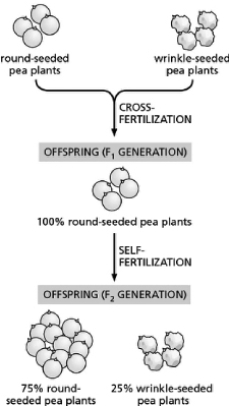 Figure 19-24
Which of the following statements about the round-seeded pea plants obtained in the F2 generation is FALSE?
A)These plants are phenotypically identical for seed shape.
B)Two-thirds of these plants are expected to be heterozygous for the seed-shape allele.
C)We expect 25% of these plants to be homozygous for the seed-shape allele.
D)If these plants were crossed to wrinkle-seeded plants, some of these plants would produce only round-seeded plants.
Figure 19-24Which of the following statements about the round-seeded pea plants obtained in the F2 generation is FALSE?
A)These plants are phenotypically identical for seed shape.
B)Two-thirds of these plants are expected to be heterozygous for the seed-shape allele.
C)We expect 25% of these plants to be homozygous for the seed-shape allele.
D)If these plants were crossed to wrinkle-seeded plants, some of these plants would produce only round-seeded plants.
Question
Question
Question
Question
Question
Question
Question
Question
Question
Question
Figure 19-24 diagrams one of Mendel's experiments using the round and wrinkled seed traits. 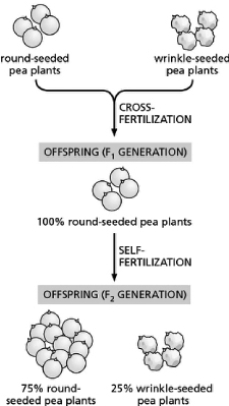 Figure 19-24
Which of the following statements about the experiment diagrammed in Figure 19-28 is TRUE?
A)If you crossed all the round-seeded pea plants from the F2 generation with true-breeding wrinkle-seeded pea plants, you would get more round-seeded pea plants in the next generation than if you crossed all the round-seeded pea plants from the F1 generation with true-breeding wrinkle-seeded pea plants.
B)The reason you do not see wrinkle-seeded pea plants in the F1 generation is because the round-seeded pea plants used to create the F1 generation were not true-breeding strains.
C)The gene for round-seeded pea plants is on a different chromosome from the gene for wrinkle-seeded pea plants, which is why you get 25% wrinkle-seeded pea plants in the F2 generation.
D)If you crossed the round-seeded pea plants from the F2 generation with the wrinkle-seeded pea plants from the F2 generation, you should get 100% round-seeded pea plants.
Figure 19-24Which of the following statements about the experiment diagrammed in Figure 19-28 is TRUE?
A)If you crossed all the round-seeded pea plants from the F2 generation with true-breeding wrinkle-seeded pea plants, you would get more round-seeded pea plants in the next generation than if you crossed all the round-seeded pea plants from the F1 generation with true-breeding wrinkle-seeded pea plants.
B)The reason you do not see wrinkle-seeded pea plants in the F1 generation is because the round-seeded pea plants used to create the F1 generation were not true-breeding strains.
C)The gene for round-seeded pea plants is on a different chromosome from the gene for wrinkle-seeded pea plants, which is why you get 25% wrinkle-seeded pea plants in the F2 generation.
D)If you crossed the round-seeded pea plants from the F2 generation with the wrinkle-seeded pea plants from the F2 generation, you should get 100% round-seeded pea plants.
Question
Figure 19-24 diagrams one of Mendel's experiments using the round and wrinkled seed traits. 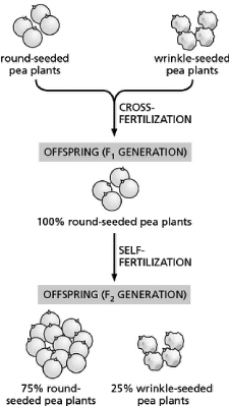 Figure 19-24
Which of the following could be considered a true-breeding strain for the seed-shape phenotype?
A)all of the round-seeded plants produced in the F2 generation
B)all of the wrinkle-seeded plants produced in the F2 generation
C)all of the round-seeded plants produced in the F1 generation
D)half of the round-seeded plants produced in the F2 generation
Figure 19-24Which of the following could be considered a true-breeding strain for the seed-shape phenotype?
A)all of the round-seeded plants produced in the F2 generation
B)all of the wrinkle-seeded plants produced in the F2 generation
C)all of the round-seeded plants produced in the F1 generation
D)half of the round-seeded plants produced in the F2 generation
Question
Question
Figure 19-24 diagrams one of Mendel's experiments using the round and wrinkled seed traits. 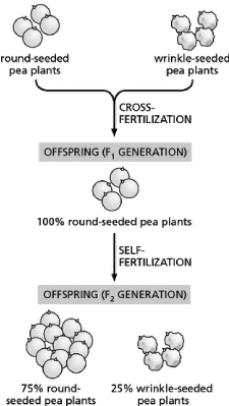 Figure 19-24
If you crossed the round-seeded plants obtained in the F1 generation with a true-breeding strain of round-seeded plants, how many wrinkle-seeded plants would you expect to obtain in the next generation?
A)none
B)25%
C)75%
D)all
Figure 19-24If you crossed the round-seeded plants obtained in the F1 generation with a true-breeding strain of round-seeded plants, how many wrinkle-seeded plants would you expect to obtain in the next generation?
A)none
B)25%
C)75%
D)all
Question
Question
Question
Figure 19-24 diagrams one of Mendel's experiments using the round and wrinkled seed traits. 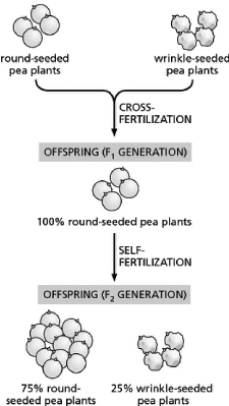 Figure 19-24
If you crossed the round-seeded plants obtained in the F1 generation with a true-breeding strain of wrinkle-seeded plants, how many round-seeded plants would you expect to obtain in the next generation?
A)25%
B)50%
C)75%
D)100%
Figure 19-24If you crossed the round-seeded plants obtained in the F1 generation with a true-breeding strain of wrinkle-seeded plants, how many round-seeded plants would you expect to obtain in the next generation?
A)25%
B)50%
C)75%
D)100%
Question
Question
Question
Question
Question
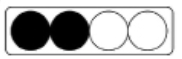
In some fungi, cell division during meiosis gives rise to an ordered spore sac containing a row of four haploid spores, as shown in Figure 19-28A.The position of each spore within the sac reflects its relation to its neighbors; in other words, spores that result from the same meiosis II division are positioned next to each other.You notice that a strain of the fungus produced by crossing a dark-colored strain with a light-colored strain gives rise mostly to spore sacs as shown in Figure 19-28B, with a few spore sacs like those in Figure 19-28C.Indicate whether the following statements are CORRECT or INCORRECT.Explain your reasoning.
(A)

(B)
(C)
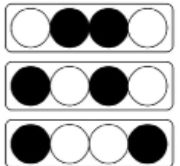
Figure 19-28
A.Meiosis I and meiosis II in the fungus occur in the reverse order from that which occur in humans.
B.Recombination in the fungus can occur during prophase I.
C.Recombination in the fungus cannot occur during prophase II.
D.The spore sacs in Figure 19-28C result from recombination between the centromere and the gene responsible for spore color.
E.Recombination has occurred between the gene responsible for spore color and the end of the chromosome arm.
(A)
(B)
(C)
Figure 19-28
A.Meiosis I and meiosis II in the fungus occur in the reverse order from that which occur in humans.
B.Recombination in the fungus can occur during prophase I.
C.Recombination in the fungus cannot occur during prophase II.
D.The spore sacs in Figure 19-28C result from recombination between the centromere and the gene responsible for spore color.
E.Recombination has occurred between the gene responsible for spore color and the end of the chromosome arm.
Question
With respect to gene E on the chromosome drawn in Figure 19-14, which gene is least likely to behave according to Mendel's law of independent assortment? Explain your answer. 
Figure 19-14
Figure 19-14
Question
Conditional alleles are mutant gene versions encoding proteins that can function normally at the permissive condition but are defective at the restrictive condition.One commonly used condition is temperature.Conditional alleles are especially useful to geneticists because they permit the study of essential genes.At the permissive temperature, the organism lives normally.When the organism is shifted to the nonpermissive temperature, the effect of inactivating the gene can be studied.Which of the three types of mutation shown in Figure 19-19 is most likely to lead to a conditional allele? Explain your answer. 
Figure 19-19
Figure 19-19
Question
Question
Question
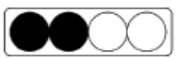
In some fungi, cell division during meiosis gives rise to an ordered spore sac containing a row of four haploid spores, as shown in Figure 19-10A.The position of each spore within the sac reflects its relation to its neighbors; in other words, spores that result from the same meiosis II division are positioned next to each other.You notice that a strain of the fungus produced by crossing a dark-colored strain with a light-colored strain gives rise mostly to spore sacs as shown in Figure 19-10B, with a few spore sacs like those in Figure 19-10C.Indicate whether the following statements are correct.Explain your reasoning.
(A)

(B)
(C)
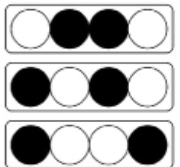
Figure 19-10
A.Meiosis I and meiosis II in the fungus occur in the reverse order from that which occurs in humans.
B.Recombination in the fungus can occur during prophase I.
C.Recombination in the fungus cannot occur during prophase II.
D.The spore sacs in Figure 19-10C result from recombination between the centromere and the gene responsible for spore color.
E.Recombination has occurred between the gene responsible for spore color and the end of the chromosome arm.
(A)
(B)
(C)
Figure 19-10
A.Meiosis I and meiosis II in the fungus occur in the reverse order from that which occurs in humans.
B.Recombination in the fungus can occur during prophase I.
C.Recombination in the fungus cannot occur during prophase II.
D.The spore sacs in Figure 19-10C result from recombination between the centromere and the gene responsible for spore color.
E.Recombination has occurred between the gene responsible for spore color and the end of the chromosome arm.
Question
You are studying a diploid yeast strain that normally uses glucose as an energy source but can use maltose when no glucose is present.You are interested in understanding how this yeast strain metabolizes maltose as an alternative energy source.You isolate the genes involved in maltose metabolism by screening for yeast that cannot grow when maltose is the sole energy source.You find six different mutants, all of which are recessive, and name these alleles mal1, mal2, mal3, mal4, mal5, and mal6.Next, you isolate gametes from the homozygous diploid mutant yeast strains and perform crosses between the different strains to do complementation analysis, because you wish to determine whether the mutations are likely to affect the same or different genes.Your results are shown in Table 19-20. 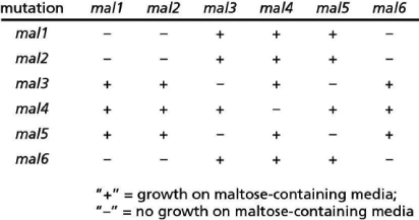
Table 19-20
In how many genes are you likely to have isolated mutations? Which alleles seem to affect the same genes? Explain your answer.
Table 19-20
In how many genes are you likely to have isolated mutations? Which alleles seem to affect the same genes? Explain your answer.
Question
Question
Figure 19-27 is a diagram of chromosomes during meiosis. 
Figure 19-27
A.On the diagram, indicate which label lines correspond to the following items: (1) sister chromatids, (2) homologous chromosomes, (3) bivalent, (4) chiasma.
B.On the figure, draw as small circles (oooo) the cohesin "glue" that is released in meiotic division I, and draw as small crosses (xxxx) the cohesin glue that is released in meiotic division II.
Figure 19-27
A.On the diagram, indicate which label lines correspond to the following items: (1) sister chromatids, (2) homologous chromosomes, (3) bivalent, (4) chiasma.
B.On the figure, draw as small circles (oooo) the cohesin "glue" that is released in meiotic division I, and draw as small crosses (xxxx) the cohesin glue that is released in meiotic division II.
Question
Question
Question
Question
Question
Shown in Figure 19-22 is a genetic pedigree of a family with several members affected by a heritable disease.Affected individuals are shown in black and healthy individuals are shown in white.Males are shown as boxes and females as circles.Can a single mutation explain the pattern of inheritance? Is the mutation responsible for the disease dominant or recessive? Is the mutation carried on the X chromosome, the Y chromosome, or an autosome? 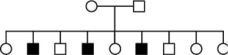
Figure 19-22
Figure 19-22
Question
Question
You are trying to map a human gene thought to be involved in cat allergies.Because you know this gene is on Chromosome 20, you decide to examine the linkage of several SNPs located on Chromosome 20 with respect to the gene involved in cat allergies.You have obtained DNA from 10 individuals, and you know whether they are allergic to cats.Your SNP results are shown in Table 19-24. 
Table 19-24 (+ indicates the presence of SNP)
A.Which SNP is most likely to be tightly linked to the gene involved in cat allergies? Explain your answer.
B.Of the SNPs tested above, which is likely to be the next closest to the gene responsible for the allergic state? Why?
Table 19-24 (+ indicates the presence of SNP)
A.Which SNP is most likely to be tightly linked to the gene involved in cat allergies? Explain your answer.
B.Of the SNPs tested above, which is likely to be the next closest to the gene responsible for the allergic state? Why?
Question
Question
Question
Question
Your friend has obtained some pea seeds from the Abbey of St.Thomas in Brno, where Gregor Mendel worked.He is very excited because not only did he obtain some yellow and green pea seeds from true-breeding plants (like the ones used in Mendel's famous experiment), he was also able to obtain some purple pea seeds from a true-breeding plant.First, your friend takes the true-breeding yellow and green pea seeds, repeats the cross that Gregor Mendel did, and obtains the same results: he sees 100% yellow-seeded pea plants in the F1 generation, and 75% yellow-seeded pea plants and 25% green-seeded pea plants in the F2 generation.His results are illustrated in Figure 19-30A.Your friend then decides to set up two more crosses.For cross #2, he crosses the true-breeding purple-seeded pea plants to the true-breeding yellow-seeded pea plants.The results from this cross are shown in Figure 19-30B.Next, for cross #3, he crosses the true-breeding purple-seeded pea plants to the true-breeding green-seeded pea plants.These results are shown in Figure 19-30C. 
Figure 19-30
Given these results, if you were to take the purple-seeded pea plants produced in the F1 generation in cross #2 and cross them to the purple-seeded pea plants produced in the F1 generation of cross #3, what do you expect that the phenotype of the progeny would look like? Explain your answer.
Figure 19-30
Given these results, if you were to take the purple-seeded pea plants produced in the F1 generation in cross #2 and cross them to the purple-seeded pea plants produced in the F1 generation of cross #3, what do you expect that the phenotype of the progeny would look like? Explain your answer.

Unlock Deck
Sign up to unlock the cards in this deck!
Unlock Deck
Unlock Deck
1/61

Play

Full screen (f)
Deck 19: Sexual Reproduction and the Power of Genetics
1
Which of the following statements most correctly describes meiosis?
A)Meiosis involves two rounds of DNA replication followed by a single cell division.
B)Meiosis involves a single round of DNA replication followed by four successive cell divisions.
C)Meiosis involves four rounds of DNA replication followed by two successive cell divisions.
D)Meiosis involves a single round of DNA replication followed by two successive cell divisions.
A)Meiosis involves two rounds of DNA replication followed by a single cell division.
B)Meiosis involves a single round of DNA replication followed by four successive cell divisions.
C)Meiosis involves four rounds of DNA replication followed by two successive cell divisions.
D)Meiosis involves a single round of DNA replication followed by two successive cell divisions.
D
2
Which of the following would NOT lead to aneuploidy during meiosis?
A)sister chromatids segregating inappropriately
B)nonsister chromatids segregating inappropriately
C)a reciprocal rearrangement of parts between nonhomologous chromosomes (for example, the left arm of Chromosome 2 exchanging places with the right arm of Chromosome 3)
D)an extra set of chromosomes produced during S phase (for example, if paternal Chromosome 3 were replicated twice)
A)sister chromatids segregating inappropriately
B)nonsister chromatids segregating inappropriately
C)a reciprocal rearrangement of parts between nonhomologous chromosomes (for example, the left arm of Chromosome 2 exchanging places with the right arm of Chromosome 3)
D)an extra set of chromosomes produced during S phase (for example, if paternal Chromosome 3 were replicated twice)
C
3
During recombination
A)sister chromatids undergo crossing-over with each other.
B)chiasmata hold chromosomes together.
C)one crossover event occurs for each pair of human chromosomes.
D)the synaptonemal complex keeps the sister chromatids together until anaphase II.
A)sister chromatids undergo crossing-over with each other.
B)chiasmata hold chromosomes together.
C)one crossover event occurs for each pair of human chromosomes.
D)the synaptonemal complex keeps the sister chromatids together until anaphase II.
B
4
Somatic cells __________.
A)are not necessary for sexual reproduction in all eukaryotic organisms.
B)are used to produce germ-line cells when organisms reach sexual maturity
C)leave no progeny.
D)do not contain sex chromosomes.
A)are not necessary for sexual reproduction in all eukaryotic organisms.
B)are used to produce germ-line cells when organisms reach sexual maturity
C)leave no progeny.
D)do not contain sex chromosomes.
Unlock Deck
Unlock for access to all 61 flashcards in this deck.
Unlock Deck
k this deck
5
Both budding yeast and the bacteria E.coli are unicellular life forms.Which of the following statements explains why budding yeast can undergo sexual reproduction while E.coli cannot?
A)Unlike E.coli, budding yeast can alternate between a diploid state and a haploid state.
B)Unlike E.coli, budding yeast cannot multiply by undergoing cell division.
C)Unlike E.coli, haploid budding yeast cells can undergo meiosis to produce the gametes necessary for sexual reproduction.
D)E.coli DNA is unable to undergo homologous recombination, making it incapable of producing gametes.
A)Unlike E.coli, budding yeast can alternate between a diploid state and a haploid state.
B)Unlike E.coli, budding yeast cannot multiply by undergoing cell division.
C)Unlike E.coli, haploid budding yeast cells can undergo meiosis to produce the gametes necessary for sexual reproduction.
D)E.coli DNA is unable to undergo homologous recombination, making it incapable of producing gametes.
Unlock Deck
Unlock for access to all 61 flashcards in this deck.
Unlock Deck
k this deck
6
Which of the following statements is FALSE?
A)Asexual reproduction typically gives rise to offspring that are genetically identical.
B)Mutations in somatic cells are passed on to individuals of the next generation.
C)Sexual reproduction allows for a wide variety of gene combinations.
D)Gametes are specialized sex cells.
A)Asexual reproduction typically gives rise to offspring that are genetically identical.
B)Mutations in somatic cells are passed on to individuals of the next generation.
C)Sexual reproduction allows for a wide variety of gene combinations.
D)Gametes are specialized sex cells.
Unlock Deck
Unlock for access to all 61 flashcards in this deck.
Unlock Deck
k this deck
7
During sexual reproduction, novel mixtures of alleles are generated.This is because
A)in all diploid species, two alleles exist for every gene.
B)a diploid individual has two different alleles for every gene.
C)every gamete produced by a diploid individual has several different alleles of a single gene.
D)during meiosis, the segregation of homologs is random such that different gametes end up with different alleles of each gene.
A)in all diploid species, two alleles exist for every gene.
B)a diploid individual has two different alleles for every gene.
C)every gamete produced by a diploid individual has several different alleles of a single gene.
D)during meiosis, the segregation of homologs is random such that different gametes end up with different alleles of each gene.
Unlock Deck
Unlock for access to all 61 flashcards in this deck.
Unlock Deck
k this deck
8
Which of the following statements is TRUE?
A)Another name for the fertilized egg cell is the zygote.
B)Diploid organisms reproduce only sexually.
C)All sexually reproducing organisms must have two copies of every chromosome.
D)Gametes have only one chromosome.
A)Another name for the fertilized egg cell is the zygote.
B)Diploid organisms reproduce only sexually.
C)All sexually reproducing organisms must have two copies of every chromosome.
D)Gametes have only one chromosome.
Unlock Deck
Unlock for access to all 61 flashcards in this deck.
Unlock Deck
k this deck
9
Organisms that reproduce sexually
A)must be haploid, unlike organisms that reproduce asexually.
B)can reproduce only with a partner that carries the same alleles.
C)create zygotes that are genetically identical to each other.
D)undergo a sexual reproductive cycle that involves an alternation of haploid cells with the generation of diploid cells.
A)must be haploid, unlike organisms that reproduce asexually.
B)can reproduce only with a partner that carries the same alleles.
C)create zygotes that are genetically identical to each other.
D)undergo a sexual reproductive cycle that involves an alternation of haploid cells with the generation of diploid cells.
Unlock Deck
Unlock for access to all 61 flashcards in this deck.
Unlock Deck
k this deck
10
Which of the following statements about meiosis is TRUE?
A)During meiosis, the paternal chromosomes pair with the maternal chromosomes before lining up at the metaphase plate.
B)Unicellular organisms that have a haploid state undergo meiosis instead of mitosis during cell division.
C)Meiosis produces four genetically identical cells.
D)In general, meiosis is faster than mitosis.
A)During meiosis, the paternal chromosomes pair with the maternal chromosomes before lining up at the metaphase plate.
B)Unicellular organisms that have a haploid state undergo meiosis instead of mitosis during cell division.
C)Meiosis produces four genetically identical cells.
D)In general, meiosis is faster than mitosis.
Unlock Deck
Unlock for access to all 61 flashcards in this deck.
Unlock Deck
k this deck
11
Imagine meiosis in a diploid organism that only has a single chromosome.Like most diploid organisms, it received one copy of this chromosome from each of its parents and the two homologs are genetically distinct.If only a single homologous recombination event occurs during meiosis, which of the following choices below correctly describes the four gametes formed?
A)None of the gametes will contain chromosomes identical to the chromosomes found in the original diploid cell.
B)All four of the gametes will have chromosomes identical to the chromosomes found in the original diploid cell.
C)Three of the gametes will have chromosomes identical to the chromosomes found in the original diploid cell, while one of the gametes will have chromosomes that are different.
D)Two of the gametes will have chromosomes identical to the chromosomes found in the original diploid cell, while two of the gametes will have chromosomes that are different.
A)None of the gametes will contain chromosomes identical to the chromosomes found in the original diploid cell.
B)All four of the gametes will have chromosomes identical to the chromosomes found in the original diploid cell.
C)Three of the gametes will have chromosomes identical to the chromosomes found in the original diploid cell, while one of the gametes will have chromosomes that are different.
D)Two of the gametes will have chromosomes identical to the chromosomes found in the original diploid cell, while two of the gametes will have chromosomes that are different.
Unlock Deck
Unlock for access to all 61 flashcards in this deck.
Unlock Deck
k this deck
12
Which of the following statements about the benefits of sexual reproduction is FALSE?
A)Sexual reproduction permits enhanced survival because the gametes that carry alleles enhancing survival in harsh environments are used preferentially during fertilization.
B)Unicellular organisms that can undergo sexual reproduction have an increased ability to adapt to harsh environments.
C)Sexual reproduction reshuffles genes, which is thought to help species survive in novel or varying environments.
D)Sexual reproduction can speed the elimination of deleterious alleles.
A)Sexual reproduction permits enhanced survival because the gametes that carry alleles enhancing survival in harsh environments are used preferentially during fertilization.
B)Unicellular organisms that can undergo sexual reproduction have an increased ability to adapt to harsh environments.
C)Sexual reproduction reshuffles genes, which is thought to help species survive in novel or varying environments.
D)Sexual reproduction can speed the elimination of deleterious alleles.
Unlock Deck
Unlock for access to all 61 flashcards in this deck.
Unlock Deck
k this deck
13
The formation of a bivalent during meiosis ensures that
A)one chromatid from the mother and one chromatid from the father will segregate together during meiosis I.
B)all four sister chromatids remain together until the cell is ready to divide.
C)recombination will occur between identical sister chromatids.
D)the sex chromosomes, which are not identical, will line up separately at the metaphase plate during meiosis I.
A)one chromatid from the mother and one chromatid from the father will segregate together during meiosis I.
B)all four sister chromatids remain together until the cell is ready to divide.
C)recombination will occur between identical sister chromatids.
D)the sex chromosomes, which are not identical, will line up separately at the metaphase plate during meiosis I.
Unlock Deck
Unlock for access to all 61 flashcards in this deck.
Unlock Deck
k this deck
14
After the first meiotic cell division,
A)two haploid gametes are produced.
B)cells are produced that contain the same number of chromosomes as somatic cells.
C)the number of chromosomes will vary depending on how the paternal and maternal chromosomes align at the metaphase plate.
D)DNA replication occurs.
A)two haploid gametes are produced.
B)cells are produced that contain the same number of chromosomes as somatic cells.
C)the number of chromosomes will vary depending on how the paternal and maternal chromosomes align at the metaphase plate.
D)DNA replication occurs.
Unlock Deck
Unlock for access to all 61 flashcards in this deck.
Unlock Deck
k this deck
15
You examine a worm that has two genders: males that produce sperm and hermaphrodites that produce both sperm and eggs.The diploid adult has four homologous pairs of chromosomes that undergo very little recombination.Given a choice, the hermaphrodites prefer to mate with males, but just to annoy the worm, you pluck a hermaphrodite out of the wild and fertilize its eggs with its own sperm.Assuming that all the resulting offspring are viable, what fraction do you expect to be genetically identical to the parent worm? Assume that each chromosome in the original hermaphrodite is genetically distinct from its homolog.
A)all
B)none
C)1/16
D)1/256
A)all
B)none
C)1/16
D)1/256
Unlock Deck
Unlock for access to all 61 flashcards in this deck.
Unlock Deck
k this deck
16
A single nondisjunction event during meiosis
A)will block recombination.
B)will occur only during meiosis II.
C)cannot occur with sex chromosomes.
D)will result in the production of two normal gametes if it occurs during meiosis II.
A)will block recombination.
B)will occur only during meiosis II.
C)cannot occur with sex chromosomes.
D)will result in the production of two normal gametes if it occurs during meiosis II.
Unlock Deck
Unlock for access to all 61 flashcards in this deck.
Unlock Deck
k this deck
17
In the absence of recombination, how many genetically different types of gametes can an organism with five homologous chromosome pairs produce?
A)5
B)10
C)32
D)64
A)5
B)10
C)32
D)64
Unlock Deck
Unlock for access to all 61 flashcards in this deck.
Unlock Deck
k this deck
18
Which of the following does not describe a situation of asexual reproduction?
A)a bacterium multiplying by simple cell division
B)using a part of a plant to create a new independent plant
C)using in vitro fertilization to combine a sperm and an egg to create an embryo
D)the parthenogenetic development of eggs produced by some species of lizards
A)a bacterium multiplying by simple cell division
B)using a part of a plant to create a new independent plant
C)using in vitro fertilization to combine a sperm and an egg to create an embryo
D)the parthenogenetic development of eggs produced by some species of lizards
Unlock Deck
Unlock for access to all 61 flashcards in this deck.
Unlock Deck
k this deck
19
There are organisms that go through meiosis but do not undergo recombination when forming haploid gametes.Which of the following statements correctly describes the gametes produced by such an organism? (Assume that these organisms are diploid, that each of the two homologous chromosomes are genetically distinct as typically found in the wild, and that these organisms have more than one chromosome.)
A)All gametes formed during a single meiosis will be identical.
B)Due to the random assortment of homologs, each of the gametes formed during a single meiosis will be different.
C)This organism could potentially produce 2n genetically distinct gametes, where n is its haploid number of chromosomes.
D)The fusion of any two gametes produced by such an organism that does not undergo recombination during meiosis will create a cell that is genetically identical to that individual.
A)All gametes formed during a single meiosis will be identical.
B)Due to the random assortment of homologs, each of the gametes formed during a single meiosis will be different.
C)This organism could potentially produce 2n genetically distinct gametes, where n is its haploid number of chromosomes.
D)The fusion of any two gametes produced by such an organism that does not undergo recombination during meiosis will create a cell that is genetically identical to that individual.
Unlock Deck
Unlock for access to all 61 flashcards in this deck.
Unlock Deck
k this deck
20
A diploid cell containing 32 chromosomes will make a haploid cell containing __________ chromosomes.
A)8
B)16
C)30
D)64
A)8
B)16
C)30
D)64
Unlock Deck
Unlock for access to all 61 flashcards in this deck.
Unlock Deck
k this deck
21
Figure 19-24 diagrams one of Mendel's experiments using the round and wrinkled seed traits. Figure 19-24
Which of the following statements about the round-seeded pea plants obtained in the F2 generation is FALSE?
A)These plants are phenotypically identical for seed shape.
B)Two-thirds of these plants are expected to be heterozygous for the seed-shape allele.
C)We expect 25% of these plants to be homozygous for the seed-shape allele.
D)If these plants were crossed to wrinkle-seeded plants, some of these plants would produce only round-seeded plants.
Figure 19-24Which of the following statements about the round-seeded pea plants obtained in the F2 generation is FALSE?
A)These plants are phenotypically identical for seed shape.
B)Two-thirds of these plants are expected to be heterozygous for the seed-shape allele.
C)We expect 25% of these plants to be homozygous for the seed-shape allele.
D)If these plants were crossed to wrinkle-seeded plants, some of these plants would produce only round-seeded plants.
Unlock Deck
Unlock for access to all 61 flashcards in this deck.
Unlock Deck
k this deck
22
For each of the following sentences, choose one of the options enclosed in square brackets to make a correct statement.
Starting with a single diploid cell, mitosis produces [two/four] [identical/different] [haploid/diploid] cells, whereas meiosis yields [two/four] [identical/different] [haploid/diploid] cells.This is accomplished in meiosis because a single round of chromosome [replication/segregation] is followed by two sequential rounds of [replication/segregation].Mitosis is more like meiosis [I/II] than meiosis [I/II].In meiosis I, the kinetochores on sister chromatids behave [independently/coordinately] and thus attach to microtubules from the [same/opposite] spindle.The cohesin-mediated glue between [chromatids/homologs] is regulated differently near the centromeres than along the chromosome arms.Cohesion is lost first at the [centromeres/arms] to allow segregation of [chromatids/homologs] and is lost later at the [centromeres/arms] to trigger segregation of [chromatids/homologs].
Starting with a single diploid cell, mitosis produces [two/four] [identical/different] [haploid/diploid] cells, whereas meiosis yields [two/four] [identical/different] [haploid/diploid] cells.This is accomplished in meiosis because a single round of chromosome [replication/segregation] is followed by two sequential rounds of [replication/segregation].Mitosis is more like meiosis [I/II] than meiosis [I/II].In meiosis I, the kinetochores on sister chromatids behave [independently/coordinately] and thus attach to microtubules from the [same/opposite] spindle.The cohesin-mediated glue between [chromatids/homologs] is regulated differently near the centromeres than along the chromosome arms.Cohesion is lost first at the [centromeres/arms] to allow segregation of [chromatids/homologs] and is lost later at the [centromeres/arms] to trigger segregation of [chromatids/homologs].
Unlock Deck
Unlock for access to all 61 flashcards in this deck.
Unlock Deck
k this deck
23
For each of the following sentences, fill in the blanks with the best word or phrase selected from the list below.Not all words or phrases will be used; each word or phrase can be used only once.
allele germ pollen
bivalent meiosis somatic
eggs mitosis sperm
gametes pedigree zygote
To reproduce sexually, an organism must create haploid __________ cells, or __________, from diploid cells via a specialized nuclear division called __________.During mating, the father's haploid cells, called __________ in animals, fuse with the mother's haploid cells, called __________.Cell fusion produces a diploid cell called a __________, which undergoes many rounds of cell division to create the entire body of the new individual.The cells produced from the initial fusion event include __________ cells that form most of the tissues of the body as well as the __________-line cells that give rise to the next generation of progeny.
allele germ pollen
bivalent meiosis somatic
eggs mitosis sperm
gametes pedigree zygote
To reproduce sexually, an organism must create haploid __________ cells, or __________, from diploid cells via a specialized nuclear division called __________.During mating, the father's haploid cells, called __________ in animals, fuse with the mother's haploid cells, called __________.Cell fusion produces a diploid cell called a __________, which undergoes many rounds of cell division to create the entire body of the new individual.The cells produced from the initial fusion event include __________ cells that form most of the tissues of the body as well as the __________-line cells that give rise to the next generation of progeny.
Unlock Deck
Unlock for access to all 61 flashcards in this deck.
Unlock Deck
k this deck
24
Which of the following statements about conditional alleles is FALSE?
A)Conditional alleles allow for the study of lethal mutations in haploid organisms.
B)Conditional alleles are only defective under high temperature conditions.
C)Conditional alleles can be used to study tissue-specific gene function in diploid organisms.
D)Conditional alleles behave like the wild-type allele under permissive conditions.
A)Conditional alleles allow for the study of lethal mutations in haploid organisms.
B)Conditional alleles are only defective under high temperature conditions.
C)Conditional alleles can be used to study tissue-specific gene function in diploid organisms.
D)Conditional alleles behave like the wild-type allele under permissive conditions.
Unlock Deck
Unlock for access to all 61 flashcards in this deck.
Unlock Deck
k this deck
25
Loss-of-function mutations
A)cause the production of proteins that are active in inappropriate circumstances.
B)will usually show a phenotype when heterozygous.
C)are only present in a population at barely detectable levels.
D)are usually recessive.
A)cause the production of proteins that are active in inappropriate circumstances.
B)will usually show a phenotype when heterozygous.
C)are only present in a population at barely detectable levels.
D)are usually recessive.
Unlock Deck
Unlock for access to all 61 flashcards in this deck.
Unlock Deck
k this deck
26
The single-nucleotide polymorphisms found in the human population
A)are important for genetic mapping because they represent mutations in genes important for human disease.
B)are rarely found among blood relatives.
C)can be linked into haplotype blocks.
D)arose mainly during the past 10,000 years.
A)are important for genetic mapping because they represent mutations in genes important for human disease.
B)are rarely found among blood relatives.
C)can be linked into haplotype blocks.
D)arose mainly during the past 10,000 years.
Unlock Deck
Unlock for access to all 61 flashcards in this deck.
Unlock Deck
k this deck
27
Haplotype blocks can be seen in humans because
A)disease genes are found in haplotype blocks.
B)modern humans descended from a relatively small population of about 10,000 individuals that existed about 2,000 generations ago.
C)human germ cells do not undergo recombination.
D)new mutations cannot be introduced into existing haplotype blocks.
A)disease genes are found in haplotype blocks.
B)modern humans descended from a relatively small population of about 10,000 individuals that existed about 2,000 generations ago.
C)human germ cells do not undergo recombination.
D)new mutations cannot be introduced into existing haplotype blocks.
Unlock Deck
Unlock for access to all 61 flashcards in this deck.
Unlock Deck
k this deck
28
Finding co-inheritance of an SNP variant and a disease tells scientists that
A)everybody who carries this SNP will get the disease.
B)sequences within the SNP cause the disease.
C)a gene important for causing the disease is linked to the SNP.
D)SNPs on other chromosomes will not be co-inherited with the disease.
A)everybody who carries this SNP will get the disease.
B)sequences within the SNP cause the disease.
C)a gene important for causing the disease is linked to the SNP.
D)SNPs on other chromosomes will not be co-inherited with the disease.
Unlock Deck
Unlock for access to all 61 flashcards in this deck.
Unlock Deck
k this deck
29
Which of the following statements about genome-wide association studies (GWAS) is FALSE?
A)GWAS use SNPs to compare populations of people with disease and people without disease to look for SNPs more likely to be present in those with disease.
B)GWAS can be used even if more than one gene can cause the disease of interest.
C)Sometimes GWAS will identify SNPs that are associated with a disease, but these SNPs do not affect the gene product of the gene that causes the disease.
D)Studies using GWAS only examine SNPs that occur very rarely (<0.001%) in the population, as those SNPs are most likely to cause disease.
A)GWAS use SNPs to compare populations of people with disease and people without disease to look for SNPs more likely to be present in those with disease.
B)GWAS can be used even if more than one gene can cause the disease of interest.
C)Sometimes GWAS will identify SNPs that are associated with a disease, but these SNPs do not affect the gene product of the gene that causes the disease.
D)Studies using GWAS only examine SNPs that occur very rarely (<0.001%) in the population, as those SNPs are most likely to cause disease.
Unlock Deck
Unlock for access to all 61 flashcards in this deck.
Unlock Deck
k this deck
30
During fertilization in humans,
A)a wave of Ca2+ ions is released in the fertilized egg's cytoplasm.
B)only one sperm binds to the unfertilized egg.
C)a sperm moves in a random fashion until it encounters an egg.
D)several sperm pronuclei compete in the cytoplasm to fuse with the egg nucleus.
A)a wave of Ca2+ ions is released in the fertilized egg's cytoplasm.
B)only one sperm binds to the unfertilized egg.
C)a sperm moves in a random fashion until it encounters an egg.
D)several sperm pronuclei compete in the cytoplasm to fuse with the egg nucleus.
Unlock Deck
Unlock for access to all 61 flashcards in this deck.
Unlock Deck
k this deck
31
Figure 19-24 diagrams one of Mendel's experiments using the round and wrinkled seed traits. Figure 19-24
Which of the following statements about the experiment diagrammed in Figure 19-28 is TRUE?
A)If you crossed all the round-seeded pea plants from the F2 generation with true-breeding wrinkle-seeded pea plants, you would get more round-seeded pea plants in the next generation than if you crossed all the round-seeded pea plants from the F1 generation with true-breeding wrinkle-seeded pea plants.
B)The reason you do not see wrinkle-seeded pea plants in the F1 generation is because the round-seeded pea plants used to create the F1 generation were not true-breeding strains.
C)The gene for round-seeded pea plants is on a different chromosome from the gene for wrinkle-seeded pea plants, which is why you get 25% wrinkle-seeded pea plants in the F2 generation.
D)If you crossed the round-seeded pea plants from the F2 generation with the wrinkle-seeded pea plants from the F2 generation, you should get 100% round-seeded pea plants.
Figure 19-24Which of the following statements about the experiment diagrammed in Figure 19-28 is TRUE?
A)If you crossed all the round-seeded pea plants from the F2 generation with true-breeding wrinkle-seeded pea plants, you would get more round-seeded pea plants in the next generation than if you crossed all the round-seeded pea plants from the F1 generation with true-breeding wrinkle-seeded pea plants.
B)The reason you do not see wrinkle-seeded pea plants in the F1 generation is because the round-seeded pea plants used to create the F1 generation were not true-breeding strains.
C)The gene for round-seeded pea plants is on a different chromosome from the gene for wrinkle-seeded pea plants, which is why you get 25% wrinkle-seeded pea plants in the F2 generation.
D)If you crossed the round-seeded pea plants from the F2 generation with the wrinkle-seeded pea plants from the F2 generation, you should get 100% round-seeded pea plants.
Unlock Deck
Unlock for access to all 61 flashcards in this deck.
Unlock Deck
k this deck
32
Figure 19-24 diagrams one of Mendel's experiments using the round and wrinkled seed traits. Figure 19-24
Which of the following could be considered a true-breeding strain for the seed-shape phenotype?
A)all of the round-seeded plants produced in the F2 generation
B)all of the wrinkle-seeded plants produced in the F2 generation
C)all of the round-seeded plants produced in the F1 generation
D)half of the round-seeded plants produced in the F2 generation
Figure 19-24Which of the following could be considered a true-breeding strain for the seed-shape phenotype?
A)all of the round-seeded plants produced in the F2 generation
B)all of the wrinkle-seeded plants produced in the F2 generation
C)all of the round-seeded plants produced in the F1 generation
D)half of the round-seeded plants produced in the F2 generation
Unlock Deck
Unlock for access to all 61 flashcards in this deck.
Unlock Deck
k this deck
33
Which of the following reasons was essential for Mendel's law of independent assortment?
A)All the traits that Mendel examined involved genes that did not display linkage.
B)Several of the phenotypes that Mendel examined involved color.
C)Mendel observed chromosomal segregation in pea-plant cells.
D)Mendel carried out his experiments on plants and not on fungi.
A)All the traits that Mendel examined involved genes that did not display linkage.
B)Several of the phenotypes that Mendel examined involved color.
C)Mendel observed chromosomal segregation in pea-plant cells.
D)Mendel carried out his experiments on plants and not on fungi.
Unlock Deck
Unlock for access to all 61 flashcards in this deck.
Unlock Deck
k this deck
34
Figure 19-24 diagrams one of Mendel's experiments using the round and wrinkled seed traits. Figure 19-24
If you crossed the round-seeded plants obtained in the F1 generation with a true-breeding strain of round-seeded plants, how many wrinkle-seeded plants would you expect to obtain in the next generation?
A)none
B)25%
C)75%
D)all
Figure 19-24If you crossed the round-seeded plants obtained in the F1 generation with a true-breeding strain of round-seeded plants, how many wrinkle-seeded plants would you expect to obtain in the next generation?
A)none
B)25%
C)75%
D)all
Unlock Deck
Unlock for access to all 61 flashcards in this deck.
Unlock Deck
k this deck
35
Which of the following reasons was essential for Mendel to disprove the theory of blended inheritance?
A)The traits that Mendel examined all involved genes that did not display linkage.
B)The traits that Mendel examined all involved the reproductive structures of the pea plant.
C)Mendel pioneered techniques permitting the fusion of male and female gametes from the same plant to produce a zygote.
D)The traits that Mendel examined involved an allele that was dominant and an allele that was recessive.
A)The traits that Mendel examined all involved genes that did not display linkage.
B)The traits that Mendel examined all involved the reproductive structures of the pea plant.
C)Mendel pioneered techniques permitting the fusion of male and female gametes from the same plant to produce a zygote.
D)The traits that Mendel examined involved an allele that was dominant and an allele that was recessive.
Unlock Deck
Unlock for access to all 61 flashcards in this deck.
Unlock Deck
k this deck
36
Which of the following statements about Mendel's experiments is FALSE?
A)The pea plants could undergo both cross-fertilization and self-fertilization.
B)The true-breeding strains were homozygous for the traits that Mendel examined.
C)The egg can carry either the allele from the maternal or the paternal chromosome.
D)All traits that Mendel studied were recessive.
A)The pea plants could undergo both cross-fertilization and self-fertilization.
B)The true-breeding strains were homozygous for the traits that Mendel examined.
C)The egg can carry either the allele from the maternal or the paternal chromosome.
D)All traits that Mendel studied were recessive.
Unlock Deck
Unlock for access to all 61 flashcards in this deck.
Unlock Deck
k this deck
37
Figure 19-24 diagrams one of Mendel's experiments using the round and wrinkled seed traits. Figure 19-24
If you crossed the round-seeded plants obtained in the F1 generation with a true-breeding strain of wrinkle-seeded plants, how many round-seeded plants would you expect to obtain in the next generation?
A)25%
B)50%
C)75%
D)100%
Figure 19-24If you crossed the round-seeded plants obtained in the F1 generation with a true-breeding strain of wrinkle-seeded plants, how many round-seeded plants would you expect to obtain in the next generation?
A)25%
B)50%
C)75%
D)100%
Unlock Deck
Unlock for access to all 61 flashcards in this deck.
Unlock Deck
k this deck
38
You conduct a genetic screen on peas and isolate four mutant strains, each carrying a recessive mutation that causes the production of red peas (instead of the wild-type green peas).To test whether these mutations are in the same gene, you perform complementation tests between the four different true-breeding strains.The results from these complementation tests are shown in Table 19-33. Table 19-33
Given this data, how many genes do these four alleles represent?
A)1
B)2
C)3
D)4
Given this data, how many genes do these four alleles represent?
A)1
B)2
C)3
D)4
Unlock Deck
Unlock for access to all 61 flashcards in this deck.
Unlock Deck
k this deck
39
Why is sexual reproduction more beneficial to a species living in an unpredictable environment than to one living in a constant environment?
Unlock Deck
Unlock for access to all 61 flashcards in this deck.
Unlock Deck
k this deck
40
Is the following statement TRUE or FALSE? Explain.
Somatic cells leave no progeny and thus, in an evolutionary sense, exist only to help create, sustain, and propagate the germ cells.
Somatic cells leave no progeny and thus, in an evolutionary sense, exist only to help create, sustain, and propagate the germ cells.
Unlock Deck
Unlock for access to all 61 flashcards in this deck.
Unlock Deck
k this deck
41
When a reciprocal translocation occurs, part of one chromosome is exchanged with a part of another chromosome.For example, one-half of Chromosome 3 may now be found fused to Chromosome 10, and part of Chromosome 10 is now found fused to Chromosome 3.In a balanced reciprocal translocation, an even exchange of material occurs such that no genetic information is extra or missing.Individuals can carry balanced reciprocal translocations and be quite healthy.Consider the case where a gamete containing a balanced reciprocal translocation of a single chromosome is used to fertilize a genetically normal egg.Explain why individuals carrying a single balanced reciprocal translocation might have problems with chromosome segregation during meiosis but not in mitosis.
Unlock Deck
Unlock for access to all 61 flashcards in this deck.
Unlock Deck
k this deck
42
In some fungi, cell division during meiosis gives rise to an ordered spore sac containing a row of four haploid spores, as shown in Figure 19-28A.The position of each spore within the sac reflects its relation to its neighbors; in other words, spores that result from the same meiosis II division are positioned next to each other.You notice that a strain of the fungus produced by crossing a dark-colored strain with a light-colored strain gives rise mostly to spore sacs as shown in Figure 19-28B, with a few spore sacs like those in Figure 19-28C.Indicate whether the following statements are CORRECT or INCORRECT.Explain your reasoning.
(A)
(B)
(C)
Figure 19-28
A.Meiosis I and meiosis II in the fungus occur in the reverse order from that which occur in humans.
B.Recombination in the fungus can occur during prophase I.
C.Recombination in the fungus cannot occur during prophase II.
D.The spore sacs in Figure 19-28C result from recombination between the centromere and the gene responsible for spore color.
E.Recombination has occurred between the gene responsible for spore color and the end of the chromosome arm.
(A)
(B)
(C)
Figure 19-28
A.Meiosis I and meiosis II in the fungus occur in the reverse order from that which occur in humans.
B.Recombination in the fungus can occur during prophase I.
C.Recombination in the fungus cannot occur during prophase II.
D.The spore sacs in Figure 19-28C result from recombination between the centromere and the gene responsible for spore color.
E.Recombination has occurred between the gene responsible for spore color and the end of the chromosome arm.
Unlock Deck
Unlock for access to all 61 flashcards in this deck.
Unlock Deck
k this deck
43
With respect to gene E on the chromosome drawn in Figure 19-14, which gene is least likely to behave according to Mendel's law of independent assortment? Explain your answer.
Figure 19-14
Figure 19-14
Unlock Deck
Unlock for access to all 61 flashcards in this deck.
Unlock Deck
k this deck
44
Conditional alleles are mutant gene versions encoding proteins that can function normally at the permissive condition but are defective at the restrictive condition.One commonly used condition is temperature.Conditional alleles are especially useful to geneticists because they permit the study of essential genes.At the permissive temperature, the organism lives normally.When the organism is shifted to the nonpermissive temperature, the effect of inactivating the gene can be studied.Which of the three types of mutation shown in Figure 19-19 is most likely to lead to a conditional allele? Explain your answer.
Figure 19-19
Figure 19-19
Unlock Deck
Unlock for access to all 61 flashcards in this deck.
Unlock Deck
k this deck
45
You have received exactly half of your genetic material from your mother, who received exactly half of her genetic material from her mother (your grandmother).
A.Explain why it is unlikely that you share EXACTLY one-quarter of your genetic material with your grandmother, and instead it is more accurate to say that in general, people receive an AVERAGE of one-quarter of their genetic endowment from each grandparent.
B.Consider a gene on Chromosome 3 that you received from your grandmother.Is it likely you received an entire Chromosome 3 from your grandmother? Why or why not?
C.What portion of your genetic material do you share with your sibling? Your aunt? Your cousin?
A.Explain why it is unlikely that you share EXACTLY one-quarter of your genetic material with your grandmother, and instead it is more accurate to say that in general, people receive an AVERAGE of one-quarter of their genetic endowment from each grandparent.
B.Consider a gene on Chromosome 3 that you received from your grandmother.Is it likely you received an entire Chromosome 3 from your grandmother? Why or why not?
C.What portion of your genetic material do you share with your sibling? Your aunt? Your cousin?
Unlock Deck
Unlock for access to all 61 flashcards in this deck.
Unlock Deck
k this deck
46
Is the following statement TRUE or FALSE? Explain
The phenotype of an organism reflects all of the alleles carried by that individual.
The phenotype of an organism reflects all of the alleles carried by that individual.
Unlock Deck
Unlock for access to all 61 flashcards in this deck.
Unlock Deck
k this deck
47
In some fungi, cell division during meiosis gives rise to an ordered spore sac containing a row of four haploid spores, as shown in Figure 19-10A.The position of each spore within the sac reflects its relation to its neighbors; in other words, spores that result from the same meiosis II division are positioned next to each other.You notice that a strain of the fungus produced by crossing a dark-colored strain with a light-colored strain gives rise mostly to spore sacs as shown in Figure 19-10B, with a few spore sacs like those in Figure 19-10C.Indicate whether the following statements are correct.Explain your reasoning.
(A)
(B)
(C)
Figure 19-10
A.Meiosis I and meiosis II in the fungus occur in the reverse order from that which occurs in humans.
B.Recombination in the fungus can occur during prophase I.
C.Recombination in the fungus cannot occur during prophase II.
D.The spore sacs in Figure 19-10C result from recombination between the centromere and the gene responsible for spore color.
E.Recombination has occurred between the gene responsible for spore color and the end of the chromosome arm.
(A)
(B)
(C)
Figure 19-10
A.Meiosis I and meiosis II in the fungus occur in the reverse order from that which occurs in humans.
B.Recombination in the fungus can occur during prophase I.
C.Recombination in the fungus cannot occur during prophase II.
D.The spore sacs in Figure 19-10C result from recombination between the centromere and the gene responsible for spore color.
E.Recombination has occurred between the gene responsible for spore color and the end of the chromosome arm.
Unlock Deck
Unlock for access to all 61 flashcards in this deck.
Unlock Deck
k this deck
48
You are studying a diploid yeast strain that normally uses glucose as an energy source but can use maltose when no glucose is present.You are interested in understanding how this yeast strain metabolizes maltose as an alternative energy source.You isolate the genes involved in maltose metabolism by screening for yeast that cannot grow when maltose is the sole energy source.You find six different mutants, all of which are recessive, and name these alleles mal1, mal2, mal3, mal4, mal5, and mal6.Next, you isolate gametes from the homozygous diploid mutant yeast strains and perform crosses between the different strains to do complementation analysis, because you wish to determine whether the mutations are likely to affect the same or different genes.Your results are shown in Table 19-20.
Table 19-20
In how many genes are you likely to have isolated mutations? Which alleles seem to affect the same genes? Explain your answer.
Table 19-20
In how many genes are you likely to have isolated mutations? Which alleles seem to affect the same genes? Explain your answer.
Unlock Deck
Unlock for access to all 61 flashcards in this deck.
Unlock Deck
k this deck
49
Gene A is located near gene B on Chromosome 13 in humans.A mutation in the germ line of an individual with the haplotype AB generates gametes with the genotype Ab.Many descendants of this founder individual carry the b mutation, which predisposes carriers to high blood pressure.Initially, all descendants who inherit the b mutation also inherit the neighboring A allele.Through the generations, fewer and fewer descendants with the b mutation carry the A allele, and instead they have the a allele.(Individuals with A and a are equally healthy and fit.) Explain how the b and A alleles are separated.
Unlock Deck
Unlock for access to all 61 flashcards in this deck.
Unlock Deck
k this deck
50
Figure 19-27 is a diagram of chromosomes during meiosis.
Figure 19-27
A.On the diagram, indicate which label lines correspond to the following items: (1) sister chromatids, (2) homologous chromosomes, (3) bivalent, (4) chiasma.
B.On the figure, draw as small circles (oooo) the cohesin "glue" that is released in meiotic division I, and draw as small crosses (xxxx) the cohesin glue that is released in meiotic division II.
Figure 19-27
A.On the diagram, indicate which label lines correspond to the following items: (1) sister chromatids, (2) homologous chromosomes, (3) bivalent, (4) chiasma.
B.On the figure, draw as small circles (oooo) the cohesin "glue" that is released in meiotic division I, and draw as small crosses (xxxx) the cohesin glue that is released in meiotic division II.
Unlock Deck
Unlock for access to all 61 flashcards in this deck.
Unlock Deck
k this deck
51
For each of the following sentences, fill in the blanks with the best word or phrase selected from the list below.Not all words or phrases will be used; each word or phrase may be used more than once.
allele genotype monohybrid
chromosome heterozygous pedigree
dependent homozygous phenotype
dihybrid independent segregation
Gregor Mendel studied pea plants and developed some very important ideas about how genes are inherited.These studies used plant strains that were true-breeding and always produced progeny that had the same __________ as the parent.These strains were true breeding because they were __________ for the gene important for a specific trait.In other words, for these true-breeding strains, both chromosomes in the diploid pea plant carried the same __________ of the gene.Mendel started out examining the inheritance of a single trait at a time, and then moved on to examining two traits at once in a __________ cross.His studies examining the inheritance of two traits in one cross allowed him to discover what is now known as Mendel's law of __________ assortment.Geneticists can study the inheritance of specific traits in humans by analyzing a __________, which shows the phenotypes of different family members over several generations for a particular trait.
allele genotype monohybrid
chromosome heterozygous pedigree
dependent homozygous phenotype
dihybrid independent segregation
Gregor Mendel studied pea plants and developed some very important ideas about how genes are inherited.These studies used plant strains that were true-breeding and always produced progeny that had the same __________ as the parent.These strains were true breeding because they were __________ for the gene important for a specific trait.In other words, for these true-breeding strains, both chromosomes in the diploid pea plant carried the same __________ of the gene.Mendel started out examining the inheritance of a single trait at a time, and then moved on to examining two traits at once in a __________ cross.His studies examining the inheritance of two traits in one cross allowed him to discover what is now known as Mendel's law of __________ assortment.Geneticists can study the inheritance of specific traits in humans by analyzing a __________, which shows the phenotypes of different family members over several generations for a particular trait.
Unlock Deck
Unlock for access to all 61 flashcards in this deck.
Unlock Deck
k this deck
52
Imagine a diploid sexually reproducing organism, Diploidus sexualis, that contains three pairs of chromosomes.This organism is unusual in that no recombination between homologous chromosomes occurs during meiosis.
A.Assuming that the chromosomes are distributed independently during meiosis, how many different types of sperm or egg cells can a single individual of this species produce?
B.What is the likelihood that two siblings of this species will be genetically identical? You can assume that the homologous chromosomes of each parent are different from one another and from their counterparts in the other parent.
A.Assuming that the chromosomes are distributed independently during meiosis, how many different types of sperm or egg cells can a single individual of this species produce?
B.What is the likelihood that two siblings of this species will be genetically identical? You can assume that the homologous chromosomes of each parent are different from one another and from their counterparts in the other parent.
Unlock Deck
Unlock for access to all 61 flashcards in this deck.
Unlock Deck
k this deck
53
Meiosis includes a recombination checkpoint that is analogous to the checkpoints in cell-cycle progression.Double-strand breaks in the DNA initiate recombination in meiosis.The broken end of a DNA molecule finds the corresponding sequence on a homologous chromosome and exchanges a chromosomal segment with its homolog, thereby repairing the break.Ongoing recombination sends a negative regulatory signal that prevents cells from entering meiotic division I.
A.Mutations in several genes inactivate the recombination checkpoint.What do you predict will happen if a cell proceeds through meiotic division I before completing recombination?
B.What will happen if a cell fails to initiate recombination and proceeds through meiotic division I? Meiotic division II?
A.Mutations in several genes inactivate the recombination checkpoint.What do you predict will happen if a cell proceeds through meiotic division I before completing recombination?
B.What will happen if a cell fails to initiate recombination and proceeds through meiotic division I? Meiotic division II?
Unlock Deck
Unlock for access to all 61 flashcards in this deck.
Unlock Deck
k this deck
54
Any two human beings typically have an estimated 0.1% difference in their nucleotide sequences, which is equivalent to about 3 million nucleotide differences.These differences are the basis of the SNPs used to construct genetic linkage maps.Some of these SNPs actually lie in the region of the DNA that codes for the protein, yet they have no effect on the phenotype of individuals carrying the SNP on both homologous chromosomes.Explain how some SNPs can lie within the portion of the DNA that codes for the protein and yet have no discernible effect on the protein's activity.
Unlock Deck
Unlock for access to all 61 flashcards in this deck.
Unlock Deck
k this deck
55
Shown in Figure 19-22 is a genetic pedigree of a family with several members affected by a heritable disease.Affected individuals are shown in black and healthy individuals are shown in white.Males are shown as boxes and females as circles.Can a single mutation explain the pattern of inheritance? Is the mutation responsible for the disease dominant or recessive? Is the mutation carried on the X chromosome, the Y chromosome, or an autosome?
Figure 19-22
Figure 19-22
Unlock Deck
Unlock for access to all 61 flashcards in this deck.
Unlock Deck
k this deck
56
Do you AGREE or DISAGREE with the following statement? Explain your answer.
A trait that is found at a low frequency in the population must be a recessive trait.
A trait that is found at a low frequency in the population must be a recessive trait.
Unlock Deck
Unlock for access to all 61 flashcards in this deck.
Unlock Deck
k this deck
57
You are trying to map a human gene thought to be involved in cat allergies.Because you know this gene is on Chromosome 20, you decide to examine the linkage of several SNPs located on Chromosome 20 with respect to the gene involved in cat allergies.You have obtained DNA from 10 individuals, and you know whether they are allergic to cats.Your SNP results are shown in Table 19-24.
Table 19-24 (+ indicates the presence of SNP)
A.Which SNP is most likely to be tightly linked to the gene involved in cat allergies? Explain your answer.
B.Of the SNPs tested above, which is likely to be the next closest to the gene responsible for the allergic state? Why?
Table 19-24 (+ indicates the presence of SNP)
A.Which SNP is most likely to be tightly linked to the gene involved in cat allergies? Explain your answer.
B.Of the SNPs tested above, which is likely to be the next closest to the gene responsible for the allergic state? Why?
Unlock Deck
Unlock for access to all 61 flashcards in this deck.
Unlock Deck
k this deck
58
Sickle-cell anemia is caused by a mutant allele of a hemoglobin gene.Individuals with two mutant alleles have sickle-cell anemia.Individuals homozygous and heterozygous for the mutant gene are more resistant to malaria than those with two wild-type alleles.Given this information, would you classify this mutant allele as behaving as a dominant, recessive, or codominant allele?
Unlock Deck
Unlock for access to all 61 flashcards in this deck.
Unlock Deck
k this deck
59
You decide to carry out genetic association studies and identify a SNP variant that is found significantly more often in individuals who have schizophrenia than in those who are not affected.This SNP is found within an intron of the SZP gene.
A.Can you deduce that an abnormality of the SZP gene is a cause of increased risk of schizophrenia?
B.Can you say whether the SNP variant itself is a cause?
A.Can you deduce that an abnormality of the SZP gene is a cause of increased risk of schizophrenia?
B.Can you say whether the SNP variant itself is a cause?
Unlock Deck
Unlock for access to all 61 flashcards in this deck.
Unlock Deck
k this deck
60
Cystic fibrosis results from mutations in a single gene that lies on Chromosome 7.Only homozygous mutant (ff) individuals are sick; homozygous wild-type (FF) and heterozygous (Ff) individuals are healthy.A healthy married couple has one child with cystic fibrosis and the wife is pregnant with a second child.
A.What is the genotype of the mother? The father?
B.What is the chance that the second child will have cystic fibrosis?
A.What is the genotype of the mother? The father?
B.What is the chance that the second child will have cystic fibrosis?
Unlock Deck
Unlock for access to all 61 flashcards in this deck.
Unlock Deck
k this deck
61
Your friend has obtained some pea seeds from the Abbey of St.Thomas in Brno, where Gregor Mendel worked.He is very excited because not only did he obtain some yellow and green pea seeds from true-breeding plants (like the ones used in Mendel's famous experiment), he was also able to obtain some purple pea seeds from a true-breeding plant.First, your friend takes the true-breeding yellow and green pea seeds, repeats the cross that Gregor Mendel did, and obtains the same results: he sees 100% yellow-seeded pea plants in the F1 generation, and 75% yellow-seeded pea plants and 25% green-seeded pea plants in the F2 generation.His results are illustrated in Figure 19-30A.Your friend then decides to set up two more crosses.For cross #2, he crosses the true-breeding purple-seeded pea plants to the true-breeding yellow-seeded pea plants.The results from this cross are shown in Figure 19-30B.Next, for cross #3, he crosses the true-breeding purple-seeded pea plants to the true-breeding green-seeded pea plants.These results are shown in Figure 19-30C.
Figure 19-30
Given these results, if you were to take the purple-seeded pea plants produced in the F1 generation in cross #2 and cross them to the purple-seeded pea plants produced in the F1 generation of cross #3, what do you expect that the phenotype of the progeny would look like? Explain your answer.
Figure 19-30
Given these results, if you were to take the purple-seeded pea plants produced in the F1 generation in cross #2 and cross them to the purple-seeded pea plants produced in the F1 generation of cross #3, what do you expect that the phenotype of the progeny would look like? Explain your answer.
Unlock Deck
Unlock for access to all 61 flashcards in this deck.
Unlock Deck
k this deck
Unlock Deck
Unlock for access to all 61 flashcards in this deck.






