







 Chat with AI

Deck 24: The Muscular System
Full screen (f)

Question

Question
Question
Question
Question
Question
Question
Question
Question
Question
Question
Question
Question
Question
Question
Question
Question
Question
Question
Question
Question

Referring to the figure, which of the following demonstrate flexion?
A) 4 and 1
B) 5 and 6
C) 4 and 9
D) 1 and 8
E) 2 and 7
Question
Question
Question
Question
Question
Question
Question
The number 5 on the figure demonstrates ____.
A) flexion
B) extension
C) abduction
D) adduction
E) dorsiflexion
Question
Question
Question
Question
Question
Question
Question
Question
Question
Question
Question
Question
Question
Dorsiflexion and plantar flexion are represented by the numbers ____.
A) 7 and 6
B) 5 and 4
C) 6 and 5
D) 2 and 3
E) 1 and 4
Question
Question
Monique is a 79-year-old patient who enjoys being active. Recently, however, her arthritis is getting worse, and she has been having more trouble moving around lately. She tells you that she wants to exercise and stay active, but she is not sure what kinds of exercise she can do now. Which of the following recommendations might you make?
A) "Take a pain pill after you exercise."
B) "Aerobic exercise is good for you even if you have arthritis."
C) "It is not necessary to exercise at your age."
D) "Try swimming or exercising your joints underwater."
E) "Any kind of exercise will make the arthritis worse."
Question
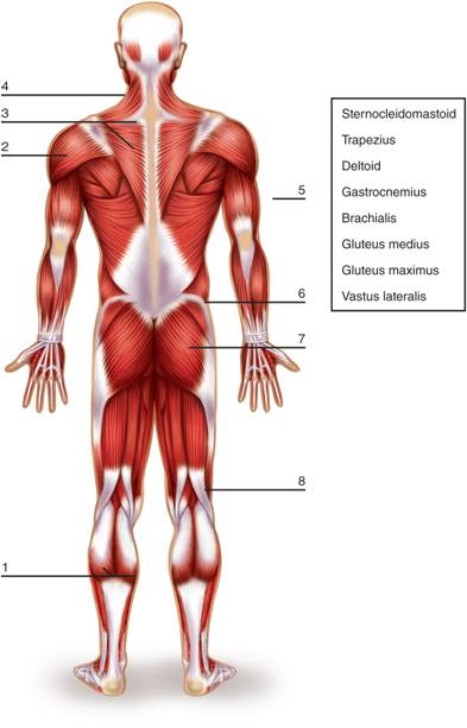
Number 3 in the figure is the ________ muscle.
Question
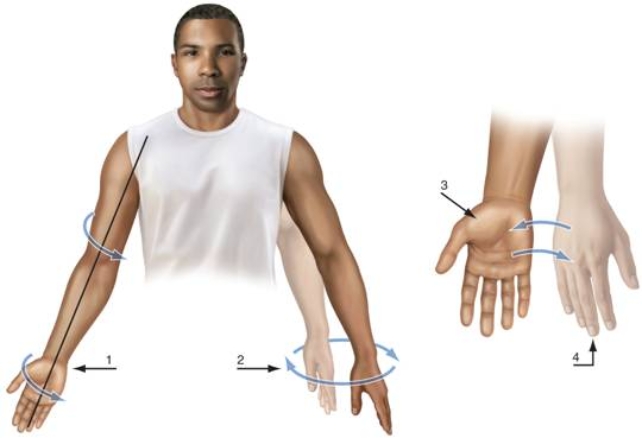
Numbers 1 and 2 demonstrate ____.
A) supination and pronation
B) elevation and pronation
C) rotation and circumduction
D) circumduction and supination
E) rotation and dorsiflexion
Question
Question
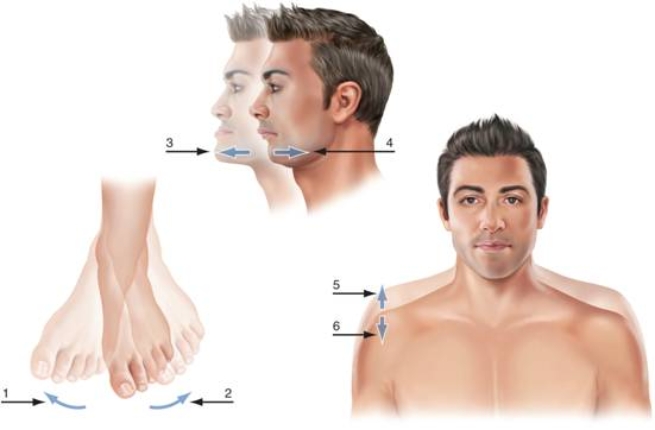
Numbers 3 and 4 on the figure demonstrate ____.
A) depression and inversion
B) eversion and protraction
C) protraction and retraction
D) elevation and inversion
E) inversion and protraction
Question
Question
Numbers 1 and 2 on the figure are examples of ____.
A) flexion and extension
B) flexion and abduction
C) pronation and extension
D) abduction and adduction
E) dorsiflexion and pronation
Question
Question
Question
Question
Supination and pronation are demonstrated by numbers _____.
A) 1 and 3
B) 3 and 4
C) 4 and 2
D) 2 and 3
E) 1 and 2
Question
As aging occurs, muscle contractions ____.
A) do not change
B) become slower
C) become stronger
D) become faster
E) become absent
Question
Eversion and inversion are demonstrated by numbers ____.
A) 3 and 6
B) 1 and 2
C) 4 and 5
D) 2 and 4
E) 3 and 4
Question
As changes occur in the musculoskeletal system due to aging, which of the following is not likely to occur?
A) Elderly patients will have increasing difficulty with dexterity.
B) Mobility may decrease.
C) Elderly patients will have increasing difficulty with gripping ability.
D) Assistive devices may be needed.
E) Endurance of muscle fibers decreases dramatically.
Question
Number 1 in the figure is the ________ muscle.
Question
Number 2 in the figure represents the ________ muscle.
Question
Question
Numbers 5 and 6 demonstrate ____.
A) protraction and depression
B) elevation and eversion
C) depression and retraction
D) elevation and depression
E) eversion and inversion
Question
Question
Question
Question
Question
Question
Question
Question
Question
Question
Question
Question
Question
Question
Question
Question
Question
Question
Question
Question

Unlock Deck
Sign up to unlock the cards in this deck!
Unlock Deck
Unlock Deck
1/100

Play

Full screen (f)
Deck 24: The Muscular System
1
The ____ divides muscles into sections called fascicles.
A) tendon
B) aponeurosis
C) perimysium
D) fascia
E) endomysium
A) tendon
B) aponeurosis
C) perimysium
D) fascia
E) endomysium
perimysium
2
Which of the following is a protein that stores phosphate groups for use by ATP?
A) Glucose
B) Lactic acid
C) Creatine phosphate
D) Pyruvic acid
E) Acetylcholine
A) Glucose
B) Lactic acid
C) Creatine phosphate
D) Pyruvic acid
E) Acetylcholine
Creatine phosphate
3
Which of the following does not apply to skeletal muscle?
A) It is under voluntary control.
B) It has intercalated discs.
C) It is attached to bones.
D) It contracts rapidly.
E) It responds to acetylcholine.
A) It is under voluntary control.
B) It has intercalated discs.
C) It is attached to bones.
D) It contracts rapidly.
E) It responds to acetylcholine.
It has intercalated discs.
4
In order to get tetanus, a person must have a(n) ____.
A) impaired immune system
B) open wound, usually from a puncture by a contaminated object
C) family history of tetanus
D) high-stress lifestyle
E) high level of sports-related activity
A) impaired immune system
B) open wound, usually from a puncture by a contaminated object
C) family history of tetanus
D) high-stress lifestyle
E) high level of sports-related activity
Unlock Deck
Unlock for access to all 100 flashcards in this deck.
Unlock Deck
k this deck
5
An early sign of tetanus is ____.
A) drooling
B) fever
C) diarrhea
D) sweating
E) muscle spasm in the jaw and neck
A) drooling
B) fever
C) diarrhea
D) sweating
E) muscle spasm in the jaw and neck
Unlock Deck
Unlock for access to all 100 flashcards in this deck.
Unlock Deck
k this deck
6
Which of the following are characteristics of cardiac muscle?
A) It is under voluntary control and has intercalated discs.
B) It is self-exciting and controls blood vessels.
C) It is slow to contract and relax and is under voluntary control.
D) It has intercalated discs and is self-exciting.
E) It produces peristalsis and has intercalated discs.
A) It is under voluntary control and has intercalated discs.
B) It is self-exciting and controls blood vessels.
C) It is slow to contract and relax and is under voluntary control.
D) It has intercalated discs and is self-exciting.
E) It produces peristalsis and has intercalated discs.
Unlock Deck
Unlock for access to all 100 flashcards in this deck.
Unlock Deck
k this deck
7
Which of the following uses glucose to help make ATP?
A) Creatine phosphate
B) Aerobic respiration
C) Lactic acid
D) Pyruvic acid
E) Acetylcholine
A) Creatine phosphate
B) Aerobic respiration
C) Lactic acid
D) Pyruvic acid
E) Acetylcholine
Unlock Deck
Unlock for access to all 100 flashcards in this deck.
Unlock Deck
k this deck
8
Small amounts of ATP are produced when pyruvic acid is converted to ____.
A) creatine phosphate
B) glucose
C) acetylcholinesterase
D) myoglobin
E) lactic acid
A) creatine phosphate
B) glucose
C) acetylcholinesterase
D) myoglobin
E) lactic acid
Unlock Deck
Unlock for access to all 100 flashcards in this deck.
Unlock Deck
k this deck
9
When muscles have a buildup of lactic acid, this ____.
A) results from excess oxygen
B) causes muscle fatigue
C) can be corrected by increasing muscle activity
D) is caused by muscle cramps
E) is a normal result of aerobic respiration
A) results from excess oxygen
B) causes muscle fatigue
C) can be corrected by increasing muscle activity
D) is caused by muscle cramps
E) is a normal result of aerobic respiration
Unlock Deck
Unlock for access to all 100 flashcards in this deck.
Unlock Deck
k this deck
10
When working with parents of young children who are at risk of botulism, what is the most important instruction to give them to reduce this risk?
A) Wash all foods well
B) Do not use well water for infants or children
C) Do not use raw fish or food from damaged or bulging cans of vegetables
D) Be sure to wash infants' and children's hands before they eat
E) Avoid giving children fresh vegetables
A) Wash all foods well
B) Do not use well water for infants or children
C) Do not use raw fish or food from damaged or bulging cans of vegetables
D) Be sure to wash infants' and children's hands before they eat
E) Avoid giving children fresh vegetables
Unlock Deck
Unlock for access to all 100 flashcards in this deck.
Unlock Deck
k this deck
11
A man staggers into the clinic. He is known to be a heavy cocaine and alcohol user. Part of the clinical data gathered includes a urine sample, which is very dark in color. He complains of weakness and has a "small" seizure in the exam room. The practitioner suspects that he may have ____.
A) tetanus
B) botulism
C) trichinosis
D) rhabdomyolysis
E) fibromyalgia
A) tetanus
B) botulism
C) trichinosis
D) rhabdomyolysis
E) fibromyalgia
Unlock Deck
Unlock for access to all 100 flashcards in this deck.
Unlock Deck
k this deck
12
A mother calls your office about her 8-month-old, who is not very active, has a weak cry, and has not had a wet diaper for 2 days. This mom is known to make homemade baby food. What advice would be appropriate for the medical assistant to give to this mother?
A) Bring the baby in tomorrow, when there is an open time slot on the schedule
B) Encourage the baby to drink water
C) Take the baby to the local emergency department
D) Administer one dose of pediatric Tylenol and call back in three hours
E) Give the baby toddler foods to stimulate urination
A) Bring the baby in tomorrow, when there is an open time slot on the schedule
B) Encourage the baby to drink water
C) Take the baby to the local emergency department
D) Administer one dose of pediatric Tylenol and call back in three hours
E) Give the baby toddler foods to stimulate urination
Unlock Deck
Unlock for access to all 100 flashcards in this deck.
Unlock Deck
k this deck
13
Which type of muscle moves contents through hollow organs such as the intestines?
A) Cardiac muscle
B) Visceral smooth muscle
C) Smooth and skeletal muscle
D) Skeletal muscle
E) Multi-unit smooth muscle
A) Cardiac muscle
B) Visceral smooth muscle
C) Smooth and skeletal muscle
D) Skeletal muscle
E) Multi-unit smooth muscle
Unlock Deck
Unlock for access to all 100 flashcards in this deck.
Unlock Deck
k this deck
14
Which of the following is true regarding the cardiac muscle?
A) It is under voluntary control
B) It contracts and relaxes slowly
C) It is self-exciting
D) It is attached to bones
E) It produces peristalsis
A) It is under voluntary control
B) It contracts and relaxes slowly
C) It is self-exciting
D) It is attached to bones
E) It produces peristalsis
Unlock Deck
Unlock for access to all 100 flashcards in this deck.
Unlock Deck
k this deck
15
Which of the following produces body movement?
A) Skeletal and cardiac muscle
B) Multi-unit smooth muscle
C) Smooth and skeletal muscle
D) Skeletal muscle
E) Visceral smooth muscle
A) Skeletal and cardiac muscle
B) Multi-unit smooth muscle
C) Smooth and skeletal muscle
D) Skeletal muscle
E) Visceral smooth muscle
Unlock Deck
Unlock for access to all 100 flashcards in this deck.
Unlock Deck
k this deck
16
Individual muscle cells are surrounded by which of the following?
A) Tendon
B) Aponeurosis
C) Perimysium
D) Fascia
E) Endomysium
A) Tendon
B) Aponeurosis
C) Perimysium
D) Fascia
E) Endomysium
Unlock Deck
Unlock for access to all 100 flashcards in this deck.
Unlock Deck
k this deck
17
Elysia is a young woman who has just been diagnosed with fibromyalgia. The practitioner asks the medical assistant to provide her with tips to help manage this disorder. The medical assistant should suggest that she ____.
A) avoid any alcohol use
B) reduce activities when her pain is the greatest
C) seek counseling to help develop better coping skills
D) increase her intake of caffeine to give her more energy
E) avoid taking anti-inflammatory medications
A) avoid any alcohol use
B) reduce activities when her pain is the greatest
C) seek counseling to help develop better coping skills
D) increase her intake of caffeine to give her more energy
E) avoid taking anti-inflammatory medications
Unlock Deck
Unlock for access to all 100 flashcards in this deck.
Unlock Deck
k this deck
18
Two of the best players on a middle-school soccer team just showed up 15 minutes late for a match. They want to go out on the field immediately, but the coach insists that they warm up and do stretches before joining the game. Which of the following is the best explanation the coach can give these players about warming up before entering the game?
A) "Warming up first will help keep you focused."
B) "If you perform the proper stretches, you will have a better chance of winning."
C) "Warming up and stretching will help keep you warm during the game."
D) "Warming up and stretching will help prevent injuries during the match."
E) "Stretching before the game can help prevent dizziness and fainting."
A) "Warming up first will help keep you focused."
B) "If you perform the proper stretches, you will have a better chance of winning."
C) "Warming up and stretching will help keep you warm during the game."
D) "Warming up and stretching will help prevent injuries during the match."
E) "Stretching before the game can help prevent dizziness and fainting."
Unlock Deck
Unlock for access to all 100 flashcards in this deck.
Unlock Deck
k this deck
19
Which of the following does not apply to visceral smooth muscle?
A) It is found in blood vessels.
B) The muscles stimulate each other to contract.
C) It is located in the bladder and uterus.
D) It produces peristalsis.
E) It moves ova through the Fallopian tubes.
A) It is found in blood vessels.
B) The muscles stimulate each other to contract.
C) It is located in the bladder and uterus.
D) It produces peristalsis.
E) It moves ova through the Fallopian tubes.
Unlock Deck
Unlock for access to all 100 flashcards in this deck.
Unlock Deck
k this deck
20
Which characteristic applies to smooth muscle?
A) It contracts rapidly.
B) It is under voluntary control.
C) It produces peristalsis.
D) It is self-exciting.
E) It contains intercalated discs.
A) It contracts rapidly.
B) It is under voluntary control.
C) It produces peristalsis.
D) It is self-exciting.
E) It contains intercalated discs.
Unlock Deck
Unlock for access to all 100 flashcards in this deck.
Unlock Deck
k this deck
21
Referring to the figure, which of the following demonstrate flexion?
A) 4 and 1
B) 5 and 6
C) 4 and 9
D) 1 and 8
E) 2 and 7
Unlock Deck
Unlock for access to all 100 flashcards in this deck.
Unlock Deck
k this deck
22
For which of the following is the use of braces an appropriate treatment?
A) Fibromyalgia
B) Muscular dystrophy
C) Tetanus
D) Botulism
E) Myasthenia gravis
A) Fibromyalgia
B) Muscular dystrophy
C) Tetanus
D) Botulism
E) Myasthenia gravis
Unlock Deck
Unlock for access to all 100 flashcards in this deck.
Unlock Deck
k this deck
23
Which symptoms are common in trichinosis?
A) Diarrhea and pneumonia
B) Dark urine and muscle fatigue
C) Tender body areas and dark urine
D) Absence of reflexes and high fever
E) Limited range of motion and diarrhea
A) Diarrhea and pneumonia
B) Dark urine and muscle fatigue
C) Tender body areas and dark urine
D) Absence of reflexes and high fever
E) Limited range of motion and diarrhea
Unlock Deck
Unlock for access to all 100 flashcards in this deck.
Unlock Deck
k this deck
24
Which of the following attaches muscles to each other?
A) Tendon
B) Aponeurosis
C) Perimysium
D) Fascia
E) Endomysium
A) Tendon
B) Aponeurosis
C) Perimysium
D) Fascia
E) Endomysium
Unlock Deck
Unlock for access to all 100 flashcards in this deck.
Unlock Deck
k this deck
25
Lifestyle changes of avoiding stress are recommended for patients who have ____.
A) muscular dystrophy
B) tetanus and myasthenia gravis
C) rhabdomyolysis and botulism
D) myasthenia gravis and fibromyalgia
E) botulism and fibromyalgia
A) muscular dystrophy
B) tetanus and myasthenia gravis
C) rhabdomyolysis and botulism
D) myasthenia gravis and fibromyalgia
E) botulism and fibromyalgia
Unlock Deck
Unlock for access to all 100 flashcards in this deck.
Unlock Deck
k this deck
26
Which muscle is most responsible for movement?
A) Insertion
B) Origin
C) Agonist
D) Synergist
E) Antagonist
A) Insertion
B) Origin
C) Agonist
D) Synergist
E) Antagonist
Unlock Deck
Unlock for access to all 100 flashcards in this deck.
Unlock Deck
k this deck
27
The attachment site for the less movable bone when a muscle contracts is the ____.
A) insertion
B) origin
C) prime mover
D) synergist
E) antagonist
A) insertion
B) origin
C) prime mover
D) synergist
E) antagonist
Unlock Deck
Unlock for access to all 100 flashcards in this deck.
Unlock Deck
k this deck
28
The number 5 on the figure demonstrates ____.
A) flexion
B) extension
C) abduction
D) adduction
E) dorsiflexion
Unlock Deck
Unlock for access to all 100 flashcards in this deck.
Unlock Deck
k this deck
29
Which of the following muscles moves the thigh?
A) Biceps brachii
B) Gluteus medius
C) External oblique
D) Gastrocnemius
E) Soleus
A) Biceps brachii
B) Gluteus medius
C) External oblique
D) Gastrocnemius
E) Soleus
Unlock Deck
Unlock for access to all 100 flashcards in this deck.
Unlock Deck
k this deck
30
Which of the following is a muscle that produces movement opposite to the prime mover?
A) Insertion
B) Origin
C) Synergist
D) Antagonist
E) Agonist
A) Insertion
B) Origin
C) Synergist
D) Antagonist
E) Agonist
Unlock Deck
Unlock for access to all 100 flashcards in this deck.
Unlock Deck
k this deck
31
Which of the following muscles moves the forearm?
A) Biceps brachii
B) External oblique
C) Gluteus medius
D) Gastrocnemius
E) Trapezius
A) Biceps brachii
B) External oblique
C) Gluteus medius
D) Gastrocnemius
E) Trapezius
Unlock Deck
Unlock for access to all 100 flashcards in this deck.
Unlock Deck
k this deck
32
Which muscle closes the jaw?
A) Temporalis
B) Sternocleidomastoid
C) Trapezius
D) Biceps brachii
E) Latissimus dorsi
A) Temporalis
B) Sternocleidomastoid
C) Trapezius
D) Biceps brachii
E) Latissimus dorsi
Unlock Deck
Unlock for access to all 100 flashcards in this deck.
Unlock Deck
k this deck
33
The attachment site for the more movable bone when a muscle contracts is the ____.
A) insertion
B) origin
C) synergist
D) antagonist
A) insertion
B) origin
C) synergist
D) antagonist
Unlock Deck
Unlock for access to all 100 flashcards in this deck.
Unlock Deck
k this deck
34
Which of the following connects muscles to bone?
A) Tendon
B) Aponeurosis
C) Perimysium
D) Fascia
E) Endomysium
A) Tendon
B) Aponeurosis
C) Perimysium
D) Fascia
E) Endomysium
Unlock Deck
Unlock for access to all 100 flashcards in this deck.
Unlock Deck
k this deck
35
Which of these muscles flexes the foot and is commonly called the calf muscle?
A) Biceps brachii
B) External oblique
C) Gluteus medius
D) Gastrocnemius
E) Sartorius
A) Biceps brachii
B) External oblique
C) Gluteus medius
D) Gastrocnemius
E) Sartorius
Unlock Deck
Unlock for access to all 100 flashcards in this deck.
Unlock Deck
k this deck
36
The ____ muscle moves the abdominal wall.
A) biceps brachii
B) external oblique
C) gluteus medius
D) gastrocnemius
E) soleus
A) biceps brachii
B) external oblique
C) gluteus medius
D) gastrocnemius
E) soleus
Unlock Deck
Unlock for access to all 100 flashcards in this deck.
Unlock Deck
k this deck
37
One common symptom of rhabdomyolysis is ____.
A) diarrhea
B) encephalitis
C) dark urine
D) muscle spasms
E) absence of reflexes
A) diarrhea
B) encephalitis
C) dark urine
D) muscle spasms
E) absence of reflexes
Unlock Deck
Unlock for access to all 100 flashcards in this deck.
Unlock Deck
k this deck
38
The ____ muscle moves the head.
A) temporalis
B) sternocleidomastoid
C) trapezius
D) biceps brachii
E) Trapezius
A) temporalis
B) sternocleidomastoid
C) trapezius
D) biceps brachii
E) Trapezius
Unlock Deck
Unlock for access to all 100 flashcards in this deck.
Unlock Deck
k this deck
39
The shoulder is moved by the ____ muscle.
A) temporalis
B) sternocleidomastoid
C) gastrocnemius
D) biceps brachii
E) trapezius
A) temporalis
B) sternocleidomastoid
C) gastrocnemius
D) biceps brachii
E) trapezius
Unlock Deck
Unlock for access to all 100 flashcards in this deck.
Unlock Deck
k this deck
40
Which type of connective tissue separates muscles from each other?
A) Tendon
B) Aponeurosis
C) Perimysium
D) Fascia
E) Endomysium
A) Tendon
B) Aponeurosis
C) Perimysium
D) Fascia
E) Endomysium
Unlock Deck
Unlock for access to all 100 flashcards in this deck.
Unlock Deck
k this deck
41
Dorsiflexion and plantar flexion are represented by the numbers ____.
A) 7 and 6
B) 5 and 4
C) 6 and 5
D) 2 and 3
E) 1 and 4
Unlock Deck
Unlock for access to all 100 flashcards in this deck.
Unlock Deck
k this deck
42
Once contraction has occurred, skeletal muscles release an enzyme called ________, which breaks down acetylcholine and allows the muscle to relax.
Unlock Deck
Unlock for access to all 100 flashcards in this deck.
Unlock Deck
k this deck
43
Monique is a 79-year-old patient who enjoys being active. Recently, however, her arthritis is getting worse, and she has been having more trouble moving around lately. She tells you that she wants to exercise and stay active, but she is not sure what kinds of exercise she can do now. Which of the following recommendations might you make?
A) "Take a pain pill after you exercise."
B) "Aerobic exercise is good for you even if you have arthritis."
C) "It is not necessary to exercise at your age."
D) "Try swimming or exercising your joints underwater."
E) "Any kind of exercise will make the arthritis worse."
Unlock Deck
Unlock for access to all 100 flashcards in this deck.
Unlock Deck
k this deck
44
Number 3 in the figure is the ________ muscle.
Unlock Deck
Unlock for access to all 100 flashcards in this deck.
Unlock Deck
k this deck
45
Numbers 1 and 2 demonstrate ____.
A) supination and pronation
B) elevation and pronation
C) rotation and circumduction
D) circumduction and supination
E) rotation and dorsiflexion
Unlock Deck
Unlock for access to all 100 flashcards in this deck.
Unlock Deck
k this deck
46
Number 6 in the figure represents the ________ muscle.
Unlock Deck
Unlock for access to all 100 flashcards in this deck.
Unlock Deck
k this deck
47
Numbers 3 and 4 on the figure demonstrate ____.
A) depression and inversion
B) eversion and protraction
C) protraction and retraction
D) elevation and inversion
E) inversion and protraction
Unlock Deck
Unlock for access to all 100 flashcards in this deck.
Unlock Deck
k this deck
48
Skeletal muscle fibers respond only to the neurotransmitter ________, which causes them to contract.
Unlock Deck
Unlock for access to all 100 flashcards in this deck.
Unlock Deck
k this deck
49
Numbers 1 and 2 on the figure are examples of ____.
A) flexion and extension
B) flexion and abduction
C) pronation and extension
D) abduction and adduction
E) dorsiflexion and pronation
Unlock Deck
Unlock for access to all 100 flashcards in this deck.
Unlock Deck
k this deck
50
The ________ is represented by number 8 on the figure.
Unlock Deck
Unlock for access to all 100 flashcards in this deck.
Unlock Deck
k this deck
51
The ________ muscle is represented by number 4 in the figure.
Unlock Deck
Unlock for access to all 100 flashcards in this deck.
Unlock Deck
k this deck
52
The ________ muscle is located at number 5 in the figure.
Unlock Deck
Unlock for access to all 100 flashcards in this deck.
Unlock Deck
k this deck
53
Supination and pronation are demonstrated by numbers _____.
A) 1 and 3
B) 3 and 4
C) 4 and 2
D) 2 and 3
E) 1 and 2
Unlock Deck
Unlock for access to all 100 flashcards in this deck.
Unlock Deck
k this deck
54
As aging occurs, muscle contractions ____.
A) do not change
B) become slower
C) become stronger
D) become faster
E) become absent
Unlock Deck
Unlock for access to all 100 flashcards in this deck.
Unlock Deck
k this deck
55
Eversion and inversion are demonstrated by numbers ____.
A) 3 and 6
B) 1 and 2
C) 4 and 5
D) 2 and 4
E) 3 and 4
Unlock Deck
Unlock for access to all 100 flashcards in this deck.
Unlock Deck
k this deck
56
As changes occur in the musculoskeletal system due to aging, which of the following is not likely to occur?
A) Elderly patients will have increasing difficulty with dexterity.
B) Mobility may decrease.
C) Elderly patients will have increasing difficulty with gripping ability.
D) Assistive devices may be needed.
E) Endurance of muscle fibers decreases dramatically.
Unlock Deck
Unlock for access to all 100 flashcards in this deck.
Unlock Deck
k this deck
57
Number 1 in the figure is the ________ muscle.
Unlock Deck
Unlock for access to all 100 flashcards in this deck.
Unlock Deck
k this deck
58
Number 2 in the figure represents the ________ muscle.
Unlock Deck
Unlock for access to all 100 flashcards in this deck.
Unlock Deck
k this deck
59
Number 7 represents the ________ muscle.
Unlock Deck
Unlock for access to all 100 flashcards in this deck.
Unlock Deck
k this deck
60
Numbers 5 and 6 demonstrate ____.
A) protraction and depression
B) elevation and eversion
C) depression and retraction
D) elevation and depression
E) eversion and inversion
Unlock Deck
Unlock for access to all 100 flashcards in this deck.
Unlock Deck
k this deck
61
The ________ is connective tissue that is just below the skin to help support and hold together muscles, bones, nerves, and blood vessels.
Unlock Deck
Unlock for access to all 100 flashcards in this deck.
Unlock Deck
k this deck
62
The _______ is a tough, sheet-like structure made of fibrous connective tissue that typically attaches muscles to other muscles.
Unlock Deck
Unlock for access to all 100 flashcards in this deck.
Unlock Deck
k this deck
63
________ is a rare but very serious disorder caused by a bacterium that normally lives in soil and water and mainly affects the gastrointestinal tract.
Unlock Deck
Unlock for access to all 100 flashcards in this deck.
Unlock Deck
k this deck
64
When pyruvic acid is converted to ________ acid for energy production, this waste product builds up and causes muscle fatigue.
Unlock Deck
Unlock for access to all 100 flashcards in this deck.
Unlock Deck
k this deck
65
Muscle cells, or ________, are called muscle fibers because of their long lengths.
Unlock Deck
Unlock for access to all 100 flashcards in this deck.
Unlock Deck
k this deck
66
The perimysium is connective tissue surrounding a group of muscle fibers called a ________.
Unlock Deck
Unlock for access to all 100 flashcards in this deck.
Unlock Deck
k this deck
67
The process of ________ respiration uses the body's store of glucose to make ATP.
Unlock Deck
Unlock for access to all 100 flashcards in this deck.
Unlock Deck
k this deck
68
Muscle ________ is a condition in which a muscle has lost its ability to contract. This condition usually develops because of an accumulation of lactic acid.
Unlock Deck
Unlock for access to all 100 flashcards in this deck.
Unlock Deck
k this deck
69
The production of ________ is a rapid way for muscle to produce energy.
Unlock Deck
Unlock for access to all 100 flashcards in this deck.
Unlock Deck
k this deck
70
A thin covering that is just deep to the fascia of a muscle and surrounds the entire muscle is the ________.
Unlock Deck
Unlock for access to all 100 flashcards in this deck.
Unlock Deck
k this deck
71
The biceps brachii attaches to two places on the scapula and to one site on the radius. When the biceps brachii contracts, the radius moves and the arm bends at the elbow. The ________ of the biceps brachii is where it attaches to the scapula.
Unlock Deck
Unlock for access to all 100 flashcards in this deck.
Unlock Deck
k this deck
72
The biceps brachii attaches to two places on the scapula and to one site on the radius. When the biceps brachii contracts, the radius moves and the arm bends at the elbow. The ________ site of the biceps brachii is its attachment site on the radius.
Unlock Deck
Unlock for access to all 100 flashcards in this deck.
Unlock Deck
k this deck
73
A fairly common condition that results in chronic pain primarily in joints, muscles, and tendons and most commonly affects women between the ages of 20 and 50 is ________.
Unlock Deck
Unlock for access to all 100 flashcards in this deck.
Unlock Deck
k this deck
74
The smooth muscle found in the iris of the eye and the walls of blood vessels, which contracts in response to neurotransmitters and hormones, is known as a ________ smooth muscle.
Unlock Deck
Unlock for access to all 100 flashcards in this deck.
Unlock Deck
k this deck
75
The _______ is the covering of connective tissue that surrounds individual muscle cells.
Unlock Deck
Unlock for access to all 100 flashcards in this deck.
Unlock Deck
k this deck
76
Groups of cardiac muscle are connected to each other through ________ discs that allow the fibers in each group to contract and relax together and allows the heart to work as a pump.
Unlock Deck
Unlock for access to all 100 flashcards in this deck.
Unlock Deck
k this deck
77
Pyruvic acid is converted into acetyl coenzyme A, which begins a series of reactions known as the ________ cycle or the citric acid cycle.
Unlock Deck
Unlock for access to all 100 flashcards in this deck.
Unlock Deck
k this deck
78
Myocytes are called muscle ________ because of their long lengths.
Unlock Deck
Unlock for access to all 100 flashcards in this deck.
Unlock Deck
k this deck
79
Most of the sarcoplasm is filled with long structures called ________, which produce the striations observed in skeletal and cardiac muscle cells.
Unlock Deck
Unlock for access to all 100 flashcards in this deck.
Unlock Deck
k this deck
80
The oxygen needed for aerobic respiration is stored in the muscle pigment called ________, which also gives muscle its pinkish color.
Unlock Deck
Unlock for access to all 100 flashcards in this deck.
Unlock Deck
k this deck
Unlock Deck
Unlock for access to all 100 flashcards in this deck.






