







 Chat with AI

Deck 20: Intrapartum Nursing Assessment
Full screen (f)

Question

Question
Question
Question
Question
Question
Question
Question
Question
Question
Question
Question
Question
Question
Question
Question
Question
Question
Question
Question
Question
Question
The fetus of a laboring patient is in the following position:
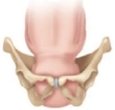
What should the nurse expect when conducting the intrapartum vaginal examination?
A)

B)

C)

D)

What should the nurse expect when conducting the intrapartum vaginal examination?
A)
B)
C)
D)
Question
A laboring patient being monitored has the following rhythm strip:
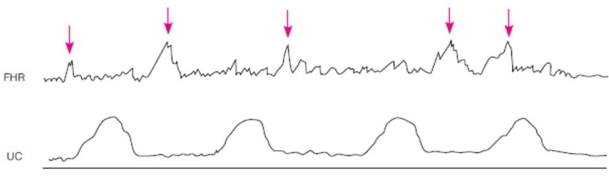
How should the nurse interpret this finding?
A) Early decelerations
B) Periodic accelerations
C) Episodic accelerations
D) Variable decelerations with overshoot
How should the nurse interpret this finding?
A) Early decelerations
B) Periodic accelerations
C) Episodic accelerations
D) Variable decelerations with overshoot
Question
Question
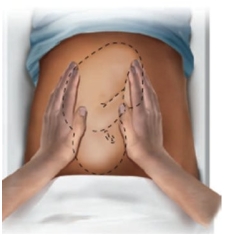
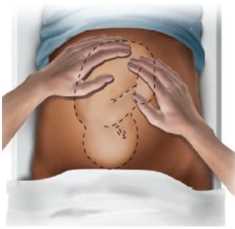
The nurse is performing Leopold maneuvers with a patient in the 3rd trimester of pregnancy. Which maneuver should the nurse perform first?
A)
B)
C)
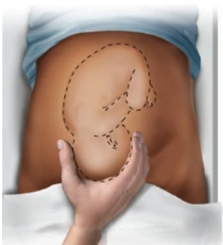
D)
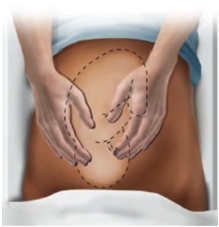
A)
B)
C)
D)
Question
Question
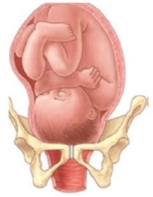
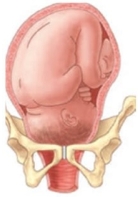
During an intrapartum vaginal examination the nurse palpates the following:
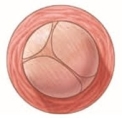
Based upon this information, which diagram best describes the fetal descent and station?
A)
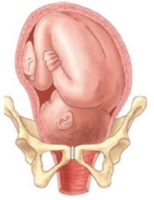
B)
C)
D)
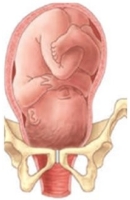
Based upon this information, which diagram best describes the fetal descent and station?
A)
B)
C)
D)
Question
Question
Question
Question
The fetus of a pregnant patient is in the right occiput anterior (R O A) position. Where should the nurse auscultate the fetal heart sounds?
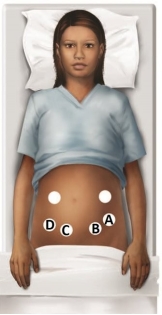
A) A
B) B
C) C
D) D
A) A
B) B
C) C
D) D
Question
Question

Unlock Deck
Sign up to unlock the cards in this deck!
Unlock Deck
Unlock Deck
1/33

Play

Full screen (f)
Deck 20: Intrapartum Nursing Assessment
1
While caring for a client in labor, the nurse notes the following F H R pattern:
Which action should the nurse perform?
A) Continue to monitor the client
B) Fetal scalp stimulation
C) Palpate contraction strength
D) Discontinue oxytocin
Which action should the nurse perform?
A) Continue to monitor the client
B) Fetal scalp stimulation
C) Palpate contraction strength
D) Discontinue oxytocin
A
2
The nurse is caring for a client with fetal heart rate monitoring, and the fetus is discovered to have tachycardia. Which complication should the nurse anticipate in the fetus?
A) Infection
B) Umbilical cord compression
C) Vagus nerve stimulation
D) Hypoxemia
A) Infection
B) Umbilical cord compression
C) Vagus nerve stimulation
D) Hypoxemia
A
3
The nurse is preparing to assess the fetus of a laboring client. Which assessment should the nurse perform first?
A) Perform Leopold maneuvers to determine fetal position.
B) Count the fetal heart rate between, during, and for 30 seconds following a uterine contraction (U C).
C) Dry the maternal abdomen before using the Doppler.
D) The diaphragm should be cooled before using the Doppler.
A) Perform Leopold maneuvers to determine fetal position.
B) Count the fetal heart rate between, during, and for 30 seconds following a uterine contraction (U C).
C) Dry the maternal abdomen before using the Doppler.
D) The diaphragm should be cooled before using the Doppler.
A
4
After several hours of labor, the electronic fetal monitor (E F M) shows repetitive variable decelerations in the fetal heart rate. The nurse would interpret the decelerations to be consistent with which of the following?
A) Breech presentation
B) Uteroplacental insufficiency
C) Compression of the fetal head
D) Umbilical cord compression
A) Breech presentation
B) Uteroplacental insufficiency
C) Compression of the fetal head
D) Umbilical cord compression
Unlock Deck
Unlock for access to all 33 flashcards in this deck.
Unlock Deck
k this deck
5
The laboring client with meconium-stained amniotic fluid asks the nurse why the fetal monitor is necessary, as she finds the belt uncomfortable. Which response by the nurse is most important?
A) "The monitor is necessary so we can see how your labor is progressing."
B) "The monitor will prevent complications from the meconium in your fluid."
C) "The monitor helps us to see how the baby is tolerating labor."
D) "The monitor can be removed, and oxygen given instead."
A) "The monitor is necessary so we can see how your labor is progressing."
B) "The monitor will prevent complications from the meconium in your fluid."
C) "The monitor helps us to see how the baby is tolerating labor."
D) "The monitor can be removed, and oxygen given instead."
Unlock Deck
Unlock for access to all 33 flashcards in this deck.
Unlock Deck
k this deck
6
While caring for a client in labor, the nurse notes the following persistent rhythm on the fetal heart rate monitor:
Which action should the nurse take first?
A) Notify the provider.
B) Prepare for expedient delivery.
C) Reposition the client.
D) Discontinue oxytocin therapy.
Which action should the nurse take first?
A) Notify the provider.
B) Prepare for expedient delivery.
C) Reposition the client.
D) Discontinue oxytocin therapy.
Unlock Deck
Unlock for access to all 33 flashcards in this deck.
Unlock Deck
k this deck
7
The nurse is admitting a client to the labor and delivery unit. Which aspect of the client's history requires notifying the physician?
A) Blood pressure 120/88
B) Father a carrier of sickle-cell trait
C) Dark red vaginal bleeding
D) History of domestic abuse
A) Blood pressure 120/88
B) Father a carrier of sickle-cell trait
C) Dark red vaginal bleeding
D) History of domestic abuse
Unlock Deck
Unlock for access to all 33 flashcards in this deck.
Unlock Deck
k this deck
8
The nurse is caring for a client undergoing fetal heart rate monitoring, and the F H R is greater than 162 beats/min for 12 minutes. For what cause(s) should the nurse anticipate treatment?
Note: Credit will be given only if all correct choices and no incorrect choices are selected.
A) Maternal anxiety
B) Fetal asphyxia
C) Prematurity
D) Fetal anemia
E) Maternal hypotension
Note: Credit will be given only if all correct choices and no incorrect choices are selected.
A) Maternal anxiety
B) Fetal asphyxia
C) Prematurity
D) Fetal anemia
E) Maternal hypotension
Unlock Deck
Unlock for access to all 33 flashcards in this deck.
Unlock Deck
k this deck
9
The nurse auscultates the F H R and determines a rate of 112 beats/min. Which action is appropriate?
A) Inform the maternal client that the rate is normal.
B) Reassess the F H R in 5 minutes because the rate is low.
C) Report the F H R to the doctor immediately.
D) Turn the maternal client on her side and administer oxygen.
A) Inform the maternal client that the rate is normal.
B) Reassess the F H R in 5 minutes because the rate is low.
C) Report the F H R to the doctor immediately.
D) Turn the maternal client on her side and administer oxygen.
Unlock Deck
Unlock for access to all 33 flashcards in this deck.
Unlock Deck
k this deck
10
The nurse is reviewing the F H R monitor for a client in labor. The rhythm strip yields the following result:
How should the nurse interpret this pattern?
A) Moderate variability
B) Minimal variability
C) Absent variability
D) Marked variability
How should the nurse interpret this pattern?
A) Moderate variability
B) Minimal variability
C) Absent variability
D) Marked variability
Unlock Deck
Unlock for access to all 33 flashcards in this deck.
Unlock Deck
k this deck
11
The nurse is assessing the baseline fetal heart rate for a client in labor.
What action should the nurse take first?
A) Measure the fetal heart rate for 10 minutes
B) Round the heart rate to increments of 5 beats/minute
C) Exclude periods of marked variation
D) Calculate the mean (average) heart rate
What action should the nurse take first?
A) Measure the fetal heart rate for 10 minutes
B) Round the heart rate to increments of 5 beats/minute
C) Exclude periods of marked variation
D) Calculate the mean (average) heart rate
Unlock Deck
Unlock for access to all 33 flashcards in this deck.
Unlock Deck
k this deck
12
A woman is in labor. The fetus is in vertex position. When the client's membranes rupture, the nurse sees that the amniotic fluid is meconium-stained. What should the nurse do immediately?
A) Change the client's position in bed.
B) Notify the physician that birth is imminent.
C) Administer oxygen at 2 liters per minute.
D) Begin continuous fetal heart rate monitoring.
A) Change the client's position in bed.
B) Notify the physician that birth is imminent.
C) Administer oxygen at 2 liters per minute.
D) Begin continuous fetal heart rate monitoring.
Unlock Deck
Unlock for access to all 33 flashcards in this deck.
Unlock Deck
k this deck
13
The nurse is admitting a client to the birthing unit. What question should the nurse ask to gain a better understanding of the client's psychosocial status?
A) "How did you decide to have your baby at this hospital?"
B) "Who will be your labor support person?"
C) "Have you chosen names for your baby yet?"
D) "What feeding method will you use for your baby?"
A) "How did you decide to have your baby at this hospital?"
B) "Who will be your labor support person?"
C) "Have you chosen names for your baby yet?"
D) "What feeding method will you use for your baby?"
Unlock Deck
Unlock for access to all 33 flashcards in this deck.
Unlock Deck
k this deck
14
Before performing Leopold maneuvers, what would the nurse do?
Note: Credit will be given only if all correct choices and no incorrect choices are selected.
A) Have the client empty her bladder.
B) Place the client in Trendelenburg position.
C) Have the client lie on her back with her feet on the bed and knees bent.
D) Turn the client to her left side.
E) This is not the optimal position for the client when performing Leopold maneuvers.
Note: Credit will be given only if all correct choices and no incorrect choices are selected.
A) Have the client empty her bladder.
B) Place the client in Trendelenburg position.
C) Have the client lie on her back with her feet on the bed and knees bent.
D) Turn the client to her left side.
E) This is not the optimal position for the client when performing Leopold maneuvers.
Unlock Deck
Unlock for access to all 33 flashcards in this deck.
Unlock Deck
k this deck
15
The student nurse is to perform Leopold maneuvers on a laboring client. Which assessment requires intervention by the staff nurse?
A) The client is assisted into supine position, and the position of the fetus is assessed.
B) The upper portion of the uterus is palpated, then the middle section.
C) After determining where the back is located, the cervix is assessed.
D) Following voiding, the client's abdomen is palpated from top to bottom.
A) The client is assisted into supine position, and the position of the fetus is assessed.
B) The upper portion of the uterus is palpated, then the middle section.
C) After determining where the back is located, the cervix is assessed.
D) Following voiding, the client's abdomen is palpated from top to bottom.
Unlock Deck
Unlock for access to all 33 flashcards in this deck.
Unlock Deck
k this deck
16
Upon assessing the F H R tracing, the nurse determines that there is fetal tachycardia. The fetal tachycardia would be caused by which of the following?
Note: Credit will be given only if all correct choices and no incorrect choices are selected.
A) Early fetal hypoxia
B) Prolonged fetal stimulation
C) Fetal anemia
D) Fetal sleep cycle
E) Infection
Note: Credit will be given only if all correct choices and no incorrect choices are selected.
A) Early fetal hypoxia
B) Prolonged fetal stimulation
C) Fetal anemia
D) Fetal sleep cycle
E) Infection
Unlock Deck
Unlock for access to all 33 flashcards in this deck.
Unlock Deck
k this deck
17
The charge nurse is looking at the charts of laboring clients. Which client is in greatest need of further intervention?
A) Woman at 7 c m, fetal heart tones auscultated every 90 minutes
B) Woman at 10 c m and pushing, external fetal monitor applied
C) Woman with meconium-stained fluid, internal fetal scalp electrode in use
D) Woman in preterm labor, external monitor in place
A) Woman at 7 c m, fetal heart tones auscultated every 90 minutes
B) Woman at 10 c m and pushing, external fetal monitor applied
C) Woman with meconium-stained fluid, internal fetal scalp electrode in use
D) Woman in preterm labor, external monitor in place
Unlock Deck
Unlock for access to all 33 flashcards in this deck.
Unlock Deck
k this deck
18
The laboring client's fetal heart rate baseline is 120 beats per minute. Accelerations are present to 135 beats/min. During contractions, the fetal heart rate gradually slows to 110, and is at 120 by the end of the contraction. What nursing action is best?
A) Document the fetal heart rate.
B) Apply oxygen via mask at 10 liters.
C) Prepare for imminent delivery.
D) Assist the client into Fowler's position.
A) Document the fetal heart rate.
B) Apply oxygen via mask at 10 liters.
C) Prepare for imminent delivery.
D) Assist the client into Fowler's position.
Unlock Deck
Unlock for access to all 33 flashcards in this deck.
Unlock Deck
k this deck
19
Persistent early decelerations are noted. What would the nurse's first action be?
A) Turn the mother on her left side and give oxygen.
B) Check for prolapsed cord.
C) Do nothing. This is a benign pattern.
D) Prepare for immediate forceps or cesarean delivery.
A) Turn the mother on her left side and give oxygen.
B) Check for prolapsed cord.
C) Do nothing. This is a benign pattern.
D) Prepare for immediate forceps or cesarean delivery.
Unlock Deck
Unlock for access to all 33 flashcards in this deck.
Unlock Deck
k this deck
20
The nurse has just palpated contractions and compares the consistency to that of the forehead in order to estimate the firmness of the fundus. What would the intensity of these contractions be identified as?
A) Mild
B) Moderate
C) Strong
D) Weak
A) Mild
B) Moderate
C) Strong
D) Weak
Unlock Deck
Unlock for access to all 33 flashcards in this deck.
Unlock Deck
k this deck
21
The fetal heart rate baseline is 140 beats/min. When contractions begin, the fetal heart rate drops suddenly to 120, and rapidly returns to 140 before the end of the contraction. Which nursing intervention is best?
A) Assist the client to change position.
B) Apply oxygen to the client at 2 liters per nasal cannula.
C) Notify the operating room of the need for a cesarean birth.
D) Determine the color of the leaking amniotic fluid.
A) Assist the client to change position.
B) Apply oxygen to the client at 2 liters per nasal cannula.
C) Notify the operating room of the need for a cesarean birth.
D) Determine the color of the leaking amniotic fluid.
Unlock Deck
Unlock for access to all 33 flashcards in this deck.
Unlock Deck
k this deck
22
The fetus of a laboring patient is in the following position:
What should the nurse expect when conducting the intrapartum vaginal examination?
A)
B)
C)
D)
What should the nurse expect when conducting the intrapartum vaginal examination?
A)
B)
C)
D)
Unlock Deck
Unlock for access to all 33 flashcards in this deck.
Unlock Deck
k this deck
23
A laboring patient being monitored has the following rhythm strip:
How should the nurse interpret this finding?
A) Early decelerations
B) Periodic accelerations
C) Episodic accelerations
D) Variable decelerations with overshoot
How should the nurse interpret this finding?
A) Early decelerations
B) Periodic accelerations
C) Episodic accelerations
D) Variable decelerations with overshoot
Unlock Deck
Unlock for access to all 33 flashcards in this deck.
Unlock Deck
k this deck
24
Fetal factors that possibly indicate electronic fetal monitoring include which of the following?
Note: Credit will be given only if all correct choices and no incorrect choices are selected.
A) Meconium passage
B) Multiple gestation
C) Preeclampsia
D) Grand multiparity
E) Decreased fetal movement
Note: Credit will be given only if all correct choices and no incorrect choices are selected.
A) Meconium passage
B) Multiple gestation
C) Preeclampsia
D) Grand multiparity
E) Decreased fetal movement
Unlock Deck
Unlock for access to all 33 flashcards in this deck.
Unlock Deck
k this deck
25
The nurse is performing Leopold maneuvers with a patient in the 3rd trimester of pregnancy. Which maneuver should the nurse perform first?
A)
B)
C)
D)
A)
B)
C)
D)
Unlock Deck
Unlock for access to all 33 flashcards in this deck.
Unlock Deck
k this deck
26
The client is in the second stage of labor. The fetal heart rate baseline is 170, with minimal variability present. The nurse performs fetal scalp stimulation. The client's partner asks why the nurse did that. What is the best response by the nurse?
A) "I stimulated the top of the fetus's head to wake him up a little."
B) "I stimulated the top of the fetus's head to try to get his heart rate to accelerate."
C) "I stimulated the top of the fetus's head to calm the fetus down before birth."
D) "I stimulated the top of the fetus's head to find out whether he is in distress."
A) "I stimulated the top of the fetus's head to wake him up a little."
B) "I stimulated the top of the fetus's head to try to get his heart rate to accelerate."
C) "I stimulated the top of the fetus's head to calm the fetus down before birth."
D) "I stimulated the top of the fetus's head to find out whether he is in distress."
Unlock Deck
Unlock for access to all 33 flashcards in this deck.
Unlock Deck
k this deck
27
During an intrapartum vaginal examination the nurse palpates the following:
Based upon this information, which diagram best describes the fetal descent and station?
A)
B)
C)
D)
Based upon this information, which diagram best describes the fetal descent and station?
A)
B)
C)
D)
Unlock Deck
Unlock for access to all 33 flashcards in this deck.
Unlock Deck
k this deck
28
The nurse is analyzing several fetal heart rate patterns. The pattern that would be of most concern to the nurse would be which of the following?
A) Moderate variability
B) Early decelerations
C) Late decelerations
D) Accelerations
A) Moderate variability
B) Early decelerations
C) Late decelerations
D) Accelerations
Unlock Deck
Unlock for access to all 33 flashcards in this deck.
Unlock Deck
k this deck
29
The labor and delivery nurse is assigned to four clients in early labor. Which electronic fetal monitoring finding would require immediate intervention?
A) Early decelerations with each contraction
B) Variable decelerations that recover to the baseline
C) Late decelerations with minimal variability
D) Accelerations
A) Early decelerations with each contraction
B) Variable decelerations that recover to the baseline
C) Late decelerations with minimal variability
D) Accelerations
Unlock Deck
Unlock for access to all 33 flashcards in this deck.
Unlock Deck
k this deck
30
The nurse is aware that a fetus that is not in any stress would respond to a fetal scalp stimulation test by showing which change on the monitor strip?
A) Late decelerations
B) Early decelerations
C) Accelerations
D) Fetal dysrhythmia
A) Late decelerations
B) Early decelerations
C) Accelerations
D) Fetal dysrhythmia
Unlock Deck
Unlock for access to all 33 flashcards in this deck.
Unlock Deck
k this deck
31
The fetus of a pregnant patient is in the right occiput anterior (R O A) position. Where should the nurse auscultate the fetal heart sounds?
A) A
B) B
C) C
D) D
A) A
B) B
C) C
D) D
Unlock Deck
Unlock for access to all 33 flashcards in this deck.
Unlock Deck
k this deck
32
After noting meconium-stained amniotic fluid and fetal heart rate decelerations, the physician diagnoses a depressed fetus. The appropriate nursing action at this time would be to do what?
A) Increase the mother's oxygen rate.
B) Turn the mother to the left lateral position.
C) Prepare the mother for a higher-risk delivery.
D) Increase the intravenous infusion rate.
A) Increase the mother's oxygen rate.
B) Turn the mother to the left lateral position.
C) Prepare the mother for a higher-risk delivery.
D) Increase the intravenous infusion rate.
Unlock Deck
Unlock for access to all 33 flashcards in this deck.
Unlock Deck
k this deck
33
A woman in labor asks the nurse to explain the electronic fetal heart rate monitor strip. The fetal heart rate baseline is 150 with accelerations to 165, variable decelerations to 140, and moderate long-term variability. Which statement indicates that the client understands the nurse's teaching?
A) "The most important part of fetal heart monitoring is the absence of variable decelerations."
B) "The most important part of fetal heart monitoring is the presence of variability."
C) "The most important part of fetal heart monitoring is the fetal heart rate baseline."
D) "The most important part of fetal heart monitoring is the depth of decelerations."
A) "The most important part of fetal heart monitoring is the absence of variable decelerations."
B) "The most important part of fetal heart monitoring is the presence of variability."
C) "The most important part of fetal heart monitoring is the fetal heart rate baseline."
D) "The most important part of fetal heart monitoring is the depth of decelerations."
Unlock Deck
Unlock for access to all 33 flashcards in this deck.
Unlock Deck
k this deck
Unlock Deck
Unlock for access to all 33 flashcards in this deck.






