Deck 10: Carboxylic Acids and Their Derivatives

Full screen (f)
exit full mode
Question
The IUPAC name for succinic acid is butanedioic acid.What is the structure of succinic acid?

A) CH3CH2CH2CO2H
B) CH3CH=CHCO2H
C) HO2CCH2CH2CO2H
D) CH3CH2CH2CO3H
E) HOCH2CH2CH2CO2H
Use Space or
up arrow
down arrow
to flip the card.
Question
The boiling point of propanoic acid is higher than that of 1-butanol because:

A) propanoic acid has a higher molecular weight than 1-butanol.
B) propanoic acid is more soluble in water than 1-butanol.
C) propanoic acid is a better hydrogen bond donor than 1-butanol.
D) propanoic acid forms hydrogen bonded dimers and 1-butanol does not.
E) 1-butanol forms hydrogen bonded dimers and propanoic acid does not.
Question
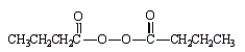
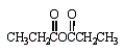
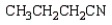
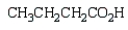
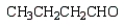
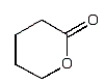
The formula for butanoic anhydride is

A) <strong>The formula for butanoic anhydride is</strong> A)   B)   C)   D)   E)   <div style=padding-top: 35px>
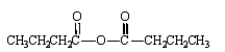
B) <strong>The formula for butanoic anhydride is</strong> A)   B)   C)   D)   E)   <div style=padding-top: 35px>
C) <strong>The formula for butanoic anhydride is</strong> A)   B)   C)   D)   E)   <div style=padding-top: 35px>
D) <strong>The formula for butanoic anhydride is</strong> A)   B)   C)   D)   E)   <div style=padding-top: 35px>
E) <strong>The formula for butanoic anhydride is</strong> A)   B)   C)   D)   E)   <div style=padding-top: 35px>
Question
What is a correct name for the following structure? <strong>What is a correct name for the following structure?  </strong> A) pentanoic acid B) cyclopentanecarboxylic acid C) cyclopentanoic acid D) cyclopentylacetic acid E) formyl cyclopentane <div style=padding-top: 35px>
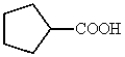
A) pentanoic acid
B) cyclopentanecarboxylic acid
C) cyclopentanoic acid
D) cyclopentylacetic acid
E) formyl cyclopentane
Question
Which structure best describes the double bond character of the amide bond in acetamide? <strong>Which structure best describes the double bond character of the amide bond in acetamide?  </strong> A) I B) II C) III D) IV E) V <div style=padding-top: 35px>

A) I
B) II
C) III
D) IV
E) V
Question
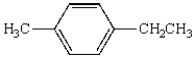
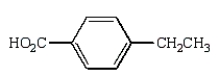
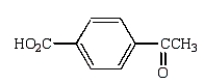
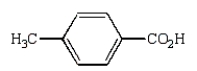
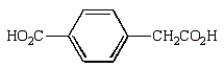
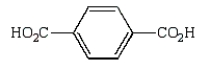
Which of the following carboxylic acids is terephthalic acid? <strong>Which of the following carboxylic acids is terephthalic acid?  </strong> A) I B) II C) III D) IV E) V <div style=padding-top: 35px>
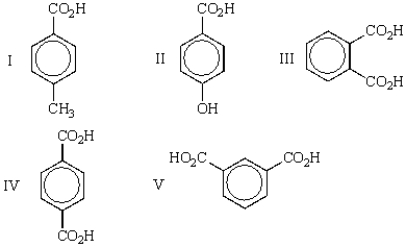
A) I
B) II
C) III
D) IV
E) V
Question
Which of the following molecules would have the highest boiling point?

A) CH3CO2H
B) CH3CH2OH
C) CH3CHO
D) CH3CH=CH2
E) HCO2H
Question
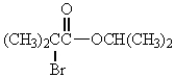
The IUPAC name for <strong>The IUPAC name for   is</strong> A) 2-bromoisopropyl isopropanoate. B) isopropyl-2-bromoisobutanoate. C) isopropyl-2-bromo-2-methylpropanoate. D) 2-bromoisobutanoyl-2-propanoate. E) isopropyl-2-bromo-3-methylbutanoate. <div style=padding-top: 35px> is

A) 2-bromoisopropyl isopropanoate.
B) isopropyl-2-bromoisobutanoate.
C) isopropyl-2-bromo-2-methylpropanoate.
D) 2-bromoisobutanoyl-2-propanoate.
E) isopropyl-2-bromo-3-methylbutanoate.
Question
What is the IUPAC name of the following molecule? <strong>What is the IUPAC name of the following molecule?  </strong> A) cyclohexyl propanoate B) cyclohexyl acetate C) ethyl cyclohexanoate D) propyl cyclohexanoate E) propanoyl cyclohexyl ether <div style=padding-top: 35px>
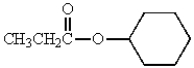
A) cyclohexyl propanoate
B) cyclohexyl acetate
C) ethyl cyclohexanoate
D) propyl cyclohexanoate
E) propanoyl cyclohexyl ether
Question
Which of the following statements regarding <strong>Which of the following statements regarding   is false?</strong> A) Rotation around the C-N bond is restricted. B) The carbonyl group, NH group, and both methyl carbons lie in a plane. C) The nitrogen is strongly basic. D) The C-N bond is shorter than the C-N bond in amines. E) The compound is named Nmethylacetamide. <div style=padding-top: 35px> is false?
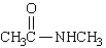
A) Rotation around the C-N bond is restricted.
B) The carbonyl group, NH group, and both methyl carbons lie in a plane.
C) The nitrogen is strongly basic.
D) The C-N bond is shorter than the C-N bond in amines.
E) The compound is named Nmethylacetamide.
Question
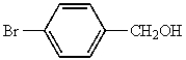
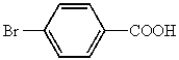
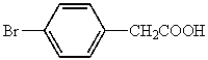
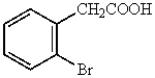
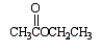
Which of the following represents p-bromobenzoic acid?

A) <strong>Which of the following represents p-bromobenzoic acid?</strong> A)   B)   C)   D)   E)   <div style=padding-top: 35px>
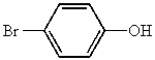
B) <strong>Which of the following represents p-bromobenzoic acid?</strong> A)   B)   C)   D)   E)   <div style=padding-top: 35px>
C) <strong>Which of the following represents p-bromobenzoic acid?</strong> A)   B)   C)   D)   E)   <div style=padding-top: 35px>
D) <strong>Which of the following represents p-bromobenzoic acid?</strong> A)   B)   C)   D)   E)   <div style=padding-top: 35px>
E) <strong>Which of the following represents p-bromobenzoic acid?</strong> A)   B)   C)   D)   E)   <div style=padding-top: 35px>
Question
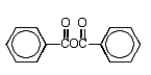
Which of the following molecules is not an anhydride?

A) <strong>Which of the following molecules is not an anhydride?</strong> A)   B)   C)   D)   E)   <div style=padding-top: 35px>
B) <strong>Which of the following molecules is not an anhydride?</strong> A)   B)   C)   D)   E)   <div style=padding-top: 35px>
C) <strong>Which of the following molecules is not an anhydride?</strong> A)   B)   C)   D)   E)   <div style=padding-top: 35px>
D) <strong>Which of the following molecules is not an anhydride?</strong> A)   B)   C)   D)   E)   <div style=padding-top: 35px>
E) <strong>Which of the following molecules is not an anhydride?</strong> A)   B)   C)   D)   E)   <div style=padding-top: 35px>
Question
Which of the following compounds undergoes hydrolysis at the fastest rate upon reaction with sodium hydroxide in water? <strong>Which of the following compounds undergoes hydrolysis at the fastest rate upon reaction with sodium hydroxide in water?  </strong> A) I B) II C) III D) IV E) V <div style=padding-top: 35px>

A) I
B) II
C) III
D) IV
E) V
Question
Rank the following according to their relative acidities <strong>Rank the following according to their relative acidities  </strong> A) 3>2>1 B) 1>2>3 C) 2>3>1 D) 3>1>2 E) 2>1>3 <div style=padding-top: 35px>
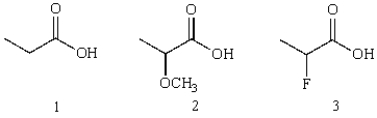
A) 3>2>1
B) 1>2>3
C) 2>3>1
D) 3>1>2
E) 2>1>3
Question
The IUPAC name for  <strong>The IUPAC name for   is</strong> A) potassium 3-bromopropanoate. B) potassium 2-bromopropanoate. C) potassium 3-bromopropionate. D) potassium  \beta -bromopropionate. E) potassium  \gamma -bromopropanoate. <div style=padding-top: 35px>  is
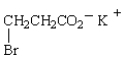
A) potassium 3-bromopropanoate.
B) potassium 2-bromopropanoate.
C) potassium 3-bromopropionate.
D) potassium β\beta -bromopropionate.
E) potassium γ\gamma -bromopropanoate.
Question
Which of the following molecules is the weakest acid?

A) CH3CH2CO2H
B) CH3CH2CH3
C) CH3CH2OH
D) CH3CH2NH2
E) H2O
Question
Which of the following molecules has the most acidic α\alpha -hydrogen?

A)  <strong>Which of the following molecules has the most acidic  \alpha -hydrogen?</strong> A)   B)   C)   D)   E)   <div style=padding-top: 35px>
B)  <strong>Which of the following molecules has the most acidic  \alpha -hydrogen?</strong> A)   B)   C)   D)   E)   <div style=padding-top: 35px>
C)  <strong>Which of the following molecules has the most acidic  \alpha -hydrogen?</strong> A)   B)   C)   D)   E)   <div style=padding-top: 35px>
D)  <strong>Which of the following molecules has the most acidic  \alpha -hydrogen?</strong> A)   B)   C)   D)   E)   <div style=padding-top: 35px>
E)  <strong>Which of the following molecules has the most acidic  \alpha -hydrogen?</strong> A)   B)   C)   D)   E)   <div style=padding-top: 35px>
Question
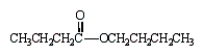
What is the IUPAC name of CH3CO2CH(CH3)2?

A) ethyl acetate
B) propyl acetate
C) isopropyl ethanoate
D) ethyl propanoate
E) dimethyl acetate
Question
What is the name of the following molecule, (CH3)2CHCONH2?

A) 2-methylpropanamide
B) 3-methylpropanamide
C) butyramide
D) ( α\alpha -methylbutyramide)
E) methylethanamide
Question
What is the common name for CH3COOH?

A) formic acid
B) acetic acid
C) propionic acid
D) oxalic acid
E) malonic acid
Question
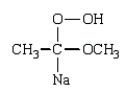
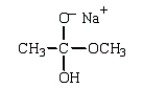
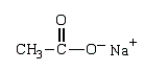
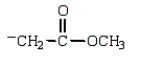
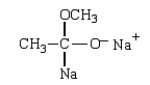
The following structure is an intermediate in the reaction of <strong>The following structure is an intermediate in the reaction of  </strong> A)CH<sub>3</sub>CO<sub>2</sub>CH<sub>3</sub> with HCl. B)CH<sub>3</sub>COCl with CH<sub>3</sub>O<sup>-</sup> Na<sup>+</sup>. C)CH<sub>3</sub>CO<sub>2</sub>CH<sub>3</sub> with HOCl. D)CH<sub>3</sub>CH(OCH<sub>3</sub>)<sub>2</sub> with Cl<sub>2</sub>. E)CH<sub>3</sub>Cl with (CH<sub>3</sub>)<sub>2</sub>C=O. <div style=padding-top: 35px>
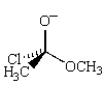
A)CH3CO2CH3 with HCl.
B)CH3COCl with CH3O- Na+.
C)CH3CO2CH3 with HOCl.
D)CH3CH(OCH3)2 with Cl2.
E)CH3Cl with (CH3)2C=O.
Question
Ethyl propanoate can be prepared by the reaction of

A) ethanoic acid with propanol.
B) ethanoic acid with isopropanol.
C) ethanoyl chloride with propanol.
D) propanoyl chloride with ethanol.
E) acetic anhydride with propanol.
Question
Which structure represents the tetrahedral intermediate in the following reaction? <strong>Which structure represents the tetrahedral intermediate in the following reaction?  </strong> A)   B)   C)   D)   E)   <div style=padding-top: 35px>

A) <strong>Which structure represents the tetrahedral intermediate in the following reaction?  </strong> A)   B)   C)   D)   E)   <div style=padding-top: 35px>
B) <strong>Which structure represents the tetrahedral intermediate in the following reaction?  </strong> A)   B)   C)   D)   E)   <div style=padding-top: 35px>
C) <strong>Which structure represents the tetrahedral intermediate in the following reaction?  </strong> A)   B)   C)   D)   E)   <div style=padding-top: 35px>
D) <strong>Which structure represents the tetrahedral intermediate in the following reaction?  </strong> A)   B)   C)   D)   E)   <div style=padding-top: 35px>
E) <strong>Which structure represents the tetrahedral intermediate in the following reaction?  </strong> A)   B)   C)   D)   E)   <div style=padding-top: 35px>
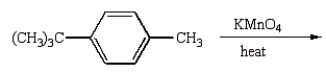
Question
Oxidation of <strong>Oxidation of   with KMnO<sub>4</sub></strong> A)   B)   C)   D)   E)   <div style=padding-top: 35px> with KMnO4

A) <strong>Oxidation of   with KMnO<sub>4</sub></strong> A)   B)   C)   D)   E)   <div style=padding-top: 35px>
B) <strong>Oxidation of   with KMnO<sub>4</sub></strong> A)   B)   C)   D)   E)   <div style=padding-top: 35px>
C) <strong>Oxidation of   with KMnO<sub>4</sub></strong> A)   B)   C)   D)   E)   <div style=padding-top: 35px>
D) <strong>Oxidation of   with KMnO<sub>4</sub></strong> A)   B)   C)   D)   E)   <div style=padding-top: 35px>
E) <strong>Oxidation of   with KMnO<sub>4</sub></strong> A)   B)   C)   D)   E)   <div style=padding-top: 35px>
Question
The mechanism of saponification is

A) nucleophilic aromatic substitution.
B) nucleophilic acyl substitution.
C) electrophilic aromatic substitution.
D) SN2.
E) SN1.
Question
Treatment of 1 mole of CH3CH2CO2CH2CH3 with 2 moles of Na+ -OCH2CH3 followed by the addition of an aqueous solution of acid gives

A) <strong>Treatment of 1 mole of CH<sub>3</sub>CH<sub>2</sub>CO<sub>2</sub>CH<sub>2</sub>CH<sub>3</sub> with 2 moles of Na<sup>+ </sup><sup>-</sup>OCH<sub>2</sub>CH<sub>3</sub> followed by the addition of an aqueous solution of acid gives</strong> A)   B)   C)   D)   E) no reaction <div style=padding-top: 35px>

B) <strong>Treatment of 1 mole of CH<sub>3</sub>CH<sub>2</sub>CO<sub>2</sub>CH<sub>2</sub>CH<sub>3</sub> with 2 moles of Na<sup>+ </sup><sup>-</sup>OCH<sub>2</sub>CH<sub>3</sub> followed by the addition of an aqueous solution of acid gives</strong> A)   B)   C)   D)   E) no reaction <div style=padding-top: 35px>
C) <strong>Treatment of 1 mole of CH<sub>3</sub>CH<sub>2</sub>CO<sub>2</sub>CH<sub>2</sub>CH<sub>3</sub> with 2 moles of Na<sup>+ </sup><sup>-</sup>OCH<sub>2</sub>CH<sub>3</sub> followed by the addition of an aqueous solution of acid gives</strong> A)   B)   C)   D)   E) no reaction <div style=padding-top: 35px>
D) <strong>Treatment of 1 mole of CH<sub>3</sub>CH<sub>2</sub>CO<sub>2</sub>CH<sub>2</sub>CH<sub>3</sub> with 2 moles of Na<sup>+ </sup><sup>-</sup>OCH<sub>2</sub>CH<sub>3</sub> followed by the addition of an aqueous solution of acid gives</strong> A)   B)   C)   D)   E) no reaction <div style=padding-top: 35px>
E) no reaction
Question
What is the product of the following reaction sequence? <strong>What is the product of the following reaction sequence?   <sub> </sub></strong> A)   B)   C)   D)   E)   <div style=padding-top: 35px>
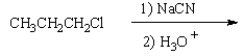
A) <strong>What is the product of the following reaction sequence?   <sub> </sub></strong> A)   B)   C)   D)   E)   <div style=padding-top: 35px>
B) <strong>What is the product of the following reaction sequence?   <sub> </sub></strong> A)   B)   C)   D)   E)   <div style=padding-top: 35px>
C) <strong>What is the product of the following reaction sequence?   <sub> </sub></strong> A)   B)   C)   D)   E)   <div style=padding-top: 35px>
D) <strong>What is the product of the following reaction sequence?   <sub> </sub></strong> A)   B)   C)   D)   E)   <div style=padding-top: 35px>
E) <strong>What is the product of the following reaction sequence?   <sub> </sub></strong> A)   B)   C)   D)   E)   <div style=padding-top: 35px>
Question
The product(s) from <strong>The product(s) from   are:</strong> A)   B)   C)   D)   E)   <div style=padding-top: 35px> are:

A) <strong>The product(s) from   are:</strong> A)   B)   C)   D)   E)   <div style=padding-top: 35px>
B) <strong>The product(s) from   are:</strong> A)   B)   C)   D)   E)   <div style=padding-top: 35px>
C) <strong>The product(s) from   are:</strong> A)   B)   C)   D)   E)   <div style=padding-top: 35px>
D) <strong>The product(s) from   are:</strong> A)   B)   C)   D)   E)   <div style=padding-top: 35px>
E) <strong>The product(s) from   are:</strong> A)   B)   C)   D)   E)   <div style=padding-top: 35px>
Question
The expected product of the reaction <strong>The expected product of the reaction   is:</strong> A)   B)   C)   D)   E)   <div style=padding-top: 35px> is:

A) <strong>The expected product of the reaction   is:</strong> A)   B)   C)   D)   E)   <div style=padding-top: 35px>
B) <strong>The expected product of the reaction   is:</strong> A)   B)   C)   D)   E)   <div style=padding-top: 35px>
C) <strong>The expected product of the reaction   is:</strong> A)   B)   C)   D)   E)   <div style=padding-top: 35px>
D) <strong>The expected product of the reaction   is:</strong> A)   B)   C)   D)   E)   <div style=padding-top: 35px>
E) <strong>The expected product of the reaction   is:</strong> A)   B)   C)   D)   E)   <div style=padding-top: 35px>
Question
Saponification of <strong>Saponification of   is expected to give:</strong> A)   B)   C)   D)   E)   <div style=padding-top: 35px> is expected to give:

A) <strong>Saponification of   is expected to give:</strong> A)   B)   C)   D)   E)   <div style=padding-top: 35px>
B) <strong>Saponification of   is expected to give:</strong> A)   B)   C)   D)   E)   <div style=padding-top: 35px>
C) <strong>Saponification of   is expected to give:</strong> A)   B)   C)   D)   E)   <div style=padding-top: 35px>
D) <strong>Saponification of   is expected to give:</strong> A)   B)   C)   D)   E)   <div style=padding-top: 35px>
E) <strong>Saponification of   is expected to give:</strong> A)   B)   C)   D)   E)   <div style=padding-top: 35px>
Question
Benzoic acid cannot be prepared by which one of the following methods?

A) <strong>Benzoic acid cannot be prepared by which one of the following methods?</strong> A)   B)   C)   D)   E)   <div style=padding-top: 35px>
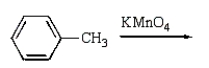
B) <strong>Benzoic acid cannot be prepared by which one of the following methods?</strong> A)   B)   C)   D)   E)   <div style=padding-top: 35px>
C) <strong>Benzoic acid cannot be prepared by which one of the following methods?</strong> A)   B)   C)   D)   E)   <div style=padding-top: 35px>
D) <strong>Benzoic acid cannot be prepared by which one of the following methods?</strong> A)   B)   C)   D)   E)   <div style=padding-top: 35px>
E) <strong>Benzoic acid cannot be prepared by which one of the following methods?</strong> A)   B)   C)   D)   E)   <div style=padding-top: 35px>
Question
The product(s) in the reaction <strong>The product(s) in the reaction   are:</strong> A)   B)   C)   D)   E)   <div style=padding-top: 35px> are:

A) <strong>The product(s) in the reaction   are:</strong> A)   B)   C)   D)   E)   <div style=padding-top: 35px>
B) <strong>The product(s) in the reaction   are:</strong> A)   B)   C)   D)   E)   <div style=padding-top: 35px>
C) <strong>The product(s) in the reaction   are:</strong> A)   B)   C)   D)   E)   <div style=padding-top: 35px>
D) <strong>The product(s) in the reaction   are:</strong> A)   B)   C)   D)   E)   <div style=padding-top: 35px>
E) <strong>The product(s) in the reaction   are:</strong> A)   B)   C)   D)   E)   <div style=padding-top: 35px>
Question
Which of the following carbonyl compounds reacts fastest with water?

A) carboxylic acid
B) ester
C) ketone
D) acid chloride
E) amide
Question
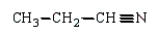
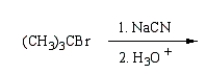
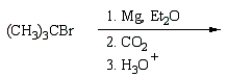
(CH3)3CCO2H can best be prepared by:

A) <strong>(CH<sub>3</sub>)<sub>3</sub>CCO<sub>2</sub>H can best be prepared by:</strong> A)   B)   C)   D)   E)   <div style=padding-top: 35px>
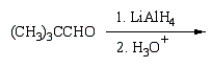
B) <strong>(CH<sub>3</sub>)<sub>3</sub>CCO<sub>2</sub>H can best be prepared by:</strong> A)   B)   C)   D)   E)   <div style=padding-top: 35px>
C) <strong>(CH<sub>3</sub>)<sub>3</sub>CCO<sub>2</sub>H can best be prepared by:</strong> A)   B)   C)   D)   E)   <div style=padding-top: 35px>
D) <strong>(CH<sub>3</sub>)<sub>3</sub>CCO<sub>2</sub>H can best be prepared by:</strong> A)   B)   C)   D)   E)   <div style=padding-top: 35px>
E) <strong>(CH<sub>3</sub>)<sub>3</sub>CCO<sub>2</sub>H can best be prepared by:</strong> A)   B)   C)   D)   E)   <div style=padding-top: 35px>
Question
The product of the following reaction sequence is: <strong>The product of the following reaction sequence is:  </strong> A)   B)   C)   D)   E)   <div style=padding-top: 35px>
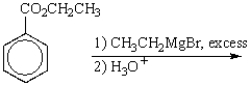
A) <strong>The product of the following reaction sequence is:  </strong> A)   B)   C)   D)   E)   <div style=padding-top: 35px>
B) <strong>The product of the following reaction sequence is:  </strong> A)   B)   C)   D)   E)   <div style=padding-top: 35px>
C) <strong>The product of the following reaction sequence is:  </strong> A)   B)   C)   D)   E)   <div style=padding-top: 35px>
D) <strong>The product of the following reaction sequence is:  </strong> A)   B)   C)   D)   E)   <div style=padding-top: 35px>
E) <strong>The product of the following reaction sequence is:  </strong> A)   B)   C)   D)   E)   <div style=padding-top: 35px>
Question
Acid chlorides react with alcohols to give:

A) ketones
B) esters
C) acetals
D) amides
E) carboxylic acids
Unlock Deck
Sign up to unlock the cards in this deck!
Unlock Deck
Unlock Deck
1/36
auto play flashcards
Play
simple tutorial
Full screen (f)
exit full mode
Deck 10: Carboxylic Acids and Their Derivatives
1
The IUPAC name for succinic acid is butanedioic acid.What is the structure of succinic acid?

A) CH3CH2CH2CO2H
B) CH3CH=CHCO2H
C) HO2CCH2CH2CO2H
D) CH3CH2CH2CO3H
E) HOCH2CH2CH2CO2H
HO2CCH2CH2CO2H
2
The boiling point of propanoic acid is higher than that of 1-butanol because:

A) propanoic acid has a higher molecular weight than 1-butanol.
B) propanoic acid is more soluble in water than 1-butanol.
C) propanoic acid is a better hydrogen bond donor than 1-butanol.
D) propanoic acid forms hydrogen bonded dimers and 1-butanol does not.
E) 1-butanol forms hydrogen bonded dimers and propanoic acid does not.
propanoic acid forms hydrogen bonded dimers and 1-butanol does not.
3
The formula for butanoic anhydride is

A) <strong>The formula for butanoic anhydride is</strong> A)   B)   C)   D)   E)
B) <strong>The formula for butanoic anhydride is</strong> A)   B)   C)   D)   E)
C) <strong>The formula for butanoic anhydride is</strong> A)   B)   C)   D)   E)
D) <strong>The formula for butanoic anhydride is</strong> A)   B)   C)   D)   E)
E) <strong>The formula for butanoic anhydride is</strong> A)   B)   C)   D)   E)
4
What is a correct name for the following structure? <strong>What is a correct name for the following structure?  </strong> A) pentanoic acid B) cyclopentanecarboxylic acid C) cyclopentanoic acid D) cyclopentylacetic acid E) formyl cyclopentane

A) pentanoic acid
B) cyclopentanecarboxylic acid
C) cyclopentanoic acid
D) cyclopentylacetic acid
E) formyl cyclopentane
Unlock Deck
Unlock for access to all 36 flashcards in this deck.
Unlock Deck
k this deck
5
Which structure best describes the double bond character of the amide bond in acetamide? <strong>Which structure best describes the double bond character of the amide bond in acetamide?  </strong> A) I B) II C) III D) IV E) V

A) I
B) II
C) III
D) IV
E) V
Unlock Deck
Unlock for access to all 36 flashcards in this deck.
Unlock Deck
k this deck
6
Which of the following carboxylic acids is terephthalic acid? <strong>Which of the following carboxylic acids is terephthalic acid?  </strong> A) I B) II C) III D) IV E) V

A) I
B) II
C) III
D) IV
E) V
Unlock Deck
Unlock for access to all 36 flashcards in this deck.
Unlock Deck
k this deck
7
Which of the following molecules would have the highest boiling point?

A) CH3CO2H
B) CH3CH2OH
C) CH3CHO
D) CH3CH=CH2
E) HCO2H
Unlock Deck
Unlock for access to all 36 flashcards in this deck.

Unlock Deck
k this deck
8
The IUPAC name for <strong>The IUPAC name for   is</strong> A) 2-bromoisopropyl isopropanoate. B) isopropyl-2-bromoisobutanoate. C) isopropyl-2-bromo-2-methylpropanoate. D) 2-bromoisobutanoyl-2-propanoate. E) isopropyl-2-bromo-3-methylbutanoate. is

A) 2-bromoisopropyl isopropanoate.
B) isopropyl-2-bromoisobutanoate.
C) isopropyl-2-bromo-2-methylpropanoate.
D) 2-bromoisobutanoyl-2-propanoate.
E) isopropyl-2-bromo-3-methylbutanoate.
Unlock Deck
Unlock for access to all 36 flashcards in this deck.

Unlock Deck
k this deck
9
What is the IUPAC name of the following molecule? <strong>What is the IUPAC name of the following molecule?  </strong> A) cyclohexyl propanoate B) cyclohexyl acetate C) ethyl cyclohexanoate D) propyl cyclohexanoate E) propanoyl cyclohexyl ether

A) cyclohexyl propanoate
B) cyclohexyl acetate
C) ethyl cyclohexanoate
D) propyl cyclohexanoate
E) propanoyl cyclohexyl ether
Unlock Deck
Unlock for access to all 36 flashcards in this deck.
Unlock Deck
k this deck
10
Which of the following statements regarding <strong>Which of the following statements regarding   is false?</strong> A) Rotation around the C-N bond is restricted. B) The carbonyl group, NH group, and both methyl carbons lie in a plane. C) The nitrogen is strongly basic. D) The C-N bond is shorter than the C-N bond in amines. E) The compound is named Nmethylacetamide. is false?

A) Rotation around the C-N bond is restricted.
B) The carbonyl group, NH group, and both methyl carbons lie in a plane.
C) The nitrogen is strongly basic.
D) The C-N bond is shorter than the C-N bond in amines.
E) The compound is named Nmethylacetamide.
Unlock Deck
Unlock for access to all 36 flashcards in this deck.
Unlock Deck
k this deck
11
Which of the following represents p-bromobenzoic acid?

A) <strong>Which of the following represents p-bromobenzoic acid?</strong> A)   B)   C)   D)   E)
B) <strong>Which of the following represents p-bromobenzoic acid?</strong> A)   B)   C)   D)   E)
C) <strong>Which of the following represents p-bromobenzoic acid?</strong> A)   B)   C)   D)   E)
D) <strong>Which of the following represents p-bromobenzoic acid?</strong> A)   B)   C)   D)   E)
E) <strong>Which of the following represents p-bromobenzoic acid?</strong> A)   B)   C)   D)   E)
Unlock Deck
Unlock for access to all 36 flashcards in this deck.
Unlock Deck
k this deck
12
Which of the following molecules is not an anhydride?

A) <strong>Which of the following molecules is not an anhydride?</strong> A)   B)   C)   D)   E)
B) <strong>Which of the following molecules is not an anhydride?</strong> A)   B)   C)   D)   E)
C) <strong>Which of the following molecules is not an anhydride?</strong> A)   B)   C)   D)   E)
D) <strong>Which of the following molecules is not an anhydride?</strong> A)   B)   C)   D)   E)
E) <strong>Which of the following molecules is not an anhydride?</strong> A)   B)   C)   D)   E)
Unlock Deck
Unlock for access to all 36 flashcards in this deck.
Unlock Deck
k this deck
13
Which of the following compounds undergoes hydrolysis at the fastest rate upon reaction with sodium hydroxide in water? <strong>Which of the following compounds undergoes hydrolysis at the fastest rate upon reaction with sodium hydroxide in water?  </strong> A) I B) II C) III D) IV E) V

A) I
B) II
C) III
D) IV
E) V
Unlock Deck
Unlock for access to all 36 flashcards in this deck.
Unlock Deck
k this deck
14
Rank the following according to their relative acidities <strong>Rank the following according to their relative acidities  </strong> A) 3>2>1 B) 1>2>3 C) 2>3>1 D) 3>1>2 E) 2>1>3

A) 3>2>1
B) 1>2>3
C) 2>3>1
D) 3>1>2
E) 2>1>3
Unlock Deck
Unlock for access to all 36 flashcards in this deck.
Unlock Deck
k this deck
15
The IUPAC name for  <strong>The IUPAC name for   is</strong> A) potassium 3-bromopropanoate. B) potassium 2-bromopropanoate. C) potassium 3-bromopropionate. D) potassium  \beta -bromopropionate. E) potassium  \gamma -bromopropanoate.  is

A) potassium 3-bromopropanoate.
B) potassium 2-bromopropanoate.
C) potassium 3-bromopropionate.
D) potassium β\beta -bromopropionate.
E) potassium γ\gamma -bromopropanoate.
Unlock Deck
Unlock for access to all 36 flashcards in this deck.
Unlock Deck
k this deck
16
Which of the following molecules is the weakest acid?

A) CH3CH2CO2H
B) CH3CH2CH3
C) CH3CH2OH
D) CH3CH2NH2
E) H2O
Unlock Deck
Unlock for access to all 36 flashcards in this deck.
Unlock Deck
k this deck
17
Which of the following molecules has the most acidic α\alpha -hydrogen?

A)  <strong>Which of the following molecules has the most acidic  \alpha -hydrogen?</strong> A)   B)   C)   D)   E)
B)  <strong>Which of the following molecules has the most acidic  \alpha -hydrogen?</strong> A)   B)   C)   D)   E)
C)  <strong>Which of the following molecules has the most acidic  \alpha -hydrogen?</strong> A)   B)   C)   D)   E)
D)  <strong>Which of the following molecules has the most acidic  \alpha -hydrogen?</strong> A)   B)   C)   D)   E)
E)  <strong>Which of the following molecules has the most acidic  \alpha -hydrogen?</strong> A)   B)   C)   D)   E)
Unlock Deck
Unlock for access to all 36 flashcards in this deck.
Unlock Deck
k this deck
18
What is the IUPAC name of CH3CO2CH(CH3)2?

A) ethyl acetate
B) propyl acetate
C) isopropyl ethanoate
D) ethyl propanoate
E) dimethyl acetate
Unlock Deck
Unlock for access to all 36 flashcards in this deck.
Unlock Deck
k this deck
19
What is the name of the following molecule, (CH3)2CHCONH2?

A) 2-methylpropanamide
B) 3-methylpropanamide
C) butyramide
D) ( α\alpha -methylbutyramide)
E) methylethanamide
Unlock Deck
Unlock for access to all 36 flashcards in this deck.
Unlock Deck
k this deck
20
What is the common name for CH3COOH?

A) formic acid
B) acetic acid
C) propionic acid
D) oxalic acid
E) malonic acid
Unlock Deck
Unlock for access to all 36 flashcards in this deck.
Unlock Deck
k this deck
21
The following structure is an intermediate in the reaction of <strong>The following structure is an intermediate in the reaction of  </strong> A)CH<sub>3</sub>CO<sub>2</sub>CH<sub>3</sub> with HCl. B)CH<sub>3</sub>COCl with CH<sub>3</sub>O<sup>-</sup> Na<sup>+</sup>. C)CH<sub>3</sub>CO<sub>2</sub>CH<sub>3</sub> with HOCl. D)CH<sub>3</sub>CH(OCH<sub>3</sub>)<sub>2</sub> with Cl<sub>2</sub>. E)CH<sub>3</sub>Cl with (CH<sub>3</sub>)<sub>2</sub>C=O.

A)CH3CO2CH3 with HCl.
B)CH3COCl with CH3O- Na+.
C)CH3CO2CH3 with HOCl.
D)CH3CH(OCH3)2 with Cl2.
E)CH3Cl with (CH3)2C=O.
Unlock Deck
Unlock for access to all 36 flashcards in this deck.
Unlock Deck
k this deck
22
Ethyl propanoate can be prepared by the reaction of

A) ethanoic acid with propanol.
B) ethanoic acid with isopropanol.
C) ethanoyl chloride with propanol.
D) propanoyl chloride with ethanol.
E) acetic anhydride with propanol.
Unlock Deck
Unlock for access to all 36 flashcards in this deck.
Unlock Deck
k this deck
23
Which structure represents the tetrahedral intermediate in the following reaction? <strong>Which structure represents the tetrahedral intermediate in the following reaction?  </strong> A)   B)   C)   D)   E)

A) <strong>Which structure represents the tetrahedral intermediate in the following reaction?  </strong> A)   B)   C)   D)   E)
B) <strong>Which structure represents the tetrahedral intermediate in the following reaction?  </strong> A)   B)   C)   D)   E)
C) <strong>Which structure represents the tetrahedral intermediate in the following reaction?  </strong> A)   B)   C)   D)   E)
D) <strong>Which structure represents the tetrahedral intermediate in the following reaction?  </strong> A)   B)   C)   D)   E)
E) <strong>Which structure represents the tetrahedral intermediate in the following reaction?  </strong> A)   B)   C)   D)   E)
Unlock Deck
Unlock for access to all 36 flashcards in this deck.
Unlock Deck
k this deck
24
Oxidation of <strong>Oxidation of   with KMnO<sub>4</sub></strong> A)   B)   C)   D)   E)   with KMnO4

A) <strong>Oxidation of   with KMnO<sub>4</sub></strong> A)   B)   C)   D)   E)
B) <strong>Oxidation of   with KMnO<sub>4</sub></strong> A)   B)   C)   D)   E)
C) <strong>Oxidation of   with KMnO<sub>4</sub></strong> A)   B)   C)   D)   E)
D) <strong>Oxidation of   with KMnO<sub>4</sub></strong> A)   B)   C)   D)   E)
E) <strong>Oxidation of   with KMnO<sub>4</sub></strong> A)   B)   C)   D)   E)
Unlock Deck
Unlock for access to all 36 flashcards in this deck.
Unlock Deck
k this deck
25
The mechanism of saponification is

A) nucleophilic aromatic substitution.
B) nucleophilic acyl substitution.
C) electrophilic aromatic substitution.
D) SN2.
E) SN1.
Unlock Deck
Unlock for access to all 36 flashcards in this deck.
Unlock Deck
k this deck
26
Treatment of 1 mole of CH3CH2CO2CH2CH3 with 2 moles of Na+ -OCH2CH3 followed by the addition of an aqueous solution of acid gives

A) <strong>Treatment of 1 mole of CH<sub>3</sub>CH<sub>2</sub>CO<sub>2</sub>CH<sub>2</sub>CH<sub>3</sub> with 2 moles of Na<sup>+ </sup><sup>-</sup>OCH<sub>2</sub>CH<sub>3</sub> followed by the addition of an aqueous solution of acid gives</strong> A)   B)   C)   D)   E) no reaction
B) <strong>Treatment of 1 mole of CH<sub>3</sub>CH<sub>2</sub>CO<sub>2</sub>CH<sub>2</sub>CH<sub>3</sub> with 2 moles of Na<sup>+ </sup><sup>-</sup>OCH<sub>2</sub>CH<sub>3</sub> followed by the addition of an aqueous solution of acid gives</strong> A)   B)   C)   D)   E) no reaction
C) <strong>Treatment of 1 mole of CH<sub>3</sub>CH<sub>2</sub>CO<sub>2</sub>CH<sub>2</sub>CH<sub>3</sub> with 2 moles of Na<sup>+ </sup><sup>-</sup>OCH<sub>2</sub>CH<sub>3</sub> followed by the addition of an aqueous solution of acid gives</strong> A)   B)   C)   D)   E) no reaction
D) <strong>Treatment of 1 mole of CH<sub>3</sub>CH<sub>2</sub>CO<sub>2</sub>CH<sub>2</sub>CH<sub>3</sub> with 2 moles of Na<sup>+ </sup><sup>-</sup>OCH<sub>2</sub>CH<sub>3</sub> followed by the addition of an aqueous solution of acid gives</strong> A)   B)   C)   D)   E) no reaction
E) no reaction
Unlock Deck
Unlock for access to all 36 flashcards in this deck.
Unlock Deck
k this deck
27
What is the product of the following reaction sequence? <strong>What is the product of the following reaction sequence?   <sub> </sub></strong> A)   B)   C)   D)   E)

A) <strong>What is the product of the following reaction sequence?   <sub> </sub></strong> A)   B)   C)   D)   E)
B) <strong>What is the product of the following reaction sequence?   <sub> </sub></strong> A)   B)   C)   D)   E)
C) <strong>What is the product of the following reaction sequence?   <sub> </sub></strong> A)   B)   C)   D)   E)
D) <strong>What is the product of the following reaction sequence?   <sub> </sub></strong> A)   B)   C)   D)   E)
E) <strong>What is the product of the following reaction sequence?   <sub> </sub></strong> A)   B)   C)   D)   E)
Unlock Deck
Unlock for access to all 36 flashcards in this deck.
Unlock Deck
k this deck
28
The product(s) from <strong>The product(s) from   are:</strong> A)   B)   C)   D)   E)   are:

A) <strong>The product(s) from   are:</strong> A)   B)   C)   D)   E)
B) <strong>The product(s) from   are:</strong> A)   B)   C)   D)   E)
C) <strong>The product(s) from   are:</strong> A)   B)   C)   D)   E)
D) <strong>The product(s) from   are:</strong> A)   B)   C)   D)   E)
E) <strong>The product(s) from   are:</strong> A)   B)   C)   D)   E)
Unlock Deck
Unlock for access to all 36 flashcards in this deck.
Unlock Deck
k this deck
29
The expected product of the reaction <strong>The expected product of the reaction   is:</strong> A)   B)   C)   D)   E)   is:

A) <strong>The expected product of the reaction   is:</strong> A)   B)   C)   D)   E)
B) <strong>The expected product of the reaction   is:</strong> A)   B)   C)   D)   E)
C) <strong>The expected product of the reaction   is:</strong> A)   B)   C)   D)   E)
D) <strong>The expected product of the reaction   is:</strong> A)   B)   C)   D)   E)
E) <strong>The expected product of the reaction   is:</strong> A)   B)   C)   D)   E)
Unlock Deck
Unlock for access to all 36 flashcards in this deck.
Unlock Deck
k this deck
30
Saponification of <strong>Saponification of   is expected to give:</strong> A)   B)   C)   D)   E)   is expected to give:

A) <strong>Saponification of   is expected to give:</strong> A)   B)   C)   D)   E)
B) <strong>Saponification of   is expected to give:</strong> A)   B)   C)   D)   E)
C) <strong>Saponification of   is expected to give:</strong> A)   B)   C)   D)   E)
D) <strong>Saponification of   is expected to give:</strong> A)   B)   C)   D)   E)
E) <strong>Saponification of   is expected to give:</strong> A)   B)   C)   D)   E)
Unlock Deck
Unlock for access to all 36 flashcards in this deck.
Unlock Deck
k this deck
31
Benzoic acid cannot be prepared by which one of the following methods?

A) <strong>Benzoic acid cannot be prepared by which one of the following methods?</strong> A)   B)   C)   D)   E)
B) <strong>Benzoic acid cannot be prepared by which one of the following methods?</strong> A)   B)   C)   D)   E)
C) <strong>Benzoic acid cannot be prepared by which one of the following methods?</strong> A)   B)   C)   D)   E)
D) <strong>Benzoic acid cannot be prepared by which one of the following methods?</strong> A)   B)   C)   D)   E)
E) <strong>Benzoic acid cannot be prepared by which one of the following methods?</strong> A)   B)   C)   D)   E)
Unlock Deck
Unlock for access to all 36 flashcards in this deck.
Unlock Deck
k this deck
32
The product(s) in the reaction <strong>The product(s) in the reaction   are:</strong> A)   B)   C)   D)   E)   are:

A) <strong>The product(s) in the reaction   are:</strong> A)   B)   C)   D)   E)
B) <strong>The product(s) in the reaction   are:</strong> A)   B)   C)   D)   E)
C) <strong>The product(s) in the reaction   are:</strong> A)   B)   C)   D)   E)
D) <strong>The product(s) in the reaction   are:</strong> A)   B)   C)   D)   E)
E) <strong>The product(s) in the reaction   are:</strong> A)   B)   C)   D)   E)
Unlock Deck
Unlock for access to all 36 flashcards in this deck.
Unlock Deck
k this deck
33
Which of the following carbonyl compounds reacts fastest with water?

A) carboxylic acid
B) ester
C) ketone
D) acid chloride
E) amide
Unlock Deck
Unlock for access to all 36 flashcards in this deck.
Unlock Deck
k this deck
34
(CH3)3CCO2H can best be prepared by:

A) <strong>(CH<sub>3</sub>)<sub>3</sub>CCO<sub>2</sub>H can best be prepared by:</strong> A)   B)   C)   D)   E)
B) <strong>(CH<sub>3</sub>)<sub>3</sub>CCO<sub>2</sub>H can best be prepared by:</strong> A)   B)   C)   D)   E)
C) <strong>(CH<sub>3</sub>)<sub>3</sub>CCO<sub>2</sub>H can best be prepared by:</strong> A)   B)   C)   D)   E)
D) <strong>(CH<sub>3</sub>)<sub>3</sub>CCO<sub>2</sub>H can best be prepared by:</strong> A)   B)   C)   D)   E)
E) <strong>(CH<sub>3</sub>)<sub>3</sub>CCO<sub>2</sub>H can best be prepared by:</strong> A)   B)   C)   D)   E)
Unlock Deck
Unlock for access to all 36 flashcards in this deck.
Unlock Deck
k this deck
35
The product of the following reaction sequence is: <strong>The product of the following reaction sequence is:  </strong> A)   B)   C)   D)   E)

A) <strong>The product of the following reaction sequence is:  </strong> A)   B)   C)   D)   E)
B) <strong>The product of the following reaction sequence is:  </strong> A)   B)   C)   D)   E)
C) <strong>The product of the following reaction sequence is:  </strong> A)   B)   C)   D)   E)
D) <strong>The product of the following reaction sequence is:  </strong> A)   B)   C)   D)   E)
E) <strong>The product of the following reaction sequence is:  </strong> A)   B)   C)   D)   E)
Unlock Deck
Unlock for access to all 36 flashcards in this deck.
Unlock Deck
k this deck
36
Acid chlorides react with alcohols to give:

A) ketones
B) esters
C) acetals
D) amides
E) carboxylic acids
Unlock Deck
Unlock for access to all 36 flashcards in this deck.
Unlock Deck
k this deck
locked card icon
Unlock Deck
Unlock for access to all 36 flashcards in this deck.