







 Chat with AI

Deck 5: Neck
Full screen (f)

Question

Question
Question
Question
Question
Question
Question
In the figure below of an axial CT of the neck, which arrow points to the arytenoid cartilage? 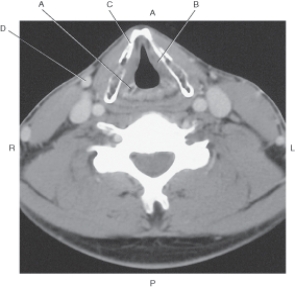
A) A
B) B
C) C
D) D
A) A
B) B
C) C
D) D
Question
Question
Question
Question
Question
Question
Question
Question
Question
Question
Question
Question
Question
In the figure below of an axial CT of the neck, which arrow points to the thyroid cartilage? 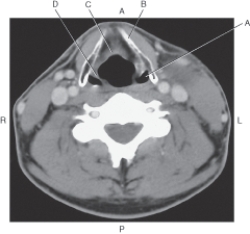
A) A
B) B
C) C
D) D
A) A
B) B
C) C
D) D
Question
The following questions refer to the figure below of a midsagittal, T2-weighted MRI of the neck. 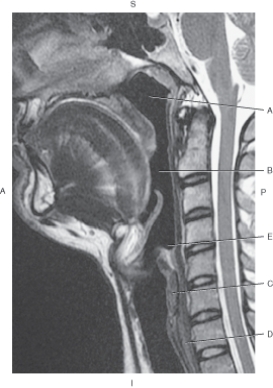
Which arrow points to the oropharynx?
A) A
B) B
C) C
D) D
E) E
Which arrow points to the oropharynx?
A) A
B) B
C) C
D) D
E) E
Question
In the figure below of an axial, T1-weighted MR of the neck, which arrow points to the medial pterygoid muscle? 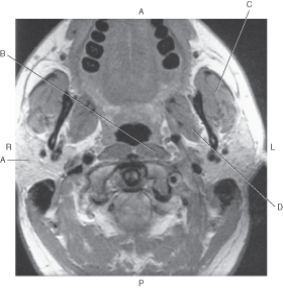
A) A
B) B
C) C
D) D
A) A
B) B
C) C
D) D
Question
The following questions refer to the figure below of an axial CT of the neck. 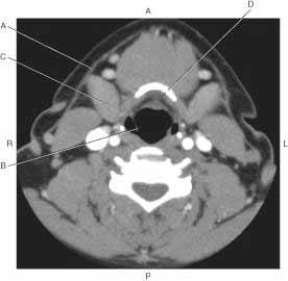
Which arrow points to the platysma muscle?
A) A
B) B
C) C
D) D
Which arrow points to the platysma muscle?
A) A
B) B
C) C
D) D
Question
The following questions refer to the figure below of a midsagittal, T2-weighted MRI of the neck.
Which arrow points to the esophagus?
A) A
B) B
C) C
D) D
E) E
Which arrow points to the esophagus?
A) A
B) B
C) C
D) D
E) E
Question
The following questions refer to the figure below of an axial CT of the neck. 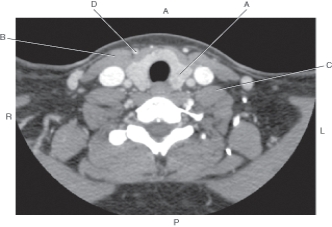
Which arrow points to the sternocleidomastoid muscle (SCM)?
A) A
B) B
C) C
D) D
Which arrow points to the sternocleidomastoid muscle (SCM)?
A) A
B) B
C) C
D) D
Question
The following questions refer to the figure below of an axial CT of the neck.
Which arrow points to the submandibular gland?
A) A
B) B
C) C
D) D
Which arrow points to the submandibular gland?
A) A
B) B
C) C
D) D
Question
The following questions refer to the figure below of a sagittal CT reformat of the pharynx. 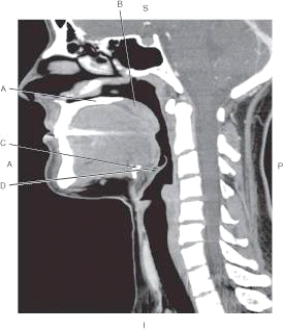
Which arrow points to the hard palate?
A) A
B) B
C) C
D) D
Which arrow points to the hard palate?
A) A
B) B
C) C
D) D
Question
In the figure below of an axial CT of the neck, which arrow points to the parotid gland? 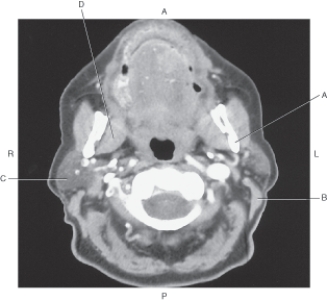
A) A
B) B
C) C
D) D
A) A
B) B
C) C
D) D
Question
The following questions refer to the figure below of a sagittal CT reformat of the pharynx.
Which arrow points to the hyoid bone?
A) A
B) B
C) C
D) D
Which arrow points to the hyoid bone?
A) A
B) B
C) C
D) D
Question
The following questions refer to the figure below of a midsagittal, T2-weighted MRI of the neck.
Which arrow points to the cricoid cartilage?
A) A
B) B
C) C
D) D
E) E
Which arrow points to the cricoid cartilage?
A) A
B) B
C) C
D) D
E) E
Question
The following questions refer to the figure below of a midsagittal, T2-weighted MRI of the neck.
Which arrow points to the laryngopharynx?
A) A
B) B
C) C
D) D
E) E
Which arrow points to the laryngopharynx?
A) A
B) B
C) C
D) D
E) E
Question
The following questions refer to the figure below of a midsagittal, T2-weighted MRI of the neck.
Which arrow points to the nasopharynx?
A) A
B) B
C) C
D) D
E) E
Which arrow points to the nasopharynx?
A) A
B) B
C) C
D) D
E) E
Question
The following questions refer to the figure below of an axial CT of the neck.
Which arrow points to the right interior jugular vein?
A) A
B) B
C) C
D) D
Which arrow points to the right interior jugular vein?
A) A
B) B
C) C
D) D
Question
The following questions refer to the figure below of a sagittal CT reformat of the pharynx.
Which arrow points to the soft palate?
A) A
B) B
C) C
D) D
Which arrow points to the soft palate?
A) A
B) B
C) C
D) D
Question
The following questions refer to the figure below of an axial CT of the neck.
Which arrow points to the anterior scalene muscle?
A) A
B) B
C) C
D) D
Which arrow points to the anterior scalene muscle?
A) A
B) B
C) C
D) D
Question
The following questions refer to the figure below of an axial CT of the neck.
Which arrow points to the hyoid bone?
A) A
B) B
C) C
D) D
Which arrow points to the hyoid bone?
A) A
B) B
C) C
D) D
Question
The following questions refer to the figure below of a coronal, T1-weighted MRI of the neck. 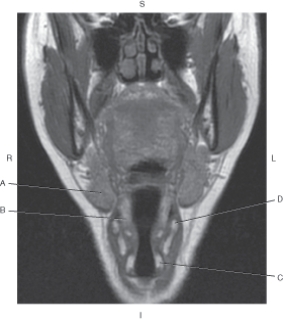
Which arrow points to the submandibular gland?
A) A
B) B
C) C
D) D
Which arrow points to the submandibular gland?
A) A
B) B
C) C
D) D
Question
The following questions refer to the figure below of a sagittal CT reformat of the pharynx.
Which arrow points to the epiglottis?
A) A
B) B
C) C
D) D
Which arrow points to the epiglottis?
A) A
B) B
C) C
D) D
Question
The following questions refer to the figure below of an axial CT of the neck.
Which arrow points to the aryepiglottic fold?
A) A
B) B
C) C
D) D
Which arrow points to the aryepiglottic fold?
A) A
B) B
C) C
D) D
Question
The following questions refer to the figure below of an axial CT of the neck.
Which arrow points to the thyroid gland (left lobe)?
A) A
B) B
C) C
D) D
Which arrow points to the thyroid gland (left lobe)?
A) A
B) B
C) C
D) D
Question
The following questions refer to the figure below of a CTA of intracranial and extracranial arteries. 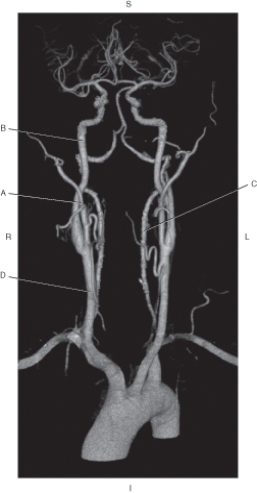
Which arrow points to the common carotid artery?
A) A
B) B
C) C
D) D
Which arrow points to the common carotid artery?
A) A
B) B
C) C
D) D
Question
The following questions refer to the figure below of an axial, T1-weighted MRI of the neck. 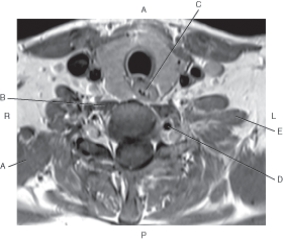
Which arrow points to the esophagus?
A) A
B) B
C) C
D) D
E) E
Which arrow points to the esophagus?
A) A
B) B
C) C
D) D
E) E
Question
The following questions refer to the figure below of an axial, T1-weighted MRI of the neck. 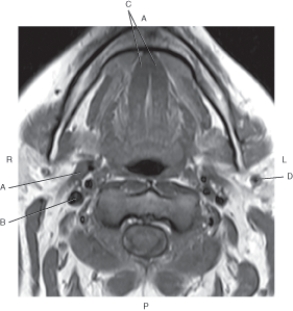
Which arrow points to the digastric muscle?
A) A
B) B
C) C
D) D
Which arrow points to the digastric muscle?
A) A
B) B
C) C
D) D
Question
The following questions refer to the figure below of a coronal, T1-weighted MRI of the neck.
Which arrow points to the thyroid cartilage?
A) A
B) B
C) C
D) D
Which arrow points to the thyroid cartilage?
A) A
B) B
C) C
D) D
Question
The following questions refer to the figure below of a coronal CT reformat of the neck. 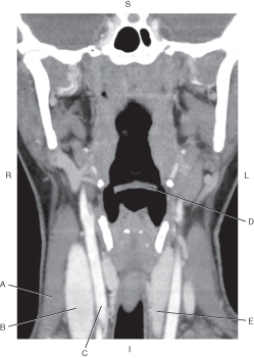
Which arrow points to the common carotid artery?
A) A
B) B
C) C
D) D
E) E
Which arrow points to the common carotid artery?
A) A
B) B
C) C
D) D
E) E
Question
The following questions refer to the figure below of a coronal, T1-weighted MRI of the neck.
Which arrow points to the aryepiglottic fold?
A) A
B) B
C) C
D) D
Which arrow points to the aryepiglottic fold?
A) A
B) B
C) C
D) D
Question
The following questions refer to the figure below of an axial, T1-weighted MRI of the neck.
Which arrow points to the levator scapulae muscle?
A) A
B) B
C) C
D) D
E) E
Which arrow points to the levator scapulae muscle?
A) A
B) B
C) C
D) D
E) E
Question
The following questions refer to the figure below of an axial, T1-weighted MRI of the neck.
Which arrow points to the middle scalene muscle?
A) A
B) B
C) C
D) D
E) E
Which arrow points to the middle scalene muscle?
A) A
B) B
C) C
D) D
E) E
Question
The following questions refer to the figure below of a coronal CT reformat of the neck.
Which arrow points to the thyroid gland?
A) A
B) B
C) C
D) D
E) E
Which arrow points to the thyroid gland?
A) A
B) B
C) C
D) D
E) E
Question
The following questions refer to the figure below of a CTA of intracranial and extracranial arteries.
Which arrow points to the vertebral artery?
A) A
B) B
C) C
D) D
Which arrow points to the vertebral artery?
A) A
B) B
C) C
D) D
Question
The following questions refer to the figure below of an axial, T1-weighted MRI of the neck.
Which arrow points to the retromandibular vein?
A) A
B) B
C) C
D) D
Which arrow points to the retromandibular vein?
A) A
B) B
C) C
D) D
Question
The following questions refer to the figure below of an axial, T1-weighted MRI of the neck.
Which arrow points to the longus capitis muscle?
A) A
B) B
C) C
D) D
E) E
Which arrow points to the longus capitis muscle?
A) A
B) B
C) C
D) D
E) E
Question
The following questions refer to the figure below of a coronal CT reformat of the neck.
Which arrow points to the sternocleidomastoid muscle (SCM)?
A) A
B) B
C) C
D) D
E) E
Which arrow points to the sternocleidomastoid muscle (SCM)?
A) A
B) B
C) C
D) D
E) E
Question
The following questions refer to the figure below of a coronal, T1-weighted MRI of the neck.
Which arrow points to the cricoid cartilage?
A) A
B) B
C) C
D) D
Which arrow points to the cricoid cartilage?
A) A
B) B
C) C
D) D
Question
The following questions refer to the figure below of a coronal CT reformat of the neck.
Which arrow points to the epiglottis?
A) A
B) B
C) C
D) D
E) E
Which arrow points to the epiglottis?
A) A
B) B
C) C
D) D
E) E
Question
The following questions refer to the figure below of an axial, T1-weighted MRI of the neck.
Which arrow points to the internal jugular vein?
A) A
B) B
C) C
D) D
Which arrow points to the internal jugular vein?
A) A
B) B
C) C
D) D
Question
The following questions refer to the figure below of an axial, T1-weighted MRI of the neck.
Which arrow points to the genioglossus muscle?
A) A
B) B
C) C
D) D
Which arrow points to the genioglossus muscle?
A) A
B) B
C) C
D) D
Question
The following questions refer to the figure below of a CTA of intracranial and extracranial arteries.
Which arrow points to the internal carotid artery?
A) A
B) B
C) C
D) D
Which arrow points to the internal carotid artery?
A) A
B) B
C) C
D) D
Question
The following questions refer to the figure below of a coronal CT reformat of the neck.
Which arrow points to the internal jugular vein?
A) A
B) B
C) C
D) D
E) E
Which arrow points to the internal jugular vein?
A) A
B) B
C) C
D) D
E) E
Question
The following questions refer to the figure below of an axial, T1-weighted MRI of the neck.
Which arrow points to the vertebral artery?
A) A
B) B
C) C
D) D
E) E
Which arrow points to the vertebral artery?
A) A
B) B
C) C
D) D
E) E
Question
The following questions refer to the figure below of an axial, T1-weighted MRI of the neck. 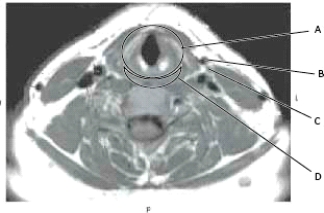
Which arrow points an upper internal jugular lymph node?
A) A
B) B
C) C
D) D
Which arrow points an upper internal jugular lymph node?
A) A
B) B
C) C
D) D
Question
The following questions refer to the figure below of an axial, T1-weighted MRI of the neck.
Which arrow points to the visceral space?
A) A
B) B
C) C
D) D
Which arrow points to the visceral space?
A) A
B) B
C) C
D) D
Question
The following questions refer to the figure below of a CTA of intracranial and extracranial arteries.
Which arrow points to the external carotid artery?
A) A
B) B
C) C
D) D
Which arrow points to the external carotid artery?
A) A
B) B
C) C
D) D
Question
The following questions refer to the figure below of an axial, T1-weighted MRI of the neck.
Which arrow points to the anterior jugular vein?
A) A
B) B
C) C
D) D
Which arrow points to the anterior jugular vein?
A) A
B) B
C) C
D) D
Question
The following questions refer to the figure below of an axial, T1-weighted MRI of the neck.
Which arrow points to the danger space?
A) A
B) B
C) C
D) D
Which arrow points to the danger space?
A) A
B) B
C) C
D) D

Unlock Deck
Sign up to unlock the cards in this deck!
Unlock Deck
Unlock Deck
1/65

Play

Full screen (f)
Deck 5: Neck
1
Which hormones excreted from the thyroid gland stimulate cell metabolism and are essential for normal body growth?
A) Parathyroid and calcitonin
B) Thyroxine and triiodothyronine
C) Triiodothyronine and calcitonin
D) Parathyroid and thyroxine
A) Parathyroid and calcitonin
B) Thyroxine and triiodothyronine
C) Triiodothyronine and calcitonin
D) Parathyroid and thyroxine
B
2
With quiet respiration the true vocal cords are in a relaxed position creating an opening between them called the:
A) Epiglottis
B) Ventricle
C) Glottis
D) Oropharynx
A) Epiglottis
B) Ventricle
C) Glottis
D) Oropharynx
C
3
The thyroid gland is located at the level of which laryngeal cartilage?
A) Cricoid
B) Corniculate
C) Epiglottis
D) Cuneiform
A) Cricoid
B) Corniculate
C) Epiglottis
D) Cuneiform
A
4
The digastric muscle is included in which muscle group?
A) Constrictor
B) Posterior triangle
C) Suprahyoid
D) Infrahyoid
A) Constrictor
B) Posterior triangle
C) Suprahyoid
D) Infrahyoid
Unlock Deck
Unlock for access to all 65 flashcards in this deck.
Unlock Deck
k this deck
5
Which cartilage forms the base of the larynx?
A) Thyroid
B) Epiglottis
C) Cricoid
D) Arytenoid
A) Thyroid
B) Epiglottis
C) Cricoid
D) Arytenoid
Unlock Deck
Unlock for access to all 65 flashcards in this deck.
Unlock Deck
k this deck
6
The oropharynx extends between which two structures?
A) Soft palate and hyoid bone
B) Hard palate and hyoid bone
C) Soft palate and cricoid cartilage
D) Hard palate and cricoid cartilage
A) Soft palate and hyoid bone
B) Hard palate and hyoid bone
C) Soft palate and cricoid cartilage
D) Hard palate and cricoid cartilage
Unlock Deck
Unlock for access to all 65 flashcards in this deck.
Unlock Deck
k this deck
7
In the figure below of an axial CT of the neck, which arrow points to the arytenoid cartilage?
A) A
B) B
C) C
D) D
A) A
B) B
C) C
D) D
Unlock Deck
Unlock for access to all 65 flashcards in this deck.
Unlock Deck
k this deck
8
The largest pair of salivary glands is the:
A) Parotid
B) Sublingual
C) Submaxillary
D) Submandibular
A) Parotid
B) Sublingual
C) Submaxillary
D) Submandibular
Unlock Deck
Unlock for access to all 65 flashcards in this deck.
Unlock Deck
k this deck
9
Which of the following muscles are frequently referred to as strap muscles?
A) Scalene
B) Infrahyoid
C) Suprahyoids
D) Pterygoids
A) Scalene
B) Infrahyoid
C) Suprahyoids
D) Pterygoids
Unlock Deck
Unlock for access to all 65 flashcards in this deck.
Unlock Deck
k this deck
10
The laryngopharynx continues as the esophagus at the level of the:
A) Hyoid bone
B) Cricoid cartilage
C) Soft palate
D) Pharyngeal tonsils
A) Hyoid bone
B) Cricoid cartilage
C) Soft palate
D) Pharyngeal tonsils
Unlock Deck
Unlock for access to all 65 flashcards in this deck.
Unlock Deck
k this deck
11
How many "unpaired" cartilages make up the larynx?
A) 1
B) 3
C) 5
D) 7
A) 1
B) 3
C) 5
D) 7
Unlock Deck
Unlock for access to all 65 flashcards in this deck.
Unlock Deck
k this deck
12
What muscle forms the boundary for the anterior and posterior triangles in the neck?
A) Platysma
B) Middle scalene
C) Sternocleidomastoid
D) Trapezius
A) Platysma
B) Middle scalene
C) Sternocleidomastoid
D) Trapezius
Unlock Deck
Unlock for access to all 65 flashcards in this deck.
Unlock Deck
k this deck
13
The trachea is reinforced by approximately how many C-shaped pieces of cartilage?
A) 6-9
B) 9-15
C) 16-20
D) 22-30
A) 6-9
B) 9-15
C) 16-20
D) 22-30
Unlock Deck
Unlock for access to all 65 flashcards in this deck.
Unlock Deck
k this deck
14
The lymph nodes of the neck can be classified or divided into how many levels or regions for ease of identification?
A) 5
B) 6
C) 7
D) 8
A) 5
B) 6
C) 7
D) 8
Unlock Deck
Unlock for access to all 65 flashcards in this deck.
Unlock Deck
k this deck
15
Which is a superficial muscle located on the posterior portion of the neck that acts to elevate the scapula?
A) Splenius capitis
B) Levator scapulae
C) Posterior scalene
D) Trapezius
A) Splenius capitis
B) Levator scapulae
C) Posterior scalene
D) Trapezius
Unlock Deck
Unlock for access to all 65 flashcards in this deck.
Unlock Deck
k this deck
16
Which vein drains blood from the lateral region of the face?
A) Retromandibular
B) Internal jugular
C) External jugular
D) Anterior jugular
A) Retromandibular
B) Internal jugular
C) External jugular
D) Anterior jugular
Unlock Deck
Unlock for access to all 65 flashcards in this deck.
Unlock Deck
k this deck
17
The thyroid cartilage consists of laminae that unite anteriorly to form a shield to protect the:
A) Thyroid gland
B) Pharyngeal tonsils
C) Epiglottis
D) Vocal cords
A) Thyroid gland
B) Pharyngeal tonsils
C) Epiglottis
D) Vocal cords
Unlock Deck
Unlock for access to all 65 flashcards in this deck.
Unlock Deck
k this deck
18
Which structures are frequently referred to as the adenoids?
A) Palatine tonsils
B) Pharyngeal tonsils
C) Parathyroid glands
D) Parotid glands
A) Palatine tonsils
B) Pharyngeal tonsils
C) Parathyroid glands
D) Parotid glands
Unlock Deck
Unlock for access to all 65 flashcards in this deck.
Unlock Deck
k this deck
19
The laminae of the thyroid cartilage unite anteriorly to form the:
A) Laryngeal prominence
B) Superior thyroid notch
C) Superior horn
D) Inferior horn
A) Laryngeal prominence
B) Superior thyroid notch
C) Superior horn
D) Inferior horn
Unlock Deck
Unlock for access to all 65 flashcards in this deck.
Unlock Deck
k this deck
20
In the figure below of an axial CT of the neck, which arrow points to the thyroid cartilage?
A) A
B) B
C) C
D) D
A) A
B) B
C) C
D) D
Unlock Deck
Unlock for access to all 65 flashcards in this deck.
Unlock Deck
k this deck
21
The following questions refer to the figure below of a midsagittal, T2-weighted MRI of the neck.
Which arrow points to the oropharynx?
A) A
B) B
C) C
D) D
E) E
Which arrow points to the oropharynx?
A) A
B) B
C) C
D) D
E) E
Unlock Deck
Unlock for access to all 65 flashcards in this deck.
Unlock Deck
k this deck
22
In the figure below of an axial, T1-weighted MR of the neck, which arrow points to the medial pterygoid muscle?
A) A
B) B
C) C
D) D
A) A
B) B
C) C
D) D
Unlock Deck
Unlock for access to all 65 flashcards in this deck.
Unlock Deck
k this deck
23
The following questions refer to the figure below of an axial CT of the neck.
Which arrow points to the platysma muscle?
A) A
B) B
C) C
D) D
Which arrow points to the platysma muscle?
A) A
B) B
C) C
D) D
Unlock Deck
Unlock for access to all 65 flashcards in this deck.
Unlock Deck
k this deck
24
The following questions refer to the figure below of a midsagittal, T2-weighted MRI of the neck.
Which arrow points to the esophagus?
A) A
B) B
C) C
D) D
E) E
Which arrow points to the esophagus?
A) A
B) B
C) C
D) D
E) E
Unlock Deck
Unlock for access to all 65 flashcards in this deck.
Unlock Deck
k this deck
25
The following questions refer to the figure below of an axial CT of the neck.
Which arrow points to the sternocleidomastoid muscle (SCM)?
A) A
B) B
C) C
D) D
Which arrow points to the sternocleidomastoid muscle (SCM)?
A) A
B) B
C) C
D) D
Unlock Deck
Unlock for access to all 65 flashcards in this deck.
Unlock Deck
k this deck
26
The following questions refer to the figure below of an axial CT of the neck.
Which arrow points to the submandibular gland?
A) A
B) B
C) C
D) D
Which arrow points to the submandibular gland?
A) A
B) B
C) C
D) D
Unlock Deck
Unlock for access to all 65 flashcards in this deck.
Unlock Deck
k this deck
27
The following questions refer to the figure below of a sagittal CT reformat of the pharynx.
Which arrow points to the hard palate?
A) A
B) B
C) C
D) D
Which arrow points to the hard palate?
A) A
B) B
C) C
D) D
Unlock Deck
Unlock for access to all 65 flashcards in this deck.
Unlock Deck
k this deck
28
In the figure below of an axial CT of the neck, which arrow points to the parotid gland?
A) A
B) B
C) C
D) D
A) A
B) B
C) C
D) D
Unlock Deck
Unlock for access to all 65 flashcards in this deck.
Unlock Deck
k this deck
29
The following questions refer to the figure below of a sagittal CT reformat of the pharynx.
Which arrow points to the hyoid bone?
A) A
B) B
C) C
D) D
Which arrow points to the hyoid bone?
A) A
B) B
C) C
D) D
Unlock Deck
Unlock for access to all 65 flashcards in this deck.
Unlock Deck
k this deck
30
The following questions refer to the figure below of a midsagittal, T2-weighted MRI of the neck.
Which arrow points to the cricoid cartilage?
A) A
B) B
C) C
D) D
E) E
Which arrow points to the cricoid cartilage?
A) A
B) B
C) C
D) D
E) E
Unlock Deck
Unlock for access to all 65 flashcards in this deck.
Unlock Deck
k this deck
31
The following questions refer to the figure below of a midsagittal, T2-weighted MRI of the neck.
Which arrow points to the laryngopharynx?
A) A
B) B
C) C
D) D
E) E
Which arrow points to the laryngopharynx?
A) A
B) B
C) C
D) D
E) E
Unlock Deck
Unlock for access to all 65 flashcards in this deck.
Unlock Deck
k this deck
32
The following questions refer to the figure below of a midsagittal, T2-weighted MRI of the neck.
Which arrow points to the nasopharynx?
A) A
B) B
C) C
D) D
E) E
Which arrow points to the nasopharynx?
A) A
B) B
C) C
D) D
E) E
Unlock Deck
Unlock for access to all 65 flashcards in this deck.
Unlock Deck
k this deck
33
The following questions refer to the figure below of an axial CT of the neck.
Which arrow points to the right interior jugular vein?
A) A
B) B
C) C
D) D
Which arrow points to the right interior jugular vein?
A) A
B) B
C) C
D) D
Unlock Deck
Unlock for access to all 65 flashcards in this deck.
Unlock Deck
k this deck
34
The following questions refer to the figure below of a sagittal CT reformat of the pharynx.
Which arrow points to the soft palate?
A) A
B) B
C) C
D) D
Which arrow points to the soft palate?
A) A
B) B
C) C
D) D
Unlock Deck
Unlock for access to all 65 flashcards in this deck.
Unlock Deck
k this deck
35
The following questions refer to the figure below of an axial CT of the neck.
Which arrow points to the anterior scalene muscle?
A) A
B) B
C) C
D) D
Which arrow points to the anterior scalene muscle?
A) A
B) B
C) C
D) D
Unlock Deck
Unlock for access to all 65 flashcards in this deck.
Unlock Deck
k this deck
36
The following questions refer to the figure below of an axial CT of the neck.
Which arrow points to the hyoid bone?
A) A
B) B
C) C
D) D
Which arrow points to the hyoid bone?
A) A
B) B
C) C
D) D
Unlock Deck
Unlock for access to all 65 flashcards in this deck.
Unlock Deck
k this deck
37
The following questions refer to the figure below of a coronal, T1-weighted MRI of the neck.
Which arrow points to the submandibular gland?
A) A
B) B
C) C
D) D
Which arrow points to the submandibular gland?
A) A
B) B
C) C
D) D
Unlock Deck
Unlock for access to all 65 flashcards in this deck.
Unlock Deck
k this deck
38
The following questions refer to the figure below of a sagittal CT reformat of the pharynx.
Which arrow points to the epiglottis?
A) A
B) B
C) C
D) D
Which arrow points to the epiglottis?
A) A
B) B
C) C
D) D
Unlock Deck
Unlock for access to all 65 flashcards in this deck.
Unlock Deck
k this deck
39
The following questions refer to the figure below of an axial CT of the neck.
Which arrow points to the aryepiglottic fold?
A) A
B) B
C) C
D) D
Which arrow points to the aryepiglottic fold?
A) A
B) B
C) C
D) D
Unlock Deck
Unlock for access to all 65 flashcards in this deck.
Unlock Deck
k this deck
40
The following questions refer to the figure below of an axial CT of the neck.
Which arrow points to the thyroid gland (left lobe)?
A) A
B) B
C) C
D) D
Which arrow points to the thyroid gland (left lobe)?
A) A
B) B
C) C
D) D
Unlock Deck
Unlock for access to all 65 flashcards in this deck.
Unlock Deck
k this deck
41
The following questions refer to the figure below of a CTA of intracranial and extracranial arteries.
Which arrow points to the common carotid artery?
A) A
B) B
C) C
D) D
Which arrow points to the common carotid artery?
A) A
B) B
C) C
D) D
Unlock Deck
Unlock for access to all 65 flashcards in this deck.
Unlock Deck
k this deck
42
The following questions refer to the figure below of an axial, T1-weighted MRI of the neck.
Which arrow points to the esophagus?
A) A
B) B
C) C
D) D
E) E
Which arrow points to the esophagus?
A) A
B) B
C) C
D) D
E) E
Unlock Deck
Unlock for access to all 65 flashcards in this deck.
Unlock Deck
k this deck
43
The following questions refer to the figure below of an axial, T1-weighted MRI of the neck.
Which arrow points to the digastric muscle?
A) A
B) B
C) C
D) D
Which arrow points to the digastric muscle?
A) A
B) B
C) C
D) D
Unlock Deck
Unlock for access to all 65 flashcards in this deck.
Unlock Deck
k this deck
44
The following questions refer to the figure below of a coronal, T1-weighted MRI of the neck.
Which arrow points to the thyroid cartilage?
A) A
B) B
C) C
D) D
Which arrow points to the thyroid cartilage?
A) A
B) B
C) C
D) D
Unlock Deck
Unlock for access to all 65 flashcards in this deck.
Unlock Deck
k this deck
45
The following questions refer to the figure below of a coronal CT reformat of the neck.
Which arrow points to the common carotid artery?
A) A
B) B
C) C
D) D
E) E
Which arrow points to the common carotid artery?
A) A
B) B
C) C
D) D
E) E
Unlock Deck
Unlock for access to all 65 flashcards in this deck.
Unlock Deck
k this deck
46
The following questions refer to the figure below of a coronal, T1-weighted MRI of the neck.
Which arrow points to the aryepiglottic fold?
A) A
B) B
C) C
D) D
Which arrow points to the aryepiglottic fold?
A) A
B) B
C) C
D) D
Unlock Deck
Unlock for access to all 65 flashcards in this deck.
Unlock Deck
k this deck
47
The following questions refer to the figure below of an axial, T1-weighted MRI of the neck.
Which arrow points to the levator scapulae muscle?
A) A
B) B
C) C
D) D
E) E
Which arrow points to the levator scapulae muscle?
A) A
B) B
C) C
D) D
E) E
Unlock Deck
Unlock for access to all 65 flashcards in this deck.
Unlock Deck
k this deck
48
The following questions refer to the figure below of an axial, T1-weighted MRI of the neck.
Which arrow points to the middle scalene muscle?
A) A
B) B
C) C
D) D
E) E
Which arrow points to the middle scalene muscle?
A) A
B) B
C) C
D) D
E) E
Unlock Deck
Unlock for access to all 65 flashcards in this deck.
Unlock Deck
k this deck
49
The following questions refer to the figure below of a coronal CT reformat of the neck.
Which arrow points to the thyroid gland?
A) A
B) B
C) C
D) D
E) E
Which arrow points to the thyroid gland?
A) A
B) B
C) C
D) D
E) E
Unlock Deck
Unlock for access to all 65 flashcards in this deck.
Unlock Deck
k this deck
50
The following questions refer to the figure below of a CTA of intracranial and extracranial arteries.
Which arrow points to the vertebral artery?
A) A
B) B
C) C
D) D
Which arrow points to the vertebral artery?
A) A
B) B
C) C
D) D
Unlock Deck
Unlock for access to all 65 flashcards in this deck.
Unlock Deck
k this deck
51
The following questions refer to the figure below of an axial, T1-weighted MRI of the neck.
Which arrow points to the retromandibular vein?
A) A
B) B
C) C
D) D
Which arrow points to the retromandibular vein?
A) A
B) B
C) C
D) D
Unlock Deck
Unlock for access to all 65 flashcards in this deck.
Unlock Deck
k this deck
52
The following questions refer to the figure below of an axial, T1-weighted MRI of the neck.
Which arrow points to the longus capitis muscle?
A) A
B) B
C) C
D) D
E) E
Which arrow points to the longus capitis muscle?
A) A
B) B
C) C
D) D
E) E
Unlock Deck
Unlock for access to all 65 flashcards in this deck.
Unlock Deck
k this deck
53
The following questions refer to the figure below of a coronal CT reformat of the neck.
Which arrow points to the sternocleidomastoid muscle (SCM)?
A) A
B) B
C) C
D) D
E) E
Which arrow points to the sternocleidomastoid muscle (SCM)?
A) A
B) B
C) C
D) D
E) E
Unlock Deck
Unlock for access to all 65 flashcards in this deck.
Unlock Deck
k this deck
54
The following questions refer to the figure below of a coronal, T1-weighted MRI of the neck.
Which arrow points to the cricoid cartilage?
A) A
B) B
C) C
D) D
Which arrow points to the cricoid cartilage?
A) A
B) B
C) C
D) D
Unlock Deck
Unlock for access to all 65 flashcards in this deck.
Unlock Deck
k this deck
55
The following questions refer to the figure below of a coronal CT reformat of the neck.
Which arrow points to the epiglottis?
A) A
B) B
C) C
D) D
E) E
Which arrow points to the epiglottis?
A) A
B) B
C) C
D) D
E) E
Unlock Deck
Unlock for access to all 65 flashcards in this deck.
Unlock Deck
k this deck
56
The following questions refer to the figure below of an axial, T1-weighted MRI of the neck.
Which arrow points to the internal jugular vein?
A) A
B) B
C) C
D) D
Which arrow points to the internal jugular vein?
A) A
B) B
C) C
D) D
Unlock Deck
Unlock for access to all 65 flashcards in this deck.
Unlock Deck
k this deck
57
The following questions refer to the figure below of an axial, T1-weighted MRI of the neck.
Which arrow points to the genioglossus muscle?
A) A
B) B
C) C
D) D
Which arrow points to the genioglossus muscle?
A) A
B) B
C) C
D) D
Unlock Deck
Unlock for access to all 65 flashcards in this deck.
Unlock Deck
k this deck
58
The following questions refer to the figure below of a CTA of intracranial and extracranial arteries.
Which arrow points to the internal carotid artery?
A) A
B) B
C) C
D) D
Which arrow points to the internal carotid artery?
A) A
B) B
C) C
D) D
Unlock Deck
Unlock for access to all 65 flashcards in this deck.
Unlock Deck
k this deck
59
The following questions refer to the figure below of a coronal CT reformat of the neck.
Which arrow points to the internal jugular vein?
A) A
B) B
C) C
D) D
E) E
Which arrow points to the internal jugular vein?
A) A
B) B
C) C
D) D
E) E
Unlock Deck
Unlock for access to all 65 flashcards in this deck.
Unlock Deck
k this deck
60
The following questions refer to the figure below of an axial, T1-weighted MRI of the neck.
Which arrow points to the vertebral artery?
A) A
B) B
C) C
D) D
E) E
Which arrow points to the vertebral artery?
A) A
B) B
C) C
D) D
E) E
Unlock Deck
Unlock for access to all 65 flashcards in this deck.
Unlock Deck
k this deck
61
The following questions refer to the figure below of an axial, T1-weighted MRI of the neck.
Which arrow points an upper internal jugular lymph node?
A) A
B) B
C) C
D) D
Which arrow points an upper internal jugular lymph node?
A) A
B) B
C) C
D) D
Unlock Deck
Unlock for access to all 65 flashcards in this deck.
Unlock Deck
k this deck
62
The following questions refer to the figure below of an axial, T1-weighted MRI of the neck.
Which arrow points to the visceral space?
A) A
B) B
C) C
D) D
Which arrow points to the visceral space?
A) A
B) B
C) C
D) D
Unlock Deck
Unlock for access to all 65 flashcards in this deck.
Unlock Deck
k this deck
63
The following questions refer to the figure below of a CTA of intracranial and extracranial arteries.
Which arrow points to the external carotid artery?
A) A
B) B
C) C
D) D
Which arrow points to the external carotid artery?
A) A
B) B
C) C
D) D
Unlock Deck
Unlock for access to all 65 flashcards in this deck.
Unlock Deck
k this deck
64
The following questions refer to the figure below of an axial, T1-weighted MRI of the neck.
Which arrow points to the anterior jugular vein?
A) A
B) B
C) C
D) D
Which arrow points to the anterior jugular vein?
A) A
B) B
C) C
D) D
Unlock Deck
Unlock for access to all 65 flashcards in this deck.
Unlock Deck
k this deck
65
The following questions refer to the figure below of an axial, T1-weighted MRI of the neck.
Which arrow points to the danger space?
A) A
B) B
C) C
D) D
Which arrow points to the danger space?
A) A
B) B
C) C
D) D
Unlock Deck
Unlock for access to all 65 flashcards in this deck.
Unlock Deck
k this deck
Unlock Deck
Unlock for access to all 65 flashcards in this deck.






