







 Chat with AI

Deck 29: The Working Plant
Full screen (f)

Question

Question
Question
Question
Question
Question
Question
Question
Question
Question
Question
Question
Question
Question
Question
Question
Question
Question
Question
Question
Question
Question
Question
Question
Question
Question
Question
Question
Question
Question
Question
Question
Question
Question
Question
Question
Question
Question
Question
Question
Question
Question
Question
Question
Question
 V
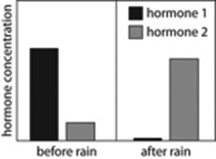
VA scientist finds seeds of an unknown plant on top of the soil in a desert. She measures the concentration of two hormones in these seeds. After it rains, she collects more of these seeds, and finds that the concentration of the two hormones has changed. A graph of her results is shown. If the scientist returns to the desert to collect more seeds, a few days later, what should she observe?
A)The seeds that are still in the desert will be dormant.
B)The seeds that are still in the desert will be germinating.
C)The seeds that are still in the desert will be dead.
D)The seeds that are still in the desert will have increased levels of hormones 1 and 2.
Question
Question
Examine the figure. Where is the site of carbon dioxide uptake by a plant? 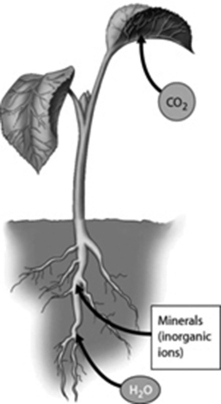
A)root hairs
B)stomata
C)rhizomes
D)internodes
A)root hairs
B)stomata
C)rhizomes
D)internodes
Question
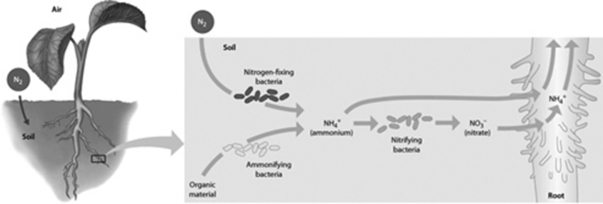
Examine the figure. What adds ammonium to the soil by decomposing organic matter?
A)nitrifying bacteria, but not ammonifying bacteria or nitrogen fixing bacteria
B)ammonifying bacteria, but not nitrifying or nitrogen fixing bacteria
C)nitrogen-fixing bacteria, but not nitrifying or ammonifying bacteria
D)nitrifying bacteria and nitrogen fixing bacteria, but not ammonifying bacteria
Question
Question
In the figure, what produces nitrogen in a form that can be used directly by the plant, without need for conversion?
A)nitrifying bacteria only
B)ammonifying bacteria only
C)nitrogen-fixing bacteria only
D)ammonifying bacteria and nitrogen fixing bacteria
Question
The figure shows plants grown in the dark, and illustrates ________ in plants. 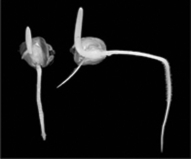
A)photoperiod
B)gravitropism
C)thigmotropism
D)phototropism
A)photoperiod
B)gravitropism
C)thigmotropism
D)phototropism
Question
VA scientist finds seeds of an unknown plant on top of the soil in a desert. She measures the concentration of two hormones in these seeds. After it rains, she collects more of these seeds, and finds that the concentration of the two hormones has changed. A graph of her results is shown. Identify the most likely hormones measured by the scientist.
A)hormone 1: gibberellin; hormone 2: cytokinin
B)hormone 1: auxin; hormone 2: ethylene
C)hormone 1: abscisic acid; hormone 2: gibberellin
D)hormone 1: ethylene; hormone 2: auxin
Question
Question
Question
Question
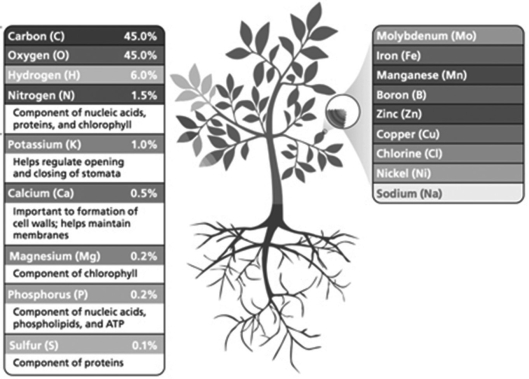
What correctly describes the plant nutrients shown in the figure?
A)The list on the left shows macronutrients, and the one on the right shows micronutrients.
B)The list on the left shows micronutrients, and the one on the right shows macronutrients.
C)The list on the left shows micro- and macronutrients, and the one on the right shows micronutrients.
Question
The figure shows plants originally grown in the dark, and then a light is added on one side only (arrow). Predict the response of the plants to the addition of the light source. 
A)Auxin becomes concentrated on the lighted side of the plants, and the plants begin to grow toward the light.
B)Auxin becomes concentrated on the darker side of the plants, and the plants begin to grow toward the light.
C)Auxin becomes concentrated on the lighted side of the plants, and the plants begin to grow away from the light.
D)Auxin becomes concentrated on the darker side of the plants, and the plants begin to grow away from the light.
A)Auxin becomes concentrated on the lighted side of the plants, and the plants begin to grow toward the light.
B)Auxin becomes concentrated on the darker side of the plants, and the plants begin to grow toward the light.
C)Auxin becomes concentrated on the lighted side of the plants, and the plants begin to grow away from the light.
D)Auxin becomes concentrated on the darker side of the plants, and the plants begin to grow away from the light.
Question
What plant nutrients are shown in the figure?
A)These are all nutrients that must be obtained from the environment in order to complete the life cycle.
B)These are all nutrients that are required in relatively large amounts.
C)These are all nutrients that are required in extremely small quantities.
D)These are all nutrients that are most often deficient in depleted soils.
Question
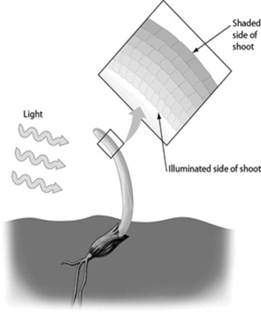
Examine the figure. Why does the shoot bend toward the light?
A)Reduction in auxin levels allows gibberellins to promote cell elongation.
B)Reduction in gibberellin levels allows auxin to promote cell elongation.
C)Increase in auxin levels promotes cell elongation.
D)Increase in auxin levels promotes cell proliferation.
Question
Question
Question
Question
Question
Question
Question
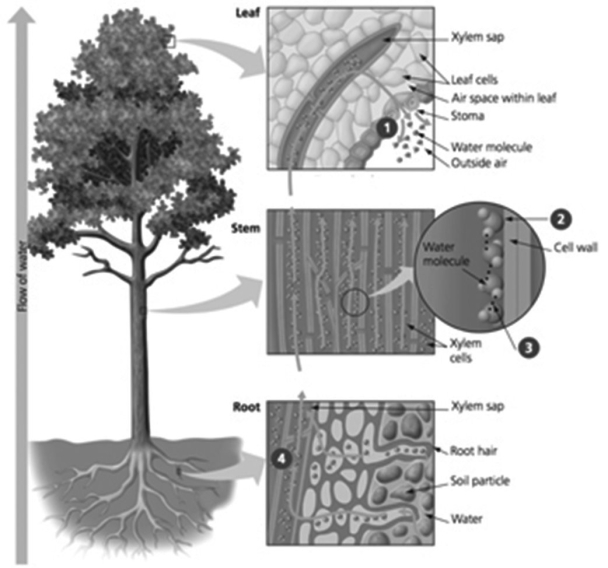
What is the difference between the two properties of water shown at label 2 and label 3?
A)Label 2 shows how water molecules adhere to other molecules, while label 3 shows how water molecules hydrogen bond together.
B)Label 2 shows how water molecules hydrogen bond together, while label 3 shows how water molecules adhere to other molecules.
C)Label 2 shows how water transforms from liquid to gaseous form, while label 3 shows how water transforms from gaseous to liquid form.
D)Label 2 shows how water transforms from gaseous to liquid form, while label 3 shows how water transforms from liquid to gaseous form.
Question
Question
Question
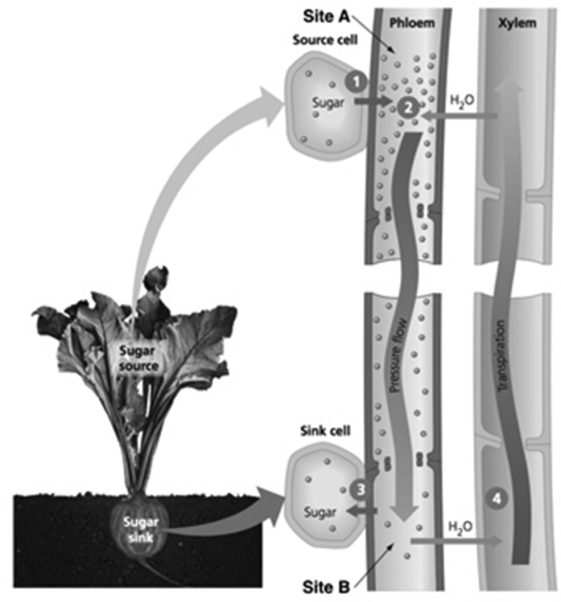
In the figure, for sugar to move from the source cell (Label 1)into the phloem (Label 2)________.
A)active transport is needed to load the phloem tube with sugar
B)water must flow to Label 2 from the adjacent xylem
C)active transport is needed to drive phloem from Label 2 to Site B
D)a sink cell at Label 3 must be removing sugar from the phloem
Question
Question
In the figure, for water to flow from Site B to the adjacent xylem ________.
A)Site B must have a lower water pressure than the adjacent xylem
B)Site B must have a lower solute concentration than the adjacent xylem
C)transpiration must be occurring out of the plant root
D)Site A must have a lower water pressure than Site B
Question
Question
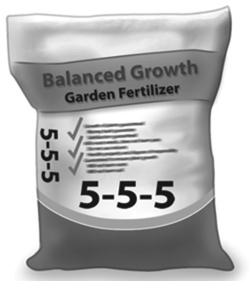 This figure shows a typical label for fertilizer. What fertilizer is contained in this bag?
A)An all-purpose fertilizer with 5% nitrogen, 5% phosphorus, and 5% potassium.
B)An organic fertilizer with 5% compost, 5% yard waste, and 5% kitchen scraps.
C)An inorganic fertilizer that will make a plant grow 5% taller, 5% wider, and produce 5% more fruit.

Unlock Deck
Sign up to unlock the cards in this deck!
Unlock Deck
Unlock Deck
1/73

Play

Full screen (f)
Deck 29: The Working Plant
1
A ________ is a chemical element that a plant can only obtain from its environment and is needed to complete its life cycle.
A)macronutrient
B)micronutrient
C)essential element
D)mineral
A)macronutrient
B)micronutrient
C)essential element
D)mineral
C
2
In phytoremediation after a nuclear power plant accident, plants are used to remove ________ and ________ from the soil.
A)carbon; heavy metals
B)radioactive isotopes; heavy metals
C)nitrogen; phosphorus
D)water; sulfur
A)carbon; heavy metals
B)radioactive isotopes; heavy metals
C)nitrogen; phosphorus
D)water; sulfur
B
3
Root nodules in plants such as peas and beans are advantageous because they ________.
A)house nitrogen-fixing bacteria
B)help absorb nutrients from the soil
C)house mycorrhizae
D)store nutrients
A)house nitrogen-fixing bacteria
B)help absorb nutrients from the soil
C)house mycorrhizae
D)store nutrients
A
4
What converts atmospheric nitrogen to ammonium?
A)nitrifying bacteria
B)nitrogen-fixing bacteria
C)mycorrhizae
D)ammonifying bacteria
A)nitrifying bacteria
B)nitrogen-fixing bacteria
C)mycorrhizae
D)ammonifying bacteria
Unlock Deck
Unlock for access to all 73 flashcards in this deck.
Unlock Deck
k this deck
5
What does a plant gain from a mycorrhizal relationship?
A)It allows roots to absorb water and solutes more rapidly.
B)It increases the surface area for photosynthesis.
C)It helps to break down complex molecules in the soil to release micronutrients.
D)It helps to break down decaying organic matter into essential plant nutrients.
A)It allows roots to absorb water and solutes more rapidly.
B)It increases the surface area for photosynthesis.
C)It helps to break down complex molecules in the soil to release micronutrients.
D)It helps to break down decaying organic matter into essential plant nutrients.
Unlock Deck
Unlock for access to all 73 flashcards in this deck.
Unlock Deck
k this deck
6
What is the conversion that occurs during nitrogen fixation?
A)ammonium to nitrate
B)nitrate to ammonium
C)nitrogen to ammonium
D)nitrogen to ammonium or nitrate
A)ammonium to nitrate
B)nitrate to ammonium
C)nitrogen to ammonium
D)nitrogen to ammonium or nitrate
Unlock Deck
Unlock for access to all 73 flashcards in this deck.
Unlock Deck
k this deck
7
What best describes the opening and closing of the stomata in most plants?
A)They are open during the day and closed at night.
B)They are open at night and closed during the day.
C)They are open almost all of the time.
D)They are closed except for brief periods of time during the day.
A)They are open during the day and closed at night.
B)They are open at night and closed during the day.
C)They are open almost all of the time.
D)They are closed except for brief periods of time during the day.
Unlock Deck
Unlock for access to all 73 flashcards in this deck.
Unlock Deck
k this deck
8
What best describes the mechanism that causes stomata to open?
A)Water accumulates below the opening and eventually causes the stoma to open.
B)A large bubble of oxygen accumulates below the stoma and eventually causes it to open.
C)Two guard cells flanking each stoma change shape to open or close the stoma.
D)The internal pressure of xylem sap expands the leaf, stretching the stoma open.
A)Water accumulates below the opening and eventually causes the stoma to open.
B)A large bubble of oxygen accumulates below the stoma and eventually causes it to open.
C)Two guard cells flanking each stoma change shape to open or close the stoma.
D)The internal pressure of xylem sap expands the leaf, stretching the stoma open.
Unlock Deck
Unlock for access to all 73 flashcards in this deck.
Unlock Deck
k this deck
9
What mechanism best explains how xylem sap moves up against the downward pull of gravity?
A)cohesion-tension hypothesis
B)gravitropism
C)phototropism
D)expenditure of ATP
A)cohesion-tension hypothesis
B)gravitropism
C)phototropism
D)expenditure of ATP
Unlock Deck
Unlock for access to all 73 flashcards in this deck.
Unlock Deck
k this deck
10
For a plant, carbon and nitrogen are ________.
A)macronutrients
B)micronutrients
C)minerals
D)compost
A)macronutrients
B)micronutrients
C)minerals
D)compost
Unlock Deck
Unlock for access to all 73 flashcards in this deck.
Unlock Deck
k this deck
11
What is an example of a plant micronutrient?
A)iron
B)oxygen
C)sulfur
D)phosphorus
A)iron
B)oxygen
C)sulfur
D)phosphorus
Unlock Deck
Unlock for access to all 73 flashcards in this deck.
Unlock Deck
k this deck
12
Substances that enter a plant through the root system are ________.
A)dissolved in water
B)obtained from the air
C)organic molecules
D)brought in through stomata
A)dissolved in water
B)obtained from the air
C)organic molecules
D)brought in through stomata
Unlock Deck
Unlock for access to all 73 flashcards in this deck.
Unlock Deck
k this deck
13
What converts soil ammonium to nitrate?
A)nitrifying bacteria
B)ammonifying bacteria
C)mycorrhizae
D)nitrogen-fixing bacteria
A)nitrifying bacteria
B)ammonifying bacteria
C)mycorrhizae
D)nitrogen-fixing bacteria
Unlock Deck
Unlock for access to all 73 flashcards in this deck.
Unlock Deck
k this deck
14
A typical plant obtains both water and minerals from ________.
A)the air
B)bacteria
C)sunlight
D)the soil
A)the air
B)bacteria
C)sunlight
D)the soil
Unlock Deck
Unlock for access to all 73 flashcards in this deck.
Unlock Deck
k this deck
15
Most plants rely on bacteria to supply them with a usable form of ________.
A)nitrogen
B)carbon dioxide
C)water
D)amino acids
A)nitrogen
B)carbon dioxide
C)water
D)amino acids
Unlock Deck
Unlock for access to all 73 flashcards in this deck.
Unlock Deck
k this deck
16
For plants, mycorrhizae are ________.
A)parasitic
B)mutualistic
C)an adaptation for photosynthesis
D)agricultural pests
A)parasitic
B)mutualistic
C)an adaptation for photosynthesis
D)agricultural pests
Unlock Deck
Unlock for access to all 73 flashcards in this deck.
Unlock Deck
k this deck
17
What aspect of plant nutrition is not found in animal nutrition?
A)Plants use inorganic substances and energy from the sun to produce their own food.
B)Plants use organic substances to produce their own food.
C)Plants absorb food through their roots.
D)Plant and animal nutrition are essentially the same.
A)Plants use inorganic substances and energy from the sun to produce their own food.
B)Plants use organic substances to produce their own food.
C)Plants absorb food through their roots.
D)Plant and animal nutrition are essentially the same.
Unlock Deck
Unlock for access to all 73 flashcards in this deck.
Unlock Deck
k this deck
18
Transpiration is ________.
A)the loss of oxygen from a plant
B)evaporation from a plant's roots
C)the bulk flow movement of water in a plant
D)the loss of water from plant leaves through evaporation
A)the loss of oxygen from a plant
B)evaporation from a plant's roots
C)the bulk flow movement of water in a plant
D)the loss of water from plant leaves through evaporation
Unlock Deck
Unlock for access to all 73 flashcards in this deck.
Unlock Deck
k this deck
19
The three most important nutrients contained in fertilizers are ________.
A)nitrogen, iron, and phosphorus
B)zinc, sulfur, and phosphorus
C)nitrogen, phosphorus, and potassium
D)zinc, iron, and potassium
A)nitrogen, iron, and phosphorus
B)zinc, sulfur, and phosphorus
C)nitrogen, phosphorus, and potassium
D)zinc, iron, and potassium
Unlock Deck
Unlock for access to all 73 flashcards in this deck.
Unlock Deck
k this deck
20
What weather conditions would cause transpiration to be most rapid?
A)hot, humid weather
B)cold, humid weather
C)hot, dry weather
D)windy, wet weather
A)hot, humid weather
B)cold, humid weather
C)hot, dry weather
D)windy, wet weather
Unlock Deck
Unlock for access to all 73 flashcards in this deck.
Unlock Deck
k this deck
21
What best describes night-neutral plants?
A)The plants flower at night.
B)Plants tend to flower when nights become longer.
C)Plants tend to flower when nights become shorter.
D)The flowering in these plants is not affected by photoperiod.
A)The plants flower at night.
B)Plants tend to flower when nights become longer.
C)Plants tend to flower when nights become shorter.
D)The flowering in these plants is not affected by photoperiod.
Unlock Deck
Unlock for access to all 73 flashcards in this deck.
Unlock Deck
k this deck
22
Early in the spring, cherry trees produce flowers, even before their leaves develop, by using sugars that were stored in their roots the previous year. While cherry flowers are developing, we would expect the phloem pressure near flowers to be ________, and ________ near root storage cells.
A)high; high
B)high; low
C)low; low
D)low; high
A)high; high
B)high; low
C)low; low
D)low; high
Unlock Deck
Unlock for access to all 73 flashcards in this deck.
Unlock Deck
k this deck
23
What moves phloem sap within a plant?
A)cohesion-tension mechanism
B)gravity pulls the phloem sap down
C)pressure-flow mechanism
D)transpiration
A)cohesion-tension mechanism
B)gravity pulls the phloem sap down
C)pressure-flow mechanism
D)transpiration
Unlock Deck
Unlock for access to all 73 flashcards in this deck.
Unlock Deck
k this deck
24
A farmer decides she wants to grow certified organic corn and sets out to meet all USDA standards to do so. Her crop grows well for the first 3 years; however, she notices during the 4th and 5th years that plants are getting smaller and producing much less corn. She has not altered farming practices and begins to wonder what is happening. She remembers someone mentioning planting peanuts every 3rd year in place of a corn crop, which leads to much healthier corn. Why would a farmer want to change to a different crop, especially something like peanuts?
A)Planting a legume like peanuts increases water retention in the soil, allowing the following year's corn crop to thrive.
B)Crop rotation with a legume like peanuts will increase nitrogen in the soil, reducing the need for chemical fertilizer.
C)Planting a legume like peanuts increases the available carbon in the soil.
D)Changing from corn to peanuts, a legume, allows the soil to "rest" for a year.
A)Planting a legume like peanuts increases water retention in the soil, allowing the following year's corn crop to thrive.
B)Crop rotation with a legume like peanuts will increase nitrogen in the soil, reducing the need for chemical fertilizer.
C)Planting a legume like peanuts increases the available carbon in the soil.
D)Changing from corn to peanuts, a legume, allows the soil to "rest" for a year.
Unlock Deck
Unlock for access to all 73 flashcards in this deck.
Unlock Deck
k this deck
25
Which statement is TRUE?
A)A given hormone has the same effect on all parts of a plant.
B)A single hormone may have different effects depending on concentration and presence of other hormones.
C)Plants and animals use hormones in very different ways.
D)Large amounts of hormones are required to affect plant growth and development.
A)A given hormone has the same effect on all parts of a plant.
B)A single hormone may have different effects depending on concentration and presence of other hormones.
C)Plants and animals use hormones in very different ways.
D)Large amounts of hormones are required to affect plant growth and development.
Unlock Deck
Unlock for access to all 73 flashcards in this deck.
Unlock Deck
k this deck
26
What hormone promotes cell division?
A)auxin
B)cytokinin
C)gibberellin
D)abscisic acid
A)auxin
B)cytokinin
C)gibberellin
D)abscisic acid
Unlock Deck
Unlock for access to all 73 flashcards in this deck.
Unlock Deck
k this deck
27
In a strawberry plant in the summer, the leaves are ________ and the strawberry fruits are ________.
A)sugar sources; sugar sources
B)sugar sources; sugar sinks
C)sugar sinks; sugar sources
D)sugar sinks; sugar sinks
A)sugar sources; sugar sources
B)sugar sources; sugar sinks
C)sugar sinks; sugar sources
D)sugar sinks; sugar sinks
Unlock Deck
Unlock for access to all 73 flashcards in this deck.
Unlock Deck
k this deck
28
Transpiration pulls water up a plant because of two mechanisms: ________ describes water molecules sticking together and ________ describes water molecules sticking to the walls of the xylem.
A)cohesion; adhesion
B)adhesion; cohesion
C)adhesion; gravity
D)gravity; cohesion
A)cohesion; adhesion
B)adhesion; cohesion
C)adhesion; gravity
D)gravity; cohesion
Unlock Deck
Unlock for access to all 73 flashcards in this deck.
Unlock Deck
k this deck
29
What hormone promotes cell elongation in stems?
A)auxin
B)cytokinin
C)ethylene
D)absiscic acid
A)auxin
B)cytokinin
C)ethylene
D)absiscic acid
Unlock Deck
Unlock for access to all 73 flashcards in this deck.
Unlock Deck
k this deck
30
What best describe(s)the dependencies of most flowering plants?
A)Many depend on insects or other animals for pollination, but not for seed dispersal.
B)Many depend on insects or other animals for seed dispersal, but not for pollination.
C)Many depend on insects or other animals for pollination and fungi to help them acquire nutrients, but none rely on other organisms for seed dispersal.
D)Many depend on insects or other animals for pollination and seed dispersal, and on fungi to help acquire nutrients.
A)Many depend on insects or other animals for pollination, but not for seed dispersal.
B)Many depend on insects or other animals for seed dispersal, but not for pollination.
C)Many depend on insects or other animals for pollination and fungi to help them acquire nutrients, but none rely on other organisms for seed dispersal.
D)Many depend on insects or other animals for pollination and seed dispersal, and on fungi to help acquire nutrients.
Unlock Deck
Unlock for access to all 73 flashcards in this deck.
Unlock Deck
k this deck
31
What happens in a twig if the auxin produced by its apical meristem is conveyed equally down all sides?
A)It will elongate.
B)It will branch near its tip.
C)It will produce a flower.
D)It will bend to one side.
A)It will elongate.
B)It will branch near its tip.
C)It will produce a flower.
D)It will bend to one side.
Unlock Deck
Unlock for access to all 73 flashcards in this deck.
Unlock Deck
k this deck
32
What triggers flowering for plants sensitive to photoperiod?
A)temperature
B)night length
C)day length
D)intensity of sunlight
A)temperature
B)night length
C)day length
D)intensity of sunlight
Unlock Deck
Unlock for access to all 73 flashcards in this deck.
Unlock Deck
k this deck
33
What plant hormone(s)affect(s)development in the plant body?
A)auxin, cytokinin, and ethylene
B)auxin, abscisic acid, and cytokinin
C)gibberellin, but not auxin or cytokinin
D)auxin, cytokinin, and gibberellin
A)auxin, cytokinin, and ethylene
B)auxin, abscisic acid, and cytokinin
C)gibberellin, but not auxin or cytokinin
D)auxin, cytokinin, and gibberellin
Unlock Deck
Unlock for access to all 73 flashcards in this deck.
Unlock Deck
k this deck
34
Which hormone promotes seed dormancy?
A)cytokinin
B)ethylene
C)gibberellin
D)abscisic acid
A)cytokinin
B)ethylene
C)gibberellin
D)abscisic acid
Unlock Deck
Unlock for access to all 73 flashcards in this deck.
Unlock Deck
k this deck
35
What hormone promotes seed germination?
A)auxin
B)ethylene
C)gibberellin
D)abscisic acid
A)auxin
B)ethylene
C)gibberellin
D)abscisic acid
Unlock Deck
Unlock for access to all 73 flashcards in this deck.
Unlock Deck
k this deck
36
Which hormone promotes fruit ripening and dropping of leaves?
A)auxin
B)ethylene
C)gibberellin
D)abscisic acid
A)auxin
B)ethylene
C)gibberellin
D)abscisic acid
Unlock Deck
Unlock for access to all 73 flashcards in this deck.
Unlock Deck
k this deck
37
Trace the flow of a water molecule that is used during photosynthesis, from the environment to the site of photosynthesis.
A)stoma → xylem → root hair → mycorrhiza
B)soil → root hair → xylem → stoma → atmosphere
C)soil → root hair → xylem → leaf cell
D)soil → xylem → leaf cell → atmosphere
A)stoma → xylem → root hair → mycorrhiza
B)soil → root hair → xylem → stoma → atmosphere
C)soil → root hair → xylem → leaf cell
D)soil → xylem → leaf cell → atmosphere
Unlock Deck
Unlock for access to all 73 flashcards in this deck.
Unlock Deck
k this deck
38
A pea tendril contacts a string or wire and coils around it for support. What does this pea tendril demonstrate?
A)gravitropism
B)photoperiod
C)thigmotropism
D)phototropism
A)gravitropism
B)photoperiod
C)thigmotropism
D)phototropism
Unlock Deck
Unlock for access to all 73 flashcards in this deck.
Unlock Deck
k this deck
39
A location in a plant where sugar is being received for storage or consumption is ________.
A)a sugar sink
B)a sugar source
C)phloem sap
D)phloem tube
A)a sugar sink
B)a sugar source
C)phloem sap
D)phloem tube
Unlock Deck
Unlock for access to all 73 flashcards in this deck.
Unlock Deck
k this deck
40
Experimental plants that were sent up in space shuttle missions did not exhibit all of their normal tropisms. Which response would you most expect to be lacking from these plants?
A)gravitropism
B)photoperiod
C)thigmotropism
D)phototropism
A)gravitropism
B)photoperiod
C)thigmotropism
D)phototropism
Unlock Deck
Unlock for access to all 73 flashcards in this deck.
Unlock Deck
k this deck
41
A farmer applies an organic fertilizer to her apple trees. Does this practice allow her to sell her apples as certified organic?
A)No, because she would also need to protect biodiversity, maintain soil quality, conserve water, and other sustainable agricultural practices.
B)No, because organic fertilizers contain simple minerals that might not be present in the soil.
C)Yes, because the contents of organic fertilizer are biologically-derived.
D)Yes, because the only practices required to be certified organic is the use of organic fertilizers and organic pesticides.
A)No, because she would also need to protect biodiversity, maintain soil quality, conserve water, and other sustainable agricultural practices.
B)No, because organic fertilizers contain simple minerals that might not be present in the soil.
C)Yes, because the contents of organic fertilizer are biologically-derived.
D)Yes, because the only practices required to be certified organic is the use of organic fertilizers and organic pesticides.
Unlock Deck
Unlock for access to all 73 flashcards in this deck.
Unlock Deck
k this deck
42
Plant transport products have many economic uses. A product that is correctly paired to its structure in a plant is ________.
A)potatoes - tubers
B)maple syrup - phloem sap
C)latex - phloem sap
A)potatoes - tubers
B)maple syrup - phloem sap
C)latex - phloem sap
Unlock Deck
Unlock for access to all 73 flashcards in this deck.
Unlock Deck
k this deck
43
What processes contribute directly to soil nitrate concentrations?
A)Nitrification by bacteria and weathering of rock.
B)Nitrification by bacteria, but not weathering of rock.
C)Ammonification, but not nitrification by bacteria.
D)Ammonification and nitrogen fixation by bacteria.
A)Nitrification by bacteria and weathering of rock.
B)Nitrification by bacteria, but not weathering of rock.
C)Ammonification, but not nitrification by bacteria.
D)Ammonification and nitrogen fixation by bacteria.
Unlock Deck
Unlock for access to all 73 flashcards in this deck.
Unlock Deck
k this deck
44
Plant transport products have many economic uses. A product that is correctly paired to its plant structure is ________.
A)maple syrup - xylem sap
B)carrots - tubers
C)latex - phloem sap
A)maple syrup - xylem sap
B)carrots - tubers
C)latex - phloem sap
Unlock Deck
Unlock for access to all 73 flashcards in this deck.
Unlock Deck
k this deck
45
VA scientist finds seeds of an unknown plant on top of the soil in a desert. She measures the concentration of two hormones in these seeds. After it rains, she collects more of these seeds, and finds that the concentration of the two hormones has changed. A graph of her results is shown. If the scientist returns to the desert to collect more seeds, a few days later, what should she observe?
A)The seeds that are still in the desert will be dormant.
B)The seeds that are still in the desert will be germinating.
C)The seeds that are still in the desert will be dead.
D)The seeds that are still in the desert will have increased levels of hormones 1 and 2.
Unlock Deck
Unlock for access to all 73 flashcards in this deck.
Unlock Deck
k this deck
46
What kind of plant response is represented by the bending of the shoot in this figure?
A)phototropism
B)gravitropism
C)thigmotropism
D)photoperiodism
A)phototropism
B)gravitropism
C)thigmotropism
D)photoperiodism
Unlock Deck
Unlock for access to all 73 flashcards in this deck.
Unlock Deck
k this deck
47
Examine the figure. Where is the site of carbon dioxide uptake by a plant?
A)root hairs
B)stomata
C)rhizomes
D)internodes
A)root hairs
B)stomata
C)rhizomes
D)internodes
Unlock Deck
Unlock for access to all 73 flashcards in this deck.
Unlock Deck
k this deck
48
Examine the figure. What adds ammonium to the soil by decomposing organic matter?
A)nitrifying bacteria, but not ammonifying bacteria or nitrogen fixing bacteria
B)ammonifying bacteria, but not nitrifying or nitrogen fixing bacteria
C)nitrogen-fixing bacteria, but not nitrifying or ammonifying bacteria
D)nitrifying bacteria and nitrogen fixing bacteria, but not ammonifying bacteria
Unlock Deck
Unlock for access to all 73 flashcards in this deck.
Unlock Deck
k this deck
49
A typical plant obtains most of the inorganic matter that forms its dry weight from ________.
A)the air
B)bacteria
C)sunlight
D)the soil
A)the air
B)bacteria
C)sunlight
D)the soil
Unlock Deck
Unlock for access to all 73 flashcards in this deck.
Unlock Deck
k this deck
50
In the figure, what produces nitrogen in a form that can be used directly by the plant, without need for conversion?
A)nitrifying bacteria only
B)ammonifying bacteria only
C)nitrogen-fixing bacteria only
D)ammonifying bacteria and nitrogen fixing bacteria
Unlock Deck
Unlock for access to all 73 flashcards in this deck.
Unlock Deck
k this deck
51
The figure shows plants grown in the dark, and illustrates ________ in plants.
A)photoperiod
B)gravitropism
C)thigmotropism
D)phototropism
A)photoperiod
B)gravitropism
C)thigmotropism
D)phototropism
Unlock Deck
Unlock for access to all 73 flashcards in this deck.
Unlock Deck
k this deck
52
VA scientist finds seeds of an unknown plant on top of the soil in a desert. She measures the concentration of two hormones in these seeds. After it rains, she collects more of these seeds, and finds that the concentration of the two hormones has changed. A graph of her results is shown. Identify the most likely hormones measured by the scientist.
A)hormone 1: gibberellin; hormone 2: cytokinin
B)hormone 1: auxin; hormone 2: ethylene
C)hormone 1: abscisic acid; hormone 2: gibberellin
D)hormone 1: ethylene; hormone 2: auxin
Unlock Deck
Unlock for access to all 73 flashcards in this deck.
Unlock Deck
k this deck
53
Michael Knoblauch and colleagues have developed methods to measure the pressure flow mechanism directly. Where would they measure high pressure vs. low pressure in a tree if the pressure flow mechanism is transporting sugar from leaves to roots?
A)High pressure near the leaves, and low pressure near the roots.
B)Low pressure near the leaves, and high pressure near the roots.
C)High pressure near both the leaves and roots.
D)Low pressure near both the leaves and roots.
A)High pressure near the leaves, and low pressure near the roots.
B)Low pressure near the leaves, and high pressure near the roots.
C)High pressure near both the leaves and roots.
D)Low pressure near both the leaves and roots.
Unlock Deck
Unlock for access to all 73 flashcards in this deck.
Unlock Deck
k this deck
54
Oats are eaten by humans as oatmeal or rolled oats, and as feed for livestock such as cattle. In order for an oat plant to make the part we eat (the seed), it must flower and be pollinated. Typically, oat plants flower when days are lengthening (i.e., late spring to early summer). What is the best classification for oat plants?
A)long night
B)short night
C)night neutral
D)short day
A)long night
B)short night
C)night neutral
D)short day
Unlock Deck
Unlock for access to all 73 flashcards in this deck.
Unlock Deck
k this deck
55
Across the globe, billions of people eat rice. In order to make rice grains (the seed), a rice plant must flower and be pollinated. Rice plants flower only after days become shorter (i.e., summer to autumn). What is the best classification for rice?
A)long night
B)short night
C)night neutral
D)long day
A)long night
B)short night
C)night neutral
D)long day
Unlock Deck
Unlock for access to all 73 flashcards in this deck.
Unlock Deck
k this deck
56
What correctly describes the plant nutrients shown in the figure?
A)The list on the left shows macronutrients, and the one on the right shows micronutrients.
B)The list on the left shows micronutrients, and the one on the right shows macronutrients.
C)The list on the left shows micro- and macronutrients, and the one on the right shows micronutrients.
Unlock Deck
Unlock for access to all 73 flashcards in this deck.
Unlock Deck
k this deck
57
The figure shows plants originally grown in the dark, and then a light is added on one side only (arrow). Predict the response of the plants to the addition of the light source.
A)Auxin becomes concentrated on the lighted side of the plants, and the plants begin to grow toward the light.
B)Auxin becomes concentrated on the darker side of the plants, and the plants begin to grow toward the light.
C)Auxin becomes concentrated on the lighted side of the plants, and the plants begin to grow away from the light.
D)Auxin becomes concentrated on the darker side of the plants, and the plants begin to grow away from the light.
A)Auxin becomes concentrated on the lighted side of the plants, and the plants begin to grow toward the light.
B)Auxin becomes concentrated on the darker side of the plants, and the plants begin to grow toward the light.
C)Auxin becomes concentrated on the lighted side of the plants, and the plants begin to grow away from the light.
D)Auxin becomes concentrated on the darker side of the plants, and the plants begin to grow away from the light.
Unlock Deck
Unlock for access to all 73 flashcards in this deck.
Unlock Deck
k this deck
58
What plant nutrients are shown in the figure?
A)These are all nutrients that must be obtained from the environment in order to complete the life cycle.
B)These are all nutrients that are required in relatively large amounts.
C)These are all nutrients that are required in extremely small quantities.
D)These are all nutrients that are most often deficient in depleted soils.
Unlock Deck
Unlock for access to all 73 flashcards in this deck.
Unlock Deck
k this deck
59
Examine the figure. Why does the shoot bend toward the light?
A)Reduction in auxin levels allows gibberellins to promote cell elongation.
B)Reduction in gibberellin levels allows auxin to promote cell elongation.
C)Increase in auxin levels promotes cell elongation.
D)Increase in auxin levels promotes cell proliferation.
Unlock Deck
Unlock for access to all 73 flashcards in this deck.
Unlock Deck
k this deck
60
Three very popular strawberry cultivars grown by farmers in the United States are Earliglow, Ozark Beauty, and Tristar. Earliglow produces all of its fruit in the early summer, before days become very long (June-bearing). Ozark Beauty produces fruit from mid to late summer (everbearing). Tristar produces fruit all summer long, starting when conditions become favorable for flowering and fruit production. What is the best classification for these three strawberry cultivars?
A)Earliglow: long night; Ozark Beauty: short night; Tristar: night neutral
B)Earliglow: short night; Ozark Beauty: short night; Tristar: night neutral
C)Earliglow: night neutral; Ozark Beauty: short night; Tristar: long night
D)Earliglow: short night; Ozark Beauty: long night; Tristar: long neutral
A)Earliglow: long night; Ozark Beauty: short night; Tristar: night neutral
B)Earliglow: short night; Ozark Beauty: short night; Tristar: night neutral
C)Earliglow: night neutral; Ozark Beauty: short night; Tristar: long night
D)Earliglow: short night; Ozark Beauty: long night; Tristar: long neutral
Unlock Deck
Unlock for access to all 73 flashcards in this deck.
Unlock Deck
k this deck
61
The force that creates the upward pulling of a string of water molecules is found at ________.
A)Label 1
B)Label 2
C)Label 3
D)Label 4
A)Label 1
B)Label 2
C)Label 3
D)Label 4
Unlock Deck
Unlock for access to all 73 flashcards in this deck.
Unlock Deck
k this deck
62
What can regulate the rate of water movement upward as shown in the figure?
A)the number of leaf stomata
B)the amount of sap in the phloem
C)the concentration of solutes in the xylem
D)the amount of pressure exerted on cell walls
A)the number of leaf stomata
B)the amount of sap in the phloem
C)the concentration of solutes in the xylem
D)the amount of pressure exerted on cell walls
Unlock Deck
Unlock for access to all 73 flashcards in this deck.
Unlock Deck
k this deck
63
Read the following scenario to answer the following questions.
Nitrogen shortage is a common nutritional problem for plants. In crops, a nitrogen deficiency can result in stunted growth as well as lower nutritional content. Farmers sometimes apply fertilizers containing nitrogen as well as other essential nutrients, such as phosphorus and potassium. Compost can also be used to fertilize soils. Compost consists of vegetable matter that adds nutrients to soil as it is decomposed by microorganisms, fungi, and animals. Certain plants, including legumes such as peas and beans, house nitrogen-fixing bacteria in swellings called "root nodules." The bacteria have enzymes that help convert atmospheric N2 to ammonium ions that can be readily used by the plants. The plant, in turn, provides the bacteria with other nutrients. When conditions are favorable, root nodule bacteria fix so much nitrogen that the nodules secrete excess ammonia.
Some farmers practice crop rotation, alternating between planting nonlegumes such as corn or wheat one year and legumes the next year. What is the advantage of crop rotation?
A)The legumes in the rotation will transfer nitrogen, phosphorus, and potassium to the other crop plants.
B)Planting legumes enriches the soil for the next year when root nodule bacteria fix so much nitrogen that excess ammonia is secreted into the soil.
C)The nitrogen-fixing bacteria in legumes can migrate to nonlegume crop plants and provide them with nitrogen.
D)Any nitrogen fertilizer that is applied to the soil will be converted into ammonium ions by the nitrogen-fixing bacteria.
Nitrogen shortage is a common nutritional problem for plants. In crops, a nitrogen deficiency can result in stunted growth as well as lower nutritional content. Farmers sometimes apply fertilizers containing nitrogen as well as other essential nutrients, such as phosphorus and potassium. Compost can also be used to fertilize soils. Compost consists of vegetable matter that adds nutrients to soil as it is decomposed by microorganisms, fungi, and animals. Certain plants, including legumes such as peas and beans, house nitrogen-fixing bacteria in swellings called "root nodules." The bacteria have enzymes that help convert atmospheric N2 to ammonium ions that can be readily used by the plants. The plant, in turn, provides the bacteria with other nutrients. When conditions are favorable, root nodule bacteria fix so much nitrogen that the nodules secrete excess ammonia.
Some farmers practice crop rotation, alternating between planting nonlegumes such as corn or wheat one year and legumes the next year. What is the advantage of crop rotation?
A)The legumes in the rotation will transfer nitrogen, phosphorus, and potassium to the other crop plants.
B)Planting legumes enriches the soil for the next year when root nodule bacteria fix so much nitrogen that excess ammonia is secreted into the soil.
C)The nitrogen-fixing bacteria in legumes can migrate to nonlegume crop plants and provide them with nitrogen.
D)Any nitrogen fertilizer that is applied to the soil will be converted into ammonium ions by the nitrogen-fixing bacteria.
Unlock Deck
Unlock for access to all 73 flashcards in this deck.
Unlock Deck
k this deck
64
Considering the experiments of the Darwins, Boysen-Jensen, Paal, and Went, what do you conclude about phototropism?
A)We still do not know the mechanism for phototropism.
B)The substance that regulates phototropism is produced in the tips of plants, and causes the same response even when it comes from an external source (not from the same individual).
C)For a plant to bend toward a light source, the substance that regulates phototropism must be able to move into cells on the same side as the light source.
D)The substance that regulates phototropism is distributed throughout a plant equally, but cells on the side away from the light source are the only ones that respond to the substance.
A)We still do not know the mechanism for phototropism.
B)The substance that regulates phototropism is produced in the tips of plants, and causes the same response even when it comes from an external source (not from the same individual).
C)For a plant to bend toward a light source, the substance that regulates phototropism must be able to move into cells on the same side as the light source.
D)The substance that regulates phototropism is distributed throughout a plant equally, but cells on the side away from the light source are the only ones that respond to the substance.
Unlock Deck
Unlock for access to all 73 flashcards in this deck.
Unlock Deck
k this deck
65
If Wents placed his agar blocks only halfway on the cut surfaces of grass shoots with their tips removed, what should he have observed?
A)The grass shoot would not grow toward a light.
B)The grass shoot would grow toward a light when the agar block was on the side of the grass that was facing the light.
C)The grass shoot would grow toward a light when the agar block was on the side of the grass that was shaded from the light.
D)The grass shoot would grow toward a light no matter which direction the light was coming from.
A)The grass shoot would not grow toward a light.
B)The grass shoot would grow toward a light when the agar block was on the side of the grass that was facing the light.
C)The grass shoot would grow toward a light when the agar block was on the side of the grass that was shaded from the light.
D)The grass shoot would grow toward a light no matter which direction the light was coming from.
Unlock Deck
Unlock for access to all 73 flashcards in this deck.
Unlock Deck
k this deck
66
What is the difference between the two properties of water shown at label 2 and label 3?
A)Label 2 shows how water molecules adhere to other molecules, while label 3 shows how water molecules hydrogen bond together.
B)Label 2 shows how water molecules hydrogen bond together, while label 3 shows how water molecules adhere to other molecules.
C)Label 2 shows how water transforms from liquid to gaseous form, while label 3 shows how water transforms from gaseous to liquid form.
D)Label 2 shows how water transforms from gaseous to liquid form, while label 3 shows how water transforms from liquid to gaseous form.
Unlock Deck
Unlock for access to all 73 flashcards in this deck.
Unlock Deck
k this deck
67
Read the following scenario to answer the following questions.
In the late 1800s, Charles Darwin and his son Francis conducted the first experiments on phototropism. Several years later, their work was furthered by Peter Boysen-Jensen, Arpad Paal, and Frits Went. Peter Boysen-Jensen separated the tip of grass shoots from the rest of the plant using either tiny blocks of agar (a gelatin)or a mica wafer (an impervious rock). Like the Darwins, Boysen-Jensen noticed that the grass did not grow toward a light without its tips. However, when he separated the tip from the rest of the plant using agar, the grass would grow toward a light. The grass would not grow toward a light if the tip of the shoot was separated using a mica wafer. Arpad Paal cut off the tips of grass shoots that were growing in the dark. He placed these cut tips back on the shoots, but with only part of the tip covering the cut surface, and found that the plants grew, in the dark, in the opposite direction from the side with the tip covering it. Lastly, Frits Went removed the tips of many grass shoots and placed them on a large block of agar for a few hours. Then, he cut up the agar block, and was able to make grass shoots without any tips at all grow toward a light by putting these agar blocks on the cut surfaces of the shoots (i.e., no tips were placed back on the shoots, only the agar).
Boysen-Jensen also used the mica to separate a tip of a grass shoot only partially, by cutting the tip halfway and inserting a wafer of mica into the cut. If this experiment supported the Darwins' hypothesis, what would Boysen-Jensen have observed?
A)The grass shoot would not grow toward a light.
B)The grass shoot would grow toward a light when the mica wafer was on the side of the grass that was facing the light.
C)The grass shoot would grow toward a light when the mica wafer was on the side of the grass that was shaded from the light.
D)The grass shoot would grow toward a light no matter which direction the light was coming from.
In the late 1800s, Charles Darwin and his son Francis conducted the first experiments on phototropism. Several years later, their work was furthered by Peter Boysen-Jensen, Arpad Paal, and Frits Went. Peter Boysen-Jensen separated the tip of grass shoots from the rest of the plant using either tiny blocks of agar (a gelatin)or a mica wafer (an impervious rock). Like the Darwins, Boysen-Jensen noticed that the grass did not grow toward a light without its tips. However, when he separated the tip from the rest of the plant using agar, the grass would grow toward a light. The grass would not grow toward a light if the tip of the shoot was separated using a mica wafer. Arpad Paal cut off the tips of grass shoots that were growing in the dark. He placed these cut tips back on the shoots, but with only part of the tip covering the cut surface, and found that the plants grew, in the dark, in the opposite direction from the side with the tip covering it. Lastly, Frits Went removed the tips of many grass shoots and placed them on a large block of agar for a few hours. Then, he cut up the agar block, and was able to make grass shoots without any tips at all grow toward a light by putting these agar blocks on the cut surfaces of the shoots (i.e., no tips were placed back on the shoots, only the agar).
Boysen-Jensen also used the mica to separate a tip of a grass shoot only partially, by cutting the tip halfway and inserting a wafer of mica into the cut. If this experiment supported the Darwins' hypothesis, what would Boysen-Jensen have observed?
A)The grass shoot would not grow toward a light.
B)The grass shoot would grow toward a light when the mica wafer was on the side of the grass that was facing the light.
C)The grass shoot would grow toward a light when the mica wafer was on the side of the grass that was shaded from the light.
D)The grass shoot would grow toward a light no matter which direction the light was coming from.
Unlock Deck
Unlock for access to all 73 flashcards in this deck.
Unlock Deck
k this deck
68
Scientists can now measure phloem pressure directly. Which measurements from a plant, as represented by the figure, would support the pressure flow mechanism of plant transport?
A)Pressure at Site B is lower than pressure at Site A.
B)Pressure at Site B is equal to pressure at Site A.
C)Pressure at Site B is higher than pressure at Site A.
A)Pressure at Site B is lower than pressure at Site A.
B)Pressure at Site B is equal to pressure at Site A.
C)Pressure at Site B is higher than pressure at Site A.
Unlock Deck
Unlock for access to all 73 flashcards in this deck.
Unlock Deck
k this deck
69
In the figure, for sugar to move from the source cell (Label 1)into the phloem (Label 2)________.
A)active transport is needed to load the phloem tube with sugar
B)water must flow to Label 2 from the adjacent xylem
C)active transport is needed to drive phloem from Label 2 to Site B
D)a sink cell at Label 3 must be removing sugar from the phloem
Unlock Deck
Unlock for access to all 73 flashcards in this deck.
Unlock Deck
k this deck
70
If Paal grew his plants using a light source that was directly overhead, what should he have observed?
A)The grass shoot would not grow.
B)The grass shoot would grow upward and straight.
C)The grass shoot would grow in the opposite direction from the side with the tip covering the cut surface.
D)The grass shoot would grow in the same direction as the side with the tip covering the cut surface.
A)The grass shoot would not grow.
B)The grass shoot would grow upward and straight.
C)The grass shoot would grow in the opposite direction from the side with the tip covering the cut surface.
D)The grass shoot would grow in the same direction as the side with the tip covering the cut surface.
Unlock Deck
Unlock for access to all 73 flashcards in this deck.
Unlock Deck
k this deck
71
In the figure, for water to flow from Site B to the adjacent xylem ________.
A)Site B must have a lower water pressure than the adjacent xylem
B)Site B must have a lower solute concentration than the adjacent xylem
C)transpiration must be occurring out of the plant root
D)Site A must have a lower water pressure than Site B
Unlock Deck
Unlock for access to all 73 flashcards in this deck.
Unlock Deck
k this deck
72
Which approach could an organic farmer use to deal with nitrogen deficiency?
A)plant legumes in alternate years and fertilize the soil with compost
B)apply synthetic fertilizers that provide nitrogen
C)plant legumes in alternate years and use synthetic fertilizers
D)use genetically modified plants that require less nitrogen
A)plant legumes in alternate years and fertilize the soil with compost
B)apply synthetic fertilizers that provide nitrogen
C)plant legumes in alternate years and use synthetic fertilizers
D)use genetically modified plants that require less nitrogen
Unlock Deck
Unlock for access to all 73 flashcards in this deck.
Unlock Deck
k this deck
73
This figure shows a typical label for fertilizer. What fertilizer is contained in this bag?A)An all-purpose fertilizer with 5% nitrogen, 5% phosphorus, and 5% potassium.
B)An organic fertilizer with 5% compost, 5% yard waste, and 5% kitchen scraps.
C)An inorganic fertilizer that will make a plant grow 5% taller, 5% wider, and produce 5% more fruit.
Unlock Deck
Unlock for access to all 73 flashcards in this deck.
Unlock Deck
k this deck
Unlock Deck
Unlock for access to all 73 flashcards in this deck.






