







 Chat with AI

Deck 5: Pharmacodynamics
Full screen (f)

Question

Question
Question
Question
Question
Question
Question
Question
Question
Question
Question
Question
Question
Indicate the spot of the median effective dose on the frequency distribution curve. 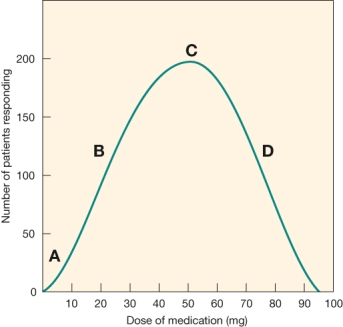
A) A
B) B
C) C
D) D
A) A
B) B
C) C
D) D
Question
Question
Question
Question
Question
Question
Question
Question
Question
Question
Question
Question
Question
Question
Question
Question
Question
Mark the location of the beginning of the plateau phase on this dose-response relationship curve. 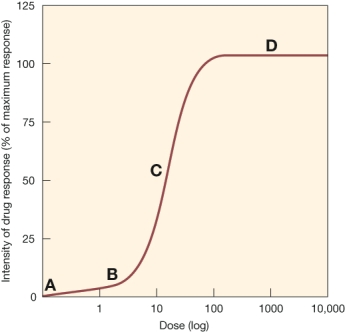
A) A
B) B
C) C
D) D
A) A
B) B
C) C
D) D

Unlock Deck
Sign up to unlock the cards in this deck!
Unlock Deck
Unlock Deck
1/30

Play

Full screen (f)
Deck 5: Pharmacodynamics
1
Drug X has a median lethal dose of 30 mg and a median effective dose of 10. Drug Y has a therapeutic index of 4, while drug Z has a therapeutic index of 3) Which statement is accurate based on this information?
A) Drugs X and Y are safer than drug Z.
B) The therapeutic index of drug X is 20.
C) Drug Y is the safest of the three.
D) Drug Z is the safest of the three.
A) Drugs X and Y are safer than drug Z.
B) The therapeutic index of drug X is 20.
C) Drug Y is the safest of the three.
D) Drug Z is the safest of the three.
Drug Y is the safest of the three.
2
The patient was receiving haloperidol (Haldol), a dopamine antagonist. The psychiatrist changed the order to aripiprazole (Abilify), a partial dopamine antagonist. Which statement best describes the effect of the change of medication on the patient?
A) The patient is more compliant in taking his medication.
B) The patient experiences greater efficacy.
C) The patient experiences a greater reduction in symptoms.
D) The patient experiences fewer side effects.
A) The patient is more compliant in taking his medication.
B) The patient experiences greater efficacy.
C) The patient experiences a greater reduction in symptoms.
D) The patient experiences fewer side effects.
The patient experiences fewer side effects.
3
The patient and his wife receive the same medication for hypertension. The patient's wife asks the nurse why she is receiving a higher amount of the medication. What is the best response by the nurse?
A) "Females have a higher metabolism, so you need more medication."
B) "Everyone is unique and responds differently to medications."
C) "Your hormones are different from your husband's, so you need more medication."
D) "You have a greater percentage of body fat, so more medication is needed."
A) "Females have a higher metabolism, so you need more medication."
B) "Everyone is unique and responds differently to medications."
C) "Your hormones are different from your husband's, so you need more medication."
D) "You have a greater percentage of body fat, so more medication is needed."
"Everyone is unique and responds differently to medications."
4
The home health nurse notes that the elderly patient doubled up on his pain medication, even though the prescribed dose was at a therapeutic level. The patient says, "If one pill is good, two pills are better." Which statement best describes the result of the patient's action?
A) The patient develops tolerance and does not experience any difference.
B) The patient experiences more pain relief from the additional dose.
C) The patient develops tolerance and will need increased doses of the drug.
D) The patient is more likely to exhibit side effects from the additional dose.
A) The patient develops tolerance and does not experience any difference.
B) The patient experiences more pain relief from the additional dose.
C) The patient develops tolerance and will need increased doses of the drug.
D) The patient is more likely to exhibit side effects from the additional dose.
Unlock Deck
Unlock for access to all 30 flashcards in this deck.
Unlock Deck
k this deck
5
At a dose of 10 mg, drug X lowers total cholesterol by 50 mg/dL, while a maximum drop in cholesterol of 65 mg/dL is achieved at 40 mg. At a dose of 5 mg, drug Y lowers cholesterol by 50 mg/dL, while a maximum drop in cholesterol of 55 mg/dL is achieved at 10 mg. What can be concluded about the efficacy and potency of these two drugs?
A) Drug X is more potent, and drug Y has a higher efficacy.
B) Drug X is more potent and has higher efficacy.
C) Drug Y is more potent and has higher efficacy.
D) Drug Y is more potent, and drug X has a higher efficacy.
A) Drug X is more potent, and drug Y has a higher efficacy.
B) Drug X is more potent and has higher efficacy.
C) Drug Y is more potent and has higher efficacy.
D) Drug Y is more potent, and drug X has a higher efficacy.
Unlock Deck
Unlock for access to all 30 flashcards in this deck.
Unlock Deck
k this deck
6
The patient receives antibiotics for a serious infection. The patient asks the nurse, "Why don't you just give me more of that drug to cure this infection faster?" What is the best response by the nurse?
A) "I will check with the doctor to see if it is time to increase the medication."
B) "You are at a maximum dose; taking more will cause interactions with other medications."
C) "You must stay on this drug for 2 more weeks before it can be increased."
D) "You are at a maximum dose; taking more will not help."
A) "I will check with the doctor to see if it is time to increase the medication."
B) "You are at a maximum dose; taking more will cause interactions with other medications."
C) "You must stay on this drug for 2 more weeks before it can be increased."
D) "You are at a maximum dose; taking more will not help."
Unlock Deck
Unlock for access to all 30 flashcards in this deck.
Unlock Deck
k this deck
7
A patient looks up the drug he is taking in a drug guide. The patient asks the nurse why the physician prescribed a medication that has a lethal dose measure. What is the best response by the nurse?
A) "It just refers to what is done in research; it is not used by doctors prescribing drugs."
B) "It is a value determined during research, which helps to determine the safe dose to give."
C) "All that means is that the drug could be lethal, but I will watch you for side effects."
D) "Don't worry about that, I'll have your doctor explain it to you."
A) "It just refers to what is done in research; it is not used by doctors prescribing drugs."
B) "It is a value determined during research, which helps to determine the safe dose to give."
C) "All that means is that the drug could be lethal, but I will watch you for side effects."
D) "Don't worry about that, I'll have your doctor explain it to you."
Unlock Deck
Unlock for access to all 30 flashcards in this deck.
Unlock Deck
k this deck
8
The nurse administers narcotics to surgical patients. Which statement represents the nurse's best understanding as it relates to the potency of different narcotics?
A) Codeine is less potent than morphine; it will not produce an allergic reaction.
B) Morphine is more potent than codeine; a lesser dose will be required.
C) Morphine is more potent than codeine; it will produce more adverse effects.
D) Codeine is less potent than morphine; it will not relieve pain as well.
A) Codeine is less potent than morphine; it will not produce an allergic reaction.
B) Morphine is more potent than codeine; a lesser dose will be required.
C) Morphine is more potent than codeine; it will produce more adverse effects.
D) Codeine is less potent than morphine; it will not relieve pain as well.
Unlock Deck
Unlock for access to all 30 flashcards in this deck.
Unlock Deck
k this deck
9
The student nurse asks the nursing instructor why drug plateaus occur with medications. What are the best responses by the nursing instructor?
A) "It could be that all of the receptors for the drug are occupied."
B) "It may mean that the drug has brought 100% relief to the patient."
C) "It means that the patient has developed resistance and needs another drug."
D) "It probably means that the drug is losing efficacy."
E) "It means that the patient needs a higher dose of the drug."
A) "It could be that all of the receptors for the drug are occupied."
B) "It may mean that the drug has brought 100% relief to the patient."
C) "It means that the patient has developed resistance and needs another drug."
D) "It probably means that the drug is losing efficacy."
E) "It means that the patient needs a higher dose of the drug."
Unlock Deck
Unlock for access to all 30 flashcards in this deck.
Unlock Deck
k this deck
10
The patient has had hypertension for many years. The physician orders an antihypertensive drug that has just come on the market. The nurse teaches the patient that this drug works more effectively than his prior drug and has fewer side effects. The patient asks how this can be. What is the best response by the nurse?
A) "Newer drugs are altered to affect your cells' receptors in a different way."
B) "Receptors tend to 'burn-out,' so newer drugs are required."
C) "Research into receptors helps 'fine-tune' drugs to be more effective."
D) "Changing the response of the drug to protein receptor-complexes produces fewer side effects."
E) "It is a process of trial and error with receptors until the new drug proves effective."
A) "Newer drugs are altered to affect your cells' receptors in a different way."
B) "Receptors tend to 'burn-out,' so newer drugs are required."
C) "Research into receptors helps 'fine-tune' drugs to be more effective."
D) "Changing the response of the drug to protein receptor-complexes produces fewer side effects."
E) "It is a process of trial and error with receptors until the new drug proves effective."
Unlock Deck
Unlock for access to all 30 flashcards in this deck.
Unlock Deck
k this deck
11
Graded dose-response curves are most useful for determining
A) response intensity within an individual.
B) response intensity within a large group of people with different characteristics.
C) response intensity within a large group of people with similar characteristics.
D) response intensity within a small group of people with similar characteristics.
A) response intensity within an individual.
B) response intensity within a large group of people with different characteristics.
C) response intensity within a large group of people with similar characteristics.
D) response intensity within a small group of people with similar characteristics.
Unlock Deck
Unlock for access to all 30 flashcards in this deck.
Unlock Deck
k this deck
12
A drug has been prescribed to decrease the effects of an endogenous chemical. The nurse would place this drug in which category?
A) An agonist
B) A partial agonist
C) An antagonist
D) An agonist-antagonist
A) An agonist
B) A partial agonist
C) An antagonist
D) An agonist-antagonist
Unlock Deck
Unlock for access to all 30 flashcards in this deck.
Unlock Deck
k this deck
13
Indicate the spot of the median effective dose on the frequency distribution curve.
A) A
B) B
C) C
D) D
A) A
B) B
C) C
D) D
Unlock Deck
Unlock for access to all 30 flashcards in this deck.
Unlock Deck
k this deck
14
Prior to administering medications, the student nurse reviews the therapeutic index. Which statement best describes the student's understanding of therapeutic index?
A) The student is able to determine if the physician prescribed the best drug for the patient.
B) The student is able to determine if the patients are receiving safe doses of the medications.
C) The student is able to identify interactions among the drugs each patient is receiving.
D) The student is able to identify the patients who will need to have serum blood levels monitored.
A) The student is able to determine if the physician prescribed the best drug for the patient.
B) The student is able to determine if the patients are receiving safe doses of the medications.
C) The student is able to identify interactions among the drugs each patient is receiving.
D) The student is able to identify the patients who will need to have serum blood levels monitored.
Unlock Deck
Unlock for access to all 30 flashcards in this deck.
Unlock Deck
k this deck
15
When administering a standard or median effective dose to a patient, the nurse explains that this amount of drug will have which effect?
A) It will produce an effect without the presence of adverse effects.
B) It will be metabolized within 24 hours.
C) It will be effective in half of the population.
D) It will be effective in the majority of patients.
A) It will produce an effect without the presence of adverse effects.
B) It will be metabolized within 24 hours.
C) It will be effective in half of the population.
D) It will be effective in the majority of patients.
Unlock Deck
Unlock for access to all 30 flashcards in this deck.
Unlock Deck
k this deck
16
The nursing instructor prepares to teach student nurses about how mean effective doses of medications are related to clinical practice. As a result of the instruction, what is the best understanding of the student nurses?
A) About 50% of patients will experience severe side effects from the drug.
B) Some patients will respond differently depending on their ethnic background.
C) About 50% of patients will not experience any effect from the drug.
D) Some patients will require more or less than the average dose of the drug.
A) About 50% of patients will experience severe side effects from the drug.
B) Some patients will respond differently depending on their ethnic background.
C) About 50% of patients will not experience any effect from the drug.
D) Some patients will require more or less than the average dose of the drug.
Unlock Deck
Unlock for access to all 30 flashcards in this deck.
Unlock Deck
k this deck
17
Pharmacogenetics is a relatively new area within pharmacology. Which statement best describes the potential of this new area?
A) To customize drugs and prevent idiosyncratic responses
B) To reduce the overall number of drugs and their associated adverse effects
C) To reduce medication errors and provide optimal drug choices
D) To provide cost-effective pharmacotherapy and higher drug efficacy
A) To customize drugs and prevent idiosyncratic responses
B) To reduce the overall number of drugs and their associated adverse effects
C) To reduce medication errors and provide optimal drug choices
D) To provide cost-effective pharmacotherapy and higher drug efficacy
Unlock Deck
Unlock for access to all 30 flashcards in this deck.
Unlock Deck
k this deck
18
When reading about a drug, the nurse learns it has a median toxic dose of 50 mg. The patient has been receiving 60 mg of the drug. What analysis does the nurse make?
A) It is likely the drug will not produce the desired effect.
B) The efficacy and potency of this drug have not been well defined.
C) The patient will be at greater risk of adverse effects.
D) This amount of drug would have been lethal to half the population.
A) It is likely the drug will not produce the desired effect.
B) The efficacy and potency of this drug have not been well defined.
C) The patient will be at greater risk of adverse effects.
D) This amount of drug would have been lethal to half the population.
Unlock Deck
Unlock for access to all 30 flashcards in this deck.
Unlock Deck
k this deck
19
The nurse is conducting medication education about the difference between potency and efficacy to a group of patients. The nurse correctly determines that learning has occurred when the patients makes which response?
A) "The best drug for us is the one with the highest potency."
B) "The best drug for us is the one with the greatest efficacy."
C) "Drugs with the greatest efficacy will produce the least side effects."
D) "Low-potency drugs have efficacy and do not produce side effects."
A) "The best drug for us is the one with the highest potency."
B) "The best drug for us is the one with the greatest efficacy."
C) "Drugs with the greatest efficacy will produce the least side effects."
D) "Low-potency drugs have efficacy and do not produce side effects."
Unlock Deck
Unlock for access to all 30 flashcards in this deck.
Unlock Deck
k this deck
20
The student nurse has been reading about the Human Genome Project and asks the nursing instructor how this will impact future pharmacological therapies. What is the best response by the instructor?
A) "We will be able to alter genes so we will not need drugs."
B) "We will be able to standardize drug doses to make prescribing easier."
C) "It will help prevent disease through gene manipulation but will not impact drugs."
D) "It will help to individualize drug therapy for people in a more effective way."
A) "We will be able to alter genes so we will not need drugs."
B) "We will be able to standardize drug doses to make prescribing easier."
C) "It will help prevent disease through gene manipulation but will not impact drugs."
D) "It will help to individualize drug therapy for people in a more effective way."
Unlock Deck
Unlock for access to all 30 flashcards in this deck.
Unlock Deck
k this deck
21
Literature review reveals that a new drug has a median lethal dose of 10 and a median effective dose of 5. The nurse determines that an error in which _____ times the correct dose is given could be lethal.
Unlock Deck
Unlock for access to all 30 flashcards in this deck.
Unlock Deck
k this deck
22
The nurse is reviewing the medication administration record for a group of patients and recognizes that which agents have nonspecific cellular responses?
A) Ethyl alcohol
B) General anesthetics
C) Osmotic diuretics
D) Calcium channel blockers
E) Alpha-adrenergic antihypertensives
A) Ethyl alcohol
B) General anesthetics
C) Osmotic diuretics
D) Calcium channel blockers
E) Alpha-adrenergic antihypertensives
Unlock Deck
Unlock for access to all 30 flashcards in this deck.
Unlock Deck
k this deck
23
A patient with hypertension is taking a potent antihypertensive without results. The patient is concerned when the health care provider orders a new drug. The nurse explains,
A) "The drug you took is very potent, and a higher dose is needed."
B) "The new drug has greater efficacy, so it will help reduce your blood pressure."
C) "The prescriber must have made an error in the orders."
D) "Efficacy in treating your hypertension is more important than potency."
E) "You are correct. I think the prescriber meant to order both drugs."
A) "The drug you took is very potent, and a higher dose is needed."
B) "The new drug has greater efficacy, so it will help reduce your blood pressure."
C) "The prescriber must have made an error in the orders."
D) "Efficacy in treating your hypertension is more important than potency."
E) "You are correct. I think the prescriber meant to order both drugs."
Unlock Deck
Unlock for access to all 30 flashcards in this deck.
Unlock Deck
k this deck
24
The nurse reads that a newly discovered drug is a functional antagonist for some commonly administered medications. The nurse interprets this information as indicating the new drug could have which actions?
A) Blocks alpha receptors
B) Enhances drug excretion
C) Blocks beta receptors
D) Speeds drug metabolism
E) Inhibits protein synthesis
A) Blocks alpha receptors
B) Enhances drug excretion
C) Blocks beta receptors
D) Speeds drug metabolism
E) Inhibits protein synthesis
Unlock Deck
Unlock for access to all 30 flashcards in this deck.
Unlock Deck
k this deck
25
The nurse explains to a student nurse that the median lethal dose of drugs is often determined in laboratory preclinical trials because
A) it would be unethical to determine these values in human subjects.
B) the safety of the medication must be determined prior to clinical trials.
C) it is difficult to obtain sufficient participants for clinical trials.
D) clinical trials determine only the effective dose of a drug.
E) it is too costly to conduct the studies during clinical trials.
A) it would be unethical to determine these values in human subjects.
B) the safety of the medication must be determined prior to clinical trials.
C) it is difficult to obtain sufficient participants for clinical trials.
D) clinical trials determine only the effective dose of a drug.
E) it is too costly to conduct the studies during clinical trials.
Unlock Deck
Unlock for access to all 30 flashcards in this deck.
Unlock Deck
k this deck
26
The nurse is participating in the clinical trial of a new medication for the treatment of hypertension. To assess the effectiveness of the medication, which interventions would the nurse perform to help determine whether the average dose is effective for the patient?
A) Monitoring blood pressure
B) Monitoring heart rate
C) Interpreting laboratory values
D) Monitoring diet
E) Monitoring sleep habits
A) Monitoring blood pressure
B) Monitoring heart rate
C) Interpreting laboratory values
D) Monitoring diet
E) Monitoring sleep habits
Unlock Deck
Unlock for access to all 30 flashcards in this deck.
Unlock Deck
k this deck
27
The nurse is preparing to administer a medication to a patient on a medical-surgical unit. The median lethal dose of the drug is 40 mg, and the median effective dose is 10 mg. The nurse calculates the therapeutic index to be _____.
Unlock Deck
Unlock for access to all 30 flashcards in this deck.
Unlock Deck
k this deck
28
From a transcription error, a patient received an overdose of a prescribed medication. If the therapeutic index of the medication is 10 and the median effective dose is 2, the nurse would calculate as the median lethal dose for the medication as _____.
Unlock Deck
Unlock for access to all 30 flashcards in this deck.
Unlock Deck
k this deck
29
During assessment, the patient mentions that he recently "sent off to a company for pharmacogenomic testing." What nursing responses are indicated?
A) "Have you changed your medications any?"
B) "Have you talked with your physician about the results?"
C) "Why did you do that?"
D) "Was that test expensive?"
E) "Who told you about the testing?"
A) "Have you changed your medications any?"
B) "Have you talked with your physician about the results?"
C) "Why did you do that?"
D) "Was that test expensive?"
E) "Who told you about the testing?"
Unlock Deck
Unlock for access to all 30 flashcards in this deck.
Unlock Deck
k this deck
30
Mark the location of the beginning of the plateau phase on this dose-response relationship curve.
A) A
B) B
C) C
D) D
A) A
B) B
C) C
D) D
Unlock Deck
Unlock for access to all 30 flashcards in this deck.
Unlock Deck
k this deck
Unlock Deck
Unlock for access to all 30 flashcards in this deck.






