







 Chat with AI

Deck 14: Income Taxation of Trusts and Estates
Full screen (f)

Question

Question
Question
The governing instrument for the Lopez Trust contains no definitions of income and principal. The Trust is locat state that has adopted the Uniform Act. In the current year, the trust reports the following receipts and disburse  What is the trust's net accounting income?
What is the trust's net accounting income? Question
Question
Question
Question
Question
Question
Question
Question
Question
Question
Question
Question
Question
Question
Question
Question
Question
Question
Question
Question
Question
Question
Question
Question
Question
Question
Question
A trust document does not mention the treatment for depreciation. The state has adopted the Uniform Act. The t document states that depreciation is a charge against corpus. The trust results are the following:  Calculate net accounting income.
Calculate net accounting income. Question
Question
Question
Question
Question
Question
Question
Question
Question
Question
Question
A simple trust has the following results:  Calculate the distribution deduction.
Calculate the distribution deduction. Question
Question
Question
Question
A trust has the following results:  The Uniform Act is followed. The trust document requires one- fifth of the income to be distributed annually to David and the remainder of the income to Patty. What is distributable net income?
A) $62,000
B) $72,000
C) $74,000
D) $64,000
The Uniform Act is followed. The trust document requires one- fifth of the income to be distributed annually to David and the remainder of the income to Patty. What is distributable net income?A) $62,000
B) $72,000
C) $74,000
D) $64,000
Question
Question
A trust reports the following results:  All of the items are allocated to income except the capital gains. Calculate the maximum amount of trustee fees t deductible.
All of the items are allocated to income except the capital gains. Calculate the maximum amount of trustee fees t deductible. Question
Question
Question
A trust reports the following results:  All of the items above are allocated to income. Calculate the maximum amount of trustee fees that are deductible
All of the items above are allocated to income. Calculate the maximum amount of trustee fees that are deductible Question
A trust reports the following results: 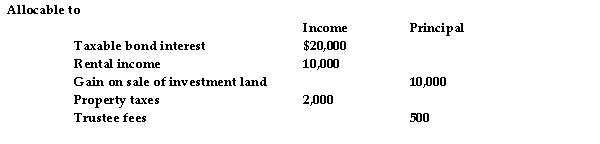 The trust must distribute all of its income annually. Calculate taxable income after the distribution deduction.
The trust must distribute all of its income annually. Calculate taxable income after the distribution deduction. Question
Question
Question
Question
Question
Question
Question
Question
Question
Question
Question
Question
Question
Question
Question
Question
Question
Question
Question
Question
Question
The Tucker Trust was established six years ago. The trust is required to distribute all of the trust income at least annually to Betty for life. Capital gains are credited to principal. The current year results of the trust are as follows:  Compute (a) distributable net income (DNI), (b) the distribution deduction, (c) trust taxable income, and (d) Bett reportable income and its classification. Charge all of the deductible expenses against rent income.
Compute (a) distributable net income (DNI), (b) the distribution deduction, (c) trust taxable income, and (d) Bett reportable income and its classification. Charge all of the deductible expenses against rent income. Question
The Williams Trust was established six years ago. The trust document allows the trustee to distribute income in i discretion to beneficiaries Carol and Karen for the next 15 years. The trust will then be terminated and the trust a will be divided equally between Carol and Karen. Capital gains are part of principal.
The current year income and expenses of the trust are reported below.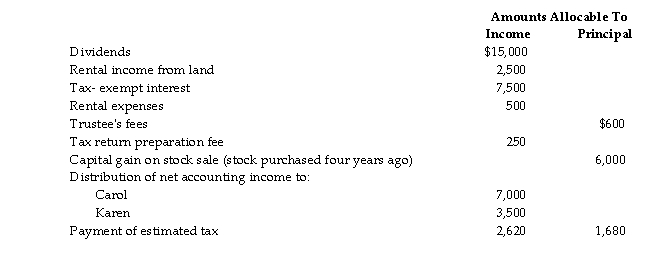 Compute (a) distributable net income (DNI), (b) distribution deduction, (c) trust taxable income, and (d) Carol's a Karen's reportable income and its classification. Charge all of the deductible expenses against the rental income.
The current year income and expenses of the trust are reported below.
Compute (a) distributable net income (DNI), (b) distribution deduction, (c) trust taxable income, and (d) Carol's a Karen's reportable income and its classification. Charge all of the deductible expenses against the rental income. Question
Question
Question
Question
Question
Question
Question

Unlock Deck
Sign up to unlock the cards in this deck!
Unlock Deck
Unlock Deck
1/101

Play

Full screen (f)
Deck 14: Income Taxation of Trusts and Estates
1
A trust has net accounting income of $15,000. In addition, the trust has a $10,000 capital gain, which is not included in net accounting income. The trust is required to distribute the trust income to the beneficiary. The beneficiary will receive
A) $25,000.
B) $15,000.
C) $24,700.
D) $10,000.
A) $25,000.
B) $15,000.
C) $24,700.
D) $10,000.
B
2
Which of the following statements is incorrect?
A) Income generated by property owned by an estate or trust is reported on that entity's tax return.
B) The income tax rules governing estates and trusts are generally identical.
C) Subchapter K contains the special rules applicable to estates and trusts.
D) All of the above are correct.
A) Income generated by property owned by an estate or trust is reported on that entity's tax return.
B) The income tax rules governing estates and trusts are generally identical.
C) Subchapter K contains the special rules applicable to estates and trusts.
D) All of the above are correct.
C
3
The governing instrument for the Lopez Trust contains no definitions of income and principal. The Trust is locat state that has adopted the Uniform Act. In the current year, the trust reports the following receipts and disburse What is the trust's net accounting income?
What is the trust's net accounting income?$10,000 - $500 - $200 = $9,300. The gain on the sale of stock and the rest of the sales proceeds constitute corpus.
4
The term "trust income" when not preceded by an explanatory word relates most closely to
A) gross income.
B) distributable net income.
C) net accounting income.
D) taxable income.
A) gross income.
B) distributable net income.
C) net accounting income.
D) taxable income.
Unlock Deck
Unlock for access to all 101 flashcards in this deck.
Unlock Deck
k this deck
5
Which of the following statements regarding the taxation of a trust is incorrect?
A) Trusts are generally not taxed at favorable rates for income shifting.
B) A trust's long- term capital gains are taxed at a top rate of 15%.
C) Trusts are not subject to double taxation.
D) An irrevocable trust's income is taxed to the grantor.
A) Trusts are generally not taxed at favorable rates for income shifting.
B) A trust's long- term capital gains are taxed at a top rate of 15%.
C) Trusts are not subject to double taxation.
D) An irrevocable trust's income is taxed to the grantor.
Unlock Deck
Unlock for access to all 101 flashcards in this deck.
Unlock Deck
k this deck
6
For purposes of trust administration, the term "sprinkling" relates to the mandatory distribution of income among various beneficiaries.
Unlock Deck
Unlock for access to all 101 flashcards in this deck.
Unlock Deck
k this deck
7
Briefly discuss the reasons for establishing a trust.
Unlock Deck
Unlock for access to all 101 flashcards in this deck.
Unlock Deck
k this deck
8
Revocable trusts means
A) the transferor may not demand the assets be returned.
B) the grantor is always the beneficiary.
C) income or estate tax savings for the grantor.
D) the assets in the trust avoid probate.
A) the transferor may not demand the assets be returned.
B) the grantor is always the beneficiary.
C) income or estate tax savings for the grantor.
D) the assets in the trust avoid probate.
Unlock Deck
Unlock for access to all 101 flashcards in this deck.
Unlock Deck
k this deck
9
A tax entity, often called a fiduciary, includes all of the following except
A) complex trusts.
B) estates.
C) testamentary trusts.
D) All of the above are fiduciaries.
A) complex trusts.
B) estates.
C) testamentary trusts.
D) All of the above are fiduciaries.
Unlock Deck
Unlock for access to all 101 flashcards in this deck.
Unlock Deck
k this deck
10
Identify which of the following statements is false.
A) The Uniform Act on principal and income requires depreciation to be charged against income.
B) State trust law preempts the trust document when defining income.
C) A statement in the trust instrument concerning the allocation of depreciation to principal or income overrides a provision of state law.
D) The Uniform Act allocates royalties to both principal and income.
A) The Uniform Act on principal and income requires depreciation to be charged against income.
B) State trust law preempts the trust document when defining income.
C) A statement in the trust instrument concerning the allocation of depreciation to principal or income overrides a provision of state law.
D) The Uniform Act allocates royalties to both principal and income.
Unlock Deck
Unlock for access to all 101 flashcards in this deck.
Unlock Deck
k this deck
11
If a state has adopted the Revised Uniform Principal and Income Act, which of the following statements is correct?
A) The definition of trust income in the trust document will preempt all other definitions.
B) Under state law, tax- exempt interest will not be allocated to income.
C) The definition of principal in the trust document must classify capital gains as principal.
D) The state law definition of trust income will preempt any other definitions.
A) The definition of trust income in the trust document will preempt all other definitions.
B) Under state law, tax- exempt interest will not be allocated to income.
C) The definition of principal in the trust document must classify capital gains as principal.
D) The state law definition of trust income will preempt any other definitions.
Unlock Deck
Unlock for access to all 101 flashcards in this deck.
Unlock Deck
k this deck
12
Briefly discuss some of the reasons for using a revocable trust.
Unlock Deck
Unlock for access to all 101 flashcards in this deck.
Unlock Deck
k this deck
13
An inter vivos trust may be created by all of the following except
A) a trustor.
B) a grantor.
C) a transferor.
D) an executor.
A) a trustor.
B) a grantor.
C) a transferor.
D) an executor.
Unlock Deck
Unlock for access to all 101 flashcards in this deck.
Unlock Deck
k this deck
14
The conduit approach for fiduciary income tax means
A) the distributed income of a remainder interest is determined by the property.
B) the distributed income is determined by the trustee annually.
C) the distributed income has the same character in the hands of the beneficiary as it has to the trust.
D) the distributed income goes to all beneficiaries proportionately.
A) the distributed income of a remainder interest is determined by the property.
B) the distributed income is determined by the trustee annually.
C) the distributed income has the same character in the hands of the beneficiary as it has to the trust.
D) the distributed income goes to all beneficiaries proportionately.
Unlock Deck
Unlock for access to all 101 flashcards in this deck.
Unlock Deck
k this deck
15
The executor or administrator is responsible for all the following estate duties except
A) paying the debts and taxes.
B) preserving the estate's existence as a separate taxpayer.
C) distributing the property.
D) collecting the assets.
A) paying the debts and taxes.
B) preserving the estate's existence as a separate taxpayer.
C) distributing the property.
D) collecting the assets.
Unlock Deck
Unlock for access to all 101 flashcards in this deck.
Unlock Deck
k this deck
16
Beneficiaries of a trust may receive
A) a remainder interest only.
B) an income interest only.
C) both an income and a remainder interest.
D) Any of the above is correct.
A) a remainder interest only.
B) an income interest only.
C) both an income and a remainder interest.
D) Any of the above is correct.
Unlock Deck
Unlock for access to all 101 flashcards in this deck.
Unlock Deck
k this deck
17
Identify which of the following statements is false.
A) Essentially, an estate or trust is taxed on any income it earns, whether retained or distributed.
B) Trusts receive a personal exemption.
C) Many of the same rules that determine the calculation of taxable income for individuals apply to trusts.
D) A conduit approach-that is, the income has the same character in the hands of the beneficiary as it has to the trust-governs for fiduciary income taxation.
A) Essentially, an estate or trust is taxed on any income it earns, whether retained or distributed.
B) Trusts receive a personal exemption.
C) Many of the same rules that determine the calculation of taxable income for individuals apply to trusts.
D) A conduit approach-that is, the income has the same character in the hands of the beneficiary as it has to the trust-governs for fiduciary income taxation.
Unlock Deck
Unlock for access to all 101 flashcards in this deck.
Unlock Deck
k this deck
18
This year, the Huang Trust received $20,000 of dividends and $30,000 of tax- free interest. It distributes all of its receipts to its beneficiary. How should the beneficiary treat the distribution?
Unlock Deck
Unlock for access to all 101 flashcards in this deck.
Unlock Deck
k this deck
19
Texas Trust receives $10,000 interest on U.S. Treasury bonds and $15,000 interest on State of New York bonds. All $25,000 is distributed to the trust beneficiary, Gary. Which of the following statements is correct?
A) Gary has $10,000 of taxable interest income and $15,000 of tax- free interest income.
B) Gary has no taxable income because the trust must pay the tax.
C) Gary has $25,000 of ordinary gross income.
D) Gary has $10,000 of capital gain and $15,000 of tax- free interest income.
A) Gary has $10,000 of taxable interest income and $15,000 of tax- free interest income.
B) Gary has no taxable income because the trust must pay the tax.
C) Gary has $25,000 of ordinary gross income.
D) Gary has $10,000 of capital gain and $15,000 of tax- free interest income.
Unlock Deck
Unlock for access to all 101 flashcards in this deck.
Unlock Deck
k this deck
20
Identify which of the following statements is false.
A) Assets in a revocable trust do not avoid probate.
B) The IRS may terminate an estate as a taxpayer after the expiration of a reasonable period of time for performance of the administrative duties.
C) For purposes of trust administration, the term "sprinkling" relates to the discretionary authority of the trustee to distribute income among various beneficiaries.
D) Assets in a revocable trust are included in the gross estate.
A) Assets in a revocable trust do not avoid probate.
B) The IRS may terminate an estate as a taxpayer after the expiration of a reasonable period of time for performance of the administrative duties.
C) For purposes of trust administration, the term "sprinkling" relates to the discretionary authority of the trustee to distribute income among various beneficiaries.
D) Assets in a revocable trust are included in the gross estate.
Unlock Deck
Unlock for access to all 101 flashcards in this deck.
Unlock Deck
k this deck
21
A client asks about the relevance of state law in classifying items as principal or income. Explain the relevance.
Unlock Deck
Unlock for access to all 101 flashcards in this deck.
Unlock Deck
k this deck
22
A trust receives no standard deduction when computing taxable income.
Unlock Deck
Unlock for access to all 101 flashcards in this deck.
Unlock Deck
k this deck
23
The personal exemption available to a trust is adjusted annually based on changes in the consumer price index.
Unlock Deck
Unlock for access to all 101 flashcards in this deck.
Unlock Deck
k this deck
24
A simple trust
A) may make charitable distributions.
B) is required to distribute all of its income currently.
C) may make discretionary distributions of principal.
D) may accumulate income.
A) may make charitable distributions.
B) is required to distribute all of its income currently.
C) may make discretionary distributions of principal.
D) may accumulate income.
Unlock Deck
Unlock for access to all 101 flashcards in this deck.
Unlock Deck
k this deck
25
Ebony Trust was established two years ago with Brent as the beneficiary. The trust instrument instructed the trustee last year to make discretionary distributions of income to Brent. Beginning in two years, the trustee is instructed to pay all of the trust income earned that year to Brent. What was the trust's personal exemption last year? What will the personal exemption be in two years?
Unlock Deck
Unlock for access to all 101 flashcards in this deck.
Unlock Deck
k this deck
26
A trust is required to distribute all of its income annually. It distributes all of the income and $2,000 of principal to the beneficiary. Which of the following statements is correct?
A) The trust is a complex trust and is allowed a $100 exemption.
B) The trust is a simple trust and is allowed a $100 exemption.
C) The trust is a simple trust and is allowed a $300 exemption.
D) The trust is a complex trust and is allowed a $300 exemption.
A) The trust is a complex trust and is allowed a $100 exemption.
B) The trust is a simple trust and is allowed a $100 exemption.
C) The trust is a simple trust and is allowed a $300 exemption.
D) The trust is a complex trust and is allowed a $300 exemption.
Unlock Deck
Unlock for access to all 101 flashcards in this deck.
Unlock Deck
k this deck
27
Little Trust, whose trust instrument is silent with respect to depreciation, collects rental income of $20,000 and p property taxes of $1,000. Depreciation expense is $5,000.
Little Trust is in a state where all depreciation is charged to principal. What is the trust's net accounting income?
Little Trust is in a state where all depreciation is charged to principal. What is the trust's net accounting income?
Unlock Deck
Unlock for access to all 101 flashcards in this deck.
Unlock Deck
k this deck
28
The exemption amount for an estate is
A) $300.
B) $600.
C) $0.
D) $100.
A) $300.
B) $600.
C) $0.
D) $100.
Unlock Deck
Unlock for access to all 101 flashcards in this deck.
Unlock Deck
k this deck
29
Identify which of the following statements is false.
A) Trust tax preparation fees are miscellaneous itemized deductions and subject to the 2% nondeductible floor.
B) A trust receives no standard deduction when computing taxable income.
C) There is no limit on a fiduciary's charitable contribution deduction if such a contribution is authorized in the trust instrument.
D) All of the above are false.
A) Trust tax preparation fees are miscellaneous itemized deductions and subject to the 2% nondeductible floor.
B) A trust receives no standard deduction when computing taxable income.
C) There is no limit on a fiduciary's charitable contribution deduction if such a contribution is authorized in the trust instrument.
D) All of the above are false.
Unlock Deck
Unlock for access to all 101 flashcards in this deck.
Unlock Deck
k this deck
30
A trust document does not mention the treatment for depreciation. The state has adopted the Uniform Act. The t document states that depreciation is a charge against corpus. The trust results are the following: Calculate net accounting income.
Calculate net accounting income. Unlock Deck
Unlock for access to all 101 flashcards in this deck.
Unlock Deck
k this deck
31
A trust that is required to distribute all of its income annually receives a personal exemption for the year of
A) $300.
B) $100.
C) $0, because it retains no income.
D) $600.
A) $300.
B) $100.
C) $0, because it retains no income.
D) $600.
Unlock Deck
Unlock for access to all 101 flashcards in this deck.
Unlock Deck
k this deck
32
Estates and trusts
A) receive a deduction for administrative expenses not otherwise deducted on the estate tax return (Form 706).
B) are taxed on state and municipal bond interest.
C) are not taxed on capital gains.
D) receive a $1,000 personal exemption.
A) receive a deduction for administrative expenses not otherwise deducted on the estate tax return (Form 706).
B) are taxed on state and municipal bond interest.
C) are not taxed on capital gains.
D) receive a $1,000 personal exemption.
Unlock Deck
Unlock for access to all 101 flashcards in this deck.
Unlock Deck
k this deck
33
Explain to a client the significance of the income and principal categorization scheme used for fiduciary accounting purposes.
Unlock Deck
Unlock for access to all 101 flashcards in this deck.
Unlock Deck
k this deck
34
A trust distributes 30% of its income to Mark and 20% to Nancy. The remaining 50% is accumulated. The trust's depreciation is $1,000. The trust instrument is silent regarding the depreciation deduction. State law requires the depreciation be charged to principal. What part of the depreciation deduction will be allocated to Mark?
A) $1,000
B) $300
C) $0
D) $200
A) $1,000
B) $300
C) $0
D) $200
Unlock Deck
Unlock for access to all 101 flashcards in this deck.
Unlock Deck
k this deck
35
Charitable contributions made by a fiduciary
A) flows through to be deducted on the beneficiary's tax return.
B) are limited to 50% of fiduciary income.
C) must be authorized in the trust instrument in order to be deductible.
D) are subject to the 2% floor.
A) flows through to be deducted on the beneficiary's tax return.
B) are limited to 50% of fiduciary income.
C) must be authorized in the trust instrument in order to be deductible.
D) are subject to the 2% floor.
Unlock Deck
Unlock for access to all 101 flashcards in this deck.
Unlock Deck
k this deck
36
List some common examples of principal and income items.
Unlock Deck
Unlock for access to all 101 flashcards in this deck.
Unlock Deck
k this deck
37
Outline the classification of principal and income under the Revised Uniform Principal and Income Act.
Unlock Deck
Unlock for access to all 101 flashcards in this deck.
Unlock Deck
k this deck
38
Identify which of the following statements is false.
A) The personal exemption for a trust provides a tax savings when some income is allocated to principal.
B) A complex trust must distribute all its income annually.
C) Distributable net income (DNI) sets the ceiling on the amount of distributions taxed to the beneficiaries.
D) The beneficiaries of a simple trust are taxed on their share of DNI irrespective of the amount they receive.
A) The personal exemption for a trust provides a tax savings when some income is allocated to principal.
B) A complex trust must distribute all its income annually.
C) Distributable net income (DNI) sets the ceiling on the amount of distributions taxed to the beneficiaries.
D) The beneficiaries of a simple trust are taxed on their share of DNI irrespective of the amount they receive.
Unlock Deck
Unlock for access to all 101 flashcards in this deck.
Unlock Deck
k this deck
39
A trust is required to distribute 10% of its income to Eleanor. In addition, the trustee in his discretion may distribute income to Eleanor and/or Marshall. The trust has net accounting income of $50,000, none of which is tax- exempt. The trust distributes the $5,000 mandatory payment to Eleanor and also distributes discretionary amounts of $5,000 to Eleanor and $5,000 to Marshall. How much must Eleanor include in income?
A) $5,000
B) $50,000
C) $10,000
D) none of the above
A) $5,000
B) $50,000
C) $10,000
D) none of the above
Unlock Deck
Unlock for access to all 101 flashcards in this deck.
Unlock Deck
k this deck
40
A complex trust permits accumulation of current income, provides for charitable contributions, or distributes principal during the taxable year.
Unlock Deck
Unlock for access to all 101 flashcards in this deck.
Unlock Deck
k this deck
41
A simple trust has the following results: Calculate the distribution deduction.
Calculate the distribution deduction. Unlock Deck
Unlock for access to all 101 flashcards in this deck.
Unlock Deck
k this deck
42
Distributable net income (DNI) does not include capital gains allocated to principal.
Unlock Deck
Unlock for access to all 101 flashcards in this deck.
Unlock Deck
k this deck
43
Melody Trust has $60,000 of DNI for the current year, $20,000 of rental income and $40,000 of corporate bond interest. The trust instrument requires the trustee to distribute 30% of the trust income to Lee and 70% to Sarah, annually. The trust instrument does not require an allocation of the different types of income to the two beneficiaries. What is the amount and composition of the income reported by Lee and Sarah, respectively?
Unlock Deck
Unlock for access to all 101 flashcards in this deck.
Unlock Deck
k this deck
44
Identify which of the following statements is true.
A) The income received by the beneficiaries of the trust loses its character once it is distributed.
B) Capital losses remaining in the final year of a trust do not pass through to the beneficiaries succeeding to the trust property.
C) Beneficiaries of simple trusts are taxed currently on their pro rata share of taxable distributable net income (DNI) regardless of the actual amount distributed to them during the period.
D) All of the above are false.
A) The income received by the beneficiaries of the trust loses its character once it is distributed.
B) Capital losses remaining in the final year of a trust do not pass through to the beneficiaries succeeding to the trust property.
C) Beneficiaries of simple trusts are taxed currently on their pro rata share of taxable distributable net income (DNI) regardless of the actual amount distributed to them during the period.
D) All of the above are false.
Unlock Deck
Unlock for access to all 101 flashcards in this deck.
Unlock Deck
k this deck
45
A trust has the following results: The Uniform Act is followed. The trust document requires one- fifth of the income to be distributed annually to David and the remainder of the income to Patty. What is distributable net income?
A) $62,000
B) $72,000
C) $74,000
D) $64,000
The Uniform Act is followed. The trust document requires one- fifth of the income to be distributed annually to David and the remainder of the income to Patty. What is distributable net income?A) $62,000
B) $72,000
C) $74,000
D) $64,000
Unlock Deck
Unlock for access to all 101 flashcards in this deck.
Unlock Deck
k this deck
46
Explain the three functions of distributable net income (DNI).
Unlock Deck
Unlock for access to all 101 flashcards in this deck.
Unlock Deck
k this deck
47
A trust reports the following results: All of the items are allocated to income except the capital gains. Calculate the maximum amount of trustee fees t deductible.
All of the items are allocated to income except the capital gains. Calculate the maximum amount of trustee fees t deductible. Unlock Deck
Unlock for access to all 101 flashcards in this deck.
Unlock Deck
k this deck
48
A trust must distribute all of its income annually. Capital gains are allocated to principal. The trust has dividend income of $12,000, capital gains of $6,000, and no expenses. Calculate the trust's taxable income.
Unlock Deck
Unlock for access to all 101 flashcards in this deck.
Unlock Deck
k this deck
49
In the current year, a trust has distributable net income (DNI) of $30,000. During the year, the trust makes a mandatory distribution to Sarah of $5,000 and a discretionary distribution of $10,000 to Kyle. The trust has no tax- exempt income. The distribution deduction of the trust is
A) $30,000.
B) $15,000.
C) $5,000.
D) $10,000.
A) $30,000.
B) $15,000.
C) $5,000.
D) $10,000.
Unlock Deck
Unlock for access to all 101 flashcards in this deck.
Unlock Deck
k this deck
50
A trust reports the following results: All of the items above are allocated to income. Calculate the maximum amount of trustee fees that are deductible
All of the items above are allocated to income. Calculate the maximum amount of trustee fees that are deductible Unlock Deck
Unlock for access to all 101 flashcards in this deck.
Unlock Deck
k this deck
51
A trust reports the following results: The trust must distribute all of its income annually. Calculate taxable income after the distribution deduction.
The trust must distribute all of its income annually. Calculate taxable income after the distribution deduction. Unlock Deck
Unlock for access to all 101 flashcards in this deck.
Unlock Deck
k this deck
52
In the year of termination, a trust incurs a $20,000 NOL. In addition, it has a $30,000 NOL carryover from the two preceding tax years. The trust distributes 40% of its assets to Sam, 30% of its assets to Alex, and 30% of its assets to Catherine. How much of the NOL can Sam (who has $150,000 of gross income) deduct on his return in the year that the trust terminates?
Unlock Deck
Unlock for access to all 101 flashcards in this deck.
Unlock Deck
k this deck
53
A simple trust has a distributable net income (DNI) of $50,000 and net accounting income of $60,000, all from taxable sources. The trust has a sole beneficiary, Marty. The trust reports on a calendar tax year and distributes the $60,000 of 2016's net accounting income to Marty on January 20, 2017. No other distributions are made in the current year. Marty's taxable income from the trust this year is
A) $49,700.
B) $0.
C) $50,000.
D) $60,000.
A) $49,700.
B) $0.
C) $50,000.
D) $60,000.
Unlock Deck
Unlock for access to all 101 flashcards in this deck.
Unlock Deck
k this deck
54
Which of the following is not an addition to trust taxable income when computing distributable net income (DNI)?
A) tax- exempt interest
B) personal exemption
C) distribution deduction
D) capital gains allocated to principal
A) tax- exempt interest
B) personal exemption
C) distribution deduction
D) capital gains allocated to principal
Unlock Deck
Unlock for access to all 101 flashcards in this deck.
Unlock Deck
k this deck
55
The $3,000 limitation on deducting net capital losses does not apply to a trust.
Unlock Deck
Unlock for access to all 101 flashcards in this deck.
Unlock Deck
k this deck
56
Panther Trust has net accounting income and distributable net income of $100,000, $75,000 from taxable sources and $25,000 from tax- exempt sources. During the year, the trust makes a mandatory distribution to Julius and Steve of $50,000 each. How much of Steve's distribution is taxable?
A) $12,500
B) $37,500
C) $25,000
D) $50,000
A) $12,500
B) $37,500
C) $25,000
D) $50,000
Unlock Deck
Unlock for access to all 101 flashcards in this deck.
Unlock Deck
k this deck
57
Panther Trust has net accounting income and distributable net income of $100,000, $75,000 from taxable sources and $25,000 from tax- exempt sources. During the year, the trust makes a mandatory distribution to Julius and Steve of $50,000 each. The distribution deduction is
A) $50,000.
B) $75,000.
C) $25,000.
D) $100,000.
A) $50,000.
B) $75,000.
C) $25,000.
D) $100,000.
Unlock Deck
Unlock for access to all 101 flashcards in this deck.
Unlock Deck
k this deck
58
A trust has distributable net income (DNI) of $50,000, including $30,000 tax- exempt interest income and $20,000 taxable interest income. The trust instrument requires that all income be distributed at least annually, 30% to Jane and 70% to Joe. What is the amount and character of the income that Jane receives?
Unlock Deck
Unlock for access to all 101 flashcards in this deck.
Unlock Deck
k this deck
59
A trust is required to distribute all of its income currently. Two years ago, it had a $10,000 capital loss. Last year, it had a $3,000 capital gain. This year, the trust is terminated. Albert has a 40% interest in the trust, and Barbara has a 60% interest. Barbara receives a capital loss pass- through of
A) $7,000.
B) $4,200.
C) $0.
D) $2,400.
A) $7,000.
B) $4,200.
C) $0.
D) $2,400.
Unlock Deck
Unlock for access to all 101 flashcards in this deck.
Unlock Deck
k this deck
60
Identify which of the following statements is true.
A) Income received by a trust beneficiary has the same character it had at the trust level.
B) The personal exemption available to a trust is adjusted annually based on changes in the consumer price index.
C) Distributable net income (DNI) excludes tax- exempt income.
D) All of the above are false.
A) Income received by a trust beneficiary has the same character it had at the trust level.
B) The personal exemption available to a trust is adjusted annually based on changes in the consumer price index.
C) Distributable net income (DNI) excludes tax- exempt income.
D) All of the above are false.
Unlock Deck
Unlock for access to all 101 flashcards in this deck.
Unlock Deck
k this deck
61
The distribution deduction for a complex trust is the lesser of the amount distributed or distributable net income, reduced by net tax- exempt income.
Unlock Deck
Unlock for access to all 101 flashcards in this deck.
Unlock Deck
k this deck
62
Sukdev Basi funded an irrevocable simple trust in May 2008. The trust benefits Sukdev's son for life and grandson upon the son's death. One of the assets he transferred to the trust was Jetco stock, which had an FMV on the transfer date of $40,000. Sukdev's basis in the stock was $44,000, and he paid no gift tax on the transfer. The stock's value has dropped to $33,000, and the trustee thinks that now, October 2011, might be the time to sell the stock and take the loss deduction. For 2011, the trust will have $20,000 of income exclusive of any gain or loss. Sukdev's taxable income is approximately $15,000. What tax and nontax issues should the trustee consider concerning the possible sale of the stock?
Unlock Deck
Unlock for access to all 101 flashcards in this deck.
Unlock Deck
k this deck
63
A trust has net accounting income of $30,000, but distributable net income (DNI) of only $25,000 because certain expenses are charged to principal. The trust is required to distribute $10,000 to Alice and it makes a discretionary distribution of $20,000 to Ben. The trust has no tax- exempt income. The amount that Ben reports as gross income is
A) $20,000.
B) $15,000.
C) $16,667.
D) none of the above
A) $20,000.
B) $15,000.
C) $16,667.
D) none of the above
Unlock Deck
Unlock for access to all 101 flashcards in this deck.
Unlock Deck
k this deck
64
Fred, a cash- basis taxpayer, died on January 15, 2016. In 2017, the estate made a $9,000 distribution from estate income to Fred's sole heir. The estate had $20,000 of taxable interest and a $10,000 net long- term capital gain allocable to corpus. The estate incurred $5,000 in expenses attributable to the estate income. What is the estate's distributable net income (DNI)?
A) $20,000
B) $25,000
C) $30,000
D) $15,000
A) $20,000
B) $25,000
C) $30,000
D) $15,000
Unlock Deck
Unlock for access to all 101 flashcards in this deck.
Unlock Deck
k this deck
65
Describe the tier system for trust beneficiaries.
Unlock Deck
Unlock for access to all 101 flashcards in this deck.
Unlock Deck
k this deck
66
Distributable net income (DNI) is not reduced by the charitable contribution deduction when calculating the deductible discretionary distributions for a complex trust.
Unlock Deck
Unlock for access to all 101 flashcards in this deck.
Unlock Deck
k this deck
67
Explain how to determine the deductible portion of trustee's fees.
Unlock Deck
Unlock for access to all 101 flashcards in this deck.
Unlock Deck
k this deck
68
A trust has net accounting income and distributable net income (DNI) of $60,000, all from taxable sources. The trustee is required to distribute $40,000 of current income to Harry. In addition, the trustee makes a discretionary distribution to Harry of $10,000 and a discretionary distribution to Susan of $30,000. $20,000 of the $40,000 total discretionary distributions is from corpus. Gross income reportable by Harry is
A) $30,000.
B) $45,000.
C) $37,500.
D) $50,000.
A) $30,000.
B) $45,000.
C) $37,500.
D) $50,000.
Unlock Deck
Unlock for access to all 101 flashcards in this deck.
Unlock Deck
k this deck
69
An example of income in respect to a decedent (IRD) for a cash method of accounting taxpayer is
A) salary earned but not received prior to death.
B) interest earned but not received prior to death.
C) gain from an installment sale entered into before death.
D) All of the above are examples.
A) salary earned but not received prior to death.
B) interest earned but not received prior to death.
C) gain from an installment sale entered into before death.
D) All of the above are examples.
Unlock Deck
Unlock for access to all 101 flashcards in this deck.
Unlock Deck
k this deck
70
Income in respect of a decedent (IRD) is included in the decedent's final income tax return.
Unlock Deck
Unlock for access to all 101 flashcards in this deck.
Unlock Deck
k this deck
71
Apple Trust reports net accounting income of $40,000, all from taxable sources. The trustee is required to distribute $15,000 annually to Megan. The trustee also makes discretionary distributions of $30,000, $7,500 to Megan and $22,500 to Caroline. The trust pays $5,000 of the discretionary distributions from corpus. What is the taxable amount of the Megan's tier- 2 distribution?
A) $7,500
B) $6,250
C) $22,500
D) $15,000
A) $7,500
B) $6,250
C) $22,500
D) $15,000
Unlock Deck
Unlock for access to all 101 flashcards in this deck.
Unlock Deck
k this deck
72
The Tucker Trust was established six years ago. The trust is required to distribute all of the trust income at least annually to Betty for life. Capital gains are credited to principal. The current year results of the trust are as follows: Compute (a) distributable net income (DNI), (b) the distribution deduction, (c) trust taxable income, and (d) Bett reportable income and its classification. Charge all of the deductible expenses against rent income.
Compute (a) distributable net income (DNI), (b) the distribution deduction, (c) trust taxable income, and (d) Bett reportable income and its classification. Charge all of the deductible expenses against rent income. Unlock Deck
Unlock for access to all 101 flashcards in this deck.
Unlock Deck
k this deck
73
The Williams Trust was established six years ago. The trust document allows the trustee to distribute income in i discretion to beneficiaries Carol and Karen for the next 15 years. The trust will then be terminated and the trust a will be divided equally between Carol and Karen. Capital gains are part of principal.
The current year income and expenses of the trust are reported below. Compute (a) distributable net income (DNI), (b) distribution deduction, (c) trust taxable income, and (d) Carol's a Karen's reportable income and its classification. Charge all of the deductible expenses against the rental income.
The current year income and expenses of the trust are reported below.
Compute (a) distributable net income (DNI), (b) distribution deduction, (c) trust taxable income, and (d) Carol's a Karen's reportable income and its classification. Charge all of the deductible expenses against the rental income. Unlock Deck
Unlock for access to all 101 flashcards in this deck.
Unlock Deck
k this deck
74
Apple Trust reports net accounting income of $40,000, all from taxable sources. The trustee is required to distribute $15,000 annually to Megan. The trustee also makes discretionary distributions of $30,000, $7,500 to Megan and $22,500 to Caroline. The trust pays $5,000 of the discretionary distributions from corpus. What is the amount of the distribution deduction?
A) $45,000
B) $30,000
C) $40,000
D) $15,000
A) $45,000
B) $30,000
C) $40,000
D) $15,000
Unlock Deck
Unlock for access to all 101 flashcards in this deck.
Unlock Deck
k this deck
75
Identify which of the following statements is true.
A) Bequests of specific sums of money when distributed out of an estate result in the recognition of gross income by the beneficiary receiving the bequest.
B) Tier- 2 beneficiaries potentially can receive more favorable tax treatment than tier- 1 beneficiaries.
C) An individual cannot be both a tier- 1 and tier- 2 beneficiary in the same year.
D) All of the above are false.
A) Bequests of specific sums of money when distributed out of an estate result in the recognition of gross income by the beneficiary receiving the bequest.
B) Tier- 2 beneficiaries potentially can receive more favorable tax treatment than tier- 1 beneficiaries.
C) An individual cannot be both a tier- 1 and tier- 2 beneficiary in the same year.
D) All of the above are false.
Unlock Deck
Unlock for access to all 101 flashcards in this deck.
Unlock Deck
k this deck
76
Income in respect of a decedent (IRD) includes interest earned by a cash- basis taxpayer but not received by the taxpayer before death.
Unlock Deck
Unlock for access to all 101 flashcards in this deck.
Unlock Deck
k this deck
77
Identify which of the following statements is true.
A) Distributable net income (DNI) is not reduced by the charitable contribution deduction when calculating the deductible discretionary distributions for a complex trust.
B) In a complex trust, distributable net income (DNI) does not act as a ceiling on the amount of the distribution deduction.
C) In a complex trust, distributable net income (DNI) is not reduced by the charitable contribution deduction when comparing DNI with the mandatory distributions in order to determine the amount of the distribution deduction.
D) All of the above are false.
A) Distributable net income (DNI) is not reduced by the charitable contribution deduction when calculating the deductible discretionary distributions for a complex trust.
B) In a complex trust, distributable net income (DNI) does not act as a ceiling on the amount of the distribution deduction.
C) In a complex trust, distributable net income (DNI) is not reduced by the charitable contribution deduction when comparing DNI with the mandatory distributions in order to determine the amount of the distribution deduction.
D) All of the above are false.
Unlock Deck
Unlock for access to all 101 flashcards in this deck.
Unlock Deck
k this deck
78
Martha died and by her will, specifically bequeathed, and the executor distributed, $20,000 cash and a $70,000 house to Harold. The distributions were made in a year in which the estate had $65,000 of DNI, all from taxable sources. The maximum Harold will be required to report as gross income as a result of these distributions is
A) $65,000.
B) $20,000.
C) $70,000.
D) $0.
A) $65,000.
B) $20,000.
C) $70,000.
D) $0.
Unlock Deck
Unlock for access to all 101 flashcards in this deck.
Unlock Deck
k this deck
79
An estate made a distribution to its sole beneficiary of $15,000 for the year. This distribution was not the result of a specific bequest. The estate had $40,000 of taxable interest and $34,000 of expenses attributable to earning that interest. What amount of the distribution is taxable to the beneficiary?
A) $15,000
B) $0
C) $40,000
D) $6,000
A) $15,000
B) $0
C) $40,000
D) $6,000
Unlock Deck
Unlock for access to all 101 flashcards in this deck.
Unlock Deck
k this deck
80
Identify which of the following statements is true.
A) Tax- exempt income is allocated among beneficiaries in the proportion that total tax- exempt income bears to total distributable net income (DNI).
B) Under the tier system, tier- 2 beneficiaries are the first to absorb income.
C) Both income required to be distributed currently and discretionary income distributions are included in tier- 1 distributions.
D) All of the above are false.
A) Tax- exempt income is allocated among beneficiaries in the proportion that total tax- exempt income bears to total distributable net income (DNI).
B) Under the tier system, tier- 2 beneficiaries are the first to absorb income.
C) Both income required to be distributed currently and discretionary income distributions are included in tier- 1 distributions.
D) All of the above are false.
Unlock Deck
Unlock for access to all 101 flashcards in this deck.
Unlock Deck
k this deck
Unlock Deck
Unlock for access to all 101 flashcards in this deck.






