







 Chat with AI

Deck 23: The Revolution in Energy and Industry, 1760-1850
Full screen (f)

Question

Question
Question
Question
Question
Question
What evidence in this illustration indicates that this woman is working a spinning jenny? 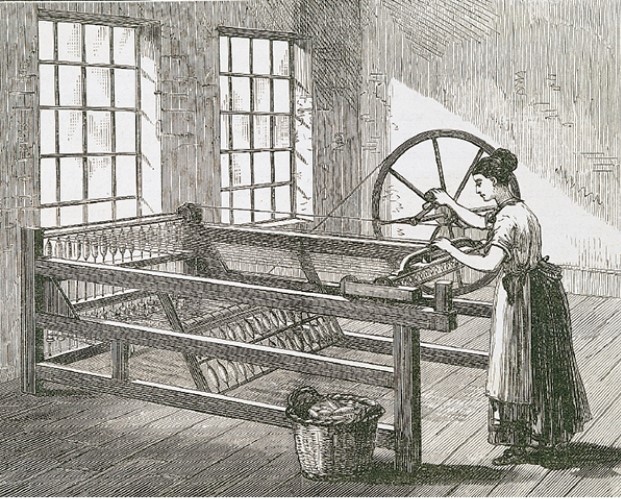
A) She is working it by hand.
B) She is working with spindles of thread.
C) The machine has a complex frame design.
D) The machine contains rollers similar in design to that of the water frame.
A) She is working it by hand.
B) She is working with spindles of thread.
C) The machine has a complex frame design.
D) The machine contains rollers similar in design to that of the water frame.
Question
Question
Question
Question
Question
Question
Question
Question
Question
Question
Question
Question
Question
Question
Question
Question
Question
Question
Question
The emerging industrial areas pictured on this map are all located near which of the following? 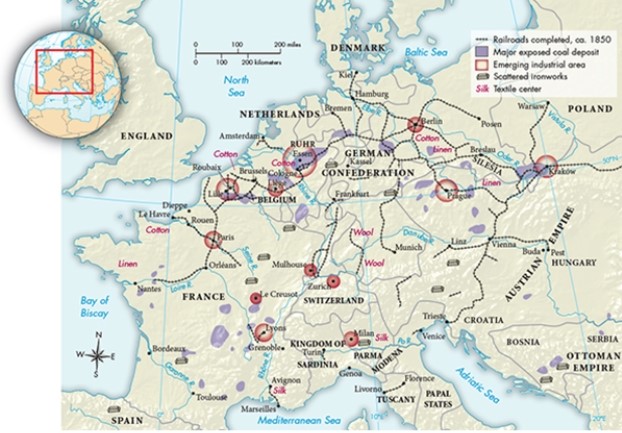
A) Ironworks
B) Completed railroads
C) Major rivers
D) Exposed coal deposits
A) Ironworks
B) Completed railroads
C) Major rivers
D) Exposed coal deposits
Question
Question
Question
Question
Question
Question
Where is the impact of the Industrial Revolution apparent in the design of the Crystal Palace? 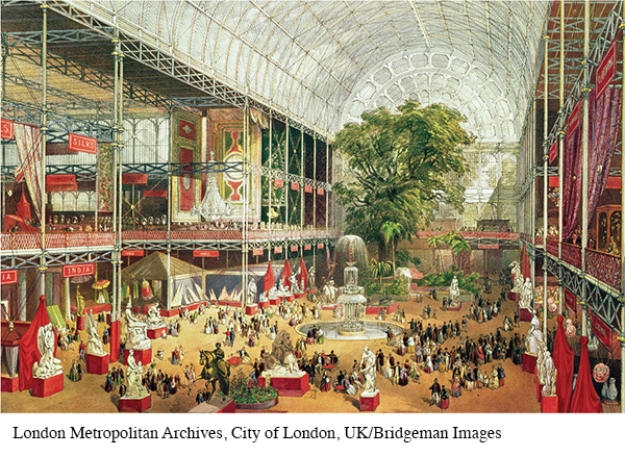
A) Stronger grades of iron made the multitier design made possible.
B) The revolution made glass and iron both cheap and abundant.
C) The large, wide-open floor plan was inspired by factories similar in design.
D) There is a mass-produced statuary on the ground floor.
A) Stronger grades of iron made the multitier design made possible.
B) The revolution made glass and iron both cheap and abundant.
C) The large, wide-open floor plan was inspired by factories similar in design.
D) There is a mass-produced statuary on the ground floor.
Question
Question
Question
Question
This map shows the importance of which factor during the Industrial Revolution in Great Britain? 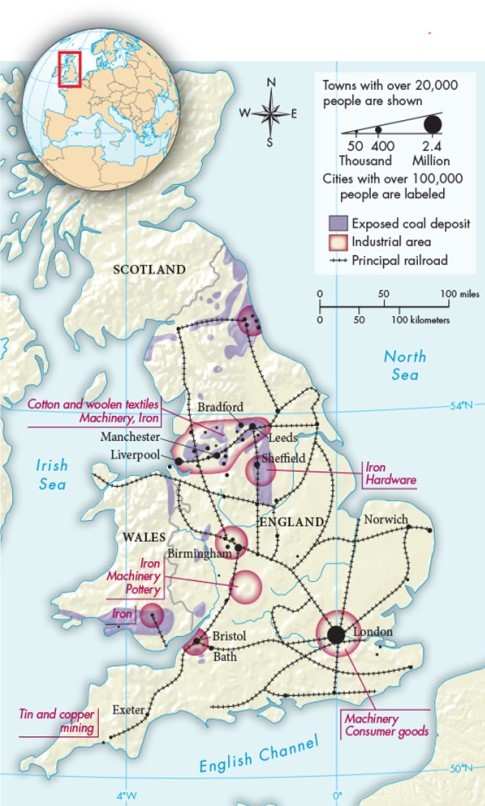
A) The railroad
B) Proximity to Europe via the English Channel
C) Rural areas in which to build factories
D) Access to seaports in Scotland
A) The railroad
B) Proximity to Europe via the English Channel
C) Rural areas in which to build factories
D) Access to seaports in Scotland
Question
How does this illustration demonstrate the effect of Britain on India's textile industry? 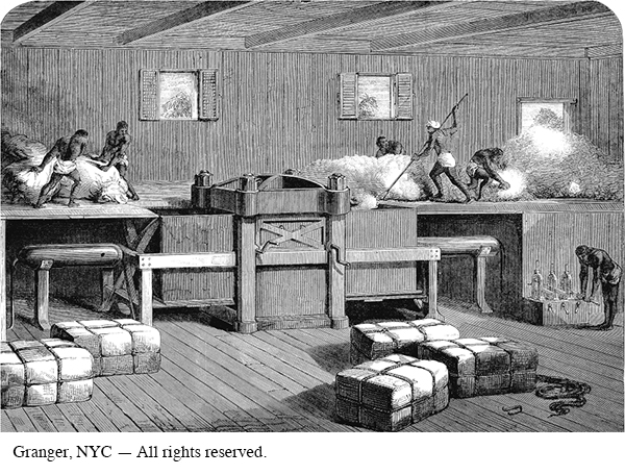
A) It depicts enslaved Indian peoples laboring for Britain's textile industry.
B) The relatively small number of workers reflects the diminished need for unskilled labor in the
Packing industry.
C) The small size of this packing operation reflects diminished British demand for Indian cotton.
D) It depicts Indian textile workers packing cotton, which was the only sector of India's textile
Industry not wiped out by British entry into textile manufacturing.
A) It depicts enslaved Indian peoples laboring for Britain's textile industry.
B) The relatively small number of workers reflects the diminished need for unskilled labor in the
Packing industry.
C) The small size of this packing operation reflects diminished British demand for Indian cotton.
D) It depicts Indian textile workers packing cotton, which was the only sector of India's textile
Industry not wiped out by British entry into textile manufacturing.
Question
Question
Question
Question
Question
Question
Question
Question
Question
Question
Question
Question
Question
Question
Question
Question
Question
Question
Question
Question
Question
Question
Question
Question
Question
Question
Question
Question
Question
Question
Question
Question
Question
Question
Question
Question
Question
Question
Question
Question
Question
Question
Question

Unlock Deck
Sign up to unlock the cards in this deck!
Unlock Deck
Unlock Deck
1/79

Play

Full screen (f)
Deck 23: The Revolution in Energy and Industry, 1760-1850
1
In the English putting-out system, what did merchants do with raw materials?
A) They sent them to colonial factories to be worked into final products.
B) They traded them to the Dutch for finished cloth.
C) They loaned them to local cottage workers who processed them at home.
D) They sent them to factories they owned in English villages for processing.
A) They sent them to colonial factories to be worked into final products.
B) They traded them to the Dutch for finished cloth.
C) They loaned them to local cottage workers who processed them at home.
D) They sent them to factories they owned in English villages for processing.
They loaned them to local cottage workers who processed them at home.
2
The labor force of the early rural textile factories was recruited primarily from what group?
A) Cottage industry workers
B) Young children abandoned by their parents
C) Persons from debtors' prisons
D) Young Irishmen
A) Cottage industry workers
B) Young children abandoned by their parents
C) Persons from debtors' prisons
D) Young Irishmen
Young children abandoned by their parents
3
Which of the following was a result of the boom in agricultural production of the eighteenth century?
A) Families began to stockpile foodstuffs for shortages.
B) Large numbers of people began leaving cities to move to farms.
C) People had more money to spend on manufactured goods.
D) People put more money into banks for saving.
A) Families began to stockpile foodstuffs for shortages.
B) Large numbers of people began leaving cities to move to farms.
C) People had more money to spend on manufactured goods.
D) People put more money into banks for saving.
People had more money to spend on manufactured goods.
4
What was one of the major limitations of the putting-out system in the British textile industry?
A) There was not enough cotton to meet demand.
B) There were too many spinners driving prices down.
C) There was an overabundance of thread.
D) There were not enough spinners to meet demand.
A) There was not enough cotton to meet demand.
B) There were too many spinners driving prices down.
C) There was an overabundance of thread.
D) There were not enough spinners to meet demand.
Unlock Deck
Unlock for access to all 79 flashcards in this deck.
Unlock Deck
k this deck
5
Which of the following was true of transportation in the eighteenth century?
A) No part of England was more than fifty miles from navigable water.
B) Shipping goods by water cost more than by land.
C) Italy had Europe's cheapest transportation system, thanks to the old Roman roads.
D) Few goods were transported more than fifty miles from where they were produced.
A) No part of England was more than fifty miles from navigable water.
B) Shipping goods by water cost more than by land.
C) Italy had Europe's cheapest transportation system, thanks to the old Roman roads.
D) Few goods were transported more than fifty miles from where they were produced.
Unlock Deck
Unlock for access to all 79 flashcards in this deck.
Unlock Deck
k this deck
6
What evidence in this illustration indicates that this woman is working a spinning jenny?
A) She is working it by hand.
B) She is working with spindles of thread.
C) The machine has a complex frame design.
D) The machine contains rollers similar in design to that of the water frame.
A) She is working it by hand.
B) She is working with spindles of thread.
C) The machine has a complex frame design.
D) The machine contains rollers similar in design to that of the water frame.
Unlock Deck
Unlock for access to all 79 flashcards in this deck.
Unlock Deck
k this deck
7
What was one of the earliest uses for steam engines?
A) To pump water out of coal mines
B) To heat large rooms and buildings
C) To burn wood to produce steam
D) As central power sources for the new factories
A) To pump water out of coal mines
B) To heat large rooms and buildings
C) To burn wood to produce steam
D) As central power sources for the new factories
Unlock Deck
Unlock for access to all 79 flashcards in this deck.
Unlock Deck
k this deck
8
Who invented the steam-powered rolling mills, which allowed for the production of iron in any shape or form?
A) Henry Cort
B) James Nasmyth
C) Thomas Newcomen
D) Thomas Savery
A) Henry Cort
B) James Nasmyth
C) Thomas Newcomen
D) Thomas Savery
Unlock Deck
Unlock for access to all 79 flashcards in this deck.
Unlock Deck
k this deck
9
Which of the following was one difference between Hargreaves's spinning jenny and Arkwright's water frame?
A) The water frame was hand-powered.
B) The jenny produced thinner thread.
C) The water frame produced a weaker thread.
D) The water frame could be worked by one woman.
A) The water frame was hand-powered.
B) The jenny produced thinner thread.
C) The water frame produced a weaker thread.
D) The water frame could be worked by one woman.
Unlock Deck
Unlock for access to all 79 flashcards in this deck.
Unlock Deck
k this deck
10
What did Edmund Cartwright invent in 1785?
A) A hybrid jenny and water frame
B) A special cotton harvester
C) A power loom
D) A better steam engine
A) A hybrid jenny and water frame
B) A special cotton harvester
C) A power loom
D) A better steam engine
Unlock Deck
Unlock for access to all 79 flashcards in this deck.
Unlock Deck
k this deck
11
In which British industry did the first modern factories begin to appear?
A) The furniture-making industry
B) The steel industry
C) The textile industry
D) The china and pottery industry
A) The furniture-making industry
B) The steel industry
C) The textile industry
D) The china and pottery industry
Unlock Deck
Unlock for access to all 79 flashcards in this deck.
Unlock Deck
k this deck
12
What was the most serious obstacle impeding industrial development in Britain in the eighteenth century?
A) A lack of investment capital
B) The Napoleonic Wars
C) An energy shortage
D) A labor shortage
A) A lack of investment capital
B) The Napoleonic Wars
C) An energy shortage
D) A labor shortage
Unlock Deck
Unlock for access to all 79 flashcards in this deck.
Unlock Deck
k this deck
13
In eighteenth-century England, what were the first mechanized cotton-spinning machines powered by?
A) Wood-fired steam engines
B) Coal-fired steam engines
C) Water
D) Draft horses on treadmills
A) Wood-fired steam engines
B) Coal-fired steam engines
C) Water
D) Draft horses on treadmills
Unlock Deck
Unlock for access to all 79 flashcards in this deck.
Unlock Deck
k this deck
14
Which of these was one of the three key factors that help explain why industrialization began in Britain first?
A) Britain's small agricultural sector
B) The policies of the British government
C) Britain's defeat in the American Revolution
D) Britain's dependence on imported coal and iron
A) Britain's small agricultural sector
B) The policies of the British government
C) Britain's defeat in the American Revolution
D) Britain's dependence on imported coal and iron
Unlock Deck
Unlock for access to all 79 flashcards in this deck.
Unlock Deck
k this deck
15
Who invented the spinning jenny around 1765?
A) James Hargreaves
B) Friedrich Engels
C) Samuel Crompton
D) James Watt
A) James Hargreaves
B) Friedrich Engels
C) Samuel Crompton
D) James Watt
Unlock Deck
Unlock for access to all 79 flashcards in this deck.
Unlock Deck
k this deck
16
Which of the following was the primary source of heat for all European homes and industries until the eighteenth century?
A) Wood
B) Coal
C) Water
D) Peat
A) Wood
B) Coal
C) Water
D) Peat
Unlock Deck
Unlock for access to all 79 flashcards in this deck.
Unlock Deck
k this deck
17
How did James Watt fundamentally improve the Newcomen steam engine?
A) He used coal instead of wood for fuel.
B) He added a condenser to the engine.
C) He introduced gears to change the power ratio.
D) He made an airtight seal on the cylinders.
A) He used coal instead of wood for fuel.
B) He added a condenser to the engine.
C) He introduced gears to change the power ratio.
D) He made an airtight seal on the cylinders.
Unlock Deck
Unlock for access to all 79 flashcards in this deck.
Unlock Deck
k this deck
18
What were working conditions like in early cotton factories?
A) Adequate
B) Poor
C) Better than average
D) Excellent
A) Adequate
B) Poor
C) Better than average
D) Excellent
Unlock Deck
Unlock for access to all 79 flashcards in this deck.
Unlock Deck
k this deck
19
The world's first important steam-powered train, the Rocket, provided service between what two English cities?
A) Bath and Exeter
B) London and Sheffield
C) Leeds and Newcastle
D) Liverpool and Manchester
A) Bath and Exeter
B) London and Sheffield
C) Leeds and Newcastle
D) Liverpool and Manchester
Unlock Deck
Unlock for access to all 79 flashcards in this deck.
Unlock Deck
k this deck
20
Coal was an essential ingredient in the manufacture of what eighteenth-century product?
A) Iron
B) Grain
C) Road gravel
D) Cloth
A) Iron
B) Grain
C) Road gravel
D) Cloth
Unlock Deck
Unlock for access to all 79 flashcards in this deck.
Unlock Deck
k this deck
21
Which of the following was a key development that encouraged continental European banks to invest in industrialization?
A) They were allowed to make all active partners liable for the firm's debts.
B) They began to establish limited-liability investments.
C) They replaced many of the old managers with young, aggressive investment bankers.
D) They began to recruit bank deposits from the landed aristocracy.
A) They were allowed to make all active partners liable for the firm's debts.
B) They began to establish limited-liability investments.
C) They replaced many of the old managers with young, aggressive investment bankers.
D) They began to recruit bank deposits from the landed aristocracy.
Unlock Deck
Unlock for access to all 79 flashcards in this deck.
Unlock Deck
k this deck
22
What did David Ricardo argue in his iron law of wages theory?
A) That the pressure of population growth prevents wages from rising above subsistence levels
B) That England's industrial production could not be sustained unless wages were increased
C) That unions were needed to protect the income of industrial workers
D) That dramatic improvements needed to be made in the lives of the working-class poor
A) That the pressure of population growth prevents wages from rising above subsistence levels
B) That England's industrial production could not be sustained unless wages were increased
C) That unions were needed to protect the income of industrial workers
D) That dramatic improvements needed to be made in the lives of the working-class poor
Unlock Deck
Unlock for access to all 79 flashcards in this deck.
Unlock Deck
k this deck
23
Which of these accurately describes employment patterns in British factories after 1833?
A) The number of adults employed in industry declined rapidly.
B) The number of children employed in industry declined rapidly.
C) The number of children employed in industry increased rapidly.
D) The number of union members employed in industry declined rapidly.
A) The number of adults employed in industry declined rapidly.
B) The number of children employed in industry declined rapidly.
C) The number of children employed in industry increased rapidly.
D) The number of union members employed in industry declined rapidly.
Unlock Deck
Unlock for access to all 79 flashcards in this deck.
Unlock Deck
k this deck
24
On the European continent, who took on the majority of the costs of building railroads?
A) The governments
B) Private investors
C) Commercial banks
D) Conglomerates
A) The governments
B) Private investors
C) Commercial banks
D) Conglomerates
Unlock Deck
Unlock for access to all 79 flashcards in this deck.
Unlock Deck
k this deck
25
The emerging industrial areas pictured on this map are all located near which of the following?
A) Ironworks
B) Completed railroads
C) Major rivers
D) Exposed coal deposits
A) Ironworks
B) Completed railroads
C) Major rivers
D) Exposed coal deposits
Unlock Deck
Unlock for access to all 79 flashcards in this deck.
Unlock Deck
k this deck
26
Where did Fritz Harkort set up production of steam engines?
A) The Netherlands
B) The United States
C) Germany
D) France
A) The Netherlands
B) The United States
C) Germany
D) France
Unlock Deck
Unlock for access to all 79 flashcards in this deck.
Unlock Deck
k this deck
27
What did the British economist Thomas Malthus conclude in his 1798 Essay on the Principle of Population?
A) That population pressure would always force wages down to subsistence levels
B) That men and women should limit population growth by marrying late in life
C) That the standard of living was a reflection of industrial capacity
D) That checks to population growth would harm the British economy
A) That population pressure would always force wages down to subsistence levels
B) That men and women should limit population growth by marrying late in life
C) That the standard of living was a reflection of industrial capacity
D) That checks to population growth would harm the British economy
Unlock Deck
Unlock for access to all 79 flashcards in this deck.
Unlock Deck
k this deck
28
What was the first country on the European continent to emulate the new industry of Britain?
A) Prussia
B) France
C) Belgium
D) Spain
A) Prussia
B) France
C) Belgium
D) Spain
Unlock Deck
Unlock for access to all 79 flashcards in this deck.
Unlock Deck
k this deck
29
Which of these was created by the Factory Act of 1833?
A) A standard set of wage guidelines
B) A set of environmental regulations for factories
C) A system of full-time factory inspectors
D) A new administrative department to encourage industrial growth
A) A standard set of wage guidelines
B) A set of environmental regulations for factories
C) A system of full-time factory inspectors
D) A new administrative department to encourage industrial growth
Unlock Deck
Unlock for access to all 79 flashcards in this deck.
Unlock Deck
k this deck
30
The Mines Act of 1842 prohibited underground work for all women because of concerns about which of the following?
A) The extremely hard physical labor demanded of the work
B) The sexual morality of the miners
C) The danger to the health of the fetus in pregnant female miners
D) The low rates of pay for women as compared to men
A) The extremely hard physical labor demanded of the work
B) The sexual morality of the miners
C) The danger to the health of the fetus in pregnant female miners
D) The low rates of pay for women as compared to men
Unlock Deck
Unlock for access to all 79 flashcards in this deck.
Unlock Deck
k this deck
31
Where is the impact of the Industrial Revolution apparent in the design of the Crystal Palace?
A) Stronger grades of iron made the multitier design made possible.
B) The revolution made glass and iron both cheap and abundant.
C) The large, wide-open floor plan was inspired by factories similar in design.
D) There is a mass-produced statuary on the ground floor.
A) Stronger grades of iron made the multitier design made possible.
B) The revolution made glass and iron both cheap and abundant.
C) The large, wide-open floor plan was inspired by factories similar in design.
D) There is a mass-produced statuary on the ground floor.
Unlock Deck
Unlock for access to all 79 flashcards in this deck.
Unlock Deck
k this deck
32
How did early factory work affect family life?
A) Traditional family structures were irrevocably broken.
B) Families were often separated as parents abandoned children to pursue factory work.
C) Factory work upset traditional gender roles as women increasingly worked outside the home.
D) Workers often came to the mills and mines and were employed as whole family units.
A) Traditional family structures were irrevocably broken.
B) Families were often separated as parents abandoned children to pursue factory work.
C) Factory work upset traditional gender roles as women increasingly worked outside the home.
D) Workers often came to the mills and mines and were employed as whole family units.
Unlock Deck
Unlock for access to all 79 flashcards in this deck.
Unlock Deck
k this deck
33
What was one unintended negative consequence of the British Factory Acts?
A) They broke the pattern of whole families working together.
B) They led to a sharp increase in child labor.
C) They led to a sharp increase in inflation.
D) They intensified class divisions.
A) They broke the pattern of whole families working together.
B) They led to a sharp increase in child labor.
C) They led to a sharp increase in inflation.
D) They intensified class divisions.
Unlock Deck
Unlock for access to all 79 flashcards in this deck.
Unlock Deck
k this deck
34
Outside of Europe, what country industrialized the earliest?
A) The Ottoman Empire
B) India
C) Japan
D) Egypt
A) The Ottoman Empire
B) India
C) Japan
D) Egypt
Unlock Deck
Unlock for access to all 79 flashcards in this deck.
Unlock Deck
k this deck
35
This map shows the importance of which factor during the Industrial Revolution in Great Britain?
A) The railroad
B) Proximity to Europe via the English Channel
C) Rural areas in which to build factories
D) Access to seaports in Scotland
A) The railroad
B) Proximity to Europe via the English Channel
C) Rural areas in which to build factories
D) Access to seaports in Scotland
Unlock Deck
Unlock for access to all 79 flashcards in this deck.
Unlock Deck
k this deck
36
How does this illustration demonstrate the effect of Britain on India's textile industry?
A) It depicts enslaved Indian peoples laboring for Britain's textile industry.
B) The relatively small number of workers reflects the diminished need for unskilled labor in the
Packing industry.
C) The small size of this packing operation reflects diminished British demand for Indian cotton.
D) It depicts Indian textile workers packing cotton, which was the only sector of India's textile
Industry not wiped out by British entry into textile manufacturing.
A) It depicts enslaved Indian peoples laboring for Britain's textile industry.
B) The relatively small number of workers reflects the diminished need for unskilled labor in the
Packing industry.
C) The small size of this packing operation reflects diminished British demand for Indian cotton.
D) It depicts Indian textile workers packing cotton, which was the only sector of India's textile
Industry not wiped out by British entry into textile manufacturing.
Unlock Deck
Unlock for access to all 79 flashcards in this deck.
Unlock Deck
k this deck
37
By reducing the cost of shipping freight, the railroad
A) proved to be a boon to cottage workers and urban artisans.
B) reduced the volume of world trade.
C) strengthened regional economies.
D) created national markets.
A) proved to be a boon to cottage workers and urban artisans.
B) reduced the volume of world trade.
C) strengthened regional economies.
D) created national markets.
Unlock Deck
Unlock for access to all 79 flashcards in this deck.
Unlock Deck
k this deck
38
How did Britain attempt to maintain its industrial advantage over continental Europe?
A) By making it illegal for skilled industrial workers and technicians to leave Britain
B) By enacting restrictions that prohibited continental Europeans from visiting
C) By refusing to hire industrial workers who had family on the European continent
D) By prohibiting industrial workers from moving from one industry to another
A) By making it illegal for skilled industrial workers and technicians to leave Britain
B) By enacting restrictions that prohibited continental Europeans from visiting
C) By refusing to hire industrial workers who had family on the European continent
D) By prohibiting industrial workers from moving from one industry to another
Unlock Deck
Unlock for access to all 79 flashcards in this deck.
Unlock Deck
k this deck
39
One reason that cottage workers were reluctant to work in factories is that they resembled which of the following?
A) Schools
B) Churches
C) Hospitals
D) Poorhouses
A) Schools
B) Churches
C) Hospitals
D) Poorhouses
Unlock Deck
Unlock for access to all 79 flashcards in this deck.
Unlock Deck
k this deck
40
In 1802, the British Parliament banned which of the following in factories?
A) Women workers
B) The use of pauper apprentices
C) Employing whole families
D) Overseers
A) Women workers
B) The use of pauper apprentices
C) Employing whole families
D) Overseers
Unlock Deck
Unlock for access to all 79 flashcards in this deck.
Unlock Deck
k this deck
41
What role did war play in how the European continent industrialized?
Unlock Deck
Unlock for access to all 79 flashcards in this deck.
Unlock Deck
k this deck
42
The Condition of the Working Class in England proposed that
A) the social problems in Britain were not a product of the Industrial Revolution.
B) industrialization had brought intensified capitalist exploitation and deepening worker poverty.
C) industrialization was generally good for society and that the living conditions of the working class were slowly improving.
D) the class-consciousness of the working class would lead to social revolution.
A) the social problems in Britain were not a product of the Industrial Revolution.
B) industrialization had brought intensified capitalist exploitation and deepening worker poverty.
C) industrialization was generally good for society and that the living conditions of the working class were slowly improving.
D) the class-consciousness of the working class would lead to social revolution.
Unlock Deck
Unlock for access to all 79 flashcards in this deck.
Unlock Deck
k this deck
43
How did industrialization alter the class system of Europe?
Unlock Deck
Unlock for access to all 79 flashcards in this deck.
Unlock Deck
k this deck
44
What was the aim of the Combination Acts of 1799?
A) To prohibit monopolies in the textile industry
B) To prevent English companies from using loans from foreign banks
C) To outlaw labor unions and strikes
D) To make it illegal for one person to own factories in more than a single industry
A) To prohibit monopolies in the textile industry
B) To prevent English companies from using loans from foreign banks
C) To outlaw labor unions and strikes
D) To make it illegal for one person to own factories in more than a single industry
Unlock Deck
Unlock for access to all 79 flashcards in this deck.
Unlock Deck
k this deck
45
What was the key demand of the Chartist movement?
A) Universal suffrage for all men
B) An eight-hour workday and a minimum wage
C) A ban on women and children working in the factories
D) The repeal of the Combination Acts
A) Universal suffrage for all men
B) An eight-hour workday and a minimum wage
C) A ban on women and children working in the factories
D) The repeal of the Combination Acts
Unlock Deck
Unlock for access to all 79 flashcards in this deck.
Unlock Deck
k this deck
46
In 1850, what two occupations employed the most people in Britain?
A) Farming and domestic service
B) Domestic service and coal mining
C) Factory labor and coal mining
D) Factory labor and farming
A) Farming and domestic service
B) Domestic service and coal mining
C) Factory labor and coal mining
D) Factory labor and farming
Unlock Deck
Unlock for access to all 79 flashcards in this deck.
Unlock Deck
k this deck
47
In addition to the coal mines, what industries used the steam engines of James Watt?
Unlock Deck
Unlock for access to all 79 flashcards in this deck.
Unlock Deck
k this deck
48
Describe working conditions in English factories between 1790 and 1835. Did they change?
Unlock Deck
Unlock for access to all 79 flashcards in this deck.
Unlock Deck
k this deck
49
Choose and describe two inventions that made a significant contribution to the Industrial Revolution. How did the inventions contribute to the Industrial Revolution?
Unlock Deck
Unlock for access to all 79 flashcards in this deck.
Unlock Deck
k this deck
50
Handicraft workers who smashed the new machines they believed were putting them out of work were known as what?
A) Socialists
B) Communists
C) Luddites
D) Wobblies
A) Socialists
B) Communists
C) Luddites
D) Wobblies
Unlock Deck
Unlock for access to all 79 flashcards in this deck.
Unlock Deck
k this deck
51
Who wrote The Condition of the Working Class in England?
A) Friedrich Engels
B) Karl Marx
C) Robert Owen
D) Friedrich List
A) Friedrich Engels
B) Karl Marx
C) Robert Owen
D) Friedrich List
Unlock Deck
Unlock for access to all 79 flashcards in this deck.
Unlock Deck
k this deck
52
What term did Karl Marx use to describe the growing belief among working people that they belonged to a particular social class?
A) Class-consciousness
B) Self awareness
C) Proletariatization
D) Self-actualization
A) Class-consciousness
B) Self awareness
C) Proletariatization
D) Self-actualization
Unlock Deck
Unlock for access to all 79 flashcards in this deck.
Unlock Deck
k this deck
53
By the mid-nineteenth century, a new paradigm of social relations suggested that
A) individuals were members of separate classes based on their relationship to the means of production.
B) most people did not develop an awareness of their particular social class.
C) an ideal society would adopt equality for women.
D) peasants and industrial workers saw themselves as united "laborers" against the traditional aristocracy.
A) individuals were members of separate classes based on their relationship to the means of production.
B) most people did not develop an awareness of their particular social class.
C) an ideal society would adopt equality for women.
D) peasants and industrial workers saw themselves as united "laborers" against the traditional aristocracy.
Unlock Deck
Unlock for access to all 79 flashcards in this deck.
Unlock Deck
k this deck
54
Describe some of the challenges of the putting-out system. How did those challenges contribute to the development of new technologies?
Unlock Deck
Unlock for access to all 79 flashcards in this deck.
Unlock Deck
k this deck
55
What did the poet William Blake think about industrialization?
A) He celebrated the tremendous power of the new mills.
B) He was a harsh critic of industrial factories.
C) He saw the factories as the heralds of a more fair and just world.
D) He praised industrialization for bringing wealth to the poor.
A) He celebrated the tremendous power of the new mills.
B) He was a harsh critic of industrial factories.
C) He saw the factories as the heralds of a more fair and just world.
D) He praised industrialization for bringing wealth to the poor.
Unlock Deck
Unlock for access to all 79 flashcards in this deck.
Unlock Deck
k this deck
56
By 1830 in Britain and by 1860 in Germany and France, what had changed about leading industrialists?
A) They were mostly from poor backgrounds and built their businesses from scratch.
B) They were more likely to have inherited their businesses.
C) They were unaware of how they differed from others financially.
D) They were more likely to leave their business to a daughter than in earlier times.
A) They were mostly from poor backgrounds and built their businesses from scratch.
B) They were more likely to have inherited their businesses.
C) They were unaware of how they differed from others financially.
D) They were more likely to leave their business to a daughter than in earlier times.
Unlock Deck
Unlock for access to all 79 flashcards in this deck.
Unlock Deck
k this deck
57
Why did early textile factories turn to abandoned children for labor, and under what conditions did these children live and work?
Unlock Deck
Unlock for access to all 79 flashcards in this deck.
Unlock Deck
k this deck
58
How did continental governments promote industry?
Unlock Deck
Unlock for access to all 79 flashcards in this deck.
Unlock Deck
k this deck
59
What geographic features encouraged England's industrialization?
Unlock Deck
Unlock for access to all 79 flashcards in this deck.
Unlock Deck
k this deck
60
Why were cottage workers so reluctant to work in the factories?
Unlock Deck
Unlock for access to all 79 flashcards in this deck.
Unlock Deck
k this deck
61
Use the following to answer questions :
water frame
A)A term first coined in the 1830s to describe the burst of major inventions and economic expansion that took place in certain industries, such as cotton textiles and iron, between 1780 and 1850.
B)A simple, inexpensive, hand-powered spinning machine created by James Hargreaves about 1765.
C)A spinning machine created by Richard Arkwright that had a capacity of several hundred spindles and used waterpower; it therefore required a larger and more specialized mill-a factory.
D)A breakthrough invention by Thomas Savery in 1698 and Thomas Newcomen in 1705 that burned coal to produce steam, which was then used to operate a pump.
E)The name given to George Stephenson's effective locomotive that was first tested in 1829 on the Liverpool and Manchester Railway and reached a maximum speed of 35 miles per hour.
F)The location of the Great Exhibition in 1851 in London, an architectural masterpiece made entirely of glass and iron.
G)Theory proposed by English economist David Ricardo suggesting that the pressure of population growth prevents wages from rising above the subsistence level.
H)A government's way of supporting and aiding its own economy by laying high taxes on imported goods from other countries, as when the French responded to the flood of cheaper British goods in their country by imposing high tariffs on some imported products.
I)English law that led to a sharp decline in the employment of children by limiting the hours that children over age nine could work and banning employment of children younger than nine.
J)A gender division of labor with the wife at home as mother and homemaker and the husband as wage earner.
K)English law prohibiting underground work for all women and girls as well as for boys under ten.
L)Group of handicraft workers who attacked factories in northern England in 1811 and after, smashing the new machines that they believed were putting them out of work.
M)An individual's sense of class differentiation, a term introduced by Karl Marx.
N)English laws passed in 1799 that outlawed unions and strikes, favoring capitalist business owners over skilled artisans. Bitterly resented and widely disregarded by many craft guilds, the acts were repealed by Parliament in 1824.
water frame
A)A term first coined in the 1830s to describe the burst of major inventions and economic expansion that took place in certain industries, such as cotton textiles and iron, between 1780 and 1850.
B)A simple, inexpensive, hand-powered spinning machine created by James Hargreaves about 1765.
C)A spinning machine created by Richard Arkwright that had a capacity of several hundred spindles and used waterpower; it therefore required a larger and more specialized mill-a factory.
D)A breakthrough invention by Thomas Savery in 1698 and Thomas Newcomen in 1705 that burned coal to produce steam, which was then used to operate a pump.
E)The name given to George Stephenson's effective locomotive that was first tested in 1829 on the Liverpool and Manchester Railway and reached a maximum speed of 35 miles per hour.
F)The location of the Great Exhibition in 1851 in London, an architectural masterpiece made entirely of glass and iron.
G)Theory proposed by English economist David Ricardo suggesting that the pressure of population growth prevents wages from rising above the subsistence level.
H)A government's way of supporting and aiding its own economy by laying high taxes on imported goods from other countries, as when the French responded to the flood of cheaper British goods in their country by imposing high tariffs on some imported products.
I)English law that led to a sharp decline in the employment of children by limiting the hours that children over age nine could work and banning employment of children younger than nine.
J)A gender division of labor with the wife at home as mother and homemaker and the husband as wage earner.
K)English law prohibiting underground work for all women and girls as well as for boys under ten.
L)Group of handicraft workers who attacked factories in northern England in 1811 and after, smashing the new machines that they believed were putting them out of work.
M)An individual's sense of class differentiation, a term introduced by Karl Marx.
N)English laws passed in 1799 that outlawed unions and strikes, favoring capitalist business owners over skilled artisans. Bitterly resented and widely disregarded by many craft guilds, the acts were repealed by Parliament in 1824.
Unlock Deck
Unlock for access to all 79 flashcards in this deck.
Unlock Deck
k this deck
62
Use the following to answer questions :
spinning jenny
A)A term first coined in the 1830s to describe the burst of major inventions and economic expansion that took place in certain industries, such as cotton textiles and iron, between 1780 and 1850.
B)A simple, inexpensive, hand-powered spinning machine created by James Hargreaves about 1765.
C)A spinning machine created by Richard Arkwright that had a capacity of several hundred spindles and used waterpower; it therefore required a larger and more specialized mill-a factory.
D)A breakthrough invention by Thomas Savery in 1698 and Thomas Newcomen in 1705 that burned coal to produce steam, which was then used to operate a pump.
E)The name given to George Stephenson's effective locomotive that was first tested in 1829 on the Liverpool and Manchester Railway and reached a maximum speed of 35 miles per hour.
F)The location of the Great Exhibition in 1851 in London, an architectural masterpiece made entirely of glass and iron.
G)Theory proposed by English economist David Ricardo suggesting that the pressure of population growth prevents wages from rising above the subsistence level.
H)A government's way of supporting and aiding its own economy by laying high taxes on imported goods from other countries, as when the French responded to the flood of cheaper British goods in their country by imposing high tariffs on some imported products.
I)English law that led to a sharp decline in the employment of children by limiting the hours that children over age nine could work and banning employment of children younger than nine.
J)A gender division of labor with the wife at home as mother and homemaker and the husband as wage earner.
K)English law prohibiting underground work for all women and girls as well as for boys under ten.
L)Group of handicraft workers who attacked factories in northern England in 1811 and after, smashing the new machines that they believed were putting them out of work.
M)An individual's sense of class differentiation, a term introduced by Karl Marx.
N)English laws passed in 1799 that outlawed unions and strikes, favoring capitalist business owners over skilled artisans. Bitterly resented and widely disregarded by many craft guilds, the acts were repealed by Parliament in 1824.
spinning jenny
A)A term first coined in the 1830s to describe the burst of major inventions and economic expansion that took place in certain industries, such as cotton textiles and iron, between 1780 and 1850.
B)A simple, inexpensive, hand-powered spinning machine created by James Hargreaves about 1765.
C)A spinning machine created by Richard Arkwright that had a capacity of several hundred spindles and used waterpower; it therefore required a larger and more specialized mill-a factory.
D)A breakthrough invention by Thomas Savery in 1698 and Thomas Newcomen in 1705 that burned coal to produce steam, which was then used to operate a pump.
E)The name given to George Stephenson's effective locomotive that was first tested in 1829 on the Liverpool and Manchester Railway and reached a maximum speed of 35 miles per hour.
F)The location of the Great Exhibition in 1851 in London, an architectural masterpiece made entirely of glass and iron.
G)Theory proposed by English economist David Ricardo suggesting that the pressure of population growth prevents wages from rising above the subsistence level.
H)A government's way of supporting and aiding its own economy by laying high taxes on imported goods from other countries, as when the French responded to the flood of cheaper British goods in their country by imposing high tariffs on some imported products.
I)English law that led to a sharp decline in the employment of children by limiting the hours that children over age nine could work and banning employment of children younger than nine.
J)A gender division of labor with the wife at home as mother and homemaker and the husband as wage earner.
K)English law prohibiting underground work for all women and girls as well as for boys under ten.
L)Group of handicraft workers who attacked factories in northern England in 1811 and after, smashing the new machines that they believed were putting them out of work.
M)An individual's sense of class differentiation, a term introduced by Karl Marx.
N)English laws passed in 1799 that outlawed unions and strikes, favoring capitalist business owners over skilled artisans. Bitterly resented and widely disregarded by many craft guilds, the acts were repealed by Parliament in 1824.
Unlock Deck
Unlock for access to all 79 flashcards in this deck.
Unlock Deck
k this deck
63
Use the following to answer questions :
Luddites
A)A term first coined in the 1830s to describe the burst of major inventions and economic expansion that took place in certain industries, such as cotton textiles and iron, between 1780 and 1850.
B)A simple, inexpensive, hand-powered spinning machine created by James Hargreaves about 1765.
C)A spinning machine created by Richard Arkwright that had a capacity of several hundred spindles and used waterpower; it therefore required a larger and more specialized mill-a factory.
D)A breakthrough invention by Thomas Savery in 1698 and Thomas Newcomen in 1705 that burned coal to produce steam, which was then used to operate a pump.
E)The name given to George Stephenson's effective locomotive that was first tested in 1829 on the Liverpool and Manchester Railway and reached a maximum speed of 35 miles per hour.
F)The location of the Great Exhibition in 1851 in London, an architectural masterpiece made entirely of glass and iron.
G)Theory proposed by English economist David Ricardo suggesting that the pressure of population growth prevents wages from rising above the subsistence level.
H)A government's way of supporting and aiding its own economy by laying high taxes on imported goods from other countries, as when the French responded to the flood of cheaper British goods in their country by imposing high tariffs on some imported products.
I)English law that led to a sharp decline in the employment of children by limiting the hours that children over age nine could work and banning employment of children younger than nine.
J)A gender division of labor with the wife at home as mother and homemaker and the husband as wage earner.
K)English law prohibiting underground work for all women and girls as well as for boys under ten.
L)Group of handicraft workers who attacked factories in northern England in 1811 and after, smashing the new machines that they believed were putting them out of work.
M)An individual's sense of class differentiation, a term introduced by Karl Marx.
N)English laws passed in 1799 that outlawed unions and strikes, favoring capitalist business owners over skilled artisans. Bitterly resented and widely disregarded by many craft guilds, the acts were repealed by Parliament in 1824.
Luddites
A)A term first coined in the 1830s to describe the burst of major inventions and economic expansion that took place in certain industries, such as cotton textiles and iron, between 1780 and 1850.
B)A simple, inexpensive, hand-powered spinning machine created by James Hargreaves about 1765.
C)A spinning machine created by Richard Arkwright that had a capacity of several hundred spindles and used waterpower; it therefore required a larger and more specialized mill-a factory.
D)A breakthrough invention by Thomas Savery in 1698 and Thomas Newcomen in 1705 that burned coal to produce steam, which was then used to operate a pump.
E)The name given to George Stephenson's effective locomotive that was first tested in 1829 on the Liverpool and Manchester Railway and reached a maximum speed of 35 miles per hour.
F)The location of the Great Exhibition in 1851 in London, an architectural masterpiece made entirely of glass and iron.
G)Theory proposed by English economist David Ricardo suggesting that the pressure of population growth prevents wages from rising above the subsistence level.
H)A government's way of supporting and aiding its own economy by laying high taxes on imported goods from other countries, as when the French responded to the flood of cheaper British goods in their country by imposing high tariffs on some imported products.
I)English law that led to a sharp decline in the employment of children by limiting the hours that children over age nine could work and banning employment of children younger than nine.
J)A gender division of labor with the wife at home as mother and homemaker and the husband as wage earner.
K)English law prohibiting underground work for all women and girls as well as for boys under ten.
L)Group of handicraft workers who attacked factories in northern England in 1811 and after, smashing the new machines that they believed were putting them out of work.
M)An individual's sense of class differentiation, a term introduced by Karl Marx.
N)English laws passed in 1799 that outlawed unions and strikes, favoring capitalist business owners over skilled artisans. Bitterly resented and widely disregarded by many craft guilds, the acts were repealed by Parliament in 1824.
Unlock Deck
Unlock for access to all 79 flashcards in this deck.
Unlock Deck
k this deck
64
Use the following to answer questions :
Crystal Palace
A)A term first coined in the 1830s to describe the burst of major inventions and economic expansion that took place in certain industries, such as cotton textiles and iron, between 1780 and 1850.
B)A simple, inexpensive, hand-powered spinning machine created by James Hargreaves about 1765.
C)A spinning machine created by Richard Arkwright that had a capacity of several hundred spindles and used waterpower; it therefore required a larger and more specialized mill-a factory.
D)A breakthrough invention by Thomas Savery in 1698 and Thomas Newcomen in 1705 that burned coal to produce steam, which was then used to operate a pump.
E)The name given to George Stephenson's effective locomotive that was first tested in 1829 on the Liverpool and Manchester Railway and reached a maximum speed of 35 miles per hour.
F)The location of the Great Exhibition in 1851 in London, an architectural masterpiece made entirely of glass and iron.
G)Theory proposed by English economist David Ricardo suggesting that the pressure of population growth prevents wages from rising above the subsistence level.
H)A government's way of supporting and aiding its own economy by laying high taxes on imported goods from other countries, as when the French responded to the flood of cheaper British goods in their country by imposing high tariffs on some imported products.
I)English law that led to a sharp decline in the employment of children by limiting the hours that children over age nine could work and banning employment of children younger than nine.
J)A gender division of labor with the wife at home as mother and homemaker and the husband as wage earner.
K)English law prohibiting underground work for all women and girls as well as for boys under ten.
L)Group of handicraft workers who attacked factories in northern England in 1811 and after, smashing the new machines that they believed were putting them out of work.
M)An individual's sense of class differentiation, a term introduced by Karl Marx.
N)English laws passed in 1799 that outlawed unions and strikes, favoring capitalist business owners over skilled artisans. Bitterly resented and widely disregarded by many craft guilds, the acts were repealed by Parliament in 1824.
Crystal Palace
A)A term first coined in the 1830s to describe the burst of major inventions and economic expansion that took place in certain industries, such as cotton textiles and iron, between 1780 and 1850.
B)A simple, inexpensive, hand-powered spinning machine created by James Hargreaves about 1765.
C)A spinning machine created by Richard Arkwright that had a capacity of several hundred spindles and used waterpower; it therefore required a larger and more specialized mill-a factory.
D)A breakthrough invention by Thomas Savery in 1698 and Thomas Newcomen in 1705 that burned coal to produce steam, which was then used to operate a pump.
E)The name given to George Stephenson's effective locomotive that was first tested in 1829 on the Liverpool and Manchester Railway and reached a maximum speed of 35 miles per hour.
F)The location of the Great Exhibition in 1851 in London, an architectural masterpiece made entirely of glass and iron.
G)Theory proposed by English economist David Ricardo suggesting that the pressure of population growth prevents wages from rising above the subsistence level.
H)A government's way of supporting and aiding its own economy by laying high taxes on imported goods from other countries, as when the French responded to the flood of cheaper British goods in their country by imposing high tariffs on some imported products.
I)English law that led to a sharp decline in the employment of children by limiting the hours that children over age nine could work and banning employment of children younger than nine.
J)A gender division of labor with the wife at home as mother and homemaker and the husband as wage earner.
K)English law prohibiting underground work for all women and girls as well as for boys under ten.
L)Group of handicraft workers who attacked factories in northern England in 1811 and after, smashing the new machines that they believed were putting them out of work.
M)An individual's sense of class differentiation, a term introduced by Karl Marx.
N)English laws passed in 1799 that outlawed unions and strikes, favoring capitalist business owners over skilled artisans. Bitterly resented and widely disregarded by many craft guilds, the acts were repealed by Parliament in 1824.
Unlock Deck
Unlock for access to all 79 flashcards in this deck.
Unlock Deck
k this deck
65
Why was Britain the first industrial nation?
Unlock Deck
Unlock for access to all 79 flashcards in this deck.
Unlock Deck
k this deck
66
Use the following to answer questions :
separate spheres
A)A term first coined in the 1830s to describe the burst of major inventions and economic expansion that took place in certain industries, such as cotton textiles and iron, between 1780 and 1850.
B)A simple, inexpensive, hand-powered spinning machine created by James Hargreaves about 1765.
C)A spinning machine created by Richard Arkwright that had a capacity of several hundred spindles and used waterpower; it therefore required a larger and more specialized mill-a factory.
D)A breakthrough invention by Thomas Savery in 1698 and Thomas Newcomen in 1705 that burned coal to produce steam, which was then used to operate a pump.
E)The name given to George Stephenson's effective locomotive that was first tested in 1829 on the Liverpool and Manchester Railway and reached a maximum speed of 35 miles per hour.
F)The location of the Great Exhibition in 1851 in London, an architectural masterpiece made entirely of glass and iron.
G)Theory proposed by English economist David Ricardo suggesting that the pressure of population growth prevents wages from rising above the subsistence level.
H)A government's way of supporting and aiding its own economy by laying high taxes on imported goods from other countries, as when the French responded to the flood of cheaper British goods in their country by imposing high tariffs on some imported products.
I)English law that led to a sharp decline in the employment of children by limiting the hours that children over age nine could work and banning employment of children younger than nine.
J)A gender division of labor with the wife at home as mother and homemaker and the husband as wage earner.
K)English law prohibiting underground work for all women and girls as well as for boys under ten.
L)Group of handicraft workers who attacked factories in northern England in 1811 and after, smashing the new machines that they believed were putting them out of work.
M)An individual's sense of class differentiation, a term introduced by Karl Marx.
N)English laws passed in 1799 that outlawed unions and strikes, favoring capitalist business owners over skilled artisans. Bitterly resented and widely disregarded by many craft guilds, the acts were repealed by Parliament in 1824.
separate spheres
A)A term first coined in the 1830s to describe the burst of major inventions and economic expansion that took place in certain industries, such as cotton textiles and iron, between 1780 and 1850.
B)A simple, inexpensive, hand-powered spinning machine created by James Hargreaves about 1765.
C)A spinning machine created by Richard Arkwright that had a capacity of several hundred spindles and used waterpower; it therefore required a larger and more specialized mill-a factory.
D)A breakthrough invention by Thomas Savery in 1698 and Thomas Newcomen in 1705 that burned coal to produce steam, which was then used to operate a pump.
E)The name given to George Stephenson's effective locomotive that was first tested in 1829 on the Liverpool and Manchester Railway and reached a maximum speed of 35 miles per hour.
F)The location of the Great Exhibition in 1851 in London, an architectural masterpiece made entirely of glass and iron.
G)Theory proposed by English economist David Ricardo suggesting that the pressure of population growth prevents wages from rising above the subsistence level.
H)A government's way of supporting and aiding its own economy by laying high taxes on imported goods from other countries, as when the French responded to the flood of cheaper British goods in their country by imposing high tariffs on some imported products.
I)English law that led to a sharp decline in the employment of children by limiting the hours that children over age nine could work and banning employment of children younger than nine.
J)A gender division of labor with the wife at home as mother and homemaker and the husband as wage earner.
K)English law prohibiting underground work for all women and girls as well as for boys under ten.
L)Group of handicraft workers who attacked factories in northern England in 1811 and after, smashing the new machines that they believed were putting them out of work.
M)An individual's sense of class differentiation, a term introduced by Karl Marx.
N)English laws passed in 1799 that outlawed unions and strikes, favoring capitalist business owners over skilled artisans. Bitterly resented and widely disregarded by many craft guilds, the acts were repealed by Parliament in 1824.
Unlock Deck
Unlock for access to all 79 flashcards in this deck.
Unlock Deck
k this deck
67
Use the following to answer questions :
Combination Acts
A)A term first coined in the 1830s to describe the burst of major inventions and economic expansion that took place in certain industries, such as cotton textiles and iron, between 1780 and 1850.
B)A simple, inexpensive, hand-powered spinning machine created by James Hargreaves about 1765.
C)A spinning machine created by Richard Arkwright that had a capacity of several hundred spindles and used waterpower; it therefore required a larger and more specialized mill-a factory.
D)A breakthrough invention by Thomas Savery in 1698 and Thomas Newcomen in 1705 that burned coal to produce steam, which was then used to operate a pump.
E)The name given to George Stephenson's effective locomotive that was first tested in 1829 on the Liverpool and Manchester Railway and reached a maximum speed of 35 miles per hour.
F)The location of the Great Exhibition in 1851 in London, an architectural masterpiece made entirely of glass and iron.
G)Theory proposed by English economist David Ricardo suggesting that the pressure of population growth prevents wages from rising above the subsistence level.
H)A government's way of supporting and aiding its own economy by laying high taxes on imported goods from other countries, as when the French responded to the flood of cheaper British goods in their country by imposing high tariffs on some imported products.
I)English law that led to a sharp decline in the employment of children by limiting the hours that children over age nine could work and banning employment of children younger than nine.
J)A gender division of labor with the wife at home as mother and homemaker and the husband as wage earner.
K)English law prohibiting underground work for all women and girls as well as for boys under ten.
L)Group of handicraft workers who attacked factories in northern England in 1811 and after, smashing the new machines that they believed were putting them out of work.
M)An individual's sense of class differentiation, a term introduced by Karl Marx.
N)English laws passed in 1799 that outlawed unions and strikes, favoring capitalist business owners over skilled artisans. Bitterly resented and widely disregarded by many craft guilds, the acts were repealed by Parliament in 1824.
Combination Acts
A)A term first coined in the 1830s to describe the burst of major inventions and economic expansion that took place in certain industries, such as cotton textiles and iron, between 1780 and 1850.
B)A simple, inexpensive, hand-powered spinning machine created by James Hargreaves about 1765.
C)A spinning machine created by Richard Arkwright that had a capacity of several hundred spindles and used waterpower; it therefore required a larger and more specialized mill-a factory.
D)A breakthrough invention by Thomas Savery in 1698 and Thomas Newcomen in 1705 that burned coal to produce steam, which was then used to operate a pump.
E)The name given to George Stephenson's effective locomotive that was first tested in 1829 on the Liverpool and Manchester Railway and reached a maximum speed of 35 miles per hour.
F)The location of the Great Exhibition in 1851 in London, an architectural masterpiece made entirely of glass and iron.
G)Theory proposed by English economist David Ricardo suggesting that the pressure of population growth prevents wages from rising above the subsistence level.
H)A government's way of supporting and aiding its own economy by laying high taxes on imported goods from other countries, as when the French responded to the flood of cheaper British goods in their country by imposing high tariffs on some imported products.
I)English law that led to a sharp decline in the employment of children by limiting the hours that children over age nine could work and banning employment of children younger than nine.
J)A gender division of labor with the wife at home as mother and homemaker and the husband as wage earner.
K)English law prohibiting underground work for all women and girls as well as for boys under ten.
L)Group of handicraft workers who attacked factories in northern England in 1811 and after, smashing the new machines that they believed were putting them out of work.
M)An individual's sense of class differentiation, a term introduced by Karl Marx.
N)English laws passed in 1799 that outlawed unions and strikes, favoring capitalist business owners over skilled artisans. Bitterly resented and widely disregarded by many craft guilds, the acts were repealed by Parliament in 1824.
Unlock Deck
Unlock for access to all 79 flashcards in this deck.
Unlock Deck
k this deck
68
Use the following to answer questions :
tariff protection
A)A term first coined in the 1830s to describe the burst of major inventions and economic expansion that took place in certain industries, such as cotton textiles and iron, between 1780 and 1850.
B)A simple, inexpensive, hand-powered spinning machine created by James Hargreaves about 1765.
C)A spinning machine created by Richard Arkwright that had a capacity of several hundred spindles and used waterpower; it therefore required a larger and more specialized mill-a factory.
D)A breakthrough invention by Thomas Savery in 1698 and Thomas Newcomen in 1705 that burned coal to produce steam, which was then used to operate a pump.
E)The name given to George Stephenson's effective locomotive that was first tested in 1829 on the Liverpool and Manchester Railway and reached a maximum speed of 35 miles per hour.
F)The location of the Great Exhibition in 1851 in London, an architectural masterpiece made entirely of glass and iron.
G)Theory proposed by English economist David Ricardo suggesting that the pressure of population growth prevents wages from rising above the subsistence level.
H)A government's way of supporting and aiding its own economy by laying high taxes on imported goods from other countries, as when the French responded to the flood of cheaper British goods in their country by imposing high tariffs on some imported products.
I)English law that led to a sharp decline in the employment of children by limiting the hours that children over age nine could work and banning employment of children younger than nine.
J)A gender division of labor with the wife at home as mother and homemaker and the husband as wage earner.
K)English law prohibiting underground work for all women and girls as well as for boys under ten.
L)Group of handicraft workers who attacked factories in northern England in 1811 and after, smashing the new machines that they believed were putting them out of work.
M)An individual's sense of class differentiation, a term introduced by Karl Marx.
N)English laws passed in 1799 that outlawed unions and strikes, favoring capitalist business owners over skilled artisans. Bitterly resented and widely disregarded by many craft guilds, the acts were repealed by Parliament in 1824.
tariff protection
A)A term first coined in the 1830s to describe the burst of major inventions and economic expansion that took place in certain industries, such as cotton textiles and iron, between 1780 and 1850.
B)A simple, inexpensive, hand-powered spinning machine created by James Hargreaves about 1765.
C)A spinning machine created by Richard Arkwright that had a capacity of several hundred spindles and used waterpower; it therefore required a larger and more specialized mill-a factory.
D)A breakthrough invention by Thomas Savery in 1698 and Thomas Newcomen in 1705 that burned coal to produce steam, which was then used to operate a pump.
E)The name given to George Stephenson's effective locomotive that was first tested in 1829 on the Liverpool and Manchester Railway and reached a maximum speed of 35 miles per hour.
F)The location of the Great Exhibition in 1851 in London, an architectural masterpiece made entirely of glass and iron.
G)Theory proposed by English economist David Ricardo suggesting that the pressure of population growth prevents wages from rising above the subsistence level.
H)A government's way of supporting and aiding its own economy by laying high taxes on imported goods from other countries, as when the French responded to the flood of cheaper British goods in their country by imposing high tariffs on some imported products.
I)English law that led to a sharp decline in the employment of children by limiting the hours that children over age nine could work and banning employment of children younger than nine.
J)A gender division of labor with the wife at home as mother and homemaker and the husband as wage earner.
K)English law prohibiting underground work for all women and girls as well as for boys under ten.
L)Group of handicraft workers who attacked factories in northern England in 1811 and after, smashing the new machines that they believed were putting them out of work.
M)An individual's sense of class differentiation, a term introduced by Karl Marx.
N)English laws passed in 1799 that outlawed unions and strikes, favoring capitalist business owners over skilled artisans. Bitterly resented and widely disregarded by many craft guilds, the acts were repealed by Parliament in 1824.
Unlock Deck
Unlock for access to all 79 flashcards in this deck.
Unlock Deck
k this deck
69
Use the following to answer questions :
steam engines
A)A term first coined in the 1830s to describe the burst of major inventions and economic expansion that took place in certain industries, such as cotton textiles and iron, between 1780 and 1850.
B)A simple, inexpensive, hand-powered spinning machine created by James Hargreaves about 1765.
C)A spinning machine created by Richard Arkwright that had a capacity of several hundred spindles and used waterpower; it therefore required a larger and more specialized mill-a factory.
D)A breakthrough invention by Thomas Savery in 1698 and Thomas Newcomen in 1705 that burned coal to produce steam, which was then used to operate a pump.
E)The name given to George Stephenson's effective locomotive that was first tested in 1829 on the Liverpool and Manchester Railway and reached a maximum speed of 35 miles per hour.
F)The location of the Great Exhibition in 1851 in London, an architectural masterpiece made entirely of glass and iron.
G)Theory proposed by English economist David Ricardo suggesting that the pressure of population growth prevents wages from rising above the subsistence level.
H)A government's way of supporting and aiding its own economy by laying high taxes on imported goods from other countries, as when the French responded to the flood of cheaper British goods in their country by imposing high tariffs on some imported products.
I)English law that led to a sharp decline in the employment of children by limiting the hours that children over age nine could work and banning employment of children younger than nine.
J)A gender division of labor with the wife at home as mother and homemaker and the husband as wage earner.
K)English law prohibiting underground work for all women and girls as well as for boys under ten.
L)Group of handicraft workers who attacked factories in northern England in 1811 and after, smashing the new machines that they believed were putting them out of work.
M)An individual's sense of class differentiation, a term introduced by Karl Marx.
N)English laws passed in 1799 that outlawed unions and strikes, favoring capitalist business owners over skilled artisans. Bitterly resented and widely disregarded by many craft guilds, the acts were repealed by Parliament in 1824.
steam engines
A)A term first coined in the 1830s to describe the burst of major inventions and economic expansion that took place in certain industries, such as cotton textiles and iron, between 1780 and 1850.
B)A simple, inexpensive, hand-powered spinning machine created by James Hargreaves about 1765.
C)A spinning machine created by Richard Arkwright that had a capacity of several hundred spindles and used waterpower; it therefore required a larger and more specialized mill-a factory.
D)A breakthrough invention by Thomas Savery in 1698 and Thomas Newcomen in 1705 that burned coal to produce steam, which was then used to operate a pump.
E)The name given to George Stephenson's effective locomotive that was first tested in 1829 on the Liverpool and Manchester Railway and reached a maximum speed of 35 miles per hour.
F)The location of the Great Exhibition in 1851 in London, an architectural masterpiece made entirely of glass and iron.
G)Theory proposed by English economist David Ricardo suggesting that the pressure of population growth prevents wages from rising above the subsistence level.
H)A government's way of supporting and aiding its own economy by laying high taxes on imported goods from other countries, as when the French responded to the flood of cheaper British goods in their country by imposing high tariffs on some imported products.
I)English law that led to a sharp decline in the employment of children by limiting the hours that children over age nine could work and banning employment of children younger than nine.
J)A gender division of labor with the wife at home as mother and homemaker and the husband as wage earner.
K)English law prohibiting underground work for all women and girls as well as for boys under ten.
L)Group of handicraft workers who attacked factories in northern England in 1811 and after, smashing the new machines that they believed were putting them out of work.
M)An individual's sense of class differentiation, a term introduced by Karl Marx.
N)English laws passed in 1799 that outlawed unions and strikes, favoring capitalist business owners over skilled artisans. Bitterly resented and widely disregarded by many craft guilds, the acts were repealed by Parliament in 1824.
Unlock Deck
Unlock for access to all 79 flashcards in this deck.
Unlock Deck
k this deck
70
Use the following to answer questions :
Mines Act of 1842
A)A term first coined in the 1830s to describe the burst of major inventions and economic expansion that took place in certain industries, such as cotton textiles and iron, between 1780 and 1850.
B)A simple, inexpensive, hand-powered spinning machine created by James Hargreaves about 1765.
C)A spinning machine created by Richard Arkwright that had a capacity of several hundred spindles and used waterpower; it therefore required a larger and more specialized mill-a factory.
D)A breakthrough invention by Thomas Savery in 1698 and Thomas Newcomen in 1705 that burned coal to produce steam, which was then used to operate a pump.
E)The name given to George Stephenson's effective locomotive that was first tested in 1829 on the Liverpool and Manchester Railway and reached a maximum speed of 35 miles per hour.
F)The location of the Great Exhibition in 1851 in London, an architectural masterpiece made entirely of glass and iron.
G)Theory proposed by English economist David Ricardo suggesting that the pressure of population growth prevents wages from rising above the subsistence level.
H)A government's way of supporting and aiding its own economy by laying high taxes on imported goods from other countries, as when the French responded to the flood of cheaper British goods in their country by imposing high tariffs on some imported products.
I)English law that led to a sharp decline in the employment of children by limiting the hours that children over age nine could work and banning employment of children younger than nine.
J)A gender division of labor with the wife at home as mother and homemaker and the husband as wage earner.
K)English law prohibiting underground work for all women and girls as well as for boys under ten.
L)Group of handicraft workers who attacked factories in northern England in 1811 and after, smashing the new machines that they believed were putting them out of work.
M)An individual's sense of class differentiation, a term introduced by Karl Marx.
N)English laws passed in 1799 that outlawed unions and strikes, favoring capitalist business owners over skilled artisans. Bitterly resented and widely disregarded by many craft guilds, the acts were repealed by Parliament in 1824.
Mines Act of 1842
A)A term first coined in the 1830s to describe the burst of major inventions and economic expansion that took place in certain industries, such as cotton textiles and iron, between 1780 and 1850.
B)A simple, inexpensive, hand-powered spinning machine created by James Hargreaves about 1765.
C)A spinning machine created by Richard Arkwright that had a capacity of several hundred spindles and used waterpower; it therefore required a larger and more specialized mill-a factory.
D)A breakthrough invention by Thomas Savery in 1698 and Thomas Newcomen in 1705 that burned coal to produce steam, which was then used to operate a pump.
E)The name given to George Stephenson's effective locomotive that was first tested in 1829 on the Liverpool and Manchester Railway and reached a maximum speed of 35 miles per hour.
F)The location of the Great Exhibition in 1851 in London, an architectural masterpiece made entirely of glass and iron.
G)Theory proposed by English economist David Ricardo suggesting that the pressure of population growth prevents wages from rising above the subsistence level.
H)A government's way of supporting and aiding its own economy by laying high taxes on imported goods from other countries, as when the French responded to the flood of cheaper British goods in their country by imposing high tariffs on some imported products.
I)English law that led to a sharp decline in the employment of children by limiting the hours that children over age nine could work and banning employment of children younger than nine.
J)A gender division of labor with the wife at home as mother and homemaker and the husband as wage earner.
K)English law prohibiting underground work for all women and girls as well as for boys under ten.
L)Group of handicraft workers who attacked factories in northern England in 1811 and after, smashing the new machines that they believed were putting them out of work.
M)An individual's sense of class differentiation, a term introduced by Karl Marx.
N)English laws passed in 1799 that outlawed unions and strikes, favoring capitalist business owners over skilled artisans. Bitterly resented and widely disregarded by many craft guilds, the acts were repealed by Parliament in 1824.
Unlock Deck
Unlock for access to all 79 flashcards in this deck.
Unlock Deck
k this deck
71
Use the following to answer questions :
iron law of wages
A)A term first coined in the 1830s to describe the burst of major inventions and economic expansion that took place in certain industries, such as cotton textiles and iron, between 1780 and 1850.
B)A simple, inexpensive, hand-powered spinning machine created by James Hargreaves about 1765.
C)A spinning machine created by Richard Arkwright that had a capacity of several hundred spindles and used waterpower; it therefore required a larger and more specialized mill-a factory.
D)A breakthrough invention by Thomas Savery in 1698 and Thomas Newcomen in 1705 that burned coal to produce steam, which was then used to operate a pump.
E)The name given to George Stephenson's effective locomotive that was first tested in 1829 on the Liverpool and Manchester Railway and reached a maximum speed of 35 miles per hour.
F)The location of the Great Exhibition in 1851 in London, an architectural masterpiece made entirely of glass and iron.
G)Theory proposed by English economist David Ricardo suggesting that the pressure of population growth prevents wages from rising above the subsistence level.
H)A government's way of supporting and aiding its own economy by laying high taxes on imported goods from other countries, as when the French responded to the flood of cheaper British goods in their country by imposing high tariffs on some imported products.
I)English law that led to a sharp decline in the employment of children by limiting the hours that children over age nine could work and banning employment of children younger than nine.
J)A gender division of labor with the wife at home as mother and homemaker and the husband as wage earner.
K)English law prohibiting underground work for all women and girls as well as for boys under ten.
L)Group of handicraft workers who attacked factories in northern England in 1811 and after, smashing the new machines that they believed were putting them out of work.
M)An individual's sense of class differentiation, a term introduced by Karl Marx.
N)English laws passed in 1799 that outlawed unions and strikes, favoring capitalist business owners over skilled artisans. Bitterly resented and widely disregarded by many craft guilds, the acts were repealed by Parliament in 1824.
iron law of wages
A)A term first coined in the 1830s to describe the burst of major inventions and economic expansion that took place in certain industries, such as cotton textiles and iron, between 1780 and 1850.
B)A simple, inexpensive, hand-powered spinning machine created by James Hargreaves about 1765.
C)A spinning machine created by Richard Arkwright that had a capacity of several hundred spindles and used waterpower; it therefore required a larger and more specialized mill-a factory.
D)A breakthrough invention by Thomas Savery in 1698 and Thomas Newcomen in 1705 that burned coal to produce steam, which was then used to operate a pump.
E)The name given to George Stephenson's effective locomotive that was first tested in 1829 on the Liverpool and Manchester Railway and reached a maximum speed of 35 miles per hour.
F)The location of the Great Exhibition in 1851 in London, an architectural masterpiece made entirely of glass and iron.
G)Theory proposed by English economist David Ricardo suggesting that the pressure of population growth prevents wages from rising above the subsistence level.
H)A government's way of supporting and aiding its own economy by laying high taxes on imported goods from other countries, as when the French responded to the flood of cheaper British goods in their country by imposing high tariffs on some imported products.
I)English law that led to a sharp decline in the employment of children by limiting the hours that children over age nine could work and banning employment of children younger than nine.
J)A gender division of labor with the wife at home as mother and homemaker and the husband as wage earner.
K)English law prohibiting underground work for all women and girls as well as for boys under ten.
L)Group of handicraft workers who attacked factories in northern England in 1811 and after, smashing the new machines that they believed were putting them out of work.
M)An individual's sense of class differentiation, a term introduced by Karl Marx.
N)English laws passed in 1799 that outlawed unions and strikes, favoring capitalist business owners over skilled artisans. Bitterly resented and widely disregarded by many craft guilds, the acts were repealed by Parliament in 1824.
Unlock Deck
Unlock for access to all 79 flashcards in this deck.
Unlock Deck
k this deck
72
The Industrial Revolution not only transformed British industry and society, but it also called forth a multifaceted reform effort to cope with the societal problems created by industrialization. What were the goals and motivations of both the parliamentary reform movement and the labor movement in nineteenth-century Britain? What were the successes and failures?
Unlock Deck
Unlock for access to all 79 flashcards in this deck.
Unlock Deck
k this deck
73
The railroad has been called the crowning glory of the Industrial Revolution. Describe the impact of the railroad on the development of industry in Britain and on the European continent.
Unlock Deck
Unlock for access to all 79 flashcards in this deck.
Unlock Deck
k this deck
74
Use the following to answer questions :
Rocket
A)A term first coined in the 1830s to describe the burst of major inventions and economic expansion that took place in certain industries, such as cotton textiles and iron, between 1780 and 1850.
B)A simple, inexpensive, hand-powered spinning machine created by James Hargreaves about 1765.
C)A spinning machine created by Richard Arkwright that had a capacity of several hundred spindles and used waterpower; it therefore required a larger and more specialized mill-a factory.
D)A breakthrough invention by Thomas Savery in 1698 and Thomas Newcomen in 1705 that burned coal to produce steam, which was then used to operate a pump.
E)The name given to George Stephenson's effective locomotive that was first tested in 1829 on the Liverpool and Manchester Railway and reached a maximum speed of 35 miles per hour.
F)The location of the Great Exhibition in 1851 in London, an architectural masterpiece made entirely of glass and iron.
G)Theory proposed by English economist David Ricardo suggesting that the pressure of population growth prevents wages from rising above the subsistence level.
H)A government's way of supporting and aiding its own economy by laying high taxes on imported goods from other countries, as when the French responded to the flood of cheaper British goods in their country by imposing high tariffs on some imported products.
I)English law that led to a sharp decline in the employment of children by limiting the hours that children over age nine could work and banning employment of children younger than nine.
J)A gender division of labor with the wife at home as mother and homemaker and the husband as wage earner.
K)English law prohibiting underground work for all women and girls as well as for boys under ten.
L)Group of handicraft workers who attacked factories in northern England in 1811 and after, smashing the new machines that they believed were putting them out of work.
M)An individual's sense of class differentiation, a term introduced by Karl Marx.
N)English laws passed in 1799 that outlawed unions and strikes, favoring capitalist business owners over skilled artisans. Bitterly resented and widely disregarded by many craft guilds, the acts were repealed by Parliament in 1824.
Rocket
A)A term first coined in the 1830s to describe the burst of major inventions and economic expansion that took place in certain industries, such as cotton textiles and iron, between 1780 and 1850.
B)A simple, inexpensive, hand-powered spinning machine created by James Hargreaves about 1765.
C)A spinning machine created by Richard Arkwright that had a capacity of several hundred spindles and used waterpower; it therefore required a larger and more specialized mill-a factory.
D)A breakthrough invention by Thomas Savery in 1698 and Thomas Newcomen in 1705 that burned coal to produce steam, which was then used to operate a pump.
E)The name given to George Stephenson's effective locomotive that was first tested in 1829 on the Liverpool and Manchester Railway and reached a maximum speed of 35 miles per hour.
F)The location of the Great Exhibition in 1851 in London, an architectural masterpiece made entirely of glass and iron.
G)Theory proposed by English economist David Ricardo suggesting that the pressure of population growth prevents wages from rising above the subsistence level.
H)A government's way of supporting and aiding its own economy by laying high taxes on imported goods from other countries, as when the French responded to the flood of cheaper British goods in their country by imposing high tariffs on some imported products.
I)English law that led to a sharp decline in the employment of children by limiting the hours that children over age nine could work and banning employment of children younger than nine.
J)A gender division of labor with the wife at home as mother and homemaker and the husband as wage earner.
K)English law prohibiting underground work for all women and girls as well as for boys under ten.
L)Group of handicraft workers who attacked factories in northern England in 1811 and after, smashing the new machines that they believed were putting them out of work.
M)An individual's sense of class differentiation, a term introduced by Karl Marx.
N)English laws passed in 1799 that outlawed unions and strikes, favoring capitalist business owners over skilled artisans. Bitterly resented and widely disregarded by many craft guilds, the acts were repealed by Parliament in 1824.
Unlock Deck
Unlock for access to all 79 flashcards in this deck.
Unlock Deck
k this deck
75
After the fall of Napoleon in 1815, industrialization began to spread to the European continent. Trace the course of industrial development there. What were the key features of this development? What were the positive and negative aspects of being a "follower" nation?
Unlock Deck
Unlock for access to all 79 flashcards in this deck.
Unlock Deck
k this deck
76
Use the following to answer questions :
class-consciousness
A)A term first coined in the 1830s to describe the burst of major inventions and economic expansion that took place in certain industries, such as cotton textiles and iron, between 1780 and 1850.
B)A simple, inexpensive, hand-powered spinning machine created by James Hargreaves about 1765.
C)A spinning machine created by Richard Arkwright that had a capacity of several hundred spindles and used waterpower; it therefore required a larger and more specialized mill-a factory.
D)A breakthrough invention by Thomas Savery in 1698 and Thomas Newcomen in 1705 that burned coal to produce steam, which was then used to operate a pump.
E)The name given to George Stephenson's effective locomotive that was first tested in 1829 on the Liverpool and Manchester Railway and reached a maximum speed of 35 miles per hour.
F)The location of the Great Exhibition in 1851 in London, an architectural masterpiece made entirely of glass and iron.
G)Theory proposed by English economist David Ricardo suggesting that the pressure of population growth prevents wages from rising above the subsistence level.
H)A government's way of supporting and aiding its own economy by laying high taxes on imported goods from other countries, as when the French responded to the flood of cheaper British goods in their country by imposing high tariffs on some imported products.
I)English law that led to a sharp decline in the employment of children by limiting the hours that children over age nine could work and banning employment of children younger than nine.
J)A gender division of labor with the wife at home as mother and homemaker and the husband as wage earner.
K)English law prohibiting underground work for all women and girls as well as for boys under ten.
L)Group of handicraft workers who attacked factories in northern England in 1811 and after, smashing the new machines that they believed were putting them out of work.
M)An individual's sense of class differentiation, a term introduced by Karl Marx.
N)English laws passed in 1799 that outlawed unions and strikes, favoring capitalist business owners over skilled artisans. Bitterly resented and widely disregarded by many craft guilds, the acts were repealed by Parliament in 1824.
class-consciousness
A)A term first coined in the 1830s to describe the burst of major inventions and economic expansion that took place in certain industries, such as cotton textiles and iron, between 1780 and 1850.
B)A simple, inexpensive, hand-powered spinning machine created by James Hargreaves about 1765.
C)A spinning machine created by Richard Arkwright that had a capacity of several hundred spindles and used waterpower; it therefore required a larger and more specialized mill-a factory.
D)A breakthrough invention by Thomas Savery in 1698 and Thomas Newcomen in 1705 that burned coal to produce steam, which was then used to operate a pump.
E)The name given to George Stephenson's effective locomotive that was first tested in 1829 on the Liverpool and Manchester Railway and reached a maximum speed of 35 miles per hour.
F)The location of the Great Exhibition in 1851 in London, an architectural masterpiece made entirely of glass and iron.
G)Theory proposed by English economist David Ricardo suggesting that the pressure of population growth prevents wages from rising above the subsistence level.
H)A government's way of supporting and aiding its own economy by laying high taxes on imported goods from other countries, as when the French responded to the flood of cheaper British goods in their country by imposing high tariffs on some imported products.
I)English law that led to a sharp decline in the employment of children by limiting the hours that children over age nine could work and banning employment of children younger than nine.
J)A gender division of labor with the wife at home as mother and homemaker and the husband as wage earner.
K)English law prohibiting underground work for all women and girls as well as for boys under ten.
L)Group of handicraft workers who attacked factories in northern England in 1811 and after, smashing the new machines that they believed were putting them out of work.
M)An individual's sense of class differentiation, a term introduced by Karl Marx.
N)English laws passed in 1799 that outlawed unions and strikes, favoring capitalist business owners over skilled artisans. Bitterly resented and widely disregarded by many craft guilds, the acts were repealed by Parliament in 1824.
Unlock Deck
Unlock for access to all 79 flashcards in this deck.
Unlock Deck
k this deck
77
What was the impact of industrialization on the women of Britain? Were these changes positive or negative? How have historians interpreted these changes?
Unlock Deck
Unlock for access to all 79 flashcards in this deck.
Unlock Deck
k this deck
78
Use the following to answer questions :
Industrial Revolution
A)A term first coined in the 1830s to describe the burst of major inventions and economic expansion that took place in certain industries, such as cotton textiles and iron, between 1780 and 1850.
B)A simple, inexpensive, hand-powered spinning machine created by James Hargreaves about 1765.
C)A spinning machine created by Richard Arkwright that had a capacity of several hundred spindles and used waterpower; it therefore required a larger and more specialized mill-a factory.
D)A breakthrough invention by Thomas Savery in 1698 and Thomas Newcomen in 1705 that burned coal to produce steam, which was then used to operate a pump.
E)The name given to George Stephenson's effective locomotive that was first tested in 1829 on the Liverpool and Manchester Railway and reached a maximum speed of 35 miles per hour.
F)The location of the Great Exhibition in 1851 in London, an architectural masterpiece made entirely of glass and iron.
G)Theory proposed by English economist David Ricardo suggesting that the pressure of population growth prevents wages from rising above the subsistence level.
H)A government's way of supporting and aiding its own economy by laying high taxes on imported goods from other countries, as when the French responded to the flood of cheaper British goods in their country by imposing high tariffs on some imported products.
I)English law that led to a sharp decline in the employment of children by limiting the hours that children over age nine could work and banning employment of children younger than nine.
J)A gender division of labor with the wife at home as mother and homemaker and the husband as wage earner.
K)English law prohibiting underground work for all women and girls as well as for boys under ten.
L)Group of handicraft workers who attacked factories in northern England in 1811 and after, smashing the new machines that they believed were putting them out of work.
M)An individual's sense of class differentiation, a term introduced by Karl Marx.
N)English laws passed in 1799 that outlawed unions and strikes, favoring capitalist business owners over skilled artisans. Bitterly resented and widely disregarded by many craft guilds, the acts were repealed by Parliament in 1824.
Industrial Revolution
A)A term first coined in the 1830s to describe the burst of major inventions and economic expansion that took place in certain industries, such as cotton textiles and iron, between 1780 and 1850.
B)A simple, inexpensive, hand-powered spinning machine created by James Hargreaves about 1765.
C)A spinning machine created by Richard Arkwright that had a capacity of several hundred spindles and used waterpower; it therefore required a larger and more specialized mill-a factory.
D)A breakthrough invention by Thomas Savery in 1698 and Thomas Newcomen in 1705 that burned coal to produce steam, which was then used to operate a pump.
E)The name given to George Stephenson's effective locomotive that was first tested in 1829 on the Liverpool and Manchester Railway and reached a maximum speed of 35 miles per hour.
F)The location of the Great Exhibition in 1851 in London, an architectural masterpiece made entirely of glass and iron.
G)Theory proposed by English economist David Ricardo suggesting that the pressure of population growth prevents wages from rising above the subsistence level.
H)A government's way of supporting and aiding its own economy by laying high taxes on imported goods from other countries, as when the French responded to the flood of cheaper British goods in their country by imposing high tariffs on some imported products.
I)English law that led to a sharp decline in the employment of children by limiting the hours that children over age nine could work and banning employment of children younger than nine.
J)A gender division of labor with the wife at home as mother and homemaker and the husband as wage earner.
K)English law prohibiting underground work for all women and girls as well as for boys under ten.
L)Group of handicraft workers who attacked factories in northern England in 1811 and after, smashing the new machines that they believed were putting them out of work.
M)An individual's sense of class differentiation, a term introduced by Karl Marx.
N)English laws passed in 1799 that outlawed unions and strikes, favoring capitalist business owners over skilled artisans. Bitterly resented and widely disregarded by many craft guilds, the acts were repealed by Parliament in 1824.
Unlock Deck
Unlock for access to all 79 flashcards in this deck.
Unlock Deck
k this deck
79
Use the following to answer questions :
Factory Act of 1833
A)A term first coined in the 1830s to describe the burst of major inventions and economic expansion that took place in certain industries, such as cotton textiles and iron, between 1780 and 1850.
B)A simple, inexpensive, hand-powered spinning machine created by James Hargreaves about 1765.
C)A spinning machine created by Richard Arkwright that had a capacity of several hundred spindles and used waterpower; it therefore required a larger and more specialized mill-a factory.
D)A breakthrough invention by Thomas Savery in 1698 and Thomas Newcomen in 1705 that burned coal to produce steam, which was then used to operate a pump.
E)The name given to George Stephenson's effective locomotive that was first tested in 1829 on the Liverpool and Manchester Railway and reached a maximum speed of 35 miles per hour.
F)The location of the Great Exhibition in 1851 in London, an architectural masterpiece made entirely of glass and iron.
G)Theory proposed by English economist David Ricardo suggesting that the pressure of population growth prevents wages from rising above the subsistence level.
H)A government's way of supporting and aiding its own economy by laying high taxes on imported goods from other countries, as when the French responded to the flood of cheaper British goods in their country by imposing high tariffs on some imported products.
I)English law that led to a sharp decline in the employment of children by limiting the hours that children over age nine could work and banning employment of children younger than nine.
J)A gender division of labor with the wife at home as mother and homemaker and the husband as wage earner.
K)English law prohibiting underground work for all women and girls as well as for boys under ten.
L)Group of handicraft workers who attacked factories in northern England in 1811 and after, smashing the new machines that they believed were putting them out of work.
M)An individual's sense of class differentiation, a term introduced by Karl Marx.
N)English laws passed in 1799 that outlawed unions and strikes, favoring capitalist business owners over skilled artisans. Bitterly resented and widely disregarded by many craft guilds, the acts were repealed by Parliament in 1824.
Factory Act of 1833
A)A term first coined in the 1830s to describe the burst of major inventions and economic expansion that took place in certain industries, such as cotton textiles and iron, between 1780 and 1850.
B)A simple, inexpensive, hand-powered spinning machine created by James Hargreaves about 1765.
C)A spinning machine created by Richard Arkwright that had a capacity of several hundred spindles and used waterpower; it therefore required a larger and more specialized mill-a factory.
D)A breakthrough invention by Thomas Savery in 1698 and Thomas Newcomen in 1705 that burned coal to produce steam, which was then used to operate a pump.
E)The name given to George Stephenson's effective locomotive that was first tested in 1829 on the Liverpool and Manchester Railway and reached a maximum speed of 35 miles per hour.
F)The location of the Great Exhibition in 1851 in London, an architectural masterpiece made entirely of glass and iron.
G)Theory proposed by English economist David Ricardo suggesting that the pressure of population growth prevents wages from rising above the subsistence level.
H)A government's way of supporting and aiding its own economy by laying high taxes on imported goods from other countries, as when the French responded to the flood of cheaper British goods in their country by imposing high tariffs on some imported products.
I)English law that led to a sharp decline in the employment of children by limiting the hours that children over age nine could work and banning employment of children younger than nine.
J)A gender division of labor with the wife at home as mother and homemaker and the husband as wage earner.
K)English law prohibiting underground work for all women and girls as well as for boys under ten.
L)Group of handicraft workers who attacked factories in northern England in 1811 and after, smashing the new machines that they believed were putting them out of work.
M)An individual's sense of class differentiation, a term introduced by Karl Marx.
N)English laws passed in 1799 that outlawed unions and strikes, favoring capitalist business owners over skilled artisans. Bitterly resented and widely disregarded by many craft guilds, the acts were repealed by Parliament in 1824.
Unlock Deck
Unlock for access to all 79 flashcards in this deck.
Unlock Deck
k this deck
Unlock Deck
Unlock for access to all 79 flashcards in this deck.






