







 Chat with AI

Deck 17: International Trade
Full screen (f)

Question

Question
Question
Reference: 1707 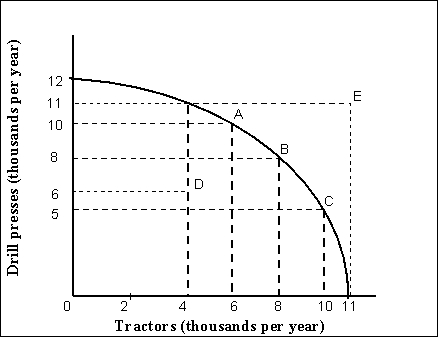
(Exhibit: Production Possibilities Curve)Which of the following statements is false?
A)The maximum amount of drill presses this economy can produce per year is 12,000.
B)The maximum amount of tractors this economy can produce per year is 11,000.
C)Point E could be achieved it the economy had more money.
D)If this economy produces 5,000 tractors per year, then it can produce up to a maximum of 10,000 drill presses per year.
(Exhibit: Production Possibilities Curve)Which of the following statements is false?
A)The maximum amount of drill presses this economy can produce per year is 12,000.
B)The maximum amount of tractors this economy can produce per year is 11,000.
C)Point E could be achieved it the economy had more money.
D)If this economy produces 5,000 tractors per year, then it can produce up to a maximum of 10,000 drill presses per year.
Question
Question
Question
Reference: 1707
(Exhibit: Production Possibilities Curve)The slope of the production possibilities curve between point B and point A is:
A)-0.5.
B)-1.0.
C)-2.0.
D)1.0.
(Exhibit: Production Possibilities Curve)The slope of the production possibilities curve between point B and point A is:
A)-0.5.
B)-1.0.
C)-2.0.
D)1.0.
Question
Question
Question
Question
Reference: 1707
(Exhibit: Production Possibilities Curve)To move from point B to point C, _______ must be ________ to produce _______ .
A)3,000 drill presses; given up; 2,000 additional tractors
B)8,000 drill presses; given up; 8,000 additional tractors
C)3,000 tractors; produced; 2,000 additional drill presses
D)8,000 drill presses; produced; 6,000 additional tractors
(Exhibit: Production Possibilities Curve)To move from point B to point C, _______ must be ________ to produce _______ .
A)3,000 drill presses; given up; 2,000 additional tractors
B)8,000 drill presses; given up; 8,000 additional tractors
C)3,000 tractors; produced; 2,000 additional drill presses
D)8,000 drill presses; produced; 6,000 additional tractors
Question
Question
Reference: 1707
(Exhibit: Production Possibilities Curve)Which of the following statements is true?
A)Point B is superior to point A
B)Point E could be attained without an increase in resources if the existing ones were just used more efficiently.
C)Points A, B, and C are all feasible and maximum production points.
D)Point C is superior to point A.
(Exhibit: Production Possibilities Curve)Which of the following statements is true?
A)Point B is superior to point A
B)Point E could be attained without an increase in resources if the existing ones were just used more efficiently.
C)Points A, B, and C are all feasible and maximum production points.
D)Point C is superior to point A.
Question
Reference: 1707
(Exhibit: Production Possibilities Curve)Which of the following statements is true?
A)Moving from point A to C is an increase in efficiency.
B)Moving from point A to C involves a reduction of 5,000 drill presses to gain 4,000 tractors.
C)A, B, and C are all inefficient points.
D)Point A is the most efficient level of output.
(Exhibit: Production Possibilities Curve)Which of the following statements is true?
A)Moving from point A to C is an increase in efficiency.
B)Moving from point A to C involves a reduction of 5,000 drill presses to gain 4,000 tractors.
C)A, B, and C are all inefficient points.
D)Point A is the most efficient level of output.
Question
Reference: 1707
(Exhibit: Production Possibilities Curve)If an economy is operating on its production possibilities curve, the law of increasing opportunity costs predicts that:
A)as more tractors are produced, fewer and fewer drill presses must be given up.
B)as more tractors are produced, more and more drill presses must be given up.
C)as more tractors are produced, the same amount of drill presses must be given up.
D)as more drill presses are produced, fewer and fewer tractors must be given up.
(Exhibit: Production Possibilities Curve)If an economy is operating on its production possibilities curve, the law of increasing opportunity costs predicts that:
A)as more tractors are produced, fewer and fewer drill presses must be given up.
B)as more tractors are produced, more and more drill presses must be given up.
C)as more tractors are produced, the same amount of drill presses must be given up.
D)as more drill presses are produced, fewer and fewer tractors must be given up.
Question
Question
Question
Question
Reference: 1707
(Exhibit: Production Possibilities Curve)In order to maximize output, this economy must:
A)operate on its production possibilities curve.
B)operate at point E.
C)produce at point B.
D)produce at point D.
(Exhibit: Production Possibilities Curve)In order to maximize output, this economy must:
A)operate on its production possibilities curve.
B)operate at point E.
C)produce at point B.
D)produce at point D.
Question
Reference: 1707
(Exhibit: Production Possibilities Curve)Which of the following statements is true?
A)Operation at Point E is possible, given the current factors of production.
B)At point D, there must be efficiency and full employment since it is not necessary to use so many resources.
C)Every point on the production possibilities curve is a full employment and efficient point of production.
D)Point B is more efficient than either point A or point C.
(Exhibit: Production Possibilities Curve)Which of the following statements is true?
A)Operation at Point E is possible, given the current factors of production.
B)At point D, there must be efficiency and full employment since it is not necessary to use so many resources.
C)Every point on the production possibilities curve is a full employment and efficient point of production.
D)Point B is more efficient than either point A or point C.
Question
Question
Question
Question
Reference: 1733 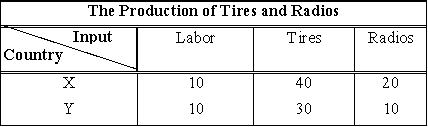
(Exhibit: The Production of Tires and Radios)Assuming constant costs in the neighborhood of their current levels of production, the exhibit shows the number of tires each country would have to forgo in order to produce the additional radios indicated.Further assume that the only input is labor and that it remains fully employed.The cost to country Y of producing an additional radio is _______ tire(s).
A)1/3
B)1/2
C)2
D)3
(Exhibit: The Production of Tires and Radios)Assuming constant costs in the neighborhood of their current levels of production, the exhibit shows the number of tires each country would have to forgo in order to produce the additional radios indicated.Further assume that the only input is labor and that it remains fully employed.The cost to country Y of producing an additional radio is _______ tire(s).
A)1/3
B)1/2
C)2
D)3
Question
Question
Reference: 1733
(Exhibit: The Production of Tires and Radios)Assuming constant costs in the neighborhood of their current levels of production, the exhibit shows the number of tires each country would have to forgo in order to produce the additional radios indicated.Further assume that the only input is labor and that it remains fully employed.Assume that there is unrestricted trade and complete specialization.According to comparative advantage, country:
A)Y would import tires.
B)Y would export radios.
C)Y would export tires.
D)X would import radios.
(Exhibit: The Production of Tires and Radios)Assuming constant costs in the neighborhood of their current levels of production, the exhibit shows the number of tires each country would have to forgo in order to produce the additional radios indicated.Further assume that the only input is labor and that it remains fully employed.Assume that there is unrestricted trade and complete specialization.According to comparative advantage, country:
A)Y would import tires.
B)Y would export radios.
C)Y would export tires.
D)X would import radios.
Question
Question
Question
Question
Question
Question
Question
Reference: 1733
(Exhibit: The Production of Tires and Radios)Assuming constant costs in the neighborhood of their current levels of production, the exhibit shows the number of tires each country would have to forgo in order to produce the additional radios indicated.Further assume that the only input is labor and that it remains fully employed.We see from the table that Country X:
A)has an absolute advantage in the production of both goods and a comparative advantage in the production of tires.
B)has an absolute advantage in the production of both goods and a comparative advantage in the production of radios.
C)does not have an absolute advantage in the production of either good, but it has a comparative advantage in the production of tires.
D)does not have an absolute advantage in the production of either good, but it has a comparative advantage in the production of radios.
(Exhibit: The Production of Tires and Radios)Assuming constant costs in the neighborhood of their current levels of production, the exhibit shows the number of tires each country would have to forgo in order to produce the additional radios indicated.Further assume that the only input is labor and that it remains fully employed.We see from the table that Country X:
A)has an absolute advantage in the production of both goods and a comparative advantage in the production of tires.
B)has an absolute advantage in the production of both goods and a comparative advantage in the production of radios.
C)does not have an absolute advantage in the production of either good, but it has a comparative advantage in the production of tires.
D)does not have an absolute advantage in the production of either good, but it has a comparative advantage in the production of radios.
Question
Reference: 1733
(Exhibit: The Production of Tires and Radios)Assuming constant costs in the neighborhood of their current levels of production, the exhibit shows the number of tires each country would have to forgo in order to produce the additional radios indicated.Further assume that the only input is labor and that it remains fully employed.Assume that there is unrestricted trade and complete specialization.According to comparative advantage, country:
A)X would import tires.
B)X would import radios.
C)Y would import tires.
D)Y would export radios.
(Exhibit: The Production of Tires and Radios)Assuming constant costs in the neighborhood of their current levels of production, the exhibit shows the number of tires each country would have to forgo in order to produce the additional radios indicated.Further assume that the only input is labor and that it remains fully employed.Assume that there is unrestricted trade and complete specialization.According to comparative advantage, country:
A)X would import tires.
B)X would import radios.
C)Y would import tires.
D)Y would export radios.
Question
Reference: 1733
(Exhibit: The Production of Tires and Radios)Assuming constant costs in the neighborhood of their current levels of production, the exhibit shows the number of tires each country would have to forgo in order to produce the additional radios indicated.Further assume that the only input is labor and that it remains fully employed.We see from the table that Country Y:
A)has an absolute advantage in the production of both goods and a comparative advantage in the production of tires.
B)has an absolute advantage in the production of both goods and a comparative advantage in the production of radios.
C)does not have an absolute advantage in the production of either good, but it has a comparative advantage in the production of tires.
D)does not have an absolute advantage in the production of either good, but it has a comparative advantage in the production of radios.
(Exhibit: The Production of Tires and Radios)Assuming constant costs in the neighborhood of their current levels of production, the exhibit shows the number of tires each country would have to forgo in order to produce the additional radios indicated.Further assume that the only input is labor and that it remains fully employed.We see from the table that Country Y:
A)has an absolute advantage in the production of both goods and a comparative advantage in the production of tires.
B)has an absolute advantage in the production of both goods and a comparative advantage in the production of radios.
C)does not have an absolute advantage in the production of either good, but it has a comparative advantage in the production of tires.
D)does not have an absolute advantage in the production of either good, but it has a comparative advantage in the production of radios.
Question
Question
Reference: 1733
(Exhibit: The Production of Tires and Radios)Assuming constant costs in the neighborhood of their current levels of production, the exhibit shows the number of tires each country would have to forgo in order to produce the additional radios indicated.Further assume that the only input is labor and that it remains fully employed.Assume that there is unrestricted trade and complete specialization.According to comparative advantage, country:
A)Y would import radios.
B)Y would import tires.
C)Y would export radios.
D)X would export tires.
(Exhibit: The Production of Tires and Radios)Assuming constant costs in the neighborhood of their current levels of production, the exhibit shows the number of tires each country would have to forgo in order to produce the additional radios indicated.Further assume that the only input is labor and that it remains fully employed.Assume that there is unrestricted trade and complete specialization.According to comparative advantage, country:
A)Y would import radios.
B)Y would import tires.
C)Y would export radios.
D)X would export tires.
Question
Reference: 1733
(Exhibit: The Production of Tires and Radios)Assuming constant costs in the neighborhood of their current levels of production, the exhibit shows the number of tires each country would have to forgo in order to produce the additional radios indicated.Further assume that the only input is labor and that it remains fully employed.Assume that there is unrestricted trade and complete specialization.According to comparative advantage, country:
A)Y would import tires.
B)Y would export radios.
C)X would export radios.
D)X would export tires.
(Exhibit: The Production of Tires and Radios)Assuming constant costs in the neighborhood of their current levels of production, the exhibit shows the number of tires each country would have to forgo in order to produce the additional radios indicated.Further assume that the only input is labor and that it remains fully employed.Assume that there is unrestricted trade and complete specialization.According to comparative advantage, country:
A)Y would import tires.
B)Y would export radios.
C)X would export radios.
D)X would export tires.
Question
Question
Question
Question
Question
Reference: 1753 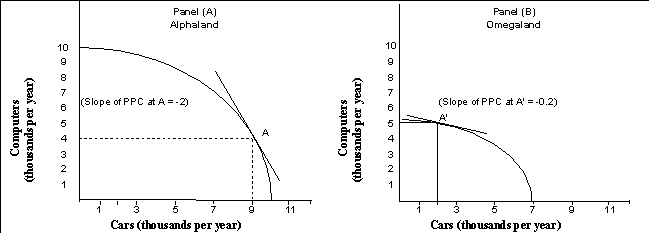
(Exhibit: Production Possibilities in Alphaland and Omegaland)Which of the following statements is true?
A)Alphaland has an absolute advantage in the production of computers.
B)Omegaland has an absolute advantage in the production of cars.
C)A nation that can produce all goods with an absolute advantage would not benefit from trade.
D)Because absolute advantage is determined by the amount of output per worker, it is not possible to determine if either country has an absolute advantage without more information.
(Exhibit: Production Possibilities in Alphaland and Omegaland)Which of the following statements is true?
A)Alphaland has an absolute advantage in the production of computers.
B)Omegaland has an absolute advantage in the production of cars.
C)A nation that can produce all goods with an absolute advantage would not benefit from trade.
D)Because absolute advantage is determined by the amount of output per worker, it is not possible to determine if either country has an absolute advantage without more information.
Question
Question
Reference: 1753
(Exhibit: Production Possibilities in Alphaland and Omegaland)Opportunity costs in the two countries can be determined by comparing the _______ of their respective _______curves.
A)positions; demand and supply
B)slopes; production possibilities
C)efficiency rates; efficiency
D)level; production possibilities
(Exhibit: Production Possibilities in Alphaland and Omegaland)Opportunity costs in the two countries can be determined by comparing the _______ of their respective _______curves.
A)positions; demand and supply
B)slopes; production possibilities
C)efficiency rates; efficiency
D)level; production possibilities
Question
Question
Question
Question
Reference: 1753
(Exhibit: Production Possibilities in Alphaland and Omegaland)The slopes of the production possibilities curves (PPCs)in the two countries are:
A)determined by the slopes of tangents drawn to the PPCs.
B)always positive.
C)a reflection of the fixed costs of production.
D)not comparable since they each have their own PPC.
(Exhibit: Production Possibilities in Alphaland and Omegaland)The slopes of the production possibilities curves (PPCs)in the two countries are:
A)determined by the slopes of tangents drawn to the PPCs.
B)always positive.
C)a reflection of the fixed costs of production.
D)not comparable since they each have their own PPC.
Question
Reference: 1753
(Exhibit: Production Possibilities in Alphaland and Omegaland)At point A in Alphaland, ________ additional car(s)cost(s)_______ computers, and at point A? in Omegaland, _______ additional car(s)cost(s)_______ computer(s).
A)2; 1; 0.2; 1
B)1; 0.2; 1; 2
C)1; 2; 1; 0.2
D)2; 2; 1; 0.2
(Exhibit: Production Possibilities in Alphaland and Omegaland)At point A in Alphaland, ________ additional car(s)cost(s)_______ computers, and at point A? in Omegaland, _______ additional car(s)cost(s)_______ computer(s).
A)2; 1; 0.2; 1
B)1; 0.2; 1; 2
C)1; 2; 1; 0.2
D)2; 2; 1; 0.2
Question
Reference: 1753
(Exhibit: Production Possibilities in Alphaland and Omegaland)Which of the following statements is true?
A)Despite Alphaland's greater ability to produce both goods, it can still gain from trade with Omegaland.
B)Omegaland can't gain from trade with Alphaland.
C)The country with a lower relative cost for a particular good has an absolute advantage.
D)Mutually beneficial trade won't occur in this case, because Alphaland is so big.
(Exhibit: Production Possibilities in Alphaland and Omegaland)Which of the following statements is true?
A)Despite Alphaland's greater ability to produce both goods, it can still gain from trade with Omegaland.
B)Omegaland can't gain from trade with Alphaland.
C)The country with a lower relative cost for a particular good has an absolute advantage.
D)Mutually beneficial trade won't occur in this case, because Alphaland is so big.
Question
Question
Reference: 1753
(Exhibit: Production Possibilities in Alphaland and Omegaland)Which of the following statements is true?
A)Omegaland can produce more computers than Alphaland.
B)Alphaland is capable of producing more of both goods.
C)Trade is not possible since it would not be advantageous for Alphaland.
D)Trade will benefit Alphaland but not Omegaland.
(Exhibit: Production Possibilities in Alphaland and Omegaland)Which of the following statements is true?
A)Omegaland can produce more computers than Alphaland.
B)Alphaland is capable of producing more of both goods.
C)Trade is not possible since it would not be advantageous for Alphaland.
D)Trade will benefit Alphaland but not Omegaland.
Question
Question
Question
Question
Reference: 1753
(Exhibit: Production Possibilities in Alphaland and Omegaland)The maximum quantity of possible production for Alphaland is:
A)10,000 computers and 10,000 cars.
B)4,000 computers and 9,000 cars at point A.
C)10,000 computers or 6,000 cars.
D)6,000 cars.
(Exhibit: Production Possibilities in Alphaland and Omegaland)The maximum quantity of possible production for Alphaland is:
A)10,000 computers and 10,000 cars.
B)4,000 computers and 9,000 cars at point A.
C)10,000 computers or 6,000 cars.
D)6,000 cars.
Question
Question
Reference: 1753
(Exhibit: Production Possibilities in Alphaland and Omegaland)Which of the following statements is true?
A)The two countries differ in their abilities to produce computers and cars.
B)Omegaland is able to produce more computers per year than Alphaland.
C)If Alphaland produced 10,000 cars per year, it could produce 10,000 computers per year as well.
D)Alphaland has an absolute advantage in cars.
(Exhibit: Production Possibilities in Alphaland and Omegaland)Which of the following statements is true?
A)The two countries differ in their abilities to produce computers and cars.
B)Omegaland is able to produce more computers per year than Alphaland.
C)If Alphaland produced 10,000 cars per year, it could produce 10,000 computers per year as well.
D)Alphaland has an absolute advantage in cars.
Question
Question
Reference: 1753
(Exhibit: Production Possibilities in Alphaland and Omegaland)At point A in Alphaland, ________ additional computer(s)cost(s)_______ additional car(s)and at point A? in Omegaland, _______ additional computer(s)cost(s)_______ car(s).
A)1; 5; 1; 1/2
B)1; 1/2; 1; 5
C)5; 1; 1/2; 1
D)1/2; 1; 5; 1
(Exhibit: Production Possibilities in Alphaland and Omegaland)At point A in Alphaland, ________ additional computer(s)cost(s)_______ additional car(s)and at point A? in Omegaland, _______ additional computer(s)cost(s)_______ car(s).
A)1; 5; 1; 1/2
B)1; 1/2; 1; 5
C)5; 1; 1/2; 1
D)1/2; 1; 5; 1
Question
Question
Reference: 1753
(Exhibit: Production Possibilities in Alphaland and Omegaland)Before trade in Omegaland, ________ car could exchange for ________ computer.
A)1; 1/5
B)1/5; 1
C)2; 1
D)2; 1
(Exhibit: Production Possibilities in Alphaland and Omegaland)Before trade in Omegaland, ________ car could exchange for ________ computer.
A)1; 1/5
B)1/5; 1
C)2; 1
D)2; 1
Question
Reference: 1753
(Exhibit: Production Possibilities in Alphaland and Omegaland)Which of the following statements is false?
A)The law of increasing costs means that, as an economy moves downward to the right along its production possibilities curve, the cost of additional units rises.
B)An economy with a comparative advantage in a particular good will tend to specialize in the production of that good.
C)An economy's production will move off its production possibilities curve because of trade.
D)Specialization and trade can benefit both countries at the same time.
(Exhibit: Production Possibilities in Alphaland and Omegaland)Which of the following statements is false?
A)The law of increasing costs means that, as an economy moves downward to the right along its production possibilities curve, the cost of additional units rises.
B)An economy with a comparative advantage in a particular good will tend to specialize in the production of that good.
C)An economy's production will move off its production possibilities curve because of trade.
D)Specialization and trade can benefit both countries at the same time.
Question
Question
Question
Question
Question
Question
Question
Question
Reference: 1753
(Exhibit: Production Possibilities in Alphaland and Omegaland)Through exchange, both Alphaland and Omegaland:
A)are likely to end up consuming less of both goods.
B)together will produce more computers but fewer cars.
C)because of specialization and increased efficiency, will have increased the amount of joint production given the same amount of total resources available.
D)will end up consuming more cars but fewer computers than before trade.
(Exhibit: Production Possibilities in Alphaland and Omegaland)Through exchange, both Alphaland and Omegaland:
A)are likely to end up consuming less of both goods.
B)together will produce more computers but fewer cars.
C)because of specialization and increased efficiency, will have increased the amount of joint production given the same amount of total resources available.
D)will end up consuming more cars but fewer computers than before trade.
Question
Question
Reference: 1753
(Exhibit: Production Possibilities in Alphaland and Omegaland)At the points where they are producing (A and A', respectively), Alphaland has a(n)_______ in producing _______ and Omegaland has a _______ in producing _______ .
A)absolute advantage; computers; comparative advantage; cars
B)comparative advantage; cars; comparative advantage; computers
C)comparative advantage; computers; comparative advantage; cars
D)comparative advantage; computers; absolute advantage; cars
(Exhibit: Production Possibilities in Alphaland and Omegaland)At the points where they are producing (A and A', respectively), Alphaland has a(n)_______ in producing _______ and Omegaland has a _______ in producing _______ .
A)absolute advantage; computers; comparative advantage; cars
B)comparative advantage; cars; comparative advantage; computers
C)comparative advantage; computers; comparative advantage; cars
D)comparative advantage; computers; absolute advantage; cars
Question
Question
Reference: 1753
(Exhibit: Production Possibilities in Alphaland and Omegaland)Which of the following statements is true?
A)Because of trading, all people in Omegaland will benefit in the short run.
B)Because of trading, all people in Alphaland will benefit in the short run.
C)The final terms of trade could be 4/5 computer for 1 car.
D)The final terms of trade could be 3 computers per car.
(Exhibit: Production Possibilities in Alphaland and Omegaland)Which of the following statements is true?
A)Because of trading, all people in Omegaland will benefit in the short run.
B)Because of trading, all people in Alphaland will benefit in the short run.
C)The final terms of trade could be 4/5 computer for 1 car.
D)The final terms of trade could be 3 computers per car.
Question
Reference: 1753
(Exhibit: Production Possibilities in Alphaland and Omegaland)Once trade opens up between the two countries:
A)computer producers in Alphaland will export computers to Omegaland.
B)computer producers in Omegaland will export computers to Alphaland.
C)as Alphaland's computers arrive in Omegaland, the price of computers in Omegaland will rise.
D)Alphaland will import computers.
(Exhibit: Production Possibilities in Alphaland and Omegaland)Once trade opens up between the two countries:
A)computer producers in Alphaland will export computers to Omegaland.
B)computer producers in Omegaland will export computers to Alphaland.
C)as Alphaland's computers arrive in Omegaland, the price of computers in Omegaland will rise.
D)Alphaland will import computers.
Question
Reference: 1753
(Exhibit: Production Possibilities in Alphaland and Omegaland)If the terms of trade established turn out to be 1 car for 1 computer, then:
A)producers of computers in Alphaland will accept these terms, and, eventually, production in Alphaland will take place inside its production possibilities curve.
B)producers of cars in Omegaland will produce more cars, and production in Omegaland will take place inside its production possibilities curve.
C)computer producers in Omegaland will be displaced as cheaper computers arrive from Alphaland.
D)car producers in Omegaland will be displaced as cheaper cars arrive from Alphaland.
(Exhibit: Production Possibilities in Alphaland and Omegaland)If the terms of trade established turn out to be 1 car for 1 computer, then:
A)producers of computers in Alphaland will accept these terms, and, eventually, production in Alphaland will take place inside its production possibilities curve.
B)producers of cars in Omegaland will produce more cars, and production in Omegaland will take place inside its production possibilities curve.
C)computer producers in Omegaland will be displaced as cheaper computers arrive from Alphaland.
D)car producers in Omegaland will be displaced as cheaper cars arrive from Alphaland.
Question
Reference: 1753
(Exhibit: Production Possibilities in Alphaland and Omegaland)Before trade, computer producers in Alphaland could exchange _______ computer(s)for _______ car(s).
A)1; 1/3
B)1; 1
C)2; 1
D)2; 2
(Exhibit: Production Possibilities in Alphaland and Omegaland)Before trade, computer producers in Alphaland could exchange _______ computer(s)for _______ car(s).
A)1; 1/3
B)1; 1
C)2; 1
D)2; 2
Question
Question
Reference: 1753
(Exhibit: Production Possibilities in Alphaland and Omegaland)If the final terms of trade are 1 computer = 1 car, then:
A)each country's production possibilities curve will have a slope of -1 at the combination it chooses to produce.
B)Alphaland will produce more cars and Omegaland will produce more computers.
C)specialization is not complete.
D)Alphaland will benefit at the expense of Omegaland.
(Exhibit: Production Possibilities in Alphaland and Omegaland)If the final terms of trade are 1 computer = 1 car, then:
A)each country's production possibilities curve will have a slope of -1 at the combination it chooses to produce.
B)Alphaland will produce more cars and Omegaland will produce more computers.
C)specialization is not complete.
D)Alphaland will benefit at the expense of Omegaland.

Unlock Deck
Sign up to unlock the cards in this deck!
Unlock Deck
Unlock Deck
1/179

Play

Full screen (f)
Deck 17: International Trade
1
The _______ model lays out the _______ available to the economy.
A)demand and supply; alternatives
B)production possibilities; price alternatives
C)production possibilities; alternatives
D)demand and supply; prices
A)demand and supply; alternatives
B)production possibilities; price alternatives
C)production possibilities; alternatives
D)demand and supply; prices
C
2
The absolute value of the slope of the production possibilities curve at any point:
A)gives the price of the good on the vertical axis that must be given up to attain an additional unit of the good on the horizontal axis.
B)is found by dividing the horizontal change by a vertical change.
C)gives the quantity of the good on the vertical axis that must be given up to produce an additional unit of the good on the horizontal axis.
D)gives the price of the good on the horizontal axis relative to the price of the good on the vertical axis.
A)gives the price of the good on the vertical axis that must be given up to attain an additional unit of the good on the horizontal axis.
B)is found by dividing the horizontal change by a vertical change.
C)gives the quantity of the good on the vertical axis that must be given up to produce an additional unit of the good on the horizontal axis.
D)gives the price of the good on the horizontal axis relative to the price of the good on the vertical axis.
C
3
Reference: 1707
(Exhibit: Production Possibilities Curve)Which of the following statements is false?
A)The maximum amount of drill presses this economy can produce per year is 12,000.
B)The maximum amount of tractors this economy can produce per year is 11,000.
C)Point E could be achieved it the economy had more money.
D)If this economy produces 5,000 tractors per year, then it can produce up to a maximum of 10,000 drill presses per year.
(Exhibit: Production Possibilities Curve)Which of the following statements is false?
A)The maximum amount of drill presses this economy can produce per year is 12,000.
B)The maximum amount of tractors this economy can produce per year is 11,000.
C)Point E could be achieved it the economy had more money.
D)If this economy produces 5,000 tractors per year, then it can produce up to a maximum of 10,000 drill presses per year.
C
4
If Britain, at the point where it is currently producing, must give up the production of 75 hats to produce 25 additional sweaters, the opportunity cost of producing 4 sweaters is _______ hats.
A)4
B)12
C)71
D)79
A)4
B)12
C)71
D)79
Unlock Deck
Unlock for access to all 179 flashcards in this deck.
Unlock Deck
k this deck
5
If Britain, at the point where it is currently producing, must give up the production of 75 hats to produce 25 additional sweaters, the opportunity cost of producing 3 hats is _______ sweater(s).
A)1
B)3
C)22
D)28
A)1
B)3
C)22
D)28
Unlock Deck
Unlock for access to all 179 flashcards in this deck.
Unlock Deck
k this deck
6
Reference: 1707
(Exhibit: Production Possibilities Curve)The slope of the production possibilities curve between point B and point A is:
A)-0.5.
B)-1.0.
C)-2.0.
D)1.0.
(Exhibit: Production Possibilities Curve)The slope of the production possibilities curve between point B and point A is:
A)-0.5.
B)-1.0.
C)-2.0.
D)1.0.
Unlock Deck
Unlock for access to all 179 flashcards in this deck.
Unlock Deck
k this deck
7
The point on the production possibilities curve at which an economy will operate is determined by:
A)which point produces the greatest amount of both goods.
B)the demands of consumers.
C)the absolute prices of the two goods.
D)which point requires the fewest resources.
A)which point produces the greatest amount of both goods.
B)the demands of consumers.
C)the absolute prices of the two goods.
D)which point requires the fewest resources.
Unlock Deck
Unlock for access to all 179 flashcards in this deck.
Unlock Deck
k this deck
8
Which of the following statements is true?
A)Nations have generally moved toward freer international trade policies over the past few decades.
B)Nations all over the world have recently raised trade barriers.
C)Eastern Europe and the Former Soviet Union countries have reduced trade in the last decade.
D)NAFTA lowered trade barriers between the United States and Mexico but raised them between the United States and Canada.
A)Nations have generally moved toward freer international trade policies over the past few decades.
B)Nations all over the world have recently raised trade barriers.
C)Eastern Europe and the Former Soviet Union countries have reduced trade in the last decade.
D)NAFTA lowered trade barriers between the United States and Mexico but raised them between the United States and Canada.
Unlock Deck
Unlock for access to all 179 flashcards in this deck.
Unlock Deck
k this deck
9
Production possibilities curves:
A)illustrate the production choices available to an economy.
B)assume full employment but not maximum efficiency.
C)assume maximum efficiency but not full employment.
D)are used to illustrate the law of decreasing opportunity costs.
A)illustrate the production choices available to an economy.
B)assume full employment but not maximum efficiency.
C)assume maximum efficiency but not full employment.
D)are used to illustrate the law of decreasing opportunity costs.
Unlock Deck
Unlock for access to all 179 flashcards in this deck.
Unlock Deck
k this deck
10
Reference: 1707
(Exhibit: Production Possibilities Curve)To move from point B to point C, _______ must be ________ to produce _______ .
A)3,000 drill presses; given up; 2,000 additional tractors
B)8,000 drill presses; given up; 8,000 additional tractors
C)3,000 tractors; produced; 2,000 additional drill presses
D)8,000 drill presses; produced; 6,000 additional tractors
(Exhibit: Production Possibilities Curve)To move from point B to point C, _______ must be ________ to produce _______ .
A)3,000 drill presses; given up; 2,000 additional tractors
B)8,000 drill presses; given up; 8,000 additional tractors
C)3,000 tractors; produced; 2,000 additional drill presses
D)8,000 drill presses; produced; 6,000 additional tractors
Unlock Deck
Unlock for access to all 179 flashcards in this deck.
Unlock Deck
k this deck
11
Different points on a production possibilities curve:
A)yield the same values of total output.
B)yield different values of total output.
C)have the same values of slope, if the production possibilities curve is non-linear.
D)can be achieved simultaneously.
A)yield the same values of total output.
B)yield different values of total output.
C)have the same values of slope, if the production possibilities curve is non-linear.
D)can be achieved simultaneously.
Unlock Deck
Unlock for access to all 179 flashcards in this deck.
Unlock Deck
k this deck
12
Reference: 1707
(Exhibit: Production Possibilities Curve)Which of the following statements is true?
A)Point B is superior to point A
B)Point E could be attained without an increase in resources if the existing ones were just used more efficiently.
C)Points A, B, and C are all feasible and maximum production points.
D)Point C is superior to point A.
(Exhibit: Production Possibilities Curve)Which of the following statements is true?
A)Point B is superior to point A
B)Point E could be attained without an increase in resources if the existing ones were just used more efficiently.
C)Points A, B, and C are all feasible and maximum production points.
D)Point C is superior to point A.
Unlock Deck
Unlock for access to all 179 flashcards in this deck.
Unlock Deck
k this deck
13
Reference: 1707
(Exhibit: Production Possibilities Curve)Which of the following statements is true?
A)Moving from point A to C is an increase in efficiency.
B)Moving from point A to C involves a reduction of 5,000 drill presses to gain 4,000 tractors.
C)A, B, and C are all inefficient points.
D)Point A is the most efficient level of output.
(Exhibit: Production Possibilities Curve)Which of the following statements is true?
A)Moving from point A to C is an increase in efficiency.
B)Moving from point A to C involves a reduction of 5,000 drill presses to gain 4,000 tractors.
C)A, B, and C are all inefficient points.
D)Point A is the most efficient level of output.
Unlock Deck
Unlock for access to all 179 flashcards in this deck.
Unlock Deck
k this deck
14
Reference: 1707
(Exhibit: Production Possibilities Curve)If an economy is operating on its production possibilities curve, the law of increasing opportunity costs predicts that:
A)as more tractors are produced, fewer and fewer drill presses must be given up.
B)as more tractors are produced, more and more drill presses must be given up.
C)as more tractors are produced, the same amount of drill presses must be given up.
D)as more drill presses are produced, fewer and fewer tractors must be given up.
(Exhibit: Production Possibilities Curve)If an economy is operating on its production possibilities curve, the law of increasing opportunity costs predicts that:
A)as more tractors are produced, fewer and fewer drill presses must be given up.
B)as more tractors are produced, more and more drill presses must be given up.
C)as more tractors are produced, the same amount of drill presses must be given up.
D)as more drill presses are produced, fewer and fewer tractors must be given up.
Unlock Deck
Unlock for access to all 179 flashcards in this deck.
Unlock Deck
k this deck
15
Canada, Mexico, and the United States have:
A)joined together and are operating in what is called a closed-trade area with respect to the European Union.
B)developed a currency similar to the euro.
C)eliminated many trade barriers among themselves.
D)reduced trade among them in order to protect jobs at home.
A)joined together and are operating in what is called a closed-trade area with respect to the European Union.
B)developed a currency similar to the euro.
C)eliminated many trade barriers among themselves.
D)reduced trade among them in order to protect jobs at home.
Unlock Deck
Unlock for access to all 179 flashcards in this deck.
Unlock Deck
k this deck
16
Members of the EU (European Union):
A)have virtually eliminated all trade barriers within the community.
B)have stopped using the euro as their new currency.
C)in using the euro have increased the transaction costs of exchange.
D)no longer trade with North America.
A)have virtually eliminated all trade barriers within the community.
B)have stopped using the euro as their new currency.
C)in using the euro have increased the transaction costs of exchange.
D)no longer trade with North America.
Unlock Deck
Unlock for access to all 179 flashcards in this deck.
Unlock Deck
k this deck
17
If the United States, at the point where it is currently producing, must give up the production of 500 bicycles (B)to produce 20 additional tractors (T)with the same resources, its opportunity cost may be expressed as:
A)1/25B = 1T.
B)1B = 1/25T.
C)1B = 1T.
D)1B = 25T.
A)1/25B = 1T.
B)1B = 1/25T.
C)1B = 1T.
D)1B = 25T.
Unlock Deck
Unlock for access to all 179 flashcards in this deck.
Unlock Deck
k this deck
18
Reference: 1707
(Exhibit: Production Possibilities Curve)In order to maximize output, this economy must:
A)operate on its production possibilities curve.
B)operate at point E.
C)produce at point B.
D)produce at point D.
(Exhibit: Production Possibilities Curve)In order to maximize output, this economy must:
A)operate on its production possibilities curve.
B)operate at point E.
C)produce at point B.
D)produce at point D.
Unlock Deck
Unlock for access to all 179 flashcards in this deck.
Unlock Deck
k this deck
19
Reference: 1707
(Exhibit: Production Possibilities Curve)Which of the following statements is true?
A)Operation at Point E is possible, given the current factors of production.
B)At point D, there must be efficiency and full employment since it is not necessary to use so many resources.
C)Every point on the production possibilities curve is a full employment and efficient point of production.
D)Point B is more efficient than either point A or point C.
(Exhibit: Production Possibilities Curve)Which of the following statements is true?
A)Operation at Point E is possible, given the current factors of production.
B)At point D, there must be efficiency and full employment since it is not necessary to use so many resources.
C)Every point on the production possibilities curve is a full employment and efficient point of production.
D)Point B is more efficient than either point A or point C.
Unlock Deck
Unlock for access to all 179 flashcards in this deck.
Unlock Deck
k this deck
20
If the United States, at the point where it is currently producing, must give up the production of 500 bicycles (B)to produce 20 additional tractors (T)with the same resources, its opportunity cost may be expressed as:
A)1/25B = 1T.
B)1B = 1T.
C)1B = 25T.
D)25B = 1T.
A)1/25B = 1T.
B)1B = 1T.
C)1B = 25T.
D)25B = 1T.
Unlock Deck
Unlock for access to all 179 flashcards in this deck.
Unlock Deck
k this deck
21
If the United States, at the point where it is currently producing, must give up the production of 500 bicycles (B)to produce 20 additional tractors (T)with the same resources, the opportunity cost of producing 5 tractors is _______ bicycles.
A)5
B)20
C)100
D)125
A)5
B)20
C)100
D)125
Unlock Deck
Unlock for access to all 179 flashcards in this deck.
Unlock Deck
k this deck
22
Reference: 1725
-(Exhibit: Production Possibilities for Machinery and Petroleum)Assuming constant costs in the neighborhood of their current levels of production, the exhibit shows the number of units of machinery each country would have to forgo in order to produce the additional petroleum indicated.The opportunity cost in the United States of producing 120 units of machinery is _______ units of petroleum.
A)80
B)60
C)40
D)20
-(Exhibit: Production Possibilities for Machinery and Petroleum)Assuming constant costs in the neighborhood of their current levels of production, the exhibit shows the number of units of machinery each country would have to forgo in order to produce the additional petroleum indicated.The opportunity cost in the United States of producing 120 units of machinery is _______ units of petroleum.
A)80
B)60
C)40
D)20
Unlock Deck
Unlock for access to all 179 flashcards in this deck.
Unlock Deck
k this deck
23
Reference: 1733
(Exhibit: The Production of Tires and Radios)Assuming constant costs in the neighborhood of their current levels of production, the exhibit shows the number of tires each country would have to forgo in order to produce the additional radios indicated.Further assume that the only input is labor and that it remains fully employed.The cost to country Y of producing an additional radio is _______ tire(s).
A)1/3
B)1/2
C)2
D)3
(Exhibit: The Production of Tires and Radios)Assuming constant costs in the neighborhood of their current levels of production, the exhibit shows the number of tires each country would have to forgo in order to produce the additional radios indicated.Further assume that the only input is labor and that it remains fully employed.The cost to country Y of producing an additional radio is _______ tire(s).
A)1/3
B)1/2
C)2
D)3
Unlock Deck
Unlock for access to all 179 flashcards in this deck.
Unlock Deck
k this deck
24
If the United States, at the point where it is currently producing, must give up the production of 500 bicycles (B)to produce 20 additional tractors (T)with the same resources, the opportunity cost of producing 100 bicycles is _______ tractor(s).
A)1
B)4
C)25
D)100
A)1
B)4
C)25
D)100
Unlock Deck
Unlock for access to all 179 flashcards in this deck.
Unlock Deck
k this deck
25
Reference: 1733
(Exhibit: The Production of Tires and Radios)Assuming constant costs in the neighborhood of their current levels of production, the exhibit shows the number of tires each country would have to forgo in order to produce the additional radios indicated.Further assume that the only input is labor and that it remains fully employed.Assume that there is unrestricted trade and complete specialization.According to comparative advantage, country:
A)Y would import tires.
B)Y would export radios.
C)Y would export tires.
D)X would import radios.
(Exhibit: The Production of Tires and Radios)Assuming constant costs in the neighborhood of their current levels of production, the exhibit shows the number of tires each country would have to forgo in order to produce the additional radios indicated.Further assume that the only input is labor and that it remains fully employed.Assume that there is unrestricted trade and complete specialization.According to comparative advantage, country:
A)Y would import tires.
B)Y would export radios.
C)Y would export tires.
D)X would import radios.
Unlock Deck
Unlock for access to all 179 flashcards in this deck.
Unlock Deck
k this deck
26
Reference: 1725
-(Exhibit: Production Possibilities for Machinery and Petroleum)Assuming constant costs in the neighborhood of their current levels of production, the exhibit shows the number of units of machinery each country would have to forgo in order to produce the additional petroleum indicated.The opportunity cost in Mexico of producing 90 units of machinery is _______ units of petroleum.
A)30
B)90
C)180
D)270
-(Exhibit: Production Possibilities for Machinery and Petroleum)Assuming constant costs in the neighborhood of their current levels of production, the exhibit shows the number of units of machinery each country would have to forgo in order to produce the additional petroleum indicated.The opportunity cost in Mexico of producing 90 units of machinery is _______ units of petroleum.
A)30
B)90
C)180
D)270
Unlock Deck
Unlock for access to all 179 flashcards in this deck.
Unlock Deck
k this deck
27
Reference: 1725
-(Exhibit: Production Possibilities for Machinery and Petroleum)Assuming constant costs in the neighborhood of their current levels of production, the exhibit shows the number of units of machinery each country would have to forgo in order to produce the additional petroleum indicated.A terms-of-trade equation that could emerge as a result of trade between the two countries is:
A)1M = 5P.
B)1M = 4P.
C)1M = 1P.
D)1M = 0.2P.
-(Exhibit: Production Possibilities for Machinery and Petroleum)Assuming constant costs in the neighborhood of their current levels of production, the exhibit shows the number of units of machinery each country would have to forgo in order to produce the additional petroleum indicated.A terms-of-trade equation that could emerge as a result of trade between the two countries is:
A)1M = 5P.
B)1M = 4P.
C)1M = 1P.
D)1M = 0.2P.
Unlock Deck
Unlock for access to all 179 flashcards in this deck.
Unlock Deck
k this deck
28
Reference: 1725
-(Exhibit: Production Possibilities for Machinery and Petroleum.)Assuming constant costs in the neighborhood of their current levels of production, the exhibit shows the number of units of machinery each country would have to forgo in order to produce the additional petroleum indicated.The opportunity cost in Mexico of producing 210 units of petroleum is _______ units of machinery.
A)35
B)70
C)90
D)160
-(Exhibit: Production Possibilities for Machinery and Petroleum.)Assuming constant costs in the neighborhood of their current levels of production, the exhibit shows the number of units of machinery each country would have to forgo in order to produce the additional petroleum indicated.The opportunity cost in Mexico of producing 210 units of petroleum is _______ units of machinery.
A)35
B)70
C)90
D)160
Unlock Deck
Unlock for access to all 179 flashcards in this deck.
Unlock Deck
k this deck
29
Reference: 1725
-(Exhibit: Production Possibilities for Machinery and Petroleum)Assuming constant costs in the neighborhood of their current levels of production, the exhibit shows the number of units of machinery each country would have to forgo in order to produce the additional petroleum indicated.A terms-of-trade equation that could emerge as a result of trade between the two countries is:
A)1M = 2P.
B)1M = 4P.
C)1M = 6P.
D)1M = 8P.
-(Exhibit: Production Possibilities for Machinery and Petroleum)Assuming constant costs in the neighborhood of their current levels of production, the exhibit shows the number of units of machinery each country would have to forgo in order to produce the additional petroleum indicated.A terms-of-trade equation that could emerge as a result of trade between the two countries is:
A)1M = 2P.
B)1M = 4P.
C)1M = 6P.
D)1M = 8P.
Unlock Deck
Unlock for access to all 179 flashcards in this deck.
Unlock Deck
k this deck
30
Reference: 1725
-(Exhibit: Production Possibilities for Machinery and Petroleum)Assuming constant costs in the neighborhood of their current levels of production, the exhibit shows the number of units of machinery each country would have to forgo in order to produce the additional petroleum indicated.Based on the information in the exhibit, it is true that:
A)The opportunity cost of machinery is more in the United States than in Mexico.
B)Machinery costs are the same in the United States and in Mexico.
C)The opportunity cost of machinery is less in the United States than in Mexico.
D)The opportunity cost of petroleum is less in the United States than in Mexico.
-(Exhibit: Production Possibilities for Machinery and Petroleum)Assuming constant costs in the neighborhood of their current levels of production, the exhibit shows the number of units of machinery each country would have to forgo in order to produce the additional petroleum indicated.Based on the information in the exhibit, it is true that:
A)The opportunity cost of machinery is more in the United States than in Mexico.
B)Machinery costs are the same in the United States and in Mexico.
C)The opportunity cost of machinery is less in the United States than in Mexico.
D)The opportunity cost of petroleum is less in the United States than in Mexico.
Unlock Deck
Unlock for access to all 179 flashcards in this deck.
Unlock Deck
k this deck
31
Reference: 1725
-(Exhibit: Production Possibilities for Machinery and Petroleum)Assuming constant costs in the neighborhood of their current levels of production, the exhibit shows the number of units of machinery each country would have to forgo in order to produce the additional petroleum indicated.The opportunity cost in the United States of producing 60 units of petroleum is _______ units of machinery.
A)60
B)80
C)100
D)120
-(Exhibit: Production Possibilities for Machinery and Petroleum)Assuming constant costs in the neighborhood of their current levels of production, the exhibit shows the number of units of machinery each country would have to forgo in order to produce the additional petroleum indicated.The opportunity cost in the United States of producing 60 units of petroleum is _______ units of machinery.
A)60
B)80
C)100
D)120
Unlock Deck
Unlock for access to all 179 flashcards in this deck.
Unlock Deck
k this deck
32
Reference: 1733
(Exhibit: The Production of Tires and Radios)Assuming constant costs in the neighborhood of their current levels of production, the exhibit shows the number of tires each country would have to forgo in order to produce the additional radios indicated.Further assume that the only input is labor and that it remains fully employed.We see from the table that Country X:
A)has an absolute advantage in the production of both goods and a comparative advantage in the production of tires.
B)has an absolute advantage in the production of both goods and a comparative advantage in the production of radios.
C)does not have an absolute advantage in the production of either good, but it has a comparative advantage in the production of tires.
D)does not have an absolute advantage in the production of either good, but it has a comparative advantage in the production of radios.
(Exhibit: The Production of Tires and Radios)Assuming constant costs in the neighborhood of their current levels of production, the exhibit shows the number of tires each country would have to forgo in order to produce the additional radios indicated.Further assume that the only input is labor and that it remains fully employed.We see from the table that Country X:
A)has an absolute advantage in the production of both goods and a comparative advantage in the production of tires.
B)has an absolute advantage in the production of both goods and a comparative advantage in the production of radios.
C)does not have an absolute advantage in the production of either good, but it has a comparative advantage in the production of tires.
D)does not have an absolute advantage in the production of either good, but it has a comparative advantage in the production of radios.
Unlock Deck
Unlock for access to all 179 flashcards in this deck.
Unlock Deck
k this deck
33
Reference: 1733
(Exhibit: The Production of Tires and Radios)Assuming constant costs in the neighborhood of their current levels of production, the exhibit shows the number of tires each country would have to forgo in order to produce the additional radios indicated.Further assume that the only input is labor and that it remains fully employed.Assume that there is unrestricted trade and complete specialization.According to comparative advantage, country:
A)X would import tires.
B)X would import radios.
C)Y would import tires.
D)Y would export radios.
(Exhibit: The Production of Tires and Radios)Assuming constant costs in the neighborhood of their current levels of production, the exhibit shows the number of tires each country would have to forgo in order to produce the additional radios indicated.Further assume that the only input is labor and that it remains fully employed.Assume that there is unrestricted trade and complete specialization.According to comparative advantage, country:
A)X would import tires.
B)X would import radios.
C)Y would import tires.
D)Y would export radios.
Unlock Deck
Unlock for access to all 179 flashcards in this deck.
Unlock Deck
k this deck
34
Reference: 1733
(Exhibit: The Production of Tires and Radios)Assuming constant costs in the neighborhood of their current levels of production, the exhibit shows the number of tires each country would have to forgo in order to produce the additional radios indicated.Further assume that the only input is labor and that it remains fully employed.We see from the table that Country Y:
A)has an absolute advantage in the production of both goods and a comparative advantage in the production of tires.
B)has an absolute advantage in the production of both goods and a comparative advantage in the production of radios.
C)does not have an absolute advantage in the production of either good, but it has a comparative advantage in the production of tires.
D)does not have an absolute advantage in the production of either good, but it has a comparative advantage in the production of radios.
(Exhibit: The Production of Tires and Radios)Assuming constant costs in the neighborhood of their current levels of production, the exhibit shows the number of tires each country would have to forgo in order to produce the additional radios indicated.Further assume that the only input is labor and that it remains fully employed.We see from the table that Country Y:
A)has an absolute advantage in the production of both goods and a comparative advantage in the production of tires.
B)has an absolute advantage in the production of both goods and a comparative advantage in the production of radios.
C)does not have an absolute advantage in the production of either good, but it has a comparative advantage in the production of tires.
D)does not have an absolute advantage in the production of either good, but it has a comparative advantage in the production of radios.
Unlock Deck
Unlock for access to all 179 flashcards in this deck.
Unlock Deck
k this deck
35
Which of the following statements is true?
A)If a nation can produce more of a good than another nation can, it has a comparative advantage in the production of that good.
B)Comparative advantage results from a lower opportunity cost of production.
C)Absolute advantage results from having more resources.
D)Absolute advantage means that an individual or country can produce more of a particular good than can any other individual or country.
A)If a nation can produce more of a good than another nation can, it has a comparative advantage in the production of that good.
B)Comparative advantage results from a lower opportunity cost of production.
C)Absolute advantage results from having more resources.
D)Absolute advantage means that an individual or country can produce more of a particular good than can any other individual or country.
Unlock Deck
Unlock for access to all 179 flashcards in this deck.
Unlock Deck
k this deck
36
Reference: 1733
(Exhibit: The Production of Tires and Radios)Assuming constant costs in the neighborhood of their current levels of production, the exhibit shows the number of tires each country would have to forgo in order to produce the additional radios indicated.Further assume that the only input is labor and that it remains fully employed.Assume that there is unrestricted trade and complete specialization.According to comparative advantage, country:
A)Y would import radios.
B)Y would import tires.
C)Y would export radios.
D)X would export tires.
(Exhibit: The Production of Tires and Radios)Assuming constant costs in the neighborhood of their current levels of production, the exhibit shows the number of tires each country would have to forgo in order to produce the additional radios indicated.Further assume that the only input is labor and that it remains fully employed.Assume that there is unrestricted trade and complete specialization.According to comparative advantage, country:
A)Y would import radios.
B)Y would import tires.
C)Y would export radios.
D)X would export tires.
Unlock Deck
Unlock for access to all 179 flashcards in this deck.
Unlock Deck
k this deck
37
Reference: 1733
(Exhibit: The Production of Tires and Radios)Assuming constant costs in the neighborhood of their current levels of production, the exhibit shows the number of tires each country would have to forgo in order to produce the additional radios indicated.Further assume that the only input is labor and that it remains fully employed.Assume that there is unrestricted trade and complete specialization.According to comparative advantage, country:
A)Y would import tires.
B)Y would export radios.
C)X would export radios.
D)X would export tires.
(Exhibit: The Production of Tires and Radios)Assuming constant costs in the neighborhood of their current levels of production, the exhibit shows the number of tires each country would have to forgo in order to produce the additional radios indicated.Further assume that the only input is labor and that it remains fully employed.Assume that there is unrestricted trade and complete specialization.According to comparative advantage, country:
A)Y would import tires.
B)Y would export radios.
C)X would export radios.
D)X would export tires.
Unlock Deck
Unlock for access to all 179 flashcards in this deck.
Unlock Deck
k this deck
38
Reference: 1725
-(Exhibit: Production Possibilities for Machinery and Petroleum)Assuming constant costs in the neighborhood of their current levels of production, the exhibit shows the number of units of machinery each country would have to forgo in order to produce the additional petroleum indicated.Based on the information in the exhibit, it is true that:
A)The opportunity cost of petroleum is less in the United States than in Mexico.
B)The opportunity cost of petroleum is more in the United States than in Mexico.
C)Petroleum costs are the same in the United States and in Mexico.
D)Machinery costs are the same in the United States and in Mexico.
-(Exhibit: Production Possibilities for Machinery and Petroleum)Assuming constant costs in the neighborhood of their current levels of production, the exhibit shows the number of units of machinery each country would have to forgo in order to produce the additional petroleum indicated.Based on the information in the exhibit, it is true that:
A)The opportunity cost of petroleum is less in the United States than in Mexico.
B)The opportunity cost of petroleum is more in the United States than in Mexico.
C)Petroleum costs are the same in the United States and in Mexico.
D)Machinery costs are the same in the United States and in Mexico.
Unlock Deck
Unlock for access to all 179 flashcards in this deck.
Unlock Deck
k this deck
39
Opportunity cost reflected on a production possibilities curve is :
A)the cost of reducing the output of one good in order to increase the output of another.
B)the rate at which people are willing to exchange goods as determined by demand and supply.
C)the dollar cost of the good given up to get another good.
D)independent of the slope of the curve.
A)the cost of reducing the output of one good in order to increase the output of another.
B)the rate at which people are willing to exchange goods as determined by demand and supply.
C)the dollar cost of the good given up to get another good.
D)independent of the slope of the curve.
Unlock Deck
Unlock for access to all 179 flashcards in this deck.
Unlock Deck
k this deck
40
Reference: 1741
-(Exhibit: Production Possibilities Schedule for Two Commodities)Assuming constant costs in the neighborhood of their current levels of production, the exhibit shows the number of units of commodity X each country would have to forgo to produce the additional units of commodity Y indicated.Further assume that the only input is labor and that it remains fully employed.The cost to the United States of producing an additional unit of Y is _______ units of X.
A)2
B)3
C)6
D)12
-(Exhibit: Production Possibilities Schedule for Two Commodities)Assuming constant costs in the neighborhood of their current levels of production, the exhibit shows the number of units of commodity X each country would have to forgo to produce the additional units of commodity Y indicated.Further assume that the only input is labor and that it remains fully employed.The cost to the United States of producing an additional unit of Y is _______ units of X.
A)2
B)3
C)6
D)12
Unlock Deck
Unlock for access to all 179 flashcards in this deck.
Unlock Deck
k this deck
41
Reference: 1741
-(Exhibit: Production Possibilities Schedule for Two Commodities)Assuming constant costs in the neighborhood of their current levels of production, the exhibit shows the number of units of commodity X each country would have to forgo to produce the additional units of commodity Y indicated.Further assume that the only input is labor and that it remains fully employed.The cost to Canada of producing an additional unit of Y is _______ unit(s)of X.
A)1
B)2
C)3
D)4
-(Exhibit: Production Possibilities Schedule for Two Commodities)Assuming constant costs in the neighborhood of their current levels of production, the exhibit shows the number of units of commodity X each country would have to forgo to produce the additional units of commodity Y indicated.Further assume that the only input is labor and that it remains fully employed.The cost to Canada of producing an additional unit of Y is _______ unit(s)of X.
A)1
B)2
C)3
D)4
Unlock Deck
Unlock for access to all 179 flashcards in this deck.
Unlock Deck
k this deck
42
Reference: 1753
(Exhibit: Production Possibilities in Alphaland and Omegaland)Which of the following statements is true?
A)Alphaland has an absolute advantage in the production of computers.
B)Omegaland has an absolute advantage in the production of cars.
C)A nation that can produce all goods with an absolute advantage would not benefit from trade.
D)Because absolute advantage is determined by the amount of output per worker, it is not possible to determine if either country has an absolute advantage without more information.
(Exhibit: Production Possibilities in Alphaland and Omegaland)Which of the following statements is true?
A)Alphaland has an absolute advantage in the production of computers.
B)Omegaland has an absolute advantage in the production of cars.
C)A nation that can produce all goods with an absolute advantage would not benefit from trade.
D)Because absolute advantage is determined by the amount of output per worker, it is not possible to determine if either country has an absolute advantage without more information.
Unlock Deck
Unlock for access to all 179 flashcards in this deck.
Unlock Deck
k this deck
43
Reference: 1741
-(Exhibit: Production Possibilities Schedule for Two Commodities)Assuming constant costs in the neighborhood of their current levels of production, the exhibit shows the number of units of commodity X each country would have to forgo to produce the additional units of commodity Y indicated.Further assume that the only input is labor and that it remains fully employed.A comparative advantage exists in:
A)American production of both X and Y.
B)Canadian production of X, American production of Y.
C)American production of X, Canadian production of Y.
D)Canadian production of both X and Y.
-(Exhibit: Production Possibilities Schedule for Two Commodities)Assuming constant costs in the neighborhood of their current levels of production, the exhibit shows the number of units of commodity X each country would have to forgo to produce the additional units of commodity Y indicated.Further assume that the only input is labor and that it remains fully employed.A comparative advantage exists in:
A)American production of both X and Y.
B)Canadian production of X, American production of Y.
C)American production of X, Canadian production of Y.
D)Canadian production of both X and Y.
Unlock Deck
Unlock for access to all 179 flashcards in this deck.
Unlock Deck
k this deck
44
Reference: 1753
(Exhibit: Production Possibilities in Alphaland and Omegaland)Opportunity costs in the two countries can be determined by comparing the _______ of their respective _______curves.
A)positions; demand and supply
B)slopes; production possibilities
C)efficiency rates; efficiency
D)level; production possibilities
(Exhibit: Production Possibilities in Alphaland and Omegaland)Opportunity costs in the two countries can be determined by comparing the _______ of their respective _______curves.
A)positions; demand and supply
B)slopes; production possibilities
C)efficiency rates; efficiency
D)level; production possibilities
Unlock Deck
Unlock for access to all 179 flashcards in this deck.
Unlock Deck
k this deck
45
Reference: 1741
-(Exhibit: Production Possibilities Schedule for Two Commodities)Assuming constant costs in the neighborhood of their current levels of production, the exhibit shows the number of units of commodity X each country would have to forgo to produce the additional units of commodity Y indicated.Further assume that the only input is labor and that it remains fully employed.If there were unrestricted trade and specialization according to the law of comparative advantage:
A)the United States would export X and import Y.
B)Canada would export X.
C)the United States would import both X and Y.
D)Canada would import both X and Y.
-(Exhibit: Production Possibilities Schedule for Two Commodities)Assuming constant costs in the neighborhood of their current levels of production, the exhibit shows the number of units of commodity X each country would have to forgo to produce the additional units of commodity Y indicated.Further assume that the only input is labor and that it remains fully employed.If there were unrestricted trade and specialization according to the law of comparative advantage:
A)the United States would export X and import Y.
B)Canada would export X.
C)the United States would import both X and Y.
D)Canada would import both X and Y.
Unlock Deck
Unlock for access to all 179 flashcards in this deck.
Unlock Deck
k this deck
46
Reference: 1741
-If the _______ differ between two countries, this suggests the possibility for mutually advantageous trade.
A)opportunity costs
B)marginal costs
C)absolute costs
D)fixed costs
-If the _______ differ between two countries, this suggests the possibility for mutually advantageous trade.
A)opportunity costs
B)marginal costs
C)absolute costs
D)fixed costs
Unlock Deck
Unlock for access to all 179 flashcards in this deck.
Unlock Deck
k this deck
47
Reference: 1741
-The relative costs of two goods produced by two countries can be determined by comparing the ________ of their ________.
A)slopes; supply curves
B)prices; domestic production
C)slopes; production possibilities curves
D)their absolute efficiencies; production
-The relative costs of two goods produced by two countries can be determined by comparing the ________ of their ________.
A)slopes; supply curves
B)prices; domestic production
C)slopes; production possibilities curves
D)their absolute efficiencies; production
Unlock Deck
Unlock for access to all 179 flashcards in this deck.
Unlock Deck
k this deck
48
Reference: 1753
(Exhibit: Production Possibilities in Alphaland and Omegaland)The slopes of the production possibilities curves (PPCs)in the two countries are:
A)determined by the slopes of tangents drawn to the PPCs.
B)always positive.
C)a reflection of the fixed costs of production.
D)not comparable since they each have their own PPC.
(Exhibit: Production Possibilities in Alphaland and Omegaland)The slopes of the production possibilities curves (PPCs)in the two countries are:
A)determined by the slopes of tangents drawn to the PPCs.
B)always positive.
C)a reflection of the fixed costs of production.
D)not comparable since they each have their own PPC.
Unlock Deck
Unlock for access to all 179 flashcards in this deck.
Unlock Deck
k this deck
49
Reference: 1753
(Exhibit: Production Possibilities in Alphaland and Omegaland)At point A in Alphaland, ________ additional car(s)cost(s)_______ computers, and at point A? in Omegaland, _______ additional car(s)cost(s)_______ computer(s).
A)2; 1; 0.2; 1
B)1; 0.2; 1; 2
C)1; 2; 1; 0.2
D)2; 2; 1; 0.2
(Exhibit: Production Possibilities in Alphaland and Omegaland)At point A in Alphaland, ________ additional car(s)cost(s)_______ computers, and at point A? in Omegaland, _______ additional car(s)cost(s)_______ computer(s).
A)2; 1; 0.2; 1
B)1; 0.2; 1; 2
C)1; 2; 1; 0.2
D)2; 2; 1; 0.2
Unlock Deck
Unlock for access to all 179 flashcards in this deck.
Unlock Deck
k this deck
50
Reference: 1753
(Exhibit: Production Possibilities in Alphaland and Omegaland)Which of the following statements is true?
A)Despite Alphaland's greater ability to produce both goods, it can still gain from trade with Omegaland.
B)Omegaland can't gain from trade with Alphaland.
C)The country with a lower relative cost for a particular good has an absolute advantage.
D)Mutually beneficial trade won't occur in this case, because Alphaland is so big.
(Exhibit: Production Possibilities in Alphaland and Omegaland)Which of the following statements is true?
A)Despite Alphaland's greater ability to produce both goods, it can still gain from trade with Omegaland.
B)Omegaland can't gain from trade with Alphaland.
C)The country with a lower relative cost for a particular good has an absolute advantage.
D)Mutually beneficial trade won't occur in this case, because Alphaland is so big.
Unlock Deck
Unlock for access to all 179 flashcards in this deck.
Unlock Deck
k this deck
51
Reference: 1741
-(Exhibit: Production Possibilities Schedule for Two Commodities)Assuming constant costs in the neighborhood of their current levels of production, the exhibit shows the number of units of commodity X each country would have to forgo to produce the additional units of commodity Y indicated.Further assume that the only input is labor and that it remains fully employed.We see from the table that Canada:
A)has an absolute advantage in the production of both goods and a comparative advantage in the production of commodity X.
B)has an absolute advantage in the production of both goods and a comparative advantage in the production of commodity Y.
C)does not have an absolute advantage in the production of either good, but it has a comparative advantage in the production of commodity X.
D)does not have an absolute advantage in the production of either good, but it has a comparative advantage in the production of commodity Y.
-(Exhibit: Production Possibilities Schedule for Two Commodities)Assuming constant costs in the neighborhood of their current levels of production, the exhibit shows the number of units of commodity X each country would have to forgo to produce the additional units of commodity Y indicated.Further assume that the only input is labor and that it remains fully employed.We see from the table that Canada:
A)has an absolute advantage in the production of both goods and a comparative advantage in the production of commodity X.
B)has an absolute advantage in the production of both goods and a comparative advantage in the production of commodity Y.
C)does not have an absolute advantage in the production of either good, but it has a comparative advantage in the production of commodity X.
D)does not have an absolute advantage in the production of either good, but it has a comparative advantage in the production of commodity Y.
Unlock Deck
Unlock for access to all 179 flashcards in this deck.
Unlock Deck
k this deck
52
Reference: 1753
(Exhibit: Production Possibilities in Alphaland and Omegaland)Which of the following statements is true?
A)Omegaland can produce more computers than Alphaland.
B)Alphaland is capable of producing more of both goods.
C)Trade is not possible since it would not be advantageous for Alphaland.
D)Trade will benefit Alphaland but not Omegaland.
(Exhibit: Production Possibilities in Alphaland and Omegaland)Which of the following statements is true?
A)Omegaland can produce more computers than Alphaland.
B)Alphaland is capable of producing more of both goods.
C)Trade is not possible since it would not be advantageous for Alphaland.
D)Trade will benefit Alphaland but not Omegaland.
Unlock Deck
Unlock for access to all 179 flashcards in this deck.
Unlock Deck
k this deck
53
Reference: 1741
-(Exhibit: Production Possibilities Schedule for Two Commodities)Assuming constant costs in the neighborhood of their current levels of production, the exhibit shows the number of units of commodity X each country would have to forgo to produce the additional units of commodity Y indicated.Further assume that the only input is labor and that it remains fully employed.If there were unrestricted trade and specialization according to comparative advantage:
A)Canada would import Y.
B)Canada would export Y and import X.
C)the United States would import X.
D)the United States would import both X and Y.
-(Exhibit: Production Possibilities Schedule for Two Commodities)Assuming constant costs in the neighborhood of their current levels of production, the exhibit shows the number of units of commodity X each country would have to forgo to produce the additional units of commodity Y indicated.Further assume that the only input is labor and that it remains fully employed.If there were unrestricted trade and specialization according to comparative advantage:
A)Canada would import Y.
B)Canada would export Y and import X.
C)the United States would import X.
D)the United States would import both X and Y.
Unlock Deck
Unlock for access to all 179 flashcards in this deck.
Unlock Deck
k this deck
54
Reference: 1741
-(Exhibit: Production Possibilities Schedule for Two Commodities)Assuming constant costs in the neighborhood of their current levels of production, the exhibit shows the number of units of commodity X each country would have to forgo to produce the additional units of commodity Y indicated.Further assume that the only input is labor and that it remains fully employed.If there were unrestricted trade and specialization according to the law of comparative advantage:
A)the United States would export Y and Canada would export X.
B)the United States would export X and Canada would export Y.
C)the United States would export both X and Y.
D)the United States and Canada would each be self-sufficient in both X and Y.
-(Exhibit: Production Possibilities Schedule for Two Commodities)Assuming constant costs in the neighborhood of their current levels of production, the exhibit shows the number of units of commodity X each country would have to forgo to produce the additional units of commodity Y indicated.Further assume that the only input is labor and that it remains fully employed.If there were unrestricted trade and specialization according to the law of comparative advantage:
A)the United States would export Y and Canada would export X.
B)the United States would export X and Canada would export Y.
C)the United States would export both X and Y.
D)the United States and Canada would each be self-sufficient in both X and Y.
Unlock Deck
Unlock for access to all 179 flashcards in this deck.
Unlock Deck
k this deck
55
Reference: 1741
-Countries that engage in trade will tend to specialize in goods in which they have a(n)
_______ and will _______ those goods.
A)comparative advantage; import
B)absolute advantage; export
C)comparative advantage; export
D)economic profit; import
-Countries that engage in trade will tend to specialize in goods in which they have a(n)
_______ and will _______ those goods.
A)comparative advantage; import
B)absolute advantage; export
C)comparative advantage; export
D)economic profit; import
Unlock Deck
Unlock for access to all 179 flashcards in this deck.
Unlock Deck
k this deck
56
Reference: 1753
(Exhibit: Production Possibilities in Alphaland and Omegaland)The maximum quantity of possible production for Alphaland is:
A)10,000 computers and 10,000 cars.
B)4,000 computers and 9,000 cars at point A.
C)10,000 computers or 6,000 cars.
D)6,000 cars.
(Exhibit: Production Possibilities in Alphaland and Omegaland)The maximum quantity of possible production for Alphaland is:
A)10,000 computers and 10,000 cars.
B)4,000 computers and 9,000 cars at point A.
C)10,000 computers or 6,000 cars.
D)6,000 cars.
Unlock Deck
Unlock for access to all 179 flashcards in this deck.
Unlock Deck
k this deck
57
Reference: 1741
-(Exhibit: Production Possibilities Schedule for Two Commodities)Assuming constant costs in the neighborhood of their current levels of production, the exhibit shows the number of units of commodity X each country would have to forgo to produce the additional units of commodity Y indicated.Further assume that the only input is labor and that it remains fully employed.If there is no trade between the United States and Canada, the costs of X and Y are such that:
A)X is cheaper than Y in both the United States and Canada.
B)Y is cheaper in the United States and X is cheaper in Canada.
C)X costs the same amount as Y in the United States.
D)X costs the same amount as Y in Canada.
-(Exhibit: Production Possibilities Schedule for Two Commodities)Assuming constant costs in the neighborhood of their current levels of production, the exhibit shows the number of units of commodity X each country would have to forgo to produce the additional units of commodity Y indicated.Further assume that the only input is labor and that it remains fully employed.If there is no trade between the United States and Canada, the costs of X and Y are such that:
A)X is cheaper than Y in both the United States and Canada.
B)Y is cheaper in the United States and X is cheaper in Canada.
C)X costs the same amount as Y in the United States.
D)X costs the same amount as Y in Canada.
Unlock Deck
Unlock for access to all 179 flashcards in this deck.
Unlock Deck
k this deck
58
Reference: 1753
(Exhibit: Production Possibilities in Alphaland and Omegaland)Which of the following statements is true?
A)The two countries differ in their abilities to produce computers and cars.
B)Omegaland is able to produce more computers per year than Alphaland.
C)If Alphaland produced 10,000 cars per year, it could produce 10,000 computers per year as well.
D)Alphaland has an absolute advantage in cars.
(Exhibit: Production Possibilities in Alphaland and Omegaland)Which of the following statements is true?
A)The two countries differ in their abilities to produce computers and cars.
B)Omegaland is able to produce more computers per year than Alphaland.
C)If Alphaland produced 10,000 cars per year, it could produce 10,000 computers per year as well.
D)Alphaland has an absolute advantage in cars.
Unlock Deck
Unlock for access to all 179 flashcards in this deck.
Unlock Deck
k this deck
59
Reference: 1741
-(Exhibit: Production Possibilities Schedule for Two Commodities)Assuming constant costs in the neighborhood of their current levels of production, the exhibit shows the number of units of commodity X each country would have to forgo to produce the additional units of commodity Y indicated.Further assume that the only input is labor and that it remains fully employed.We see from the table that the United States:
A)has an absolute advantage in the production of both goods and a comparative advantage in the production of commodity X.
B)has an absolute advantage in the production of both goods and a comparative advantage in the production of commodity Y.
C)does not have an absolute advantage in the production of either good, but it has a comparative advantage in the production of commodity X.
D)does not have an absolute advantage in the production of either good, but it has a comparative advantage in the production of commodity Y.
-(Exhibit: Production Possibilities Schedule for Two Commodities)Assuming constant costs in the neighborhood of their current levels of production, the exhibit shows the number of units of commodity X each country would have to forgo to produce the additional units of commodity Y indicated.Further assume that the only input is labor and that it remains fully employed.We see from the table that the United States:
A)has an absolute advantage in the production of both goods and a comparative advantage in the production of commodity X.
B)has an absolute advantage in the production of both goods and a comparative advantage in the production of commodity Y.
C)does not have an absolute advantage in the production of either good, but it has a comparative advantage in the production of commodity X.
D)does not have an absolute advantage in the production of either good, but it has a comparative advantage in the production of commodity Y.
Unlock Deck
Unlock for access to all 179 flashcards in this deck.
Unlock Deck
k this deck
60
Reference: 1753
(Exhibit: Production Possibilities in Alphaland and Omegaland)At point A in Alphaland, ________ additional computer(s)cost(s)_______ additional car(s)and at point A? in Omegaland, _______ additional computer(s)cost(s)_______ car(s).
A)1; 5; 1; 1/2
B)1; 1/2; 1; 5
C)5; 1; 1/2; 1
D)1/2; 1; 5; 1
(Exhibit: Production Possibilities in Alphaland and Omegaland)At point A in Alphaland, ________ additional computer(s)cost(s)_______ additional car(s)and at point A? in Omegaland, _______ additional computer(s)cost(s)_______ car(s).
A)1; 5; 1; 1/2
B)1; 1/2; 1; 5
C)5; 1; 1/2; 1
D)1/2; 1; 5; 1
Unlock Deck
Unlock for access to all 179 flashcards in this deck.
Unlock Deck
k this deck
61
Which of the following statements is true?
A)If the opportunity costs differ between two countries, there is no opportunity for mutually advantageous trade.
B)International trade leads countries to specialize in the production of those goods for which they have an absolute, rather than a comparative, advantage.
C)Free international trade can increase the availability of all goods and services in the countries that participate in trade.
D)The potential costs of free trade generally outweigh the benefits.
A)If the opportunity costs differ between two countries, there is no opportunity for mutually advantageous trade.
B)International trade leads countries to specialize in the production of those goods for which they have an absolute, rather than a comparative, advantage.
C)Free international trade can increase the availability of all goods and services in the countries that participate in trade.
D)The potential costs of free trade generally outweigh the benefits.
Unlock Deck
Unlock for access to all 179 flashcards in this deck.
Unlock Deck
k this deck
62
Reference: 1753
(Exhibit: Production Possibilities in Alphaland and Omegaland)Before trade in Omegaland, ________ car could exchange for ________ computer.
A)1; 1/5
B)1/5; 1
C)2; 1
D)2; 1
(Exhibit: Production Possibilities in Alphaland and Omegaland)Before trade in Omegaland, ________ car could exchange for ________ computer.
A)1; 1/5
B)1/5; 1
C)2; 1
D)2; 1
Unlock Deck
Unlock for access to all 179 flashcards in this deck.
Unlock Deck
k this deck
63
Reference: 1753
(Exhibit: Production Possibilities in Alphaland and Omegaland)Which of the following statements is false?
A)The law of increasing costs means that, as an economy moves downward to the right along its production possibilities curve, the cost of additional units rises.
B)An economy with a comparative advantage in a particular good will tend to specialize in the production of that good.
C)An economy's production will move off its production possibilities curve because of trade.
D)Specialization and trade can benefit both countries at the same time.
(Exhibit: Production Possibilities in Alphaland and Omegaland)Which of the following statements is false?
A)The law of increasing costs means that, as an economy moves downward to the right along its production possibilities curve, the cost of additional units rises.
B)An economy with a comparative advantage in a particular good will tend to specialize in the production of that good.
C)An economy's production will move off its production possibilities curve because of trade.
D)Specialization and trade can benefit both countries at the same time.
Unlock Deck
Unlock for access to all 179 flashcards in this deck.
Unlock Deck
k this deck
64
If two countries find that neither has a comparative advantage in the production of any good or service:
A)it must be true that one country produces everything more efficiently than the other country.
B)each country will find it beneficial to trade.
C)it is impossible for them to benefit from trade.
D)they should still specialize and trade.
A)it must be true that one country produces everything more efficiently than the other country.
B)each country will find it beneficial to trade.
C)it is impossible for them to benefit from trade.
D)they should still specialize and trade.
Unlock Deck
Unlock for access to all 179 flashcards in this deck.
Unlock Deck
k this deck
65
When a country specializes in the production of a good that is relatively cheaper for it to produce than other goods, it is because of:
A)the foreign-trade multiplier.
B)comparative advantage.
C)nontariff barriers.
D)absolute advantage.
A)the foreign-trade multiplier.
B)comparative advantage.
C)nontariff barriers.
D)absolute advantage.
Unlock Deck
Unlock for access to all 179 flashcards in this deck.
Unlock Deck
k this deck
66
People participate in international trade basically because:
A)they are better off by doing so.
B)they must.
C)it makes other countries better off.
D)they prefer to share their income with people in other countries.
A)they are better off by doing so.
B)they must.
C)it makes other countries better off.
D)they prefer to share their income with people in other countries.
Unlock Deck
Unlock for access to all 179 flashcards in this deck.
Unlock Deck
k this deck
67
A country with a lower relative cost of production of a particular good has a(n)_______ advantage and it is likely to _______ this good.
A)absolute; import
B)comparative; import
C)comparative; export
D)absolute; not export
A)absolute; import
B)comparative; import
C)comparative; export
D)absolute; not export
Unlock Deck
Unlock for access to all 179 flashcards in this deck.
Unlock Deck
k this deck
68
Gains of trade are possible for two countries if they have:
A)different opportunity costs.
B)equal opportunity costs.
C)different political systems.
D)identical political systems.
A)different opportunity costs.
B)equal opportunity costs.
C)different political systems.
D)identical political systems.
Unlock Deck
Unlock for access to all 179 flashcards in this deck.
Unlock Deck
k this deck
69
If a country has a comparative advantage in the production of a good:
A)it can produce that good at a lower opportunity cost.
B)it will find trade most beneficial when it trades with another country that has a comparative advantage in the same good.
C)it will not find trade beneficial because other country(ies)won't have a comparative advantage in other goods.
D)it must also have an absolute advantage in the good.
A)it can produce that good at a lower opportunity cost.
B)it will find trade most beneficial when it trades with another country that has a comparative advantage in the same good.
C)it will not find trade beneficial because other country(ies)won't have a comparative advantage in other goods.
D)it must also have an absolute advantage in the good.
Unlock Deck
Unlock for access to all 179 flashcards in this deck.
Unlock Deck
k this deck
70
Taken collectively, people in nations that engage in international trade are not likely to:
A)consume more than they were able to consume in the absence of trade.
B)increase their standards of living.
C)gain from lower opportunity costs of production.
D)be made worse off.
A)consume more than they were able to consume in the absence of trade.
B)increase their standards of living.
C)gain from lower opportunity costs of production.
D)be made worse off.
Unlock Deck
Unlock for access to all 179 flashcards in this deck.
Unlock Deck
k this deck
71
Reference: 1753
(Exhibit: Production Possibilities in Alphaland and Omegaland)Through exchange, both Alphaland and Omegaland:
A)are likely to end up consuming less of both goods.
B)together will produce more computers but fewer cars.
C)because of specialization and increased efficiency, will have increased the amount of joint production given the same amount of total resources available.
D)will end up consuming more cars but fewer computers than before trade.
(Exhibit: Production Possibilities in Alphaland and Omegaland)Through exchange, both Alphaland and Omegaland:
A)are likely to end up consuming less of both goods.
B)together will produce more computers but fewer cars.
C)because of specialization and increased efficiency, will have increased the amount of joint production given the same amount of total resources available.
D)will end up consuming more cars but fewer computers than before trade.
Unlock Deck
Unlock for access to all 179 flashcards in this deck.
Unlock Deck
k this deck
72
If one country has the ability to produce all goods and services more efficiently than any other country, then :
A)there is no benefit to be derived from trading.
B)there is still benefit to trading because the advantages to trade depend on comparative advantage and not on an absolute ability to produce more efficiently.
C)it should not trade but should isolate itself from the less productive rest of the world.
D)it must be a very large country.
A)there is no benefit to be derived from trading.
B)there is still benefit to trading because the advantages to trade depend on comparative advantage and not on an absolute ability to produce more efficiently.
C)it should not trade but should isolate itself from the less productive rest of the world.
D)it must be a very large country.
Unlock Deck
Unlock for access to all 179 flashcards in this deck.
Unlock Deck
k this deck
73
Reference: 1753
(Exhibit: Production Possibilities in Alphaland and Omegaland)At the points where they are producing (A and A', respectively), Alphaland has a(n)_______ in producing _______ and Omegaland has a _______ in producing _______ .
A)absolute advantage; computers; comparative advantage; cars
B)comparative advantage; cars; comparative advantage; computers
C)comparative advantage; computers; comparative advantage; cars
D)comparative advantage; computers; absolute advantage; cars
(Exhibit: Production Possibilities in Alphaland and Omegaland)At the points where they are producing (A and A', respectively), Alphaland has a(n)_______ in producing _______ and Omegaland has a _______ in producing _______ .
A)absolute advantage; computers; comparative advantage; cars
B)comparative advantage; cars; comparative advantage; computers
C)comparative advantage; computers; comparative advantage; cars
D)comparative advantage; computers; absolute advantage; cars
Unlock Deck
Unlock for access to all 179 flashcards in this deck.
Unlock Deck
k this deck
74
Opportunities created by trade:
A)induce a greater degree of specialization.
B)are evidenced by higher opportunity costs of production.
C)are a result of absolute advantage.
D)are few and far between.
A)induce a greater degree of specialization.
B)are evidenced by higher opportunity costs of production.
C)are a result of absolute advantage.
D)are few and far between.
Unlock Deck
Unlock for access to all 179 flashcards in this deck.
Unlock Deck
k this deck
75
Reference: 1753
(Exhibit: Production Possibilities in Alphaland and Omegaland)Which of the following statements is true?
A)Because of trading, all people in Omegaland will benefit in the short run.
B)Because of trading, all people in Alphaland will benefit in the short run.
C)The final terms of trade could be 4/5 computer for 1 car.
D)The final terms of trade could be 3 computers per car.
(Exhibit: Production Possibilities in Alphaland and Omegaland)Which of the following statements is true?
A)Because of trading, all people in Omegaland will benefit in the short run.
B)Because of trading, all people in Alphaland will benefit in the short run.
C)The final terms of trade could be 4/5 computer for 1 car.
D)The final terms of trade could be 3 computers per car.
Unlock Deck
Unlock for access to all 179 flashcards in this deck.
Unlock Deck
k this deck
76
Reference: 1753
(Exhibit: Production Possibilities in Alphaland and Omegaland)Once trade opens up between the two countries:
A)computer producers in Alphaland will export computers to Omegaland.
B)computer producers in Omegaland will export computers to Alphaland.
C)as Alphaland's computers arrive in Omegaland, the price of computers in Omegaland will rise.
D)Alphaland will import computers.
(Exhibit: Production Possibilities in Alphaland and Omegaland)Once trade opens up between the two countries:
A)computer producers in Alphaland will export computers to Omegaland.
B)computer producers in Omegaland will export computers to Alphaland.
C)as Alphaland's computers arrive in Omegaland, the price of computers in Omegaland will rise.
D)Alphaland will import computers.
Unlock Deck
Unlock for access to all 179 flashcards in this deck.
Unlock Deck
k this deck
77
Reference: 1753
(Exhibit: Production Possibilities in Alphaland and Omegaland)If the terms of trade established turn out to be 1 car for 1 computer, then:
A)producers of computers in Alphaland will accept these terms, and, eventually, production in Alphaland will take place inside its production possibilities curve.
B)producers of cars in Omegaland will produce more cars, and production in Omegaland will take place inside its production possibilities curve.
C)computer producers in Omegaland will be displaced as cheaper computers arrive from Alphaland.
D)car producers in Omegaland will be displaced as cheaper cars arrive from Alphaland.
(Exhibit: Production Possibilities in Alphaland and Omegaland)If the terms of trade established turn out to be 1 car for 1 computer, then:
A)producers of computers in Alphaland will accept these terms, and, eventually, production in Alphaland will take place inside its production possibilities curve.
B)producers of cars in Omegaland will produce more cars, and production in Omegaland will take place inside its production possibilities curve.
C)computer producers in Omegaland will be displaced as cheaper computers arrive from Alphaland.
D)car producers in Omegaland will be displaced as cheaper cars arrive from Alphaland.
Unlock Deck
Unlock for access to all 179 flashcards in this deck.
Unlock Deck
k this deck
78
Reference: 1753
(Exhibit: Production Possibilities in Alphaland and Omegaland)Before trade, computer producers in Alphaland could exchange _______ computer(s)for _______ car(s).
A)1; 1/3
B)1; 1
C)2; 1
D)2; 2
(Exhibit: Production Possibilities in Alphaland and Omegaland)Before trade, computer producers in Alphaland could exchange _______ computer(s)for _______ car(s).
A)1; 1/3
B)1; 1
C)2; 1
D)2; 2
Unlock Deck
Unlock for access to all 179 flashcards in this deck.
Unlock Deck
k this deck
79
The United States can produce both grain and oil more efficiently than Mexico can, but the United States can produce grain more efficiently than oil.Therefore, according to _______ , a basis for trade exists between the two countries.
A)free trade
B)demand
C)supply
D)comparative advantage
A)free trade
B)demand
C)supply
D)comparative advantage
Unlock Deck
Unlock for access to all 179 flashcards in this deck.
Unlock Deck
k this deck
80
Reference: 1753
(Exhibit: Production Possibilities in Alphaland and Omegaland)If the final terms of trade are 1 computer = 1 car, then:
A)each country's production possibilities curve will have a slope of -1 at the combination it chooses to produce.
B)Alphaland will produce more cars and Omegaland will produce more computers.
C)specialization is not complete.
D)Alphaland will benefit at the expense of Omegaland.
(Exhibit: Production Possibilities in Alphaland and Omegaland)If the final terms of trade are 1 computer = 1 car, then:
A)each country's production possibilities curve will have a slope of -1 at the combination it chooses to produce.
B)Alphaland will produce more cars and Omegaland will produce more computers.
C)specialization is not complete.
D)Alphaland will benefit at the expense of Omegaland.
Unlock Deck
Unlock for access to all 179 flashcards in this deck.
Unlock Deck
k this deck
Unlock Deck
Unlock for access to all 179 flashcards in this deck.






