







 Chat with AI

Deck 12: Organization, Capital Structures, and Income Distributions of Corporations
Full screen (f)

Question

Question
Question
Ben is incorporating his proprietorship and would like to transfer the following capital assets to the new corporation. 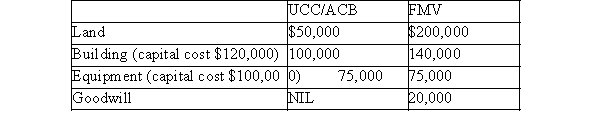 Ben will also transfer his inventory. The inventory originally cost $25,000 and has a fair market valu
$30,000.
Ben wishes to defer all gains at this time so has elected to use a section 85 rollover. He will receive the maximum note receivable possible and the remainder of the transfer in preferred shares.
Required:
A)What is the elected value for each of the assets transferred under section 85?
B)What is the value of the note receivable that Ben will receive from those assets which benefit from section 85? (Show the amounts for each asset, and the total for all.)
C)What is the value of the preferred shares that Ben must receive in order to defer any income inclusions at this point in time?
Ben will also transfer his inventory. The inventory originally cost $25,000 and has a fair market valu$30,000.
Ben wishes to defer all gains at this time so has elected to use a section 85 rollover. He will receive the maximum note receivable possible and the remainder of the transfer in preferred shares.
Required:
A)What is the elected value for each of the assets transferred under section 85?
B)What is the value of the note receivable that Ben will receive from those assets which benefit from section 85? (Show the amounts for each asset, and the total for all.)
C)What is the value of the preferred shares that Ben must receive in order to defer any income inclusions at this point in time?
Question
Question
Question
Question

Unlock Deck
Sign up to unlock the cards in this deck!
Unlock Deck
Unlock Deck
1/7

Play

Full screen (f)
Deck 12: Organization, Capital Structures, and Income Distributions of Corporations
1
Anthony is the sole shareholder of Glass Co. He would like to lend $500,000 to his company by way of a shareholder loan. He is not sure whether to issue an interest free loan or a loan with an interest
rate of 10%. Anthony does not pay himself a salary, but rather issues all after-tax profits to himself in the form of a dividend.
Required:
A)Calculate the total combined tax liability for Anthony and Glass Co. under both alternatives (an
interest free loan and a loan with 10% interest). (Assume that the CRA's prescribed rate of interest is
2%; Anthony's personal tax rate is 50%; his marginal tax rate on dividends is 41%; and Glass Co. has income of $200,000, subject to a 15% tax rate.)
B)Briefly explain the reason for any tax differential in your results.
rate of 10%. Anthony does not pay himself a salary, but rather issues all after-tax profits to himself in the form of a dividend.
Required:
A)Calculate the total combined tax liability for Anthony and Glass Co. under both alternatives (an
interest free loan and a loan with 10% interest). (Assume that the CRA's prescribed rate of interest is
2%; Anthony's personal tax rate is 50%; his marginal tax rate on dividends is 41%; and Glass Co. has income of $200,000, subject to a 15% tax rate.)
B)Briefly explain the reason for any tax differential in your results.
A)Glass Co: 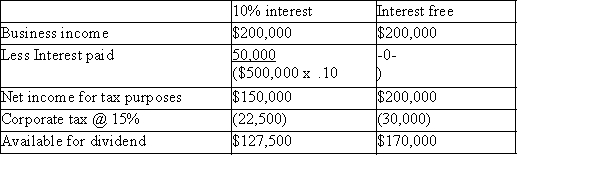 Anthony:
 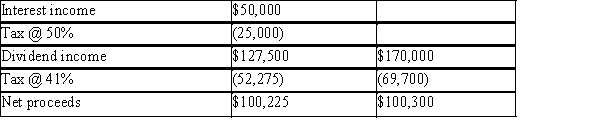 Combined tax:
  B)The tax liability is slightly higher in the alternative with the 10% loan because the income has shifted, by way of an interest payment, from the low corporate tax rate to the higher
individual tax rate.
Anthony: Combined tax: B)The tax liability is slightly higher in the alternative with the 10% loan because the income has shifted, by way of an interest payment, from the low corporate tax rate to the higherindividual tax rate.
2
Corporation A is a Canadian controlled private corporation and Corporation B is a public Canadian corporation. The paid-up capital of both corporations was established with $25,000 in common shares. Both corporations have a paid-up capital balance of $25,000. Which of these statements is TRUE, provided the proper legal steps are followed?
A)If the private corporation makes a payment of $25,000 to its shareholders by reducing its paid-up capital, there will be no tax consequence.
B)If the public corporation makes a payment of $25,000 to its shareholders by reducing its paid-up capital, only 50% of the payment will be taxable.
C)If the public corporation makes a payment of $25,000 to its shareholders by reducing its paid-up capital, there will be no tax consequence.
D)If the private corporation makes a payment of $25,000 to its shareholders by reducing its paid-up capital, only 50% of the payment will be taxable.
A)If the private corporation makes a payment of $25,000 to its shareholders by reducing its paid-up capital, there will be no tax consequence.
B)If the public corporation makes a payment of $25,000 to its shareholders by reducing its paid-up capital, only 50% of the payment will be taxable.
C)If the public corporation makes a payment of $25,000 to its shareholders by reducing its paid-up capital, there will be no tax consequence.
D)If the private corporation makes a payment of $25,000 to its shareholders by reducing its paid-up capital, only 50% of the payment will be taxable.
A
3
Ben is incorporating his proprietorship and would like to transfer the following capital assets to the new corporation. Ben will also transfer his inventory. The inventory originally cost $25,000 and has a fair market valu
$30,000.
Ben wishes to defer all gains at this time so has elected to use a section 85 rollover. He will receive the maximum note receivable possible and the remainder of the transfer in preferred shares.
Required:
A)What is the elected value for each of the assets transferred under section 85?
B)What is the value of the note receivable that Ben will receive from those assets which benefit from section 85? (Show the amounts for each asset, and the total for all.)
C)What is the value of the preferred shares that Ben must receive in order to defer any income inclusions at this point in time?
Ben will also transfer his inventory. The inventory originally cost $25,000 and has a fair market valu$30,000.
Ben wishes to defer all gains at this time so has elected to use a section 85 rollover. He will receive the maximum note receivable possible and the remainder of the transfer in preferred shares.
Required:
A)What is the elected value for each of the assets transferred under section 85?
B)What is the value of the note receivable that Ben will receive from those assets which benefit from section 85? (Show the amounts for each asset, and the total for all.)
C)What is the value of the preferred shares that Ben must receive in order to defer any income inclusions at this point in time?

 The equipment would not benefit from a section 85 rollover since the elected value and fair market value would be equal.
 4
Which of the following statements is TRUE regarding the disposal of shares by a shareholder?
A)The sale of shares to the corporate treasury is not allowed in the Income Tax Act.
B)When a shareholder sells shares to other shareholders, the corporation's capital base increases.
C)The sale of shares to other shareholders is known as a 'buy-back'.
D)The sale of shares to the corporate treasury may result in a deemed dividend and a capital gain or loss to the shareholder.
A)The sale of shares to the corporate treasury is not allowed in the Income Tax Act.
B)When a shareholder sells shares to other shareholders, the corporation's capital base increases.
C)The sale of shares to other shareholders is known as a 'buy-back'.
D)The sale of shares to the corporate treasury may result in a deemed dividend and a capital gain or loss to the shareholder.
Unlock Deck
Unlock for access to all 7 flashcards in this deck.
Unlock Deck
k this deck
5
Tony Brown sold 5000 of his shares back to ABC Co. for $25,000 during the current fiscal year. He purchased these shares from Carrie White three years ago for $15,000. Carrie had originally purchased the shares from the corporate treasury for $10,000. Which of the following tax consequences will Tony recognize?
A)He will recognize a deemed dividend of $10,000 and no capital gain or loss.
B)He will recognize a deemed dividend of $10,000 and a capital gain of $10,000.
C)He will recognize a deemed dividend of $15,000 and a capital loss of $5,000.
D)He will recognize a deemed dividend of $15,000 and a capital gain of $10,000.
A)He will recognize a deemed dividend of $10,000 and no capital gain or loss.
B)He will recognize a deemed dividend of $10,000 and a capital gain of $10,000.
C)He will recognize a deemed dividend of $15,000 and a capital loss of $5,000.
D)He will recognize a deemed dividend of $15,000 and a capital gain of $10,000.
Unlock Deck
Unlock for access to all 7 flashcards in this deck.
Unlock Deck
k this deck
6
Which of the following scenarios would be most appropriate for a section 85 rollover?
A)A corporation is selling its equipment to another corporation and does not wish to own shares in the other corporation.
B)A corporation wishes to convert land owned by the company into a parking lot.
C)A taxpayer wishes to transfer property worth $200,000, with an ACB of $90,000, to her corporation.
D)A shareholder of a corporation wishes to transfer his vehicle to his corporation. The vehicle originally cost $20,000 and has a market value of $12,000.
A)A corporation is selling its equipment to another corporation and does not wish to own shares in the other corporation.
B)A corporation wishes to convert land owned by the company into a parking lot.
C)A taxpayer wishes to transfer property worth $200,000, with an ACB of $90,000, to her corporation.
D)A shareholder of a corporation wishes to transfer his vehicle to his corporation. The vehicle originally cost $20,000 and has a market value of $12,000.
Unlock Deck
Unlock for access to all 7 flashcards in this deck.
Unlock Deck
k this deck
7
Green Co. transferred a small piece of land to one of its shareholders as a dividend in kind. The land originally cost $50,000 and had a fair market value of $175,000 at the time of the transfer. The corporation will realize , and the shareholder will realize _.
A)a dividend of $125,000; no tax effect.
B)a capital gain of $125,000; a dividend of $175,000.
C)no tax effect; a dividend of $125,000.
D)a capital gain of $50,000; a dividend of $125,000.
A)a dividend of $125,000; no tax effect.
B)a capital gain of $125,000; a dividend of $175,000.
C)no tax effect; a dividend of $125,000.
D)a capital gain of $50,000; a dividend of $125,000.
Unlock Deck
Unlock for access to all 7 flashcards in this deck.
Unlock Deck
k this deck
Unlock Deck
Unlock for access to all 7 flashcards in this deck.






