







 Chat with AI

Deck 21: Tax Aspects of Corporate Financing
Full screen (f)

Question

Question
Question
Question
Question
Question

Unlock Deck
Sign up to unlock the cards in this deck!
Unlock Deck
Unlock Deck
1/6

Play

Full screen (f)
Deck 21: Tax Aspects of Corporate Financing
1
Mary is deciding where to invest $10,000. Based on her decision, she will either receive a 5% capital gain or a 7% non-eligible dividend as her return on investment. Mary's marginal tax rates are 45% on regular income, 36% on non-eligible dividends, 28% on eligible dividends, and 23% (rounded)on capital gains. Which of the following is
TRUE?
A)Mary will receive an after-tax rate of return of 3.85% on the capital gain and 4.48% on the non-eligible dividends.
B)There is no difference in the after-tax rate of return on the two investments.
C)Mary will receive a higher after-tax rate of return on the capital gain due to the higher tax rate for non-eligible dividends.
D)Mary will receive an after-tax rate of return of 5% on the capital gain and 7% on the non-eligible dividends.
TRUE?
A)Mary will receive an after-tax rate of return of 3.85% on the capital gain and 4.48% on the non-eligible dividends.
B)There is no difference in the after-tax rate of return on the two investments.
C)Mary will receive a higher after-tax rate of return on the capital gain due to the higher tax rate for non-eligible dividends.
D)Mary will receive an after-tax rate of return of 5% on the capital gain and 7% on the non-eligible dividends.
A
2
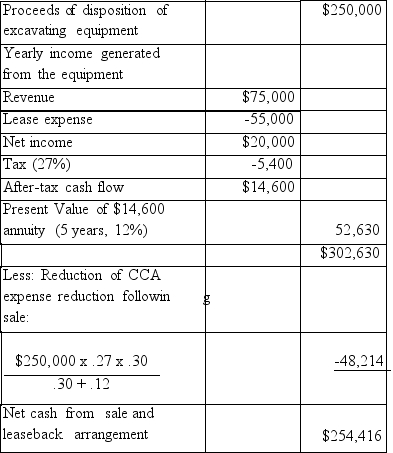
Jet Dry Inc. is undergoing a sale/leaseback arrangement on a piece of its excavating equipment. The equipment is a class 38 (30%)asset, with a fair market value of $250,000 (which is lower than the original cost). The equipment currently generates $75,000 in annual pre-tax revenue. Jet Dry Inc.
will sell the equipment at FMV.
Under the leasing terms, the lease agreement will be for five years, with no residual value at the end of the term. The annual leasing cost will be $55,000 per year.
The UCC relating to this piece of equipment is estimated to be $150,000. Other assets will remain in the asset pool, and there is sufficient UCC in the class that recapture will not occur as a result of the sale.
The company is subject to a corporate tax rate of 27% and achieves a 12% after-tax rate of return. Required:
Calculate the net present value of the cash flow that will result from this sale-and-leaseback
arrangement. (Round all numbers to zero decimal places.)
will sell the equipment at FMV.
Under the leasing terms, the lease agreement will be for five years, with no residual value at the end of the term. The annual leasing cost will be $55,000 per year.
The UCC relating to this piece of equipment is estimated to be $150,000. Other assets will remain in the asset pool, and there is sufficient UCC in the class that recapture will not occur as a result of the sale.
The company is subject to a corporate tax rate of 27% and achieves a 12% after-tax rate of return. Required:
Calculate the net present value of the cash flow that will result from this sale-and-leaseback
arrangement. (Round all numbers to zero decimal places.)
3
Which of the following statements regarding debt and equity financing is FALSE?
A)Dividend payments on equity financing are deductible by the corporation for tax purposes.
B)Dividends are paid from after-tax corporate income.
C)Interest income from debt financing is taxable in the hands of the investor.
D)Interest payments on debt financing are deductible by the corporation for tax purposes.
A)Dividend payments on equity financing are deductible by the corporation for tax purposes.
B)Dividends are paid from after-tax corporate income.
C)Interest income from debt financing is taxable in the hands of the investor.
D)Interest payments on debt financing are deductible by the corporation for tax purposes.
A
4
Joe Genius of ABC Corporation is considering whether to lease or purchase a large capital asset. If Joe purchases the asset, he will use debt financing. Which of the following accurately describes the similarities in the tax treatment of leasing and purchasing with debt?
A)Both methods allow for a deduction which reduces taxable income.
B)Cash payments and tax savings will usually occur simultaneously for both alternatives.
C)Capital cost allowance is always expensed for both alternatives.
D)The after-tax net present value will always be identical for both alternatives.
A)Both methods allow for a deduction which reduces taxable income.
B)Cash payments and tax savings will usually occur simultaneously for both alternatives.
C)Capital cost allowance is always expensed for both alternatives.
D)The after-tax net present value will always be identical for both alternatives.
Unlock Deck
Unlock for access to all 6 flashcards in this deck.
Unlock Deck
k this deck
5
With regard to debt and equity securities, which of the following statements is TRUE? (Assume the corporations are not in the business of lending money.)
A)A discount on a debt security is fully or partially deductible for tax purposes, depending on the discount rate.
B)A premium on an equity issue has a tax impact on the issuing corporation.
C)A premium on a debt security is taxed in the hands of the issuing corporation.
D)A discount on an equity issue has a tax impact on the issuing corporation.
A)A discount on a debt security is fully or partially deductible for tax purposes, depending on the discount rate.
B)A premium on an equity issue has a tax impact on the issuing corporation.
C)A premium on a debt security is taxed in the hands of the issuing corporation.
D)A discount on an equity issue has a tax impact on the issuing corporation.
Unlock Deck
Unlock for access to all 6 flashcards in this deck.
Unlock Deck
k this deck
6
During the year, The Light Corporation paid $550,000 in preferred share dividends to ABC Inc. Both companies are Canadian corporations. Which of the following is TRUE?
A)ABC Inc. will be subject to Part VI.1 tax.
B)The Light Corporation will be subject to Part VI.1 tax.
C)Neither corporation will be subject to Part VI.1 tax.
D)Both corporations will be subject to Part VI.1 tax.
A)ABC Inc. will be subject to Part VI.1 tax.
B)The Light Corporation will be subject to Part VI.1 tax.
C)Neither corporation will be subject to Part VI.1 tax.
D)Both corporations will be subject to Part VI.1 tax.
Unlock Deck
Unlock for access to all 6 flashcards in this deck.
Unlock Deck
k this deck
Unlock Deck
Unlock for access to all 6 flashcards in this deck.






