







 Chat with AI

Deck 11: Investor Losses
Full screen (f)

Question

Question
Question
Question
Question
Question
Question
Question
Question
Question
Question
Question
Question
Question
Question
Question
Question
Question
Question
Question
Question
Question
Question
Question
Question
Question
Question
Question
Question
Question
Question
Question
Question
Question
Question
Question
Question
Question
Question
Question
Question
Question
Question
Question
Question
Question
Question
Question
Question
Matt has three passive activities and has at-risk amounts in excess of $100,000 for each. During the year, the activities produced the following income (losses). 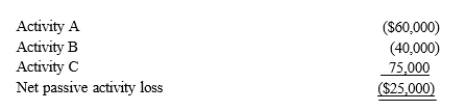 Matt's suspended losses are as follows:
A) $25,000 is allocated to C; $0 to A and B.
B) $12,500 is allocated to A; $12,500 to B.
C) $15,000 is allocated to A; $10,000 to B.
D) $8,333 is allocated to A, B and C.
E) None of these.
Matt's suspended losses are as follows:A) $25,000 is allocated to C; $0 to A and B.
B) $12,500 is allocated to A; $12,500 to B.
C) $15,000 is allocated to A; $10,000 to B.
D) $8,333 is allocated to A, B and C.
E) None of these.
Question
Question
Question
Question
Question
Question
Question
Question
Question
Question
Question
Question
Question
Question
Question
Question
Question
Question
Question
Question
Question
Question
Question
Question
Question
Question
Question
Question
Question
Question
Question

Unlock Deck
Sign up to unlock the cards in this deck!
Unlock Deck
Unlock Deck
1/130

Play

Full screen (f)
Deck 11: Investor Losses
1
Tonya owns an interest in an activity (not real estate) that converted recourse financing to nonrecourse financing.
Recapture of previously allowed losses is required if Tonya's at-risk amount is reduced below zero as a result of the debt restructuring.
Recapture of previously allowed losses is required if Tonya's at-risk amount is reduced below zero as a result of the debt restructuring.
True
2
Tom participates for 100 hours in Activity A and 450 hours in Activity B, both of which are nonrental businesses.
Both activities are active.
Both activities are active.
False
3
A taxpayer is considered to be a material participant if he or she spends more than 500 hours in the activity.
True
4
Jackson Company incurs a $50,000 loss on a passive activity during the year. The company has active income of
$34,000 and portfolio income of $24,000. If Jackson is a personal service corporation, it may deduct $34,000 of the passive activity loss.
$34,000 and portfolio income of $24,000. If Jackson is a personal service corporation, it may deduct $34,000 of the passive activity loss.
Unlock Deck
Unlock for access to all 130 flashcards in this deck.
Unlock Deck
k this deck
5
Mary Jane participates for 100 hours during the year in an activity she owns. She has no employees and is the only participant in the activity. The activity is a significant participation activity.
Unlock Deck
Unlock for access to all 130 flashcards in this deck.
Unlock Deck
k this deck
6
Aram owns a 20% interest in a partnership (not real estate) in which her at-risk amount was $35,000 at the beginning of the year. The partnership borrowed $50,000 on a recourse note and made a $40,000 profit during the year. Her at-risk amount at the end of the year is $43,000.
Unlock Deck
Unlock for access to all 130 flashcards in this deck.
Unlock Deck
k this deck
7
Tomas participates for 300 hours in Activity A and 250 hours in Activity B, both of which are nonrental businesses.
Both activities are active.
Both activities are active.
Unlock Deck
Unlock for access to all 130 flashcards in this deck.
Unlock Deck
k this deck
8
Dick participates in an activity for 90 hours during the year. He has no employees and there are no other participants. Dick is a material participant.
Unlock Deck
Unlock for access to all 130 flashcards in this deck.
Unlock Deck
k this deck
9
Wolf Corporation has active income of $55,000 and a passive activity loss of $33,000 in the current year. Wolf cannot deduct the $33,000 loss if it is a closely held C corporation that is not a personal service corporation.
Unlock Deck
Unlock for access to all 130 flashcards in this deck.
Unlock Deck
k this deck
10
Linda owns investments that produce portfolio income and Activity A that produces losses. From a tax perspective, Linda will be better off if Activity A is not passive.
Unlock Deck
Unlock for access to all 130 flashcards in this deck.
Unlock Deck
k this deck
11
Oriole Corporation has active income of $45,000 and a passive activity loss of $23,000 in the current year. Under an exception, Oriole can deduct the $23,000 loss if it is a personal service corporation.
Unlock Deck
Unlock for access to all 130 flashcards in this deck.
Unlock Deck
k this deck
12
A taxpayer is considered to be a material participant in a significant participation activity if he or she spends at least
400 hours in the activity.
400 hours in the activity.
Unlock Deck
Unlock for access to all 130 flashcards in this deck.
Unlock Deck
k this deck
13
Kelly, who earns a yearly salary of $120,000, sold an activity with a suspended passive activity loss of $44,000. The activity was sold at a loss and Kelly has no other passive activities. The suspended loss is not deductible.
Unlock Deck
Unlock for access to all 130 flashcards in this deck.
Unlock Deck
k this deck
14
Jack owns a 10% interest in a partnership (not real estate) in which his at-risk amount is $42,000 at the beginning of the year. During the year, the partnership borrows $80,000 on a nonrecourse note and incurs a loss of $60,000 from operations. Jack's at-risk amount at the end of the year is $44,000.
Unlock Deck
Unlock for access to all 130 flashcards in this deck.
Unlock Deck
k this deck
15
Gray Company, a closely held C corporation, incurs a $50,000 loss on a passive activity during the year. The
company has active income of $34,000 and portfolio income of $24,000. If Gray is not a personal service corporation, it may deduct $34,000 of the passive activity loss.
company has active income of $34,000 and portfolio income of $24,000. If Gray is not a personal service corporation, it may deduct $34,000 of the passive activity loss.
Unlock Deck
Unlock for access to all 130 flashcards in this deck.
Unlock Deck
k this deck
16
Sherri owns an interest in a business that is not a passive activity and in which she has $20,000 at risk. If the business incurs a loss from operations during the year and her share of the loss is $32,000, this loss will be fully deductible.
Unlock Deck
Unlock for access to all 130 flashcards in this deck.
Unlock Deck
k this deck
17
In the current year, Don has a $55,000 loss from a business he owns. His at-risk amount at the end of the year, prior to considering the current-year loss, is $36,000. He will be allowed to deduct the $55,000 loss this year if he is a material participant in the business.
Unlock Deck
Unlock for access to all 130 flashcards in this deck.
Unlock Deck
k this deck
18
All of a taxpayer's tax credits relating to a passive activity can be utilized when the activity is sold at a loss.
Unlock Deck
Unlock for access to all 130 flashcards in this deck.
Unlock Deck
k this deck
19
From January through November, Vern participated for 420 hours as a salesman in a partnership in which he owns a
50% interest. The partnership has four full-time employees. During December, Vern spends 110 hours cleaning the store and painting the walls in order to meet the material participation standards. Vern qualifies as a material participant.
50% interest. The partnership has four full-time employees. During December, Vern spends 110 hours cleaning the store and painting the walls in order to meet the material participation standards. Vern qualifies as a material participant.
Unlock Deck
Unlock for access to all 130 flashcards in this deck.
Unlock Deck
k this deck
20
Nathan owns Activity A, which produces income, and Activity B, which produces passive activity losses. From a tax planning perspective, Nathan will be better off if Activity A is passive.
Unlock Deck
Unlock for access to all 130 flashcards in this deck.
Unlock Deck
k this deck
21
When determining whether an individual is a material participant, participation by an owner's spouse generally counts.
Unlock Deck
Unlock for access to all 130 flashcards in this deck.
Unlock Deck
k this deck
22
Roger owns and actively participates in the operations of an apartment building that produces a $40,000 loss during the year. He has AGI of $150,000 from an active business. He may deduct $25,000 of the loss.
Unlock Deck
Unlock for access to all 130 flashcards in this deck.
Unlock Deck
k this deck
23
Individuals can deduct from active or portfolio income losses of up to $25,000 from real estate rental activities in which they actively participate.
Unlock Deck
Unlock for access to all 130 flashcards in this deck.
Unlock Deck
k this deck
24
Services performed by an employee are treated as being related to a real estate trade or business if the employee performing the services has more than a 5% ownership interest in the employer.
Unlock Deck
Unlock for access to all 130 flashcards in this deck.
Unlock Deck
k this deck
25
Carlos receives a gift of a passive activity from his father whose basis is $60,000. Suspended losses related to the activity are $18,000. Carlos will be allowed to offset the $18,000 suspended losses against future passive
activity income.
activity income.
Unlock Deck
Unlock for access to all 130 flashcards in this deck.
Unlock Deck
k this deck
26
Eric makes an installment sale of a passive activity having suspended losses of $40,000. He collects 25% of the sales price in the current year and will collect 25% in each of the next three years. Eric can deduct $10,000 of the passive activity loss this year.
Unlock Deck
Unlock for access to all 130 flashcards in this deck.
Unlock Deck
k this deck
27
During the current year, David earned investment income of $20,000. In addition, he incurred investment interest expense of $12,000 and other investment expenses of $9,000. David can deduct $12,000 of investment interest expense for this year.
Unlock Deck
Unlock for access to all 130 flashcards in this deck.
Unlock Deck
k this deck
28
Individuals with modified AGI of $100,000 can deduct against active or portfolio income losses of up to $25,000 from real estate rental activities in which they actively participate.
Unlock Deck
Unlock for access to all 130 flashcards in this deck.
Unlock Deck
k this deck
29
A qualified real estate professional is allowed to treat income or loss from any real estate venture as active except for income or loss from a rental activity.
Unlock Deck
Unlock for access to all 130 flashcards in this deck.
Unlock Deck
k this deck
30
In the current year, Kelly had a $35,000 loss from a real estate rental activity in which she is a 10% owner. If she is an active participant and if her modified AGI is $100,000 or less, she can deduct $25,000 of the loss.
Unlock Deck
Unlock for access to all 130 flashcards in this deck.
Unlock Deck
k this deck
31
Bob realized a long-term capital gain of $8,000. In calculating his net investment income, Bob may elect to include the gain in investment income.
Unlock Deck
Unlock for access to all 130 flashcards in this deck.
Unlock Deck
k this deck
32
If an owner participates for more than 500 hours in a bicycle rental activity located at a beach resort, any loss from that activity is treated as an active loss that can offset active income.
Unlock Deck
Unlock for access to all 130 flashcards in this deck.
Unlock Deck
k this deck
33
Stuart is the sole owner and a material participant in a business in which he has $50,000 at risk. If the business incurs a loss of $80,000 from operations, Stuart will be allowed the full amount as a deduction.
Unlock Deck
Unlock for access to all 130 flashcards in this deck.
Unlock Deck
k this deck
34
Wayne owns a small apartment building that produces a $45,000 loss during the year. His AGI before considering the rental loss is $85,000. Because Wayne is an active participant with respect to the rental activity, he may deduct the
$45,000 loss.
$45,000 loss.
Unlock Deck
Unlock for access to all 130 flashcards in this deck.
Unlock Deck
k this deck
35
Joyce owns an activity (not real estate) in which she participates for 100 hours a year; her spouse participates for
450 hours. Joyce qualifies as a material participant.
450 hours. Joyce qualifies as a material participant.
Unlock Deck
Unlock for access to all 130 flashcards in this deck.
Unlock Deck
k this deck
36
Lucy owns and actively participates in the operations of an apartment complex that produces a $50,000 loss during the year. Her modified AGI is $125,000 from an active business. Disregarding any at-risk amount limitation, she may deduct $25,000 of the loss this year, and the remaining $25,000 is a suspended passive activity loss.
Unlock Deck
Unlock for access to all 130 flashcards in this deck.
Unlock Deck
k this deck
37
Investment income can include gross income from interest, dividends, annuities, and royalties not derived in the ordinary course of a trade or business; income from a passive activity; and income from a real estate activity in which the taxpayer actively participates.
Unlock Deck
Unlock for access to all 130 flashcards in this deck.
Unlock Deck
k this deck
38
During the current year, Harry earned investment income of $18,500. In addition, he incurred investment interest expense of $15,500 and other investment expenses of $9,000. Harry may deduct $9,500 of investment interest expense this year and carry forward $6,000 to future years.
Unlock Deck
Unlock for access to all 130 flashcards in this deck.
Unlock Deck
k this deck
39
Bruce owns a small apartment building that produces a $25,000 loss during the year. His AGI before considering the rental loss is $85,000. Bruce must be a material participant with respect to the rental activity in order to deduct the
$25,000 loss under the real estate rental exception.
$25,000 loss under the real estate rental exception.
Unlock Deck
Unlock for access to all 130 flashcards in this deck.
Unlock Deck
k this deck
40
Kim dies owning a passive activity with a basis of $75,000, a fair market value of $140,000, and suspended losses of
$80,000. All of the $80,000 passive activity loss can be deducted on Kim's final income tax return.
$80,000. All of the $80,000 passive activity loss can be deducted on Kim's final income tax return.
Unlock Deck
Unlock for access to all 130 flashcards in this deck.
Unlock Deck
k this deck
41
Nell sells a passive activity with an adjusted basis of $45,000 for $105,000. Suspended losses attributable to this property total $45,000. The total gain and the taxable gain are:
A) $60,000 total gain; $105,000 taxable gain.
B) $10,000 total gain; $15,000 taxable gain.
C) $60,000 total gain; $0 taxable gain.
D) $60,000 total gain; $15,000 taxable gain.
E) None of these.
A) $60,000 total gain; $105,000 taxable gain.
B) $10,000 total gain; $15,000 taxable gain.
C) $60,000 total gain; $0 taxable gain.
D) $60,000 total gain; $15,000 taxable gain.
E) None of these.
Unlock Deck
Unlock for access to all 130 flashcards in this deck.
Unlock Deck
k this deck
42
White Corporation, a closely held personal service corporation, has $150,000 of passive activity losses, $120,000 of active business income, and $30,000 of portfolio income. How much of the passive activity loss can White Corporation deduct?
A) $0
B) $30,000
C) $120,000
D) $150,000
E) None of these
A) $0
B) $30,000
C) $120,000
D) $150,000
E) None of these
Unlock Deck
Unlock for access to all 130 flashcards in this deck.
Unlock Deck
k this deck
43
Josh has investments in two passive activities. Activity A (acquired three years ago) produces income of $30,000 this year, while Activity B (acquired two years ago) produces a loss of $50,000. What is the amount of Josh's suspended loss for the year?
A) $0
B) $18,000
C) $20,000
D) $50,000
E) None of these
A) $0
B) $18,000
C) $20,000
D) $50,000
E) None of these
Unlock Deck
Unlock for access to all 130 flashcards in this deck.
Unlock Deck
k this deck
44
In 2019, Wang invests $80,000 for a 20% interest in a partnership in which he is a material participant. The partnership incurs a loss with $100,000 being Wang's share. Which of the following statements is incorrect?
A) Since Wang has only $80,000 of capital at risk, he cannot deduct any more than this amount against his other income.
B) Wang's nondeductible loss of $20,000 can be carried over and used in future years (subject to the at-risk provisions).
C) If Wang has taxable income of $40,000 from the partnership in 2020 and there are no other transactions that affect his at-risk amount, he can use all of the $20,000 loss carried over from 2019.
D) Wang's $100,000 loss is nondeductible in 2019 and 2020 under the passive activity loss provisions.
E) All of the statements are correct.
A) Since Wang has only $80,000 of capital at risk, he cannot deduct any more than this amount against his other income.
B) Wang's nondeductible loss of $20,000 can be carried over and used in future years (subject to the at-risk provisions).
C) If Wang has taxable income of $40,000 from the partnership in 2020 and there are no other transactions that affect his at-risk amount, he can use all of the $20,000 loss carried over from 2019.
D) Wang's $100,000 loss is nondeductible in 2019 and 2020 under the passive activity loss provisions.
E) All of the statements are correct.
Unlock Deck
Unlock for access to all 130 flashcards in this deck.
Unlock Deck
k this deck
45
Tara owns a shoe store and a bookstore. Both businesses are operated in a mall. She also owns a restaurant across the street and a jewelry store several blocks away.
A) All four businesses can be treated as a single activity if Tara elects to do so.
B) Only the shoe store and bookstore can be treated as a single activity, the restaurant must be treated as a separate activity, and the jewelry store must be treated as a separate activity.
C) The shoe store, bookstore, and restaurant can be treated as a single activity, and the jewelry store must be treated as a separate activity.
D) All four businesses must be treated as separate activities.
E) None of these is correct.
A) All four businesses can be treated as a single activity if Tara elects to do so.
B) Only the shoe store and bookstore can be treated as a single activity, the restaurant must be treated as a separate activity, and the jewelry store must be treated as a separate activity.
C) The shoe store, bookstore, and restaurant can be treated as a single activity, and the jewelry store must be treated as a separate activity.
D) All four businesses must be treated as separate activities.
E) None of these is correct.
Unlock Deck
Unlock for access to all 130 flashcards in this deck.
Unlock Deck
k this deck
46
Jennifer gave her interest in a passive activity (fair market value of $75,000 and basis of $60,000) to Harrison.
Associated with the interest is a suspended passive activity loss of $8,000. Upon making the gift, the suspended passive activity loss is not deductible to Jennifer, but it will benefit Harrison.
Associated with the interest is a suspended passive activity loss of $8,000. Upon making the gift, the suspended passive activity loss is not deductible to Jennifer, but it will benefit Harrison.
Unlock Deck
Unlock for access to all 130 flashcards in this deck.
Unlock Deck
k this deck
47
Kathy, who is a real estate professional, owns an apartment building and devotes 550 hours to managing the activity.
All losses from the rental activity will be considered nonpassive and deductible against active income.
All losses from the rental activity will be considered nonpassive and deductible against active income.
Unlock Deck
Unlock for access to all 130 flashcards in this deck.
Unlock Deck
k this deck
48
In 2019, Joanne invested $90,000 for a 20% interest in a limited liability company (LLC) in which she is a material participant. The LLC reported losses of $340,000 in 2019 and $180,000 in 2020. Joanne's share of the LLC's losses was $68,000 in 2019 and $36,000 in 2020. How much of these losses can Joanne deduct?
A) $68,000 in 2019; $36,000 in 2020.
B) $68,000 in 2019; $22,000 in 2020.
C) $0 in 2019; $0 in 2020.
D) $68,000 in 2019; $0 in 2020.
E) None of these.
A) $68,000 in 2019; $36,000 in 2020.
B) $68,000 in 2019; $22,000 in 2020.
C) $0 in 2019; $0 in 2020.
D) $68,000 in 2019; $0 in 2020.
E) None of these.
Unlock Deck
Unlock for access to all 130 flashcards in this deck.
Unlock Deck
k this deck
49
Matt has three passive activities and has at-risk amounts in excess of $100,000 for each. During the year, the activities produced the following income (losses). Matt's suspended losses are as follows:
A) $25,000 is allocated to C; $0 to A and B.
B) $12,500 is allocated to A; $12,500 to B.
C) $15,000 is allocated to A; $10,000 to B.
D) $8,333 is allocated to A, B and C.
E) None of these.
Matt's suspended losses are as follows:A) $25,000 is allocated to C; $0 to A and B.
B) $12,500 is allocated to A; $12,500 to B.
C) $15,000 is allocated to A; $10,000 to B.
D) $8,333 is allocated to A, B and C.
E) None of these.
Unlock Deck
Unlock for access to all 130 flashcards in this deck.
Unlock Deck
k this deck
50
In 2019, Kipp invested $65,000 for a 30% interest in a partnership conducting a passive activity. The partnership reported losses of $200,000 in 2019 and $100,000 in 2020, Kipp's share being $60,000 in 2019 and $30,000 in 2020. How much of the losses from the partnership can Kipp deduct assuming he owns no other investments and does not participate in the partnership's operations?
A) $0 in 2019; $30,000 in 2020.
B) $60,000 in 2019; $30,000 in 2020.
C) $60,000 in 2019; $5,000 in 2020.
D) $60,000 in 2019; $0 in 2020.
E) None of these.
A) $0 in 2019; $30,000 in 2020.
B) $60,000 in 2019; $30,000 in 2020.
C) $60,000 in 2019; $5,000 in 2020.
D) $60,000 in 2019; $0 in 2020.
E) None of these.
Unlock Deck
Unlock for access to all 130 flashcards in this deck.
Unlock Deck
k this deck
51
Gloria owns and works full-time at a shop that rents watercraft of various types to tourists who are vacationing at the beach. If she generates a loss from that activity, the loss is subject to the passive activity loss rules because it is rental property.
Unlock Deck
Unlock for access to all 130 flashcards in this deck.
Unlock Deck
k this deck
52
Green Corporation earns active income of $50,000 and receives $40,000 in dividends during the year. In addition, Green incurs a loss of $70,000 from an investment in a passive activity acquired several years ago. Consider the following two statements: (1) Green's current deduction for passive activity losses is $50,000 if it is a closely held C
Corporation that is not a personal service corporation.
(2) Green's current deduction for passive activity losses is $0 if it is a personal service corporation. Which of the following answers is correct?
A) Only statement 1.
B) Only statement 2.
C) Both statements 1 and 2.
D) Neither statement 1 or 2.
E) None of these.
Corporation that is not a personal service corporation.
(2) Green's current deduction for passive activity losses is $0 if it is a personal service corporation. Which of the following answers is correct?
A) Only statement 1.
B) Only statement 2.
C) Both statements 1 and 2.
D) Neither statement 1 or 2.
E) None of these.
Unlock Deck
Unlock for access to all 130 flashcards in this deck.
Unlock Deck
k this deck
53
Jared earned investment income of $22,000 and incurred investment interest expense of $14,000 during the year. He incurred other investment expenses of $7,000 during the year. Jared may deduct $14,000 of investment interest in the current year.
Unlock Deck
Unlock for access to all 130 flashcards in this deck.
Unlock Deck
k this deck
54
Charles owns a business with two separate departments. Department A produces $100,000 of income and Department B incurs a $60,000 loss. Charles participates for 550 hours in Department A and 100 hours in Department B. He has full-time employees in both departments.
A) If Charles elects to treat both departments as a single activity, he cannot offset the $60,000 loss against the $100,000 income.
B) Charles may not treat Department A and Department B as separate activities because they are parts of one business.
C) If Charles elects to treat the two departments as separate activities, he can offset the $60,000 loss against the $100,000 income.
D) If Charles elects to treat both departments as a single activity, he can offset the $60,000 loss against the $100,000 income.
E) None of these is correct.
A) If Charles elects to treat both departments as a single activity, he cannot offset the $60,000 loss against the $100,000 income.
B) Charles may not treat Department A and Department B as separate activities because they are parts of one business.
C) If Charles elects to treat the two departments as separate activities, he can offset the $60,000 loss against the $100,000 income.
D) If Charles elects to treat both departments as a single activity, he can offset the $60,000 loss against the $100,000 income.
E) None of these is correct.
Unlock Deck
Unlock for access to all 130 flashcards in this deck.
Unlock Deck
k this deck
55
This year Seth had investment royalty income of $31,000, investment expenses of $28,000, and a long-term capital gain of $8,000 on an investment. In calculating his net investment income for the current year, Seth may deduct a maximum of $11,000 of investment interest.
Unlock Deck
Unlock for access to all 130 flashcards in this deck.
Unlock Deck
k this deck
56
In the current year, Louise invests $50,000 for a 20% interest in a passive activity. Her share of the loss this year is
$10,000. If this is her only passive activity, the $10,000 loss from the activity this year is suspended for use in a future year.
$10,000. If this is her only passive activity, the $10,000 loss from the activity this year is suspended for use in a future year.
Unlock Deck
Unlock for access to all 130 flashcards in this deck.
Unlock Deck
k this deck
57
Joyce, an architect, earns $100,000 from her practice in the current year. In addition, she receives $35,000 in dividends, capital gains, and annuity income during the year. Further, she incurs a loss of $35,000 from an investment in a passive activity. Joyce's AGI for the year after considering the passive investment is $100,000.
Unlock Deck
Unlock for access to all 130 flashcards in this deck.
Unlock Deck
k this deck
58
Carl, a physician, earns $200,000 from his medical practice in the current year. He receives $45,000 in dividends and interest during the year as well as $5,000 of income from a passive activity. In addition, he incurs a loss of $50,000 from an investment in a passive activity. What is Carl's AGI for the current year after considering the passive investment?
A) $195,000
B) $200,000
C) $240,000
D) $245,000
E) None of these
A) $195,000
B) $200,000
C) $240,000
D) $245,000
E) None of these
Unlock Deck
Unlock for access to all 130 flashcards in this deck.
Unlock Deck
k this deck
59
Last year, Ted invested $100,000 for a 50% interest in a partnership in which he was a material participant. The partnership incurred a loss, and Ted's share was $150,000. Which of the following statements is incorrect?
A) Ted's nondeductible loss of $50,000 can be carried over and used in the future (subject to the at-risk provisions).
B) If Ted has taxable income of $50,000 from the partnership in the current year and no other transactions that affect his at-risk amount, he can use all of the $50,000 loss carried over.
C) Since Ted has only $100,000 of capital at risk, he cannot deduct more than $100,000 against his other income.
D) None of these is incorrect.
A) Ted's nondeductible loss of $50,000 can be carried over and used in the future (subject to the at-risk provisions).
B) If Ted has taxable income of $50,000 from the partnership in the current year and no other transactions that affect his at-risk amount, he can use all of the $50,000 loss carried over.
C) Since Ted has only $100,000 of capital at risk, he cannot deduct more than $100,000 against his other income.
D) None of these is incorrect.
Unlock Deck
Unlock for access to all 130 flashcards in this deck.
Unlock Deck
k this deck
60
Anita owns Activity A, which produces active income, and Activity B, which produces losses. From a tax planning perspective, Anita will be better off if Activity B is a passive activity.
Unlock Deck
Unlock for access to all 130 flashcards in this deck.
Unlock Deck
k this deck
61
Art's at-risk amount in a passive activity was $60,000 at the beginning of 2018. His loss from the activity in 2018 is $80,000, and he had no passive activity income during the year. Art had $20,000 of passive activity income from the activity in 2019. Under the passive activity loss rules, Art's suspended loss at the end of 2019 is:
A) $15,000.
B) $20,000.
C) $45,000.
D) $60,000.
E) None of these.
A) $15,000.
B) $20,000.
C) $45,000.
D) $60,000.
E) None of these.
Unlock Deck
Unlock for access to all 130 flashcards in this deck.
Unlock Deck
k this deck
62
Ned, a college professor, owns a separate business (not real estate) in which he participates in the current year. He has one employee who works part-time in the business.
A) If Ned participates for 120 hours and the employee participates for 120 hours during the year, Ned does not qualify as a material participant.
B) If Ned participates for 95 hours and the employee participates for 5 hours during the year, Ned probably does not qualify as material participant.
C) If Ned participates for 500 hours and the employee participates for 520 hours during the year, Ned qualifies as material participant.
D) If Ned participates for 600 hours and the employee participates for 2,000 hours during the year, Ned qualifies as a material participant.
E) None of these applies.
A) If Ned participates for 120 hours and the employee participates for 120 hours during the year, Ned does not qualify as a material participant.
B) If Ned participates for 95 hours and the employee participates for 5 hours during the year, Ned probably does not qualify as material participant.
C) If Ned participates for 500 hours and the employee participates for 520 hours during the year, Ned qualifies as material participant.
D) If Ned participates for 600 hours and the employee participates for 2,000 hours during the year, Ned qualifies as a material participant.
E) None of these applies.
Unlock Deck
Unlock for access to all 130 flashcards in this deck.
Unlock Deck
k this deck
63
Wes's at-risk amount in a passive activity is $25,000 at the beginning of the current year. His current loss from the activity is $35,000 and he has no passive activity income. At the end of the current year, which of the following statements is incorrect?
A) Wes has a loss of $25,000 suspended under the passive activity loss rules.
B) Wes has an at-risk amount in the activity of $0.
C) Wes has a loss of $10,000 suspended under the at-risk rules.
D) Wes has a loss of $35,000 suspended under the passive activity loss rules.
E) None of these is incorrect.
A) Wes has a loss of $25,000 suspended under the passive activity loss rules.
B) Wes has an at-risk amount in the activity of $0.
C) Wes has a loss of $10,000 suspended under the at-risk rules.
D) Wes has a loss of $35,000 suspended under the passive activity loss rules.
E) None of these is incorrect.
Unlock Deck
Unlock for access to all 130 flashcards in this deck.
Unlock Deck
k this deck
64
Ahmad owns four activities. He participated for 120 hours in Activity A, 150 hours in Activity B, 140 hours in Activity C, and 100 hours in Activity D. Which of the following statements is correct?
A) Activities A, B, C, and D are all significant participation activities.
B) Activities A, B, and C are significant participation activities.
C) Ahmad is a material participant with respect to Activities A, B, and C.
D) Ahmad is a material participant with respect to Activities A, B, C, and D.
E) None of these is correct.
A) Activities A, B, C, and D are all significant participation activities.
B) Activities A, B, and C are significant participation activities.
C) Ahmad is a material participant with respect to Activities A, B, and C.
D) Ahmad is a material participant with respect to Activities A, B, C, and D.
E) None of these is correct.
Unlock Deck
Unlock for access to all 130 flashcards in this deck.
Unlock Deck
k this deck
65
Rita earns a salary of $150,000, and invests $40,000 for a 20% interest in a passive activity. Operations of the activity result in a loss of $250,000, of which Rita's share is $50,000. How is her loss characterized?
A) $40,000 is suspended under the passive activity loss rules and $10,000 is suspended under the at-risk rules.
B) $40,000 is suspended under the at-risk rules and $10,000 is suspended under the passive activity loss rules.
C) $50,000 is suspended under the passive activity loss rules.
D) $50,000 is suspended under the at-risk rules.
E) None of these characterizes it.
A) $40,000 is suspended under the passive activity loss rules and $10,000 is suspended under the at-risk rules.
B) $40,000 is suspended under the at-risk rules and $10,000 is suspended under the passive activity loss rules.
C) $50,000 is suspended under the passive activity loss rules.
D) $50,000 is suspended under the at-risk rules.
E) None of these characterizes it.
Unlock Deck
Unlock for access to all 130 flashcards in this deck.
Unlock Deck
k this deck
66
Jed spends 32 hours a week, 50 weeks a year, operating a bicycle rental store that he owns at a resort community. He also owns a music store in another city that is operated by a full-time employee. He elects not to group them together as a single activity under the "appropriate economic unit" standard. Jed spends 40 hours per year working at the music store.
A) Neither store is a passive activity.
B) Both stores are passive activities.
C) Only the bicycle rental store is a passive activity.
D) Only the music store is a passive activity.
E) None of these is correct.
A) Neither store is a passive activity.
B) Both stores are passive activities.
C) Only the bicycle rental store is a passive activity.
D) Only the music store is a passive activity.
E) None of these is correct.
Unlock Deck
Unlock for access to all 130 flashcards in this deck.
Unlock Deck
k this deck
67
Jenny spends 32 hours a week, 50 weeks a year, operating a bicycle rental store that she owns at a resort community. She also owns a music store in another city that is operated by a full-time employee. Jenny spends 140 hours per year working at the music store. She elects not to group them together as a single activity under the "appropriate economic unit" standard.
A) Neither store is a passive activity.
B) Both stores are passive activities.
C) Only the bicycle rental store is a passive activity.
D) Only the music store is a passive activity.
E) None of these is correct.
A) Neither store is a passive activity.
B) Both stores are passive activities.
C) Only the bicycle rental store is a passive activity.
D) Only the music store is a passive activity.
E) None of these is correct.
Unlock Deck
Unlock for access to all 130 flashcards in this deck.
Unlock Deck
k this deck
68
Jon owns an apartment building in which he is a material participant and also owns a computer consulting business. Of the 2,000 hours he spends on these activities during the year, 55% of the time is spent operating the apartment building and 45% of the time is spent in the computer consulting business.
A) The computer consulting business is a passive activity but the apartment building is not.
B) The apartment building is a passive activity but the computer consulting business is not.
C) Both the apartment building and the computer consulting business are passive activities.
D) Neither the apartment building nor the computer consulting business is a passive activity.
E) None of these these applies here.
A) The computer consulting business is a passive activity but the apartment building is not.
B) The apartment building is a passive activity but the computer consulting business is not.
C) Both the apartment building and the computer consulting business are passive activities.
D) Neither the apartment building nor the computer consulting business is a passive activity.
E) None of these these applies here.
Unlock Deck
Unlock for access to all 130 flashcards in this deck.
Unlock Deck
k this deck
69
Sandra acquired a passive activity three years ago. Until last year, the activity was profitable and her at-risk amount was $300,000. Last year, the activity produced a loss of $100,000, and in the current year, the loss is $50,000. Assuming Sandra has received no passive activity income in the current or prior years, her suspended passive activity loss from the activity is:
A) $90,000 from last year and $50,000 from the current year.
B) $100,000 from last year and $50,000 from the current year.
C) $0 from last year and $0 from the current year.
D) $50,000 from the current year.
E) None of these.
A) $90,000 from last year and $50,000 from the current year.
B) $100,000 from last year and $50,000 from the current year.
C) $0 from last year and $0 from the current year.
D) $50,000 from the current year.
E) None of these.
Unlock Deck
Unlock for access to all 130 flashcards in this deck.
Unlock Deck
k this deck
70
Vic's at-risk amount in a passive activity is $200,000 at the beginning of the current year. His current loss from the activity is $80,000. Vic had no passive activity income during the year. At the end of the current year:
A) Vic has an at-risk amount in the activity of $120,000 and a suspended passive activity loss of $80,000.
B) Vic has an at-risk amount in the activity of $200,000 and a suspended passive activity loss of $80,000.
C) Vic has an at-risk amount in the activity of $120,000 and no suspended passive activity loss.
D) Vic has an at-risk amount in the activity of $200,000 and no suspended passive activity loss.
E) None of these is correct.
A) Vic has an at-risk amount in the activity of $120,000 and a suspended passive activity loss of $80,000.
B) Vic has an at-risk amount in the activity of $200,000 and a suspended passive activity loss of $80,000.
C) Vic has an at-risk amount in the activity of $120,000 and no suspended passive activity loss.
D) Vic has an at-risk amount in the activity of $200,000 and no suspended passive activity loss.
E) None of these is correct.
Unlock Deck
Unlock for access to all 130 flashcards in this deck.
Unlock Deck
k this deck
71
Paula owns four separate activities. She elects not to group them together as a single activity under the "appropriate economic unit" standard. Paula participates for 130 hours in Activity A, 115 hours in Activity B, 260 hours in Activity C, and 100 hours in Activity D. She has one employee, who works 125 hours in Activity D. Which of the following statements is correct?
A) Activities A, B, C, and D are all significant participation activities.
B) Paula is a material participant with respect to Activities A, B, C, and D.
C) Paula is not a material participant with respect to Activities A, B, C, and D.
D) Losses from all of the activities can be used to offset Paula's active income.
E) None of these is correct.
A) Activities A, B, C, and D are all significant participation activities.
B) Paula is a material participant with respect to Activities A, B, C, and D.
C) Paula is not a material participant with respect to Activities A, B, C, and D.
D) Losses from all of the activities can be used to offset Paula's active income.
E) None of these is correct.
Unlock Deck
Unlock for access to all 130 flashcards in this deck.
Unlock Deck
k this deck
72
Which of the following is not a factor that should be considered in determining whether an activity is treated as an appropriate economic unit?
A) The interdependencies between the activities.
B) The extent of common control.
C) The extent of common ownership.
D) The geographical location.
E) All of these.
A) The interdependencies between the activities.
B) The extent of common control.
C) The extent of common ownership.
D) The geographical location.
E) All of these.
Unlock Deck
Unlock for access to all 130 flashcards in this deck.
Unlock Deck
k this deck
73
Maria, who owns a 50% interest in a restaurant, has been a material participant in the restaurant activity for the last 20 years. She retired from the restaurant at the end of last year and will not participate in the restaurant activity in the future. However, she continues to be a material participant in a retail store in which she is a 50% partner. The restaurant operations produce a loss for the current year, and Maria's share of the loss is $80,000. Her share of the income from the retail store is $150,000. She does not own interests in any other activities.
A) Maria cannot deduct the $80,000 loss from the restaurant because she is not a material participant.
B) Maria can offset the $80,000 loss against the $150,000 of income from the retail store.
C) Maria will not be able to deduct any losses from the restaurant until she has been retired for at least three years.
D) Assuming Maria continues to hold the interest in the restaurant, she will always treat the losses as active.
E) None of these applies here.
A) Maria cannot deduct the $80,000 loss from the restaurant because she is not a material participant.
B) Maria can offset the $80,000 loss against the $150,000 of income from the retail store.
C) Maria will not be able to deduct any losses from the restaurant until she has been retired for at least three years.
D) Assuming Maria continues to hold the interest in the restaurant, she will always treat the losses as active.
E) None of these applies here.
Unlock Deck
Unlock for access to all 130 flashcards in this deck.
Unlock Deck
k this deck
74
Josh has investments in two passive activities. Activity A, acquired three years ago, produces income in the current year of $60,000. Activity B, acquired last year, produces a loss of $100,000 in the current year. At the beginning of this year, Josh's at-risk amounts in Activities A and B are $10,000 and $100,000, respectively. What is the amount of Josh's suspended passive activity loss with respect to these activities at the end of the current year?
A) $0
B) $36,000
C) $40,000
D) $100,000
E) None of these
A) $0
B) $36,000
C) $40,000
D) $100,000
E) None of these
Unlock Deck
Unlock for access to all 130 flashcards in this deck.
Unlock Deck
k this deck
75
Dena owns interests in five businesses and has full-time employees in each business. She participates for 100 hours in Activity A, 120 hours in Activity B, 130 hours in Activity C, 140 hours in Activity D, and 125 hours in Activity E.
A) All five of Dena's activities are significant participation activities.
B) Dena is a material participant with respect to all five activities.
C) Dena is not a material participant in any of the activities.
D) Dena is a material participant with respect to Activities B, C, D, and E.
E) None of these is correct.
A) All five of Dena's activities are significant participation activities.
B) Dena is a material participant with respect to all five activities.
C) Dena is not a material participant in any of the activities.
D) Dena is a material participant with respect to Activities B, C, D, and E.
E) None of these is correct.
Unlock Deck
Unlock for access to all 130 flashcards in this deck.
Unlock Deck
k this deck
76
Tess owns a building in which she rents apartments to tenants and operates a restaurant. Which of the following statements is incorrect?
A) If 60% of Tess's gross income is from apartment rentals and 40% is from the restaurant, the rental operation and the restaurant business must be treated as separate activities.
B) If 95% of Tess's gross income is from apartment rentals and 5% is from the restaurant, she may treat the rental operation and the restaurant business as a single activity that is a rental activity.
C) If 5% of Tess's gross income is from apartment rentals and 95% is from the restaurant, she may treat the rental operation and the restaurant business as a single activity that is not a rental activity.
D) If 98% of Tess's gross income is from apartment rentals and 2% is from the restaurant, the rental operation and the restaurant business must be treated as a single activity that is not a rental activity.
E) None of these is correct.
A) If 60% of Tess's gross income is from apartment rentals and 40% is from the restaurant, the rental operation and the restaurant business must be treated as separate activities.
B) If 95% of Tess's gross income is from apartment rentals and 5% is from the restaurant, she may treat the rental operation and the restaurant business as a single activity that is a rental activity.
C) If 5% of Tess's gross income is from apartment rentals and 95% is from the restaurant, she may treat the rental operation and the restaurant business as a single activity that is not a rental activity.
D) If 98% of Tess's gross income is from apartment rentals and 2% is from the restaurant, the rental operation and the restaurant business must be treated as a single activity that is not a rental activity.
E) None of these is correct.
Unlock Deck
Unlock for access to all 130 flashcards in this deck.
Unlock Deck
k this deck
77
Rick, a computer consultant, owns a separate business (not real estate) in which he participates. He has one employee who works part-time in the business.
A) If Rick participates for 500 hours and the employee participates for 620 hours during the year, Rick qualifies as a material participant.
B) If Rick participates for 550 hours and the employee participates for 2,000 hours during the year, Rick qualifies as a material participant.
C) If Rick participates for 120 hours and the employee participates for 120 hours during the year, Rick does not qualify as a material participant.
D) If Rick participates for 95 hours and the employee participates for 5 hours during the year, Rick probably does not qualify as a material participant.
E) None of these applies here.
A) If Rick participates for 500 hours and the employee participates for 620 hours during the year, Rick qualifies as a material participant.
B) If Rick participates for 550 hours and the employee participates for 2,000 hours during the year, Rick qualifies as a material participant.
C) If Rick participates for 120 hours and the employee participates for 120 hours during the year, Rick does not qualify as a material participant.
D) If Rick participates for 95 hours and the employee participates for 5 hours during the year, Rick probably does not qualify as a material participant.
E) None of these applies here.
Unlock Deck
Unlock for access to all 130 flashcards in this deck.
Unlock Deck
k this deck
78
Which of the following factors should be considered in determining whether an activity is treated as an appropriate economic unit?
A) The similarities and differences in types of business.
B) The extent of common control.
C) The extent of common ownership.
D) The geographic location.
E) All of these.
A) The similarities and differences in types of business.
B) The extent of common control.
C) The extent of common ownership.
D) The geographic location.
E) All of these.
Unlock Deck
Unlock for access to all 130 flashcards in this deck.
Unlock Deck
k this deck
79
Leigh, who owns a 50% interest in a sporting goods store, was a material participant in the activity for the last 15 years. She retired from the sporting goods store at the end of last year and will not participate in the activity in the future. However, she continues to be a material participant in an office supply store in which she is a 50% partner. The operations of the sporting goods store resulted in a loss for the current year and Leigh's share of the loss is $40,000. Leigh's share of the income from the office supply store is $75,000. She does not own interests in any other activities.
A) Leigh cannot deduct the $40,000 loss from the sporting goods store because she is not a material participant.
B) Leigh can offset the $40,000 loss from the sporting goods store against the $75,000 of income from the office supply store.
C) Leigh will not be able to deduct any losses from the sporting goods store until future years.
D) Leigh will not be able to deduct any losses from the sporting goods store until she has been retired for at least four years.
E) None of these these applies here.
A) Leigh cannot deduct the $40,000 loss from the sporting goods store because she is not a material participant.
B) Leigh can offset the $40,000 loss from the sporting goods store against the $75,000 of income from the office supply store.
C) Leigh will not be able to deduct any losses from the sporting goods store until future years.
D) Leigh will not be able to deduct any losses from the sporting goods store until she has been retired for at least four years.
E) None of these these applies here.
Unlock Deck
Unlock for access to all 130 flashcards in this deck.
Unlock Deck
k this deck
80
During the current year, Ethan performs personal services as follows: 800 hours in his information technology consulting practice, 625 hours in a real estate development business, and 510 hours in a condominium leasing operation. He expects that losses will be realized from the two real estate ventures and that his consulting practice will show a profit. Ethan files a joint return with his spouse whose salary is $125,000. The income and losses from the following ventures are considered active and not subject to the passive activity loss limitations:
A) Only the information technology consulting practice.
B) Only the information technology consulting practice and the real estate development business.
C) Only the information technology consulting practice and the condominium leasing operation.
D) All three of the ventures are considered active and not subject to the passive activity loss limitations.
E) None of these.
A) Only the information technology consulting practice.
B) Only the information technology consulting practice and the real estate development business.
C) Only the information technology consulting practice and the condominium leasing operation.
D) All three of the ventures are considered active and not subject to the passive activity loss limitations.
E) None of these.
Unlock Deck
Unlock for access to all 130 flashcards in this deck.
Unlock Deck
k this deck
Unlock Deck
Unlock for access to all 130 flashcards in this deck.






