







 Chat with AI

Deck 16: Multistate Corporate Taxation
Full screen (f)

Question

Question
Question
Question
Question
Question
Question
Question
Question
Question
Question
Question
Question
Question
Question
Question
Question
Question
Question
Question
Question
Question
Question
Question
Question
Question
Question
Question
Question
Question
Question
Question
Question
Question
Question
Question
Question
Question
Question
Question
Question
Question
Question
Question
Question
Question
Question
Question
Question
Question
Question
Question
Question
Question
Question
Question
Question
Question
Question
Question
Question
Question
Question
Question
Question
Question
Question
Question
Question
Question
Bert Corporation, a calendar year taxpayer, owns property in States M and O. Both states require that the average value of assets be included in the property factor. State M requires that the property be valued at its historical cost, and State O requires that the property be included in the property factor at its net depreciated book value. 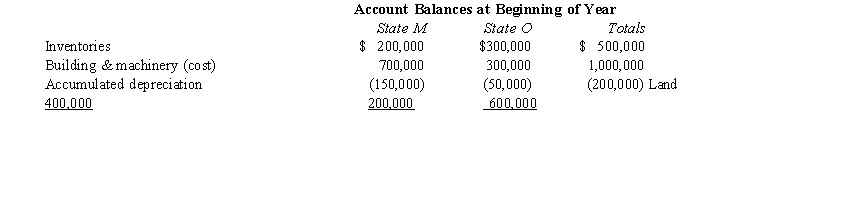
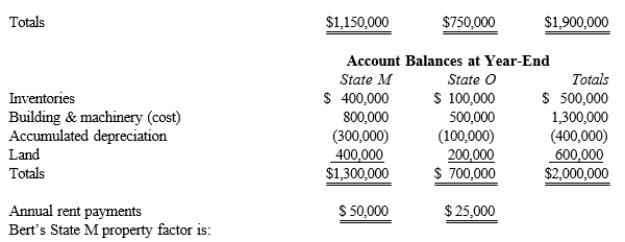
A) 75.0%.
B) 66.7%.
C) 64.9%.
D) 64.5%.
A) 75.0%.
B) 66.7%.
C) 64.9%.
D) 64.5%.
Question
Question
Question
Question
Question
Net Corporation's sales office and manufacturing plant are located in State X. Net also maintains a manufacturing plant and sales office in State W. For purposes of apportionment, State X defines payroll as all compensation paid to employees, including contributions to § 401k) deferred compensation plans. Under State W's statutes, neither compensation paid to officers nor contributions to § 401k) plans are included in the payroll factor. Net incurred the following personnel costs: 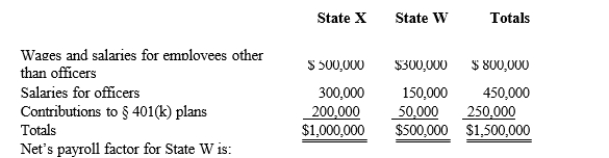
A) 50.00%.
B) 37.50%.
C) 33.33%.
D) 0.00%.
A) 50.00%.
B) 37.50%.
C) 33.33%.
D) 0.00%.
Question
Valdez Corporation, a calendar year taxpayer, owns property in States M and O. Both states require that the average value of assets be included in the property factor. State M requires that the property be valued at its historical cost, and State O requires that the property be included in the property factor at its net depreciated book value. 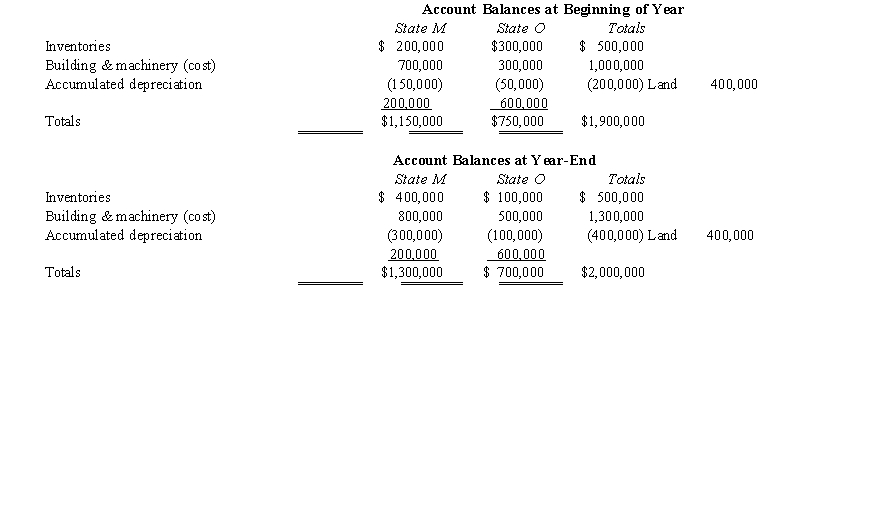 Valdez's O property factor is:
A) 35.0%.
B) 37.2%.
C) 39.5%.
D) 53.8%.
Valdez's O property factor is:A) 35.0%.
B) 37.2%.
C) 39.5%.
D) 53.8%.
Question
Question
Question
Trayne Corporation's sales office and manufacturing plant are located in State X. Trayne also maintains a manufacturing plant and sales office in State W. For purposes of apportionment, State X defines payroll as all compensation paid to employees, including elective contributions to § 401k) deferred compensation plans. Under the statutes of State W, neither compensation paid to officers nor contributions to § 401k) plans are included in the payroll factor. Trayne incurred the following personnel costs. 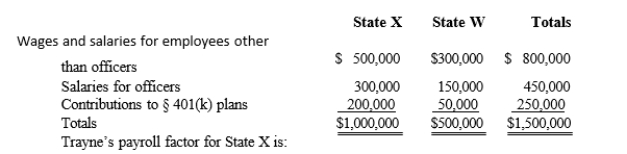
A) 100.00%.
B) 66.67%.
C) 62.50%.
D) 50.00%.
A) 100.00%.
B) 66.67%.
C) 62.50%.
D) 50.00%.
Question

Unlock Deck
Sign up to unlock the cards in this deck!
Unlock Deck
Unlock Deck
1/184

Play

Full screen (f)
Deck 16: Multistate Corporate Taxation
1
All of the U.S. states have adopted a tax based on the net taxable income of corporations.
False
2
A typical state taxable income subtraction modification is the interest income earned from another state's bonds.
False
3
Usually a business chooses a location where it will build a new plant based chiefly on tax considerations.
False
4
Typical indicators of income tax nexus include the presence of customers in the state.
Unlock Deck
Unlock for access to all 184 flashcards in this deck.
Unlock Deck
k this deck
5
State and local politicians tend to apply new and increased taxes to taxpayers who are nonresident visitors to the jurisdiction, such as a tax on auto rentals and hotel stays, because the taxpayer cannot vote to reelect or oust) the lawmaker.
Unlock Deck
Unlock for access to all 184 flashcards in this deck.
Unlock Deck
k this deck
6
A typical U.S. state piggybacks its collections of the corporate income tax by letting the Federal government collect and remit the corresponding tax to the state.
Unlock Deck
Unlock for access to all 184 flashcards in this deck.
Unlock Deck
k this deck
7
A state can levy an income tax on a business only if the business was incorporated in the state.
Unlock Deck
Unlock for access to all 184 flashcards in this deck.
Unlock Deck
k this deck
8
Under P.L. 86-272, the taxpayer is exempt from state taxes on income resulting from the mere solicitation of orders for the sale of stocks and bonds.
Unlock Deck
Unlock for access to all 184 flashcards in this deck.
Unlock Deck
k this deck
9
A typical state taxable income addition modification is for the state's NOL allowed the taxpayer for the tax year.
Unlock Deck
Unlock for access to all 184 flashcards in this deck.
Unlock Deck
k this deck
10
An assembly worker earns a $50,000 salary and receives a fringe benefit package worth $15,000. The payroll factor assigns $65,000 for this employee.
Unlock Deck
Unlock for access to all 184 flashcards in this deck.
Unlock Deck
k this deck
11
In most states, a taxpayer's income is apportioned on the basis of a formula measuring the extent of business contact and allocated according to the location of property owned or used.
Unlock Deck
Unlock for access to all 184 flashcards in this deck.
Unlock Deck
k this deck
12
Roughly 5% of all taxes paid by businesses in the United States are to state, local, and municipal jurisdictions.
Unlock Deck
Unlock for access to all 184 flashcards in this deck.
Unlock Deck
k this deck
13
Typically, sales/use taxes constitute about 20% of a state's annual tax collections for most states.
Unlock Deck
Unlock for access to all 184 flashcards in this deck.
Unlock Deck
k this deck
14
All of the U.S. states use an apportionment formula based on the sales, property, and payroll factors.
Unlock Deck
Unlock for access to all 184 flashcards in this deck.
Unlock Deck
k this deck
15
Property taxes generally are collected by local taxing jurisdictions, not the state or Federal governments.
Unlock Deck
Unlock for access to all 184 flashcards in this deck.
Unlock Deck
k this deck
16
Politicians frequently use tax credits and exemptions to create economic development incentives.
Unlock Deck
Unlock for access to all 184 flashcards in this deck.
Unlock Deck
k this deck
17
A service engineer spends 80% of her time maintaining the employer's productive business property and 20% maintaining the employer's nonbusiness rental properties. This year, her compensation totaled $90,000. The payroll factor assigns $90,000 to the state in which the employer is based.
Unlock Deck
Unlock for access to all 184 flashcards in this deck.
Unlock Deck
k this deck
18
Double weighting the sales factor effectively decreases the corporate income tax burden on taxpayers based in a state such as entities with in-state headquarters.
Unlock Deck
Unlock for access to all 184 flashcards in this deck.
Unlock Deck
k this deck
19
Most states begin the computation of corporate taxable income with an amount from the Federal income tax return.
Unlock Deck
Unlock for access to all 184 flashcards in this deck.
Unlock Deck
k this deck
20
If a state follows Federal income tax rules, the state's tax compliance and enforcement become easier to accomplish.
Unlock Deck
Unlock for access to all 184 flashcards in this deck.
Unlock Deck
k this deck
21
A taxpayer automatically has nexus with a state for sales and use tax purposes if it has income tax nexus with the same state.
Unlock Deck
Unlock for access to all 184 flashcards in this deck.
Unlock Deck
k this deck
22
The property factor includes business assets that the taxpayer owns and those merely used under a lease agreement.
Unlock Deck
Unlock for access to all 184 flashcards in this deck.
Unlock Deck
k this deck
23
Most states' consumer sales taxes are to be paid by the final purchaser of the taxable asset.
Unlock Deck
Unlock for access to all 184 flashcards in this deck.
Unlock Deck
k this deck
24
By making a water's edge election, a multinational taxpayer can limit the reach of unitary principles to the apportionment factors and income of its U.S. and E.U. affiliates.
Unlock Deck
Unlock for access to all 184 flashcards in this deck.
Unlock Deck
k this deck
25
An LLC apportions and allocates its annual taxable income in the same manner used by any other business operating in the state.
Unlock Deck
Unlock for access to all 184 flashcards in this deck.
Unlock Deck
k this deck
26
Typically exempt from the sales/use tax base is the purchase of tools by a manufacturer to make the widgets that it sells.
Unlock Deck
Unlock for access to all 184 flashcards in this deck.
Unlock Deck
k this deck
27
Typically exempt from the sales/use tax base is a symphony orchestra's purchase of printed music for its musicians.
Unlock Deck
Unlock for access to all 184 flashcards in this deck.
Unlock Deck
k this deck
28
Typically included in the sales/use tax base is the purchase of tablet computers and cell phone equipment by a large manufacturing firm whose sales force uses the items.
Unlock Deck
Unlock for access to all 184 flashcards in this deck.
Unlock Deck
k this deck
29
Typically exempt from the sales/use tax base is the purchase of clothing from a neighbor's garage sale.
Unlock Deck
Unlock for access to all 184 flashcards in this deck.
Unlock Deck
k this deck
30
The property factor includes land and buildings used for business purposes.
Unlock Deck
Unlock for access to all 184 flashcards in this deck.
Unlock Deck
k this deck
31
A unitary business applies a combined apportionment formula, including data from operations of all affiliates.
Unlock Deck
Unlock for access to all 184 flashcards in this deck.
Unlock Deck
k this deck
32
Most states exempt consumer purchases of groceries from the collection of the local sales tax.
Unlock Deck
Unlock for access to all 184 flashcards in this deck.
Unlock Deck
k this deck
33
Typically exempt from the sales/use tax base is the purchase of lumber by a do-it-yourself homeowner when she builds a deck onto her patio. This exemption is known as the homestead rule.
Unlock Deck
Unlock for access to all 184 flashcards in this deck.
Unlock Deck
k this deck
34
A unitary group of entities files a combined return that includes all of the affiliates' income and apportionment data.
Unlock Deck
Unlock for access to all 184 flashcards in this deck.
Unlock Deck
k this deck
35
The individual seller of shares of stock in Facebook is liable for sales tax on the transaction.
Unlock Deck
Unlock for access to all 184 flashcards in this deck.
Unlock Deck
k this deck
36
Almost all of the states assess some form of consumer-level sales/use tax.
Unlock Deck
Unlock for access to all 184 flashcards in this deck.
Unlock Deck
k this deck
37
In most states, Federal S corporations must make a separate state-level election of the flow-through status.
Unlock Deck
Unlock for access to all 184 flashcards in this deck.
Unlock Deck
k this deck
38
The use tax is designed to complement the sales tax. A use tax typically covers purchases made out of state and brought into the jurisdiction.
Unlock Deck
Unlock for access to all 184 flashcards in this deck.
Unlock Deck
k this deck
39
S corporations flow through income amounts to its shareholders, and most states require a withholding of shareholder taxes on the allocated amounts.
Unlock Deck
Unlock for access to all 184 flashcards in this deck.
Unlock Deck
k this deck
40
Typically exempt from the sales/use tax base is the purchase of prescription medicines by an individual.
Unlock Deck
Unlock for access to all 184 flashcards in this deck.
Unlock Deck
k this deck
41
The typical state sales/use tax falls on sales of both real and personal property.
Unlock Deck
Unlock for access to all 184 flashcards in this deck.
Unlock Deck
k this deck
42
Flint Corporation is subject to a corporate income tax only in State X. The starting point in computing X taxable income is Federal taxable income which is $750,000. This amount includes a $50,000 deduction for state income taxes. During the year, Flint received $10,000 interest on Federal obligations. X tax law does not allow a deduction for state income tax payments. Flint's taxable income for X purposes is:
A) $810,000
B) $800,000
C) $790,000
D) $750,000
A) $810,000
B) $800,000
C) $790,000
D) $750,000
Unlock Deck
Unlock for access to all 184 flashcards in this deck.
Unlock Deck
k this deck
43
In most states, legal and accounting services are exempt from the sales/use tax base.
Unlock Deck
Unlock for access to all 184 flashcards in this deck.
Unlock Deck
k this deck
44
Zhao Company sold an asset on the first day of the tax year for $500,000. Zhao's Federal tax basis for the asset was $300,000. Because of differences in cost recovery schedules, the state regular-tax basis in the asset was $350,000. What modification, if any, should be made to Zhao's Federal taxable income in determining the correct taxable income for the typical state?
A) $0
B) $50,000)
C) $50,000
D) $150,000
A) $0
B) $50,000)
C) $50,000
D) $150,000
Unlock Deck
Unlock for access to all 184 flashcards in this deck.
Unlock Deck
k this deck
45
Which of the following is not immune from state income taxation even if P.L. 86-272 is in effect?
A) Sale of office equipment that is used in the taxpayer's business.
B) Sale of office equipment that constitutes inventory to the purchaser.
C) Sale of a warehouse used in the taxpayer's business.
D) All of these are protected by P.L. 86-272 immunity provisions.
A) Sale of office equipment that is used in the taxpayer's business.
B) Sale of office equipment that constitutes inventory to the purchaser.
C) Sale of a warehouse used in the taxpayer's business.
D) All of these are protected by P.L. 86-272 immunity provisions.
Unlock Deck
Unlock for access to all 184 flashcards in this deck.
Unlock Deck
k this deck
46
Sales/use tax in most states applies to a restaurant meal.
Unlock Deck
Unlock for access to all 184 flashcards in this deck.
Unlock Deck
k this deck
47
In determining state taxable income, all of the following are adjustments to Federal income except:
A) Federal net operating loss.
B) State income tax expense.
C) Fringe benefits paid to officers and executives.
D) Dividends received from other U.S. corporations.
A) Federal net operating loss.
B) State income tax expense.
C) Fringe benefits paid to officers and executives.
D) Dividends received from other U.S. corporations.
Unlock Deck
Unlock for access to all 184 flashcards in this deck.
Unlock Deck
k this deck
48
Adams Corporation owns and operates two manufacturing facilities, one in State X and the other in State Y. Due to a temporary decline in the corporation's sales, Adams has rented 20% of its Y facility to an unaffiliated corporation. Adams generated $1,000,000 net rental income and $5,000,000 income from manufacturing. Adams is incorporated in Y. For X and Y purposes, rental income is classified as allocable nonbusiness income. By applying the statutes of each state, Adams determined that its apportionment factors are 0.65 for X and 0.35 for Y.
Adams's income attributed to X is:
A) $0.
B) $3,250,000.
C) $3,900,000.
D) $5,000,000.
E) $6,000,000.
Adams's income attributed to X is:
A) $0.
B) $3,250,000.
C) $3,900,000.
D) $5,000,000.
E) $6,000,000.
Unlock Deck
Unlock for access to all 184 flashcards in this deck.
Unlock Deck
k this deck
49
The typical local property tax falls on both an investor's principal residence and her stock portfolio.
Unlock Deck
Unlock for access to all 184 flashcards in this deck.
Unlock Deck
k this deck
50
The most commonly used state income tax apportionment formula is:
A) Sales factor only.
B) Sales factor double-weighted.
C) Sales factor equally weighted with property and payroll.
D) Payroll factor only.
A) Sales factor only.
B) Sales factor double-weighted.
C) Sales factor equally weighted with property and payroll.
D) Payroll factor only.
Unlock Deck
Unlock for access to all 184 flashcards in this deck.
Unlock Deck
k this deck
51
A capital stock tax usually is structured as an excise tax imposed on a corporation's net worth, using financial statement data to compute the tax.
Unlock Deck
Unlock for access to all 184 flashcards in this deck.
Unlock Deck
k this deck
52
Under P.L. 86-272, which of the following transactions by itself would create nexus with a state?
A) Order solicitation for a plot of real estate approved and filled from another state.
B) Order solicitation for a computer approved and filled from another state.
C) Order solicitation for a machine with credit approval from another state.
D) The conduct of a training seminar for sales personnel as to how to install and operate a new software product.
A) Order solicitation for a plot of real estate approved and filled from another state.
B) Order solicitation for a computer approved and filled from another state.
C) Order solicitation for a machine with credit approval from another state.
D) The conduct of a training seminar for sales personnel as to how to install and operate a new software product.
Unlock Deck
Unlock for access to all 184 flashcards in this deck.
Unlock Deck
k this deck
53
The model law relating to the assignment of income among the states for corporations is:
A) Public Law 86-272.
B) The Multistate Tax Treaty.
C) The Multistate Tax Commission MTC).
D) The Uniform Division of Income for Tax Purposes Act UDITPA).
A) Public Law 86-272.
B) The Multistate Tax Treaty.
C) The Multistate Tax Commission MTC).
D) The Uniform Division of Income for Tax Purposes Act UDITPA).
Unlock Deck
Unlock for access to all 184 flashcards in this deck.
Unlock Deck
k this deck
54
Public Law 86-272:
A) Was written by the Multistate Tax Commission.
B) Provides nexus definitions for sales of stocks and bonds.
C) Provides nexus definitions for the sale of medical and legal services.
D) Was adopted by Congress.
A) Was written by the Multistate Tax Commission.
B) Provides nexus definitions for sales of stocks and bonds.
C) Provides nexus definitions for the sale of medical and legal services.
D) Was adopted by Congress.
Unlock Deck
Unlock for access to all 184 flashcards in this deck.
Unlock Deck
k this deck
55
In determining a corporation's taxable income for state income tax purposes, which of the following does not constitute a subtraction modification from Federal income?
A) Interest on U.S. obligations.
B) Expenses that are directly or indirectly related to state and municipal interest that is taxable for state purposes.
C) The amount by which the state depreciation deduction exceeds the corresponding Federal amount.
D) The amount by which the Federal depreciation deduction exceeds the corresponding state amount.
A) Interest on U.S. obligations.
B) Expenses that are directly or indirectly related to state and municipal interest that is taxable for state purposes.
C) The amount by which the state depreciation deduction exceeds the corresponding Federal amount.
D) The amount by which the Federal depreciation deduction exceeds the corresponding state amount.
Unlock Deck
Unlock for access to all 184 flashcards in this deck.
Unlock Deck
k this deck
56
Under P.L. 86-272, which of the following transactions by itself would create nexus with a state?
A) Having a sales employee inspect customer's inventory for specific product lines.
B) Using a manufacturer's representative for the taxpayer through a sales office in the state.
C) Executing a sales campaign using an advertising agency acting as an independent contractor for the taxpayer.
D) Maintaining inventory in the state by an independent contractor under a consignment plan.
A) Having a sales employee inspect customer's inventory for specific product lines.
B) Using a manufacturer's representative for the taxpayer through a sales office in the state.
C) Executing a sales campaign using an advertising agency acting as an independent contractor for the taxpayer.
D) Maintaining inventory in the state by an independent contractor under a consignment plan.
Unlock Deck
Unlock for access to all 184 flashcards in this deck.
Unlock Deck
k this deck
57
In applying the typical apportionment formula:
A) The aggregate of state taxable incomes equals Federal taxable income.
B) The aggregate of state taxable incomes may not equal Federal taxable income.
C) When Federal taxable income is positive, all states' taxable incomes are positive.
D) When Federal taxable income is negative, aggregate state taxable incomes total to zero.
A) The aggregate of state taxable incomes equals Federal taxable income.
B) The aggregate of state taxable incomes may not equal Federal taxable income.
C) When Federal taxable income is positive, all states' taxable incomes are positive.
D) When Federal taxable income is negative, aggregate state taxable incomes total to zero.
Unlock Deck
Unlock for access to all 184 flashcards in this deck.
Unlock Deck
k this deck
58
Ramirez Corporation, which is subject to income tax only in State A, generated the following income and deductions: Federal taxable income is the starting point in computing A taxable income. State income taxes are not deductible for A tax purposes. Ramirez's A taxable income is:
A) $495,000
B) $500,000
C) $545,000
D) $595,000
A) $495,000
B) $500,000
C) $545,000
D) $595,000
Unlock Deck
Unlock for access to all 184 flashcards in this deck.
Unlock Deck
k this deck
59
Marquardt Corporation realized $900,000 taxable income from the sales of its products in States X and Z. Marquardt's activities establish nexus for income tax purposes in both states. Marquardt's sales, payroll, and property among the states include the following: Z utilizes an equally weighted three-factor apportionment formula. Marquardt is incorporated in X. How much of
Marquardt's taxable income is apportioned to Z?
A) $0
B) $225,000
C) $675,000
D) $3,000,000
Marquardt's taxable income is apportioned to Z?
A) $0
B) $225,000
C) $675,000
D) $3,000,000
Unlock Deck
Unlock for access to all 184 flashcards in this deck.
Unlock Deck
k this deck
60
A city might assess a recording tax when a business takes out a mortgage on its real estate.
Unlock Deck
Unlock for access to all 184 flashcards in this deck.
Unlock Deck
k this deck
61
Simpkin Corporation owns manufacturing facilities in States A, B, and C. State A uses a three-factor apportionment formula under which the sales, property, and payroll factors are equally weighted. State B uses a three-factor apportionment formula under which sales are double-weighted. State C employs a single-factor apportionment factor, based solely on sales. Simpkin's operations generated $1,000,000 of apportionable income, and its sales and payroll activity and average property owned in each of the three states is as follows: Simpkin's apportionable income assigned to State B is:
A) $1,000,000
B) $533,333
C) $475,000
D) $0
A) $1,000,000
B) $533,333
C) $475,000
D) $0
Unlock Deck
Unlock for access to all 184 flashcards in this deck.
Unlock Deck
k this deck
62
Chipper Corporation realized $1,000,000 taxable income from the sales of its products in States X and Z. Chipper's activities establish nexus for income tax purposes only in Z, the state of its incorporation. Chipper's sales, payroll, and property among the states include the following: X utilizes a sales-only factor in its three-factor apportionment formula. How much of Chipper's taxable income is apportioned to X?
A) $0
B) $333,333
C) $500,000
D) $1,000,000
A) $0
B) $333,333
C) $500,000
D) $1,000,000
Unlock Deck
Unlock for access to all 184 flashcards in this deck.
Unlock Deck
k this deck
63
General Corporation is taxable in a number of states. This year, General made a $100,000 sale from its State A headquarters to a customer in State B. General has not established nexus with State B. State A does not apply a throwback rule. In which states) will the sale be included in the sales factor numerator?
A) In all of the states, according to the apportionment formulas of each, as the U.S. government is present in all states.
B) $100,000 in State A.
C) $100,000 in State B.
D) $0 in State A and $0 in State B.
A) In all of the states, according to the apportionment formulas of each, as the U.S. government is present in all states.
B) $100,000 in State A.
C) $100,000 in State B.
D) $0 in State A and $0 in State B.
Unlock Deck
Unlock for access to all 184 flashcards in this deck.
Unlock Deck
k this deck
64
José Corporation realized $900,000 taxable income from the sales of its products in States X and Z. José's activities in both states establish nexus for income tax purposes. José's sales, payroll, and property among the states include the following: X utilizes an equally weighted three-factor apportionment formula. How much of José's taxable income is apportioned to X?
A) $120,000
B) $450,000
C) $780,000
D) $900,000
A) $120,000
B) $450,000
C) $780,000
D) $900,000
Unlock Deck
Unlock for access to all 184 flashcards in this deck.
Unlock Deck
k this deck
65
Boot Corporation is subject to income tax in States A and B. Boot's operations generated $200,000 of apportionable income, and its sales and payroll activity and average property owned in each of the states is as follows: How much more less) of Boot's income is subject to State A income tax if, instead of using an equally weighted three-factor apportionment formula, State A uses a formula with a double-weighted sales factor?
A) $50,000)
B) $50,000
C) $16,100
D) $16,100)
A) $50,000)
B) $50,000
C) $16,100
D) $16,100)
Unlock Deck
Unlock for access to all 184 flashcards in this deck.
Unlock Deck
k this deck
66
Cruz Corporation owns manufacturing facilities in States A, B, and C. State A uses a three-factor apportionment formula under which the sales, property, and payroll factors are equally weighted. State B uses a three-factor apportionment formula under which sales are double-weighted. State C employs a single-factor apportionment factor based solely on sales. Cruz's operations generated $1,000,000 of apportionable income, and its sales and payroll activity and average property owned in each of the three states is as follows: Cruz's apportionable income assigned to State C is:
A) $1,000,000
B) $273,333
C) $200,000
D) $0
A) $1,000,000
B) $273,333
C) $200,000
D) $0
Unlock Deck
Unlock for access to all 184 flashcards in this deck.
Unlock Deck
k this deck
67
General Corporation is taxable in a number of states. This year, General made a $100,000 sale from its State A headquarters to a customer in State B. This activity is not sufficient for General to create nexus with State B. State A applies a throwback rule but State B does not. In which states) will the sale be included in the sales factor numerator?
A) $0 in both State A and State B.
B) $100,000 in State A.
C) $100,000 in State B.
D) In both State A and State B, according to the apportionment formulas of each.
A) $0 in both State A and State B.
B) $100,000 in State A.
C) $100,000 in State B.
D) In both State A and State B, according to the apportionment formulas of each.
Unlock Deck
Unlock for access to all 184 flashcards in this deck.
Unlock Deck
k this deck
68
In the income tax apportionment formula, market-sourcing the sales factor means that:
A) Sales are sourced to the state of the seller.
B) Sales are sourced to the state of the customer.
C) Sales are sourced to the state of the seller's corporate headquarters i.e., where the marketing department works).
D) Sales are sourced to the states) where the customer will use the product i.e., to the customers markets).
A) Sales are sourced to the state of the seller.
B) Sales are sourced to the state of the customer.
C) Sales are sourced to the state of the seller's corporate headquarters i.e., where the marketing department works).
D) Sales are sourced to the states) where the customer will use the product i.e., to the customers markets).
Unlock Deck
Unlock for access to all 184 flashcards in this deck.
Unlock Deck
k this deck
69
General Corporation is taxable in a number of states. This year, General made a $100,000 sale from its State A headquarters to the State B office of the Federal Bureau of Investigation. In which states) will the sale be included in the sales factor numerator?
A) $0 in A and $0 in B.
B) $50,000 in A with the balance exempted from other states' sales factors under the Altria doctrine.
C) $100,000 in A.
D) $100,000 in B.
A) $0 in A and $0 in B.
B) $50,000 in A with the balance exempted from other states' sales factors under the Altria doctrine.
C) $100,000 in A.
D) $100,000 in B.
Unlock Deck
Unlock for access to all 184 flashcards in this deck.
Unlock Deck
k this deck
70
Bert Corporation, a calendar year taxpayer, owns property in States M and O. Both states require that the average value of assets be included in the property factor. State M requires that the property be valued at its historical cost, and State O requires that the property be included in the property factor at its net depreciated book value.
A) 75.0%.
B) 66.7%.
C) 64.9%.
D) 64.5%.
A) 75.0%.
B) 66.7%.
C) 64.9%.
D) 64.5%.
Unlock Deck
Unlock for access to all 184 flashcards in this deck.
Unlock Deck
k this deck
71
Britta Corporation's entire operations are located in State A. Of Britta's sales, 80% $800,000) are made in State A and the remaining sales $200,000) are made in State B, which has not adopted a corporate income tax. If State A has adopted a throwback rule, the numerator of Britta's State A sales factor is:
A) $0.
B) $200,000.
C) $800,000.
D) $1,000,000.
A) $0.
B) $200,000.
C) $800,000.
D) $1,000,000.
Unlock Deck
Unlock for access to all 184 flashcards in this deck.
Unlock Deck
k this deck
72
José Corporation realized $900,000 taxable income from the sales of its products in States X and Z. José's activities in both states establish nexus for income tax purposes. José's sales, payroll, and property among the states include the following: Z utilizes a double-weighted sales factor in its three-factor apportionment formula. How much of José's taxable income is apportioned to Z?
A) $1,000,000
B) $900,000
C) $180,000
D) $0
A) $1,000,000
B) $900,000
C) $180,000
D) $0
Unlock Deck
Unlock for access to all 184 flashcards in this deck.
Unlock Deck
k this deck
73
The throwback rule requires that:
A) Sales of tangible personal property are attributed to the state where they originated if the taxpayer is not taxable in the state of destination.
B) When an asset is sold, any recognized gain from depreciation recapture is taxed at the rates that applied when the depreciation deductions were claimed.
C) Sales of services are attributed to the state of the seller's domicile.
D) Capital gain/loss is attributed to the state of the seller's domicile.
A) Sales of tangible personal property are attributed to the state where they originated if the taxpayer is not taxable in the state of destination.
B) When an asset is sold, any recognized gain from depreciation recapture is taxed at the rates that applied when the depreciation deductions were claimed.
C) Sales of services are attributed to the state of the seller's domicile.
D) Capital gain/loss is attributed to the state of the seller's domicile.
Unlock Deck
Unlock for access to all 184 flashcards in this deck.
Unlock Deck
k this deck
74
General Corporation is taxable in a number of states. This year, General made a $100,000 sale from its State A headquarters to a customer in State B. This activity is not sufficient for General to create nexus with State B. State B applies a throwback rule, but State A does not. In which states) will the sale be included in the sales factor numerator?
A) $0 in State A and $0 in State B.
B) $100,000 in State A.
C) $100,000 in State B.
D) In both States A and B, according to the apportionment formulas of each.
A) $0 in State A and $0 in State B.
B) $100,000 in State A.
C) $100,000 in State B.
D) In both States A and B, according to the apportionment formulas of each.
Unlock Deck
Unlock for access to all 184 flashcards in this deck.
Unlock Deck
k this deck
75
Net Corporation's sales office and manufacturing plant are located in State X. Net also maintains a manufacturing plant and sales office in State W. For purposes of apportionment, State X defines payroll as all compensation paid to employees, including contributions to § 401k) deferred compensation plans. Under State W's statutes, neither compensation paid to officers nor contributions to § 401k) plans are included in the payroll factor. Net incurred the following personnel costs:
A) 50.00%.
B) 37.50%.
C) 33.33%.
D) 0.00%.
A) 50.00%.
B) 37.50%.
C) 33.33%.
D) 0.00%.
Unlock Deck
Unlock for access to all 184 flashcards in this deck.
Unlock Deck
k this deck
76
Valdez Corporation, a calendar year taxpayer, owns property in States M and O. Both states require that the average value of assets be included in the property factor. State M requires that the property be valued at its historical cost, and State O requires that the property be included in the property factor at its net depreciated book value. Valdez's O property factor is:
A) 35.0%.
B) 37.2%.
C) 39.5%.
D) 53.8%.
Valdez's O property factor is:A) 35.0%.
B) 37.2%.
C) 39.5%.
D) 53.8%.
Unlock Deck
Unlock for access to all 184 flashcards in this deck.
Unlock Deck
k this deck
77
Ting, a regional sales manager, works from her office in State W. Her region includes several states as indicated in the following sales report. Determine how much of Ting's $300,000 compensation is assigned to the payroll factor of State W.
A) $0.
B) $90,000.
C) $120,000.
D) $300,000.
A) $0.
B) $90,000.
C) $120,000.
D) $300,000.
Unlock Deck
Unlock for access to all 184 flashcards in this deck.
Unlock Deck
k this deck
78
Given the following transactions for the year, determine Comp Corporation's D payroll factor denominator. State D has adopted the principles of UDITPA.
A) $900,000
B) $700,000
C) $600,000
A) $900,000
B) $700,000
C) $600,000
Unlock Deck
Unlock for access to all 184 flashcards in this deck.
Unlock Deck
k this deck
79
Trayne Corporation's sales office and manufacturing plant are located in State X. Trayne also maintains a manufacturing plant and sales office in State W. For purposes of apportionment, State X defines payroll as all compensation paid to employees, including elective contributions to § 401k) deferred compensation plans. Under the statutes of State W, neither compensation paid to officers nor contributions to § 401k) plans are included in the payroll factor. Trayne incurred the following personnel costs.
A) 100.00%.
B) 66.67%.
C) 62.50%.
D) 50.00%.
A) 100.00%.
B) 66.67%.
C) 62.50%.
D) 50.00%.
Unlock Deck
Unlock for access to all 184 flashcards in this deck.
Unlock Deck
k this deck
80
Helene Corporation owns manufacturing facilities in States A, B, and C. State A uses a three-factor apportionment formula under which the sales, property, and payroll factors are equally weighted. State B uses a three-factor apportionment formula under which sales are double-weighted. State C employs a single-factor apportionment factor based solely on sales. Helene's operations generated $1,000,000 of apportionable income, and its sales and payroll activity and average property owned in each of the three states is as follows: Helene's apportionable income assigned to State A is:
A) $0
B) $266,667
C) $311,100
D) $1,000,000
A) $0
B) $266,667
C) $311,100
D) $1,000,000
Unlock Deck
Unlock for access to all 184 flashcards in this deck.
Unlock Deck
k this deck
Unlock Deck
Unlock for access to all 184 flashcards in this deck.






