







 Chat with AI

Deck 28: Applied and Industrial Microbiology
Full screen (f)

Question
Figure 28.1
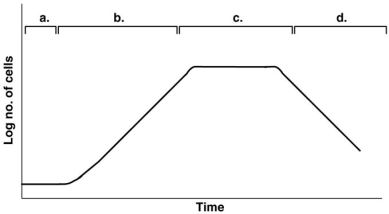
In Figure 28.1, assume that a secondary metabolite is your desired product. Remember, the top lines/markings indicate the different phases observed in the curve below them. When would you be able to obtain it?
A) a
B) b
C) c
D) d
In Figure 28.1, assume that a secondary metabolite is your desired product. Remember, the top lines/markings indicate the different phases observed in the curve below them. When would you be able to obtain it?
A) a
B) b
C) c
D) d

Question
Question
Figure 28.1
In Figure 28.1, assume the cells are your desired product and you want to maintain a continuous culture. Remember, the top lines/markings indicate the different phases observed in the curve below them. When would you harvest cells to maximize your yield?
A) a
B) b
C) c
D) d
In Figure 28.1, assume the cells are your desired product and you want to maintain a continuous culture. Remember, the top lines/markings indicate the different phases observed in the curve below them. When would you harvest cells to maximize your yield?
A) a
B) b
C) c
D) d
Question
Figure 28.1
In Figure 28.1, assume the cells are producing penicillin which is collected during the idiophase. Remember, the top lines/markings indicate the different phases observed in the curve below them. When would you be able to collect the penicillin?
A) a
B) b
C) c
D) d
In Figure 28.1, assume the cells are producing penicillin which is collected during the idiophase. Remember, the top lines/markings indicate the different phases observed in the curve below them. When would you be able to collect the penicillin?
A) a
B) b
C) c
D) d
Question
Question
Question
Question
Question
Question
Question
Question
Question
Question
Question
Question
Question
Question
Question
Question
Question
Question
Question
Question
Question
Question
Question
Question
Question
Question
Question
Question
Figure 28.3
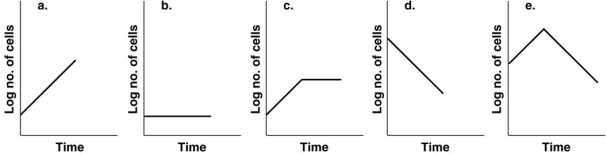
Which of the growth curves in Figure 28.3 will give the highest yield of a secondary metabolite?
A) a
B) b
C) c
D) d
E) e
Which of the growth curves in Figure 28.3 will give the highest yield of a secondary metabolite?
A) a
B) b
C) c
D) d
E) e
Question
Question
Question
Question
Question
Question
Figure 28.3
Figure 28.3 shows the growth curves of Acetobacter under different conditions. Which culture would produce the highest amount of the primary metabolite acetic acid?
A) a
B) b
C) c
D) d
E) e
Figure 28.3 shows the growth curves of Acetobacter under different conditions. Which culture would produce the highest amount of the primary metabolite acetic acid?
A) a
B) b
C) c
D) d
E) e
Question
Question
Question
Question
Question
Question
Question
Question
Question
Question
Question
Question
Question
Question
Question
Question
Question

Unlock Deck
Sign up to unlock the cards in this deck!
Unlock Deck
Unlock Deck
1/55

Play

Full screen (f)
Deck 28: Applied and Industrial Microbiology
1
Figure 28.1
In Figure 28.1, assume that a secondary metabolite is your desired product. Remember, the top lines/markings indicate the different phases observed in the curve below them. When would you be able to obtain it?
A) a
B) b
C) c
D) d
In Figure 28.1, assume that a secondary metabolite is your desired product. Remember, the top lines/markings indicate the different phases observed in the curve below them. When would you be able to obtain it?
A) a
B) b
C) c
D) d
C
2
Commercial sterilization of processed canned foods uses a 12D treatment which is based upon a theoretical population of 1012 C. botulinum endospores in a can of food. After treatment, there would theoretically be how many endospores left?
A) 12 endospores
B) 10 endospores
C) 100 endospores
D) 120 endospores
E) 1 endospore
A) 12 endospores
B) 10 endospores
C) 100 endospores
D) 120 endospores
E) 1 endospore
E
3
Figure 28.1
In Figure 28.1, assume the cells are your desired product and you want to maintain a continuous culture. Remember, the top lines/markings indicate the different phases observed in the curve below them. When would you harvest cells to maximize your yield?
A) a
B) b
C) c
D) d
In Figure 28.1, assume the cells are your desired product and you want to maintain a continuous culture. Remember, the top lines/markings indicate the different phases observed in the curve below them. When would you harvest cells to maximize your yield?
A) a
B) b
C) c
D) d
B
4
Figure 28.1
In Figure 28.1, assume the cells are producing penicillin which is collected during the idiophase. Remember, the top lines/markings indicate the different phases observed in the curve below them. When would you be able to collect the penicillin?
A) a
B) b
C) c
D) d
In Figure 28.1, assume the cells are producing penicillin which is collected during the idiophase. Remember, the top lines/markings indicate the different phases observed in the curve below them. When would you be able to collect the penicillin?
A) a
B) b
C) c
D) d
Unlock Deck
Unlock for access to all 55 flashcards in this deck.
Unlock Deck
k this deck
5
Which of the following pairs is mismatched?
A) Acetobacter - vinegar
B) Propionibacterium - Swiss cheese
C) Lactobacillus - yogurt
D) Bacillus - beer
E) Penicillium - blue cheese
A) Acetobacter - vinegar
B) Propionibacterium - Swiss cheese
C) Lactobacillus - yogurt
D) Bacillus - beer
E) Penicillium - blue cheese
Unlock Deck
Unlock for access to all 55 flashcards in this deck.
Unlock Deck
k this deck
6
Spoilage of canned foods stored at high temperatures, accompanied by gas production, is
A) flat sour spoilage.
B) caused by acid-tolerant fungi.
C) putrefactive anaerobic spoilage.
D) thermophilic anaerobic spoilage.
E) spoilage by mesophilic bacteria.
A) flat sour spoilage.
B) caused by acid-tolerant fungi.
C) putrefactive anaerobic spoilage.
D) thermophilic anaerobic spoilage.
E) spoilage by mesophilic bacteria.
Unlock Deck
Unlock for access to all 55 flashcards in this deck.
Unlock Deck
k this deck
7
Spoilage of canned foods due to inadequate processing, NOT accompanied by gas production, is
A) thermophilic anaerobic spoilage.
B) flat sour spoilage.
C) caused by acid-tolerant fungi.
D) putrefactive anaerobic spoilage.
E) spoilage by mesophilic bacteria.
A) thermophilic anaerobic spoilage.
B) flat sour spoilage.
C) caused by acid-tolerant fungi.
D) putrefactive anaerobic spoilage.
E) spoilage by mesophilic bacteria.
Unlock Deck
Unlock for access to all 55 flashcards in this deck.
Unlock Deck
k this deck
8
Which of the following pertains to an improperly canned food product on a store shelf that has a bad odor and putrefaction of the canned material?
A) mesophilic spoilage
B) flat sour spoilage
C) hydrogen sulfide spoilage
D) bacterial soft rot
E) thermophilic anaerobic spoilage
A) mesophilic spoilage
B) flat sour spoilage
C) hydrogen sulfide spoilage
D) bacterial soft rot
E) thermophilic anaerobic spoilage
Unlock Deck
Unlock for access to all 55 flashcards in this deck.
Unlock Deck
k this deck
9
All of the following are industrial products produced by microbes EXCEPT
A) vitamin B12 and riboflavin.
B) industrial enzymes.
C) amino acids in food supplements.
D) uranium.
E) antibiotics.
A) vitamin B12 and riboflavin.
B) industrial enzymes.
C) amino acids in food supplements.
D) uranium.
E) antibiotics.
Unlock Deck
Unlock for access to all 55 flashcards in this deck.
Unlock Deck
k this deck
10
Which of the following reactions makes wine less acidic, and is important for good flavor when grapes with higher acidity are used?
A) carbon dioxide → sucrose
B) ethanol → acetic acid
C) sugar → CO₂ + H₂O
D) sugar → ethanol
E) malic acid → lactic acid
A) carbon dioxide → sucrose
B) ethanol → acetic acid
C) sugar → CO₂ + H₂O
D) sugar → ethanol
E) malic acid → lactic acid
Unlock Deck
Unlock for access to all 55 flashcards in this deck.
Unlock Deck
k this deck
11
Microbial products can be improved by all of the following EXCEPT
A) isolating new strains.
B) mutating existing strains.
C) sterilization.
D) genetically modifying strains.
E) modifying culture conditions.
A) isolating new strains.
B) mutating existing strains.
C) sterilization.
D) genetically modifying strains.
E) modifying culture conditions.
Unlock Deck
Unlock for access to all 55 flashcards in this deck.
Unlock Deck
k this deck
12
Which of the following is an undesirable contaminant in wine-making?
A) Saccharomyces
B) lactic acid bacteria
C) Acetobacter
D) Clostridium botulinum endospores
A) Saccharomyces
B) lactic acid bacteria
C) Acetobacter
D) Clostridium botulinum endospores
Unlock Deck
Unlock for access to all 55 flashcards in this deck.
Unlock Deck
k this deck
13
All of the following are fuels produced by microorganisms EXCEPT
A) hydrogen.
B) cellulose.
C) oil from algae.
D) ethanol.
E) methane.
A) hydrogen.
B) cellulose.
C) oil from algae.
D) ethanol.
E) methane.
Unlock Deck
Unlock for access to all 55 flashcards in this deck.
Unlock Deck
k this deck
14
Which of the following microorganisms is usually used in the fermentation of alcoholic beverages?
A) Lactobacillus
B) Saccharomyces
C) Propionobacterium
D) Rhizopus
E) Penicillium
A) Lactobacillus
B) Saccharomyces
C) Propionobacterium
D) Rhizopus
E) Penicillium
Unlock Deck
Unlock for access to all 55 flashcards in this deck.
Unlock Deck
k this deck
15
A baker forgets to put yeast in his bread dough. Which of the following do you expect to happen to the bread as a result?
A) The bread will look normal but will be tough.
B) Bacterial contaminants will now be able to grow.
C) The bread will have a sour taste.
D) The bread will not rise.
E) It will take longer to bake.
A) The bread will look normal but will be tough.
B) Bacterial contaminants will now be able to grow.
C) The bread will have a sour taste.
D) The bread will not rise.
E) It will take longer to bake.
Unlock Deck
Unlock for access to all 55 flashcards in this deck.
Unlock Deck
k this deck
16
All of the following are true of irradiation methods used for food preservation and sterilization EXCEPT
A) they prolong shelf-life of fruits and vegetables.
B) they are used for the sterilization of many spices.
C) they greatly reduce the number of pathogens present in meats and poultry.
D) residual radioactivity is left behind on many foods.
E) ionizing radiation such as X rays or gamma rays is used.
A) they prolong shelf-life of fruits and vegetables.
B) they are used for the sterilization of many spices.
C) they greatly reduce the number of pathogens present in meats and poultry.
D) residual radioactivity is left behind on many foods.
E) ionizing radiation such as X rays or gamma rays is used.
Unlock Deck
Unlock for access to all 55 flashcards in this deck.
Unlock Deck
k this deck
17
All of the following are advantages of a bioreactor instead of a flask culture EXCEPT
A) instrumentation for monitoring environmental conditions.
B) uniform aeration and mixing.
C) larger culture volumes can be grown.
D) aseptic sampling.
E) None of the answers is correct; all of these are advantages of using a bioreactor instead of a flask culture.
A) instrumentation for monitoring environmental conditions.
B) uniform aeration and mixing.
C) larger culture volumes can be grown.
D) aseptic sampling.
E) None of the answers is correct; all of these are advantages of using a bioreactor instead of a flask culture.
Unlock Deck
Unlock for access to all 55 flashcards in this deck.
Unlock Deck
k this deck
18
Commercial sterilization differs from complete sterilization in that commercial sterilization
A) kills all microorganisms.
B) may result in the survival of thermophiles.
C) may result in the survival of fungal spores.
D) kills only bacteria.
E) employs a higher temperature.
A) kills all microorganisms.
B) may result in the survival of thermophiles.
C) may result in the survival of fungal spores.
D) kills only bacteria.
E) employs a higher temperature.
Unlock Deck
Unlock for access to all 55 flashcards in this deck.
Unlock Deck
k this deck
19
Microorganisms play an active role in the formation of industrial products. Which of the following is mismatched?
A) Saccharomyces cerevisiae - for fermentation
B) Penicillium - treatment of disease
C) Rhizobium - increases nitrogen in the soil
D) algae - citric acid
E) Bacillus thuringiensis - insecticide
A) Saccharomyces cerevisiae - for fermentation
B) Penicillium - treatment of disease
C) Rhizobium - increases nitrogen in the soil
D) algae - citric acid
E) Bacillus thuringiensis - insecticide
Unlock Deck
Unlock for access to all 55 flashcards in this deck.
Unlock Deck
k this deck
20
Which of the following reactions is performed by yeast in wine-making?
A) ethanol → acetic acid
B) carbon dioxide → sucrose
C) sugar → ethanol
D) malic acid → lactic acid
E) sugar → CO₂ + H₂O
A) ethanol → acetic acid
B) carbon dioxide → sucrose
C) sugar → ethanol
D) malic acid → lactic acid
E) sugar → CO₂ + H₂O
Unlock Deck
Unlock for access to all 55 flashcards in this deck.
Unlock Deck
k this deck
21
Canning works to preserve foods through
A) increasing pH.
B) creation of an anaerobic environment.
C) exposure to high heat.
D) mutation of bacterial DNA.
E) creation of an anaerobic environment and exposure to high heat.
A) increasing pH.
B) creation of an anaerobic environment.
C) exposure to high heat.
D) mutation of bacterial DNA.
E) creation of an anaerobic environment and exposure to high heat.
Unlock Deck
Unlock for access to all 55 flashcards in this deck.
Unlock Deck
k this deck
22
The following steps are required for making cheese. What is the second step, which helps to provide the characteristic flavors and aromas of the cheese?
A) enzymatic coagulation of milk
B) separation of curds and whey
C) inoculation with lactic acid bacteria
D) inoculation with Penicillium
E) fermentation of curd
A) enzymatic coagulation of milk
B) separation of curds and whey
C) inoculation with lactic acid bacteria
D) inoculation with Penicillium
E) fermentation of curd
Unlock Deck
Unlock for access to all 55 flashcards in this deck.
Unlock Deck
k this deck
23
Aseptic packaging utilizes which of the following to sterilize laminated paper or plastic prior to filling with food?
A) hot hydrogen peroxide solution
B) hot HCl solution
C) autoclave
D) X rays
E) gamma radiation
A) hot hydrogen peroxide solution
B) hot HCl solution
C) autoclave
D) X rays
E) gamma radiation
Unlock Deck
Unlock for access to all 55 flashcards in this deck.
Unlock Deck
k this deck
24
As cheese ages, it gets
A) saltier.
B) more alcoholic.
C) more acidic.
D) more protein.
E) more whey.
A) saltier.
B) more alcoholic.
C) more acidic.
D) more protein.
E) more whey.
Unlock Deck
Unlock for access to all 55 flashcards in this deck.
Unlock Deck
k this deck
25
What process does yeast use to produce ethanol for automobile fuel from corn?
A) fermentation
B) the Krebs cycle
C) oxidation
D) photosynthesis
E) anaerobic respiration
A) fermentation
B) the Krebs cycle
C) oxidation
D) photosynthesis
E) anaerobic respiration
Unlock Deck
Unlock for access to all 55 flashcards in this deck.
Unlock Deck
k this deck
26
Microorganisms themselves are commercial products. Which of the following microbes is available as a product sold in retail stores?
A) Saccharomyces
B) Rhizobium
C) Lactobacillus
D) Bacillus thuringiensis
E) All of these organisms can be found in various commercial products.
A) Saccharomyces
B) Rhizobium
C) Lactobacillus
D) Bacillus thuringiensis
E) All of these organisms can be found in various commercial products.
Unlock Deck
Unlock for access to all 55 flashcards in this deck.
Unlock Deck
k this deck
27
All of the following are uses for ionizing or ultraviolet radiation EXCEPT
A) sterilizing spices.
B) prevention of sprouting.
C) heating cold food.
D) inactivation of Trichinella larvae.
E) killing of insect eggs and larva.
A) sterilizing spices.
B) prevention of sprouting.
C) heating cold food.
D) inactivation of Trichinella larvae.
E) killing of insect eggs and larva.
Unlock Deck
Unlock for access to all 55 flashcards in this deck.
Unlock Deck
k this deck
28
All of the following foods are produced using microbial fermentations EXCEPT
A) sauerkraut.
B) coffee.
C) ketchup.
D) sour cream.
E) yogurt.
A) sauerkraut.
B) coffee.
C) ketchup.
D) sour cream.
E) yogurt.
Unlock Deck
Unlock for access to all 55 flashcards in this deck.
Unlock Deck
k this deck
29
Canning preserves food
A) by exposure to radiation.
B) by exposure to high pH.
C) by exposure to chemicals.
D) through use of aseptic packaging.
E) by exposure to high heat.
A) by exposure to radiation.
B) by exposure to high pH.
C) by exposure to chemicals.
D) through use of aseptic packaging.
E) by exposure to high heat.
Unlock Deck
Unlock for access to all 55 flashcards in this deck.
Unlock Deck
k this deck
30
All of the following are industrial enzymes made by microbial fermentations EXCEPT
A) rennin.
B) proteases.
C) amylases.
D) vitamin C.
E) glucose isomerase.
A) rennin.
B) proteases.
C) amylases.
D) vitamin C.
E) glucose isomerase.
Unlock Deck
Unlock for access to all 55 flashcards in this deck.
Unlock Deck
k this deck
31
All of the following are industrial products produced using microbial fermentations EXCEPT
A) riboflavin.
B) citric acid.
C) glutamic acid.
D) aspartic acid.
E) saccharin.
A) riboflavin.
B) citric acid.
C) glutamic acid.
D) aspartic acid.
E) saccharin.
Unlock Deck
Unlock for access to all 55 flashcards in this deck.
Unlock Deck
k this deck
32
Figure 28.3
Which of the growth curves in Figure 28.3 will give the highest yield of a secondary metabolite?
A) a
B) b
C) c
D) d
E) e
Which of the growth curves in Figure 28.3 will give the highest yield of a secondary metabolite?
A) a
B) b
C) c
D) d
E) e
Unlock Deck
Unlock for access to all 55 flashcards in this deck.
Unlock Deck
k this deck
33
You are growing Bacillus subtilis, an aerobic bacterium that can also carry out fermentation when required, in a bioreactor and notice that the growth rate has slowed and the pH has decreased. What could you add?
A) peptides
B) lactic acid
C) oxygen
D) lactose
E) glucose
A) peptides
B) lactic acid
C) oxygen
D) lactose
E) glucose
Unlock Deck
Unlock for access to all 55 flashcards in this deck.
Unlock Deck
k this deck
34
Aseptic packaging (where the packaging itself is rendered sterile) helps to preserve foods through
A) mutation of bacterial DNA by exposure to the packaging material.
B) creation of an anaerobic environment in the packaging.
C) exposure of the packaging to high heat.
D) increasing pH in the food contained in the packaging.
E) creation of an anaerobic environment in the packaging and exposure of the packaging to high heat.
A) mutation of bacterial DNA by exposure to the packaging material.
B) creation of an anaerobic environment in the packaging.
C) exposure of the packaging to high heat.
D) increasing pH in the food contained in the packaging.
E) creation of an anaerobic environment in the packaging and exposure of the packaging to high heat.
Unlock Deck
Unlock for access to all 55 flashcards in this deck.
Unlock Deck
k this deck
35
Which of the following microbes produces a natural biopesticide?
A) Penicillium chryssogenum
B) Saccharomyces cerevisiae
C) Lactobacillus buggaricus
D) Bacillus thuringiensis
E) Thiobacillus ferroxidans
A) Penicillium chryssogenum
B) Saccharomyces cerevisiae
C) Lactobacillus buggaricus
D) Bacillus thuringiensis
E) Thiobacillus ferroxidans
Unlock Deck
Unlock for access to all 55 flashcards in this deck.
Unlock Deck
k this deck
36
You are growing Bacillus subtilis, an aerobic bacterium that can also carry out fermentation when required, in a bioreactor and notice that the growth rate has slowed and the pH has decreased. You suspect the bacteria are
A) fermenting.
B) using proteins.
C) photosynthesizing.
D) using the Krebs cycle.
E) dead.
A) fermenting.
B) using proteins.
C) photosynthesizing.
D) using the Krebs cycle.
E) dead.
Unlock Deck
Unlock for access to all 55 flashcards in this deck.
Unlock Deck
k this deck
37
Acidithiobacillus ferrooxidans is used for the recovery of from ore.
A) gold
B) sulfur
C) sulfuric acid
D) iron
E) copper
A) gold
B) sulfur
C) sulfuric acid
D) iron
E) copper
Unlock Deck
Unlock for access to all 55 flashcards in this deck.
Unlock Deck
k this deck
38
Figure 28.3
Figure 28.3 shows the growth curves of Acetobacter under different conditions. Which culture would produce the highest amount of the primary metabolite acetic acid?
A) a
B) b
C) c
D) d
E) e
Figure 28.3 shows the growth curves of Acetobacter under different conditions. Which culture would produce the highest amount of the primary metabolite acetic acid?
A) a
B) b
C) c
D) d
E) e
Unlock Deck
Unlock for access to all 55 flashcards in this deck.
Unlock Deck
k this deck
39
Biomass is a renewable energy source derived from the organic matter produced by living organisms. All of the following are sources of biomass EXCEPT
A) algae.
B) oxidation of metals.
C) crops.
D) landfill sites.
E) bacteria.
A) algae.
B) oxidation of metals.
C) crops.
D) landfill sites.
E) bacteria.
Unlock Deck
Unlock for access to all 55 flashcards in this deck.
Unlock Deck
k this deck
40
What role do lactic acid bacteria play in cheese production?
A) production of holes in Swiss cheese
B) curd formation
C) ripening the cheese
D) providing characteristic flavor and smell
E) Lactic acid bacteria carry out each of these roles in cheese production.
A) production of holes in Swiss cheese
B) curd formation
C) ripening the cheese
D) providing characteristic flavor and smell
E) Lactic acid bacteria carry out each of these roles in cheese production.
Unlock Deck
Unlock for access to all 55 flashcards in this deck.
Unlock Deck
k this deck
41
High-pressure processing of foods such as deli meats and precooked chicken strips targets pathogens such as Salmonella and Listeria.
Unlock Deck
Unlock for access to all 55 flashcards in this deck.
Unlock Deck
k this deck
42
All of the following are reasons for utilizing algae for biofuel production EXCEPT
A) they produce more energy per acre than corn.
B) they produce a nondegradable waste product.
C) they can utilize agriculturally poor land.
D) their main requirement is abundant light.
E) they do not take up land needed for food production.
A) they produce more energy per acre than corn.
B) they produce a nondegradable waste product.
C) they can utilize agriculturally poor land.
D) their main requirement is abundant light.
E) they do not take up land needed for food production.
Unlock Deck
Unlock for access to all 55 flashcards in this deck.
Unlock Deck
k this deck
43
Radiation works to preserve foods through
A) exposure to high heat.
B) lethal mutation of bacterial DNA.
C) increasing pH.
D) creation of an anaerobic environment and high heat.
E) creation of an anaerobic environment.
A) exposure to high heat.
B) lethal mutation of bacterial DNA.
C) increasing pH.
D) creation of an anaerobic environment and high heat.
E) creation of an anaerobic environment.
Unlock Deck
Unlock for access to all 55 flashcards in this deck.
Unlock Deck
k this deck
44
What will be produced if wine is aerated and inoculated with bacteria of the genera Acetobacter and Gluconobacter?
A) CO₂ + H₂O
B) acetic acid
C) CH4
D) ethanol + CO₂
E) None of the answers is correct.
A) CO₂ + H₂O
B) acetic acid
C) CH4
D) ethanol + CO₂
E) None of the answers is correct.
Unlock Deck
Unlock for access to all 55 flashcards in this deck.
Unlock Deck
k this deck
45
Mesophilic bacteria grow best at temperatures of 60°C.
Unlock Deck
Unlock for access to all 55 flashcards in this deck.
Unlock Deck
k this deck
46
Bioreactors are widely used for industrial fermentation. Which of the following conditions must be closely monitored for optimal fermentation?
A) oxygen levels
B) temperature
C) pH
D) both temperature and pH
E) temperature, pH, and oxygen levels
A) oxygen levels
B) temperature
C) pH
D) both temperature and pH
E) temperature, pH, and oxygen levels
Unlock Deck
Unlock for access to all 55 flashcards in this deck.
Unlock Deck
k this deck
47
The longer interior-ripened cheeses are permitted to ripen, the milder the taste of the cheese.
Unlock Deck
Unlock for access to all 55 flashcards in this deck.
Unlock Deck
k this deck
48
A large industry exists based on the synthesis of amino acids by microorganisms.
Unlock Deck
Unlock for access to all 55 flashcards in this deck.
Unlock Deck
k this deck
49
Xanthan used in household products is produced by bacteria
A) selected for their ability to utilize lactose rather than glucose and that are plant pathogens.
B) that are plant pathogens.
C) that were irradiated to mutate them.
D) selected for their ability to utilize lactose rather than glucose.
E) that were genetically modified.
A) selected for their ability to utilize lactose rather than glucose and that are plant pathogens.
B) that are plant pathogens.
C) that were irradiated to mutate them.
D) selected for their ability to utilize lactose rather than glucose.
E) that were genetically modified.
Unlock Deck
Unlock for access to all 55 flashcards in this deck.
Unlock Deck
k this deck
50
The production of vinegar relies on the microbial oxidation of ethanol to acetic acid.
Unlock Deck
Unlock for access to all 55 flashcards in this deck.
Unlock Deck
k this deck
51
Industrial canning, as opposed to home canning, is achieved using a pressure cooker which operates in a manner similar to an autoclave.
Unlock Deck
Unlock for access to all 55 flashcards in this deck.
Unlock Deck
k this deck
52
Rhizobium and Bradyrhizobium are mixed with peat moss to increase nitrogen fixation.
Unlock Deck
Unlock for access to all 55 flashcards in this deck.
Unlock Deck
k this deck
53
Vitamins A and E are commonly produced by microorganisms.
Unlock Deck
Unlock for access to all 55 flashcards in this deck.
Unlock Deck
k this deck
54
The blue-green clumps observed in Roquefort cheese are a result of mold growth.
Unlock Deck
Unlock for access to all 55 flashcards in this deck.
Unlock Deck
k this deck
55
If an industrial microbiologist works with Acidithiobacillus ferrooxidans, he is likely to be involved in copper mining.
Unlock Deck
Unlock for access to all 55 flashcards in this deck.
Unlock Deck
k this deck
Unlock Deck
Unlock for access to all 55 flashcards in this deck.






