







 Chat with AI

Deck 20: Political Economy and Public Choice
Full screen (f)

Question

Question
Question
Question
Question
Question
Question
Question
Question
Question
Question
Question
Question
Question
Question
Question
Question
Question
Question
Question
Question
Question
Question
Question
Question
Question
Question
Question
Question
Question
Question
Question
Question
Question
Question
Question
Question
Question
Question
Question
Question
Question
Question
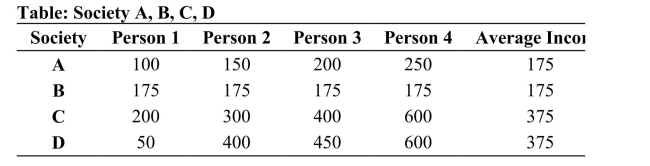 Reference: Ref 20-3 (Table: Society A, B, C, D) Refer to the table. According to the maximin principle, which of the societies is ranked highest?
A) A
B) B
C) C
D) D
Question
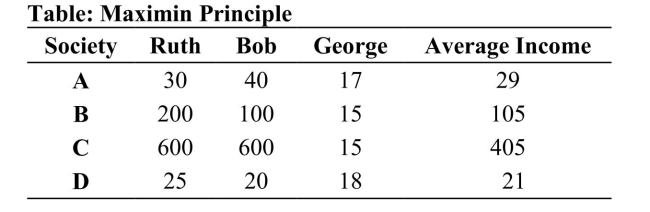 Reference: Ref 20-1 (Table: Maximin Principle) Refer to the table. If income is shown in thousands of dollars, which is the best society based on Rawls's principle?
A) Society A
B) Society B
C) Society C
D) Society D
Question
Question
Question
Question

 Reference: Ref 20-2 (Table: Rawls's Maximin) Refer to the table. According to the maximin principle, which of the societies is ranked lowest?
A) A
B) C
C) D
D) All societies are ranked equally.
Question
Question
Question
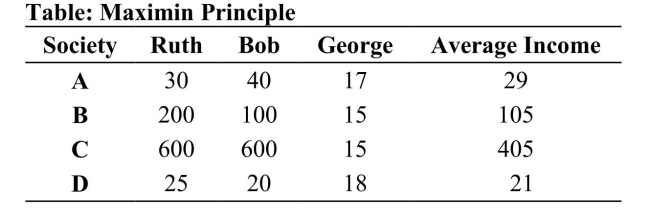 Reference: Ref 20-1 (Table: Maximin Principle) Refer to the table. If income is shown in thousands of dollars, according to Rawls's maximin principle, Society ________ is preferred to Society ________.
A) A; D
B) B; C
C) C; A
D) D; B
Question
Question
Question
Question
Question
Question
Question
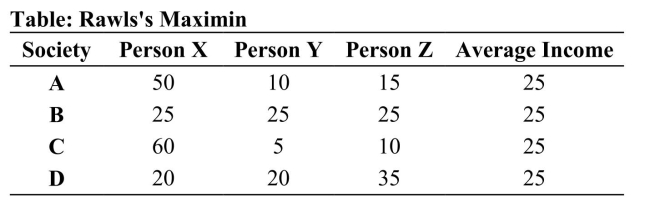 Reference: Ref 20-2 (Table: Rawls's Maximin) Refer to the table. According to the maximin principle, which of the societies is ranked highest?
A) A
B) B
C) D
D) All societies are ranked equally.
Question
Question
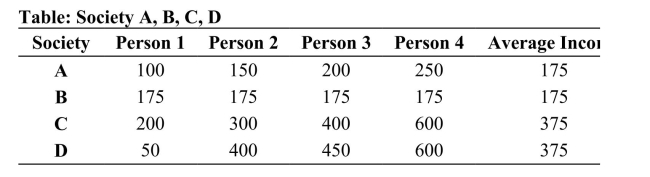 Reference: Ref 20-3 (Table: Society A, B, C, D) Refer to the table. According to the maximin principle, which of the societies is ranked lowest?
A) A
B) B
C) C
D) D
Question
Question
Question
Question
Question
Question
Question
Question
Question
Question
Question
Question
Question
Question
Question
Question
Question
Question
Question
Question

Unlock Deck
Sign up to unlock the cards in this deck!
Unlock Deck
Unlock Deck
1/151

Play

Full screen (f)
Deck 20: Political Economy and Public Choice
1
The problems of standard economic reasoning that need to be examined include all of the following EXCEPT:
A) the problem of exploitation.
B) meddlesome preferences.
C) unfair and unequal treatment.
D) cultural goods and paternalism.
A) the problem of exploitation.
B) meddlesome preferences.
C) unfair and unequal treatment.
D) cultural goods and paternalism.
C
2
Which of the following is a normative economic statement?
A) Tests should always be hard to ensure that students are challenged.
B) Quantity demanded for steak will fall if the price of steak rises.
C) Hot dogs and hot dog buns are generally complementary goods.
D) Each of these three statements uses normative economics.
A) Tests should always be hard to ensure that students are challenged.
B) Quantity demanded for steak will fall if the price of steak rises.
C) Hot dogs and hot dog buns are generally complementary goods.
D) Each of these three statements uses normative economics.
A
3
Gary Becker, a Nobel Prize-winning economist, argued for which of the following?
A) keeping the price of kidneys at $0
B) encouraging the importation of kidneys from less- developed countries
C) importing pollutants from less-developed countries
D) exporting pollutants to less-developed countries
A) keeping the price of kidneys at $0
B) encouraging the importation of kidneys from less- developed countries
C) importing pollutants from less-developed countries
D) exporting pollutants to less-developed countries
B
4
Why would a poor country accept pollution from a rich country?
A) The money payment is more valuable than the costs of having the pollution.
B) The poor country values health less than rich countries.
C) Poor countries have better technologies for storing pollution.
D) Poor countries have more space for storing pollution.
A) The money payment is more valuable than the costs of having the pollution.
B) The poor country values health less than rich countries.
C) Poor countries have better technologies for storing pollution.
D) Poor countries have more space for storing pollution.
Unlock Deck
Unlock for access to all 151 flashcards in this deck.
Unlock Deck
k this deck
5
Which of the following is a positive statement?
A) The government should limit imports of sugar.
B) Import restrictions on sugar will increase sugar prices.
C) Sugar is not good for you.
D) Import quotas on sugar are unfair to foreign sugar sellers.
A) The government should limit imports of sugar.
B) Import restrictions on sugar will increase sugar prices.
C) Sugar is not good for you.
D) Import quotas on sugar are unfair to foreign sugar sellers.
Unlock Deck
Unlock for access to all 151 flashcards in this deck.
Unlock Deck
k this deck
6
The difference between positive and normative economics is that:
A) positive economics is what you are learning in school whereas normative economics is what you will learn in the real world.
B) normative economics is based on proven fact whereas positive economics is based on what should be.
C) positive economics describes, explains and predicts economic events, whereas normative economics recommends what economic policies should look like.
D) economists always use positive economics whereas politicians always use normative economics.
A) positive economics is what you are learning in school whereas normative economics is what you will learn in the real world.
B) normative economics is based on proven fact whereas positive economics is based on what should be.
C) positive economics describes, explains and predicts economic events, whereas normative economics recommends what economic policies should look like.
D) economists always use positive economics whereas politicians always use normative economics.
Unlock Deck
Unlock for access to all 151 flashcards in this deck.
Unlock Deck
k this deck
7
Which of the following is a normative economic statement?
A) Raising the price of new textbooks will lead students to seek more used textbooks.
B) Raising the price of new textbooks will lead students to buy fewer new textbooks.
C) Publishers should not raise the price of new textbooks.
D) The price of new textbooks will rise if transportation costs and costs of paper rise.
A) Raising the price of new textbooks will lead students to seek more used textbooks.
B) Raising the price of new textbooks will lead students to buy fewer new textbooks.
C) Publishers should not raise the price of new textbooks.
D) The price of new textbooks will rise if transportation costs and costs of paper rise.
Unlock Deck
Unlock for access to all 151 flashcards in this deck.
Unlock Deck
k this deck
8
Which of the following is a positive economic statement?
A) Raising the price of steak should be a priority for a government that wishes to protect animal rights.
B) An export market that transports pollutants to less- developed countries will increase their short-run GDP.
C) The government should limit earnings for top management in corporations.
D) The government should not provide bailouts to corporations in financial trouble.
A) Raising the price of steak should be a priority for a government that wishes to protect animal rights.
B) An export market that transports pollutants to less- developed countries will increase their short-run GDP.
C) The government should limit earnings for top management in corporations.
D) The government should not provide bailouts to corporations in financial trouble.
Unlock Deck
Unlock for access to all 151 flashcards in this deck.
Unlock Deck
k this deck
9
Normative economics is about:
A) verifying and confirming economic policy.
B) describing, explaining, or predicting economic events.
C) prescribing and making a claim on the economy.
D) making recommendations about what economic policy should be.
A) verifying and confirming economic policy.
B) describing, explaining, or predicting economic events.
C) prescribing and making a claim on the economy.
D) making recommendations about what economic policy should be.
Unlock Deck
Unlock for access to all 151 flashcards in this deck.
Unlock Deck
k this deck
10
Which of the following is NOT a normative statement?
A) Import restrictions on sugar will increase sugar prices.
B) The government should limit imports of sugar.
C) Schools need to limit their students' sugar intake.
D) Import quotas on sugar are unfair to foreign sugar sellers.
A) Import restrictions on sugar will increase sugar prices.
B) The government should limit imports of sugar.
C) Schools need to limit their students' sugar intake.
D) Import quotas on sugar are unfair to foreign sugar sellers.
Unlock Deck
Unlock for access to all 151 flashcards in this deck.
Unlock Deck
k this deck
11
Presidential campaign speeches about economic policy are largely filled with:
A) poor economics.
B) normative economics.
C) positive economics.
D) false promises.
A) poor economics.
B) normative economics.
C) positive economics.
D) false promises.
Unlock Deck
Unlock for access to all 151 flashcards in this deck.
Unlock Deck
k this deck
12
The case for exporting pollution from rich countries to poor countries is based on:
A) the power of politics.
B) the power of coercion.
C) the power of trade.
D) monopoly power.
A) the power of politics.
B) the power of coercion.
C) the power of trade.
D) monopoly power.
Unlock Deck
Unlock for access to all 151 flashcards in this deck.
Unlock Deck
k this deck
13
Positive economics is:
A) about morals and values.
B) the method used to assess justice.
C) description of facts.
D) impossible to accomplish.
A) about morals and values.
B) the method used to assess justice.
C) description of facts.
D) impossible to accomplish.
Unlock Deck
Unlock for access to all 151 flashcards in this deck.
Unlock Deck
k this deck
14
Which of these statements is an example of positive economics?
A) A free market in kidneys would end the shortage of kidneys.
B) People should not sell organs for profit.
C) The United States should not trade with countries with human rights abuses.
D) All three of these statements are examples of positive economics.
A) A free market in kidneys would end the shortage of kidneys.
B) People should not sell organs for profit.
C) The United States should not trade with countries with human rights abuses.
D) All three of these statements are examples of positive economics.
Unlock Deck
Unlock for access to all 151 flashcards in this deck.
Unlock Deck
k this deck
15
Larry Summers argued that it makes economic sense for:
A) poor people to pay higher taxes.
B) rich countries to export their pollution to poor countries.
C) poor countries to pay higher taxes.
D) unemployment to be lower in heavily unionized states.
A) poor people to pay higher taxes.
B) rich countries to export their pollution to poor countries.
C) poor countries to pay higher taxes.
D) unemployment to be lower in heavily unionized states.
Unlock Deck
Unlock for access to all 151 flashcards in this deck.
Unlock Deck
k this deck
16
Which is NOT a so-called problem of economic reasoning?
A) meddlesome preferences
B) fair and equal treatment
C) exploitation
D) prices as information signals
A) meddlesome preferences
B) fair and equal treatment
C) exploitation
D) prices as information signals
Unlock Deck
Unlock for access to all 151 flashcards in this deck.
Unlock Deck
k this deck
17
Positive economics is about:
A) verifying and confirming economic policy.
B) describing, explaining, or predicting economic events.
C) prescribing and making a claim on the economy.
D) making recommendations about what economic policy should be.
A) verifying and confirming economic policy.
B) describing, explaining, or predicting economic events.
C) prescribing and making a claim on the economy.
D) making recommendations about what economic policy should be.
Unlock Deck
Unlock for access to all 151 flashcards in this deck.
Unlock Deck
k this deck
18
Which of these statements is an example of normative economics?
A) The Americans with Disabilities Act reduced employment opportunities for the disabled.
B) Rent controls reduce the housing stock.
C) Workers pay the majority of corporate taxes in the form of lower wages.
D) The government should not have bailed out the domestic automobile market.
A) The Americans with Disabilities Act reduced employment opportunities for the disabled.
B) Rent controls reduce the housing stock.
C) Workers pay the majority of corporate taxes in the form of lower wages.
D) The government should not have bailed out the domestic automobile market.
Unlock Deck
Unlock for access to all 151 flashcards in this deck.
Unlock Deck
k this deck
19
Which of the following is a positive economic statement?
A) Shortages in the kidney trade are a necessary phenomenon.
B) Animal rights activists are to blame for the high prices of real furs.
C) We should encourage the importation of kidneys from the less-developed countries.
D) A government-imposed price of zero for kidneys helps create a black market in kidneys.
A) Shortages in the kidney trade are a necessary phenomenon.
B) Animal rights activists are to blame for the high prices of real furs.
C) We should encourage the importation of kidneys from the less-developed countries.
D) A government-imposed price of zero for kidneys helps create a black market in kidneys.
Unlock Deck
Unlock for access to all 151 flashcards in this deck.
Unlock Deck
k this deck
20
In a now infamous leaked memo, Larry Summers argued for which of the following?
A) keeping the price of kidneys at $0
B) encouraging the importation of kidneys from less- developed countries
C) importing pollutants from less-developed countries
D) exporting pollutants to less-developed countries
A) keeping the price of kidneys at $0
B) encouraging the importation of kidneys from less- developed countries
C) importing pollutants from less-developed countries
D) exporting pollutants to less-developed countries
Unlock Deck
Unlock for access to all 151 flashcards in this deck.
Unlock Deck
k this deck
21
A city-owned hospital sends morbidly obese patients to the zoo to get an MRI. The city, however, could purchase a newer model MRI machine (at a cost of $2.5 million) that is capable of accommodating morbidly obese patients. This type of problem:
A) can usually be solved by economists.
B) can always be solved by economists.
C) cannot be solved by economists.
D) can be solved by economists who are trained in econometrics.
A) can usually be solved by economists.
B) can always be solved by economists.
C) cannot be solved by economists.
D) can be solved by economists who are trained in econometrics.
Unlock Deck
Unlock for access to all 151 flashcards in this deck.
Unlock Deck
k this deck
22
Many economists argue that kidney sales are ________ exploitative because ________.
A) not; they are market exchange that leaves both recipients and donors better off
B) always; the rich on average benefit at the expense of the poor
C) not; the government could set low prices
D) always; you cannot put a price on life
A) not; they are market exchange that leaves both recipients and donors better off
B) always; the rich on average benefit at the expense of the poor
C) not; the government could set low prices
D) always; you cannot put a price on life
Unlock Deck
Unlock for access to all 151 flashcards in this deck.
Unlock Deck
k this deck
23
Meddlesome preferences are ________ with ________.
A) consistent; liberty, rights, and religious freedom
B) inconsistent; liberty, rights, and religious freedom
C) consistent; more fundamental rights like the pursuit of life, liberty, and happiness
D) harmless; dictatorships
A) consistent; liberty, rights, and religious freedom
B) inconsistent; liberty, rights, and religious freedom
C) consistent; more fundamental rights like the pursuit of life, liberty, and happiness
D) harmless; dictatorships
Unlock Deck
Unlock for access to all 151 flashcards in this deck.
Unlock Deck
k this deck
24
Some people believe that trade such as the buying and selling of human kidneys is exploitative because:
A) poor people have less information than wealthy individuals.
B) wealthy individuals choose to buy kidneys from poor people only because they are willing to sell them for less.
C) poor people have little choice but to sell things (such as their own kidneys) which they would really rather keep.
D) these types of risky exchanges happen only in poor countries.
A) poor people have less information than wealthy individuals.
B) wealthy individuals choose to buy kidneys from poor people only because they are willing to sell them for less.
C) poor people have little choice but to sell things (such as their own kidneys) which they would really rather keep.
D) these types of risky exchanges happen only in poor countries.
Unlock Deck
Unlock for access to all 151 flashcards in this deck.
Unlock Deck
k this deck
25
It is often difficult to resolve meddlesome preferences with other values that are considered important such as:
A) liberty.
B) rights.
C) religious freedom.
D) All of the answers are correct.
A) liberty.
B) rights.
C) religious freedom.
D) All of the answers are correct.
Unlock Deck
Unlock for access to all 151 flashcards in this deck.
Unlock Deck
k this deck
26
Someone who believes that the sale of kidneys by the poor is exploitative would find which of the following price tags for a kidney most exploitative?
A) $0
B) $250
C) $10,000
D) $50,000
A) $0
B) $250
C) $10,000
D) $50,000
Unlock Deck
Unlock for access to all 151 flashcards in this deck.
Unlock Deck
k this deck
27
Opponents of kidney sales argue that:
A) paying someone to donate a kidney is exploitative.
B) poor people would benefit from a market in kidneys.
C) rich people would be exploited by paying large sums of money to the poor.
D) Opponents of kidney sales make all three of these arguments.
A) paying someone to donate a kidney is exploitative.
B) poor people would benefit from a market in kidneys.
C) rich people would be exploited by paying large sums of money to the poor.
D) Opponents of kidney sales make all three of these arguments.
Unlock Deck
Unlock for access to all 151 flashcards in this deck.
Unlock Deck
k this deck
28
The economic reasoning for exporting pollution from rich to poor countries is that:
A) the rich value health more than money and the poor value money more than health.
B) the rich value money more than health and the poor value health more than money.
C) pollution is a more severe problem in the rich countries than in the poor countries.
D) the poor countries can use the money they make to resolve the problems of pollution.
A) the rich value health more than money and the poor value money more than health.
B) the rich value money more than health and the poor value health more than money.
C) pollution is a more severe problem in the rich countries than in the poor countries.
D) the poor countries can use the money they make to resolve the problems of pollution.
Unlock Deck
Unlock for access to all 151 flashcards in this deck.
Unlock Deck
k this deck
29
Preferences over what other people do, even when their actions don't interfere in any direct way with the rest of society, are called:
A) interfering preferences.
B) intervening preferences.
C) meddlesome preferences.
D) officious preferences.
A) interfering preferences.
B) intervening preferences.
C) meddlesome preferences.
D) officious preferences.
Unlock Deck
Unlock for access to all 151 flashcards in this deck.
Unlock Deck
k this deck
30
A meddlesome preference is a(n):
A) interpersonal opinion about one's self- discipline.
B) interpersonal opinion about one's motivation.
C) preference about other people's behavior, even when it doesn't affect you.
D) preference about how the government should reform tax law.
A) interpersonal opinion about one's self- discipline.
B) interpersonal opinion about one's motivation.
C) preference about other people's behavior, even when it doesn't affect you.
D) preference about how the government should reform tax law.
Unlock Deck
Unlock for access to all 151 flashcards in this deck.
Unlock Deck
k this deck
31
The question of whether selling kidneys is exploitative boils down to the question of whether:
A) we could save more lives by allowing the sale of kidneys.
B) it is wrong to buy things from the poor just because they are poor.
C) it is risky to sell kidneys.
D) the poor would be better off with or without the additional income.
A) we could save more lives by allowing the sale of kidneys.
B) it is wrong to buy things from the poor just because they are poor.
C) it is risky to sell kidneys.
D) the poor would be better off with or without the additional income.
Unlock Deck
Unlock for access to all 151 flashcards in this deck.
Unlock Deck
k this deck
32
In which of the following cases do meddlesome preferences interfere with standard economic reasoning?
A) In a poor economy, the diet is very low in protein, and plenty of stray dogs abound. Sellers realize that dog meat would be profitable and deliver the protein needs of the people, but don't sell it because the animal rights society issued a ban against eating dogs.
B) Thousands of people are on the wait list for kidneys. However, the government does not allow the sale of kidneys even though people can survive very well with one kidney.
C) In poor countries, workers between the ages of 13 to 16 bring much-needed income to households. However, due to child labor laws in the richer countries, export industries in poor countries cannot hire these workers, leading to the poor getting poorer.
D) Each of these cases provides an example of meddlesome preferences.
A) In a poor economy, the diet is very low in protein, and plenty of stray dogs abound. Sellers realize that dog meat would be profitable and deliver the protein needs of the people, but don't sell it because the animal rights society issued a ban against eating dogs.
B) Thousands of people are on the wait list for kidneys. However, the government does not allow the sale of kidneys even though people can survive very well with one kidney.
C) In poor countries, workers between the ages of 13 to 16 bring much-needed income to households. However, due to child labor laws in the richer countries, export industries in poor countries cannot hire these workers, leading to the poor getting poorer.
D) Each of these cases provides an example of meddlesome preferences.
Unlock Deck
Unlock for access to all 151 flashcards in this deck.
Unlock Deck
k this deck
33
Suppose the sale of human kidneys was legal. If the seller of kidneys is well informed of the risks of the exchange, then:
A) some people believe this is not exploitation, but instead simply a voluntary trade.
B) the price of kidneys will be lower.
C) wealthy individuals will be just as likely to sell their kidneys as poor individuals.
D) these types of exchanges would happen only in poor countries.
A) some people believe this is not exploitation, but instead simply a voluntary trade.
B) the price of kidneys will be lower.
C) wealthy individuals will be just as likely to sell their kidneys as poor individuals.
D) these types of exchanges would happen only in poor countries.
Unlock Deck
Unlock for access to all 151 flashcards in this deck.
Unlock Deck
k this deck
34
Which of the following statements is TRUE?
A) It is illegal to sell horsemeat in European restaurants.
B) It is illegal to sell horsemeat in Japanese restaurants.
C) It is illegal to sell horsemeat in California restaurants.
D) All of these statements are correct.
A) It is illegal to sell horsemeat in European restaurants.
B) It is illegal to sell horsemeat in Japanese restaurants.
C) It is illegal to sell horsemeat in California restaurants.
D) All of these statements are correct.
Unlock Deck
Unlock for access to all 151 flashcards in this deck.
Unlock Deck
k this deck
35
A city-owned hospital sends morbidly obese patients to the zoo to get an MRI. The city, however, could purchase a newer model MRI machine (at a cost of $2.5 million) that is capable of accommodating morbidly obese patients. This example highlights the problem of:
A) exploitation.
B) meddlesome preferences.
C) fair and equal treatment.
D) the distribution of wealth.
A) exploitation.
B) meddlesome preferences.
C) fair and equal treatment.
D) the distribution of wealth.
Unlock Deck
Unlock for access to all 151 flashcards in this deck.
Unlock Deck
k this deck
36
Which of the following statements is TRUE?
A) New York City buses do not accommodate the disabled.
B) Taxpayers would have lost money if New York City had paid disabled people to use taxis rather than retrofitting city buses for wheelchair ramps.
C) New York City buses are capable of accepting passengers in wheelchairs.
D) New York City would have saved money if buses were used to transport the disabled rather than taxicabs.
A) New York City buses do not accommodate the disabled.
B) Taxpayers would have lost money if New York City had paid disabled people to use taxis rather than retrofitting city buses for wheelchair ramps.
C) New York City buses are capable of accepting passengers in wheelchairs.
D) New York City would have saved money if buses were used to transport the disabled rather than taxicabs.
Unlock Deck
Unlock for access to all 151 flashcards in this deck.
Unlock Deck
k this deck
37
It is sometimes difficult to see the difference between:
A) inequality and the distribution of wealth.
B) risk and fair treatment.
C) exploitation and exchange.
D) fair treatment and equality.
A) inequality and the distribution of wealth.
B) risk and fair treatment.
C) exploitation and exchange.
D) fair treatment and equality.
Unlock Deck
Unlock for access to all 151 flashcards in this deck.
Unlock Deck
k this deck
38
The economic reasoning for importing kidneys is that: I. trade may save many kidney-failure patients' lives. II. people who are allowed to sell their kidneys earn more income. III. buyers and sellers of kidneys can both be made better off by trade.
A) II only
B) II and III only
C) I and III only
D) I, II, and III
A) II only
B) II and III only
C) I and III only
D) I, II, and III
Unlock Deck
Unlock for access to all 151 flashcards in this deck.
Unlock Deck
k this deck
39
Why does economic efficiency not always result in fair and equal treatment?
A) Efficiency demands cost-minimization, which may cause the non-production of expensive items or adjustments designed to ensure that disadvantaged members of society are catered for.
B) Market efficiency requires that only profitable goods be produced in order to maximize the return from using scarce resources and some goods for the disadvantaged may not always yield profits.
C) Market efficiency does not always allow firms to hire disadvantaged members of society so labor and governments sometimes have to step in to demand hiring of some of these individuals.
D) All of these explanations are correct.
A) Efficiency demands cost-minimization, which may cause the non-production of expensive items or adjustments designed to ensure that disadvantaged members of society are catered for.
B) Market efficiency requires that only profitable goods be produced in order to maximize the return from using scarce resources and some goods for the disadvantaged may not always yield profits.
C) Market efficiency does not always allow firms to hire disadvantaged members of society so labor and governments sometimes have to step in to demand hiring of some of these individuals.
D) All of these explanations are correct.
Unlock Deck
Unlock for access to all 151 flashcards in this deck.
Unlock Deck
k this deck
40
Which of the following hold to a meddlesome preference?
A) people who are against interracial dating
B) people who are against sodomy
C) people who are against certain religious practices
D) All of the answers are correct.
A) people who are against interracial dating
B) people who are against sodomy
C) people who are against certain religious practices
D) All of the answers are correct.
Unlock Deck
Unlock for access to all 151 flashcards in this deck.
Unlock Deck
k this deck
41
The Rawls's maximin principle has had ________ among economists because it ________ trade-offs.
A) great influence; emphasizes
B) little influence; ignores
C) little influence; over emphasizes
D) great influence; ignores
A) great influence; emphasizes
B) little influence; ignores
C) little influence; over emphasizes
D) great influence; ignores
Unlock Deck
Unlock for access to all 151 flashcards in this deck.
Unlock Deck
k this deck
42
What is the title of John Rawls's book about income and wealth distribution?
A) Anarchy, State, and Utopia
B) The Wealth of Nations
C) A Theory of Justice
D) A Theory of Efficiency
A) Anarchy, State, and Utopia
B) The Wealth of Nations
C) A Theory of Justice
D) A Theory of Efficiency
Unlock Deck
Unlock for access to all 151 flashcards in this deck.
Unlock Deck
k this deck
43
Reference: Ref 20-3 (Table: Society A, B, C, D) Refer to the table. According to the maximin principle, which of the societies is ranked highest?A) A
B) B
C) C
D) D
Unlock Deck
Unlock for access to all 151 flashcards in this deck.
Unlock Deck
k this deck
44
Reference: Ref 20-1 (Table: Maximin Principle) Refer to the table. If income is shown in thousands of dollars, which is the best society based on Rawls's principle?A) Society A
B) Society B
C) Society C
D) Society D
Unlock Deck
Unlock for access to all 151 flashcards in this deck.
Unlock Deck
k this deck
45
The maximin principle, utilitarianism, and entitlement theory of justice are concerned with issues of:
A) income distribution.
B) money supply and inflation.
C) consumer sovereignty.
D) economic forecasting.
A) income distribution.
B) money supply and inflation.
C) consumer sovereignty.
D) economic forecasting.
Unlock Deck
Unlock for access to all 151 flashcards in this deck.
Unlock Deck
k this deck
46
Rawls's maximin principle is based on:
A) minimizing the income of the wealthiest in society.
B) trade-offs between efficiency and equity.
C) finding the Nash equilibrium for society.
D) maximizing the benefits to the most disadvantaged group in society.
A) minimizing the income of the wealthiest in society.
B) trade-offs between efficiency and equity.
C) finding the Nash equilibrium for society.
D) maximizing the benefits to the most disadvantaged group in society.
Unlock Deck
Unlock for access to all 151 flashcards in this deck.
Unlock Deck
k this deck
47
The problem with kidney sales and exporting pollution to poor countries is not trade per se but the:
A) demand and supply making the trade happen.
B) poverty and inequality making the trade happen.
C) surplus and shortage making the trade happen.
D) market making the trade happen.
A) demand and supply making the trade happen.
B) poverty and inequality making the trade happen.
C) surplus and shortage making the trade happen.
D) market making the trade happen.
Unlock Deck
Unlock for access to all 151 flashcards in this deck.
Unlock Deck
k this deck
48
Reference: Ref 20-2 (Table: Rawls's Maximin) Refer to the table. According to the maximin principle, which of the societies is ranked lowest?A) A
B) C
C) D
D) All societies are ranked equally.
Unlock Deck
Unlock for access to all 151 flashcards in this deck.
Unlock Deck
k this deck
49
Most university officials believe students should exercise regularly, and thus charge them a mandatory gym fee so that they can regularly use university gym facilities. Many students do not use the gym facilities and would prefer to use the money for textbooks or food. Which one of the following arguments against standard economic reasoning can be applied to this scenario?
A) fair and equal treatment
B) cultural goods and paternalism
C) poverty, inequality, and the distribution of income
D) exploitation
A) fair and equal treatment
B) cultural goods and paternalism
C) poverty, inequality, and the distribution of income
D) exploitation
Unlock Deck
Unlock for access to all 151 flashcards in this deck.
Unlock Deck
k this deck
50
The pragmatic criticism argues that the French government's subsidy schemes tend to be:
A) productive and effective.
B) productive but unnecessary.
C) counterproductive but necessary.
D) counterproductive and wasteful.
A) productive and effective.
B) productive but unnecessary.
C) counterproductive but necessary.
D) counterproductive and wasteful.
Unlock Deck
Unlock for access to all 151 flashcards in this deck.
Unlock Deck
k this deck
51
Reference: Ref 20-1 (Table: Maximin Principle) Refer to the table. If income is shown in thousands of dollars, according to Rawls's maximin principle, Society ________ is preferred to Society ________.A) A; D
B) B; C
C) C; A
D) D; B
Unlock Deck
Unlock for access to all 151 flashcards in this deck.
Unlock Deck
k this deck
52
What principle was the basis for equipping buses in New York City for wheelchair service?
A) efficiency
B) paternalism
C) poverty reduction
D) fair and equal treatment
A) efficiency
B) paternalism
C) poverty reduction
D) fair and equal treatment
Unlock Deck
Unlock for access to all 151 flashcards in this deck.
Unlock Deck
k this deck
53
The notion of fair and equal treatment can:
A) match the value of trade and efficiency.
B) be irrelevant to the value of trade and efficiency.
C) enhance the value of trade and efficiency.
D) run up against the value of trade and efficiency.
A) match the value of trade and efficiency.
B) be irrelevant to the value of trade and efficiency.
C) enhance the value of trade and efficiency.
D) run up against the value of trade and efficiency.
Unlock Deck
Unlock for access to all 151 flashcards in this deck.
Unlock Deck
k this deck
54
Which of the following assertions about the principle of fair and equal treatment is correct?
A) Fair and equal treatment does not apply in New York City.
B) Mass transit is really about not making people feel different or disadvantaged.
C) Handicapped should have easier and more luxurious transport options.
D) Equipping buses to accept handicapped passengers increases the value of efficiency.
A) Fair and equal treatment does not apply in New York City.
B) Mass transit is really about not making people feel different or disadvantaged.
C) Handicapped should have easier and more luxurious transport options.
D) Equipping buses to accept handicapped passengers increases the value of efficiency.
Unlock Deck
Unlock for access to all 151 flashcards in this deck.
Unlock Deck
k this deck
55
The view that has proven especially influential on normative policy judgments is:
A) John Rawls's maximin principle.
B) utilitarianism.
C) Robert Nozick's entitlement theory of justice.
D) All three of these views have been very influential on normative policies in the past.
A) John Rawls's maximin principle.
B) utilitarianism.
C) Robert Nozick's entitlement theory of justice.
D) All three of these views have been very influential on normative policies in the past.
Unlock Deck
Unlock for access to all 151 flashcards in this deck.
Unlock Deck
k this deck
56
Which of the following statements is TRUE?
A) The French government mandates that 40 percent of the movies shown on TV must be French-language movies.
B) The French government encourages rock-and-roll music from French bands instead of American and British rock bands.
C) In general, the French government tries to support French culture.
D) Each of these statements is correct.
A) The French government mandates that 40 percent of the movies shown on TV must be French-language movies.
B) The French government encourages rock-and-roll music from French bands instead of American and British rock bands.
C) In general, the French government tries to support French culture.
D) Each of these statements is correct.
Unlock Deck
Unlock for access to all 151 flashcards in this deck.
Unlock Deck
k this deck
57
The French government spends what percent of GDP per year subsidizing culture?
A) 0.5 percent
B) 1.0 percent
C) 1.5 percent
D) 2.0 percent
A) 0.5 percent
B) 1.0 percent
C) 1.5 percent
D) 2.0 percent
Unlock Deck
Unlock for access to all 151 flashcards in this deck.
Unlock Deck
k this deck
58
Reference: Ref 20-2 (Table: Rawls's Maximin) Refer to the table. According to the maximin principle, which of the societies is ranked highest?A) A
B) B
C) D
D) All societies are ranked equally.
Unlock Deck
Unlock for access to all 151 flashcards in this deck.
Unlock Deck
k this deck
59
An unintended consequence of the French government's support for French-language movies is that:
A) it lowers the quality of French movies.
B) it increases the quality of French movies.
C) it makes French movies more internationally competitive.
D) it has no effect on the viewing habits of French movie fans.
A) it lowers the quality of French movies.
B) it increases the quality of French movies.
C) it makes French movies more internationally competitive.
D) it has no effect on the viewing habits of French movie fans.
Unlock Deck
Unlock for access to all 151 flashcards in this deck.
Unlock Deck
k this deck
60
Reference: Ref 20-3 (Table: Society A, B, C, D) Refer to the table. According to the maximin principle, which of the societies is ranked lowest?A) A
B) B
C) C
D) D
Unlock Deck
Unlock for access to all 151 flashcards in this deck.
Unlock Deck
k this deck
61
Nozick argued that the distribution of income is:
A) important in assessing justice in society.
B) not relevant in understanding what is just.
C) a stable and achievable ideal.
D) the most important value in society.
A) important in assessing justice in society.
B) not relevant in understanding what is just.
C) a stable and achievable ideal.
D) the most important value in society.
Unlock Deck
Unlock for access to all 151 flashcards in this deck.
Unlock Deck
k this deck
62
Under utilitarianism, we try to implement the outcome that:
A) makes equal allocation of utility to society.
B) raises utility of the most productive workers in the society.
C) increases utility to lower-income people in the society.
D) brings the greatest sum of utility to society.
A) makes equal allocation of utility to society.
B) raises utility of the most productive workers in the society.
C) increases utility to lower-income people in the society.
D) brings the greatest sum of utility to society.
Unlock Deck
Unlock for access to all 151 flashcards in this deck.
Unlock Deck
k this deck
63
John Rawls's A Theory of Justice, published in 1971, argued that ________ is/are key(s) for evaluating social policy.
A) design of the tax system
B) economic welfare
C) interaction of suppliers and demanders
D) questions of income and wealth distribution
A) design of the tax system
B) economic welfare
C) interaction of suppliers and demanders
D) questions of income and wealth distribution
Unlock Deck
Unlock for access to all 151 flashcards in this deck.
Unlock Deck
k this deck
64
Which of the following statements about the maximin principle is correct?
A) Doing well by the better-off group is more important than improving the lot of worst-off groups.
B) Doing well by the worst-off group is more important than improving the lot of any other group.
C) Doing well by both the better-off group and worst- off group is equally important.
D) Doing well by neither the better-off group nor worst-off group is important.
A) Doing well by the better-off group is more important than improving the lot of worst-off groups.
B) Doing well by the worst-off group is more important than improving the lot of any other group.
C) Doing well by both the better-off group and worst- off group is equally important.
D) Doing well by neither the better-off group nor worst-off group is important.
Unlock Deck
Unlock for access to all 151 flashcards in this deck.
Unlock Deck
k this deck
65
Utilitarians are likely to suggest that taking a dollar from a rich person and giving it to a poor person:
A) increases society's total well-being because the loss in utility to the rich person is more than offset by the gain in utility to the poor person.
B) decreases society's total well-being because the loss in utility to the rich person is more than offset by the gain in utility to the poor person.
C) decreases society's total well-being because the gain in utility to the rich person exceeds the loss in utility to the poor person.
D) increases society's total well-being because the gain in utility to the rich person exceeds the loss in utility to the poor person.
A) increases society's total well-being because the loss in utility to the rich person is more than offset by the gain in utility to the poor person.
B) decreases society's total well-being because the loss in utility to the rich person is more than offset by the gain in utility to the poor person.
C) decreases society's total well-being because the gain in utility to the rich person exceeds the loss in utility to the poor person.
D) increases society's total well-being because the gain in utility to the rich person exceeds the loss in utility to the poor person.
Unlock Deck
Unlock for access to all 151 flashcards in this deck.
Unlock Deck
k this deck
66
Entitlement theory argues that:
A) capitalistic systems based on voluntary trade reduce income inequality.
B) market trades between consenting adults lead to income inequality.
C) market trades between consenting adults lead to an equal distribution of income.
D) the rich should compensate the poor.
A) capitalistic systems based on voluntary trade reduce income inequality.
B) market trades between consenting adults lead to income inequality.
C) market trades between consenting adults lead to an equal distribution of income.
D) the rich should compensate the poor.
Unlock Deck
Unlock for access to all 151 flashcards in this deck.
Unlock Deck
k this deck
67
Which of the following cases is likely a suggestion of the utilitarian?
A) Some amount of money should be redistributed from less productive people to more productive people.
B) Some amount of money should be redistributed from more productive people to less productive people.
C) Some amount of money should be redistributed from poor people to rich people.
D) Some amount of money should be redistributed from rich people toward poor people.
A) Some amount of money should be redistributed from less productive people to more productive people.
B) Some amount of money should be redistributed from more productive people to less productive people.
C) Some amount of money should be redistributed from poor people to rich people.
D) Some amount of money should be redistributed from rich people toward poor people.
Unlock Deck
Unlock for access to all 151 flashcards in this deck.
Unlock Deck
k this deck
68
The maximin principle is the idea that a government should:
A) maximize the benefits accruing to the most disadvantaged group in society.
B) maximize the benefits accruing to the most advantaged group in society.
C) minimize the benefits accruing to the most disadvantaged group in society.
D) minimize the benefits accruing to the most advantaged group in society.
A) maximize the benefits accruing to the most disadvantaged group in society.
B) maximize the benefits accruing to the most advantaged group in society.
C) minimize the benefits accruing to the most disadvantaged group in society.
D) minimize the benefits accruing to the most advantaged group in society.
Unlock Deck
Unlock for access to all 151 flashcards in this deck.
Unlock Deck
k this deck
69
What is the maximin principle?
A) that government should minimize benefits that the maximum income earners receive from society, allowing others to become better-off
B) that government should maximize benefits that the minimum income earners receive from society, making them as well-off as possible
C) that the least well-off people in society should be made as well-off as anyone else in society
D) that the most well-off people in society should have a maximum level of wealth
A) that government should minimize benefits that the maximum income earners receive from society, allowing others to become better-off
B) that government should maximize benefits that the minimum income earners receive from society, making them as well-off as possible
C) that the least well-off people in society should be made as well-off as anyone else in society
D) that the most well-off people in society should have a maximum level of wealth
Unlock Deck
Unlock for access to all 151 flashcards in this deck.
Unlock Deck
k this deck
70
Taking into account the incentive effects of redistribution on the poor, utilitarianism suggests that:
A) giving dollars to poor people is the best way to improve their welfare.
B) giving dollars to poor people is not always the best way to improve their welfare.
C) poor people tend to be more responsive to incentives.
D) poor people tend to be less responsive to incentives.
A) giving dollars to poor people is the best way to improve their welfare.
B) giving dollars to poor people is not always the best way to improve their welfare.
C) poor people tend to be more responsive to incentives.
D) poor people tend to be less responsive to incentives.
Unlock Deck
Unlock for access to all 151 flashcards in this deck.
Unlock Deck
k this deck
71
The maximin principle is influential among philosophers but less so among economists because economists contend that:
A) a little bit less income for the worst-off might be acceptable if it comes with a big enough gain to others.
B) lower average income might be acceptable if income is more equally divideB.
C) higher average income is always better.
D) a larger income inequality may be acceptable if the worst-off are less productive.
A) a little bit less income for the worst-off might be acceptable if it comes with a big enough gain to others.
B) lower average income might be acceptable if income is more equally divideB.
C) higher average income is always better.
D) a larger income inequality may be acceptable if the worst-off are less productive.
Unlock Deck
Unlock for access to all 151 flashcards in this deck.
Unlock Deck
k this deck
72
Which of the following is NOT a limitation of utilitarianism?
A) People have differing preferences.
B) Happiness is difficult to measure.
C) People respond differently to incentives.
D) Just acquisition of goods.
A) People have differing preferences.
B) Happiness is difficult to measure.
C) People respond differently to incentives.
D) Just acquisition of goods.
Unlock Deck
Unlock for access to all 151 flashcards in this deck.
Unlock Deck
k this deck
73
Under which circumstances would utilitarians favor a redistribution of income from poor individuals to rich individuals?
A) always
B) if the marginal utility lost by the poor individuals was less than the marginal utility gained by the rich individuals
C) if the marginal utility gained by the poor individuals was less than the marginal utility lost by the rich individuals
D) never
A) always
B) if the marginal utility lost by the poor individuals was less than the marginal utility gained by the rich individuals
C) if the marginal utility gained by the poor individuals was less than the marginal utility lost by the rich individuals
D) never
Unlock Deck
Unlock for access to all 151 flashcards in this deck.
Unlock Deck
k this deck
74
For Nozick, the relevant basis of the justice of wealth and income distribution is:
A) the degree of equality of income.
B) whether income differences can be eliminated.
C) the natural limits of income.
D) whether income differences are justly acquired.
A) the degree of equality of income.
B) whether income differences can be eliminated.
C) the natural limits of income.
D) whether income differences are justly acquired.
Unlock Deck
Unlock for access to all 151 flashcards in this deck.
Unlock Deck
k this deck
75
Utilitarians:
A) are similar to animal activists, they represent those that would otherwise have no voice in government.
B) do not always try to make the poorest people as well-off as possible.
C) believe we should make the distribution of income more equal across all individuals.
D) believe those who earn income through productive activities should be allowed to keep it.
A) are similar to animal activists, they represent those that would otherwise have no voice in government.
B) do not always try to make the poorest people as well-off as possible.
C) believe we should make the distribution of income more equal across all individuals.
D) believe those who earn income through productive activities should be allowed to keep it.
Unlock Deck
Unlock for access to all 151 flashcards in this deck.
Unlock Deck
k this deck
76
Nozick's entitlement theory is also known as:
A) the republican theory of justice.
B) the democratic theory of justice.
C) the libertarian theory of justice.
D) the democratic socialist theory of distribution.
A) the republican theory of justice.
B) the democratic theory of justice.
C) the libertarian theory of justice.
D) the democratic socialist theory of distribution.
Unlock Deck
Unlock for access to all 151 flashcards in this deck.
Unlock Deck
k this deck
77
Consider the statement: Giving an extra dollar to a homeless person provides more additional utility than giving an extra dollar to a corporate CEO. Economic theory:
A) doesn't allow economists to directly test this statement.
B) can test this proposition scientifically.
C) leads economists to agree with this statement.
D) can test this proposition by examining tax returns.
A) doesn't allow economists to directly test this statement.
B) can test this proposition scientifically.
C) leads economists to agree with this statement.
D) can test this proposition by examining tax returns.
Unlock Deck
Unlock for access to all 151 flashcards in this deck.
Unlock Deck
k this deck
78
The goal of utilitarianism is to:
A) ensure that everyone is equal.
B) maximize the happiness of the poor.
C) create the greatest happiness for society.
D) prevent recessions, high unemployment, and inflation.
A) ensure that everyone is equal.
B) maximize the happiness of the poor.
C) create the greatest happiness for society.
D) prevent recessions, high unemployment, and inflation.
Unlock Deck
Unlock for access to all 151 flashcards in this deck.
Unlock Deck
k this deck
79
Which of the following might limit the amount of wealth a utilitarian would redistribute from rich to poor?
A) incentives
B) perceptions
C) price
D) utility
A) incentives
B) perceptions
C) price
D) utility
Unlock Deck
Unlock for access to all 151 flashcards in this deck.
Unlock Deck
k this deck
80
Who argued that income inequality is not a problem as long as income was justly acquired?
A) Peter Singer
B) Robert Nozick
C) John Craine
D) John Rawls
A) Peter Singer
B) Robert Nozick
C) John Craine
D) John Rawls
Unlock Deck
Unlock for access to all 151 flashcards in this deck.
Unlock Deck
k this deck
Unlock Deck
Unlock for access to all 151 flashcards in this deck.






