







 Chat with AI

Deck 35: Plant Structure and Growth
Full screen (f)

Question
The following question is based on data from Northern Red Maples in the table below
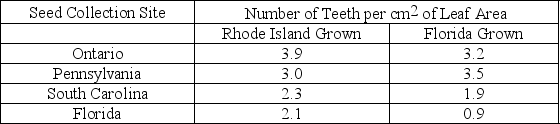
Which data above best illustrates phenotypic plasticity in leaf "toothiness"?
A) Rhode Island Grown, Ontario Collected and Florida Grown, Florida Collected
B) Florida Grown, Ontario Collected and Florida Grown, Florida Collected
C) Rhode Island Grown, Ontario Collected and Rhode Island Grown, Florida Collected
D) Rhode Island Grown, Florida Collected and Florida Grown, Florida Collected
Which data above best illustrates phenotypic plasticity in leaf "toothiness"?
A) Rhode Island Grown, Ontario Collected and Florida Grown, Florida Collected
B) Florida Grown, Ontario Collected and Florida Grown, Florida Collected
C) Rhode Island Grown, Ontario Collected and Rhode Island Grown, Florida Collected
D) Rhode Island Grown, Florida Collected and Florida Grown, Florida Collected

Question
Question
Question
Question
Question
Question
Question
Question
Question
Question
Question
Question
The following question is based on the figure below. 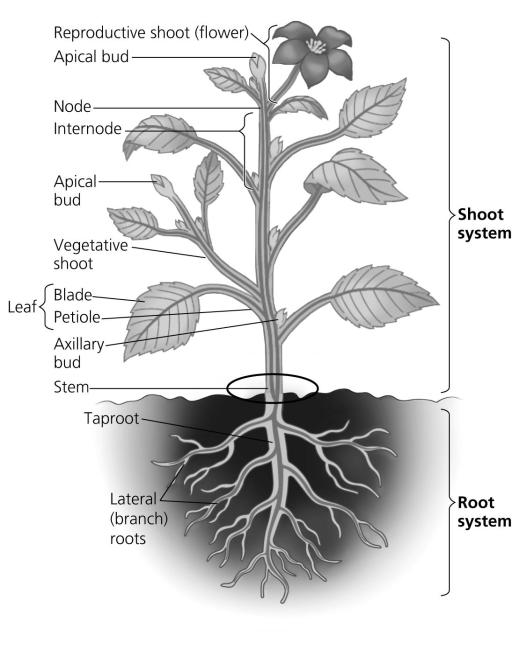 Which of the following must have occurred during development in the region between the root and stem circled on this diagram of an herbaceous eudicot?
A) the endodermis in the root must convert into the epidermis of the stem
B) the xylem in the root must split into separate strands in the stem
C) each vascular bundle of the root spreads as it moves up into the stem
D) the parenchyma core of the root is continuous with the pith of the stem
Which of the following must have occurred during development in the region between the root and stem circled on this diagram of an herbaceous eudicot?A) the endodermis in the root must convert into the epidermis of the stem
B) the xylem in the root must split into separate strands in the stem
C) each vascular bundle of the root spreads as it moves up into the stem
D) the parenchyma core of the root is continuous with the pith of the stem
Question
Question
Question
The following question is based on the diagram of three-years-old growth in a winter twig below. 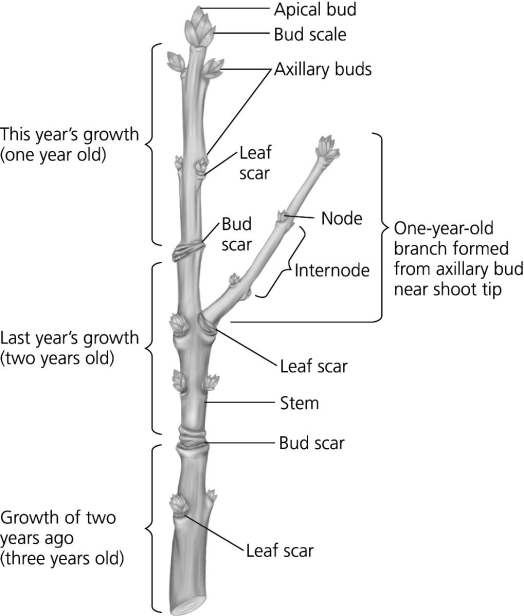 If you examined the cut surface at the base of this twig, how many growth rings should be present?
A) one
B) two
C) three
D) either two or three, depending on when secondary growth began.
If you examined the cut surface at the base of this twig, how many growth rings should be present?A) one
B) two
C) three
D) either two or three, depending on when secondary growth began.
Question
Question
Question
The following question is based on the figure below. 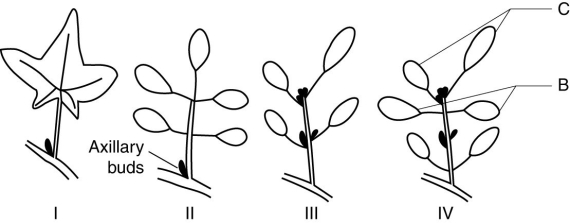 In the diagram above, the dark "dots" represent axillary buds. Which diagram illustrates a compound leaf?
A) I only
B) II only
C) III only
D) both II and III
In the diagram above, the dark "dots" represent axillary buds. Which diagram illustrates a compound leaf?A) I only
B) II only
C) III only
D) both II and III
Question
Question
Question
Question
Question
The following question is based on the drawings of root or stem cross sections shown in the figure. 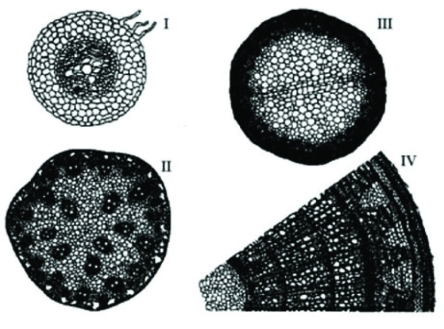 Refer to the figure. Which of the following represents a plant at least three years old?
A) I only
B) II only
C) III only
D) IV only
Refer to the figure. Which of the following represents a plant at least three years old?A) I only
B) II only
C) III only
D) IV only
Question
Question
Question
Question
Question
The following question is based on the drawings of root or stem cross sections shown in the figure. 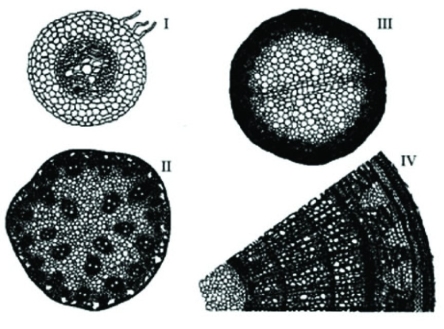 Refer to the figure. A monocot stem is represented by which of the following?
A) I only
B) II only
C) III only
D) IV only
Refer to the figure. A monocot stem is represented by which of the following?A) I only
B) II only
C) III only
D) IV only
Question
Question
Question
Question
Question
Question
Question
Question
Question
Question
Question
The following question is based on the drawings of root or stem cross sections shown in the figure. 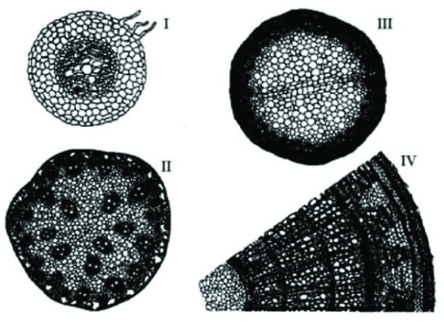 Refer to the figure. A woody eudicot is represented by which of the following?
A) II only
B) III only
C) IV only
D) I and III
Refer to the figure. A woody eudicot is represented by which of the following?A) II only
B) III only
C) IV only
D) I and III
Question
Question
The following question is based on the image below. 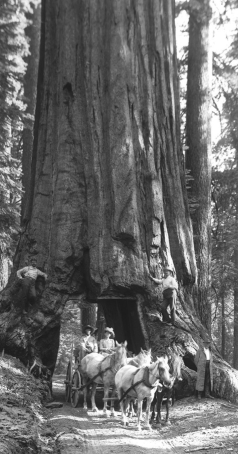 As this wagon passed from the middle of the Sequoia tree to the outside, what would be the order of tissues it passed through?
A) the annual rings, new xylem, vascular cambium, phloem, and bark
B) the secondary xylem, cork cambium, phloem, and periderm
C) the vascular cambium, oldest xylem, newest xylem, and primary phloem
D) the secondary xylem, primary xylem, secondary phloem, primary phloem and vascular cambium
As this wagon passed from the middle of the Sequoia tree to the outside, what would be the order of tissues it passed through?A) the annual rings, new xylem, vascular cambium, phloem, and bark
B) the secondary xylem, cork cambium, phloem, and periderm
C) the vascular cambium, oldest xylem, newest xylem, and primary phloem
D) the secondary xylem, primary xylem, secondary phloem, primary phloem and vascular cambium
Question
Question
The following diagram is of a cross section of a plant leaf. Use the diagram to answer the question. 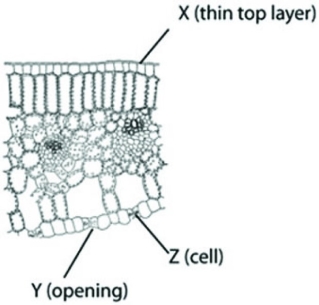 Which of the following is the main function associated with structure Y?
A) absorption of carbon dioxide
B) absorption of water
C) collection of light
D) release of carbon dioxide
Which of the following is the main function associated with structure Y?A) absorption of carbon dioxide
B) absorption of water
C) collection of light
D) release of carbon dioxide
Question
Question
The following diagram is of a cross section of a plant leaf. Use the diagram to answer the question. 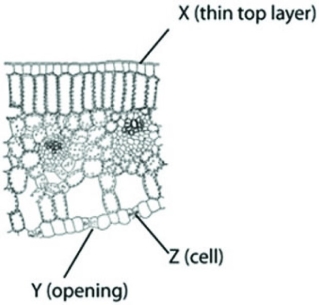 Which of the following is the main function associated with structure X?
A) absorption of carbon dioxide
B) retention of water
C) collection of light
D) release of carbon dioxide
Which of the following is the main function associated with structure X?A) absorption of carbon dioxide
B) retention of water
C) collection of light
D) release of carbon dioxide
Question
Question
Question
Question
Question
Question
Question
Question
Question
Question
Question
Question
Question
The image below is a cross section through a young root tip with a layer of root cap cells surrounding the developing epidermis and interior tissues. The darker epidermal cells are stained to express the homeotic gene GLABRA-2. Which of the following best predicts what will be the appearance of this part of the mature root? 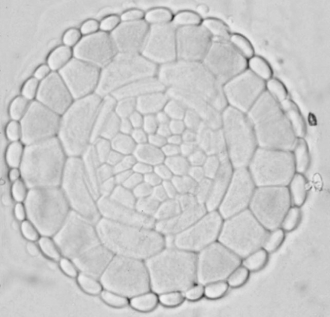
A) The epidermis will lack root hairs.
B) Only the stained epidermal cells will develop root hairs.
C) Only the unstained cells will develop root hairs.
D) Every epidermal cell will develop a root hair.
A) The epidermis will lack root hairs.
B) Only the stained epidermal cells will develop root hairs.
C) Only the unstained cells will develop root hairs.
D) Every epidermal cell will develop a root hair.
Question
The following question is based on this cross section of a monocot stem. 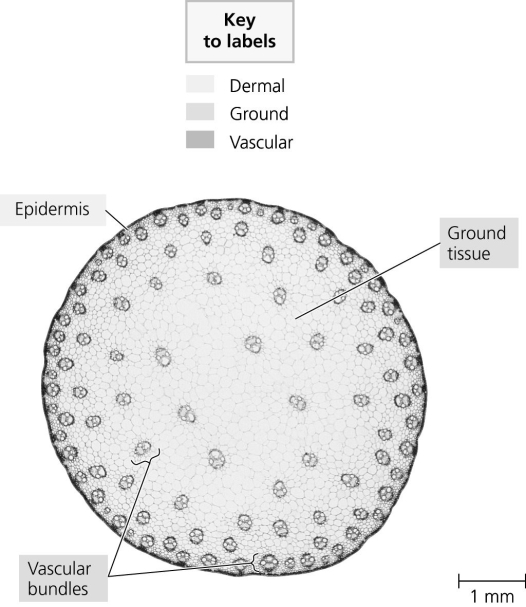 Which of the following is NOT a pattern of vascular bundles evident in this stem?
A) smaller vascular bundles toward the outside, larger bundles toward the center
B) xylem toward the outside of each bundle, phloem toward the center
C) vascular bundles more densely arranged toward the outside, less dense towards the center
D) vascular bundles arranged in concentric rings
Which of the following is NOT a pattern of vascular bundles evident in this stem?A) smaller vascular bundles toward the outside, larger bundles toward the center
B) xylem toward the outside of each bundle, phloem toward the center
C) vascular bundles more densely arranged toward the outside, less dense towards the center
D) vascular bundles arranged in concentric rings
Question
Question
Question
Question
Question
Question
Question
Question

Unlock Deck
Sign up to unlock the cards in this deck!
Unlock Deck
Unlock Deck
1/68

Play

Full screen (f)
Deck 35: Plant Structure and Growth
1
The following question is based on data from Northern Red Maples in the table below
Which data above best illustrates phenotypic plasticity in leaf "toothiness"?
A) Rhode Island Grown, Ontario Collected and Florida Grown, Florida Collected
B) Florida Grown, Ontario Collected and Florida Grown, Florida Collected
C) Rhode Island Grown, Ontario Collected and Rhode Island Grown, Florida Collected
D) Rhode Island Grown, Florida Collected and Florida Grown, Florida Collected
Which data above best illustrates phenotypic plasticity in leaf "toothiness"?
A) Rhode Island Grown, Ontario Collected and Florida Grown, Florida Collected
B) Florida Grown, Ontario Collected and Florida Grown, Florida Collected
C) Rhode Island Grown, Ontario Collected and Rhode Island Grown, Florida Collected
D) Rhode Island Grown, Florida Collected and Florida Grown, Florida Collected
D
2
Which of the following accurately describes meristematic plant cells?
A) All tissues throughout the plant contain meristematic cells.
B) Meristematic cells are undifferentiated cells that produce new cells.
C) Meristematic cells increase the surface area of dermal tissue by developing root hairs.
D) Parenchyma, ground meristem, and procambium are three subdivisions of meristematic cells.
A) All tissues throughout the plant contain meristematic cells.
B) Meristematic cells are undifferentiated cells that produce new cells.
C) Meristematic cells increase the surface area of dermal tissue by developing root hairs.
D) Parenchyma, ground meristem, and procambium are three subdivisions of meristematic cells.
B
3
Which of the following describes an anatomical difference between roots and leaves?
A) only leaves have phloem and only roots have xylem
B) root cells have cell walls and leaf cells do not
C) a waxy cuticle covers leaves but is absent from roots
D) vascular tissue is found in roots but is absent from leaves
A) only leaves have phloem and only roots have xylem
B) root cells have cell walls and leaf cells do not
C) a waxy cuticle covers leaves but is absent from roots
D) vascular tissue is found in roots but is absent from leaves
C
4
Which of the following structures is a modified horizontal shoot growing along the soil surface?
A) rhizome
B) tuber
C) stolon
D) rhizoid
A) rhizome
B) tuber
C) stolon
D) rhizoid
Unlock Deck
Unlock for access to all 68 flashcards in this deck.
Unlock Deck
k this deck
5
Some understory plants in dense tropical rain forests have very large leaves. Which of the following is the most likely selective advantage of these leaves?
A) The higher oxygen concentration on the forest floor stimulates leaf growth.
B) High rates of photosynthesis from these large leaves lower carbon dioxide levels in the interior of the forest.
C) Low light levels slow photosynthesis but increase respiration rates to provide energy necessary for leaf growth.
D) Increased leaf surface area maximizes light absorption for photosynthesis under low light intensity.
A) The higher oxygen concentration on the forest floor stimulates leaf growth.
B) High rates of photosynthesis from these large leaves lower carbon dioxide levels in the interior of the forest.
C) Low light levels slow photosynthesis but increase respiration rates to provide energy necessary for leaf growth.
D) Increased leaf surface area maximizes light absorption for photosynthesis under low light intensity.
Unlock Deck
Unlock for access to all 68 flashcards in this deck.
Unlock Deck
k this deck
6
Which of the following are water-conducting cells that are dead at functional maturity?
A) parenchyma cells
B) collenchyma cells
C) tracheids and vessel elements
D) sieve-tube elements
A) parenchyma cells
B) collenchyma cells
C) tracheids and vessel elements
D) sieve-tube elements
Unlock Deck
Unlock for access to all 68 flashcards in this deck.
Unlock Deck
k this deck
7
Onions are monocots with certain parts adapted for storage. From which of the following plant parts is the main storage structure formed?
A) ovary of flower
B) herbaceous stem
C) leaf sheaths
D) taproot
A) ovary of flower
B) herbaceous stem
C) leaf sheaths
D) taproot
Unlock Deck
Unlock for access to all 68 flashcards in this deck.
Unlock Deck
k this deck
8
Which of the following tissues or cell types are always present in a monocot stem?
A) pith in the center of the stem
B) endodermis around the vascular tissue
C) ground tissue beneath the epidermis
D) xylem and phloem in separate vascular bundles
A) pith in the center of the stem
B) endodermis around the vascular tissue
C) ground tissue beneath the epidermis
D) xylem and phloem in separate vascular bundles
Unlock Deck
Unlock for access to all 68 flashcards in this deck.
Unlock Deck
k this deck
9
Which of the following plant parts absorbs most of the water and minerals taken up from the soil?
A) root cap
B) root hairs
C) taproots
D) storage roots
A) root cap
B) root hairs
C) taproots
D) storage roots
Unlock Deck
Unlock for access to all 68 flashcards in this deck.
Unlock Deck
k this deck
10
Which of the following cells transport sugars over long distances?
A) parenchyma cells
B) sclerenchyma cells
C) tracheids and vessel elements
D) sieve-tube elements
A) parenchyma cells
B) sclerenchyma cells
C) tracheids and vessel elements
D) sieve-tube elements
Unlock Deck
Unlock for access to all 68 flashcards in this deck.
Unlock Deck
k this deck
11
Which of the following cell types retains the ability to undergo cell division?
A) a meristem cell near the root tip
B) a functional sieve tube element
C) a tracheid
D) a stem fiber
A) a meristem cell near the root tip
B) a functional sieve tube element
C) a tracheid
D) a stem fiber
Unlock Deck
Unlock for access to all 68 flashcards in this deck.
Unlock Deck
k this deck
12
Which of the following biological molecules is specific to woody sclerenchyma cells?
A) cellulose
B) starch
C) lignin
D) chlorophyll
A) cellulose
B) starch
C) lignin
D) chlorophyll
Unlock Deck
Unlock for access to all 68 flashcards in this deck.
Unlock Deck
k this deck
13
The following question is based on the figure below. Which of the following must have occurred during development in the region between the root and stem circled on this diagram of an herbaceous eudicot?
A) the endodermis in the root must convert into the epidermis of the stem
B) the xylem in the root must split into separate strands in the stem
C) each vascular bundle of the root spreads as it moves up into the stem
D) the parenchyma core of the root is continuous with the pith of the stem
Which of the following must have occurred during development in the region between the root and stem circled on this diagram of an herbaceous eudicot?A) the endodermis in the root must convert into the epidermis of the stem
B) the xylem in the root must split into separate strands in the stem
C) each vascular bundle of the root spreads as it moves up into the stem
D) the parenchyma core of the root is continuous with the pith of the stem
Unlock Deck
Unlock for access to all 68 flashcards in this deck.
Unlock Deck
k this deck
14
Which structure is correctly paired with its tissue system?
A) root hair-vascular tissue
B) guard cell-vascular tissue
C) companion cell-ground tissue
D) tracheid-vascular tissue
A) root hair-vascular tissue
B) guard cell-vascular tissue
C) companion cell-ground tissue
D) tracheid-vascular tissue
Unlock Deck
Unlock for access to all 68 flashcards in this deck.
Unlock Deck
k this deck
15
Which of the following modified roots has a similar function as prop roots?
A) strangler roots
B) buttress roots
C) storage roots
D) pneumatophores
A) strangler roots
B) buttress roots
C) storage roots
D) pneumatophores
Unlock Deck
Unlock for access to all 68 flashcards in this deck.
Unlock Deck
k this deck
16
The following question is based on the diagram of three-years-old growth in a winter twig below. If you examined the cut surface at the base of this twig, how many growth rings should be present?
A) one
B) two
C) three
D) either two or three, depending on when secondary growth began.
If you examined the cut surface at the base of this twig, how many growth rings should be present?A) one
B) two
C) three
D) either two or three, depending on when secondary growth began.
Unlock Deck
Unlock for access to all 68 flashcards in this deck.
Unlock Deck
k this deck
17
Which of the following structures is correctly paired with its function?
A) sclerenchyma-supporting cells with thick secondary walls
B) ground meristem-protective coat of woody stems and roots
C) guard cells-waterproof ring of cells surrounding the central stele in roots
D) periderm-parenchyma cells functioning in photosynthesis in leaves
A) sclerenchyma-supporting cells with thick secondary walls
B) ground meristem-protective coat of woody stems and roots
C) guard cells-waterproof ring of cells surrounding the central stele in roots
D) periderm-parenchyma cells functioning in photosynthesis in leaves
Unlock Deck
Unlock for access to all 68 flashcards in this deck.
Unlock Deck
k this deck
18
Which of the following cell types have unevenly thickened primary walls that support young, growing parts of the plant?
A) parenchyma cells
B) collenchyma cells
C) sclerenchyma cells
D) tracheids and vessel elements
A) parenchyma cells
B) collenchyma cells
C) sclerenchyma cells
D) tracheids and vessel elements
Unlock Deck
Unlock for access to all 68 flashcards in this deck.
Unlock Deck
k this deck
19
The following question is based on the figure below. In the diagram above, the dark "dots" represent axillary buds. Which diagram illustrates a compound leaf?
A) I only
B) II only
C) III only
D) both II and III
In the diagram above, the dark "dots" represent axillary buds. Which diagram illustrates a compound leaf?A) I only
B) II only
C) III only
D) both II and III
Unlock Deck
Unlock for access to all 68 flashcards in this deck.
Unlock Deck
k this deck
20
Which of the following structures cannot be formed by an axillary bud?
A) stem branch
B) thorn
C) flower
D) branch root
A) stem branch
B) thorn
C) flower
D) branch root
Unlock Deck
Unlock for access to all 68 flashcards in this deck.
Unlock Deck
k this deck
21
As a youngster, you drive a nail in the trunk of a young tree that is 3 meters tall. The nail is about 1.5 meters from the ground. Fifteen years later, you return and discover that the tree has grown to a height of 30 meters. About how many meters above the ground is the nail?
A) 0.5
B) 1.5
C) 3.0
D) 15.0
A) 0.5
B) 1.5
C) 3.0
D) 15.0
Unlock Deck
Unlock for access to all 68 flashcards in this deck.
Unlock Deck
k this deck
22
Which of the following best describes the driving force that pushes the root tip through the soil?
A) continuous cell division in the root cap at the tip of the root
B) continuous cell division just behind the root cap in the center of the apical meristem
C) elongation of cells behind the root apical meristem
D) continuous cell division of root cap cells
A) continuous cell division in the root cap at the tip of the root
B) continuous cell division just behind the root cap in the center of the apical meristem
C) elongation of cells behind the root apical meristem
D) continuous cell division of root cap cells
Unlock Deck
Unlock for access to all 68 flashcards in this deck.
Unlock Deck
k this deck
23
In a meristematic region, the cell plate during mitosis is perpendicular to the side of the stem. In what direction will the stem grow?
A) laterally in width
B) vertically in height
C) at a 45-degree angle from the ground
D) away from the sun
A) laterally in width
B) vertically in height
C) at a 45-degree angle from the ground
D) away from the sun
Unlock Deck
Unlock for access to all 68 flashcards in this deck.
Unlock Deck
k this deck
24
The following question is based on the drawings of root or stem cross sections shown in the figure. Refer to the figure. Which of the following represents a plant at least three years old?
A) I only
B) II only
C) III only
D) IV only
Refer to the figure. Which of the following represents a plant at least three years old?A) I only
B) II only
C) III only
D) IV only
Unlock Deck
Unlock for access to all 68 flashcards in this deck.
Unlock Deck
k this deck
25
The veins of leaves are best described as which of the following?
I) composed of xylem and phloem
II) continuous, with vascular bundles in the stem
III) finely branched to be in close contact with photosynthesizing cells
A) only I
B) only II
C) only III
D) I, II, and III
I) composed of xylem and phloem
II) continuous, with vascular bundles in the stem
III) finely branched to be in close contact with photosynthesizing cells
A) only I
B) only II
C) only III
D) I, II, and III
Unlock Deck
Unlock for access to all 68 flashcards in this deck.
Unlock Deck
k this deck
26
What is a consequence of monocot vascular bundles not having a vascular cambium between the xylem and phloem?
A) Monocots are not very efficient at conducting water and sugars.
B) The stems of monocots are very thin stems.
C) Monocots have no secondary growth.
D) Monocots cannot produce lateral shoots.
A) Monocots are not very efficient at conducting water and sugars.
B) The stems of monocots are very thin stems.
C) Monocots have no secondary growth.
D) Monocots cannot produce lateral shoots.
Unlock Deck
Unlock for access to all 68 flashcards in this deck.
Unlock Deck
k this deck
27
Which of the following cells or tissues arise from lateral meristem activity?
A) secondary xylem
B) leaves
C) trichomes
D) tubers
A) secondary xylem
B) leaves
C) trichomes
D) tubers
Unlock Deck
Unlock for access to all 68 flashcards in this deck.
Unlock Deck
k this deck
28
Which of the following can be used to determine a twig's age?
A) number of apical bud scar rings
B) number of leaf scars
C) number and arrangement of axillary buds
D) length of internodes
A) number of apical bud scar rings
B) number of leaf scars
C) number and arrangement of axillary buds
D) length of internodes
Unlock Deck
Unlock for access to all 68 flashcards in this deck.
Unlock Deck
k this deck
29
The following question is based on the drawings of root or stem cross sections shown in the figure. Refer to the figure. A monocot stem is represented by which of the following?
A) I only
B) II only
C) III only
D) IV only
Refer to the figure. A monocot stem is represented by which of the following?A) I only
B) II only
C) III only
D) IV only
Unlock Deck
Unlock for access to all 68 flashcards in this deck.
Unlock Deck
k this deck
30
Which of the following best describes the growth of most plant structures, except for flowers?
A) perennial
B) weedy
C) indeterminate
D) primary
A) perennial
B) weedy
C) indeterminate
D) primary
Unlock Deck
Unlock for access to all 68 flashcards in this deck.
Unlock Deck
k this deck
31
Which of the following root tissues gives rise to lateral roots?
A) endodermis
B) phloem
C) epidermis
D) pericycle
A) endodermis
B) phloem
C) epidermis
D) pericycle
Unlock Deck
Unlock for access to all 68 flashcards in this deck.
Unlock Deck
k this deck
32
Which of the following is unique to the shoot apical meristem region?
I) the region of cell division
II) leaf primordia
III) cells that will give rise to the protoderm, ground meristem, and procambium
A) only I
B) only II
C) only III
D) I, II, and III
I) the region of cell division
II) leaf primordia
III) cells that will give rise to the protoderm, ground meristem, and procambium
A) only I
B) only II
C) only III
D) I, II, and III
Unlock Deck
Unlock for access to all 68 flashcards in this deck.
Unlock Deck
k this deck
33
Apical meristems of dicots are at the tips of stems and the leaves have determinate growth. Apical meristems of grasses are at ground level, or slightly below, and the leaves have indeterminate growth from meristems at the base of each leaf. What does this mean when considering care of a lawn or soccer field?
A) If you mow one inch above ground level, most apical meristems are removed and cut leaves will stop growing.
B) If you mow one inch above ground level, most apical meristems are removed but cut leaves can keep growing.
C) If you mow one inch above ground level, apical meristems can continue to produce new leaves and cut leaves can continue growing.
D) Grass mowed two inches above ground level stops cut leaves from growing but new leaves are produced at a faster rate.
A) If you mow one inch above ground level, most apical meristems are removed and cut leaves will stop growing.
B) If you mow one inch above ground level, most apical meristems are removed but cut leaves can keep growing.
C) If you mow one inch above ground level, apical meristems can continue to produce new leaves and cut leaves can continue growing.
D) Grass mowed two inches above ground level stops cut leaves from growing but new leaves are produced at a faster rate.
Unlock Deck
Unlock for access to all 68 flashcards in this deck.
Unlock Deck
k this deck
34
Which of the following is the correct sequence of the zones in the primary growth of a root, moving from the root cap toward the stem?
A) zone of cell division, zone of elongation, zone of differentiation
B) zone of differentiation, zone of elongation, zone of cell division
C) zone of elongation, zone of cell division, zone of differentiation
D) zone of cell division, zone of differentiation, zone of elongation
A) zone of cell division, zone of elongation, zone of differentiation
B) zone of differentiation, zone of elongation, zone of cell division
C) zone of elongation, zone of cell division, zone of differentiation
D) zone of cell division, zone of differentiation, zone of elongation
Unlock Deck
Unlock for access to all 68 flashcards in this deck.
Unlock Deck
k this deck
35
A student examining leaf cross sections under a microscope finds many loosely packed cells with relatively thin cell walls. The cells have numerous chloroplasts. What type of cells are they?
A) parenchyma
B) endodermis
C) collenchyma
D) sclerenchyma
A) parenchyma
B) endodermis
C) collenchyma
D) sclerenchyma
Unlock Deck
Unlock for access to all 68 flashcards in this deck.
Unlock Deck
k this deck
36
Which of the following is true for an emerging lateral root to function?
A) a root cap forms from the epidermis of the original root
B) xylem of the new lateral root connects to the xylem of the original root
C) the emerging lateral root must be in front of the root hairs of the original root
D) the lateral root forms by secondary growth from a lateral meristem of the original root
A) a root cap forms from the epidermis of the original root
B) xylem of the new lateral root connects to the xylem of the original root
C) the emerging lateral root must be in front of the root hairs of the original root
D) the lateral root forms by secondary growth from a lateral meristem of the original root
Unlock Deck
Unlock for access to all 68 flashcards in this deck.
Unlock Deck
k this deck
37
You find a plant unfamiliar to you and observe that it has vascular bundles scattered throughout the stem cross section. What should you conclude about the plant?
A) It is an herbaceous eudicot.
B) It will produce annual rings of wood.
C) It is a monocot.
D) It has begun secondary growth.
A) It is an herbaceous eudicot.
B) It will produce annual rings of wood.
C) It is a monocot.
D) It has begun secondary growth.
Unlock Deck
Unlock for access to all 68 flashcards in this deck.
Unlock Deck
k this deck
38
Shoot elongation in a growing bud is due primarily to which of the following?
A) cell division at the shoot apical meristem
B) cell elongation directly below the shoot apical meristem
C) cell elongation localized in each internode
D) cell division at the shoot apical meristem and cell elongation directly below the shoot apical meristem
A) cell division at the shoot apical meristem
B) cell elongation directly below the shoot apical meristem
C) cell elongation localized in each internode
D) cell division at the shoot apical meristem and cell elongation directly below the shoot apical meristem
Unlock Deck
Unlock for access to all 68 flashcards in this deck.
Unlock Deck
k this deck
39
A plant that grows one year, without flowering, and then grows again the following year and produces flowers before it dies is described as which of the following?
A) an annual
B) a biennial
C) a perennial
D) not very fit
A) an annual
B) a biennial
C) a perennial
D) not very fit
Unlock Deck
Unlock for access to all 68 flashcards in this deck.
Unlock Deck
k this deck
40
The following question is based on the drawings of root or stem cross sections shown in the figure. Refer to the figure. A woody eudicot is represented by which of the following?
A) II only
B) III only
C) IV only
D) I and III
Refer to the figure. A woody eudicot is represented by which of the following?A) II only
B) III only
C) IV only
D) I and III
Unlock Deck
Unlock for access to all 68 flashcards in this deck.
Unlock Deck
k this deck
41
An initial cell in a plant apical meristem has a cuboidal shape. Predict the orientation of microtubules beneath the cell membrane if that cell will differentiate into procambium and ultimately a xylem vessel.
A) Microtubules are arranged randomly around the cell.
B) Parallel microtubules are oriented in the direction the cell will eventually expand.
C) Rings of microtubules are oriented in the plane the cell will eventually expand.
D) Rings of microtubules are oriented at right angles to the direction the cell will eventually expand.
A) Microtubules are arranged randomly around the cell.
B) Parallel microtubules are oriented in the direction the cell will eventually expand.
C) Rings of microtubules are oriented in the plane the cell will eventually expand.
D) Rings of microtubules are oriented at right angles to the direction the cell will eventually expand.
Unlock Deck
Unlock for access to all 68 flashcards in this deck.
Unlock Deck
k this deck
42
The following question is based on the image below. As this wagon passed from the middle of the Sequoia tree to the outside, what would be the order of tissues it passed through?
A) the annual rings, new xylem, vascular cambium, phloem, and bark
B) the secondary xylem, cork cambium, phloem, and periderm
C) the vascular cambium, oldest xylem, newest xylem, and primary phloem
D) the secondary xylem, primary xylem, secondary phloem, primary phloem and vascular cambium
As this wagon passed from the middle of the Sequoia tree to the outside, what would be the order of tissues it passed through?A) the annual rings, new xylem, vascular cambium, phloem, and bark
B) the secondary xylem, cork cambium, phloem, and periderm
C) the vascular cambium, oldest xylem, newest xylem, and primary phloem
D) the secondary xylem, primary xylem, secondary phloem, primary phloem and vascular cambium
Unlock Deck
Unlock for access to all 68 flashcards in this deck.
Unlock Deck
k this deck
43
Where is primary growth occurring in an old tree?
A) closest to ground level at the base of the tree
B) in young branches where leaves are forming
C) where the vascular cambium and cork cambium are located
D) Nowhere; trees more than a year old have only secondary growth.
A) closest to ground level at the base of the tree
B) in young branches where leaves are forming
C) where the vascular cambium and cork cambium are located
D) Nowhere; trees more than a year old have only secondary growth.
Unlock Deck
Unlock for access to all 68 flashcards in this deck.
Unlock Deck
k this deck
44
The following diagram is of a cross section of a plant leaf. Use the diagram to answer the question. Which of the following is the main function associated with structure Y?
A) absorption of carbon dioxide
B) absorption of water
C) collection of light
D) release of carbon dioxide
Which of the following is the main function associated with structure Y?A) absorption of carbon dioxide
B) absorption of water
C) collection of light
D) release of carbon dioxide
Unlock Deck
Unlock for access to all 68 flashcards in this deck.
Unlock Deck
k this deck
45
Which of the following accurately describes the structure of a leaf?
A) stomata can occur on both sides of a leaf
B) in a eudicot, spongy mesophyll is on the same side of the leaf as xylem in the vein
C) the main veins of leaves have both xylem and phloem, but smaller veins have only xylem or phloem
D) palisade mesophyll occurs only in monocot leaves
A) stomata can occur on both sides of a leaf
B) in a eudicot, spongy mesophyll is on the same side of the leaf as xylem in the vein
C) the main veins of leaves have both xylem and phloem, but smaller veins have only xylem or phloem
D) palisade mesophyll occurs only in monocot leaves
Unlock Deck
Unlock for access to all 68 flashcards in this deck.
Unlock Deck
k this deck
46
The following diagram is of a cross section of a plant leaf. Use the diagram to answer the question. Which of the following is the main function associated with structure X?
A) absorption of carbon dioxide
B) retention of water
C) collection of light
D) release of carbon dioxide
Which of the following is the main function associated with structure X?A) absorption of carbon dioxide
B) retention of water
C) collection of light
D) release of carbon dioxide
Unlock Deck
Unlock for access to all 68 flashcards in this deck.
Unlock Deck
k this deck
47
Additional vascular tissue produced as secondary growth in a root originates from which cells?
A) vascular cambium
B) apical meristem
C) endodermis
D) xylem
A) vascular cambium
B) apical meristem
C) endodermis
D) xylem
Unlock Deck
Unlock for access to all 68 flashcards in this deck.
Unlock Deck
k this deck
48
When is the polarity of a plant established?
A) when the cotyledons form at the shoot end of the embryo
B) when the shoot-root axis is established in the embryo
C) when the primary root breaks through the seed coat
D) when the shoot first breaks through the soil into the light as the seed germinates
A) when the cotyledons form at the shoot end of the embryo
B) when the shoot-root axis is established in the embryo
C) when the primary root breaks through the seed coat
D) when the shoot first breaks through the soil into the light as the seed germinates
Unlock Deck
Unlock for access to all 68 flashcards in this deck.
Unlock Deck
k this deck
49
What tissue makes up most of the wood of a tree?
A) primary xylem
B) secondary xylem
C) secondary phloem
D) vascular cambium
A) primary xylem
B) secondary xylem
C) secondary phloem
D) vascular cambium
Unlock Deck
Unlock for access to all 68 flashcards in this deck.
Unlock Deck
k this deck
50
Many ornamental roses have sepals and multiple showy petals, but lack reproductive parts. Assuming that rose development follows the ABC hypothesis, which gene is most likely to be suppressed?
A) the A gene
B) the B gene
C) the C gene
D) both the B and C genes
A) the A gene
B) the B gene
C) the C gene
D) both the B and C genes
Unlock Deck
Unlock for access to all 68 flashcards in this deck.
Unlock Deck
k this deck
51
Most of the growth of a plant body is the result of ________.
A) cell differentiation
B) morphogenesis
C) cell division
D) cell elongation
A) cell differentiation
B) morphogenesis
C) cell division
D) cell elongation
Unlock Deck
Unlock for access to all 68 flashcards in this deck.
Unlock Deck
k this deck
52
A plant has the following characteristics: a taproot system, several growth rings evident in a cross section of the stem, and a layer of bark around the outside. Which of the following best describes the plant?
A) herbaceous eudicot
B) woody eudicot
C) woody monocot
D) herbaceous monocot
A) herbaceous eudicot
B) woody eudicot
C) woody monocot
D) herbaceous monocot
Unlock Deck
Unlock for access to all 68 flashcards in this deck.
Unlock Deck
k this deck
53
Growth and development of plant parts involves which of the following processes?
I) cell division to produce new cells
II) enlargement and elongation of cells
III) specialization of cells into tissues
A) only I
B) only II
C) only III
D) I, II, and III
I) cell division to produce new cells
II) enlargement and elongation of cells
III) specialization of cells into tissues
A) only I
B) only II
C) only III
D) I, II, and III
Unlock Deck
Unlock for access to all 68 flashcards in this deck.
Unlock Deck
k this deck
54
The bark of a tree trunk includes which of the following tissues?
A) heartwood and sapwood
B) heartwood and phloem
C) primary and secondary phloem
D) secondary phloem and layers of periderm
A) heartwood and sapwood
B) heartwood and phloem
C) primary and secondary phloem
D) secondary phloem and layers of periderm
Unlock Deck
Unlock for access to all 68 flashcards in this deck.
Unlock Deck
k this deck
55
Which of the following are produced by lateral meristems?
A) dermal and ground tissues
B) buds and branches
C) pith and cortex
D) wood and cork
A) dermal and ground tissues
B) buds and branches
C) pith and cortex
D) wood and cork
Unlock Deck
Unlock for access to all 68 flashcards in this deck.
Unlock Deck
k this deck
56
Increasing the number of stomata per unit surface area of a leaf when atmospheric carbon dioxide levels decline is most analogous to which of the following human adaptations?
A) breathing faster as atmospheric carbon dioxide levels increase
B) putting more red blood cells into circulation when atmospheric oxygen levels decline
C) removing red blood cells from circulation when atmospheric oxygen levels increase
D) increasing the volume of its lungs when atmospheric carbon dioxide levels increase
A) breathing faster as atmospheric carbon dioxide levels increase
B) putting more red blood cells into circulation when atmospheric oxygen levels decline
C) removing red blood cells from circulation when atmospheric oxygen levels increase
D) increasing the volume of its lungs when atmospheric carbon dioxide levels increase
Unlock Deck
Unlock for access to all 68 flashcards in this deck.
Unlock Deck
k this deck
57
The innermost layer of the root cortex is the ________.
A) core
B) pericycle
C) endodermis
D) pith
A) core
B) pericycle
C) endodermis
D) pith
Unlock Deck
Unlock for access to all 68 flashcards in this deck.
Unlock Deck
k this deck
58
Which of the following is a common feature of secondary xylem and cork cells?
A) they are both formed from the vascular cambium
B) the both form on the outside of secondary phloem
C) they are both formed by primary meristems
D) they are both composed of dead cells at maturity
A) they are both formed from the vascular cambium
B) the both form on the outside of secondary phloem
C) they are both formed by primary meristems
D) they are both composed of dead cells at maturity
Unlock Deck
Unlock for access to all 68 flashcards in this deck.
Unlock Deck
k this deck
59
The image below is a cross section through a young root tip with a layer of root cap cells surrounding the developing epidermis and interior tissues. The darker epidermal cells are stained to express the homeotic gene GLABRA-2. Which of the following best predicts what will be the appearance of this part of the mature root?
A) The epidermis will lack root hairs.
B) Only the stained epidermal cells will develop root hairs.
C) Only the unstained cells will develop root hairs.
D) Every epidermal cell will develop a root hair.
A) The epidermis will lack root hairs.
B) Only the stained epidermal cells will develop root hairs.
C) Only the unstained cells will develop root hairs.
D) Every epidermal cell will develop a root hair.
Unlock Deck
Unlock for access to all 68 flashcards in this deck.
Unlock Deck
k this deck
60
The following question is based on this cross section of a monocot stem. Which of the following is NOT a pattern of vascular bundles evident in this stem?
A) smaller vascular bundles toward the outside, larger bundles toward the center
B) xylem toward the outside of each bundle, phloem toward the center
C) vascular bundles more densely arranged toward the outside, less dense towards the center
D) vascular bundles arranged in concentric rings
Which of the following is NOT a pattern of vascular bundles evident in this stem?A) smaller vascular bundles toward the outside, larger bundles toward the center
B) xylem toward the outside of each bundle, phloem toward the center
C) vascular bundles more densely arranged toward the outside, less dense towards the center
D) vascular bundles arranged in concentric rings
Unlock Deck
Unlock for access to all 68 flashcards in this deck.
Unlock Deck
k this deck
61
The root pericycle is the site where ________.
A) secondary growth originates
B) root hairs originate
C) lateral roots originate
D) the endodermis originates
A) secondary growth originates
B) root hairs originate
C) lateral roots originate
D) the endodermis originates
Unlock Deck
Unlock for access to all 68 flashcards in this deck.
Unlock Deck
k this deck
62
The phase change of an apical meristem from the juvenile to the mature vegetative phase is often revealed by ________.
A) a change in the shape of the leaves produced
B) the initiation of secondary growth
C) the formation of lateral roots
D) the activation of flower-inducing genes
A) a change in the shape of the leaves produced
B) the initiation of secondary growth
C) the formation of lateral roots
D) the activation of flower-inducing genes
Unlock Deck
Unlock for access to all 68 flashcards in this deck.
Unlock Deck
k this deck
63
Root apical meristems are found ________.
A) only in taproots
B) only in lateral roots
C) only in adventitious roots
D) in all roots
A) only in taproots
B) only in lateral roots
C) only in adventitious roots
D) in all roots
Unlock Deck
Unlock for access to all 68 flashcards in this deck.
Unlock Deck
k this deck
64
Which of the following arise(s), directly or indirectly, from meristematic activity?
A) secondary xylem
B) leaves
C) dermal tissue
D) all of the above
A) secondary xylem
B) leaves
C) dermal tissue
D) all of the above
Unlock Deck
Unlock for access to all 68 flashcards in this deck.
Unlock Deck
k this deck
65
Heartwood and sapwood consist of ________.
A) bark
B) periderm
C) secondary xylem
D) secondary phloem
A) bark
B) periderm
C) secondary xylem
D) secondary phloem
Unlock Deck
Unlock for access to all 68 flashcards in this deck.
Unlock Deck
k this deck
66
A strawberry plant mutant that fails to make stolons would suffer from ________.
A) too little mineral absorption
B) a tendency to topple over
C) too little water absorption
D) a reduction in asexual reproduction
A) too little mineral absorption
B) a tendency to topple over
C) too little water absorption
D) a reduction in asexual reproduction
Unlock Deck
Unlock for access to all 68 flashcards in this deck.
Unlock Deck
k this deck
67
The vascular cambium gives rise to ________.
A) all xylem
B) all phloem
C) primary xylem and phloem
D) secondary xylem and phloem
A) all xylem
B) all phloem
C) primary xylem and phloem
D) secondary xylem and phloem
Unlock Deck
Unlock for access to all 68 flashcards in this deck.
Unlock Deck
k this deck
68
Suppose a flower had normal expression of genes A and C and expression of gene B in all four whorls. Based on the ABC hypothesis, what would be the structure of that flower, starting at the outermost whorl?
A) carpel-petal-petal-carpel
B) petal-petal-stamen-stamen
C) sepal-carpel-carpel-sepal
D) sepal-sepal-carpel-carpel
A) carpel-petal-petal-carpel
B) petal-petal-stamen-stamen
C) sepal-carpel-carpel-sepal
D) sepal-sepal-carpel-carpel
Unlock Deck
Unlock for access to all 68 flashcards in this deck.
Unlock Deck
k this deck
Unlock Deck
Unlock for access to all 68 flashcards in this deck.






