







 Chat with AI

Deck 29: Nonvascular and Seedless Vascular Plants
Full screen (f)

Question
The following question refers to the generalized life cycle for plants shown in the figure. Each number within a circle or square represents a specific plant or plant part, and each number over an arrow represents meiosis, mitosis, or fertilization. 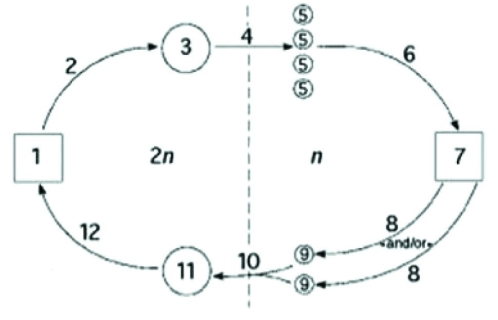 In the figure, which number represents an embryo?
A) 1
B) 3
C) 7
D) 11
In the figure, which number represents an embryo?A) 1
B) 3
C) 7
D) 11

Question
Question
Question
Question
Question
Question
Question
The following question refers to the generalized life cycle for plants shown in the figure. Each number within a circle or square represents a specific plant or plant part, and each number over an arrow represents meiosis, mitosis, or fertilization. 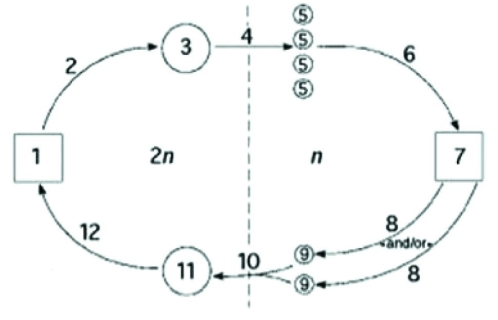 In the figure, which number represents the mature gametophyte?
A) 1
B) 3
C) 7
D) 11
In the figure, which number represents the mature gametophyte?A) 1
B) 3
C) 7
D) 11
Question
Question
Question
The following question refers to the generalized life cycle for plants shown in the figure. Each number within a circle or square represents a specific plant or plant part, and each number over an arrow represents meiosis, mitosis, or fertilization. 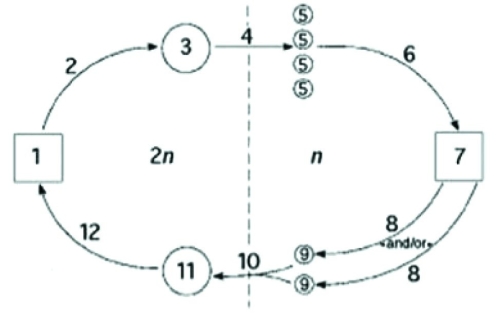 In the figure, the process labeled "6" involves ________.
A) mitosis
B) meiosis
C) fertilization
D) binary fission
In the figure, the process labeled "6" involves ________.A) mitosis
B) meiosis
C) fertilization
D) binary fission
Question
Question
Question
The following question refers to the generalized life cycle for plants shown in the figure. Each number within a circle or square represents a specific plant or plant part, and each number over an arrow represents meiosis, mitosis, or fertilization. 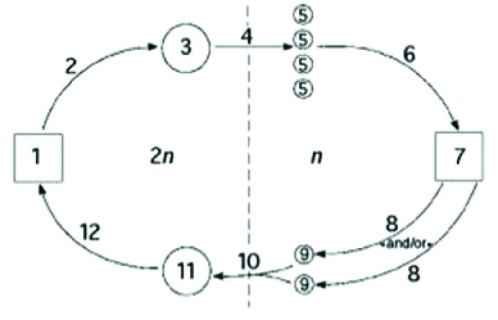 Which number represents a megaspore mother cell in the figure?
A) 1
B) 3
C) 5
D) 7
Which number represents a megaspore mother cell in the figure?A) 1
B) 3
C) 5
D) 7
Question
Question
The following question refers to the generalized life cycle for plants shown in the figure. Each number within a circle or square represents a specific plant or plant part, and each number over an arrow represents meiosis, mitosis, or fertilization. 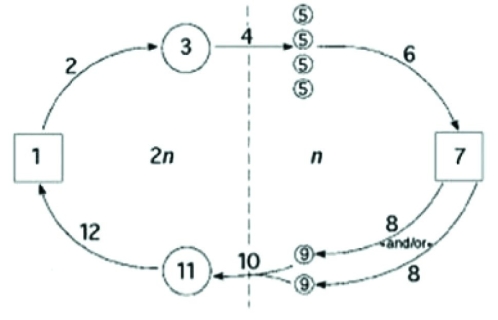 In the figure, meiosis is most likely to be represented by which number(s)?
A) 2
B) 4
C) 2 and 8
D) 10 and 12
In the figure, meiosis is most likely to be represented by which number(s)?A) 2
B) 4
C) 2 and 8
D) 10 and 12
Question
Question
Question
Question
Question
Question
Question
Question
Question
Question
Question
Question
Question
Question
Question
Question
Question
Question
Question
Question
Question
Question
Question
Question
Question
Question
Question
Question
Question
Question
In an investigation of Sphagnum growth, researchers measured the growth of four different S. fuscum species (labeled a, ab, bc, and c in the figure) at four temperatures. The results of the investigation are represented in the graph. 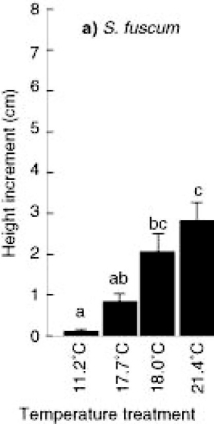 What would you expect to happen to the geographic range of S. fuscum as the average temperatures on Earth rise?
A) The geographic range of S. fuscum will extend southward.
B) The geographic range of S. fuscum will extend northward.
C) The geographic range of S. fuscum will not change.
D) The geographic range of S. fuscum will contract at both the northern and southern ends.
What would you expect to happen to the geographic range of S. fuscum as the average temperatures on Earth rise?A) The geographic range of S. fuscum will extend southward.
B) The geographic range of S. fuscum will extend northward.
C) The geographic range of S. fuscum will not change.
D) The geographic range of S. fuscum will contract at both the northern and southern ends.
Question
Question
Question
Question
Question
Question
Question
Question
Question
Question
In an investigation of Sphagnum growth, researchers measured the growth of four different S. fuscum species (labeled a, ab, bc, and c in the figure) at four temperatures. The results of the investigation are represented in the graph. 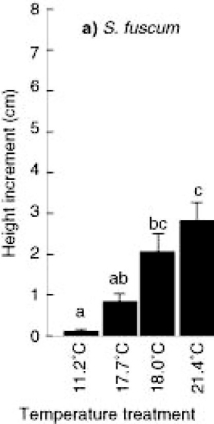 Which of the following claims is most consistent with the data?
A) S. fuscum species are best adapted to live in warm climates.
B) S. fuscum species grow faster at moderate temperatures.
C) S. fuscum species grow slower at warmer temperatures.
D) S. fuscum species are best adapted to growth in cold climates.
Which of the following claims is most consistent with the data?A) S. fuscum species are best adapted to live in warm climates.
B) S. fuscum species grow faster at moderate temperatures.
C) S. fuscum species grow slower at warmer temperatures.
D) S. fuscum species are best adapted to growth in cold climates.
Question
Question
Question
Question
Question
Question
Question
Question
Question
Question
Question
Question
Question
Question
Question
Question

Unlock Deck
Sign up to unlock the cards in this deck!
Unlock Deck
Unlock Deck
1/72

Play

Full screen (f)
Deck 29: Nonvascular and Seedless Vascular Plants
1
The following question refers to the generalized life cycle for plants shown in the figure. Each number within a circle or square represents a specific plant or plant part, and each number over an arrow represents meiosis, mitosis, or fertilization. In the figure, which number represents an embryo?
A) 1
B) 3
C) 7
D) 11
In the figure, which number represents an embryo?A) 1
B) 3
C) 7
D) 11
D
2
Which of the following could occur after plants moved from the oceans to land?
A) Animals could also move onto land because there were opportunities for new food sources.
B) Animals could also move onto land because they had easier access to nitrogen.
C) Cyanobacteria could also move onto land because their host plants occurred there.
D) Plants in the oceans were able to evolve forms that lived in much deeper parts of the oceans.
A) Animals could also move onto land because there were opportunities for new food sources.
B) Animals could also move onto land because they had easier access to nitrogen.
C) Cyanobacteria could also move onto land because their host plants occurred there.
D) Plants in the oceans were able to evolve forms that lived in much deeper parts of the oceans.
A
3
Which of the following biological molecules contributes to the structural integrity of plant spores?
A) lignin
B) cellulose
C) chlorophyll
D) sporopollenin
A) lignin
B) cellulose
C) chlorophyll
D) sporopollenin
D
4
What evidence do paleobotanists look for that indicates the movement of plants from water to land?
A) waxy cuticle to decrease evaporation from leaves
B) loss of structures that produce spores
C) sporopollenin to inhibit evaporation from leaves
D) remnants of chloroplasts from photosynthesizing cells
A) waxy cuticle to decrease evaporation from leaves
B) loss of structures that produce spores
C) sporopollenin to inhibit evaporation from leaves
D) remnants of chloroplasts from photosynthesizing cells
Unlock Deck
Unlock for access to all 72 flashcards in this deck.
Unlock Deck
k this deck
5
Based on the plant fossil record, which of these events likely occurred most recently?
A) extensive growth of gymnosperm forests
B) colonization of land by early liverworts and mosses
C) rise and diversification of angiosperms
D) carboniferous swamps with giant horsetails and lycophytes
A) extensive growth of gymnosperm forests
B) colonization of land by early liverworts and mosses
C) rise and diversification of angiosperms
D) carboniferous swamps with giant horsetails and lycophytes
Unlock Deck
Unlock for access to all 72 flashcards in this deck.
Unlock Deck
k this deck
6
Which of the following organisms were most likely the direct ancestors of plants?
A) kelp (brown alga) that formed large beds near the shorelines
B) green algae
C) photosynthesizing prokaryotes (cyanobacteria)
D) liverworts and mosses
A) kelp (brown alga) that formed large beds near the shorelines
B) green algae
C) photosynthesizing prokaryotes (cyanobacteria)
D) liverworts and mosses
Unlock Deck
Unlock for access to all 72 flashcards in this deck.
Unlock Deck
k this deck
7
Which taxon includes organisms referred to as "embryophytes"?
A) Plantae
B) Pterophyta
C) Bryophyta
D) Charophycea
A) Plantae
B) Pterophyta
C) Bryophyta
D) Charophycea
Unlock Deck
Unlock for access to all 72 flashcards in this deck.
Unlock Deck
k this deck
8
The following question refers to the generalized life cycle for plants shown in the figure. Each number within a circle or square represents a specific plant or plant part, and each number over an arrow represents meiosis, mitosis, or fertilization. In the figure, which number represents the mature gametophyte?
A) 1
B) 3
C) 7
D) 11
In the figure, which number represents the mature gametophyte?A) 1
B) 3
C) 7
D) 11
Unlock Deck
Unlock for access to all 72 flashcards in this deck.
Unlock Deck
k this deck
9
You find a green organism in a pond near your house and believe it is a plant, not an alga. Which of the following characteristics would best support your identification of the organism as a plant and not an alga?
A) It contains chloroplasts.
B) It is surrounded by a cuticle.
C) It lacks vascular tissue.
D) It has cell walls that are comprised largely of cellulose.
A) It contains chloroplasts.
B) It is surrounded by a cuticle.
C) It lacks vascular tissue.
D) It has cell walls that are comprised largely of cellulose.
Unlock Deck
Unlock for access to all 72 flashcards in this deck.
Unlock Deck
k this deck
10
A student encounters a pondweed that appears to be a charophyte. Which of the following features would best help the student determine whether the sample comes from a charophyte or from some other type of green alga?
A) molecular structure of enzymes inside the chloroplasts
B) molecular structure of cellulose
C) structure of mitochondria
D) structure of sperm cells
A) molecular structure of enzymes inside the chloroplasts
B) molecular structure of cellulose
C) structure of mitochondria
D) structure of sperm cells
Unlock Deck
Unlock for access to all 72 flashcards in this deck.
Unlock Deck
k this deck
11
The following question refers to the generalized life cycle for plants shown in the figure. Each number within a circle or square represents a specific plant or plant part, and each number over an arrow represents meiosis, mitosis, or fertilization. In the figure, the process labeled "6" involves ________.
A) mitosis
B) meiosis
C) fertilization
D) binary fission
In the figure, the process labeled "6" involves ________.A) mitosis
B) meiosis
C) fertilization
D) binary fission
Unlock Deck
Unlock for access to all 72 flashcards in this deck.
Unlock Deck
k this deck
12
In plants, which of the following is a benefit of retaining the zygote on the living gametophyte?
A) it protects the zygote from herbivores
B) It helps in dispersal of pollen
C) it helps in dispersal of the zygote
D) it allows it to be nourished by the parent plant
A) it protects the zygote from herbivores
B) It helps in dispersal of pollen
C) it helps in dispersal of the zygote
D) it allows it to be nourished by the parent plant
Unlock Deck
Unlock for access to all 72 flashcards in this deck.
Unlock Deck
k this deck
13
If the kingdom Plantae is someday expanded to include the charophytes (stoneworts), which of the following shared derived characteristics would be included in the revised kingdom?
A) rings of cellulose-synthesizing complexes
B) rings of cellulose-synthesizing complexes, chlorophylls a and b, and alternation of generations
C) rings of cellulose-synthesizing complexes, alternation of generations, and ability to synthesize sporopollenin
D) rings of cellulose-synthesizing complexes, chlorophylls a and b, cell walls of cellulose, and ability to synthesize sporopollenin
A) rings of cellulose-synthesizing complexes
B) rings of cellulose-synthesizing complexes, chlorophylls a and b, and alternation of generations
C) rings of cellulose-synthesizing complexes, alternation of generations, and ability to synthesize sporopollenin
D) rings of cellulose-synthesizing complexes, chlorophylls a and b, cell walls of cellulose, and ability to synthesize sporopollenin
Unlock Deck
Unlock for access to all 72 flashcards in this deck.
Unlock Deck
k this deck
14
The following question refers to the generalized life cycle for plants shown in the figure. Each number within a circle or square represents a specific plant or plant part, and each number over an arrow represents meiosis, mitosis, or fertilization. Which number represents a megaspore mother cell in the figure?
A) 1
B) 3
C) 5
D) 7
Which number represents a megaspore mother cell in the figure?A) 1
B) 3
C) 5
D) 7
Unlock Deck
Unlock for access to all 72 flashcards in this deck.
Unlock Deck
k this deck
15
Which of the following describes a difference between the structures of spores and seeds?
A) Spores have a protective outer covering while seeds do not.
B) Spores have an embryo while seeds do not.
C) Spores have stored nutrition while seeds do not.
D) Spores are unicellular while seeds are not.
A) Spores have a protective outer covering while seeds do not.
B) Spores have an embryo while seeds do not.
C) Spores have stored nutrition while seeds do not.
D) Spores are unicellular while seeds are not.
Unlock Deck
Unlock for access to all 72 flashcards in this deck.
Unlock Deck
k this deck
16
The following question refers to the generalized life cycle for plants shown in the figure. Each number within a circle or square represents a specific plant or plant part, and each number over an arrow represents meiosis, mitosis, or fertilization. In the figure, meiosis is most likely to be represented by which number(s)?
A) 2
B) 4
C) 2 and 8
D) 10 and 12
In the figure, meiosis is most likely to be represented by which number(s)?A) 2
B) 4
C) 2 and 8
D) 10 and 12
Unlock Deck
Unlock for access to all 72 flashcards in this deck.
Unlock Deck
k this deck
17
Which of the following factors most likely helped early plants colonize land?
A) a decreased availability of CO2
B) a high number of competitors for light
C) formation of mutualistic associations with fungi
D) air's relative lack of support, compared to water's support
A) a decreased availability of CO2
B) a high number of competitors for light
C) formation of mutualistic associations with fungi
D) air's relative lack of support, compared to water's support
Unlock Deck
Unlock for access to all 72 flashcards in this deck.
Unlock Deck
k this deck
18
Which of the following statements correctly describes the colonization of terrestrial habitats by plants?
A) It occurred in conjunction with insects that pollinated them.
B) It occurred in conjunction with fungi that helped provide them with nutrients from the soil.
C) It helped them to escape abundant herbivores in the oceans.
D) It occurred only about 150 million years ago.
A) It occurred in conjunction with insects that pollinated them.
B) It occurred in conjunction with fungi that helped provide them with nutrients from the soil.
C) It helped them to escape abundant herbivores in the oceans.
D) It occurred only about 150 million years ago.
Unlock Deck
Unlock for access to all 72 flashcards in this deck.
Unlock Deck
k this deck
19
About 450 million years ago, the terrestrial landscape on Earth would most likely have had which of the following features?
A) flowers, grasses, shrubs, and trees
B) completely bare rock, with little pools that contained cyanobacteria and protists
C) tall forests in swamps
D) nonvascular, green plants similar to liverworts forming green mats on rock
A) flowers, grasses, shrubs, and trees
B) completely bare rock, with little pools that contained cyanobacteria and protists
C) tall forests in swamps
D) nonvascular, green plants similar to liverworts forming green mats on rock
Unlock Deck
Unlock for access to all 72 flashcards in this deck.
Unlock Deck
k this deck
20
Which of the following assumptions led to the hypothesis that the first plants exhibited low, sprawling growth?
A) They were tied to the water for reproduction, thus needing to remain in close contact with the moist soil.
B) The ancestors of plants, green algae, lacked the structural support to stand erect in air.
C) Land animals of that period were small and could not pollinate tall plants.
D) There was less competition for space, so they simply spread out flat.
A) They were tied to the water for reproduction, thus needing to remain in close contact with the moist soil.
B) The ancestors of plants, green algae, lacked the structural support to stand erect in air.
C) Land animals of that period were small and could not pollinate tall plants.
D) There was less competition for space, so they simply spread out flat.
Unlock Deck
Unlock for access to all 72 flashcards in this deck.
Unlock Deck
k this deck
21
In which of the following structures of a plant are apical meristems found?
A) only in shoots
B) only in roots
C) in both roots and shoots
D) in pollen
A) only in shoots
B) only in roots
C) in both roots and shoots
D) in pollen
Unlock Deck
Unlock for access to all 72 flashcards in this deck.
Unlock Deck
k this deck
22
The evolution of vascular tissue in plants facilitated which of the following changes?
A) the ability to form symbiotic relationships with fungi
B) the ability to grow taller
C) the ability to protect developing embryos
D) the ability to reproduce using flowers
A) the ability to form symbiotic relationships with fungi
B) the ability to grow taller
C) the ability to protect developing embryos
D) the ability to reproduce using flowers
Unlock Deck
Unlock for access to all 72 flashcards in this deck.
Unlock Deck
k this deck
23
Which of the following is an accurate statement about plant reproduction?
A) Embryophytes are small plants in an early developmental stage.
B) Male and female bryophytes each produce a type of gametangia.
C) Eggs and sperm of most plants swim toward one another.
D) Bryophytes are limited to asexual reproduction.
A) Embryophytes are small plants in an early developmental stage.
B) Male and female bryophytes each produce a type of gametangia.
C) Eggs and sperm of most plants swim toward one another.
D) Bryophytes are limited to asexual reproduction.
Unlock Deck
Unlock for access to all 72 flashcards in this deck.
Unlock Deck
k this deck
24
Which of the following statements about stomata is correct?
A) Stomata are absent in aquatic plants.
B) Stomata open when guard cells shrink.
C) Stomata allow movement of nutrients into the plant.
D) Stomata allow gases to diffuse into and out of the plant.
A) Stomata are absent in aquatic plants.
B) Stomata open when guard cells shrink.
C) Stomata allow movement of nutrients into the plant.
D) Stomata allow gases to diffuse into and out of the plant.
Unlock Deck
Unlock for access to all 72 flashcards in this deck.
Unlock Deck
k this deck
25
Assuming that they all belong to the same plant, which of the following lists the structures from largest to smallest?
A) gametes, gametophytes, antheridia
B) gametes, antheridia, gametophytes
C) gametophytes, gametes, antheridia
D) gametophytes, antheridia, gametes
A) gametes, gametophytes, antheridia
B) gametes, antheridia, gametophytes
C) gametophytes, gametes, antheridia
D) gametophytes, antheridia, gametes
Unlock Deck
Unlock for access to all 72 flashcards in this deck.
Unlock Deck
k this deck
26
Which of the following statements correctly describes a characteristic of bryophytes (nonvascular plants)?
A) They share a more recent common ancestor with vascular plants than they do with green algae.
B) They are more similar to ancestral red algae than are vascular plants.
C) They can be included in the grade monilophyte because they do not have a complex vascular system.
D) They are evolutionarily more advanced than seed plants.
A) They share a more recent common ancestor with vascular plants than they do with green algae.
B) They are more similar to ancestral red algae than are vascular plants.
C) They can be included in the grade monilophyte because they do not have a complex vascular system.
D) They are evolutionarily more advanced than seed plants.
Unlock Deck
Unlock for access to all 72 flashcards in this deck.
Unlock Deck
k this deck
27
Which of these structures produce spores?
A) sporophyte (capsule) of a moss
B) antheridium of a moss or fern
C) archegonium of a moss or fern
D) gametophyte of a moss
A) sporophyte (capsule) of a moss
B) antheridium of a moss or fern
C) archegonium of a moss or fern
D) gametophyte of a moss
Unlock Deck
Unlock for access to all 72 flashcards in this deck.
Unlock Deck
k this deck
28
Which of the following is a common feature among liverworts, hornworts, and mosses?
A) They are all wind pollinated.
B) They are heterosporous.
C) They are pollinated by animals.
D) They require standing water for reproduction.
A) They are all wind pollinated.
B) They are heterosporous.
C) They are pollinated by animals.
D) They require standing water for reproduction.
Unlock Deck
Unlock for access to all 72 flashcards in this deck.
Unlock Deck
k this deck
29
Which of the following plant forms is best adapted to live in a forest with a temperate climate?
A) zygote of a green alga
B) gametophyte of a moss
C) sporophyte of a liverwort
D) gametophyte of a fern
A) zygote of a green alga
B) gametophyte of a moss
C) sporophyte of a liverwort
D) gametophyte of a fern
Unlock Deck
Unlock for access to all 72 flashcards in this deck.
Unlock Deck
k this deck
30
Which of the following statements is correct regarding stomata?
A) They occur in all plants and define them as a monophyletic group.
B) They open to allow gas exchange and close to decrease water loss.
C) They occur in all plants and are the same as pores.
D) They open to increase both water absorption and gas exchange.
A) They occur in all plants and define them as a monophyletic group.
B) They open to allow gas exchange and close to decrease water loss.
C) They occur in all plants and are the same as pores.
D) They open to increase both water absorption and gas exchange.
Unlock Deck
Unlock for access to all 72 flashcards in this deck.
Unlock Deck
k this deck
31
Which of the following statements correctly describes a characteristic of archegonia?
A) they are where male gametes are produced
B) they may contain sporophyte embryos
C) they have the same function as sporangia
D) they make asexual reproductive structures
A) they are where male gametes are produced
B) they may contain sporophyte embryos
C) they have the same function as sporangia
D) they make asexual reproductive structures
Unlock Deck
Unlock for access to all 72 flashcards in this deck.
Unlock Deck
k this deck
32
Which of the following statements is most likely true of the cuticle in plant species lacking pores?
A) It is impermeable to water and gases.
B) It is thicker than in species with pores.
C) It is thinner than in species with pores.
D) It is composed of a non-waxy substance.
A) It is impermeable to water and gases.
B) It is thicker than in species with pores.
C) It is thinner than in species with pores.
D) It is composed of a non-waxy substance.
Unlock Deck
Unlock for access to all 72 flashcards in this deck.
Unlock Deck
k this deck
33
Which of the following statements is accurate with regard to the life cycle of mosses?
A) The haploid generation grows on the sporophyte generation.
B) Spores are primarily distributed by water currents.
C) Antheridia and archegonia are produced by gametophytes.
D) The sporophyte generation is dominant.
A) The haploid generation grows on the sporophyte generation.
B) Spores are primarily distributed by water currents.
C) Antheridia and archegonia are produced by gametophytes.
D) The sporophyte generation is dominant.
Unlock Deck
Unlock for access to all 72 flashcards in this deck.
Unlock Deck
k this deck
34
Which of the following outcomes is most likely if animals had alternation of generations?
A) they would have twice as rapid a population growth rate as compared to their current rates
B) the products of meiosis would undergo mitosis and remain unicellular
C) the products of meiosis would immediately fuse to form a zygote and then undergo mitosis
D) the products of meiosis would undergo mitosis and become multicellular
A) they would have twice as rapid a population growth rate as compared to their current rates
B) the products of meiosis would undergo mitosis and remain unicellular
C) the products of meiosis would immediately fuse to form a zygote and then undergo mitosis
D) the products of meiosis would undergo mitosis and become multicellular
Unlock Deck
Unlock for access to all 72 flashcards in this deck.
Unlock Deck
k this deck
35
The observation that both charophytes and green plants contain chlorophylls a and b is more consistent with which of the following claims?
A) These derived traits show that green plants evolved from ancient charophytes.
B) These shared traits show that green plants evolved from present-day charophytes.
C) The common ancestor of these two groups contained chlorophylls a and b.
D) These two groups are not closely related.
A) These derived traits show that green plants evolved from ancient charophytes.
B) These shared traits show that green plants evolved from present-day charophytes.
C) The common ancestor of these two groups contained chlorophylls a and b.
D) These two groups are not closely related.
Unlock Deck
Unlock for access to all 72 flashcards in this deck.
Unlock Deck
k this deck
36
Which of the following is an accurate statement about the genus Sphagnum?
A) It is an economically important liverwort.
B) It grows in extensive mats in grassland areas.
C) It accumulates to form coal and is burned as a fuel.
D) It represents a large repository of CO2 that is likely to be released with global warming.
A) It is an economically important liverwort.
B) It grows in extensive mats in grassland areas.
C) It accumulates to form coal and is burned as a fuel.
D) It represents a large repository of CO2 that is likely to be released with global warming.
Unlock Deck
Unlock for access to all 72 flashcards in this deck.
Unlock Deck
k this deck
37
Which of the following statements about the zygotes of plants is most likely to be accurate?
A) Protection of the zygote from the drying effects of air was important.
B) Protection of the zygote from competitors for light was more important in air than in water.
C) Zygotes in plants are more independent of parental tissue than are algal zygotes.
D) Zygotes in plants are more likely to germinate quickly after release from the parent plant than are zygotes released from algal organisms.
A) Protection of the zygote from the drying effects of air was important.
B) Protection of the zygote from competitors for light was more important in air than in water.
C) Zygotes in plants are more independent of parental tissue than are algal zygotes.
D) Zygotes in plants are more likely to germinate quickly after release from the parent plant than are zygotes released from algal organisms.
Unlock Deck
Unlock for access to all 72 flashcards in this deck.
Unlock Deck
k this deck
38
Which of the following is a similarity between bryophytes and seedless vascular plants?
A) Plants in both groups have vascular tissue.
B) In both groups, sperm swim from antheridia to archegonia.
C) The dominant generation in both groups is the sporophyte.
D) Plants in both groups have true roots, stems, and leaves.
A) Plants in both groups have vascular tissue.
B) In both groups, sperm swim from antheridia to archegonia.
C) The dominant generation in both groups is the sporophyte.
D) Plants in both groups have true roots, stems, and leaves.
Unlock Deck
Unlock for access to all 72 flashcards in this deck.
Unlock Deck
k this deck
39
Which of the following claims about moss gametophytes is most consistent with the observation that they lack a cuticle and are 1-2 cells thick?
A) They use stomata for gas exchange regulation.
B) They can easily lose water to, and absorb water from, the atmosphere.
C) Photosynthesis occurs throughout the entire gametophyte surface.
D) They have branching veins in their leaves.
A) They use stomata for gas exchange regulation.
B) They can easily lose water to, and absorb water from, the atmosphere.
C) Photosynthesis occurs throughout the entire gametophyte surface.
D) They have branching veins in their leaves.
Unlock Deck
Unlock for access to all 72 flashcards in this deck.
Unlock Deck
k this deck
40
Which of the following statements about the transition from ocean to land by plants is most likely to be accurate?
A) The transition to land occurred within a few generations.
B) The transition to land was likely gradual, with plants evolving traits that let them survive ever-drier conditions.
C) Rising sea levels favored individuals that were able to survive ever-drier conditions.
D) The high light levels of terrestrial systems favored individuals that contained flexible photosynthetic enzyme systems.
A) The transition to land occurred within a few generations.
B) The transition to land was likely gradual, with plants evolving traits that let them survive ever-drier conditions.
C) Rising sea levels favored individuals that were able to survive ever-drier conditions.
D) The high light levels of terrestrial systems favored individuals that contained flexible photosynthetic enzyme systems.
Unlock Deck
Unlock for access to all 72 flashcards in this deck.
Unlock Deck
k this deck
41
Dawsonia is a moss that can grow to 1 meter in height, which is not common among mosses. Which of the following structures is likely to be found in Dawsonia but not in most other mosses?
A) cuticle along the ridges of leaves
B) leaves that are more than one cell layer thick
C) reduced size, mass, and persistence of the sporophytes
D) the presence of water-conducting tissues
A) cuticle along the ridges of leaves
B) leaves that are more than one cell layer thick
C) reduced size, mass, and persistence of the sporophytes
D) the presence of water-conducting tissues
Unlock Deck
Unlock for access to all 72 flashcards in this deck.
Unlock Deck
k this deck
42
Which of the following statements is correct regarding the structure of a fern?
A) the sporophyte generation is smaller in size than the gametophyte generation
B) sporangia are found on the gametophyte
C) ferns contain no vascular tissue
D) sporangia are found on the sporophylls
A) the sporophyte generation is smaller in size than the gametophyte generation
B) sporangia are found on the gametophyte
C) ferns contain no vascular tissue
D) sporangia are found on the sporophylls
Unlock Deck
Unlock for access to all 72 flashcards in this deck.
Unlock Deck
k this deck
43
A biology student hiking in a forest discovers a 15-centimeter-tall plant that bears microphylls and a strobili at its tallest point. When disturbed, the cone emits a dense cloud of brownish dust. A pocket magnifying glass reveals the dust to be composed of tiny spheres with a high oil content. Which of the following chemicals are most likely to be detected in substantial amounts upon chemical analysis of these small spheres?
A) sporopollenins
B) phenolics
C) waxes
D) terpenes
A) sporopollenins
B) phenolics
C) waxes
D) terpenes
Unlock Deck
Unlock for access to all 72 flashcards in this deck.
Unlock Deck
k this deck
44
Two small, poorly drained lakes lie close to each other in a northern forest. The basins of both lakes are composed of the same geologic substratum. One lake is surrounded by a dense Sphagnum mat; the other is not. Compared to the pond with Sphagnum, the pond lacking the moss mat most likely has ________.
A) a lower concentration of bacteria
B) a higher diversity of organisms
C) a lower oxygen content
D) a higher pH
A) a lower concentration of bacteria
B) a higher diversity of organisms
C) a lower oxygen content
D) a higher pH
Unlock Deck
Unlock for access to all 72 flashcards in this deck.
Unlock Deck
k this deck
45
Use the following information to answer the question.
Big Bend National Park in Texas is mostly Chihuahuan desert, where rainfall averages about 25 centimeters per year. Yet, it is not uncommon when hiking in this extremely arid zone to encounter mosses and ferns. One such plant is called "flower of stone." It is not a flowering plant, nor does it produce seeds. Under arid conditions, its leaflike structures curl up. However, when it rains, it unfurls its leaves, which form a bright green rosette on the desert floor. Consequently, it is sometimes called the "resurrection plant." At first glance, it could be a fern, a true moss, or a spike moss.
Upon closer inspection of the leaves of "flower of stone," one can observe tiny, cone-like structures. Each cone-like structure emits spores of two different sizes. Further investigation also reveals that the roots of "flower of stone" branch only at the growing tip of the root, forming a Y-shaped structure. Consequently, "flower of stone" should be expected to possess which other characteristics?
A) a gametophyte generation that is dominant and lignified vascular tissues
B) a gametophyte generation that is dominant and spores that are diploid when mature
C) lignified vascular tissues and microphylls
D) microphylls, filamentous rhizoids, but not true roots, and spores that are diploid when mature
Big Bend National Park in Texas is mostly Chihuahuan desert, where rainfall averages about 25 centimeters per year. Yet, it is not uncommon when hiking in this extremely arid zone to encounter mosses and ferns. One such plant is called "flower of stone." It is not a flowering plant, nor does it produce seeds. Under arid conditions, its leaflike structures curl up. However, when it rains, it unfurls its leaves, which form a bright green rosette on the desert floor. Consequently, it is sometimes called the "resurrection plant." At first glance, it could be a fern, a true moss, or a spike moss.
Upon closer inspection of the leaves of "flower of stone," one can observe tiny, cone-like structures. Each cone-like structure emits spores of two different sizes. Further investigation also reveals that the roots of "flower of stone" branch only at the growing tip of the root, forming a Y-shaped structure. Consequently, "flower of stone" should be expected to possess which other characteristics?
A) a gametophyte generation that is dominant and lignified vascular tissues
B) a gametophyte generation that is dominant and spores that are diploid when mature
C) lignified vascular tissues and microphylls
D) microphylls, filamentous rhizoids, but not true roots, and spores that are diploid when mature
Unlock Deck
Unlock for access to all 72 flashcards in this deck.
Unlock Deck
k this deck
46
In an investigation of Sphagnum growth, researchers measured the growth of four different S. fuscum species (labeled a, ab, bc, and c in the figure) at four temperatures. The results of the investigation are represented in the graph. What would you expect to happen to the geographic range of S. fuscum as the average temperatures on Earth rise?
A) The geographic range of S. fuscum will extend southward.
B) The geographic range of S. fuscum will extend northward.
C) The geographic range of S. fuscum will not change.
D) The geographic range of S. fuscum will contract at both the northern and southern ends.
What would you expect to happen to the geographic range of S. fuscum as the average temperatures on Earth rise?A) The geographic range of S. fuscum will extend southward.
B) The geographic range of S. fuscum will extend northward.
C) The geographic range of S. fuscum will not change.
D) The geographic range of S. fuscum will contract at both the northern and southern ends.
Unlock Deck
Unlock for access to all 72 flashcards in this deck.
Unlock Deck
k this deck
47
Assuming equal spore production rates, what is a likely consequence in a bryophyte with both asexual and sexual reproduction versus one with only sexual reproduction?
A) Species with both types of reproduction have higher rates of genetic diversity than species with only sexual reproduction.
B) Species with both types of reproduction have higher population growth rates than species with only sexual reproduction.
C) Species with both types of reproduction are less evolutionarily advanced than species with only sexual reproduction.
D) Species with both types of reproduction occur primarily in dry environments.
A) Species with both types of reproduction have higher rates of genetic diversity than species with only sexual reproduction.
B) Species with both types of reproduction have higher population growth rates than species with only sexual reproduction.
C) Species with both types of reproduction are less evolutionarily advanced than species with only sexual reproduction.
D) Species with both types of reproduction occur primarily in dry environments.
Unlock Deck
Unlock for access to all 72 flashcards in this deck.
Unlock Deck
k this deck
48
Use the following description to answer the question.
A biology student hiking in a forest discovers an erect, 15-centimeter-tall plant that bears microphylls and a strobili at its tallest point. When disturbed, the cone emits a dense cloud of brownish dust. Observing a sample with a magnifying glass reveals the dust to be composed of tiny spheres with a high oil content.
What type of plant has this student most likely discovered?
A) bryophyte sporophyte
B) fern sporophyte
C) horsetail gametophyte
D) lycophyte sporophyte
A biology student hiking in a forest discovers an erect, 15-centimeter-tall plant that bears microphylls and a strobili at its tallest point. When disturbed, the cone emits a dense cloud of brownish dust. Observing a sample with a magnifying glass reveals the dust to be composed of tiny spheres with a high oil content.
What type of plant has this student most likely discovered?
A) bryophyte sporophyte
B) fern sporophyte
C) horsetail gametophyte
D) lycophyte sporophyte
Unlock Deck
Unlock for access to all 72 flashcards in this deck.
Unlock Deck
k this deck
49
Which of the following statements correctly describes the haploid gametophytes of bryophytes?
A) They are multicellular, just like the haploid stages of animal species.
B) They are multicellular and produce zygotes.
C) They are usually composed of single cells, just like the gametes of mammals.
D) They are usually multicellular, but lack vascular tissue.
A) They are multicellular, just like the haploid stages of animal species.
B) They are multicellular and produce zygotes.
C) They are usually composed of single cells, just like the gametes of mammals.
D) They are usually multicellular, but lack vascular tissue.
Unlock Deck
Unlock for access to all 72 flashcards in this deck.
Unlock Deck
k this deck
50
If bryophytes do not have vascular tissue, how can some mosses reach 60 centimeters tall?
A) The term nonvascular plant is actually incorrect in describing bryophytes.
B) These tall mosses are more closely related to seed plants than to other mosses.
C) Some mosses independently evolved conducting tissues.
D) The rhizoids contain the conducting tissues.
A) The term nonvascular plant is actually incorrect in describing bryophytes.
B) These tall mosses are more closely related to seed plants than to other mosses.
C) Some mosses independently evolved conducting tissues.
D) The rhizoids contain the conducting tissues.
Unlock Deck
Unlock for access to all 72 flashcards in this deck.
Unlock Deck
k this deck
51
Which of the following characteristics is found in heterosporous plants?
A) two types of sporophylls
B) vascular tissue
C) one type of sporophyll
D) a diploid sporophyte produces spores via meiosis
A) two types of sporophylls
B) vascular tissue
C) one type of sporophyll
D) a diploid sporophyte produces spores via meiosis
Unlock Deck
Unlock for access to all 72 flashcards in this deck.
Unlock Deck
k this deck
52
Which of the following structures is present in a bryophyte at some point in their life cycles?
A) microphylls
B) true roots
C) true leaves
D) sporangia
A) microphylls
B) true roots
C) true leaves
D) sporangia
Unlock Deck
Unlock for access to all 72 flashcards in this deck.
Unlock Deck
k this deck
53
Use the following information to answer the question.
Big Bend National Park in Texas is mostly desert, where rainfall averages about 25 centimeters per year. Yet, it is not uncommon when hiking in this extremely arid zone to encounter mosses and ferns.
Which of the following features is most important for true mosses and ferns to reproduce in the desert?
A) that the sporophytes occupy only permanently shady, north-facing habitats
B) that the sporophytes are low to the ground, growing no taller than a couple of inches
C) that their gametophytes grow closely together
D) that the sporophytes have highly lignified vascular tissues
Big Bend National Park in Texas is mostly desert, where rainfall averages about 25 centimeters per year. Yet, it is not uncommon when hiking in this extremely arid zone to encounter mosses and ferns.
Which of the following features is most important for true mosses and ferns to reproduce in the desert?
A) that the sporophytes occupy only permanently shady, north-facing habitats
B) that the sporophytes are low to the ground, growing no taller than a couple of inches
C) that their gametophytes grow closely together
D) that the sporophytes have highly lignified vascular tissues
Unlock Deck
Unlock for access to all 72 flashcards in this deck.
Unlock Deck
k this deck
54
Use the following information to answer the question.
Big Bend National Park in Texas is mostly desert, where rainfall averages about 25 centimeters per year. Yet, it is not uncommon when hiking in this extremely arid zone to encounter mosses and ferns.
What feature of both true mosses and ferns makes it most surprising that they can survive for many generations in dry deserts?
A) flagellated sperm
B) lack of vascular tissues
C) lack of true roots
D) lack of cuticle
Big Bend National Park in Texas is mostly desert, where rainfall averages about 25 centimeters per year. Yet, it is not uncommon when hiking in this extremely arid zone to encounter mosses and ferns.
What feature of both true mosses and ferns makes it most surprising that they can survive for many generations in dry deserts?
A) flagellated sperm
B) lack of vascular tissues
C) lack of true roots
D) lack of cuticle
Unlock Deck
Unlock for access to all 72 flashcards in this deck.
Unlock Deck
k this deck
55
Which of the following statements is correct regarding the life cycle of a fern?
A) the gametophyte generation produces spores
B) the sporophyte generation produces pollen
C) the sporophyte generation produces spores
D) the gametophyte generation produces pollen
A) the gametophyte generation produces spores
B) the sporophyte generation produces pollen
C) the sporophyte generation produces spores
D) the gametophyte generation produces pollen
Unlock Deck
Unlock for access to all 72 flashcards in this deck.
Unlock Deck
k this deck
56
In an investigation of Sphagnum growth, researchers measured the growth of four different S. fuscum species (labeled a, ab, bc, and c in the figure) at four temperatures. The results of the investigation are represented in the graph. Which of the following claims is most consistent with the data?
A) S. fuscum species are best adapted to live in warm climates.
B) S. fuscum species grow faster at moderate temperatures.
C) S. fuscum species grow slower at warmer temperatures.
D) S. fuscum species are best adapted to growth in cold climates.
Which of the following claims is most consistent with the data?A) S. fuscum species are best adapted to live in warm climates.
B) S. fuscum species grow faster at moderate temperatures.
C) S. fuscum species grow slower at warmer temperatures.
D) S. fuscum species are best adapted to growth in cold climates.
Unlock Deck
Unlock for access to all 72 flashcards in this deck.
Unlock Deck
k this deck
57
You are hiking in a forest and come upon a mysterious plant, which you determine is either a lycophyte sporophyte or a monilophyte sporophyte. Which of the following characteristics would be most helpful in determining the correct classification of the plant?
A) whether or not it has true leaves
B) whether it has microphylls or megaphylls
C) whether or not it has seeds
D) its height
A) whether or not it has true leaves
B) whether it has microphylls or megaphylls
C) whether or not it has seeds
D) its height
Unlock Deck
Unlock for access to all 72 flashcards in this deck.
Unlock Deck
k this deck
58
Use the following information to answer the question.
Big Bend National Park in Texas is mostly Chihuahuan desert, where rainfall averages about 25 centimeters per year. Yet, it is not uncommon when hiking in this extremely arid zone to encounter mosses and ferns. One such plant is called "flower of stone." It is not a flowering plant, nor does it produce seeds. Under arid conditions, its leaflike structures curl up. However, when it rains, it unfurls its leaves, which form a bright green rosette on the desert floor. Consequently, it is sometimes called the "resurrection plant." At first glance, it could be a fern, a true moss, or a spike moss.
Which of the following characteristics is (are) possessed in common by true mosses, ferns, and spike mosses, and therefore becomes useless at helping to determine to which of these groups "flower of stone" belongs?
A) alternation of generations
B) a sporophyte generation that is dominant and alternation of generations
C) flagellated sperm and true leaves and roots
D) flagellated sperm and alternation of generations
Big Bend National Park in Texas is mostly Chihuahuan desert, where rainfall averages about 25 centimeters per year. Yet, it is not uncommon when hiking in this extremely arid zone to encounter mosses and ferns. One such plant is called "flower of stone." It is not a flowering plant, nor does it produce seeds. Under arid conditions, its leaflike structures curl up. However, when it rains, it unfurls its leaves, which form a bright green rosette on the desert floor. Consequently, it is sometimes called the "resurrection plant." At first glance, it could be a fern, a true moss, or a spike moss.
Which of the following characteristics is (are) possessed in common by true mosses, ferns, and spike mosses, and therefore becomes useless at helping to determine to which of these groups "flower of stone" belongs?
A) alternation of generations
B) a sporophyte generation that is dominant and alternation of generations
C) flagellated sperm and true leaves and roots
D) flagellated sperm and alternation of generations
Unlock Deck
Unlock for access to all 72 flashcards in this deck.
Unlock Deck
k this deck
59
A botanist discovers a new species of plant in a tropical rain forest. Investigation of its anatomy and life cycle shows the following characteristics: flagellated sperm, xylem with tracheids, separate gametophyte, sporophyte generations with the sporophyte dominant, and no seeds. To which of the following groups does this plant most likely belong?
A) mosses
B) ferns
C) gymnosperms
D) flowering plants
A) mosses
B) ferns
C) gymnosperms
D) flowering plants
Unlock Deck
Unlock for access to all 72 flashcards in this deck.
Unlock Deck
k this deck
60
Which of the following symbiotic relationships would most likely allow bryophytes to live successfully in a bare, moist area?
A) a symbiosis with phosphorus-absorbing mycorrhizae fungi
B) a symbiosis with nitrogen-fixing cyanobacteria
C) a symbiosis with iron-absorbing algae
D) a symbiosis with toxin-producing dinoflagellates
A) a symbiosis with phosphorus-absorbing mycorrhizae fungi
B) a symbiosis with nitrogen-fixing cyanobacteria
C) a symbiosis with iron-absorbing algae
D) a symbiosis with toxin-producing dinoflagellates
Unlock Deck
Unlock for access to all 72 flashcards in this deck.
Unlock Deck
k this deck
61
Suppose an efficient conducting system evolved in a moss that could transport water and other materials as high as a tall tree. Which of the following statements about "trees" of such a species would be true?
A) spore dispersal distances would probably decrease
B) females could produce only one archegonium
C) unless its body parts were strengthened, such a "tree" would probably flop over
D) individuals would probably compete less effectively for access to light
A) spore dispersal distances would probably decrease
B) females could produce only one archegonium
C) unless its body parts were strengthened, such a "tree" would probably flop over
D) individuals would probably compete less effectively for access to light
Unlock Deck
Unlock for access to all 72 flashcards in this deck.
Unlock Deck
k this deck
62
A sample of mosses and ferns is comprised of which of the following?
A) both sporophyte and gametophyte generations
B) only vascular plants
C) both nonvascular and seed-bearing plants
D) both seedless and seed-bearing plants
A) both sporophyte and gametophyte generations
B) only vascular plants
C) both nonvascular and seed-bearing plants
D) both seedless and seed-bearing plants
Unlock Deck
Unlock for access to all 72 flashcards in this deck.
Unlock Deck
k this deck
63
Which of the following features of fertilization in plants are the same as in some of their algal ancestors?
A) Conjugation tubes are formed between sperm and egg cells.
B) Packets of sperm are delivered by wind to the eggs.
C) Aquatic invertebrates carry sperm to eggs.
D) Flagellated sperm swim to the eggs in a water drop.
A) Conjugation tubes are formed between sperm and egg cells.
B) Packets of sperm are delivered by wind to the eggs.
C) Aquatic invertebrates carry sperm to eggs.
D) Flagellated sperm swim to the eggs in a water drop.
Unlock Deck
Unlock for access to all 72 flashcards in this deck.
Unlock Deck
k this deck
64
Which of the following characteristics of plants is absent in their closest relatives, the charophyte algae?
A) chlorophyll b
B) cellulose in cell walls
C) sexual reproduction
D) alternation of multicellular generations
A) chlorophyll b
B) cellulose in cell walls
C) sexual reproduction
D) alternation of multicellular generations
Unlock Deck
Unlock for access to all 72 flashcards in this deck.
Unlock Deck
k this deck
65
As global temperatures continue to rise, the water levels of some peatlands are expected to drop, exposing the peat to the air and causing it to decompose. Which of the following is most likely to result from this change in water levels?
A) the decomposition would cause the release of more carbon dioxide into the air, further contributing to global warming
B) the decomposition would cause the release of less carbon dioxide into the air, and have no effect on global warming
C) peatlands would become larger in size, and aid in the removal of carbon dioxide from the atmosphere
D) peatlands would become smaller in size, and aid in the removal of carbon dioxide from the atmosphere
A) the decomposition would cause the release of more carbon dioxide into the air, further contributing to global warming
B) the decomposition would cause the release of less carbon dioxide into the air, and have no effect on global warming
C) peatlands would become larger in size, and aid in the removal of carbon dioxide from the atmosphere
D) peatlands would become smaller in size, and aid in the removal of carbon dioxide from the atmosphere
Unlock Deck
Unlock for access to all 72 flashcards in this deck.
Unlock Deck
k this deck
66
Microphylls are found in which plant group?
A) lycophytes
B) liverworts
C) ferns
D) hornworts
A) lycophytes
B) liverworts
C) ferns
D) hornworts
Unlock Deck
Unlock for access to all 72 flashcards in this deck.
Unlock Deck
k this deck
67
The evolution of a vascular system in plants allowed which of the following characteristics and process to occur?
A) increased height, improved competition for water, and increased spore dispersal distances
B) increased height, improved competition for light, and increased spore dispersal distances
C) decreased height, improved competition for light, and decreased spore dispersal distances
D) decreased height, improved competition for water, and decreased spore dispersal distances
A) increased height, improved competition for water, and increased spore dispersal distances
B) increased height, improved competition for light, and increased spore dispersal distances
C) decreased height, improved competition for light, and decreased spore dispersal distances
D) decreased height, improved competition for water, and decreased spore dispersal distances
Unlock Deck
Unlock for access to all 72 flashcards in this deck.
Unlock Deck
k this deck
68
Many types of plants increase the number of stomata per unit surface area of a leaf when atmospheric carbon dioxide levels decline. Which of the following is an analogous response in humans?
A) breathing faster as atmospheric carbon dioxide levels increase
B) putting more red blood cells into circulation when oxygen availability declines at high elevations
C) breathing more slowly as atmospheric oxygen levels increase
D) increasing the volume of its lungs when atmospheric carbon dioxide levels increase
A) breathing faster as atmospheric carbon dioxide levels increase
B) putting more red blood cells into circulation when oxygen availability declines at high elevations
C) breathing more slowly as atmospheric oxygen levels increase
D) increasing the volume of its lungs when atmospheric carbon dioxide levels increase
Unlock Deck
Unlock for access to all 72 flashcards in this deck.
Unlock Deck
k this deck
69
In plants, which of the following are produced by meiosis?
A) haploid gametes
B) diploid gametes
C) haploid spores
D) diploid spores
A) haploid gametes
B) diploid gametes
C) haploid spores
D) diploid spores
Unlock Deck
Unlock for access to all 72 flashcards in this deck.
Unlock Deck
k this deck
70
Three of the following are evidence that charophytes are the closest algal relatives of plants. Select the exception.
A) similar sperm structure
B) the presence of chloroplasts
C) similarities in cell wall formation during cell division
D) genetic similarities in chloroplasts
A) similar sperm structure
B) the presence of chloroplasts
C) similarities in cell wall formation during cell division
D) genetic similarities in chloroplasts
Unlock Deck
Unlock for access to all 72 flashcards in this deck.
Unlock Deck
k this deck
71
Compared to nonvascular plants, the ancient relatives of vascular plants ________.
A) the ancient relatives produced sporophyte generations independent of, not dependent on, gametophyte generations
B) the ancient relatives produced much smaller sporophyte generations
C) the ancient relatives produced sporophyte generations that provided more nutrition to gametophyte generations
D) the ancient relatives probably experienced less competition for light
A) the ancient relatives produced sporophyte generations independent of, not dependent on, gametophyte generations
B) the ancient relatives produced much smaller sporophyte generations
C) the ancient relatives produced sporophyte generations that provided more nutrition to gametophyte generations
D) the ancient relatives probably experienced less competition for light
Unlock Deck
Unlock for access to all 72 flashcards in this deck.
Unlock Deck
k this deck
72
Suppose an efficient conducting system evolved in a moss that could transport water and other materials as high as a tall tree. Which of the following statements about "trees" of such a species would be accurate?
A) Fertilization would probably be easier.
B) Spore dispersal distances would probably decrease.
C) Females could produce only one archegonium.
D) Individuals would probably compete more effectively for access to light.
A) Fertilization would probably be easier.
B) Spore dispersal distances would probably decrease.
C) Females could produce only one archegonium.
D) Individuals would probably compete more effectively for access to light.
Unlock Deck
Unlock for access to all 72 flashcards in this deck.
Unlock Deck
k this deck
Unlock Deck
Unlock for access to all 72 flashcards in this deck.






