







 Chat with AI

Deck 27: Seedless Plants
Full screen (f)

Question
Figure 27-1
Use the figure to answer the corresponding question(s).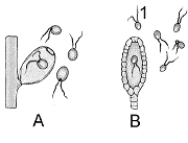
The structure labeled 1 in Figure 27-1 is a(n):
A) homospore.
B) heterospore.
C) embryo.
D) gamete.
E) zygote.
Use the figure to answer the corresponding question(s).
The structure labeled 1 in Figure 27-1 is a(n):
A) homospore.
B) heterospore.
C) embryo.
D) gamete.
E) zygote.

Question
Figure 27-1
Use the figure to answer the corresponding question(s).
Alternation of generations in plants refers to the alternation of:
A) diploid and haploid stages.
B) male and female stages.
C) meiotic and mitotic stages.
D) spore and seed stages.
E) thallus and leaf stages.
Use the figure to answer the corresponding question(s).
Alternation of generations in plants refers to the alternation of:
A) diploid and haploid stages.
B) male and female stages.
C) meiotic and mitotic stages.
D) spore and seed stages.
E) thallus and leaf stages.
Question
Question
Question
Question
Question
Question
Question
Question
Question
Question
Figure 27-1
Use the figure to answer the corresponding question(s).
The structure labeled A in Figure 27-1 is a:
A) gametangium of an alga.
B) gametangium of a plant.
C) germinating spore.
D) megasporangium of an alga.
E) megasporangium of a plant.
Use the figure to answer the corresponding question(s).
The structure labeled A in Figure 27-1 is a:
A) gametangium of an alga.
B) gametangium of a plant.
C) germinating spore.
D) megasporangium of an alga.
E) megasporangium of a plant.
Question
Question
Figure 27-1
Use the figure to answer the corresponding question(s).
The gametophyte is the dominant stage in the life cycle for which of the following plant groups?
A) club mosses
B) whisk ferns
C) ferns
D) horsetails
E) liverworts
Use the figure to answer the corresponding question(s).
The gametophyte is the dominant stage in the life cycle for which of the following plant groups?
A) club mosses
B) whisk ferns
C) ferns
D) horsetails
E) liverworts
Question
Question
Question
Question
Question
Question
Question
Question
Question
Question
Question
Question
Question
Question
Question
Question
Question
Question
Question
Question
Question
Question
Question
Question
Question
Question
Question
Question
Question
Question
Figure 27-3
Use the figure to answer the corresponding question(s).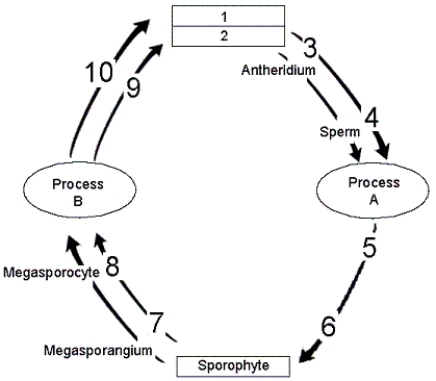
The structure in Figure 27-3 labeled 4 is:
A) haploid.
B) diploid.
C) polyploid.
D) a zygote.
E) produced by meiosis.
Use the figure to answer the corresponding question(s).
The structure in Figure 27-3 labeled 4 is:
A) haploid.
B) diploid.
C) polyploid.
D) a zygote.
E) produced by meiosis.
Question
Question
Question
Question
Question
Question
Question
Question
Question
Figure 27-3
Use the figure to answer the corresponding question(s).
Which of the following is heterosporous?
A) whisk fern
B) spike moss
C) horsetail
D) liverwort
E) hornwort
Use the figure to answer the corresponding question(s).
Which of the following is heterosporous?
A) whisk fern
B) spike moss
C) horsetail
D) liverwort
E) hornwort
Question
Question
Question
Question
Question
Figure 27-3
Use the figure to answer the corresponding question(s).
The life cycle in Figure 27-3 could represent:
A) a moss.
B) a whisk fern.
C) a club moss
D) a horsetail.
E) a liverwort.
Use the figure to answer the corresponding question(s).
The life cycle in Figure 27-3 could represent:
A) a moss.
B) a whisk fern.
C) a club moss
D) a horsetail.
E) a liverwort.
Question
Figure 27-3
Use the figure to answer the corresponding question(s).
Which of the following statements is FALSE concerning the structure in Figure 27-3 labeled 1?
A) It is haploid.
B) It was produced by mitosis.
C) It was produced from a megaspore.
D) It is not a product of fertilization.
E) It is part of the sporophyte generation.
Use the figure to answer the corresponding question(s).
Which of the following statements is FALSE concerning the structure in Figure 27-3 labeled 1?
A) It is haploid.
B) It was produced by mitosis.
C) It was produced from a megaspore.
D) It is not a product of fertilization.
E) It is part of the sporophyte generation.
Question
Question
Question
Question
Question
Question
Question
Question
Question
Question
Question
Question
Question
Question
Question
Question
Question
Question
Question
Question
Question

Unlock Deck
Sign up to unlock the cards in this deck!
Unlock Deck
Unlock Deck
1/80

Play

Full screen (f)
Deck 27: Seedless Plants
1
Figure 27-1
Use the figure to answer the corresponding question(s).
The structure labeled 1 in Figure 27-1 is a(n):
A) homospore.
B) heterospore.
C) embryo.
D) gamete.
E) zygote.
Use the figure to answer the corresponding question(s).
The structure labeled 1 in Figure 27-1 is a(n):
A) homospore.
B) heterospore.
C) embryo.
D) gamete.
E) zygote.
D
2
Figure 27-1
Use the figure to answer the corresponding question(s).
Alternation of generations in plants refers to the alternation of:
A) diploid and haploid stages.
B) male and female stages.
C) meiotic and mitotic stages.
D) spore and seed stages.
E) thallus and leaf stages.
Use the figure to answer the corresponding question(s).
Alternation of generations in plants refers to the alternation of:
A) diploid and haploid stages.
B) male and female stages.
C) meiotic and mitotic stages.
D) spore and seed stages.
E) thallus and leaf stages.
A
3
An important difference between plants and algae is that a __________ covers the aerial portion of a plant.
A) chlorophyll.
B) waxy cuticle
C) lignin
D) stomata with guard cells
E) cellulose
A) chlorophyll.
B) waxy cuticle
C) lignin
D) stomata with guard cells
E) cellulose
B
4
In plants the fertilized egg develops into a multicellular __________ (young plant) within a female gametangium.
A) zygote
B) seed
C) embryo
D) endosperm
E) cotyledon
A) zygote
B) seed
C) embryo
D) endosperm
E) cotyledon
Unlock Deck
Unlock for access to all 80 flashcards in this deck.
Unlock Deck
k this deck
5
The first plants evolved rapidly during the __________ period.
A) Devonian
B) Silurian
C) Carboniferous
D) Triassic
E) Ordovician
A) Devonian
B) Silurian
C) Carboniferous
D) Triassic
E) Ordovician
Unlock Deck
Unlock for access to all 80 flashcards in this deck.
Unlock Deck
k this deck
6
The cuticle in plants helps in preventing:
A) dessication.
B) transpiration.
C) diffusion of gases.
D) translocation of food.
E) translocation of minerals.
A) dessication.
B) transpiration.
C) diffusion of gases.
D) translocation of food.
E) translocation of minerals.
Unlock Deck
Unlock for access to all 80 flashcards in this deck.
Unlock Deck
k this deck
7
A key step in the evolution of vascular plants was the ability to produce __________, a strengthening polymer in the walls of cells that function in support and conduction.
A) lignin
B) cellulose
C) starch
D) fructose
E) cutin
A) lignin
B) cellulose
C) starch
D) fructose
E) cutin
Unlock Deck
Unlock for access to all 80 flashcards in this deck.
Unlock Deck
k this deck
8
Mosses and liverworts are limited in size because they lack:
A) sperm.
B) eggs.
C) vascular tissues.
D) stomata.
E) reproductive structures.
A) sperm.
B) eggs.
C) vascular tissues.
D) stomata.
E) reproductive structures.
Unlock Deck
Unlock for access to all 80 flashcards in this deck.
Unlock Deck
k this deck
9
Terrestrial plants obtain carbon dioxide, required for photosynthesis, from the:
A) soil.
B) roots.
C) atmosphere.
D) water.
E) sun.
A) soil.
B) roots.
C) atmosphere.
D) water.
E) sun.
Unlock Deck
Unlock for access to all 80 flashcards in this deck.
Unlock Deck
k this deck
10
Which of the following is not a seedless plant?
A) moss
B) conifer
C) fern
D) club moss
E) hornwort
A) moss
B) conifer
C) fern
D) club moss
E) hornwort
Unlock Deck
Unlock for access to all 80 flashcards in this deck.
Unlock Deck
k this deck
11
The most recent group of plants to evolve are the:
A) liverworts.
B) hornworts.
C) angiosperms.
D) gymnosperms.
E) mosses.
A) liverworts.
B) hornworts.
C) angiosperms.
D) gymnosperms.
E) mosses.
Unlock Deck
Unlock for access to all 80 flashcards in this deck.
Unlock Deck
k this deck
12
Figure 27-1
Use the figure to answer the corresponding question(s).
The structure labeled A in Figure 27-1 is a:
A) gametangium of an alga.
B) gametangium of a plant.
C) germinating spore.
D) megasporangium of an alga.
E) megasporangium of a plant.
Use the figure to answer the corresponding question(s).
The structure labeled A in Figure 27-1 is a:
A) gametangium of an alga.
B) gametangium of a plant.
C) germinating spore.
D) megasporangium of an alga.
E) megasporangium of a plant.
Unlock Deck
Unlock for access to all 80 flashcards in this deck.
Unlock Deck
k this deck
13
Modern botanists think that all plants evolved from a common ancestor that was an ancient green alga, because:
A) plants are green like green algae.
B) plants live on land.
C) they have green leaves.
D) they are autotrophs.
E) they share many biochemical and metabolic traits.
A) plants are green like green algae.
B) plants live on land.
C) they have green leaves.
D) they are autotrophs.
E) they share many biochemical and metabolic traits.
Unlock Deck
Unlock for access to all 80 flashcards in this deck.
Unlock Deck
k this deck
14
Figure 27-1
Use the figure to answer the corresponding question(s).
The gametophyte is the dominant stage in the life cycle for which of the following plant groups?
A) club mosses
B) whisk ferns
C) ferns
D) horsetails
E) liverworts
Use the figure to answer the corresponding question(s).
The gametophyte is the dominant stage in the life cycle for which of the following plant groups?
A) club mosses
B) whisk ferns
C) ferns
D) horsetails
E) liverworts
Unlock Deck
Unlock for access to all 80 flashcards in this deck.
Unlock Deck
k this deck
15
Plants are thought to have evolved from a group of algae known as:
A) red algae.
B) cyanobacteria.
C) charophytes.
D) dinoflagellates.
E) diatoms.
A) red algae.
B) cyanobacteria.
C) charophytes.
D) dinoflagellates.
E) diatoms.
Unlock Deck
Unlock for access to all 80 flashcards in this deck.
Unlock Deck
k this deck
16
The multicellular sex organs in plants are known as:
A) gametes.
B) spores.
C) gametangia.
D) fruits.
E) sperm.
A) gametes.
B) spores.
C) gametangia.
D) fruits.
E) sperm.
Unlock Deck
Unlock for access to all 80 flashcards in this deck.
Unlock Deck
k this deck
17
The most ancient group of plants alive today are:
A) horsetail.
B) club moss.
C) hornworts.
D) liverworts.
E) gymnosperms.
A) horsetail.
B) club moss.
C) hornworts.
D) liverworts.
E) gymnosperms.
Unlock Deck
Unlock for access to all 80 flashcards in this deck.
Unlock Deck
k this deck
18
Which of the following is a vascular plant?
A) moss
B) fern
C) liverwort
D) hornwort
E) charophyte
A) moss
B) fern
C) liverwort
D) hornwort
E) charophyte
Unlock Deck
Unlock for access to all 80 flashcards in this deck.
Unlock Deck
k this deck
19
Cell walls of plants contain cellulose and __________, which aids in structural support.
A) cutin
B) chitin
C) lignin
D) lipopolysaccharide
E) actin
A) cutin
B) chitin
C) lignin
D) lipopolysaccharide
E) actin
Unlock Deck
Unlock for access to all 80 flashcards in this deck.
Unlock Deck
k this deck
20
Characteristics shared between green algae and plants include:
A) stomata in the surface of leaves.
B) multicellular gametangia.
C) chlorophylls a and b in plastids.
D) a waxy cuticle.
E) stomata in the surface of stems.
A) stomata in the surface of leaves.
B) multicellular gametangia.
C) chlorophylls a and b in plastids.
D) a waxy cuticle.
E) stomata in the surface of stems.
Unlock Deck
Unlock for access to all 80 flashcards in this deck.
Unlock Deck
k this deck
21
__________ are small leaves with a single vascular strand.
A) Megaphylls
B) Microphylls
C) Thalli
D) Strobili
E) Sori
A) Megaphylls
B) Microphylls
C) Thalli
D) Strobili
E) Sori
Unlock Deck
Unlock for access to all 80 flashcards in this deck.
Unlock Deck
k this deck
22
The sori of most ferns are found on the:
A) fiddleheads.
B) fronds.
C) rhizomes.
D) prothalli.
E) antheridia.
A) fiddleheads.
B) fronds.
C) rhizomes.
D) prothalli.
E) antheridia.
Unlock Deck
Unlock for access to all 80 flashcards in this deck.
Unlock Deck
k this deck
23
Which of the following statements about whisk ferns is FALSE?
A) They exhibit dichotomous branching.
B) They lack true roots.
C) They lack true leaves.
D) A representative is Psilotum.
E) They lack true stems.
A) They exhibit dichotomous branching.
B) They lack true roots.
C) They lack true leaves.
D) A representative is Psilotum.
E) They lack true stems.
Unlock Deck
Unlock for access to all 80 flashcards in this deck.
Unlock Deck
k this deck
24
Moss sperm are transported to the archegonia by:
A) wind.
B) water.
C) hummingbirds.
D) insects.
E) both insects and water.
A) wind.
B) water.
C) hummingbirds.
D) insects.
E) both insects and water.
Unlock Deck
Unlock for access to all 80 flashcards in this deck.
Unlock Deck
k this deck
25
The oldest known fossils suggest that the __________ may have been the first plants to inhabit land.
A) mosses
B) hornworts
C) ferns
D) angiosperms
E) liverworts
A) mosses
B) hornworts
C) ferns
D) angiosperms
E) liverworts
Unlock Deck
Unlock for access to all 80 flashcards in this deck.
Unlock Deck
k this deck
26
Hornworts are members of phylum:
A) Pteridophyta.
B) Anthocerophyta.
C) Bryophyta.
D) Hepatophyta.
E) Anthophyta.
A) Pteridophyta.
B) Anthocerophyta.
C) Bryophyta.
D) Hepatophyta.
E) Anthophyta.
Unlock Deck
Unlock for access to all 80 flashcards in this deck.
Unlock Deck
k this deck
27
Ferns lack:
A) rhizomes.
B) seeds.
C) vascular tissue.
D) sexual reproduction.
E) photosynthesis.
A) rhizomes.
B) seeds.
C) vascular tissue.
D) sexual reproduction.
E) photosynthesis.
Unlock Deck
Unlock for access to all 80 flashcards in this deck.
Unlock Deck
k this deck
28
One type of asexual reproduction in liverworts involves:
A) setae.
B) gemmae.
C) fronds.
D) archegonia.
E) prothalli.
A) setae.
B) gemmae.
C) fronds.
D) archegonia.
E) prothalli.
Unlock Deck
Unlock for access to all 80 flashcards in this deck.
Unlock Deck
k this deck
29
The gametophyte generation of ferns is called the:
A) prothallus.
B) protonema.
C) gemma.
D) thallus.
E) fiddlehead.
A) prothallus.
B) protonema.
C) gemma.
D) thallus.
E) fiddlehead.
Unlock Deck
Unlock for access to all 80 flashcards in this deck.
Unlock Deck
k this deck
30
The most economically important bryophyte is:
A) Equisetum.
B) Anthoceros.
C) Psilotum.
D) Sphagnum.
E) Lycopodium.
A) Equisetum.
B) Anthoceros.
C) Psilotum.
D) Sphagnum.
E) Lycopodium.
Unlock Deck
Unlock for access to all 80 flashcards in this deck.
Unlock Deck
k this deck
31
The leafy fern that you might have as a house plant is the __________ generation.
A) diploid sporophyte
B) diploid gametophyte
C) haploid sporophyte
D) haploid gametophyte
E) triploid sporophyte..
A) diploid sporophyte
B) diploid gametophyte
C) haploid sporophyte
D) haploid gametophyte
E) triploid sporophyte..
Unlock Deck
Unlock for access to all 80 flashcards in this deck.
Unlock Deck
k this deck
32
Two vascular tissues in plants are:
A) xylem and stomata.
B) xylem and phloem.
C) phloem and stomata.
D) roots and leaves.
E) stem and roots.
A) xylem and stomata.
B) xylem and phloem.
C) phloem and stomata.
D) roots and leaves.
E) stem and roots.
Unlock Deck
Unlock for access to all 80 flashcards in this deck.
Unlock Deck
k this deck
33
The __________ generation is dominant in mosses, as it can live independently.
A) haploid sporophyte
B) haploid gametophyte
C) diploid sporophyte
D) diploid gametophyte
E) triploid sporophyte
A) haploid sporophyte
B) haploid gametophyte
C) diploid sporophyte
D) diploid gametophyte
E) triploid sporophyte
Unlock Deck
Unlock for access to all 80 flashcards in this deck.
Unlock Deck
k this deck
34
Microphylls are found only in __________.
A) hornworts
B) liverworts
C) club mosses
D) ferns
E) whisk ferns
A) hornworts
B) liverworts
C) club mosses
D) ferns
E) whisk ferns
Unlock Deck
Unlock for access to all 80 flashcards in this deck.
Unlock Deck
k this deck
35
The __________ are plants that made major contributions to the coal deposits formed hundreds of millions of years ago.
A) hornworts and liverworts
B) horsetails and club mosses
C) angiosperms
D) whisk ferns and true mosses
E) lichens and true mosses
A) hornworts and liverworts
B) horsetails and club mosses
C) angiosperms
D) whisk ferns and true mosses
E) lichens and true mosses
Unlock Deck
Unlock for access to all 80 flashcards in this deck.
Unlock Deck
k this deck
36
Plants are a:
A) polyphyletic group.
B) monophyletic group.
C) group without a common ancestor.
D) group with many ancestors.
E) paraphyletic group.
A) polyphyletic group.
B) monophyletic group.
C) group without a common ancestor.
D) group with many ancestors.
E) paraphyletic group.
Unlock Deck
Unlock for access to all 80 flashcards in this deck.
Unlock Deck
k this deck
37
The gametophyte of most liverworts is referred to as:
A) a seta.
B) gemmae.
C) a thallus.
D) a frond.
E) a prothallus.
A) a seta.
B) gemmae.
C) a thallus.
D) a frond.
E) a prothallus.
Unlock Deck
Unlock for access to all 80 flashcards in this deck.
Unlock Deck
k this deck
38
A bryophyte having a single large hloroplast in each cell belongs to the phylum:
A) Hepatophyta.
B) Pterophyta.
C) Lycopodiophyta.
D) Anthocerophyta.
E) Bryophyta.
A) Hepatophyta.
B) Pterophyta.
C) Lycopodiophyta.
D) Anthocerophyta.
E) Bryophyta.
Unlock Deck
Unlock for access to all 80 flashcards in this deck.
Unlock Deck
k this deck
39
Coal deposits formed when forested areas were inundated with water and the __________ conditions that resulted promoted incomplete decomposition of the vegetation into coal.
A) aerobic
B) anaerobic
C) oxidizing
D) desiccating
E) saline
A) aerobic
B) anaerobic
C) oxidizing
D) desiccating
E) saline
Unlock Deck
Unlock for access to all 80 flashcards in this deck.
Unlock Deck
k this deck
40
In mosses, the __________ grows into the leafy gametophyte plant.
A) protonema
B) seta
C) capsule
D) antheridium
E) prothallus
A) protonema
B) seta
C) capsule
D) antheridium
E) prothallus
Unlock Deck
Unlock for access to all 80 flashcards in this deck.
Unlock Deck
k this deck
41
What am I? I have a jointed hollow stem with reduced megaphylls.
A) moss
B) horsetail
C) club moss
D) whisk fern
E) hornwort
A) moss
B) horsetail
C) club moss
D) whisk fern
E) hornwort
Unlock Deck
Unlock for access to all 80 flashcards in this deck.
Unlock Deck
k this deck
42
After a moss spore germinates it forms a prothallus.
____________________
____________________
Unlock Deck
Unlock for access to all 80 flashcards in this deck.
Unlock Deck
k this deck
43
According to the fossil record, the oldest vascular plants are placed in the phylum:
A) Rhyniophyta.
B) Bryophyta.
C) Anthocerophyta.
D) Pteridophyta.
E) Lycopodiphyta.
A) Rhyniophyta.
B) Bryophyta.
C) Anthocerophyta.
D) Pteridophyta.
E) Lycopodiphyta.
Unlock Deck
Unlock for access to all 80 flashcards in this deck.
Unlock Deck
k this deck
44
Figure 27-3
Use the figure to answer the corresponding question(s).
The structure in Figure 27-3 labeled 4 is:
A) haploid.
B) diploid.
C) polyploid.
D) a zygote.
E) produced by meiosis.
Use the figure to answer the corresponding question(s).
The structure in Figure 27-3 labeled 4 is:
A) haploid.
B) diploid.
C) polyploid.
D) a zygote.
E) produced by meiosis.
Unlock Deck
Unlock for access to all 80 flashcards in this deck.
Unlock Deck
k this deck
45
In algae, gametangia are generally unicellular.
_________________
_________________
Unlock Deck
Unlock for access to all 80 flashcards in this deck.
Unlock Deck
k this deck
46
A gemma is a sexual reproductive structure produced by certain liverworts.
____________________
____________________
Unlock Deck
Unlock for access to all 80 flashcards in this deck.
Unlock Deck
k this deck
47
Each archgonium produces many eggs.
_____________________
_____________________
Unlock Deck
Unlock for access to all 80 flashcards in this deck.
Unlock Deck
k this deck
48
In plants, sporogenous cells divide by mitosis to form spores.
___________________
___________________
Unlock Deck
Unlock for access to all 80 flashcards in this deck.
Unlock Deck
k this deck
49
An archegoniophore is found in certain liverworts.
____________________
____________________
Unlock Deck
Unlock for access to all 80 flashcards in this deck.
Unlock Deck
k this deck
50
Microsporocytes divide by __________ to form __________.
A) meiosis; megapores
B) mitosis; megaspores
C) mitosis; microspores
D) meiosis; microspore mother cells
E) meiosis; microspores
A) meiosis; megapores
B) mitosis; megaspores
C) mitosis; microspores
D) meiosis; microspore mother cells
E) meiosis; microspores
Unlock Deck
Unlock for access to all 80 flashcards in this deck.
Unlock Deck
k this deck
51
The strobilus of a spike moss contains:
A) an apical meristem.
B) both microsporangia and megasporangia.
C) microsporangia only.
D) megasporangia only.
E) a plant embryo.
A) an apical meristem.
B) both microsporangia and megasporangia.
C) microsporangia only.
D) megasporangia only.
E) a plant embryo.
Unlock Deck
Unlock for access to all 80 flashcards in this deck.
Unlock Deck
k this deck
52
The oldest known megafossils of early vascular plants may be characterized as:
A) possessing dichotomously branched stems with leaves.
B) possessing dichotomously branched stems without leaves or roots.
C) possessing erect stems with megaphylls.
D) possessing roots but lacking sporangia.
E) lacking roots but possessing megaphylls.
A) possessing dichotomously branched stems with leaves.
B) possessing dichotomously branched stems without leaves or roots.
C) possessing erect stems with megaphylls.
D) possessing roots but lacking sporangia.
E) lacking roots but possessing megaphylls.
Unlock Deck
Unlock for access to all 80 flashcards in this deck.
Unlock Deck
k this deck
53
Figure 27-3
Use the figure to answer the corresponding question(s).
Which of the following is heterosporous?
A) whisk fern
B) spike moss
C) horsetail
D) liverwort
E) hornwort
Use the figure to answer the corresponding question(s).
Which of the following is heterosporous?
A) whisk fern
B) spike moss
C) horsetail
D) liverwort
E) hornwort
Unlock Deck
Unlock for access to all 80 flashcards in this deck.
Unlock Deck
k this deck
54
Xylem is a vascular tissue that conducts dissolved sugars.
____________________
____________________
Unlock Deck
Unlock for access to all 80 flashcards in this deck.
Unlock Deck
k this deck
55
Many seedless plants produce spores of one morphological type, which is referred to as:
A) heterospory.
B) sporogeny.
C) megaspory.
D) homospory.
E) microspory.
A) heterospory.
B) sporogeny.
C) megaspory.
D) homospory.
E) microspory.
Unlock Deck
Unlock for access to all 80 flashcards in this deck.
Unlock Deck
k this deck
56
Prepare a table that lists the features that distinguish bryophytes from green algae and from other plants.
Unlock Deck
Unlock for access to all 80 flashcards in this deck.
Unlock Deck
k this deck
57
Mosses have stems, roots, and leaves.
____________________
____________________
Unlock Deck
Unlock for access to all 80 flashcards in this deck.
Unlock Deck
k this deck
58
Figure 27-3
Use the figure to answer the corresponding question(s).
The life cycle in Figure 27-3 could represent:
A) a moss.
B) a whisk fern.
C) a club moss
D) a horsetail.
E) a liverwort.
Use the figure to answer the corresponding question(s).
The life cycle in Figure 27-3 could represent:
A) a moss.
B) a whisk fern.
C) a club moss
D) a horsetail.
E) a liverwort.
Unlock Deck
Unlock for access to all 80 flashcards in this deck.
Unlock Deck
k this deck
59
Figure 27-3
Use the figure to answer the corresponding question(s).
Which of the following statements is FALSE concerning the structure in Figure 27-3 labeled 1?
A) It is haploid.
B) It was produced by mitosis.
C) It was produced from a megaspore.
D) It is not a product of fertilization.
E) It is part of the sporophyte generation.
Use the figure to answer the corresponding question(s).
Which of the following statements is FALSE concerning the structure in Figure 27-3 labeled 1?
A) It is haploid.
B) It was produced by mitosis.
C) It was produced from a megaspore.
D) It is not a product of fertilization.
E) It is part of the sporophyte generation.
Unlock Deck
Unlock for access to all 80 flashcards in this deck.
Unlock Deck
k this deck
60
Heterospory was an important evolutionary development, as it led to the evolution of:
A) pollen.
B) eggs.
C) xylem.
D) phloem.
E) seeds.
A) pollen.
B) eggs.
C) xylem.
D) phloem.
E) seeds.
Unlock Deck
Unlock for access to all 80 flashcards in this deck.
Unlock Deck
k this deck
61
MATCHING
Match the plant phylum with the appropriate word or phrase.
a.Anthocerophyta
d.Lycopodiophyta
b.Bryophyta
e.Pteridophyta
c.Hepaticophyta
hornworts
Match the plant phylum with the appropriate word or phrase.
a.Anthocerophyta
d.Lycopodiophyta
b.Bryophyta
e.Pteridophyta
c.Hepaticophyta
hornworts
Unlock Deck
Unlock for access to all 80 flashcards in this deck.
Unlock Deck
k this deck
62
MATCHING
Match the plant phylum with the appropriate word or phrase.
a.Anthocerophyta
d.Lycopodiophyta
b.Bryophyta
e.Pteridophyta
c.Hepaticophyta
whisk ferns
Match the plant phylum with the appropriate word or phrase.
a.Anthocerophyta
d.Lycopodiophyta
b.Bryophyta
e.Pteridophyta
c.Hepaticophyta
whisk ferns
Unlock Deck
Unlock for access to all 80 flashcards in this deck.
Unlock Deck
k this deck
63
A sorus is a cluster of sporangia.
____________________
____________________
Unlock Deck
Unlock for access to all 80 flashcards in this deck.
Unlock Deck
k this deck
64
MATCHING
Match the plant phylum with the appropriate word or phrase.
a.Anthocerophyta
d.Lycopodiophyta
b.Bryophyta
e.Pteridophyta
c.Hepaticophyta
liverworts
Match the plant phylum with the appropriate word or phrase.
a.Anthocerophyta
d.Lycopodiophyta
b.Bryophyta
e.Pteridophyta
c.Hepaticophyta
liverworts
Unlock Deck
Unlock for access to all 80 flashcards in this deck.
Unlock Deck
k this deck
65
MATCHING
Match the plant phylum with the appropriate word or phrase.
a.Anthocerophyta
d.Lycopodiophyta
b.Bryophyta
e.Pteridophyta
c.Hepaticophyta
Marchantia
Match the plant phylum with the appropriate word or phrase.
a.Anthocerophyta
d.Lycopodiophyta
b.Bryophyta
e.Pteridophyta
c.Hepaticophyta
Marchantia
Unlock Deck
Unlock for access to all 80 flashcards in this deck.
Unlock Deck
k this deck
66
MATCHING
Match the plant phylum with the appropriate word or phrase.
a.Anthocerophyta
d.Lycopodiophyta
b.Bryophyta
e.Pteridophyta
c.Hepaticophyta
ferns
Match the plant phylum with the appropriate word or phrase.
a.Anthocerophyta
d.Lycopodiophyta
b.Bryophyta
e.Pteridophyta
c.Hepaticophyta
ferns
Unlock Deck
Unlock for access to all 80 flashcards in this deck.
Unlock Deck
k this deck
67
If a plant produces microspores and megaspores, then by definition it is homosporous.
____________________
____________________
Unlock Deck
Unlock for access to all 80 flashcards in this deck.
Unlock Deck
k this deck
68
MATCHING
Match the plant phylum with the appropriate word or phrase.
a.Anthocerophyta
d.Lycopodiophyta
b.Bryophyta
e.Pteridophyta
c.Hepaticophyta
Sphagnum
Match the plant phylum with the appropriate word or phrase.
a.Anthocerophyta
d.Lycopodiophyta
b.Bryophyta
e.Pteridophyta
c.Hepaticophyta
Sphagnum
Unlock Deck
Unlock for access to all 80 flashcards in this deck.
Unlock Deck
k this deck
69
Horsetails belong to the phylum Pteridophyta.
____________________
____________________
Unlock Deck
Unlock for access to all 80 flashcards in this deck.
Unlock Deck
k this deck
70
MATCHING
Match the plant phylum with the appropriate word or phrase.
a.Anthocerophyta
d.Lycopodiophyta
b.Bryophyta
e.Pteridophyta
c.Hepaticophyta
Psilotum
Match the plant phylum with the appropriate word or phrase.
a.Anthocerophyta
d.Lycopodiophyta
b.Bryophyta
e.Pteridophyta
c.Hepaticophyta
Psilotum
Unlock Deck
Unlock for access to all 80 flashcards in this deck.
Unlock Deck
k this deck
71
If you were a paleontologist studying clams, you would have an easier research project than if you were studying early plants.Why? Include in your discussion the term megafossils.
Unlock Deck
Unlock for access to all 80 flashcards in this deck.
Unlock Deck
k this deck
72
MATCHING
Match the plant phylum with the appropriate word or phrase.
a.Anthocerophyta
d.Lycopodiophyta
b.Bryophyta
e.Pteridophyta
c.Hepaticophyta
horsetails
Match the plant phylum with the appropriate word or phrase.
a.Anthocerophyta
d.Lycopodiophyta
b.Bryophyta
e.Pteridophyta
c.Hepaticophyta
horsetails
Unlock Deck
Unlock for access to all 80 flashcards in this deck.
Unlock Deck
k this deck
73
Club mosses belong to the phylum Bryophyta.
____________________
____________________
Unlock Deck
Unlock for access to all 80 flashcards in this deck.
Unlock Deck
k this deck
74
MATCHING
Match the plant phylum with the appropriate word or phrase.
a.Anthocerophyta
d.Lycopodiophyta
b.Bryophyta
e.Pteridophyta
c.Hepaticophyta
club mosses
Match the plant phylum with the appropriate word or phrase.
a.Anthocerophyta
d.Lycopodiophyta
b.Bryophyta
e.Pteridophyta
c.Hepaticophyta
club mosses
Unlock Deck
Unlock for access to all 80 flashcards in this deck.
Unlock Deck
k this deck
75
Microphylls evolved from stem branches.
____________________
____________________
Unlock Deck
Unlock for access to all 80 flashcards in this deck.
Unlock Deck
k this deck
76
MATCHING
Match the plant phylum with the appropriate word or phrase.
a.Anthocerophyta
d.Lycopodiophyta
b.Bryophyta
e.Pteridophyta
c.Hepaticophyta
Describe alternation of generations.Include in your discussion the following terms: gametophyte, sporophyte, diploid, haploid, dominant form, meiosis, and fertilization.
Match the plant phylum with the appropriate word or phrase.
a.Anthocerophyta
d.Lycopodiophyta
b.Bryophyta
e.Pteridophyta
c.Hepaticophyta
Describe alternation of generations.Include in your discussion the following terms: gametophyte, sporophyte, diploid, haploid, dominant form, meiosis, and fertilization.
Unlock Deck
Unlock for access to all 80 flashcards in this deck.
Unlock Deck
k this deck
77
MATCHING
Match the plant phylum with the appropriate word or phrase.
a.Anthocerophyta
d.Lycopodiophyta
b.Bryophyta
e.Pteridophyta
c.Hepaticophyta
mosses
Match the plant phylum with the appropriate word or phrase.
a.Anthocerophyta
d.Lycopodiophyta
b.Bryophyta
e.Pteridophyta
c.Hepaticophyta
mosses
Unlock Deck
Unlock for access to all 80 flashcards in this deck.
Unlock Deck
k this deck
78
MATCHING
Match the plant phylum with the appropriate word or phrase.
a.Anthocerophyta
d.Lycopodiophyta
b.Bryophyta
e.Pteridophyta
c.Hepaticophyta
Discuss adaptations for terrestrial life seen in land plants.
Match the plant phylum with the appropriate word or phrase.
a.Anthocerophyta
d.Lycopodiophyta
b.Bryophyta
e.Pteridophyta
c.Hepaticophyta
Discuss adaptations for terrestrial life seen in land plants.
Unlock Deck
Unlock for access to all 80 flashcards in this deck.
Unlock Deck
k this deck
79
MATCHING
Match the plant phylum with the appropriate word or phrase.
a.Anthocerophyta
d.Lycopodiophyta
b.Bryophyta
e.Pteridophyta
c.Hepaticophyta
Anthoceros
Match the plant phylum with the appropriate word or phrase.
a.Anthocerophyta
d.Lycopodiophyta
b.Bryophyta
e.Pteridophyta
c.Hepaticophyta
Anthoceros
Unlock Deck
Unlock for access to all 80 flashcards in this deck.
Unlock Deck
k this deck
80
The oldest megafossils of vascular plants belong to the phylum Rhyniophyta.
____________________
____________________
Unlock Deck
Unlock for access to all 80 flashcards in this deck.
Unlock Deck
k this deck
Unlock Deck
Unlock for access to all 80 flashcards in this deck.






