







 Chat with AI

Deck 9: The Transformation of American Society, 1815-1840
Full screen (f)

Question

Question
Question
Question
Question
Question
Question
Question
Question
Question
Question
Question
Question
Question
Question
Question
Question
Question
Question
Question
Question
MAP QUESTIONS
Instructions: Choose the letter on the accompanying map of the eastern United States that correctly identifies each of the following:
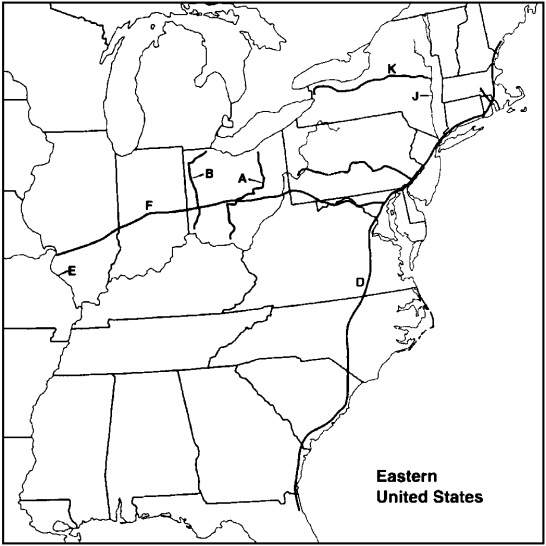
Ohio Canal
Instructions: Choose the letter on the accompanying map of the eastern United States that correctly identifies each of the following:
Ohio Canal
Question
Question
Question
Question
Question
Question
Question
Question
Question
Question
Question
MAP QUESTIONS
Instructions: Choose the letter on the accompanying map of the eastern United States that correctly identifies each of the following:
Erie Canal
Instructions: Choose the letter on the accompanying map of the eastern United States that correctly identifies each of the following:
Erie Canal
Question
Question
Question
Question
MAP QUESTIONS
Instructions: Choose the letter on the accompanying map of the eastern United States that correctly identifies each of the following:
Hudson River
Instructions: Choose the letter on the accompanying map of the eastern United States that correctly identifies each of the following:
Hudson River
Question
Question
Question
Question
Question
MAP QUESTIONS
Instructions: Choose the letter on the accompanying map of the eastern United States that correctly identifies each of the following:
Mississippi River
Instructions: Choose the letter on the accompanying map of the eastern United States that correctly identifies each of the following:
Mississippi River
Question
MAP QUESTIONS
Instructions: Choose the letter on the accompanying map of the eastern United States that correctly identifies each of the following:
National (Cumberland) Road
Instructions: Choose the letter on the accompanying map of the eastern United States that correctly identifies each of the following:
National (Cumberland) Road
Question
MAP QUESTIONS
Instructions: Choose the letter on the accompanying map of the eastern United States that correctly identifies each of the following:
Coastal Road
Instructions: Choose the letter on the accompanying map of the eastern United States that correctly identifies each of the following:
Coastal Road

Unlock Deck
Sign up to unlock the cards in this deck!
Unlock Deck
Unlock Deck
1/43

Play

Full screen (f)
Deck 9: The Transformation of American Society, 1815-1840
1
How did Samuel Slater transform American economic life?
A) He introduced the assembly line system to factories.
B) He proposed the use of immigrants as a labor supply.
C) He integrated the steam engine with the factory production process.
D) He helped design and built the country's first cotton mill.
E) He organized the first joint-stock company in American history.
A) He introduced the assembly line system to factories.
B) He proposed the use of immigrants as a labor supply.
C) He integrated the steam engine with the factory production process.
D) He helped design and built the country's first cotton mill.
E) He organized the first joint-stock company in American history.
He helped design and built the country's first cotton mill.
2
The purpose of the Indian Removal Act of 1830 was to
A) eliminate barriers to Indian unity.
B) encourage Georgia to establish Indian schools.
C) remove Indians from the jurisdiction of the Supreme Court.
D) move them from land needed to construct canals.
E) facilitate white settlement on Indian lands.
A) eliminate barriers to Indian unity.
B) encourage Georgia to establish Indian schools.
C) remove Indians from the jurisdiction of the Supreme Court.
D) move them from land needed to construct canals.
E) facilitate white settlement on Indian lands.
facilitate white settlement on Indian lands.
3
Who founded the fur-trading post in Astoria, Oregon?
A) Meriwether Lewis
B) Kit Carson
C) John Jacob Astor
D) Jedediah Smith
E) George Stewart
A) Meriwether Lewis
B) Kit Carson
C) John Jacob Astor
D) Jedediah Smith
E) George Stewart
John Jacob Astor
4
What impact did the Erie Canal have on New York City?
A) It forced New York to support other canal projects.
B) It turned New York into the nation's largest city.
C) It affect New York very little since the canal was connected to Boston.
D) It caused New York to build a new bureaucratic structure to manage the canal.
E) It enabled immigrants arriving in New York to move South much quicker.
A) It forced New York to support other canal projects.
B) It turned New York into the nation's largest city.
C) It affect New York very little since the canal was connected to Boston.
D) It caused New York to build a new bureaucratic structure to manage the canal.
E) It enabled immigrants arriving in New York to move South much quicker.
Unlock Deck
Unlock for access to all 43 flashcards in this deck.
Unlock Deck
k this deck
5
What did the military bounties awarded during the War of 1812 provide?
A) Soldiers would receive western land in exchange for military service.
B) Soldiers were paid cash bonuses for enlisting.
C) Soldiers were given cash bonuses for each new recruit they could find.
D) Soldiers were paid for each British soldier they captured.
E) Soldiers would receive an early discharge if they recruited an agreed-upon number of new soldiers.
A) Soldiers would receive western land in exchange for military service.
B) Soldiers were paid cash bonuses for enlisting.
C) Soldiers were given cash bonuses for each new recruit they could find.
D) Soldiers were paid for each British soldier they captured.
E) Soldiers would receive an early discharge if they recruited an agreed-upon number of new soldiers.
Unlock Deck
Unlock for access to all 43 flashcards in this deck.
Unlock Deck
k this deck
6
Which of the following did not stimulate westward settlement?
A) Military bounties
B) Building the National Road
C) The growing strength of the federal government
D) Admission of new states into the Union
E) Federal support of existing Indian settlements
A) Military bounties
B) Building the National Road
C) The growing strength of the federal government
D) Admission of new states into the Union
E) Federal support of existing Indian settlements
Unlock Deck
Unlock for access to all 43 flashcards in this deck.
Unlock Deck
k this deck
7
Which of the following tribes was not one of the Five Civilized Tribes?
A) Cherokees
B) Choctaws
C) Creeks
D) Huron
E) Seminoles
A) Cherokees
B) Choctaws
C) Creeks
D) Huron
E) Seminoles
Unlock Deck
Unlock for access to all 43 flashcards in this deck.
Unlock Deck
k this deck
8
What was Alabama fever?
A) an outbreak of yellow fever that devastated settlers in the 1820s.
B) a land rush in Alabama that caused the price of land to skyrocket.
C) an illness that affected mainly Native Americans that forced them to move elsewhere.
D) an epidemic that began as a bird influenza.
E) None of these choices
A) an outbreak of yellow fever that devastated settlers in the 1820s.
B) a land rush in Alabama that caused the price of land to skyrocket.
C) an illness that affected mainly Native Americans that forced them to move elsewhere.
D) an epidemic that began as a bird influenza.
E) None of these choices
Unlock Deck
Unlock for access to all 43 flashcards in this deck.
Unlock Deck
k this deck
9
Black Hawk was an Indian leader who led resistance in
A) Florida.
B) Illinois.
C) Georgia.
D) New York.
E) Michigan.
A) Florida.
B) Illinois.
C) Georgia.
D) New York.
E) Michigan.
Unlock Deck
Unlock for access to all 43 flashcards in this deck.
Unlock Deck
k this deck
10
Which of the following commodities was a major agricultural product of the Old Southwest?
A) Wheat
B) Apples
C) Oranges
D) Corn
E) Cotton
A) Wheat
B) Apples
C) Oranges
D) Corn
E) Cotton
Unlock Deck
Unlock for access to all 43 flashcards in this deck.
Unlock Deck
k this deck
11
Which of the following is not a principle drawn from Chief Justice John Marshall's decisions on federal Indian policy?
A) Native Americans had a right to their land because of prolonged occupancy.
B) Native Americans were entitled to federal protection.
C) They were to be considered a domestic dependent nation.
D) They were, essentially, a republic within Georgia.
E) Native Americans were a distinct political community.
A) Native Americans had a right to their land because of prolonged occupancy.
B) Native Americans were entitled to federal protection.
C) They were to be considered a domestic dependent nation.
D) They were, essentially, a republic within Georgia.
E) Native Americans were a distinct political community.
Unlock Deck
Unlock for access to all 43 flashcards in this deck.
Unlock Deck
k this deck
12
Which of the following is not true of the Cherokee Indians?
A) They were one of the Five Civilized Tribes.
B) They supported the movement of Indians out of the South.
C) They included an influential minority of mixed-bloods who embraced Christianity and owned slaves.
D) They published their own newspaper.
E) They engaged in agriculture.
A) They were one of the Five Civilized Tribes.
B) They supported the movement of Indians out of the South.
C) They included an influential minority of mixed-bloods who embraced Christianity and owned slaves.
D) They published their own newspaper.
E) They engaged in agriculture.
Unlock Deck
Unlock for access to all 43 flashcards in this deck.
Unlock Deck
k this deck
13
Who wrote Democracy in America?
A) Frederick Jackson Turner
B) Alexis de Tocqueville
C) Gustave de Beaumont
D) George Stevenson
E) James Fenimore Cooper
A) Frederick Jackson Turner
B) Alexis de Tocqueville
C) Gustave de Beaumont
D) George Stevenson
E) James Fenimore Cooper
Unlock Deck
Unlock for access to all 43 flashcards in this deck.
Unlock Deck
k this deck
14
In Worcester v. Georgia, the Supreme Court ruled that the Cherokee Nation
A) was a distinct political community and entitled to federal protection from Georgia's claims.
B) was subject to federal but not state laws.
C) was not protected by the Constitution.
D) was bound by state laws.
E) could sue individuals but not the state government.
A) was a distinct political community and entitled to federal protection from Georgia's claims.
B) was subject to federal but not state laws.
C) was not protected by the Constitution.
D) was bound by state laws.
E) could sue individuals but not the state government.
Unlock Deck
Unlock for access to all 43 flashcards in this deck.
Unlock Deck
k this deck
15
What was the direction of the population movement that took place between 1790 and 1840?
A) From the North to the South
B) From the Atlantic coast to the areas between the Appalachians and the Mississippi
C) From New England to California
D) From the Old Northwest back to New England
E) From the Pacific Northwest back to the Great Plains
A) From the North to the South
B) From the Atlantic coast to the areas between the Appalachians and the Mississippi
C) From New England to California
D) From the Old Northwest back to New England
E) From the Pacific Northwest back to the Great Plains
Unlock Deck
Unlock for access to all 43 flashcards in this deck.
Unlock Deck
k this deck
16
What was the purpose of the National Road?
A) to provide work for veterans of the War of 1812.
B) to facilitate westward migration.
C) to encourage a political alliance between Virginia and Illinois.
D) to permit easy troop movements across America in the event of war.
E) to enable the president to reach Washington easily.
A) to provide work for veterans of the War of 1812.
B) to facilitate westward migration.
C) to encourage a political alliance between Virginia and Illinois.
D) to permit easy troop movements across America in the event of war.
E) to enable the president to reach Washington easily.
Unlock Deck
Unlock for access to all 43 flashcards in this deck.
Unlock Deck
k this deck
17
Which of the following is not a characteristic of the typical pioneer settlers?
A) They migrated as families.
B) They craved sociability.
C) They sought stability and security.
D) They tended to cluster with people who hailed from the same region back east.
E) They were wild and restless individualists.
A) They migrated as families.
B) They craved sociability.
C) They sought stability and security.
D) They tended to cluster with people who hailed from the same region back east.
E) They were wild and restless individualists.
Unlock Deck
Unlock for access to all 43 flashcards in this deck.
Unlock Deck
k this deck
18
In Gibbons v. Ogden the Supreme Court ruled that Congress had the authority to
A) regulate navigation on rivers.
B) expel Indians from within state borders.
C) limit trade with foreign countries.
D) buy and sell public lands.
E) cancel state financial obligations.
A) regulate navigation on rivers.
B) expel Indians from within state borders.
C) limit trade with foreign countries.
D) buy and sell public lands.
E) cancel state financial obligations.
Unlock Deck
Unlock for access to all 43 flashcards in this deck.
Unlock Deck
k this deck
19
Which of the following was not one of the developments that took place in the United States after the War of 1812?
A) Improvements in transportation
B) Growth of interregional trade and migration
C) Slowing of economic growth
D) Growth of towns
E) Massive uprooting of Native American populations
A) Improvements in transportation
B) Growth of interregional trade and migration
C) Slowing of economic growth
D) Growth of towns
E) Massive uprooting of Native American populations
Unlock Deck
Unlock for access to all 43 flashcards in this deck.
Unlock Deck
k this deck
20
In 1838, why did thousands of Cherokees move from the southeastern United States to Indian Territory in what is now Oklahoma?
A) They were too ignorant and depraved to remain in a civilized section of the country.
B) They were forced to move by the federal government.
C) They longed to rejoin their cousins, who had moved west in the 17th century.
D) They were pawns in diplomatic negotiations between the United States and Spain.
E) They were fleeing from the floods and crop failures that had devastated the Southeast.
A) They were too ignorant and depraved to remain in a civilized section of the country.
B) They were forced to move by the federal government.
C) They longed to rejoin their cousins, who had moved west in the 17th century.
D) They were pawns in diplomatic negotiations between the United States and Spain.
E) They were fleeing from the floods and crop failures that had devastated the Southeast.
Unlock Deck
Unlock for access to all 43 flashcards in this deck.
Unlock Deck
k this deck
21
MAP QUESTIONS
Instructions: Choose the letter on the accompanying map of the eastern United States that correctly identifies each of the following:
Ohio Canal
Instructions: Choose the letter on the accompanying map of the eastern United States that correctly identifies each of the following:
Ohio Canal
Unlock Deck
Unlock for access to all 43 flashcards in this deck.
Unlock Deck
k this deck
22
During the pre-Civil War period,
A) horizontal allegiances tended to replace vertical allegiances;
B) vertical allegiances tended to replace horizontal allegiances;
C) families became more patriarchal;
D) workers in large textile mills discovered that they had a great deal in common with their managers and overseers
E) government programs tended to crowd out voluntary associations in most communities
A) horizontal allegiances tended to replace vertical allegiances;
B) vertical allegiances tended to replace horizontal allegiances;
C) families became more patriarchal;
D) workers in large textile mills discovered that they had a great deal in common with their managers and overseers
E) government programs tended to crowd out voluntary associations in most communities
Unlock Deck
Unlock for access to all 43 flashcards in this deck.
Unlock Deck
k this deck
23
Which conclusion did Americans not draw from the Panic of 1819?
A) Banks could not be trusted.
B) American industries had to be protected against foreign competition.
C) Farmers had become entrepreneurs.
D) Farmers had become dependent on distant markets over which they had little control.
E) Land speculation could be financially risky.
A) Banks could not be trusted.
B) American industries had to be protected against foreign competition.
C) Farmers had become entrepreneurs.
D) Farmers had become dependent on distant markets over which they had little control.
E) Land speculation could be financially risky.
Unlock Deck
Unlock for access to all 43 flashcards in this deck.
Unlock Deck
k this deck
24
New England became America's first industrial region in part because it had
A) only a few rivers to interfere with transportation.
B) an influx of foreign capital.
C) a surplus of young women to work in the mills.
D) a surplus of young men returning from fur trapping in the West.
E) a commercial economy that had been devastated by trade wars.
A) only a few rivers to interfere with transportation.
B) an influx of foreign capital.
C) a surplus of young women to work in the mills.
D) a surplus of young men returning from fur trapping in the West.
E) a commercial economy that had been devastated by trade wars.
Unlock Deck
Unlock for access to all 43 flashcards in this deck.
Unlock Deck
k this deck
25
What was one of the major changes that took place in American towns and cities between 1820 and 1860?
A) Western towns declined as more people moved to farms.
B) Towns grew rapidly, especially in the West.
C) River cities rose to prominence while lake cities declined.
D) Cities tended to grow up on the open plains of the West.
E) Eastern cities declined, as more people moved to the West.
A) Western towns declined as more people moved to farms.
B) Towns grew rapidly, especially in the West.
C) River cities rose to prominence while lake cities declined.
D) Cities tended to grow up on the open plains of the West.
E) Eastern cities declined, as more people moved to the West.
Unlock Deck
Unlock for access to all 43 flashcards in this deck.
Unlock Deck
k this deck
26
What was the first major canal project in the United States?
A) The Blackstone Canal
B) The Chesapeake and Ohio Canal
C) The Panama Canal
D) The Connecticut and Berkshire Canal
E) The Erie Canal
A) The Blackstone Canal
B) The Chesapeake and Ohio Canal
C) The Panama Canal
D) The Connecticut and Berkshire Canal
E) The Erie Canal
Unlock Deck
Unlock for access to all 43 flashcards in this deck.
Unlock Deck
k this deck
27
Squatters
A) tended to gobble up all available public land.
B) exerted a restraining influence on the land speculator.
C) lobbied for a stronger Indian removal policy.
D) brought about the Panic of 1819.
E) were removed from the West by new federal land policy enacted in 1841.
A) tended to gobble up all available public land.
B) exerted a restraining influence on the land speculator.
C) lobbied for a stronger Indian removal policy.
D) brought about the Panic of 1819.
E) were removed from the West by new federal land policy enacted in 1841.
Unlock Deck
Unlock for access to all 43 flashcards in this deck.
Unlock Deck
k this deck
28
During the antebellum period, what happened to the birthrate among native-born white women?
A) It declined.
B) It rose slightly.
C) It remained the same.
D) It rose dramatically.
E) none of these choices
A) It declined.
B) It rose slightly.
C) It remained the same.
D) It rose dramatically.
E) none of these choices
Unlock Deck
Unlock for access to all 43 flashcards in this deck.
Unlock Deck
k this deck
29
What did the intense antebellum criticism of lawyers, physicians, ministers, and other professionals indicate about America?
A) People no longer had need for doctors.
B) People were becoming less religious.
C) Americans were inclined to question authority.
D) Professional schools were undergoing a crisis and needed to reform their curricula.
E) Professional corruption had reached new peaks.
A) People no longer had need for doctors.
B) People were becoming less religious.
C) Americans were inclined to question authority.
D) Professional schools were undergoing a crisis and needed to reform their curricula.
E) Professional corruption had reached new peaks.
Unlock Deck
Unlock for access to all 43 flashcards in this deck.
Unlock Deck
k this deck
30
What unintended consequence did the Embargo Act of 1807 produce?
A) It forced American ship builders to develop improved technology.
B) It increased American trade with South America.
C) It led to the development of a railroad connecting the cities on the eastern seaboard.
D) It stimulated merchants to invest their capital into domestic factories.
E) It persuaded the British to end their blockade.
A) It forced American ship builders to develop improved technology.
B) It increased American trade with South America.
C) It led to the development of a railroad connecting the cities on the eastern seaboard.
D) It stimulated merchants to invest their capital into domestic factories.
E) It persuaded the British to end their blockade.
Unlock Deck
Unlock for access to all 43 flashcards in this deck.
Unlock Deck
k this deck
31
Early American steamboats
A) became ornate and luxurious.
B) took the lead in voluntary safety precautions.
C) were used mainly on the transatlantic routes, but were uneconomical in river trade.
D) were subsidized by the federal government.
E) were unpopular methods of transportation because they were slow and uncomfortable.
A) became ornate and luxurious.
B) took the lead in voluntary safety precautions.
C) were used mainly on the transatlantic routes, but were uneconomical in river trade.
D) were subsidized by the federal government.
E) were unpopular methods of transportation because they were slow and uncomfortable.
Unlock Deck
Unlock for access to all 43 flashcards in this deck.
Unlock Deck
k this deck
32
MAP QUESTIONS
Instructions: Choose the letter on the accompanying map of the eastern United States that correctly identifies each of the following:
Erie Canal
Instructions: Choose the letter on the accompanying map of the eastern United States that correctly identifies each of the following:
Erie Canal
Unlock Deck
Unlock for access to all 43 flashcards in this deck.
Unlock Deck
k this deck
33
The doctrine of "separate spheres" suggested that many Antebellum Americans believed that
A) children and parents should not mingle.
B) men were superior in worldly pursuits, while women were superior for their moral influence.
C) moral issues should be determined by the church, while economic issues should be determined by the family.
D) business affairs were best conducted in the factory and the office, and workers had no role in making decisions.
E) Indians and Americans of European ancestry should be allowed to live in separate regions of the country.
A) children and parents should not mingle.
B) men were superior in worldly pursuits, while women were superior for their moral influence.
C) moral issues should be determined by the church, while economic issues should be determined by the family.
D) business affairs were best conducted in the factory and the office, and workers had no role in making decisions.
E) Indians and Americans of European ancestry should be allowed to live in separate regions of the country.
Unlock Deck
Unlock for access to all 43 flashcards in this deck.
Unlock Deck
k this deck
34
Which of the following changes in marriage patterns did not occur in the antebellum period?
A) Romantic love had a greater role in marriage decisions.
B) More women married out of birth order.
C) Fewer couples had lengthy engagements.
D) Young people had greater control over courtship and marriage.
E) More women chose not to marry.
A) Romantic love had a greater role in marriage decisions.
B) More women married out of birth order.
C) Fewer couples had lengthy engagements.
D) Young people had greater control over courtship and marriage.
E) More women chose not to marry.
Unlock Deck
Unlock for access to all 43 flashcards in this deck.
Unlock Deck
k this deck
35
Which of the following statements is the best description of federal land policy from 1790 to 1820?
A) Federalists encouraged sales of large blocks of land to speculators, whereas Republicans favored selling federal land in smaller tracts to less wealthy buyers.
B) A political consensus kept land policy above partisan or sectional politics.
C) Federal land policy was consistent throughout the period.
D) Federal land was sold off to the highest bidder, usually railroad and canal interests.
E) The federal government allowed the states total control over the distribution of public lands.
A) Federalists encouraged sales of large blocks of land to speculators, whereas Republicans favored selling federal land in smaller tracts to less wealthy buyers.
B) A political consensus kept land policy above partisan or sectional politics.
C) Federal land policy was consistent throughout the period.
D) Federal land was sold off to the highest bidder, usually railroad and canal interests.
E) The federal government allowed the states total control over the distribution of public lands.
Unlock Deck
Unlock for access to all 43 flashcards in this deck.
Unlock Deck
k this deck
36
MAP QUESTIONS
Instructions: Choose the letter on the accompanying map of the eastern United States that correctly identifies each of the following:
Hudson River
Instructions: Choose the letter on the accompanying map of the eastern United States that correctly identifies each of the following:
Hudson River
Unlock Deck
Unlock for access to all 43 flashcards in this deck.
Unlock Deck
k this deck
37
Which of the following best describes crop and land use patterns in the United States by the 1830s?
A) In New England, industry languished in the post-war depression, causing a revival of New England agriculture.
B) Small farmers moved to the South and large planters moved to the Old Northwest.
C) The Old Northwest boomed with land development and wheat production.
D) In the Old Southwest, cotton growing skyrocketed while land prices plummeted.
E) The 1830s saw a revival of the small family farm.
A) In New England, industry languished in the post-war depression, causing a revival of New England agriculture.
B) Small farmers moved to the South and large planters moved to the Old Northwest.
C) The Old Northwest boomed with land development and wheat production.
D) In the Old Southwest, cotton growing skyrocketed while land prices plummeted.
E) The 1830s saw a revival of the small family farm.
Unlock Deck
Unlock for access to all 43 flashcards in this deck.
Unlock Deck
k this deck
38
What was the economic status of most people in antebellum America?
A) Wealthy
B) Upper class
C) Middling
D) Destitute
E) Bankrupt
A) Wealthy
B) Upper class
C) Middling
D) Destitute
E) Bankrupt
Unlock Deck
Unlock for access to all 43 flashcards in this deck.
Unlock Deck
k this deck
39
The Waltham and Lowell textile mills were more advanced than the mills established by Samuel Slater because they, unlike the Slater mills, produced
A) yarn.
B) finished fabrics.
C) sheets of cloth.
D) colored cloth.
E) multilayered cloth.
A) yarn.
B) finished fabrics.
C) sheets of cloth.
D) colored cloth.
E) multilayered cloth.
Unlock Deck
Unlock for access to all 43 flashcards in this deck.
Unlock Deck
k this deck
40
Outwork was
A) any employment that required you to be outside.
B) the process of coloring cloth.
C) a manufacturing system where a merchant distributed raw materials to individuals and paid them to make a finished product.
D) a new manufacturing process where raw materials were distributed to specific factories for production.
E) the new urban sanitation movement that transformed American cities in the 1830s.
A) any employment that required you to be outside.
B) the process of coloring cloth.
C) a manufacturing system where a merchant distributed raw materials to individuals and paid them to make a finished product.
D) a new manufacturing process where raw materials were distributed to specific factories for production.
E) the new urban sanitation movement that transformed American cities in the 1830s.
Unlock Deck
Unlock for access to all 43 flashcards in this deck.
Unlock Deck
k this deck
41
MAP QUESTIONS
Instructions: Choose the letter on the accompanying map of the eastern United States that correctly identifies each of the following:
Mississippi River
Instructions: Choose the letter on the accompanying map of the eastern United States that correctly identifies each of the following:
Mississippi River
Unlock Deck
Unlock for access to all 43 flashcards in this deck.
Unlock Deck
k this deck
42
MAP QUESTIONS
Instructions: Choose the letter on the accompanying map of the eastern United States that correctly identifies each of the following:
National (Cumberland) Road
Instructions: Choose the letter on the accompanying map of the eastern United States that correctly identifies each of the following:
National (Cumberland) Road
Unlock Deck
Unlock for access to all 43 flashcards in this deck.
Unlock Deck
k this deck
43
MAP QUESTIONS
Instructions: Choose the letter on the accompanying map of the eastern United States that correctly identifies each of the following:
Coastal Road
Instructions: Choose the letter on the accompanying map of the eastern United States that correctly identifies each of the following:
Coastal Road
Unlock Deck
Unlock for access to all 43 flashcards in this deck.
Unlock Deck
k this deck
Unlock Deck
Unlock for access to all 43 flashcards in this deck.






