







 Chat with AI

Deck 8: America at War and Peace, 1801-1824
Full screen (f)

Question

Question
Question
Question
Question
Question
Question
Question
Question
Question
Question
Question
Question
Question
Question
Question
Question
Question
Question
Question
Question
Question
Question
Question
Question
Question
Question
Question
Question
Question
Question
Question
Question
Question
Question
Question
Question
Question
Question
Question
Question
MAP QUESTIONS
Instructions: Choose the letter on the accompanying map of the United States that correctly identifies each of the following:
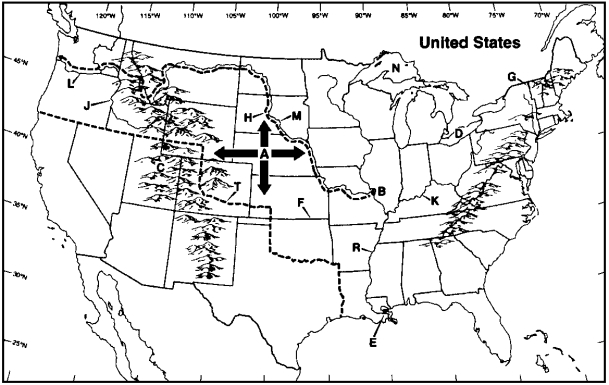
St. Louis, Missouri
Instructions: Choose the letter on the accompanying map of the United States that correctly identifies each of the following:
St. Louis, Missouri
Question
MAP QUESTIONS
Instructions: Choose the letter on the accompanying map of the United States that correctly identifies each of the following:
New Orleans
Instructions: Choose the letter on the accompanying map of the United States that correctly identifies each of the following:
New Orleans
Question
Question
MAP QUESTIONS
Instructions: Choose the letter on the accompanying map of the United States that correctly identifies each of the following:
Ohio River
Instructions: Choose the letter on the accompanying map of the United States that correctly identifies each of the following:
Ohio River
Question
MAP QUESTIONS
Instructions: Choose the letter on the accompanying map of the United States that correctly identifies each of the following:
Mississippi River
Instructions: Choose the letter on the accompanying map of the United States that correctly identifies each of the following:
Mississippi River
Question
MAP QUESTIONS
Instructions: Choose the letter on the accompanying map of the United States that correctly identifies each of the following:
route of the Lewis and Clark expedition
Instructions: Choose the letter on the accompanying map of the United States that correctly identifies each of the following:
route of the Lewis and Clark expedition
Question
MAP QUESTIONS
Instructions: Choose the letter on the accompanying map of the United States that correctly identifies each of the following:
Snake River
Instructions: Choose the letter on the accompanying map of the United States that correctly identifies each of the following:
Snake River
Question
MAP QUESTIONS
Instructions: Choose the letter on the accompanying map of the United States that correctly identifies each of the following:
Lake Erie
Instructions: Choose the letter on the accompanying map of the United States that correctly identifies each of the following:
Lake Erie
Question
MAP QUESTIONS
Instructions: Choose the letter on the accompanying map of the United States that correctly identifies each of the following:
Columbia River
Instructions: Choose the letter on the accompanying map of the United States that correctly identifies each of the following:
Columbia River
Question
MAP QUESTIONS
Instructions: Choose the letter on the accompanying map of the United States that correctly identifies each of the following:
Missouri River
Instructions: Choose the letter on the accompanying map of the United States that correctly identifies each of the following:
Missouri River
Question
MAP QUESTIONS
Instructions: Choose the letter on the accompanying map of the United States that correctly identifies each of the following:
lands of the Louisiana Purchase
Instructions: Choose the letter on the accompanying map of the United States that correctly identifies each of the following:
lands of the Louisiana Purchase
Question
Question
MAP QUESTIONS
Instructions: Choose the letter on the accompanying map of the United States that correctly identifies each of the following:
the boundaries established by the Adams-Onís (Transcontinental) Treaty
Instructions: Choose the letter on the accompanying map of the United States that correctly identifies each of the following:
the boundaries established by the Adams-Onís (Transcontinental) Treaty

Unlock Deck
Sign up to unlock the cards in this deck!
Unlock Deck
Unlock Deck
1/53

Play

Full screen (f)
Deck 8: America at War and Peace, 1801-1824
1
Which of the following statements about the "Missouri Compromise" is not accurate?
A) Maine was admitted as a free state
B) Missouri was admitted as a slave state
C) Slavery was prohibited in the remainder of the Louisiana Purchase north of 36°30'
D) Slavery in the Upper South was to be phased out by 1853
E) The controversy signaled that the main source of sectional conflict in future decades would be the slavery issue
A) Maine was admitted as a free state
B) Missouri was admitted as a slave state
C) Slavery was prohibited in the remainder of the Louisiana Purchase north of 36°30'
D) Slavery in the Upper South was to be phased out by 1853
E) The controversy signaled that the main source of sectional conflict in future decades would be the slavery issue
Slavery in the Upper South was to be phased out by 1853
2
President Jefferson advocated naval action against the Barbary pirates because he believed that
A) waging war would be less expensive than paying tribute.
B) Americans wanted war.
C) he would gain political support because most of the nation's naval facilities were in areas where his party was strong.
D) it was essential to turn public attention away from domestic difficulties.
E) American prestige in Europe needed a boost.
A) waging war would be less expensive than paying tribute.
B) Americans wanted war.
C) he would gain political support because most of the nation's naval facilities were in areas where his party was strong.
D) it was essential to turn public attention away from domestic difficulties.
E) American prestige in Europe needed a boost.
waging war would be less expensive than paying tribute.
3
What did the Supreme Court argue in Marbury v. Madison?
A) Marbury deserved his appointment as a justice of the peace.
B) The Supreme Court did not have constitutional jurisdiction over this case.
C) Congress did not have the power to pass laws.
D) The Supreme Court had the authority to determine the constitutionality of a law.
E) Congress cannot deny a president's nominee for a judicial appointment
A) Marbury deserved his appointment as a justice of the peace.
B) The Supreme Court did not have constitutional jurisdiction over this case.
C) Congress did not have the power to pass laws.
D) The Supreme Court had the authority to determine the constitutionality of a law.
E) Congress cannot deny a president's nominee for a judicial appointment
The Supreme Court had the authority to determine the constitutionality of a law.
4
The 1823 Monroe Doctrine argued that European countries
A) could no longer establish new colonies in the Western Hemisphere.
B) had to withdraw from their colonies in the Western Hemisphere.
C) should sell their colonies in the Western Hemisphere to the United States.
D) needed to develop plans to liberate their colonies.
E) needed to focus their colonial ambitions on Asia.
A) could no longer establish new colonies in the Western Hemisphere.
B) had to withdraw from their colonies in the Western Hemisphere.
C) should sell their colonies in the Western Hemisphere to the United States.
D) needed to develop plans to liberate their colonies.
E) needed to focus their colonial ambitions on Asia.
Unlock Deck
Unlock for access to all 53 flashcards in this deck.
Unlock Deck
k this deck
5
Why did President Jefferson consider French ownership of Louisiana unacceptable?
A) Ownership by a weaker nation than France offered more possibilities for the United States.
B) The French might join forces with the British and endanger American security.
C) If the French quarreled with the British, the United States might find itself caught in the middle.
D) French ownership interfered with Jefferson's dream of an empire of liberty.
E) All of these choices
A) Ownership by a weaker nation than France offered more possibilities for the United States.
B) The French might join forces with the British and endanger American security.
C) If the French quarreled with the British, the United States might find itself caught in the middle.
D) French ownership interfered with Jefferson's dream of an empire of liberty.
E) All of these choices
Unlock Deck
Unlock for access to all 53 flashcards in this deck.
Unlock Deck
k this deck
6
Why did Jefferson overcome his doubts about the constitutionality of the Louisiana Purchase?
A) He found a passage in the Constitution that mentioned the purchase of territory.
B) An amendment was ratified permitting territorial acquisition.
C) He decided that a guarantee of land for American farmers was more important than a constitutional principle.
D) He realized that he would lose the next election without the additional votes from Louisiana.
E) All of these choices
A) He found a passage in the Constitution that mentioned the purchase of territory.
B) An amendment was ratified permitting territorial acquisition.
C) He decided that a guarantee of land for American farmers was more important than a constitutional principle.
D) He realized that he would lose the next election without the additional votes from Louisiana.
E) All of these choices
Unlock Deck
Unlock for access to all 53 flashcards in this deck.
Unlock Deck
k this deck
7
Who led American forces at the Battle of New Orleans?
A) Oliver Perry
B) William Harrison
C) Andrew Jackson
D) James Monroe
E) Henry Knox
A) Oliver Perry
B) William Harrison
C) Andrew Jackson
D) James Monroe
E) Henry Knox
Unlock Deck
Unlock for access to all 53 flashcards in this deck.
Unlock Deck
k this deck
8
Which of the following beliefs did Thomas Jefferson hold?
A) People should learn to serve the government rather than expecting the government to serve the people.
B) An established church was the best bulwark against corruption.
C) High taxes, standing armies, and corruption could destroy American liberty by turning government into the master rather than the servant of the people.
D) The British parliamentary system was the surest model for Americans to follow.
E) To maintain order, a government had to levy substantial taxes and maintain a sizable standing army.
A) People should learn to serve the government rather than expecting the government to serve the people.
B) An established church was the best bulwark against corruption.
C) High taxes, standing armies, and corruption could destroy American liberty by turning government into the master rather than the servant of the people.
D) The British parliamentary system was the surest model for Americans to follow.
E) To maintain order, a government had to levy substantial taxes and maintain a sizable standing army.
Unlock Deck
Unlock for access to all 53 flashcards in this deck.
Unlock Deck
k this deck
9
Which of the following was not part of President Jefferson's policy of cutting federal expenses?
A) He closed various American embassies in Europe.
B) He reduced the size of the army.
C) He cut the federal debt.
D) He bribed the Barbary pirates rather than fighting them.
E) He repealed many taxes.
A) He closed various American embassies in Europe.
B) He reduced the size of the army.
C) He cut the federal debt.
D) He bribed the Barbary pirates rather than fighting them.
E) He repealed many taxes.
Unlock Deck
Unlock for access to all 53 flashcards in this deck.
Unlock Deck
k this deck
10
Who were the "midnight" judges?
A) Federal judges fired by President Jefferson late in the evening of his first day as president.
B) Judicial appointments made by President Adams in the last days of his presidency.
C) Republican judges accused by the Federalists of engaging in immoral nighttime activities.
D) Judges requested by Adams to preside over night court.
E) None of these choices
A) Federal judges fired by President Jefferson late in the evening of his first day as president.
B) Judicial appointments made by President Adams in the last days of his presidency.
C) Republican judges accused by the Federalists of engaging in immoral nighttime activities.
D) Judges requested by Adams to preside over night court.
E) None of these choices
Unlock Deck
Unlock for access to all 53 flashcards in this deck.
Unlock Deck
k this deck
11
Which of the following statements does not accurately describes the War of 1812?
A) It occurred even though Great Britain had decided to seek peace prior to the U.S. declaration of war.
B) It was militarily indecisive but left the U.S. as a major power.
C) The Battle of New Orleans enabled Americans to win generous terms in the Treaty of Ghent.
D) Americans launched a series of unsuccessful attacks on Canada.
E) Because of Captain Perry's victory at Put-in-Bay the British abandoned Lake Erie.
A) It occurred even though Great Britain had decided to seek peace prior to the U.S. declaration of war.
B) It was militarily indecisive but left the U.S. as a major power.
C) The Battle of New Orleans enabled Americans to win generous terms in the Treaty of Ghent.
D) Americans launched a series of unsuccessful attacks on Canada.
E) Because of Captain Perry's victory at Put-in-Bay the British abandoned Lake Erie.
Unlock Deck
Unlock for access to all 53 flashcards in this deck.
Unlock Deck
k this deck
12
The main issue that led to the "Missouri Compromise" was
A) the balance between slave states and free states.
B) how to quietly end the embargo that was destroying the New England economy.
C) the need to maintain a balance between agricultural states and industrial states.
D) the lack of a provision in the Constitution for admission of new states into the Union.
E) federal aid to Mississippi River steamboats.
A) the balance between slave states and free states.
B) how to quietly end the embargo that was destroying the New England economy.
C) the need to maintain a balance between agricultural states and industrial states.
D) the lack of a provision in the Constitution for admission of new states into the Union.
E) federal aid to Mississippi River steamboats.
Unlock Deck
Unlock for access to all 53 flashcards in this deck.
Unlock Deck
k this deck
13
Who did Thomas Jefferson believe were the most vigilant and virtuous people?
A) City dwellers
B) Educated farmers
C) Factory workers
D) African-American slaves
E) Indians
A) City dwellers
B) Educated farmers
C) Factory workers
D) African-American slaves
E) Indians
Unlock Deck
Unlock for access to all 53 flashcards in this deck.
Unlock Deck
k this deck
14
In President Jefferson's view, what did the Judiciary Act of 1801 demonstrate?
A) The federal government needed to be overhauled.
B) The Republican party would be able to dominate all branches of the federal government.
C) John Marshall had to be impeached.
D) The Constitutional Convention had been wrong in not describing the federal judiciary in greater detail.
E) The Federalists were trying to make the judiciary their stronghold.
A) The federal government needed to be overhauled.
B) The Republican party would be able to dominate all branches of the federal government.
C) John Marshall had to be impeached.
D) The Constitutional Convention had been wrong in not describing the federal judiciary in greater detail.
E) The Federalists were trying to make the judiciary their stronghold.
Unlock Deck
Unlock for access to all 53 flashcards in this deck.
Unlock Deck
k this deck
15
As a result of the Chesapeake-Leopard Affair, Americans were enraged and a war was almost precipitated because of an attack on a U.S. warship by
A) Britain.
B) Spain.
C) France.
D) Germany.
E) Portugal.
A) Britain.
B) Spain.
C) France.
D) Germany.
E) Portugal.
Unlock Deck
Unlock for access to all 53 flashcards in this deck.
Unlock Deck
k this deck
16
Why did Thomas Jefferson favor sovereignty of state government over the federal government?
A) He knew that the opposition Federalist party still dominated the federal government.
B) He wanted the states to be free to build new cities.
C) He believed that state government was more responsive to popular will.
D) He feared that the federal government would provide financial assistance to manufacturers, leaving the states to subsidize family farms.
E) He believed that the federal government was not yet strong enough.
A) He knew that the opposition Federalist party still dominated the federal government.
B) He wanted the states to be free to build new cities.
C) He believed that state government was more responsive to popular will.
D) He feared that the federal government would provide financial assistance to manufacturers, leaving the states to subsidize family farms.
E) He believed that the federal government was not yet strong enough.
Unlock Deck
Unlock for access to all 53 flashcards in this deck.
Unlock Deck
k this deck
17
The Lewis and Clark expedition produced which of the following results?
A) New scientific information
B) Tall tales about gigantic Indians and a mountain of salt
C) Stimulation of interest in the West
D) New geographic information
E) All of these choices
A) New scientific information
B) Tall tales about gigantic Indians and a mountain of salt
C) Stimulation of interest in the West
D) New geographic information
E) All of these choices
Unlock Deck
Unlock for access to all 53 flashcards in this deck.
Unlock Deck
k this deck
18
How did President Jefferson plan to reverse what he perceived to be a drift toward despotism that had occurred in the 1790s?
A) by eliminating the national debt, thereby reducing the need for taxes.
B) by destroying the opposition Federalist party.
C) by acquiring additional territory that could help to bolster American freedom.
D) by strengthening the army to stand guard against tyrants.
E) by sending cash payments to America's foreign foes.
A) by eliminating the national debt, thereby reducing the need for taxes.
B) by destroying the opposition Federalist party.
C) by acquiring additional territory that could help to bolster American freedom.
D) by strengthening the army to stand guard against tyrants.
E) by sending cash payments to America's foreign foes.
Unlock Deck
Unlock for access to all 53 flashcards in this deck.
Unlock Deck
k this deck
19
Who served as a Spanish agent while working for the U.S. government?
A) Alexander Hamilton
B) George Clark
C) Albert Gallatin
D) Henry Knox
E) James Wilkinson
A) Alexander Hamilton
B) George Clark
C) Albert Gallatin
D) Henry Knox
E) James Wilkinson
Unlock Deck
Unlock for access to all 53 flashcards in this deck.
Unlock Deck
k this deck
20
The Adams-Onís (Transcontinental) Treaty was designed to settle border disputes between the United States and
A) Great Britain.
B) France.
C) Spain.
D) Russia.
E) Portugal.
A) Great Britain.
B) France.
C) Spain.
D) Russia.
E) Portugal.
Unlock Deck
Unlock for access to all 53 flashcards in this deck.
Unlock Deck
k this deck
21
Which region of the United States was hit the hardest by the Embargo Act?
A) New England
B) The Southeast
C) The mid-Atlantic states
D) The Old Northwest
E) The Louisiana territory
A) New England
B) The Southeast
C) The mid-Atlantic states
D) The Old Northwest
E) The Louisiana territory
Unlock Deck
Unlock for access to all 53 flashcards in this deck.
Unlock Deck
k this deck
22
Who composed "The Star-Spangled Banner"?
A) Franklin Pierce
B) Alexander Johns
C) Scott Joplin
D) Francis Scott Key
E) George Gershwin
A) Franklin Pierce
B) Alexander Johns
C) Scott Joplin
D) Francis Scott Key
E) George Gershwin
Unlock Deck
Unlock for access to all 53 flashcards in this deck.
Unlock Deck
k this deck
23
The Rush-Bagot Treaty demilitarized
A) the border between the United States and the Spanish Empire.
B) the border between the Oregon Territory and British Canada.
C) the Great Lakes.
D) the Caribbean.
E) any British and American possessions where they held joint control.
A) the border between the United States and the Spanish Empire.
B) the border between the Oregon Territory and British Canada.
C) the Great Lakes.
D) the Caribbean.
E) any British and American possessions where they held joint control.
Unlock Deck
Unlock for access to all 53 flashcards in this deck.
Unlock Deck
k this deck
24
Which of the following was not one of the ideas proposed at the Hartford Convention?
A) The United States should abolish the Constitution's three-fifths clause.
B) The Constitution should be amended to allow the president to declare war without congressional approval.
C) There should be a prohibition against two successive presidents from the same state.
D) The president should be limited to a single term.
E) Embargoes lasting more than 60 days should be illegal.
A) The United States should abolish the Constitution's three-fifths clause.
B) The Constitution should be amended to allow the president to declare war without congressional approval.
C) There should be a prohibition against two successive presidents from the same state.
D) The president should be limited to a single term.
E) Embargoes lasting more than 60 days should be illegal.
Unlock Deck
Unlock for access to all 53 flashcards in this deck.
Unlock Deck
k this deck
25
When Henry Clay called for an "American System" after the War of 1812, he meant that the United States needed
A) a system of high tariffs to keep out European products.
B) a unique method of manufacturing that Europeans could not emulate.
C) a new way of winning wars.
D) an approach to government that had never been tried before.
E) internal improvements that would make the nation self-sufficient.
A) a system of high tariffs to keep out European products.
B) a unique method of manufacturing that Europeans could not emulate.
C) a new way of winning wars.
D) an approach to government that had never been tried before.
E) internal improvements that would make the nation self-sufficient.
Unlock Deck
Unlock for access to all 53 flashcards in this deck.
Unlock Deck
k this deck
26
What was the main source of votes in favor of war with Britain when Congress declared war in June 1812?
A) Republicans in populous states like Pennsylvania, Maryland, and Virginia
B) War hawks from western states
C) Great Lakes states
D) New England
E) New York and New Jersey
A) Republicans in populous states like Pennsylvania, Maryland, and Virginia
B) War hawks from western states
C) Great Lakes states
D) New England
E) New York and New Jersey
Unlock Deck
Unlock for access to all 53 flashcards in this deck.
Unlock Deck
k this deck
27
Which of the following actions of the American government reopened trade with Britain and France and determined that if either nation repealed its restrictions the United States would halt all commerce with the other nation?
A) The embargo
B) The Non-Intercourse Act
C) Macon's Bill No. 2
D) The Treaty of Fort Wayne
E) The War Hawk Proviso
A) The embargo
B) The Non-Intercourse Act
C) Macon's Bill No. 2
D) The Treaty of Fort Wayne
E) The War Hawk Proviso
Unlock Deck
Unlock for access to all 53 flashcards in this deck.
Unlock Deck
k this deck
28
Why was Captain Oliver Perry's victory at the Battle of Put-in-Bay (Lake Erie) significant?
A) The United States won the War of 1812.
B) The British came to realize that Canada was indefensible and had to be abandoned.
C) The British lost control of Lake Erie and therefore pulled back from Detroit.
D) The president announced he would not run for reelection in order to focus on a U.S. victory in the war.
E) The American people turned to new political leadership in the next presidential election.
A) The United States won the War of 1812.
B) The British came to realize that Canada was indefensible and had to be abandoned.
C) The British lost control of Lake Erie and therefore pulled back from Detroit.
D) The president announced he would not run for reelection in order to focus on a U.S. victory in the war.
E) The American people turned to new political leadership in the next presidential election.
Unlock Deck
Unlock for access to all 53 flashcards in this deck.
Unlock Deck
k this deck
29
What was the main thrust of John Quincy Adams's foreign policy?
A) to conquer commercial rivals by military means.
B) to militarize the Great Lakes for security.
C) to encourage European involvement in keeping peace in the Western Hemisphere.
D) to isolate the United States from the rest of the world by prohibiting immigrants and foreign goods.
E) to secure American borders and strengthen the peace with Great Britain.
A) to conquer commercial rivals by military means.
B) to militarize the Great Lakes for security.
C) to encourage European involvement in keeping peace in the Western Hemisphere.
D) to isolate the United States from the rest of the world by prohibiting immigrants and foreign goods.
E) to secure American borders and strengthen the peace with Great Britain.
Unlock Deck
Unlock for access to all 53 flashcards in this deck.
Unlock Deck
k this deck
30
Thomas Jefferson believed that the U.S. army should
A) remain the same size as he inherited it.
B) be increased in size to help manage the country's new territory.
C) be reduced in size in order to save money.
D) be increased in size in order to be able to compete with any military in the world.
E) be disbanded and that the country should rely on militia for protection.
A) remain the same size as he inherited it.
B) be increased in size to help manage the country's new territory.
C) be reduced in size in order to save money.
D) be increased in size in order to be able to compete with any military in the world.
E) be disbanded and that the country should rely on militia for protection.
Unlock Deck
Unlock for access to all 53 flashcards in this deck.
Unlock Deck
k this deck
31
What is impressment?
A) A British effort to convince their opponents that they were wrong.
B) The British policy of seizing American sailors who had defected to the French during the Napoleonic Wars.
C) The French policy of forcing all nations to impress their soldiers into the French army.
D) The American policy of seizing seamen from bars and brothels and forcing them to join the navy.
E) The seizure of purported British sailors from American merchant ships, and pressing them into service.
A) A British effort to convince their opponents that they were wrong.
B) The British policy of seizing American sailors who had defected to the French during the Napoleonic Wars.
C) The French policy of forcing all nations to impress their soldiers into the French army.
D) The American policy of seizing seamen from bars and brothels and forcing them to join the navy.
E) The seizure of purported British sailors from American merchant ships, and pressing them into service.
Unlock Deck
Unlock for access to all 53 flashcards in this deck.
Unlock Deck
k this deck
32
What were the terms of the Non-Intercourse Act?
A) Premarital sex became a federal offense.
B) America would trade with all nations except Britain and France and would restore trade with either nation if it ceased to violate neutral rights.
C) America would refrain from trading with any nation that was at war.
D) Britain and France would refrain from trading with the United States unless it observed proper neutrality.
E) All American vessels were prohibited from leaving American ports for foreign ports.
A) Premarital sex became a federal offense.
B) America would trade with all nations except Britain and France and would restore trade with either nation if it ceased to violate neutral rights.
C) America would refrain from trading with any nation that was at war.
D) Britain and France would refrain from trading with the United States unless it observed proper neutrality.
E) All American vessels were prohibited from leaving American ports for foreign ports.
Unlock Deck
Unlock for access to all 53 flashcards in this deck.
Unlock Deck
k this deck
33
Which of the following was not a reason the United States went to war with Great Britain in 1812?
A) An economic recession affected the South and West after 1808.
B) Many Americans believed that British policy was damaging America's economy.
C) President Madison's believed that Britain wished to eliminate the United States as an economic rival.
D) New England merchants wanted the government to protect their shipping.
E) Britain was impressing American sailors and violating American neutral rights.
A) An economic recession affected the South and West after 1808.
B) Many Americans believed that British policy was damaging America's economy.
C) President Madison's believed that Britain wished to eliminate the United States as an economic rival.
D) New England merchants wanted the government to protect their shipping.
E) Britain was impressing American sailors and violating American neutral rights.
Unlock Deck
Unlock for access to all 53 flashcards in this deck.
Unlock Deck
k this deck
34
DNA evidence suggests that Thomas Jefferson probably
A) had a psychological disorder.
B) fathered at least one child with his slave, Sally Hemings.
C) died from an early version of AIDS.
D) had a father who was a slave.
E) could not have fathered any of his children.
A) had a psychological disorder.
B) fathered at least one child with his slave, Sally Hemings.
C) died from an early version of AIDS.
D) had a father who was a slave.
E) could not have fathered any of his children.
Unlock Deck
Unlock for access to all 53 flashcards in this deck.
Unlock Deck
k this deck
35
Who helped Lewis and Clark on their expedition to the Pacific?
A) Pocahontas
B) Tecumseh
C) Black Hawk
D) Sacajawea
E) Red Eagle
A) Pocahontas
B) Tecumseh
C) Black Hawk
D) Sacajawea
E) Red Eagle
Unlock Deck
Unlock for access to all 53 flashcards in this deck.
Unlock Deck
k this deck
36
What did the British Rule of 1756 state?
A) In wartime, neutral nations were expected to pick up the trade formerly conducted by the belligerents.
B) Warfare would not extend to the high seas.
C) Trade closed in time of peace could not be opened in time of war.
D) Conditions of war would determine shipping rules.
E) Forts controlled by a country before a war could be used by the same country during a war.
A) In wartime, neutral nations were expected to pick up the trade formerly conducted by the belligerents.
B) Warfare would not extend to the high seas.
C) Trade closed in time of peace could not be opened in time of war.
D) Conditions of war would determine shipping rules.
E) Forts controlled by a country before a war could be used by the same country during a war.
Unlock Deck
Unlock for access to all 53 flashcards in this deck.
Unlock Deck
k this deck
37
The war hawks were
A) frontiersmen from New England who wanted to seize Canada from Great Britain.
B) men who were eager for war against Napoleon in order to gain the Louisiana Territory.
C) supporters of Jefferson and Madison's policy of economic coercion.
D) Old Line Federalists who wanted to sweep down and attack the British West Indies and Cuba.
E) Republicans from the West and South who thought the government's policies were wrecking their economies.
A) frontiersmen from New England who wanted to seize Canada from Great Britain.
B) men who were eager for war against Napoleon in order to gain the Louisiana Territory.
C) supporters of Jefferson and Madison's policy of economic coercion.
D) Old Line Federalists who wanted to sweep down and attack the British West Indies and Cuba.
E) Republicans from the West and South who thought the government's policies were wrecking their economies.
Unlock Deck
Unlock for access to all 53 flashcards in this deck.
Unlock Deck
k this deck
38
Where did William Henry Harrison's forces defeat the Shawnee Indians?
A) Battle of New Orleans
B) Battle of Tippecanoe
C) Battle of Lake Erie
D) Battle of Fallen Timbers
E) Battle of Queenston
A) Battle of New Orleans
B) Battle of Tippecanoe
C) Battle of Lake Erie
D) Battle of Fallen Timbers
E) Battle of Queenston
Unlock Deck
Unlock for access to all 53 flashcards in this deck.
Unlock Deck
k this deck
39
What did the Treaty of Ghent not do?
A) It outlawed of the impressment of American sailors.
B) It restored the status quo antebellum.
C) It ended the War of 1812.
D) It provided for no territorial gain or loss for the United States.
E) It referred boundary issues to a joint commission.
A) It outlawed of the impressment of American sailors.
B) It restored the status quo antebellum.
C) It ended the War of 1812.
D) It provided for no territorial gain or loss for the United States.
E) It referred boundary issues to a joint commission.
Unlock Deck
Unlock for access to all 53 flashcards in this deck.
Unlock Deck
k this deck
40
How effective was the 1807 Embargo Act?
A) It forced the French to abandon the Continental System.
B) It severely hurt the American economy and had little influence on foreign countries.
C) It damaged Franco-American relations and led to the War of 1812.
D) It made the British abandon the Rule of 1756.
E) None of these choices
A) It forced the French to abandon the Continental System.
B) It severely hurt the American economy and had little influence on foreign countries.
C) It damaged Franco-American relations and led to the War of 1812.
D) It made the British abandon the Rule of 1756.
E) None of these choices
Unlock Deck
Unlock for access to all 53 flashcards in this deck.
Unlock Deck
k this deck
41
MAP QUESTIONS
Instructions: Choose the letter on the accompanying map of the United States that correctly identifies each of the following:
St. Louis, Missouri
Instructions: Choose the letter on the accompanying map of the United States that correctly identifies each of the following:
St. Louis, Missouri
Unlock Deck
Unlock for access to all 53 flashcards in this deck.
Unlock Deck
k this deck
42
MAP QUESTIONS
Instructions: Choose the letter on the accompanying map of the United States that correctly identifies each of the following:
New Orleans
Instructions: Choose the letter on the accompanying map of the United States that correctly identifies each of the following:
New Orleans
Unlock Deck
Unlock for access to all 53 flashcards in this deck.
Unlock Deck
k this deck
43
In McCulloch v. Maryland, what did the Supreme Court declare?
A) Congress lacked the power to charter a national bank.
B) A state cannot tax an agency of the federal government.
C) The state of Maryland was superior to the United States.
D) The Supreme Court had the power to declare an act of the federal government unconstitutional.
E) A college had a right to a charter.
A) Congress lacked the power to charter a national bank.
B) A state cannot tax an agency of the federal government.
C) The state of Maryland was superior to the United States.
D) The Supreme Court had the power to declare an act of the federal government unconstitutional.
E) A college had a right to a charter.
Unlock Deck
Unlock for access to all 53 flashcards in this deck.
Unlock Deck
k this deck
44
MAP QUESTIONS
Instructions: Choose the letter on the accompanying map of the United States that correctly identifies each of the following:
Ohio River
Instructions: Choose the letter on the accompanying map of the United States that correctly identifies each of the following:
Ohio River
Unlock Deck
Unlock for access to all 53 flashcards in this deck.
Unlock Deck
k this deck
45
MAP QUESTIONS
Instructions: Choose the letter on the accompanying map of the United States that correctly identifies each of the following:
Mississippi River
Instructions: Choose the letter on the accompanying map of the United States that correctly identifies each of the following:
Mississippi River
Unlock Deck
Unlock for access to all 53 flashcards in this deck.
Unlock Deck
k this deck
46
MAP QUESTIONS
Instructions: Choose the letter on the accompanying map of the United States that correctly identifies each of the following:
route of the Lewis and Clark expedition
Instructions: Choose the letter on the accompanying map of the United States that correctly identifies each of the following:
route of the Lewis and Clark expedition
Unlock Deck
Unlock for access to all 53 flashcards in this deck.
Unlock Deck
k this deck
47
MAP QUESTIONS
Instructions: Choose the letter on the accompanying map of the United States that correctly identifies each of the following:
Snake River
Instructions: Choose the letter on the accompanying map of the United States that correctly identifies each of the following:
Snake River
Unlock Deck
Unlock for access to all 53 flashcards in this deck.
Unlock Deck
k this deck
48
MAP QUESTIONS
Instructions: Choose the letter on the accompanying map of the United States that correctly identifies each of the following:
Lake Erie
Instructions: Choose the letter on the accompanying map of the United States that correctly identifies each of the following:
Lake Erie
Unlock Deck
Unlock for access to all 53 flashcards in this deck.
Unlock Deck
k this deck
49
MAP QUESTIONS
Instructions: Choose the letter on the accompanying map of the United States that correctly identifies each of the following:
Columbia River
Instructions: Choose the letter on the accompanying map of the United States that correctly identifies each of the following:
Columbia River
Unlock Deck
Unlock for access to all 53 flashcards in this deck.
Unlock Deck
k this deck
50
MAP QUESTIONS
Instructions: Choose the letter on the accompanying map of the United States that correctly identifies each of the following:
Missouri River
Instructions: Choose the letter on the accompanying map of the United States that correctly identifies each of the following:
Missouri River
Unlock Deck
Unlock for access to all 53 flashcards in this deck.
Unlock Deck
k this deck
51
MAP QUESTIONS
Instructions: Choose the letter on the accompanying map of the United States that correctly identifies each of the following:
lands of the Louisiana Purchase
Instructions: Choose the letter on the accompanying map of the United States that correctly identifies each of the following:
lands of the Louisiana Purchase
Unlock Deck
Unlock for access to all 53 flashcards in this deck.
Unlock Deck
k this deck
52
Why did the Supreme Court decisions in McCulloch v. Maryland and Dartmouth College v. Woodward dismay Republicans?
A) They saw the decisions as an attack on state and popular authority.
B) They believed that the Court was giving away too much of its power.
C) They feared that too many states would begin to interfere with corporations.
D) They believed that the Court was exceeding its Constitutional authority.
E) All of these choices
A) They saw the decisions as an attack on state and popular authority.
B) They believed that the Court was giving away too much of its power.
C) They feared that too many states would begin to interfere with corporations.
D) They believed that the Court was exceeding its Constitutional authority.
E) All of these choices
Unlock Deck
Unlock for access to all 53 flashcards in this deck.
Unlock Deck
k this deck
53
MAP QUESTIONS
Instructions: Choose the letter on the accompanying map of the United States that correctly identifies each of the following:
the boundaries established by the Adams-Onís (Transcontinental) Treaty
Instructions: Choose the letter on the accompanying map of the United States that correctly identifies each of the following:
the boundaries established by the Adams-Onís (Transcontinental) Treaty
Unlock Deck
Unlock for access to all 53 flashcards in this deck.
Unlock Deck
k this deck
Unlock Deck
Unlock for access to all 53 flashcards in this deck.






