







 Chat with AI

Deck 38: Pulmonary Ventilation
Full screen (f)

Question
Following Questions : Use the following figure to answer questions 7-9. 
Which of the following is true regarding residual volume?
A)It is part of the expiratory reserve volume
B)It is part of vital capacity
C)It cannot be measured directly with a spirometer
D)It represents the resting volume of the lungs
E)It is the volume at which the lungs tend to recoil outward
Which of the following is true regarding residual volume?
A)It is part of the expiratory reserve volume
B)It is part of vital capacity
C)It cannot be measured directly with a spirometer
D)It represents the resting volume of the lungs
E)It is the volume at which the lungs tend to recoil outward

Question
Question
Before inspiration, alveolar pressure is 0 and intrapleural pressure is -5 cm H2O. At the end of an inspiration in a healthy person, with the glottis open, these readings would be: 
Question
Question
Following Questions : Use the following figure to answer questions 7-9.
Assuming a respiratory rate of 12 breaths/min, calculate the minute ventilation.
A)1 L/min
B)2 L/min
C)4 L/min
D)5 L/min
E)6 L/min
Assuming a respiratory rate of 12 breaths/min, calculate the minute ventilation.
A)1 L/min
B)2 L/min
C)4 L/min
D)5 L/min
E)6 L/min
Question
Question
A 34-year-old man sustains a bullet wound to the chest that causes a pneumothorax. Which of the following best describe the changes in lung volume and thoracic volume in this man compared with normal? 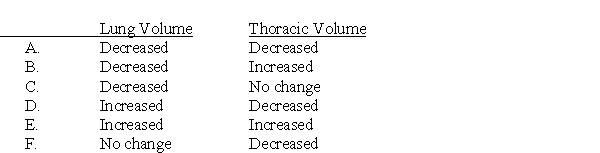
Question

Question
Following Questions : Use the following figure to answer questions 7-9.
Assuming the same respiratory rate of 12 breaths/min, calculate the alveolar ventilation.
A)3 L/min
B)4 L/min
C)6 L/min
D)12 L/min
E)Do not have enough information to calculate alveolar ventilation
Assuming the same respiratory rate of 12 breaths/min, calculate the alveolar ventilation.
A)3 L/min
B)4 L/min
C)6 L/min
D)12 L/min
E)Do not have enough information to calculate alveolar ventilation
Question
Following Questions : Use the following figure to answer questions 7-9.
A preterm infant has a surfactant deficiency. Without surfactant, many of the alveoli collapse at the end of each expiration, which in turn leads to pulmonary failure. Which set of changes is present in the preterm infant compared with a normal infant?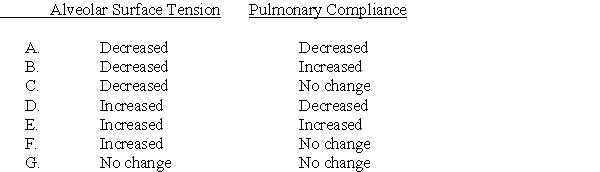
A preterm infant has a surfactant deficiency. Without surfactant, many of the alveoli collapse at the end of each expiration, which in turn leads to pulmonary failure. Which set of changes is present in the preterm infant compared with a normal infant?
Question
Question
Calculate the minute ventilation and the alveolar ventilation for a patient with a respiratory rate of 10 breaths/minute, a tidal volume of 600 mL, and a dead space of 150 mL. 
Question
Following Questions : Use the following figure to answer questions 7-9.
What is the residual volume?
A)1,000 mL
B)1,500 mL
C)2,000 mL
D)2,500 mL
E)5,000 mL
What is the residual volume?
A)1,000 mL
B)1,500 mL
C)2,000 mL
D)2,500 mL
E)5,000 mL
Question
Following Questions : Use the following figure to answer questions 7-9.
A group of students is trying to see who can generate the highest expiratory flow. Which muscle is most effective at producing a maximal effort?
A)Diaphragm
B)Internal intercostals
C)External intercostals
D)Rectus abdominis
E)Sternocleidomastoid
A group of students is trying to see who can generate the highest expiratory flow. Which muscle is most effective at producing a maximal effort?
A)Diaphragm
B)Internal intercostals
C)External intercostals
D)Rectus abdominis
E)Sternocleidomastoid

Unlock Deck
Sign up to unlock the cards in this deck!
Unlock Deck
Unlock Deck
1/14

Play

Full screen (f)
Deck 38: Pulmonary Ventilation
1
Following Questions : Use the following figure to answer questions 7-9.
Which of the following is true regarding residual volume?
A)It is part of the expiratory reserve volume
B)It is part of vital capacity
C)It cannot be measured directly with a spirometer
D)It represents the resting volume of the lungs
E)It is the volume at which the lungs tend to recoil outward
Which of the following is true regarding residual volume?
A)It is part of the expiratory reserve volume
B)It is part of vital capacity
C)It cannot be measured directly with a spirometer
D)It represents the resting volume of the lungs
E)It is the volume at which the lungs tend to recoil outward
C
2
Which of the following tend to decrease airway resistance?
A)Asthma
B)Stimulation by sympathetic fibers
C)Treatment with acetylcholine
D)Exhalation to residual volume
A)Asthma
B)Stimulation by sympathetic fibers
C)Treatment with acetylcholine
D)Exhalation to residual volume
B
B
B
3
Before inspiration, alveolar pressure is 0 and intrapleural pressure is -5 cm H2O. At the end of an inspiration in a healthy person, with the glottis open, these readings would be:
E
4
Which of the following lung volumes or capacities cannot be determined with a simple spirometer?
A)Vital capacity
B)Expiratory reserve volume
C)Inspiratory reserve volume
D)Tidal volume
E)Functional residual capacity
A)Vital capacity
B)Expiratory reserve volume
C)Inspiratory reserve volume
D)Tidal volume
E)Functional residual capacity
Unlock Deck
Unlock for access to all 14 flashcards in this deck.
Unlock Deck
k this deck
5
Following Questions : Use the following figure to answer questions 7-9.
Assuming a respiratory rate of 12 breaths/min, calculate the minute ventilation.
A)1 L/min
B)2 L/min
C)4 L/min
D)5 L/min
E)6 L/min
Assuming a respiratory rate of 12 breaths/min, calculate the minute ventilation.
A)1 L/min
B)2 L/min
C)4 L/min
D)5 L/min
E)6 L/min
Unlock Deck
Unlock for access to all 14 flashcards in this deck.
Unlock Deck
k this deck
6
Which of the following would be expected to increase the measured airway resistance?
A)Stimulation of parasympathetic nerves to the lungs
B)Low lung volumes
C)Release of histamine by mast cells
D)Forced expirations
E)All of the above
A)Stimulation of parasympathetic nerves to the lungs
B)Low lung volumes
C)Release of histamine by mast cells
D)Forced expirations
E)All of the above
Unlock Deck
Unlock for access to all 14 flashcards in this deck.
Unlock Deck
k this deck
7
A 34-year-old man sustains a bullet wound to the chest that causes a pneumothorax. Which of the following best describe the changes in lung volume and thoracic volume in this man compared with normal?
Unlock Deck
Unlock for access to all 14 flashcards in this deck.
Unlock Deck
k this deck
8
Unlock Deck
Unlock for access to all 14 flashcards in this deck.
Unlock Deck
k this deck
9
Following Questions : Use the following figure to answer questions 7-9.
Assuming the same respiratory rate of 12 breaths/min, calculate the alveolar ventilation.
A)3 L/min
B)4 L/min
C)6 L/min
D)12 L/min
E)Do not have enough information to calculate alveolar ventilation
Assuming the same respiratory rate of 12 breaths/min, calculate the alveolar ventilation.
A)3 L/min
B)4 L/min
C)6 L/min
D)12 L/min
E)Do not have enough information to calculate alveolar ventilation
Unlock Deck
Unlock for access to all 14 flashcards in this deck.
Unlock Deck
k this deck
10
Following Questions : Use the following figure to answer questions 7-9.
A preterm infant has a surfactant deficiency. Without surfactant, many of the alveoli collapse at the end of each expiration, which in turn leads to pulmonary failure. Which set of changes is present in the preterm infant compared with a normal infant?
A preterm infant has a surfactant deficiency. Without surfactant, many of the alveoli collapse at the end of each expiration, which in turn leads to pulmonary failure. Which set of changes is present in the preterm infant compared with a normal infant?
Unlock Deck
Unlock for access to all 14 flashcards in this deck.
Unlock Deck
k this deck
11
A 50-year-old man participates in a marathon. Which muscle(s) are being used for inspiration during the marathon?
A)Gastrocnemius
B)Internal intercostals
C)Abdominals
D)External intercostals
A)Gastrocnemius
B)Internal intercostals
C)Abdominals
D)External intercostals
Unlock Deck
Unlock for access to all 14 flashcards in this deck.
Unlock Deck
k this deck
12
Calculate the minute ventilation and the alveolar ventilation for a patient with a respiratory rate of 10 breaths/minute, a tidal volume of 600 mL, and a dead space of 150 mL.
Unlock Deck
Unlock for access to all 14 flashcards in this deck.
Unlock Deck
k this deck
13
Following Questions : Use the following figure to answer questions 7-9.
What is the residual volume?
A)1,000 mL
B)1,500 mL
C)2,000 mL
D)2,500 mL
E)5,000 mL
What is the residual volume?
A)1,000 mL
B)1,500 mL
C)2,000 mL
D)2,500 mL
E)5,000 mL
Unlock Deck
Unlock for access to all 14 flashcards in this deck.
Unlock Deck
k this deck
14
Following Questions : Use the following figure to answer questions 7-9.
A group of students is trying to see who can generate the highest expiratory flow. Which muscle is most effective at producing a maximal effort?
A)Diaphragm
B)Internal intercostals
C)External intercostals
D)Rectus abdominis
E)Sternocleidomastoid
A group of students is trying to see who can generate the highest expiratory flow. Which muscle is most effective at producing a maximal effort?
A)Diaphragm
B)Internal intercostals
C)External intercostals
D)Rectus abdominis
E)Sternocleidomastoid
Unlock Deck
Unlock for access to all 14 flashcards in this deck.
Unlock Deck
k this deck
Unlock Deck
Unlock for access to all 14 flashcards in this deck.






