







 Chat with AI

Deck 13: Cardiac Arrhythmias and Their Electrocardiographic Interpretation
Full screen (f)

Question
Use the following information to answer Following Questions : A 60-year-old woman was admitted to the emergency department after an automobile accident, where the following electrocardiogram was taken. Chest lead V2 is shown. 
What is her diagnosis?
A)Atrial paroxysmal tachycardia
B)First-degree atrioventricular block
C)Second-degree atrioventricular block
D)Third-degree atrioventricular block
E)Atrial flutter
What is her diagnosis?
A)Atrial paroxysmal tachycardia
B)First-degree atrioventricular block
C)Second-degree atrioventricular block
D)Third-degree atrioventricular block
E)Atrial flutter

Question
Question
Question
Question
A 65-year-old man reported some unusual sensations in his chest. His blood pressure is 135/85 mm Hg, and he weighs 200 pounds. He had an electrocardiogram, which is shown below. What is his likely diagnosis? 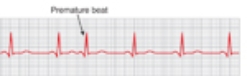

A)Atrial paroxysmal tachycardia
B)First-degree atrioventricular block
C)Second-degree atrioventricular block
D)Premature atrial contractions
E)Premature ventricular contractions
A)Atrial paroxysmal tachycardia
B)First-degree atrioventricular block
C)Second-degree atrioventricular block
D)Premature atrial contractions
E)Premature ventricular contractions
Question
A 48-year-old man had unusual sensations in his chest during exercise. His electrocardiogram is below, with lead aVF shown. What is the diagnosis? 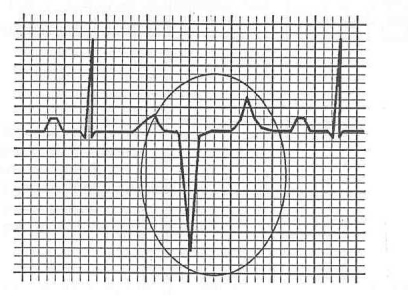
A)Premature contraction originating in the atrium
B)Premature contraction originating high in the atrioventricular node
C)Premature contraction originating low in the atrioventricular node
D)Premature contraction originating in the inferior part of the ventricle
E)Premature contraction originating in the base of the ventricle
A)Premature contraction originating in the atrium
B)Premature contraction originating high in the atrioventricular node
C)Premature contraction originating low in the atrioventricular node
D)Premature contraction originating in the inferior part of the ventricle
E)Premature contraction originating in the base of the ventricle
Question
Question
Question
A 55-year-old woman had the following electrocardiogram recorded at her annual physical. She reported to her doctor that sometimes her pulse rate feels strong and at other times it feels weak. Standard limb lead II is shown. 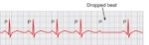 What is her likely diagnosis?
A)Atrial paroxysmal tachycardia
B)First-degree atrioventricular block
C)Second-degree atrioventricular block, Mobitz type I (Wenckebach)
D)Second-degree atrioventricular block, Mobitz type II
E)Third-degree atrioventricular block
What is her likely diagnosis?A)Atrial paroxysmal tachycardia
B)First-degree atrioventricular block
C)Second-degree atrioventricular block, Mobitz type I (Wenckebach)
D)Second-degree atrioventricular block, Mobitz type II
E)Third-degree atrioventricular block
Question
Question
Question
Question
Question
Use the following information to answer Following Questions : A 60-year-old woman was admitted to the emergency department after an automobile accident, where the following electrocardiogram was taken. Chest lead V2 is shown.
What is her heart rate in beats per minute?
A)40
B)60
C)75
D)100
E)150
What is her heart rate in beats per minute?
A)40
B)60
C)75
D)100
E)150
Question
Question
A forty-year-old man reported to his cardiologist that he had unusual feelings in his chest after drinking his fourth cup of coffee in the morning. The cardiologist recorded the following electrocardiogram during an exercise stress test. Leads II and III are shown. What is the likely diagnosis? 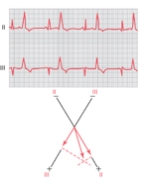
A)Premature contraction originating in the atrium
B)Premature contraction originating high in the atrioventricular node
C)Premature contraction originating low in the atrioventricular node
D)Premature contraction originating in the apex of the ventricle
E)Premature contraction originating in the base of the ventricle
A)Premature contraction originating in the atrium
B)Premature contraction originating high in the atrioventricular node
C)Premature contraction originating low in the atrioventricular node
D)Premature contraction originating in the apex of the ventricle
E)Premature contraction originating in the base of the ventricle

Unlock Deck
Sign up to unlock the cards in this deck!
Unlock Deck
Unlock Deck
1/16

Play

Full screen (f)
Deck 13: Cardiac Arrhythmias and Their Electrocardiographic Interpretation
1
Use the following information to answer Following Questions : A 60-year-old woman was admitted to the emergency department after an automobile accident, where the following electrocardiogram was taken. Chest lead V2 is shown.
What is her diagnosis?
A)Atrial paroxysmal tachycardia
B)First-degree atrioventricular block
C)Second-degree atrioventricular block
D)Third-degree atrioventricular block
E)Atrial flutter
What is her diagnosis?
A)Atrial paroxysmal tachycardia
B)First-degree atrioventricular block
C)Second-degree atrioventricular block
D)Third-degree atrioventricular block
E)Atrial flutter
B
2
Which of the following statements about a premature atrial contraction is true?
A)The radial artery pulse associated with the premature contraction will be stronger than normal
B)Stroke volume associated with the premature contraction will be increased
C)The P wave is never seen
D)The probability of these premature contractions occurring is increased in people with a large caffeine intake
E)It causes the QRS interval to be lengthened
A)The radial artery pulse associated with the premature contraction will be stronger than normal
B)Stroke volume associated with the premature contraction will be increased
C)The P wave is never seen
D)The probability of these premature contractions occurring is increased in people with a large caffeine intake
E)It causes the QRS interval to be lengthened
D
A
A
3
Which of the following decrease the risk of occurrence of ventricular fibrillation?
A)An enlarged ventricle
B)A lengthened ventricular refractory period
C)Decreased electrical conduction velocity
D)Exposure of the heart to 60-cycle alternating current
E)Epinephrine administration
A)An enlarged ventricle
B)A lengthened ventricular refractory period
C)Decreased electrical conduction velocity
D)Exposure of the heart to 60-cycle alternating current
E)Epinephrine administration
D
4
A 50-year-old man has been having fainting "spells" for about 2 weeks. During the fainting episodes, his electrocardiogram shows a ventricular beat of 25 per minute and 100 P waves per minute. After about 30 seconds of fainting a normal sinus rhythm reoccurs. What is his likely diagnosis?
A)Atrial flutter
B)First degree atrioventricular block
C)Second degree atrioventricular block
D)Third degree atrioventricular block
E)Stokes-Adams syndrome
A)Atrial flutter
B)First degree atrioventricular block
C)Second degree atrioventricular block
D)Third degree atrioventricular block
E)Stokes-Adams syndrome
Unlock Deck
Unlock for access to all 16 flashcards in this deck.
Unlock Deck
k this deck
5
A 65-year-old man reported some unusual sensations in his chest. His blood pressure is 135/85 mm Hg, and he weighs 200 pounds. He had an electrocardiogram, which is shown below. What is his likely diagnosis?
A)Atrial paroxysmal tachycardia
B)First-degree atrioventricular block
C)Second-degree atrioventricular block
D)Premature atrial contractions
E)Premature ventricular contractions
A)Atrial paroxysmal tachycardia
B)First-degree atrioventricular block
C)Second-degree atrioventricular block
D)Premature atrial contractions
E)Premature ventricular contractions
Unlock Deck
Unlock for access to all 16 flashcards in this deck.
Unlock Deck
k this deck
6
A 48-year-old man had unusual sensations in his chest during exercise. His electrocardiogram is below, with lead aVF shown. What is the diagnosis?
A)Premature contraction originating in the atrium
B)Premature contraction originating high in the atrioventricular node
C)Premature contraction originating low in the atrioventricular node
D)Premature contraction originating in the inferior part of the ventricle
E)Premature contraction originating in the base of the ventricle
A)Premature contraction originating in the atrium
B)Premature contraction originating high in the atrioventricular node
C)Premature contraction originating low in the atrioventricular node
D)Premature contraction originating in the inferior part of the ventricle
E)Premature contraction originating in the base of the ventricle
Unlock Deck
Unlock for access to all 16 flashcards in this deck.
Unlock Deck
k this deck
7
Which of the following will usually result in an inverted P wave that occurs after the QRS complex?
A)Premature contraction originating in the atrium
B)Premature contraction originating high in the atrioventricular junction
C)Premature contraction originating in the middle of the atrioventricular junction
D)Premature contraction originating low in the atrioventricular junction
E)Atrial fibrillation
A)Premature contraction originating in the atrium
B)Premature contraction originating high in the atrioventricular junction
C)Premature contraction originating in the middle of the atrioventricular junction
D)Premature contraction originating low in the atrioventricular junction
E)Atrial fibrillation
Unlock Deck
Unlock for access to all 16 flashcards in this deck.
Unlock Deck
k this deck
8
A 65-year-old woman had the following electrocardiogram recorded at her annual physical. She reported to her doctor that sometimes her pulse rate feels a little irregular. Standard limb lead III is shown. What is her likely diagnosis?
A)Atrial paroxysmal tachycardia
B)First-degree atrioventricular block
C)Second-degree atrioventricular block, Mobitz type I (Wenckebach)
D)Normal sinus rhythm
E)Third-degree atrioventricular block
A)Atrial paroxysmal tachycardia
B)First-degree atrioventricular block
C)Second-degree atrioventricular block, Mobitz type I (Wenckebach)
D)Normal sinus rhythm
E)Third-degree atrioventricular block
Unlock Deck
Unlock for access to all 16 flashcards in this deck.
Unlock Deck
k this deck
9
A 55-year-old woman had the following electrocardiogram recorded at her annual physical. She reported to her doctor that sometimes her pulse rate feels strong and at other times it feels weak. Standard limb lead II is shown. What is her likely diagnosis?
A)Atrial paroxysmal tachycardia
B)First-degree atrioventricular block
C)Second-degree atrioventricular block, Mobitz type I (Wenckebach)
D)Second-degree atrioventricular block, Mobitz type II
E)Third-degree atrioventricular block
What is her likely diagnosis?A)Atrial paroxysmal tachycardia
B)First-degree atrioventricular block
C)Second-degree atrioventricular block, Mobitz type I (Wenckebach)
D)Second-degree atrioventricular block, Mobitz type II
E)Third-degree atrioventricular block
Unlock Deck
Unlock for access to all 16 flashcards in this deck.
Unlock Deck
k this deck
10
A 50-year-old man has a blood pressure of 140/85 mm Hg and weighs 200 lbs. He reports that he is not feeling well. His electrocardiogram has no P waves, and he has a heart rate of 42 beats/min. What is his condition?
A)First-degree heart block
B)Second-degree heart block
C)Third-degree heart block
D)Sinoatrial heart block
E)Sinus bradycardia
A)First-degree heart block
B)Second-degree heart block
C)Third-degree heart block
D)Sinoatrial heart block
E)Sinus bradycardia
Unlock Deck
Unlock for access to all 16 flashcards in this deck.
Unlock Deck
k this deck
11
A 70-year-old woman had an electrocardiogram taken at her local hospital, and the diagnosis was atrial fibrillation. Which of the following is likely in someone with atrial fibrillation?
A)Ventricular fibrillation normally accompanies atrial fibrillation
B)The P waves of the electrocardiogram are missing
C)The rate of ventricular contraction is regular and slow
D)The atrial "a" wave is normal
E)The atria have a smaller volume than normal
A)Ventricular fibrillation normally accompanies atrial fibrillation
B)The P waves of the electrocardiogram are missing
C)The rate of ventricular contraction is regular and slow
D)The atrial "a" wave is normal
E)The atria have a smaller volume than normal
Unlock Deck
Unlock for access to all 16 flashcards in this deck.
Unlock Deck
k this deck
12
Circus movements in the ventricle can lead to ventricular fibrillation. Which of the following conditions in the ventricular muscle will increase the tendency for circus movements?
A)Decreased conduction velocity
B)Low extracellular potassium concentration
C)Increased refractory period
D)Shorter conduction pathway (decreased ventricular volume)
E)Increase in parasympathetic impulses to the heart
A)Decreased conduction velocity
B)Low extracellular potassium concentration
C)Increased refractory period
D)Shorter conduction pathway (decreased ventricular volume)
E)Increase in parasympathetic impulses to the heart
Unlock Deck
Unlock for access to all 16 flashcards in this deck.
Unlock Deck
k this deck
13
Which of the following decreases the risk of occurrence of ventricular fibrillation?
A)An enlarged ventricle
B)A lengthened ventricular refractory period
C)Decreased electrical conduction velocity
D)Exposure of the heart to 60-cycle alternating current
E)Epinephrine administration
A)An enlarged ventricle
B)A lengthened ventricular refractory period
C)Decreased electrical conduction velocity
D)Exposure of the heart to 60-cycle alternating current
E)Epinephrine administration
Unlock Deck
Unlock for access to all 16 flashcards in this deck.
Unlock Deck
k this deck
14
Use the following information to answer Following Questions : A 60-year-old woman was admitted to the emergency department after an automobile accident, where the following electrocardiogram was taken. Chest lead V2 is shown.
What is her heart rate in beats per minute?
A)40
B)60
C)75
D)100
E)150
What is her heart rate in beats per minute?
A)40
B)60
C)75
D)100
E)150
Unlock Deck
Unlock for access to all 16 flashcards in this deck.
Unlock Deck
k this deck
15
Which of the following occurs after electrical shock of the heart with a 60-cycle alternating current?
A)Normal arterial pressure
B)Decreased ventricular refractory period
C)Increased electrical conduction velocity
D)Shortened conduction pathway around the heart
E)Normal cardiac output
A)Normal arterial pressure
B)Decreased ventricular refractory period
C)Increased electrical conduction velocity
D)Shortened conduction pathway around the heart
E)Normal cardiac output
Unlock Deck
Unlock for access to all 16 flashcards in this deck.
Unlock Deck
k this deck
16
A forty-year-old man reported to his cardiologist that he had unusual feelings in his chest after drinking his fourth cup of coffee in the morning. The cardiologist recorded the following electrocardiogram during an exercise stress test. Leads II and III are shown. What is the likely diagnosis?
A)Premature contraction originating in the atrium
B)Premature contraction originating high in the atrioventricular node
C)Premature contraction originating low in the atrioventricular node
D)Premature contraction originating in the apex of the ventricle
E)Premature contraction originating in the base of the ventricle
A)Premature contraction originating in the atrium
B)Premature contraction originating high in the atrioventricular node
C)Premature contraction originating low in the atrioventricular node
D)Premature contraction originating in the apex of the ventricle
E)Premature contraction originating in the base of the ventricle
Unlock Deck
Unlock for access to all 16 flashcards in this deck.
Unlock Deck
k this deck
Unlock Deck
Unlock for access to all 16 flashcards in this deck.






