







 Chat with AI

Deck 9: Cardiac Muscle; the Heart As a Pump and Function of the Heart Valves
Full screen (f)

Question
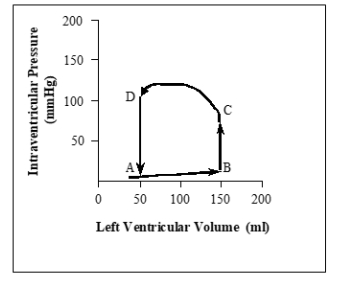
Use the following information to answer Questions 8 and 9. A 50-year-old man has a body weight of 110 kg, resting heart rate of 90 beats/min, arterial pressure of 120/70 mm Hg, arterial hematocrit of 35%, and normal body temperature. His pressure-volume diagram of the left ventricle is shown below.
-When does the fourth heart sound occur in the ventricular pressure-volume relationship?
A. At point
B. Between point and point
C. Between point and point
D. Between point and point
E. Between point and point
Left Ventricular Volume (
-When does the fourth heart sound occur in the ventricular pressure-volume relationship?
A. At point
B. Between point and point
C. Between point and point
D. Between point and point
E. Between point and point
Left Ventricular Volume (

Question
Question
Question
Question
Question
Question
Question
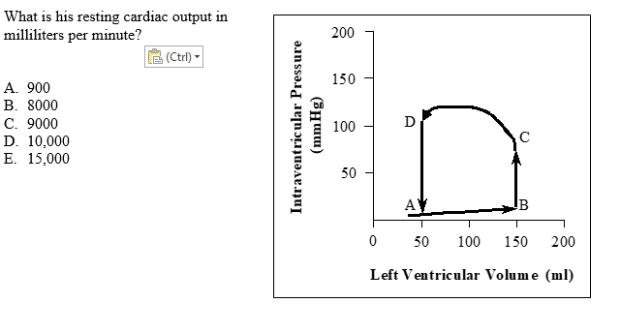
Use the following information to answer Following Questions . A 50-year-old man has a body weight of 110 kg, resting heart rate of 90 beats/min, arterial pressure of 120/70 mm Hg, arterial hematocrit of 35% and a normal body temperature. His pressure-volume diagram of the left ventricle is shown below.

Unlock Deck
Sign up to unlock the cards in this deck!
Unlock Deck
Unlock Deck
1/8

Play

Full screen (f)
Deck 9: Cardiac Muscle; the Heart As a Pump and Function of the Heart Valves
1
Use the following information to answer Questions 8 and 9. A 50-year-old man has a body weight of 110 kg, resting heart rate of 90 beats/min, arterial pressure of 120/70 mm Hg, arterial hematocrit of 35%, and normal body temperature. His pressure-volume diagram of the left ventricle is shown below.
-When does the fourth heart sound occur in the ventricular pressure-volume relationship?
A. At point
B. Between point and point
C. Between point and point
D. Between point and point
E. Between point and point
Left Ventricular Volume (
-When does the fourth heart sound occur in the ventricular pressure-volume relationship?
A. At point
B. Between point and point
C. Between point and point
D. Between point and point
E. Between point and point
Left Ventricular Volume (
B
2
Use the following information to answer Following Questions . A 50-year-old man has a body weight of 110 kg, resting heart rate of 90 beats/min, arterial pressure of 120/70 mm Hg, arterial hematocrit of 35% and a normal body temperature. His pressure-volume diagram of the left ventricle is shown below.
What is his ventricular ejection fraction?
A)33%
B)50%
C)60%
D)67%
E)80%
What is his ventricular ejection fraction?
A)33%
B)50%
C)60%
D)67%
E)80%
D
3
Use the following information to answer Questions 8 and 9. A 50-year-old man has a body weight of 110 kg, resting heart rate of 90 beats/min, arterial pressure of 120/70 mm Hg, arterial hematocrit of 35%, and normal body temperature. His pressure-volume diagram of the left ventricle is shown below.
When does the first heart sound occur in the ventricular pressure- relationship?
A)At point B
B)Between point A and point B
C)Between point B and point C
D)Between point C and point D
E)Between point D and point A
When does the first heart sound occur in the ventricular pressure- relationship?
A)At point B
B)Between point A and point B
C)Between point B and point C
D)Between point C and point D
E)Between point D and point A
A
4
Use the following information to answer Questions 5-7. A 60-year-old woman has a body weight of 110 kg, resting cardiac output of 9000 ml/min, arterial pressure of 90/50 mm Hg, arterial hematocrit of 25%, and normal body temperature. Her pressure-volume diagram of the left ventricle is shown below.
What event occurs at point A in the woman's pressure-volume relationship?
A)Atrioventricular valves close
B)Aortic valve opens
C)Aortic valve closes
D)Atrioventricular valves open
E)Third heart sound
What event occurs at point A in the woman's pressure-volume relationship?
A)Atrioventricular valves close
B)Aortic valve opens
C)Aortic valve closes
D)Atrioventricular valves open
E)Third heart sound
Unlock Deck
Unlock for access to all 8 flashcards in this deck.
Unlock Deck
k this deck
5
Use the following information to answer Following Questions . A 50-year-old man has a body weight of 110 kg, resting heart rate of 90 beats/min, arterial pressure of 120/70 mm Hg, arterial hematocrit of 35% and a normal body temperature. His pressure-volume diagram of the left ventricle is shown below.
Which of the following will result in a dilated heart?
A)Decreased calcium ions in the blood
B)Decreased magnesium ions in the blood
C)Increased sodium ions in the blood
D)Increased sympathetic stimulation
E)Increased norepinephrine concentration in the blood
Which of the following will result in a dilated heart?
A)Decreased calcium ions in the blood
B)Decreased magnesium ions in the blood
C)Increased sodium ions in the blood
D)Increased sympathetic stimulation
E)Increased norepinephrine concentration in the blood
Unlock Deck
Unlock for access to all 8 flashcards in this deck.
Unlock Deck
k this deck
6
Use the following information to answer Questions 5-7. A 60-year-old woman has a body weight of 110 kg, resting cardiac output of 9000 ml/min, arterial pressure of 90/50 mm Hg, arterial hematocrit of 25%, and normal body temperature. Her pressure-volume diagram of the left ventricle is shown below.
At the end of ventricular isovolumic relaxation, which of the following occurs?
A)Atrioventricular valves close
B)Aortic valve opens
C)Aortic valve closes
D)Mitral valve opens
E)Pulmonary valve closes
At the end of ventricular isovolumic relaxation, which of the following occurs?
A)Atrioventricular valves close
B)Aortic valve opens
C)Aortic valve closes
D)Mitral valve opens
E)Pulmonary valve closes
Unlock Deck
Unlock for access to all 8 flashcards in this deck.
Unlock Deck
k this deck
7
Use the following information to answer Following Questions . A 50-year-old man has a body weight of 110 kg, resting heart rate of 90 beats/min, arterial pressure of 120/70 mm Hg, arterial hematocrit of 35% and a normal body temperature. His pressure-volume diagram of the left ventricle is shown below.
What event occurs at point D in the pressure-volume relationship?
A)Atrioventricular valves close
B)Aortic valve opens
C)Aortic valve closes
D)Atrioventricular valves open
E)Third heart sound
What event occurs at point D in the pressure-volume relationship?
A)Atrioventricular valves close
B)Aortic valve opens
C)Aortic valve closes
D)Atrioventricular valves open
E)Third heart sound
Unlock Deck
Unlock for access to all 8 flashcards in this deck.
Unlock Deck
k this deck
8
Use the following information to answer Following Questions . A 50-year-old man has a body weight of 110 kg, resting heart rate of 90 beats/min, arterial pressure of 120/70 mm Hg, arterial hematocrit of 35% and a normal body temperature. His pressure-volume diagram of the left ventricle is shown below.
Unlock Deck
Unlock for access to all 8 flashcards in this deck.
Unlock Deck
k this deck
Unlock Deck
Unlock for access to all 8 flashcards in this deck.






