







 Chat with AI

Deck 2: Past, Present, and Future World Energy Use
Full screen (f)

Question

Question
Question
Question
Question
Question
Question
Question
Question
Question
The population of a country as a function of time is shown in the following
table. Is the growth exponential?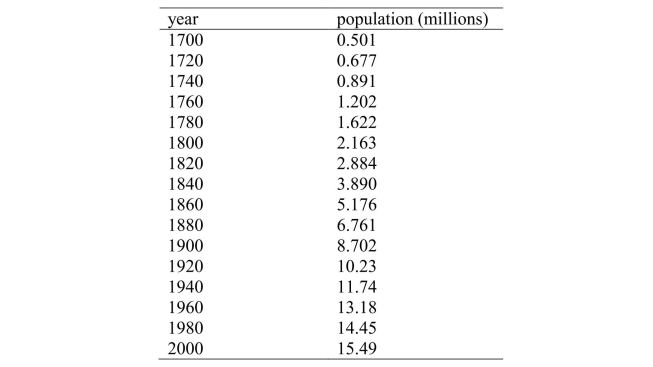
table. Is the growth exponential?
Question
Question
Question
(a) If the total amount of a resource available is  calculate its
calculate its Question
Question
Question
Question
Question
Question
Question

Unlock Deck
Sign up to unlock the cards in this deck!
Unlock Deck
Unlock Deck
1/20

Play

Full screen (f)
Deck 2: Past, Present, and Future World Energy Use
1
Assume that the historical growth rate of the human population was constant
at 1.6% per year. For a population of 7 billion in 2012, determine the time in the past when
the human population was 2.
at 1.6% per year. For a population of 7 billion in 2012, determine the time in the past when
the human population was 2.
As the annual percentage growth rate is small then we can use the approximation
of equation (2.4) to get the doubling time from R so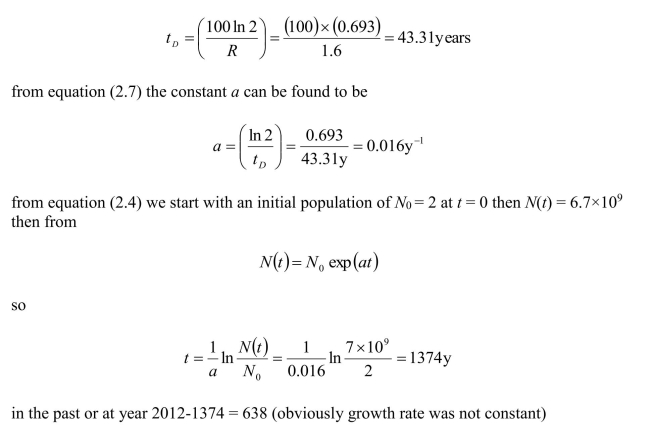
of equation (2.4) to get the doubling time from R so
2
the example of energy use on page 31, leading to equation (2.1), consider
a family (two people) who use gasoline at the rate indicated but who heat their home
electrically in accordance with the efficiencies given in the text above equation (2.1). How
would this affect the per person power consumption?
a family (two people) who use gasoline at the rate indicated but who heat their home
electrically in accordance with the efficiencies given in the text above equation (2.1). How
would this affect the per person power consumption?
Assuming an efficiency of 40% for electricity generation the primary energy use
for two people will be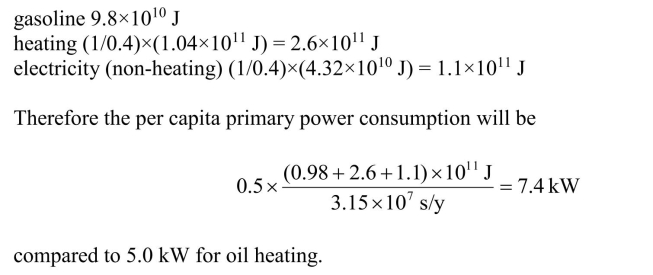
for two people will be
3
A person in the United States consumes 2000 Calories of food per day.
What fraction of the average per capita energy use, as indicated in Table 2.1, does this
represent?
What fraction of the average per capita energy use, as indicated in Table 2.1, does this
represent?
From the Table the per capita power consumption is 11,730 W. This represents 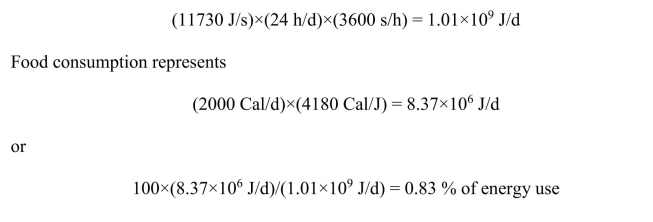
4
If a quantity has a doubling time of 30 days and its value is 1000 units at
noontime today, what will be its value at noontime tomorrow?
noontime today, what will be its value at noontime tomorrow?
Unlock Deck
Unlock for access to all 20 flashcards in this deck.
Unlock Deck
k this deck
5
Assume that the combustion of coal is approximated by the burning of
carbon. If a coal-fired generating station operates at 40% efficiency, calculate the amount
of CO2 emitted per MWh of electricity produced.
carbon. If a coal-fired generating station operates at 40% efficiency, calculate the amount
of CO2 emitted per MWh of electricity produced.
Unlock Deck
Unlock for access to all 20 flashcards in this deck.
Unlock Deck
k this deck
6
Repeat problem 2.15 for the combustion of natural gas (methane). How
does the use of the HHV affect your answer?
does the use of the HHV affect your answer?
Unlock Deck
Unlock for access to all 20 flashcards in this deck.
Unlock Deck
k this deck
7
For an annual growth rate of 1.6%, use the data in Table 2.3 to estimate the
year in which the human population will reach 200 per km2 of land area.
year in which the human population will reach 200 per km2 of land area.
Unlock Deck
Unlock for access to all 20 flashcards in this deck.
Unlock Deck
k this deck
8
The population of a state is 25,600 in the year 1800 and 218,900 in the year
1900. Calculate the expected population in the year 2000 if (a) the growth is linear and (b)
the growth is exponential.
1900. Calculate the expected population in the year 2000 if (a) the growth is linear and (b)
the growth is exponential.
Unlock Deck
Unlock for access to all 20 flashcards in this deck.
Unlock Deck
k this deck
9
Consider a solar photovoltaic system with a total rated output of 10 MWe and
a capacity factor of 29%. If the total installation cost is $35,000,000, calculate the decrease
in the cost of electricity per kilowatt-hour if the payback period is 25 years instead of 15
years. Assume a constant interest rate of 5.8%.
a capacity factor of 29%. If the total installation cost is $35,000,000, calculate the decrease
in the cost of electricity per kilowatt-hour if the payback period is 25 years instead of 15
years. Assume a constant interest rate of 5.8%.
Unlock Deck
Unlock for access to all 20 flashcards in this deck.
Unlock Deck
k this deck
10
The population of a country as a function of time is shown in the following
table. Is the growth exponential?
table. Is the growth exponential?
Unlock Deck
Unlock for access to all 20 flashcards in this deck.
Unlock Deck
k this deck
11
What is the current average human population density (i.e., people per square
kilometer) on earth?
kilometer) on earth?
Unlock Deck
Unlock for access to all 20 flashcards in this deck.
Unlock Deck
k this deck
12
The total world population in 2012 was about 7 billion, and Figure 2.11
shows that at that time the actual world population growth rate was about 1% per year. The
figure also shows an anticipated roughly linear decrease in growth rate that extrapolates to
zero growth in about the year 2080. Assuming an average growth rate of 0.5% between
2012 and 2080, what would the world population be in 2080? How does this compare with
estimates discussed in the text for limits to human population?
shows that at that time the actual world population growth rate was about 1% per year. The
figure also shows an anticipated roughly linear decrease in growth rate that extrapolates to
zero growth in about the year 2080. Assuming an average growth rate of 0.5% between
2012 and 2080, what would the world population be in 2080? How does this compare with
estimates discussed in the text for limits to human population?
Unlock Deck
Unlock for access to all 20 flashcards in this deck.
Unlock Deck
k this deck
13
(a) If the total amount of a resource available is calculate its
calculate its Unlock Deck
Unlock for access to all 20 flashcards in this deck.
Unlock Deck
k this deck
14
Consider an island with a current population density of 50 people/km2 (about
equal to the present world average). If the annual growth rate is 2%, determine the year in
which the population density be equal to 20,000 people/km2 (approximately the population
density of Macau, the world's most densely populated nation).
equal to the present world average). If the annual growth rate is 2%, determine the year in
which the population density be equal to 20,000 people/km2 (approximately the population
density of Macau, the world's most densely populated nation).
Unlock Deck
Unlock for access to all 20 flashcards in this deck.
Unlock Deck
k this deck
15
If world energy use increases linearly, use Figure 2.13 to estimate the
annual percentage increase for OECD and non-OECD countries from 1990 to 2035 relative
to the use in 1990.
annual percentage increase for OECD and non-OECD countries from 1990 to 2035 relative
to the use in 1990.
Unlock Deck
Unlock for access to all 20 flashcards in this deck.
Unlock Deck
k this deck
16
A quantity has a doubling time of 110 years. Estimate the annual percent
increase in the quantity.
increase in the quantity.
Unlock Deck
Unlock for access to all 20 flashcards in this deck.
Unlock Deck
k this deck
17
(a) Assume that human population growth is described as exponential
growth and the current population is 7.5 billion. If the current daily increase in population
is 250,000, calculate the doubling time.
(b) For the conditions in part (a), what is the current annual growth rate?
growth and the current population is 7.5 billion. If the current daily increase in population
is 250,000, calculate the doubling time.
(b) For the conditions in part (a), what is the current annual growth rate?
Unlock Deck
Unlock for access to all 20 flashcards in this deck.
Unlock Deck
k this deck
18
If a facility has a capital recovery factor of 0.12 and the annual interest rate
is 5%, what is the payback period?
is 5%, what is the payback period?
Unlock Deck
Unlock for access to all 20 flashcards in this deck.
Unlock Deck
k this deck
19
The population of a particular country has a doubling time of 45 years. When
will the population be three times its present value?
will the population be three times its present value?
Unlock Deck
Unlock for access to all 20 flashcards in this deck.
Unlock Deck
k this deck
20
From the data in Table 2.1 and Figure 2.3, estimate the total energy
production per year from hydroelectricity in the United States.
production per year from hydroelectricity in the United States.
Unlock Deck
Unlock for access to all 20 flashcards in this deck.
Unlock Deck
k this deck
Unlock Deck
Unlock for access to all 20 flashcards in this deck.






