







 Chat with AI

Deck 13: Firms Production Decisions
Full screen (f)

Question

Question
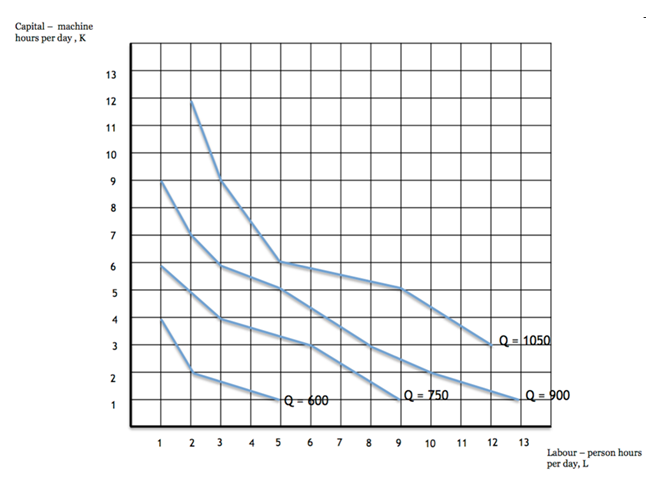
Refer to the figure above showing the possible production functions of a fictitious pizza firm. For an output of 600 pizzas which combinations of capital and labour can be used?
A) 4 capital and 1 labour.
B) 1 capital and 5 labour.
C) 2 capital and 2 labour.
D) All of the above.
Question
Question
Question
Question
Question
Question
Question
Question
Question
Question
Question
Question
Question
Question
Refer to the figure above showing the possible production functions of a fictitious pizza firm. Which isoquant line is the following combination of six units of capital and three units of labour possible?
A) Q=600
B) Q=750
C) Q=900
D) Q=1050
Question
Question
Question
Question
Question
Question
Question
Question
Question
Question
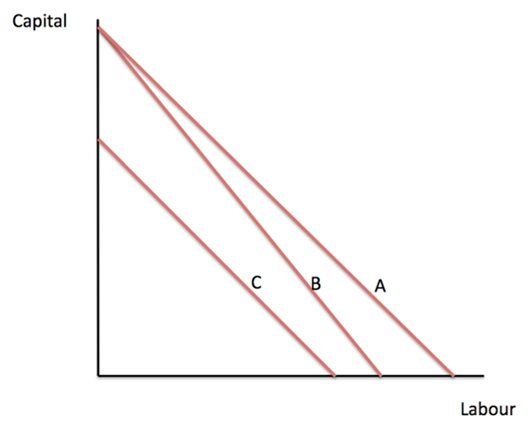
Refer to the figure above. A firm's isocost line would shift from B to A if
A) capital increases in price.
B) labour falls in price.
C) the firm's budget increased.
D) capital decreased in price.
Question
Question
Refer to the figure above showing the possible production functions of a fictitious pizza firm. What would the pizza output be if the firm employed 8 labour person hours a day and used 3 machine hours a day?
A) 600 pizzas.
B) 750 pizzas.
C) 900 pizzas.
D) 1050 pizzas.
Question
Question
Question
Question
Question
Question
Question
Refer to the figure above. A firm's isocost line would shift from C to B if
A) the firm's budget increased.
B) capital falls in price.
C) both a and b happen.
D) none of the above is correct.
Question
Question
Refer to the figure above. A firm's isocost line would shift from C to A if
A) capital increases in price.
B) labour falls in price.
C) the firm's budget increased.
D) capital decreased in price.
Question
Question
Question
Refer to the figure above. A firm's isocost line would shift from A to C if
A) the firm's budget increased and the factor costs remained the same.
B) the budget increased and also the cost of labour increased.
C) the firm's budget stayed the same, but the cost of the two factors increased by the same percentage.
D) the firm's budget stayed the same, but cost of the two factors decreased by the same percentage.
Question
Question
Question
Question
Question
Question
Question
Question
Question
Question
Question
Question
Question
Question
Question
Construct isoquant lines for the following data

Question
Question
Question
Question
Question
Question
After analysing factor input data, a firm as established that:
 Can the firm increase its production without increasing its budget?
Can the firm increase its production without increasing its budget?
Unlock Deck
Sign up to unlock the cards in this deck!
Unlock Deck
Unlock Deck
1/61

Play

Full screen (f)
Deck 13: Firms Production Decisions
1
As a result of doubling all its inputs, if a firm can more than double its output, its production function exhibits
A) constant returns to scale.
B) increasing returns to scale.
C) decreasing returns to scale.
D) increasing marginal productivity to at least one input.
A) constant returns to scale.
B) increasing returns to scale.
C) decreasing returns to scale.
D) increasing marginal productivity to at least one input.
increasing marginal productivity to at least one input.
2
Refer to the figure above showing the possible production functions of a fictitious pizza firm. For an output of 600 pizzas which combinations of capital and labour can be used?
A) 4 capital and 1 labour.
B) 1 capital and 5 labour.
C) 2 capital and 2 labour.
D) All of the above.
All of the above.
3
Assume that capital is represented by the vertical axis and labour is represented by the horizontal axis. The steeper an isoquant is
A) the larger the marginal productivity of labour relative to that of capital.
B) the greater is the substitutability between capital and labour.
C) the larger the marginal productivity of capital relative to that of labour.
D) the greater is the budget available to the firm.
A) the larger the marginal productivity of labour relative to that of capital.
B) the greater is the substitutability between capital and labour.
C) the larger the marginal productivity of capital relative to that of labour.
D) the greater is the budget available to the firm.
the larger the marginal productivity of labour relative to that of capital.
4
A production isoquant is a function that represents
A) the best combination of factor inputs that can be used to produce a given level of output.
B) the different combination of factor inputs which can be purchased with a given budget.
C) the budget available to the firm.
D) all the possible combinations of factor inputs that can be used to produce a given level of output.
A) the best combination of factor inputs that can be used to produce a given level of output.
B) the different combination of factor inputs which can be purchased with a given budget.
C) the budget available to the firm.
D) all the possible combinations of factor inputs that can be used to produce a given level of output.
Unlock Deck
Unlock for access to all 61 flashcards in this deck.
Unlock Deck
k this deck
5
The isocost line measures the different combination of factor inputs, such as labour and capital, which can be purchased within a given budget.
Unlock Deck
Unlock for access to all 61 flashcards in this deck.
Unlock Deck
k this deck
6
There are an infinite number of isocost lines, corresponding to every possible level of total cost.
Unlock Deck
Unlock for access to all 61 flashcards in this deck.
Unlock Deck
k this deck
7
An isocost line shows the different combination of factor inputs which can be purchased with a given budget.
Unlock Deck
Unlock for access to all 61 flashcards in this deck.
Unlock Deck
k this deck
8
A firm's isoquant shows
A) the amount of labour needed to produce a given level of output with capital held constant.
B) the amount of capital needed to produce a given level of output with labour held constant.
C) the various combinations of capital and labour that will produce a given amount of output.
D) none of these.
A) the amount of labour needed to produce a given level of output with capital held constant.
B) the amount of capital needed to produce a given level of output with labour held constant.
C) the various combinations of capital and labour that will produce a given amount of output.
D) none of these.
Unlock Deck
Unlock for access to all 61 flashcards in this deck.
Unlock Deck
k this deck
9
A production function may exhibit
A) constant returns to scale and diminishing marginal productivities to all inputs.
B) constant returns to scale and diminishing marginal productivities to all but one input, but at least one input must have a constant marginal productivity.
C) constant returns to scale and diminishing marginal productivity to at most one input.
D) constant returns to scale and diminishing marginal productivities for no inputs.
A) constant returns to scale and diminishing marginal productivities to all inputs.
B) constant returns to scale and diminishing marginal productivities to all but one input, but at least one input must have a constant marginal productivity.
C) constant returns to scale and diminishing marginal productivity to at most one input.
D) constant returns to scale and diminishing marginal productivities for no inputs.
Unlock Deck
Unlock for access to all 61 flashcards in this deck.
Unlock Deck
k this deck
10
If both land and labour costs increased, the isocost line would shift inwards.
Unlock Deck
Unlock for access to all 61 flashcards in this deck.
Unlock Deck
k this deck
11
Any point where the isocost line cuts the isoquant line is a possible combination of factors that could be used.
Unlock Deck
Unlock for access to all 61 flashcards in this deck.
Unlock Deck
k this deck
12
The production isoquant line measures the different combination of factor inputs such as labour and capital, which can be purchased within a given budget.
Unlock Deck
Unlock for access to all 61 flashcards in this deck.
Unlock Deck
k this deck
13
Production isoquants can cross each other.
Unlock Deck
Unlock for access to all 61 flashcards in this deck.
Unlock Deck
k this deck
14
A technical innovation in a firm would
A) shift each isoquant away from the origin.
B) shift each isoquant toward the origin.
C) cause more to be produced with more capital and less labour.
D) cause more to be produced with more labour and less capital.
A) shift each isoquant away from the origin.
B) shift each isoquant toward the origin.
C) cause more to be produced with more capital and less labour.
D) cause more to be produced with more labour and less capital.
Unlock Deck
Unlock for access to all 61 flashcards in this deck.
Unlock Deck
k this deck
15
The marginal rate of technical substitution is the rate at which one factor input can be substituted for another at a given level of output.
Unlock Deck
Unlock for access to all 61 flashcards in this deck.
Unlock Deck
k this deck
16
Refer to the figure above showing the possible production functions of a fictitious pizza firm. Which isoquant line is the following combination of six units of capital and three units of labour possible?
A) Q=600
B) Q=750
C) Q=900
D) Q=1050
Unlock Deck
Unlock for access to all 61 flashcards in this deck.
Unlock Deck
k this deck
17
If the ratio of land to labour to capital for a farm was 30:50:20 then the firm would be described as
A) capital intensive.
B) land intensive.
C) labour intensive.
D) highly intensive.
A) capital intensive.
B) land intensive.
C) labour intensive.
D) highly intensive.
Unlock Deck
Unlock for access to all 61 flashcards in this deck.
Unlock Deck
k this deck
18
The point of least-cost input occurs where the marginal rate of technical substitution is equal to the ratio of the prices of factors.
Unlock Deck
Unlock for access to all 61 flashcards in this deck.
Unlock Deck
k this deck
19
Trying to maximise output and minimise costs is an example of a constrained optimisation problem.
Unlock Deck
Unlock for access to all 61 flashcards in this deck.
Unlock Deck
k this deck
20
The low-cost input combination is the point where the isocost line cuts through the isoquant curve.
Unlock Deck
Unlock for access to all 61 flashcards in this deck.
Unlock Deck
k this deck
21
A production function measures how
A) a firm transforms output into input.
B) a firm transforms inputs into output.
C) an individual maximises utility.
D) a firm minimises cost.
A) a firm transforms output into input.
B) a firm transforms inputs into output.
C) an individual maximises utility.
D) a firm minimises cost.
Unlock Deck
Unlock for access to all 61 flashcards in this deck.
Unlock Deck
k this deck
22
The marginal rate of technical substitution measures
A) the rate at which one factor input can be substituted for another at a given level of output.
B) the rate that output changes as a result of more factors being used.
C) the rate at which costs change.
D) the rate at which a business can increase production.
A) the rate at which one factor input can be substituted for another at a given level of output.
B) the rate that output changes as a result of more factors being used.
C) the rate at which costs change.
D) the rate at which a business can increase production.
Unlock Deck
Unlock for access to all 61 flashcards in this deck.
Unlock Deck
k this deck
23
-Refer to table above. If capital hours are drawn on the vertical axis and labour hours are drawn on the horizontal axis, then the budget line would intersect the vertical axis at ___ and the horizontal axis at ___.
A) 14, 0
B) 8.4, 0
C) 8.4, 14
D) 14, 8.4
Unlock Deck
Unlock for access to all 61 flashcards in this deck.
Unlock Deck
k this deck
24
-Refer to the table above. Which of the following equations is appropriate?
A) K=8 - 0.5L
B) K=8.4 - 0.6L
C) K=10 - 6L
D) K= 1 -15L
Unlock Deck
Unlock for access to all 61 flashcards in this deck.
Unlock Deck
k this deck
25
An increase in the wage rate will have a greater effect on average costs
A) the larger the proportion labour costs are of total costs and the easier it is to substitute capital for labour.
B) the larger the proportion labour costs are of total costs and the harder it is to substitute capital for labour.
C) the greater the diminishing marginal product of labour is.
D) the greater returns to scale are.
A) the larger the proportion labour costs are of total costs and the easier it is to substitute capital for labour.
B) the larger the proportion labour costs are of total costs and the harder it is to substitute capital for labour.
C) the greater the diminishing marginal product of labour is.
D) the greater returns to scale are.
Unlock Deck
Unlock for access to all 61 flashcards in this deck.
Unlock Deck
k this deck
26
Refer to the figure above. A firm's isocost line would shift from B to A if
A) capital increases in price.
B) labour falls in price.
C) the firm's budget increased.
D) capital decreased in price.
Unlock Deck
Unlock for access to all 61 flashcards in this deck.
Unlock Deck
k this deck
27
-Refer to the table above where K = capital hours and L = labour hours.
A) The data can be used to plot the isoquant line.
B) The data is based on the best combination of factors for a given output.
C) Shows the factor inputs that can be purchased with a given budget.
D) None of the above.
Unlock Deck
Unlock for access to all 61 flashcards in this deck.
Unlock Deck
k this deck
28
Refer to the figure above showing the possible production functions of a fictitious pizza firm. What would the pizza output be if the firm employed 8 labour person hours a day and used 3 machine hours a day?
A) 600 pizzas.
B) 750 pizzas.
C) 900 pizzas.
D) 1050 pizzas.
Unlock Deck
Unlock for access to all 61 flashcards in this deck.
Unlock Deck
k this deck
29
Assuming there are only two factors of production required, the slope of the isocost line shows
A) the marginal rate of substitution.
B) the ratio of capital to labour.
C) the best combination of those factors to use.
D) the potential combination of those factors for a given level of output.
A) the marginal rate of substitution.
B) the ratio of capital to labour.
C) the best combination of those factors to use.
D) the potential combination of those factors for a given level of output.
Unlock Deck
Unlock for access to all 61 flashcards in this deck.
Unlock Deck
k this deck
30
A firm's rate of technical substitution is represented graphically by
A) the slope of the line connecting the origin with the relevant point on the isoquant.
B) the negative of the slope of the line connecting the origin with the relevant point on the isoquant.
C) the slope of the isoquant at the relevant point.
D) the negative of the slope of the isoquant at the relevant point.
A) the slope of the line connecting the origin with the relevant point on the isoquant.
B) the negative of the slope of the line connecting the origin with the relevant point on the isoquant.
C) the slope of the isoquant at the relevant point.
D) the negative of the slope of the isoquant at the relevant point.
Unlock Deck
Unlock for access to all 61 flashcards in this deck.
Unlock Deck
k this deck
31
-Refer to the table above. For the given budget if 6 hours of labour were used the maximum capital that can be used is:
A) 4.
B) 4.8.
C) 6.
D) 6.6.
Unlock Deck
Unlock for access to all 61 flashcards in this deck.
Unlock Deck
k this deck
32
-Refer to the table above. If the price of labour is R60 an hour and the price of capital R100 an hour, the total budget available is:
A) R160 an hour.
B) R600 an hour.
C) R840 an hour.
D) R960 an hour
Unlock Deck
Unlock for access to all 61 flashcards in this deck.
Unlock Deck
k this deck
33
Suppose the production function for good q is given by q = 3K + 2L where K and L are capital and labour inputs. Consider three statements about this function: I. The function exhibits constant returns to scale.
II) The function exhibits diminishing marginal productivities to all inputs.
III) The function has a constant rate of technical substitution.
Which of these statements is true?
A) All of them.
B) Only I.
C) I and II but not III.
D) I and III but not II.
II) The function exhibits diminishing marginal productivities to all inputs.
III) The function has a constant rate of technical substitution.
Which of these statements is true?
A) All of them.
B) Only I.
C) I and II but not III.
D) I and III but not II.
Unlock Deck
Unlock for access to all 61 flashcards in this deck.
Unlock Deck
k this deck
34
-Refer to the table above. The price of labour is R60 per hour and the price of capital is R100 per hour. Then it follows that in relation to 3 hours of capital, the total labour costs that could be afforded would be:
A) R300
B) R360
C) R540
D) R900
Unlock Deck
Unlock for access to all 61 flashcards in this deck.
Unlock Deck
k this deck
35
Refer to the figure above. A firm's isocost line would shift from C to B if
A) the firm's budget increased.
B) capital falls in price.
C) both a and b happen.
D) none of the above is correct.
Unlock Deck
Unlock for access to all 61 flashcards in this deck.
Unlock Deck
k this deck
36
The marginal rate of technical substitution of labour for capital measures
A) the amount by which capital input can be reduced while holding quantity produced constant when one more unit of labour is used.
B) the amount by which labour input can be reduced while holding quantity produced constant when one more unit of capital is used.
C) the ratio of total labour to total capital.
D) the ratio of total capital to total labour.
A) the amount by which capital input can be reduced while holding quantity produced constant when one more unit of labour is used.
B) the amount by which labour input can be reduced while holding quantity produced constant when one more unit of capital is used.
C) the ratio of total labour to total capital.
D) the ratio of total capital to total labour.
Unlock Deck
Unlock for access to all 61 flashcards in this deck.
Unlock Deck
k this deck
37
Refer to the figure above. A firm's isocost line would shift from C to A if
A) capital increases in price.
B) labour falls in price.
C) the firm's budget increased.
D) capital decreased in price.
Unlock Deck
Unlock for access to all 61 flashcards in this deck.
Unlock Deck
k this deck
38
All combinations of the factors on the budget constraint are
A) attainable for the given budget.
B) the factors kept in reserve should demand increase.
C) equally desirable.
D) All the above are correct.
A) attainable for the given budget.
B) the factors kept in reserve should demand increase.
C) equally desirable.
D) All the above are correct.
Unlock Deck
Unlock for access to all 61 flashcards in this deck.
Unlock Deck
k this deck
39
An isocost line shows
A) the different combination of factor inputs, which can be purchased with a given budget.
B) the rate at which one factor input can be substituted for another at a given level of output.
C) possible combinations of factor inputs that can be used to produce a given level of output.
D) the marginal rate of substitution.
A) the different combination of factor inputs, which can be purchased with a given budget.
B) the rate at which one factor input can be substituted for another at a given level of output.
C) possible combinations of factor inputs that can be used to produce a given level of output.
D) the marginal rate of substitution.
Unlock Deck
Unlock for access to all 61 flashcards in this deck.
Unlock Deck
k this deck
40
Refer to the figure above. A firm's isocost line would shift from A to C if
A) the firm's budget increased and the factor costs remained the same.
B) the budget increased and also the cost of labour increased.
C) the firm's budget stayed the same, but the cost of the two factors increased by the same percentage.
D) the firm's budget stayed the same, but cost of the two factors decreased by the same percentage.
Unlock Deck
Unlock for access to all 61 flashcards in this deck.
Unlock Deck
k this deck
41
In theory, a cost-minimising firm will choose
A) not to produce any output.
B) the lowest isocost line tangential to the relevant isoquant.
C) the highest isocost line tangential to the relevant isoquant.
D) any combination of the factors between where the isocost line cuts through the isoquant line.
A) not to produce any output.
B) the lowest isocost line tangential to the relevant isoquant.
C) the highest isocost line tangential to the relevant isoquant.
D) any combination of the factors between where the isocost line cuts through the isoquant line.
Unlock Deck
Unlock for access to all 61 flashcards in this deck.
Unlock Deck
k this deck
42
Why might the least-cost input combination change?
Unlock Deck
Unlock for access to all 61 flashcards in this deck.
Unlock Deck
k this deck
43
In the short run
A) all inputs are fixed.
B) all inputs are variable.
C) some inputs are fixed.
D) no production occurs.
A) all inputs are fixed.
B) all inputs are variable.
C) some inputs are fixed.
D) no production occurs.
Unlock Deck
Unlock for access to all 61 flashcards in this deck.
Unlock Deck
k this deck
44
If an isocost line cuts through the isoquant line, a cost-minimising firm will
A) choose the factor input combination at the intersection on the higher point of the isoquant.
B) choose the factor input combination at the intersection on the lower point of the isoquant. Use the input bundle associated with the intersection on the lower point of the isoquant.
C) choose any combination of the factors between where the isocost line cuts through the isoquant line.
D) use a lower isocost line to select the combination of inputs.
A) choose the factor input combination at the intersection on the higher point of the isoquant.
B) choose the factor input combination at the intersection on the lower point of the isoquant. Use the input bundle associated with the intersection on the lower point of the isoquant.
C) choose any combination of the factors between where the isocost line cuts through the isoquant line.
D) use a lower isocost line to select the combination of inputs.
Unlock Deck
Unlock for access to all 61 flashcards in this deck.
Unlock Deck
k this deck
45
Find the least cost output assuming that MPL = R100 and MPK = R200
A) Total cost of labour R2 000 and total cost of capital R2 000.
B) Total cost of labour R2 000 and total cost of capital R4 000.
C) Total cost of labour R4 000 and total cost of capital R2 000.
D) It can't be done.
A) Total cost of labour R2 000 and total cost of capital R2 000.
B) Total cost of labour R2 000 and total cost of capital R4 000.
C) Total cost of labour R4 000 and total cost of capital R2 000.
D) It can't be done.
Unlock Deck
Unlock for access to all 61 flashcards in this deck.
Unlock Deck
k this deck
46
A firm's R200 per hour isocost line is calculated using the equation K = 10 - 0.5L. However, if the price of labour doubles, then new equation becomes:
A) K=10-0.5L
B) K=10-L
C) K=10-0.25L
D) K=20-0.5L
A) K=10-0.5L
B) K=10-L
C) K=10-0.25L
D) K=20-0.5L
Unlock Deck
Unlock for access to all 61 flashcards in this deck.
Unlock Deck
k this deck
47
Explain how a firm may increase the amount it produces without increasing the budget.
Unlock Deck
Unlock for access to all 61 flashcards in this deck.
Unlock Deck
k this deck
48
The least-cost combination occurs where:
A) the isocost line cuts through the isoquant curve.
B) on the uppermost of the two points where the isocost line cuts through the isoquant curve.
C) where the isocost line is just tangential to the isoquant curve.
D) as long as the isoquant line doesn't touch the isocost line.
A) the isocost line cuts through the isoquant curve.
B) on the uppermost of the two points where the isocost line cuts through the isoquant curve.
C) where the isocost line is just tangential to the isoquant curve.
D) as long as the isoquant line doesn't touch the isocost line.
Unlock Deck
Unlock for access to all 61 flashcards in this deck.
Unlock Deck
k this deck
49
When are the factor inputs, labour and capital, perfect substitutes and how does this affect the shape of the isoquant line?
Unlock Deck
Unlock for access to all 61 flashcards in this deck.
Unlock Deck
k this deck
50
A firm doubles its budget having previously had the equation K= 10 - 0.5L. The new equation becomes:
A) K=10-0.5L
B) K=20-1L
C) K=20-0.25L
D) K=20-0.5L
A) K=10-0.5L
B) K=20-1L
C) K=20-0.25L
D) K=20-0.5L
Unlock Deck
Unlock for access to all 61 flashcards in this deck.
Unlock Deck
k this deck
51
Given the equation K= 10 - 0.5L, if eight labour hours were used how many capital hours could be used within the budget constraint?
A) 6
B) 9.5
C) 2
D) All combinations could be used.
A) 6
B) 9.5
C) 2
D) All combinations could be used.
Unlock Deck
Unlock for access to all 61 flashcards in this deck.
Unlock Deck
k this deck
52
How does a change in the price of one input change the least cost combination?
Unlock Deck
Unlock for access to all 61 flashcards in this deck.
Unlock Deck
k this deck
53
Which of the following statements is true?
A) All costs are fixed in the short run.
B) All costs are variable in the long run.
C) All costs are variable in the short run.
D) All costs are fixed in the long run.
A) All costs are fixed in the short run.
B) All costs are variable in the long run.
C) All costs are variable in the short run.
D) All costs are fixed in the long run.
Unlock Deck
Unlock for access to all 61 flashcards in this deck.
Unlock Deck
k this deck
54
Consider, for example, a case in which L (Labour) = R10 per labour hour, K (Capital) = R20 per capital hour, and the budget = R200 an hour. Then the isocost line is described by the equation:
A) 200 = 20K + 10L
B) K= 200/ 20 - (10/20)L
C) K= 10 - 0.5L
D) All of the above.
A) 200 = 20K + 10L
B) K= 200/ 20 - (10/20)L
C) K= 10 - 0.5L
D) All of the above.
Unlock Deck
Unlock for access to all 61 flashcards in this deck.
Unlock Deck
k this deck
55
Construct isoquant lines for the following data
Unlock Deck
Unlock for access to all 61 flashcards in this deck.
Unlock Deck
k this deck
56
Any point where the isocost line cuts the isoquant line is
A) an impossible combination of factors.
B) a possible combination of factors that could be used.
C) an efficient use of the combination of factors.
D) a point that is below the firm's budget constraint.
A) an impossible combination of factors.
B) a possible combination of factors that could be used.
C) an efficient use of the combination of factors.
D) a point that is below the firm's budget constraint.
Unlock Deck
Unlock for access to all 61 flashcards in this deck.
Unlock Deck
k this deck
57
Explain, using examples, the difference between specific factor intensive firms.
Unlock Deck
Unlock for access to all 61 flashcards in this deck.
Unlock Deck
k this deck
58
Define production isoquant and provide three facts about isoquants.
Unlock Deck
Unlock for access to all 61 flashcards in this deck.
Unlock Deck
k this deck
59
The least-cost combination can change if
A) the cost of labour changes.
B) the cost of capital changes.
C) if both factors change equally.
D) all of the above.
A) the cost of labour changes.
B) the cost of capital changes.
C) if both factors change equally.
D) all of the above.
Unlock Deck
Unlock for access to all 61 flashcards in this deck.
Unlock Deck
k this deck
60
How does an increase in the price of labour affect the slope of an isocost line?
Unlock Deck
Unlock for access to all 61 flashcards in this deck.
Unlock Deck
k this deck
61
After analysing factor input data, a firm as established that:
Can the firm increase its production without increasing its budget?
Can the firm increase its production without increasing its budget? Unlock Deck
Unlock for access to all 61 flashcards in this deck.
Unlock Deck
k this deck
Unlock Deck
Unlock for access to all 61 flashcards in this deck.






