







 Chat with AI

Deck 14: The Valuation of Fixed-Income Securities
Full screen (f)

Question

Question
Question
Question
Question
Question
Question
Question
Question
Question
Question
Question
Question
Question
Question
Question
Question
Question
Question
Question
Question
Question
Question
Question
Question
Question
Question
Question
Question
Question
Question
Question
Question
Question
Question
Question
Question
Question
Question
Question
Question
Question
Question
Question
Question
Question
Question
Question
Question
Question
Question
Question
Question
Question
Question
Question
Question
Question
Question
Compute the durations of the following bonds and rank them on the basis of their price volatility. Assume that the current rate of interest is 8 percent.
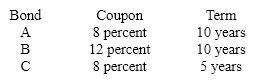
Confirm your ranking by calculating the percentage change in the price of each bond when interest rates rise from 8 to 12 percent.
Confirm your ranking by calculating the percentage change in the price of each bond when interest rates rise from 8 to 12 percent.
Question
Question
Question
Question
Question

Unlock Deck
Sign up to unlock the cards in this deck!
Unlock Deck
Unlock Deck
1/64

Play

Full screen (f)
Deck 14: The Valuation of Fixed-Income Securities
1
If investors expect interest rates to decline, they are also expecting bond prices to rise.
True
2
An investor may expect a bond to be called if its current yield exceeds the yield to maturity.
True
3
A call penalty is a payment made to the firm to encourage early retirement of the bond.
False
4
A call feature will have no impact on the value of a bond if interest rates rise.
Unlock Deck
Unlock for access to all 64 flashcards in this deck.
Unlock Deck
k this deck
5
If interest rates have fallen, a firm may prefer to repurchase the bonds on the market instead of calling and redeeming them.
Unlock Deck
Unlock for access to all 64 flashcards in this deck.
Unlock Deck
k this deck
6
If a bond sells for a discount, the yield to maturity exceeds the current yield.
Unlock Deck
Unlock for access to all 64 flashcards in this deck.
Unlock Deck
k this deck
7
The prices of low coupon bonds tend to fluctuate more than the prices of high coupon bonds.
Unlock Deck
Unlock for access to all 64 flashcards in this deck.
Unlock Deck
k this deck
8
If a $1,000 bond with a 7 percent coupon were to sell for $978, the current interest rate exceeds 7 percent.
Unlock Deck
Unlock for access to all 64 flashcards in this deck.
Unlock Deck
k this deck
9
A few bonds called "perpetuals" never mature.
Unlock Deck
Unlock for access to all 64 flashcards in this deck.
Unlock Deck
k this deck
10
If a bond sells for a premium, the current yield exceeds the yield to maturity.
Unlock Deck
Unlock for access to all 64 flashcards in this deck.
Unlock Deck
k this deck
11
Most bonds pay interest semi-annually.
Unlock Deck
Unlock for access to all 64 flashcards in this deck.
Unlock Deck
k this deck
12
The value of a bond depends on the amount of principal, when it matures, and the interest it pays.
Unlock Deck
Unlock for access to all 64 flashcards in this deck.
Unlock Deck
k this deck
13
As interest rates increase, the prices of existing bonds increase.
Unlock Deck
Unlock for access to all 64 flashcards in this deck.
Unlock Deck
k this deck
14
A bond is more likely to be called after interest rates have fallen.
Unlock Deck
Unlock for access to all 64 flashcards in this deck.
Unlock Deck
k this deck
15
Bonds that are callable often have a call penalty.
Unlock Deck
Unlock for access to all 64 flashcards in this deck.
Unlock Deck
k this deck
16
If interest rates increase, a bond may be called.
Unlock Deck
Unlock for access to all 64 flashcards in this deck.
Unlock Deck
k this deck
17
If bond prices rise, the yield to maturity declines.
Unlock Deck
Unlock for access to all 64 flashcards in this deck.
Unlock Deck
k this deck
18
The current yield exceeds the yield to maturity if interest rates fall.
Unlock Deck
Unlock for access to all 64 flashcards in this deck.
Unlock Deck
k this deck
19
If a $1,000 bond has a coupon of 8 percent and matures after eight years, the price of the bond will exceed $1,000 if the current interest rate is 9 percent.
Unlock Deck
Unlock for access to all 64 flashcards in this deck.
Unlock Deck
k this deck
20
If bond prices were to decline, the current yield would increase.
Unlock Deck
Unlock for access to all 64 flashcards in this deck.
Unlock Deck
k this deck
21
Preferred stock pays a fixed amount of interest.
Unlock Deck
Unlock for access to all 64 flashcards in this deck.
Unlock Deck
k this deck
22
If interest rates decline after a bond is issued and the investor reinvests the interest payment, the realized yield exceeds the yield to maturity.
Unlock Deck
Unlock for access to all 64 flashcards in this deck.
Unlock Deck
k this deck
23
Since preferred stock pays a fixed dividend, it is often valued as if it were a bond.
Unlock Deck
Unlock for access to all 64 flashcards in this deck.
Unlock Deck
k this deck
24
The prices of zero coupon bonds fluctuate less than bonds with large coupons.
Unlock Deck
Unlock for access to all 64 flashcards in this deck.
Unlock Deck
k this deck
25
The spread (the basis points)between the yields on AAA-rated bonds and B-rated bonds tends to rise when yields increase.
Unlock Deck
Unlock for access to all 64 flashcards in this deck.
Unlock Deck
k this deck
26
If a bond pays $90 interest annually, matures after ten years, and costs $1,100, the current yield is
A)8.2 percent
B)10.1 percent
C)9.0 percent
D)9.6 percent
A)8.2 percent
B)10.1 percent
C)9.0 percent
D)9.6 percent
Unlock Deck
Unlock for access to all 64 flashcards in this deck.
Unlock Deck
k this deck
27
If preferred stock is subject to mandatory retirement, its price is more volatile than preferred stock without the retirement feature.
Unlock Deck
Unlock for access to all 64 flashcards in this deck.
Unlock Deck
k this deck
28
The value of a bond depends on
1. the coupon rate
2. the terms of the indenture
3. the maturity date
A)1 and 2
B)1 and 3
C)2 and 3
D)all of the above
1. the coupon rate
2. the terms of the indenture
3. the maturity date
A)1 and 2
B)1 and 3
C)2 and 3
D)all of the above
Unlock Deck
Unlock for access to all 64 flashcards in this deck.
Unlock Deck
k this deck
29
If investors expect interest rates to rise, they should sell preferred stock and buy bonds.
Unlock Deck
Unlock for access to all 64 flashcards in this deck.
Unlock Deck
k this deck
30
The smaller a bond's coupon implies a longer duration.
Unlock Deck
Unlock for access to all 64 flashcards in this deck.
Unlock Deck
k this deck
31
The term and duration of a bond are equal for zero coupon bonds.
Unlock Deck
Unlock for access to all 64 flashcards in this deck.
Unlock Deck
k this deck
32
If a $1,000 bond costs $1,000 and pays $50 interest,
1. the current yield is 5 percent
2. the yield to maturity is 5 percent
3. the bond is selling for par
A)1 and 2
B)1 and 3
C)2 and 3
D)all of the above
1. the current yield is 5 percent
2. the yield to maturity is 5 percent
3. the bond is selling for par
A)1 and 2
B)1 and 3
C)2 and 3
D)all of the above
Unlock Deck
Unlock for access to all 64 flashcards in this deck.
Unlock Deck
k this deck
33
The market price of preferred stock moves directly with changes in interest rates.
Unlock Deck
Unlock for access to all 64 flashcards in this deck.
Unlock Deck
k this deck
34
From the viewpoint of the investor, preferred stock is riskier than bonds issued by the same firm.
Unlock Deck
Unlock for access to all 64 flashcards in this deck.
Unlock Deck
k this deck
35
The concept of duration stresses when a bond will make its payments to bondholders.
Unlock Deck
Unlock for access to all 64 flashcards in this deck.
Unlock Deck
k this deck
36
The smaller the duration, the more volatile the bond's price.
Unlock Deck
Unlock for access to all 64 flashcards in this deck.
Unlock Deck
k this deck
37
A conservative investor will prefer a bond with a smaller duration even though it may have a longer term to maturity.
Unlock Deck
Unlock for access to all 64 flashcards in this deck.
Unlock Deck
k this deck
38
The prices of twenty-year bonds tend to fluctuate less than bonds with five years to maturity.
Unlock Deck
Unlock for access to all 64 flashcards in this deck.
Unlock Deck
k this deck
39
If a 7 percent, $1,000 bond matures after ten years and current interest rates are 9 percent, the current price of the bond should not be
1. $1,000
2. $872
3. $1,140
A)1 and 2
B)1 and 3
C)2 and 3
D)only 2
1. $1,000
2. $872
3. $1,140
A)1 and 2
B)1 and 3
C)2 and 3
D)only 2
Unlock Deck
Unlock for access to all 64 flashcards in this deck.
Unlock Deck
k this deck
40
Matching a bond's duration with the time the funds are needed reduces reinvestment risk.
Unlock Deck
Unlock for access to all 64 flashcards in this deck.
Unlock Deck
k this deck
41
The current yield on a long-term bond is the
A)coupon interest divided by the price of the bond
B)coupon
C)interest paid, adjusted for price changes
D)going rate of interest
A)coupon interest divided by the price of the bond
B)coupon
C)interest paid, adjusted for price changes
D)going rate of interest
Unlock Deck
Unlock for access to all 64 flashcards in this deck.
Unlock Deck
k this deck
42
The concept of duration considers
A)the timing of interest payments
B)the timing of principal repayment
C)the current rate of interest
D)the timing of both interest and principal repayment
A)the timing of interest payments
B)the timing of principal repayment
C)the current rate of interest
D)the timing of both interest and principal repayment
Unlock Deck
Unlock for access to all 64 flashcards in this deck.
Unlock Deck
k this deck
43
The yield to call
A)is important if interest rates have fallen
B)is important if interest rates have risen
C)equals the yield to maturity
D)equals the current yield
A)is important if interest rates have fallen
B)is important if interest rates have risen
C)equals the yield to maturity
D)equals the current yield
Unlock Deck
Unlock for access to all 64 flashcards in this deck.
Unlock Deck
k this deck
44
A high-yield bond has the following terms:
Principal amount $1,000
Annual interest paid $100
Maturity 10 years
a. What is the bond's price if comparable debt yields 12 percent?
b. What would be the price if comparable debt yields 12 percent and the bond matures after five years?
c. What are the current yields and yields to maturity in a and b?
d. What would be the bond's price in a and b if interest rates declined to 9 percent?
e. What are the current yield and yield to maturity in d?
f. What two generalizations may be drawn from the above price changes?
Principal amount $1,000
Annual interest paid $100
Maturity 10 years
a. What is the bond's price if comparable debt yields 12 percent?
b. What would be the price if comparable debt yields 12 percent and the bond matures after five years?
c. What are the current yields and yields to maturity in a and b?
d. What would be the bond's price in a and b if interest rates declined to 9 percent?
e. What are the current yield and yield to maturity in d?
f. What two generalizations may be drawn from the above price changes?
Unlock Deck
Unlock for access to all 64 flashcards in this deck.
Unlock Deck
k this deck
45
Preferred stock and long-term bonds are similar because
A)they both have voting power
B)interest and dividend payments are fixed
C)interest and dividend payments are legal obligations
D)interest and dividend payments are tax-deductible expenses
A)they both have voting power
B)interest and dividend payments are fixed
C)interest and dividend payments are legal obligations
D)interest and dividend payments are tax-deductible expenses
Unlock Deck
Unlock for access to all 64 flashcards in this deck.
Unlock Deck
k this deck
46
If interest rates in general were to fall,
1. the prices of existing bonds would rise
2. the prices of existing bonds would fall
3. yields to maturity would rise
4. yields to maturity would fall
A)1 and 3
B)1 and 4
C)2 and 3
D)2 and 4
1. the prices of existing bonds would rise
2. the prices of existing bonds would fall
3. yields to maturity would rise
4. yields to maturity would fall
A)1 and 3
B)1 and 4
C)2 and 3
D)2 and 4
Unlock Deck
Unlock for access to all 64 flashcards in this deck.
Unlock Deck
k this deck
47
Buying a bond with a duration equal to when the funds are needed
A)reduces reinvestment rate risk
B)increases impact of higher interest rates
C)reduces the impact of default
D)increases the bond's yield
A)reduces reinvestment rate risk
B)increases impact of higher interest rates
C)reduces the impact of default
D)increases the bond's yield
Unlock Deck
Unlock for access to all 64 flashcards in this deck.
Unlock Deck
k this deck
48
A bond's call feature may be exercised if
1. the yield to maturity exceeds the current yield
2. the yield to maturity is less than the current yield
3. interest rates have risen
4. interest rates have fallen
A)1 and 3
B)1 and 4
C)2 and 3
D)2 and 4
1. the yield to maturity exceeds the current yield
2. the yield to maturity is less than the current yield
3. interest rates have risen
4. interest rates have fallen
A)1 and 3
B)1 and 4
C)2 and 3
D)2 and 4
Unlock Deck
Unlock for access to all 64 flashcards in this deck.
Unlock Deck
k this deck
49
While bond prices fluctuate,
A)yields are constant
B)coupons are constant
C)the spread between yields is constant
D)short-term bond prices fluctuate more
A)yields are constant
B)coupons are constant
C)the spread between yields is constant
D)short-term bond prices fluctuate more
Unlock Deck
Unlock for access to all 64 flashcards in this deck.
Unlock Deck
k this deck
50
If a $100 par value preferred stock pays an annual dividend of $5 and comparable yields are 10 percent, the price of this preferred stock will be
A)$100
B)$75
C)$50
D)$25
A)$100
B)$75
C)$50
D)$25
Unlock Deck
Unlock for access to all 64 flashcards in this deck.
Unlock Deck
k this deck
51
a. What is the value (i.e., price)of the following preferred stocks if the comparable yield is 10 percent?
MN Inc. $6 preferred stock, $100 par
ST Inc. $6 preferred stock, $100 par and the stock is to be retired after twenty years
b. What is the current yield offered by each preferred stock?
c. Why are the prices of these preferred stocks different even though they both pay the same dividend?
MN Inc. $6 preferred stock, $100 par
ST Inc. $6 preferred stock, $100 par and the stock is to be retired after twenty years
b. What is the current yield offered by each preferred stock?
c. Why are the prices of these preferred stocks different even though they both pay the same dividend?
Unlock Deck
Unlock for access to all 64 flashcards in this deck.
Unlock Deck
k this deck
52
An individual may purchase preferred stock
1. in anticipation of lower interest rates
2. in anticipation of higher interest rates
3. to receive a flow of tax-free income
4. to receive a flow of income
A)1 and 3
B)1 and 4
C)2 and 3
D)2 and 4
1. in anticipation of lower interest rates
2. in anticipation of higher interest rates
3. to receive a flow of tax-free income
4. to receive a flow of income
A)1 and 3
B)1 and 4
C)2 and 3
D)2 and 4
Unlock Deck
Unlock for access to all 64 flashcards in this deck.
Unlock Deck
k this deck
53
If an investor were to anticipate that interest rates were going to fall, that individual should
A)take no action
B)buy bonds
C)sell bonds
D)acquire money market securities
A)take no action
B)buy bonds
C)sell bonds
D)acquire money market securities
Unlock Deck
Unlock for access to all 64 flashcards in this deck.
Unlock Deck
k this deck
54
A bond with a 5 percent coupon ($50 a year)that matures after eight years is selling for $779. What is the yield to maturity?
Unlock Deck
Unlock for access to all 64 flashcards in this deck.
Unlock Deck
k this deck
55
A bond has the following terms:
Annual interest $100
Term 15 years
Principal $1,000
a. What is the current price of the bond if comparable yields are 7 percent?
b. What are the current yield and yield to maturity given the price of the bond in the previous question?
c. If you expect the bond to be called at the end of the year, what would be the maximum price you should pay for the bond?
d. Is there a reason to expect that the bond will be called?
Annual interest $100
Term 15 years
Principal $1,000
a. What is the current price of the bond if comparable yields are 7 percent?
b. What are the current yield and yield to maturity given the price of the bond in the previous question?
c. If you expect the bond to be called at the end of the year, what would be the maximum price you should pay for the bond?
d. Is there a reason to expect that the bond will be called?
Unlock Deck
Unlock for access to all 64 flashcards in this deck.
Unlock Deck
k this deck
56
If interest rates rise, the price of preferred stock
A)rises
B)falls
C)is not affected
D)rises or falls
A)rises
B)falls
C)is not affected
D)rises or falls
Unlock Deck
Unlock for access to all 64 flashcards in this deck.
Unlock Deck
k this deck
57
Preferred stock generally pays
A)a variable dividend
B)a fixed dividend
C)a stock dividend
D)no dividend
A)a variable dividend
B)a fixed dividend
C)a stock dividend
D)no dividend
Unlock Deck
Unlock for access to all 64 flashcards in this deck.
Unlock Deck
k this deck
58
If a bond is selling for a premium,
A)the yield to maturity exceeds the current yield
B)the current yield exceeds the yield to maturity
C)the current yield has risen
D)the bond cannot be called
A)the yield to maturity exceeds the current yield
B)the current yield exceeds the yield to maturity
C)the current yield has risen
D)the bond cannot be called
Unlock Deck
Unlock for access to all 64 flashcards in this deck.
Unlock Deck
k this deck
59
Compute the durations of the following bonds and rank them on the basis of their price volatility. Assume that the current rate of interest is 8 percent.
Confirm your ranking by calculating the percentage change in the price of each bond when interest rates rise from 8 to 12 percent.
Confirm your ranking by calculating the percentage change in the price of each bond when interest rates rise from 8 to 12 percent.
Unlock Deck
Unlock for access to all 64 flashcards in this deck.
Unlock Deck
k this deck
60
If a preferred stock pays an annual $4.50 dividend, what should be the price of the stock if comparable yields are 10 percent? What would be the loss if yields rose to 12 percent?
Unlock Deck
Unlock for access to all 64 flashcards in this deck.
Unlock Deck
k this deck
61
You purchase a high-yield, junk bond for $1,000 that pays $140 annually. After buying the bond, yields decline and you are able to reinvest the interest at only 9 percent. You reinvest all the interest payments. How much will you have when the bond is retired after twelve years? What was the annual return you earned on this investment?
Unlock Deck
Unlock for access to all 64 flashcards in this deck.
Unlock Deck
k this deck
62
Junk Corp.'s high-yield bond has the following features:
Principal $1,000
Coupon 10%
Maturity 5 years
Special features: Company may extend the life of the bond to 10 years
a. If interest rates are currently 12 percent on comparable high-yield securities and are not expected to change, what is the price of this bond?
b. If interest rates are currently 9 percent on comparable high-yield securities and are not expected to change, what is the price of this bond?
c. If interest rates are currently 9 percent on comparable high-yield securities but the investor has no forecast as to future rates, what is the possible range of prices for this bond?
Principal $1,000
Coupon 10%
Maturity 5 years
Special features: Company may extend the life of the bond to 10 years
a. If interest rates are currently 12 percent on comparable high-yield securities and are not expected to change, what is the price of this bond?
b. If interest rates are currently 9 percent on comparable high-yield securities and are not expected to change, what is the price of this bond?
c. If interest rates are currently 9 percent on comparable high-yield securities but the investor has no forecast as to future rates, what is the possible range of prices for this bond?
Unlock Deck
Unlock for access to all 64 flashcards in this deck.
Unlock Deck
k this deck
63
If you purchase a $5 preferred stock for $40 a share, what is the current yield? If you anticipate that yields will decline to 10 percent, what will be the anticipated capital gain on this investment?
Unlock Deck
Unlock for access to all 64 flashcards in this deck.
Unlock Deck
k this deck
64
An investor buys a $1,000, 20 year 7 percent (interest paid semiannually)bond at par. After five years have passed, interest rates are 10 percent. How much did the investor lose on the purchase of the bond?
Unlock Deck
Unlock for access to all 64 flashcards in this deck.
Unlock Deck
k this deck
Unlock Deck
Unlock for access to all 64 flashcards in this deck.






