







 Chat with AI

Deck 28: Seed Plants
Full screen (f)

Question

Question
Question
Question
Question
Question
Question
Question
Question
Question
Question
Question
Question
Question
Question
Question
Question
Question
Question
The accompanying figures are representative of which of the following?
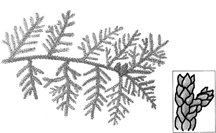
A) Anthophyta
B) Gnetophyta
C) Ginkophyta
D) Cycadophyta
E) Coniferophyta
A) Anthophyta
B) Gnetophyta
C) Ginkophyta
D) Cycadophyta
E) Coniferophyta
Question
Question
Figure 28-1
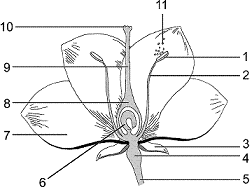
What is the structure labeled as 9 in the accompanying figure?
A) Style
B) Pistil
C) Ovary
D) Anther
E) Filament
What is the structure labeled as 9 in the accompanying figure?
A) Style
B) Pistil
C) Ovary
D) Anther
E) Filament
Question
Question
Question
Question
Figure 28-1

Which label designates a female reproductive structure in the accompanying figure?
A) 1
B) 2
C) 5
D) 7
E) 8
Which label designates a female reproductive structure in the accompanying figure?
A) 1
B) 2
C) 5
D) 7
E) 8
Question
Question
Question
Question
Question
Question
Question
Question
Question
Figure 28-1
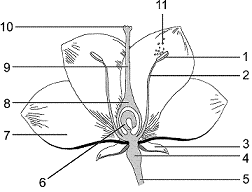
In the accompanying figure, which label designates the structures largely responsible for attracting potential pollinators?
A) 1
B) 3
C) 7
D) 8
E) 10
In the accompanying figure, which label designates the structures largely responsible for attracting potential pollinators?
A) 1
B) 3
C) 7
D) 8
E) 10
Question
Question
Question
Question
Question
Question
Question
Question
Question
Question
Question
Question
Question
Question
Question
Question
Question
Question
Question
Question
Question
Question
Question
Question
Question
Question
Question
Question
Question
Question
Match between columns
Question
Match between columns
Question
Question
Match between columns
Question
Match between columns
Question
Match between columns
Question
Match between columns
Question
Question
Question
Match between columns
Question
Question
Question
Match between columns

Unlock Deck
Sign up to unlock the cards in this deck!
Unlock Deck
Unlock Deck
1/76

Play

Full screen (f)
Deck 28: Seed Plants
1
Which phylum's very few surviving species are tropical and subtropical plants with stout, trunk-like stems, and compound leaves that resemble those of palms or tree ferns?
A) Cycadophyta
B) Pteridophyta
C) Gnetophyta
D) Anthophyta
E) Coniferophyta
A) Cycadophyta
B) Pteridophyta
C) Gnetophyta
D) Anthophyta
E) Coniferophyta
A
2
Which part of a flowering plant is the immature male gametophyte?
A) Style
B) Anther
C) Sperm cell
D) Pollen grain
E) Microsporocytes
A) Style
B) Anther
C) Sperm cell
D) Pollen grain
E) Microsporocytes
D
3
The name conifer comes from the reproductive parts of conifers as they have separate male and female reproductive parts in different locations on the same plant. What is the technical name for the structures bearing these reproductive parts?
A) Strobili
B) Xylem
C) Tracheid
D) Resin
E) Conifers
A) Strobili
B) Xylem
C) Tracheid
D) Resin
E) Conifers
A
4
How is the pollen of pine trees primarily disseminated?
A) Birds
B) Wind
C) Water
D) Insects
E) Mammals
A) Birds
B) Wind
C) Water
D) Insects
E) Mammals
Unlock Deck
Unlock for access to all 76 flashcards in this deck.
Unlock Deck
k this deck
5
Most conifers have separate male and female reproductive parts on the same tree. This condition is referred to as:
A) deciduous.
B) dioecious.
C) monoecious.
D) homosporous.
E) heterosporous.
A) deciduous.
B) dioecious.
C) monoecious.
D) homosporous.
E) heterosporous.
Unlock Deck
Unlock for access to all 76 flashcards in this deck.
Unlock Deck
k this deck
6
In most developing eudicot seeds, the primary source of nutritive material is in the:
A) fruit.
B) zygote.
C) embryo.
D) endosperm.
E) cotyledons.
A) fruit.
B) zygote.
C) embryo.
D) endosperm.
E) cotyledons.
Unlock Deck
Unlock for access to all 76 flashcards in this deck.
Unlock Deck
k this deck
7
As a seed develops from an ovule, the ovule wall enlarges and develops into a:
A) fruit
B) seed coat
C) megaspore
D) microspore
E) pollen grain
A) fruit
B) seed coat
C) megaspore
D) microspore
E) pollen grain
Unlock Deck
Unlock for access to all 76 flashcards in this deck.
Unlock Deck
k this deck
8
Which generation is significantly reduced in size and entirely dependent on the sporophyte generation?
A) Megasporangium
B) Gymnosperms
C) Gametophyte
D) Angiosperms
E) Integuments
A) Megasporangium
B) Gymnosperms
C) Gametophyte
D) Angiosperms
E) Integuments
Unlock Deck
Unlock for access to all 76 flashcards in this deck.
Unlock Deck
k this deck
9
Which statement about gymnosperms and angiosperms is FALSE?
A) Both groups produce seeds.
B) Both groups are heterosporous.
C) Both groups possess vascular tissues.
D) In both groups, the sporophyte generation is dominant.
E) Both groups have free-living gametophytes.
A) Both groups produce seeds.
B) Both groups are heterosporous.
C) Both groups possess vascular tissues.
D) In both groups, the sporophyte generation is dominant.
E) Both groups have free-living gametophytes.
Unlock Deck
Unlock for access to all 76 flashcards in this deck.
Unlock Deck
k this deck
10
Why are seeds reproductively superior to spores?
A) Seeds contain a multicellular young plant.
B) Seeds are used as a food source for humans.
C) Seeds are protected by a multicellular seed coat.
D) Only seeds can survive for an extended period of time.
E) Seeds contain a young plant and also are protected by a seed coat.
A) Seeds contain a multicellular young plant.
B) Seeds are used as a food source for humans.
C) Seeds are protected by a multicellular seed coat.
D) Only seeds can survive for an extended period of time.
E) Seeds contain a young plant and also are protected by a seed coat.
Unlock Deck
Unlock for access to all 76 flashcards in this deck.
Unlock Deck
k this deck
11
Cycads may be characterized as being:
A) dioecious and having motile sperm.
B) the most primitive flowering plants.
C) monoecious and having motile sperm.
D) dioecious and having nonmotile sperm.
E) monoecious and having nonmotile sperm.
A) dioecious and having motile sperm.
B) the most primitive flowering plants.
C) monoecious and having motile sperm.
D) dioecious and having nonmotile sperm.
E) monoecious and having nonmotile sperm.
Unlock Deck
Unlock for access to all 76 flashcards in this deck.
Unlock Deck
k this deck
12
Plants that have a distinct haploid stage and diploid stage exhibit:
A) parthenocarpy.
B) binary generations.
C) alternation of generations.
D) asexual and sexual generations.
E) mitotic and meiotic generations.
A) parthenocarpy.
B) binary generations.
C) alternation of generations.
D) asexual and sexual generations.
E) mitotic and meiotic generations.
Unlock Deck
Unlock for access to all 76 flashcards in this deck.
Unlock Deck
k this deck
13
What do the large female cones of a pine tree contain?
A) Pollen
B) Antheridia
C) Microspores
D) Megasporangia
E) Microsporangia
A) Pollen
B) Antheridia
C) Microspores
D) Megasporangia
E) Microsporangia
Unlock Deck
Unlock for access to all 76 flashcards in this deck.
Unlock Deck
k this deck
14
Seed plants produce ovules, each of which is a megasporangium surrounded by ___________.
A) integuments
B) megasporangium
C) angiosperms
D) gymnosperms
E) phloem
A) integuments
B) megasporangium
C) angiosperms
D) gymnosperms
E) phloem
Unlock Deck
Unlock for access to all 76 flashcards in this deck.
Unlock Deck
k this deck
15
Extracts from the ginkgo tree are sold in over-the-counter (OTC) medicines purported to increase memory. Extracts from what other gymnosperm were once sold in OTC weight loss supplements?
A) Ephedra
B) Eucalyptus
C) Welwitschia
D) Archaeopteris
E) Sequoiadendron
A) Ephedra
B) Eucalyptus
C) Welwitschia
D) Archaeopteris
E) Sequoiadendron
Unlock Deck
Unlock for access to all 76 flashcards in this deck.
Unlock Deck
k this deck
16
Which plants generally have leaves called needles that are long, narrow, tough, and leathery?
A) Strobili
B) Xylem
C) Tracheid
D) Resins
E) Conifers
A) Strobili
B) Xylem
C) Tracheid
D) Resins
E) Conifers
Unlock Deck
Unlock for access to all 76 flashcards in this deck.
Unlock Deck
k this deck
17
Which vascular tissue in both gymnosperms and flowering plants is for conducting water and dissolved minerals?
A) Ovules
B) Phyla
C) Phloem
D) Xylem
E) Integuments
A) Ovules
B) Phyla
C) Phloem
D) Xylem
E) Integuments
Unlock Deck
Unlock for access to all 76 flashcards in this deck.
Unlock Deck
k this deck
18
Which of the following phyla is unusual because it is composed of a single species?
A) Gnetophtya
B) Anthophyta
C) Ginkgophyta
D) Coniferophyta
E) Cycadophyta
A) Gnetophtya
B) Anthophyta
C) Ginkgophyta
D) Coniferophyta
E) Cycadophyta
Unlock Deck
Unlock for access to all 76 flashcards in this deck.
Unlock Deck
k this deck
19
The accompanying figures are representative of which of the following?
A) Anthophyta
B) Gnetophyta
C) Ginkophyta
D) Cycadophyta
E) Coniferophyta
A) Anthophyta
B) Gnetophyta
C) Ginkophyta
D) Cycadophyta
E) Coniferophyta
Unlock Deck
Unlock for access to all 76 flashcards in this deck.
Unlock Deck
k this deck
20
What is the function of the phloem in plants?
A) To transport sap
B) To transport nutrients
C) To transport dissolved sugars
D) To transport water and food
E) To transport water and minerals
A) To transport sap
B) To transport nutrients
C) To transport dissolved sugars
D) To transport water and food
E) To transport water and minerals
Unlock Deck
Unlock for access to all 76 flashcards in this deck.
Unlock Deck
k this deck
21
Figure 28-1
What is the structure labeled as 9 in the accompanying figure?
A) Style
B) Pistil
C) Ovary
D) Anther
E) Filament
What is the structure labeled as 9 in the accompanying figure?
A) Style
B) Pistil
C) Ovary
D) Anther
E) Filament
Unlock Deck
Unlock for access to all 76 flashcards in this deck.
Unlock Deck
k this deck
22
The endosperm of an angiosperm seed is typically:
A) haploid (1n).
B) diploid (2n).
C) triploid (3n).
D) quadraploid (4n).
E) pentaploid (5n).
A) haploid (1n).
B) diploid (2n).
C) triploid (3n).
D) quadraploid (4n).
E) pentaploid (5n).
Unlock Deck
Unlock for access to all 76 flashcards in this deck.
Unlock Deck
k this deck
23
Which is an example of a monocot?
A) Cactus
B) Onions
C) Oak tree
D) Pine tree
E) Tomato plant
A) Cactus
B) Onions
C) Oak tree
D) Pine tree
E) Tomato plant
Unlock Deck
Unlock for access to all 76 flashcards in this deck.
Unlock Deck
k this deck
24
What does each male cone's leaflike scales that bear sporangia on the underside consist of?
A) Megasporangia
B) Pollen grain
C) Microsporangia
D) Sporophylls
E) Megasporocyte
A) Megasporangia
B) Pollen grain
C) Microsporangia
D) Sporophylls
E) Megasporocyte
Unlock Deck
Unlock for access to all 76 flashcards in this deck.
Unlock Deck
k this deck
25
Figure 28-1
Which label designates a female reproductive structure in the accompanying figure?
A) 1
B) 2
C) 5
D) 7
E) 8
Which label designates a female reproductive structure in the accompanying figure?
A) 1
B) 2
C) 5
D) 7
E) 8
Unlock Deck
Unlock for access to all 76 flashcards in this deck.
Unlock Deck
k this deck
26
Each cone scale bears two ovules, or _____________, on its upper surface.
Unlock Deck
Unlock for access to all 76 flashcards in this deck.
Unlock Deck
k this deck
27
The third gnetophyte genus, ________________, contains a single species found in deserts of southwestern Africa.
Unlock Deck
Unlock for access to all 76 flashcards in this deck.
Unlock Deck
k this deck
28
The genus Pinus , by far the largest genus in the conifers, consists of about how many species?
A) 150
B) 200
C) 100
D) 120
E) 220
A) 150
B) 200
C) 100
D) 120
E) 220
Unlock Deck
Unlock for access to all 76 flashcards in this deck.
Unlock Deck
k this deck
29
What is the function of the sepal of a flowering plant?
A) To absorb sunlight for photosynthesis
B) To protect the flower bud
C) To attract pollinators
D) To absorb nutrients
E) To bear ovules
A) To absorb sunlight for photosynthesis
B) To protect the flower bud
C) To attract pollinators
D) To absorb nutrients
E) To bear ovules
Unlock Deck
Unlock for access to all 76 flashcards in this deck.
Unlock Deck
k this deck
30
A plant with parallel veins and floral parts in threes or multiples of three would be classified as a:
A) eudicot.
B) monocot.
C) gnetophyte.
D) gymnosperm.
E) cotyledonous plant.
A) eudicot.
B) monocot.
C) gnetophyte.
D) gymnosperm.
E) cotyledonous plant.
Unlock Deck
Unlock for access to all 76 flashcards in this deck.
Unlock Deck
k this deck
31
The most diverse, successful, and familiar group of plants today are the:
A) ferns.
B) lycopods.
C) bryophytes.
D) angiosperms.
E) gymnosperms.
A) ferns.
B) lycopods.
C) bryophytes.
D) angiosperms.
E) gymnosperms.
Unlock Deck
Unlock for access to all 76 flashcards in this deck.
Unlock Deck
k this deck
32
The fourth phylum is a collection of which unusual plants that share certain traits not found in other gymnosperms?
A) Megasporangium
B) Gnetophyta
C) Gametophyte
D) Angiosperms
E) Integuments
A) Megasporangium
B) Gnetophyta
C) Gametophyte
D) Angiosperms
E) Integuments
Unlock Deck
Unlock for access to all 76 flashcards in this deck.
Unlock Deck
k this deck
33
After fertilization in angiosperms, what does the ovule develop into?
A) Fruit
B) Seed
C) Ovary
D) Stigma
E) Pollen grain
A) Fruit
B) Seed
C) Ovary
D) Stigma
E) Pollen grain
Unlock Deck
Unlock for access to all 76 flashcards in this deck.
Unlock Deck
k this deck
34
Figure 28-1
In the accompanying figure, which label designates the structures largely responsible for attracting potential pollinators?
A) 1
B) 3
C) 7
D) 8
E) 10
In the accompanying figure, which label designates the structures largely responsible for attracting potential pollinators?
A) 1
B) 3
C) 7
D) 8
E) 10
Unlock Deck
Unlock for access to all 76 flashcards in this deck.
Unlock Deck
k this deck
35
Cycads were very important during the _____________, which began about 251 million years ago.
Unlock Deck
Unlock for access to all 76 flashcards in this deck.
Unlock Deck
k this deck
36
A flower that has sepals, petals, and stamens, but lacks carpels, is known as:
A) complete and perfect.
B) complete and imperfect.
C) incomplete and perfect.
D) incomplete and imperfect.
E) almost complete and almost perfect.
A) complete and perfect.
B) complete and imperfect.
C) incomplete and perfect.
D) incomplete and imperfect.
E) almost complete and almost perfect.
Unlock Deck
Unlock for access to all 76 flashcards in this deck.
Unlock Deck
k this deck
37
What type of leaf venation do eudicots possess?
A) Striated
B) Fibrous
C) Netted
D) Parallel
E) Reticulate
A) Striated
B) Fibrous
C) Netted
D) Parallel
E) Reticulate
Unlock Deck
Unlock for access to all 76 flashcards in this deck.
Unlock Deck
k this deck
38
Why are bees important to the reproductive success of flowering plants?
A) Bees carry pollen to other plants.
B) Bees provide honey for the plants.
C) Bees transport nutrients to the plant.
D) Bees insert pollen into a flower's ovule.
E) Bees' beating wings scatter pollen to the air.
A) Bees carry pollen to other plants.
B) Bees provide honey for the plants.
C) Bees transport nutrients to the plant.
D) Bees insert pollen into a flower's ovule.
E) Bees' beating wings scatter pollen to the air.
Unlock Deck
Unlock for access to all 76 flashcards in this deck.
Unlock Deck
k this deck
39
The female gametophyte generation in angiosperms is found in the:
A) antheridium.
B) prothallium.
C) ovule of the ovary.
D) stigma and style of the pistil.
E) megasporophyte of the cones.
A) antheridium.
B) prothallium.
C) ovule of the ovary.
D) stigma and style of the pistil.
E) megasporophyte of the cones.
Unlock Deck
Unlock for access to all 76 flashcards in this deck.
Unlock Deck
k this deck
40
______________ has been an important medicinal plant for centuries and is still a common herbal remedy today.
Unlock Deck
Unlock for access to all 76 flashcards in this deck.
Unlock Deck
k this deck
41
______________ include oaks, roses, mustards, cacti, blueberries, and sunflowers; these are either herbaceous or woody.
Unlock Deck
Unlock for access to all 76 flashcards in this deck.
Unlock Deck
k this deck
42
Which statement about basal angiosperms is FALSE?
A) They consist of three clades.
B) Star anise is a representative.
C) Amborella trichopoda is a representative.
D) Water lilies are representatives.
E) They evolved after the core angiosperms.
A) They consist of three clades.
B) Star anise is a representative.
C) Amborella trichopoda is a representative.
D) Water lilies are representatives.
E) They evolved after the core angiosperms.
Unlock Deck
Unlock for access to all 76 flashcards in this deck.
Unlock Deck
k this deck
43
The oldest definitive trace of flowering plants in the fossil record consists of:
A) petals and sepals.
B) primitive embryo sacs.
C) pollen grains in an anther.
D) pistils on vegetative stems.
E) ovules enclosed in podlike fruits.
A) petals and sepals.
B) primitive embryo sacs.
C) pollen grains in an anther.
D) pistils on vegetative stems.
E) ovules enclosed in podlike fruits.
Unlock Deck
Unlock for access to all 76 flashcards in this deck.
Unlock Deck
k this deck
44
Progymnosperms had two derived features, which were :
A) megaphylls and woody tissue.
B) microphylls and woody tissue.
C) megaphylls and herbaceous tissue.
D) microphylls and herbaceous tissue.
E) both megaphylls and microphylls and herbaceous tissue.
A) megaphylls and woody tissue.
B) microphylls and woody tissue.
C) megaphylls and herbaceous tissue.
D) microphylls and herbaceous tissue.
E) both megaphylls and microphylls and herbaceous tissue.
Unlock Deck
Unlock for access to all 76 flashcards in this deck.
Unlock Deck
k this deck
45
Which of the following is an economically important basal angiosperm?
A) Rose
B) Corn
C) Gingko
D) Star anise
E) Water lily
A) Rose
B) Corn
C) Gingko
D) Star anise
E) Water lily
Unlock Deck
Unlock for access to all 76 flashcards in this deck.
Unlock Deck
k this deck
46
Cycads and Ginkgo are similar in that they produce nonmotile sperm.
Unlock Deck
Unlock for access to all 76 flashcards in this deck.
Unlock Deck
k this deck
47
The pollen grains of pine each consists of three cells.
Unlock Deck
Unlock for access to all 76 flashcards in this deck.
Unlock Deck
k this deck
48
Flowering plants have efficient sugar-conducting cells called _____________ in their phloem.
Unlock Deck
Unlock for access to all 76 flashcards in this deck.
Unlock Deck
k this deck
49
Draw the life cycle of a pine.
Unlock Deck
Unlock for access to all 76 flashcards in this deck.
Unlock Deck
k this deck
50
Most conifers are dioecious.
Unlock Deck
Unlock for access to all 76 flashcards in this deck.
Unlock Deck
k this deck
51
Flowering plants appeared in the fossil record in the:
A) Tertiary period.
B) Cenozoic era.
C) Paleozoic era.
D) Late Cretaceous period.
E) Jurassic and Lower Cretaceous periods.
A) Tertiary period.
B) Cenozoic era.
C) Paleozoic era.
D) Late Cretaceous period.
E) Jurassic and Lower Cretaceous periods.
Unlock Deck
Unlock for access to all 76 flashcards in this deck.
Unlock Deck
k this deck
52
Discuss how gymnosperms are different from bryophytes and ferns.
Unlock Deck
Unlock for access to all 76 flashcards in this deck.
Unlock Deck
k this deck
53
Identify and briefly explain three adaptations of flowering plants that contributed to their evolutionary expansion and success.
Unlock Deck
Unlock for access to all 76 flashcards in this deck.
Unlock Deck
k this deck
54
Integuments develop into the megasporangium.
Unlock Deck
Unlock for access to all 76 flashcards in this deck.
Unlock Deck
k this deck
55
The first plants to produce seeds evolved during which time period?
A) Mesozoic era
B) Cenozoic era
C) Jurassic period
D) Devonian period
E) Cretaceous period
A) Mesozoic era
B) Cenozoic era
C) Jurassic period
D) Devonian period
E) Cretaceous period
Unlock Deck
Unlock for access to all 76 flashcards in this deck.
Unlock Deck
k this deck
56
Gnetophytes are different from other gymnosperms in that gnetophytes have vessel elements.
Unlock Deck
Unlock for access to all 76 flashcards in this deck.
Unlock Deck
k this deck
57
Recent studies of gene function as it relates to reproductive development suggest that angiosperms evolved most directly from:
A) cycads.
B) ginkgos.
C) conifers.
D) lycopods.
E) gnetophytes.
A) cycads.
B) ginkgos.
C) conifers.
D) lycopods.
E) gnetophytes.
Unlock Deck
Unlock for access to all 76 flashcards in this deck.
Unlock Deck
k this deck
58
What type of root system is prevalent of eudicots?
A) Netted
B) Parallel
C) Fibrous
D) Taproot
E) Concentric
A) Netted
B) Parallel
C) Fibrous
D) Taproot
E) Concentric
Unlock Deck
Unlock for access to all 76 flashcards in this deck.
Unlock Deck
k this deck
59
The nutritive tissue in a mature pine seed is triploid.
Unlock Deck
Unlock for access to all 76 flashcards in this deck.
Unlock Deck
k this deck
60
The wood of conifers consists mostly of tracheids.
Unlock Deck
Unlock for access to all 76 flashcards in this deck.
Unlock Deck
k this deck
61
The lowermost and outermost whorl on a floral shoot consists of petals.
Unlock Deck
Unlock for access to all 76 flashcards in this deck.
Unlock Deck
k this deck
62
In the process of double fertilization, one sperm fuses with the egg and the other sperm fuses with a spore.
Unlock Deck
Unlock for access to all 76 flashcards in this deck.
Unlock Deck
k this deck
63
Seeds are superior reproductive structures, compared to spores. Describe the advantages of seeds. Briefly describe the connection between human civilization and seeds.
Unlock Deck
Unlock for access to all 76 flashcards in this deck.
Unlock Deck
k this deck
64
Match between columns
Unlock Deck
Unlock for access to all 76 flashcards in this deck.
Unlock Deck
k this deck
65
Match between columns
Unlock Deck
Unlock for access to all 76 flashcards in this deck.
Unlock Deck
k this deck
66
Coniferous forests are important ecosystems, particularly in higher latitudes and altitudes. How are conifers of direct economic importance to humans?
Unlock Deck
Unlock for access to all 76 flashcards in this deck.
Unlock Deck
k this deck
67
Match between columns
Unlock Deck
Unlock for access to all 76 flashcards in this deck.
Unlock Deck
k this deck
68
Match between columns
Unlock Deck
Unlock for access to all 76 flashcards in this deck.
Unlock Deck
k this deck
69
Match between columns
Unlock Deck
Unlock for access to all 76 flashcards in this deck.
Unlock Deck
k this deck
70
Match between columns
Unlock Deck
Unlock for access to all 76 flashcards in this deck.
Unlock Deck
k this deck
71
Give examples of plants in each of the gymnosperm phyla. Differentiate among them with respect to morphology and reproductive characteristics. Which is the most diverse? Least diverse?
Unlock Deck
Unlock for access to all 76 flashcards in this deck.
Unlock Deck
k this deck
72
A fruit develops from the ovary wall.
Unlock Deck
Unlock for access to all 76 flashcards in this deck.
Unlock Deck
k this deck
73
Match between columns
Unlock Deck
Unlock for access to all 76 flashcards in this deck.
Unlock Deck
k this deck
74
A gymnosperm that produces a long taproot and only two leaves belongs to the genus Gnetum .
Unlock Deck
Unlock for access to all 76 flashcards in this deck.
Unlock Deck
k this deck
75
In angiosperms, the mature female gametophyte is the embryo sac.
Unlock Deck
Unlock for access to all 76 flashcards in this deck.
Unlock Deck
k this deck
76
Match between columns
Unlock Deck
Unlock for access to all 76 flashcards in this deck.
Unlock Deck
k this deck
Unlock Deck
Unlock for access to all 76 flashcards in this deck.






