







 Chat with AI

Deck 56: Ecology and the Geography of Life
Full screen (f)

Question

Question
Question
Question
Question
Question
Question
Question
Question
Question
Question
Question
Question
Question
Question
Figure 56-1
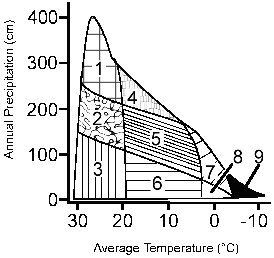
Based on the temperature range and precipitation, the area on the accompanying figure labeled as 3 represents which of the following biomes?
A) Savanna
B) Temperate deciduous forest
C) Temperate rain forest
D) Taiga
E) Tundra
Based on the temperature range and precipitation, the area on the accompanying figure labeled as 3 represents which of the following biomes?
A) Savanna
B) Temperate deciduous forest
C) Temperate rain forest
D) Taiga
E) Tundra
Question
Question
Question
Figure 56-1
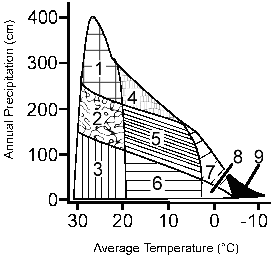
Based on the temperature range and precipitation, the area on the accompanying figure labeled as 5 represents which of the following biomes?
A) Savanna
B) Temperate deciduous forest
C) Temperate rain forest
D) Taiga
E) Tundra
Based on the temperature range and precipitation, the area on the accompanying figure labeled as 5 represents which of the following biomes?
A) Savanna
B) Temperate deciduous forest
C) Temperate rain forest
D) Taiga
E) Tundra
Question
Question
Figure 56-1
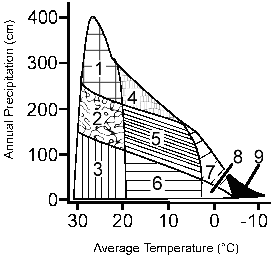
Based on the accompanying figure, what is the annual precipitation and temperature range for a temperate rain forest?
A) 300−400 cm/yr precipitation and 20−30 °C
B) 200−300 cm/yr precipitation and 20−30 °C
C) 200−300 cm/yr precipitation and 10−20 °C
D) 150−250 cm/yr precipitation and 10−20 °C
E) 150−250 cm/yr precipitation and 20−30 °C
Based on the accompanying figure, what is the annual precipitation and temperature range for a temperate rain forest?
A) 300−400 cm/yr precipitation and 20−30 °C
B) 200−300 cm/yr precipitation and 20−30 °C
C) 200−300 cm/yr precipitation and 10−20 °C
D) 150−250 cm/yr precipitation and 10−20 °C
E) 150−250 cm/yr precipitation and 20−30 °C
Question
Question
Question
Question
Question
Question
Question
Question
Question
Question
Question
Figure 56-2
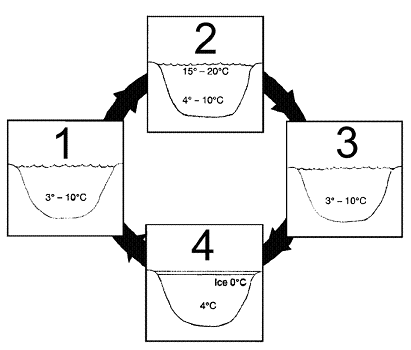
Refer to the accompanying figure. Which of the following represents the fall turnover?
A) 1 going to 2
B) 2 going to 3
C) 3 going to 4
D) 4 going to 1
E) 4 going to 2
Refer to the accompanying figure. Which of the following represents the fall turnover?
A) 1 going to 2
B) 2 going to 3
C) 3 going to 4
D) 4 going to 1
E) 4 going to 2
Question
Question
Question
Figure 56-2
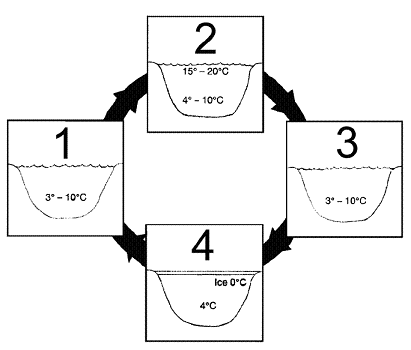
Which of the lakes in the accompanying figure may have a thermocline?
A) 1
B) 2
C) 4
D) 1 and 3
E) 2 and 4
Which of the lakes in the accompanying figure may have a thermocline?
A) 1
B) 2
C) 4
D) 1 and 3
E) 2 and 4
Question
Question
Question
Question
Figure 56-2
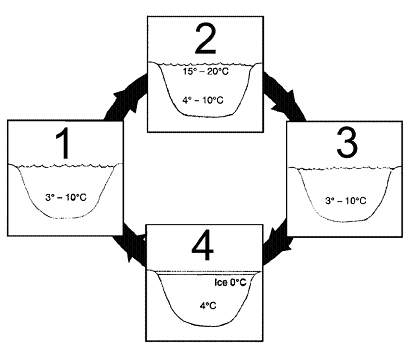
Which of the lakes in the accompanying figure may experience turnover?
A) 2 and 4
B) 2 and 3
C) 3 and 4
D) 1 and 2
E) 1 and 3
Which of the lakes in the accompanying figure may experience turnover?
A) 2 and 4
B) 2 and 3
C) 3 and 4
D) 1 and 2
E) 1 and 3
Question
Question
Question
Question
Question
Question
Question
Question
Question
Question
Question
Question
Question
Question
Question
Question
Question
Question
Question
Question
Question
Question
Question
Match between columns
Question
Match between columns
Question
Match between columns
Question
Match between columns
Question
Match between columns
Question
Question
Match between columns
Question
Match between columns
Question
Question
Match between columns
Question
Match between columns
Question
Match between columns
Question
Match between columns
Question
Match between columns
Question
Match between columns
Question
Question
Match between columns
Question
Question
Match between columns
Question
Match between columns

Unlock Deck
Sign up to unlock the cards in this deck!
Unlock Deck
Unlock Deck
1/99

Play

Full screen (f)
Deck 56: Ecology and the Geography of Life
1
Which of the following characteristics applies to biomes?
A) They are usually confined to a relatively small geographical area.
B) They encompass interacting landscapes.
C) Their distribution is largely the result of differences in population.
D) Their boundaries extend beyond climate barriers.
E) They include regions with similar climate, but different plants, animals, and soil.
A) They are usually confined to a relatively small geographical area.
B) They encompass interacting landscapes.
C) Their distribution is largely the result of differences in population.
D) Their boundaries extend beyond climate barriers.
E) They include regions with similar climate, but different plants, animals, and soil.
B
2
Currently, much commercial lumber and wood products come from which biome?
A) Tundra
B) Temperate rain forest
C) Savanna
D) Tropical rain forest
E) Temperate deciduous forest
A) Tundra
B) Temperate rain forest
C) Savanna
D) Tropical rain forest
E) Temperate deciduous forest
B
3
Which biome is characterized by weasels, gray wolves, ptarmigan, musk oxen, and lemmings?
A) Tundra
B) Desert
C) Tropical rain forest
D) Savanna
E) Temperate deciduous forest
A) Tundra
B) Desert
C) Tropical rain forest
D) Savanna
E) Temperate deciduous forest
A
4
Compared to soils of other ecosystems, desert soils are characterized as having:
A) high amounts of organic material and low mineral content.
B) low amounts of organic material and low mineral content.
C) high amounts of organic material and high mineral content.
D) low amounts of organic material and high mineral content.
E) moderate levels of both organic material and minerals.
A) high amounts of organic material and low mineral content.
B) low amounts of organic material and low mineral content.
C) high amounts of organic material and high mineral content.
D) low amounts of organic material and high mineral content.
E) moderate levels of both organic material and minerals.
Unlock Deck
Unlock for access to all 99 flashcards in this deck.
Unlock Deck
k this deck
5
Overgrazing in savannas by domestic animals has contributed to its conversion into:
A) chaparral.
B) grassland.
C) desert.
D) taiga.
E) ecotones.
A) chaparral.
B) grassland.
C) desert.
D) taiga.
E) ecotones.
Unlock Deck
Unlock for access to all 99 flashcards in this deck.
Unlock Deck
k this deck
6
Which of the following is a characteristic of desert plants?
A) Common annuals
B) Enlarged leaf size
C) Lianas with extensive epiphytes
D) Adaptations that conserve water
E) Adaptations to stable temperatures
A) Common annuals
B) Enlarged leaf size
C) Lianas with extensive epiphytes
D) Adaptations that conserve water
E) Adaptations to stable temperatures
Unlock Deck
Unlock for access to all 99 flashcards in this deck.
Unlock Deck
k this deck
7
Which of the following is an adaptation of black-tailed prairie dogs?
A) Modified digestive tracts easily digest seeds of grasses
B) Transition to a carnivore lifestyle
C) Movement toward above ground living
D) Hibernation throughout the spring
E) Movement toward living in small social groups
A) Modified digestive tracts easily digest seeds of grasses
B) Transition to a carnivore lifestyle
C) Movement toward above ground living
D) Hibernation throughout the spring
E) Movement toward living in small social groups
Unlock Deck
Unlock for access to all 99 flashcards in this deck.
Unlock Deck
k this deck
8
Based on the temperature range and precipitation, which area in the accompanying figure is dominated by pine trees?
A) 3
B) 4
C) 5
D) 6
E) 7
A) 3
B) 4
C) 5
D) 6
E) 7
Unlock Deck
Unlock for access to all 99 flashcards in this deck.
Unlock Deck
k this deck
9
The greatest proportion of which two biomes have been converted to agriculture?
A) Taiga and tropical rain forest
B) Tropical rain forest and temperate rain forest
C) Temperate deciduous forest and temperate grassland
D) Chaparral and tropical rain forest
E) Temperate grassland and savanna
A) Taiga and tropical rain forest
B) Tropical rain forest and temperate rain forest
C) Temperate deciduous forest and temperate grassland
D) Chaparral and tropical rain forest
E) Temperate grassland and savanna
Unlock Deck
Unlock for access to all 99 flashcards in this deck.
Unlock Deck
k this deck
10
Near the poles, what is generally the overriding climate factor?
A) Temperature
B) Precipitation
C) Latitude
D) Altitude
E) pH
A) Temperature
B) Precipitation
C) Latitude
D) Altitude
E) pH
Unlock Deck
Unlock for access to all 99 flashcards in this deck.
Unlock Deck
k this deck
11
Which of the following is most characteristic of desert animals?
A) They tend to be quite large in size.
B) They estivate during the rainy season.
C) They are primarily active at night.
D) They do not include mammals except for rodents.
E) They do not include insects.
A) They tend to be quite large in size.
B) They estivate during the rainy season.
C) They are primarily active at night.
D) They do not include mammals except for rodents.
E) They do not include insects.
Unlock Deck
Unlock for access to all 99 flashcards in this deck.
Unlock Deck
k this deck
12
The Southern Hemisphere has no equivalent of the boreal forest of the north. Why?
A) It has no latitudes near the poles.
B) It has insufficient altitudes.
C) It has no land in the corresponding latitudes.
D) It is too close to the sun during the winter.
E) It has an inhospitable temperature.
A) It has no latitudes near the poles.
B) It has insufficient altitudes.
C) It has no land in the corresponding latitudes.
D) It is too close to the sun during the winter.
E) It has an inhospitable temperature.
Unlock Deck
Unlock for access to all 99 flashcards in this deck.
Unlock Deck
k this deck
13
There are no trees in the tundra because:
A) of the short growing season.
B) of the limited supply of nutrients in the soil.
C) of limited root penetration due to permafrost.
D) of limited precipitation.
E) of low temperatures.
A) of the short growing season.
B) of the limited supply of nutrients in the soil.
C) of limited root penetration due to permafrost.
D) of limited precipitation.
E) of low temperatures.
Unlock Deck
Unlock for access to all 99 flashcards in this deck.
Unlock Deck
k this deck
14
Much precipitation in the tropical rain forest is derived from:
A) evaporation from lakes.
B) evaporation from rivers.
C) groundwater.
D) transpiration.
E) translocation.
A) evaporation from lakes.
B) evaporation from rivers.
C) groundwater.
D) transpiration.
E) translocation.
Unlock Deck
Unlock for access to all 99 flashcards in this deck.
Unlock Deck
k this deck
15
Figure 56-1
Based on the temperature range and precipitation, the area on the accompanying figure labeled as 3 represents which of the following biomes?
A) Savanna
B) Temperate deciduous forest
C) Temperate rain forest
D) Taiga
E) Tundra
Based on the temperature range and precipitation, the area on the accompanying figure labeled as 3 represents which of the following biomes?
A) Savanna
B) Temperate deciduous forest
C) Temperate rain forest
D) Taiga
E) Tundra
Unlock Deck
Unlock for access to all 99 flashcards in this deck.
Unlock Deck
k this deck
16
Which statement about Earth's biomes is FALSE?
A) Biomes near the poles have less rainfall than biomes on the equator.
B) Altitude can result in biomes that are not characteristic for a particular latitude.
C) Deserts have less rainfall due to their distance from the ocean.
D) Rainforests occur in both the Northern and Southern Hemisphere.
E) Deserts occur in both the Northern and Southern Hemisphere.
A) Biomes near the poles have less rainfall than biomes on the equator.
B) Altitude can result in biomes that are not characteristic for a particular latitude.
C) Deserts have less rainfall due to their distance from the ocean.
D) Rainforests occur in both the Northern and Southern Hemisphere.
E) Deserts occur in both the Northern and Southern Hemisphere.
Unlock Deck
Unlock for access to all 99 flashcards in this deck.
Unlock Deck
k this deck
17
The tropical rain forest biome is characterized by:
A) high density of plants, but nutrient poor soil.
B) high density of plants and nutrient rich soil.
C) low density of plants due to nutrient poor soil.
D) low density of plants, yet nutrient rich soil.
E) intermediate density of plants and intermediate nutrient supply.
A) high density of plants, but nutrient poor soil.
B) high density of plants and nutrient rich soil.
C) low density of plants due to nutrient poor soil.
D) low density of plants, yet nutrient rich soil.
E) intermediate density of plants and intermediate nutrient supply.
Unlock Deck
Unlock for access to all 99 flashcards in this deck.
Unlock Deck
k this deck
18
Figure 56-1
Based on the temperature range and precipitation, the area on the accompanying figure labeled as 5 represents which of the following biomes?
A) Savanna
B) Temperate deciduous forest
C) Temperate rain forest
D) Taiga
E) Tundra
Based on the temperature range and precipitation, the area on the accompanying figure labeled as 5 represents which of the following biomes?
A) Savanna
B) Temperate deciduous forest
C) Temperate rain forest
D) Taiga
E) Tundra
Unlock Deck
Unlock for access to all 99 flashcards in this deck.
Unlock Deck
k this deck
19
Climates characteristic of the Mediterranean region are also common in:
A) Nebraska.
B) New York.
C) Florida.
D) Hawaii.
E) California.
A) Nebraska.
B) New York.
C) Florida.
D) Hawaii.
E) California.
Unlock Deck
Unlock for access to all 99 flashcards in this deck.
Unlock Deck
k this deck
20
Figure 56-1
Based on the accompanying figure, what is the annual precipitation and temperature range for a temperate rain forest?
A) 300−400 cm/yr precipitation and 20−30 °C
B) 200−300 cm/yr precipitation and 20−30 °C
C) 200−300 cm/yr precipitation and 10−20 °C
D) 150−250 cm/yr precipitation and 10−20 °C
E) 150−250 cm/yr precipitation and 20−30 °C
Based on the accompanying figure, what is the annual precipitation and temperature range for a temperate rain forest?
A) 300−400 cm/yr precipitation and 20−30 °C
B) 200−300 cm/yr precipitation and 20−30 °C
C) 200−300 cm/yr precipitation and 10−20 °C
D) 150−250 cm/yr precipitation and 10−20 °C
E) 150−250 cm/yr precipitation and 20−30 °C
Unlock Deck
Unlock for access to all 99 flashcards in this deck.
Unlock Deck
k this deck
21
The ____ contains the greatest volume of ocean water.
A) oceanic province
B) intertidal zone
C) euphotic zone
D) neritic province
E) limnetic zone
A) oceanic province
B) intertidal zone
C) euphotic zone
D) neritic province
E) limnetic zone
Unlock Deck
Unlock for access to all 99 flashcards in this deck.
Unlock Deck
k this deck
22
What environment is characterized by high nutrient inputs and by relatively great fluctuations in salinity and temperature?
A) A river
B) An estuary
C) A freshwater wetland
D) Aa large lake
E) The oceanic province
A) A river
B) An estuary
C) A freshwater wetland
D) Aa large lake
E) The oceanic province
Unlock Deck
Unlock for access to all 99 flashcards in this deck.
Unlock Deck
k this deck
23
Lianas and epiphytes are especially common in the:
A) tropical rain forest.
B) savanna.
C) temperate grassland.
D) chaparral.
E) taiga.
A) tropical rain forest.
B) savanna.
C) temperate grassland.
D) chaparral.
E) taiga.
Unlock Deck
Unlock for access to all 99 flashcards in this deck.
Unlock Deck
k this deck
24
Characteristics of headwaters include:
A) fast flow, high oxygen, and free-floating vegetation.
B) fast flow, low oxygen, and free-floating vegetation.
C) fast flow, high oxygen, and streamlined animal bodies.
D) fast flow, high oxygen, and free-floating vegetation.
E) slow flow, high oxygen, and free-floating vegetation.
A) fast flow, high oxygen, and free-floating vegetation.
B) fast flow, low oxygen, and free-floating vegetation.
C) fast flow, high oxygen, and streamlined animal bodies.
D) fast flow, high oxygen, and free-floating vegetation.
E) slow flow, high oxygen, and free-floating vegetation.
Unlock Deck
Unlock for access to all 99 flashcards in this deck.
Unlock Deck
k this deck
25
Which biome has the greatest number of distinct layers of vegetation?
A) Savanna
B) Tropical rain forest
C) Desert
D) Chaparral
E) Grassland
A) Savanna
B) Tropical rain forest
C) Desert
D) Chaparral
E) Grassland
Unlock Deck
Unlock for access to all 99 flashcards in this deck.
Unlock Deck
k this deck
26
Which organism would be found exclusively in the benthic environment?
A) Painted turtles
B) Pond snail
C) Bur-reeds
D) Cattails
E) Bloodworms
A) Painted turtles
B) Pond snail
C) Bur-reeds
D) Cattails
E) Bloodworms
Unlock Deck
Unlock for access to all 99 flashcards in this deck.
Unlock Deck
k this deck
27
For coral reefs to form in tropical waters, it is necessary for the coral animals to live in symbiosis with:
A) bacteria.
B) parrot fish.
C) zooxanthellae.
D) sea urchins.
E) kelp.
A) bacteria.
B) parrot fish.
C) zooxanthellae.
D) sea urchins.
E) kelp.
Unlock Deck
Unlock for access to all 99 flashcards in this deck.
Unlock Deck
k this deck
28
Microscopic algae typically fall under the classification of:
A) nekton.
B) phytoplankton.
C) zooplankton.
D) benthos.
E) profundal microorganisms.
A) nekton.
B) phytoplankton.
C) zooplankton.
D) benthos.
E) profundal microorganisms.
Unlock Deck
Unlock for access to all 99 flashcards in this deck.
Unlock Deck
k this deck
29
The most productive region of a lake is the ____ zone.
A) neritic
B) limnetic
C) profundal
D) littoral
E) oceanic
A) neritic
B) limnetic
C) profundal
D) littoral
E) oceanic
Unlock Deck
Unlock for access to all 99 flashcards in this deck.
Unlock Deck
k this deck
30
Adaptations found in inhabitants of the rocky intertidal zone include:
A) soft bodies.
B) an anchor or some other means of attachment.
C) strong swimming abilities.
D) active burrowing.
E) delicate outer coverings or bodies.
A) soft bodies.
B) an anchor or some other means of attachment.
C) strong swimming abilities.
D) active burrowing.
E) delicate outer coverings or bodies.
Unlock Deck
Unlock for access to all 99 flashcards in this deck.
Unlock Deck
k this deck
31
Figure 56-2
Refer to the accompanying figure. Which of the following represents the fall turnover?
A) 1 going to 2
B) 2 going to 3
C) 3 going to 4
D) 4 going to 1
E) 4 going to 2
Refer to the accompanying figure. Which of the following represents the fall turnover?
A) 1 going to 2
B) 2 going to 3
C) 3 going to 4
D) 4 going to 1
E) 4 going to 2
Unlock Deck
Unlock for access to all 99 flashcards in this deck.
Unlock Deck
k this deck
32
Which of the following applies to the deepest zone of a large lake?
A) Effective recycling of minerals
B) Anaerobic conditions
C) A mineral-poor zone
D) Plentiful light penetration
E) Numerous organisms
A) Effective recycling of minerals
B) Anaerobic conditions
C) A mineral-poor zone
D) Plentiful light penetration
E) Numerous organisms
Unlock Deck
Unlock for access to all 99 flashcards in this deck.
Unlock Deck
k this deck
33
Which biome has the longest growing season?
A) Tundra
B) Taiga
C) Grassland
D) Temperate deciduous forest
E) Tropical rain forest
A) Tundra
B) Taiga
C) Grassland
D) Temperate deciduous forest
E) Tropical rain forest
Unlock Deck
Unlock for access to all 99 flashcards in this deck.
Unlock Deck
k this deck
34
Figure 56-2
Which of the lakes in the accompanying figure may have a thermocline?
A) 1
B) 2
C) 4
D) 1 and 3
E) 2 and 4
Which of the lakes in the accompanying figure may have a thermocline?
A) 1
B) 2
C) 4
D) 1 and 3
E) 2 and 4
Unlock Deck
Unlock for access to all 99 flashcards in this deck.
Unlock Deck
k this deck
35
Headwater streams depend primarily on ____ as an energy input.
A) photosynthesis
B) detritus
C) phytoplankton
D) zooplankton
E) nekton
A) photosynthesis
B) detritus
C) phytoplankton
D) zooplankton
E) nekton
Unlock Deck
Unlock for access to all 99 flashcards in this deck.
Unlock Deck
k this deck
36
A(n) ____ is the transition zone where two ecosystems meet and intergrade.
A) intertidal zone
B) ecotone
C) range
D) biome
E) thermocline
A) intertidal zone
B) ecotone
C) range
D) biome
E) thermocline
Unlock Deck
Unlock for access to all 99 flashcards in this deck.
Unlock Deck
k this deck
37
Marine snow is a major source of energy for the ____ region of the ocean.
A) littoral
B) aphotic
C) euphotic
D) intertidal
E) neustonic
A) littoral
B) aphotic
C) euphotic
D) intertidal
E) neustonic
Unlock Deck
Unlock for access to all 99 flashcards in this deck.
Unlock Deck
k this deck
38
Figure 56-2
Which of the lakes in the accompanying figure may experience turnover?
A) 2 and 4
B) 2 and 3
C) 3 and 4
D) 1 and 2
E) 1 and 3
Which of the lakes in the accompanying figure may experience turnover?
A) 2 and 4
B) 2 and 3
C) 3 and 4
D) 1 and 2
E) 1 and 3
Unlock Deck
Unlock for access to all 99 flashcards in this deck.
Unlock Deck
k this deck
39
Sponges and brittle stars are members of the ____ category of organisms:
A) nekton
B) phytoplankton
C) zooplankton
D) benthos
E) profundal zone
A) nekton
B) phytoplankton
C) zooplankton
D) benthos
E) profundal zone
Unlock Deck
Unlock for access to all 99 flashcards in this deck.
Unlock Deck
k this deck
40
Which factor is most important in determining the distribution of organisms in aquatic biomes?
A) Interspecies composition
B) Dominant vegetation
C) Distance from shore
D) Salinity
E) Intraspecies composition
A) Interspecies composition
B) Dominant vegetation
C) Distance from shore
D) Salinity
E) Intraspecies composition
Unlock Deck
Unlock for access to all 99 flashcards in this deck.
Unlock Deck
k this deck
41
Describe the climate, soil, and representative organisms for one of the following terrestrial biomes: savanna, temperate rain forest, chaparral, or taiga.
Unlock Deck
Unlock for access to all 99 flashcards in this deck.
Unlock Deck
k this deck
42
The term nekton refers to bottom-dwelling organisms in an aquatic ecosystem.
Unlock Deck
Unlock for access to all 99 flashcards in this deck.
Unlock Deck
k this deck
43
The transition zone between biomes is called an ecotone.
Unlock Deck
Unlock for access to all 99 flashcards in this deck.
Unlock Deck
k this deck
44
The upper part of the neritic province is called the euphotic zone.
Unlock Deck
Unlock for access to all 99 flashcards in this deck.
Unlock Deck
k this deck
45
An example of a freshwater wetland is an estuary.
Unlock Deck
Unlock for access to all 99 flashcards in this deck.
Unlock Deck
k this deck
46
The oceanic province is that part of the ocean that overlies the continental shelf.
Unlock Deck
Unlock for access to all 99 flashcards in this deck.
Unlock Deck
k this deck
47
The Southern Hemisphere has no alpine tundra.
Unlock Deck
Unlock for access to all 99 flashcards in this deck.
Unlock Deck
k this deck
48
Small lakes and ponds usually lack a profundal zone.
Unlock Deck
Unlock for access to all 99 flashcards in this deck.
Unlock Deck
k this deck
49
The boreal forest biome does not contain deciduous trees.
Unlock Deck
Unlock for access to all 99 flashcards in this deck.
Unlock Deck
k this deck
50
The limnetic zone is the shallow-water area along the shore of a lake or pond.
Unlock Deck
Unlock for access to all 99 flashcards in this deck.
Unlock Deck
k this deck
51
Dense coastal fog is characteristic of the temperate deciduous forest biome.
Unlock Deck
Unlock for access to all 99 flashcards in this deck.
Unlock Deck
k this deck
52
Explain the changes in vegetation observed with increasing latitude.
Unlock Deck
Unlock for access to all 99 flashcards in this deck.
Unlock Deck
k this deck
53
A layer of permanently frozen ground is called permafrost.
Unlock Deck
Unlock for access to all 99 flashcards in this deck.
Unlock Deck
k this deck
54
The hadal zone is that part of the benthic environment deeper than 6000 m.
Unlock Deck
Unlock for access to all 99 flashcards in this deck.
Unlock Deck
k this deck
55
Extensive epiphytes are found in the tropical dry forests.
Unlock Deck
Unlock for access to all 99 flashcards in this deck.
Unlock Deck
k this deck
56
The ____ realm has long been separated from other land masses and is the area in which marsupials are particularly common.
A) Ethiopian
B) Palearctic
C) Nearctic
D) Oriental
E) Australian
A) Ethiopian
B) Palearctic
C) Nearctic
D) Oriental
E) Australian
Unlock Deck
Unlock for access to all 99 flashcards in this deck.
Unlock Deck
k this deck
57
The United States is part of the Palearctic realm.
Unlock Deck
Unlock for access to all 99 flashcards in this deck.
Unlock Deck
k this deck
58
The chaparral biome is characterized by grasses as high as 2 m.
Unlock Deck
Unlock for access to all 99 flashcards in this deck.
Unlock Deck
k this deck
59
Identify and briefly describe three biogeographical realms.
Unlock Deck
Unlock for access to all 99 flashcards in this deck.
Unlock Deck
k this deck
60
The American kangaroo rat is characteristic of the desert biome.
Unlock Deck
Unlock for access to all 99 flashcards in this deck.
Unlock Deck
k this deck
61
Match between columns
Unlock Deck
Unlock for access to all 99 flashcards in this deck.
Unlock Deck
k this deck
62
Match between columns
Unlock Deck
Unlock for access to all 99 flashcards in this deck.
Unlock Deck
k this deck
63
Match between columns
Unlock Deck
Unlock for access to all 99 flashcards in this deck.
Unlock Deck
k this deck
64
Match between columns
Unlock Deck
Unlock for access to all 99 flashcards in this deck.
Unlock Deck
k this deck
65
Match between columns
Unlock Deck
Unlock for access to all 99 flashcards in this deck.
Unlock Deck
k this deck
66
Chose five biomes. Briefly describe how humans have altered those biomes. Consider how humans may have converted these biomes for commercial or agricultural use.
Unlock Deck
Unlock for access to all 99 flashcards in this deck.
Unlock Deck
k this deck
67
Match between columns
Unlock Deck
Unlock for access to all 99 flashcards in this deck.
Unlock Deck
k this deck
68
Match between columns
Unlock Deck
Unlock for access to all 99 flashcards in this deck.
Unlock Deck
k this deck
69
Describe the physical processes that result in the summer and winter stratification in temperate zone lakes. Include the cause of the mixing in the spring and fall.
Unlock Deck
Unlock for access to all 99 flashcards in this deck.
Unlock Deck
k this deck
70
Match between columns
Unlock Deck
Unlock for access to all 99 flashcards in this deck.
Unlock Deck
k this deck
71
Match between columns
Unlock Deck
Unlock for access to all 99 flashcards in this deck.
Unlock Deck
k this deck
72
Match between columns
Unlock Deck
Unlock for access to all 99 flashcards in this deck.
Unlock Deck
k this deck
73
Match between columns
Unlock Deck
Unlock for access to all 99 flashcards in this deck.
Unlock Deck
k this deck
74
Match between columns
Unlock Deck
Unlock for access to all 99 flashcards in this deck.
Unlock Deck
k this deck
75
Match between columns
Unlock Deck
Unlock for access to all 99 flashcards in this deck.
Unlock Deck
k this deck
76
Describe the human impact on two aquatic ecosystems. How have these alterations impacted these ecosystems?
Unlock Deck
Unlock for access to all 99 flashcards in this deck.
Unlock Deck
k this deck
77
Match between columns
Unlock Deck
Unlock for access to all 99 flashcards in this deck.
Unlock Deck
k this deck
78
Describe and diagram the various zones and provinces in the ocean. What adaptations to these variable conditions are seen in the biota that inhabit these regions?
Unlock Deck
Unlock for access to all 99 flashcards in this deck.
Unlock Deck
k this deck
79
Match between columns
Unlock Deck
Unlock for access to all 99 flashcards in this deck.
Unlock Deck
k this deck
80
Match between columns
Unlock Deck
Unlock for access to all 99 flashcards in this deck.
Unlock Deck
k this deck
Unlock Deck
Unlock for access to all 99 flashcards in this deck.






