







 Chat with AI

Deck 11: School Finance
Full screen (f)

Question

Question
Question
Question
Question
Question
Question
Question
Question
Question
Question
Question
Question
Question
Question
Question
Question
Question
Question
Question
Question
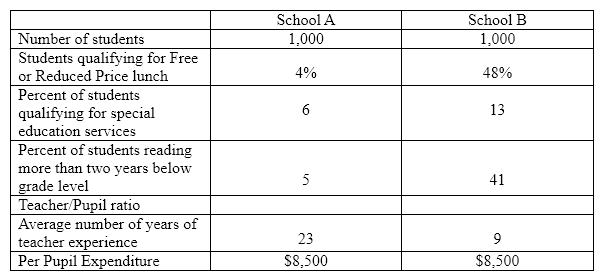
Using the table below for your data, explain the concepts of equity, equality, and adequacy in relation to the demography of the school and the per pupil expenditures.
Question
Question
Question
Question
Question

Unlock Deck
Sign up to unlock the cards in this deck!
Unlock Deck
Unlock Deck
1/26

Play

Full screen (f)
Deck 11: School Finance
1
Which of the following statements is true?
A) Education acts as an economic stimulus.
B) Education tends to reduce public social expenses of unemployment costs, incarceration rates, and crime expenditures.
C) Education increases one's earning potential.
D) Education increases one's employability.
E) All are true
F) None are true
A) Education acts as an economic stimulus.
B) Education tends to reduce public social expenses of unemployment costs, incarceration rates, and crime expenditures.
C) Education increases one's earning potential.
D) Education increases one's employability.
E) All are true
F) None are true
E
2
Which of the following is true concerning education budget categories in the Digest of Education Statistics, 2010 ?
A) The Digest separates education expenditures into 25 categories.
B) Student support has the largest percentage of all the other categories.
C) Capital outlay accounts for 26% of the budgets as building and land costs have skyrocketed.
D) Instruction counts for approximately 53% of expenditures.
E) School administration accounts for approximately 15% of expenditures.
A) The Digest separates education expenditures into 25 categories.
B) Student support has the largest percentage of all the other categories.
C) Capital outlay accounts for 26% of the budgets as building and land costs have skyrocketed.
D) Instruction counts for approximately 53% of expenditures.
E) School administration accounts for approximately 15% of expenditures.
D
3
The average per capita 2010 income for all persons who did not complete high school was
A) $17,384
B) $19,887
C) $20,241
D) $21,973
A) $17,384
B) $19,887
C) $20,241
D) $21,973
C
4
Which of the following is the best answer to how much it costs to educate a child in the United States?
A) $11,950 is the average of all the state per-pupil expenditures.
B) It varies by the wealth and willingness of states and localities to fund education.
C) It costs more to educate a child with special needs than one without those needs.
D) The range is from $7,756 in Utah, to $20,066 in the District of Columbia.
A) $11,950 is the average of all the state per-pupil expenditures.
B) It varies by the wealth and willingness of states and localities to fund education.
C) It costs more to educate a child with special needs than one without those needs.
D) The range is from $7,756 in Utah, to $20,066 in the District of Columbia.
Unlock Deck
Unlock for access to all 26 flashcards in this deck.
Unlock Deck
k this deck
5
Which of the following statements is true concerning federal, state, and local revenue for public education?
A) The federal share of revenue has been consistently increasing at a significant rate since 1970.
B) Trend data show that state and local revenue for public education has shown both to be intersecting with each other to provide more funding for public schools.
C) The federal share of funding has been fairly consistent at 25% since 1970.
D) The state and local share of revenue for public education totals a bit more than 75%.
E) None are true
A) The federal share of revenue has been consistently increasing at a significant rate since 1970.
B) Trend data show that state and local revenue for public education has shown both to be intersecting with each other to provide more funding for public schools.
C) The federal share of funding has been fairly consistent at 25% since 1970.
D) The state and local share of revenue for public education totals a bit more than 75%.
E) None are true
Unlock Deck
Unlock for access to all 26 flashcards in this deck.
Unlock Deck
k this deck
6
Which of the following statements is true?
A) Education increases one's earnings potential.
B) Education increases one's employability.
C) Education increases one's probability of paying higher taxes in comparison to those with lower levels of education.
D) Education lowers one's probability of being incarcerated.
E) All are true
F) None are true
A) Education increases one's earnings potential.
B) Education increases one's employability.
C) Education increases one's probability of paying higher taxes in comparison to those with lower levels of education.
D) Education lowers one's probability of being incarcerated.
E) All are true
F) None are true
Unlock Deck
Unlock for access to all 26 flashcards in this deck.
Unlock Deck
k this deck
7
Which of the following statements is false concerning teacher salaries?
A) The best teachers are usually the teachers who earn the most money.
B) Teachers are generally paid on a scale based on years of service and graduate degrees or credits.
C) School districts with higher salaries tend to have the more experienced and well-educated teachers.
D) School districts with lower salaries tend to have teachers with the fewest years of experience.
A) The best teachers are usually the teachers who earn the most money.
B) Teachers are generally paid on a scale based on years of service and graduate degrees or credits.
C) School districts with higher salaries tend to have the more experienced and well-educated teachers.
D) School districts with lower salaries tend to have teachers with the fewest years of experience.
Unlock Deck
Unlock for access to all 26 flashcards in this deck.
Unlock Deck
k this deck
8
Which of the followings statements is false concerning school buildings?
A) One study found a 5- to 17-point difference in standardized test scores for students who attended school in well-maintained buildings compared with students who attended school in poorly maintained facilities.
B) One study found that if a school district were to improve its schools' condition from poor to excellent, student test scores would increase by an average of 10.9 percentile points.
C) Working in "sick buildings" creates health issues for students and staff resulting in higher absentee rates and lower teachers' capacity to effectively instruct students.
D) 98.9% of school buildings are in excellent shape and maintained well.
A) One study found a 5- to 17-point difference in standardized test scores for students who attended school in well-maintained buildings compared with students who attended school in poorly maintained facilities.
B) One study found that if a school district were to improve its schools' condition from poor to excellent, student test scores would increase by an average of 10.9 percentile points.
C) Working in "sick buildings" creates health issues for students and staff resulting in higher absentee rates and lower teachers' capacity to effectively instruct students.
D) 98.9% of school buildings are in excellent shape and maintained well.
Unlock Deck
Unlock for access to all 26 flashcards in this deck.
Unlock Deck
k this deck
9
Which of the following is true concerning financing public education?
A) Since 50% of funding comes from local taxes and largely based on property taxes, wealthier locales can raise more funds for school much more easily than can poorer locales.
B) Wealthier school districts can raise two to three times more per pupil with much greater ease than can poorer districts.
C) States have been reducing their funding share making it more difficult for poorer school districts to match the funding of wealthier districts.
D) One study showed a more than $100,000 disparity in student spending within the same state.
E) All are true
A) Since 50% of funding comes from local taxes and largely based on property taxes, wealthier locales can raise more funds for school much more easily than can poorer locales.
B) Wealthier school districts can raise two to three times more per pupil with much greater ease than can poorer districts.
C) States have been reducing their funding share making it more difficult for poorer school districts to match the funding of wealthier districts.
D) One study showed a more than $100,000 disparity in student spending within the same state.
E) All are true
Unlock Deck
Unlock for access to all 26 flashcards in this deck.
Unlock Deck
k this deck
10
The Alpha and Omega Syndrome is best described as
A) Glaring disparities in student resource allocation within schools in the same district
B) A parable concerning who will be first and last in educational achievement
C) Why one state can spend so much more on education while other states with the same level of wealth spend so little
D) A concert with Tony Bennett and Kiss performing alternately
A) Glaring disparities in student resource allocation within schools in the same district
B) A parable concerning who will be first and last in educational achievement
C) Why one state can spend so much more on education while other states with the same level of wealth spend so little
D) A concert with Tony Bennett and Kiss performing alternately
Unlock Deck
Unlock for access to all 26 flashcards in this deck.
Unlock Deck
k this deck
11
Which of the following is true of teacher salaries based on the Economic Policy Institute report?
A) Teacher weekly pay ranges from 12.2% to 14.1% less than jobs with comparable skill and education requirements.
B) Teacher weekly pay ranges from 17.2% to 18.1% less than jobs with comparable skill and education requirements.
C) Teacher weekly pay ranges from 22.0% to 24.7% less than jobs with comparable skill and education requirements.
D) Teacher weekly pay ranges from 28.2% to 24.9% less than jobs with comparable skill and education requirements.
A) Teacher weekly pay ranges from 12.2% to 14.1% less than jobs with comparable skill and education requirements.
B) Teacher weekly pay ranges from 17.2% to 18.1% less than jobs with comparable skill and education requirements.
C) Teacher weekly pay ranges from 22.0% to 24.7% less than jobs with comparable skill and education requirements.
D) Teacher weekly pay ranges from 28.2% to 24.9% less than jobs with comparable skill and education requirements.
Unlock Deck
Unlock for access to all 26 flashcards in this deck.
Unlock Deck
k this deck
12
Which of the following statements is true?
A) The Alliance for Excellent Education estimates that if the 1.2 million students who drop out of school each year instead, earned a high school diploma, states could save $17 billion in health care costs over the graduates' lifetime.
B) The Economic Policy Institute found that children who live in poverty but who receive high-quality early education have significantly fewer arrests than peers without this opportunity.
C) The Committee for Economic Development determined that investing $4,800 per child in preschool can reduce teenage arrests by 40%.
D) The Coalition for Juvenile Justice reports that high school dropouts are three times more likely to be arrested than their peers who stay in school.
E) All are true
F) None are true
A) The Alliance for Excellent Education estimates that if the 1.2 million students who drop out of school each year instead, earned a high school diploma, states could save $17 billion in health care costs over the graduates' lifetime.
B) The Economic Policy Institute found that children who live in poverty but who receive high-quality early education have significantly fewer arrests than peers without this opportunity.
C) The Committee for Economic Development determined that investing $4,800 per child in preschool can reduce teenage arrests by 40%.
D) The Coalition for Juvenile Justice reports that high school dropouts are three times more likely to be arrested than their peers who stay in school.
E) All are true
F) None are true
Unlock Deck
Unlock for access to all 26 flashcards in this deck.
Unlock Deck
k this deck
13
Which of the following statements is true concerning the cost of educating low-income students?
A) Educating children to common meaningful standards costs more than it does to bring more affluent students to these standards.
B) Typically, children from low-income families have more educational and academic ground to reach expectations than their more affluent peers.
C) Low-income students typically experience an achievement and knowledge gap upon entering school compared with more affluent peers.
D) The Education Trust calculates the cost of educating children from low-income families to be 40% more than educating middle-income peers.
E) All are true
F) All are false
A) Educating children to common meaningful standards costs more than it does to bring more affluent students to these standards.
B) Typically, children from low-income families have more educational and academic ground to reach expectations than their more affluent peers.
C) Low-income students typically experience an achievement and knowledge gap upon entering school compared with more affluent peers.
D) The Education Trust calculates the cost of educating children from low-income families to be 40% more than educating middle-income peers.
E) All are true
F) All are false
Unlock Deck
Unlock for access to all 26 flashcards in this deck.
Unlock Deck
k this deck
14
Which of the following statements is true concerning educators' salaries?
A) Salaries make up approximately 70% of budgets.
B) The average teacher salary for public school teachers in 2012 was $55,489.
C) The highest average teacher salary in 2012 was in New Jersey.
D) The lowest average teacher salary in 2012 was in Mississippi.
E) Salaries make up approximately 70% of budgets, and the average teacher salary for public school teachers in 2012 was $55,489.
F) The highest average teacher salary in 2012 was in New Jersey and the lowest average teacher salary in 2012 was in Mississippi.
G) All are true
A) Salaries make up approximately 70% of budgets.
B) The average teacher salary for public school teachers in 2012 was $55,489.
C) The highest average teacher salary in 2012 was in New Jersey.
D) The lowest average teacher salary in 2012 was in Mississippi.
E) Salaries make up approximately 70% of budgets, and the average teacher salary for public school teachers in 2012 was $55,489.
F) The highest average teacher salary in 2012 was in New Jersey and the lowest average teacher salary in 2012 was in Mississippi.
G) All are true
Unlock Deck
Unlock for access to all 26 flashcards in this deck.
Unlock Deck
k this deck
15
The difference between equity and equality is best defined as
A) There is no real difference.
B) Equity involves giving the students the services they actually need.
C) Equality involves providing equal services to students regardless of their needs.
D) The difference between equity and equality is if teachers are provided the resources to accomplish the job of educating all children achieve high and rigorous standards.
E) Equity involves giving the students the services they actually need and equality involves providing equal services to students regardless of their needs.
F) None are correct
A) There is no real difference.
B) Equity involves giving the students the services they actually need.
C) Equality involves providing equal services to students regardless of their needs.
D) The difference between equity and equality is if teachers are provided the resources to accomplish the job of educating all children achieve high and rigorous standards.
E) Equity involves giving the students the services they actually need and equality involves providing equal services to students regardless of their needs.
F) None are correct
Unlock Deck
Unlock for access to all 26 flashcards in this deck.
Unlock Deck
k this deck
16
Which of the following statements are true concerning educational attainment and participation in the workforce for those ages 25-34 in 2010?
A) Those with higher levels of education participate in the workforce at twice the percentage rate for each level of education completed (i.e., less than high school to high school completer, etc.).
B) There is a lower percentage of persons with Master's degrees or higher participating in the workforce due to the fact that the majority of people with Master's degrees are women who are teachers and they leave the workforce when they have children.
C) Since only 41% of individuals with less than high school completion are participating in the workforce, 59% are collecting unemployment.
D) Generally speaking, as the level of one's education increases, so does one's participation in the workforce.
A) Those with higher levels of education participate in the workforce at twice the percentage rate for each level of education completed (i.e., less than high school to high school completer, etc.).
B) There is a lower percentage of persons with Master's degrees or higher participating in the workforce due to the fact that the majority of people with Master's degrees are women who are teachers and they leave the workforce when they have children.
C) Since only 41% of individuals with less than high school completion are participating in the workforce, 59% are collecting unemployment.
D) Generally speaking, as the level of one's education increases, so does one's participation in the workforce.
Unlock Deck
Unlock for access to all 26 flashcards in this deck.
Unlock Deck
k this deck
17
Which of the following statements is true concerning average per capita income by level of education?
A) Generally speaking, as the level of one's education increases, so do one's earnings.
B) At all levels of educational attainment, men earn more than women.
C) Generally speaking, someone with a Master's degree will earn more than twice that of a someone with only a high school level of education.
D) Generally speaking, someone with a Master's degree will earn more than six times that of a high school dropout.
E) All are true
A) Generally speaking, as the level of one's education increases, so do one's earnings.
B) At all levels of educational attainment, men earn more than women.
C) Generally speaking, someone with a Master's degree will earn more than twice that of a someone with only a high school level of education.
D) Generally speaking, someone with a Master's degree will earn more than six times that of a high school dropout.
E) All are true
Unlock Deck
Unlock for access to all 26 flashcards in this deck.
Unlock Deck
k this deck
18
Which of the following statements is false?
A) The U.S. has 3.3 million elementary and secondary teachers.
B) One in 75 adults is an elementary or secondary teacher.
C) For the 2014 fiscal year, public education for all levels cost $781.2 billion.
D) The average per pupil expenditure for K-12 education in the United States exceeds $28,000.
A) The U.S. has 3.3 million elementary and secondary teachers.
B) One in 75 adults is an elementary or secondary teacher.
C) For the 2014 fiscal year, public education for all levels cost $781.2 billion.
D) The average per pupil expenditure for K-12 education in the United States exceeds $28,000.
Unlock Deck
Unlock for access to all 26 flashcards in this deck.
Unlock Deck
k this deck
19
Adequacy is defined as
A) A value driven concept
B) The major focus of education finance litigation in 45 states
C) Providing sufficient funding to accomplish the job of educating the average and special needs students to state standards
D) A difficult amount to compute
E) All are correct
A) A value driven concept
B) The major focus of education finance litigation in 45 states
C) Providing sufficient funding to accomplish the job of educating the average and special needs students to state standards
D) A difficult amount to compute
E) All are correct
Unlock Deck
Unlock for access to all 26 flashcards in this deck.
Unlock Deck
k this deck
20
Which of the following statements is false concerning education funding since 1960?
A) Education funding has been increasing since 1960.
B) The number of teachers has increased.
C) The pupil teacher ratio has decreased.
D) The number of students in U.S. public school has remained almost level since 1980.
E) All are true
A) Education funding has been increasing since 1960.
B) The number of teachers has increased.
C) The pupil teacher ratio has decreased.
D) The number of students in U.S. public school has remained almost level since 1980.
E) All are true
Unlock Deck
Unlock for access to all 26 flashcards in this deck.
Unlock Deck
k this deck
21
Using the table below for your data, explain the concepts of equity, equality, and adequacy in relation to the demography of the school and the per pupil expenditures.
Unlock Deck
Unlock for access to all 26 flashcards in this deck.
Unlock Deck
k this deck
22
List and explain in detail four areas where spending on education has been shown to improve student achievement.
Unlock Deck
Unlock for access to all 26 flashcards in this deck.
Unlock Deck
k this deck
23
List and explain four reasons why many have negative feelings about paying taxes for schools.
Unlock Deck
Unlock for access to all 26 flashcards in this deck.
Unlock Deck
k this deck
24
List and provide a one-sentence explanation for why people might believe spending more money on education does not increase student achievement.
Unlock Deck
Unlock for access to all 26 flashcards in this deck.
Unlock Deck
k this deck
25
List and provide six reasons for why people spending more money on education increases student achievement.
Unlock Deck
Unlock for access to all 26 flashcards in this deck.
Unlock Deck
k this deck
26
List and provide a one-sentence explanation for why people might believe spending more money on education increases student achievement.
Unlock Deck
Unlock for access to all 26 flashcards in this deck.
Unlock Deck
k this deck
Unlock Deck
Unlock for access to all 26 flashcards in this deck.






