







 Chat with AI

Deck 21: International Trade and Finance
Full screen (f)

Question

Question
Exhibit 21-1 Production possibilities curves 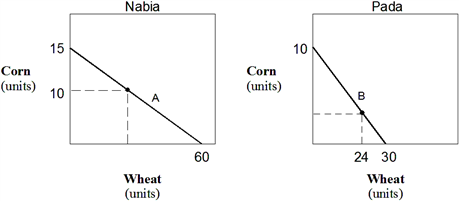 In Exhibit 21-1, the production possibilities curves of wheat and corn for Nabia and Pada are presented. If these two nations trade, Nabia should specialize in the production of:
A) corn.
B) corn and wheat.
C) neither product since Pada has the comparative advantage in the production of both.
D) neither product since Pada has the absolute advantage in the production of both.
E) wheat.
In Exhibit 21-1, the production possibilities curves of wheat and corn for Nabia and Pada are presented. If these two nations trade, Nabia should specialize in the production of:A) corn.
B) corn and wheat.
C) neither product since Pada has the comparative advantage in the production of both.
D) neither product since Pada has the absolute advantage in the production of both.
E) wheat.
Question
Question
Question
Question
Exhibit 21-1 Production possibilities curves 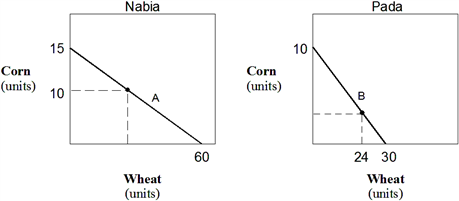 In Exhibit 21-1, the production possibilities curves of wheat and corn for Nabia and Pada are presented. If these two nations trade, Pada should specialize in the production of:
A) corn.
B) corn and wheat.
C) neither product since Nabia has the comparative advantage in the production of both.
D) neither product since Nabia has the absolute advantage in the production of both.
E) wheat.
In Exhibit 21-1, the production possibilities curves of wheat and corn for Nabia and Pada are presented. If these two nations trade, Pada should specialize in the production of:A) corn.
B) corn and wheat.
C) neither product since Nabia has the comparative advantage in the production of both.
D) neither product since Nabia has the absolute advantage in the production of both.
E) wheat.
Question
Question
Question
Exhibit 21-1 Production possibilities curves 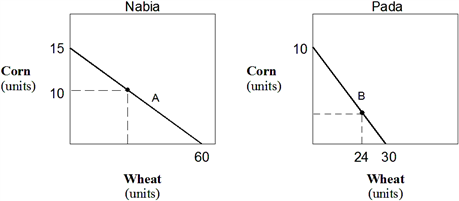 In Exhibit 21-1, the production possibilities curves of wheat and corn for Nabia and Pada are presented. In Pada the cost of producing one more unit of wheat is equal to:
A) 3 units of corn.
B) 1/3 unit of corn.
C) 1/3 unit of wheat.
D) 15 units of corn.
E) 30 units of corn.
In Exhibit 21-1, the production possibilities curves of wheat and corn for Nabia and Pada are presented. In Pada the cost of producing one more unit of wheat is equal to:A) 3 units of corn.
B) 1/3 unit of corn.
C) 1/3 unit of wheat.
D) 15 units of corn.
E) 30 units of corn.
Question
Question
Exhibit 21-1 Production possibilities curves 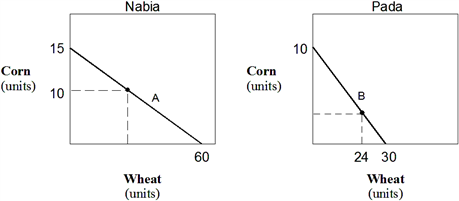 In Exhibit 21-1, the production possibilities curves of wheat and corn for Nabia and Pada are presented. In Nabia the cost of producing one more unit of wheat is equal to:
A) 4 units of corn.
B) 4 units of wheat.
C) 1/4 unit of corn.
D) 15 units of corn.
E) 60 units of corn.
In Exhibit 21-1, the production possibilities curves of wheat and corn for Nabia and Pada are presented. In Nabia the cost of producing one more unit of wheat is equal to:A) 4 units of corn.
B) 4 units of wheat.
C) 1/4 unit of corn.
D) 15 units of corn.
E) 60 units of corn.
Question
Question
Exhibit 21-2 Production possibilities curves for U. S. and Mexico 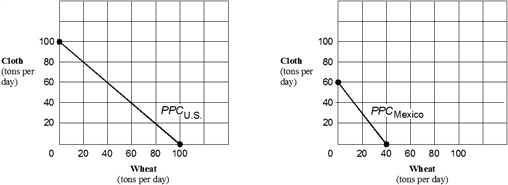 As shown in Exhibit 21-2, the United States has a comparative advantage over Mexico in:
A) wheat, but not in cloth.
B) cloth, but not in wheat.
C) both wheat and cloth.
D) neither wheat nor cloth
As shown in Exhibit 21-2, the United States has a comparative advantage over Mexico in:A) wheat, but not in cloth.
B) cloth, but not in wheat.
C) both wheat and cloth.
D) neither wheat nor cloth
Question
Exhibit 21-1 Production possibilities curves 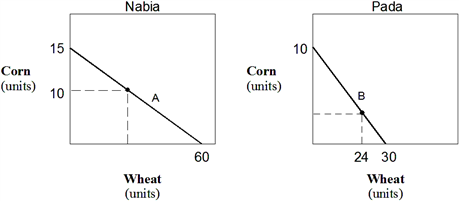 In Exhibit 21-1, the production possibilities curves of wheat and corn for Nabia and Pada are presented. In Pada the cost of producing one more unit of corn is equal to:
A) 3 units of wheat.
B) 3 units of corn.
C) 1/3 unit of wheat.
D) 15 units of wheat.
E) 30 units of wheat.
In Exhibit 21-1, the production possibilities curves of wheat and corn for Nabia and Pada are presented. In Pada the cost of producing one more unit of corn is equal to:A) 3 units of wheat.
B) 3 units of corn.
C) 1/3 unit of wheat.
D) 15 units of wheat.
E) 30 units of wheat.
Question
Exhibit 21-1 Production possibilities curves 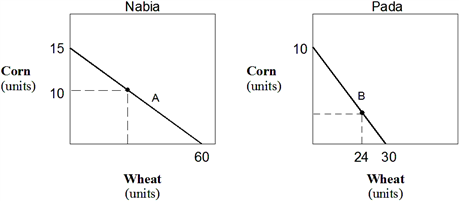 In Exhibit 21-1, the production possibilities curves of wheat and corn for Nabia and Pada are presented. Suppose Nabia produces at point A on its PPC. How many units of wheat is the country able to produce?
A) 15.
B) 60.
C) 5.
D) 20.
E) 40.
In Exhibit 21-1, the production possibilities curves of wheat and corn for Nabia and Pada are presented. Suppose Nabia produces at point A on its PPC. How many units of wheat is the country able to produce?A) 15.
B) 60.
C) 5.
D) 20.
E) 40.
Question
Exhibit 21-1 Production possibilities curves 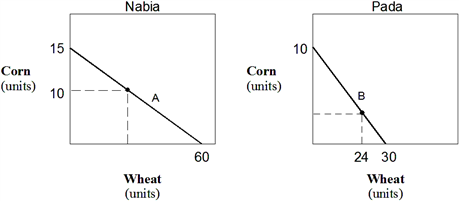 In Exhibit 21-1, the production possibilities curves of wheat and corn for Nabia and Pada are presented. In Nabia the cost of producing one more unit of corn is equal to:
A) 4 units of wheat.
B) 4 units of corn.
C) 1/4 unit of wheat.
D) 15 units of wheat.
E) 60 units of wheat.
In Exhibit 21-1, the production possibilities curves of wheat and corn for Nabia and Pada are presented. In Nabia the cost of producing one more unit of corn is equal to:A) 4 units of wheat.
B) 4 units of corn.
C) 1/4 unit of wheat.
D) 15 units of wheat.
E) 60 units of wheat.
Question
Question
Exhibit 21-1 Production possibilities curves 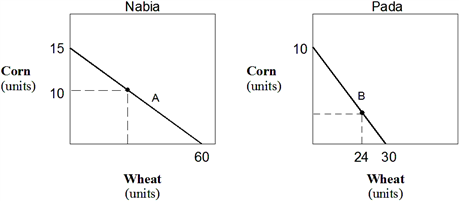 In Exhibit 21-1, the production possibilities curves of wheat and corn for Nabia and Pada are presented. Suppose Pada produces at point B on its PPC. How much corn is the country able to produce?
A) 2.
B) 15.
C) 10.
D) 6.
E) 13.
In Exhibit 21-1, the production possibilities curves of wheat and corn for Nabia and Pada are presented. Suppose Pada produces at point B on its PPC. How much corn is the country able to produce?A) 2.
B) 15.
C) 10.
D) 6.
E) 13.
Question
Question
Exhibit 21-2 Production possibilities curves for U. S. and Mexico 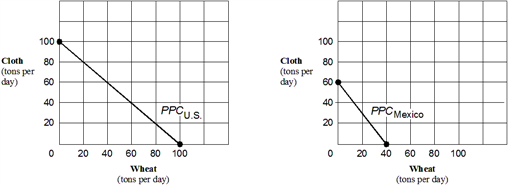 As shown in Exhibit 21-2, in Mexico, producing 1 additional ton of wheat costs:
A) 1/2 ton of cloth.
B) 2/3 ton of cloth.
C) 1 ton of cloth.
D) 1 1/2 tons of cloth.
As shown in Exhibit 21-2, in Mexico, producing 1 additional ton of wheat costs:A) 1/2 ton of cloth.
B) 2/3 ton of cloth.
C) 1 ton of cloth.
D) 1 1/2 tons of cloth.
Question
Question
Question
Question
Question
Question
Question
Question
Question
Question
Question
Question
Question
Question
Question
Question
Question
Question
Question
Question
Question
Question
Question
Question
Question
Question
Question
Question
Question
Question
Question
Question
Question
Question
Question
Question
Question
Question
Question
Question
Question
Exhibit 21-4 Coffee and tea output (pounds per hour) 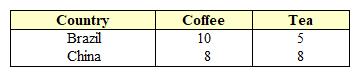 As shown in Exhibit 21-4, If each country produced according to its comparative advantage, Brazil would produce:
A) tea and China would produce coffee.
B) coffee and China would produce tea.
C) both coffee and tea.
D) neither coffee nor tea.
As shown in Exhibit 21-4, If each country produced according to its comparative advantage, Brazil would produce:A) tea and China would produce coffee.
B) coffee and China would produce tea.
C) both coffee and tea.
D) neither coffee nor tea.
Question
Question
Question
Exhibit 21-3 Potatoes and wheat output (tons per day) 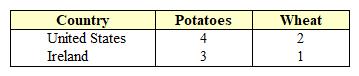 In Exhibit 21-3, the United States has a comparative advantage in producing:
A) potatoes.
B) wheat.
C) both.
D) neither.
In Exhibit 21-3, the United States has a comparative advantage in producing:A) potatoes.
B) wheat.
C) both.
D) neither.
Question
Exhibit 21-4 Coffee and tea output (pounds per hour) 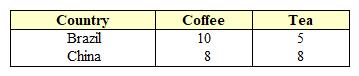 As shown in Exhibit 21-4, compared to Brazil, China has a comparative advantage in the production of:
A) coffee.
B) tea.
C) both coffee and tea.
D) neither coffee nor tea.
As shown in Exhibit 21-4, compared to Brazil, China has a comparative advantage in the production of:A) coffee.
B) tea.
C) both coffee and tea.
D) neither coffee nor tea.
Question
Question
Question
Question
Question
Exhibit 21-4 Coffee and tea output (pounds per hour) 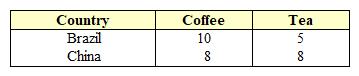 As shown in Exhibit 21-4, the opportunity cost to Brazil of producing one pound of coffee is:
A) 1 pound of tea.
B) 5 pounds of tea.
C) 1/2 pound of tea.
D) 10 pounds of tea.
As shown in Exhibit 21-4, the opportunity cost to Brazil of producing one pound of coffee is:A) 1 pound of tea.
B) 5 pounds of tea.
C) 1/2 pound of tea.
D) 10 pounds of tea.
Question
Question
Question
Exhibit 21-3 Potatoes and wheat output (tons per day) 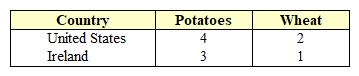 If each nation in Exhibit 21-3 specializes in producing the good for which it has a comparative advantage, then:
A) Ireland would produce neither potatoes or wheat.
B) the United States would produce both potatoes and wheat.
C) the United States would produce potatoes.
D) Ireland would produce potatoes.
If each nation in Exhibit 21-3 specializes in producing the good for which it has a comparative advantage, then:A) Ireland would produce neither potatoes or wheat.
B) the United States would produce both potatoes and wheat.
C) the United States would produce potatoes.
D) Ireland would produce potatoes.
Question
Question
Question
Question
Exhibit 21-3 Potatoes and wheat output (tons per day) 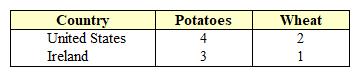 In Exhibit 21-3, Ireland's opportunity cost of producing one unit of wheat is:
A) 1/3 ton of potatoes.
B) 3 tons of potatoes.
C) either a or b.
D) neither a nor b.
In Exhibit 21-3, Ireland's opportunity cost of producing one unit of wheat is:A) 1/3 ton of potatoes.
B) 3 tons of potatoes.
C) either a or b.
D) neither a nor b.
Question
Question
Exhibit 21-3 Potatoes and wheat output (tons per day) 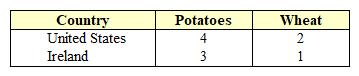 In Exhibit 21-3, the United States has an absolute advantage in producing:
A) potatoes.
B) wheat.
C) both.
D) neither.
In Exhibit 21-3, the United States has an absolute advantage in producing:A) potatoes.
B) wheat.
C) both.
D) neither.
Question
Exhibit 21-4 Coffee and tea output (pounds per hour) 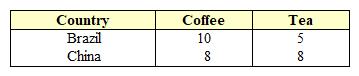 If specialization were carried out by each country in Exhibit 21-4 on the basis of comparative advantage, then:
A) Brazil would produce neither coffee nor tea.
B) China would produce both coffee and tea.
C) Brazil would produce tea and China would produce coffee.
D) Brazil would produce coffee and China would produce tea.
If specialization were carried out by each country in Exhibit 21-4 on the basis of comparative advantage, then:A) Brazil would produce neither coffee nor tea.
B) China would produce both coffee and tea.
C) Brazil would produce tea and China would produce coffee.
D) Brazil would produce coffee and China would produce tea.

Unlock Deck
Sign up to unlock the cards in this deck!
Unlock Deck
Unlock Deck
1/251

Play

Full screen (f)
Deck 21: International Trade and Finance
1
Opening trade between two nations would:
A) shift their production possibilities curves outward.
B) shift their production possibilities curves inward.
C) leave the production possibilities unchanged and increase their consumption possibilities.
D) leave the production possibilities unchanged and decreased their consumption possibilities.
A) shift their production possibilities curves outward.
B) shift their production possibilities curves inward.
C) leave the production possibilities unchanged and increase their consumption possibilities.
D) leave the production possibilities unchanged and decreased their consumption possibilities.
C
2
Exhibit 21-1 Production possibilities curves In Exhibit 21-1, the production possibilities curves of wheat and corn for Nabia and Pada are presented. If these two nations trade, Nabia should specialize in the production of:
A) corn.
B) corn and wheat.
C) neither product since Pada has the comparative advantage in the production of both.
D) neither product since Pada has the absolute advantage in the production of both.
E) wheat.
In Exhibit 21-1, the production possibilities curves of wheat and corn for Nabia and Pada are presented. If these two nations trade, Nabia should specialize in the production of:A) corn.
B) corn and wheat.
C) neither product since Pada has the comparative advantage in the production of both.
D) neither product since Pada has the absolute advantage in the production of both.
E) wheat.
E
3
What country is our largest trading partner, as measured by exports and imports?
A) Japan.
B) The United Kingdom
C) China.
D) Canada.
E) Mexico.
A) Japan.
B) The United Kingdom
C) China.
D) Canada.
E) Mexico.
D
4
With the benefits of international trade:
A) there can be increased consumption for all.
B) global production will be increased.
C) world resources will be used more efficiently.
D) all of the above are true.
A) there can be increased consumption for all.
B) global production will be increased.
C) world resources will be used more efficiently.
D) all of the above are true.
Unlock Deck
Unlock for access to all 251 flashcards in this deck.
Unlock Deck
k this deck
5
Suppose Japan has a comparative advantage over Canada in the production of VCRs. This means that Japan:
A) needs fewer resources to produce DVDS than does Canada.
B) has better technology for producing DVDs than does Canada.
C) has a lower opportunity cost of DVD production than does Canada.
D) can produce more VCRs in a given period of time than can Canada.
A) needs fewer resources to produce DVDS than does Canada.
B) has better technology for producing DVDs than does Canada.
C) has a lower opportunity cost of DVD production than does Canada.
D) can produce more VCRs in a given period of time than can Canada.
Unlock Deck
Unlock for access to all 251 flashcards in this deck.
Unlock Deck
k this deck
6
Exhibit 21-1 Production possibilities curves In Exhibit 21-1, the production possibilities curves of wheat and corn for Nabia and Pada are presented. If these two nations trade, Pada should specialize in the production of:
A) corn.
B) corn and wheat.
C) neither product since Nabia has the comparative advantage in the production of both.
D) neither product since Nabia has the absolute advantage in the production of both.
E) wheat.
In Exhibit 21-1, the production possibilities curves of wheat and corn for Nabia and Pada are presented. If these two nations trade, Pada should specialize in the production of:A) corn.
B) corn and wheat.
C) neither product since Nabia has the comparative advantage in the production of both.
D) neither product since Nabia has the absolute advantage in the production of both.
E) wheat.
Unlock Deck
Unlock for access to all 251 flashcards in this deck.
Unlock Deck
k this deck
7
If a nation follows a policy of being self-sufficient, its:
A) production possibilities equal its consumption possibilities.
B) consumption possibilities are greater than its production possibilities.
C) production possibilities curve shifts rightward.
D) consumption possibilities are less than its production possibilities.
A) production possibilities equal its consumption possibilities.
B) consumption possibilities are greater than its production possibilities.
C) production possibilities curve shifts rightward.
D) consumption possibilities are less than its production possibilities.
Unlock Deck
Unlock for access to all 251 flashcards in this deck.
Unlock Deck
k this deck
8
Trade between nations A and B:
A) leaves the production possibilities of nation A unchanged.
B) leaves the production possibilities of nation B unchanged.
C) increases the consumption possibilities of both nations.
D) All of the above are true.
A) leaves the production possibilities of nation A unchanged.
B) leaves the production possibilities of nation B unchanged.
C) increases the consumption possibilities of both nations.
D) All of the above are true.
Unlock Deck
Unlock for access to all 251 flashcards in this deck.
Unlock Deck
k this deck
9
Exhibit 21-1 Production possibilities curves In Exhibit 21-1, the production possibilities curves of wheat and corn for Nabia and Pada are presented. In Pada the cost of producing one more unit of wheat is equal to:
A) 3 units of corn.
B) 1/3 unit of corn.
C) 1/3 unit of wheat.
D) 15 units of corn.
E) 30 units of corn.
In Exhibit 21-1, the production possibilities curves of wheat and corn for Nabia and Pada are presented. In Pada the cost of producing one more unit of wheat is equal to:A) 3 units of corn.
B) 1/3 unit of corn.
C) 1/3 unit of wheat.
D) 15 units of corn.
E) 30 units of corn.
Unlock Deck
Unlock for access to all 251 flashcards in this deck.
Unlock Deck
k this deck
10
International trade has the potential to ____ the availability of goods and services to ____.
A) increase, those nations who export more than they import
B) increase, nations that have an absolute advantage in the production of a good or service
C) increase, all nations
D) decrease, all nations
A) increase, those nations who export more than they import
B) increase, nations that have an absolute advantage in the production of a good or service
C) increase, all nations
D) decrease, all nations
Unlock Deck
Unlock for access to all 251 flashcards in this deck.
Unlock Deck
k this deck
11
Exhibit 21-1 Production possibilities curves In Exhibit 21-1, the production possibilities curves of wheat and corn for Nabia and Pada are presented. In Nabia the cost of producing one more unit of wheat is equal to:
A) 4 units of corn.
B) 4 units of wheat.
C) 1/4 unit of corn.
D) 15 units of corn.
E) 60 units of corn.
In Exhibit 21-1, the production possibilities curves of wheat and corn for Nabia and Pada are presented. In Nabia the cost of producing one more unit of wheat is equal to:A) 4 units of corn.
B) 4 units of wheat.
C) 1/4 unit of corn.
D) 15 units of corn.
E) 60 units of corn.
Unlock Deck
Unlock for access to all 251 flashcards in this deck.
Unlock Deck
k this deck
12
Specialization and trade allow an economy to expand its:
A) production possibilities.
B) consumption possibilities.
C) technological advantage.
D) absolute advantage.
A) production possibilities.
B) consumption possibilities.
C) technological advantage.
D) absolute advantage.
Unlock Deck
Unlock for access to all 251 flashcards in this deck.
Unlock Deck
k this deck
13
Exhibit 21-2 Production possibilities curves for U. S. and Mexico As shown in Exhibit 21-2, the United States has a comparative advantage over Mexico in:
A) wheat, but not in cloth.
B) cloth, but not in wheat.
C) both wheat and cloth.
D) neither wheat nor cloth
As shown in Exhibit 21-2, the United States has a comparative advantage over Mexico in:A) wheat, but not in cloth.
B) cloth, but not in wheat.
C) both wheat and cloth.
D) neither wheat nor cloth
Unlock Deck
Unlock for access to all 251 flashcards in this deck.
Unlock Deck
k this deck
14
Exhibit 21-1 Production possibilities curves In Exhibit 21-1, the production possibilities curves of wheat and corn for Nabia and Pada are presented. In Pada the cost of producing one more unit of corn is equal to:
A) 3 units of wheat.
B) 3 units of corn.
C) 1/3 unit of wheat.
D) 15 units of wheat.
E) 30 units of wheat.
In Exhibit 21-1, the production possibilities curves of wheat and corn for Nabia and Pada are presented. In Pada the cost of producing one more unit of corn is equal to:A) 3 units of wheat.
B) 3 units of corn.
C) 1/3 unit of wheat.
D) 15 units of wheat.
E) 30 units of wheat.
Unlock Deck
Unlock for access to all 251 flashcards in this deck.
Unlock Deck
k this deck
15
Exhibit 21-1 Production possibilities curves In Exhibit 21-1, the production possibilities curves of wheat and corn for Nabia and Pada are presented. Suppose Nabia produces at point A on its PPC. How many units of wheat is the country able to produce?
A) 15.
B) 60.
C) 5.
D) 20.
E) 40.
In Exhibit 21-1, the production possibilities curves of wheat and corn for Nabia and Pada are presented. Suppose Nabia produces at point A on its PPC. How many units of wheat is the country able to produce?A) 15.
B) 60.
C) 5.
D) 20.
E) 40.
Unlock Deck
Unlock for access to all 251 flashcards in this deck.
Unlock Deck
k this deck
16
Exhibit 21-1 Production possibilities curves In Exhibit 21-1, the production possibilities curves of wheat and corn for Nabia and Pada are presented. In Nabia the cost of producing one more unit of corn is equal to:
A) 4 units of wheat.
B) 4 units of corn.
C) 1/4 unit of wheat.
D) 15 units of wheat.
E) 60 units of wheat.
In Exhibit 21-1, the production possibilities curves of wheat and corn for Nabia and Pada are presented. In Nabia the cost of producing one more unit of corn is equal to:A) 4 units of wheat.
B) 4 units of corn.
C) 1/4 unit of wheat.
D) 15 units of wheat.
E) 60 units of wheat.
Unlock Deck
Unlock for access to all 251 flashcards in this deck.
Unlock Deck
k this deck
17
In terms of production possibilities curves, the benefits of trade between two nations are that each nation moves to a higher:
A) standard of living.
B) consumption possibilities combination.
C) both a and b.
D) neither a nor b.
A) standard of living.
B) consumption possibilities combination.
C) both a and b.
D) neither a nor b.
Unlock Deck
Unlock for access to all 251 flashcards in this deck.
Unlock Deck
k this deck
18
Exhibit 21-1 Production possibilities curves In Exhibit 21-1, the production possibilities curves of wheat and corn for Nabia and Pada are presented. Suppose Pada produces at point B on its PPC. How much corn is the country able to produce?
A) 2.
B) 15.
C) 10.
D) 6.
E) 13.
In Exhibit 21-1, the production possibilities curves of wheat and corn for Nabia and Pada are presented. Suppose Pada produces at point B on its PPC. How much corn is the country able to produce?A) 2.
B) 15.
C) 10.
D) 6.
E) 13.
Unlock Deck
Unlock for access to all 251 flashcards in this deck.
Unlock Deck
k this deck
19
Without trade, the consumption possibilities for two nations are:
A) outside their production possibilities curve.
B) inside their production possibilities curve.
C) along their production possibilities curve.
D) at a point equal to the world production possibilities curve.
A) outside their production possibilities curve.
B) inside their production possibilities curve.
C) along their production possibilities curve.
D) at a point equal to the world production possibilities curve.
Unlock Deck
Unlock for access to all 251 flashcards in this deck.
Unlock Deck
k this deck
20
Exhibit 21-2 Production possibilities curves for U. S. and Mexico As shown in Exhibit 21-2, in Mexico, producing 1 additional ton of wheat costs:
A) 1/2 ton of cloth.
B) 2/3 ton of cloth.
C) 1 ton of cloth.
D) 1 1/2 tons of cloth.
As shown in Exhibit 21-2, in Mexico, producing 1 additional ton of wheat costs:A) 1/2 ton of cloth.
B) 2/3 ton of cloth.
C) 1 ton of cloth.
D) 1 1/2 tons of cloth.
Unlock Deck
Unlock for access to all 251 flashcards in this deck.
Unlock Deck
k this deck
21
In a two good, two-country world, a country has a comparative advantage in any good for which it has a:
A) lower absolute cost than the other country.
B) lower opportunity cost than the other country.
C) higher absolute cost than the other country.
D) higher opportunity cost than the other country.
A) lower absolute cost than the other country.
B) lower opportunity cost than the other country.
C) higher absolute cost than the other country.
D) higher opportunity cost than the other country.
Unlock Deck
Unlock for access to all 251 flashcards in this deck.
Unlock Deck
k this deck
22
A country that has a lower opportunity cost of producing a good:
A) has a comparative advantage.
B) can produce the good using fewer resources than another country.
C) requires fewer labor hours to produce the good.
D) all of the above.
A) has a comparative advantage.
B) can produce the good using fewer resources than another country.
C) requires fewer labor hours to produce the good.
D) all of the above.
Unlock Deck
Unlock for access to all 251 flashcards in this deck.
Unlock Deck
k this deck
23
Which of the following statements is true ?
A) Specialization and trade along the lines of comparative advantage allows nations to consume more than if they were to produce just for themselves.
B) Free trade theory suggests that when trade takes place any gains made by one nation comes at the expense of another.
C) According to the theory of comparative advantage, a nation should specialize in the production of those goods for which it has an absolute advantage.
D) All of the above.
A) Specialization and trade along the lines of comparative advantage allows nations to consume more than if they were to produce just for themselves.
B) Free trade theory suggests that when trade takes place any gains made by one nation comes at the expense of another.
C) According to the theory of comparative advantage, a nation should specialize in the production of those goods for which it has an absolute advantage.
D) All of the above.
Unlock Deck
Unlock for access to all 251 flashcards in this deck.
Unlock Deck
k this deck
24
Assume the United States can use a given amount of its resources to produce either 20 airplanes or 8 automobiles and Japan can employ the same amount of its resources to produce either 20 airplanes or 10 automobiles. The U.S. should specialize in:
A) airplanes.
B) automobiles.
C) both goods.
D) neither good.
A) airplanes.
B) automobiles.
C) both goods.
D) neither good.
Unlock Deck
Unlock for access to all 251 flashcards in this deck.
Unlock Deck
k this deck
25
Comparative advantage is the ability of a country to produce a good at a(n) ____ opportunity cost relative to other countries.
A) higher
B) lower
C) equivalent
D) none of the above
A) higher
B) lower
C) equivalent
D) none of the above
Unlock Deck
Unlock for access to all 251 flashcards in this deck.
Unlock Deck
k this deck
26
The theory of comparative advantage suggests that nations should produce a good if they:
A) have the lowest opportunity cost.
B) have the lowest wages.
C) have the most resources.
D) can produce more of the good than any other nation.
A) have the lowest opportunity cost.
B) have the lowest wages.
C) have the most resources.
D) can produce more of the good than any other nation.
Unlock Deck
Unlock for access to all 251 flashcards in this deck.
Unlock Deck
k this deck
27
Comparative advantage explains why a nation will benefit from trade when:
A) it exports more than it imports.
B) its trading partners are experiencing offsetting losses.
C) it exports goods for which it is a high-opportunity cost producer, while importing those for which it is a low-opportunity cost producer.
D) it exports goods for which it is a low-opportunity cost producer, while importing those for which it is a high-opportunity cost producer.
A) it exports more than it imports.
B) its trading partners are experiencing offsetting losses.
C) it exports goods for which it is a high-opportunity cost producer, while importing those for which it is a low-opportunity cost producer.
D) it exports goods for which it is a low-opportunity cost producer, while importing those for which it is a high-opportunity cost producer.
Unlock Deck
Unlock for access to all 251 flashcards in this deck.
Unlock Deck
k this deck
28
Which of the following provides the foundation of the case for free trade?
A) The law of diminishing marginal utility
B) The anti-dumping argument
C) The industrial diversity argument
D) The theory of comparative advantage
A) The law of diminishing marginal utility
B) The anti-dumping argument
C) The industrial diversity argument
D) The theory of comparative advantage
Unlock Deck
Unlock for access to all 251 flashcards in this deck.
Unlock Deck
k this deck
29
Comparative advantage indicates that:
A) specialization and exchange will cause trading partners to reduce their joint output.
B) a nation can gain from trade even when it is at an absolute disadvantage in producing all goods.
C) trade with low-wage countries will pull down the wages of workers in high-wage countries.
D) all of the above.
A) specialization and exchange will cause trading partners to reduce their joint output.
B) a nation can gain from trade even when it is at an absolute disadvantage in producing all goods.
C) trade with low-wage countries will pull down the wages of workers in high-wage countries.
D) all of the above.
Unlock Deck
Unlock for access to all 251 flashcards in this deck.
Unlock Deck
k this deck
30
The theory of comparative advantage suggests that a(n):
A) industrialized country should not import.
B) country that is not competitive should import everything.
C) country specialize in producing goods or services for which it has a lower opportunity cost.
D) none of the above.
A) industrialized country should not import.
B) country that is not competitive should import everything.
C) country specialize in producing goods or services for which it has a lower opportunity cost.
D) none of the above.
Unlock Deck
Unlock for access to all 251 flashcards in this deck.
Unlock Deck
k this deck
31
If the United States were to adopt a policy of free trade with European countries and Japan, this policy would:
A) help the United States and hurt the other countries because the United States has a larger population.
B) help all of the countries involved because every country would have a comparative advantage in the production of some goods.
C) hurt all of the countries involved because all the countries are capable of producing anything that could be produced in one of the other countries.
D) help the United States and hurt the other countries because the United States has more natural resources than the other countries.
A) help the United States and hurt the other countries because the United States has a larger population.
B) help all of the countries involved because every country would have a comparative advantage in the production of some goods.
C) hurt all of the countries involved because all the countries are capable of producing anything that could be produced in one of the other countries.
D) help the United States and hurt the other countries because the United States has more natural resources than the other countries.
Unlock Deck
Unlock for access to all 251 flashcards in this deck.
Unlock Deck
k this deck
32
According to the principle of comparative advantage, total output and consumption levels will be highest when goods are produced in nations according to which of the following conditions?
A) Opportunity costs are lowest.
B) Absolute advantages are highest.
C) Opportunity costs are equal.
D) Absolute advantages are lowest.
A) Opportunity costs are lowest.
B) Absolute advantages are highest.
C) Opportunity costs are equal.
D) Absolute advantages are lowest.
Unlock Deck
Unlock for access to all 251 flashcards in this deck.
Unlock Deck
k this deck
33
The theory of comparative advantage suggests that nations should produce a good if they:
A) have the lowest opportunity cost.
B) have the lowest wages.
C) have the most resources.
D) can produce more of the good than any other nation.
A) have the lowest opportunity cost.
B) have the lowest wages.
C) have the most resources.
D) can produce more of the good than any other nation.
Unlock Deck
Unlock for access to all 251 flashcards in this deck.
Unlock Deck
k this deck
34
Suppose that country X can produce 1,000 pounds of flour per hour, or catch 500 pounds of fish per hour. In contrast, country Y can produce 1,800 pounds of flour per hour, or catch 300 pounds of fish per hour. If both countries specialize in their comparative advantage and trade, by how much combined output of fish and flour per hour be greater than if there were no trade and the countries divide an hour of time equally between each output?
A) 200 pounds of flour and 200 pounds of fish.
B) 400 pounds of flour and 100 pounds of fish.
C) 50 pounds of flour and 50 pounds of fish.
D) 160 pounds of flour and 200 pounds of fish.
A) 200 pounds of flour and 200 pounds of fish.
B) 400 pounds of flour and 100 pounds of fish.
C) 50 pounds of flour and 50 pounds of fish.
D) 160 pounds of flour and 200 pounds of fish.
Unlock Deck
Unlock for access to all 251 flashcards in this deck.
Unlock Deck
k this deck
35
Suppose that the Zubians can produce 1000 pounds of flour per hours, or catch 500 pounds of fish per hour. In contrast, the Zirconians can produce 1800 pounds of flour per hour, or catch 300 pounds of fish per hours. What is the comparative advantage of the Zubians?
A) Flour.
B) Fish.
C) Neither flour nor fish.
D) Both flour and fish.
A) Flour.
B) Fish.
C) Neither flour nor fish.
D) Both flour and fish.
Unlock Deck
Unlock for access to all 251 flashcards in this deck.
Unlock Deck
k this deck
36
Comparative advantage indicates that:
A) specialization and exchange will permit trading partners to maximize their joint consumption.
B) a nation can gain from trade only if it is not at an absolute disadvantage in producing all goods.
C) a nation can gain from trade only when its trading partners are not low-wage countries.
D) countries should export products for which they are high-opportunity cost producers.
A) specialization and exchange will permit trading partners to maximize their joint consumption.
B) a nation can gain from trade only if it is not at an absolute disadvantage in producing all goods.
C) a nation can gain from trade only when its trading partners are not low-wage countries.
D) countries should export products for which they are high-opportunity cost producers.
Unlock Deck
Unlock for access to all 251 flashcards in this deck.
Unlock Deck
k this deck
37
A country is said to have a comparative advantage in the production of a good when it:
A) has the lower opportunity cost of producing the good.
B) can produce the good using fewer resources than another country.
C) requires fewer labor hours to produce the good.
D) all of the above.
A) has the lower opportunity cost of producing the good.
B) can produce the good using fewer resources than another country.
C) requires fewer labor hours to produce the good.
D) all of the above.
Unlock Deck
Unlock for access to all 251 flashcards in this deck.
Unlock Deck
k this deck
38
A nation should specialize in the production of the product for which it has a(n):
A) absolute advantage.
B) exchange rate.
C) specialization.
D) comparative advantage.
E) terms of trade.
A) absolute advantage.
B) exchange rate.
C) specialization.
D) comparative advantage.
E) terms of trade.
Unlock Deck
Unlock for access to all 251 flashcards in this deck.
Unlock Deck
k this deck
39
Following the principle of comparative advantage, specialization:
A) permits greater levels of total production than would be attained without it.
B) increases the dependency of countries on trade.
C) both of the above.
D) neither of the above.
A) permits greater levels of total production than would be attained without it.
B) increases the dependency of countries on trade.
C) both of the above.
D) neither of the above.
Unlock Deck
Unlock for access to all 251 flashcards in this deck.
Unlock Deck
k this deck
40
A nation benefits from international trade if it:
A) exports more than it imports.
B) imports more than it exports.
C) imports goods for which it is a low opportunity cost producer.
D) exports goods for which it is a low opportunity cost producer.
A) exports more than it imports.
B) imports more than it exports.
C) imports goods for which it is a low opportunity cost producer.
D) exports goods for which it is a low opportunity cost producer.
Unlock Deck
Unlock for access to all 251 flashcards in this deck.
Unlock Deck
k this deck
41
If nation A has an absolute advantage over nation B in the production of a product, this implies that:
A) it requires fewer resources in A to produce the good than in B.
B) the cost of producing the good in terms of some other good's production that must be sacrificed is lower in A than in B.
C) nation B could not benefit by engaging in trade with A.
D) nation A should acquire this product by trading with B.
E) nation A could not benefit by engaging in trade with B.
A) it requires fewer resources in A to produce the good than in B.
B) the cost of producing the good in terms of some other good's production that must be sacrificed is lower in A than in B.
C) nation B could not benefit by engaging in trade with A.
D) nation A should acquire this product by trading with B.
E) nation A could not benefit by engaging in trade with B.
Unlock Deck
Unlock for access to all 251 flashcards in this deck.
Unlock Deck
k this deck
42
If nation A has a comparative advantage over nation B in the production of a product, this implies:
A) it requires fewer resources in A to produce the good than in B.
B) the cost of producing the good in terms of some other good's production that must be sacrificed is lower in A than in B.
C) that nation B could not benefit by engaging in trade with A.
D) that nation A should acquire this product by trading with B.
E) that nation A could not benefit by engaging in trade with B.
A) it requires fewer resources in A to produce the good than in B.
B) the cost of producing the good in terms of some other good's production that must be sacrificed is lower in A than in B.
C) that nation B could not benefit by engaging in trade with A.
D) that nation A should acquire this product by trading with B.
E) that nation A could not benefit by engaging in trade with B.
Unlock Deck
Unlock for access to all 251 flashcards in this deck.
Unlock Deck
k this deck
43
When Brazil can generate a product using fewer labor hours and resources than the United States, an economist would say that Brazil had:
A) a comparative advantage in production of the product.
B) an absolute advantage in production of the product.
C) a higher opportunity cost of producing the product.
D) no incentive to import the product, regardless of the cost-price conditions for other products.
A) a comparative advantage in production of the product.
B) an absolute advantage in production of the product.
C) a higher opportunity cost of producing the product.
D) no incentive to import the product, regardless of the cost-price conditions for other products.
Unlock Deck
Unlock for access to all 251 flashcards in this deck.
Unlock Deck
k this deck
44
If Japan gives up ten bushels of rice to produce one bicycle, while the United States gives up five bushels of rice to produce one bicycle, then:
A) the opportunity cost of producing bicycles in the United States is higher than in Japan.
B) Japan has a comparative advantage in the production of bicycles.
C) the United States has an absolute advantage in the production of rice.
D) total output will be highest if the United States specializes in rice and Japan specializes in bicycles.
E) total output will be highest if Japan specializes in rice and the United States specializes in bicycles.
A) the opportunity cost of producing bicycles in the United States is higher than in Japan.
B) Japan has a comparative advantage in the production of bicycles.
C) the United States has an absolute advantage in the production of rice.
D) total output will be highest if the United States specializes in rice and Japan specializes in bicycles.
E) total output will be highest if Japan specializes in rice and the United States specializes in bicycles.
Unlock Deck
Unlock for access to all 251 flashcards in this deck.
Unlock Deck
k this deck
45
The average National Basketball Association player is over 6 feet tall. The average horse jockey is shorter than 5 1/2 feet tall. This is because height provides NBA players with:
A) d and e.
B) an absolute advantage for horse racing.
C) an absolute disadvantage for other sports in general.
D) a comparative disadvantage in horse racing.
E) a comparative advantage in basketball.
A) d and e.
B) an absolute advantage for horse racing.
C) an absolute disadvantage for other sports in general.
D) a comparative disadvantage in horse racing.
E) a comparative advantage in basketball.
Unlock Deck
Unlock for access to all 251 flashcards in this deck.
Unlock Deck
k this deck
46
A lawyer once said, "I could paint my house and fix my plumbing if I just had some technical training and good tools. But, I would rather hire a painter and a plumber." When it comes to fixing a leaking sink, the plumber:
A) d and e.
B) charges more per hour than the lawyer does.
C) charges less per hour than the lawyer does.
D) is more efficient.
E) has a comparative advantage.
A) d and e.
B) charges more per hour than the lawyer does.
C) charges less per hour than the lawyer does.
D) is more efficient.
E) has a comparative advantage.
Unlock Deck
Unlock for access to all 251 flashcards in this deck.
Unlock Deck
k this deck
47
If a country has a lower opportunity cost of producing oranges, then this is:
A) inefficient resource use.
B) an absolute advantage.
C) a tariff.
D) a comparative advantage.
E) a situation where oranges should be imported.
A) inefficient resource use.
B) an absolute advantage.
C) a tariff.
D) a comparative advantage.
E) a situation where oranges should be imported.
Unlock Deck
Unlock for access to all 251 flashcards in this deck.
Unlock Deck
k this deck
48
Juanita, a lawyer, can type faster than Jill, her secretary. Jill, on the other hand, does not have the ability or skills to practice law. Applying the principles of international trade to this situation, an economic consultant advises Juanita to:
A) fire Jill, practice law during the day, and do her own typing at night.
B) practice law and leave all the typing to the secretary.
C) divide her time equally between typing and practicing law.
D) quit practicing law and take a job as a secretary.
E) have Jill attend law school.
A) fire Jill, practice law during the day, and do her own typing at night.
B) practice law and leave all the typing to the secretary.
C) divide her time equally between typing and practicing law.
D) quit practicing law and take a job as a secretary.
E) have Jill attend law school.
Unlock Deck
Unlock for access to all 251 flashcards in this deck.
Unlock Deck
k this deck
49
If a country has a comparative advantage in oil, then this means that the opportunity cost of producing oil is:
A) high.
B) low.
C) zero.
D) infinite.
E) equal to all other goods.
A) high.
B) low.
C) zero.
D) infinite.
E) equal to all other goods.
Unlock Deck
Unlock for access to all 251 flashcards in this deck.
Unlock Deck
k this deck
50
Suppose rice can be produced in country X at a lower cost than in country Y, while tuna can be produced in country Y at a lower cost than in country X. International competition will:
A) destroy the rice market in both countries.
B) drive X to specialize in rice and Y to specialize in tuna.
C) drive Y to specialize in rice and X to specialize in tuna.
D) cause both X and Y to reject international specialization.
E) result in lower total output of rice and tuna.
A) destroy the rice market in both countries.
B) drive X to specialize in rice and Y to specialize in tuna.
C) drive Y to specialize in rice and X to specialize in tuna.
D) cause both X and Y to reject international specialization.
E) result in lower total output of rice and tuna.
Unlock Deck
Unlock for access to all 251 flashcards in this deck.
Unlock Deck
k this deck
51
Absolute advantage is the ability of a country to produce a good with ____ than another country.
A) a lower opportunity cost
B) a higher opportunity cost
C) fewer resources
D) more resources
A) a lower opportunity cost
B) a higher opportunity cost
C) fewer resources
D) more resources
Unlock Deck
Unlock for access to all 251 flashcards in this deck.
Unlock Deck
k this deck
52
A country is said to have an absolute advantage in the production of a good when:
A) its opportunity cost of producing the good is lower than another country.
B) it can produce the good using fewer resources than another country.
C) it specializes in the production of the good.
D) all of the above.
A) its opportunity cost of producing the good is lower than another country.
B) it can produce the good using fewer resources than another country.
C) it specializes in the production of the good.
D) all of the above.
Unlock Deck
Unlock for access to all 251 flashcards in this deck.
Unlock Deck
k this deck
53
Suppose that Spain has a comparative advantage in hats and Portugal has a comparative advantage in doormats. Under a system of free trade, each country specializes and then trades with the other. If the price starts at four hats per doormat, and then increases to five hats per doormat, then:
A) people in Portugal will not want to buy as many hats.
B) Spain no longer has a comparative advantage in hats.
C) Portugal is flooding the market with too many doormats.
D) some of the gains from trade shift to Portugal.
E) some of the gains from trade shift to Spain.
A) people in Portugal will not want to buy as many hats.
B) Spain no longer has a comparative advantage in hats.
C) Portugal is flooding the market with too many doormats.
D) some of the gains from trade shift to Portugal.
E) some of the gains from trade shift to Spain.
Unlock Deck
Unlock for access to all 251 flashcards in this deck.
Unlock Deck
k this deck
54
If a country has a comparative advantage in the production of all goods, it should:
A) specialize in the production of goods with the lowest opportunity cost.
B) specialize in the production of goods with the highest opportunity cost.
C) specialize in the production of goods with the absolute advantage.
D) specialize in the production of goods without the absolute advantage.
E) not specialize at all and produce all the goods itself.
A) specialize in the production of goods with the lowest opportunity cost.
B) specialize in the production of goods with the highest opportunity cost.
C) specialize in the production of goods with the absolute advantage.
D) specialize in the production of goods without the absolute advantage.
E) not specialize at all and produce all the goods itself.
Unlock Deck
Unlock for access to all 251 flashcards in this deck.
Unlock Deck
k this deck
55
If the opportunity cost of producing cheese is higher in Greece than it is in Italy, then:
A) Greece should specialize in producing cheese.
B) Italy should specialize in producing cheese.
C) both Greece and Italy should produce cheese.
D) Greece gives up fewer goods to produce cheese than Italy does.
E) Italy has a better economy than Greece.
A) Greece should specialize in producing cheese.
B) Italy should specialize in producing cheese.
C) both Greece and Italy should produce cheese.
D) Greece gives up fewer goods to produce cheese than Italy does.
E) Italy has a better economy than Greece.
Unlock Deck
Unlock for access to all 251 flashcards in this deck.
Unlock Deck
k this deck
56
A country that can produce a good using fewer resources than another country has a(n):
A) lower opportunity cost of producing the good than another country.
B) absolute advantage.
C) specialization in the production of the good.
D) all of the above.
A) lower opportunity cost of producing the good than another country.
B) absolute advantage.
C) specialization in the production of the good.
D) all of the above.
Unlock Deck
Unlock for access to all 251 flashcards in this deck.
Unlock Deck
k this deck
57
If one country can produce a good with fewer resources than another country, this is called:
A) specialization.
B) geographic advantage.
C) comparative advantage.
D) absolute advantage.
E) free trade.
A) specialization.
B) geographic advantage.
C) comparative advantage.
D) absolute advantage.
E) free trade.
Unlock Deck
Unlock for access to all 251 flashcards in this deck.
Unlock Deck
k this deck
58
If Country A has an absolute advantage over Country B in the production of every commodity:
A) mutual gains from trade between Country A and Country B would be impossible.
B) Country B would be able to gain from trade but not country A.
C) the joint output of the two countries could not be increased through specialization and exchange.
D) mutual gains from trade would still be possible.
A) mutual gains from trade between Country A and Country B would be impossible.
B) Country B would be able to gain from trade but not country A.
C) the joint output of the two countries could not be increased through specialization and exchange.
D) mutual gains from trade would still be possible.
Unlock Deck
Unlock for access to all 251 flashcards in this deck.
Unlock Deck
k this deck
59
If India has an absolute advantage in rug production when compared to England, then:
A) India should export rugs to England.
B) England should export rugs to India.
C) international trade should not occur.
D) England uses fewer resources to produce rugs than India.
E) India uses fewer resources to produce rugs than England.
A) India should export rugs to England.
B) England should export rugs to India.
C) international trade should not occur.
D) England uses fewer resources to produce rugs than India.
E) India uses fewer resources to produce rugs than England.
Unlock Deck
Unlock for access to all 251 flashcards in this deck.
Unlock Deck
k this deck
60
If Dana can paint his house faster than Luke, a professional house painter, then:
A) Dana has a comparative advantage in house painting.
B) Dana has an absolute advantage in house painting.
C) Luke has a comparative advantage in house painting.
D) Luke has an absolute advantage in house painting.
E) Dana should always paint his own house.
A) Dana has a comparative advantage in house painting.
B) Dana has an absolute advantage in house painting.
C) Luke has a comparative advantage in house painting.
D) Luke has an absolute advantage in house painting.
E) Dana should always paint his own house.
Unlock Deck
Unlock for access to all 251 flashcards in this deck.
Unlock Deck
k this deck
61
Exhibit 21-4 Coffee and tea output (pounds per hour) As shown in Exhibit 21-4, If each country produced according to its comparative advantage, Brazil would produce:
A) tea and China would produce coffee.
B) coffee and China would produce tea.
C) both coffee and tea.
D) neither coffee nor tea.
As shown in Exhibit 21-4, If each country produced according to its comparative advantage, Brazil would produce:A) tea and China would produce coffee.
B) coffee and China would produce tea.
C) both coffee and tea.
D) neither coffee nor tea.
Unlock Deck
Unlock for access to all 251 flashcards in this deck.
Unlock Deck
k this deck
62
Which of the following would be expected if the tariff on foreign-produced automobiles were increased?
A) The domestic price of automobiles would fall.
B) The supply of foreign automobiles to the domestic market would decline, causing auto prices to rise.
C) The number of unemployed workers in the domestic automobile industry would rise.
D) The demand for foreign-produced automobiles would increase, causing the price of automobiles to increase in other nations.
A) The domestic price of automobiles would fall.
B) The supply of foreign automobiles to the domestic market would decline, causing auto prices to rise.
C) The number of unemployed workers in the domestic automobile industry would rise.
D) The demand for foreign-produced automobiles would increase, causing the price of automobiles to increase in other nations.
Unlock Deck
Unlock for access to all 251 flashcards in this deck.
Unlock Deck
k this deck
63
Which of the following would be expected if the tariff on foreign-produced shoes were decreased?
A) The domestic price of shoes would fall.
B) The supply of foreign shoes to the domestic market would decline, causing shoe prices to rise.
C) The number of unemployed workers in the domestic shoe industry would decline.
D) The demand for foreign-produced shoes would decrease, causing the price of shoes to increase in other nations.
A) The domestic price of shoes would fall.
B) The supply of foreign shoes to the domestic market would decline, causing shoe prices to rise.
C) The number of unemployed workers in the domestic shoe industry would decline.
D) The demand for foreign-produced shoes would decrease, causing the price of shoes to increase in other nations.
Unlock Deck
Unlock for access to all 251 flashcards in this deck.
Unlock Deck
k this deck
64
Exhibit 21-3 Potatoes and wheat output (tons per day) In Exhibit 21-3, the United States has a comparative advantage in producing:
A) potatoes.
B) wheat.
C) both.
D) neither.
In Exhibit 21-3, the United States has a comparative advantage in producing:A) potatoes.
B) wheat.
C) both.
D) neither.
Unlock Deck
Unlock for access to all 251 flashcards in this deck.
Unlock Deck
k this deck
65
Exhibit 21-4 Coffee and tea output (pounds per hour) As shown in Exhibit 21-4, compared to Brazil, China has a comparative advantage in the production of:
A) coffee.
B) tea.
C) both coffee and tea.
D) neither coffee nor tea.
As shown in Exhibit 21-4, compared to Brazil, China has a comparative advantage in the production of:A) coffee.
B) tea.
C) both coffee and tea.
D) neither coffee nor tea.
Unlock Deck
Unlock for access to all 251 flashcards in this deck.
Unlock Deck
k this deck
66
Protective tariffs help a nation reach which of the following goals?
A) Decreased domestic consumer prices.
B) Increased domestic employment.
C) Increased amount of goods for consumers to purchase.
D) Increased competition among domestic and foreign producers.
E) None of the above.
A) Decreased domestic consumer prices.
B) Increased domestic employment.
C) Increased amount of goods for consumers to purchase.
D) Increased competition among domestic and foreign producers.
E) None of the above.
Unlock Deck
Unlock for access to all 251 flashcards in this deck.
Unlock Deck
k this deck
67
A tax levied on imported goods is called a(n):
A) excise tax.
B) quota.
C) foreign profits tax.
D) tariff.
A) excise tax.
B) quota.
C) foreign profits tax.
D) tariff.
Unlock Deck
Unlock for access to all 251 flashcards in this deck.
Unlock Deck
k this deck
68
A tariff is:
A) a duty that a company must pay its own government on exports.
B) the price charged by one country to buyers of a good in another country.
C) a price reduction designed to encourage international trade.
D) a tax on an import.
A) a duty that a company must pay its own government on exports.
B) the price charged by one country to buyers of a good in another country.
C) a price reduction designed to encourage international trade.
D) a tax on an import.
Unlock Deck
Unlock for access to all 251 flashcards in this deck.
Unlock Deck
k this deck
69
A tariff can be defined as a:
A) tax on imports.
B) tax on exports.
C) legal limit on imports.
D) legal limit on exports.
A) tax on imports.
B) tax on exports.
C) legal limit on imports.
D) legal limit on exports.
Unlock Deck
Unlock for access to all 251 flashcards in this deck.
Unlock Deck
k this deck
70
Exhibit 21-4 Coffee and tea output (pounds per hour) As shown in Exhibit 21-4, the opportunity cost to Brazil of producing one pound of coffee is:
A) 1 pound of tea.
B) 5 pounds of tea.
C) 1/2 pound of tea.
D) 10 pounds of tea.
As shown in Exhibit 21-4, the opportunity cost to Brazil of producing one pound of coffee is:A) 1 pound of tea.
B) 5 pounds of tea.
C) 1/2 pound of tea.
D) 10 pounds of tea.
Unlock Deck
Unlock for access to all 251 flashcards in this deck.
Unlock Deck
k this deck
71
If it costs the DuPont Chemical Company more to make the chemical flaxinate in the United States than it does to make it in Formosa, the Formosans must have:
A) lower demand for flaxinate.
B) tariffs on flaxinate.
C) inefficient markets.
D) a more favorable political environment.
E) an absolute advantage in flaxinate production.
A) lower demand for flaxinate.
B) tariffs on flaxinate.
C) inefficient markets.
D) a more favorable political environment.
E) an absolute advantage in flaxinate production.
Unlock Deck
Unlock for access to all 251 flashcards in this deck.
Unlock Deck
k this deck
72
The primary benefits derived from tariffs usually accrue to the:
A) domestic consumers of goods protected by the tariffs.
B) foreign producers of goods protected by the tariffs.
C) domestic producers of export goods.
D) domestic suppliers of goods protected by the tariffs.
A) domestic consumers of goods protected by the tariffs.
B) foreign producers of goods protected by the tariffs.
C) domestic producers of export goods.
D) domestic suppliers of goods protected by the tariffs.
Unlock Deck
Unlock for access to all 251 flashcards in this deck.
Unlock Deck
k this deck
73
Exhibit 21-3 Potatoes and wheat output (tons per day) If each nation in Exhibit 21-3 specializes in producing the good for which it has a comparative advantage, then:
A) Ireland would produce neither potatoes or wheat.
B) the United States would produce both potatoes and wheat.
C) the United States would produce potatoes.
D) Ireland would produce potatoes.
If each nation in Exhibit 21-3 specializes in producing the good for which it has a comparative advantage, then:A) Ireland would produce neither potatoes or wheat.
B) the United States would produce both potatoes and wheat.
C) the United States would produce potatoes.
D) Ireland would produce potatoes.
Unlock Deck
Unlock for access to all 251 flashcards in this deck.
Unlock Deck
k this deck
74
A tariff is a:
A) tax on an exported product.
B) limit on the number of goods that can be exported.
C) limit on the number of goods that can be imported.
D) tax on an imported product.
E) subsidy on an imported product.
A) tax on an exported product.
B) limit on the number of goods that can be exported.
C) limit on the number of goods that can be imported.
D) tax on an imported product.
E) subsidy on an imported product.
Unlock Deck
Unlock for access to all 251 flashcards in this deck.
Unlock Deck
k this deck
75
Absolute advantage occurs when one nation can produce a good ____ its trading partners.
A) in larger quantities than
B) faster than
C) that is desired by
D) more efficiently than
E) only consumed by
A) in larger quantities than
B) faster than
C) that is desired by
D) more efficiently than
E) only consumed by
Unlock Deck
Unlock for access to all 251 flashcards in this deck.
Unlock Deck
k this deck
76
When a nation totally bans trade with another country, it is imposing a(n):
A) tariff.
B) embargo.
C) quota.
D) none of the above.
A) tariff.
B) embargo.
C) quota.
D) none of the above.
Unlock Deck
Unlock for access to all 251 flashcards in this deck.
Unlock Deck
k this deck
77
Exhibit 21-3 Potatoes and wheat output (tons per day) In Exhibit 21-3, Ireland's opportunity cost of producing one unit of wheat is:
A) 1/3 ton of potatoes.
B) 3 tons of potatoes.
C) either a or b.
D) neither a nor b.
In Exhibit 21-3, Ireland's opportunity cost of producing one unit of wheat is:A) 1/3 ton of potatoes.
B) 3 tons of potatoes.
C) either a or b.
D) neither a nor b.
Unlock Deck
Unlock for access to all 251 flashcards in this deck.
Unlock Deck
k this deck
78
Suppose a country with a large domestic textile industry removed all tariffs on imported textiles, we would expect domestic:
A) textile prices to decline.
B) textile production to increase.
C) textile employment to increase.
D) textile prices to rise.
A) textile prices to decline.
B) textile production to increase.
C) textile employment to increase.
D) textile prices to rise.
Unlock Deck
Unlock for access to all 251 flashcards in this deck.
Unlock Deck
k this deck
79
Exhibit 21-3 Potatoes and wheat output (tons per day) In Exhibit 21-3, the United States has an absolute advantage in producing:
A) potatoes.
B) wheat.
C) both.
D) neither.
In Exhibit 21-3, the United States has an absolute advantage in producing:A) potatoes.
B) wheat.
C) both.
D) neither.
Unlock Deck
Unlock for access to all 251 flashcards in this deck.
Unlock Deck
k this deck
80
Exhibit 21-4 Coffee and tea output (pounds per hour) If specialization were carried out by each country in Exhibit 21-4 on the basis of comparative advantage, then:
A) Brazil would produce neither coffee nor tea.
B) China would produce both coffee and tea.
C) Brazil would produce tea and China would produce coffee.
D) Brazil would produce coffee and China would produce tea.
If specialization were carried out by each country in Exhibit 21-4 on the basis of comparative advantage, then:A) Brazil would produce neither coffee nor tea.
B) China would produce both coffee and tea.
C) Brazil would produce tea and China would produce coffee.
D) Brazil would produce coffee and China would produce tea.
Unlock Deck
Unlock for access to all 251 flashcards in this deck.
Unlock Deck
k this deck
Unlock Deck
Unlock for access to all 251 flashcards in this deck.






