







 Chat with AI

Deck 6: HESI-A2-Biology
 Free Deck
 Full screen (f)
 Free Deck
 Question

Question
Question
Question
Question
Question
Question
Question
Question
Question
Question
Question
Question
Question
Question
Question
Question
Question
Question
Question
Question
Question
Question
Question
Question
Question
Question
Question
Question
Question
Question
Question
Question
Question
Question
Question
Question
Question
Question
Question
Question
Question
Question
Question
Question
Question
Question
Question
Question
Question
Question
Question
Question
Question
Question
Question
Question
Question
Question
Question
Question
Question
Question
Question
Question
Question
Question
Question
Question
Question
Question
Question
Question
Question
Question
Question
Question
Question
Question
Question
Sign Up to check this deck
already have account? log in
1/165

Play


Full screen (f)
Deck 6: HESI-A2-Biology
1
Transcription is:
A)synthesizing tRNA from mRNA
B)synthesizing DNA from mRNA
C)synthesizing peptides from mRNA
D)synthesizing mRNA from DNA
A)synthesizing tRNA from mRNA
B)synthesizing DNA from mRNA
C)synthesizing peptides from mRNA
D)synthesizing mRNA from DNA
synthesizing mRNA from DNA
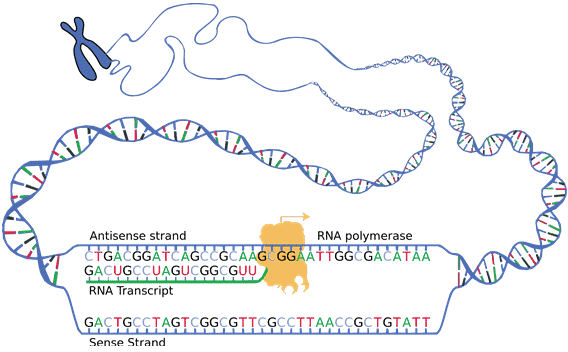
Transcription is when the DNA in a gene is copied to produce an RNA transcript called messenger RNA (mRNA).
Transcription is carried out by an enzyme called RNA polymerase which uses available bases from the nucleus of the cell to form the mRNA.
RNA is a chemical similar in structure and properties to DNA, but it only has a single strand of bases and instead of the base thymine, RNA has a base called uracil.
You may use the diagram below as a visual for the process of synthesizing mRNA from DNA.
Transcription is when the DNA in a gene is copied to produce an RNA transcript called messenger RNA (mRNA).
Transcription is carried out by an enzyme called RNA polymerase which uses available bases from the nucleus of the cell to form the mRNA.
RNA is a chemical similar in structure and properties to DNA, but it only has a single strand of bases and instead of the base thymine, RNA has a base called uracil.
You may use the diagram below as a visual for the process of synthesizing mRNA from DNA.
2
In his genetic experiments, Mendel used:
A)cherry trees
B)pea plants
C)apple trees
D)basil plants
A)cherry trees
B)pea plants
C)apple trees
D)basil plants
pea plants
Gregor Mendel conducted hybridization experiments on around 29,000 pea plants. Peas were an ideal choice for Mendel to use because they had easily observable traits.
Gregor Mendel conducted hybridization experiments on around 29,000 pea plants. Peas were an ideal choice for Mendel to use because they had easily observable traits.
3
Which of the following makes it possible to predict genotype and phenotype of the offspring of sexual reproduction?
A)ELISA
B)Mendel square
C)PCR
D)Punnett square
A)ELISA
B)Mendel square
C)PCR
D)Punnett square
Punnett square
By using a diagram called a Punnett square, it is possible to predict genotypes and phenotypes of the offspring of sexual reproduction.
For every trait expressed in a sexually reproducing organism, there are at least two alternative versions of a gene, called alleles.
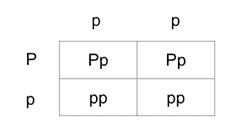
In a Punnett square, alleles are placed one per column for one gene and one per row for the other gene. The Punnett square can be used to cross any number of different traits simultaneously. A probability of phenotypes that will be produced can be determined.
In the example Punnett Square below, the two parents have genotypes PP and Pp. 50% of their offspring will have the dominant feature, while 50% will have the recessive.
By using a diagram called a Punnett square, it is possible to predict genotypes and phenotypes of the offspring of sexual reproduction.
For every trait expressed in a sexually reproducing organism, there are at least two alternative versions of a gene, called alleles.
In a Punnett square, alleles are placed one per column for one gene and one per row for the other gene. The Punnett square can be used to cross any number of different traits simultaneously. A probability of phenotypes that will be produced can be determined.
In the example Punnett Square below, the two parents have genotypes PP and Pp. 50% of their offspring will have the dominant feature, while 50% will have the recessive.
4
In the hierarchic system of classification, which of the following is least inclusive?
A)Phylum
B)Class
C)Family
D)Order
A)Phylum
B)Class
C)Family
D)Order

Unlock Deck
Unlock for access to all 165 flashcards in this deck.
Unlock Deck
k this deck
5
Which of the following best describes the molecular structure of water?
A)Two hydrogen atoms covalently bonded to one oxygen atom
B)Two hydrogen atoms ionically bonded to one oxygen atom
C)Two oxygen atoms covalently bonded to one hydrogen atom
D)Two oxygen atoms ionically bonded to one hydrogen atom
A)Two hydrogen atoms covalently bonded to one oxygen atom
B)Two hydrogen atoms ionically bonded to one oxygen atom
C)Two oxygen atoms covalently bonded to one hydrogen atom
D)Two oxygen atoms ionically bonded to one hydrogen atom
Unlock Deck
Unlock for access to all 165 flashcards in this deck.
Unlock Deck
k this deck
6
Which of the following about carbohydrates is incorrect?
A)They form the backbone of important molecules such as DNA and RNA.
B)They contain only two elements: carbon and oxygen.
C)Their most important functions are providing storage, structure, and energy.
D)They are polymers of sugars.
A)They form the backbone of important molecules such as DNA and RNA.
B)They contain only two elements: carbon and oxygen.
C)Their most important functions are providing storage, structure, and energy.
D)They are polymers of sugars.
Unlock Deck
Unlock for access to all 165 flashcards in this deck.
Unlock Deck
k this deck
7
Which of the following is a lipid that is a component of cellular membranes and a precursor to significant hormones and drugs?
A)Unsaturated fats
B)Phospholipids
C)Saturated fats
D)Steroids
A)Unsaturated fats
B)Phospholipids
C)Saturated fats
D)Steroids
Unlock Deck
Unlock for access to all 165 flashcards in this deck.
Unlock Deck
k this deck
8
Which of the following correctly identifies the difference between saturated and unsaturated fats?
A)There is no difference between saturated and unsaturated fats.
B)Saturated fats contain one or more double bonds in their hydrocarbon tail, while unsaturated fats contain no double bonds.
C)Saturated fats contain two or more double bonds in their hydrocarbon tail, while unsaturated fats contain only one double bond.
D)Unsaturated fats contain one or more double bonds in their hydrocarbon tail, while saturated fats contain no double bonds.
A)There is no difference between saturated and unsaturated fats.
B)Saturated fats contain one or more double bonds in their hydrocarbon tail, while unsaturated fats contain no double bonds.
C)Saturated fats contain two or more double bonds in their hydrocarbon tail, while unsaturated fats contain only one double bond.
D)Unsaturated fats contain one or more double bonds in their hydrocarbon tail, while saturated fats contain no double bonds.
Unlock Deck
Unlock for access to all 165 flashcards in this deck.
Unlock Deck
k this deck
9
Polymers of which of the following make up proteins?
A)Steroids
B)Amino acids
C)Nucleic acids
D)Enzymes
A)Steroids
B)Amino acids
C)Nucleic acids
D)Enzymes
Unlock Deck
Unlock for access to all 165 flashcards in this deck.
Unlock Deck
k this deck
10
Which molecules are considered the most important in biology?
A)Carbohydrates, lipids, proteins, and amino acids
B)Carbohydrates, lipids, proteins, and fatty acids
C)Carbohydrates, lipids, proteins, and steroids
D)Carbohydrates, lipids, proteins, and nucleic acids
A)Carbohydrates, lipids, proteins, and amino acids
B)Carbohydrates, lipids, proteins, and fatty acids
C)Carbohydrates, lipids, proteins, and steroids
D)Carbohydrates, lipids, proteins, and nucleic acids
Unlock Deck
Unlock for access to all 165 flashcards in this deck.
Unlock Deck
k this deck
11
The sum of all chemical reactions that occur in an organism is:
A)Cellular respiration
B)Metabolism
C)Cytokinesis
D)Synthesis
A)Cellular respiration
B)Metabolism
C)Cytokinesis
D)Synthesis
Unlock Deck
Unlock for access to all 165 flashcards in this deck.
Unlock Deck
k this deck
12
How are plant cells different from animal cells?
A)Plant cells have a nucleoid region; Animal cells have a defined nucleus
B)Plant cells have membrane-bound organelles; Animal cells do not have membrane-bound organelles
C)Plant cells have a cell wall; Animal cells do not have a cell wall
D)Plant cells contain mitochondria; Animal cells contain chloroplasts
A)Plant cells have a nucleoid region; Animal cells have a defined nucleus
B)Plant cells have membrane-bound organelles; Animal cells do not have membrane-bound organelles
C)Plant cells have a cell wall; Animal cells do not have a cell wall
D)Plant cells contain mitochondria; Animal cells contain chloroplasts
Unlock Deck
Unlock for access to all 165 flashcards in this deck.
Unlock Deck
k this deck
13
Where in the cell does active transport take place?
A)Nucleus
B)Plasma membrane
C)Mitochondria
D)Chloroplast
A)Nucleus
B)Plasma membrane
C)Mitochondria
D)Chloroplast
Unlock Deck
Unlock for access to all 165 flashcards in this deck.
Unlock Deck
k this deck
14
Which organelle is correctly paired with its function?
A)Nucleus - stores DNA
B)Mitochondria - protein synthesis
C)Peroxisome - cellular respiration
D)Endoplasmic reticulum - locomotion
A)Nucleus - stores DNA
B)Mitochondria - protein synthesis
C)Peroxisome - cellular respiration
D)Endoplasmic reticulum - locomotion
Unlock Deck
Unlock for access to all 165 flashcards in this deck.
Unlock Deck
k this deck
15
Which of the following microtubules can be used to move the cell?
A)Centrioles
B)Flagella
C)Centrosomes
D)Filaments
A)Centrioles
B)Flagella
C)Centrosomes
D)Filaments
Unlock Deck
Unlock for access to all 165 flashcards in this deck.
Unlock Deck
k this deck
16
What is the function of lysosomes?
A)Energy production
B)Digestion
C)Protein synthesis
D)Storage
A)Energy production
B)Digestion
C)Protein synthesis
D)Storage
Unlock Deck
Unlock for access to all 165 flashcards in this deck.
Unlock Deck
k this deck
17
Which of the following is the fundamental unit of biology?
A)Nucleus
B)Atom
C)Carbohydrates
D)Cell
A)Nucleus
B)Atom
C)Carbohydrates
D)Cell
Unlock Deck
Unlock for access to all 165 flashcards in this deck.
Unlock Deck
k this deck
18
The molecule that is used as the energy currency of the cell is which of the following?
A)Adenosine diphosphate (ADP)
B)Nicotinamide adenine dinucleotide (NADH)
C)Flavin adenine dinucleotide (FAD)
D)Adenosine triphosphate (ATP)
A)Adenosine diphosphate (ADP)
B)Nicotinamide adenine dinucleotide (NADH)
C)Flavin adenine dinucleotide (FAD)
D)Adenosine triphosphate (ATP)
Unlock Deck
Unlock for access to all 165 flashcards in this deck.
Unlock Deck
k this deck
19
What is the first step of cellular respiration when glucose is converted to pyruvate?
A)Glycolysis
B)The Krebs cycle
C)The Calvin cycle
D)Electron transport chain
A)Glycolysis
B)The Krebs cycle
C)The Calvin cycle
D)Electron transport chain
Unlock Deck
Unlock for access to all 165 flashcards in this deck.
Unlock Deck
k this deck
20
What are the two catabolic pathways that lead to energy production in a cell?
A)Cellular respiration and fermentation
B)Fermentation and anaerobic respiration
C)Anaerobic and cellular respiration
D)Combustion and fermentation
A)Cellular respiration and fermentation
B)Fermentation and anaerobic respiration
C)Anaerobic and cellular respiration
D)Combustion and fermentation
Unlock Deck
Unlock for access to all 165 flashcards in this deck.
Unlock Deck
k this deck
21
What is the role of water in photosynthesis?
A)Convert solar energy to chemical energy
B)Supply electrons in the light reactions
C)Absorb light energy
D)Provide sugars to be used in the Calvin cycle
A)Convert solar energy to chemical energy
B)Supply electrons in the light reactions
C)Absorb light energy
D)Provide sugars to be used in the Calvin cycle
Unlock Deck
Unlock for access to all 165 flashcards in this deck.
Unlock Deck
k this deck
22
What are the two categories of cellular reproduction?
A)Mitosis and meiosis
B)Binary fission and mitosis
C)Asexual reproduction and binary fission
D)Sexual reproduction and asexual reproduction
A)Mitosis and meiosis
B)Binary fission and mitosis
C)Asexual reproduction and binary fission
D)Sexual reproduction and asexual reproduction
Unlock Deck
Unlock for access to all 165 flashcards in this deck.
Unlock Deck
k this deck
23
During which phase of cell reproduction do the cell's chromosomes line up along the middle of the cell?
A)Prometaphase
B)Cytokinesis
C)Prophase
D)Metaphase
A)Prometaphase
B)Cytokinesis
C)Prophase
D)Metaphase
Unlock Deck
Unlock for access to all 165 flashcards in this deck.
Unlock Deck
k this deck
24
How does the number of chromosomes in daughter cells produced by meiosis differ from the number of chromosomes in daughter cells produced by mitosis?
A)In meiosis, each daughter cell contains half as many chromosomes as the parent; In mitosis, each daughter cell contains the same number of chromosomes as the parent cell.
B)In mitosis, each daughter cell contains half as many chromosomes as the parent; In meiosis, each daughter cell contains the same number of chromosomes as the parent cell.
C)In mitosis, each daughter cell contains twice as many chromosomes as the parent; In meiosis, each daughter cell contains the same number of chromosomes as the parent cell.
D)In meiosis, each daughter cell contains twice as many chromosomes as the parent; In mitosis, each daughter cell contains the same number of chromosomes as the parent cell.
A)In meiosis, each daughter cell contains half as many chromosomes as the parent; In mitosis, each daughter cell contains the same number of chromosomes as the parent cell.
B)In mitosis, each daughter cell contains half as many chromosomes as the parent; In meiosis, each daughter cell contains the same number of chromosomes as the parent cell.
C)In mitosis, each daughter cell contains twice as many chromosomes as the parent; In meiosis, each daughter cell contains the same number of chromosomes as the parent cell.
D)In meiosis, each daughter cell contains twice as many chromosomes as the parent; In mitosis, each daughter cell contains the same number of chromosomes as the parent cell.
Unlock Deck
Unlock for access to all 165 flashcards in this deck.
Unlock Deck
k this deck
25
What is the primary reason cells undergo mitosis?
A)Mitosis produces gametes, allowing organisms to reproduce.
B)Mitosis increases genetic variation within the species.
C)Mitosis produces cells for growth and to replace worn out cells.
D)Mitosis produces daughter cells that are different from the parent cell.
A)Mitosis produces gametes, allowing organisms to reproduce.
B)Mitosis increases genetic variation within the species.
C)Mitosis produces cells for growth and to replace worn out cells.
D)Mitosis produces daughter cells that are different from the parent cell.
Unlock Deck
Unlock for access to all 165 flashcards in this deck.
Unlock Deck
k this deck
26
Which are the correct mRNA bases, complementary to the following DNA strand " TGCA":
A)ACGT
B)ACGU
C)TUGT
D)TGCA
A)ACGT
B)ACGU
C)TUGT
D)TGCA
Unlock Deck
Unlock for access to all 165 flashcards in this deck.
Unlock Deck
k this deck
27
Translation takes place:
A)in the cell membrane
B)in the lysosomes
C)in the cell cytoplasm
D)in the cell nucleus
A)in the cell membrane
B)in the lysosomes
C)in the cell cytoplasm
D)in the cell nucleus
Unlock Deck
Unlock for access to all 165 flashcards in this deck.
Unlock Deck
k this deck
28
Which of the following describes heterozygous individuals?
A)They have two different alleles for the same gene
B)They have two of the same alleles
C)They result from asexual reproduction only
D)They result from sexual reproduction only
A)They have two different alleles for the same gene
B)They have two of the same alleles
C)They result from asexual reproduction only
D)They result from sexual reproduction only
Unlock Deck
Unlock for access to all 165 flashcards in this deck.
Unlock Deck
k this deck
29
Which of the following correctly lists the hierarchic system of classification from most inclusive to least inclusive?
A)Kingdom, Phylum, Order, Family, Class, Genus, Species
B)Kingdom, Phylum, Class, Family, Order, Genus, Species
C)Kingdom, Phylum, Class, Order, Family, Genus, Species
D)Kingdom, Phylum, Order, Class, Family, Genus, Species
A)Kingdom, Phylum, Order, Family, Class, Genus, Species
B)Kingdom, Phylum, Class, Family, Order, Genus, Species
C)Kingdom, Phylum, Class, Order, Family, Genus, Species
D)Kingdom, Phylum, Order, Class, Family, Genus, Species
Unlock Deck
Unlock for access to all 165 flashcards in this deck.
Unlock Deck
k this deck
30
A repeatable procedure of gathering data to support or refute a hypothesis is known as
A)developing a theory
B)drawing a conclusion
C)conducting an experiment
D)the scientific method
A)developing a theory
B)drawing a conclusion
C)conducting an experiment
D)the scientific method
Unlock Deck
Unlock for access to all 165 flashcards in this deck.
Unlock Deck
k this deck
31
Which of the following is not true about water?
A)Large bodies of water stabilize climates due to water's high specific heat.
B)When water freezes, it forms a lattice crystal, causing ice to float.
C)The polarity of water's bonds allows for covalent bonding between molecules.
D)Hydrogen bonding results in water having strong cohesive and adhesive properties.
A)Large bodies of water stabilize climates due to water's high specific heat.
B)When water freezes, it forms a lattice crystal, causing ice to float.
C)The polarity of water's bonds allows for covalent bonding between molecules.
D)Hydrogen bonding results in water having strong cohesive and adhesive properties.
Unlock Deck
Unlock for access to all 165 flashcards in this deck.
Unlock Deck
k this deck
32
Which biologic molecule would you recommend a patient limit if they want to avoid having cardiovascular problems?
A)Phospholipids
B)Saturated fats
C)Unsaturated fats
D)Carbohydrates
A)Phospholipids
B)Saturated fats
C)Unsaturated fats
D)Carbohydrates
Unlock Deck
Unlock for access to all 165 flashcards in this deck.
Unlock Deck
k this deck
33
DNA and RNA are subunits of which type of biologic molecule?
A)Proteins
B)Nucleic acids
C)Carbohydrates
D)Lipids
A)Proteins
B)Nucleic acids
C)Carbohydrates
D)Lipids
Unlock Deck
Unlock for access to all 165 flashcards in this deck.
Unlock Deck
k this deck
34
Which type of protein acts to catalyze different reactions or processes?
A)Steroids
B)Hormones
C)Amino acids
D)Enzymes
A)Steroids
B)Hormones
C)Amino acids
D)Enzymes
Unlock Deck
Unlock for access to all 165 flashcards in this deck.
Unlock Deck
k this deck
35
What are the three types of lipids?
A)Fatty acids, saturated fats, and unsaturated fats
B)Fatty acids, phospholipids, and enzymes
C)Fatty acids, phospholipids, and steroids
D)Fatty acids, enzymes, and steroids
A)Fatty acids, saturated fats, and unsaturated fats
B)Fatty acids, phospholipids, and enzymes
C)Fatty acids, phospholipids, and steroids
D)Fatty acids, enzymes, and steroids
Unlock Deck
Unlock for access to all 165 flashcards in this deck.
Unlock Deck
k this deck
36
In a cell, reactions take place in a series of steps called ____________?
A)the electron transport chain
B)cellular respiration
C)metabolic pathways
D)catabolic pathways
A)the electron transport chain
B)cellular respiration
C)metabolic pathways
D)catabolic pathways
Unlock Deck
Unlock for access to all 165 flashcards in this deck.
Unlock Deck
k this deck
37
What function do cholesterol molecules serve within the cell membrane?
A)They act as transport highways for molecular movement into and out of the cell.
B)They allow for carbohydrate chains to extend beyond the cell membrane to communicate with other cells.
C)They stabilize the flexible bilayer structure to prevent breakage.
D)They allow the cell membrane to be selectively permeable by making the bilayer structure more flexible.
A)They act as transport highways for molecular movement into and out of the cell.
B)They allow for carbohydrate chains to extend beyond the cell membrane to communicate with other cells.
C)They stabilize the flexible bilayer structure to prevent breakage.
D)They allow the cell membrane to be selectively permeable by making the bilayer structure more flexible.
Unlock Deck
Unlock for access to all 165 flashcards in this deck.
Unlock Deck
k this deck
38
Although animal cells lack cell walls, they do have an elaborate system of glycoproteins that provide support to the outside of the cell called the:
A)endomembrane system
B)cytoskeleton
C)extracellular matrix
D)cytosol
A)endomembrane system
B)cytoskeleton
C)extracellular matrix
D)cytosol
Unlock Deck
Unlock for access to all 165 flashcards in this deck.
Unlock Deck
k this deck
39
If an animal cell is left in an unknown solution overnight, and the next day the cell bursts, it can be assumed that the unknown solution is:
A)isotonic
B)hypertonic
C)hypotonic
D)tonic
A)isotonic
B)hypertonic
C)hypotonic
D)tonic
Unlock Deck
Unlock for access to all 165 flashcards in this deck.
Unlock Deck
k this deck
40
Which organelle is responsible for storing, modifying and sending out products of the endoplasmic reticulum, such as proteins?
A)Golgi apparatus
B)Ribosomes
C)Lysosomes
D)Endoplasmic reticulum
A)Golgi apparatus
B)Ribosomes
C)Lysosomes
D)Endoplasmic reticulum
Unlock Deck
Unlock for access to all 165 flashcards in this deck.
Unlock Deck
k this deck
41
Which cell organelle functions in the detoxification and metabolism of multiple molecules?
A)Lysosomes
B)Rough endoplasmic reticulum
C)Smooth endoplasmic reticulum
D)Golgi apparatus
A)Lysosomes
B)Rough endoplasmic reticulum
C)Smooth endoplasmic reticulum
D)Golgi apparatus
Unlock Deck
Unlock for access to all 165 flashcards in this deck.
Unlock Deck
k this deck
42
A flagellum is a whip-like appendage found on the surface of some cells. What is their primary purpose?
A)Transport proteins throughout the cell
B)Detoxification of medications and poisons
C)Movement of the cell
D)Membrane production
A)Transport proteins throughout the cell
B)Detoxification of medications and poisons
C)Movement of the cell
D)Membrane production
Unlock Deck
Unlock for access to all 165 flashcards in this deck.
Unlock Deck
k this deck
43
Which type of cell lacks a defined nucleus?
A)Animal cell
B)Prokaryotic cell
C)Eukaryotic cell
D)Plant cell
A)Animal cell
B)Prokaryotic cell
C)Eukaryotic cell
D)Plant cell
Unlock Deck
Unlock for access to all 165 flashcards in this deck.
Unlock Deck
k this deck
44
Which step in cellular respiration takes place in the mitochondria of the cell and produces two ATP molecules, six carbon dioxide molecules, and six NADH molecules for every molecule of glucose?
A)The Calvin cycle
B)The Krebs cycle
C)Glycolysis
D)Electron transport chain
A)The Calvin cycle
B)The Krebs cycle
C)Glycolysis
D)Electron transport chain
Unlock Deck
Unlock for access to all 165 flashcards in this deck.
Unlock Deck
k this deck
45
Which of the following statements about catabolic pathways that lead to cellular respiration is correct?
A)Fermentation produces more energy than cellular respiration.
B)Cellular respiration and fermentation produce the same amount of energy.
C)Cellular respiration is an anaerobic reaction; fermentation is a combustion reaction.
D)Cellular respiration produces more energy than fermentation.
A)Fermentation produces more energy than cellular respiration.
B)Cellular respiration and fermentation produce the same amount of energy.
C)Cellular respiration is an anaerobic reaction; fermentation is a combustion reaction.
D)Cellular respiration produces more energy than fermentation.
Unlock Deck
Unlock for access to all 165 flashcards in this deck.
Unlock Deck
k this deck
46
Solar energy is converted to chemical energy during which stage of photosynthesis?
A)The Krebs cycle
B)Light reactions
C)The Calvin cycle
D)Sugar polymerization
A)The Krebs cycle
B)Light reactions
C)The Calvin cycle
D)Sugar polymerization
Unlock Deck
Unlock for access to all 165 flashcards in this deck.
Unlock Deck
k this deck
47
What is the process by which bacterial cells reproduce called?
A)Mitosis
B)Binary fission
C)Meiosis
D)Cytokinesis
A)Mitosis
B)Binary fission
C)Meiosis
D)Cytokinesis
Unlock Deck
Unlock for access to all 165 flashcards in this deck.
Unlock Deck
k this deck
48
During which phase of cell reproduction does the cell's nuclear envelope begin to disappear?
A)Prophase
B)Metaphase
C)Prometaphase
D)Cytokinesis
A)Prophase
B)Metaphase
C)Prometaphase
D)Cytokinesis
Unlock Deck
Unlock for access to all 165 flashcards in this deck.
Unlock Deck
k this deck
49
Crossing over occurs during which phase of meiosis?
A)Prophase I
B)Prophase II
C)Telophase I
D)Telophase II
A)Prophase I
B)Prophase II
C)Telophase I
D)Telophase II
Unlock Deck
Unlock for access to all 165 flashcards in this deck.
Unlock Deck
k this deck
50
36 chromosomes undergo meiosis. How many chromosomes will be in each gamete?
A)18
B)36
C)144
D)72
A)18
B)36
C)144
D)72
Unlock Deck
Unlock for access to all 165 flashcards in this deck.
Unlock Deck
k this deck
51
What type of bond forms between base pairs in DNA?
A)hydrogen
B)hydrophobic
C)glycosidic
D)phosphodiester
A)hydrogen
B)hydrophobic
C)glycosidic
D)phosphodiester
Unlock Deck
Unlock for access to all 165 flashcards in this deck.
Unlock Deck
k this deck
52
Transcription takes place:
A)in the endoplasmic reticulum
B)in the vacuole
C)in the cytoplasm
D)in the nucleus
A)in the endoplasmic reticulum
B)in the vacuole
C)in the cytoplasm
D)in the nucleus
Unlock Deck
Unlock for access to all 165 flashcards in this deck.
Unlock Deck
k this deck
53
Which of the following correctly represents a heterozygous individual?
A)hH
B)Hh
C)hh
D)HH
A)hH
B)Hh
C)hh
D)HH
Unlock Deck
Unlock for access to all 165 flashcards in this deck.
Unlock Deck
k this deck
54
What are alleles?
A)cells that have a double set of chromosomes
B)different variants of the same genes
C)segments of DNA containing codes for specific functions in the body
D)the genetic composition of a living organism
A)cells that have a double set of chromosomes
B)different variants of the same genes
C)segments of DNA containing codes for specific functions in the body
D)the genetic composition of a living organism
Unlock Deck
Unlock for access to all 165 flashcards in this deck.
Unlock Deck
k this deck
55
In the hierarchic system of classification, which of the following is most inclusive?
A)Genus
B)Phylum
C)Species
D)Order
A)Genus
B)Phylum
C)Species
D)Order
Unlock Deck
Unlock for access to all 165 flashcards in this deck.
Unlock Deck
k this deck
56
Which of the following best describes why polarity is the most important characteristic of water?
A)The benefits of polarity are hydrogen bonding, a high specific heat value, strong cohesive and adhesive properties, and its versatility as a solvent.
B)The benefits of polarity are hydrogen bonding, a high specific heat value, weak cohesive and adhesive properties, and its versatility as a solvent.
C)The benefits of polarity are covalent bonding, a high specific heat value, strong cohesive and adhesive properties, and its versatility as a solvent.
D)The benefits of polarity are hydrogen bonding, a low specific heat value, strong cohesive and adhesive properties, and its versatility as a solvent.
A)The benefits of polarity are hydrogen bonding, a high specific heat value, strong cohesive and adhesive properties, and its versatility as a solvent.
B)The benefits of polarity are hydrogen bonding, a high specific heat value, weak cohesive and adhesive properties, and its versatility as a solvent.
C)The benefits of polarity are covalent bonding, a high specific heat value, strong cohesive and adhesive properties, and its versatility as a solvent.
D)The benefits of polarity are hydrogen bonding, a low specific heat value, strong cohesive and adhesive properties, and its versatility as a solvent.
Unlock Deck
Unlock for access to all 165 flashcards in this deck.
Unlock Deck
k this deck
57
Which of the following about phospholipids is incorrect?
A)The phosphate group in phospholipids is nonpolar and non-soluble in water.
B)Phospholipids consist of two fatty acids bonded to a phosphate group.
C)Phospholipids are important in the function of cellular membranes.
D)The phosphate group is charged.
A)The phosphate group in phospholipids is nonpolar and non-soluble in water.
B)Phospholipids consist of two fatty acids bonded to a phosphate group.
C)Phospholipids are important in the function of cellular membranes.
D)The phosphate group is charged.
Unlock Deck
Unlock for access to all 165 flashcards in this deck.
Unlock Deck
k this deck
58
Which of the following biologic molecules are components of the molecules of inheritance?
A)Carbohydrates
B)Proteins
C)Nucleic acids
D)Lipids
A)Carbohydrates
B)Proteins
C)Nucleic acids
D)Lipids
Unlock Deck
Unlock for access to all 165 flashcards in this deck.
Unlock Deck
k this deck
59
What are the two categories of fatty acids?
A)Trans fat and unsaturated fat
B)Saturated and unsaturated fat
C)Steroids and enzymes
D)Phospholipids and polyunsaturated fats
A)Trans fat and unsaturated fat
B)Saturated and unsaturated fat
C)Steroids and enzymes
D)Phospholipids and polyunsaturated fats
Unlock Deck
Unlock for access to all 165 flashcards in this deck.
Unlock Deck
k this deck
60
Metabolic reactions in a cell progress from a standpoint of ________.
A)high energy to low energy
B)low energy to high energy
C)moderate energy to decreased energy
D)moderate energy to increased energy
A)high energy to low energy
B)low energy to high energy
C)moderate energy to decreased energy
D)moderate energy to increased energy
Unlock Deck
Unlock for access to all 165 flashcards in this deck.
Unlock Deck
k this deck
61
The cell membrane is composed of which of the following?
A)A rigid layer of cytoskeleton
B)A bilayer of phospholipid molecules
C)A wall of cholesterol and phospholipids
D)A single layer of phospholipid molecules
A)A rigid layer of cytoskeleton
B)A bilayer of phospholipid molecules
C)A wall of cholesterol and phospholipids
D)A single layer of phospholipid molecules
Unlock Deck
Unlock for access to all 165 flashcards in this deck.
Unlock Deck
k this deck
62
Many cells uptake food through the cell membrane creating a food vacuole in a process known as
A)osmosis
B)photosynthesis
C)phagocytosis
D)cytokinesis
A)osmosis
B)photosynthesis
C)phagocytosis
D)cytokinesis
Unlock Deck
Unlock for access to all 165 flashcards in this deck.
Unlock Deck
k this deck
63
Which of the following statements about endoplasmic reticulum is true?
A)The smooth endoplasmic reticulum is responsible for storing calcium ions.
B)The smooth endoplasmic reticulum is covered in ribosomes.
C)The smooth endoplasmic reticulum is responsible for the assembly of proteins.
D)The endoplasmic reticulum is attached to the cell membrane.
A)The smooth endoplasmic reticulum is responsible for storing calcium ions.
B)The smooth endoplasmic reticulum is covered in ribosomes.
C)The smooth endoplasmic reticulum is responsible for the assembly of proteins.
D)The endoplasmic reticulum is attached to the cell membrane.
Unlock Deck
Unlock for access to all 165 flashcards in this deck.
Unlock Deck
k this deck
64
If a substance is moving across a plasma membrane against the concentration gradient, what type of transport is required?
A)Passive transport
B)Osmosis
C)Active transport
D)Diffusion
A)Passive transport
B)Osmosis
C)Active transport
D)Diffusion
Unlock Deck
Unlock for access to all 165 flashcards in this deck.
Unlock Deck
k this deck
65
Of the following choices, choose the best description of a prokaryotic cell:
A)Contains chromosomes, ribosomes, a plasma membrane and is enclosed in a cell wall
B)Lacks a cell wall and organelles but contains chromosomes, a plasma membrane and is enclosed in a capsule
C)Contains a nucleus, cytosol, and cytoplasm but lacks a plasma membrane and cell wall
D)Contains a nucleoid region without chromosomes, cytoplasm and is enclosed in a cell wall
A)Contains chromosomes, ribosomes, a plasma membrane and is enclosed in a cell wall
B)Lacks a cell wall and organelles but contains chromosomes, a plasma membrane and is enclosed in a capsule
C)Contains a nucleus, cytosol, and cytoplasm but lacks a plasma membrane and cell wall
D)Contains a nucleoid region without chromosomes, cytoplasm and is enclosed in a cell wall
Unlock Deck
Unlock for access to all 165 flashcards in this deck.
Unlock Deck
k this deck
66
Cells with a high rate of protein synthesis generally have a large number of:
A)Mitochondria
B)Ribosomes
C)Lysosomes
D)Vacuoles
A)Mitochondria
B)Ribosomes
C)Lysosomes
D)Vacuoles
Unlock Deck
Unlock for access to all 165 flashcards in this deck.
Unlock Deck
k this deck
67
Which of the following organelles are responsible for producing energy for the cell?
A)Nucleus and chloroplast
B)Chloroplast and cellular membrane
C)Mitochondrion and chloroplast
D)Nucleus and mitochondrion
A)Nucleus and chloroplast
B)Chloroplast and cellular membrane
C)Mitochondrion and chloroplast
D)Nucleus and mitochondrion
Unlock Deck
Unlock for access to all 165 flashcards in this deck.
Unlock Deck
k this deck
68
Which of the following best describes the function of the Golgi apparatus?
A)Store food, nutrients, and waste.
B)Transport proteins from the endoplasmic reticulum throughout the cell
C)Break down proteins, fats, sugars, and nucleic acids inside of the cell.
D)Translate RNA into proteins.
A)Store food, nutrients, and waste.
B)Transport proteins from the endoplasmic reticulum throughout the cell
C)Break down proteins, fats, sugars, and nucleic acids inside of the cell.
D)Translate RNA into proteins.
Unlock Deck
Unlock for access to all 165 flashcards in this deck.
Unlock Deck
k this deck
69
Which step in cellular respiration involves the oxidation of NADH molecules to produce oxygen and water?
A)Glycolysis
B)Electron transport chain
C)The Krebs cycle
D)The Calvin cycle
A)Glycolysis
B)Electron transport chain
C)The Krebs cycle
D)The Calvin cycle
Unlock Deck
Unlock for access to all 165 flashcards in this deck.
Unlock Deck
k this deck
70
Which of the following equations represents the simplified chemistry behind cellular respiration?
A)6CO2 + 6O2 + ATP → C6H12O6 + 6H2O
B)C6 H12O6 + 6O2 → 6CO2 + 6H2 O + ATP
C)6CO2 + 6H2O + Light energy → C6H12O6 + 6O2
D)C6H12O6 + 6CO2 + Light energy → 6O2 + 6H2O
A)6CO2 + 6O2 + ATP → C6H12O6 + 6H2O
B)C6 H12O6 + 6O2 → 6CO2 + 6H2 O + ATP
C)6CO2 + 6H2O + Light energy → C6H12O6 + 6O2
D)C6H12O6 + 6CO2 + Light energy → 6O2 + 6H2O
Unlock Deck
Unlock for access to all 165 flashcards in this deck.
Unlock Deck
k this deck
71
What are the two primary products of photosynthesis?
A)Sugar and carbon dioxide
B)Water and carbon dioxide
C)Water and oxygen
D)Sugar and oxygen
A)Sugar and carbon dioxide
B)Water and carbon dioxide
C)Water and oxygen
D)Sugar and oxygen
Unlock Deck
Unlock for access to all 165 flashcards in this deck.
Unlock Deck
k this deck
72
Which of the following occurs during binary fission?
A)The chromosomes bind to the plasma membrane.
B)Chromatids separate into individual chromosomes and pull apart towards opposite ends of the cell
C)The chromosomes gather along the metaphase plate.
D)The homologous pairs of chromosomes exchange bits of DNA in a process called crossing over.
A)The chromosomes bind to the plasma membrane.
B)Chromatids separate into individual chromosomes and pull apart towards opposite ends of the cell
C)The chromosomes gather along the metaphase plate.
D)The homologous pairs of chromosomes exchange bits of DNA in a process called crossing over.
Unlock Deck
Unlock for access to all 165 flashcards in this deck.
Unlock Deck
k this deck
73
During which phase of cell reproduction do the cell's chromosomes become visibly separate with each duplicated chromosome having two sister chromatids?
A)Prometaphase
B)Prophase
C)Metaphase
D)Cytokinesis
A)Prometaphase
B)Prophase
C)Metaphase
D)Cytokinesis
Unlock Deck
Unlock for access to all 165 flashcards in this deck.
Unlock Deck
k this deck
74
Gametes are formed by which process?
A)Binary fission
B)Mitosis
C)Meiosis
D)Cytokenesis
A)Binary fission
B)Mitosis
C)Meiosis
D)Cytokenesis
Unlock Deck
Unlock for access to all 165 flashcards in this deck.
Unlock Deck
k this deck
75
How do the results of sexual reproduction differ from asexual reproduction?
A)In asexual reproduction one parent cell produces two haploid daughter cells; in sexual reproduction, two cells contribute genetic material producing two diploid cells.
B)In asexual reproduction one parent cell divides into two identical daughter cells; in sexual reproduction, two cells contribute genetic material resulting in significantly greater variation.
C)In asexual reproduction two cells contribute genetic materials resulting in significantly greater variation; in sexual reproduction, one parent cell divides into two identical daughter cells.
D)In asexual reproduction one parent cell produces two haploid daughter cells; in sexual reproduction, two cells merge to create a parent cell.
A)In asexual reproduction one parent cell produces two haploid daughter cells; in sexual reproduction, two cells contribute genetic material producing two diploid cells.
B)In asexual reproduction one parent cell divides into two identical daughter cells; in sexual reproduction, two cells contribute genetic material resulting in significantly greater variation.
C)In asexual reproduction two cells contribute genetic materials resulting in significantly greater variation; in sexual reproduction, one parent cell divides into two identical daughter cells.
D)In asexual reproduction one parent cell produces two haploid daughter cells; in sexual reproduction, two cells merge to create a parent cell.
Unlock Deck
Unlock for access to all 165 flashcards in this deck.
Unlock Deck
k this deck
76
Messenger RNA transfers information:
A)from DNA to ribosomes
B)from RNA to DNA
C)from DNA to glucose
D)from DNA to proteins
A)from DNA to ribosomes
B)from RNA to DNA
C)from DNA to glucose
D)from DNA to proteins
Unlock Deck
Unlock for access to all 165 flashcards in this deck.
Unlock Deck
k this deck
77
Proteins are made of chains of:
A)phospholipids
B)amino acids
C)nucleotides
D)sugars
A)phospholipids
B)amino acids
C)nucleotides
D)sugars
Unlock Deck
Unlock for access to all 165 flashcards in this deck.
Unlock Deck
k this deck
78
The color purple (P) is dominant in a plant. If you have a purple plant with an unknown genotype and cross it with a white plant (pp) and get offspring which are 100% purple, what is the genotype of the unknown plant?
A)Pp
B)PP
C)pp
D)Uncertain
A)Pp
B)PP
C)pp
D)Uncertain
Unlock Deck
Unlock for access to all 165 flashcards in this deck.
Unlock Deck
k this deck
79
Alleles of the same type are called:
A)homozygous
B)mutations
C)heterozygous
D)dominant
A)homozygous
B)mutations
C)heterozygous
D)dominant
Unlock Deck
Unlock for access to all 165 flashcards in this deck.
Unlock Deck
k this deck
80
In the hierarchic system of classification, which of the following is most inclusive?
A)Kingdom
B)Species
C)Class
D)Order
A)Kingdom
B)Species
C)Class
D)Order
Unlock Deck
Unlock for access to all 165 flashcards in this deck.
Unlock Deck
k this deck
4
Unlock Deck
Unlock for access to all 165 flashcards in this deck.
5
Unlock Deck
Unlock for access to all 165 flashcards in this deck.






