







 Chat with AI

Deck 1: Anatomy
Full screen (f)

Question
A 34-year-old man begins treatment for Hodgkin lymphoma with combined chemotherapy. Shortly later, he begins vomiting violently and requires IV fluid replacement. Which of the following brain regions is most likely to be to blame for his symptoms? 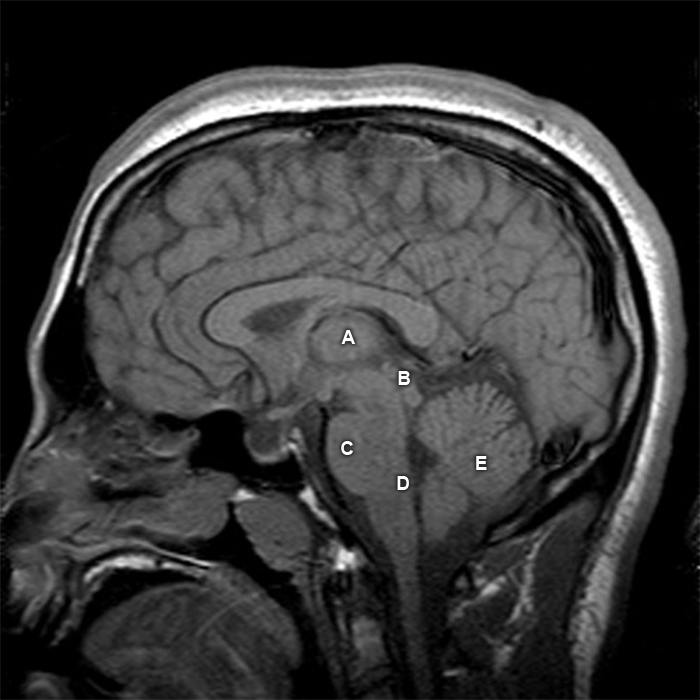
A)A
B)B
C)C
D)D
E)E
A)A
B)B
C)C
D)D
E)E

Question
A 55-year-old right-handed man arrives at the emergency department complaining of continuous right arm tingling and numbness for many hours. There is no headache, muscular weakness, slurred speech, or trouble walking in this patient. He has a history of hypertension, paroxysmal atrial fibrillation, and ischemic stroke, all of which have resolved. He was taken off anticoagulants two months ago after suffering a gastrointestinal hemorrhage. The blood pressure is 150/90 mm Hg, and the pulse rate is 92 beats per minute. During the examination, the patient's right arm paresthesia extends to the full right side of his body, and he experiences right-sided convulsions, which are followed by a bilateral tonic-clonic seizure. Which of the following structures in the left cerebral hemisphere is most likely to be the source of this patient's seizure? 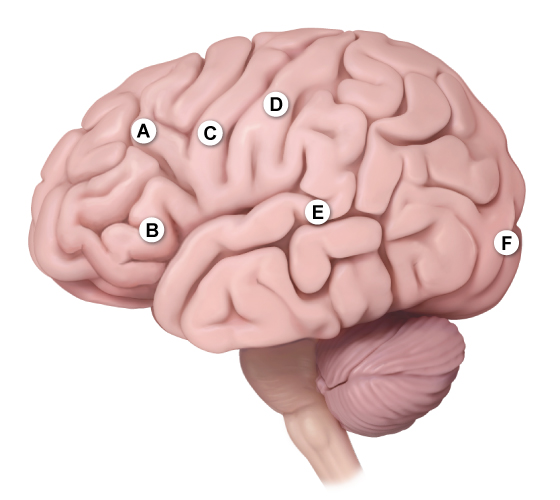
A)A
B)B
C)C
D)D
E)E
F)F
A)A
B)B
C)C
D)D
E)E
F)F
Question
A 58-year-old man had a descending thoracic aortic aneurysm repaired surgically. There are no intraoperative problems, but the patient develops new-onset neurologic impairments after surgery. The brain imaging is normal, but an MRI of the lower thoracic spinal cord indicates an ischemic infarction in the locations depicted in the example below. 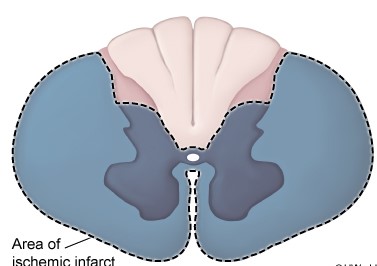 Lower extremity examination of this patient is most likely to show which of the following neurologic findings?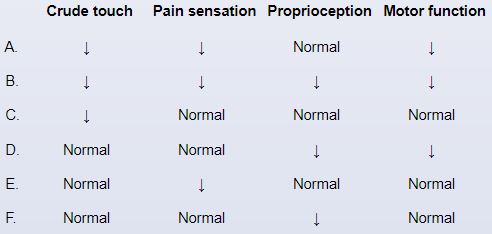
A)A
B)B
C)C
D)D
E)E
F)F
Lower extremity examination of this patient is most likely to show which of the following neurologic findings? A)A
B)B
C)C
D)D
E)E
F)F
Question
Due to memory loss and frequent falls, a 62-year-old man is brought to the office by his son. The patient has been living alone since his wife died a year ago. His visiting son discovered his father in deplorable living circumstances. The patient was forgetful and didn't recall where certain belongings in his residence, where he had resided for almost 20 years, were located. His walk is extremely shaky, and he has fallen multiple times. According to his son, his father has always been "a drinker" and may have been drinking recently. The patient appears unconcerned about his son's fears and claims to be OK. The vital indicators are within normal ranges. On physical examination, bilateral lateral gaze palsy and nystagmus are present. Muscle strength and deep tendon reflexes are normal, but the gait is ataxic. On memory testing, he recalls 0 out of 3 objects after 5 minutes. A lesion of which of the following labeled structures on a normal brain MRI is most specifically associated with this patient's current condition? 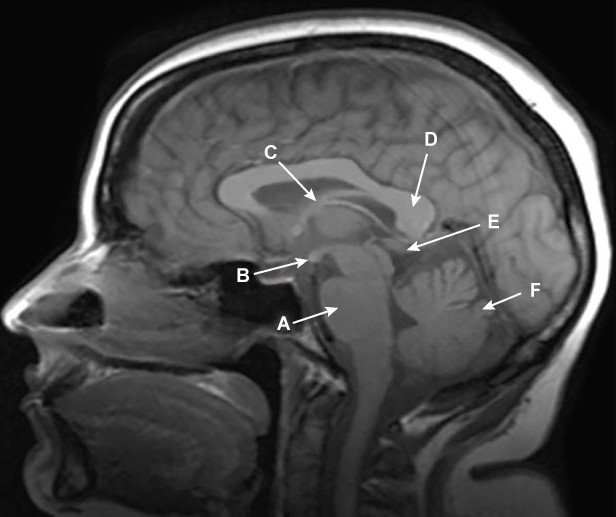
A)A
B)B
C)C
D)D
E)E
F)F
A)A
B)B
C)C
D)D
E)E
F)F
Question
A 65-year-old man arrives at the emergency department with acute slurred speech. He is likewise weak on the right side, although he denies any damage, headache, or loss of consciousness. His medical issues include hypertension and type 2 diabetes. For the past 20 years, the patient has smoked one pack of cigarettes every day. A neurologic examination reveals right-sided lower facial droop, with the forehead muscles spared. Motor strength on the right is 3/5 and on the left is 5/5, with a Babinski response on the right. His right upper and lower limbs are similarly affected by dysmetria and dysdiadochokinesia. As illustrated in the figure below, an MRI of the brain indicates an acute lacunar infarct in the brainstem. 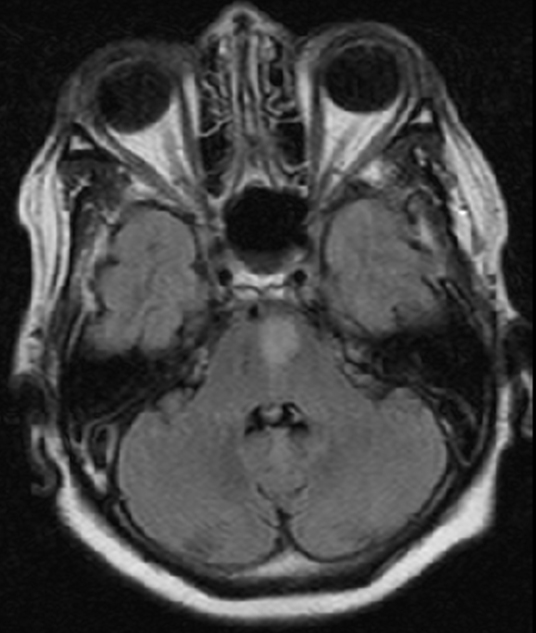 Which of the following cranial nerves exits the brainstem closest to the level affected by this patient's stroke?
A)Facial
B)Hypoglossal
C)Oculomotor
D)Trigeminal
E)Trochlear
Which of the following cranial nerves exits the brainstem closest to the level affected by this patient's stroke?A)Facial
B)Hypoglossal
C)Oculomotor
D)Trigeminal
E)Trochlear
Question
A 59-year-old man visits the office to have a facial skin lesion evaluated. The lesion is a mole-like area on the patient's face that has gradually expanded over several months. He claims there is no discomfort or bleeding from the lesion. There is a family history of skin cancer. The presentation depicts the results of the physical examination. 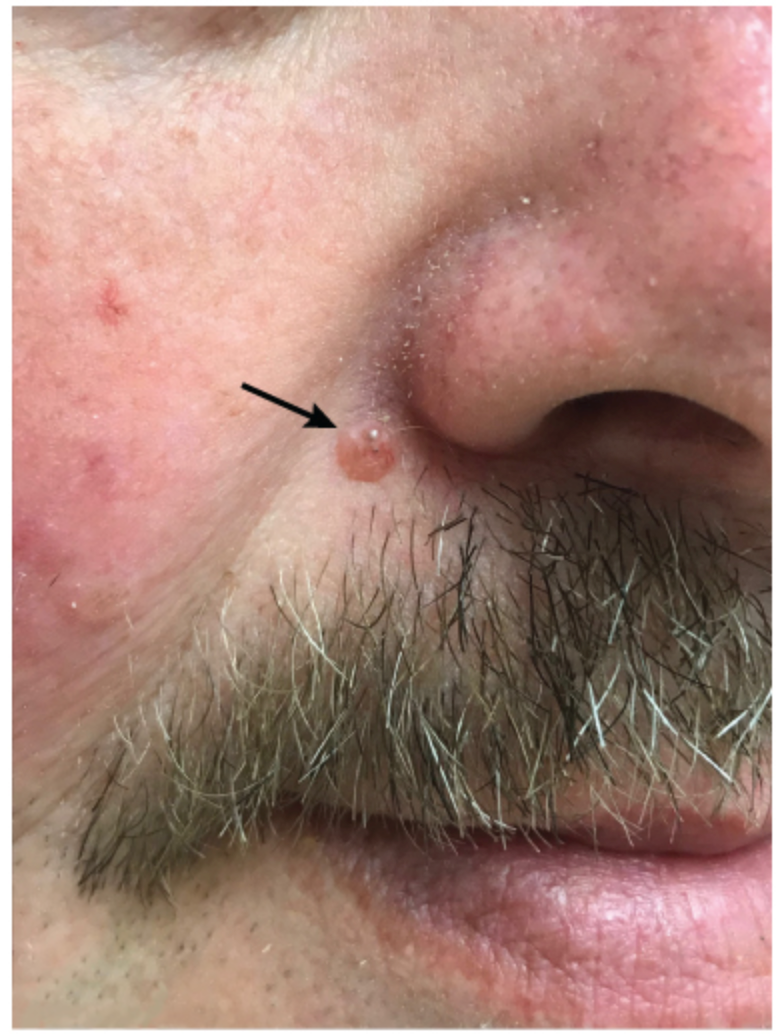 Biopsy of the lesion with a local nerve block for anesthesia is planned. Which of the following injection sites is most likely to provide adequate anesthesia for the procedure?
A)Infraorbital foramen
B)Mandibular foramen
C)Mental foramen
D)Stylomastoid foramen
E)Superior orbital fissure
Biopsy of the lesion with a local nerve block for anesthesia is planned. Which of the following injection sites is most likely to provide adequate anesthesia for the procedure?A)Infraorbital foramen
B)Mandibular foramen
C)Mental foramen
D)Stylomastoid foramen
E)Superior orbital fissure
Question
A 49-year-old woman arrives at the office complaining of muscular weakness. The patient's right hand has been weakening for the previous three months. She's also been hallucinating. The patient's arms and legs are twitching and cramping. She has no sensory issues. The lower extremities muscles have increased tone and fasciculations on examination. There is atrophy of the interosseus muscles of the right hand as well as the bilateral intrinsic muscles of the foot. When the doctor touches the chin with the mouth slightly open, the jaw jerks up quickly. This response is mediated by which of the following cranial nerves? 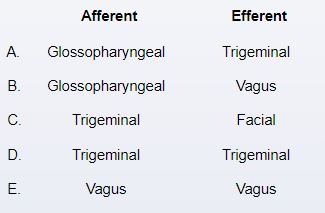
A)A
B)B
C)C
D)D
E)E
A)A
B)B
C)C
D)D
E)E
Question
A 34-year-old man visits the clinic after experiencing chronic buzzing in his right ear for the previous 6 months. In addition, the patient's hearing on the right side is impaired. He hasn't experienced a fever, earache, a runny nose, a sore throat, or a cough. The patient has not been exposed to loud noises or used cotton swabs. He tried over-the-counter oral pseudoephedrine, but it had little effect on his symptoms. There is no sinus discomfort on physical examination, and the mucous membranes are moist without erythema or exudate. Otoscopic examination reveals bilaterally normal external auditory canals with pinkish-grey tympanic membranes. An intracranial tumor is discovered during a brain MRI. Which of the following structures is most likely to have caused this patient's lesion? 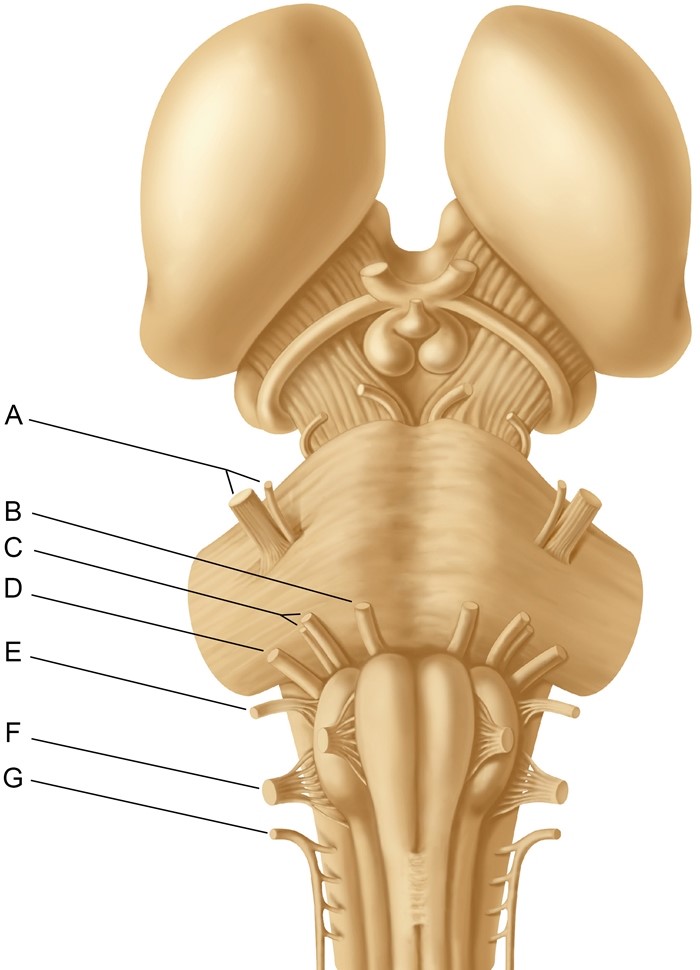
A)A
B)B
C)C
D)D
E)E
F)F
G)G
A)A
B)B
C)C
D)D
E)E
F)F
G)G
Question
A 23-year-old woman is suffering from severe visual neuritis. She has had relapsing-remitting multiple sclerosis in the past. Her brain MRI indicates a demyelination region affecting the right optic nerve. Which of the following is most likely to be discovered after a thorough examination of both eyes? 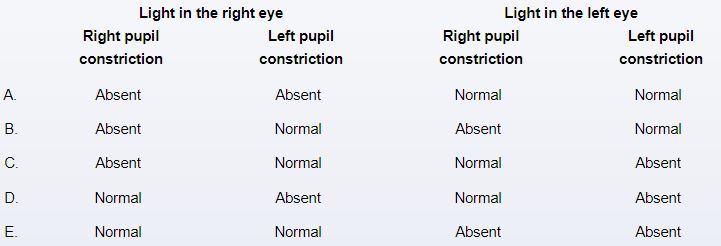
A)A
B)B
C)C
D)D
E)E
A)A
B)B
C)C
D)D
E)E
Question
A 56-year-old woman arrives at the emergency department with a severe headache and partial visual loss. She has had atrial fibrillation for three years. The physical examination reveals a visual field impairment including the dark regions shown below. 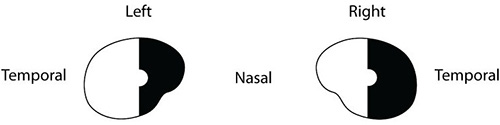 This patient most likely has occlusion of which of the following arteries?
A)Anterior cerebral
B)Central retinal
C)Middle cerebral
D)Posterior cerebral
E)Posterior inferior cerebellar
This patient most likely has occlusion of which of the following arteries?A)Anterior cerebral
B)Central retinal
C)Middle cerebral
D)Posterior cerebral
E)Posterior inferior cerebellar
Question
A 67-year-old woman visits the clinic because she has observed diminished vision in her right eye for the last week. The patient claims that her right eye's vision is "narrower" than her left. Her medical history is notable for hypertension, type 2 diabetes, and hyperlipidemia. She also has intermittent lower limb claudication and has experienced two previous instances of transitory vision loss in her right eye. A right nasal hemianopia is shown by visual field testing. A right internal carotid artery aneurysm is discovered during a head and neck MRI/magnetic resonance angiography. Which of the following visual pathway segments is most likely disturbed in this patient?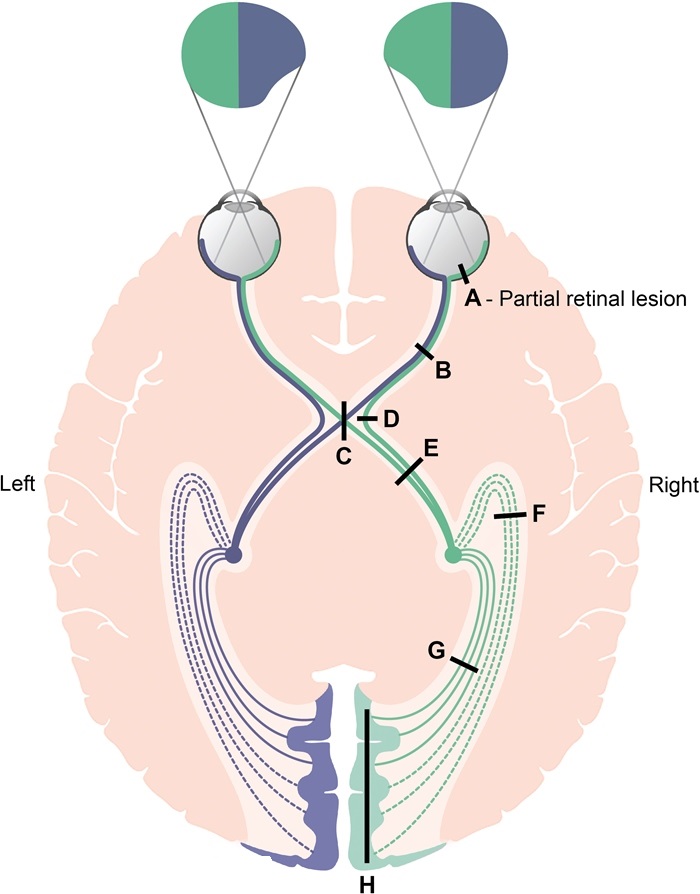
A)A
B)B
C)C
D)D
E)E
F)F
G)G
H)H
A)A
B)B
C)C
D)D
E)E
F)F
G)G
H)H
Question
Due to her easy fatigability, a 54-year-old woman is assessed at the clinic. There has been no weight gain or cold intolerance in the patient, and there is no history of thyroid disorders. Her medical history suggests that she should have a gastrectomy due to a nonhealing gastric ulcer. A glossy tongue and light palmar wrinkles are visible on physical examination. When her eyes are closed, her walking becomes unsteady, and her vibration awareness is significantly reduced in her lower limbs. There is modest symmetrical weakness in the proximal lower extremities muscles. The hemoglobin level in the blood is 7.2 g/dL, and the white blood cell count is 3,600/mm3. Stool tests for occult blood have always come out negative. Which of the following spinal cord lesions is this patient most likely to have?
A)
B)
C)
D)
E)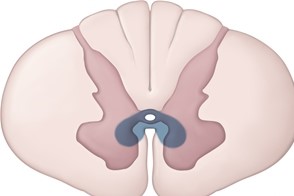
A)
B)
C)
D)
E)
Question
Question
A 68-year-old woman arrives at the emergency room with rapid onset double vision that began shortly after she awoke. When she looks to the right, the patient's vision deteriorates. She does not have a headache, weakness, or numbness. The patient has a lengthy history of high blood pressure, hyperlipidemia, and type 2 diabetes. The blood pressure is 160/90 mm Hg, and the pulse rate is 86 beats per minute. Except for the ocular abnormalities depicted in the figure below, the neurologic evaluation, including visual acuity, is normal. 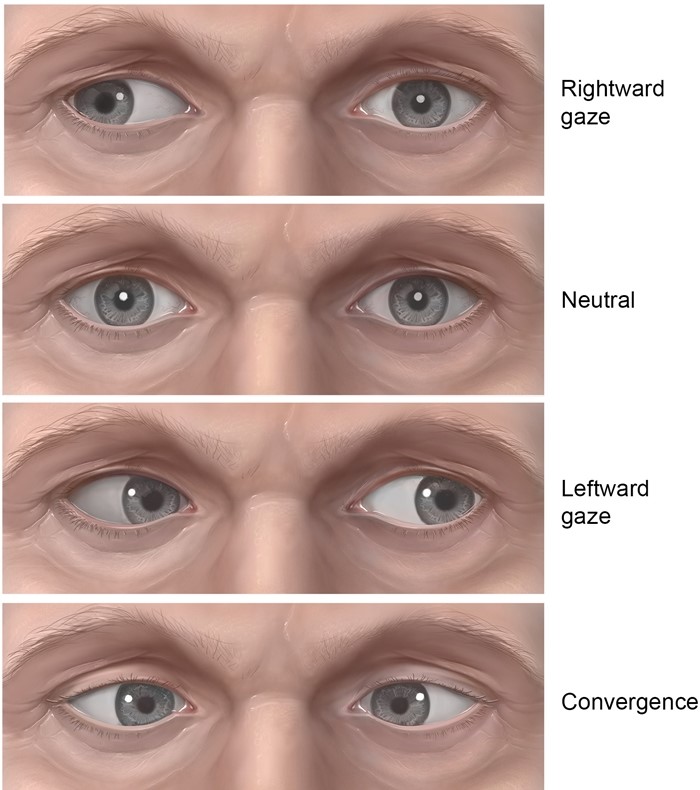 A lesion involving which of the following structures is most likely causing the observed ocular findings in this patient?
A)Abducens nerve
B)Lateral geniculate nucleus
C)Medial longitudinal fasciculus
D)Occipital lobe
E)Oculomotor nerve
F)Superior colliculus
A lesion involving which of the following structures is most likely causing the observed ocular findings in this patient?A)Abducens nerve
B)Lateral geniculate nucleus
C)Medial longitudinal fasciculus
D)Occipital lobe
E)Oculomotor nerve
F)Superior colliculus
Question
Question
A 57-year-old man is sent to the emergency room after having a widespread tonic-clonic seizure. According to his wife, he has no history of seizures. However, she claims that he has been complaining of sporadic headaches, memory loss, and visual issues for the previous two weeks. A single mass is seen on brain imaging in the right temporal lobe. Which of the following visual field problems does this patient most likely have? 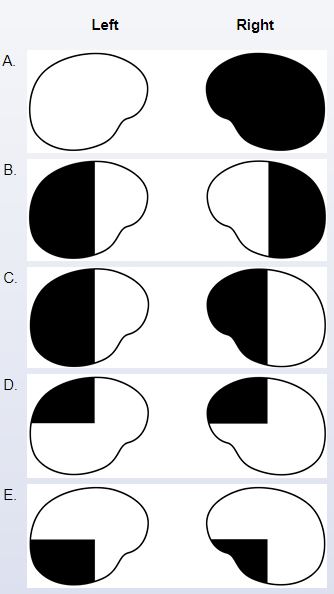
A)A
B)B
C)C
D)D
E)E
A)A
B)B
C)C
D)D
E)E
Question
Question
A previously healthy 35-year-old lady arrives at the hospital after several days of productive coughing accompanied by chills and fever. Her sputum is purulent, with slight pink blood streaks. Deep inspiration has also caused acute discomfort throughout the right shoulder and neck area. The patient's medical history is ordinary. Her temperature is 38.3 degrees Celsius (101 degrees Fahrenheit), her blood pressure is 130/70 mm Hg, her pulse is 98 bpm, and her respirations are 22 /minute. The right lower pulmonary lobe exhibits crackles and dullness on examination. The examiner has the patient speak the letter "E" while listening with the stethoscope over the right midback, and the sound is heard by the examiner as a loud letter "A." A chest x-ray is obtained and is shown in the image below. 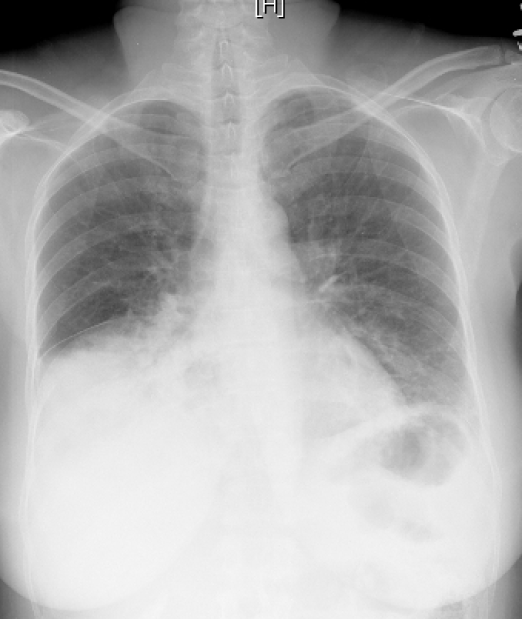 The pain experienced by this patient is most likely carried by which of the following nerves?
A)Accessory
B)Intercostal
C)Long thoracic
D)Phrenic
E)Vagus
The pain experienced by this patient is most likely carried by which of the following nerves?A)Accessory
B)Intercostal
C)Long thoracic
D)Phrenic
E)Vagus
Question
Question
A 13-year-old girl has been taken to the hospital with a fever, cough, and malaise for the previous two days. She has no history of illness, and all of her vaccines are current. Her leukocyte count is 21,000/mm3, and she has 7% band formations. The following are the results of an upright chest x-ray: 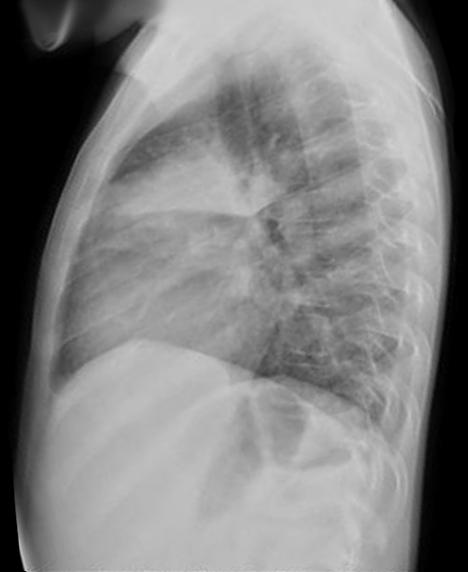 Which of the following is the most likely location of the pathologic process in this patient?
A)Left lower lung lobe
B)Left pleural space
C)Right middle lung lobe
D)Right pleural space
E)Right upper lung lobe
Which of the following is the most likely location of the pathologic process in this patient?A)Left lower lung lobe
B)Left pleural space
C)Right middle lung lobe
D)Right pleural space
E)Right upper lung lobe
Question
Question
A 47-year-old lady arrives at the clinic with a fever, dysuria, and abdominal discomfort. She has experienced multiple urinary tract infections throughout her adolescence, but no other medical issues. A physical examination indicates that the patient is experiencing minor suprapubic pain. Urinalysis reveals pyuria as well as many microorganisms. A CT scan of the abdomen is performed, as seen in the figure below. 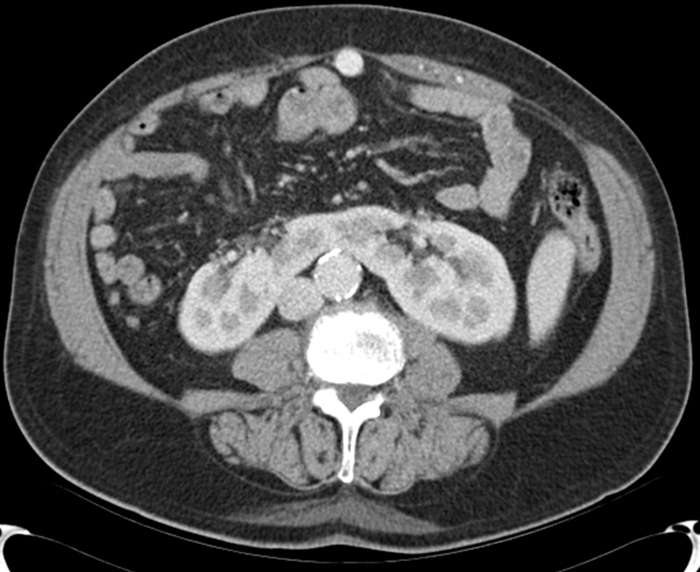 Which of the following most likely prevented the proper ascent of the anomalous organ seen on the CT scan?
A)Inferior mesenteric artery
B)Inferior vena cava
C)Persistent urachus
D)Superior mesenteric artery
E)Vitellointestinal duct
Which of the following most likely prevented the proper ascent of the anomalous organ seen on the CT scan?A)Inferior mesenteric artery
B)Inferior vena cava
C)Persistent urachus
D)Superior mesenteric artery
E)Vitellointestinal duct
Question
Question
A 32-year-old man arrives in the ER complaining of acute heart palpitations. His blood pressure is 100/70 mmHg, and his heart rate is 160 beats per minute. To alleviate these symptoms, the doctor tells the patient to do the "Valsalva technique." Which of the following structures is most crucial in completing the Valsalva technique, as seen in the pelvic CT scan below? 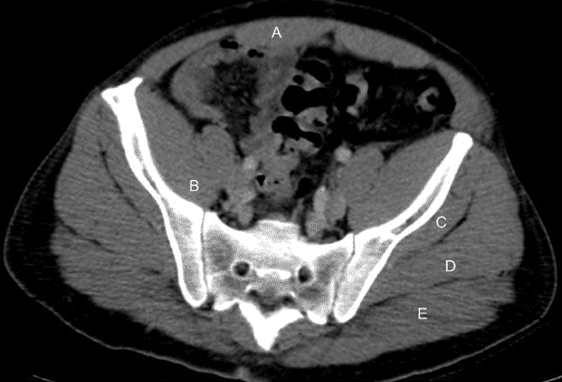
A)A
B)B
C)C
D)D
E)E
A)A
B)B
C)C
D)D
E)E
Question
A 63-year-old man has undergone an abdominal CT scan, for vague abdominal pain. 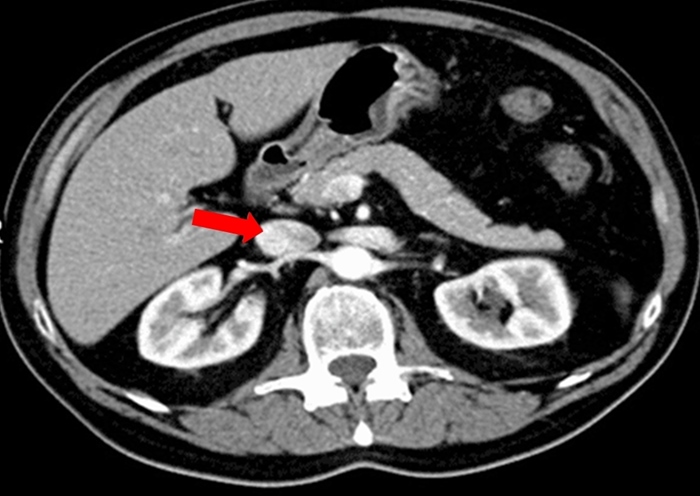 What is the structure indicated by the arrow?
A)The Aorta
B)Renal Artery
C)Inferior Vena Cava
D)Portal Vein
What is the structure indicated by the arrow?A)The Aorta
B)Renal Artery
C)Inferior Vena Cava
D)Portal Vein
Question
Following an attack, a 21-year-old man is transported to the emergency room. He was trying to flee and turned aside just as his assailant came at him from behind with a knife. The patient had a 4-cm-wide penetrating wound with severe blood loss. He is taken to the surgery room after basic stabilization. An injury to a muscle that aids in internal rotation of the arm and is innervated by the thoracodorsal nerve is discovered during surgical investigation. Which of the muscles seen in the cadaveric specimen is most likely damaged in this patient? 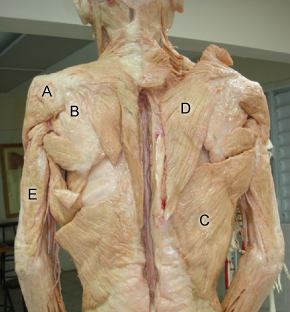
A)A
B)B
C)C
D)D
E)E
A)A
B)B
C)C
D)D
E)E
Question
The structure mentioned, traverses the diaphragm alongside which structure?
A)The Right Phrenic Nerve
B)Esophagus
C)Thoracic Duct
D)Azygos Vein
A)The Right Phrenic Nerve
B)Esophagus
C)Thoracic Duct
D)Azygos Vein
Question
A 37-year-old lady arrives at the clinic complaining of left elbow soreness and edema that has persisted for several days. The patient recalls no serious trauma but has lately begun a high-intensity training regimen. The presentation depicts the results of the physical examination. 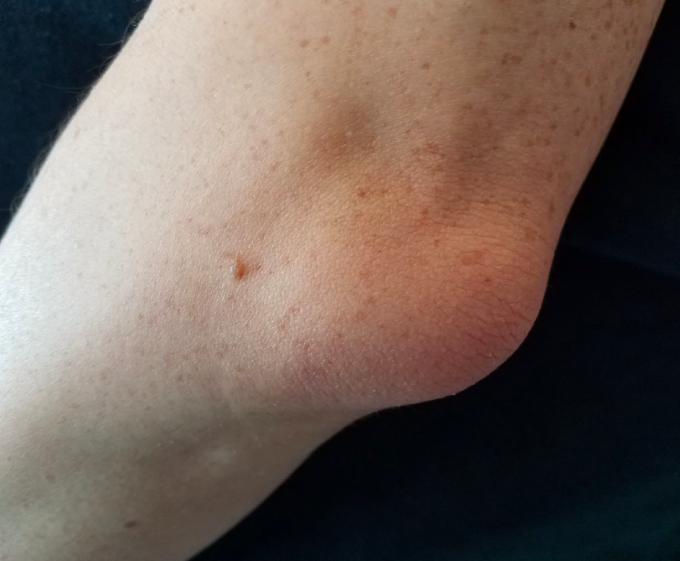 The patient is able to fully extend the elbow without increased pain. Pathology involving which of the following structures is the most likely cause of this patient's current condition?
A)Annular ligament
B)Articular capsule
C)Joint synovium
D)Subcutaneous bursa
E)Triceps tendon
The patient is able to fully extend the elbow without increased pain. Pathology involving which of the following structures is the most likely cause of this patient's current condition?A)Annular ligament
B)Articular capsule
C)Joint synovium
D)Subcutaneous bursa
E)Triceps tendon
Question
Which of the following sentences described the mentioned structure?
A)The left gonadal veins drain directly into it.
B)It branches into the common iliac arteries
C) It is found by the confluence of the right and left common iliac veins.
D)It drains the blood from the gastrointestinal system to the liver.
A)The left gonadal veins drain directly into it.
B)It branches into the common iliac arteries
C) It is found by the confluence of the right and left common iliac veins.
D)It drains the blood from the gastrointestinal system to the liver.
Question
After falling from a jungle gym, a 3-year-old boy is taken to the emergency room. The child landed on his outstretched arms after attempting to catch himself. He did not pass out and has been weeping uncontrollably since he collapsed. The pulse rate is 140 beats per minute, and all other vital indicators are within normal ranges. Physical examination indicates soreness and swelling across the anterior region of his right shoulder, as well as crepitus. Below is an x-ray of his right shoulder. 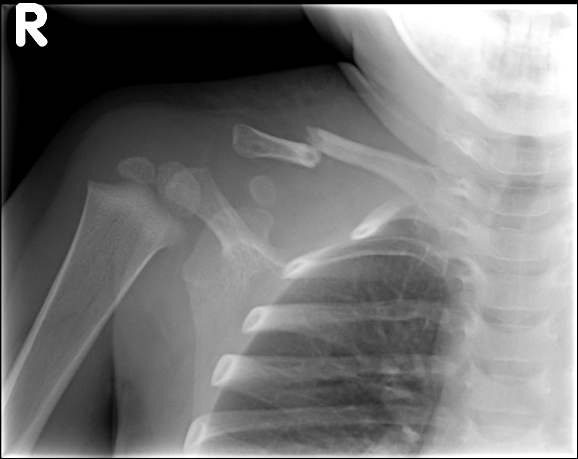 Tension from which of the following muscles is most likely responsible for displacement of the distal bone fragment?
A)Biceps
B)Deltoid
C)Levator scapulae
D)Pectoralis minor
E)Teres minor
Tension from which of the following muscles is most likely responsible for displacement of the distal bone fragment?A)Biceps
B)Deltoid
C)Levator scapulae
D)Pectoralis minor
E)Teres minor
Question
Question
Question
A 65-year-old man arrives at the clinic complaining of right lower abdomen pain radiating to his groin and trouble walking for the last week. Climbing stairs has been very difficult for him, and he has fallen numerous times as a result of knee buckling. Diabetes, hypertension, and atrial fibrillation all have a medical history. The patient is taking warfarin for long-term anticoagulation. Physical examination reveals that the right patellar reflex is weaker than the left. The following is an abdominal CT scan: 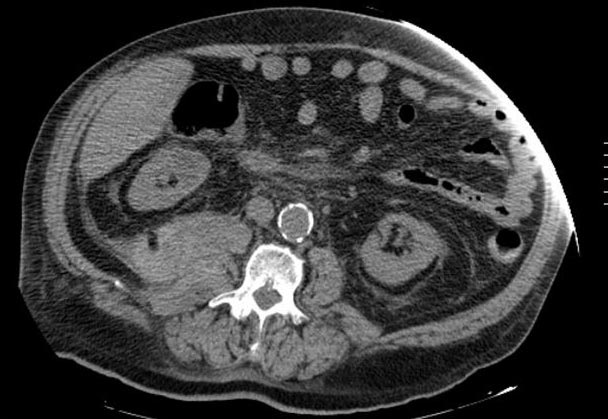 Which of the following additional findings is most likely to be seen in this patient?
A)Impaired adduction of the right thigh
B)Loss of sensation on the anterior aspect of the right thigh
C)Loss of sensation on the dorsum of the right foot
D)Loss of sensation on the sole of the right foot
E)Weakened abduction of the right thigh
Which of the following additional findings is most likely to be seen in this patient?A)Impaired adduction of the right thigh
B)Loss of sensation on the anterior aspect of the right thigh
C)Loss of sensation on the dorsum of the right foot
D)Loss of sensation on the sole of the right foot
E)Weakened abduction of the right thigh
Question
Question
Question
A 54-year-old woman arrives at the emergency department with a hand injury sustained in a fall. In the restroom, the patient stumbled and fell backwards onto her outstretched right hand. She was able to get up, but she has been experiencing right wrist discomfort and finger numbness since the incident. Obesity, hypertension, and type 2 diabetes mellitus are all present in his medical history. A tiny hump is detected immediately below the palm of her right hand, and there is diminished feeling in the palmar aspect of her first three digits. A dislocation of the lunate resulting in median nerve compression is suspected. On a normal x-ray, which of the following indicated bones is most likely displaced in this patient? 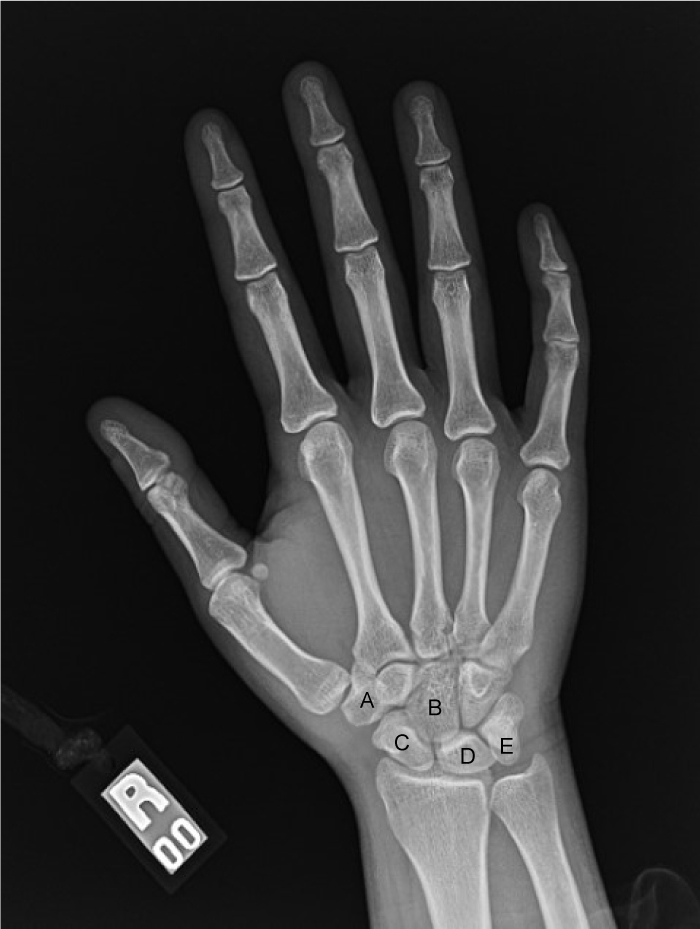
A)A
B)B
C)C
D)D
E)E
A)A
B)B
C)C
D)D
E)E
Question
Question
A 73-year-old woman is brought to the emergency department due to right hip pain. The patient was getting out of the shower when she slipped and fell directly on her right hip. She now has pain and swelling over the lateral aspect of her hip and cannot walk without assistance. Vital signs are within normal limits. Bilateral pedal pulses are normal, and sensation is intact. X-ray of the right hip is shown below : 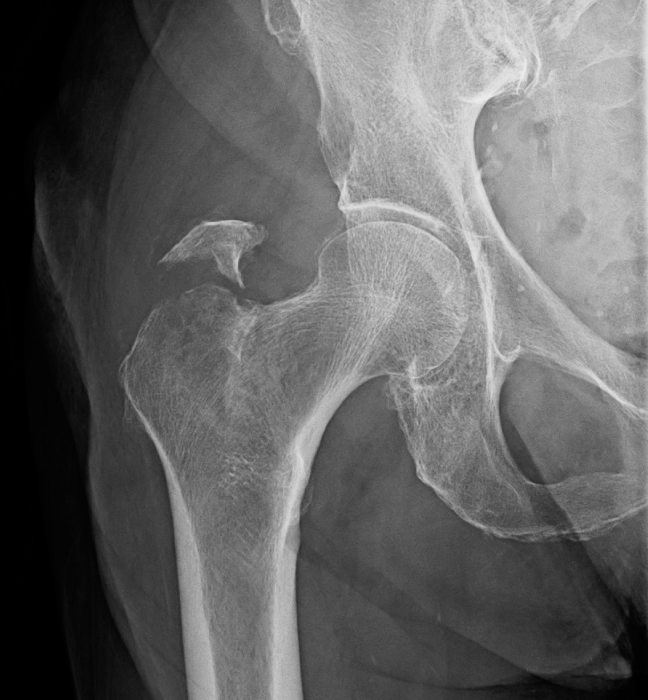 Examination of this patient will most likely show impaired function of which of the following muscles?
A)Adductor magnus
B)Gluteus medius
C)Iliopsoas
D)Rectus femoris
E)Sartorius
Examination of this patient will most likely show impaired function of which of the following muscles?A)Adductor magnus
B)Gluteus medius
C)Iliopsoas
D)Rectus femoris
E)Sartorius
Question
During cardiac catheterization, an artery indicated by the arrow in the picture was visualized after injecting the contrast material, What is the origin of this artery? 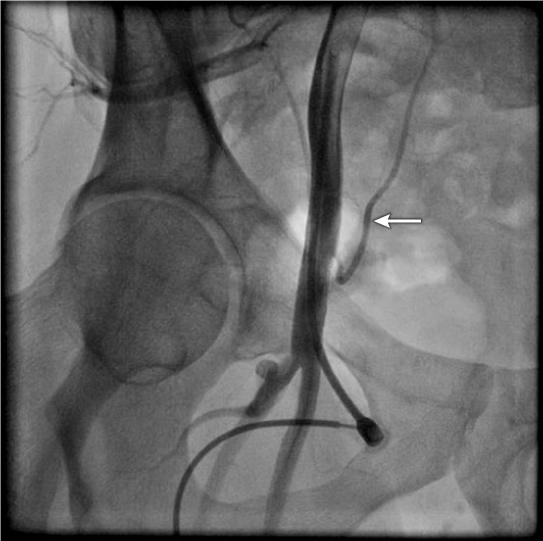
A) Internal Iliac Artery
B) External Iliac Artery
C) Common Femoral Artery
D) Superior Gluteal Artery
A) Internal Iliac Artery
B) External Iliac Artery
C) Common Femoral Artery
D) Superior Gluteal Artery
Question
Following a car accident, a 37-year-old lady is taken to the emergency room. She lost control of her automobile as she round a bend and collided with a brick wall head on. Any movement causes considerable discomfort in the patient's right hip. The right lower extremity is adducted and internally rotated, and it appears shorter than the contralateral leg. Due to considerable discomfort, range of motion testing at the hip is limited in all directions. The display includes an X-ray of the hip. 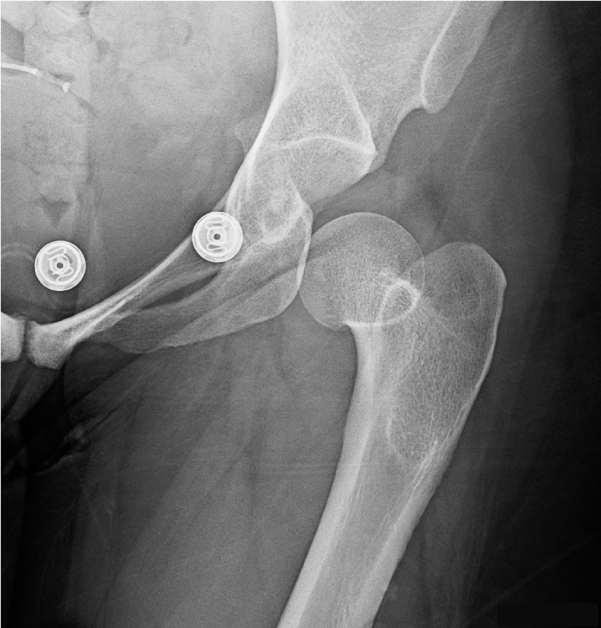 Which of the following structures is most vulnerable to involvement from this patient's injury?
A)Femoral artery
B)Femoral nerve
C)Lateral femoral cutaneous nerve
D)Sciatic nerve
E)Superior gluteal artery
Which of the following structures is most vulnerable to involvement from this patient's injury?A)Femoral artery
B)Femoral nerve
C)Lateral femoral cutaneous nerve
D)Sciatic nerve
E)Superior gluteal artery
Question
Question
Question
A 20-year-old man arrives at the hospital complaining of knee discomfort after tripping and landing on his right knee during a soccer game. He has been unable to bear weight since the incident since the anterior area of his tibia struck straight against the ground. The patient's knee seems swollen on physical examination, and there is significant posterior displacement of the tibia when pressure is given to his anterior tibia with the knee flexed. The image below shows an axial MRI cross section of the right knee at the tibial plateau level. Which of the following structures in this patient is most likely injured?
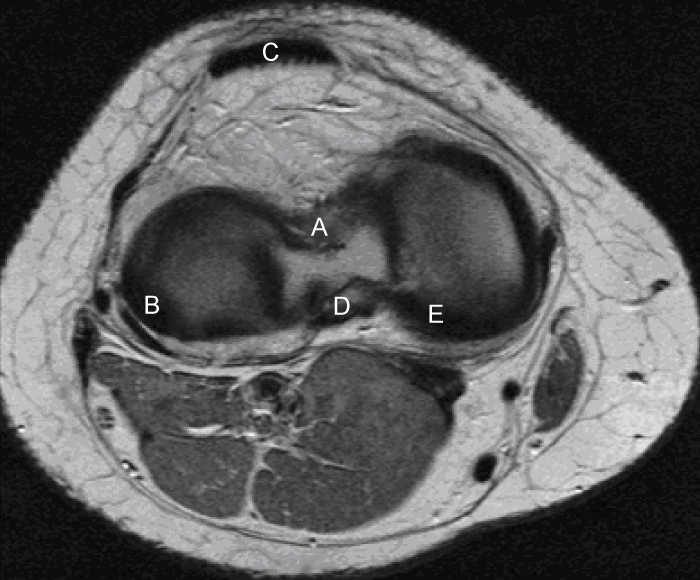
A)A
B)B
C)C
D)D
E)E
A)A
B)B
C)C
D)D
E)E
Question
Question
A 23-year-old basketball player arrives at the office complaining of right knee discomfort. A coronal MRI of his knee, seen from the back, is presented below. 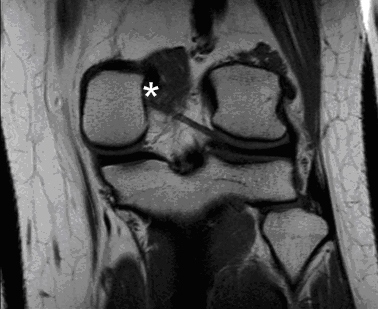 The asterisk marks the attachment site of which of the following ligaments?
A)Anterior cruciate
B)Patellar
C)Posterior cruciate
D)Tibial collateral
E)Transverse genicular
The asterisk marks the attachment site of which of the following ligaments?A)Anterior cruciate
B)Patellar
C)Posterior cruciate
D)Tibial collateral
E)Transverse genicular
Question
Question
Following a ground-level fall at home, a 46-year-old woman is transported to the emergency room by ambulance. She slid out of the shower and landed on her left knee on the tile floor. The patient is unable to walk due to acute left knee pain and edema. The examination reveals a knee contusion and soft tissue edema, as well as a substantial knee effusion. The picture below shows an X-ray of the knee: 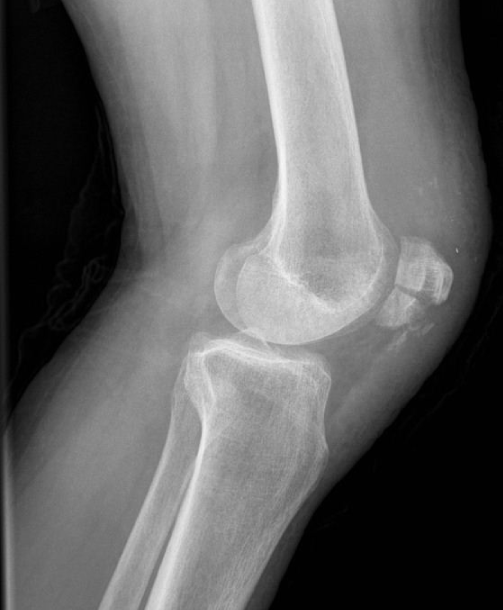 Which of the following examination findings would most likely be seen in this patient?
A)Backward movement of the tibia against a fixed femur
B)Excessive joint widening on valgus stress
C)Forward movement of the tibia against a fixed femur
D)Inability to extend the knee against gravity
E)Inability to flex the knee against resistance
Which of the following examination findings would most likely be seen in this patient?A)Backward movement of the tibia against a fixed femur
B)Excessive joint widening on valgus stress
C)Forward movement of the tibia against a fixed femur
D)Inability to extend the knee against gravity
E)Inability to flex the knee against resistance
Question
Question
A 16-year-old girl arrives at the clinic complaining of left elbow discomfort that has been bothering her for several months. The pain worsens with activities, limiting her ability to exercise. She has tried over-the-counter ibuprofen and acetaminophen but has only gotten partial relief. Seasonal allergies are mentioned in the medical history, and current treatments include a fluticasone nasal spray. A further examination reveals that the patient's condition is the result of a tendon damage. A long-acting glucocorticoid injection is given to the most tender area, as seen in the figure below.. 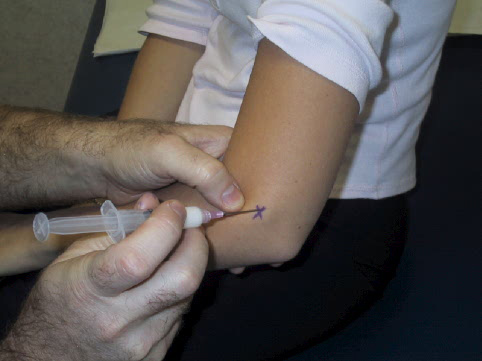 Which of the following actions is most likely performed by the affected muscle?
A)Finger adduction
B)Forearm flexion
C)Shoulder abduction
D)Thumb abduction
E)Wrist extension
F)Wrist flexion
Which of the following actions is most likely performed by the affected muscle?A)Finger adduction
B)Forearm flexion
C)Shoulder abduction
D)Thumb abduction
E)Wrist extension
F)Wrist flexion
Question
Question
Question
After a fall, a 68-year-old woman is taken to the emergency department with significant right hip discomfort. She stumbled on a rug and crashed against a wall before falling on her right hip on the floor. There is a history of sadness and polymyalgia rheumatica in the patient. Sertraline and low-dose prednisone are among the medications used. She also has a smoking history of 40 packs per year. The blood pressure is 145/85 mm Hg, and the pulse rate is 96 beats per minute. The patient appeared to be in a lot of agony. She can't move her right hip, and her right leg looks to be shorter than her left. The picture below depicts a pelvic x-ray: 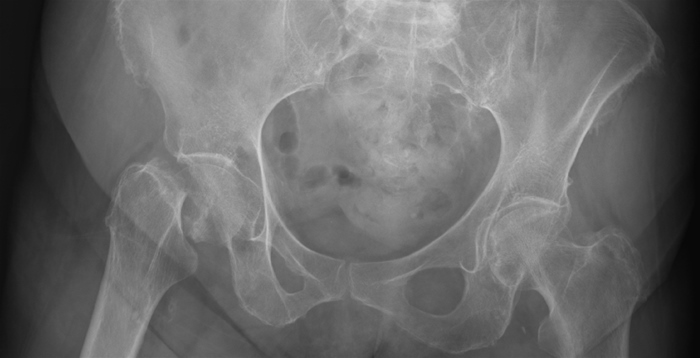 Injury involving which of the following arteries is most likely to lead to osteonecrosis in this patient?
A)Deep femoral
B)Inferior gluteal
C)Lateral circumflex femoral
D)Medial circumflex femoral
E)Obturator
Injury involving which of the following arteries is most likely to lead to osteonecrosis in this patient?A)Deep femoral
B)Inferior gluteal
C)Lateral circumflex femoral
D)Medial circumflex femoral
E)Obturator
Question
Question
A 16-year-old boy arrives at the emergency department with right knee discomfort following a tumble. His symptoms began following a skiing mishap in which he wrenched his right lower leg outward relative to the thigh. He has no medical issues and is not currently on any drugs. There is edema and pain on the medial area of the right knee on examination. When a mild force is given to the lateral knee while the lower leg remains motionless, the medial joint line widens. Which of the following indicated structures in this patient is most likely injured? 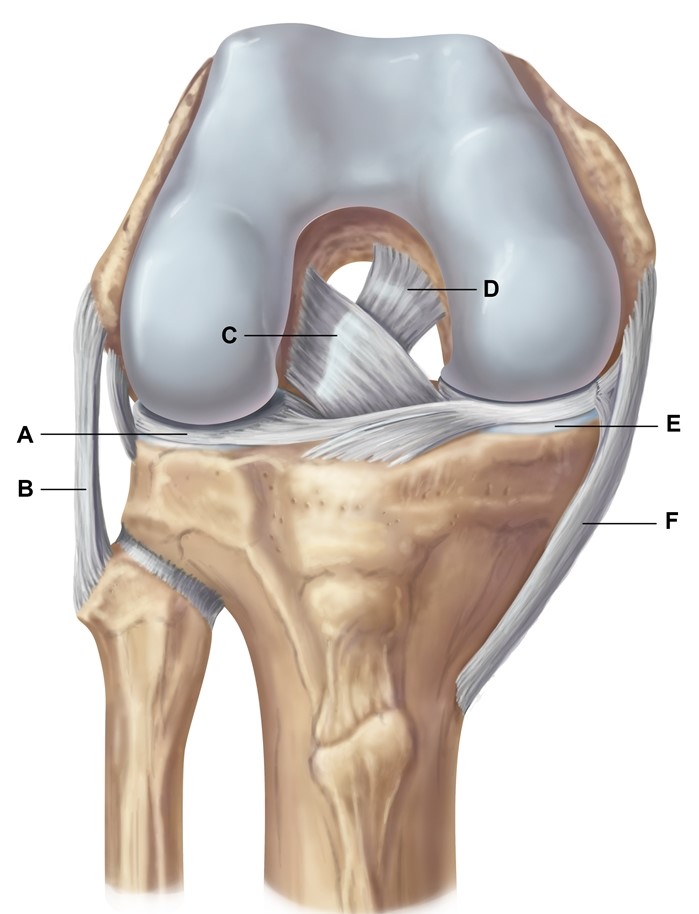
A)A
B)B
C)C
D)D
E)E
F)F
A)A
B)B
C)C
D)D
E)E
F)F
Question
Question
Question
A 14-year-old kid comes to the clinic with his mother because he has been experiencing worsening anterior knee discomfort in his left leg for the previous two months. The issue began as a little ache at the conclusion of a hiking expedition. The patient reports no fever, night sweats, or knee trauma. He has a normal walk, according to physical assessment. The hips, knees, and ankles all move freely. A slight swelling with palpable tenderness is positioned about 3 cm below the inferior border of the patella. The exhibit includes an x-ray of the left knee. 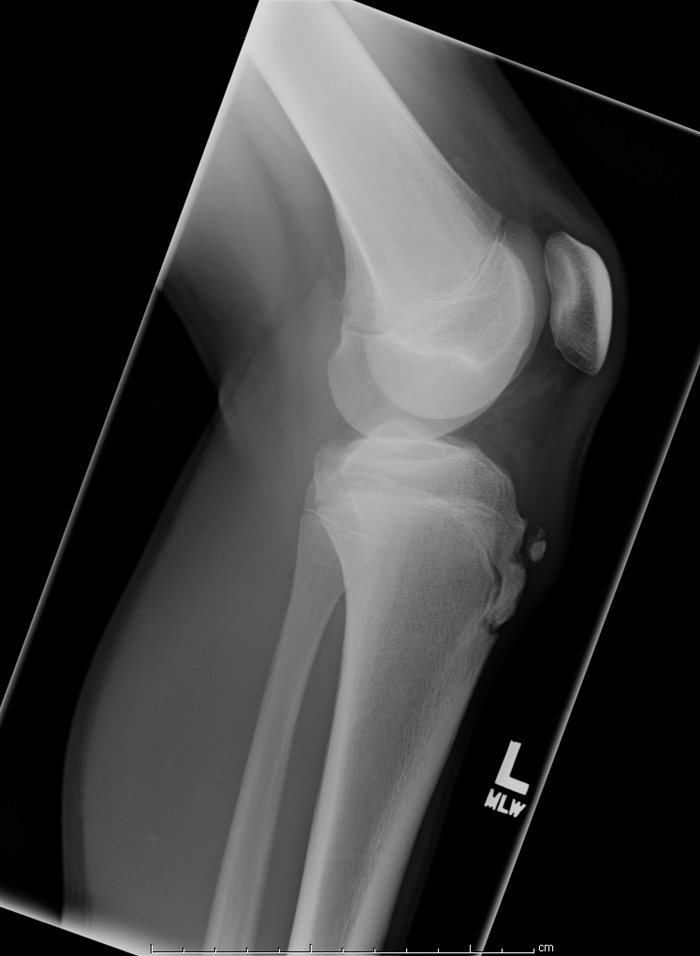 Overuse of which of the following muscles most likely contributed to this patient's condition?
A)Biceps femoris
B)Popliteus
C)Quadriceps femoris
D)Sartorius
E)Tibialis anterior
Overuse of which of the following muscles most likely contributed to this patient's condition?A)Biceps femoris
B)Popliteus
C)Quadriceps femoris
D)Sartorius
E)Tibialis anterior
Question
Question
Question
A 17-year-old boy is sent to the emergency room with a lower extremities injury. When the patient was playing football with his pals, he was tackled and "felt something shatter" in his right leg. He avoids putting any weight on his right foot. A big contusion with point pain is seen on examination of the proximal lateral right leg. The exhibit includes an x-ray of the leg. 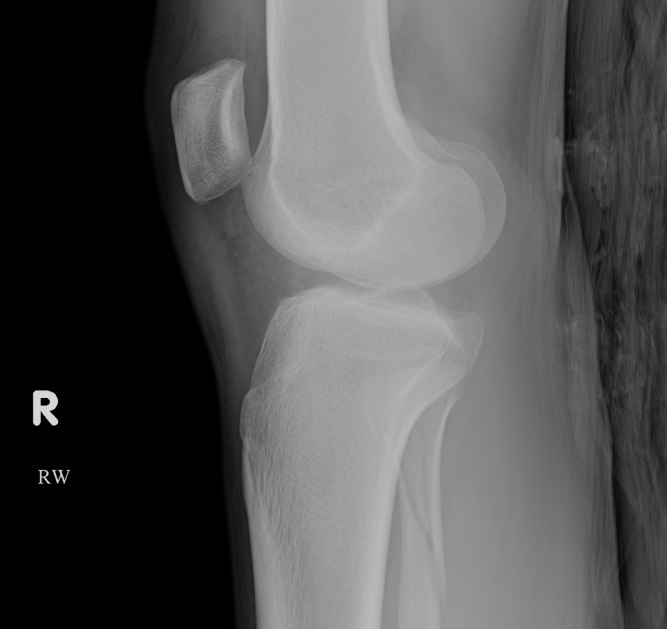 Which of the following would most likely be found on physical examination?
A)Loss of inversion of the foot
B)Loss of plantar flexion of the foot
C)Loss of sensation at the dorsum of the foot
D)Loss of sensation at the medial aspect of the leg
E)Loss of sensation at the sole of the foot
Which of the following would most likely be found on physical examination?A)Loss of inversion of the foot
B)Loss of plantar flexion of the foot
C)Loss of sensation at the dorsum of the foot
D)Loss of sensation at the medial aspect of the leg
E)Loss of sensation at the sole of the foot
Question
Question
Question
A 52-year-old man arrives at the hospital after experiencing nonspecific back and stomach discomfort for four weeks. He has also had episodes of fever, anorexia, and a 2-kg (4.4-lb) weight loss. The patient was diagnosed with HIV recently and has not yet started antiretroviral medication. He has a history of using intravenous drugs. An infection involving the structure indicated by the arrow in the figure below is shown by a CT scan of the abdomen. 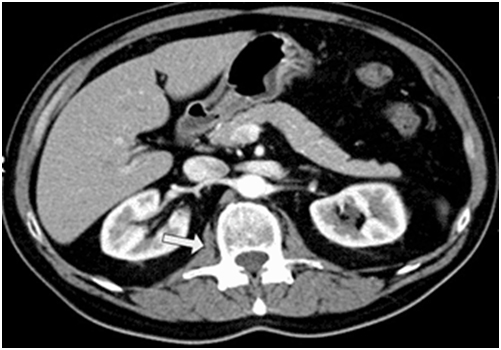 Which of the following structures is involved by this patient's infectious process?
A)Erector spinae muscle
B)Iliacus muscle
C)Ligamentum flavum
D)Psoas muscle
E)Transversus abdominis muscle
Which of the following structures is involved by this patient's infectious process?A)Erector spinae muscle
B)Iliacus muscle
C)Ligamentum flavum
D)Psoas muscle
E)Transversus abdominis muscle
Question
Question
Question
A 54-year-old man arrives at the clinic complaining of excruciating discomfort in his left neck and shoulder area for several months. He has also experienced numbness and weakness in his left hand. The patient has no recollection of any big trauma and no prior medical concerns. He attempted chiropractic and massage treatments, but the problems remained. The left upper extremity examination reveals diminished feeling in the palm, index, and middle fingers, as well as weakness in the left wrist extension. The deep tendon reflexes of the left biceps and brachioradialis are normal, while the triceps reflex is weak. The evaluation of the right upper extremity is normal. The most likely cause of this patient's neurologic symptoms is a lesion affecting which of the following identified parts of the brachial plexus? 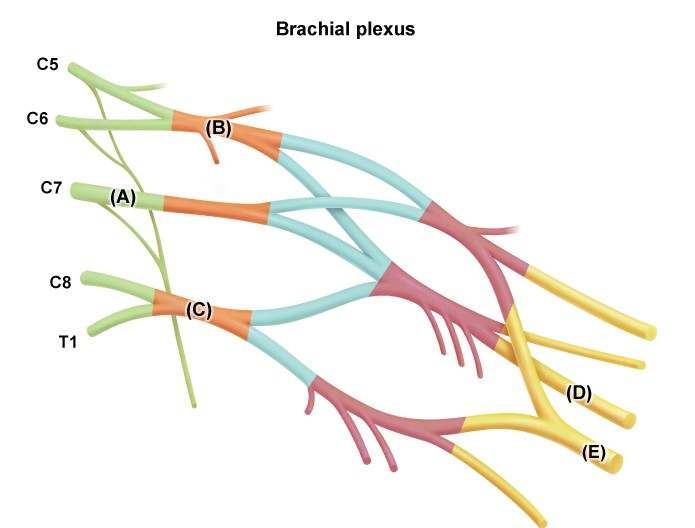
A)A
B)B
C)C
D)D
E)E
A)A
B)B
C)C
D)D
E)E
Question
Question
Question
A 56-year-old man visits the emergency room with recurrent left wrist discomfort. He slid forward onto the ground and landed on his outstretched hand while walking his dog 5 hours ago. The examination reveals modest edema of the left wrist with intact range of motion. There is dorsolateral wrist discomfort between the tendons of the extensor pollicis longus and extensor pollicis brevis. The picture below depicts an x-ray of the left wrist: 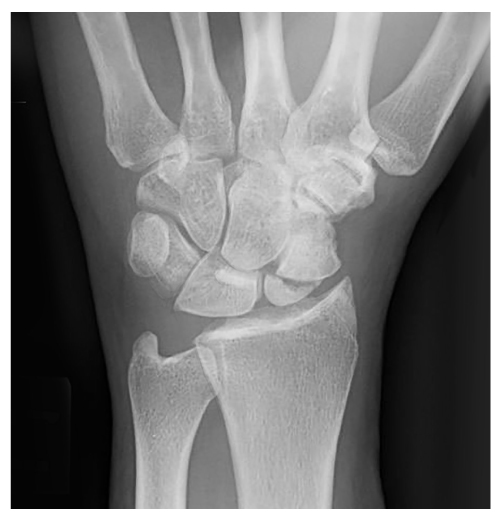 This patient is at greatest risk for developing which of the following complications?
A)Avascular necrosis
B)Carpal tunnel syndrome
C)Compartment syndrome
D)Dupuytren contracture
E)Guyon canal syndrome
This patient is at greatest risk for developing which of the following complications?A)Avascular necrosis
B)Carpal tunnel syndrome
C)Compartment syndrome
D)Dupuytren contracture
E)Guyon canal syndrome
Question
Question
Question
A 36-year-old construction worker arrives at the emergency room after falling three meters (ten feet) off a ladder. The patient braced his fall with outstretched hands and instantly felt significant pain in his left wrist upon striking the ground. The left wrist is swollen, but there are no lacerations. There is a robust radial pulse and the fingers are fully perfused. A palpable lump is located directly proximal to the left palm. As seen in the exhibit, an X-ray of the left wrist demonstrates a lunate dislocation with no sign of a distal radius fracture. 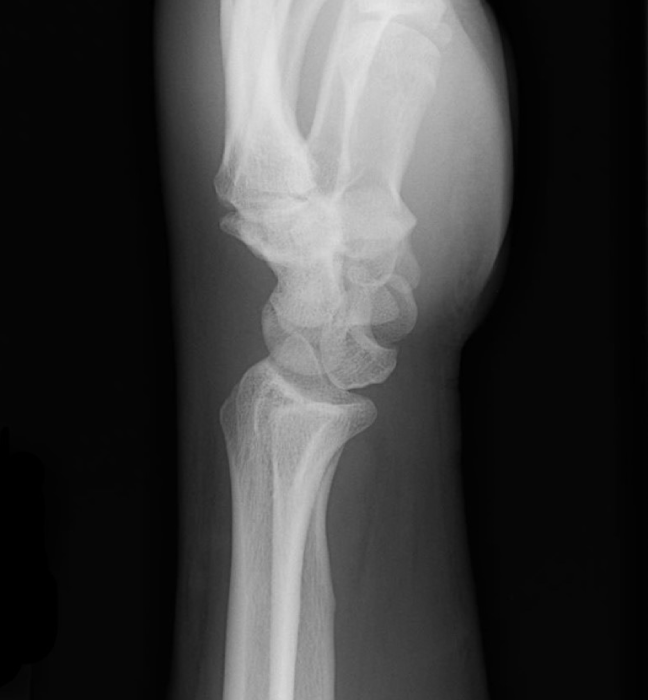 The patient is at greatest risk for impairment of which of the following hand functions?
A)Finger abduction
B)Finger interphalangeal joint flexion
C)Thumb abduction
D)Thumb adduction
E)Thumb extension
The patient is at greatest risk for impairment of which of the following hand functions?A)Finger abduction
B)Finger interphalangeal joint flexion
C)Thumb abduction
D)Thumb adduction
E)Thumb extension
Question
Question
Question
Question
Question
Question
Question
Question
A 40-year-old woman had delivered a 4.5 kg baby in the last week. The patient is a known case of gestational diabetes mellitus and inherited bleeding disorder. Her BMI is 40 kg/m2. The patient presented to the emergency department with a left calf swelling. Temperature is 36.7 C (98 F), blood pressure is 120/80mm Hg, the pulse is 100/min, and respirations are 15/min. Doppler ultrasonography revealed a left deep venous thrombosis. A filter placement is planned to prevent embolization. A section of the patient's abdominal CT at the level of L2 is shown in the image below. The filter will most likely be placed in which of the following structures? 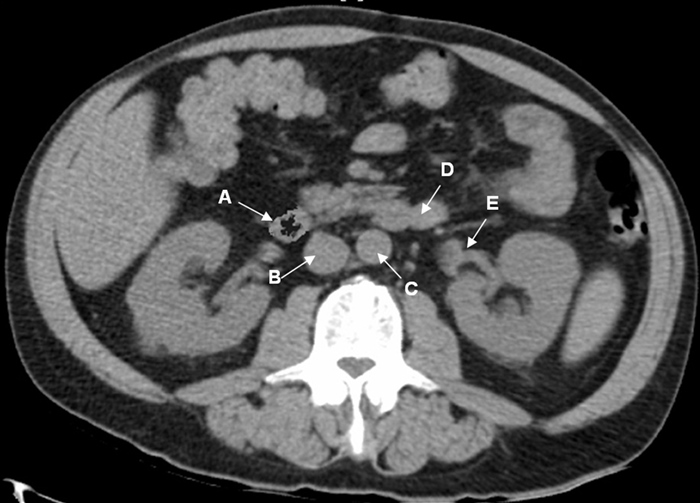
A)A
B)B
C)C
D)D
E)E
A)A
B)B
C)C
D)D
E)E

Unlock Deck
Sign up to unlock the cards in this deck!
Unlock Deck
Unlock Deck
1/265

Play

Full screen (f)
Deck 1: Anatomy
1
A 34-year-old man begins treatment for Hodgkin lymphoma with combined chemotherapy. Shortly later, he begins vomiting violently and requires IV fluid replacement. Which of the following brain regions is most likely to be to blame for his symptoms?
A)A
B)B
C)C
D)D
E)E
A)A
B)B
C)C
D)D
E)E
D
2
A 55-year-old right-handed man arrives at the emergency department complaining of continuous right arm tingling and numbness for many hours. There is no headache, muscular weakness, slurred speech, or trouble walking in this patient. He has a history of hypertension, paroxysmal atrial fibrillation, and ischemic stroke, all of which have resolved. He was taken off anticoagulants two months ago after suffering a gastrointestinal hemorrhage. The blood pressure is 150/90 mm Hg, and the pulse rate is 92 beats per minute. During the examination, the patient's right arm paresthesia extends to the full right side of his body, and he experiences right-sided convulsions, which are followed by a bilateral tonic-clonic seizure. Which of the following structures in the left cerebral hemisphere is most likely to be the source of this patient's seizure?
A)A
B)B
C)C
D)D
E)E
F)F
A)A
B)B
C)C
D)D
E)E
F)F
D
3
A 58-year-old man had a descending thoracic aortic aneurysm repaired surgically. There are no intraoperative problems, but the patient develops new-onset neurologic impairments after surgery. The brain imaging is normal, but an MRI of the lower thoracic spinal cord indicates an ischemic infarction in the locations depicted in the example below. Lower extremity examination of this patient is most likely to show which of the following neurologic findings?
A)A
B)B
C)C
D)D
E)E
F)F
Lower extremity examination of this patient is most likely to show which of the following neurologic findings? A)A
B)B
C)C
D)D
E)E
F)F
A
4
Due to memory loss and frequent falls, a 62-year-old man is brought to the office by his son. The patient has been living alone since his wife died a year ago. His visiting son discovered his father in deplorable living circumstances. The patient was forgetful and didn't recall where certain belongings in his residence, where he had resided for almost 20 years, were located. His walk is extremely shaky, and he has fallen multiple times. According to his son, his father has always been "a drinker" and may have been drinking recently. The patient appears unconcerned about his son's fears and claims to be OK. The vital indicators are within normal ranges. On physical examination, bilateral lateral gaze palsy and nystagmus are present. Muscle strength and deep tendon reflexes are normal, but the gait is ataxic. On memory testing, he recalls 0 out of 3 objects after 5 minutes. A lesion of which of the following labeled structures on a normal brain MRI is most specifically associated with this patient's current condition?
A)A
B)B
C)C
D)D
E)E
F)F
A)A
B)B
C)C
D)D
E)E
F)F
Unlock Deck
Unlock for access to all 265 flashcards in this deck.
Unlock Deck
k this deck
5
A 65-year-old man arrives at the emergency department with acute slurred speech. He is likewise weak on the right side, although he denies any damage, headache, or loss of consciousness. His medical issues include hypertension and type 2 diabetes. For the past 20 years, the patient has smoked one pack of cigarettes every day. A neurologic examination reveals right-sided lower facial droop, with the forehead muscles spared. Motor strength on the right is 3/5 and on the left is 5/5, with a Babinski response on the right. His right upper and lower limbs are similarly affected by dysmetria and dysdiadochokinesia. As illustrated in the figure below, an MRI of the brain indicates an acute lacunar infarct in the brainstem. Which of the following cranial nerves exits the brainstem closest to the level affected by this patient's stroke?
A)Facial
B)Hypoglossal
C)Oculomotor
D)Trigeminal
E)Trochlear
Which of the following cranial nerves exits the brainstem closest to the level affected by this patient's stroke?A)Facial
B)Hypoglossal
C)Oculomotor
D)Trigeminal
E)Trochlear
Unlock Deck
Unlock for access to all 265 flashcards in this deck.
Unlock Deck
k this deck
6
A 59-year-old man visits the office to have a facial skin lesion evaluated. The lesion is a mole-like area on the patient's face that has gradually expanded over several months. He claims there is no discomfort or bleeding from the lesion. There is a family history of skin cancer. The presentation depicts the results of the physical examination. Biopsy of the lesion with a local nerve block for anesthesia is planned. Which of the following injection sites is most likely to provide adequate anesthesia for the procedure?
A)Infraorbital foramen
B)Mandibular foramen
C)Mental foramen
D)Stylomastoid foramen
E)Superior orbital fissure
Biopsy of the lesion with a local nerve block for anesthesia is planned. Which of the following injection sites is most likely to provide adequate anesthesia for the procedure?A)Infraorbital foramen
B)Mandibular foramen
C)Mental foramen
D)Stylomastoid foramen
E)Superior orbital fissure
Unlock Deck
Unlock for access to all 265 flashcards in this deck.
Unlock Deck
k this deck
7
A 49-year-old woman arrives at the office complaining of muscular weakness. The patient's right hand has been weakening for the previous three months. She's also been hallucinating. The patient's arms and legs are twitching and cramping. She has no sensory issues. The lower extremities muscles have increased tone and fasciculations on examination. There is atrophy of the interosseus muscles of the right hand as well as the bilateral intrinsic muscles of the foot. When the doctor touches the chin with the mouth slightly open, the jaw jerks up quickly. This response is mediated by which of the following cranial nerves?
A)A
B)B
C)C
D)D
E)E
A)A
B)B
C)C
D)D
E)E
Unlock Deck
Unlock for access to all 265 flashcards in this deck.
Unlock Deck
k this deck
8
A 34-year-old man visits the clinic after experiencing chronic buzzing in his right ear for the previous 6 months. In addition, the patient's hearing on the right side is impaired. He hasn't experienced a fever, earache, a runny nose, a sore throat, or a cough. The patient has not been exposed to loud noises or used cotton swabs. He tried over-the-counter oral pseudoephedrine, but it had little effect on his symptoms. There is no sinus discomfort on physical examination, and the mucous membranes are moist without erythema or exudate. Otoscopic examination reveals bilaterally normal external auditory canals with pinkish-grey tympanic membranes. An intracranial tumor is discovered during a brain MRI. Which of the following structures is most likely to have caused this patient's lesion?
A)A
B)B
C)C
D)D
E)E
F)F
G)G
A)A
B)B
C)C
D)D
E)E
F)F
G)G
Unlock Deck
Unlock for access to all 265 flashcards in this deck.
Unlock Deck
k this deck
9
A 23-year-old woman is suffering from severe visual neuritis. She has had relapsing-remitting multiple sclerosis in the past. Her brain MRI indicates a demyelination region affecting the right optic nerve. Which of the following is most likely to be discovered after a thorough examination of both eyes?
A)A
B)B
C)C
D)D
E)E
A)A
B)B
C)C
D)D
E)E
Unlock Deck
Unlock for access to all 265 flashcards in this deck.
Unlock Deck
k this deck
10
A 56-year-old woman arrives at the emergency department with a severe headache and partial visual loss. She has had atrial fibrillation for three years. The physical examination reveals a visual field impairment including the dark regions shown below. This patient most likely has occlusion of which of the following arteries?
A)Anterior cerebral
B)Central retinal
C)Middle cerebral
D)Posterior cerebral
E)Posterior inferior cerebellar
This patient most likely has occlusion of which of the following arteries?A)Anterior cerebral
B)Central retinal
C)Middle cerebral
D)Posterior cerebral
E)Posterior inferior cerebellar
Unlock Deck
Unlock for access to all 265 flashcards in this deck.
Unlock Deck
k this deck
11
A 67-year-old woman visits the clinic because she has observed diminished vision in her right eye for the last week. The patient claims that her right eye's vision is "narrower" than her left. Her medical history is notable for hypertension, type 2 diabetes, and hyperlipidemia. She also has intermittent lower limb claudication and has experienced two previous instances of transitory vision loss in her right eye. A right nasal hemianopia is shown by visual field testing. A right internal carotid artery aneurysm is discovered during a head and neck MRI/magnetic resonance angiography. Which of the following visual pathway segments is most likely disturbed in this patient?
A)A
B)B
C)C
D)D
E)E
F)F
G)G
H)H
A)A
B)B
C)C
D)D
E)E
F)F
G)G
H)H
Unlock Deck
Unlock for access to all 265 flashcards in this deck.
Unlock Deck
k this deck
12
Due to her easy fatigability, a 54-year-old woman is assessed at the clinic. There has been no weight gain or cold intolerance in the patient, and there is no history of thyroid disorders. Her medical history suggests that she should have a gastrectomy due to a nonhealing gastric ulcer. A glossy tongue and light palmar wrinkles are visible on physical examination. When her eyes are closed, her walking becomes unsteady, and her vibration awareness is significantly reduced in her lower limbs. There is modest symmetrical weakness in the proximal lower extremities muscles. The hemoglobin level in the blood is 7.2 g/dL, and the white blood cell count is 3,600/mm3. Stool tests for occult blood have always come out negative. Which of the following spinal cord lesions is this patient most likely to have?
A)
B)
C)
D)
E)
A)
B)
C)
D)
E)
Unlock Deck
Unlock for access to all 265 flashcards in this deck.
Unlock Deck
k this deck
13
During the preparation for a catheter-based radiofrequency ablation of the atrioventricular node, one of your medical students asked where we should place the catheter tip to ablate the AV-node, your answer should be?
A)Midway between the inferior van cava opening and the tricuspid valve.
B)In the left Atrium near the orifices of the pulmonary veins.
C)In the interatrial septum close to the coronary sinus
D)Near the orifice of the superior vena cava.
E)In the interventricular septum, close to the tricuspid valve.
A)Midway between the inferior van cava opening and the tricuspid valve.
B)In the left Atrium near the orifices of the pulmonary veins.
C)In the interatrial septum close to the coronary sinus
D)Near the orifice of the superior vena cava.
E)In the interventricular septum, close to the tricuspid valve.
Unlock Deck
Unlock for access to all 265 flashcards in this deck.
Unlock Deck
k this deck
14
A 68-year-old woman arrives at the emergency room with rapid onset double vision that began shortly after she awoke. When she looks to the right, the patient's vision deteriorates. She does not have a headache, weakness, or numbness. The patient has a lengthy history of high blood pressure, hyperlipidemia, and type 2 diabetes. The blood pressure is 160/90 mm Hg, and the pulse rate is 86 beats per minute. Except for the ocular abnormalities depicted in the figure below, the neurologic evaluation, including visual acuity, is normal. A lesion involving which of the following structures is most likely causing the observed ocular findings in this patient?
A)Abducens nerve
B)Lateral geniculate nucleus
C)Medial longitudinal fasciculus
D)Occipital lobe
E)Oculomotor nerve
F)Superior colliculus
A lesion involving which of the following structures is most likely causing the observed ocular findings in this patient?A)Abducens nerve
B)Lateral geniculate nucleus
C)Medial longitudinal fasciculus
D)Occipital lobe
E)Oculomotor nerve
F)Superior colliculus
Unlock Deck
Unlock for access to all 265 flashcards in this deck.
Unlock Deck
k this deck
15
A 50-year-old female was brought to the emergency department after a car accident. The collided cars were traveling at high-speed. The patient was wearing her seatbelt, restrained. On presentation, the patient complains of severe chest pain associated with breathing difficulty. On examination, her blood pressure was 90/50 and pulse is 160/min. Later, the patient lost consciousness and died 20 minutes later. She was diagnosed with traumatic aortic rupture, what is the location of the primary injury?
A) Aortic Isthmus near the origin of the left subclavian artery
B) The ascending aorta near the aortic valve.
C) The ascending aorta close to the origin of the brachiocephalic artery
D) The Descending aorta
A) Aortic Isthmus near the origin of the left subclavian artery
B) The ascending aorta near the aortic valve.
C) The ascending aorta close to the origin of the brachiocephalic artery
D) The Descending aorta
Unlock Deck
Unlock for access to all 265 flashcards in this deck.
Unlock Deck
k this deck
16
A 57-year-old man is sent to the emergency room after having a widespread tonic-clonic seizure. According to his wife, he has no history of seizures. However, she claims that he has been complaining of sporadic headaches, memory loss, and visual issues for the previous two weeks. A single mass is seen on brain imaging in the right temporal lobe. Which of the following visual field problems does this patient most likely have?
A)A
B)B
C)C
D)D
E)E
A)A
B)B
C)C
D)D
E)E
Unlock Deck
Unlock for access to all 265 flashcards in this deck.
Unlock Deck
k this deck
17
A 65-year-old man presented to the emergency department due to severe chest pain in the morning. The patient is a known case of coronary artery disease and has done percutaneous coronary intervention (PCI) before. On examination, his blood pressure is 130/90 mm Hg, and pulse is 90/min. ECG was done and showed ST elevation in the anterior leads, so he was referred for a PCI. The PCI failed, so a coronary artery bypass graft (CABG) was decided to be done. During the surgery, a part of the great saphenous vein is used as a bypass. How we can access the great saphenous vein?
A)At the medial aspect of the knee.
B)Superior to the anterior superior iliac spine.
C)At the inferolateral side of the pubic tubercle.
D)At the midline of the inguinal ligament.
E)At the lateral aspect of the foot.
A)At the medial aspect of the knee.
B)Superior to the anterior superior iliac spine.
C)At the inferolateral side of the pubic tubercle.
D)At the midline of the inguinal ligament.
E)At the lateral aspect of the foot.
Unlock Deck
Unlock for access to all 265 flashcards in this deck.
Unlock Deck
k this deck
18
A previously healthy 35-year-old lady arrives at the hospital after several days of productive coughing accompanied by chills and fever. Her sputum is purulent, with slight pink blood streaks. Deep inspiration has also caused acute discomfort throughout the right shoulder and neck area. The patient's medical history is ordinary. Her temperature is 38.3 degrees Celsius (101 degrees Fahrenheit), her blood pressure is 130/70 mm Hg, her pulse is 98 bpm, and her respirations are 22 /minute. The right lower pulmonary lobe exhibits crackles and dullness on examination. The examiner has the patient speak the letter "E" while listening with the stethoscope over the right midback, and the sound is heard by the examiner as a loud letter "A." A chest x-ray is obtained and is shown in the image below. The pain experienced by this patient is most likely carried by which of the following nerves?
A)Accessory
B)Intercostal
C)Long thoracic
D)Phrenic
E)Vagus
The pain experienced by this patient is most likely carried by which of the following nerves?A)Accessory
B)Intercostal
C)Long thoracic
D)Phrenic
E)Vagus
Unlock Deck
Unlock for access to all 265 flashcards in this deck.
Unlock Deck
k this deck
19
A 65-year-old man presented to the emergency department due to severe chest pain in the morning. The patient is a known case of coronary artery disease and has done percutaneous coronary intervention (PCI) before. On examination, his blood pressure is 130/90 mm Hg, and pulse is 90/min. ECG was done and showed ST elevation in the anterior leads, so he was referred for a PCI. The PCI failed, so a coronary artery bypass graft (CABG) was decided to be done. During the surgery, the short saphenous vein is used as a bypass. How we can access the short vein?
A)At the midline of the popliteal fossa
B)Just inferior to the anterior superior iliac spine
C)Just inferolateral to the pubic tubercle
D)Just superior to the inguinal ligament
E)Over the lateral aspect of the foot
A)At the midline of the popliteal fossa
B)Just inferior to the anterior superior iliac spine
C)Just inferolateral to the pubic tubercle
D)Just superior to the inguinal ligament
E)Over the lateral aspect of the foot
Unlock Deck
Unlock for access to all 265 flashcards in this deck.
Unlock Deck
k this deck
20
A 13-year-old girl has been taken to the hospital with a fever, cough, and malaise for the previous two days. She has no history of illness, and all of her vaccines are current. Her leukocyte count is 21,000/mm3, and she has 7% band formations. The following are the results of an upright chest x-ray: Which of the following is the most likely location of the pathologic process in this patient?
A)Left lower lung lobe
B)Left pleural space
C)Right middle lung lobe
D)Right pleural space
E)Right upper lung lobe
Which of the following is the most likely location of the pathologic process in this patient?A)Left lower lung lobe
B)Left pleural space
C)Right middle lung lobe
D)Right pleural space
E)Right upper lung lobe
Unlock Deck
Unlock for access to all 265 flashcards in this deck.
Unlock Deck
k this deck
21
An 81-year-old man was referred to the cardiology center for PCI after presenting with excruciating chest pain associated with breathing difficulty. PCI was done using femoral access. After the procedure, the pressure was used to maintain hemostasis. 30 minutes later, the patient became hypotensive with cold extremities. The patient is suspected to have internal bleeding. Ecchymosis was found at the site of the femoral artery. What is the location of blood collection?
A)Anterior Compartment of the thigh.
B)Pelvic Cavity
C)Retroperitoneal Space
D)Subcutaneous tissue
A)Anterior Compartment of the thigh.
B)Pelvic Cavity
C)Retroperitoneal Space
D)Subcutaneous tissue
Unlock Deck
Unlock for access to all 265 flashcards in this deck.
Unlock Deck
k this deck
22
A 47-year-old lady arrives at the clinic with a fever, dysuria, and abdominal discomfort. She has experienced multiple urinary tract infections throughout her adolescence, but no other medical issues. A physical examination indicates that the patient is experiencing minor suprapubic pain. Urinalysis reveals pyuria as well as many microorganisms. A CT scan of the abdomen is performed, as seen in the figure below. Which of the following most likely prevented the proper ascent of the anomalous organ seen on the CT scan?
A)Inferior mesenteric artery
B)Inferior vena cava
C)Persistent urachus
D)Superior mesenteric artery
E)Vitellointestinal duct
Which of the following most likely prevented the proper ascent of the anomalous organ seen on the CT scan?A)Inferior mesenteric artery
B)Inferior vena cava
C)Persistent urachus
D)Superior mesenteric artery
E)Vitellointestinal duct
Unlock Deck
Unlock for access to all 265 flashcards in this deck.
Unlock Deck
k this deck
23
A 60-year-old patient was diagnosed with persistent atrial fibrillation associated with rapid ventricular response. The patient was referred for radiofrequency ablation, to ablate the ectopic foci at the pulmonary veins ostia. The patient was accessed through femoral vein to reach the left atrium the catheter will pass through which of the following?
A)Tricuspid Valve
B) Ductus Arteriosus
C) Pulmonary Valve
D) Interatrial Septum
E) Interventricular Septum
A)Tricuspid Valve
B) Ductus Arteriosus
C) Pulmonary Valve
D) Interatrial Septum
E) Interventricular Septum
Unlock Deck
Unlock for access to all 265 flashcards in this deck.
Unlock Deck
k this deck
24
A 32-year-old man arrives in the ER complaining of acute heart palpitations. His blood pressure is 100/70 mmHg, and his heart rate is 160 beats per minute. To alleviate these symptoms, the doctor tells the patient to do the "Valsalva technique." Which of the following structures is most crucial in completing the Valsalva technique, as seen in the pelvic CT scan below?
A)A
B)B
C)C
D)D
E)E
A)A
B)B
C)C
D)D
E)E
Unlock Deck
Unlock for access to all 265 flashcards in this deck.
Unlock Deck
k this deck
25
A 63-year-old man has undergone an abdominal CT scan, for vague abdominal pain. What is the structure indicated by the arrow?
A)The Aorta
B)Renal Artery
C)Inferior Vena Cava
D)Portal Vein
What is the structure indicated by the arrow?A)The Aorta
B)Renal Artery
C)Inferior Vena Cava
D)Portal Vein
Unlock Deck
Unlock for access to all 265 flashcards in this deck.
Unlock Deck
k this deck
26
Following an attack, a 21-year-old man is transported to the emergency room. He was trying to flee and turned aside just as his assailant came at him from behind with a knife. The patient had a 4-cm-wide penetrating wound with severe blood loss. He is taken to the surgery room after basic stabilization. An injury to a muscle that aids in internal rotation of the arm and is innervated by the thoracodorsal nerve is discovered during surgical investigation. Which of the muscles seen in the cadaveric specimen is most likely damaged in this patient?
A)A
B)B
C)C
D)D
E)E
A)A
B)B
C)C
D)D
E)E
Unlock Deck
Unlock for access to all 265 flashcards in this deck.
Unlock Deck
k this deck
27
The structure mentioned, traverses the diaphragm alongside which structure?
A)The Right Phrenic Nerve
B)Esophagus
C)Thoracic Duct
D)Azygos Vein
A)The Right Phrenic Nerve
B)Esophagus
C)Thoracic Duct
D)Azygos Vein
Unlock Deck
Unlock for access to all 265 flashcards in this deck.
Unlock Deck
k this deck
28
A 37-year-old lady arrives at the clinic complaining of left elbow soreness and edema that has persisted for several days. The patient recalls no serious trauma but has lately begun a high-intensity training regimen. The presentation depicts the results of the physical examination. The patient is able to fully extend the elbow without increased pain. Pathology involving which of the following structures is the most likely cause of this patient's current condition?
A)Annular ligament
B)Articular capsule
C)Joint synovium
D)Subcutaneous bursa
E)Triceps tendon
The patient is able to fully extend the elbow without increased pain. Pathology involving which of the following structures is the most likely cause of this patient's current condition?A)Annular ligament
B)Articular capsule
C)Joint synovium
D)Subcutaneous bursa
E)Triceps tendon
Unlock Deck
Unlock for access to all 265 flashcards in this deck.
Unlock Deck
k this deck
29
Which of the following sentences described the mentioned structure?
A)The left gonadal veins drain directly into it.
B)It branches into the common iliac arteries
C) It is found by the confluence of the right and left common iliac veins.
D)It drains the blood from the gastrointestinal system to the liver.
A)The left gonadal veins drain directly into it.
B)It branches into the common iliac arteries
C) It is found by the confluence of the right and left common iliac veins.
D)It drains the blood from the gastrointestinal system to the liver.
Unlock Deck
Unlock for access to all 265 flashcards in this deck.
Unlock Deck
k this deck
30
After falling from a jungle gym, a 3-year-old boy is taken to the emergency room. The child landed on his outstretched arms after attempting to catch himself. He did not pass out and has been weeping uncontrollably since he collapsed. The pulse rate is 140 beats per minute, and all other vital indicators are within normal ranges. Physical examination indicates soreness and swelling across the anterior region of his right shoulder, as well as crepitus. Below is an x-ray of his right shoulder. Tension from which of the following muscles is most likely responsible for displacement of the distal bone fragment?
A)Biceps
B)Deltoid
C)Levator scapulae
D)Pectoralis minor
E)Teres minor
Tension from which of the following muscles is most likely responsible for displacement of the distal bone fragment?A)Biceps
B)Deltoid
C)Levator scapulae
D)Pectoralis minor
E)Teres minor
Unlock Deck
Unlock for access to all 265 flashcards in this deck.
Unlock Deck
k this deck
31
During the evaluation of a patient suspected to have infective endocarditis, he had undergone a transesophageal echocardiogram. Which of the following structures is the closest to the esophagus?
A)Right Atrium
B) Right Ventricle
C)Left Atrium
D)Left Ventricle
A)Right Atrium
B) Right Ventricle
C)Left Atrium
D)Left Ventricle
Unlock Deck
Unlock for access to all 265 flashcards in this deck.
Unlock Deck
k this deck
32
A 78-year-old man was brought to the office by his wife due to abnormal involuntary movements of the left arm. While he was walking with his wife, he suddenly through his phone across the street. The patient is known to have hypertension and diabetes mellitus. On examination, he is moving his left arm with large amplitude movements. This patient has a most likely injury in which of the following sites?
A)Caudate nucleus
B)Internal capsule
C)Lentiform nucleus
D)Substantia nigra
E)Subthalamic nucleus
F)Ventral posterior thalamus
A)Caudate nucleus
B)Internal capsule
C)Lentiform nucleus
D)Substantia nigra
E)Subthalamic nucleus
F)Ventral posterior thalamus
Unlock Deck
Unlock for access to all 265 flashcards in this deck.
Unlock Deck
k this deck
33
A 65-year-old man arrives at the clinic complaining of right lower abdomen pain radiating to his groin and trouble walking for the last week. Climbing stairs has been very difficult for him, and he has fallen numerous times as a result of knee buckling. Diabetes, hypertension, and atrial fibrillation all have a medical history. The patient is taking warfarin for long-term anticoagulation. Physical examination reveals that the right patellar reflex is weaker than the left. The following is an abdominal CT scan: Which of the following additional findings is most likely to be seen in this patient?
A)Impaired adduction of the right thigh
B)Loss of sensation on the anterior aspect of the right thigh
C)Loss of sensation on the dorsum of the right foot
D)Loss of sensation on the sole of the right foot
E)Weakened abduction of the right thigh
Which of the following additional findings is most likely to be seen in this patient?A)Impaired adduction of the right thigh
B)Loss of sensation on the anterior aspect of the right thigh
C)Loss of sensation on the dorsum of the right foot
D)Loss of sensation on the sole of the right foot
E)Weakened abduction of the right thigh
Unlock Deck
Unlock for access to all 265 flashcards in this deck.
Unlock Deck
k this deck
34
If the transesophageal echocardiogram probe is rotated to face posteriorly at the mid esophagus, what is the closest structure to the probe?
A)The inferior Vena Cava
B) The Descending Aorta
C)The right lung
D) The Thoracic Duct
A)The inferior Vena Cava
B) The Descending Aorta
C)The right lung
D) The Thoracic Duct
Unlock Deck
Unlock for access to all 265 flashcards in this deck.
Unlock Deck
k this deck
35
An autopsy is done for an 82-year-old man who has died after having a brainstem stroke. During the autopsy, there is destruction in a group of pigmented neurons in the posterior rostral pons, at the lateral floor of the fourth ventricle. These neurons function to release which of the following compounds?
A)Dopamine
B)Dynorphin
C)Epinephrine
D)Histamine
E)Norepinephrine
F)Orexin
G)Oxytocin
H)Vasopressin
A)Dopamine
B)Dynorphin
C)Epinephrine
D)Histamine
E)Norepinephrine
F)Orexin
G)Oxytocin
H)Vasopressin
Unlock Deck
Unlock for access to all 265 flashcards in this deck.
Unlock Deck
k this deck
36
A 54-year-old woman arrives at the emergency department with a hand injury sustained in a fall. In the restroom, the patient stumbled and fell backwards onto her outstretched right hand. She was able to get up, but she has been experiencing right wrist discomfort and finger numbness since the incident. Obesity, hypertension, and type 2 diabetes mellitus are all present in his medical history. A tiny hump is detected immediately below the palm of her right hand, and there is diminished feeling in the palmar aspect of her first three digits. A dislocation of the lunate resulting in median nerve compression is suspected. On a normal x-ray, which of the following indicated bones is most likely displaced in this patient?
A)A
B)B
C)C
D)D
E)E
A)A
B)B
C)C
D)D
E)E
Unlock Deck
Unlock for access to all 265 flashcards in this deck.
Unlock Deck
k this deck
37
An autopsy is done for an 82-year-old man who has died after having a brainstem stroke. During the autopsy, there is destruction in a group of pigmented neurons in the posterior rostral pons, at the lateral floor of the fourth ventricle. These neurons function to release which of the following compounds?
A)Dopamine
B)Dynorphin
C)Epinephrine
D)Histamine
E)Norepinephrine
F)Orexin
G)Oxytocin
H)Vasopressin
A)Dopamine
B)Dynorphin
C)Epinephrine
D)Histamine
E)Norepinephrine
F)Orexin
G)Oxytocin
H)Vasopressin
Unlock Deck
Unlock for access to all 265 flashcards in this deck.
Unlock Deck
k this deck
38
A 73-year-old woman is brought to the emergency department due to right hip pain. The patient was getting out of the shower when she slipped and fell directly on her right hip. She now has pain and swelling over the lateral aspect of her hip and cannot walk without assistance. Vital signs are within normal limits. Bilateral pedal pulses are normal, and sensation is intact. X-ray of the right hip is shown below : Examination of this patient will most likely show impaired function of which of the following muscles?
A)Adductor magnus
B)Gluteus medius
C)Iliopsoas
D)Rectus femoris
E)Sartorius
Examination of this patient will most likely show impaired function of which of the following muscles?A)Adductor magnus
B)Gluteus medius
C)Iliopsoas
D)Rectus femoris
E)Sartorius
Unlock Deck
Unlock for access to all 265 flashcards in this deck.
Unlock Deck
k this deck
39
During cardiac catheterization, an artery indicated by the arrow in the picture was visualized after injecting the contrast material, What is the origin of this artery?
A) Internal Iliac Artery
B) External Iliac Artery
C) Common Femoral Artery
D) Superior Gluteal Artery
A) Internal Iliac Artery
B) External Iliac Artery
C) Common Femoral Artery
D) Superior Gluteal Artery
Unlock Deck
Unlock for access to all 265 flashcards in this deck.
Unlock Deck
k this deck
40
Following a car accident, a 37-year-old lady is taken to the emergency room. She lost control of her automobile as she round a bend and collided with a brick wall head on. Any movement causes considerable discomfort in the patient's right hip. The right lower extremity is adducted and internally rotated, and it appears shorter than the contralateral leg. Due to considerable discomfort, range of motion testing at the hip is limited in all directions. The display includes an X-ray of the hip. Which of the following structures is most vulnerable to involvement from this patient's injury?
A)Femoral artery
B)Femoral nerve
C)Lateral femoral cutaneous nerve
D)Sciatic nerve
E)Superior gluteal artery
Which of the following structures is most vulnerable to involvement from this patient's injury?A)Femoral artery
B)Femoral nerve
C)Lateral femoral cutaneous nerve
D)Sciatic nerve
E)Superior gluteal artery
Unlock Deck
Unlock for access to all 265 flashcards in this deck.
Unlock Deck
k this deck
41
A 75-year-old man was admitted to the emergency department due to acute lower limb pain. The patient has a history of left leg pain induced by movement, the pain usually starts at 100 meters. The patient notices that in the previous two weeks, the pain was exacerbated even at short distances. His temperature is 37 C, blood pressure 130/80 and pulse is 90/min. On physical examination, the left lower leg is cold with shiny hairless skin. You suspected the diagnosis of acute lower limb ischemia, what is the site for palpation of the femoral artery?
A)Immediately lateral to the pubic tubercle.
B)Immediately medial to the anterior superior iliac spine.
C)Midway between the pubic symphysis and the anterior superior iliac spine
D)Superior and medial to the pubic tubercle
E)Superior to the inguinal ligament
A)Immediately lateral to the pubic tubercle.
B)Immediately medial to the anterior superior iliac spine.
C)Midway between the pubic symphysis and the anterior superior iliac spine
D)Superior and medial to the pubic tubercle
E)Superior to the inguinal ligament
Unlock Deck
Unlock for access to all 265 flashcards in this deck.
Unlock Deck
k this deck
42
A 25-year-old man presented to the office due to a severe headache that has been present for the last month. The headache intensifies in the morning and is associated with nausea and vomiting. Brain imaging shows a tumor, with enlarged lateral and third ventricles. The fourth ventricle has a normal size. The patient has an obstruction in which of the following structures?
A)Arachnoid Villi
B)Cerebral aqueduct
C)Interventricular foramina of Monro
D)Lateral foramina of Luschka
E)Medial foramen of Magendie
A)Arachnoid Villi
B)Cerebral aqueduct
C)Interventricular foramina of Monro
D)Lateral foramina of Luschka
E)Medial foramen of Magendie
Unlock Deck
Unlock for access to all 265 flashcards in this deck.
Unlock Deck
k this deck
43
A 20-year-old man arrives at the hospital complaining of knee discomfort after tripping and landing on his right knee during a soccer game. He has been unable to bear weight since the incident since the anterior area of his tibia struck straight against the ground. The patient's knee seems swollen on physical examination, and there is significant posterior displacement of the tibia when pressure is given to his anterior tibia with the knee flexed. The image below shows an axial MRI cross section of the right knee at the tibial plateau level. Which of the following structures in this patient is most likely injured?
A)A
B)B
C)C
D)D
E)E
A)A
B)B
C)C
D)D
E)E
Unlock Deck
Unlock for access to all 265 flashcards in this deck.
Unlock Deck
k this deck
44
A 70-year-old man presented to the clinic with recurrent substernal chest pain. His pain is induced by exercise, relieved with rest. The patient is a known case of diabetes mellitus for 20 years. He is a heavy smoker. His blood pressure is 140/85 mm Hg and his pulse is 76/min. ECG showed old ischemic changes. Myocardial perfusion has been done and revealed ischemia at the anterior surface of the heart, involving the upper part of the interventricular septum. Which of the following coronary arteries is most likely affected in this patient?
A)Left anterior descending coronary artery
B)Left circumflex coronary artery
C)Left main coronary artery
D)Right coronary artery
E)Right marginal branch
A)Left anterior descending coronary artery
B)Left circumflex coronary artery
C)Left main coronary artery
D)Right coronary artery
E)Right marginal branch
Unlock Deck
Unlock for access to all 265 flashcards in this deck.
Unlock Deck
k this deck
45
A 23-year-old basketball player arrives at the office complaining of right knee discomfort. A coronal MRI of his knee, seen from the back, is presented below. The asterisk marks the attachment site of which of the following ligaments?
A)Anterior cruciate
B)Patellar
C)Posterior cruciate
D)Tibial collateral
E)Transverse genicular
The asterisk marks the attachment site of which of the following ligaments?A)Anterior cruciate
B)Patellar
C)Posterior cruciate
D)Tibial collateral
E)Transverse genicular
Unlock Deck
Unlock for access to all 265 flashcards in this deck.
Unlock Deck
k this deck
46
A myocardial perfusion scan has been ordered for a 50-year-old man. The patient presented with recurrent chest pain exacerbated with exercise, relieved with rest. During the scan, there was inducible ischemia at the inferior wall of the heart. Which of the following coronary arteries is most likely affected in this patient?
A)Left anterior descending coronary artery
B)Left circumflex coronary artery
C)Left main coronary artery
D)Right coronary artery
E)Right marginal branch
A)Left anterior descending coronary artery
B)Left circumflex coronary artery
C)Left main coronary artery
D)Right coronary artery
E)Right marginal branch
Unlock Deck
Unlock for access to all 265 flashcards in this deck.
Unlock Deck
k this deck
47
Following a ground-level fall at home, a 46-year-old woman is transported to the emergency room by ambulance. She slid out of the shower and landed on her left knee on the tile floor. The patient is unable to walk due to acute left knee pain and edema. The examination reveals a knee contusion and soft tissue edema, as well as a substantial knee effusion. The picture below shows an X-ray of the knee: Which of the following examination findings would most likely be seen in this patient?
A)Backward movement of the tibia against a fixed femur
B)Excessive joint widening on valgus stress
C)Forward movement of the tibia against a fixed femur
D)Inability to extend the knee against gravity
E)Inability to flex the knee against resistance
Which of the following examination findings would most likely be seen in this patient?A)Backward movement of the tibia against a fixed femur
B)Excessive joint widening on valgus stress
C)Forward movement of the tibia against a fixed femur
D)Inability to extend the knee against gravity
E)Inability to flex the knee against resistance
Unlock Deck
Unlock for access to all 265 flashcards in this deck.
Unlock Deck
k this deck
48
A 56-year-old man presented to the emergency department with severe sudden onset chest pain and dyspnea. The patient has a history of hypertension and dyslipidemia. An ECG showed ST elevation. Cardiac enzymes were elevated. The patient is diagnoased with acute myocardial infarction, and he was referred for urgent cardiac catheterization. The patient is right-dominant circulation. The stenotic portion of the artery was localized before the origin of the artery supplying the atrioventricular node. Which of the following arteries is most likely affected?
A)Left Anterior Descending Artery
B)Left circumflex artery
C)Left diagonal artery
D)Right coronary artery
E)Right marginal artery
A)Left Anterior Descending Artery
B)Left circumflex artery
C)Left diagonal artery
D)Right coronary artery
E)Right marginal artery
Unlock Deck
Unlock for access to all 265 flashcards in this deck.
Unlock Deck
k this deck
49
A 16-year-old girl arrives at the clinic complaining of left elbow discomfort that has been bothering her for several months. The pain worsens with activities, limiting her ability to exercise. She has tried over-the-counter ibuprofen and acetaminophen but has only gotten partial relief. Seasonal allergies are mentioned in the medical history, and current treatments include a fluticasone nasal spray. A further examination reveals that the patient's condition is the result of a tendon damage. A long-acting glucocorticoid injection is given to the most tender area, as seen in the figure below.. Which of the following actions is most likely performed by the affected muscle?
A)Finger adduction
B)Forearm flexion
C)Shoulder abduction
D)Thumb abduction
E)Wrist extension
F)Wrist flexion
Which of the following actions is most likely performed by the affected muscle?A)Finger adduction
B)Forearm flexion
C)Shoulder abduction
D)Thumb abduction
E)Wrist extension
F)Wrist flexion
Unlock Deck
Unlock for access to all 265 flashcards in this deck.
Unlock Deck
k this deck
50
A 45-year-old man presented to the clinic due to hoarseness that started in the past month. Additionally, he has had solid food dysphagia for the past several months. The patient was diagnosed with rheumatic heart disease during childhood. The patient was referred to a gastroenterologist for investigations regarding her dysphagia. During barium swallow, the esophagus has compression at the level of mid-thorax. The patient has enlargement in which of the following chambers?
A)Left atrium
B)Left ventricle
C)Right atrium
D)Right ventricle
A)Left atrium
B)Left ventricle
C)Right atrium
D)Right ventricle
Unlock Deck
Unlock for access to all 265 flashcards in this deck.
Unlock Deck
k this deck
51
A 52-year-old woman presented to the office complaining of knee pain of 4 days duration. The pain is exacerbated with kneeling and responds minimally to acetaminophen. Most of her chores require her to kneel. Her past medical and surgical histories are clean. She experiences sharp pain on the anterior side of the left knee upon examination. Which of the following bursae is most likely affected in this patient?
A)Anserine
B)Gastrocnemius
C)Prepatellar
D)Semimembranosus (popliteal)
E)Suprapatellar
A)Anserine
B)Gastrocnemius
C)Prepatellar
D)Semimembranosus (popliteal)
E)Suprapatellar
Unlock Deck
Unlock for access to all 265 flashcards in this deck.
Unlock Deck
k this deck
52
After a fall, a 68-year-old woman is taken to the emergency department with significant right hip discomfort. She stumbled on a rug and crashed against a wall before falling on her right hip on the floor. There is a history of sadness and polymyalgia rheumatica in the patient. Sertraline and low-dose prednisone are among the medications used. She also has a smoking history of 40 packs per year. The blood pressure is 145/85 mm Hg, and the pulse rate is 96 beats per minute. The patient appeared to be in a lot of agony. She can't move her right hip, and her right leg looks to be shorter than her left. The picture below depicts a pelvic x-ray: Injury involving which of the following arteries is most likely to lead to osteonecrosis in this patient?
A)Deep femoral
B)Inferior gluteal
C)Lateral circumflex femoral
D)Medial circumflex femoral
E)Obturator
Injury involving which of the following arteries is most likely to lead to osteonecrosis in this patient?A)Deep femoral
B)Inferior gluteal
C)Lateral circumflex femoral
D)Medial circumflex femoral
E)Obturator
Unlock Deck
Unlock for access to all 265 flashcards in this deck.
Unlock Deck
k this deck
53
A 50-year-old man presented to the office complaining of left hip pain for the past week. The pain is exacerbated with movement and with crossing the left leg over the right leg. BMI is 32 kg/m2. Physical examination shows point tenderness on the lateral side of the thigh. Additionally, the pain is exacerbated with left hip abduction and internal rotation against resistance when the hip is flexed. The pain is expected to be caused by tendinopathy. Which of the following muscles' tendons is involved in the presentation?
A)Adductor Brevis
B)Gluteus medius
C)Obturator externus
D)Quadratus femoris
E)Vastus lateralis
A)Adductor Brevis
B)Gluteus medius
C)Obturator externus
D)Quadratus femoris
E)Vastus lateralis
Unlock Deck
Unlock for access to all 265 flashcards in this deck.
Unlock Deck
k this deck
54
A 16-year-old boy arrives at the emergency department with right knee discomfort following a tumble. His symptoms began following a skiing mishap in which he wrenched his right lower leg outward relative to the thigh. He has no medical issues and is not currently on any drugs. There is edema and pain on the medial area of the right knee on examination. When a mild force is given to the lateral knee while the lower leg remains motionless, the medial joint line widens. Which of the following indicated structures in this patient is most likely injured?
A)A
B)B
C)C
D)D
E)E
F)F
A)A
B)B
C)C
D)D
E)E
F)F
Unlock Deck
Unlock for access to all 265 flashcards in this deck.
Unlock Deck
k this deck
55
A 71-year-old man was admitted to the emergency department due to severe substernal chest pain that started suddenly for the last hour. The pain started while the patient was working in the yard. He has a history of dyslipidemia and uncontrolled hypertension. ECG shows ST elevation in leads II, III, and AvF. Cardiac enzymes are elevated. Cardiac evaluation of this patient would reveal stenosis in which of the following arteries?
A) left anterior descending artery
B)Posterior Descending Artery
C)Left Circumflex Artery
D)Right coronary artery
A) left anterior descending artery
B)Posterior Descending Artery
C)Left Circumflex Artery
D)Right coronary artery
Unlock Deck
Unlock for access to all 265 flashcards in this deck.
Unlock Deck
k this deck
56
A 25-year-old man is brought to the emergency department after a motor vehicle collision. The patient is complaining of severe left leg pain. He can not stand on his left leg. Radiological imaging shows left fibular and tibia shaft fractures. The fracture was reduced with immobilization of the limb. A few hours later, the patient is complaining of severe left leg pain. Physical examination shows increased tension in the anterior compartment. Which of the following structures would be most likely affected?
A)Deep peroneal nerve
B)Great saphenous vein
C)Peroneal veins
D)Posterior tibial artery
E)Superficial peroneal nerve
F)Tibial nerve
A)Deep peroneal nerve
B)Great saphenous vein
C)Peroneal veins
D)Posterior tibial artery
E)Superficial peroneal nerve
F)Tibial nerve
Unlock Deck
Unlock for access to all 265 flashcards in this deck.
Unlock Deck
k this deck
57
A 14-year-old kid comes to the clinic with his mother because he has been experiencing worsening anterior knee discomfort in his left leg for the previous two months. The issue began as a little ache at the conclusion of a hiking expedition. The patient reports no fever, night sweats, or knee trauma. He has a normal walk, according to physical assessment. The hips, knees, and ankles all move freely. A slight swelling with palpable tenderness is positioned about 3 cm below the inferior border of the patella. The exhibit includes an x-ray of the left knee. Overuse of which of the following muscles most likely contributed to this patient's condition?
A)Biceps femoris
B)Popliteus
C)Quadriceps femoris
D)Sartorius
E)Tibialis anterior
Overuse of which of the following muscles most likely contributed to this patient's condition?A)Biceps femoris
B)Popliteus
C)Quadriceps femoris
D)Sartorius
E)Tibialis anterior
Unlock Deck
Unlock for access to all 265 flashcards in this deck.
Unlock Deck
k this deck
58
An 81-year-old man presents to the emergency department due to unbearable chest pain, that started before 30 minutes. The pain started while he was chasing his dog in the neighborhood. He has a history of dyslipidemia and diabetes mellitus. ECG shows ST elevation in leads V3 and V4. Cardiac enzymes are elevated. Cardiac evaluation of this patient would reveal stenosis in which of the following arteries?
A) Acute Marginal Artery
B)Posterior Descending Artery
C)Left Circumflex Artery
D)Right coronary artery
E) Distal Left Anterior Descending Artery
A) Acute Marginal Artery
B)Posterior Descending Artery
C)Left Circumflex Artery
D)Right coronary artery
E) Distal Left Anterior Descending Artery
Unlock Deck
Unlock for access to all 265 flashcards in this deck.
Unlock Deck
k this deck
59
A 35-year-old man is brought to the emergency department due to a left groin mass. He works as a builder. He has been smoking two packs per day for the last 10 years. His blood pressure is 160/100 mm Hg and his pulse is 90/min. During the evaluation, the patient is asked to sit up from the supine position without using his hands. Which of the following muscles acted during this action?
A)Adductor Magnus
B)Biceps femoris, long head
C)Gluteus medius
D)Obturator externus
E)Psoas major
F)Vastus medialis
A)Adductor Magnus
B)Biceps femoris, long head
C)Gluteus medius
D)Obturator externus
E)Psoas major
F)Vastus medialis
Unlock Deck
Unlock for access to all 265 flashcards in this deck.
Unlock Deck
k this deck
60
A 17-year-old boy is sent to the emergency room with a lower extremities injury. When the patient was playing football with his pals, he was tackled and "felt something shatter" in his right leg. He avoids putting any weight on his right foot. A big contusion with point pain is seen on examination of the proximal lateral right leg. The exhibit includes an x-ray of the leg. Which of the following would most likely be found on physical examination?
A)Loss of inversion of the foot
B)Loss of plantar flexion of the foot
C)Loss of sensation at the dorsum of the foot
D)Loss of sensation at the medial aspect of the leg
E)Loss of sensation at the sole of the foot
Which of the following would most likely be found on physical examination?A)Loss of inversion of the foot
B)Loss of plantar flexion of the foot
C)Loss of sensation at the dorsum of the foot
D)Loss of sensation at the medial aspect of the leg
E)Loss of sensation at the sole of the foot
Unlock Deck
Unlock for access to all 265 flashcards in this deck.
Unlock Deck
k this deck
61
A 62-year-old woman is admitted to the cardiology center due to acute myocardial infarction. The patient had chest pain for the past 3 days, that exacerbated today while shoveling snow. She has a history of hypertension. On the 4th day of hospitalization, the patient was evaluated due to severe dyspnea. On physical examination, the patient has a holosystolic murmur best heard at the apex. Echocardiography confirms severe mitral regurgitation. She is taken to the operating room, where she is found to have anterolateral papillary muscle rupture. What is the compromised artery in this patient?
A)Acute marginal artery and diagonal artery.
B)The right coronary artery
C)Left anterior descending and the left circumflex artery
D)Posterior descending
A)Acute marginal artery and diagonal artery.
B)The right coronary artery
C)Left anterior descending and the left circumflex artery
D)Posterior descending
Unlock Deck
Unlock for access to all 265 flashcards in this deck.
Unlock Deck
k this deck
62
An 18-year-old girl is brought to the emergency department due to a left lower extremity sports injury. The patient was playing basketball when he jumped and turned to the left suddenly avoiding contact with another player. He landed on his left foot, extending the knee with the foot internally rotated. He complains of instability of the left knee, and he feels sometimes that he will fall. The physical evaluation shows swelling of the left knee. In addition, there is anterior laxity of the tibia over the femur. Which of the following ligaments is most likely injured?
A)Anterior cruciate
B)Fibular (lateral) collateral
C)Oblique popliteal
D)Patellar
E)Posterior cruciate
F)Tibial (medial) collateral
A)Anterior cruciate
B)Fibular (lateral) collateral
C)Oblique popliteal
D)Patellar
E)Posterior cruciate
F)Tibial (medial) collateral
Unlock Deck
Unlock for access to all 265 flashcards in this deck.
Unlock Deck
k this deck
63
A 52-year-old man arrives at the hospital after experiencing nonspecific back and stomach discomfort for four weeks. He has also had episodes of fever, anorexia, and a 2-kg (4.4-lb) weight loss. The patient was diagnosed with HIV recently and has not yet started antiretroviral medication. He has a history of using intravenous drugs. An infection involving the structure indicated by the arrow in the figure below is shown by a CT scan of the abdomen. Which of the following structures is involved by this patient's infectious process?
A)Erector spinae muscle
B)Iliacus muscle
C)Ligamentum flavum
D)Psoas muscle
E)Transversus abdominis muscle
Which of the following structures is involved by this patient's infectious process?A)Erector spinae muscle
B)Iliacus muscle
C)Ligamentum flavum
D)Psoas muscle
E)Transversus abdominis muscle
Unlock Deck
Unlock for access to all 265 flashcards in this deck.
Unlock Deck
k this deck
64
A 73-year-old man is admitted to the emergency department due to severe chest pain. He has a history of hypertension. On ECG there is ST elevation in leads II, III, and AvF. Cardiac enzymes are elevated. Which of the following structure would be affected?
A)Anterolateral papillary muscle.
B)The upper part of the interventricular septum.
C)The anterior left ventricle.
D)The posteromedial papillary muscle.
A)Anterolateral papillary muscle.
B)The upper part of the interventricular septum.
C)The anterior left ventricle.
D)The posteromedial papillary muscle.
Unlock Deck
Unlock for access to all 265 flashcards in this deck.
Unlock Deck
k this deck
65
A 20-year-old man is brought to the emergency department after he was stabbed in the left arm in a street fight. The patient presented with diffuse bleeding, that stopped with direct pressure. A deep stab is found in the proximal part of the left cubital fossa, at the lateral side of the medial epicondyle. Physical examination shows impaired sensation in the lateral palm and the palmar surface of the first 3 1/2 digits at the palmar side, abnormality with flexing the proximal interphalangeal joints, and inability to pronate the forearm. Which of the following additional structures do you expect to be injured?
A)Anterior interosseous artery
B)Brachial artery
C)Deep brachial artery
D)Radial artery
E)Radial recurrent artery
F)Ulnar artery
A)Anterior interosseous artery
B)Brachial artery
C)Deep brachial artery
D)Radial artery
E)Radial recurrent artery
F)Ulnar artery
Unlock Deck
Unlock for access to all 265 flashcards in this deck.
Unlock Deck
k this deck
66
A 54-year-old man arrives at the clinic complaining of excruciating discomfort in his left neck and shoulder area for several months. He has also experienced numbness and weakness in his left hand. The patient has no recollection of any big trauma and no prior medical concerns. He attempted chiropractic and massage treatments, but the problems remained. The left upper extremity examination reveals diminished feeling in the palm, index, and middle fingers, as well as weakness in the left wrist extension. The deep tendon reflexes of the left biceps and brachioradialis are normal, while the triceps reflex is weak. The evaluation of the right upper extremity is normal. The most likely cause of this patient's neurologic symptoms is a lesion affecting which of the following identified parts of the brachial plexus?
A)A
B)B
C)C
D)D
E)E
A)A
B)B
C)C
D)D
E)E
Unlock Deck
Unlock for access to all 265 flashcards in this deck.
Unlock Deck
k this deck
67
A 72-year-old man was admitted to the hospital diagnosed with non-ST elevation MI. The patient is scheduled for cardiac catheterization in the following murmur. During the night round, the attending doctor notices a new-onset first-degree atrioventricular block. The patient is known to be left-dominant circulation, what is the affected artery?
A)Left anterior descending
B)Left circumflex
C)Left main coronary
D)Ramus intermedius
E)Right coronary
A)Left anterior descending
B)Left circumflex
C)Left main coronary
D)Ramus intermedius
E)Right coronary
Unlock Deck
Unlock for access to all 265 flashcards in this deck.
Unlock Deck
k this deck
68
A 15-year-old girl is brought to the office due to left knee pain. A few weeks ago, she had knee pain on the anterior side, the pain progressed and is limiting her movement now. The pain is exacerbated by extending the knee while sitting and relieved by rest. Evaluations show avulsion fracture affecting an ossification center due to muscle overuse. Which of the following structures is most likely affected?
A)Anterior intercondylar area
B)Anteromedial tibia shaft
C)Fibular head
D)Medial condyle of tibia
E)Tibial tubercle
A)Anterior intercondylar area
B)Anteromedial tibia shaft
C)Fibular head
D)Medial condyle of tibia
E)Tibial tubercle
Unlock Deck
Unlock for access to all 265 flashcards in this deck.
Unlock Deck
k this deck
69
A 56-year-old man visits the emergency room with recurrent left wrist discomfort. He slid forward onto the ground and landed on his outstretched hand while walking his dog 5 hours ago. The examination reveals modest edema of the left wrist with intact range of motion. There is dorsolateral wrist discomfort between the tendons of the extensor pollicis longus and extensor pollicis brevis. The picture below depicts an x-ray of the left wrist: This patient is at greatest risk for developing which of the following complications?
A)Avascular necrosis
B)Carpal tunnel syndrome
C)Compartment syndrome
D)Dupuytren contracture
E)Guyon canal syndrome
This patient is at greatest risk for developing which of the following complications?A)Avascular necrosis
B)Carpal tunnel syndrome
C)Compartment syndrome
D)Dupuytren contracture
E)Guyon canal syndrome
Unlock Deck
Unlock for access to all 265 flashcards in this deck.
Unlock Deck
k this deck
70
A 72-year-old man was admitted to the hospital diagnosed with non-ST elevation MI. The patient is scheduled for cardiac catheterization in the following murmur. During the night round, the attending doctor notices a new-onset mobitz 1 atrioventricular block. what is the affected artery?
A)Left anterior descending
B)Left circumflex
C)Left main coronary
D)Ramus intermedius
E)Right coronary
A)Left anterior descending
B)Left circumflex
C)Left main coronary
D)Ramus intermedius
E)Right coronary
Unlock Deck
Unlock for access to all 265 flashcards in this deck.
Unlock Deck
k this deck
71
A 40-year-old woman presented to the office due to difficulty walking. Three days ago, the patient has received a left-sided intramuscular injection in the buttock. Later, she developed difficulty walking. On examination, there is no erythema or edema at the injections site. The patient has full strength against resistance on the knee and ankles' plantar flexion. When the patient is asked to walk, the right hip drops every time he raises his right foot. The patient has received the injection at which of the following sites?
A)Inferolateral quadrant of the buttock
B)Inferomedial quadrant of the buttock
C)Superior portion of the posterior thigh
D)Superolateral quadrant of the buttock
E)Superomedial quadrant of the buttock
A)Inferolateral quadrant of the buttock
B)Inferomedial quadrant of the buttock
C)Superior portion of the posterior thigh
D)Superolateral quadrant of the buttock
E)Superomedial quadrant of the buttock
Unlock Deck
Unlock for access to all 265 flashcards in this deck.
Unlock Deck
k this deck
72
A 36-year-old construction worker arrives at the emergency room after falling three meters (ten feet) off a ladder. The patient braced his fall with outstretched hands and instantly felt significant pain in his left wrist upon striking the ground. The left wrist is swollen, but there are no lacerations. There is a robust radial pulse and the fingers are fully perfused. A palpable lump is located directly proximal to the left palm. As seen in the exhibit, an X-ray of the left wrist demonstrates a lunate dislocation with no sign of a distal radius fracture. The patient is at greatest risk for impairment of which of the following hand functions?
A)Finger abduction
B)Finger interphalangeal joint flexion
C)Thumb abduction
D)Thumb adduction
E)Thumb extension
The patient is at greatest risk for impairment of which of the following hand functions?A)Finger abduction
B)Finger interphalangeal joint flexion
C)Thumb abduction
D)Thumb adduction
E)Thumb extension
Unlock Deck
Unlock for access to all 265 flashcards in this deck.
Unlock Deck
k this deck
73
A 22-year-old woman is evaluated due to left thigh pain. She does not have any medical or surgical history. Physical examination shows impaired hip flexion and knee extension. All other actions on the hip and the knee are intact with full strength. The patient has an injury at which of the following muscles?
A)Biceps femoris long head
B)Psoas muscle
C)Rectus femoris
D)Sartorius
E)Tensor fascia lata
A)Biceps femoris long head
B)Psoas muscle
C)Rectus femoris
D)Sartorius
E)Tensor fascia lata
Unlock Deck
Unlock for access to all 265 flashcards in this deck.
Unlock Deck
k this deck
74
A 27-year-old male boxer is being evaluated for loss of consciousness. The patient is sent for a CT scan, which showed epidural hematoma. The patient had an epidural hematoma due to a box he received at the pterion, which caused middle meningeal artery rupture. What is the origin of the middle meningeal artery?
A)Maxillary Artery
B)Facial Artery
C)Superficial Temporal Artery
D)Ascending Pharyngeal Artery
A)Maxillary Artery
B)Facial Artery
C)Superficial Temporal Artery
D)Ascending Pharyngeal Artery
Unlock Deck
Unlock for access to all 265 flashcards in this deck.
Unlock Deck
k this deck
75
A 25-year-old woman presented to the office due to a fever of 3 days duration. The fever is associated with difficulty walking and left flank pain. A few days ago, the patient has received IV antibiotics for a skin abscess. She has IV substance drug abuse. The temperature is 38.9° C (102° F). Physical examination shows the resistance to extension of the hip due to exacerbation of the pain. This patient's presentation is due to the involvement of which of the following muscles?
A)Obturator externus
B)Psoas major
C)Quadratus lumborum
D)Rectus femoris
E)Transversus abdominis
A)Obturator externus
B)Psoas major
C)Quadratus lumborum
D)Rectus femoris
E)Transversus abdominis
Unlock Deck
Unlock for access to all 265 flashcards in this deck.
Unlock Deck
k this deck
76
A 16-year-old previously healthy man is admitted to the emergency department due to a stab at the thorax. On examination, the patient is not conscious. The patient's blood pressure is 90/60 and the pulse is 120/min. The physical examination shows an anterior stab wound lateral to the sternum, at the level of the fourth intercostal space. Which of the following structures is most likely to have been injured in this patient?
A)Left Atrium
B)Left ventricle
C)Right Atrium
D)Right ventricle
A)Left Atrium
B)Left ventricle
C)Right Atrium
D)Right ventricle
Unlock Deck
Unlock for access to all 265 flashcards in this deck.
Unlock Deck
k this deck
77
During the evaluation of a 26-year-old male patient who was involved in a car accident, a metal part was found stabbed in the chest of the patient. The stab is located laterally, at the level of the 5th intercostal space, along the midclavicular line. Which of the following structures has been injured in this patient?
A)Left Ventricle
B)Superior vena cava
C)Left atrium
D)Left lung
E)Right ventricle
A)Left Ventricle
B)Superior vena cava
C)Left atrium
D)Left lung
E)Right ventricle
Unlock Deck
Unlock for access to all 265 flashcards in this deck.
Unlock Deck
k this deck
78
A 23-year-old woman is evaluated for exercise intolerance for the past year. Blood pressure is 120/80 mm Hg and pulse is 88/min. On examination, a loud second heart sound was heard at the left second intercostal space. The patient was referred for evaluation with cardiac catheterization. A catheter with a balloon was inserted into the pulmonary circulation. It is advanced until it occludes a branch of the pulmonary system. The pressure is a measure beyond this point. What Does this pressure reading represent?
A)Left atrial pressure
B)Mean arterial pressure
C)Pulse pressure
D)Right atrial pressure
E)Right ventricular systolic pressure
A)Left atrial pressure
B)Mean arterial pressure
C)Pulse pressure
D)Right atrial pressure
E)Right ventricular systolic pressure
Unlock Deck
Unlock for access to all 265 flashcards in this deck.
Unlock Deck
k this deck
79
A 70-year-old man diagnosed with lung cancer presented to the office for chest pain control. The patient was diagnosed with adenocarcinoma of the left upper lobe. Cancer has spread to reach the pleura and the 2nd and 3rd ribs. He is complaining of severe chest pain that wakes him up each night. Opioid analgesics could not be tolerated due to the side effect of sedation. A nerve block is planned. Which of the following nerves would be the target for the nerve block?
A)Inferior cervical ganglion
B)Intercostal nerves
C)Phrenic nerve
D)Pulmonary plexus
E)Thoracic sympathetic trunk
A)Inferior cervical ganglion
B)Intercostal nerves
C)Phrenic nerve
D)Pulmonary plexus
E)Thoracic sympathetic trunk
Unlock Deck
Unlock for access to all 265 flashcards in this deck.
Unlock Deck
k this deck
80
A 40-year-old woman had delivered a 4.5 kg baby in the last week. The patient is a known case of gestational diabetes mellitus and inherited bleeding disorder. Her BMI is 40 kg/m2. The patient presented to the emergency department with a left calf swelling. Temperature is 36.7 C (98 F), blood pressure is 120/80mm Hg, the pulse is 100/min, and respirations are 15/min. Doppler ultrasonography revealed a left deep venous thrombosis. A filter placement is planned to prevent embolization. A section of the patient's abdominal CT at the level of L2 is shown in the image below. The filter will most likely be placed in which of the following structures?
A)A
B)B
C)C
D)D
E)E
A)A
B)B
C)C
D)D
E)E
Unlock Deck
Unlock for access to all 265 flashcards in this deck.
Unlock Deck
k this deck
Unlock Deck
Unlock for access to all 265 flashcards in this deck.






