







 Chat with AI

Deck 31: International Trade
Full screen (f)

Question

Question
Question
Question
Question
Question
Question
Question
Question
Question
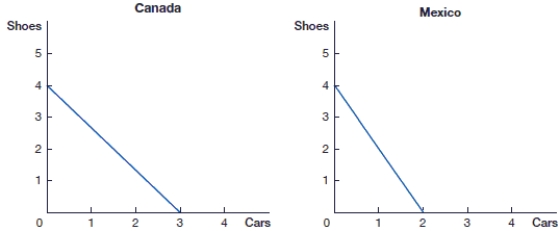
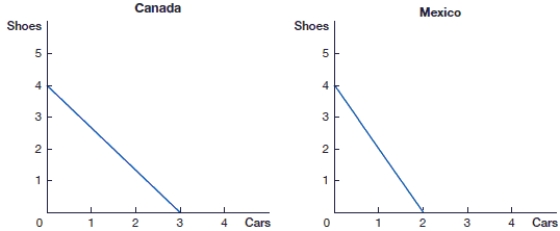
(Figure: Production Possibilities Frontier) In the figure, if Mexico specializes, it can produce either _____ shoes or _____ cars.
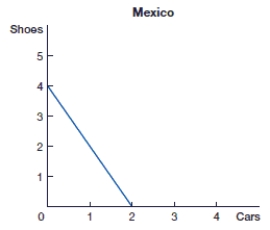
A) four; three
B) three; four
C) two; four
D) four; two
A) four; three
B) three; four
C) two; four
D) four; two
Question
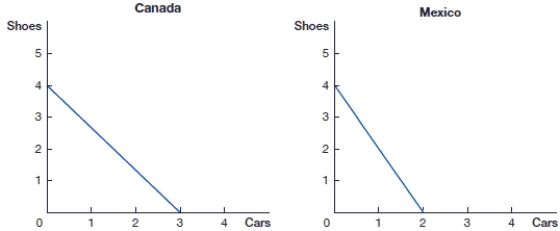
(Figure: Production Possibilities Frontier 2) In the figure, if Canada specializes it can produce either _____ shoes or _____ cars.
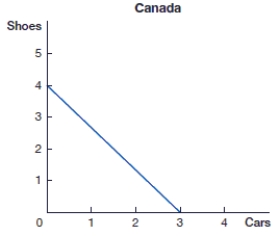
A) four; three
B) three four
C) two; four
D) four; two
A) four; three
B) three four
C) two; four
D) four; two
Question
(Figure: Production Possibilities Frontier) In the figure, without trade Mexico can produce _____ shoes and _____ cars.
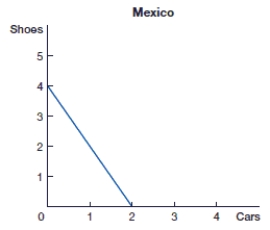
A) three; three
B) two; one
C) one; three
D) zero; four
A) three; three
B) two; one
C) one; three
D) zero; four
Question
(Figure: Production Possibilities Frontier) In the figure, for each pair of shoes that Mexico produces, the opportunity cost is:
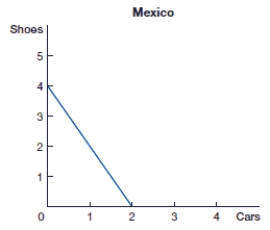
A) half a car.
B) one car.
C) one and a half cars.
D) two cars.
A) half a car.
B) one car.
C) one and a half cars.
D) two cars.
Question
(Figure: PPF) In the figure, _____ a comparative advantage in making shoes.
A) Canada has
B) Mexico has
C) neither country has
D) both countries have
A) Canada has
B) Mexico has
C) neither country has
D) both countries have
Question
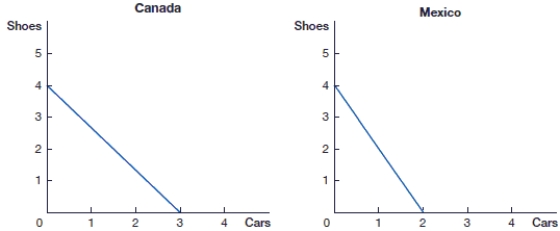
(Figure: PPF) In the figure, _____ a comparative advantage in making cars.
A) Canada has
B) Mexico has
C) neither country has
D) both countries have
A) Canada has
B) Mexico has
C) neither country has
D) both countries have
Question
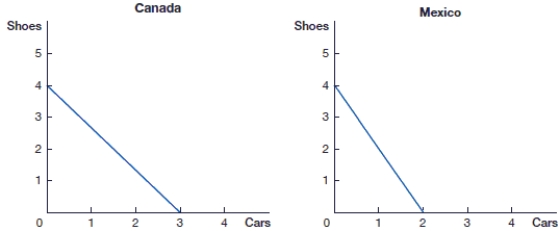
(Figure: PPF) In the figure, _____ should export shoes.
A) Canada
B) Mexico
C) neither country
D) both countries
A) Canada
B) Mexico
C) neither country
D) both countries
Question
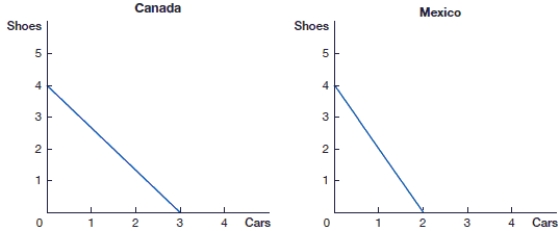
(Figure: PPF) In the figure, _____ should export cars.
A) Canada
B) Mexico
C) neither country
D) both countries
A) Canada
B) Mexico
C) neither country
D) both countries
Question
(Figure: PPF) In the figure, with specialization and terms of trade of 3 shoes for 2 cars, Mexico can consume _____ shoe(s) and _____ car(s).
A) 1; 2
B) 2; 2
C) 3; 1
D) 4; 1
A) 1; 2
B) 2; 2
C) 3; 1
D) 4; 1
Question
(Figure: PPF) In the figure, with specialization and terms of trade of 3 shoes for 2 cars, Canada can consume _____ shoe(s) and _____ car(s).
A) 1; 2
B) 2; 2
C) 3; 1
D) 4; 1
A) 1; 2
B) 2; 2
C) 3; 1
D) 4; 1
Question
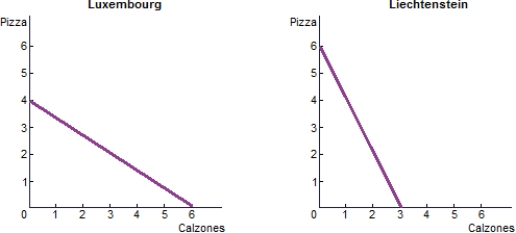
(Figure: PPF0) In the figure, _____ a comparative advantage in making pizza.
A) Luxembourg has
B) Liechtenstein has
C) neither country has
D) both countries have
A) Luxembourg has
B) Liechtenstein has
C) neither country has
D) both countries have
Question
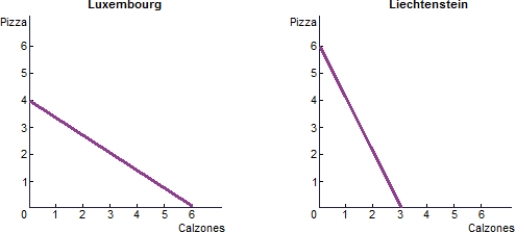
(Figure: PPF0) In the figure, _____ a comparative advantage in making calzones.
A) Luxembourg has
B) Liechtenstein has
C) neither country has
D) both countries have
A) Luxembourg has
B) Liechtenstein has
C) neither country has
D) both countries have
Question
(Figure: PPF0) In the figure, _____ should export calzones.
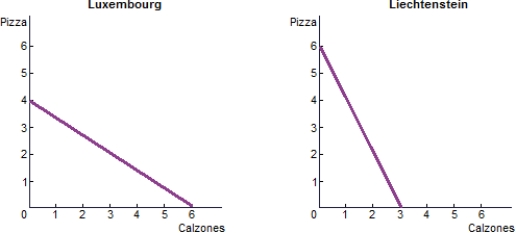
A) Luxembourg
B) Liechtenstein
C) neither country
D) both countries
A) Luxembourg
B) Liechtenstein
C) neither country
D) both countries
Question
(Figure: PPF0) In the figure, _____ should export pizzas.
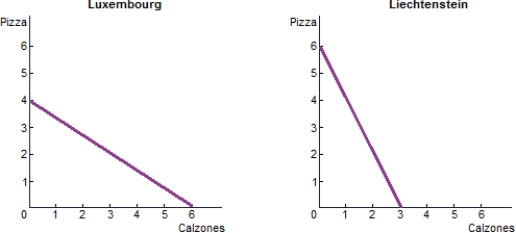
A) Luxembourg
B) Liechtenstein
C) neither country
D) both countries
A) Luxembourg
B) Liechtenstein
C) neither country
D) both countries
Question
(Figure: PPF0) In the figure, with specialization and terms of trade of 2 pizza for 2 calzone, Luxembourg can consume _____ pizza(s) and _____ calzone(s).
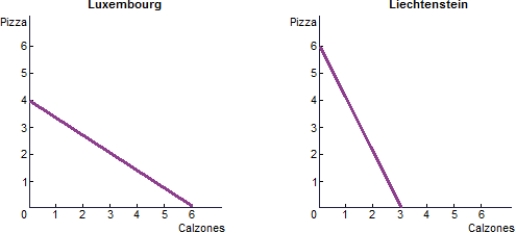
A) 2; 3
B) 2; 4
C) 4; 3
D) 4; 6
A) 2; 3
B) 2; 4
C) 4; 3
D) 4; 6
Question
(Figure: PPF0) In the figure, with specialization and terms of trade of 3 pizza for 3 calzone, Liechtenstein can consume _____ pizza(s) and _____ calzone(s).
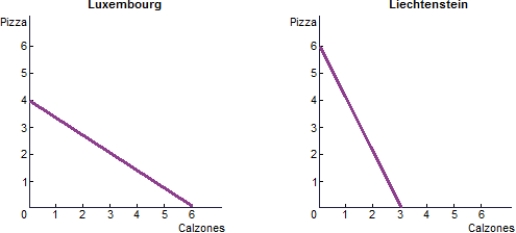
A) 1; 6
B) 2; 3
C) 3; 3
D) 6; 3
A) 1; 6
B) 2; 3
C) 3; 3
D) 6; 3
Question
Question
Question
Question
Question
Question
Question
Question
Question
Question
Question
Question
Question
Question
Question
Question
Question
Question
Question
Question
Question
Question
Question
Question
Question
Question
Question
Question
Question
Question
Question
Question
Question
Question
Question
Question
Question
Question
Question
Question
Question
Question
Question
Question
Question
Question
Question
Question
Question
Question
Question
Question
Question
Question
Question

Unlock Deck
Sign up to unlock the cards in this deck!
Unlock Deck
Unlock Deck
1/127

Play

Full screen (f)
Deck 31: International Trade
1
The top four trading partners of the United States include Canada, Mexico, China, and:
A) Japan.
B) Ireland.
C) Brazil.
D) Ukraine.
A) Japan.
B) Ireland.
C) Brazil.
D) Ukraine.
A
2
The United States exports more to:
A) Japan than to Mexico.
B) Germany than to the United Kingdom.
C) Canada than to China.
D) Mexico than to Canada.
A) Japan than to Mexico.
B) Germany than to the United Kingdom.
C) Canada than to China.
D) Mexico than to Canada.
C
3
The United States imports more from
A) Japan than from Mexico.
B) South Korea than from Germany.
C) Canada than from China.
D) China than from Japan.
A) Japan than from Mexico.
B) South Korea than from Germany.
C) Canada than from China.
D) China than from Japan.
D
4
_____ advantage is the ability to produce a product at a lower opportunity cost than a trading partner can.
A) Comparative
B) Absolute
C) Equal
D) Production
A) Comparative
B) Absolute
C) Equal
D) Production
Unlock Deck
Unlock for access to all 127 flashcards in this deck.
Unlock Deck
k this deck
5
In constructing a production possibilities frontier model, only _____ considered.
A) one good is
B) two goods are
C) three goods are
D) four goods are
A) one good is
B) two goods are
C) three goods are
D) four goods are
Unlock Deck
Unlock for access to all 127 flashcards in this deck.
Unlock Deck
k this deck
6
Consider a production possibilities frontier model for Mexico and Canada where each country makes only two goods - cars and shoes. If Mexico puts all of its resources into making shoes, it would be able to make:
A) zero cars.
B) one car.
C) two cars.
D) three cars.
A) zero cars.
B) one car.
C) two cars.
D) three cars.
Unlock Deck
Unlock for access to all 127 flashcards in this deck.
Unlock Deck
k this deck
7
Every production decision involves _____ cost.
A) a temporary
B) a permanent
C) an opportunity
D) a sunk
A) a temporary
B) a permanent
C) an opportunity
D) a sunk
Unlock Deck
Unlock for access to all 127 flashcards in this deck.
Unlock Deck
k this deck
8
If one country can produce a product at a lower opportunity cost relative to another country, it has ____ advantage over the other country.
A) a comparative
B) an absolute
C) an equal
D) a production
A) a comparative
B) an absolute
C) an equal
D) a production
Unlock Deck
Unlock for access to all 127 flashcards in this deck.
Unlock Deck
k this deck
9
Comparative advantage is measured in terms of _____ cost.
A) production
B) absolute
C) equal
D) relative
A) production
B) absolute
C) equal
D) relative
Unlock Deck
Unlock for access to all 127 flashcards in this deck.
Unlock Deck
k this deck
10
(Figure: Production Possibilities Frontier) In the figure, if Mexico specializes, it can produce either _____ shoes or _____ cars.
A) four; three
B) three; four
C) two; four
D) four; two
A) four; three
B) three; four
C) two; four
D) four; two
Unlock Deck
Unlock for access to all 127 flashcards in this deck.
Unlock Deck
k this deck
11
(Figure: Production Possibilities Frontier 2) In the figure, if Canada specializes it can produce either _____ shoes or _____ cars.
A) four; three
B) three four
C) two; four
D) four; two
A) four; three
B) three four
C) two; four
D) four; two
Unlock Deck
Unlock for access to all 127 flashcards in this deck.
Unlock Deck
k this deck
12
(Figure: Production Possibilities Frontier) In the figure, without trade Mexico can produce _____ shoes and _____ cars.
A) three; three
B) two; one
C) one; three
D) zero; four
A) three; three
B) two; one
C) one; three
D) zero; four
Unlock Deck
Unlock for access to all 127 flashcards in this deck.
Unlock Deck
k this deck
13
(Figure: Production Possibilities Frontier) In the figure, for each pair of shoes that Mexico produces, the opportunity cost is:
A) half a car.
B) one car.
C) one and a half cars.
D) two cars.
A) half a car.
B) one car.
C) one and a half cars.
D) two cars.
Unlock Deck
Unlock for access to all 127 flashcards in this deck.
Unlock Deck
k this deck
14
(Figure: PPF) In the figure, _____ a comparative advantage in making shoes.
A) Canada has
B) Mexico has
C) neither country has
D) both countries have
A) Canada has
B) Mexico has
C) neither country has
D) both countries have
Unlock Deck
Unlock for access to all 127 flashcards in this deck.
Unlock Deck
k this deck
15
(Figure: PPF) In the figure, _____ a comparative advantage in making cars.
A) Canada has
B) Mexico has
C) neither country has
D) both countries have
A) Canada has
B) Mexico has
C) neither country has
D) both countries have
Unlock Deck
Unlock for access to all 127 flashcards in this deck.
Unlock Deck
k this deck
16
(Figure: PPF) In the figure, _____ should export shoes.
A) Canada
B) Mexico
C) neither country
D) both countries
A) Canada
B) Mexico
C) neither country
D) both countries
Unlock Deck
Unlock for access to all 127 flashcards in this deck.
Unlock Deck
k this deck
17
(Figure: PPF) In the figure, _____ should export cars.
A) Canada
B) Mexico
C) neither country
D) both countries
A) Canada
B) Mexico
C) neither country
D) both countries
Unlock Deck
Unlock for access to all 127 flashcards in this deck.
Unlock Deck
k this deck
18
(Figure: PPF) In the figure, with specialization and terms of trade of 3 shoes for 2 cars, Mexico can consume _____ shoe(s) and _____ car(s).
A) 1; 2
B) 2; 2
C) 3; 1
D) 4; 1
A) 1; 2
B) 2; 2
C) 3; 1
D) 4; 1
Unlock Deck
Unlock for access to all 127 flashcards in this deck.
Unlock Deck
k this deck
19
(Figure: PPF) In the figure, with specialization and terms of trade of 3 shoes for 2 cars, Canada can consume _____ shoe(s) and _____ car(s).
A) 1; 2
B) 2; 2
C) 3; 1
D) 4; 1
A) 1; 2
B) 2; 2
C) 3; 1
D) 4; 1
Unlock Deck
Unlock for access to all 127 flashcards in this deck.
Unlock Deck
k this deck
20
(Figure: PPF0) In the figure, _____ a comparative advantage in making pizza.
A) Luxembourg has
B) Liechtenstein has
C) neither country has
D) both countries have
A) Luxembourg has
B) Liechtenstein has
C) neither country has
D) both countries have
Unlock Deck
Unlock for access to all 127 flashcards in this deck.
Unlock Deck
k this deck
21
(Figure: PPF0) In the figure, _____ a comparative advantage in making calzones.
A) Luxembourg has
B) Liechtenstein has
C) neither country has
D) both countries have
A) Luxembourg has
B) Liechtenstein has
C) neither country has
D) both countries have
Unlock Deck
Unlock for access to all 127 flashcards in this deck.
Unlock Deck
k this deck
22
(Figure: PPF0) In the figure, _____ should export calzones.
A) Luxembourg
B) Liechtenstein
C) neither country
D) both countries
A) Luxembourg
B) Liechtenstein
C) neither country
D) both countries
Unlock Deck
Unlock for access to all 127 flashcards in this deck.
Unlock Deck
k this deck
23
(Figure: PPF0) In the figure, _____ should export pizzas.
A) Luxembourg
B) Liechtenstein
C) neither country
D) both countries
A) Luxembourg
B) Liechtenstein
C) neither country
D) both countries
Unlock Deck
Unlock for access to all 127 flashcards in this deck.
Unlock Deck
k this deck
24
(Figure: PPF0) In the figure, with specialization and terms of trade of 2 pizza for 2 calzone, Luxembourg can consume _____ pizza(s) and _____ calzone(s).
A) 2; 3
B) 2; 4
C) 4; 3
D) 4; 6
A) 2; 3
B) 2; 4
C) 4; 3
D) 4; 6
Unlock Deck
Unlock for access to all 127 flashcards in this deck.
Unlock Deck
k this deck
25
(Figure: PPF0) In the figure, with specialization and terms of trade of 3 pizza for 3 calzone, Liechtenstein can consume _____ pizza(s) and _____ calzone(s).
A) 1; 6
B) 2; 3
C) 3; 3
D) 6; 3
A) 1; 6
B) 2; 3
C) 3; 3
D) 6; 3
Unlock Deck
Unlock for access to all 127 flashcards in this deck.
Unlock Deck
k this deck
26
The opportunity cost of a good on the x-axis of a production possibilities frontier is the _____ of the production possibility frontier.
A) x-intercept
B) y-intercept
C) slope
D) inverse of the slope
A) x-intercept
B) y-intercept
C) slope
D) inverse of the slope
Unlock Deck
Unlock for access to all 127 flashcards in this deck.
Unlock Deck
k this deck
27
The opportunity cost of a good on the y-axis of a production possibilities frontier is the _____ of the production possibility frontier.
A) x-intercept
B) y-intercept
C) slope
D) inverse of the slope
A) x-intercept
B) y-intercept
C) slope
D) inverse of the slope
Unlock Deck
Unlock for access to all 127 flashcards in this deck.
Unlock Deck
k this deck
28
_____ allows countries to consume beyond their production possibilities frontier.
A) Absolute advantage
B) A fixed level of resources
C) Free trade
D) Marketing
A) Absolute advantage
B) A fixed level of resources
C) Free trade
D) Marketing
Unlock Deck
Unlock for access to all 127 flashcards in this deck.
Unlock Deck
k this deck
29
_____ is the amount of one country's good that is exchanged for a different good from another country.
A) The terms of trade
B) The exchange rate
C) Free trade
D) Money
A) The terms of trade
B) The exchange rate
C) Free trade
D) Money
Unlock Deck
Unlock for access to all 127 flashcards in this deck.
Unlock Deck
k this deck
30
_____ advantage is the ability to produce more of a product than a trading partner with an equivalent amount of resources.
A) Comparative
B) Absolute
C) Equal
D) Production
A) Comparative
B) Absolute
C) Equal
D) Production
Unlock Deck
Unlock for access to all 127 flashcards in this deck.
Unlock Deck
k this deck
31
Absolute advantage is the ability to produce:
A) a product at a lower opportunity cost than a trading partner can.
B) more of a product than a trading partner with an equivalent amount of resources.
C) an equal amount of a product as a trading partner with an equivalent amount of resources can produce.
D) none of a product that a trading partner with an equivalent amount of resources can produce.
A) a product at a lower opportunity cost than a trading partner can.
B) more of a product than a trading partner with an equivalent amount of resources.
C) an equal amount of a product as a trading partner with an equivalent amount of resources can produce.
D) none of a product that a trading partner with an equivalent amount of resources can produce.
Unlock Deck
Unlock for access to all 127 flashcards in this deck.
Unlock Deck
k this deck
32
Comparative advantage is the ability to produce:
A) a product at a lower opportunity cost than a trading partner can.
B) more of a product than a trading partner with an equivalent amount of resources.
C) an equal amount of a product as a trading partner can produce with an equivalent amount of resources.
D) none of a product that a trading partner with an equivalent amount of resources can produce.
A) a product at a lower opportunity cost than a trading partner can.
B) more of a product than a trading partner with an equivalent amount of resources.
C) an equal amount of a product as a trading partner can produce with an equivalent amount of resources.
D) none of a product that a trading partner with an equivalent amount of resources can produce.
Unlock Deck
Unlock for access to all 127 flashcards in this deck.
Unlock Deck
k this deck
33
______ advantage is the basis for specialization and trade.
A) Comparative
B) Absolute
C) Equal
D) Production
A) Comparative
B) Absolute
C) Equal
D) Production
Unlock Deck
Unlock for access to all 127 flashcards in this deck.
Unlock Deck
k this deck
34
When two countries trade, total output increases when each country specializes in something in which it has its respective _____ advantage.
A) comparative
B) absolute
C) equal
D) production
A) comparative
B) absolute
C) equal
D) production
Unlock Deck
Unlock for access to all 127 flashcards in this deck.
Unlock Deck
k this deck
35
If both Mexico and Canada produce shoes and cars but Mexico has a comparative advantage in shoes and Canada has a comparative advantage in cars, then Mexico should trade _____, and Canada should trade:
A) shoes; shoes.
B) cars; cars.
C) shoes; cars.
D) cars; shoes.
A) shoes; shoes.
B) cars; cars.
C) shoes; cars.
D) cars; shoes.
Unlock Deck
Unlock for access to all 127 flashcards in this deck.
Unlock Deck
k this deck
36
A _____ game is where the gains or losses of one player are exactly offset by the gains or losses of another player.
A) zero sum
B) non-zero-sum
C) win-win
D) lose-lose
A) zero sum
B) non-zero-sum
C) win-win
D) lose-lose
Unlock Deck
Unlock for access to all 127 flashcards in this deck.
Unlock Deck
k this deck
37
Trade between two countries is generally a _____ situation.
A) zero-sum
B) non-zero-sum
C) win-win
D) lose-lose
A) zero-sum
B) non-zero-sum
C) win-win
D) lose-lose
Unlock Deck
Unlock for access to all 127 flashcards in this deck.
Unlock Deck
k this deck
38
In the United States, one source of competitive advantage is _____ because it has relatively more college graduates than many other countries.
A) natural resources
B) technological know-how
C) abundant labor
D) business environment
A) natural resources
B) technological know-how
C) abundant labor
D) business environment
Unlock Deck
Unlock for access to all 127 flashcards in this deck.
Unlock Deck
k this deck
39
In Saudi Arabia, one source of competitive advantage is _____ because it has plentiful supplies of crude oil reserves.
A) natural resources
B) technological know-how
C) abundant labor
D) business environment
A) natural resources
B) technological know-how
C) abundant labor
D) business environment
Unlock Deck
Unlock for access to all 127 flashcards in this deck.
Unlock Deck
k this deck
40
In India, one source of competitive advantage is _____ because it has the second highest population in the world.
A) natural resources
B) technological know-how
C) abundant labor
D) business environment
A) natural resources
B) technological know-how
C) abundant labor
D) business environment
Unlock Deck
Unlock for access to all 127 flashcards in this deck.
Unlock Deck
k this deck
41
In Luxembourg, one source of competitive advantage is _____ because it has very favorable tax laws.
A) natural resources
B) technological know-how
C) abundant labor
D) business environment
A) natural resources
B) technological know-how
C) abundant labor
D) business environment
Unlock Deck
Unlock for access to all 127 flashcards in this deck.
Unlock Deck
k this deck
42
_____ a source of competitive advantage as illustrated by two countries, France and the United States, which assemble most of the world's large passenger airplanes.
A) Physical capital is
B) Technological know-how is
C) Economies of scale are
D) Business environments are
A) Physical capital is
B) Technological know-how is
C) Economies of scale are
D) Business environments are
Unlock Deck
Unlock for access to all 127 flashcards in this deck.
Unlock Deck
k this deck
43
_____ surplus is the buyer's gain from a purchase.
A) Consumer
B) Producer
C) Total
D) Business
A) Consumer
B) Producer
C) Total
D) Business
Unlock Deck
Unlock for access to all 127 flashcards in this deck.
Unlock Deck
k this deck
44
_____ surplus is the seller's gain from a sale.
A) Consumer
B) Producer
C) Total
D) Business
A) Consumer
B) Producer
C) Total
D) Business
Unlock Deck
Unlock for access to all 127 flashcards in this deck.
Unlock Deck
k this deck
45
On a graph, _____ surplus is measured as the space between the demand curve and equilibrium price line.
A) consumer
B) producer
C) total
D) business
A) consumer
B) producer
C) total
D) business
Unlock Deck
Unlock for access to all 127 flashcards in this deck.
Unlock Deck
k this deck
46
On a graph, _____ surplus is measured as the space between the supply curve and equilibrium price line.
A) consumer
B) producer
C) total
D) business
A) consumer
B) producer
C) total
D) business
Unlock Deck
Unlock for access to all 127 flashcards in this deck.
Unlock Deck
k this deck
47
The _____ price of a good is its prevailing price in international markets.
A) U.S. consumer
B) producer
C) domestic
D) world
A) U.S. consumer
B) producer
C) domestic
D) world
Unlock Deck
Unlock for access to all 127 flashcards in this deck.
Unlock Deck
k this deck
48
The _____ price of a good is its home country price.
A) U.S. consumer
B) producer
C) domestic
D) world
A) U.S. consumer
B) producer
C) domestic
D) world
Unlock Deck
Unlock for access to all 127 flashcards in this deck.
Unlock Deck
k this deck
49
The _____ price occurs under self-sufficiency and where domestic supply equals domestic demand.
A) U.S. consumer
B) producer
C) home country
D) world
A) U.S. consumer
B) producer
C) home country
D) world
Unlock Deck
Unlock for access to all 127 flashcards in this deck.
Unlock Deck
k this deck
50
The _____ price is determined by global demand for and global supply of the product.
A) U.S. consumer
B) producer
C) home country
D) world
A) U.S. consumer
B) producer
C) home country
D) world
Unlock Deck
Unlock for access to all 127 flashcards in this deck.
Unlock Deck
k this deck
51
When the world price of a product is higher than the domestic price, with international trade domestic consumers will pay a _____ domestic price, and domestic producers will generally _____ the product.
A) higher; export
B) lower; export
C) higher; import
D) lower; import
A) higher; export
B) lower; export
C) higher; import
D) lower; import
Unlock Deck
Unlock for access to all 127 flashcards in this deck.
Unlock Deck
k this deck
52
With international trade, a higher world price will ultimately _____ quantity demanded in the domestic country and _____ quantity exported.
A) lower; increase
B) lower; decrease
C) raise; increase
D) raise; decrease
A) lower; increase
B) lower; decrease
C) raise; increase
D) raise; decrease
Unlock Deck
Unlock for access to all 127 flashcards in this deck.
Unlock Deck
k this deck
53
Society as a whole benefits from _____ products when the domestic price is _____ the world price.
A) importing; equal to
B) importing; higher than
C) exporting; higher than
D) exporting; equal to
A) importing; equal to
B) importing; higher than
C) exporting; higher than
D) exporting; equal to
Unlock Deck
Unlock for access to all 127 flashcards in this deck.
Unlock Deck
k this deck
54
Gains from trade can occur when a society _____ products when the domestic price is _____ the world price.
A) imports; higher than
B) imports; equal to
C) exports; higher than
D) exports; equal to
A) imports; higher than
B) imports; equal to
C) exports; higher than
D) exports; equal to
Unlock Deck
Unlock for access to all 127 flashcards in this deck.
Unlock Deck
k this deck
55
When the world price is lower than the domestic price, domestic producers are:
A) satisfied.
B) harmed.
C) unaffected.
D) very happy.
A) satisfied.
B) harmed.
C) unaffected.
D) very happy.
Unlock Deck
Unlock for access to all 127 flashcards in this deck.
Unlock Deck
k this deck
56
Complete specialization by countries does not occur because:
A) countries want to protect domestic producers.
B) international markets cannot support specialization.
C) governments of some countries do not support international trade.
D) some goods, such as services, cannot be cost-effectively traded globally.
A) countries want to protect domestic producers.
B) international markets cannot support specialization.
C) governments of some countries do not support international trade.
D) some goods, such as services, cannot be cost-effectively traded globally.
Unlock Deck
Unlock for access to all 127 flashcards in this deck.
Unlock Deck
k this deck
57
_____ are goods that cannot be cost-effectively traded globally, which thus prevents complete specialization by a country.
A) Automobiles
B) Agriculture products
C) Haircuts
D) Oil products
A) Automobiles
B) Agriculture products
C) Haircuts
D) Oil products
Unlock Deck
Unlock for access to all 127 flashcards in this deck.
Unlock Deck
k this deck
58
Italy's production of exotic sports cars is an example of the _____ reason that complete specialization by countries does not occur.
A) lack of cost-effectiveness in trading some goods such as services
B) variation in technical skills from country to country
C) variation in consumer preferences
D) transportation costs
A) lack of cost-effectiveness in trading some goods such as services
B) variation in technical skills from country to country
C) variation in consumer preferences
D) transportation costs
Unlock Deck
Unlock for access to all 127 flashcards in this deck.
Unlock Deck
k this deck
59
The inability of a haircut to be easily traded is an example of the _____ reason that complete specialization by countries does not occur.
A) lack of cost-effectiveness in trading some goods such as services
B) variation in technical skills from country to country
C) variation in consumer preferences
D) transportation costs
A) lack of cost-effectiveness in trading some goods such as services
B) variation in technical skills from country to country
C) variation in consumer preferences
D) transportation costs
Unlock Deck
Unlock for access to all 127 flashcards in this deck.
Unlock Deck
k this deck
60
Some people prefer to buy products made domestically, and others prefer the attributes of products that are made elsewhere. This is an example of the _____ reason that complete specialization by countries does not occur.
A) lack of cost-effectiveness in trading some goods such as services
B) variation in technical skills from country to country
C) variation in consumer preferences
D) transportation costs
A) lack of cost-effectiveness in trading some goods such as services
B) variation in technical skills from country to country
C) variation in consumer preferences
D) transportation costs
Unlock Deck
Unlock for access to all 127 flashcards in this deck.
Unlock Deck
k this deck
61
In a situation where it costs the same to produce a boat domestically as it does to produce it in another country, the boat will generally be produced locally due to _____, a reason that complete specialization by countries does not occur.
A) a lack of cost-effectiveness in trading some goods such as services
B) a variation in technical skills from country to country
C) difference in absolute advantage
D) transportation costs
A) a lack of cost-effectiveness in trading some goods such as services
B) a variation in technical skills from country to country
C) difference in absolute advantage
D) transportation costs
Unlock Deck
Unlock for access to all 127 flashcards in this deck.
Unlock Deck
k this deck
62
A restaurant meal is a good that generally is not traded globally due to _____, a reason that complete specialization by countries does not occur.
A) a lack of cost-effectiveness in trading some goods such as services
B) a variation in technical skills from country to country
C) difference in absolute advantage
D) transportation costs
A) a lack of cost-effectiveness in trading some goods such as services
B) a variation in technical skills from country to country
C) difference in absolute advantage
D) transportation costs
Unlock Deck
Unlock for access to all 127 flashcards in this deck.
Unlock Deck
k this deck
63
Complete specialization by countries does not occur because:
A) countries want to protect domestic producers.
B) services can be cost-effectively traded globally.
C) governments often do not support international trade.
D) technical skills vary greatly from country to country.
A) countries want to protect domestic producers.
B) services can be cost-effectively traded globally.
C) governments often do not support international trade.
D) technical skills vary greatly from country to country.
Unlock Deck
Unlock for access to all 127 flashcards in this deck.
Unlock Deck
k this deck
64
Complete specialization by countries does not occur because:
A) countries want to protect domestic producers.
B) services can be cost-effectively traded globally.
C) consumer preferences vary.
D) technical skills are similar from country to country.
A) countries want to protect domestic producers.
B) services can be cost-effectively traded globally.
C) consumer preferences vary.
D) technical skills are similar from country to country.
Unlock Deck
Unlock for access to all 127 flashcards in this deck.
Unlock Deck
k this deck
65
Complete specialization by countries does not occur because:
A) countries want to protect domestic producers.
B) transportation costs can be high.
C) consumer preferences do not vary much.
D) technical skills are similar from country to country.
A) countries want to protect domestic producers.
B) transportation costs can be high.
C) consumer preferences do not vary much.
D) technical skills are similar from country to country.
Unlock Deck
Unlock for access to all 127 flashcards in this deck.
Unlock Deck
k this deck
66
The practice of using uniform, secure containers that can switch between shipping goods via rail, ship, and trucks and greatly reduce shipping costs is known as _____, an invention that changed the nature of global trade.
A) containerization
B) a box
C) a receptacle
D) repository
A) containerization
B) a box
C) a receptacle
D) repository
Unlock Deck
Unlock for access to all 127 flashcards in this deck.
Unlock Deck
k this deck
67
_____ is the use of government policy to protect domestic businesses from foreign competition.
A) Export tariff
B) Protectionism
C) Export quota
D) Registration
A) Export tariff
B) Protectionism
C) Export quota
D) Registration
Unlock Deck
Unlock for access to all 127 flashcards in this deck.
Unlock Deck
k this deck
68
Protectionism is:
A) the suggestion that importers should obtain a license in order to engage in international trade.
B) the relaxing of restrictions on imports.
C) the use of government policy to protect domestic businesses from foreign competition.
D) a tax on exports.
A) the suggestion that importers should obtain a license in order to engage in international trade.
B) the relaxing of restrictions on imports.
C) the use of government policy to protect domestic businesses from foreign competition.
D) a tax on exports.
Unlock Deck
Unlock for access to all 127 flashcards in this deck.
Unlock Deck
k this deck
69
_____ is a tax on imports that is imposed by the importing country.
A) A tariff
B) A voluntary export agreement
C) A quota
D) An import license
A) A tariff
B) A voluntary export agreement
C) A quota
D) An import license
Unlock Deck
Unlock for access to all 127 flashcards in this deck.
Unlock Deck
k this deck
70
_____ is a quantity restriction on imports that is imposed by the importing country.
A) A tariff
B) A voluntary export agreement
C) A quota
D) An import license
A) A tariff
B) A voluntary export agreement
C) A quota
D) An import license
Unlock Deck
Unlock for access to all 127 flashcards in this deck.
Unlock Deck
k this deck
71
_____ is a law that requires importers to obtain permission to engage in international trade.
A) A tariff
B) A voluntary export agreement
C) A quota
D) An import license
A) A tariff
B) A voluntary export agreement
C) A quota
D) An import license
Unlock Deck
Unlock for access to all 127 flashcards in this deck.
Unlock Deck
k this deck
72
_____ is a quantity restriction on imports that is imposed by negotiating with the foreign exporting country to freely restrict its exports.
A) A tariff
B) A voluntary export agreement
C) A quota
D) An import license
A) A tariff
B) A voluntary export agreement
C) A quota
D) An import license
Unlock Deck
Unlock for access to all 127 flashcards in this deck.
Unlock Deck
k this deck
73
A voluntary export agreement is:
A) a requirement that importers obtain a license in order to engage in international trade.
B) a quantity restriction on imports that is negotiated with the foreign exporting country to freely restrict its exports.
C) the use of government policy to protect domestic businesses from foreign competition.
D) a tax on imports.
A) a requirement that importers obtain a license in order to engage in international trade.
B) a quantity restriction on imports that is negotiated with the foreign exporting country to freely restrict its exports.
C) the use of government policy to protect domestic businesses from foreign competition.
D) a tax on imports.
Unlock Deck
Unlock for access to all 127 flashcards in this deck.
Unlock Deck
k this deck
74
An import license is:
A) a requirement that importers obtain a license in order to engage in international trade.
B) a quantity restriction on imports that is negotiated with the foreign exporting country to freely restrict its exports.
C) the use of government policy to protect domestic businesses from foreign competition.
D) a tax on imports.
A) a requirement that importers obtain a license in order to engage in international trade.
B) a quantity restriction on imports that is negotiated with the foreign exporting country to freely restrict its exports.
C) the use of government policy to protect domestic businesses from foreign competition.
D) a tax on imports.
Unlock Deck
Unlock for access to all 127 flashcards in this deck.
Unlock Deck
k this deck
75
A quota is:
A) a requirement that importers obtain a license in order to engage in international trade.
B) a quantity restriction on imports that is imposed by the importing country.
C) the use of government policy to protect domestic businesses from foreign competition.
D) a tax on imports.
A) a requirement that importers obtain a license in order to engage in international trade.
B) a quantity restriction on imports that is imposed by the importing country.
C) the use of government policy to protect domestic businesses from foreign competition.
D) a tax on imports.
Unlock Deck
Unlock for access to all 127 flashcards in this deck.
Unlock Deck
k this deck
76
A tariff is:
A) a requirement that importers obtain a license in order to engage in international trade.
B) a quantity restriction on imports that is imposed by the importing country.
C) the use of government policy to protect domestic businesses from foreign competition.
D) a tax on imports.
A) a requirement that importers obtain a license in order to engage in international trade.
B) a quantity restriction on imports that is imposed by the importing country.
C) the use of government policy to protect domestic businesses from foreign competition.
D) a tax on imports.
Unlock Deck
Unlock for access to all 127 flashcards in this deck.
Unlock Deck
k this deck
77
Which of the following situations is an example of a voluntary export restraint?
A) Japan agrees to limit the number of automobiles that it exports to the United States.
B) The United States places a tax on textiles from China.
C) Canada limits the amount of steel that can be imported.
D) Sweden requires domestic firms to obtain a permit before they can export certain chemicals.
A) Japan agrees to limit the number of automobiles that it exports to the United States.
B) The United States places a tax on textiles from China.
C) Canada limits the amount of steel that can be imported.
D) Sweden requires domestic firms to obtain a permit before they can export certain chemicals.
Unlock Deck
Unlock for access to all 127 flashcards in this deck.
Unlock Deck
k this deck
78
Which of the following situations is an example of a quota?
A) Japan agrees to limit the number of automobiles that it exports to the United States.
B) The United States places a tax on textiles from China.
C) Canada limits the amount of steel that can be imported.
D) Sweden requires domestic firms to obtain a permit before they can export certain chemicals.
A) Japan agrees to limit the number of automobiles that it exports to the United States.
B) The United States places a tax on textiles from China.
C) Canada limits the amount of steel that can be imported.
D) Sweden requires domestic firms to obtain a permit before they can export certain chemicals.
Unlock Deck
Unlock for access to all 127 flashcards in this deck.
Unlock Deck
k this deck
79
Which of the following situations is an example of a tariff?
A) Japan agrees to limit the number of automobiles that it exports to the United States.
B) The United States places a tax on textiles from China.
C) Canada limits the amount of steel that can be imported.
D) Sweden requires domestic firms to obtain a permit before they can export certain chemicals.
A) Japan agrees to limit the number of automobiles that it exports to the United States.
B) The United States places a tax on textiles from China.
C) Canada limits the amount of steel that can be imported.
D) Sweden requires domestic firms to obtain a permit before they can export certain chemicals.
Unlock Deck
Unlock for access to all 127 flashcards in this deck.
Unlock Deck
k this deck
80
Which of the following situations is an example of an import license?
A) Japan agrees to limit the number of automobiles that it exports to the United States.
B) The United States places a tax on textiles from China.
C) Canada limits the amount of steel that can be imported.
D) Sweden requires international firms to obtain a permit before they can import certain chemicals.
A) Japan agrees to limit the number of automobiles that it exports to the United States.
B) The United States places a tax on textiles from China.
C) Canada limits the amount of steel that can be imported.
D) Sweden requires international firms to obtain a permit before they can import certain chemicals.
Unlock Deck
Unlock for access to all 127 flashcards in this deck.
Unlock Deck
k this deck
Unlock Deck
Unlock for access to all 127 flashcards in this deck.






