







 Chat with AI

Deck 24: Modernity and the Road to War, 1890-1914
Full screen (f)

Question

Question
Question
Question
Question
Question
Question
Question
Question
Question
Question
Question
Question
Question
Question
Question
Question
Question
Question
Question
Question
Question
Question
Question
Question
Question
Question
Question
Question
Question
Question
Question
Question
Question
Question
Question
Question
Question
Question
Question
Question
Question
Question
Question
Question
Which of the following statements best describes the migration of Jews during the late nineteenth century?
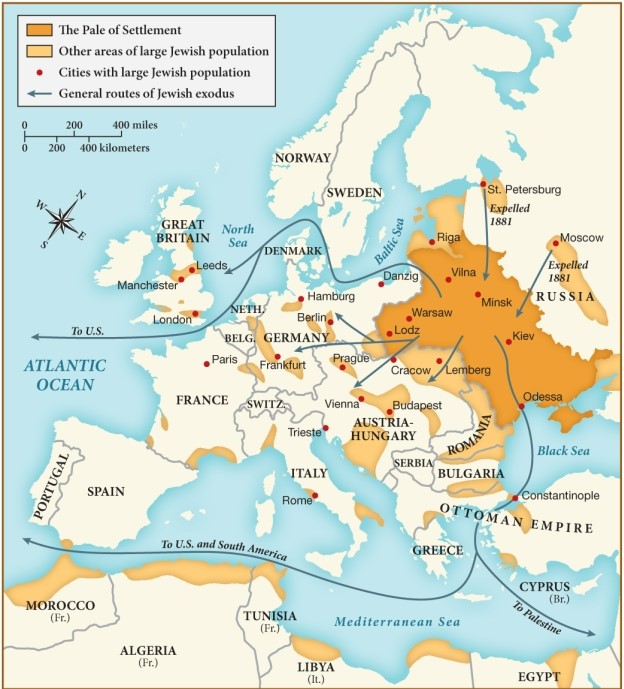
A) Jews migrated south of Europe into Africa, where religion had not been strongly established.
B) Jews primarily migrated out of western Europe, which was predominantly Catholic, to eastern Europe.
C) Jews left their eastern European home countries and migrated south to Middle Eastern territories.
D) Jews primarily migrated out of eastern Europe to the west, even to nations across the Atlantic Ocean.
A) Jews migrated south of Europe into Africa, where religion had not been strongly established.
B) Jews primarily migrated out of western Europe, which was predominantly Catholic, to eastern Europe.
C) Jews left their eastern European home countries and migrated south to Middle Eastern territories.
D) Jews primarily migrated out of eastern Europe to the west, even to nations across the Atlantic Ocean.
Question
Question
Question
This map of Africa in 1914 justifies which of the following statements?
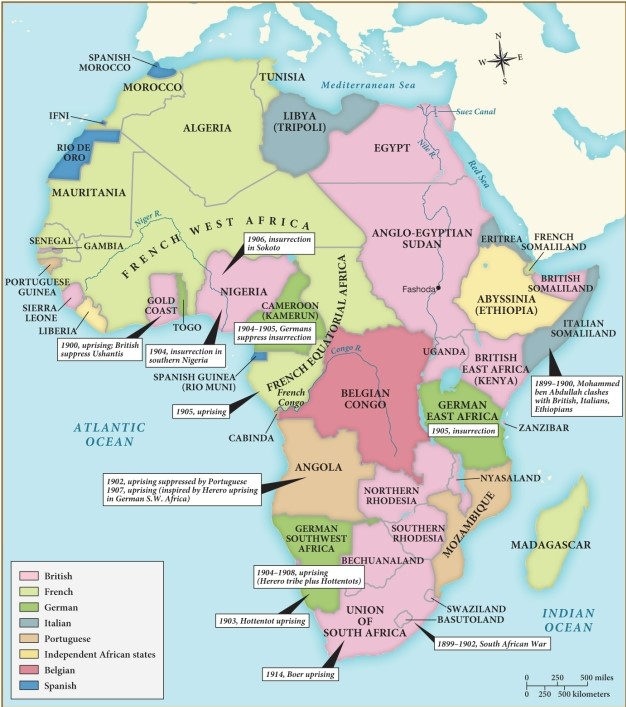
A) The Spanish and the Germans were Africa's major colonizing powers.
B) Africans, like Asians, were challenging their European colonizers at this time.
C) European powers had claimed the entirety of the continent by World War I.
D) Industrialization had begun in earnest in South Africa only in 1914.
A) The Spanish and the Germans were Africa's major colonizing powers.
B) Africans, like Asians, were challenging their European colonizers at this time.
C) European powers had claimed the entirety of the continent by World War I.
D) Industrialization had begun in earnest in South Africa only in 1914.
Question
Question
According to this map, Great Britain controlled which of the following territories during the late nineteenth and early twentieth centuries?
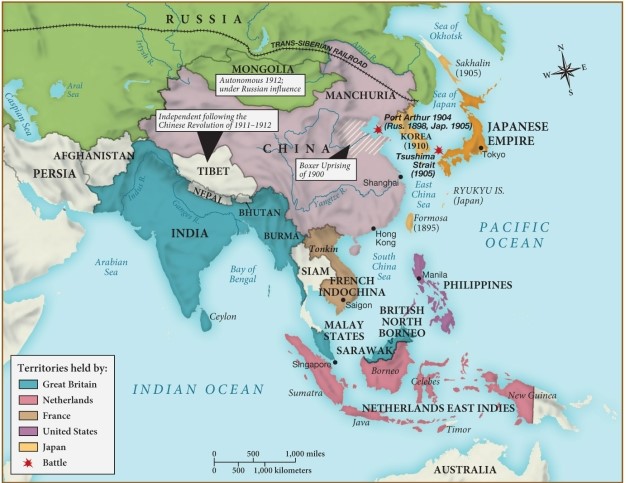
A) Indochina
B) The East Indies
C) India
D) Korea
A) Indochina
B) The East Indies
C) India
D) Korea
Question
Question
Question
Question
Question
Question
Question
Question
Which of the following statements about the Balkans during the early twentieth century is supported by this map?
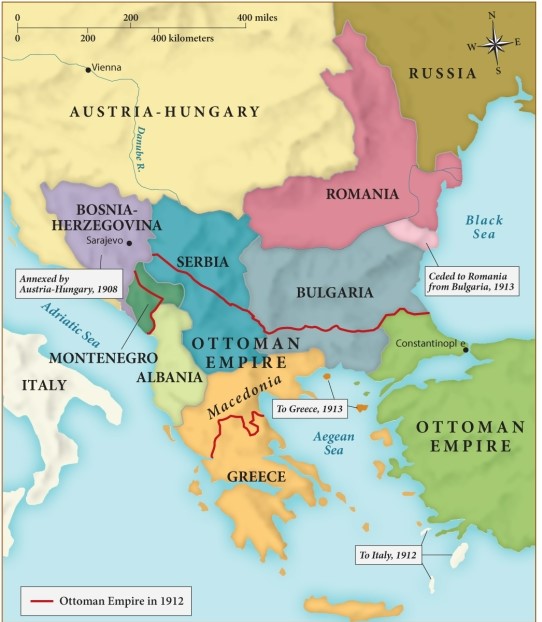
A) The Austro-Hungarian Empire laid claim to smaller nations like Serbia and Bulgaria.
B) Russia had expanded significantly, eclipsing most of Austria-Hungary.
C) By 1912, the Ottoman Empire was composed of ethnically and culturally diverse peoples.
D) Wanting greater influence, Great Britain began to annex territories in the Balkans.
A) The Austro-Hungarian Empire laid claim to smaller nations like Serbia and Bulgaria.
B) Russia had expanded significantly, eclipsing most of Austria-Hungary.
C) By 1912, the Ottoman Empire was composed of ethnically and culturally diverse peoples.
D) Wanting greater influence, Great Britain began to annex territories in the Balkans.
Question
Question
Question
Question
Question
Question
Question
According to this map, which of the following nations was part of the Triple Alliance from 1882 through 1915?
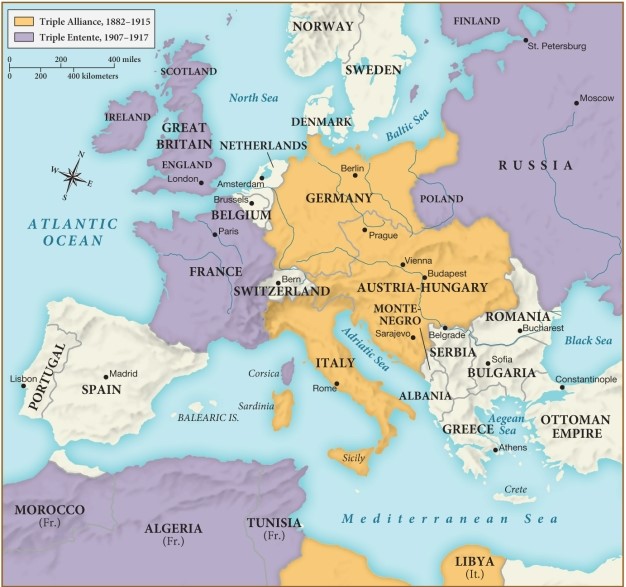
A) Great Britain
B) France
C) Russia
D) Germany
A) Great Britain
B) France
C) Russia
D) Germany

Unlock Deck
Sign up to unlock the cards in this deck!
Unlock Deck
Unlock Deck
1/65

Play

Full screen (f)
Deck 24: Modernity and the Road to War, 1890-1914
1
What concerns did some people have about population and the future of their nations in the late nineteenth century, and how did these concerns affect debates about sexuality?
Answer would ideally include the following. In the late nineteenth century, politicians worried that the declining birthrate was due to a crisis in masculinity, which would put military strength and national security at risk. Additionally, people also worried about a declining birthrate among the upper and middle classes, whom they believed to be morally and intellectually superior. Politicians were concerned about what society would look like if only the "worst" classes grew in number. These concerns surfaced when ideas about women's behavior began to change, moving them away from the model of traditional marriage, domesticity, and motherhood. Similarly, homosexuality also seemed to threaten the traditional family or to emasculate men, thereby further degrading the race.
2
How did the relationship between science and society evolve in the late nineteenth century?
Answer would ideally include the following. Although some late-nineteenth-century philosophers and critics cast doubt on the ability of science to provide satisfactory answers to universal questions, scientific inquiry flourished and the scientific method gained authority, as advances in chemistry and physics, including the discovery of radioactivity and the development of atomic theory, led to Albert Einstein's theory of relativity. Although Einstein and others had to struggle against the scientific establishment to have their ideas accepted, widespread acceptance came in time, along with significant technological advances.
3
How did audiences react to the Paris premiere of Igor Stravinsky's ballet The Rite of Spring and to premieres of musical works by Arnold Schoenberg, and what caused this reaction? How were this style of dance and Schoenberg's music representative of the changes gripping modern music and dance?
Answer would ideally include the following. Audiences for The Rite of Spring and Schoenberg's music were appalled and shouted their disgust during the performances. The reason audiences reacted this way was that these performances intentionally violated existing norms. Instead of polished melodies, graceful dancers, and familiar themes, The Rite of Spring used primitive rhythms and awkward poses, while Schoenberg advocated getting rid of the traditional scale and creating music that was extremely discordant. Both of these examples reflect the motto "Astonish me!" that had been enthusiastically adopted by artists in the early twentieth century.
4
The campaign for women's rights was often divided because not all women saw obtaining the vote as their most pressing need. What were some of the other reforms women sought in the late nineteenth century, and to what extent did social class influence women's perspective on reform?
Unlock Deck
Unlock for access to all 65 flashcards in this deck.
Unlock Deck
k this deck
5
Why are denunciations of Jews and socialists by right-wing and nationalist groups in Germany at the turn of the twentieth century considered a departure from rational debate, and what consequences did such politics have?
Unlock Deck
Unlock for access to all 65 flashcards in this deck.
Unlock Deck
k this deck
6
Why was Japan's decisive defeat of Russia in 1905 so troubling for European nations that might otherwise have been pleased at a check to the tsar's power?
Unlock Deck
Unlock for access to all 65 flashcards in this deck.
Unlock Deck
k this deck
7
What reforms did the Russian prime minister Pyotr Stolypin introduce in order to end peasant unrest, and why did they fail to achieve their purpose?
Unlock Deck
Unlock for access to all 65 flashcards in this deck.
Unlock Deck
k this deck
8
Who were the Young Turks? How were their goals turned against them once they seized power in 1908, and what was their response?
Unlock Deck
Unlock for access to all 65 flashcards in this deck.
Unlock Deck
k this deck
9
Europeans often inspired the rise of nationalist movements in their overseas empires as well as in the Ottoman Empire. How did they respond to these movements?
Unlock Deck
Unlock for access to all 65 flashcards in this deck.
Unlock Deck
k this deck
10
Why were the Balkans such a source of tension among Germany, Austria-Hungary, Russia, and Serbia in the twentieth century?
Unlock Deck
Unlock for access to all 65 flashcards in this deck.
Unlock Deck
k this deck
11
How and why did private life become a public affair in the late nineteenth and early twentieth centuries? How did population pressures affect debates about Europeans' private lives? In what ways did governments intervene in the private lives of European men and women?
Unlock Deck
Unlock for access to all 65 flashcards in this deck.
Unlock Deck
k this deck
12
Men and women working in the sciences, art, and music in the period 1890-1914 mounted significant challenges to established norms in their fields. Describe some of these challenges; then discuss how their work reflected the growing sense of anxiety the public at large felt about the problems that society faced in this period, and the response of the public to the art they produced.
Unlock Deck
Unlock for access to all 65 flashcards in this deck.
Unlock Deck
k this deck
13
By the 1890s, workers, women, and oppressed ethnic groups who had limited rights and political power in nineteenth-century Europe were organizing to demand full civil rights, increased political participation, greater economic leverage, and even national independence. Provide a basic summary of the goals of these groups and the methods they used to achieve them. Assess the response of conservatives and nationalists to these demands.
Unlock Deck
Unlock for access to all 65 flashcards in this deck.
Unlock Deck
k this deck
14
How would you characterize the imperialist policies of European nations and the United States in the early twentieth century? How did those being colonized react to these policies? Provide examples to support your answer.
Unlock Deck
Unlock for access to all 65 flashcards in this deck.
Unlock Deck
k this deck
15
Explain the ways in which technology, bureaucracies, economics, and ideologies shaped the military forces of European nations by the early twentieth century. How were armies changing? In what ways were they more powerful? How might these changes in themselves have increased the possibility of war?
Unlock Deck
Unlock for access to all 65 flashcards in this deck.
Unlock Deck
k this deck
16
Which of the following issues became a hotly debated talking point among European politicians at the beginning of the twentieth century?
A) Immigration
B) Religious toleration
C) Workers' rights
D) Sexuality
A) Immigration
B) Religious toleration
C) Workers' rights
D) Sexuality
Unlock Deck
Unlock for access to all 65 flashcards in this deck.
Unlock Deck
k this deck
17
What factors contributed to the massive increase in the European population at the turn of the twentieth century?
A) Improvements in technology that made warfare less deadly and diplomatic initiatives to prevent major conflicts
B) An increase in government projects to prevent emigration abroad and greater investment in local housing and job training
C) Improvements in public health and sanitation that extended the human life span and lowered infant mortality rates
D) The annexation of new territories and the growth of European empires, which expanded Europe far beyond its old borders
A) Improvements in technology that made warfare less deadly and diplomatic initiatives to prevent major conflicts
B) An increase in government projects to prevent emigration abroad and greater investment in local housing and job training
C) Improvements in public health and sanitation that extended the human life span and lowered infant mortality rates
D) The annexation of new territories and the growth of European empires, which expanded Europe far beyond its old borders
Unlock Deck
Unlock for access to all 65 flashcards in this deck.
Unlock Deck
k this deck
18
Despite the fact that the overall population in the West was growing at the end of the nineteenth century,
A) most European governments worried that they lacked enough manpower for their armies.
B) the birthrate was falling in almost every country.
C) governments still struggled to collect enough taxes to pay for urban improvements.
D) average life expectancy did not increase.
A) most European governments worried that they lacked enough manpower for their armies.
B) the birthrate was falling in almost every country.
C) governments still struggled to collect enough taxes to pay for urban improvements.
D) average life expectancy did not increase.
Unlock Deck
Unlock for access to all 65 flashcards in this deck.
Unlock Deck
k this deck
19
Which of the following did politicians and social theorists in the late nineteenth century blame for what they feared was a marked decline in fertility?
A) Dangerous working conditions for working-class women
B) The growing availability of birth control
C) Higher infant mortality rates caused by disease
D) Late marriages among the working class
A) Dangerous working conditions for working-class women
B) The growing availability of birth control
C) Higher infant mortality rates caused by disease
D) Late marriages among the working class
Unlock Deck
Unlock for access to all 65 flashcards in this deck.
Unlock Deck
k this deck
20
Many educated Europeans at the turn of the twentieth century believed in a set of ideas called eugenics, which argued that
A) humans could produce "superior" people through selective breeding and that it was their national duty to prevent the disabled and other "inferior" degenerates from reproducing.
B) astrology, metaphysics, and spirit forces could be scientifically proven through psychical research and Eastern philosophies.
C) the invisible hand of the market was the only guiding force in the social and political order.
D) a universal language known as Esperanto should be taught to all children as a means of creating a global, unified culture.
A) humans could produce "superior" people through selective breeding and that it was their national duty to prevent the disabled and other "inferior" degenerates from reproducing.
B) astrology, metaphysics, and spirit forces could be scientifically proven through psychical research and Eastern philosophies.
C) the invisible hand of the market was the only guiding force in the social and political order.
D) a universal language known as Esperanto should be taught to all children as a means of creating a global, unified culture.
Unlock Deck
Unlock for access to all 65 flashcards in this deck.
Unlock Deck
k this deck
21
Which of the following marriage reforms did Europeans propose in the late nineteenth century?
A) Making it harder to obtain a divorce if a couple had no children
B) Allowing people to remarry quickly after being widowed and allowing women to bring their property with them
C) Building public housing to give couples more privacy and encouraging young couples to move to the countryside
D) Giving women equal control of finances in marriage, legalizing divorce, and providing government subsidies for mothers
A) Making it harder to obtain a divorce if a couple had no children
B) Allowing people to remarry quickly after being widowed and allowing women to bring their property with them
C) Building public housing to give couples more privacy and encouraging young couples to move to the countryside
D) Giving women equal control of finances in marriage, legalizing divorce, and providing government subsidies for mothers
Unlock Deck
Unlock for access to all 65 flashcards in this deck.
Unlock Deck
k this deck
22
What belief about marriage became increasingly common among middle- and upper-class Europeans by the beginning of the twentieth century?
A) That socially acceptable marriages might involve same-sex partners
B) That marriage was fundamentally about the equitable redistribution of property between generations
C) That children should select their own marriage partners
D) That marriage was an outmoded institution that was irrelevant to modern social conditions
A) That socially acceptable marriages might involve same-sex partners
B) That marriage was fundamentally about the equitable redistribution of property between generations
C) That children should select their own marriage partners
D) That marriage was an outmoded institution that was irrelevant to modern social conditions
Unlock Deck
Unlock for access to all 65 flashcards in this deck.
Unlock Deck
k this deck
23
What was the name given to the growing number of women who challenged accepted views of women's dependence and seclusion in the home at the beginning of the twentieth century?
A) The Missionary Woman
B) The Good Wives
C) The Sisters of Modernity
D) The New Woman
A) The Missionary Woman
B) The Good Wives
C) The Sisters of Modernity
D) The New Woman
Unlock Deck
Unlock for access to all 65 flashcards in this deck.
Unlock Deck
k this deck
24
The British theorist Havelock Ellis emerged as a practitioner of the new field of
A) sinology.
B) political economy.
C) sexology.
D) sociology.
A) sinology.
B) political economy.
C) sexology.
D) sociology.
Unlock Deck
Unlock for access to all 65 flashcards in this deck.
Unlock Deck
k this deck
25
What was the basic methodology and purpose of Sigmund Freud's "talking cure"?
A) Exposing patients to long periods of silence in order to cure those who talked too much
B) Encouraging patients to talk through their problems with a therapist, thereby exposing their unconscious desires and restoring their mental health
C) Leaving patients in an isolated space to talk for long periods of time and free themselves of their inner demons
D) Using electricity to train stroke victims and stutterers in speech therapy
A) Exposing patients to long periods of silence in order to cure those who talked too much
B) Encouraging patients to talk through their problems with a therapist, thereby exposing their unconscious desires and restoring their mental health
C) Leaving patients in an isolated space to talk for long periods of time and free themselves of their inner demons
D) Using electricity to train stroke victims and stutterers in speech therapy
Unlock Deck
Unlock for access to all 65 flashcards in this deck.
Unlock Deck
k this deck
26
The work of some late-nineteenth-century philosophers known as pragmatists and relativists reflected a change in Western perceptions of the world and argued that
A) history did not support the notion of an uninterrupted chain of human progress.
B) brain physiology did not indicate fundamental intellectual differences between men and women.
C) Western nations had a duty to conquer "backward" peoples so as to maintain Caucasian preeminence.
D) human understanding was contingent upon the complex and ever-changing conditions of daily existence, and therefore no theory or standard was ever definitive.
A) history did not support the notion of an uninterrupted chain of human progress.
B) brain physiology did not indicate fundamental intellectual differences between men and women.
C) Western nations had a duty to conquer "backward" peoples so as to maintain Caucasian preeminence.
D) human understanding was contingent upon the complex and ever-changing conditions of daily existence, and therefore no theory or standard was ever definitive.
Unlock Deck
Unlock for access to all 65 flashcards in this deck.
Unlock Deck
k this deck
27
Why did the German philosopher Friedrich Nietzsche announce, "God is dead, we have killed him"?
A) He was a theologian giving a famous sermon on the crucifixion and its impact on humanity.
B) He was attempting to rally a crowd to join his anarchist political movement and further destroy social hierarchies.
C) He believed that Europeans were witnessing the decline of absolute truths such as those found in religion.
D) He was despairing over the declining influence of organized religion over European society.
A) He was a theologian giving a famous sermon on the crucifixion and its impact on humanity.
B) He was attempting to rally a crowd to join his anarchist political movement and further destroy social hierarchies.
C) He believed that Europeans were witnessing the decline of absolute truths such as those found in religion.
D) He was despairing over the declining influence of organized religion over European society.
Unlock Deck
Unlock for access to all 65 flashcards in this deck.
Unlock Deck
k this deck
28
The scientists Antoine Becquerel, Marie Curie, and Max Planck all contributed to the conclusion that
A) Alfred Nobel's invention of dynamite in 1866 would one day lead to a worldwide military conflagration.
B) completion of the periodic table would revolutionize commercial application of chemical compounds by vastly facilitating their reproduction.
C) matter was not solid but rather was made up of mutable atoms, themselves made up of subatomic particles moving around a core.
D) the spontaneous emission of radiation occurred directly from unstable atomic nuclei, which, if marshaled, could be used medically to treat tumors.
A) Alfred Nobel's invention of dynamite in 1866 would one day lead to a worldwide military conflagration.
B) completion of the periodic table would revolutionize commercial application of chemical compounds by vastly facilitating their reproduction.
C) matter was not solid but rather was made up of mutable atoms, themselves made up of subatomic particles moving around a core.
D) the spontaneous emission of radiation occurred directly from unstable atomic nuclei, which, if marshaled, could be used medically to treat tumors.
Unlock Deck
Unlock for access to all 65 flashcards in this deck.
Unlock Deck
k this deck
29
What is one way in which Albert Einstein's special theory of relativity challenged mainstream scientific principles?
A) It argued that space and time were not absolute categories, as scientists had always believed, but varied according to the vantage point of the observer.
B) It claimed that humans were related to animal species such as apes, from which humans evolved.
C) It better explained the properties of explosives and eventually led to the invention of dynamite.
D) It revolutionized scientific understanding of genetic diseases through the discovery of DNA.
A) It argued that space and time were not absolute categories, as scientists had always believed, but varied according to the vantage point of the observer.
B) It claimed that humans were related to animal species such as apes, from which humans evolved.
C) It better explained the properties of explosives and eventually led to the invention of dynamite.
D) It revolutionized scientific understanding of genetic diseases through the discovery of DNA.
Unlock Deck
Unlock for access to all 65 flashcards in this deck.
Unlock Deck
k this deck
30
Like other expressionist art of the period, the Norwegian artist Edvard Munch's painting The Scream (1893) conveyed
A) the peaceful and romantic mood of middle-class life in turn-of-the-century Europe.
B) the carnival atmosphere and decadence of Scandinavia at the end of the nineteenth century.
C) the political outrage and horror of modern life felt by many Europeans, particularly in the face of middle-class optimism.
D) an absence of emotion or imagery and reflected the alienation of the viewer from the artwork itself.
A) the peaceful and romantic mood of middle-class life in turn-of-the-century Europe.
B) the carnival atmosphere and decadence of Scandinavia at the end of the nineteenth century.
C) the political outrage and horror of modern life felt by many Europeans, particularly in the face of middle-class optimism.
D) an absence of emotion or imagery and reflected the alienation of the viewer from the artwork itself.
Unlock Deck
Unlock for access to all 65 flashcards in this deck.
Unlock Deck
k this deck
31
How did cubism and expressionism differ significantly from art nouveau?
A) Cubism and expressionism stressed the unpleasant aspects of industrial society, while art nouveau strove to offset the harshness of industrial society by emphasizing beauty.
B) The other two styles were popular throughout Europe, while art nouveau was primarily found only in France.
C) Art nouveau, unlike cubism and expressionism, was not influenced by Asian art or philosophy.
D) Art nouveau never became commercially viable, but the paintings of cubists and expressionists sold for high prices from the start.
A) Cubism and expressionism stressed the unpleasant aspects of industrial society, while art nouveau strove to offset the harshness of industrial society by emphasizing beauty.
B) The other two styles were popular throughout Europe, while art nouveau was primarily found only in France.
C) Art nouveau, unlike cubism and expressionism, was not influenced by Asian art or philosophy.
D) Art nouveau never became commercially viable, but the paintings of cubists and expressionists sold for high prices from the start.
Unlock Deck
Unlock for access to all 65 flashcards in this deck.
Unlock Deck
k this deck
32
The Russian Ballet's performance of Igor Stravinsky's The Rite of Spring in 1913 was
A) a tribute to classical ballet in the midst of modern and innovative musical compositions.
B) a dance done to primitive rhythms with experimental forms of bodily expression and awkward poses.
C) a flop at the box office.
D) an artistic foreshadowing of the Russian communist revolution.
A) a tribute to classical ballet in the midst of modern and innovative musical compositions.
B) a dance done to primitive rhythms with experimental forms of bodily expression and awkward poses.
C) a flop at the box office.
D) an artistic foreshadowing of the Russian communist revolution.
Unlock Deck
Unlock for access to all 65 flashcards in this deck.
Unlock Deck
k this deck
33
Which of the following is an example of the power of European working classes at the turn of the century?
A) The election of working-class mayors in Berlin, Paris, and London
B) The creation of planned housing developments subsidized by governments to court workers' votes
C) The election of women to prominent political positions in several European countries
D) The election of candidates from workers' political parties to national legislatures
A) The election of working-class mayors in Berlin, Paris, and London
B) The creation of planned housing developments subsidized by governments to court workers' votes
C) The election of women to prominent political positions in several European countries
D) The election of candidates from workers' political parties to national legislatures
Unlock Deck
Unlock for access to all 65 flashcards in this deck.
Unlock Deck
k this deck
34
How did V. I. Lenin (1870-1924) come to prominence in Russian Marxist circles?
A) He took over the Socialist Revolutionaries after stating that he wanted to destroy the Russian government through violent means.
B) He was elected leader of the Duma after he gained the support of the growing liberal faction in Moscow.
C) He had the leader of the Mensheviks murdered, leaving the faction in disarray and in search of a new, charismatic leader.
D) He used his Bolshevik faction to outflank the Mensheviks at an important party meeting in 1903.
A) He took over the Socialist Revolutionaries after stating that he wanted to destroy the Russian government through violent means.
B) He was elected leader of the Duma after he gained the support of the growing liberal faction in Moscow.
C) He had the leader of the Mensheviks murdered, leaving the faction in disarray and in search of a new, charismatic leader.
D) He used his Bolshevik faction to outflank the Mensheviks at an important party meeting in 1903.
Unlock Deck
Unlock for access to all 65 flashcards in this deck.
Unlock Deck
k this deck
35
Women's rights activists came mainly from which class?
A) The aristocracy and upper class
B) The middle class
C) The artisan class
D) The working class
A) The aristocracy and upper class
B) The middle class
C) The artisan class
D) The working class
Unlock Deck
Unlock for access to all 65 flashcards in this deck.
Unlock Deck
k this deck
36
What was the Women's Social and Political Union (WSPU), cofounded by the British suffragist Emmeline Pankhurst, known for?
A) Its staunch pacifism, especially in response to growing militarism in Europe
B) Its confrontational tactics and public displays of violence in response to the failure of European parliaments to give women the right to vote
C) Its charity drives on behalf of orphanages and homes for fallen women in the East End of London
D) Its belief that women's place was in the home and that every woman's essential role was to be a good wife and mother
A) Its staunch pacifism, especially in response to growing militarism in Europe
B) Its confrontational tactics and public displays of violence in response to the failure of European parliaments to give women the right to vote
C) Its charity drives on behalf of orphanages and homes for fallen women in the East End of London
D) Its belief that women's place was in the home and that every woman's essential role was to be a good wife and mother
Unlock Deck
Unlock for access to all 65 flashcards in this deck.
Unlock Deck
k this deck
37
In 1911, Liberals in Britain initiated a new social policy funded by new taxes on the wealthy that was known as the
A) Home Rule Bill, which gave Ireland its own parliament.
B) Maternal Aid Bill, which provided subsistence incomes for single mothers.
C) Old Age Pension Appropriation.
D) National Insurance Act, a system of relief for the unemployed.
A) Home Rule Bill, which gave Ireland its own parliament.
B) Maternal Aid Bill, which provided subsistence incomes for single mothers.
C) Old Age Pension Appropriation.
D) National Insurance Act, a system of relief for the unemployed.
Unlock Deck
Unlock for access to all 65 flashcards in this deck.
Unlock Deck
k this deck
38
What was the primary goal of Sinn Féin, which was founded in 1905?
A) To obtain woman suffrage in the United Kingdom
B) To enact legislation strengthening child labor laws and creating shorter factory workdays
C) To promote Christian missions throughout the British Empire, especially in India
D) To obtain complete Irish independence from Great Britain
A) To obtain woman suffrage in the United Kingdom
B) To enact legislation strengthening child labor laws and creating shorter factory workdays
C) To promote Christian missions throughout the British Empire, especially in India
D) To obtain complete Irish independence from Great Britain
Unlock Deck
Unlock for access to all 65 flashcards in this deck.
Unlock Deck
k this deck
39
How did the Italian prime minister Giovanni Giolitti respond to the urban working classes and rural laborers who demanded political change in the years before World War I?
A) He ordered the Italian military to brutally suppress workers' strikes and political rallies.
B) He instituted a national draft and sent thousands of men overseas in an attempt to capture more territory for the Italian empire.
C) He instituted social welfare programs and nearly universal manhood suffrage.
D) He invested huge amounts of money in economic development projects, especially in southern Italy.
A) He ordered the Italian military to brutally suppress workers' strikes and political rallies.
B) He instituted a national draft and sent thousands of men overseas in an attempt to capture more territory for the Italian empire.
C) He instituted social welfare programs and nearly universal manhood suffrage.
D) He invested huge amounts of money in economic development projects, especially in southern Italy.
Unlock Deck
Unlock for access to all 65 flashcards in this deck.
Unlock Deck
k this deck
40
Violent attacks against Jews in Russia were known as
A) Pinskers.
B) Zions.
C) pogroms.
D) ghettos.
A) Pinskers.
B) Zions.
C) pogroms.
D) ghettos.
Unlock Deck
Unlock for access to all 65 flashcards in this deck.
Unlock Deck
k this deck
41
In France, anti-Semitism became a hotly contested political issue with the 1894 arrest of Alfred Dreyfus, a Jewish army officer, for espionage, particularly after
A) conservative National Assembly leaders admitted having hired someone to plant the evidence found in Dreyfus's office.
B) the German government acknowledged that Dreyfus had indeed passed military secrets to German embassy officials.
C) Dreyfus leaked a military memorandum that revealed widespread anti-Semitism in the French army.
D) Émile Zola published an article titled "J'accuse" on the front page of a popular Paris newspaper.
A) conservative National Assembly leaders admitted having hired someone to plant the evidence found in Dreyfus's office.
B) the German government acknowledged that Dreyfus had indeed passed military secrets to German embassy officials.
C) Dreyfus leaked a military memorandum that revealed widespread anti-Semitism in the French army.
D) Émile Zola published an article titled "J'accuse" on the front page of a popular Paris newspaper.
Unlock Deck
Unlock for access to all 65 flashcards in this deck.
Unlock Deck
k this deck
42
Why did nationalist and anti-Semitic politics flourish in late-nineteenth-century Germany?
A) Rural landowners feared that wealthy Jews moving from urban areas were taking over their land.
B) As agriculture declined due to industrialization and agrarian elites lost power, they blamed Jews for destroying traditional society.
C) Jewish political parties gained major victories in the Reichstag, causing a backlash among conservative elites.
D) A major influx of Jewish refugees from eastern Europe drained German resources, prompting resentment from the German population.
A) Rural landowners feared that wealthy Jews moving from urban areas were taking over their land.
B) As agriculture declined due to industrialization and agrarian elites lost power, they blamed Jews for destroying traditional society.
C) Jewish political parties gained major victories in the Reichstag, causing a backlash among conservative elites.
D) A major influx of Jewish refugees from eastern Europe drained German resources, prompting resentment from the German population.
Unlock Deck
Unlock for access to all 65 flashcards in this deck.
Unlock Deck
k this deck
43
How did Hungarian nationalists justify their claims for greater Hungarian influence (or Magyarization) in Austria-Hungary?
A) Budapest was a thriving industrial city, and the export of Hungarian grain had saved the monarchy's finances.
B) The Magyars had their own private army, which could potentially overthrow the Habsburg monarchy.
C) The Magyars were much more inclusive of ethnic minorities than were other regions of the empire.
D) The Magyars were the largest and most influential ethnic group in Austria-Hungary.
A) Budapest was a thriving industrial city, and the export of Hungarian grain had saved the monarchy's finances.
B) The Magyars had their own private army, which could potentially overthrow the Habsburg monarchy.
C) The Magyars were much more inclusive of ethnic minorities than were other regions of the empire.
D) The Magyars were the largest and most influential ethnic group in Austria-Hungary.
Unlock Deck
Unlock for access to all 65 flashcards in this deck.
Unlock Deck
k this deck
44
What was the name of the ultranationalist, anti-Semitic leader of Austria's Christian Social Party who was elected mayor of Vienna in 1895?
A) Karl Lueger
B) Leon Pinsker
C) Theodor Herzl
D) Rudyard Kipling
A) Karl Lueger
B) Leon Pinsker
C) Theodor Herzl
D) Rudyard Kipling
Unlock Deck
Unlock for access to all 65 flashcards in this deck.
Unlock Deck
k this deck
45
Which of the following statements best describes the migration of Jews during the late nineteenth century?
A) Jews migrated south of Europe into Africa, where religion had not been strongly established.
B) Jews primarily migrated out of western Europe, which was predominantly Catholic, to eastern Europe.
C) Jews left their eastern European home countries and migrated south to Middle Eastern territories.
D) Jews primarily migrated out of eastern Europe to the west, even to nations across the Atlantic Ocean.
A) Jews migrated south of Europe into Africa, where religion had not been strongly established.
B) Jews primarily migrated out of western Europe, which was predominantly Catholic, to eastern Europe.
C) Jews left their eastern European home countries and migrated south to Middle Eastern territories.
D) Jews primarily migrated out of eastern Europe to the west, even to nations across the Atlantic Ocean.
Unlock Deck
Unlock for access to all 65 flashcards in this deck.
Unlock Deck
k this deck
46
In 1896, a Hungarian-born Jew named Theodor Herzl published a book that called for the creation of a Jewish nation-state, which was the goal of what major movement?
A) Fascism
B) Communism
C) Judaism
D) Zionism
A) Fascism
B) Communism
C) Judaism
D) Zionism
Unlock Deck
Unlock for access to all 65 flashcards in this deck.
Unlock Deck
k this deck
47
The South African War (or Boer War), which ended with Britain's defeat of the Boers in 1902, began when
A) the German kaiser Wilhelm II sent an expeditionary force to the Transvaal to show his support for the Boers' territorial claims against the British.
B) the Boers seized British businesses within the Natal, the Transvaal, and the Orange Free State.
C) a group of Boers stormed the legislative assembly of the Orange Free State and demanded that Boers be granted exemption from British military duty.
D) Cecil Rhodes ordered a raid into the Transvaal to stir up conflict between the Boers and British immigrants.
A) the German kaiser Wilhelm II sent an expeditionary force to the Transvaal to show his support for the Boers' territorial claims against the British.
B) the Boers seized British businesses within the Natal, the Transvaal, and the Orange Free State.
C) a group of Boers stormed the legislative assembly of the Orange Free State and demanded that Boers be granted exemption from British military duty.
D) Cecil Rhodes ordered a raid into the Transvaal to stir up conflict between the Boers and British immigrants.
Unlock Deck
Unlock for access to all 65 flashcards in this deck.
Unlock Deck
k this deck
48
This map of Africa in 1914 justifies which of the following statements?
A) The Spanish and the Germans were Africa's major colonizing powers.
B) Africans, like Asians, were challenging their European colonizers at this time.
C) European powers had claimed the entirety of the continent by World War I.
D) Industrialization had begun in earnest in South Africa only in 1914.
A) The Spanish and the Germans were Africa's major colonizing powers.
B) Africans, like Asians, were challenging their European colonizers at this time.
C) European powers had claimed the entirety of the continent by World War I.
D) Industrialization had begun in earnest in South Africa only in 1914.
Unlock Deck
Unlock for access to all 65 flashcards in this deck.
Unlock Deck
k this deck
49
After a brief war in 1898, Spain lost Cuba, Puerto Rico, and the Philippines to which country?
A) Mexico
B) The United States
C) Great Britain
D) France
A) Mexico
B) The United States
C) Great Britain
D) France
Unlock Deck
Unlock for access to all 65 flashcards in this deck.
Unlock Deck
k this deck
50
According to this map, Great Britain controlled which of the following territories during the late nineteenth and early twentieth centuries?
A) Indochina
B) The East Indies
C) India
D) Korea
A) Indochina
B) The East Indies
C) India
D) Korea
Unlock Deck
Unlock for access to all 65 flashcards in this deck.
Unlock Deck
k this deck
51
How did Russia respond to the rise of Japanese imperialism in the late nineteenth century?
A) By joining into a military and diplomatic alliance with China
B) By building the Trans-Siberian Railroad, sending Russian settlers eastward, and sponsoring anti-Japanese groups in Korea
C) By attacking Japanese colonies throughout Asia and limiting further Japanese expansion into Europe
D) By secretly supporting revolutionaries in Japan who were attempting to overthrow the emperor
A) By joining into a military and diplomatic alliance with China
B) By building the Trans-Siberian Railroad, sending Russian settlers eastward, and sponsoring anti-Japanese groups in Korea
C) By attacking Japanese colonies throughout Asia and limiting further Japanese expansion into Europe
D) By secretly supporting revolutionaries in Japan who were attempting to overthrow the emperor
Unlock Deck
Unlock for access to all 65 flashcards in this deck.
Unlock Deck
k this deck
52
What event set off the Russian Revolution of 1905?
A) Russian troops fired on a crowd of workers who were protesting their inhumane working conditions.
B) Tsar Nicholas II refused to allow Lenin and his Bolsheviks back into the country after their exile.
C) A bitter dispute arose between the Bolsheviks and the Mensheviks in the Duma.
D) The successful Boxer Uprising in China inspired Russian peasants to take up arms.
A) Russian troops fired on a crowd of workers who were protesting their inhumane working conditions.
B) Tsar Nicholas II refused to allow Lenin and his Bolsheviks back into the country after their exile.
C) A bitter dispute arose between the Bolsheviks and the Mensheviks in the Duma.
D) The successful Boxer Uprising in China inspired Russian peasants to take up arms.
Unlock Deck
Unlock for access to all 65 flashcards in this deck.
Unlock Deck
k this deck
53
Though peasants, industrial workers, professionals, and others participating in the Russian Revolution of 1905 had different goals, they united because of
A) violence against protesters and the tsar's refusal to make genuine constitutional reforms.
B) the charismatic leadership of V. I. Lenin.
C) the Bolsheviks, who were ready to step in and seize power if these groups did not unite to keep them out.
D) the impending threat of German invasion, which had destabilized the government.
A) violence against protesters and the tsar's refusal to make genuine constitutional reforms.
B) the charismatic leadership of V. I. Lenin.
C) the Bolsheviks, who were ready to step in and seize power if these groups did not unite to keep them out.
D) the impending threat of German invasion, which had destabilized the government.
Unlock Deck
Unlock for access to all 65 flashcards in this deck.
Unlock Deck
k this deck
54
How did the Boxer Uprising in 1900 affect European relations with China?
A) After European colonial powers put down the uprising, the Qing dynasty was discredited, leading to its overthrow and the eventual weakening of Western imperialism.
B) The leaders of the uprising gained power with the help of European arms and money, strengthening European ties to China.
C) After the uprising, European missionaries gained greater access to China, and vast numbers of Chinese converted to Christianity.
D) Chinese leaders imprisoned all Europeans in China and closed the country's borders, preventing any foreigners from entering or leaving the country.
A) After European colonial powers put down the uprising, the Qing dynasty was discredited, leading to its overthrow and the eventual weakening of Western imperialism.
B) The leaders of the uprising gained power with the help of European arms and money, strengthening European ties to China.
C) After the uprising, European missionaries gained greater access to China, and vast numbers of Chinese converted to Christianity.
D) Chinese leaders imprisoned all Europeans in China and closed the country's borders, preventing any foreigners from entering or leaving the country.
Unlock Deck
Unlock for access to all 65 flashcards in this deck.
Unlock Deck
k this deck
55
Why did British officials sponsor the Muslim League in India?
A) They believed it was the best forum for training future Indian leaders.
B) They saw it as a way of increasing the power of local Indians in government.
C) They were trying to make up for the shortage of Indian officials in Muslim regions.
D) They wanted to divide Muslims and Hindus in the Indian National Congress.
A) They believed it was the best forum for training future Indian leaders.
B) They saw it as a way of increasing the power of local Indians in government.
C) They were trying to make up for the shortage of Indian officials in Muslim regions.
D) They wanted to divide Muslims and Hindus in the Indian National Congress.
Unlock Deck
Unlock for access to all 65 flashcards in this deck.
Unlock Deck
k this deck
56
In which empire did the Young Turks come to power in 1908?
A) The Habsburg Empire
B) The British Empire
C) The Ottoman Empire
D) The Russian Empire
A) The Habsburg Empire
B) The British Empire
C) The Ottoman Empire
D) The Russian Empire
Unlock Deck
Unlock for access to all 65 flashcards in this deck.
Unlock Deck
k this deck
57
In 1905 and 1911, Germany risked conflict with France by attempting to assert its strength in
A) Sardinia.
B) Morocco.
C) Bulgaria.
D) Algeria.
A) Sardinia.
B) Morocco.
C) Bulgaria.
D) Algeria.
Unlock Deck
Unlock for access to all 65 flashcards in this deck.
Unlock Deck
k this deck
58
Which of the following statements about the Balkans during the early twentieth century is supported by this map?
A) The Austro-Hungarian Empire laid claim to smaller nations like Serbia and Bulgaria.
B) Russia had expanded significantly, eclipsing most of Austria-Hungary.
C) By 1912, the Ottoman Empire was composed of ethnically and culturally diverse peoples.
D) Wanting greater influence, Great Britain began to annex territories in the Balkans.
A) The Austro-Hungarian Empire laid claim to smaller nations like Serbia and Bulgaria.
B) Russia had expanded significantly, eclipsing most of Austria-Hungary.
C) By 1912, the Ottoman Empire was composed of ethnically and culturally diverse peoples.
D) Wanting greater influence, Great Britain began to annex territories in the Balkans.
Unlock Deck
Unlock for access to all 65 flashcards in this deck.
Unlock Deck
k this deck
59
At the beginning of the twentieth century, Europe found itself divided into two rigid diplomatic and military camps, the one "wild card" being
A) Serbia.
B) France.
C) Great Britain.
D) Belgium.
A) Serbia.
B) France.
C) Great Britain.
D) Belgium.
Unlock Deck
Unlock for access to all 65 flashcards in this deck.
Unlock Deck
k this deck
60
What was the Entente Cordiale?
A) A diplomatic alliance negotiated among Germany, Austria-Hungary, and Italy at the turn of the twentieth century
B) A peace treaty that signaled the end of the Franco-Prussian War
C) A series of agreements that officially redrew the map of Africa and divided its territory between the European imperial powers
D) A secret British-French alliance that recognized British claims in Egypt and French claims in Morocco
A) A diplomatic alliance negotiated among Germany, Austria-Hungary, and Italy at the turn of the twentieth century
B) A peace treaty that signaled the end of the Franco-Prussian War
C) A series of agreements that officially redrew the map of Africa and divided its territory between the European imperial powers
D) A secret British-French alliance that recognized British claims in Egypt and French claims in Morocco
Unlock Deck
Unlock for access to all 65 flashcards in this deck.
Unlock Deck
k this deck
61
Why were political leaders reluctant to call a halt to the arms buildup in the years leading up to the outbreak of World War I?
A) They feared that cutting back would lead to unemployment and unrest.
B) They feared unrest in the colonies.
C) Most of them would have been personally bankrupted if they had not continued to spend public money on arms.
D) They feared that their countries would fall behind in modern technology.
A) They feared that cutting back would lead to unemployment and unrest.
B) They feared unrest in the colonies.
C) Most of them would have been personally bankrupted if they had not continued to spend public money on arms.
D) They feared that their countries would fall behind in modern technology.
Unlock Deck
Unlock for access to all 65 flashcards in this deck.
Unlock Deck
k this deck
62
In the event that sparked World War I, the Austrian archduke Francis Ferdinand and his wife were assassinated by a nationalist named Gavrilo Princip, who was from which European country?
A) Russia
B) Serbia
C) Bosnia-Herzegovina
D) Hungary
A) Russia
B) Serbia
C) Bosnia-Herzegovina
D) Hungary
Unlock Deck
Unlock for access to all 65 flashcards in this deck.
Unlock Deck
k this deck
63
Why did German leaders support Austria-Hungary's ultimatum to Serbia and its subsequent declaration of war in the wake of the assassination of Archduke Francis Ferdinand in June 1914?
A) They hoped their support would immediately push Britain, France, and Russia to declare war on Serbia and crush a potential Balkan uprising.
B) They hoped to keep France, Britain, and Russia out of the war, ensuring a short conflict that would give them new territory and help consolidate conservative rule in Germany.
C) They saw the potential war as an opportunity to distract European militaries on the continent, allowing Germany to expand its overseas empire without major conflict.
D) They thought the coming war would bring substantial new income to the German armaments industry and give a much-needed boost to the German economy.
A) They hoped their support would immediately push Britain, France, and Russia to declare war on Serbia and crush a potential Balkan uprising.
B) They hoped to keep France, Britain, and Russia out of the war, ensuring a short conflict that would give them new territory and help consolidate conservative rule in Germany.
C) They saw the potential war as an opportunity to distract European militaries on the continent, allowing Germany to expand its overseas empire without major conflict.
D) They thought the coming war would bring substantial new income to the German armaments industry and give a much-needed boost to the German economy.
Unlock Deck
Unlock for access to all 65 flashcards in this deck.
Unlock Deck
k this deck
64
What caused Britain to enter World War I in 1914?
A) France entered the war on the Russian side.
B) Austria-Hungary invaded Serbia.
C) Germany violated Belgian neutrality.
D) Germany entered the war as an ally of Austria-Hungary.
A) France entered the war on the Russian side.
B) Austria-Hungary invaded Serbia.
C) Germany violated Belgian neutrality.
D) Germany entered the war as an ally of Austria-Hungary.
Unlock Deck
Unlock for access to all 65 flashcards in this deck.
Unlock Deck
k this deck
65
According to this map, which of the following nations was part of the Triple Alliance from 1882 through 1915?
A) Great Britain
B) France
C) Russia
D) Germany
A) Great Britain
B) France
C) Russia
D) Germany
Unlock Deck
Unlock for access to all 65 flashcards in this deck.
Unlock Deck
k this deck
Unlock Deck
Unlock for access to all 65 flashcards in this deck.






