







 Chat with AI

Deck 20: Napoleon and the Revolutionary Legacy, 1800-1830
Full screen (f)

Question

Question
Question
Question
Question
Question
Question
Question
Question
Question
Question
Question
Question
Question
Question
Question
Question
Question
Question
Question
Question
Question
Question
Question
Question
Question
Question
Question
Question
Which nation was allied with Napoleon's empire in 1812?
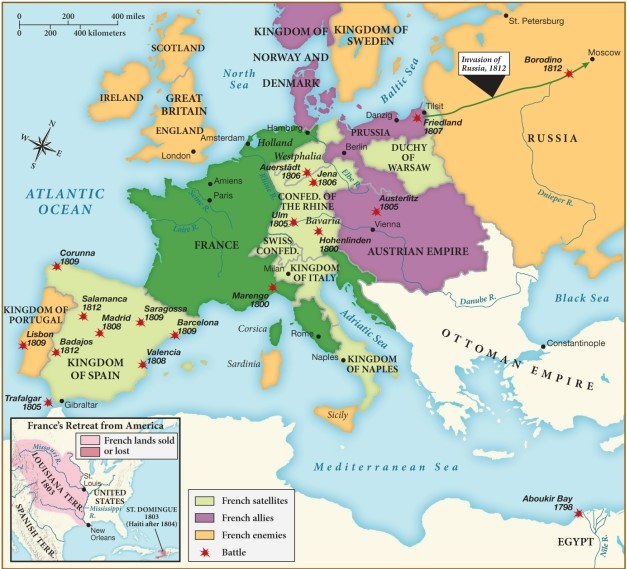
A) Great Britain
B) Russia
C) Prussia
D) The Kingdom of Sweden
A) Great Britain
B) Russia
C) Prussia
D) The Kingdom of Sweden
Question
Question
Question
Question
Question
Question
Question
Question
Question
Question
Question
Question
Question
Question
Question
Question
Question
What impact did the Congress of Vienna have on Europe by 1815?
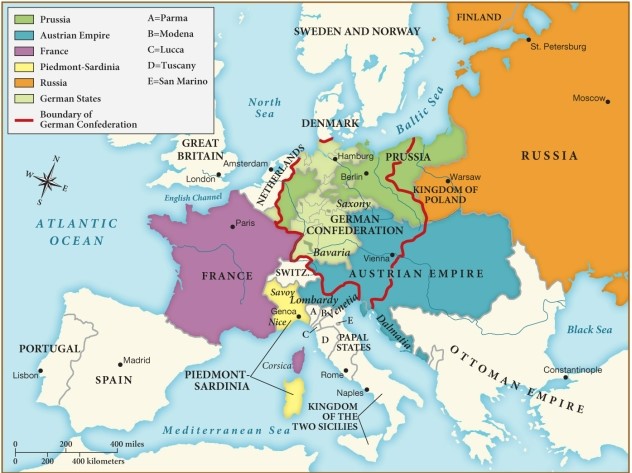
A) Poland was liberated and regained territory lost in the Third Partition.
B) Great Britain expanded its territorial control to include land in France.
C) France shrank back to the borders it had in 1789.
D) Germany lost a considerable amount of territory and influence.
A) Poland was liberated and regained territory lost in the Third Partition.
B) Great Britain expanded its territorial control to include land in France.
C) France shrank back to the borders it had in 1789.
D) Germany lost a considerable amount of territory and influence.
Question
Question
Question
Question
Question
Question
Question
Question
According to this map, which European state was the first to experience an attempted revolution during the 1820s?
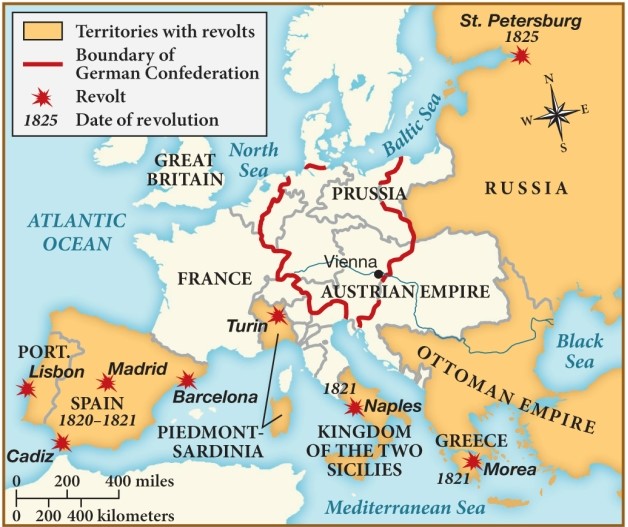
A) Spain
B) Russia
C) Prussia
D) The Austrian Empire
A) Spain
B) Russia
C) Prussia
D) The Austrian Empire
Question
Question
Question
Question
Question
Question
Napoleon's occupation of Spain significantly weakened the country during the early 1800s. How is that reflected in this map?
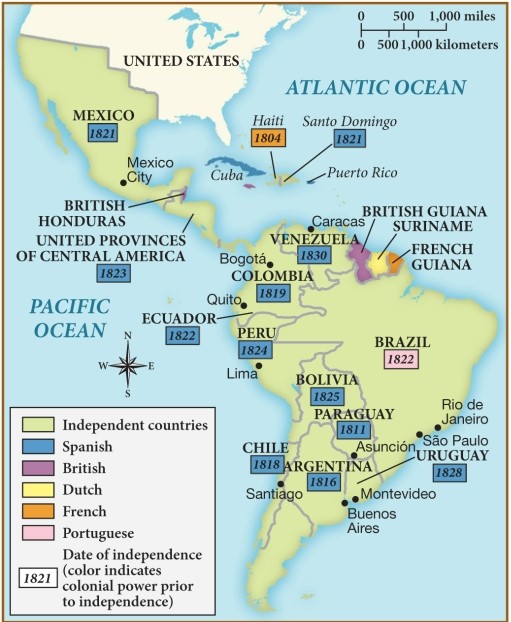
A) Spain shifted its focus to seizing territory from the United States in North America instead of focusing on its South American colonies.
B) Spain had to cede their colonial holdings in South America to France during this time as part of Napoleon's demands.
C) Spain was able to focus their efforts on strengthening their presence in South America, since they had little control over their home country.
D) Spain could no longer exert sufficient control over their colonies in South America and lost many from the 1810s through the 1830s.
A) Spain shifted its focus to seizing territory from the United States in North America instead of focusing on its South American colonies.
B) Spain had to cede their colonial holdings in South America to France during this time as part of Napoleon's demands.
C) Spain was able to focus their efforts on strengthening their presence in South America, since they had little control over their home country.
D) Spain could no longer exert sufficient control over their colonies in South America and lost many from the 1810s through the 1830s.
Question
Question
Question
Question
Question
According to this map, which of the following European countries experienced revolt during the 1830s?
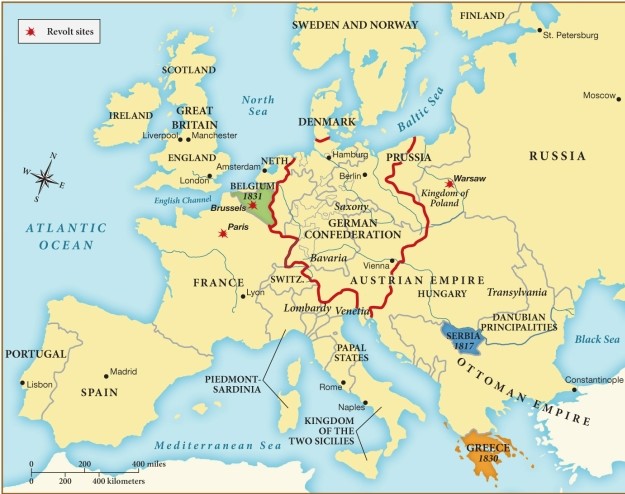
A) Great Britain
B) Greece
C) Spain
D) Belgium
A) Great Britain
B) Greece
C) Spain
D) Belgium

Unlock Deck
Sign up to unlock the cards in this deck!
Unlock Deck
Unlock Deck
1/65

Play

Full screen (f)
Deck 20: Napoleon and the Revolutionary Legacy, 1800-1830
1
After Prussia was defeated and humiliated by the French in 1806, Frederick William III undertook major domestic reforms. What did he do, and why did he take this course of action?
Answer would ideally include the following. After suffering crushing defeats at Jena and Auerstädt, which resulted in a humiliating settlement that stripped Prussia of sizable territory, King Frederick William III appointed a reform commission that recommended sweeping changes. Serfdom was abolished, peasants gained complete independence from landlords, and officer positions in the army were opened to men from the middle classes. These reforms were undertaken not in response to public demands but rather from a desire to reform the Prussian state so that it could keep up with France.
2
What was the Continental System, what was it intended to do, and how did the battle of Trafalgar lead Napoleon to create it?
Answer would ideally include the following. The Continental System was the name given to the policy enacted by Napoleon in 1806 that closed to British trade all European ports controlled by France or its dependents. The battle of Trafalgar (1805) encouraged Napoleon to adopt this policy because Britain's overwhelming victory gave it mastery over the seas. Napoleon had no hopes of defeating Britain in a naval battle or of undertaking a successful, large-scale invasion of the island nation, so he hoped to bankrupt the country by cutting off its trade with Europe.
3
How did the idea of a balance of power influence the decisions at the Congress of Vienna, and how did this work in France's favor despite more than two decades of war resulting from French aggression?
Answer would ideally include the following. The idea of a balance of power was at the heart of the decisions made by the Congress of Vienna participants, who were determined to redraw the map of Europe in such a way that no one European country could dominate the others. Because France had been an aggressor nation since the time of Louis XIV, the other major countries of Europe agreed that France needed to be contained, and they made it clear that the borders of states reestablished around France were guaranteed. On the other hand, the congress recognized that, as one of the largest and most populous states of Europe, France needed to remain a major participant in European affairs to counter the other great continental states, particularly Prussia and Russia.
4
Explain which government came to power after Napoleon's downfall and how that regime fared.
Unlock Deck
Unlock for access to all 65 flashcards in this deck.
Unlock Deck
k this deck
5
In what sense can Methodism be seen as undermining established authority?
Unlock Deck
Unlock for access to all 65 flashcards in this deck.
Unlock Deck
k this deck
6
Why did Austria in particular view nationalism as a great threat, and how did Prince Klemens von Metternich attempt to deal with that threat?
Unlock Deck
Unlock for access to all 65 flashcards in this deck.
Unlock Deck
k this deck
7
How did romanticism address the political problems of the age and encourage nationalism?
Unlock Deck
Unlock for access to all 65 flashcards in this deck.
Unlock Deck
k this deck
8
How did Greece gain its independence? What factors contributed to an independent Greece?
Unlock Deck
Unlock for access to all 65 flashcards in this deck.
Unlock Deck
k this deck
9
What was the Monroe Doctrine? Why could it work only with British support?
Unlock Deck
Unlock for access to all 65 flashcards in this deck.
Unlock Deck
k this deck
10
How was the British Reform Bill of 1832 both moderate and precedent setting?
Unlock Deck
Unlock for access to all 65 flashcards in this deck.
Unlock Deck
k this deck
11
Although Napoleon instituted a number of reforms throughout Europe that were based on Enlightenment ideas of reason and order, in at least one respect he was a conservative: he believed that people should follow the orders of their superiors without question. Explain how he attempted to promote this belief in France, using laws to regulate family structure, work relationships, public welfare programs, and religion.
Unlock Deck
Unlock for access to all 65 flashcards in this deck.
Unlock Deck
k this deck
12
How did Napoleon help to create nationalism in Germany and Italy, and how did this undermine his rule of these countries? What other factors contributed to nationalism in countries conquered or dominated by Napoleonic France?
Unlock Deck
Unlock for access to all 65 flashcards in this deck.
Unlock Deck
k this deck
13
How were the settlement of the Congress of Vienna and the period of "restoration" emblematic of the new political doctrine of conservatism that emerged in Europe after 1815? How did conservatives justify their belief in the necessity for a return to a pre-1789 social order?
Unlock Deck
Unlock for access to all 65 flashcards in this deck.
Unlock Deck
k this deck
14
Explain what romanticism is and how it differs from classicism. Discuss the forms, styles, and goals of three of the romantic artists, authors, and/or musicians who emerged during this time. What, if any, common political thread is there among these artists?
Unlock Deck
Unlock for access to all 65 flashcards in this deck.
Unlock Deck
k this deck
15
How did the revolutionary movements of the 1830s demonstrate the general discontent with the Vienna settlement of 1815 and the ideology of conservatism? In your answer consider what the revolts were attempting to accomplish and whether they were a response to new problems or a recurring outbreak of a deeper revolutionary impulse.
Unlock Deck
Unlock for access to all 65 flashcards in this deck.
Unlock Deck
k this deck
16
The rise of Napoleon Bonaparte began after
A) his victories in the Italian campaigns of 1796-1797.
B) the emergence of a power vacuum in the Directory, which needed to be filled by a vigorous leader.
C) the general success of the French wars after 1795.
D) his soldiers' discovery of the Rosetta stone and other important artifacts from the ancient world.
A) his victories in the Italian campaigns of 1796-1797.
B) the emergence of a power vacuum in the Directory, which needed to be filled by a vigorous leader.
C) the general success of the French wars after 1795.
D) his soldiers' discovery of the Rosetta stone and other important artifacts from the ancient world.
Unlock Deck
Unlock for access to all 65 flashcards in this deck.
Unlock Deck
k this deck
17
What was the intention behind the French invasion and occupation of Egypt in 1798?
A) The French wanted to establish a base in North Africa for further colonization of the Middle East and central Africa.
B) The Directory wanted to strike a blow at British trade by cutting off Great Britain's route to India.
C) Napoleon Bonaparte wanted to follow in the footsteps of his Roman hero Marc Antony by invading and colonizing Egypt.
D) The French wanted to find and import ancient Egyptian artifacts to fill their museums and galleries.
A) The French wanted to establish a base in North Africa for further colonization of the Middle East and central Africa.
B) The Directory wanted to strike a blow at British trade by cutting off Great Britain's route to India.
C) Napoleon Bonaparte wanted to follow in the footsteps of his Roman hero Marc Antony by invading and colonizing Egypt.
D) The French wanted to find and import ancient Egyptian artifacts to fill their museums and galleries.
Unlock Deck
Unlock for access to all 65 flashcards in this deck.
Unlock Deck
k this deck
18
The French Revolution came to an end in 1799 when Napoleon Bonaparte
A) took power after a coup, ousted the Directory, and established himself as First Consul.
B) seized power and crowned himself French emperor.
C) was elected consul through a national plebiscite.
D) enacted the Civil Code, which made him head of state.
A) took power after a coup, ousted the Directory, and established himself as First Consul.
B) seized power and crowned himself French emperor.
C) was elected consul through a national plebiscite.
D) enacted the Civil Code, which made him head of state.
Unlock Deck
Unlock for access to all 65 flashcards in this deck.
Unlock Deck
k this deck
19
How did the constitution of 1799 effectively end the French republic?
A) It reinstated the monarchy, gave renewed powers to the Catholic church, and suppressed all political dissent.
B) It made Napoleon emperor of France with near absolute power to govern; although plebiscites approved his decisions, no alternatives were offered.
C) It ended representative government by making Napoleon the First Consul and giving him power to pick the Council of State, which drew up all laws.
D) It established a military dictatorship in which Napoleon governed as the leading general of France without any advice or support from civilian legislative bodies.
A) It reinstated the monarchy, gave renewed powers to the Catholic church, and suppressed all political dissent.
B) It made Napoleon emperor of France with near absolute power to govern; although plebiscites approved his decisions, no alternatives were offered.
C) It ended representative government by making Napoleon the First Consul and giving him power to pick the Council of State, which drew up all laws.
D) It established a military dictatorship in which Napoleon governed as the leading general of France without any advice or support from civilian legislative bodies.
Unlock Deck
Unlock for access to all 65 flashcards in this deck.
Unlock Deck
k this deck
20
Why did Napoleon sign a concordat with the pope in 1801?
A) The French bishops agreed to support Napoleon's plan to become emperor.
B) He believed that religion was a powerful component for maintaining social order.
C) His religious convictions had been violated by the anti-Catholicism of the Revolution.
D) The pope had agreed to persuade the Italians to become a French satellite kingdom.
A) The French bishops agreed to support Napoleon's plan to become emperor.
B) He believed that religion was a powerful component for maintaining social order.
C) His religious convictions had been violated by the anti-Catholicism of the Revolution.
D) The pope had agreed to persuade the Italians to become a French satellite kingdom.
Unlock Deck
Unlock for access to all 65 flashcards in this deck.
Unlock Deck
k this deck
21
How did Napoleon's tactics for achieving order differ from those used during the French Revolution?
A) Napoleon replaced the local police with National Guard units that were trained in security surveillance and given authority to execute political dissenters.
B) Although he strictly limited political expression, imposing surveillance and arbitrary imprisonment on his opponents, Napoleon never used mass executions to maintain control.
C) Realizing that the suppression of dissent was at the root of the Terror, Napoleon conversely achieved order by allowing the free expression of democratic ideas.
D) Napoleon ordered massive urban reconstruction projects designed to both improve the economic situation of the citizens and promote surveillance.
A) Napoleon replaced the local police with National Guard units that were trained in security surveillance and given authority to execute political dissenters.
B) Although he strictly limited political expression, imposing surveillance and arbitrary imprisonment on his opponents, Napoleon never used mass executions to maintain control.
C) Realizing that the suppression of dissent was at the root of the Terror, Napoleon conversely achieved order by allowing the free expression of democratic ideas.
D) Napoleon ordered massive urban reconstruction projects designed to both improve the economic situation of the citizens and promote surveillance.
Unlock Deck
Unlock for access to all 65 flashcards in this deck.
Unlock Deck
k this deck
22
Which of the following actions did Napoleon undertake in 1804 with the pope's blessing?
A) He instituted Catholicism as the state religion of France.
B) He annexed Rome as a satellite state.
C) He went to war with Protestant England.
D) He crowned himself emperor.
A) He instituted Catholicism as the state religion of France.
B) He annexed Rome as a satellite state.
C) He went to war with Protestant England.
D) He crowned himself emperor.
Unlock Deck
Unlock for access to all 65 flashcards in this deck.
Unlock Deck
k this deck
23
In what manner did Napoleon build on the legacy of previous French rulers to demonstrate his power?
A) Like Louis XIV, Napoleon used art and architecture to depict himself as a warrior-hero of mythic proportions.
B) Napoleon modeled himself after Henry IV and once again brought religious tolerance back to France.
C) Just like Robespierre during the French Revolution, Napoleon used terror to keep the French population subservient to his will.
D) Napoleon co-opted the image of Charlemagne to depict himself as the ruler who would unite Europe under French rule.
A) Like Louis XIV, Napoleon used art and architecture to depict himself as a warrior-hero of mythic proportions.
B) Napoleon modeled himself after Henry IV and once again brought religious tolerance back to France.
C) Just like Robespierre during the French Revolution, Napoleon used terror to keep the French population subservient to his will.
D) Napoleon co-opted the image of Charlemagne to depict himself as the ruler who would unite Europe under French rule.
Unlock Deck
Unlock for access to all 65 flashcards in this deck.
Unlock Deck
k this deck
24
Napoleon's founding of the Legion of Honor in 1802 was part of his campaign to
A) claim the legacy of ancient Rome by establishing an elite based on virtue and faithfulness.
B) build a permanent elite fighting force that could help increase French colonial possessions abroad.
C) control French culture by granting liberal pensions to those artists and writers of whom he approved.
D) create a new nobility by establishing a social hierarchy based on merit.
A) claim the legacy of ancient Rome by establishing an elite based on virtue and faithfulness.
B) build a permanent elite fighting force that could help increase French colonial possessions abroad.
C) control French culture by granting liberal pensions to those artists and writers of whom he approved.
D) create a new nobility by establishing a social hierarchy based on merit.
Unlock Deck
Unlock for access to all 65 flashcards in this deck.
Unlock Deck
k this deck
25
Who benefited the most from Napoleon's introduction of a hierarchy of noble titles?
A) The French nobility, whose titles and wealth were reinstated after their exile during the French Revolution
B) Napoleon's family members, who were given positions of power in France's new satellite territories across Europe
C) Scientists and artists, who were awarded honors and positions of authority based on their talents
D) Ordinary citizens, who now had access to positions based on merit rather than on birth or social status
A) The French nobility, whose titles and wealth were reinstated after their exile during the French Revolution
B) Napoleon's family members, who were given positions of power in France's new satellite territories across Europe
C) Scientists and artists, who were awarded honors and positions of authority based on their talents
D) Ordinary citizens, who now had access to positions based on merit rather than on birth or social status
Unlock Deck
Unlock for access to all 65 flashcards in this deck.
Unlock Deck
k this deck
26
In what way did the Civil Code limit political and social liberties?
A) It reversed the Revolution's expansion of women's and children's rights to increase men's power.
B) It failed to guarantee toleration for all religious groups.
C) It reinstituted restrictions on commoners' professional mobility.
D) It failed to provide safeguards for private property and familial integrity.
A) It reversed the Revolution's expansion of women's and children's rights to increase men's power.
B) It failed to guarantee toleration for all religious groups.
C) It reinstituted restrictions on commoners' professional mobility.
D) It failed to provide safeguards for private property and familial integrity.
Unlock Deck
Unlock for access to all 65 flashcards in this deck.
Unlock Deck
k this deck
27
How did Napoleon view women's roles within his new paternalistic vision of French society?
A) Seeing women as essential members of the nation, he went further than the French revolutionaries and gave women the right to vote and participate in political life.
B) He saw women as the moral backbone of French society, so he instituted mandatory primary and secondary education for girls and improved women's legal rights.
C) Although he reaffirmed the Old Regime's patriarchal control over women, Napoleon believed that women should have free access to education and abortion.
D) He believed women should be restricted to the private sphere of the home; his legal code curtailed women's rights, and he took little interest in girls' education.
A) Seeing women as essential members of the nation, he went further than the French revolutionaries and gave women the right to vote and participate in political life.
B) He saw women as the moral backbone of French society, so he instituted mandatory primary and secondary education for girls and improved women's legal rights.
C) Although he reaffirmed the Old Regime's patriarchal control over women, Napoleon believed that women should have free access to education and abortion.
D) He believed women should be restricted to the private sphere of the home; his legal code curtailed women's rights, and he took little interest in girls' education.
Unlock Deck
Unlock for access to all 65 flashcards in this deck.
Unlock Deck
k this deck
28
Napoleon's attitude toward the French novelist Anne-Louise-Germaine de Staël is a prime example of his
A) support of the promotion and patronage of the arts in France.
B) inability to tolerate criticism, particularly from writers.
C) willingness to promote women to positions of power and prestige.
D) desire to reconcile the French state with Catholicism.
A) support of the promotion and patronage of the arts in France.
B) inability to tolerate criticism, particularly from writers.
C) willingness to promote women to positions of power and prestige.
D) desire to reconcile the French state with Catholicism.
Unlock Deck
Unlock for access to all 65 flashcards in this deck.
Unlock Deck
k this deck
29
Which nation was allied with Napoleon's empire in 1812?
A) Great Britain
B) Russia
C) Prussia
D) The Kingdom of Sweden
A) Great Britain
B) Russia
C) Prussia
D) The Kingdom of Sweden
Unlock Deck
Unlock for access to all 65 flashcards in this deck.
Unlock Deck
k this deck
30
Which of the following characterizes Napoleon's approach to war?
A) The desire to cut his opponents off from their supplies and defeat them without a major battle
B) A focus on shipbuilding and naval warfare, to take advantage of France's extensive coastline
C) The ability to train, inspire, and support brilliant generals to support his campaigns
D) The careful study of military strategy and an instinct for sudden, overwhelming attacks
A) The desire to cut his opponents off from their supplies and defeat them without a major battle
B) A focus on shipbuilding and naval warfare, to take advantage of France's extensive coastline
C) The ability to train, inspire, and support brilliant generals to support his campaigns
D) The careful study of military strategy and an instinct for sudden, overwhelming attacks
Unlock Deck
Unlock for access to all 65 flashcards in this deck.
Unlock Deck
k this deck
31
Which of the following was one of Napoleon's greatest advantages in his wars against European powers?
A) The lack of coordination among his enemies
B) The tendency of his enemies to underestimate his military talents
C) The French navy, which was the strongest in Europe
D) The failure of his enemies to enlist the support of the British
A) The lack of coordination among his enemies
B) The tendency of his enemies to underestimate his military talents
C) The French navy, which was the strongest in Europe
D) The failure of his enemies to enlist the support of the British
Unlock Deck
Unlock for access to all 65 flashcards in this deck.
Unlock Deck
k this deck
32
After Napoleon defeated the Russians at Friedland in 1807, the ensuing Treaties of Tilsit
A) effectively took Russia out of the continental conflict by demanding its neutrality.
B) turned Russia into France's largest satellite state in Europe.
C) forced Prussia to relinquish its territory west of the Elbe, which became the kingdom of Westphalia under Napoleon's brother.
D) established a formal alliance between France and Russia against Great Britain and Austria.
A) effectively took Russia out of the continental conflict by demanding its neutrality.
B) turned Russia into France's largest satellite state in Europe.
C) forced Prussia to relinquish its territory west of the Elbe, which became the kingdom of Westphalia under Napoleon's brother.
D) established a formal alliance between France and Russia against Great Britain and Austria.
Unlock Deck
Unlock for access to all 65 flashcards in this deck.
Unlock Deck
k this deck
33
The Confederation of the Rhine, established in 1806, resulted from
A) Austria's desire to rally the German-speaking lands against France and reassert Habsburg control over the former Holy Roman Empire.
B) Napoleon's decision to reduce the number of German principalities under his control and organize the resulting larger states into a more coherent body.
C) the Germans' determination to repel the French army through an organized military alliance even if it meant abdicating a degree of sovereignty to Prussia.
D) a mere rumor disseminated by Metternich, who sought to sway Napoleon into negotiating a truce by feigning the establishment of a pan-German military alliance.
A) Austria's desire to rally the German-speaking lands against France and reassert Habsburg control over the former Holy Roman Empire.
B) Napoleon's decision to reduce the number of German principalities under his control and organize the resulting larger states into a more coherent body.
C) the Germans' determination to repel the French army through an organized military alliance even if it meant abdicating a degree of sovereignty to Prussia.
D) a mere rumor disseminated by Metternich, who sought to sway Napoleon into negotiating a truce by feigning the establishment of a pan-German military alliance.
Unlock Deck
Unlock for access to all 65 flashcards in this deck.
Unlock Deck
k this deck
34
What measures did Napoleon impose on the colonized populations in the annexed territories and satellite kingdoms of France?
A) He abolished local customs and languages in favor of the French language and customs and forced the local populations to convert to Catholicism.
B) He punished resistant populations by confiscating the bulk of their agricultural resources and forcing them to billet his troops.
C) He confiscated the best farmland and urban dwellings to give to French citizens who intended to settle in the newly colonized territories.
D) He forcibly introduced French-style reforms, including the abolition of serfdom and the introduction of the Napoleonic Code, as well as conscripting and taxing local populations.
A) He abolished local customs and languages in favor of the French language and customs and forced the local populations to convert to Catholicism.
B) He punished resistant populations by confiscating the bulk of their agricultural resources and forcing them to billet his troops.
C) He confiscated the best farmland and urban dwellings to give to French citizens who intended to settle in the newly colonized territories.
D) He forcibly introduced French-style reforms, including the abolition of serfdom and the introduction of the Napoleonic Code, as well as conscripting and taxing local populations.
Unlock Deck
Unlock for access to all 65 flashcards in this deck.
Unlock Deck
k this deck
35
When an adviser to Frederick William III of Prussia (r. 1797-1840) wrote, "We must do from above what the French have done from below," to what was he referring?
A) The institution of French-inspired reforms that included the abolition of serfdom and an overhaul of the army to open the way for the appointment of middle-class officers
B) Ending religious toleration of the Catholic church in Prussia and instituting Lutheranism as the state religion
C) Instilling a spirit of patriotic nationalism in the Prussian population in order to reconquer the country's lost territory
D) The effort to make Prussia into a constitutional monarchy and end noble privileges that were based on heredity as opposed to merit
A) The institution of French-inspired reforms that included the abolition of serfdom and an overhaul of the army to open the way for the appointment of middle-class officers
B) Ending religious toleration of the Catholic church in Prussia and instituting Lutheranism as the state religion
C) Instilling a spirit of patriotic nationalism in the Prussian population in order to reconquer the country's lost territory
D) The effort to make Prussia into a constitutional monarchy and end noble privileges that were based on heredity as opposed to merit
Unlock Deck
Unlock for access to all 65 flashcards in this deck.
Unlock Deck
k this deck
36
Napoleon attempted to undermine British power in which of the following ways?
A) He allied France with Russia and Prussia.
B) He attacked British possessions in the West Indies and India.
C) He founded the satellite Confederation of the Rhine in 1806.
D) He instituted the Continental System in 1806.
A) He allied France with Russia and Prussia.
B) He attacked British possessions in the West Indies and India.
C) He founded the satellite Confederation of the Rhine in 1806.
D) He instituted the Continental System in 1806.
Unlock Deck
Unlock for access to all 65 flashcards in this deck.
Unlock Deck
k this deck
37
Between 1807 and 1812, which European nations demonstrated the strongest resistance against French rule?
A) Prussia and Austria
B) Italy and Germany
C) Spain and Portugal
D) The Netherlands and Denmark
A) Prussia and Austria
B) Italy and Germany
C) Spain and Portugal
D) The Netherlands and Denmark
Unlock Deck
Unlock for access to all 65 flashcards in this deck.
Unlock Deck
k this deck
38
In 1812, Napoleon made what disastrous military error?
A) He began imprisoning soldiers who criticized him, thereby reducing the army's manpower.
B) He accepted non-French troops into his Grand Army.
C) He opened a second front by invading Russia.
D) He installed only generals who were aggressive but lacked his genius for tactics.
A) He began imprisoning soldiers who criticized him, thereby reducing the army's manpower.
B) He accepted non-French troops into his Grand Army.
C) He opened a second front by invading Russia.
D) He installed only generals who were aggressive but lacked his genius for tactics.
Unlock Deck
Unlock for access to all 65 flashcards in this deck.
Unlock Deck
k this deck
39
Following the battle of Borodino in September 1812, Napoleon
A) entered Moscow to find that the Russians had set it on fire and retreated.
B) overran Moscow and entered the royal palace, taking Tsar Alexander I prisoner.
C) negotiated a truce with Tsar Alexander I in which the Russian monarch agreed to relinquish control of Poland in exchange for a French retreat.
D) ordered his troops to retreat, an effort that failed to save the bulk of his army.
A) entered Moscow to find that the Russians had set it on fire and retreated.
B) overran Moscow and entered the royal palace, taking Tsar Alexander I prisoner.
C) negotiated a truce with Tsar Alexander I in which the Russian monarch agreed to relinquish control of Poland in exchange for a French retreat.
D) ordered his troops to retreat, an effort that failed to save the bulk of his army.
Unlock Deck
Unlock for access to all 65 flashcards in this deck.
Unlock Deck
k this deck
40
Following Napoleon's defeat at Leipzig in 1813 and his abdication in 1814, the allies
A) imprisoned him and his family in the Bastille in Paris.
B) occupied France until an international congress decided France's future.
C) restored Louis XVIII to the throne.
D) reestablished the French republic by calling for the election of a new French national assembly.
A) imprisoned him and his family in the Bastille in Paris.
B) occupied France until an international congress decided France's future.
C) restored Louis XVIII to the throne.
D) reestablished the French republic by calling for the election of a new French national assembly.
Unlock Deck
Unlock for access to all 65 flashcards in this deck.
Unlock Deck
k this deck
41
Napoleon's decisive defeat at the battle of Waterloo in 1815 came at the hands of
A) the French army, which had turned its back on its former leader.
B) the British army, with some assistance from colonial troops.
C) the newly formed Continental Army of the United States of America.
D) the Prussian army and a coalition of British, Dutch, German, and Belgian troops.
A) the French army, which had turned its back on its former leader.
B) the British army, with some assistance from colonial troops.
C) the newly formed Continental Army of the United States of America.
D) the Prussian army and a coalition of British, Dutch, German, and Belgian troops.
Unlock Deck
Unlock for access to all 65 flashcards in this deck.
Unlock Deck
k this deck
42
Because the allied powers still feared Napoleon after his final defeat in 1815, they
A) exiled him to St. Helena, a tiny, remote island in the middle of the South Atlantic.
B) ordered that all mention of his name be removed from the legal codes he had established.
C) required schools to omit any mention of him in teaching students about recent history.
D) forbade any of his former officers or troops to serve in the French army.
A) exiled him to St. Helena, a tiny, remote island in the middle of the South Atlantic.
B) ordered that all mention of his name be removed from the legal codes he had established.
C) required schools to omit any mention of him in teaching students about recent history.
D) forbade any of his former officers or troops to serve in the French army.
Unlock Deck
Unlock for access to all 65 flashcards in this deck.
Unlock Deck
k this deck
43
How did the Congress of Vienna (1814-1815) set the parameters for future relations between European states?
A) It shifted the balance of power from western to eastern Europe, as powerful leaders from Austria and Prussia took control of diplomatic and military negotiations.
B) It set limits on the number of military troops each country could maintain in order to limit future aggression and territorial expansion.
C) It established a new framework for international relations based on periodic meetings, or congresses, between the major powers.
D) It imposed severe penalties on France in order to greatly diminish its political and economic status, which served as a warning to other countries considering territorial expansion.
A) It shifted the balance of power from western to eastern Europe, as powerful leaders from Austria and Prussia took control of diplomatic and military negotiations.
B) It set limits on the number of military troops each country could maintain in order to limit future aggression and territorial expansion.
C) It established a new framework for international relations based on periodic meetings, or congresses, between the major powers.
D) It imposed severe penalties on France in order to greatly diminish its political and economic status, which served as a warning to other countries considering territorial expansion.
Unlock Deck
Unlock for access to all 65 flashcards in this deck.
Unlock Deck
k this deck
44
What well-educated nobleman took the lead in devising the settlement at the Congress of Vienna and shaping the post-Napoleonic European order?
A) Robert Castlereagh
B) Klemens von Metternich
C) Charles Maurice de Talleyrand
D) Johann Wolfgang von Goethe
A) Robert Castlereagh
B) Klemens von Metternich
C) Charles Maurice de Talleyrand
D) Johann Wolfgang von Goethe
Unlock Deck
Unlock for access to all 65 flashcards in this deck.
Unlock Deck
k this deck
45
During the Congress of Vienna (1814-1815) and beyond, British prime minister Robert Castlereagh (1769-1822) had which of the following goals?
A) To create a settlement that would punish France and prevent it from ever again becoming a great power in Europe
B) To reduce the power of the Catholic church throughout Europe
C) To make Great Britain the chief arbiter of European affairs
D) To establish constitutional monarchies in the newly reorganized states in order to bring them into line with British values and traditions
A) To create a settlement that would punish France and prevent it from ever again becoming a great power in Europe
B) To reduce the power of the Catholic church throughout Europe
C) To make Great Britain the chief arbiter of European affairs
D) To establish constitutional monarchies in the newly reorganized states in order to bring them into line with British values and traditions
Unlock Deck
Unlock for access to all 65 flashcards in this deck.
Unlock Deck
k this deck
46
What impact did the Congress of Vienna have on Europe by 1815?
A) Poland was liberated and regained territory lost in the Third Partition.
B) Great Britain expanded its territorial control to include land in France.
C) France shrank back to the borders it had in 1789.
D) Germany lost a considerable amount of territory and influence.
A) Poland was liberated and regained territory lost in the Third Partition.
B) Great Britain expanded its territorial control to include land in France.
C) France shrank back to the borders it had in 1789.
D) Germany lost a considerable amount of territory and influence.
Unlock Deck
Unlock for access to all 65 flashcards in this deck.
Unlock Deck
k this deck
47
Which of the following ideologies argued for the restoration of social and religious hierarchies in the years after the Napoleonic wars?
A) Socialism
B) Conservatism
C) Liberalism
D) Utilitarianism
A) Socialism
B) Conservatism
C) Liberalism
D) Utilitarianism
Unlock Deck
Unlock for access to all 65 flashcards in this deck.
Unlock Deck
k this deck
48
The British political theorist Edmund Burke (1729-1799) was known for what influential belief?
A) That reason was incapable of answering life's most important questions
B) That merit and talent needed to be the basis for political and social advancement
C) That Napoleon's reforms were bound to fail because they were not rooted in Christian ideals
D) That government should be rooted in experience and that all change should be gradual and respect tradition
A) That reason was incapable of answering life's most important questions
B) That merit and talent needed to be the basis for political and social advancement
C) That Napoleon's reforms were bound to fail because they were not rooted in Christian ideals
D) That government should be rooted in experience and that all change should be gradual and respect tradition
Unlock Deck
Unlock for access to all 65 flashcards in this deck.
Unlock Deck
k this deck
49
Which of the following provided a major test for the theory of conservatism in the post-Napoleonic order?
A) The restoration of the Bourbon monarchy to the throne of France
B) The transformation of the duchy of Warsaw into a new Polish kingdom
C) The unification of the Dutch and Austrian Netherlands into a single kingdom
D) The consolidation of the German Confederation, which included Prussia
A) The restoration of the Bourbon monarchy to the throne of France
B) The transformation of the duchy of Warsaw into a new Polish kingdom
C) The unification of the Dutch and Austrian Netherlands into a single kingdom
D) The consolidation of the German Confederation, which included Prussia
Unlock Deck
Unlock for access to all 65 flashcards in this deck.
Unlock Deck
k this deck
50
Why did religious and political authorities distrust Methodism?
A) It emphasized the perfectibility of individuals but denied the absolute authority of the state.
B) It rejected the idea that Christians should avoid political involvement.
C) It fostered a sense of democratic community and encouraged women to preach.
D) It called for a Christian crusade against Napoleon, who was seen to be the Antichrist.
A) It emphasized the perfectibility of individuals but denied the absolute authority of the state.
B) It rejected the idea that Christians should avoid political involvement.
C) It fostered a sense of democratic community and encouraged women to preach.
D) It called for a Christian crusade against Napoleon, who was seen to be the Antichrist.
Unlock Deck
Unlock for access to all 65 flashcards in this deck.
Unlock Deck
k this deck
51
Which of the following did Johann Wolfgang von Goethe (1749-1832) refer to as "everything that is sick"?
A) Romanticism
B) Conservatism
C) Nationalism
D) Clericalism
A) Romanticism
B) Conservatism
C) Nationalism
D) Clericalism
Unlock Deck
Unlock for access to all 65 flashcards in this deck.
Unlock Deck
k this deck
52
German composer Ludwig von Beethoven's Ninth Symphony (1824), which contained the poet Friedrich Schiller's verses in praise of universal human solidarity, demonstrates
A) the increasing use of traditional folk songs in the works of great composers.
B) Germany's openness to French influences in the wake of the Congress of Vienna.
C) the way in which romanticism also reflected the political climate of the era.
D) the growing influence of British art and culture over European artists.
A) the increasing use of traditional folk songs in the works of great composers.
B) Germany's openness to French influences in the wake of the Congress of Vienna.
C) the way in which romanticism also reflected the political climate of the era.
D) the growing influence of British art and culture over European artists.
Unlock Deck
Unlock for access to all 65 flashcards in this deck.
Unlock Deck
k this deck
53
Nineteenth-century poets and writers who collected old legends and folktales that expressed a shared cultural and linguistic heritage stretching back to the Middle Ages embraced what ideology?
A) Utopian socialism
B) Romantic nationalism
C) Conservatism
D) Liberalism
A) Utopian socialism
B) Romantic nationalism
C) Conservatism
D) Liberalism
Unlock Deck
Unlock for access to all 65 flashcards in this deck.
Unlock Deck
k this deck
54
According to this map, which European state was the first to experience an attempted revolution during the 1820s?
A) Spain
B) Russia
C) Prussia
D) The Austrian Empire
A) Spain
B) Russia
C) Prussia
D) The Austrian Empire
Unlock Deck
Unlock for access to all 65 flashcards in this deck.
Unlock Deck
k this deck
55
Which of the following is true of Ferdinand VII after his restoration to the Spanish throne in 1814?
A) He restricted freedoms and abolished the constitution of 1812.
B) He attempted to restore the Spanish empire in America, sending expeditions to seize Brazil and Mexico.
C) His rule as a liberal, constitutional monarch was held up as a model for other European monarchs.
D) His excessive use of torture and executions led to such a European outcry that he was deposed by a joint French-Austrian army, and his throne was given to his daughter.
A) He restricted freedoms and abolished the constitution of 1812.
B) He attempted to restore the Spanish empire in America, sending expeditions to seize Brazil and Mexico.
C) His rule as a liberal, constitutional monarch was held up as a model for other European monarchs.
D) His excessive use of torture and executions led to such a European outcry that he was deposed by a joint French-Austrian army, and his throne was given to his daughter.
Unlock Deck
Unlock for access to all 65 flashcards in this deck.
Unlock Deck
k this deck
56
In the early 1820s, rebellions against the monarchies in Spain and Russia were led by army officers because these men
A) had the most to lose when the liberal monarchs of those two countries decided to end the special privileges given to military officials.
B) were generally the only literate people in their society, which made them the natural leaders of any reform campaign.
C) were most familiar with the extent of royal corruption and were able to choose a good moment for starting a rebellion.
D) had been influenced by French ideas about reform during the long campaigns against Napoleon.
A) had the most to lose when the liberal monarchs of those two countries decided to end the special privileges given to military officials.
B) were generally the only literate people in their society, which made them the natural leaders of any reform campaign.
C) were most familiar with the extent of royal corruption and were able to choose a good moment for starting a rebellion.
D) had been influenced by French ideas about reform during the long campaigns against Napoleon.
Unlock Deck
Unlock for access to all 65 flashcards in this deck.
Unlock Deck
k this deck
57
Which of the following was part of Metternich's campaign to suppress dissent within the states of the German Confederation?
A) The Enabling Law
B) The Act of Supremacy
C) The Burschenschaften
D) The Carlsbad Decrees
A) The Enabling Law
B) The Act of Supremacy
C) The Burschenschaften
D) The Carlsbad Decrees
Unlock Deck
Unlock for access to all 65 flashcards in this deck.
Unlock Deck
k this deck
58
Why did western Europeans support the Greek independence movement?
A) Europeans identified with the Greeks because Greece was viewed as the birthplace of Western civilization.
B) The movement was a check to growing Turkish power in the eastern Mediterranean.
C) The Greek prince Alexander Ypsilanti, who led the revolt, was a charismatic and popular figure.
D) Europeans saw the movement as the first step toward independence for all subject peoples throughout Europe.
A) Europeans identified with the Greeks because Greece was viewed as the birthplace of Western civilization.
B) The movement was a check to growing Turkish power in the eastern Mediterranean.
C) The Greek prince Alexander Ypsilanti, who led the revolt, was a charismatic and popular figure.
D) Europeans saw the movement as the first step toward independence for all subject peoples throughout Europe.
Unlock Deck
Unlock for access to all 65 flashcards in this deck.
Unlock Deck
k this deck
59
Simón Bolívar (1783-1830) was known throughout the world for
A) negotiating the settlement of the Monroe Doctrine between the United States and Britain.
B) leading the Greek revolt against the Turks in the 1820s.
C) playing a leading role in Latin America's struggle for independence from Spain and Portugal.
D) guiding the rebellion against King Ferdinand VII of Spain in 1814, and for his subsequent martyrdom.
A) negotiating the settlement of the Monroe Doctrine between the United States and Britain.
B) leading the Greek revolt against the Turks in the 1820s.
C) playing a leading role in Latin America's struggle for independence from Spain and Portugal.
D) guiding the rebellion against King Ferdinand VII of Spain in 1814, and for his subsequent martyrdom.
Unlock Deck
Unlock for access to all 65 flashcards in this deck.
Unlock Deck
k this deck
60
Napoleon's occupation of Spain significantly weakened the country during the early 1800s. How is that reflected in this map?
A) Spain shifted its focus to seizing territory from the United States in North America instead of focusing on its South American colonies.
B) Spain had to cede their colonial holdings in South America to France during this time as part of Napoleon's demands.
C) Spain was able to focus their efforts on strengthening their presence in South America, since they had little control over their home country.
D) Spain could no longer exert sufficient control over their colonies in South America and lost many from the 1810s through the 1830s.
A) Spain shifted its focus to seizing territory from the United States in North America instead of focusing on its South American colonies.
B) Spain had to cede their colonial holdings in South America to France during this time as part of Napoleon's demands.
C) Spain was able to focus their efforts on strengthening their presence in South America, since they had little control over their home country.
D) Spain could no longer exert sufficient control over their colonies in South America and lost many from the 1810s through the 1830s.
Unlock Deck
Unlock for access to all 65 flashcards in this deck.
Unlock Deck
k this deck
61
What reforms did the revolution of 1830 achieve in France?
A) The king extended political liberties and doubled the number of voting men, though that number remained miniscule, and the king's reforms did little to improve the situation of the poor and working classes.
B) The revolt forced the monarchy to agree to a constitution and the sharing of powers as well as the extension of suffrage to all men over the age of thirty.
C) The monarchy was once again abolished, and universal suffrage was extended to both men and women, as new elections were called to restore the French legislature.
D) The revolution's reforms were primarily economic and included the right to organize workers unions and strike against unjust working conditions.
A) The king extended political liberties and doubled the number of voting men, though that number remained miniscule, and the king's reforms did little to improve the situation of the poor and working classes.
B) The revolt forced the monarchy to agree to a constitution and the sharing of powers as well as the extension of suffrage to all men over the age of thirty.
C) The monarchy was once again abolished, and universal suffrage was extended to both men and women, as new elections were called to restore the French legislature.
D) The revolution's reforms were primarily economic and included the right to organize workers unions and strike against unjust working conditions.
Unlock Deck
Unlock for access to all 65 flashcards in this deck.
Unlock Deck
k this deck
62
Conservative European states agreed to Belgium's independence in 1831 under the condition that
A) the Belgians allowed Charles X of France to become their new king.
B) Belgium would remain neutral in all international affairs.
C) the Belgians did not encourage other countries to gain their independence.
D) Belgium's new democracy banned any of the rebels from participating in the nation's new government.
A) the Belgians allowed Charles X of France to become their new king.
B) Belgium would remain neutral in all international affairs.
C) the Belgians did not encourage other countries to gain their independence.
D) Belgium's new democracy banned any of the rebels from participating in the nation's new government.
Unlock Deck
Unlock for access to all 65 flashcards in this deck.
Unlock Deck
k this deck
63
What happened at "Peterloo" in 1819?
A) The Duke of Wellington thwarted a French invasion plan.
B) Citizens resisting the Six Acts took control of Northern England.
C) A large protest meeting for parliamentary reform was attacked by cavalry.
D) The English king was threatened with revolution unless he resigned.
A) The Duke of Wellington thwarted a French invasion plan.
B) Citizens resisting the Six Acts took control of Northern England.
C) A large protest meeting for parliamentary reform was attacked by cavalry.
D) The English king was threatened with revolution unless he resigned.
Unlock Deck
Unlock for access to all 65 flashcards in this deck.
Unlock Deck
k this deck
64
Why was the Reform Bill of 1832 a political landmark?
A) It increased the number of male voters by about 50 percent and set a precedent for widening suffrage further.
B) It granted a powerful voice to the numerically superior but materially poorer south and demonstrated the weakness of industry.
C) It gave universal suffrage to all men over the age of twenty-five and to women who held a sufficient amount of property.
D) It granted women the right to initiate divorce on grounds other than abandonment, specifically abuse of themselves or their children.
A) It increased the number of male voters by about 50 percent and set a precedent for widening suffrage further.
B) It granted a powerful voice to the numerically superior but materially poorer south and demonstrated the weakness of industry.
C) It gave universal suffrage to all men over the age of twenty-five and to women who held a sufficient amount of property.
D) It granted women the right to initiate divorce on grounds other than abandonment, specifically abuse of themselves or their children.
Unlock Deck
Unlock for access to all 65 flashcards in this deck.
Unlock Deck
k this deck
65
According to this map, which of the following European countries experienced revolt during the 1830s?
A) Great Britain
B) Greece
C) Spain
D) Belgium
A) Great Britain
B) Greece
C) Spain
D) Belgium
Unlock Deck
Unlock for access to all 65 flashcards in this deck.
Unlock Deck
k this deck
Unlock Deck
Unlock for access to all 65 flashcards in this deck.






